OSGi and SOA Understanding how OSGi helps SOA January 2009 Paul Fremantle Co-Founder & CTO
Paul Fremantle Co-Founded WSO2 in 2005 Aiming to be the Open Source SOA platform of choice Apache Member VP, Apache Synapse PMC: HTTPComponents, Incubator, Qpid, Tuscany Co-chair WS-RX Technical Committee, OASIS Infoworld CTO 25
OSGi History OSGi initially founded in 1999 to make it easier to deploy Java applications in embedded devices In 2003 Eclipse chose OSGi as the plugin architecture OSGi R4 released in 2005 May 2007 – OSGi R4.1 released (JSR 291)
OSGi and Middleware Originally designed as a modularity model for embedded and mobile devices Increasingly used as a framework by Enterprise Middleware Spring dm Server IBM WebSphere JBoss AS etc “ SOA for the infrastructure”  using a Service model within a JVM James Governor from Redmonk calls OSGi the  “ Stackless Stack”
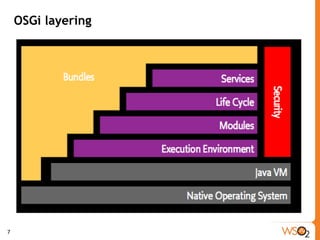
What does OSGi give me? Modularity: Each JAR is a  Bundle Each bundle has its own classloader Bundles can share or hide packages Import a package, or require another bundle (import all packages) Bundles have versions Services Each bundle can provide  services  to other bundles Services are simply Java objects that implement a given interface There is a Service Registry where you can find a service implementation Dynamic loading and lifecycle Bundles may be stopped, started, uninstalled and updated without stopping the framework
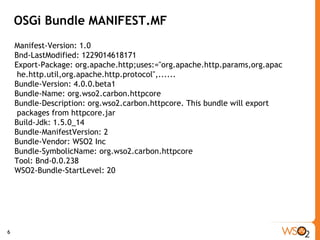
OSGi Bundle MANIFEST.MF Manifest-Version: 1.0 Bnd-LastModified: 1229014618171 Export-Package: org.apache.http;uses:="org.apache.http.params,org.apac he.http.util,org.apache.http.protocol",...... Bundle-Version: 4.0.0.beta1 Bundle-Name: org.wso2.carbon.httpcore Bundle-Description: org.wso2.carbon.httpcore. This bundle will export  packages from httpcore.jar Build-Jdk: 1.5.0_14 Bundle-ManifestVersion: 2 Bundle-Vendor: WSO2 Inc Bundle-SymbolicName: org.wso2.carbon.httpcore Tool: Bnd-0.0.238 WSO2-Bundle-StartLevel: 20
OSGi layering
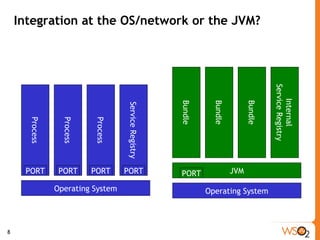
Integration at the OS/network or the JVM? Operating System Process PORT Process PORT Process PORT Service Registry PORT JVM Bundle PORT Bundle Bundle Internal Service Registry Operating System
SOA Anti-patterns Traditional / proprietary SOA platforms are: Overly complex Heavyweight Not internally consistent  Hard to learn The result is: Customers centralize SOA on a single hub based ESB Departments rely on the “SOA team” to solve problems Replacing centralized monolithic applications with Centralized monolithic ESB and SOA platform What should we be doing? Allowing departments to host  just enough  SOA infrastructure Making it easier to start simple and grow as needed Making the SOA platform integrate simply and naturally
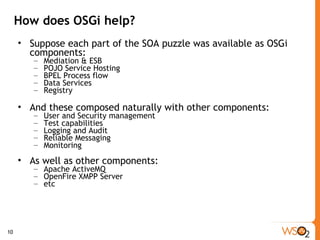
How does OSGi help? Suppose each part of the SOA puzzle was available as OSGi components: Mediation & ESB POJO Service Hosting  BPEL Process flow Data Services Registry And these composed naturally with other components: User and Security management Test capabilities Logging and Audit Reliable Messaging Monitoring  As well as other components: Apache ActiveMQ OpenFire XMPP Server etc
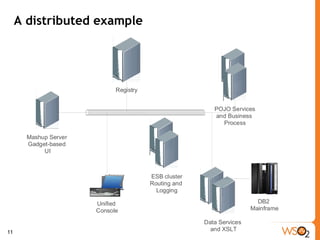
A distributed example
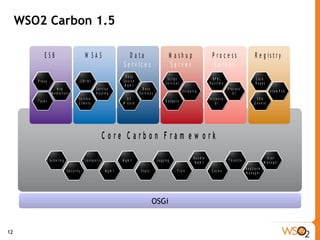
WSO2 Carbon 1.5 OSGi
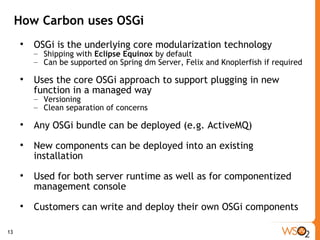
How Carbon uses OSGi OSGi is the underlying core modularization technology Shipping with  Eclipse Equinox  by default Can be supported on Spring dm Server, Felix and Knoplerfish if required Uses the core OSGi approach to support plugging in new function in a managed way Versioning Clean separation of concerns Any OSGi bundle can be deployed (e.g. ActiveMQ) New components can be deployed into an existing installation Used for both server runtime as well as for componentized management console Customers can write and deploy their own OSGi components
Carbon is more than just OSGi Analogies: Eclipse uses OSGi but is much more – it defines how you plug Tool components into a Tooling Framework Microsoft Office uses DLLs, but is much more – it defines how you can share a graph component across multiple document types Carbon uses OSGI, but it also defines how you build a consistent SOA platform  New service types plug into the console Security, throttling, stats, TryIt, all work on any service component Not just using OSGi for componentizing a single product, but rather  entire  middleware platform: app server, ESB, process server, registry, governance, mashup and more Our “products” are now simply our choice about how you start with this platform You can assemble your own “product” by combining components
Roadmap September 2008 Carbon 1.0 release (Data Services) Internal WSO2 proof point Feb 6 th  2009 Carbon 1.5 release (ESB, WSAS, BPS, Registry) First full OSGi release Feb 28 th  2009 Feature Packs available: Mediation, BPEL, Java Service Hosting, Cluster Management Mid 2009 OSGi as a development and deployment model Axis2 services packaged as bundles Mediators packaged as bundles, etc Dynamic support for reloading code and config
Lessons learnt about OSGi Benefits: Better management of classloading Imports and Exports Proper Modularity Versions of modules and dependencies Supports multiple versions of the same code  As long as there are no cycles Supports dynamic loading/reloading  Upgrade your code or a system in flight Not yet used by Carbon  Problems: Existing code using classloaders is a big issue Either change the code or the classloader PAX tools can help No built in support for JSPs in the model Plenty of well-documented workarounds on the Web Getting the “start level” of bundles right is hard http://ruwansblog.blogspot.com/2008/10/osgi-bundle-start-levels.html Building and managing patches is a significant issue http://afkham.org/2008/10/how-to-create-patches-for-osgi-bundles.html
Find out more about Carbon: Upcoming Webinar: WSO2 Synergies: the Carbon Story Feb 17 th  2009 http://wso2.on.intercall.com
Questions?

Osgi Webinar

  • 1.
    OSGi and SOAUnderstanding how OSGi helps SOA January 2009 Paul Fremantle Co-Founder & CTO
  • 2.
    Paul Fremantle Co-FoundedWSO2 in 2005 Aiming to be the Open Source SOA platform of choice Apache Member VP, Apache Synapse PMC: HTTPComponents, Incubator, Qpid, Tuscany Co-chair WS-RX Technical Committee, OASIS Infoworld CTO 25
  • 3.
    OSGi History OSGiinitially founded in 1999 to make it easier to deploy Java applications in embedded devices In 2003 Eclipse chose OSGi as the plugin architecture OSGi R4 released in 2005 May 2007 – OSGi R4.1 released (JSR 291)
  • 4.
    OSGi and MiddlewareOriginally designed as a modularity model for embedded and mobile devices Increasingly used as a framework by Enterprise Middleware Spring dm Server IBM WebSphere JBoss AS etc “ SOA for the infrastructure” using a Service model within a JVM James Governor from Redmonk calls OSGi the “ Stackless Stack”
  • 5.
    What does OSGigive me? Modularity: Each JAR is a Bundle Each bundle has its own classloader Bundles can share or hide packages Import a package, or require another bundle (import all packages) Bundles have versions Services Each bundle can provide services to other bundles Services are simply Java objects that implement a given interface There is a Service Registry where you can find a service implementation Dynamic loading and lifecycle Bundles may be stopped, started, uninstalled and updated without stopping the framework
  • 6.
    OSGi Bundle MANIFEST.MFManifest-Version: 1.0 Bnd-LastModified: 1229014618171 Export-Package: org.apache.http;uses:="org.apache.http.params,org.apac he.http.util,org.apache.http.protocol",...... Bundle-Version: 4.0.0.beta1 Bundle-Name: org.wso2.carbon.httpcore Bundle-Description: org.wso2.carbon.httpcore. This bundle will export packages from httpcore.jar Build-Jdk: 1.5.0_14 Bundle-ManifestVersion: 2 Bundle-Vendor: WSO2 Inc Bundle-SymbolicName: org.wso2.carbon.httpcore Tool: Bnd-0.0.238 WSO2-Bundle-StartLevel: 20
  • 7.
  • 8.
    Integration at theOS/network or the JVM? Operating System Process PORT Process PORT Process PORT Service Registry PORT JVM Bundle PORT Bundle Bundle Internal Service Registry Operating System
  • 9.
    SOA Anti-patterns Traditional/ proprietary SOA platforms are: Overly complex Heavyweight Not internally consistent Hard to learn The result is: Customers centralize SOA on a single hub based ESB Departments rely on the “SOA team” to solve problems Replacing centralized monolithic applications with Centralized monolithic ESB and SOA platform What should we be doing? Allowing departments to host just enough SOA infrastructure Making it easier to start simple and grow as needed Making the SOA platform integrate simply and naturally
  • 10.
    How does OSGihelp? Suppose each part of the SOA puzzle was available as OSGi components: Mediation & ESB POJO Service Hosting BPEL Process flow Data Services Registry And these composed naturally with other components: User and Security management Test capabilities Logging and Audit Reliable Messaging Monitoring As well as other components: Apache ActiveMQ OpenFire XMPP Server etc
  • 11.
  • 12.
  • 13.
    How Carbon usesOSGi OSGi is the underlying core modularization technology Shipping with Eclipse Equinox by default Can be supported on Spring dm Server, Felix and Knoplerfish if required Uses the core OSGi approach to support plugging in new function in a managed way Versioning Clean separation of concerns Any OSGi bundle can be deployed (e.g. ActiveMQ) New components can be deployed into an existing installation Used for both server runtime as well as for componentized management console Customers can write and deploy their own OSGi components
  • 14.
    Carbon is morethan just OSGi Analogies: Eclipse uses OSGi but is much more – it defines how you plug Tool components into a Tooling Framework Microsoft Office uses DLLs, but is much more – it defines how you can share a graph component across multiple document types Carbon uses OSGI, but it also defines how you build a consistent SOA platform New service types plug into the console Security, throttling, stats, TryIt, all work on any service component Not just using OSGi for componentizing a single product, but rather entire middleware platform: app server, ESB, process server, registry, governance, mashup and more Our “products” are now simply our choice about how you start with this platform You can assemble your own “product” by combining components
  • 15.
    Roadmap September 2008Carbon 1.0 release (Data Services) Internal WSO2 proof point Feb 6 th 2009 Carbon 1.5 release (ESB, WSAS, BPS, Registry) First full OSGi release Feb 28 th 2009 Feature Packs available: Mediation, BPEL, Java Service Hosting, Cluster Management Mid 2009 OSGi as a development and deployment model Axis2 services packaged as bundles Mediators packaged as bundles, etc Dynamic support for reloading code and config
  • 16.
    Lessons learnt aboutOSGi Benefits: Better management of classloading Imports and Exports Proper Modularity Versions of modules and dependencies Supports multiple versions of the same code As long as there are no cycles Supports dynamic loading/reloading Upgrade your code or a system in flight Not yet used by Carbon Problems: Existing code using classloaders is a big issue Either change the code or the classloader PAX tools can help No built in support for JSPs in the model Plenty of well-documented workarounds on the Web Getting the “start level” of bundles right is hard http://ruwansblog.blogspot.com/2008/10/osgi-bundle-start-levels.html Building and managing patches is a significant issue http://afkham.org/2008/10/how-to-create-patches-for-osgi-bundles.html
  • 17.
    Find out moreabout Carbon: Upcoming Webinar: WSO2 Synergies: the Carbon Story Feb 17 th 2009 http://wso2.on.intercall.com
  • 18.