OSCILLATION
SUBHIKSHA S
22ECR195
ECE-D
INTRODUCTION
• Moving of the celestial bodies is also an
example of the oscillation..
 Periodic variation of matter between
two values or about its central value.
 T = 2π√mk
where T is angular frequency
m is mass
k is force constant
 Three types:
Free oscillation
Forced oscillation
Damped oscillation
SIMPLE HARMONIC MOTION
• The restoring force acting on the system is directly proportional to the displacement from the equilibrium
position and acts in the opposite direction.
• It is described by Hooke's law, which states that the force (F) exerted by a spring is equal to the spring
constant (k) multiplied by the displacement (x): F = -kx.
FREE OSCILLATION
 Free oscillation refers to the natural motion of a system or object that occurs without any external force or
influence.
 It is also known as natural or undamped oscillation. In this type of oscillation, the system or object follows a
periodic motion with a specific frequency determined by its inherent properties.
FORCED OSCILLATION
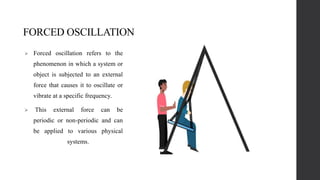
 Forced oscillation refers to the
phenomenon in which a system or
object is subjected to an external
force that causes it to oscillate or
vibrate at a specific frequency.
 This external force can be
periodic or non-periodic and can
be applied to various physical
systems.
DAMPED OSCILLATION
 Damped oscillation refers to a type of
oscillatory motion where the amplitude
of the oscillations gradually decreases
over time due to the presence of
damping forces.
 In this phenomenon, the system loses
energy to its surroundings, resulting in
a gradual decay of the oscillations.
APPLICATIONS IN MECHANICAL ENGINEERING
Oscillations play a crucial role in mechanical engineering, where they are
utilized in various applications. One prominent example is in the design and
operation of engines.
Internal combustion engines rely on the controlled oscillation of pistons within
cylinders to convert chemical energy into mechanical work.
APPLICATIONS IN ELECTRONICSAND
TELECOMMUNICATIONS
• Oscillations find extensive use in electronics and telecommunications systems.
One notable application is in radio frequency (RF) circuits, where oscillators
generate continuous waveforms at specific frequencies.
• These oscillators are essential components in devices such as radios,
televisions, cell phones, and wireless communication systems.
• They provide stable and precise signals for transmitting and receiving
information.
APPLICATIONS IN MEDICAL SCIENCE
• In diagnostics, techniques such as electrocardiography (ECG) and electroencephalography (EEG)
rely on the measurement of electrical oscillations in the heart and brain, respectively.
• These measurements provide valuable information about the health and functioning of these
organs.
• In therapeutic applications, oscillations are utilized in techniques like ultrasound and laser surgery.
Ultrasound waves, which are mechanical oscillations with frequencies above the audible range,
are used for imaging internal organs and tissues.
APPLICATIONS IN PHYSICS AND ASTRONOMY
• In quantum mechanics, particles such as electrons exhibit wave-particle duality, meaning they can
behave as both particles and waves.
• These wave-like properties give rise to quantum oscillations, which have been observed in
experiments involving superconductors and quantum Hall systems.
• In astrophysics, oscillations are studied in stars to gain insights into their internal structures and
dynamics. This information helps astronomers understand stellar evolution and formation.
EXAMPLES OF OSCILLATION
THANK YOU…

Oscillation

  • 1.
  • 2.
    INTRODUCTION • Moving ofthe celestial bodies is also an example of the oscillation..  Periodic variation of matter between two values or about its central value.  T = 2π√mk where T is angular frequency m is mass k is force constant  Three types: Free oscillation Forced oscillation Damped oscillation
  • 3.
    SIMPLE HARMONIC MOTION •The restoring force acting on the system is directly proportional to the displacement from the equilibrium position and acts in the opposite direction. • It is described by Hooke's law, which states that the force (F) exerted by a spring is equal to the spring constant (k) multiplied by the displacement (x): F = -kx.
  • 4.
    FREE OSCILLATION  Freeoscillation refers to the natural motion of a system or object that occurs without any external force or influence.  It is also known as natural or undamped oscillation. In this type of oscillation, the system or object follows a periodic motion with a specific frequency determined by its inherent properties.
  • 5.
    FORCED OSCILLATION  Forcedoscillation refers to the phenomenon in which a system or object is subjected to an external force that causes it to oscillate or vibrate at a specific frequency.  This external force can be periodic or non-periodic and can be applied to various physical systems.
  • 6.
    DAMPED OSCILLATION  Dampedoscillation refers to a type of oscillatory motion where the amplitude of the oscillations gradually decreases over time due to the presence of damping forces.  In this phenomenon, the system loses energy to its surroundings, resulting in a gradual decay of the oscillations.
  • 7.
    APPLICATIONS IN MECHANICALENGINEERING Oscillations play a crucial role in mechanical engineering, where they are utilized in various applications. One prominent example is in the design and operation of engines. Internal combustion engines rely on the controlled oscillation of pistons within cylinders to convert chemical energy into mechanical work.
  • 8.
    APPLICATIONS IN ELECTRONICSAND TELECOMMUNICATIONS •Oscillations find extensive use in electronics and telecommunications systems. One notable application is in radio frequency (RF) circuits, where oscillators generate continuous waveforms at specific frequencies. • These oscillators are essential components in devices such as radios, televisions, cell phones, and wireless communication systems. • They provide stable and precise signals for transmitting and receiving information.
  • 9.
    APPLICATIONS IN MEDICALSCIENCE • In diagnostics, techniques such as electrocardiography (ECG) and electroencephalography (EEG) rely on the measurement of electrical oscillations in the heart and brain, respectively. • These measurements provide valuable information about the health and functioning of these organs. • In therapeutic applications, oscillations are utilized in techniques like ultrasound and laser surgery. Ultrasound waves, which are mechanical oscillations with frequencies above the audible range, are used for imaging internal organs and tissues.
  • 10.
    APPLICATIONS IN PHYSICSAND ASTRONOMY • In quantum mechanics, particles such as electrons exhibit wave-particle duality, meaning they can behave as both particles and waves. • These wave-like properties give rise to quantum oscillations, which have been observed in experiments involving superconductors and quantum Hall systems. • In astrophysics, oscillations are studied in stars to gain insights into their internal structures and dynamics. This information helps astronomers understand stellar evolution and formation.
  • 11.
  • 12.