HARMONY IN
MOTION: EXPLORING
THE MESMERIZING
WORLD OF
OSCILLATION
INTRODUCTION
Welcome to the mesmerizing world of
oscillation! In this presentation, we will explore
the captivating harmony found in various
oscillatory phenomena. Get ready to be amazed
by the rhythmic patterns and the elegant dance
of motion. Let's dive into this creative journey!
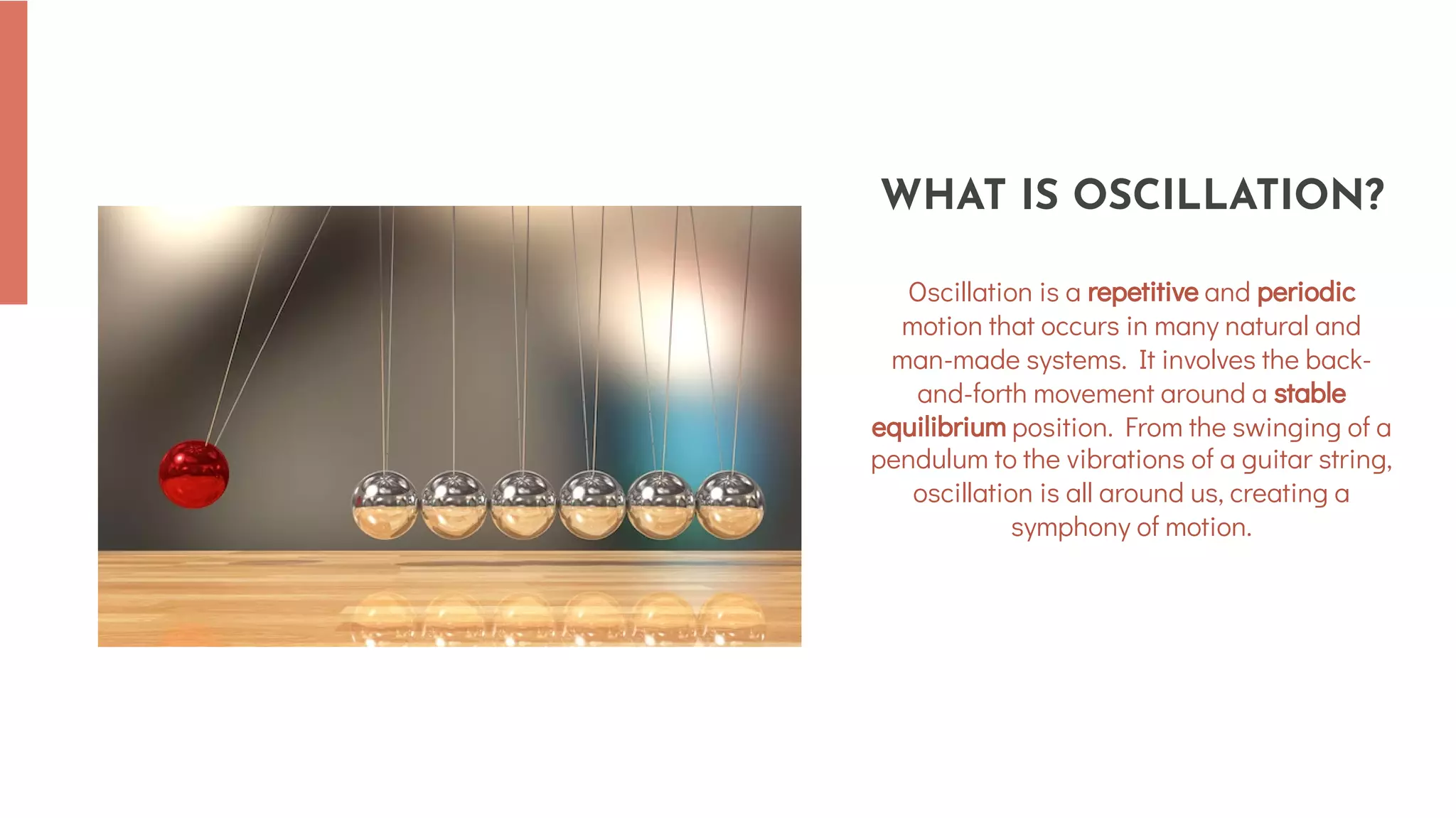
Oscillation is a repetitive and periodic
motion that occurs in many natural and
man-made systems. It involves the back-
and-forth movement around a stable
equilibrium position. From the swinging of a
pendulum to the vibrations of a guitar string,
oscillation is all around us, creating a
symphony of motion.
WHAT IS OSCILLATION?
TYPES OF OSCILLATION
There are various types of oscillation,
including simple harmonic motion, damped
oscillation, and forced oscillation. Simple
harmonic motion is characterized by a
restoring force that is directly proportional to
the displacement. Damped oscillation
involves the gradual decrease in amplitude
over time. Forced oscillation occurs when an
external force is applied to a system,
causing it to oscillate.
Oscillation plays a crucial role in various
fields. From the precise timekeeping of
pendulum clocks to the generation of sound
in musical instruments, oscillation is
essential. It is also utilized in technologies
like electronic circuits, seismometers, and
MRI machines. Understanding oscillation
opens doors to innovation and enhances our
understanding of the world.
APPLICATIONS OF OSCILLATION
Oscillation can be described mathematically
using concepts like amplitude, frequency,
and period. Amplitude represents the
maximum displacement from the equilibrium
position, while frequency is the number of
oscillations per unit of time. The period is the
time taken for one complete oscillation.
These mathematical relationships help us
analyze and predict the behavior of
oscillatory systems.
THE MATHEMATICS OF OSCILLATION
CONCLUSION
In conclusion, oscillation is a fascinating phenomenon that brings
harmony and motion together. We have explored the various types of
oscillation, its applications in different fields, and the mathematical
principles behind it. Embracing the creative essence of oscillation allows
us to unlock new possibilities and appreciate the beauty of rhythmic
patterns in our world. Let's continue to explore and be inspired by the
mesmerizing world of oscillation!
Thanks!

OSCILLATION PPT.pdf

  • 1.
    HARMONY IN MOTION: EXPLORING THEMESMERIZING WORLD OF OSCILLATION
  • 2.
    INTRODUCTION Welcome to themesmerizing world of oscillation! In this presentation, we will explore the captivating harmony found in various oscillatory phenomena. Get ready to be amazed by the rhythmic patterns and the elegant dance of motion. Let's dive into this creative journey!
  • 3.
    Oscillation is arepetitive and periodic motion that occurs in many natural and man-made systems. It involves the back- and-forth movement around a stable equilibrium position. From the swinging of a pendulum to the vibrations of a guitar string, oscillation is all around us, creating a symphony of motion. WHAT IS OSCILLATION?
  • 4.
    TYPES OF OSCILLATION Thereare various types of oscillation, including simple harmonic motion, damped oscillation, and forced oscillation. Simple harmonic motion is characterized by a restoring force that is directly proportional to the displacement. Damped oscillation involves the gradual decrease in amplitude over time. Forced oscillation occurs when an external force is applied to a system, causing it to oscillate.
  • 5.
    Oscillation plays acrucial role in various fields. From the precise timekeeping of pendulum clocks to the generation of sound in musical instruments, oscillation is essential. It is also utilized in technologies like electronic circuits, seismometers, and MRI machines. Understanding oscillation opens doors to innovation and enhances our understanding of the world. APPLICATIONS OF OSCILLATION
  • 6.
    Oscillation can bedescribed mathematically using concepts like amplitude, frequency, and period. Amplitude represents the maximum displacement from the equilibrium position, while frequency is the number of oscillations per unit of time. The period is the time taken for one complete oscillation. These mathematical relationships help us analyze and predict the behavior of oscillatory systems. THE MATHEMATICS OF OSCILLATION
  • 7.
    CONCLUSION In conclusion, oscillationis a fascinating phenomenon that brings harmony and motion together. We have explored the various types of oscillation, its applications in different fields, and the mathematical principles behind it. Embracing the creative essence of oscillation allows us to unlock new possibilities and appreciate the beauty of rhythmic patterns in our world. Let's continue to explore and be inspired by the mesmerizing world of oscillation!
  • 8.