
Advanced Spring Framework Rod Johnson CEO Interface21 www.interface21.com
Aims  Understand the capabilities of the Spring Framework component model, and how you can use them to add new power to your POJO-based applications
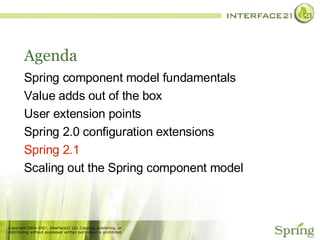
Agenda Spring component model fundamentals Value adds out of the box User extension points Spring 2.0 configuration extensions Spring 2.1: New Scaling out the Spring component model
What Is Spring?
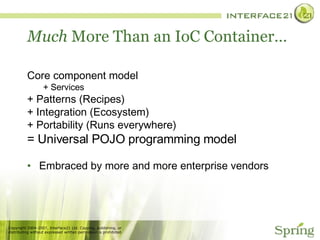
Much  More Than an IoC Container… Core component model  + Services  + Patterns (Recipes) + Integration (Ecosystem) + Portability (Runs everywhere) = Universal POJO programming model Embraced by more and more enterprise vendors
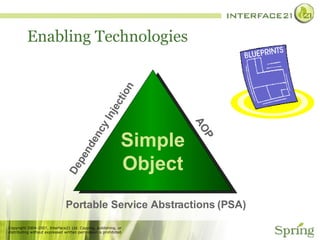
Enabling Technologies Simple Object Simple Object Dependency Injection AOP Portable Service Abstractions (PSA)
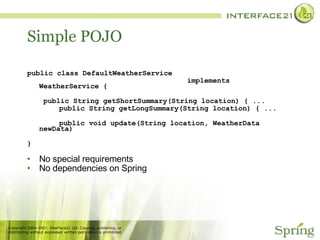
Simple POJO public class DefaultWeatherService  implements WeatherService {   public String getShortSummary(String location) { ... public String getLongSummary(String location) { ... public void update(String location, WeatherData newData) } No special requirements No dependencies on Spring
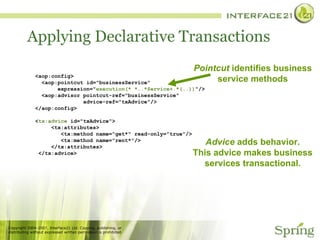
Applying Declarative Transactions  <aop:config> <aop:pointcut id=&quot;businessService&quot; expression=&quot; execution(* *..*Service+.*(..)) &quot;/> <aop:advisor pointcut-ref=&quot;businessService&quot; advice-ref=&quot;txAdvice&quot;/> </aop:config> < tx:advice  id=&quot;txAdvice&quot;> <tx:attributes> <tx:method name=&quot;get*&quot; read-only=&quot;true&quot;/> <tx:method name=&quot;rent*&quot;/> </tx:attributes> </tx:advice> Pointcut  identifies business service methods Advice  adds behavior. This advice makes business services transactional.
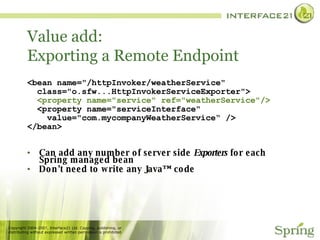
Value add: Exporting a Remote Endpoint  <bean name=&quot;/httpInvoker/weatherService&quot;  class=&quot;o.sfw...HttpInvokerServiceExporter&quot;> <property name=&quot;service&quot; ref=&quot;weatherService&quot;/>   <property name=&quot;serviceInterface&quot; value=&quot;com.mycompanyWeatherService“ /> </bean> Can add any number of server side  Exporters  for each Spring managed bean Don’t need to write any Java™ code
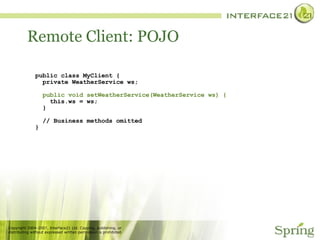
Remote Client: POJO public class MyClient { private WeatherService ws; public void setWeatherService(WeatherService ws) { this.ws = ws; } // Business methods omitted }
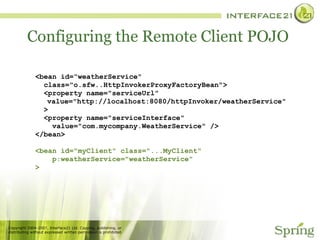
Configuring the Remote Client POJO <bean id=“weatherService&quot;  class=&quot;o.sfw..HttpInvokerProxyFactoryBean&quot;> <property name=&quot;serviceUrl&quot; value=&quot;http://localhost:8080/httpInvoker/weatherService&quot; > <property name=&quot;serviceInterface&quot; value=&quot;com.mycompany.WeatherService&quot; /> </bean> <bean id=&quot;myClient&quot; class=&quot;...MyClient&quot; p:weatherService=&quot;weatherService&quot; >
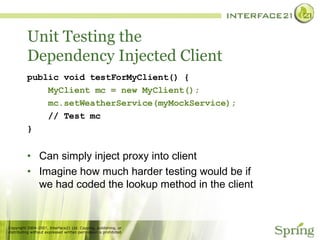
Unit Testing the Dependency Injected Client public void testForMyClient() { MyClient mc = new MyClient(); mc.setWeatherService(myMockService); // Test mc } Can simply inject proxy into client Imagine how much harder testing would be if we had coded the lookup method in the client
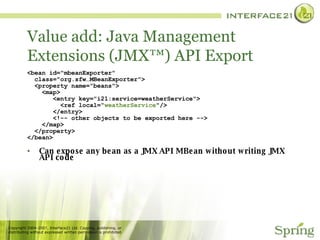
Value add: Java Management Extensions (JMX™) API Export <bean id=&quot;mbeanExporter&quot; class=&quot;org.sfw…MBeanExporter&quot;> <property name=&quot;beans&quot;> <map> <entry key=&quot;i21:service=weatherService&quot;> <ref local=“ weatherService &quot;/> </entry> <!-- other objects to be exported here --> </map> </property> </bean> Can expose any bean as a JMX API MBean without writing JMX API code
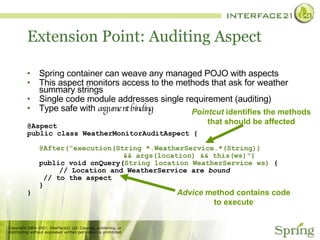
Extension Point: Auditing Aspect Spring container can weave any managed POJO with aspects This aspect monitors access to the methods that ask for weather summary strings Single code module addresses single requirement (auditing) Type safe with  argument binding @Aspect public class WeatherMonitorAuditAspect { @After(&quot;execution(String *.WeatherService.*(String))  && args(location) && this(ws)&quot;) public void onQuery( String location WeatherService ws)  { // Location and WeatherService are  bound   // to the aspect  } } Pointcut  identifies the methods that should be affected Advice  method contains code to execute
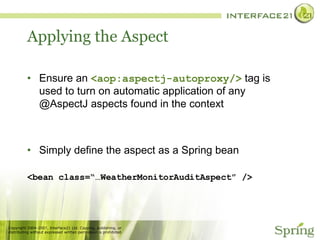
Applying the Aspect Ensure an  <aop:aspectj-autoproxy/>  tag is used to turn on automatic application of any @AspectJ aspects found in the context Simply define the aspect as a Spring bean <bean class=“…WeatherMonitorAuditAspect” />
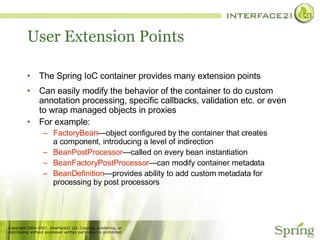
User Extension Points The Spring IoC container provides many extension points Can easily modify the behavior of the container to do custom annotation processing, specific callbacks, validation etc. or even to wrap managed objects in proxies For example: FactoryBean —object configured by the container that creates a component, introducing a level of indirection BeanPostProcessor —called on every bean instantiation BeanFactoryPostProcessor —can modify container metadata BeanDefinition —provides ability to add custom metadata for processing by post processors
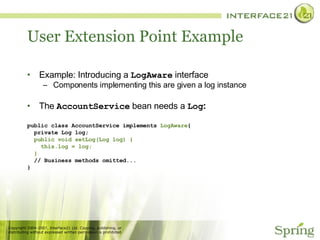
User Extension Point Example Example: Introducing a  LogAware  interface Components implementing this are given a log instance The  AccountService  bean needs a  Log : public class AccountService implements  LogAware { private Log log; public void setLog(Log log) { this.log = log; } // Business methods omitted... }
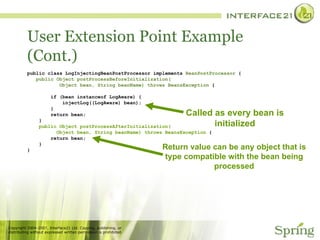
User Extension Point Example (Cont.) public class LogInjectingBeanPostProcessor implements  BeanPostProcessor  { public Object postProcessBeforeInitialization( Object bean, String beanName) throws BeansException  { if (bean instanceof LogAware) { injectLog((LogAware) bean); } return bean; } public Object postProcessAfterInitialization( Object bean, String beanName) throws BeansException  { return bean; } } Called as every bean is initialized Return value can be any object that is type compatible with the bean being processed
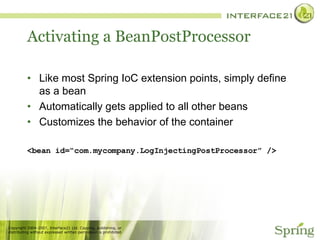
Activating a BeanPostProcessor Like most Spring IoC extension points, simply define as a bean Automatically gets applied to all other beans Customizes the behavior of the container <bean id=“com.mycompany.LogInjectingPostProcessor” />
Agenda Spring component model fundamentals Value adds out of the box User extension points Spring 2.0 configuration extensions Dynamic language support Scaling out the Spring component model
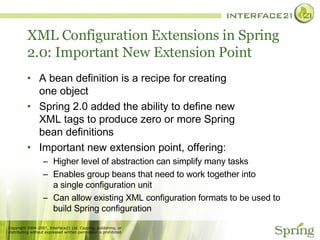
XML Configuration Extensions in Spring 2.0: Important New Extension Point A bean definition is a recipe for creating one object Spring 2.0 added the ability to define new XML tags to produce zero or more Spring bean definitions Important new extension point, offering: Higher level of abstraction can simplify many tasks Enables group beans that need to work together into a single configuration unit Can allow existing XML configuration formats to be used to build Spring configuration
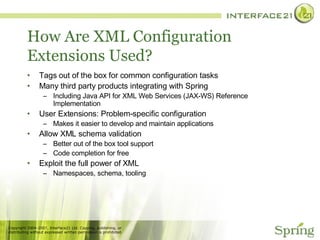
How Are XML Configuration Extensions Used? Tags out of the box for common configuration tasks Many third party products integrating with Spring Including Java API for XML Web Services (JAX-WS) Reference Implementation User Extensions: Problem-specific configuration Makes it easier to develop and maintain applications Allow XML schema validation Better out of the box tool support Code completion for free Exploit the full power of XML Namespaces, schema, tooling
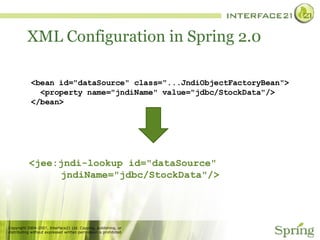
XML Configuration in Spring 2.0 <bean id=&quot;dataSource&quot; class=&quot;...JndiObjectFactoryBean&quot;>   <property name=&quot;jndiName&quot; value=&quot;jdbc/StockData&quot;/> </bean> <jee:jndi-lookup id=&quot;dataSource&quot;  jndiName=&quot;jdbc/StockData&quot;/>
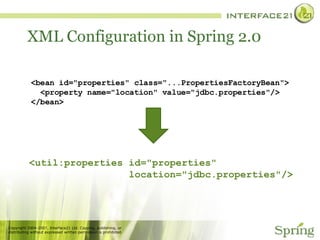
XML Configuration in Spring 2.0 <bean id=&quot;properties&quot; class=&quot;...PropertiesFactoryBean&quot;>   <property name=&quot;location&quot; value=&quot;jdbc.properties&quot;/> </bean> <util:properties id=&quot;properties&quot;  location=&quot;jdbc.properties&quot;/>
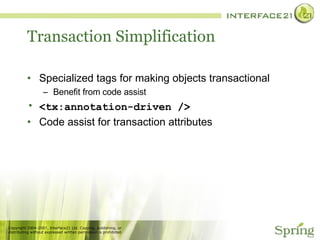
Transaction Simplification Specialized tags for making objects transactional Benefit from code assist <tx:annotation-driven /> Code assist for transaction attributes
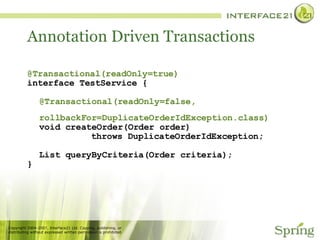
Annotation Driven Transactions @Transactional(readOnly=true) interface TestService { @Transactional(readOnly=false,   rollbackFor=DuplicateOrderIdException.class) void createOrder(Order order) throws DuplicateOrderIdException; List queryByCriteria(Order criteria); }
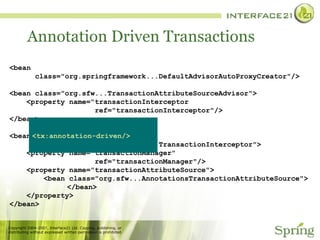
Annotation Driven Transactions <bean class=&quot;org.springframework...DefaultAdvisorAutoProxyCreator&quot;/> <bean class=&quot;org.sfw...TransactionAttributeSourceAdvisor&quot;> <property name=&quot;transactionInterceptor ref=&quot;transactionInterceptor&quot;/> </bean> <bean id=&quot;transactionInterceptor&quot; class=&quot;org.springframework...TransactionInterceptor&quot;> <property name=&quot;transactionManager&quot; ref=&quot;transactionManager&quot;/> <property name=&quot;transactionAttributeSource&quot;> <bean class=&quot;org.sfw...AnnotationsTransactionAttributeSource&quot;>   </bean> </property> </bean> <tx:annotation-driven/>
Out-of-the-Box Namespaces AOP JMX API Remoting Scheduling MVC Suggestions and contributions welcome A rich library will build over time
Authoring Custom Extensions: Step 1 Write an XSD to define element content Allows sophisticated validation, well beyond DTD Amenable to tool support during development Author with XML tools XML Spy
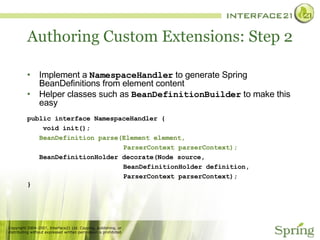
Authoring Custom Extensions: Step 2 Implement a  NamespaceHandler  to generate Spring BeanDefinitions from element content Helper classes such as  BeanDefinitionBuilder  to make this easy public interface NamespaceHandler { void init(); BeanDefinition parse(Element element,  ParserContext parserContext); BeanDefinitionHolder decorate(Node source, BeanDefinitionHolder definition,  ParserContext parserContext); }
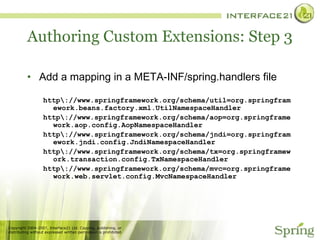
Authoring Custom Extensions: Step 3 Add a mapping in a META-INF/spring.handlers file http\://www.springframework.org/schema/util=org.springframework.beans.factory.xml.UtilNamespaceHandler http\://www.springframework.org/schema/aop=org.springframework.aop.config.AopNamespaceHandler http\://www.springframework.org/schema/jndi=org.springframework.jndi.config.JndiNamespaceHandler http\://www.springframework.org/schema/tx=org.springframework.transaction.config.TxNamespaceHandler http\://www.springframework.org/schema/mvc=org.springframework.web.servlet.config.MvcNamespaceHandler
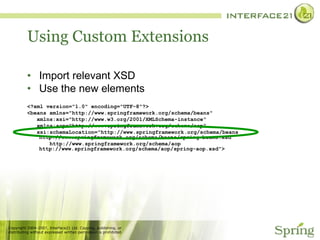
Using Custom Extensions Import relevant XSD Use the new elements <?xml version=&quot;1.0&quot; encoding=&quot;UTF-8&quot;?> <beans xmlns=&quot;http://www.springframework.org/schema/beans&quot; xmlns:xsi=&quot;http://www.w3.org/2001/XMLSchema-instance&quot; xmlns:aop=&quot;http://www.springframework.org/schema/aop&quot; xsi:schemaLocation=&quot;http://www.springframework.org/schema/beans http://www.springframework.org/schema/beans/spring-beans.xsd http://www.springframework.org/schema/aop http://www.springframework.org/schema/aop/spring-aop.xsd&quot;>
Agenda Spring component model fundamentals Value adds out of the box User extension points Spring 2.0 configuration extensions Spring 2.1 Scaling out the Spring component model
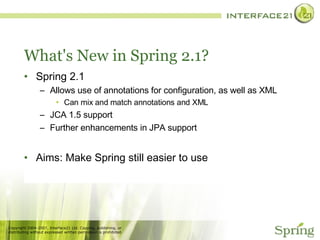
What's New in Spring 2.1? Spring 2.1 Allows use of annotations for configuration, as well as XML Can mix and match annotations and XML JCA 1.5 support Further enhancements in JPA support Aims: Make Spring still easier to use
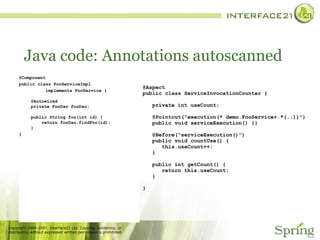
Java code: Annotations autoscanned @Component public class FooServiceImpl  implements FooService { @Autowired private FooDao fooDao; public String foo(int id) {   return fooDao.findFoo(id); } } @Aspect  public class ServiceInvocationCounter {   private int useCount;   @Pointcut(&quot;execution(* demo.FooService+.*(..))&quot;)   public void serviceExecution() {}   @Before(&quot;serviceExecution()&quot;)   public void countUse() {   this.useCount++;   }   public int getCount() {   return this.useCount;   } }
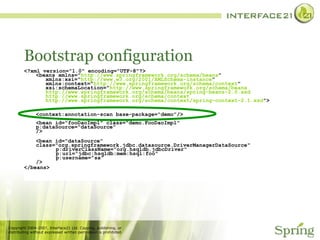
Bootstrap configuration <?xml version=&quot;1.0&quot; encoding=&quot;UTF-8&quot;?> <beans xmlns=&quot; http://www.springframework.org/schema/beans &quot;   xmlns:xsi=&quot; http://www.w3.org/2001/XMLSchema-instance &quot;   xmlns:context=&quot; http://www.springframework.org/schema/context &quot;   xsi:schemaLocation=&quot; http://www.springframework.org/schema/beans   http://www.springframework.org/schema/beans/spring-beans-2.0.xsd   http://www.springframework.org/schema/context   http://www.springframework.org/schema/context/spring-context-2.1.xsd &quot;> <context:annotation-scan base-package=&quot;demo&quot;/> <bean id=&quot;fooDaoImpl&quot; class=&quot;demo.FooDaoImpl&quot;   p:dataSource=&quot;dataSource&quot; /> <bean id=&quot;dataSource&quot;  class=&quot;org.springframework.jdbc.datasource.DriverManagerDataSource&quot;   p:driverClassName=&quot;org.hsqldb.jdbcDriver&quot;   p:url=“jdbc:hsqldb:mem:hsql:foo&quot;   p:username=&quot;sa&quot; /> </beans>
One  component model Contributions from different sources of configuration XML Java code Internal Java metadata not coupled to configuration format
Agenda Spring component model fundamentals Value adds out of the box User extension points Spring 2.0 configuration extensions Spring 2.1 Scaling out the Spring component model
Scaling Out Spring Spring can consume objects written in dynamic languages It can also make it easier to scale out applications by deploying and exposing POJOs in new models Examples Other deployment models such as grid SOA with SCA and ESBs OSGi dynamic modularization
Scaling POJOs Out to Grid Deployment Spring enables applications to be implemented in POJOs Avoids assumptions about environment in application code Environment changes over time Ignorance is bliss: What your objects don’t know can’t break them if it changes Hence deployment model can change without breaking code Servlet Application Server Standalone client Grid distribution technology…
SCA (Service Component Architecture): A Standard for SOA Assembly model Service components, references, wires Policy framework QoS etc. Service implementation and client API Spring Java API C++ BPEL EJB™ architecture Bindings  Web Services, Java Message Service (JMS), Java Cryptography Architecture (JCA)
The Open SOA Collaboration BEA IBM Oracle SAP Sun Interface21 Red Hat Cape Clear Software IONA Primeton Technologies Sybase Siemens Software AG TIBCO Rogue Wave Software
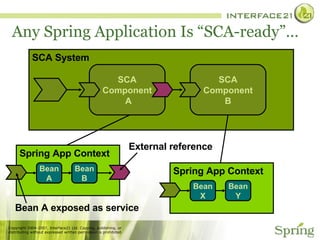
Any Spring Application Is “SCA-ready”… SCA System SCA Component A SCA Component B Spring App Context Bean A Bean B Spring App Context Bean X Bean Y Bean A exposed as service External reference
OSG — what?
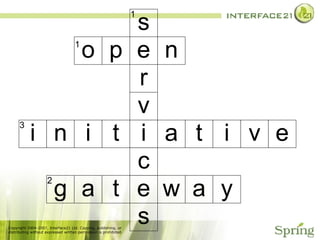
o p e n s r v i c e s t a g w a y a t i v e t i n i 1 1 2 3
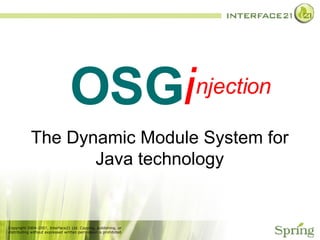
OSG i The Dynamic Module System for Java technology njection
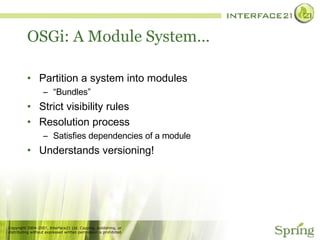
OSGi: A Module System… Partition a system into modules  “ Bundles” Strict visibility rules Resolution process  Satisfies dependencies of a module Understands versioning!
… and It’s Dynamic! Modules can be  Installed Started Stopped Uninstalled Updated … at runtime!
Spring and OSGi: Complementary Technologies Both are the best at what they do Injection/AOP component model Dynamic runtime infrastructure Both run  everywhere Little overlap Natural to combine dynamic power of OSGi with ease of use of Spring component model Spring/OSGi integration likely to make its way into OSGi specifications
Spring OSGi—Project Goals Use Spring container to configure modules (bundles) Make it easy to publish and consume services Across a number of bundles Enable applications to be coded without dependency on OSGi APIs Easy unit and integration testing Provide the needed bundles and infrastructure to deploy OSGi-based applications to application servers
Project Collaborators Led by Interface21 Committers from BEA and Oracle also active on the project Input to the specification and direction from OSGi Alliance (technical director and CTO) BEA, Oracle, IBM Eclipse Equinox Felix and many individuals
OSGi Packaging for Spring Spring modules packaged as OSGi bundles Spring-core Spring-beans Spring-aop Etc. All the necessary import and export package headers defined Enables an OSGi application to import and use Spring packages and services Currently done in Spring-OSGi project Spring module jars will come this way “out of the box” in Spring 2.1
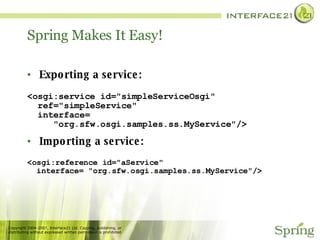
Spring Makes It Easy!  Exporting a service: <osgi:service id=&quot;simpleServiceOsgi&quot; ref=&quot;simpleService&quot; interface= &quot;org.sfw.osgi.samples.ss.MyService&quot;/> Importing a service: <osgi:reference id=&quot;aService&quot; interface= &quot;org.sfw.osgi.samples.ss.MyService&quot;/>
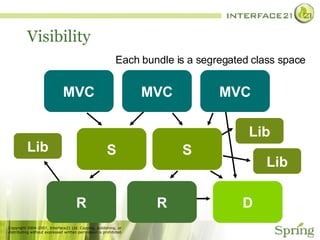
Visibility Each bundle is a segregated class space MVC MVC MVC S S R R D Lib Lib Lib
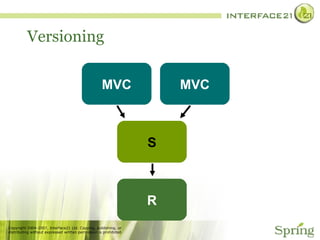
Versioning MVC MVC S R
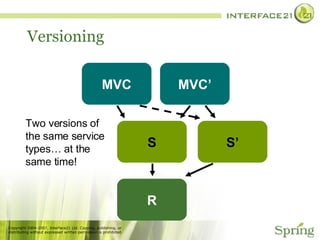
Versioning MVC MVC’ S R Two versions of the same service types… at the  same time! S’
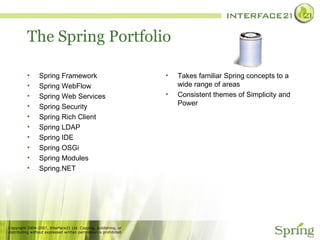
The Spring Portfolio Spring Framework Spring WebFlow Spring Web Services Spring Security Spring Rich Client Spring LDAP Spring IDE Spring OSGi Spring Modules Spring.NET Takes familiar Spring concepts to a wide range of areas Consistent themes of Simplicity and Power
Summary Spring provides a highly extensible component model POJOs used as “Spring beans” in a Spring application benefit from many potential services for free Many value adds out of the box Many extension points for users The Spring component model is ready for the challenges of tomorrow. Build out directions include: Dynamic language support SCA OSGi
Q&A

Os Johnson

  • 1.
    Advanced Spring FrameworkRod Johnson CEO Interface21 www.interface21.com
  • 2.
    Aims Understandthe capabilities of the Spring Framework component model, and how you can use them to add new power to your POJO-based applications
  • 3.
    Agenda Spring componentmodel fundamentals Value adds out of the box User extension points Spring 2.0 configuration extensions Spring 2.1: New Scaling out the Spring component model
  • 4.
  • 5.
    Much MoreThan an IoC Container… Core component model + Services + Patterns (Recipes) + Integration (Ecosystem) + Portability (Runs everywhere) = Universal POJO programming model Embraced by more and more enterprise vendors
  • 6.
    Enabling Technologies SimpleObject Simple Object Dependency Injection AOP Portable Service Abstractions (PSA)
  • 7.
    Simple POJO publicclass DefaultWeatherService implements WeatherService { public String getShortSummary(String location) { ... public String getLongSummary(String location) { ... public void update(String location, WeatherData newData) } No special requirements No dependencies on Spring
  • 8.
    Applying Declarative Transactions <aop:config> <aop:pointcut id=&quot;businessService&quot; expression=&quot; execution(* *..*Service+.*(..)) &quot;/> <aop:advisor pointcut-ref=&quot;businessService&quot; advice-ref=&quot;txAdvice&quot;/> </aop:config> < tx:advice id=&quot;txAdvice&quot;> <tx:attributes> <tx:method name=&quot;get*&quot; read-only=&quot;true&quot;/> <tx:method name=&quot;rent*&quot;/> </tx:attributes> </tx:advice> Pointcut identifies business service methods Advice adds behavior. This advice makes business services transactional.
  • 9.
    Value add: Exportinga Remote Endpoint <bean name=&quot;/httpInvoker/weatherService&quot; class=&quot;o.sfw...HttpInvokerServiceExporter&quot;> <property name=&quot;service&quot; ref=&quot;weatherService&quot;/> <property name=&quot;serviceInterface&quot; value=&quot;com.mycompanyWeatherService“ /> </bean> Can add any number of server side Exporters for each Spring managed bean Don’t need to write any Java™ code
  • 10.
    Remote Client: POJOpublic class MyClient { private WeatherService ws; public void setWeatherService(WeatherService ws) { this.ws = ws; } // Business methods omitted }
  • 11.
    Configuring the RemoteClient POJO <bean id=“weatherService&quot; class=&quot;o.sfw..HttpInvokerProxyFactoryBean&quot;> <property name=&quot;serviceUrl&quot; value=&quot;http://localhost:8080/httpInvoker/weatherService&quot; > <property name=&quot;serviceInterface&quot; value=&quot;com.mycompany.WeatherService&quot; /> </bean> <bean id=&quot;myClient&quot; class=&quot;...MyClient&quot; p:weatherService=&quot;weatherService&quot; >
  • 12.
    Unit Testing theDependency Injected Client public void testForMyClient() { MyClient mc = new MyClient(); mc.setWeatherService(myMockService); // Test mc } Can simply inject proxy into client Imagine how much harder testing would be if we had coded the lookup method in the client
  • 13.
    Value add: JavaManagement Extensions (JMX™) API Export <bean id=&quot;mbeanExporter&quot; class=&quot;org.sfw…MBeanExporter&quot;> <property name=&quot;beans&quot;> <map> <entry key=&quot;i21:service=weatherService&quot;> <ref local=“ weatherService &quot;/> </entry> <!-- other objects to be exported here --> </map> </property> </bean> Can expose any bean as a JMX API MBean without writing JMX API code
  • 14.
    Extension Point: AuditingAspect Spring container can weave any managed POJO with aspects This aspect monitors access to the methods that ask for weather summary strings Single code module addresses single requirement (auditing) Type safe with argument binding @Aspect public class WeatherMonitorAuditAspect { @After(&quot;execution(String *.WeatherService.*(String)) && args(location) && this(ws)&quot;) public void onQuery( String location WeatherService ws) { // Location and WeatherService are bound // to the aspect } } Pointcut identifies the methods that should be affected Advice method contains code to execute
  • 15.
    Applying the AspectEnsure an <aop:aspectj-autoproxy/> tag is used to turn on automatic application of any @AspectJ aspects found in the context Simply define the aspect as a Spring bean <bean class=“…WeatherMonitorAuditAspect” />
  • 16.
    User Extension PointsThe Spring IoC container provides many extension points Can easily modify the behavior of the container to do custom annotation processing, specific callbacks, validation etc. or even to wrap managed objects in proxies For example: FactoryBean —object configured by the container that creates a component, introducing a level of indirection BeanPostProcessor —called on every bean instantiation BeanFactoryPostProcessor —can modify container metadata BeanDefinition —provides ability to add custom metadata for processing by post processors
  • 17.
    User Extension PointExample Example: Introducing a LogAware interface Components implementing this are given a log instance The AccountService bean needs a Log : public class AccountService implements LogAware { private Log log; public void setLog(Log log) { this.log = log; } // Business methods omitted... }
  • 18.
    User Extension PointExample (Cont.) public class LogInjectingBeanPostProcessor implements BeanPostProcessor { public Object postProcessBeforeInitialization( Object bean, String beanName) throws BeansException { if (bean instanceof LogAware) { injectLog((LogAware) bean); } return bean; } public Object postProcessAfterInitialization( Object bean, String beanName) throws BeansException { return bean; } } Called as every bean is initialized Return value can be any object that is type compatible with the bean being processed
  • 19.
    Activating a BeanPostProcessorLike most Spring IoC extension points, simply define as a bean Automatically gets applied to all other beans Customizes the behavior of the container <bean id=“com.mycompany.LogInjectingPostProcessor” />
  • 20.
    Agenda Spring componentmodel fundamentals Value adds out of the box User extension points Spring 2.0 configuration extensions Dynamic language support Scaling out the Spring component model
  • 21.
    XML Configuration Extensionsin Spring 2.0: Important New Extension Point A bean definition is a recipe for creating one object Spring 2.0 added the ability to define new XML tags to produce zero or more Spring bean definitions Important new extension point, offering: Higher level of abstraction can simplify many tasks Enables group beans that need to work together into a single configuration unit Can allow existing XML configuration formats to be used to build Spring configuration
  • 22.
    How Are XMLConfiguration Extensions Used? Tags out of the box for common configuration tasks Many third party products integrating with Spring Including Java API for XML Web Services (JAX-WS) Reference Implementation User Extensions: Problem-specific configuration Makes it easier to develop and maintain applications Allow XML schema validation Better out of the box tool support Code completion for free Exploit the full power of XML Namespaces, schema, tooling
  • 23.
    XML Configuration inSpring 2.0 <bean id=&quot;dataSource&quot; class=&quot;...JndiObjectFactoryBean&quot;> <property name=&quot;jndiName&quot; value=&quot;jdbc/StockData&quot;/> </bean> <jee:jndi-lookup id=&quot;dataSource&quot; jndiName=&quot;jdbc/StockData&quot;/>
  • 24.
    XML Configuration inSpring 2.0 <bean id=&quot;properties&quot; class=&quot;...PropertiesFactoryBean&quot;> <property name=&quot;location&quot; value=&quot;jdbc.properties&quot;/> </bean> <util:properties id=&quot;properties&quot; location=&quot;jdbc.properties&quot;/>
  • 25.
    Transaction Simplification Specializedtags for making objects transactional Benefit from code assist <tx:annotation-driven /> Code assist for transaction attributes
  • 26.
    Annotation Driven Transactions@Transactional(readOnly=true) interface TestService { @Transactional(readOnly=false, rollbackFor=DuplicateOrderIdException.class) void createOrder(Order order) throws DuplicateOrderIdException; List queryByCriteria(Order criteria); }
  • 27.
    Annotation Driven Transactions<bean class=&quot;org.springframework...DefaultAdvisorAutoProxyCreator&quot;/> <bean class=&quot;org.sfw...TransactionAttributeSourceAdvisor&quot;> <property name=&quot;transactionInterceptor ref=&quot;transactionInterceptor&quot;/> </bean> <bean id=&quot;transactionInterceptor&quot; class=&quot;org.springframework...TransactionInterceptor&quot;> <property name=&quot;transactionManager&quot; ref=&quot;transactionManager&quot;/> <property name=&quot;transactionAttributeSource&quot;> <bean class=&quot;org.sfw...AnnotationsTransactionAttributeSource&quot;> </bean> </property> </bean> <tx:annotation-driven/>
  • 28.
    Out-of-the-Box Namespaces AOPJMX API Remoting Scheduling MVC Suggestions and contributions welcome A rich library will build over time
  • 29.
    Authoring Custom Extensions:Step 1 Write an XSD to define element content Allows sophisticated validation, well beyond DTD Amenable to tool support during development Author with XML tools XML Spy
  • 30.
    Authoring Custom Extensions:Step 2 Implement a NamespaceHandler to generate Spring BeanDefinitions from element content Helper classes such as BeanDefinitionBuilder to make this easy public interface NamespaceHandler { void init(); BeanDefinition parse(Element element, ParserContext parserContext); BeanDefinitionHolder decorate(Node source, BeanDefinitionHolder definition, ParserContext parserContext); }
  • 31.
    Authoring Custom Extensions:Step 3 Add a mapping in a META-INF/spring.handlers file http\://www.springframework.org/schema/util=org.springframework.beans.factory.xml.UtilNamespaceHandler http\://www.springframework.org/schema/aop=org.springframework.aop.config.AopNamespaceHandler http\://www.springframework.org/schema/jndi=org.springframework.jndi.config.JndiNamespaceHandler http\://www.springframework.org/schema/tx=org.springframework.transaction.config.TxNamespaceHandler http\://www.springframework.org/schema/mvc=org.springframework.web.servlet.config.MvcNamespaceHandler
  • 32.
    Using Custom ExtensionsImport relevant XSD Use the new elements <?xml version=&quot;1.0&quot; encoding=&quot;UTF-8&quot;?> <beans xmlns=&quot;http://www.springframework.org/schema/beans&quot; xmlns:xsi=&quot;http://www.w3.org/2001/XMLSchema-instance&quot; xmlns:aop=&quot;http://www.springframework.org/schema/aop&quot; xsi:schemaLocation=&quot;http://www.springframework.org/schema/beans http://www.springframework.org/schema/beans/spring-beans.xsd http://www.springframework.org/schema/aop http://www.springframework.org/schema/aop/spring-aop.xsd&quot;>
  • 33.
    Agenda Spring componentmodel fundamentals Value adds out of the box User extension points Spring 2.0 configuration extensions Spring 2.1 Scaling out the Spring component model
  • 34.
    What's New inSpring 2.1? Spring 2.1 Allows use of annotations for configuration, as well as XML Can mix and match annotations and XML JCA 1.5 support Further enhancements in JPA support Aims: Make Spring still easier to use
  • 35.
    Java code: Annotationsautoscanned @Component public class FooServiceImpl implements FooService { @Autowired private FooDao fooDao; public String foo(int id) { return fooDao.findFoo(id); } } @Aspect public class ServiceInvocationCounter { private int useCount; @Pointcut(&quot;execution(* demo.FooService+.*(..))&quot;) public void serviceExecution() {} @Before(&quot;serviceExecution()&quot;) public void countUse() { this.useCount++; } public int getCount() { return this.useCount; } }
  • 36.
    Bootstrap configuration <?xmlversion=&quot;1.0&quot; encoding=&quot;UTF-8&quot;?> <beans xmlns=&quot; http://www.springframework.org/schema/beans &quot; xmlns:xsi=&quot; http://www.w3.org/2001/XMLSchema-instance &quot; xmlns:context=&quot; http://www.springframework.org/schema/context &quot; xsi:schemaLocation=&quot; http://www.springframework.org/schema/beans http://www.springframework.org/schema/beans/spring-beans-2.0.xsd http://www.springframework.org/schema/context http://www.springframework.org/schema/context/spring-context-2.1.xsd &quot;> <context:annotation-scan base-package=&quot;demo&quot;/> <bean id=&quot;fooDaoImpl&quot; class=&quot;demo.FooDaoImpl&quot; p:dataSource=&quot;dataSource&quot; /> <bean id=&quot;dataSource&quot; class=&quot;org.springframework.jdbc.datasource.DriverManagerDataSource&quot; p:driverClassName=&quot;org.hsqldb.jdbcDriver&quot; p:url=“jdbc:hsqldb:mem:hsql:foo&quot; p:username=&quot;sa&quot; /> </beans>
  • 37.
    One componentmodel Contributions from different sources of configuration XML Java code Internal Java metadata not coupled to configuration format
  • 38.
    Agenda Spring componentmodel fundamentals Value adds out of the box User extension points Spring 2.0 configuration extensions Spring 2.1 Scaling out the Spring component model
  • 39.
    Scaling Out SpringSpring can consume objects written in dynamic languages It can also make it easier to scale out applications by deploying and exposing POJOs in new models Examples Other deployment models such as grid SOA with SCA and ESBs OSGi dynamic modularization
  • 40.
    Scaling POJOs Outto Grid Deployment Spring enables applications to be implemented in POJOs Avoids assumptions about environment in application code Environment changes over time Ignorance is bliss: What your objects don’t know can’t break them if it changes Hence deployment model can change without breaking code Servlet Application Server Standalone client Grid distribution technology…
  • 41.
    SCA (Service ComponentArchitecture): A Standard for SOA Assembly model Service components, references, wires Policy framework QoS etc. Service implementation and client API Spring Java API C++ BPEL EJB™ architecture Bindings Web Services, Java Message Service (JMS), Java Cryptography Architecture (JCA)
  • 42.
    The Open SOACollaboration BEA IBM Oracle SAP Sun Interface21 Red Hat Cape Clear Software IONA Primeton Technologies Sybase Siemens Software AG TIBCO Rogue Wave Software
  • 43.
    Any Spring ApplicationIs “SCA-ready”… SCA System SCA Component A SCA Component B Spring App Context Bean A Bean B Spring App Context Bean X Bean Y Bean A exposed as service External reference
  • 44.
  • 45.
    o p en s r v i c e s t a g w a y a t i v e t i n i 1 1 2 3
  • 46.
    OSG i TheDynamic Module System for Java technology njection
  • 47.
    OSGi: A ModuleSystem… Partition a system into modules “ Bundles” Strict visibility rules Resolution process Satisfies dependencies of a module Understands versioning!
  • 48.
    … and It’sDynamic! Modules can be Installed Started Stopped Uninstalled Updated … at runtime!
  • 49.
    Spring and OSGi:Complementary Technologies Both are the best at what they do Injection/AOP component model Dynamic runtime infrastructure Both run everywhere Little overlap Natural to combine dynamic power of OSGi with ease of use of Spring component model Spring/OSGi integration likely to make its way into OSGi specifications
  • 50.
    Spring OSGi—Project GoalsUse Spring container to configure modules (bundles) Make it easy to publish and consume services Across a number of bundles Enable applications to be coded without dependency on OSGi APIs Easy unit and integration testing Provide the needed bundles and infrastructure to deploy OSGi-based applications to application servers
  • 51.
    Project Collaborators Ledby Interface21 Committers from BEA and Oracle also active on the project Input to the specification and direction from OSGi Alliance (technical director and CTO) BEA, Oracle, IBM Eclipse Equinox Felix and many individuals
  • 52.
    OSGi Packaging forSpring Spring modules packaged as OSGi bundles Spring-core Spring-beans Spring-aop Etc. All the necessary import and export package headers defined Enables an OSGi application to import and use Spring packages and services Currently done in Spring-OSGi project Spring module jars will come this way “out of the box” in Spring 2.1
  • 53.
    Spring Makes ItEasy! Exporting a service: <osgi:service id=&quot;simpleServiceOsgi&quot; ref=&quot;simpleService&quot; interface= &quot;org.sfw.osgi.samples.ss.MyService&quot;/> Importing a service: <osgi:reference id=&quot;aService&quot; interface= &quot;org.sfw.osgi.samples.ss.MyService&quot;/>
  • 54.
    Visibility Each bundleis a segregated class space MVC MVC MVC S S R R D Lib Lib Lib
  • 55.
  • 56.
    Versioning MVC MVC’S R Two versions of the same service types… at the same time! S’
  • 57.
    The Spring PortfolioSpring Framework Spring WebFlow Spring Web Services Spring Security Spring Rich Client Spring LDAP Spring IDE Spring OSGi Spring Modules Spring.NET Takes familiar Spring concepts to a wide range of areas Consistent themes of Simplicity and Power
  • 58.
    Summary Spring providesa highly extensible component model POJOs used as “Spring beans” in a Spring application benefit from many potential services for free Many value adds out of the box Many extension points for users The Spring component model is ready for the challenges of tomorrow. Build out directions include: Dynamic language support SCA OSGi
  • 59.