Types of Folds
and Symbols
Origami
EDUFRIENZ
Introduction
This edition is part of Edufrienz’s library of learning and activities
worksheets. We have specially created this exclusive content to
support your children's learning and development purposes.
This Origami Types of Folds and Symbols worksheet is designed to
provide children with a fun and informative introduction to the art of
paper folding. This serves as a foundation for understanding the
fundamental types of folds and symbols used in origami.
No. of Pages: 5
Recommended for Ages: 5-9 years old
Activity Outcome:
Enhance your child’s imagination as they become familiar with basic
folds, they can experiment and apply these techniques to create
their own origami designs, fostering creativity and self-expression.
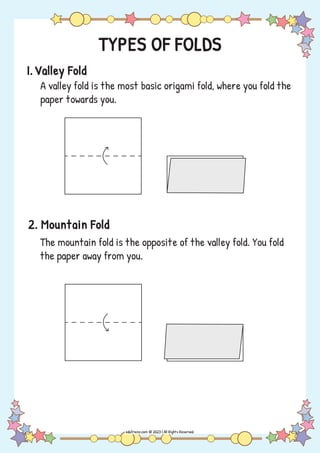
1.Valley Fold
TYPES OF FOLDS
A valley fold is the most basic origami fold, where you fold the
paper towards you.
The mountain fold is the opposite of the valley fold. You fold
the paper away from you.
2. Mountain Fold
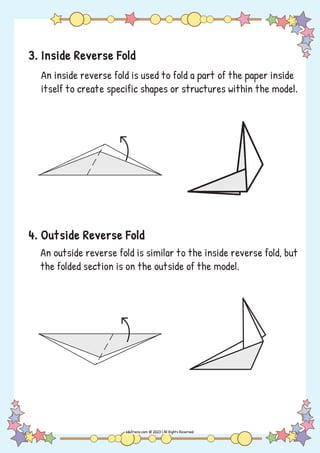
An outside reverse fold is similar to the inside reverse fold, but
the folded section is on the outside of the model.
An inside reverse fold is used to fold a part of the paper inside
itself to create specific shapes or structures within the model.
4. Outside Reverse Fold
3. Inside Reverse Fold
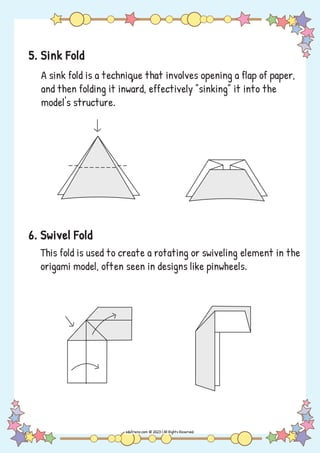
This fold is used to create a rotating or swiveling element in the
origami model, often seen in designs like pinwheels.
A sink fold is a technique that involves opening a flap of paper,
and then folding it inward, effectively "sinking" it into the
model's structure.
6. Swivel Fold
5. Sink Fold
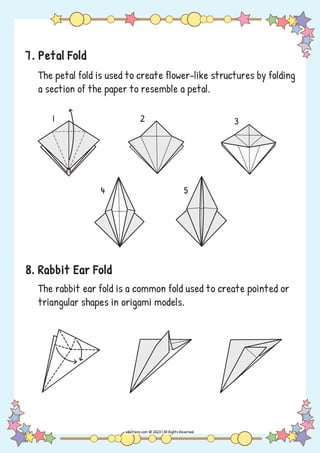
The petal fold is used to create flower-like structures by folding
a section of the paper to resemble a petal.
7. Petal Fold
1 2 3
4 5
The rabbit ear fold is a common fold used to create pointed or
triangular shapes in origami models.
8. Rabbit Ear Fold
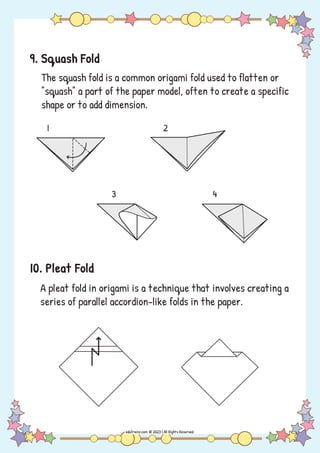
A pleat fold in origami is a technique that involves creating a
series of parallel accordion-like folds in the paper.
10. Pleat Fold
The squash fold is a common origami fold used to flatten or
"squash" a part of the paper model, often to create a specific
shape or to add dimension.
9. Squash Fold
1 2
4
3
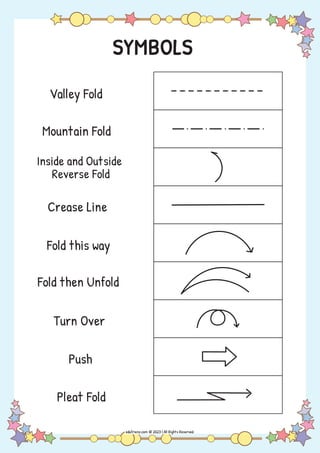
SYMBOLS
Valley Fold
Mountain Fold
Inside and Outside
Reverse Fold
Crease Line
Fold this way
Fold then Unfold
Turn Over
Push
Pleat Fold
EDUFRIENZ
Marketed and Distributed by:
Edufrienz 99 Pte. Ltd.
edufrienz.com © 2023 | All Rights Reserved
No part of this book may be reproduced or used in any matter,
stored in any retrieval system, or tansmitted in any form by any
means - Electronic, Mechanical, Photocopy, Recording, or
otherwise without written permission of the copyright owner
except for the use of quotation in a book review.
www.edufrienz.com
Edufrienz and all related trademarks and characters TM & © 2023
Edufrienz 99 Pte. Ltd.
All Rights Reserved. Used with Permission.

Origami Folding Symbols – Digital Printable

  • 1.
    Types of Folds andSymbols Origami EDUFRIENZ
  • 2.
    Introduction This edition ispart of Edufrienz’s library of learning and activities worksheets. We have specially created this exclusive content to support your children's learning and development purposes. This Origami Types of Folds and Symbols worksheet is designed to provide children with a fun and informative introduction to the art of paper folding. This serves as a foundation for understanding the fundamental types of folds and symbols used in origami. No. of Pages: 5 Recommended for Ages: 5-9 years old Activity Outcome: Enhance your child’s imagination as they become familiar with basic folds, they can experiment and apply these techniques to create their own origami designs, fostering creativity and self-expression.
  • 3.
    1.Valley Fold TYPES OFFOLDS A valley fold is the most basic origami fold, where you fold the paper towards you. The mountain fold is the opposite of the valley fold. You fold the paper away from you. 2. Mountain Fold
  • 4.
    An outside reversefold is similar to the inside reverse fold, but the folded section is on the outside of the model. An inside reverse fold is used to fold a part of the paper inside itself to create specific shapes or structures within the model. 4. Outside Reverse Fold 3. Inside Reverse Fold
  • 5.
    This fold isused to create a rotating or swiveling element in the origami model, often seen in designs like pinwheels. A sink fold is a technique that involves opening a flap of paper, and then folding it inward, effectively "sinking" it into the model's structure. 6. Swivel Fold 5. Sink Fold
  • 6.
    The petal foldis used to create flower-like structures by folding a section of the paper to resemble a petal. 7. Petal Fold 1 2 3 4 5 The rabbit ear fold is a common fold used to create pointed or triangular shapes in origami models. 8. Rabbit Ear Fold
  • 7.
    A pleat foldin origami is a technique that involves creating a series of parallel accordion-like folds in the paper. 10. Pleat Fold The squash fold is a common origami fold used to flatten or "squash" a part of the paper model, often to create a specific shape or to add dimension. 9. Squash Fold 1 2 4 3
  • 8.
    SYMBOLS Valley Fold Mountain Fold Insideand Outside Reverse Fold Crease Line Fold this way Fold then Unfold Turn Over Push Pleat Fold
  • 9.
    EDUFRIENZ Marketed and Distributedby: Edufrienz 99 Pte. Ltd. edufrienz.com © 2023 | All Rights Reserved No part of this book may be reproduced or used in any matter, stored in any retrieval system, or tansmitted in any form by any means - Electronic, Mechanical, Photocopy, Recording, or otherwise without written permission of the copyright owner except for the use of quotation in a book review. www.edufrienz.com Edufrienz and all related trademarks and characters TM & © 2023 Edufrienz 99 Pte. Ltd. All Rights Reserved. Used with Permission.