Organizational
Structure
Organizational
Structure
 An organizational structure identifies responsibilities
for each job position and the relationships among
those positions.
Purpose and
Types of
Organizational
Structure
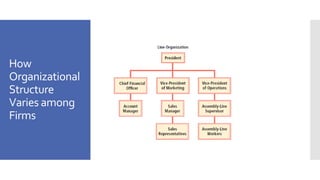
 A firm’s organizational structure can be illustrated with an
organization chart, which shows the interaction among job
positions.This chart indicates the chain of command, which
identifies the job positions to which all types of employees must
report.
How
Organizational
Structure
Varies among
Firms
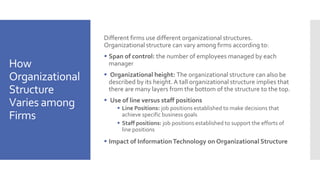
Different firms use different organizational structures.
Organizational structure can vary among firms according to:
 Span of control: the number of employees managed by each
manager
 Organizational height: The organizational structure can also be
described by its height. A tall organizational structure implies that
there are many layers from the bottom of the structure to the top.
 Use of line versus staff positions
 Line Positions: job positions established to make decisions that
achieve specific business goals
 Staff positions: job positions established to support the efforts of
line positions
 Impact of InformationTechnology on Organizational Structure
How
Organizational
Structure
Varies among
Firms
How
Organizational
Structure
Varies among
Firms
How
Organizational
Structure
Varies among
Firms
Accountability
in an
Organizational
Structure
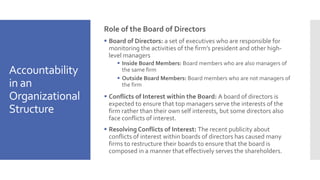
Role of the Board of Directors
 Board of Directors: a set of executives who are responsible for
monitoring the activities of the firm’s president and other high-
level managers
 Inside Board Members: Board members who are also managers of
the same firm
 Outside Board Members: Board members who are not managers of
the firm
 Conflicts of Interest within the Board: A board of directors is
expected to ensure that top managers serve the interests of the
firm rather than their own self interests, but some directors also
face conflicts of interest.
 Resolving Conflicts of Interest: The recent publicity about
conflicts of interest within boards of directors has caused many
firms to restructure their boards to ensure that the board is
composed in a manner that effectively serves the shareholders.
Accountability
in an
Organizational
Structure
 Board Committees: Committees made up of members of the
board of directors have been given specific assignments to ensure
proper oversight of the firm.
 Compensation Committee: Reviews existing salaries and
compensation formulas for high-level managers, including the CEO.
 Nominating Committee: Assesses whether the existing board
members have the knowledge and skills necessary to be effective;
makes recommendations to the board of directors about the size
and composition of the board.
 Audit Committee: Oversees the hiring and work of an external
auditor that audits the firm’s financial statements.
Oversight of
the Internal
Auditor
 Internal auditor: responsible for ensuring that all departments
follow the firm’s guidelines and procedures
 Internal Control Process: It is a system that generates timely and
accurate reporting of financial information and establishes
controls over that information.
Distributing
Authority
among theJob
Positions
 Centralization: most authority is held by the high-level managers
 Decentralization: authority is spread among several divisions or
managers
 Autonomy: An extreme form of decentralization is autonomy, in
which divisions are permitted to make their own decisions and act
independently.
Distributing
Authority
among theJob
Positions
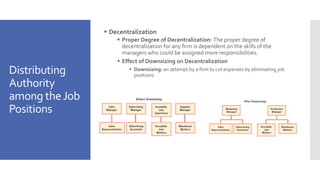
 Decentralization
 Advantages
 Decentralization reduces operating expenses because salaries of some
employees who are no longer needed are eliminated.
 Second, decentralization can shorten the decision-making process
because lower-level employees are assigned more power.
 Third, delegation of authority can improve the morale of employees,
who may be more enthusiastic about their work if they have more
responsibilities.
 Disadvantages
 It could force some managers to make major decisions even though
they lack the experience to make such decisions or prefer not to do so.
 Also, if middle and supervisory managers are assigned an excessive
amount of responsibilities, they may be unable to complete all of their
tasks.
Distributing
Authority
among theJob
Positions
 Decentralization
 Proper Degree of Decentralization: The proper degree of
decentralization for any firm is dependent on the skills of the
managers who could be assigned more responsibilities.
 Effect of Downsizing on Decentralization
 Downsizing: an attempt by a firm to cut expenses by eliminating job
positions
Structures
ThatAllow
More
Employee
Input
 Matrix organization
 Intrapreneurship
 Informal organizational structure
Structures
ThatAllow
More
Employee
Input
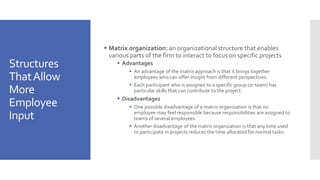
 Matrix organization: an organizational structure that enables
various parts of the firm to interact to focus on specific projects
 Advantages
 An advantage of the matrix approach is that it brings together
employees who can offer insight from different perspectives.
 Each participant who is assigned to a specific group (or team) has
particular skills that can contribute to the project.
 Disadvantages
 One possible disadvantage of a matrix organization is that no
employee may feel responsible because responsibilities are assigned to
teams of several employees.
 Another disadvantage of the matrix organization is that any time used
to participate in projects reduces the time allocated for normal tasks.
Structures
ThatAllow
More
Employee
Input
 Intrapreneurship: the assignment of particular employees of a
firm to generate ideas, as if they were entrepreneurs running their
own firms
 Intrapreneurship is likely to be more successful if employees are
rewarded with some type of bonus for innovations that are
ultimately applied by the firm.
 The firm should also attempt to ensure that any ideas that
employees develop are seriously considered.
Structures
ThatAllow
More
Employee
Input
 Informal Organizational Structure: an informal communications
network among a firm’s employees
 Communication: A firm may take steps to develop an informal
organizational structure to encourage communication between
managers and employees in a less formal environment.
 Advantages
 Disadvantages
Methods of
Departmentali
zingTasks
 Departmentalize: assign tasks and responsibilities to different
departments
 By function
 By product
 By location
 By customer
Thank you

Organizational Structure.pptx

  • 1.
  • 2.
    Organizational Structure  An organizationalstructure identifies responsibilities for each job position and the relationships among those positions.
  • 3.
    Purpose and Types of Organizational Structure A firm’s organizational structure can be illustrated with an organization chart, which shows the interaction among job positions.This chart indicates the chain of command, which identifies the job positions to which all types of employees must report.
  • 4.
    How Organizational Structure Varies among Firms Different firmsuse different organizational structures. Organizational structure can vary among firms according to:  Span of control: the number of employees managed by each manager  Organizational height: The organizational structure can also be described by its height. A tall organizational structure implies that there are many layers from the bottom of the structure to the top.  Use of line versus staff positions  Line Positions: job positions established to make decisions that achieve specific business goals  Staff positions: job positions established to support the efforts of line positions  Impact of InformationTechnology on Organizational Structure
  • 5.
  • 6.
  • 7.
  • 8.
    Accountability in an Organizational Structure Role ofthe Board of Directors  Board of Directors: a set of executives who are responsible for monitoring the activities of the firm’s president and other high- level managers  Inside Board Members: Board members who are also managers of the same firm  Outside Board Members: Board members who are not managers of the firm  Conflicts of Interest within the Board: A board of directors is expected to ensure that top managers serve the interests of the firm rather than their own self interests, but some directors also face conflicts of interest.  Resolving Conflicts of Interest: The recent publicity about conflicts of interest within boards of directors has caused many firms to restructure their boards to ensure that the board is composed in a manner that effectively serves the shareholders.
  • 9.
    Accountability in an Organizational Structure  BoardCommittees: Committees made up of members of the board of directors have been given specific assignments to ensure proper oversight of the firm.  Compensation Committee: Reviews existing salaries and compensation formulas for high-level managers, including the CEO.  Nominating Committee: Assesses whether the existing board members have the knowledge and skills necessary to be effective; makes recommendations to the board of directors about the size and composition of the board.  Audit Committee: Oversees the hiring and work of an external auditor that audits the firm’s financial statements.
  • 10.
    Oversight of the Internal Auditor Internal auditor: responsible for ensuring that all departments follow the firm’s guidelines and procedures  Internal Control Process: It is a system that generates timely and accurate reporting of financial information and establishes controls over that information.
  • 11.
    Distributing Authority among theJob Positions  Centralization:most authority is held by the high-level managers  Decentralization: authority is spread among several divisions or managers  Autonomy: An extreme form of decentralization is autonomy, in which divisions are permitted to make their own decisions and act independently.
  • 12.
    Distributing Authority among theJob Positions  Decentralization Advantages  Decentralization reduces operating expenses because salaries of some employees who are no longer needed are eliminated.  Second, decentralization can shorten the decision-making process because lower-level employees are assigned more power.  Third, delegation of authority can improve the morale of employees, who may be more enthusiastic about their work if they have more responsibilities.  Disadvantages  It could force some managers to make major decisions even though they lack the experience to make such decisions or prefer not to do so.  Also, if middle and supervisory managers are assigned an excessive amount of responsibilities, they may be unable to complete all of their tasks.
  • 13.
    Distributing Authority among theJob Positions  Decentralization Proper Degree of Decentralization: The proper degree of decentralization for any firm is dependent on the skills of the managers who could be assigned more responsibilities.  Effect of Downsizing on Decentralization  Downsizing: an attempt by a firm to cut expenses by eliminating job positions
  • 14.
    Structures ThatAllow More Employee Input  Matrix organization Intrapreneurship  Informal organizational structure
  • 15.
    Structures ThatAllow More Employee Input  Matrix organization:an organizational structure that enables various parts of the firm to interact to focus on specific projects  Advantages  An advantage of the matrix approach is that it brings together employees who can offer insight from different perspectives.  Each participant who is assigned to a specific group (or team) has particular skills that can contribute to the project.  Disadvantages  One possible disadvantage of a matrix organization is that no employee may feel responsible because responsibilities are assigned to teams of several employees.  Another disadvantage of the matrix organization is that any time used to participate in projects reduces the time allocated for normal tasks.
  • 16.
    Structures ThatAllow More Employee Input  Intrapreneurship: theassignment of particular employees of a firm to generate ideas, as if they were entrepreneurs running their own firms  Intrapreneurship is likely to be more successful if employees are rewarded with some type of bonus for innovations that are ultimately applied by the firm.  The firm should also attempt to ensure that any ideas that employees develop are seriously considered.
  • 17.
    Structures ThatAllow More Employee Input  Informal OrganizationalStructure: an informal communications network among a firm’s employees  Communication: A firm may take steps to develop an informal organizational structure to encourage communication between managers and employees in a less formal environment.  Advantages  Disadvantages
  • 18.
    Methods of Departmentali zingTasks  Departmentalize:assign tasks and responsibilities to different departments  By function  By product  By location  By customer
  • 19.