Organizational Communication Balancing
Creativity and Constraint 8th Edition Eisenberg
Test Bank download

https://testbankfan.com/product/organizational-communication-
balancing-creativity-and-constraint-8th-edition-eisenberg-test-
bank/
Visit testbankfan.com today to download the complete set of
test bank or solution manual
We believe these products will be a great fit for you. Click
the link to download now, or visit testbankfan.com
to discover even more!
Organizational Communication Balancing Creativity and
Constraint 8th Edition Eisenberg Solutions Manual
https://testbankfan.com/product/organizational-communication-
balancing-creativity-and-constraint-8th-edition-eisenberg-solutions-
manual/
Organizational Communication Balancing Creativity and
Constraint 7th Edition Eisenberg Test Bank
https://testbankfan.com/product/organizational-communication-
balancing-creativity-and-constraint-7th-edition-eisenberg-test-bank/
Organizational Communication Balancing Creativity and
Constraint 7th Edition Eisenberg Solutions Manual
https://testbankfan.com/product/organizational-communication-
balancing-creativity-and-constraint-7th-edition-eisenberg-solutions-
manual/
Principles of Economics 6th Edition Frank Test Bank
https://testbankfan.com/product/principles-of-economics-6th-edition-
frank-test-bank/
Taxation of Individuals 5th Edition Spilker Solutions
Manual
https://testbankfan.com/product/taxation-of-individuals-5th-edition-
spilker-solutions-manual/
Principles of Economics 1st Edition Mateer Test Bank
https://testbankfan.com/product/principles-of-economics-1st-edition-
mateer-test-bank/
Guide to TCP IP 4th Edition Carrell Test Bank
https://testbankfan.com/product/guide-to-tcp-ip-4th-edition-carrell-
test-bank/
Accounting What the Numbers Mean 9th Edition Marshall
Solutions Manual
https://testbankfan.com/product/accounting-what-the-numbers-mean-9th-
edition-marshall-solutions-manual/
Advertising and Promotion An Integrated Marketing
Communications Perspective 11th Edition Belch Solutions
Manual
https://testbankfan.com/product/advertising-and-promotion-an-
integrated-marketing-communications-perspective-11th-edition-belch-
solutions-manual/
Marketing for Hospitality and Tourism 7th Edition Kotler
Test Bank
https://testbankfan.com/product/marketing-for-hospitality-and-
tourism-7th-edition-kotler-test-bank/
Page 1
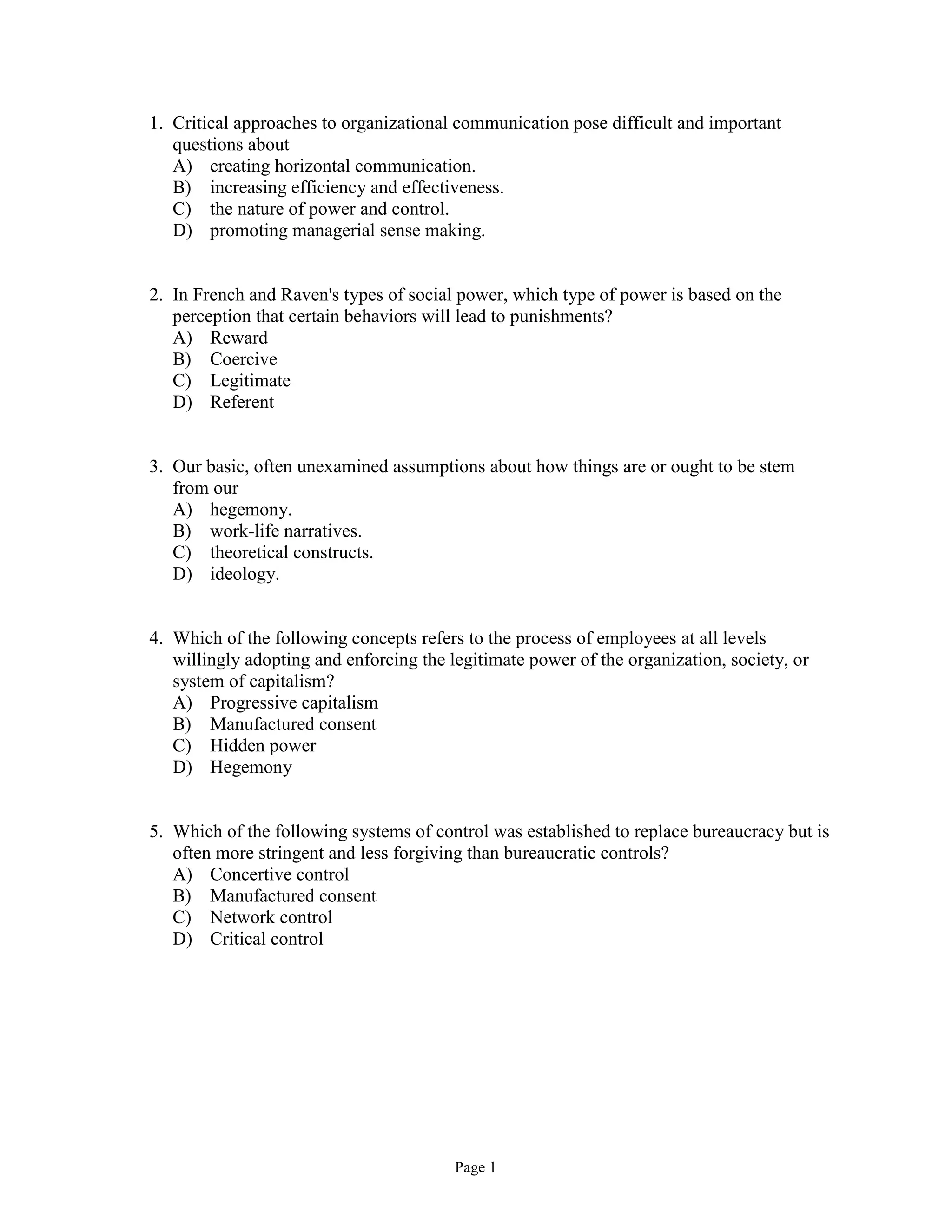
1. Critical approaches to organizational communication pose difficult and important
questions about
A) creating horizontal communication.
B) increasing efficiency and effectiveness.
C) the nature of power and control.
D) promoting managerial sense making.
2. In French and Raven's types of social power, which type of power is based on the
perception that certain behaviors will lead to punishments?
A) Reward
B) Coercive
C) Legitimate
D) Referent
3. Our basic, often unexamined assumptions about how things are or ought to be stem
from our
A) hegemony.
B) work-life narratives.
C) theoretical constructs.
D) ideology.
4. Which of the following concepts refers to the process of employees at all levels
willingly adopting and enforcing the legitimate power of the organization, society, or
system of capitalism?
A) Progressive capitalism
B) Manufactured consent
C) Hidden power
D) Hegemony
5. Which of the following systems of control was established to replace bureaucracy but is
often more stringent and less forgiving than bureaucratic controls?
A) Concertive control
B) Manufactured consent
C) Network control
D) Critical control
Page 2
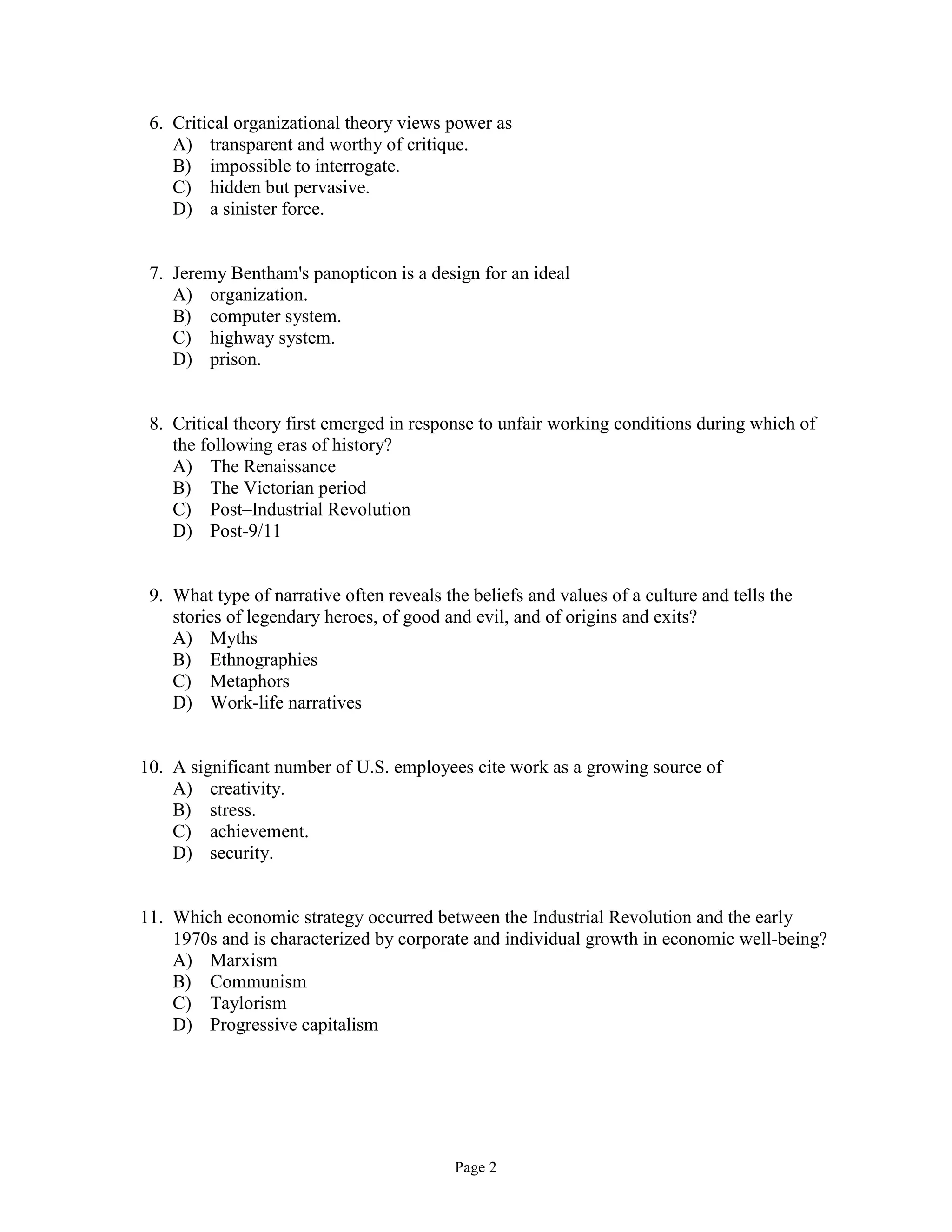
6. Critical organizational theory views power as
A) transparent and worthy of critique.
B) impossible to interrogate.
C) hidden but pervasive.
D) a sinister force.
7. Jeremy Bentham's panopticon is a design for an ideal
A) organization.
B) computer system.
C) highway system.
D) prison.
8. Critical theory first emerged in response to unfair working conditions during which of
the following eras of history?
A) The Renaissance
B) The Victorian period
C) Post–Industrial Revolution
D) Post-9/11
9. What type of narrative often reveals the beliefs and values of a culture and tells the
stories of legendary heroes, of good and evil, and of origins and exits?
A) Myths
B) Ethnographies
C) Metaphors
D) Work-life narratives
10. A significant number of U.S. employees cite work as a growing source of
A) creativity.
B) stress.
C) achievement.
D) security.
11. Which economic strategy occurred between the Industrial Revolution and the early
1970s and is characterized by corporate and individual growth in economic well-being?
A) Marxism
B) Communism
C) Taylorism
D) Progressive capitalism
Page 3
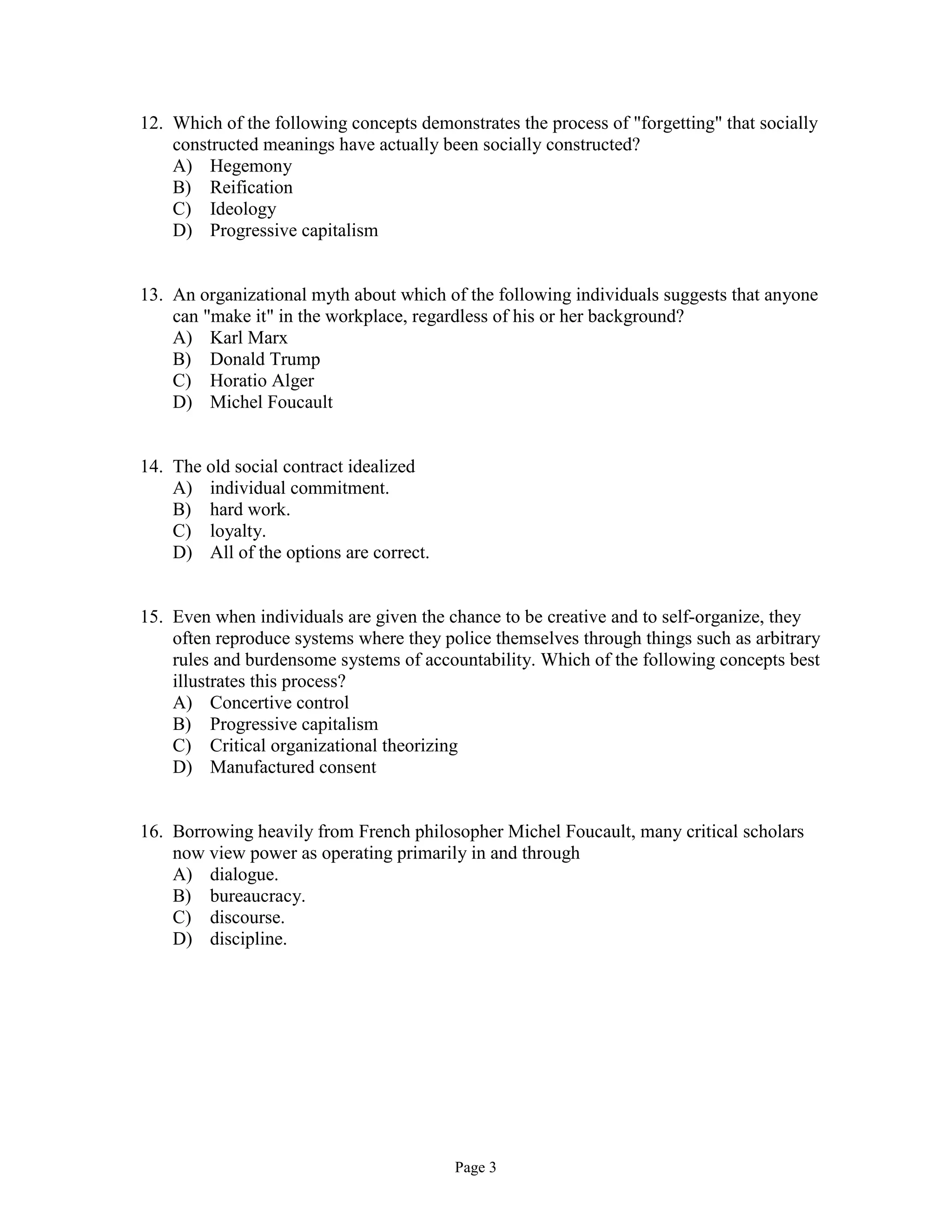
12. Which of the following concepts demonstrates the process of "forgetting" that socially
constructed meanings have actually been socially constructed?
A) Hegemony
B) Reification
C) Ideology
D) Progressive capitalism
13. An organizational myth about which of the following individuals suggests that anyone
can "make it" in the workplace, regardless of his or her background?
A) Karl Marx
B) Donald Trump
C) Horatio Alger
D) Michel Foucault
14. The old social contract idealized
A) individual commitment.
B) hard work.
C) loyalty.
D) All of the options are correct.
15. Even when individuals are given the chance to be creative and to self-organize, they
often reproduce systems where they police themselves through things such as arbitrary
rules and burdensome systems of accountability. Which of the following concepts best
illustrates this process?
A) Concertive control
B) Progressive capitalism
C) Critical organizational theorizing
D) Manufactured consent
16. Borrowing heavily from French philosopher Michel Foucault, many critical scholars
now view power as operating primarily in and through
A) dialogue.
B) bureaucracy.
C) discourse.
D) discipline.
Page 4
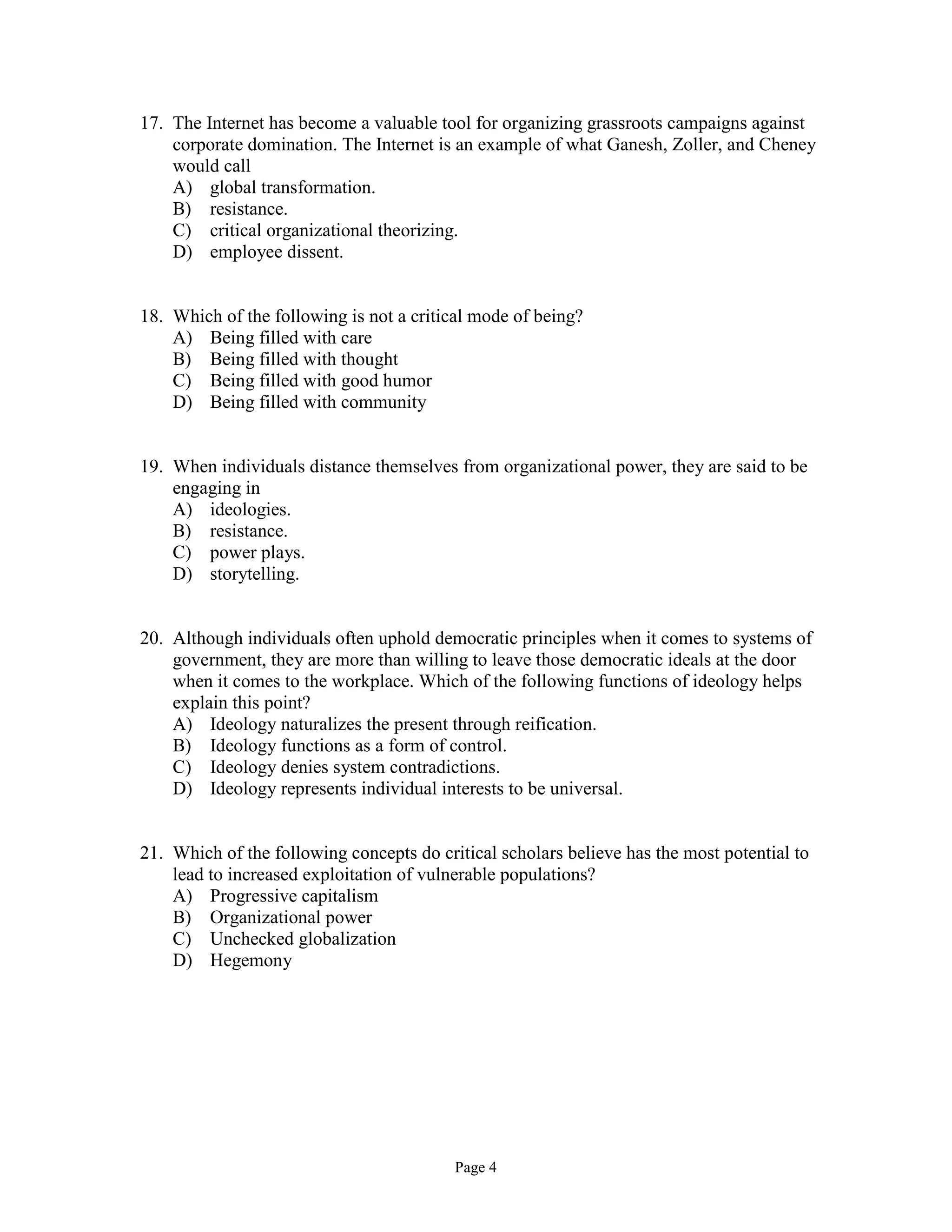
17. The Internet has become a valuable tool for organizing grassroots campaigns against
corporate domination. The Internet is an example of what Ganesh, Zoller, and Cheney
would call
A) global transformation.
B) resistance.
C) critical organizational theorizing.
D) employee dissent.
18. Which of the following is not a critical mode of being?
A) Being filled with care
B) Being filled with thought
C) Being filled with good humor
D) Being filled with community
19. When individuals distance themselves from organizational power, they are said to be
engaging in
A) ideologies.
B) resistance.
C) power plays.
D) storytelling.
20. Although individuals often uphold democratic principles when it comes to systems of
government, they are more than willing to leave those democratic ideals at the door
when it comes to the workplace. Which of the following functions of ideology helps
explain this point?
A) Ideology naturalizes the present through reification.
B) Ideology functions as a form of control.
C) Ideology denies system contradictions.
D) Ideology represents individual interests to be universal.
21. Which of the following concepts do critical scholars believe has the most potential to
lead to increased exploitation of vulnerable populations?
A) Progressive capitalism
B) Organizational power
C) Unchecked globalization
D) Hegemony
Page 5
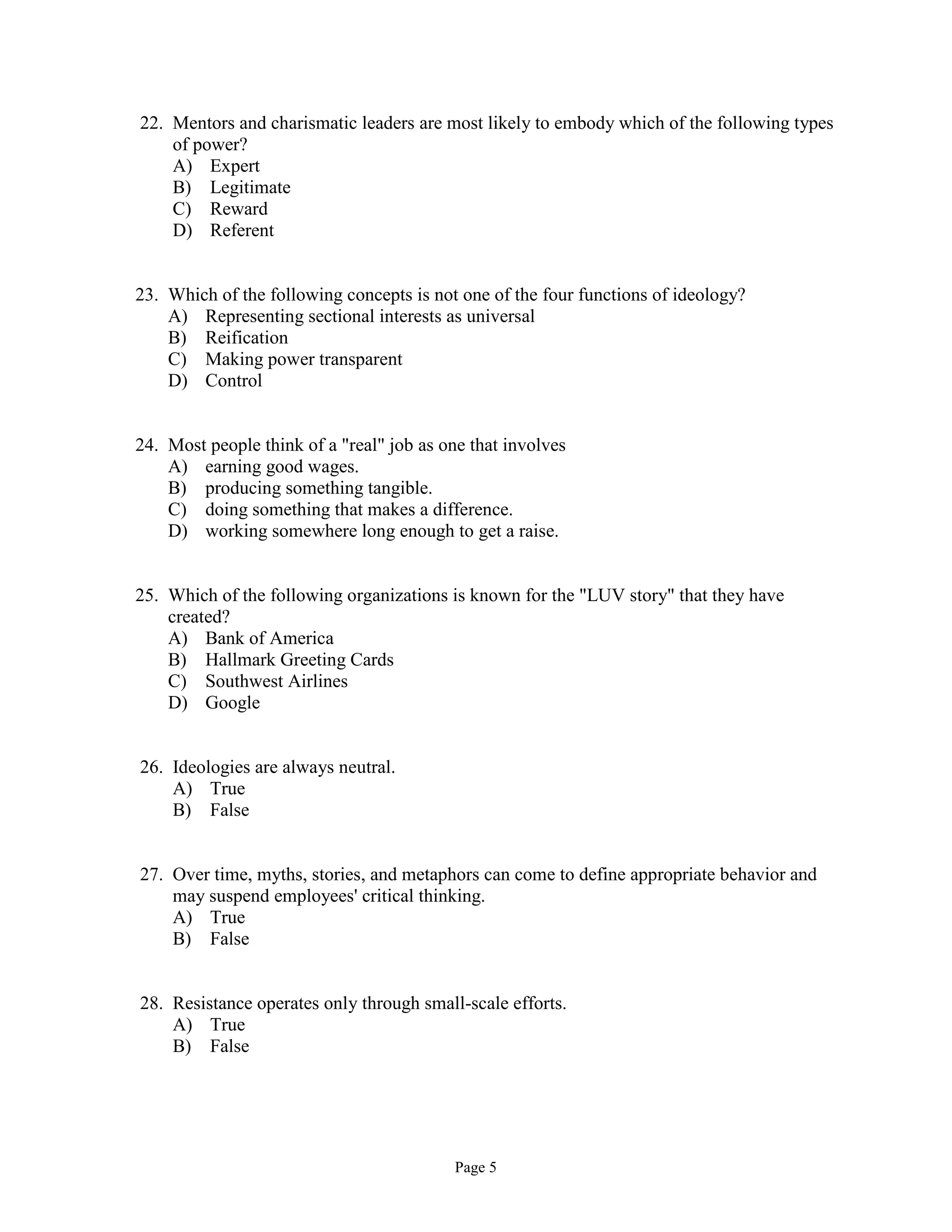
22. Mentors and charismatic leaders are most likely to embody which of the following types
of power?
A) Expert
B) Legitimate
C) Reward
D) Referent
23. Which of the following concepts is not one of the four functions of ideology?
A) Representing sectional interests as universal
B) Reification
C) Making power transparent
D) Control
24. Most people think of a "real" job as one that involves
A) earning good wages.
B) producing something tangible.
C) doing something that makes a difference.
D) working somewhere long enough to get a raise.
25. Which of the following organizations is known for the "LUV story" that they have
created?
A) Bank of America
B) Hallmark Greeting Cards
C) Southwest Airlines
D) Google
26. Ideologies are always neutral.
A) True
B) False
27. Over time, myths, stories, and metaphors can come to define appropriate behavior and
may suspend employees' critical thinking.
A) True
B) False
28. Resistance operates only through small-scale efforts.
A) True
B) False
Page 6
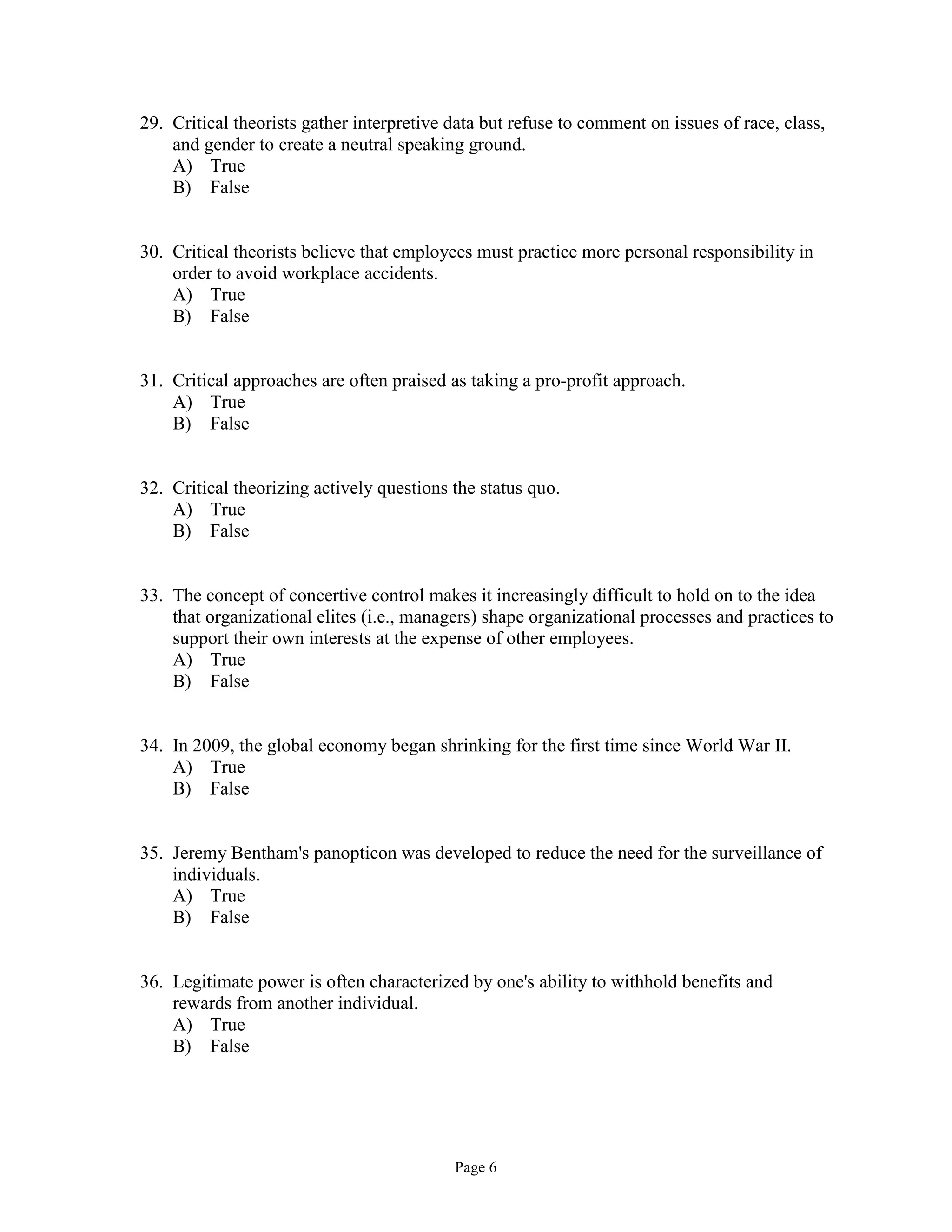
29. Critical theorists gather interpretive data but refuse to comment on issues of race, class,
and gender to create a neutral speaking ground.
A) True
B) False
30. Critical theorists believe that employees must practice more personal responsibility in
order to avoid workplace accidents.
A) True
B) False
31. Critical approaches are often praised as taking a pro-profit approach.
A) True
B) False
32. Critical theorizing actively questions the status quo.
A) True
B) False
33. The concept of concertive control makes it increasingly difficult to hold on to the idea
that organizational elites (i.e., managers) shape organizational processes and practices to
support their own interests at the expense of other employees.
A) True
B) False
34. In 2009, the global economy began shrinking for the first time since World War II.
A) True
B) False
35. Jeremy Bentham's panopticon was developed to reduce the need for the surveillance of
individuals.
A) True
B) False
36. Legitimate power is often characterized by one's ability to withhold benefits and
rewards from another individual.
A) True
B) False
Page 7
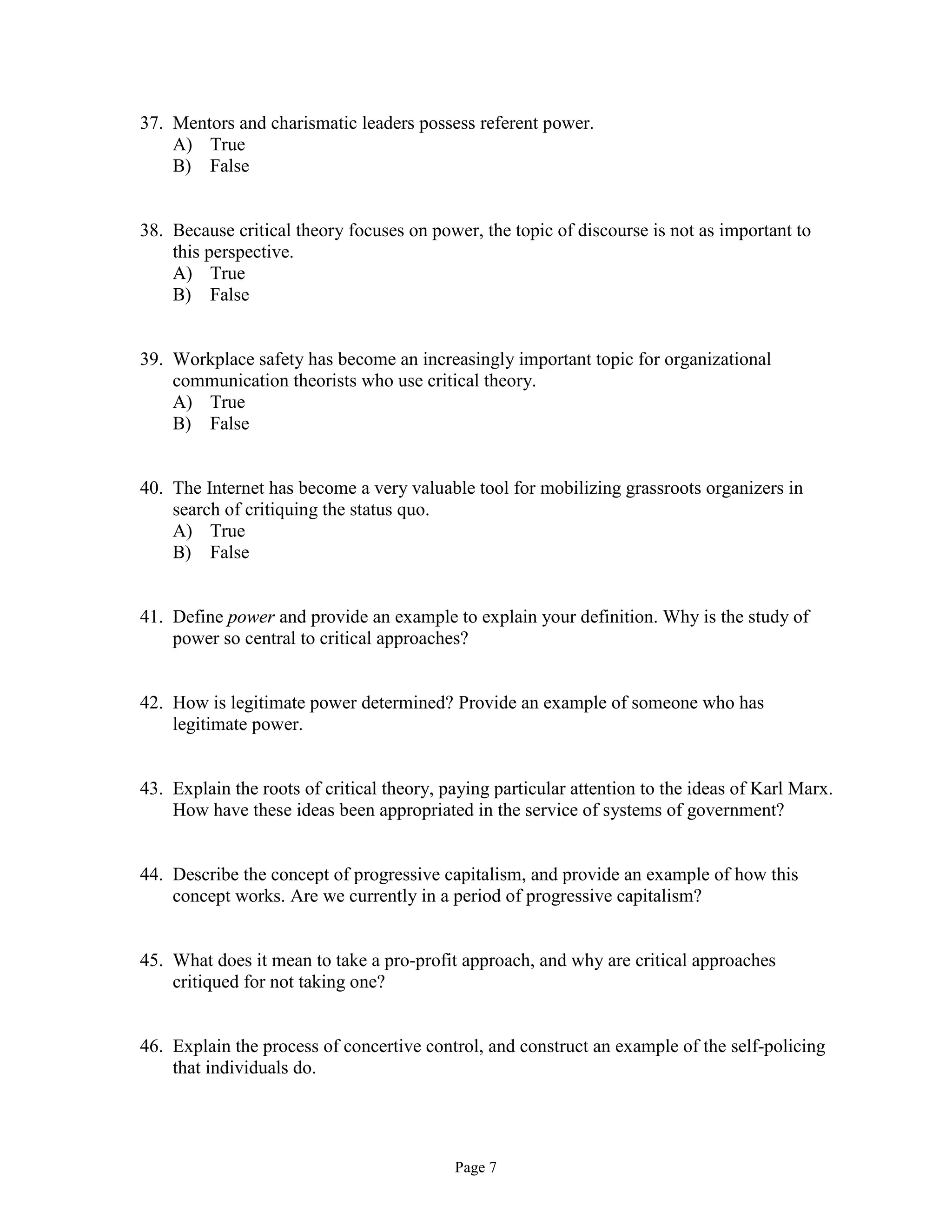
37. Mentors and charismatic leaders possess referent power.
A) True
B) False
38. Because critical theory focuses on power, the topic of discourse is not as important to
this perspective.
A) True
B) False
39. Workplace safety has become an increasingly important topic for organizational
communication theorists who use critical theory.
A) True
B) False
40. The Internet has become a very valuable tool for mobilizing grassroots organizers in
search of critiquing the status quo.
A) True
B) False
41. Define power and provide an example to explain your definition. Why is the study of
power so central to critical approaches?
42. How is legitimate power determined? Provide an example of someone who has
legitimate power.
43. Explain the roots of critical theory, paying particular attention to the ideas of Karl Marx.
How have these ideas been appropriated in the service of systems of government?
44. Describe the concept of progressive capitalism, and provide an example of how this
concept works. Are we currently in a period of progressive capitalism?
45. What does it mean to take a pro-profit approach, and why are critical approaches
critiqued for not taking one?
46. Explain the process of concertive control, and construct an example of the self-policing
that individuals do.
Page 8
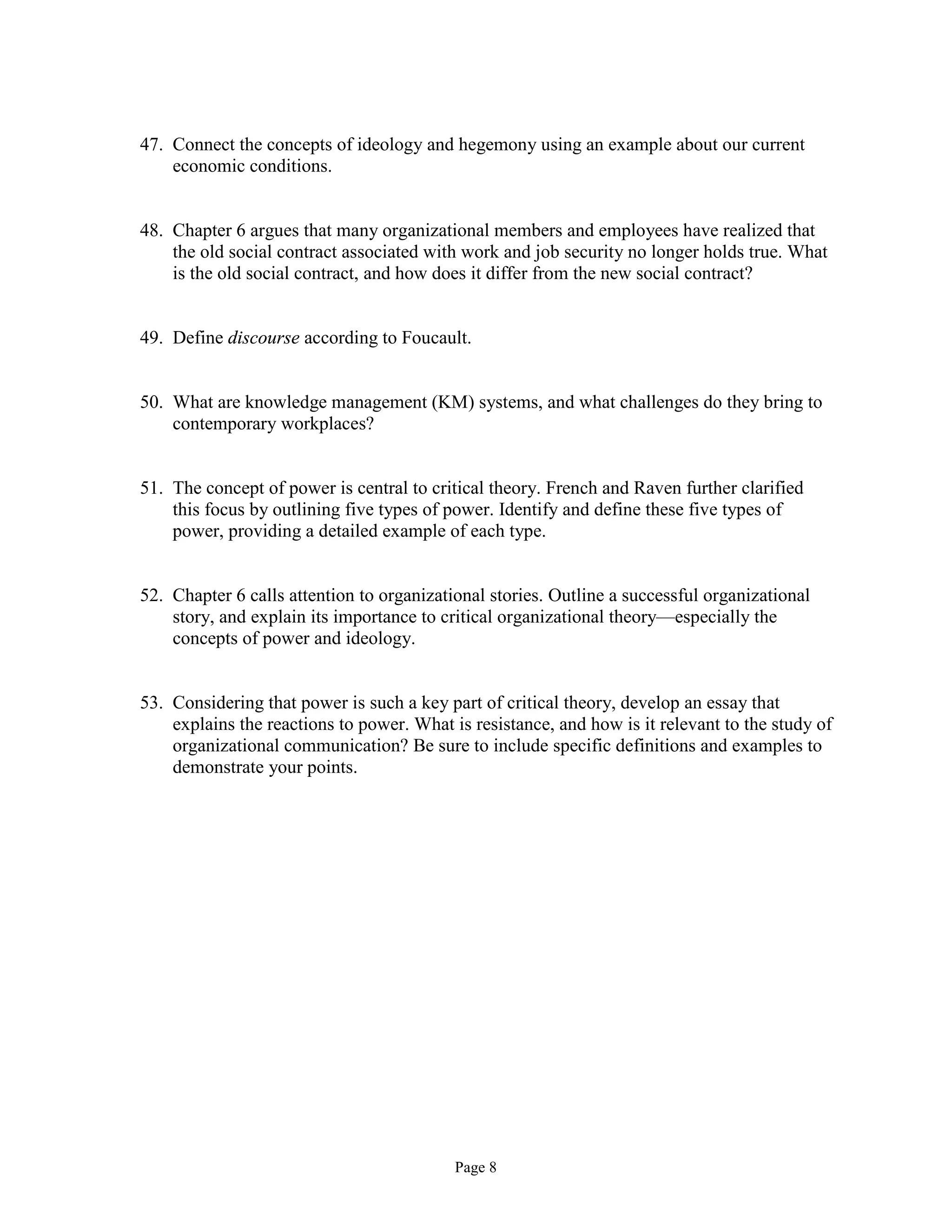
47. Connect the concepts of ideology and hegemony using an example about our current
economic conditions.
48. Chapter 6 argues that many organizational members and employees have realized that
the old social contract associated with work and job security no longer holds true. What
is the old social contract, and how does it differ from the new social contract?
49. Define discourse according to Foucault.
50. What are knowledge management (KM) systems, and what challenges do they bring to
contemporary workplaces?
51. The concept of power is central to critical theory. French and Raven further clarified
this focus by outlining five types of power. Identify and define these five types of
power, providing a detailed example of each type.
52. Chapter 6 calls attention to organizational stories. Outline a successful organizational
story, and explain its importance to critical organizational theory—especially the
concepts of power and ideology.
53. Considering that power is such a key part of critical theory, develop an essay that
explains the reactions to power. What is resistance, and how is it relevant to the study of
organizational communication? Be sure to include specific definitions and examples to
demonstrate your points.
Page 9
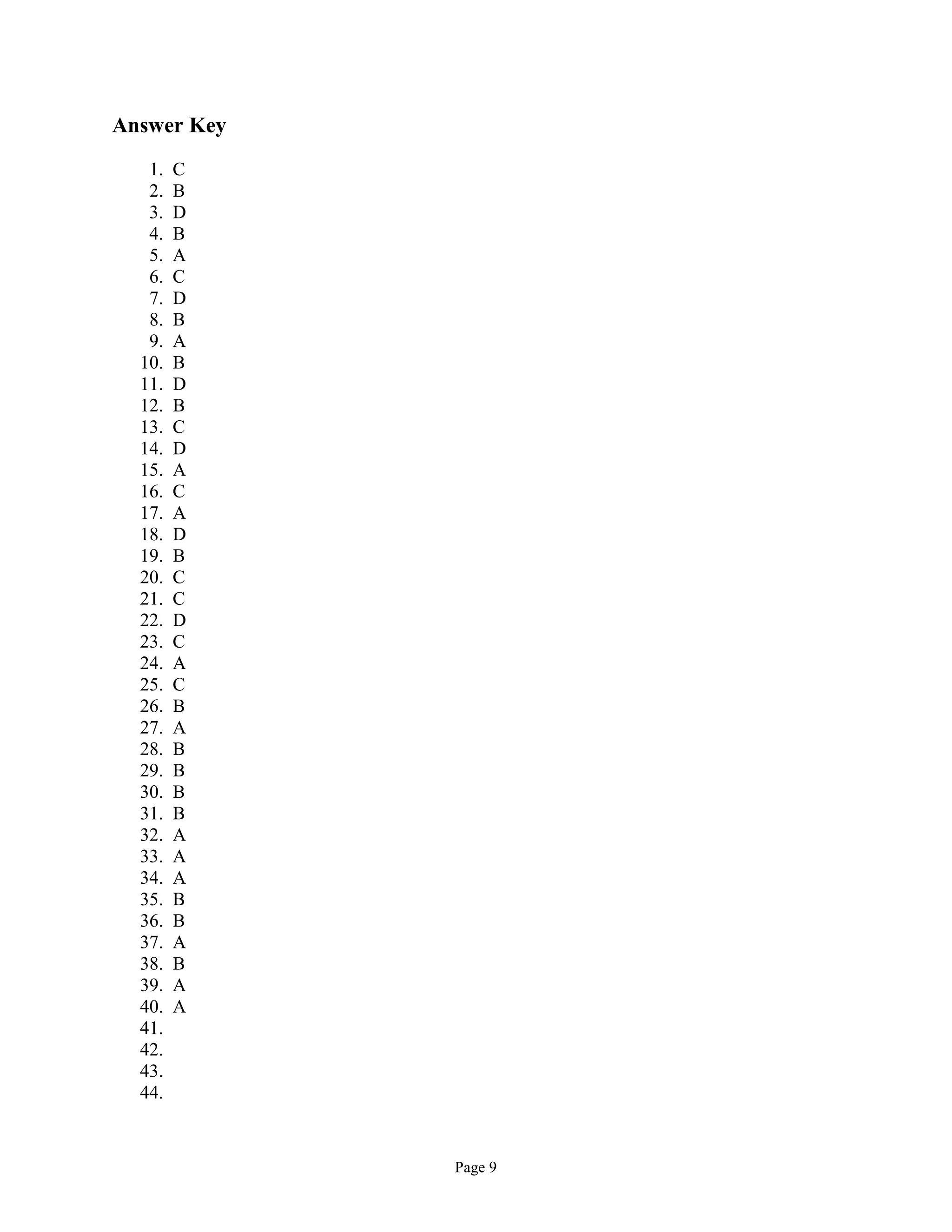
Answer Key
1. C
2. B
3. D
4. B
5. A
6. C
7. D
8. B
9. A
10. B
11. D
12. B
13. C
14. D
15. A
16. C
17. A
18. D
19. B
20. C
21. C
22. D
23. C
24. A
25. C
26. B
27. A
28. B
29. B
30. B
31. B
32. A
33. A
34. A
35. B
36. B
37. A
38. B
39. A
40. A
41.
42.
43.
44.
Page 10
45.
46.
47.
48.
49.
50.
51.
52.
53.
Other documents randomly have
different content
CHAPTER XXVII.
ALL QUIET.
Frank expected to meet an officer at the station when he reached
Dundee late that night, for he fancied Riddle, intending to keep up
the game, would telegraph ahead for his arrest.
When he stepped down from the train, Merry looked around for
the expected sheriff or policeman.
No one was there to meet him.
He was pretty tired, and so he took a carriage to a hotel, where
he registered, and asked if he could get something to eat. It was
long past the supper hour, but he was able to obtain a lunch, which
satisfied him very well.
Next Frank sent a telegram to Barnaby Haley, and then sat down
and wrote a letter, telling briefly his adventures since starting out as
advance man for the company.
By this time it was pretty late, and he decided to retire and get
some sleep.
He was filled with wonder because he had not been molested in
Dundee, but decided that Riddle had resolved to come on himself
and see to the matter.
Fully convinced that there would be more trouble for him in the
morning, he went to his room.
As he was preparing to go to bed, he thought of Cassie and his
last talk with her.
“Poor girl!” thought Frank. “I wonder if she really prayed to-night
and tried to go through her part without the stimulation of
morphine. It is too bad that the accursed drug should get such a
hold on such a girl. She said she would pray for me.”
He was about to jump into bed when another thought came to
him.
“I said I would pray for her!”
Down beside the bed Frank Merriwell knelt. He bowed his head,
and his lips moved in a whispered prayer.
Who can say that prayer was not heard—and answered?
For all of the exciting adventures of the day, Frank was soon
sleeping soundly.
He was aroused by a sharp knocking on his door.
“Hello!” he muttered, as he sat up. “Here’s the trouble I’ve been
expecting! They might have let me sleep till morning. Wonder if they
will take me to some wretched lockup and give me a buggy bunk. If
they do, I’ll have to stay up the rest of the night. I enjoy excitement,
but I draw the line at night encounters with bugs.”
He got up leisurely.
Rat-tat-tat!
The person outside the door was getting impatient.
“Don’t be in such a hurry,” called Merry, placidly. “I won’t jump out
of the window.”
“Let me in!”
“Directly.”
Frank struck a match and lighted the gas. Then, in his nightgown,
he opened the door.
A man dodged in quickly.
“Shut the door!” he ordered, his voice and manner betraying
agitation.
“What’s the matter?” asked Frank, in surprise.
“Lock it—lock it!”
The stranger took hold of the key and turned it himself.
Frank’s surprise increased.
“Well,” he said, looking the man over, “will you be good enough to
tell me what this means?”
“I want to see you.”
“All right. Take a good look at me.”
“Your name’s Merriwell?”
“Sure thing.”
“New man ahead of the ‘Empire Theater Comedy Company’?”
“Right again.”
“I’m Collins.”
Frank jumped.
“Collins?” he cried—“Weston Collins?”
“Yes.”
Frank had never seen the former advance man of the company, so
it was not strange he had not known Collins.
“Well,” he said, sitting down on the edge of the bed and staring
hard at the intruder, “what in the name of all that’s bad are you
doing here?”
“I came in a little while ago. Saw your name on the register. You
registered with the name of the company attached, so I knew you
must be the man Haley had sent out to fill my place. I came up to
see you.”
“Did King send you?”
“King! What made you think so?”
“On account of your telegram.”
“Telegram to whom?”
“Mr. Haley.”
“What telegram?”
“The one you sent from Salacia.”
“Never sent any.”
“What?”
Frank was surprised and incredulous. Was this more trickery?
“Never sent Haley a telegram,” declared Collins. “Did he receive
one?”
“Yes.”
“My name signed?”
“Just that.”
“Fake! King did it—or somebody representing King.”
Merry was doubtful.
“What did it say?” asked Collins.
Frank told him, and the former advance man showed anger.
“Just like King!” he cried. “He hates Haley, and he will do anything
to torment the old man.”
“But—but you dropped the work in Salacia. Manager of the opera
house heard our company had gone up. He put King’s paper right up
over what you had put up for us. Why did you do that way?”
Collins hesitated a little, and then, walking up and down, he
began:
“Look here, Merriwell, I want to set myself straight, but I don’t
know how to do it. That’s why I’m here. I’m taking all chances of
being arrested.”
“Arrested?”
“Yes. It’s like this: I got into some trouble out here in this country
once, and had to skip. I’ve kept it quiet all my life—never told
anybody about it. King knew it, because he was with me at the time.
I changed my name. Collins is not my right name. When Haley
decided to book this section, I tried to persuade him not to do it.
Didn’t want to come here. Had to come or throw up my job.
Thought I might get into the county and out again without being
recognized. Could have done it, but when King heard we were
having a hard time to hold the show together, he believed he could
knock the company out by driving me off. He gave me an hour to
get out of Salacia before he put the officers on me. I was scared and
made a run for it. He must have had his advance man send the
telegram from Salacia. I suppose he has told everything, and they
are looking for me; but I made up my mind I’d go back and see
Haley. That’s why I’m here. I’ve got back this far. Registered here to-
night under a fake name. Have telegraphed Haley myself. Did that as
soon as I got over my scare. That’s the whole thing in a nutshell. I
won’t be able to stay with the company, and I’m glad they had a
man to send right out in my place.”
Frank had been watching the man as he told the story, and Merry
was convinced that Collins was not lying. He could see that the
fellow was just recovering from the effects of too much liquor, which
helped serve to explain his singular conduct in taking flight without
notifying Haley.
Merry talked with Collins for at least two hours, telling him
everything that had happened since he started out in advance of the
show.
Collins complimented him on his ability and the manner in which
he had gotten the best of Delvin Riddle.
“It is my opinion,” he said, “that Riddle is thoroughly disgusted
over the attempt to side track you, and I don’t fancy you’ll have any
more trouble with him. He has found out that you are up to snuff
and too smart for him. It is quite probable that, when he got back in
Salacia, he made a find that caused him to withdraw that warrant
from the hands of the sheriff.”
“What sort of a find?”
“The stolen watch.”
Frank brightened.
“I understand!” he exclaimed. “Riddle may have done that in order
to avoid being detained himself.”
“Just that. He’s liable to be on here to-morrow, and you’ll soon
find out if he’s going to let you alone. I shall get out of town the first
thing in the morning, and I’ll lay low till I can rejoin the company
somewhere outside the State.”
Everything turned out just as Collins had fancied it would. Riddle
appeared the following day, but he did not even seem to see
Merriwell. Frank was not molested then or afterward by Julian King’s
agent.
After this Frank found that work on the road as an advance agent
was a great deal easier than it had appeared at the start. In
defeating the schemes of his rivals he had overcome the greatest
difficulties of his new career, and though he found other obstacles
from time to time, he met them with the same steady courage that
was sure to win in the end.
He proved one of the finest advance agents that had ever traveled
for Haley, and made a host of friends wherever he went.
THE END.
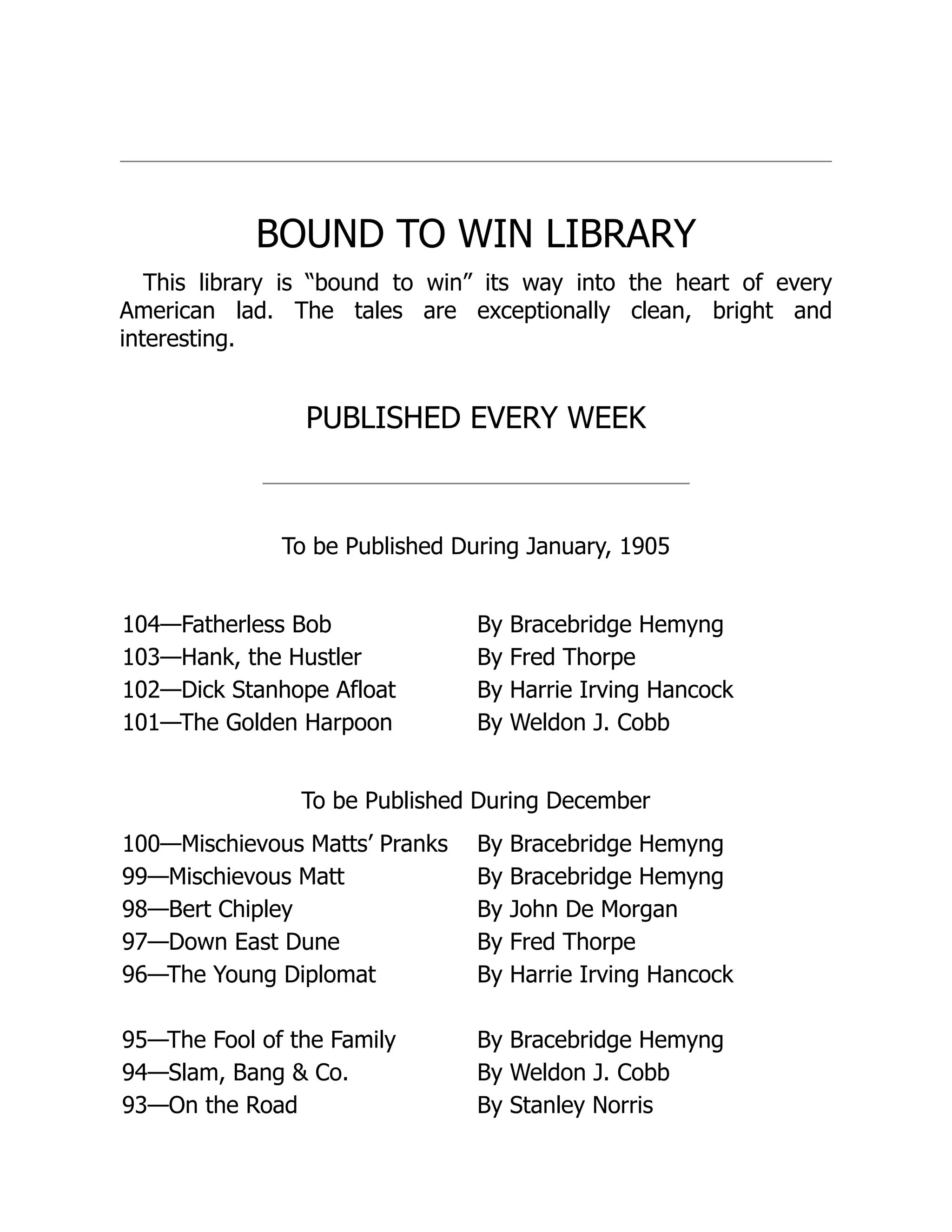
BOUND TO WIN LIBRARY
This library is “bound to win” its way into the heart of every
American lad. The tales are exceptionally clean, bright and
interesting.
PUBLISHED EVERY WEEK
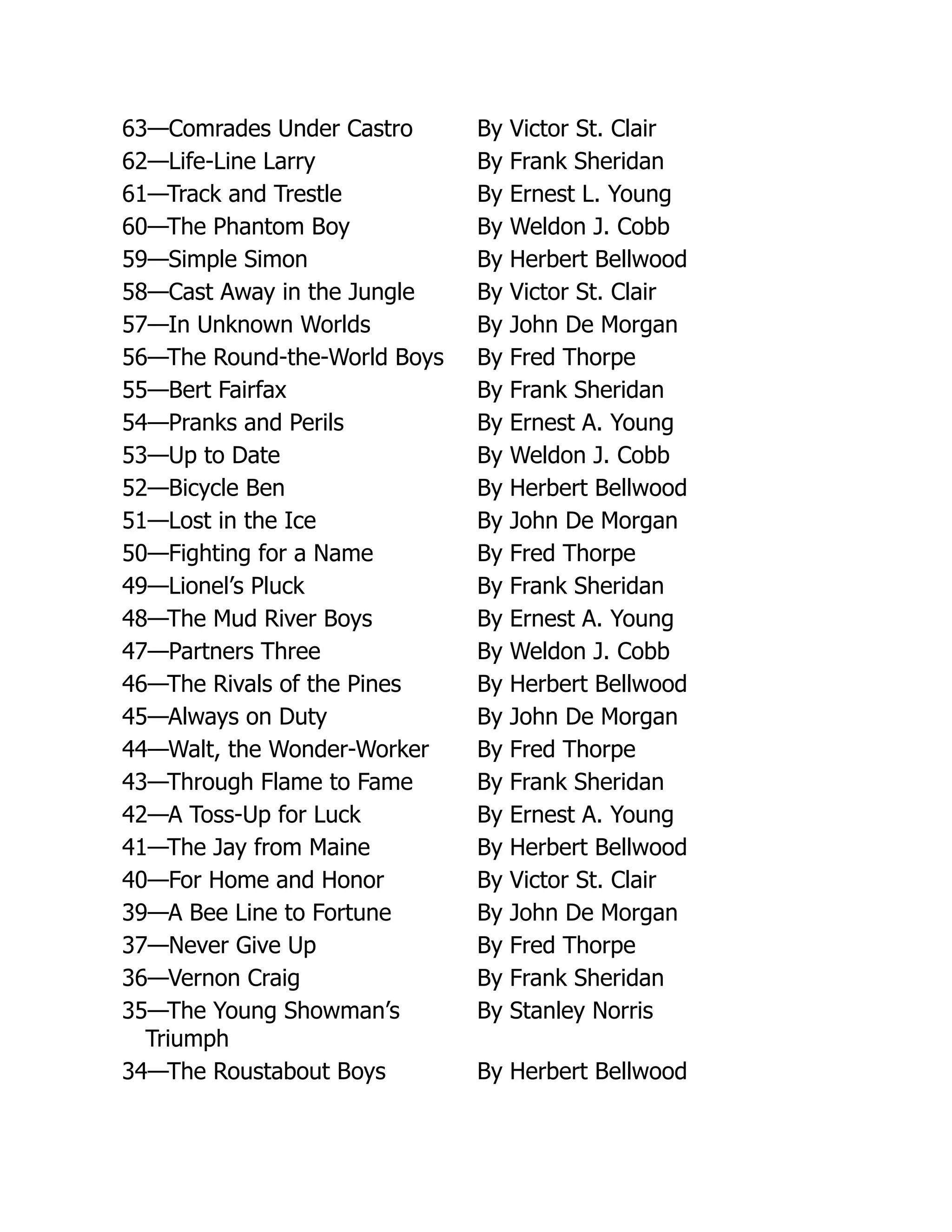
To be Published During January, 1905
104—Fatherless Bob By Bracebridge Hemyng
103—Hank, the Hustler By Fred Thorpe
102—Dick Stanhope Afloat By Harrie Irving Hancock
101—The Golden Harpoon By Weldon J. Cobb
To be Published During December
100—Mischievous Matts’ Pranks By Bracebridge Hemyng
99—Mischievous Matt By Bracebridge Hemyng
98—Bert Chipley By John De Morgan
97—Down East Dune By Fred Thorpe
96—The Young Diplomat By Harrie Irving Hancock
95—The Fool of the Family By Bracebridge Hemyng
94—Slam, Bang & Co. By Weldon J. Cobb
93—On the Road By Stanley Norris
92—The Blood-Red Hand By John De Morgan
91—The Diamond King By Cornelius Shea
90—The Double-Faced Mystery By Fred Thorpe
89—The Young Theatrical
Manager
By Stanley Norris
88—The Young West-Pointer By Harrie Irving Hancock
87—Held For Ransom. By Weldon J. Cobb
86—Boot-Black Bob By John De Morgan
85—Engineer Tom By Cornelius Shea
84—The Mascot of Hoodooville By Fred Thorpe
83—Walter Blackshaw By Frank Sheridan
82—The Young Showman’s
Foes
By Stanley Norris
81—On the Wing By Weldon J. Cobb
80—Yankee Grit By John De Morgan
79—Bicycle and Gun By Cornelius Shea
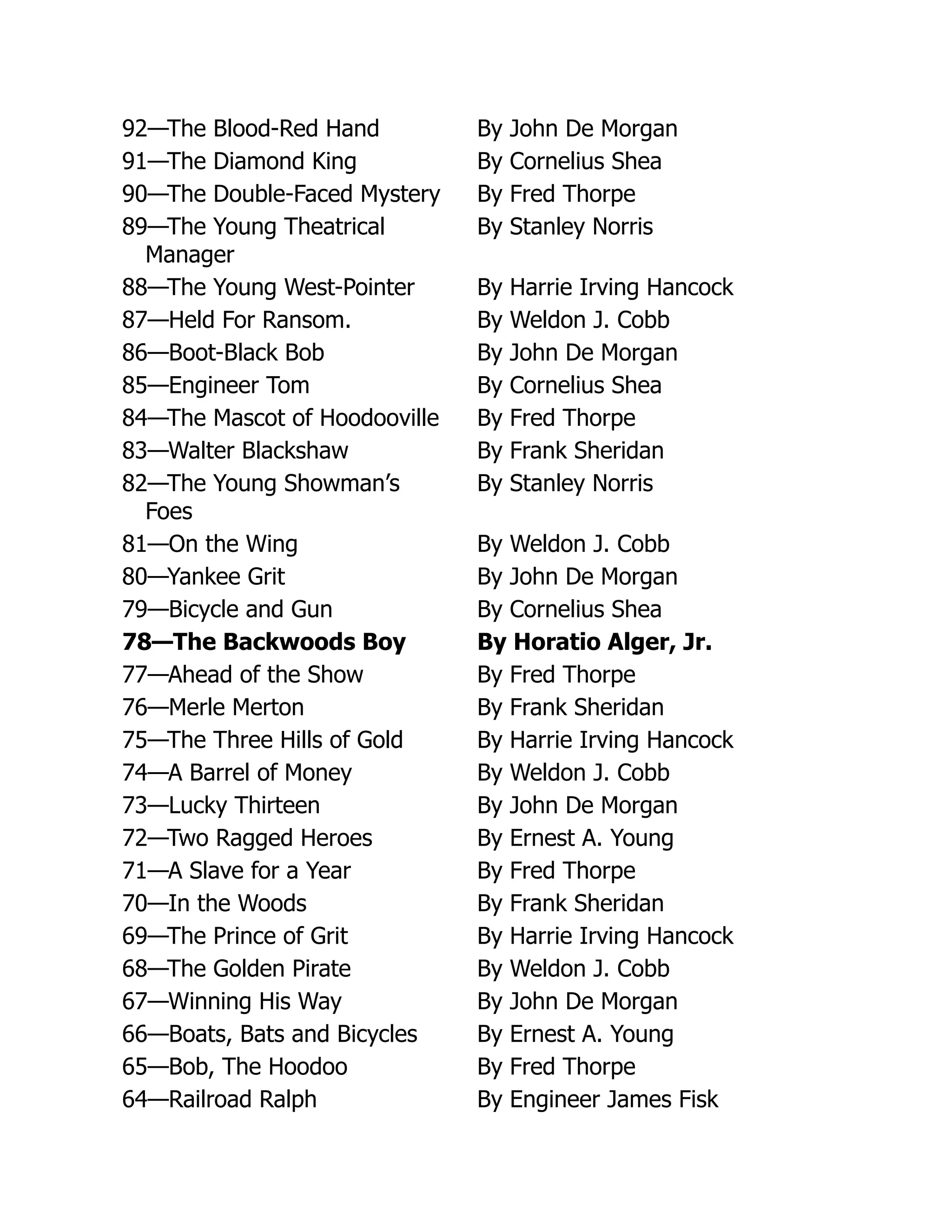
78—The Backwoods Boy By Horatio Alger, Jr.
77—Ahead of the Show By Fred Thorpe
76—Merle Merton By Frank Sheridan
75—The Three Hills of Gold By Harrie Irving Hancock
74—A Barrel of Money By Weldon J. Cobb
73—Lucky Thirteen By John De Morgan
72—Two Ragged Heroes By Ernest A. Young
71—A Slave for a Year By Fred Thorpe
70—In the Woods By Frank Sheridan
69—The Prince of Grit By Harrie Irving Hancock
68—The Golden Pirate By Weldon J. Cobb
67—Winning His Way By John De Morgan
66—Boats, Bats and Bicycles By Ernest A. Young
65—Bob, The Hoodoo By Fred Thorpe
64—Railroad Ralph By Engineer James Fisk
63—Comrades Under Castro By Victor St. Clair
62—Life-Line Larry By Frank Sheridan
61—Track and Trestle By Ernest L. Young
60—The Phantom Boy By Weldon J. Cobb
59—Simple Simon By Herbert Bellwood
58—Cast Away in the Jungle By Victor St. Clair
57—In Unknown Worlds By John De Morgan
56—The Round-the-World Boys By Fred Thorpe
55—Bert Fairfax By Frank Sheridan
54—Pranks and Perils By Ernest A. Young
53—Up to Date By Weldon J. Cobb
52—Bicycle Ben By Herbert Bellwood
51—Lost in the Ice By John De Morgan
50—Fighting for a Name By Fred Thorpe
49—Lionel’s Pluck By Frank Sheridan
48—The Mud River Boys By Ernest A. Young
47—Partners Three By Weldon J. Cobb
46—The Rivals of the Pines By Herbert Bellwood
45—Always on Duty By John De Morgan
44—Walt, the Wonder-Worker By Fred Thorpe
43—Through Flame to Fame By Frank Sheridan
42—A Toss-Up for Luck By Ernest A. Young
41—The Jay from Maine By Herbert Bellwood
40—For Home and Honor By Victor St. Clair
39—A Bee Line to Fortune By John De Morgan
37—Never Give Up By Fred Thorpe
36—Vernon Craig By Frank Sheridan
35—The Young Showman’s
Triumph
By Stanley Norris
34—The Roustabout Boys By Herbert Bellwood
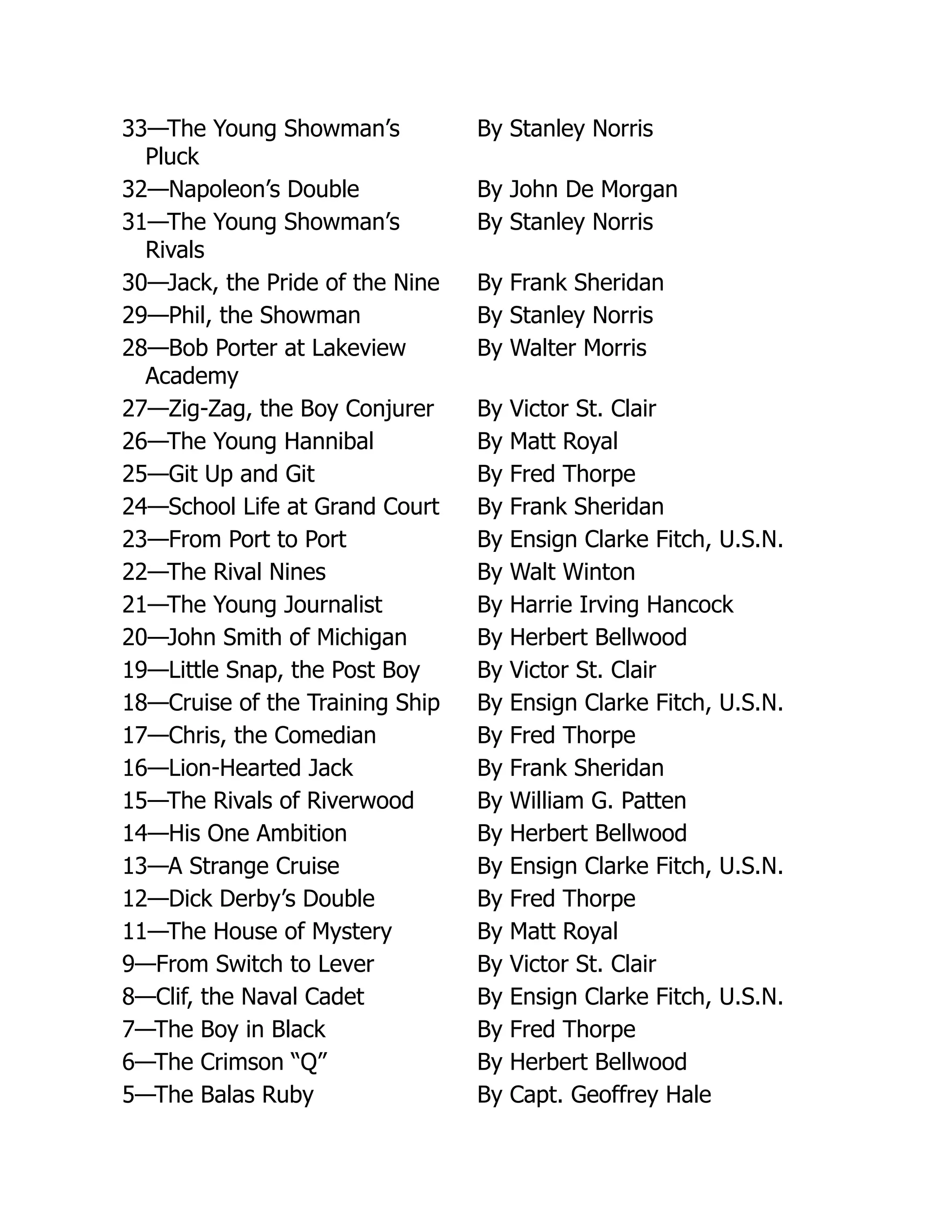
33—The Young Showman’s
Pluck
By Stanley Norris
32—Napoleon’s Double By John De Morgan
31—The Young Showman’s
Rivals
By Stanley Norris
30—Jack, the Pride of the Nine By Frank Sheridan
29—Phil, the Showman By Stanley Norris
28—Bob Porter at Lakeview
Academy
By Walter Morris
27—Zig-Zag, the Boy Conjurer By Victor St. Clair
26—The Young Hannibal By Matt Royal
25—Git Up and Git By Fred Thorpe
24—School Life at Grand Court By Frank Sheridan
23—From Port to Port By Ensign Clarke Fitch, U.S.N.
22—The Rival Nines By Walt Winton
21—The Young Journalist By Harrie Irving Hancock
20—John Smith of Michigan By Herbert Bellwood
19—Little Snap, the Post Boy By Victor St. Clair
18—Cruise of the Training Ship By Ensign Clarke Fitch, U.S.N.
17—Chris, the Comedian By Fred Thorpe
16—Lion-Hearted Jack By Frank Sheridan
15—The Rivals of Riverwood By William G. Patten
14—His One Ambition By Herbert Bellwood
13—A Strange Cruise By Ensign Clarke Fitch, U.S.N.
12—Dick Derby’s Double By Fred Thorpe
11—The House of Mystery By Matt Royal
9—From Switch to Lever By Victor St. Clair
8—Clif, the Naval Cadet By Ensign Clarke Fitch, U.S.N.
7—The Boy in Black By Fred Thorpe
6—The Crimson “Q” By Herbert Bellwood
5—The Balas Ruby By Capt. Geoffrey Hale
3—Bound for Annapolis By Ensign Clarke Fitch, U.S.N.
2—Blind Luck By Fred Thorpe
1—The Boy Argus By William G. Patten
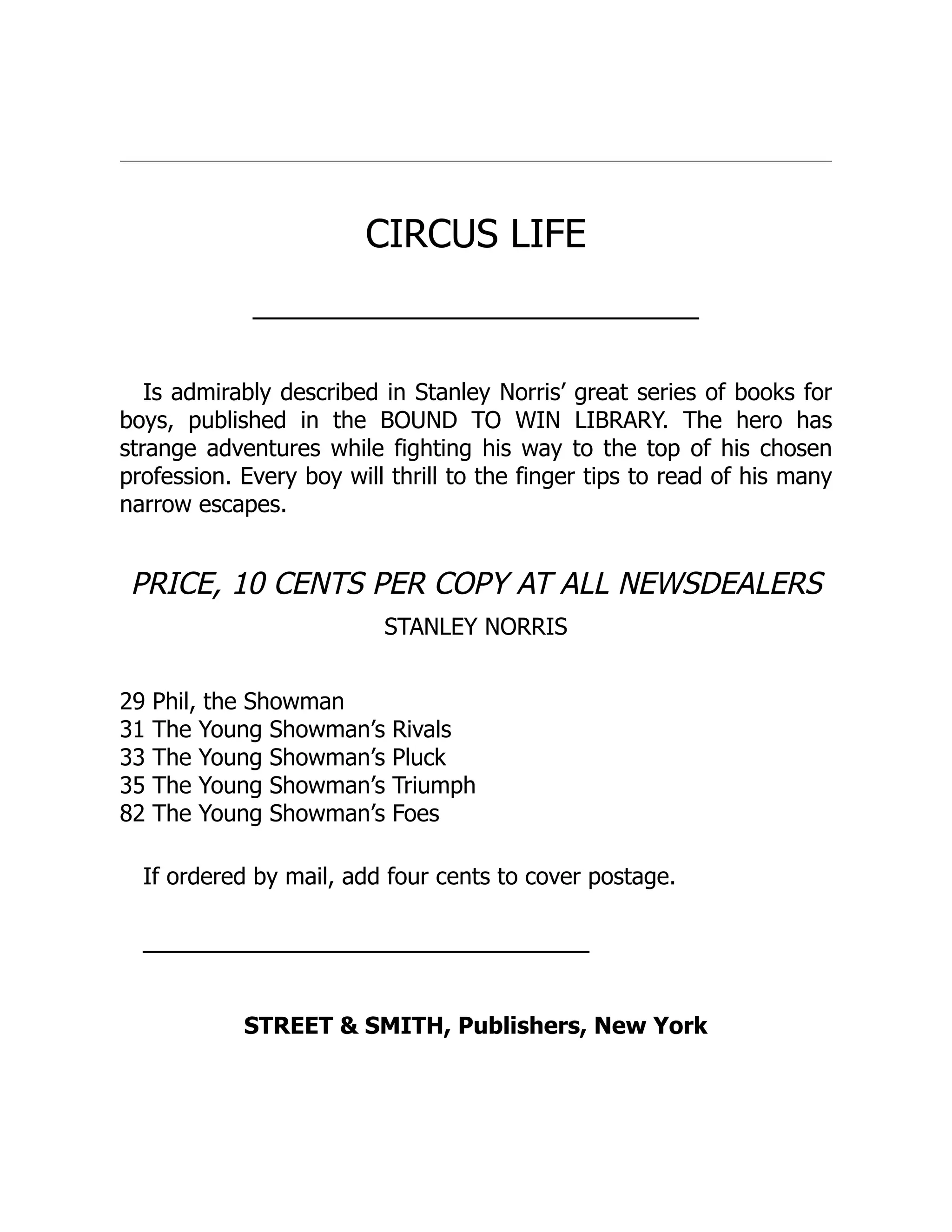
CIRCUS LIFE
───────────────────────────
Is admirably described in Stanley Norris’ great series of books for
boys, published in the BOUND TO WIN LIBRARY. The hero has
strange adventures while fighting his way to the top of his chosen
profession. Every boy will thrill to the finger tips to read of his many
narrow escapes.
PRICE, 10 CENTS PER COPY AT ALL NEWSDEALERS
STANLEY NORRIS
29 Phil, the Showman
31 The Young Showman’s Rivals
33 The Young Showman’s Pluck
35 The Young Showman’s Triumph
82 The Young Showman’s Foes
If ordered by mail, add four cents to cover postage.
───────────────────────────
STREET & SMITH, Publishers, New York
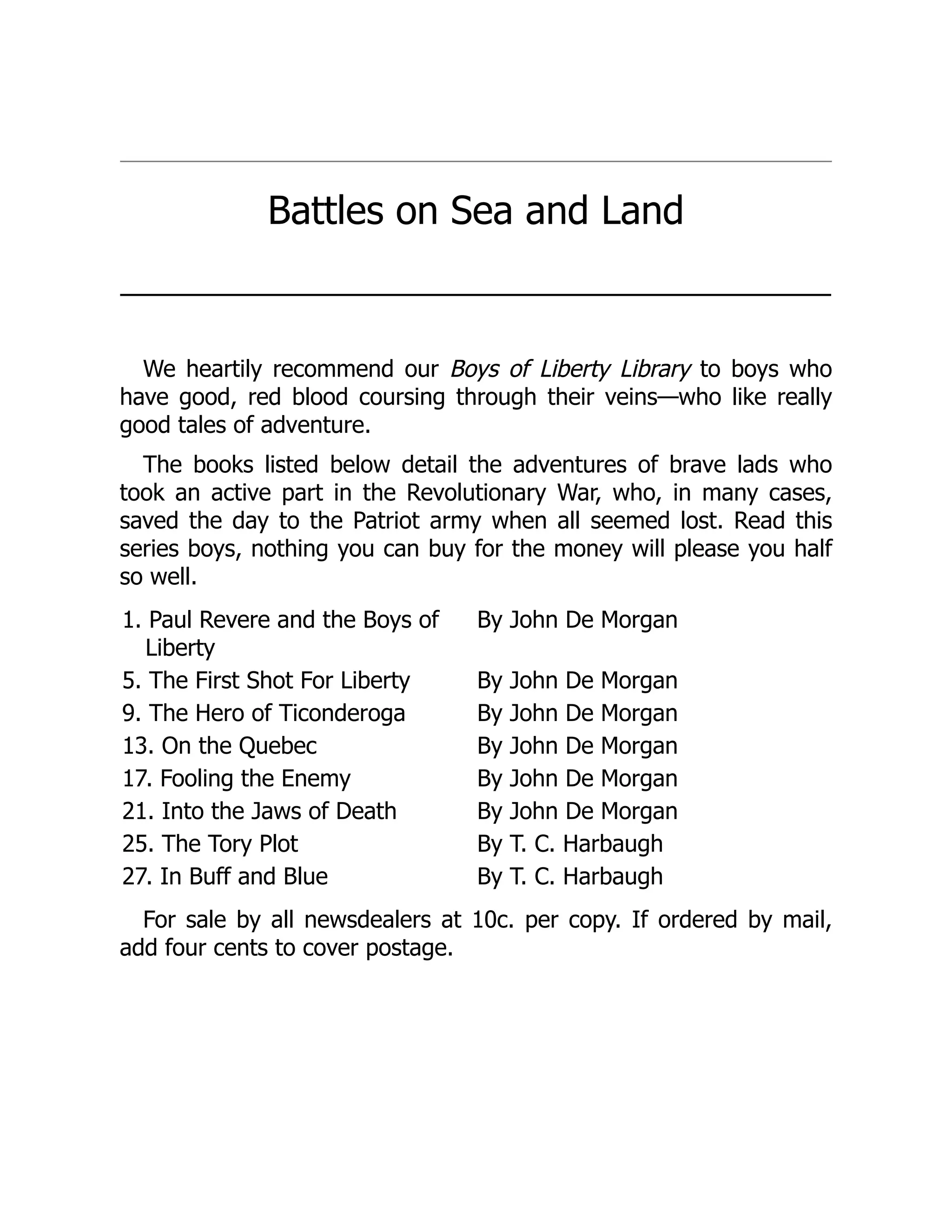
Battles on Sea and Land
───────────────────────────────────────────
We heartily recommend our Boys of Liberty Library to boys who
have good, red blood coursing through their veins—who like really
good tales of adventure.
The books listed below detail the adventures of brave lads who
took an active part in the Revolutionary War, who, in many cases,
saved the day to the Patriot army when all seemed lost. Read this
series boys, nothing you can buy for the money will please you half
so well.
1. Paul Revere and the Boys of
Liberty
By John De Morgan
5. The First Shot For Liberty By John De Morgan
9. The Hero of Ticonderoga By John De Morgan
13. On the Quebec By John De Morgan
17. Fooling the Enemy By John De Morgan
21. Into the Jaws of Death By John De Morgan
25. The Tory Plot By T. C. Harbaugh
27. In Buff and Blue By T. C. Harbaugh
For sale by all newsdealers at 10c. per copy. If ordered by mail,
add four cents to cover postage.
WEST POINT STORIES
───────────────────────────
One of the most interesting series of stories for boys is that which
details the adventures of Mark Malloy at West Point. No boy who
likes good, exciting tales of adventure should miss reading them.
Published only in THE MEDAL LIBRARY.
PRICE, 10 CENTS PER COPY
LIEUT. FREDERICK GARRISON, U.S.A.
214 On Guard
222 A West Point Treasure
230 Off for West Point
238 A Cadet’s Honor
248 The West Point Rivals
For Sale By All Newsdealers. If ordered by mail, add four cents to
cover postage.
───────────────────────────
Street & Smith, Publishers, New York
Transcriber’s Notes:
Missing or obscured punctuation was silently
corrected.
Typographical errors were silently corrected.
Inconsistent spelling and hyphenation were
made consistent only when a predominant
form was found in this book.
*** END OF THE PROJECT GUTENBERG EBOOK FRANK MERRIWELL
ON THE ROAD; OR, THE ALL-STAR COMBINATION ***
Updated editions will replace the previous one—the old editions
will be renamed.
Creating the works from print editions not protected by U.S.
copyright law means that no one owns a United States
copyright in these works, so the Foundation (and you!) can copy
and distribute it in the United States without permission and
without paying copyright royalties. Special rules, set forth in the
General Terms of Use part of this license, apply to copying and
distributing Project Gutenberg™ electronic works to protect the
PROJECT GUTENBERG™ concept and trademark. Project
Gutenberg is a registered trademark, and may not be used if
you charge for an eBook, except by following the terms of the
trademark license, including paying royalties for use of the
Project Gutenberg trademark. If you do not charge anything for
copies of this eBook, complying with the trademark license is
very easy. You may use this eBook for nearly any purpose such
as creation of derivative works, reports, performances and
research. Project Gutenberg eBooks may be modified and
printed and given away—you may do practically ANYTHING in
the United States with eBooks not protected by U.S. copyright
law. Redistribution is subject to the trademark license, especially
commercial redistribution.
START: FULL LICENSE
THE FULL PROJECT GUTENBERG LICENSE
PLEASE READ THIS BEFORE YOU DISTRIBUTE OR USE THIS WORK
To protect the Project Gutenberg™ mission of promoting the
free distribution of electronic works, by using or distributing this
work (or any other work associated in any way with the phrase
“Project Gutenberg”), you agree to comply with all the terms of
the Full Project Gutenberg™ License available with this file or
online at www.gutenberg.org/license.
Section 1. General Terms of Use and
Redistributing Project Gutenberg™
electronic works
1.A. By reading or using any part of this Project Gutenberg™
electronic work, you indicate that you have read, understand,
agree to and accept all the terms of this license and intellectual
property (trademark/copyright) agreement. If you do not agree
to abide by all the terms of this agreement, you must cease
using and return or destroy all copies of Project Gutenberg™
electronic works in your possession. If you paid a fee for
obtaining a copy of or access to a Project Gutenberg™
electronic work and you do not agree to be bound by the terms
of this agreement, you may obtain a refund from the person or
entity to whom you paid the fee as set forth in paragraph 1.E.8.
1.B. “Project Gutenberg” is a registered trademark. It may only
be used on or associated in any way with an electronic work by
people who agree to be bound by the terms of this agreement.
There are a few things that you can do with most Project
Gutenberg™ electronic works even without complying with the
full terms of this agreement. See paragraph 1.C below. There
are a lot of things you can do with Project Gutenberg™
electronic works if you follow the terms of this agreement and
help preserve free future access to Project Gutenberg™
electronic works. See paragraph 1.E below.
Welcome to our website – the perfect destination for book lovers and
knowledge seekers. We believe that every book holds a new world,
offering opportunities for learning, discovery, and personal growth.
That’s why we are dedicated to bringing you a diverse collection of
books, ranging from classic literature and specialized publications to
self-development guides and children's books.
More than just a book-buying platform, we strive to be a bridge
connecting you with timeless cultural and intellectual values. With an
elegant, user-friendly interface and a smart search system, you can
quickly find the books that best suit your interests. Additionally,
our special promotions and home delivery services help you save time
and fully enjoy the joy of reading.
Join us on a journey of knowledge exploration, passion nurturing, and
personal growth every day!
testbankfan.com

Organizational Communication Balancing Creativity and Constraint 8th Edition Eisenberg Test Bank
  • 1.
    Organizational Communication Balancing Creativityand Constraint 8th Edition Eisenberg Test Bank download https://testbankfan.com/product/organizational-communication- balancing-creativity-and-constraint-8th-edition-eisenberg-test- bank/ Visit testbankfan.com today to download the complete set of test bank or solution manual
  • 2.
    We believe theseproducts will be a great fit for you. Click the link to download now, or visit testbankfan.com to discover even more! Organizational Communication Balancing Creativity and Constraint 8th Edition Eisenberg Solutions Manual https://testbankfan.com/product/organizational-communication- balancing-creativity-and-constraint-8th-edition-eisenberg-solutions- manual/ Organizational Communication Balancing Creativity and Constraint 7th Edition Eisenberg Test Bank https://testbankfan.com/product/organizational-communication- balancing-creativity-and-constraint-7th-edition-eisenberg-test-bank/ Organizational Communication Balancing Creativity and Constraint 7th Edition Eisenberg Solutions Manual https://testbankfan.com/product/organizational-communication- balancing-creativity-and-constraint-7th-edition-eisenberg-solutions- manual/ Principles of Economics 6th Edition Frank Test Bank https://testbankfan.com/product/principles-of-economics-6th-edition- frank-test-bank/
  • 3.
    Taxation of Individuals5th Edition Spilker Solutions Manual https://testbankfan.com/product/taxation-of-individuals-5th-edition- spilker-solutions-manual/ Principles of Economics 1st Edition Mateer Test Bank https://testbankfan.com/product/principles-of-economics-1st-edition- mateer-test-bank/ Guide to TCP IP 4th Edition Carrell Test Bank https://testbankfan.com/product/guide-to-tcp-ip-4th-edition-carrell- test-bank/ Accounting What the Numbers Mean 9th Edition Marshall Solutions Manual https://testbankfan.com/product/accounting-what-the-numbers-mean-9th- edition-marshall-solutions-manual/ Advertising and Promotion An Integrated Marketing Communications Perspective 11th Edition Belch Solutions Manual https://testbankfan.com/product/advertising-and-promotion-an- integrated-marketing-communications-perspective-11th-edition-belch- solutions-manual/

  • 4.
    Marketing for Hospitalityand Tourism 7th Edition Kotler Test Bank https://testbankfan.com/product/marketing-for-hospitality-and- tourism-7th-edition-kotler-test-bank/

  • 5.
    Page 1 1. Criticalapproaches to organizational communication pose difficult and important questions about A) creating horizontal communication. B) increasing efficiency and effectiveness. C) the nature of power and control. D) promoting managerial sense making. 2. In French and Raven's types of social power, which type of power is based on the perception that certain behaviors will lead to punishments? A) Reward B) Coercive C) Legitimate D) Referent 3. Our basic, often unexamined assumptions about how things are or ought to be stem from our A) hegemony. B) work-life narratives. C) theoretical constructs. D) ideology. 4. Which of the following concepts refers to the process of employees at all levels willingly adopting and enforcing the legitimate power of the organization, society, or system of capitalism? A) Progressive capitalism B) Manufactured consent C) Hidden power D) Hegemony 5. Which of the following systems of control was established to replace bureaucracy but is often more stringent and less forgiving than bureaucratic controls? A) Concertive control B) Manufactured consent C) Network control D) Critical control
  • 6.
    Page 2 6. Criticalorganizational theory views power as A) transparent and worthy of critique. B) impossible to interrogate. C) hidden but pervasive. D) a sinister force. 7. Jeremy Bentham's panopticon is a design for an ideal A) organization. B) computer system. C) highway system. D) prison. 8. Critical theory first emerged in response to unfair working conditions during which of the following eras of history? A) The Renaissance B) The Victorian period C) Post–Industrial Revolution D) Post-9/11 9. What type of narrative often reveals the beliefs and values of a culture and tells the stories of legendary heroes, of good and evil, and of origins and exits? A) Myths B) Ethnographies C) Metaphors D) Work-life narratives 10. A significant number of U.S. employees cite work as a growing source of A) creativity. B) stress. C) achievement. D) security. 11. Which economic strategy occurred between the Industrial Revolution and the early 1970s and is characterized by corporate and individual growth in economic well-being? A) Marxism B) Communism C) Taylorism D) Progressive capitalism
  • 7.
    Page 3 12. Whichof the following concepts demonstrates the process of "forgetting" that socially constructed meanings have actually been socially constructed? A) Hegemony B) Reification C) Ideology D) Progressive capitalism 13. An organizational myth about which of the following individuals suggests that anyone can "make it" in the workplace, regardless of his or her background? A) Karl Marx B) Donald Trump C) Horatio Alger D) Michel Foucault 14. The old social contract idealized A) individual commitment. B) hard work. C) loyalty. D) All of the options are correct. 15. Even when individuals are given the chance to be creative and to self-organize, they often reproduce systems where they police themselves through things such as arbitrary rules and burdensome systems of accountability. Which of the following concepts best illustrates this process? A) Concertive control B) Progressive capitalism C) Critical organizational theorizing D) Manufactured consent 16. Borrowing heavily from French philosopher Michel Foucault, many critical scholars now view power as operating primarily in and through A) dialogue. B) bureaucracy. C) discourse. D) discipline.
  • 8.
    Page 4 17. TheInternet has become a valuable tool for organizing grassroots campaigns against corporate domination. The Internet is an example of what Ganesh, Zoller, and Cheney would call A) global transformation. B) resistance. C) critical organizational theorizing. D) employee dissent. 18. Which of the following is not a critical mode of being? A) Being filled with care B) Being filled with thought C) Being filled with good humor D) Being filled with community 19. When individuals distance themselves from organizational power, they are said to be engaging in A) ideologies. B) resistance. C) power plays. D) storytelling. 20. Although individuals often uphold democratic principles when it comes to systems of government, they are more than willing to leave those democratic ideals at the door when it comes to the workplace. Which of the following functions of ideology helps explain this point? A) Ideology naturalizes the present through reification. B) Ideology functions as a form of control. C) Ideology denies system contradictions. D) Ideology represents individual interests to be universal. 21. Which of the following concepts do critical scholars believe has the most potential to lead to increased exploitation of vulnerable populations? A) Progressive capitalism B) Organizational power C) Unchecked globalization D) Hegemony
  • 9.
    Page 5 22. Mentorsand charismatic leaders are most likely to embody which of the following types of power? A) Expert B) Legitimate C) Reward D) Referent 23. Which of the following concepts is not one of the four functions of ideology? A) Representing sectional interests as universal B) Reification C) Making power transparent D) Control 24. Most people think of a "real" job as one that involves A) earning good wages. B) producing something tangible. C) doing something that makes a difference. D) working somewhere long enough to get a raise. 25. Which of the following organizations is known for the "LUV story" that they have created? A) Bank of America B) Hallmark Greeting Cards C) Southwest Airlines D) Google 26. Ideologies are always neutral. A) True B) False 27. Over time, myths, stories, and metaphors can come to define appropriate behavior and may suspend employees' critical thinking. A) True B) False 28. Resistance operates only through small-scale efforts. A) True B) False

  • 10.
    Page 6 29. Criticaltheorists gather interpretive data but refuse to comment on issues of race, class, and gender to create a neutral speaking ground. A) True B) False 30. Critical theorists believe that employees must practice more personal responsibility in order to avoid workplace accidents. A) True B) False 31. Critical approaches are often praised as taking a pro-profit approach. A) True B) False 32. Critical theorizing actively questions the status quo. A) True B) False 33. The concept of concertive control makes it increasingly difficult to hold on to the idea that organizational elites (i.e., managers) shape organizational processes and practices to support their own interests at the expense of other employees. A) True B) False 34. In 2009, the global economy began shrinking for the first time since World War II. A) True B) False 35. Jeremy Bentham's panopticon was developed to reduce the need for the surveillance of individuals. A) True B) False 36. Legitimate power is often characterized by one's ability to withhold benefits and rewards from another individual. A) True B) False
  • 11.
    Page 7 37. Mentorsand charismatic leaders possess referent power. A) True B) False 38. Because critical theory focuses on power, the topic of discourse is not as important to this perspective. A) True B) False 39. Workplace safety has become an increasingly important topic for organizational communication theorists who use critical theory. A) True B) False 40. The Internet has become a very valuable tool for mobilizing grassroots organizers in search of critiquing the status quo. A) True B) False 41. Define power and provide an example to explain your definition. Why is the study of power so central to critical approaches? 42. How is legitimate power determined? Provide an example of someone who has legitimate power. 43. Explain the roots of critical theory, paying particular attention to the ideas of Karl Marx. How have these ideas been appropriated in the service of systems of government? 44. Describe the concept of progressive capitalism, and provide an example of how this concept works. Are we currently in a period of progressive capitalism? 45. What does it mean to take a pro-profit approach, and why are critical approaches critiqued for not taking one? 46. Explain the process of concertive control, and construct an example of the self-policing that individuals do.
  • 12.
    Page 8 47. Connectthe concepts of ideology and hegemony using an example about our current economic conditions. 48. Chapter 6 argues that many organizational members and employees have realized that the old social contract associated with work and job security no longer holds true. What is the old social contract, and how does it differ from the new social contract? 49. Define discourse according to Foucault. 50. What are knowledge management (KM) systems, and what challenges do they bring to contemporary workplaces? 51. The concept of power is central to critical theory. French and Raven further clarified this focus by outlining five types of power. Identify and define these five types of power, providing a detailed example of each type. 52. Chapter 6 calls attention to organizational stories. Outline a successful organizational story, and explain its importance to critical organizational theory—especially the concepts of power and ideology. 53. Considering that power is such a key part of critical theory, develop an essay that explains the reactions to power. What is resistance, and how is it relevant to the study of organizational communication? Be sure to include specific definitions and examples to demonstrate your points.
  • 13.
    Page 9 Answer Key 1.C 2. B 3. D 4. B 5. A 6. C 7. D 8. B 9. A 10. B 11. D 12. B 13. C 14. D 15. A 16. C 17. A 18. D 19. B 20. C 21. C 22. D 23. C 24. A 25. C 26. B 27. A 28. B 29. B 30. B 31. B 32. A 33. A 34. A 35. B 36. B 37. A 38. B 39. A 40. A 41. 42. 43. 44.
  • 14.
  • 15.
    Other documents randomlyhave different content
  • 17.
    CHAPTER XXVII. ALL QUIET. Frankexpected to meet an officer at the station when he reached Dundee late that night, for he fancied Riddle, intending to keep up the game, would telegraph ahead for his arrest. When he stepped down from the train, Merry looked around for the expected sheriff or policeman. No one was there to meet him. He was pretty tired, and so he took a carriage to a hotel, where he registered, and asked if he could get something to eat. It was long past the supper hour, but he was able to obtain a lunch, which satisfied him very well. Next Frank sent a telegram to Barnaby Haley, and then sat down and wrote a letter, telling briefly his adventures since starting out as advance man for the company. By this time it was pretty late, and he decided to retire and get some sleep. He was filled with wonder because he had not been molested in Dundee, but decided that Riddle had resolved to come on himself and see to the matter. Fully convinced that there would be more trouble for him in the morning, he went to his room.
  • 18.
    As he waspreparing to go to bed, he thought of Cassie and his last talk with her. “Poor girl!” thought Frank. “I wonder if she really prayed to-night and tried to go through her part without the stimulation of morphine. It is too bad that the accursed drug should get such a hold on such a girl. She said she would pray for me.” He was about to jump into bed when another thought came to him. “I said I would pray for her!” Down beside the bed Frank Merriwell knelt. He bowed his head, and his lips moved in a whispered prayer. Who can say that prayer was not heard—and answered? For all of the exciting adventures of the day, Frank was soon sleeping soundly. He was aroused by a sharp knocking on his door. “Hello!” he muttered, as he sat up. “Here’s the trouble I’ve been expecting! They might have let me sleep till morning. Wonder if they will take me to some wretched lockup and give me a buggy bunk. If they do, I’ll have to stay up the rest of the night. I enjoy excitement, but I draw the line at night encounters with bugs.” He got up leisurely. Rat-tat-tat! The person outside the door was getting impatient. “Don’t be in such a hurry,” called Merry, placidly. “I won’t jump out of the window.” “Let me in!” “Directly.” Frank struck a match and lighted the gas. Then, in his nightgown, he opened the door.

  • 19.
    A man dodgedin quickly. “Shut the door!” he ordered, his voice and manner betraying agitation. “What’s the matter?” asked Frank, in surprise. “Lock it—lock it!” The stranger took hold of the key and turned it himself. Frank’s surprise increased. “Well,” he said, looking the man over, “will you be good enough to tell me what this means?” “I want to see you.” “All right. Take a good look at me.” “Your name’s Merriwell?” “Sure thing.” “New man ahead of the ‘Empire Theater Comedy Company’?” “Right again.” “I’m Collins.” Frank jumped. “Collins?” he cried—“Weston Collins?” “Yes.” Frank had never seen the former advance man of the company, so it was not strange he had not known Collins. “Well,” he said, sitting down on the edge of the bed and staring hard at the intruder, “what in the name of all that’s bad are you doing here?” “I came in a little while ago. Saw your name on the register. You registered with the name of the company attached, so I knew you must be the man Haley had sent out to fill my place. I came up to see you.”
  • 20.
    “Did King sendyou?” “King! What made you think so?” “On account of your telegram.” “Telegram to whom?” “Mr. Haley.” “What telegram?” “The one you sent from Salacia.” “Never sent any.” “What?” Frank was surprised and incredulous. Was this more trickery? “Never sent Haley a telegram,” declared Collins. “Did he receive one?” “Yes.” “My name signed?” “Just that.” “Fake! King did it—or somebody representing King.” Merry was doubtful. “What did it say?” asked Collins. Frank told him, and the former advance man showed anger. “Just like King!” he cried. “He hates Haley, and he will do anything to torment the old man.” “But—but you dropped the work in Salacia. Manager of the opera house heard our company had gone up. He put King’s paper right up over what you had put up for us. Why did you do that way?” Collins hesitated a little, and then, walking up and down, he began:
  • 21.
    “Look here, Merriwell,I want to set myself straight, but I don’t know how to do it. That’s why I’m here. I’m taking all chances of being arrested.” “Arrested?” “Yes. It’s like this: I got into some trouble out here in this country once, and had to skip. I’ve kept it quiet all my life—never told anybody about it. King knew it, because he was with me at the time. I changed my name. Collins is not my right name. When Haley decided to book this section, I tried to persuade him not to do it. Didn’t want to come here. Had to come or throw up my job. Thought I might get into the county and out again without being recognized. Could have done it, but when King heard we were having a hard time to hold the show together, he believed he could knock the company out by driving me off. He gave me an hour to get out of Salacia before he put the officers on me. I was scared and made a run for it. He must have had his advance man send the telegram from Salacia. I suppose he has told everything, and they are looking for me; but I made up my mind I’d go back and see Haley. That’s why I’m here. I’ve got back this far. Registered here to- night under a fake name. Have telegraphed Haley myself. Did that as soon as I got over my scare. That’s the whole thing in a nutshell. I won’t be able to stay with the company, and I’m glad they had a man to send right out in my place.” Frank had been watching the man as he told the story, and Merry was convinced that Collins was not lying. He could see that the fellow was just recovering from the effects of too much liquor, which helped serve to explain his singular conduct in taking flight without notifying Haley. Merry talked with Collins for at least two hours, telling him everything that had happened since he started out in advance of the show. Collins complimented him on his ability and the manner in which he had gotten the best of Delvin Riddle.
  • 22.
    “It is myopinion,” he said, “that Riddle is thoroughly disgusted over the attempt to side track you, and I don’t fancy you’ll have any more trouble with him. He has found out that you are up to snuff and too smart for him. It is quite probable that, when he got back in Salacia, he made a find that caused him to withdraw that warrant from the hands of the sheriff.” “What sort of a find?” “The stolen watch.” Frank brightened. “I understand!” he exclaimed. “Riddle may have done that in order to avoid being detained himself.” “Just that. He’s liable to be on here to-morrow, and you’ll soon find out if he’s going to let you alone. I shall get out of town the first thing in the morning, and I’ll lay low till I can rejoin the company somewhere outside the State.” Everything turned out just as Collins had fancied it would. Riddle appeared the following day, but he did not even seem to see Merriwell. Frank was not molested then or afterward by Julian King’s agent. After this Frank found that work on the road as an advance agent was a great deal easier than it had appeared at the start. In defeating the schemes of his rivals he had overcome the greatest difficulties of his new career, and though he found other obstacles from time to time, he met them with the same steady courage that was sure to win in the end. He proved one of the finest advance agents that had ever traveled for Haley, and made a host of friends wherever he went. THE END.
  • 23.
    BOUND TO WINLIBRARY This library is “bound to win” its way into the heart of every American lad. The tales are exceptionally clean, bright and interesting. PUBLISHED EVERY WEEK To be Published During January, 1905 104—Fatherless Bob By Bracebridge Hemyng 103—Hank, the Hustler By Fred Thorpe 102—Dick Stanhope Afloat By Harrie Irving Hancock 101—The Golden Harpoon By Weldon J. Cobb To be Published During December 100—Mischievous Matts’ Pranks By Bracebridge Hemyng 99—Mischievous Matt By Bracebridge Hemyng 98—Bert Chipley By John De Morgan 97—Down East Dune By Fred Thorpe 96—The Young Diplomat By Harrie Irving Hancock 95—The Fool of the Family By Bracebridge Hemyng 94—Slam, Bang & Co. By Weldon J. Cobb 93—On the Road By Stanley Norris
  • 24.
    92—The Blood-Red HandBy John De Morgan 91—The Diamond King By Cornelius Shea 90—The Double-Faced Mystery By Fred Thorpe 89—The Young Theatrical Manager By Stanley Norris 88—The Young West-Pointer By Harrie Irving Hancock 87—Held For Ransom. By Weldon J. Cobb 86—Boot-Black Bob By John De Morgan 85—Engineer Tom By Cornelius Shea 84—The Mascot of Hoodooville By Fred Thorpe 83—Walter Blackshaw By Frank Sheridan 82—The Young Showman’s Foes By Stanley Norris 81—On the Wing By Weldon J. Cobb 80—Yankee Grit By John De Morgan 79—Bicycle and Gun By Cornelius Shea 78—The Backwoods Boy By Horatio Alger, Jr. 77—Ahead of the Show By Fred Thorpe 76—Merle Merton By Frank Sheridan 75—The Three Hills of Gold By Harrie Irving Hancock 74—A Barrel of Money By Weldon J. Cobb 73—Lucky Thirteen By John De Morgan 72—Two Ragged Heroes By Ernest A. Young 71—A Slave for a Year By Fred Thorpe 70—In the Woods By Frank Sheridan 69—The Prince of Grit By Harrie Irving Hancock 68—The Golden Pirate By Weldon J. Cobb 67—Winning His Way By John De Morgan 66—Boats, Bats and Bicycles By Ernest A. Young 65—Bob, The Hoodoo By Fred Thorpe 64—Railroad Ralph By Engineer James Fisk
  • 25.
    63—Comrades Under CastroBy Victor St. Clair 62—Life-Line Larry By Frank Sheridan 61—Track and Trestle By Ernest L. Young 60—The Phantom Boy By Weldon J. Cobb 59—Simple Simon By Herbert Bellwood 58—Cast Away in the Jungle By Victor St. Clair 57—In Unknown Worlds By John De Morgan 56—The Round-the-World Boys By Fred Thorpe 55—Bert Fairfax By Frank Sheridan 54—Pranks and Perils By Ernest A. Young 53—Up to Date By Weldon J. Cobb 52—Bicycle Ben By Herbert Bellwood 51—Lost in the Ice By John De Morgan 50—Fighting for a Name By Fred Thorpe 49—Lionel’s Pluck By Frank Sheridan 48—The Mud River Boys By Ernest A. Young 47—Partners Three By Weldon J. Cobb 46—The Rivals of the Pines By Herbert Bellwood 45—Always on Duty By John De Morgan 44—Walt, the Wonder-Worker By Fred Thorpe 43—Through Flame to Fame By Frank Sheridan 42—A Toss-Up for Luck By Ernest A. Young 41—The Jay from Maine By Herbert Bellwood 40—For Home and Honor By Victor St. Clair 39—A Bee Line to Fortune By John De Morgan 37—Never Give Up By Fred Thorpe 36—Vernon Craig By Frank Sheridan 35—The Young Showman’s Triumph By Stanley Norris 34—The Roustabout Boys By Herbert Bellwood
  • 26.
    33—The Young Showman’s Pluck ByStanley Norris 32—Napoleon’s Double By John De Morgan 31—The Young Showman’s Rivals By Stanley Norris 30—Jack, the Pride of the Nine By Frank Sheridan 29—Phil, the Showman By Stanley Norris 28—Bob Porter at Lakeview Academy By Walter Morris 27—Zig-Zag, the Boy Conjurer By Victor St. Clair 26—The Young Hannibal By Matt Royal 25—Git Up and Git By Fred Thorpe 24—School Life at Grand Court By Frank Sheridan 23—From Port to Port By Ensign Clarke Fitch, U.S.N. 22—The Rival Nines By Walt Winton 21—The Young Journalist By Harrie Irving Hancock 20—John Smith of Michigan By Herbert Bellwood 19—Little Snap, the Post Boy By Victor St. Clair 18—Cruise of the Training Ship By Ensign Clarke Fitch, U.S.N. 17—Chris, the Comedian By Fred Thorpe 16—Lion-Hearted Jack By Frank Sheridan 15—The Rivals of Riverwood By William G. Patten 14—His One Ambition By Herbert Bellwood 13—A Strange Cruise By Ensign Clarke Fitch, U.S.N. 12—Dick Derby’s Double By Fred Thorpe 11—The House of Mystery By Matt Royal 9—From Switch to Lever By Victor St. Clair 8—Clif, the Naval Cadet By Ensign Clarke Fitch, U.S.N. 7—The Boy in Black By Fred Thorpe 6—The Crimson “Q” By Herbert Bellwood 5—The Balas Ruby By Capt. Geoffrey Hale
  • 27.
    3—Bound for AnnapolisBy Ensign Clarke Fitch, U.S.N. 2—Blind Luck By Fred Thorpe 1—The Boy Argus By William G. Patten
  • 28.
    CIRCUS LIFE ─────────────────────────── Is admirablydescribed in Stanley Norris’ great series of books for boys, published in the BOUND TO WIN LIBRARY. The hero has strange adventures while fighting his way to the top of his chosen profession. Every boy will thrill to the finger tips to read of his many narrow escapes. PRICE, 10 CENTS PER COPY AT ALL NEWSDEALERS STANLEY NORRIS 29 Phil, the Showman 31 The Young Showman’s Rivals 33 The Young Showman’s Pluck 35 The Young Showman’s Triumph 82 The Young Showman’s Foes If ordered by mail, add four cents to cover postage. ─────────────────────────── STREET & SMITH, Publishers, New York
  • 29.
    Battles on Seaand Land ─────────────────────────────────────────── We heartily recommend our Boys of Liberty Library to boys who have good, red blood coursing through their veins—who like really good tales of adventure. The books listed below detail the adventures of brave lads who took an active part in the Revolutionary War, who, in many cases, saved the day to the Patriot army when all seemed lost. Read this series boys, nothing you can buy for the money will please you half so well. 1. Paul Revere and the Boys of Liberty By John De Morgan 5. The First Shot For Liberty By John De Morgan 9. The Hero of Ticonderoga By John De Morgan 13. On the Quebec By John De Morgan 17. Fooling the Enemy By John De Morgan 21. Into the Jaws of Death By John De Morgan 25. The Tory Plot By T. C. Harbaugh 27. In Buff and Blue By T. C. Harbaugh For sale by all newsdealers at 10c. per copy. If ordered by mail, add four cents to cover postage.
  • 30.
    WEST POINT STORIES ─────────────────────────── Oneof the most interesting series of stories for boys is that which details the adventures of Mark Malloy at West Point. No boy who likes good, exciting tales of adventure should miss reading them. Published only in THE MEDAL LIBRARY. PRICE, 10 CENTS PER COPY LIEUT. FREDERICK GARRISON, U.S.A. 214 On Guard 222 A West Point Treasure 230 Off for West Point 238 A Cadet’s Honor 248 The West Point Rivals For Sale By All Newsdealers. If ordered by mail, add four cents to cover postage. ─────────────────────────── Street & Smith, Publishers, New York
  • 34.
    Transcriber’s Notes: Missing orobscured punctuation was silently corrected. Typographical errors were silently corrected. Inconsistent spelling and hyphenation were made consistent only when a predominant form was found in this book.
  • 35.
    *** END OFTHE PROJECT GUTENBERG EBOOK FRANK MERRIWELL ON THE ROAD; OR, THE ALL-STAR COMBINATION *** Updated editions will replace the previous one—the old editions will be renamed. Creating the works from print editions not protected by U.S. copyright law means that no one owns a United States copyright in these works, so the Foundation (and you!) can copy and distribute it in the United States without permission and without paying copyright royalties. Special rules, set forth in the General Terms of Use part of this license, apply to copying and distributing Project Gutenberg™ electronic works to protect the PROJECT GUTENBERG™ concept and trademark. Project Gutenberg is a registered trademark, and may not be used if you charge for an eBook, except by following the terms of the trademark license, including paying royalties for use of the Project Gutenberg trademark. If you do not charge anything for copies of this eBook, complying with the trademark license is very easy. You may use this eBook for nearly any purpose such as creation of derivative works, reports, performances and research. Project Gutenberg eBooks may be modified and printed and given away—you may do practically ANYTHING in the United States with eBooks not protected by U.S. copyright law. Redistribution is subject to the trademark license, especially commercial redistribution. START: FULL LICENSE
  • 36.
    THE FULL PROJECTGUTENBERG LICENSE
  • 37.
    PLEASE READ THISBEFORE YOU DISTRIBUTE OR USE THIS WORK To protect the Project Gutenberg™ mission of promoting the free distribution of electronic works, by using or distributing this work (or any other work associated in any way with the phrase “Project Gutenberg”), you agree to comply with all the terms of the Full Project Gutenberg™ License available with this file or online at www.gutenberg.org/license. Section 1. General Terms of Use and Redistributing Project Gutenberg™ electronic works 1.A. By reading or using any part of this Project Gutenberg™ electronic work, you indicate that you have read, understand, agree to and accept all the terms of this license and intellectual property (trademark/copyright) agreement. If you do not agree to abide by all the terms of this agreement, you must cease using and return or destroy all copies of Project Gutenberg™ electronic works in your possession. If you paid a fee for obtaining a copy of or access to a Project Gutenberg™ electronic work and you do not agree to be bound by the terms of this agreement, you may obtain a refund from the person or entity to whom you paid the fee as set forth in paragraph 1.E.8. 1.B. “Project Gutenberg” is a registered trademark. It may only be used on or associated in any way with an electronic work by people who agree to be bound by the terms of this agreement. There are a few things that you can do with most Project Gutenberg™ electronic works even without complying with the full terms of this agreement. See paragraph 1.C below. There are a lot of things you can do with Project Gutenberg™ electronic works if you follow the terms of this agreement and help preserve free future access to Project Gutenberg™ electronic works. See paragraph 1.E below.
  • 38.
    Welcome to ourwebsite – the perfect destination for book lovers and knowledge seekers. We believe that every book holds a new world, offering opportunities for learning, discovery, and personal growth. That’s why we are dedicated to bringing you a diverse collection of books, ranging from classic literature and specialized publications to self-development guides and children's books. More than just a book-buying platform, we strive to be a bridge connecting you with timeless cultural and intellectual values. With an elegant, user-friendly interface and a smart search system, you can quickly find the books that best suit your interests. Additionally, our special promotions and home delivery services help you save time and fully enjoy the joy of reading. Join us on a journey of knowledge exploration, passion nurturing, and personal growth every day! testbankfan.com