Organizational Communication Balancing
Creativity and Constraint 8th Edition Eisenberg
Test Bank download

https://testbankdeal.com/product/organizational-communication-
balancing-creativity-and-constraint-8th-edition-eisenberg-test-
bank/
Explore and download more test bank or solution manual
at testbankdeal.com
We have selected some products that you may be interested in
Click the link to download now or visit testbankdeal.com
for more options!.
Organizational Communication Balancing Creativity and
Constraint 8th Edition Eisenberg Solutions Manual
https://testbankdeal.com/product/organizational-communication-
balancing-creativity-and-constraint-8th-edition-eisenberg-solutions-
manual/
Organizational Communication Balancing Creativity and
Constraint 7th Edition Eisenberg Test Bank
https://testbankdeal.com/product/organizational-communication-
balancing-creativity-and-constraint-7th-edition-eisenberg-test-bank/
Organizational Communication Balancing Creativity and
Constraint 7th Edition Eisenberg Solutions Manual
https://testbankdeal.com/product/organizational-communication-
balancing-creativity-and-constraint-7th-edition-eisenberg-solutions-
manual/
Vector Mechanics for Engineers Statics and Dynamics 11th
Edition Beer Solutions Manual
https://testbankdeal.com/product/vector-mechanics-for-engineers-
statics-and-dynamics-11th-edition-beer-solutions-manual/
Organizational Behavior A Practical Problem Solving
Approach 1st Edition Kinicki Solutions Manual
https://testbankdeal.com/product/organizational-behavior-a-practical-
problem-solving-approach-1st-edition-kinicki-solutions-manual/
Essentials of Nursing Leadership and Management 6th
edition Weiss Test Bank
https://testbankdeal.com/product/essentials-of-nursing-leadership-and-
management-6th-edition-weiss-test-bank/
College Physics Strategic Approach 2nd Edition Knight Test
Bank
https://testbankdeal.com/product/college-physics-strategic-
approach-2nd-edition-knight-test-bank/
Design Of Wood Structures ASD-LRFD 6th Edition Donald
Breyer Solutions Manual
https://testbankdeal.com/product/design-of-wood-structures-asd-
lrfd-6th-edition-donald-breyer-solutions-manual/
Analyzing Inequalities An Introduction to Race Class
Gender and Sexuality Using the General Social Survey 1st
Edition Harnois Solutions Manual
https://testbankdeal.com/product/analyzing-inequalities-an-
introduction-to-race-class-gender-and-sexuality-using-the-general-
social-survey-1st-edition-harnois-solutions-manual/
Conceptual and Historical Issues in Psychology 1st Edition
Piekkola Test Bank
https://testbankdeal.com/product/conceptual-and-historical-issues-in-
psychology-1st-edition-piekkola-test-bank/
Page 1
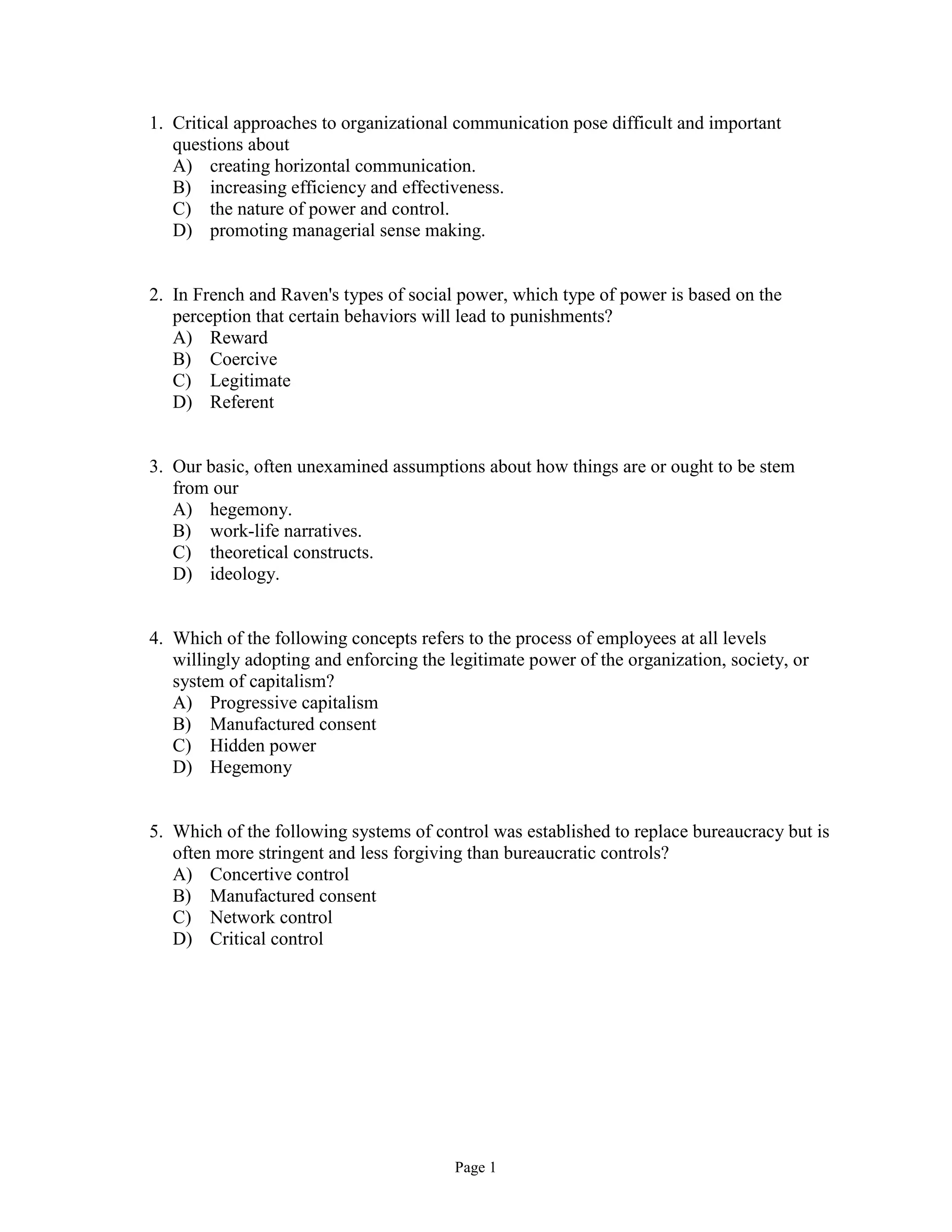
1. Critical approaches to organizational communication pose difficult and important
questions about
A) creating horizontal communication.
B) increasing efficiency and effectiveness.
C) the nature of power and control.
D) promoting managerial sense making.
2. In French and Raven's types of social power, which type of power is based on the
perception that certain behaviors will lead to punishments?
A) Reward
B) Coercive
C) Legitimate
D) Referent
3. Our basic, often unexamined assumptions about how things are or ought to be stem
from our
A) hegemony.
B) work-life narratives.
C) theoretical constructs.
D) ideology.
4. Which of the following concepts refers to the process of employees at all levels
willingly adopting and enforcing the legitimate power of the organization, society, or
system of capitalism?
A) Progressive capitalism
B) Manufactured consent
C) Hidden power
D) Hegemony
5. Which of the following systems of control was established to replace bureaucracy but is
often more stringent and less forgiving than bureaucratic controls?
A) Concertive control
B) Manufactured consent
C) Network control
D) Critical control
Page 2
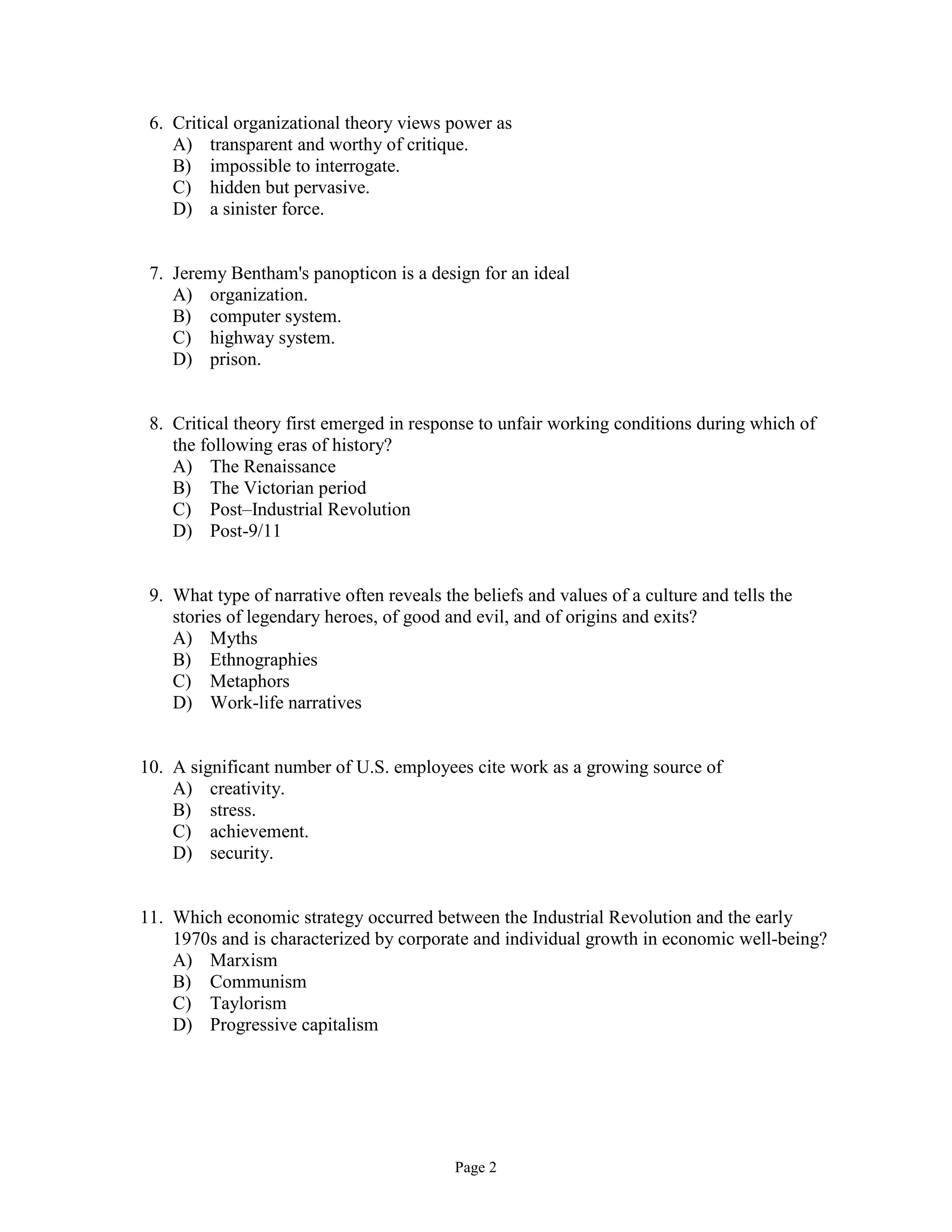
6. Critical organizational theory views power as
A) transparent and worthy of critique.
B) impossible to interrogate.
C) hidden but pervasive.
D) a sinister force.
7. Jeremy Bentham's panopticon is a design for an ideal
A) organization.
B) computer system.
C) highway system.
D) prison.
8. Critical theory first emerged in response to unfair working conditions during which of
the following eras of history?
A) The Renaissance
B) The Victorian period
C) Post–Industrial Revolution
D) Post-9/11
9. What type of narrative often reveals the beliefs and values of a culture and tells the
stories of legendary heroes, of good and evil, and of origins and exits?
A) Myths
B) Ethnographies
C) Metaphors
D) Work-life narratives
10. A significant number of U.S. employees cite work as a growing source of
A) creativity.
B) stress.
C) achievement.
D) security.
11. Which economic strategy occurred between the Industrial Revolution and the early
1970s and is characterized by corporate and individual growth in economic well-being?
A) Marxism
B) Communism
C) Taylorism
D) Progressive capitalism
Page 3
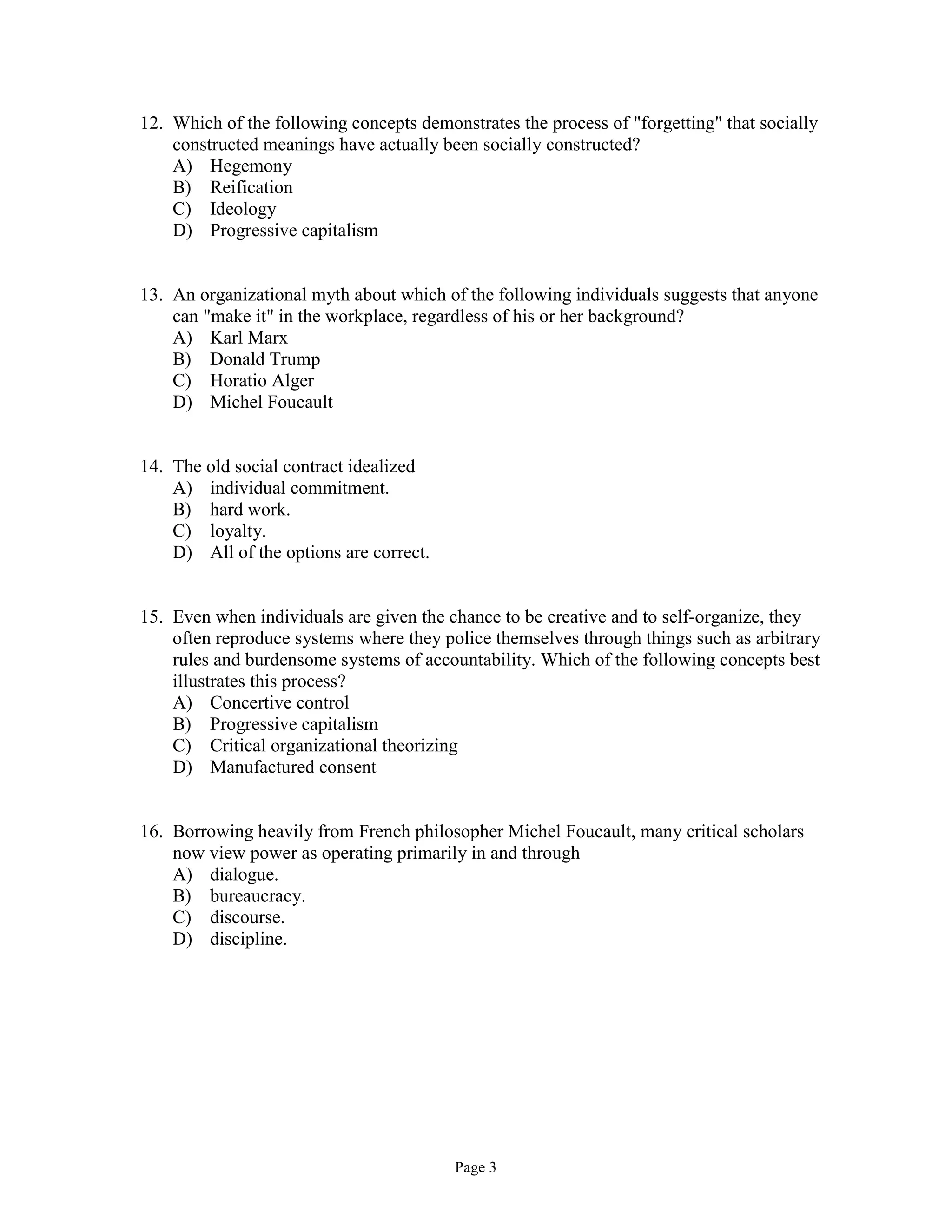
12. Which of the following concepts demonstrates the process of "forgetting" that socially
constructed meanings have actually been socially constructed?
A) Hegemony
B) Reification
C) Ideology
D) Progressive capitalism
13. An organizational myth about which of the following individuals suggests that anyone
can "make it" in the workplace, regardless of his or her background?
A) Karl Marx
B) Donald Trump
C) Horatio Alger
D) Michel Foucault
14. The old social contract idealized
A) individual commitment.
B) hard work.
C) loyalty.
D) All of the options are correct.
15. Even when individuals are given the chance to be creative and to self-organize, they
often reproduce systems where they police themselves through things such as arbitrary
rules and burdensome systems of accountability. Which of the following concepts best
illustrates this process?
A) Concertive control
B) Progressive capitalism
C) Critical organizational theorizing
D) Manufactured consent
16. Borrowing heavily from French philosopher Michel Foucault, many critical scholars
now view power as operating primarily in and through
A) dialogue.
B) bureaucracy.
C) discourse.
D) discipline.
Page 4
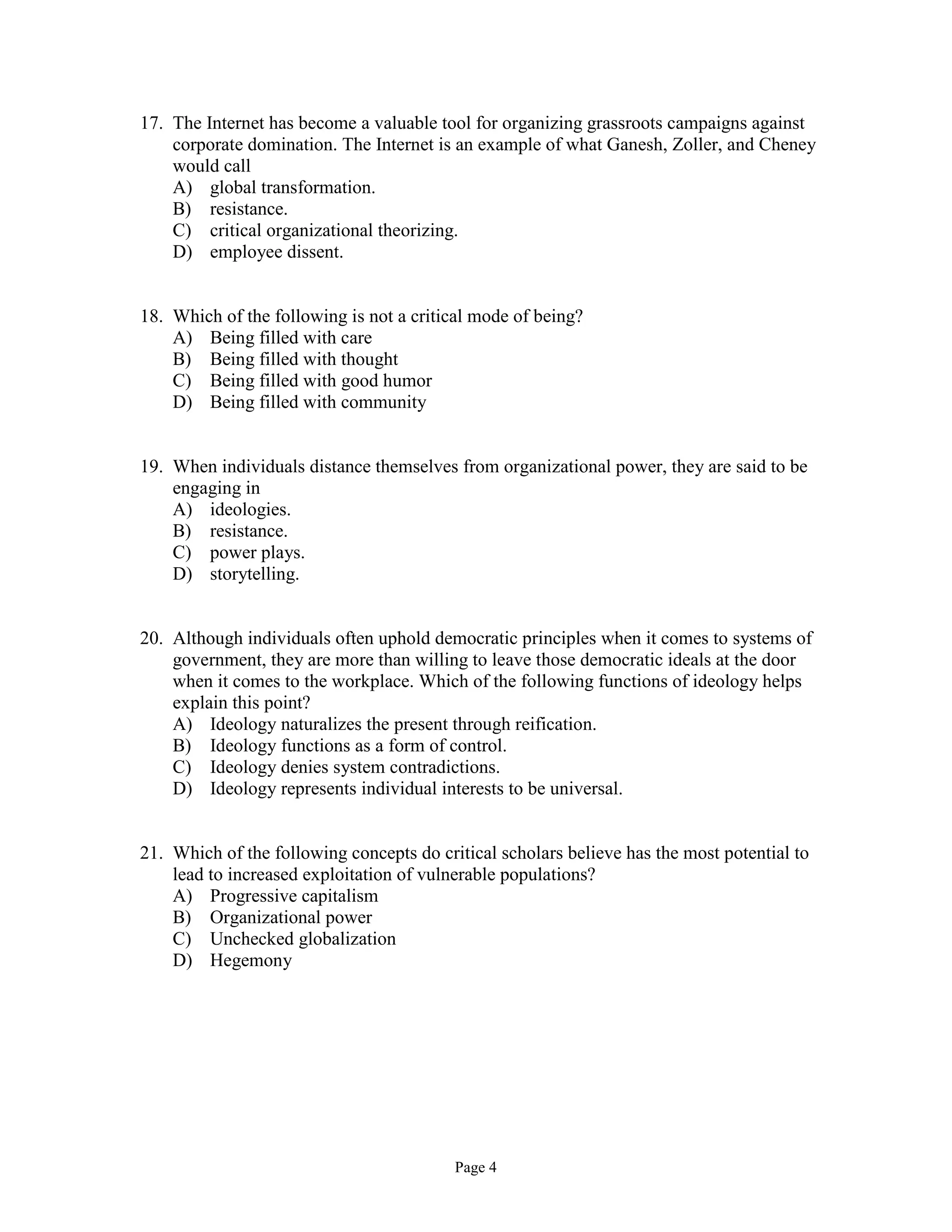
17. The Internet has become a valuable tool for organizing grassroots campaigns against
corporate domination. The Internet is an example of what Ganesh, Zoller, and Cheney
would call
A) global transformation.
B) resistance.
C) critical organizational theorizing.
D) employee dissent.
18. Which of the following is not a critical mode of being?
A) Being filled with care
B) Being filled with thought
C) Being filled with good humor
D) Being filled with community
19. When individuals distance themselves from organizational power, they are said to be
engaging in
A) ideologies.
B) resistance.
C) power plays.
D) storytelling.
20. Although individuals often uphold democratic principles when it comes to systems of
government, they are more than willing to leave those democratic ideals at the door
when it comes to the workplace. Which of the following functions of ideology helps
explain this point?
A) Ideology naturalizes the present through reification.
B) Ideology functions as a form of control.
C) Ideology denies system contradictions.
D) Ideology represents individual interests to be universal.
21. Which of the following concepts do critical scholars believe has the most potential to
lead to increased exploitation of vulnerable populations?
A) Progressive capitalism
B) Organizational power
C) Unchecked globalization
D) Hegemony
Page 5
22. Mentors and charismatic leaders are most likely to embody which of the following types
of power?
A) Expert
B) Legitimate
C) Reward
D) Referent
23. Which of the following concepts is not one of the four functions of ideology?
A) Representing sectional interests as universal
B) Reification
C) Making power transparent
D) Control
24. Most people think of a "real" job as one that involves
A) earning good wages.
B) producing something tangible.
C) doing something that makes a difference.
D) working somewhere long enough to get a raise.
25. Which of the following organizations is known for the "LUV story" that they have
created?
A) Bank of America
B) Hallmark Greeting Cards
C) Southwest Airlines
D) Google
26. Ideologies are always neutral.
A) True
B) False
27. Over time, myths, stories, and metaphors can come to define appropriate behavior and
may suspend employees' critical thinking.
A) True
B) False
28. Resistance operates only through small-scale efforts.
A) True
B) False
Page 6
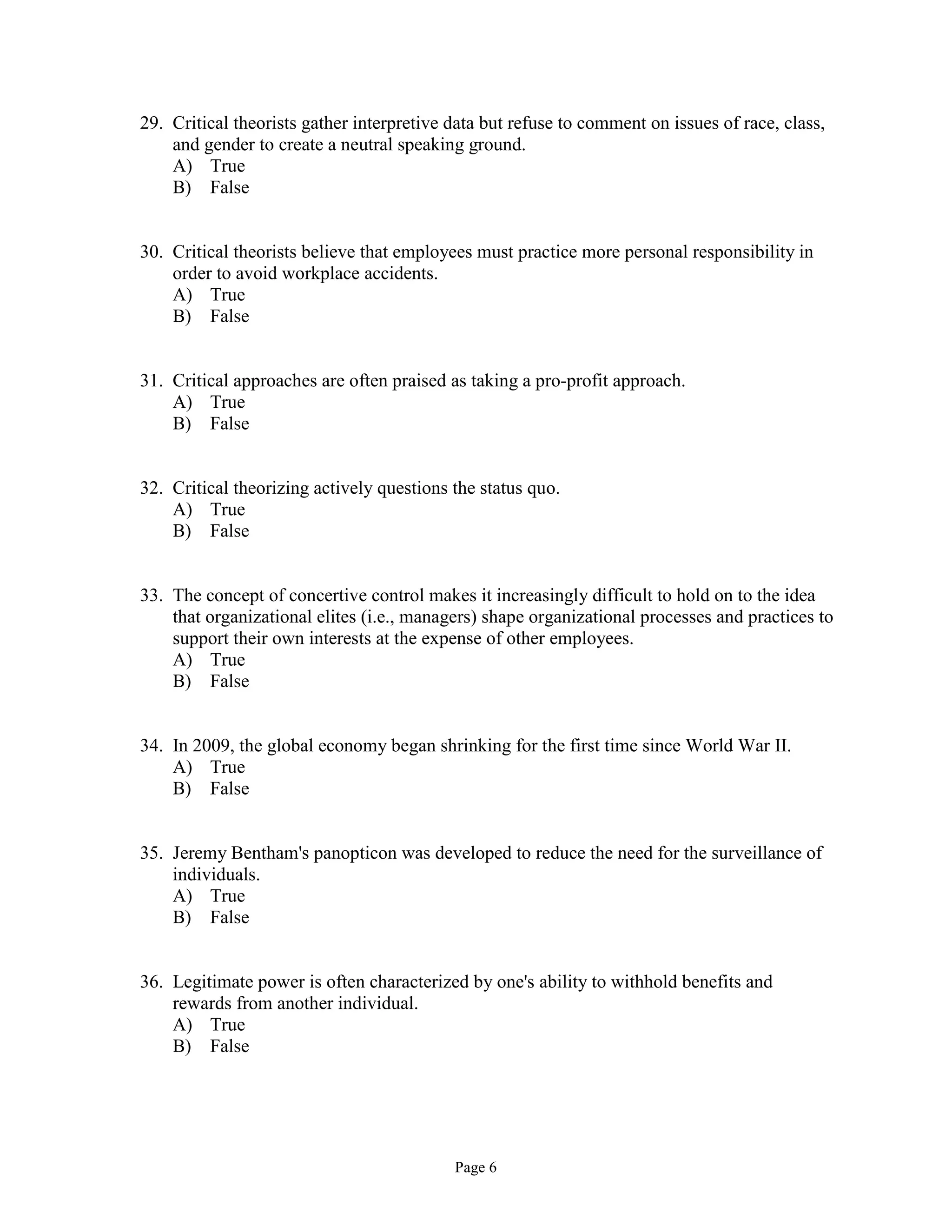
29. Critical theorists gather interpretive data but refuse to comment on issues of race, class,
and gender to create a neutral speaking ground.
A) True
B) False
30. Critical theorists believe that employees must practice more personal responsibility in
order to avoid workplace accidents.
A) True
B) False
31. Critical approaches are often praised as taking a pro-profit approach.
A) True
B) False
32. Critical theorizing actively questions the status quo.
A) True
B) False
33. The concept of concertive control makes it increasingly difficult to hold on to the idea
that organizational elites (i.e., managers) shape organizational processes and practices to
support their own interests at the expense of other employees.
A) True
B) False
34. In 2009, the global economy began shrinking for the first time since World War II.
A) True
B) False
35. Jeremy Bentham's panopticon was developed to reduce the need for the surveillance of
individuals.
A) True
B) False
36. Legitimate power is often characterized by one's ability to withhold benefits and
rewards from another individual.
A) True
B) False
Page 7
37. Mentors and charismatic leaders possess referent power.
A) True
B) False
38. Because critical theory focuses on power, the topic of discourse is not as important to
this perspective.
A) True
B) False
39. Workplace safety has become an increasingly important topic for organizational
communication theorists who use critical theory.
A) True
B) False
40. The Internet has become a very valuable tool for mobilizing grassroots organizers in
search of critiquing the status quo.
A) True
B) False
41. Define power and provide an example to explain your definition. Why is the study of
power so central to critical approaches?
42. How is legitimate power determined? Provide an example of someone who has
legitimate power.
43. Explain the roots of critical theory, paying particular attention to the ideas of Karl Marx.
How have these ideas been appropriated in the service of systems of government?
44. Describe the concept of progressive capitalism, and provide an example of how this
concept works. Are we currently in a period of progressive capitalism?
45. What does it mean to take a pro-profit approach, and why are critical approaches
critiqued for not taking one?
46. Explain the process of concertive control, and construct an example of the self-policing
that individuals do.
Page 8
47. Connect the concepts of ideology and hegemony using an example about our current
economic conditions.
48. Chapter 6 argues that many organizational members and employees have realized that
the old social contract associated with work and job security no longer holds true. What
is the old social contract, and how does it differ from the new social contract?
49. Define discourse according to Foucault.
50. What are knowledge management (KM) systems, and what challenges do they bring to
contemporary workplaces?
51. The concept of power is central to critical theory. French and Raven further clarified
this focus by outlining five types of power. Identify and define these five types of
power, providing a detailed example of each type.
52. Chapter 6 calls attention to organizational stories. Outline a successful organizational
story, and explain its importance to critical organizational theory—especially the
concepts of power and ideology.
53. Considering that power is such a key part of critical theory, develop an essay that
explains the reactions to power. What is resistance, and how is it relevant to the study of
organizational communication? Be sure to include specific definitions and examples to
demonstrate your points.
Page 9
Answer Key
1. C
2. B
3. D
4. B
5. A
6. C
7. D
8. B
9. A
10. B
11. D
12. B
13. C
14. D
15. A
16. C
17. A
18. D
19. B
20. C
21. C
22. D
23. C
24. A
25. C
26. B
27. A
28. B
29. B
30. B
31. B
32. A
33. A
34. A
35. B
36. B
37. A
38. B
39. A
40. A
41.
42.
43.
44.
Page 10
45.
46.
47.
48.
49.
50.
51.
52.
53.
Visit https://testbankdead.com
now to explore a rich
collection of testbank,
solution manual and enjoy
exciting offers!
Other documents randomly have
different content
eyes from the window and appear to be talking, as though we were
acquaintances met in the street, before they were both upon us,
and, fixing her eye upon me, Doll recognised me again in a moment.
"Why," she said to her friend, with her saucy laugh, "'tis the pretty
youth who was in the tavern but an hour ago." And then, turning to
me, she went on, "Young sir, you should be a-bed by now. The night
air is bad for--for young gentlemen. Yet, perhaps, you have a tryst
here with some maid, or"--but now she halted in her speech and,
bending her brows upon me, said--"or, no, it cannot be that you are
concerned in the foul plot Mr. St. Amande spoke of within. No, no!
That cannot be. You did not appear to know him, nor he you. Yet,
again, that might be part of the plot, too." And once more she
looked steadfastly at me.
I would have answered her but Oliver took the word now, and
speaking up boldly to her, said:
"Madam, if my young master be concerned at all in the plot of
which you speak it is to thwart it, as, by good chance, he most
assuredly will do. Therefore, since you say it is 'foul,' by which I
gather that you do not approve of it, I pray you pass on and leave
us to do our best."
She looked at his great form and at me, her friend standing
always close by her side, and then she said to me:
"Who are you? No friend of his, assuredly. And if such be the
case, as it seems, then I heartily wish that your attempts to thwart
his villainy may be successful. Oh! 'tis a shame--a shame."
"I guessed you thought as much," I answered in reply to her,
"from what I overheard you say within. Therefore, I make bold to
tell you that he will doubtless be so thwarted. And, if you would hear
the ending of the plot which he described to you to-night, and which
I assure you was incomplete, you will have to wait a little longer.
Then, if I have the honour to encounter you again, it shall be told.
Meanwhile, if you wish us well, I beg of you to leave us. He may
come out at any moment when your presence would interfere with
our plans."
"So be it," she replied, "and so farewell, and fortune go with you.
And--stay--I should like to hear the ending of that gallant and
courteous young gentleman's plot; a line to Mistress Doll Morris at
the New Theatre in Aungier Street will reach me. Farewell."
"Farewell, my pretty page," said the other saucily, and so they
passed down the street, I telling them as they went that, doubtless,
they would hear something ere long.
And now the evening was gone, the passers-by were getting
fewer, the shops were all shut; soon Macarthy's would shut too. The
time for action was at hand.
CHAPTER VII
TRAPPED
And still the night drew on and we waited outside, sheltering
ourselves in the stoop of an empty house opposite Macarthy's, or
walking up and down the street to keep ourselves warm as well as
not to attract observation to our loitering. Yet, indeed, there was but
little fear that we should be observed, since there were but few
people in the streets. A coach or hackney carriage would now and
again rumble past; once the watch went by; two of his Majesty's
sailors passed down singing a jovial chaunt about the West Indies
and the girls and the drinking there--but that was all. The city was
fast going to bed.
Knowing that my hopeful cousin was intoxicated by now, we had
somewhat altered our plans, and we had determined that, directly
we could seize him, we would carry him down to the boat which we
had ready for us at Essex Stairs. Once there, we would await the
arrival of O'Rourke's "honest gentleman" with the remaining hundred
guineas and my uncle's acquittal, the form of which was already
arranged; after which we would pull off to the Dove, which lay below
Dublin in mid stream, and deposit our cargo with the captain, and
take his guineas too. Resistance from our prize we had no fear of. I
could myself have easily mastered him in the state he now was,
while for any noise he might make--why, a gag would stop that and
would be perfectly understood and approved of by the captain,
should Roderick go aboard thus muzzled. It would, doubtless, not be
the first victim he had shipped for Virginia in such a condition.
Yet there was no necessity for even this, as you shall now see,
since my cousin's own actions, and his love for the bottle, led him to
fall into our hands as easily as the leaf falls from the tree when
autumn winds are blowing.
As we stood in the street waiting for him and his friend to come
forth--who we hoped would soon part from him and seek his own
home--we heard a hubbub and loud noises in Macarthy's, as well as
expostulations in the drawer's voice, and then, suddenly, the door
was flung open and out into the street there came, as though they
had both been thrust forth together by strong hands, my cousin and
his guest.
"Now what may this mean?" whispered Oliver, while, as he spoke,
he drew me further within the porch, or stoop, so that we were quite
invisible behind its thick pillars.
It took not long to learn. My cousin was mightily flustered as
'twas easy to see; his hat was awry as also was his steinkirk, his face
was flushed and he breathed forth most dreadful execrations against
the tavern first, and then his companion, who, perhaps because of
his longer sleep within, seemed more cool and calm.
"I tell thee 'tis a scurvy trick, Garrett," bawled Roderick, after he
had finished kicking at the tavern door, which was now fast closed,
while the lights within were extinguished; and after he had yelled
through the keyhole at them that "they should be indicted on the
morrow." "A scurvy trick, and worst of all from a guest as thou art.
But it shall not pass, and I will have satisfaction." And he began
tugging at the sword by his side, though he lurched a good deal as
he did so.
"Mr. St. Amande," replied the other, "satisfaction you shall indeed
have, as I will for the blow you dealt me in there, which led to our
ignominious expulsion. And you may have it now, or in the park to-
morrow morning, or when and where you will. But, previously, let
me tell you, sir, that when you say that I am any party to the
departure of the young ladies, or that I know where they are, or am
about to rejoin them, you lie. Now, sir, shall we draw?"
"Where are they then? I did but doze, yet when I opened my eyes
they were gone," but he made no attempt further to unsheath his
weapon.
"As I have now told you twice, I know not. But I cannot stay
parleying here with you all night. A friend will wait upon you to-
morrow. Frank Garrett must wipe out that blow. I trust my friend's
visit will be agreeable. Sir, I wish you a good night," and he took off
his richly gold laced hat with great ceremony and, bowing solemnly,
withdrew. My cousin gazed with drunken gravity after him and
hiccoughed more than once, and muttered, "A nice ending truly to a
supper party. The girls gone, insulted by landlord and--and the
reckoning to pay and fight to-morrow--Garrett knows every passado
to be learnt at the fence school. I must see to it. And there is no
more to drink." Here he reeled over to the tavern again from the
middle of the road, and, beating on the door, called out to, them to
come down and give him another draught and he would forget their
treatment of him while the reckoning should be paid in the morning.
But his noise produced no other reply than the opening of a window
upstairs, from which a man thrust forth his head covered with a
nightcap and bade him begone or the watch should be summoned.
While for the reckoning, the man said, his honour might be sure that
that would have to be paid since he knew his honour's father well.
After which the window was closed.
But now, when once more all was still, Oliver and I stepped forth,
and the former taking off his hat with great civility and bowing, said,
"Sir, we have been witnesses of how ill you have been treated, both
by your friend and the tavern-keeper. And 'tis a sin to thrust forth so
gallant a gentle man when he wishes another cup."
"I do, plaguily," muttered Roderick.
"Therefore, young sir, if you require another draught I can show
you where it may be obtained."
"Can you? Then you are a right good fellow, though who and
what you are I know not from Adam. Some city put, I suppose, who
wishes to be seen in company with a gentleman!"--'twas ever my
cousin's habit to make such amiable speeches as these, and thereby
to encounter the ill will of those whom he addressed. "But, however,
I care not whom I am seen in company with. I'll go along with you."
Then, suddenly, his eye lighted on me, whereon he exclaimed,
"What, my gentleman! Why, 'twas you who were in Macarthy's
earlier in the evening. I suppose you left ere I awoke from my doze.
Are you, too, stranded for a draught and obliged to be indebted to
this good--humph!--person for procuring you one?"
"Even so," I answered, thinking it best to fall in with his
supposition, whereon Oliver said:
"Come on then, young sirs, or all the taverns will be closed. Yet,
stay, will you have a sup ere we set forth. I have the wherewithal in
my pocket," and he thrust his hand in his coat and pulled out a great
flask he had provided to keep out the morning air from our lungs
when we should be on the river.
"First come, first served," he said, winking at me, which action
being under an oil lamp I could well perceive, and he handed me the
flask which I put to my mouth and pretended to drink from, though
not a drop did I let pass my lips. "And you, sir," he went on, turning
to my cousin, "will you try a draught? 'Tis of the right kind--and--
hush! a word--the gauger has never taken duty on it."
"So much the better. Hand over," said Roderick, "the night air is
raw. Ah!" He placed the bottle to his lips as he uttered this grunt of
satisfaction and took a long deep draught, and then returned the
flask enviously to Oliver and bade him lead to the tavern he knew of,
where he promised he would treat us both to a bowl of punch ere
the night was done.
But Oliver (as he told me afterwards) not thinking it advisable to
be seen in more public houses than necessary--considering the
business we were on--purposely led the way to one near the river of
which he knew, by as circuitous a route as possible, so that, ere we
had gone half a mile, Roderick called a halt for another refresher. All
the way we had come he had been maundering about the treatment
he had received at the tavern, about the desertion of him by the
actresses, and about his friend's treachery, mixed up with boastings
of his father's standing, his speech being very thick and his gait
unsteady. So that the same hope was in Oliver's mind as in mine,
namely that another attack upon the bottle might do his business for
him. Yet, when he had taken it, he was not quite finished--though
nearly so, since he would once or twice have fallen had we not held
him up between us as we went along,--and we were fain at last to
suggest a third pull at the flask. And shortly after he had taken that
he could go no farther but, after hiccoughing out some unintelligible
words, sank helpless on the stones.
"Caught in their own toils!" exclaimed Oliver, as he bent over him,
"caught in their own toils! Gerald, already the spell begins to work
that shall undo your uncle. Yet, if this were not the son of a villain,
and a villain himself in the future if he be not one now, as by his
rejoicing over the plot in the tavern he seems to be, I would never
have taken part in such a snare as this. But," he continued, "they
would have sent you, poor lad, to where he is going, and he would
have gloated over it. Let us, therefore, harden our hearts and
continue what we have begun."
He stooped over Roderick as he spoke and gazed at him as he lay
there insensible, and said, "We must remove from him his lace and
ruffles; they are too fine. His hat with its lacings is easily disposed
of," saying which he tossed it on a heap of refuse such as was then
to be found in every street in Dublin. "His clothes," he continued,
"are, however, none too sumptuous, and they are soiled with mud
where he has fallen. His sword he must not have however," with
which words he unloosed it as well as the sash and placed the
former against a doorway and the latter in his pocket. "Now," he
said, "let us carry him to the stairs," and he forthwith hoisted him on
his back as easily as he had hundreds of times hoisted a sheep in a
similar manner.
We passed scarcely any persons on our road, and, when we did,
they seemed to think little enough of such a sight as a man who
looked like a porter carrying another who was overcome by drink on
his back, while a third, probably, as they supposed, the drunken
man's friend, walked by their side. Such sights were common
enough in the days when I was young and George II. had just
ascended the throne, and not only in Dublin but in England and all
over his dominions. Nay, in those days things were even worse than
this; men went to taverns to pass their evenings, leaving word with
others, to whom they paid a regular wage, to come and fetch them
at a certain hour, by which time they would be drunk. Noblemen's
servants came for them on the same errand to their wine clubs and
the ordinaries, and even many divines thought it no sin to be seen
reeling home tipsy through the streets at night, or being led off by
their children who had sought them out at their houses of use.
So, I say, we passed unheeded by those few we encountered, and
in this manner we came to Essex Stairs, where Oliver deposited his
burden upon the shingle under a dry arch and went to fetch the
boat.
"I know not," he said, "whether 'tis best to put him in the boat at
once and so to row about the river, or whether to let him lie here
until O'Rourke's friend comes to see that the scheme is
accomplished. He is to wear a red cockade by which we shall know
him."
"I imagine 'twould be best to take to the boat," I said. "Any one
may come down to the river shore at any moment, but the river is
as still as death. And we could lie under yon vessel that is listed over
by the tide, and so see those on shore without being seen."
"Thou art right, Gerald; thou art right. No thing could be better.
Wilt lend a hand to carry him in? And then we will shove off."
We bent over the prostrate form enveloped now in Oliver's frieze
coat, when, as we did so, we heard behind us a voice--a voice that
terrified me so that I felt as though paralysed, or as if the marrow
were freezing in my bones--a voice that said, "Softly, softly! What!
Would'st put off without the other guineas and the acquittance?"
And, starting to our feet, we saw behind us O'Rourke regarding us
with a dreadful smile.
"So, Mr. Quin," he went on, "thou would'st have tricked me, eh!
and hast found some other youth to send to the plantations in place
of this young sprig here--who, in spite of his gay apparel and his
smart wig, I recognise as the brat who was not long ago in my
custody, and shall be again. A pretty trick in faith! a pretty trick to
try on me who, in my time, have served the Pope, the Devil, and the
Pretender, and hoodwinked the whole joyous three. Why, Quin," he
went on banteringly, "you are not so clever as I took you for."
"I may outwit you yet, O'Rourke," replied Oliver, "in spite of your
cleverness. But," he continued, in a peculiar voice that I could not
understand, and, indeed, I felt now so miserable and wretched at
the failure of our undertaking that I paid but little heed to what they
said, "I suppose you, too, were tricking me. If we had got down the
river we should have found no Dove there to take our cargo on
board."
"Nay, nay, Quin," continued the other, "for what then think you I
have paid you the guineas, which now you must return or I will blow
your brains out? The Dove is there fast enough, though she is
anchor a-peak now and ready to sail. And in my pocket, too, are the
remaining pieces--for I am an honest man, Quin, and keep my word-
-and with a line from my lord absolving thee, which now thou must
forego." Here he burst into another laugh such as he had once or
twice given before, and went on, "Yet I cannot but smile at your
simplicity. What! pay thee twenty-five guineas for nothing, and
entrust an honest gentleman with a red cockade in his hat--ha, ha!--
to look after my affairs when I can look after them myself. 'Tis not
thus that I have prospered and made my way. Now, Quin, give back
my guineas to me."
"Nay," said Oliver, "that will never be. We have the guineas and
we mean to keep them."
"I am armed," said O'Rourke, "and I will have them; yet, ere I
take them from you or shoot you like a dog, let's see what creature,
what scaramouch or scarecrow thou hast picked out of the gutter to
send to Virginia in place of this boy, Gerald," and, stooping down, he
bent on his knee and flung Oliver's cloak off my cousin's form till it
lay there as it had fallen, and with a ray from the oil lamp of the
archway glistening on his face.
"What!" he exclaimed, "what! nay, 'tis impossible--yet, yet, oh!
oh! Quin, thou damnable, thou double-dyed scoundrel; why--why--
thou wretch, thou execrable wretch, had this happened, had this
wicked plot been put in practice, my lord would have slain me. Oh!
thou villain. I should have been ruined for ever."
"As so you shall be yet," said Oliver springing at him as he spoke,
"as you shall be if I myself do not slay you first."
In a moment he had seized the ruffian by the throat with his
great strong hands while he called to me to secure his pistols, which
I did without loss of time; and he so pressed upon his windpipe that
O'Rourke's face became almost black. Yet he struggled, too, being,
as I think, no coward, and dealt out buffets and blows right and left,
some falling on Oliver's face and some on his body. But gradually
these blows relaxed in strength and fell harmless on his more
brawny antagonist, who never loosed the hold upon his throat, so
that 'twas easy to perceive, even in the dark of the archway with its
one faint illumination, he must in a few moments be choked to
death.
"Do not kill him, Oliver," I whispered, "do not kill him. Spare him
now; he is harmless."
Whether it was my words or his own merciful nature I know not,
but, at any rate, Oliver did at last relax his hold on the other, who,
when he had done so, fell to the earth and, after writhing there for a
moment, lay perfectly still.
"We must be speedy," said Oliver, "and lose no time. Look!
towards the east the light is coming. Quick. Do you rifle his pockets
for the money and the paper--above all, the paper; do not overlook
that! while I lift the other into the boat. And gag him with this sash,"
taking Roderick's sword sash out of his pocket and tossing it to me;
"gag him tightly, but leave him room to breathe. I have not killed
him, though I came near doing so."
As he spoke, he snatched up my cousin as easily as though he
had been a valise, and went down with him to the boat, throwing
him lightly into the stern sheets, and then pushed the boat off by
the bow so that she should be ready to float the moment we were
in.
As for me, I went through O'Rourke's pockets hurriedly, finding in
them the bag with the remainder of the guineas (in which we
discovered afterwards three more jacks, so that we were led to think
that he followed, amongst other pursuits, that of passing bad coin
whenever it was possible) and also the paper--a scrawl in my uncle's
hand writing saying that "he thanked Mr. Quin for what he had done
in ridding Ireland of an atrocious young villain and impostor falsely
calling himself a member of a noble family, to wit, his own"--and
pledging himself to hold Mr. Quin harmless of any proceedings on
that account.
Then, tying Roderick's sash in O'Rourke's mouth, I ran down to
the boat, and, jumping into it, rolled up my cloak and coat and took
the bow oar.
Half-an-hour later the dawn was come; already there was stealing
over the river that faint light which, even on a winter morning, tells
that the day is at hand, and our oars were keeping time well
together as we drew near to the ship that was to carry my wretched
cousin far away to the Virginia plantations--the plantations to which
he and his father fondly hoped they would have consigned me.
CHAPTER VIII
AND CAGED
As we thus drew near to what Oliver said was the Dove--he
having been down to reconnoitre her the day before from the shore-
-our burden gave some signs of coming to, or rather of awakening
from his drunken slumbers. First he rolled his head about under the
cloak, then he got it free from the folds, and, when he had done
this, he opened his bloodshot eyes and stared at us with a look of
tipsy amazement. Yet, so strong was the unhappy youth's ruling
passion, that he exclaimed:
"If you have a taste of that spirit left in the flask, I pray you give
it me."
"Feel in the pocket over by your left shoulder," replied Quin, "and
you may yet find a drop or so--'twill warm you." Then, turning to me
as the wretched Roderick did as he was bidden, Quin said over his
shoulder, in a whisper, "'Tis a charity to give it him. It is the last he
will taste for many a day. The skippers do not give their prisoners
aught else but water on these cruises, and as for the planters--if all
accounts be true!---they treat their white slaves no better." After
saying which he bent to his oar again.
For a moment the draught seemed to arouse Roderick and even
to put sense into his muddled pate, since, as he gazed on the shore
on either side, he muttered, "This is not the way home. Not the way
I know of"; but, even as he did so, the fumes of the overnight's
liquor, stirred up perhaps by the new accession of drink, got the
better of him again and once more he closed his eyes.
"'Tis thy way home at any rate," I heard Oliver mutter; "the way
to the only home you will know of for some years. And may it be as
happy a one to thee as thou destined it for thy cousin." Then turning
swiftly to me, he said, "Pull two strokes, Gerald; we are alongside
the Dove."
As we slewed round to run alongside the gangway, there stood at
the top of it as villainous a looking old man as ever it was my lot to
see. An old man clad in a dirty plush suit with, on his head, a hat
covered with tarnished, or rather blackened, silver lace; one who
squinted hideously down at us.
"Whence come you, friends?" he asked. "From the noble Captain
O'Rourke," replied Oliver, "and we bring you his parting gift. The
youth is not well, having partaken freely over night, doubting,
perhaps, of your hospitality. Now, sir, if you will produce the price
named to the Captain and send down a man or so to haul him on
board, he is very much at your service."
"Ay, ay," said the captain, "let's see him though, first. I don't want
to buy a dead man--as I did up at Glasgow not long ago--or one
who has lost his limbs. Here, Jabez, and you, Peter, jump down and
haul him up," while, as he spoke, he produced a filthy skin bag from
his pocket and began counting out some guineas into his palm.
Those called Jabez and Peter--one of whom was a negro--did as
they were bidden, and, shoving our boat a little forward so as to
bring the stern, where Roderick lay, up to the platform of the
gangway, they quickly threw off the cloak, and, seizing his limbs,
began to lift them up and let them fall, to see that they were not
broken nor he dead. But such treatment even this poor bemused
and sodden creature could not bear without protest, so, as the men
seized him and swiftly bore him up the gangway until he stood upon
the deck of the Dove--a filthy, dirty-looking craft, with, however, a
great, high poop much ornamented with brass and gilding--he began
to strike out right and left, and to scream and ejaculate.
"Hands off, you ruffians, hands off you wretches, I say! What! do
you know who I am; do you know that I am the son of the Viscount
St. Amande and his heir? Let me go, you dogs!" and putting his
hand to where his sword should have been and not finding it there,
he struck at the negro, who, instantly striking back at him, fetched
him such a blow on the cheek as sent him reeling against the rough-
tree rail, where he glowered and muttered at all around.
"Hark ye, young sir," said the villainous looking skipper, "we have
been informed before this by the gallant Captain O'Rourke that it
pleases you to style yourself a son of Lord St. Amande." Here Quin
nodded up to the speaker, saying, "'Tis so, I have even at this
moment a paper in my pocket saying that he does so claim that
position." "But let me tell you," the captain went on, "'twill avail you
nothing on board this craft. I am, like the honest man in the boat
below, in possession of a paper from his lordship saying you will try
this tack with me, and, as I tell you, 'twill profit you nothing. You
may call yourself what you will but you must accustom yourself to
this ship for some weeks, at least, and take your part with these
your companions till you reach your destination. While, if you do not
do so, I will have you brained with a marling-spike or flung into the
sea, or, since I cannot afford to lose you, have you put in irons in the
hold," after which he turned away from Roderick, handed the twenty
guineas to Oliver, and bellowed out his orders for getting the ship
under weigh at once.
But now, as I glanced at those whom the man spoke of as his
companions, my heart went out to my cousin, and, cruelly as he had
ever used me, and even remembering that he had chuckled over the
doom which now was his having been planned for me, I could not
but pity him. Nay, I think, had it been possible, that I would have
saved him, would have had him set on shore free again, and would
have trusted to Heaven to soften his heart and make him grow into
a better man. His companions! The creatures with whom he was to
live and herd until he reached Virginia, and even afterwards, maybe.
Oh! 'twas dreadful to reflect upon. They stood upon the deck of that
horrid-looking craft, surrounding him, jeering at him, mocking at
him, but not one with a look of pity in his or her face--as, indeed,
'twas not likely they should have since his fate was theirs. Amongst
them there were convicted felons with chains to their legs and arms,
who were being sent out so as to ease the jails which were always
full to overflowing; there were women who were coin clippers and
coiners, and some who--for I learnt their histories afterwards--had
been traffickers in their own sex, or ensnarers of drunken men, or
even murderesses--though some of them were fair enough in looks
and some, also, quite young. And there were youths, nay, lads,
younger than I was, who had been sold to the captain (to be again
re-sold by him at the end of his voyage) by their own unnatural
parents, so that, as they became lost, the parents' shame might
become forgotten. There, too, lying about, were drunken lads and
girls who had been picked up in the streets and brought on board
and kept drunk until the ship should sail; there were some who
looked like peasants who had been enticed in from the country,
since they wore scarce any clothes, and--horror of horrors!--sitting
weeping on a cask was a clergyman, still with his cassock on and
with a red blotchy face. He--I afterwards learnt also--had forged to
obtain money for drink, and this was his doom. And those who were
not drunk, or sleeping off the effects of drink, came near that other
drunkard, my cousin, and, approaching as close as possible to him
until the mate and sailors kicked them, men and women,
indiscriminately away, jeered at and derided him and made him
welcome, and asked him if he had any money, or what he thought of
the prospects of a sea voyage, and with what feelings he looked
forward to a sojourn in Virginia as a slave.
"As a slave! In Virginia!" he screamed, taking in his situation at
last. "As a slave in Virginia! Oh, God! spare me, spare me! 'Tis a
mistake, I tell you. A mistake. Another one was meant, not I. 'Tis he
who should go. 'Tis he! Send for him and set me free!"
And then they all laughed again, while the captain, seizing him
roughly by the collar, threw him amidst the others, telling him he
would do very well for him; and then they hauled up the gangway
and gradually the ship wore round.
She had commenced her voyage.
So he went forth a slave and, as he went, the pity that had welled
up into my heart for him became stifled and I felt it no more. For,
think! As he screamed in his desperation for mercy he asked for it
only for himself, he would at that moment, in spite of the horrors
which he saw, have cheerfully sent me in his place. Nay, in his place
or not, he had meant that I should go. Why, I asked myself, should I
pity him?
The Dove had quickly caught the north wind that was blowing
now; she had slipped away so easily from us when once her anchor
was up and her sails set, that, as she went heeling over down the
river, we saw but little of her but her stern and her poop lantern
swinging aft. And so we turned our boat's nose back to the city and
prepared to return.
Oliver was himself silent; I think because in his noble heart there
was the same conflict going on that there was in mine--the regret
for having been concerned in such a deed fighting with the pleasant
conviction that he had foiled a most wicked plot against me and thus
defeated two utter villains, my uncle and Considine, while, on a third
one, the punishment had fallen. And now that years have passed it
pleasures me to think that it was so with him, and that that brave
heart of his could, even at this moment of triumph, feel sorrow for
what he had thought it best to do. A brave heart, I have called it; a
noble heart--and so it was. A heart ever entendered to me from the
first when, God He knows, there was none else to show me
kindness; a heart that so long as it beat was ever loyal, good, and
true.
"Will you put back to the bridge?" I asked him, seeing that he still
kept the boat's course headed up river. "Surely it would be best to
make straight for the packet and go on board at once. Suppose
O'Rourke has recovered by now and informed my uncle. What may
he not do to us?"
"Nothing," replied Oliver, as he still set a fast stroke, "nothing. To
begin with--which is the most important thing--he cannot catch the
Dove, no, not even if he could persuade the captain of one of His
Majesty's sloops now lying in the river to put out in chase of her,--
such vessels as she is can show their heels to anything they have a
few hours' start of. And as for what he can do to us--why, what can
he attempt? We have been employed on his service, I hold in my
pocket a letter from him justifying me in kidnapping the youth who
claims to be Lord St. Amande. Well! that is what thy cousin claims to
be in succession, and, even if he did not do so, how can thy uncle
make any stir, or announce himself, as he needs must do if he blows
on me; he, a participator in what I have done? While for O'Rourke--
the noble Captain O'Rourke, Hanoverian spy, Jacobite plotter, white
or black cockade wearer as the time serves and the wind shifts,
crimp and bully,--think you he will come within a hundred leagues of
Mr. Robert St. Amande after having failed so damnably? Nay! more
likely are we to meet him in the streets of London when we get
there than in those of Dublin! So bend thy back to it, Gerald, and
pull hard for Essex Bridge. The tide runs out apace."
As we passed up through the shipping lying in the river and on to
our destination, Quin did utter one more remark to the effect that, if
he had in very fact slain O'Rourke, or injured him so badly that he
could not rise from the spot where he fell, it was possible we might
still find him there, but that he did not think such a thing was very
likely to come about.
"The fellow has as many lives as a cat," he said,--"he was nigh
hanged at Carlisle for a Jacobite in the last rising, and almost shot at
St. Germain for a Hanoverian, yet he escaped these and countless
other dangers somehow--and he has also as many holes as a rat in
this city into which he can creep and lie hid, to say nought of his den
farther up the river, of which you know well, since you escaped from
it. 'Tis not like we shall find him when we land."
To land it was now time since we had reached the bridge, though
by this the river had run so low that we were forced to get out and
drag the boat up through the slime and ooze of the bank to get her
high and dry. And as we were doing so, I, who was lifting her with
my face turned towards the shore, saw a sight that had quite as
terrible an effect on me as the sight of O'Rourke standing over us a
couple of hours before had had. For, wrapped in long horsemen's
cloaks and with their hats pulled down well over their eyes, I
observed upon the river's brink my uncle and his friend and creature,
Wolfe Considine, both of whom were regarding us fixedly. But, when
I whispered this news to Oliver as I bent over the bows of the boat,
he whispered back to me, "No matter; fear nothing. Courage.
Courage!"
"Well, fellow," said my uncle to Quin, as we approached them, I
walking behind my companion and with my own hat drawn down as
low as possible so as to evade observation if I could do so. "Well,
fellow, so thou hast determined to change thy song and serve Lord
St. Amande, instead of vomiting forth abuse on him and doing thy
best to thwart him. Is't not so?" and he let his cloak fall so that his
features were visible, and his fierce, piercing eyes shone forth.
"To serve Lord St. Amande is my wish," Quin replied gruffly,
returning his glance boldly.
"And have done so this morning, as I understand, though where
that tosspot, O'Rourke, is, who should be here to settle matters, I
know not."
"Ay," Quin replied in the same tone as before, "I have done good
service to his lordship this morning."
"And the fellow is away to sea? The Dove has sailed?"
"Ay, away to sea on the road to Virginia! The Dove has sailed."
But while this discourse was taking place I was trembling in my
wet boots--remember, I was still but a youth to whom tremblings
and fears may be forgiven--for fixed on me were the eyes of
Considine, and I knew that, disguised as I was in handsome apparel,
if he had not yet recognised me he would do so ere long.
"Yet," my uncle went on, "I should have thought you would have
chosen a somewhat different style of companion for a helpmate in
the affair than such a dandy youth as this. Wigs and laces and
riding-boots, to say nought of roquelaures and swords by the side,
are scarcely the kit of those who assist in carrying youths off for
shipment to the King's colonies!" and he bent those piercing eyes on
me while I saw that other pair, those of Considine, looking me
through and through.
"But," went on my uncle, "doubtless you know your own business
best, and I suppose the youth is some young cogger, or decoy,
whom thou can'st trust and who finds his account in the affair."
"Nay," said Considine, springing at me, "'tis the whelp himself,
and we are undone; some other has gone to sea, if any, in his place.
Look! Look, my lord, you should know him well," and, tearing off my
wig, he left me standing exposed to my uncle's regard and that of a
few shore-side denizens who had been idly gazing upon us, and who
now testified great interest in what was taking place.
"What!" exclaimed my uncle, rushing forward. "What! 'Tis Gerald,
as I live, and still safe on shore. Thou villain!" he said, turning to
Oliver, "what hast thou done?"
"The duty I was paid for and the duty I love. My duty to Lord St.
Amande."
"Scoundrel," the other said, lugging out his rapier, "this is too
much. I will slay you and the boy as you stand here. Considine,
draw."
"Ay," exclaimed Oliver, "Considine draw--though you could not
have bade him do an thing he fears more. But so will I. Let's see
whether steel or a blue plum shall get the best of this fray"; with
which he produced his two great pistols and pointed one at each of
his opponents, while the knot of people who had now gathered
together on the bank cheered him to the echo. And especially they
did so when they learnt the circumstances of the dispute, and that,
in me, they beheld the real Lord St. Amande, the youth deprived of
his rights, and, in Robert St. Amande, the usurper whose misdeeds
were now the talk of the lower parts of Dublin, if no other.
"Bah!" the latter exclaimed, thrusting his rapier back into the
scabbard with a clash, "put up thy pistols, fellow. This is no place for
such an encounter. Nor will I stain my sword with thy base blood.
But remember," he said, coming a pace or two closer, as he saw
Oliver return the pistols to his belt, "remember, you shall not escape.
You have my writing in your pocket to hold you free of this
morning's work, but"--and he looked terrible as he hissed forth the
words--"think not that I will fail to yet be avenged. Even though you
should go to the other end of the known world I will follow you or
have you followed, while as for you," turning to me, "I will never
know peace night nor day till I have blotted your life out of
existence. And if you have not gone forth to the plantations this
morning, 'tis but a short reprieve. If I do not have thy life, as I will,
as I will"--and here he opened and clenched both his hands as he
repeated himself, so that he looked as though trying to clutch at me
and tear me to pieces--"as I will, why then still shalt thou be
transported to the colonies, thou devil's brat!"
"Ay to the colonies," struck in Quin, "to the colonies, whereunto
now the Dove is taking the false usurper, or the future false usurper
of the title of St. Amande, while the real owner remains here safe
and sound for the present at least. To the colonies. Right!"
"The Dove. The false usurper," exclaimed Considine and my uncle
together, while their faces became blanched with fear and rising
apprehension. "The Dove taking the false usurper. Villain!" said my
uncle, "what mean you? Speak!"
"I mean, villain," replied Oliver, "that on board the Dove, now well
out to sea, is one of the false claimants of the title of St. Amande,
one of those who were concerned in the plot to ship this, the rightful
lord, off to Virginia. I mean that, amongst the convicts and the scum
of Dublin who have been bought for slavery, there goes Roderick St.
Amande, your son, sold also into slavery like the rest."
From my uncle's lips there came a cry terrible to hear, a cry which
mingled with the shouts of those who could catch Oliver's words;
then with another and a shorter cry, more resembling a gasp, he fell
fainting into the arms of Considine.
CHAPTER IX
MY MOTHER
That afternoon we took the first packet boat for Holyhead, where,
being favoured by fortune, we found a fast coach about to start for
London which, in spite of its rapidity and in consequence of the
badness of the roads and some falls of snow in the West, took five
days in reaching the Metropolis. Yet, long as the journey was--
though rendered easier by the quality of the inns at which we halted
and the excellence of the provisions, to which, in my youth, there
was nothing to compare in Ireland--yet, I say, long as the journey
was and tedious, I was happy to find myself once more in London--
in which I had not been since I was a child of six years of age, when
my father and mother were then living happily together in a house in
the new Hanover Square. Nay, I was more than happy at the
thought that I was about so soon to see my dear and honoured
mother again, so that, as the coach neared London, I almost sang
with joy at the thought of all my troubles being over, and of how we
should surely live together in peace and happiness now until my
rights were made good.
Oliver had rid himself of his occupation by a simple method; he
had merely abstained from going to his work at the butcher's any
more, and had sent round to say he had found other and more
suitable employment, and, as a slight recompense to his master for
any loss he might suppose himself to sustain, had bidden him keep
the few shillings of wage due to him. So that he felt himself, as he
said, now entirely free to look after and protect me.
"For look after you I always shall," he said, "So long as it is in my
power and until I see you accorded your own. Then, when that
happens, you may send me about my business as soon as you will,
and I will shift for myself."
"It can never happen," I replied, "that the time will come when
you and I must part,"--alas! I spake as what I was, a child who
knew not and could not foresee the stirring events that were to be
my portion for many years to come, nor how the seas were to roll
between me and that honest creature for many of those years,--"nor
can the time ever come when I shall fail in my gratitude to you or to
Mr. Kinchella. You! my only friends."
Then Oliver's face lighted up with pleasure as I spoke, and he
grasped my hand and said that if Providence would only allow it we
would never part.
To Mr. Kinchella I had gone between the time of the affray with
my uncle--of whom the last I saw was his being half-led and half-
carried to a coach by Considine, after he had learnt who it was who
had gone to Virginia in my place--and the sailing of the packet, and I
had found him busy making his preparations for departing for his
vacation, the Michaelmas term being now nearly at its end. He was
astonished at my appearance, as he might well be, and muttered, as
he looked smilingly down at me, "Quantum mutatus ab illo! Have
you come in for your fortune and proved your right to your title, my
lord?"
But when I had sat me down and told him the whole of my story
and of the strange things that had happened during the last two
days, he seemed as though thunderstruck and mused deeply ere he
spoke.
"'Tis a strong blow, a brave blow," he exclaimed at last, "and
boldly planned. Moreover, I see not how your uncle can proceed
against you or Quin for your parts in it. If he goes against Quin,
there is the paper showing that he was willing that you should be
sold into slavery. Therefore he dare not move in that quarter. Then,
as for you, if he proceeds against you he acknowledges your
existence and so stultifies his own claim. And, again, he cannot
move because witnesses could be brought against him to show that
the scheme was his, though the carrying out of it was different from
his hopes--those player wenches could also testify, though I know
not whether a court of law would admit, or receive, the evidence of
such as they."
"There are others besides," I said. "Mr. Garrett, with whom
Roderick quarrelled, and who seemed to be of a good position; he,
too, heard it. Also, there were several by the river this morning who
witnessed the fit into which my uncle fell when he found how his
wicked plot had recoiled on his own head----"
"Ay, hoist with his own petard! Well, I am honestly glad of it. And,
moreover, 'tis something different from the musty old story told by
the romancers and the playwrights. With these gentry 'tis ever the
rightful heir who goes to the wall and is the sufferer, but here in this,
a real matter, 'tis the heir who--up to now at least--is triumphant and
the villains who are outwitted. Gerald, when you get to London, you
should make your way to the coffee-houses--there is the 'Rose'; also
'Button's' still exists, I think, besides many others--and offer thy
story to the gentlemen who write. It might make the fortune of a
play, if not of the author."
"'Tis as yet not ripe," I replied, though I could not but laugh at
good Mr. Kinchella's homely jokes; "the first act is hardly over. Let us
wait and see what the result may be."
"Prosperity to you, at least," he said, gravely now, "and success in
all that you desire. For that I will ever pray, as well as for a happy
issue for you and your mother out of all your afflictions," and here
he bent his head as he recited those solemn and beautiful words.
"And now, farewell, Gerald, farewell, Lord St. Amande. Any letter
Welcome to our website – the perfect destination for book lovers and
knowledge seekers. We believe that every book holds a new world,
offering opportunities for learning, discovery, and personal growth.
That’s why we are dedicated to bringing you a diverse collection of
books, ranging from classic literature and specialized publications to
self-development guides and children's books.
More than just a book-buying platform, we strive to be a bridge
connecting you with timeless cultural and intellectual values. With an
elegant, user-friendly interface and a smart search system, you can
quickly find the books that best suit your interests. Additionally,
our special promotions and home delivery services help you save time
and fully enjoy the joy of reading.
Join us on a journey of knowledge exploration, passion nurturing, and
personal growth every day!
testbankdeal.com

Organizational Communication Balancing Creativity and Constraint 8th Edition Eisenberg Test Bank

  • 1.
    Organizational Communication Balancing Creativityand Constraint 8th Edition Eisenberg Test Bank download https://testbankdeal.com/product/organizational-communication- balancing-creativity-and-constraint-8th-edition-eisenberg-test- bank/ Explore and download more test bank or solution manual at testbankdeal.com

  • 2.
    We have selectedsome products that you may be interested in Click the link to download now or visit testbankdeal.com for more options!. Organizational Communication Balancing Creativity and Constraint 8th Edition Eisenberg Solutions Manual https://testbankdeal.com/product/organizational-communication- balancing-creativity-and-constraint-8th-edition-eisenberg-solutions- manual/ Organizational Communication Balancing Creativity and Constraint 7th Edition Eisenberg Test Bank https://testbankdeal.com/product/organizational-communication- balancing-creativity-and-constraint-7th-edition-eisenberg-test-bank/ Organizational Communication Balancing Creativity and Constraint 7th Edition Eisenberg Solutions Manual https://testbankdeal.com/product/organizational-communication- balancing-creativity-and-constraint-7th-edition-eisenberg-solutions- manual/ Vector Mechanics for Engineers Statics and Dynamics 11th Edition Beer Solutions Manual https://testbankdeal.com/product/vector-mechanics-for-engineers- statics-and-dynamics-11th-edition-beer-solutions-manual/
  • 3.
    Organizational Behavior APractical Problem Solving Approach 1st Edition Kinicki Solutions Manual https://testbankdeal.com/product/organizational-behavior-a-practical- problem-solving-approach-1st-edition-kinicki-solutions-manual/ Essentials of Nursing Leadership and Management 6th edition Weiss Test Bank https://testbankdeal.com/product/essentials-of-nursing-leadership-and- management-6th-edition-weiss-test-bank/ College Physics Strategic Approach 2nd Edition Knight Test Bank https://testbankdeal.com/product/college-physics-strategic- approach-2nd-edition-knight-test-bank/ Design Of Wood Structures ASD-LRFD 6th Edition Donald Breyer Solutions Manual https://testbankdeal.com/product/design-of-wood-structures-asd- lrfd-6th-edition-donald-breyer-solutions-manual/ Analyzing Inequalities An Introduction to Race Class Gender and Sexuality Using the General Social Survey 1st Edition Harnois Solutions Manual https://testbankdeal.com/product/analyzing-inequalities-an- introduction-to-race-class-gender-and-sexuality-using-the-general- social-survey-1st-edition-harnois-solutions-manual/
  • 4.
    Conceptual and HistoricalIssues in Psychology 1st Edition Piekkola Test Bank https://testbankdeal.com/product/conceptual-and-historical-issues-in- psychology-1st-edition-piekkola-test-bank/
  • 5.
    Page 1 1. Criticalapproaches to organizational communication pose difficult and important questions about A) creating horizontal communication. B) increasing efficiency and effectiveness. C) the nature of power and control. D) promoting managerial sense making. 2. In French and Raven's types of social power, which type of power is based on the perception that certain behaviors will lead to punishments? A) Reward B) Coercive C) Legitimate D) Referent 3. Our basic, often unexamined assumptions about how things are or ought to be stem from our A) hegemony. B) work-life narratives. C) theoretical constructs. D) ideology. 4. Which of the following concepts refers to the process of employees at all levels willingly adopting and enforcing the legitimate power of the organization, society, or system of capitalism? A) Progressive capitalism B) Manufactured consent C) Hidden power D) Hegemony 5. Which of the following systems of control was established to replace bureaucracy but is often more stringent and less forgiving than bureaucratic controls? A) Concertive control B) Manufactured consent C) Network control D) Critical control
  • 6.
    Page 2 6. Criticalorganizational theory views power as A) transparent and worthy of critique. B) impossible to interrogate. C) hidden but pervasive. D) a sinister force. 7. Jeremy Bentham's panopticon is a design for an ideal A) organization. B) computer system. C) highway system. D) prison. 8. Critical theory first emerged in response to unfair working conditions during which of the following eras of history? A) The Renaissance B) The Victorian period C) Post–Industrial Revolution D) Post-9/11 9. What type of narrative often reveals the beliefs and values of a culture and tells the stories of legendary heroes, of good and evil, and of origins and exits? A) Myths B) Ethnographies C) Metaphors D) Work-life narratives 10. A significant number of U.S. employees cite work as a growing source of A) creativity. B) stress. C) achievement. D) security. 11. Which economic strategy occurred between the Industrial Revolution and the early 1970s and is characterized by corporate and individual growth in economic well-being? A) Marxism B) Communism C) Taylorism D) Progressive capitalism
  • 7.
    Page 3 12. Whichof the following concepts demonstrates the process of "forgetting" that socially constructed meanings have actually been socially constructed? A) Hegemony B) Reification C) Ideology D) Progressive capitalism 13. An organizational myth about which of the following individuals suggests that anyone can "make it" in the workplace, regardless of his or her background? A) Karl Marx B) Donald Trump C) Horatio Alger D) Michel Foucault 14. The old social contract idealized A) individual commitment. B) hard work. C) loyalty. D) All of the options are correct. 15. Even when individuals are given the chance to be creative and to self-organize, they often reproduce systems where they police themselves through things such as arbitrary rules and burdensome systems of accountability. Which of the following concepts best illustrates this process? A) Concertive control B) Progressive capitalism C) Critical organizational theorizing D) Manufactured consent 16. Borrowing heavily from French philosopher Michel Foucault, many critical scholars now view power as operating primarily in and through A) dialogue. B) bureaucracy. C) discourse. D) discipline.
  • 8.
    Page 4 17. TheInternet has become a valuable tool for organizing grassroots campaigns against corporate domination. The Internet is an example of what Ganesh, Zoller, and Cheney would call A) global transformation. B) resistance. C) critical organizational theorizing. D) employee dissent. 18. Which of the following is not a critical mode of being? A) Being filled with care B) Being filled with thought C) Being filled with good humor D) Being filled with community 19. When individuals distance themselves from organizational power, they are said to be engaging in A) ideologies. B) resistance. C) power plays. D) storytelling. 20. Although individuals often uphold democratic principles when it comes to systems of government, they are more than willing to leave those democratic ideals at the door when it comes to the workplace. Which of the following functions of ideology helps explain this point? A) Ideology naturalizes the present through reification. B) Ideology functions as a form of control. C) Ideology denies system contradictions. D) Ideology represents individual interests to be universal. 21. Which of the following concepts do critical scholars believe has the most potential to lead to increased exploitation of vulnerable populations? A) Progressive capitalism B) Organizational power C) Unchecked globalization D) Hegemony
  • 9.
    Page 5 22. Mentorsand charismatic leaders are most likely to embody which of the following types of power? A) Expert B) Legitimate C) Reward D) Referent 23. Which of the following concepts is not one of the four functions of ideology? A) Representing sectional interests as universal B) Reification C) Making power transparent D) Control 24. Most people think of a "real" job as one that involves A) earning good wages. B) producing something tangible. C) doing something that makes a difference. D) working somewhere long enough to get a raise. 25. Which of the following organizations is known for the "LUV story" that they have created? A) Bank of America B) Hallmark Greeting Cards C) Southwest Airlines D) Google 26. Ideologies are always neutral. A) True B) False 27. Over time, myths, stories, and metaphors can come to define appropriate behavior and may suspend employees' critical thinking. A) True B) False 28. Resistance operates only through small-scale efforts. A) True B) False
  • 10.
    Page 6 29. Criticaltheorists gather interpretive data but refuse to comment on issues of race, class, and gender to create a neutral speaking ground. A) True B) False 30. Critical theorists believe that employees must practice more personal responsibility in order to avoid workplace accidents. A) True B) False 31. Critical approaches are often praised as taking a pro-profit approach. A) True B) False 32. Critical theorizing actively questions the status quo. A) True B) False 33. The concept of concertive control makes it increasingly difficult to hold on to the idea that organizational elites (i.e., managers) shape organizational processes and practices to support their own interests at the expense of other employees. A) True B) False 34. In 2009, the global economy began shrinking for the first time since World War II. A) True B) False 35. Jeremy Bentham's panopticon was developed to reduce the need for the surveillance of individuals. A) True B) False 36. Legitimate power is often characterized by one's ability to withhold benefits and rewards from another individual. A) True B) False
  • 11.
    Page 7 37. Mentorsand charismatic leaders possess referent power. A) True B) False 38. Because critical theory focuses on power, the topic of discourse is not as important to this perspective. A) True B) False 39. Workplace safety has become an increasingly important topic for organizational communication theorists who use critical theory. A) True B) False 40. The Internet has become a very valuable tool for mobilizing grassroots organizers in search of critiquing the status quo. A) True B) False 41. Define power and provide an example to explain your definition. Why is the study of power so central to critical approaches? 42. How is legitimate power determined? Provide an example of someone who has legitimate power. 43. Explain the roots of critical theory, paying particular attention to the ideas of Karl Marx. How have these ideas been appropriated in the service of systems of government? 44. Describe the concept of progressive capitalism, and provide an example of how this concept works. Are we currently in a period of progressive capitalism? 45. What does it mean to take a pro-profit approach, and why are critical approaches critiqued for not taking one? 46. Explain the process of concertive control, and construct an example of the self-policing that individuals do.
  • 12.
    Page 8 47. Connectthe concepts of ideology and hegemony using an example about our current economic conditions. 48. Chapter 6 argues that many organizational members and employees have realized that the old social contract associated with work and job security no longer holds true. What is the old social contract, and how does it differ from the new social contract? 49. Define discourse according to Foucault. 50. What are knowledge management (KM) systems, and what challenges do they bring to contemporary workplaces? 51. The concept of power is central to critical theory. French and Raven further clarified this focus by outlining five types of power. Identify and define these five types of power, providing a detailed example of each type. 52. Chapter 6 calls attention to organizational stories. Outline a successful organizational story, and explain its importance to critical organizational theory—especially the concepts of power and ideology. 53. Considering that power is such a key part of critical theory, develop an essay that explains the reactions to power. What is resistance, and how is it relevant to the study of organizational communication? Be sure to include specific definitions and examples to demonstrate your points.
  • 13.
    Page 9 Answer Key 1.C 2. B 3. D 4. B 5. A 6. C 7. D 8. B 9. A 10. B 11. D 12. B 13. C 14. D 15. A 16. C 17. A 18. D 19. B 20. C 21. C 22. D 23. C 24. A 25. C 26. B 27. A 28. B 29. B 30. B 31. B 32. A 33. A 34. A 35. B 36. B 37. A 38. B 39. A 40. A 41. 42. 43. 44.
  • 14.
  • 15.
    Visit https://testbankdead.com now toexplore a rich collection of testbank, solution manual and enjoy exciting offers!
  • 16.
    Other documents randomlyhave different content
  • 17.
    eyes from thewindow and appear to be talking, as though we were acquaintances met in the street, before they were both upon us, and, fixing her eye upon me, Doll recognised me again in a moment. "Why," she said to her friend, with her saucy laugh, "'tis the pretty youth who was in the tavern but an hour ago." And then, turning to me, she went on, "Young sir, you should be a-bed by now. The night air is bad for--for young gentlemen. Yet, perhaps, you have a tryst here with some maid, or"--but now she halted in her speech and, bending her brows upon me, said--"or, no, it cannot be that you are concerned in the foul plot Mr. St. Amande spoke of within. No, no! That cannot be. You did not appear to know him, nor he you. Yet, again, that might be part of the plot, too." And once more she looked steadfastly at me. I would have answered her but Oliver took the word now, and speaking up boldly to her, said: "Madam, if my young master be concerned at all in the plot of which you speak it is to thwart it, as, by good chance, he most assuredly will do. Therefore, since you say it is 'foul,' by which I gather that you do not approve of it, I pray you pass on and leave us to do our best." She looked at his great form and at me, her friend standing always close by her side, and then she said to me: "Who are you? No friend of his, assuredly. And if such be the case, as it seems, then I heartily wish that your attempts to thwart his villainy may be successful. Oh! 'tis a shame--a shame." "I guessed you thought as much," I answered in reply to her, "from what I overheard you say within. Therefore, I make bold to tell you that he will doubtless be so thwarted. And, if you would hear the ending of the plot which he described to you to-night, and which I assure you was incomplete, you will have to wait a little longer. Then, if I have the honour to encounter you again, it shall be told.
  • 18.
    Meanwhile, if youwish us well, I beg of you to leave us. He may come out at any moment when your presence would interfere with our plans." "So be it," she replied, "and so farewell, and fortune go with you. And--stay--I should like to hear the ending of that gallant and courteous young gentleman's plot; a line to Mistress Doll Morris at the New Theatre in Aungier Street will reach me. Farewell." "Farewell, my pretty page," said the other saucily, and so they passed down the street, I telling them as they went that, doubtless, they would hear something ere long. And now the evening was gone, the passers-by were getting fewer, the shops were all shut; soon Macarthy's would shut too. The time for action was at hand. CHAPTER VII TRAPPED And still the night drew on and we waited outside, sheltering ourselves in the stoop of an empty house opposite Macarthy's, or walking up and down the street to keep ourselves warm as well as not to attract observation to our loitering. Yet, indeed, there was but little fear that we should be observed, since there were but few people in the streets. A coach or hackney carriage would now and again rumble past; once the watch went by; two of his Majesty's sailors passed down singing a jovial chaunt about the West Indies
  • 19.
    and the girlsand the drinking there--but that was all. The city was fast going to bed. Knowing that my hopeful cousin was intoxicated by now, we had somewhat altered our plans, and we had determined that, directly we could seize him, we would carry him down to the boat which we had ready for us at Essex Stairs. Once there, we would await the arrival of O'Rourke's "honest gentleman" with the remaining hundred guineas and my uncle's acquittal, the form of which was already arranged; after which we would pull off to the Dove, which lay below Dublin in mid stream, and deposit our cargo with the captain, and take his guineas too. Resistance from our prize we had no fear of. I could myself have easily mastered him in the state he now was, while for any noise he might make--why, a gag would stop that and would be perfectly understood and approved of by the captain, should Roderick go aboard thus muzzled. It would, doubtless, not be the first victim he had shipped for Virginia in such a condition. Yet there was no necessity for even this, as you shall now see, since my cousin's own actions, and his love for the bottle, led him to fall into our hands as easily as the leaf falls from the tree when autumn winds are blowing. As we stood in the street waiting for him and his friend to come forth--who we hoped would soon part from him and seek his own home--we heard a hubbub and loud noises in Macarthy's, as well as expostulations in the drawer's voice, and then, suddenly, the door was flung open and out into the street there came, as though they had both been thrust forth together by strong hands, my cousin and his guest. "Now what may this mean?" whispered Oliver, while, as he spoke, he drew me further within the porch, or stoop, so that we were quite invisible behind its thick pillars.
  • 20.
    It took notlong to learn. My cousin was mightily flustered as 'twas easy to see; his hat was awry as also was his steinkirk, his face was flushed and he breathed forth most dreadful execrations against the tavern first, and then his companion, who, perhaps because of his longer sleep within, seemed more cool and calm. "I tell thee 'tis a scurvy trick, Garrett," bawled Roderick, after he had finished kicking at the tavern door, which was now fast closed, while the lights within were extinguished; and after he had yelled through the keyhole at them that "they should be indicted on the morrow." "A scurvy trick, and worst of all from a guest as thou art. But it shall not pass, and I will have satisfaction." And he began tugging at the sword by his side, though he lurched a good deal as he did so. "Mr. St. Amande," replied the other, "satisfaction you shall indeed have, as I will for the blow you dealt me in there, which led to our ignominious expulsion. And you may have it now, or in the park to- morrow morning, or when and where you will. But, previously, let me tell you, sir, that when you say that I am any party to the departure of the young ladies, or that I know where they are, or am about to rejoin them, you lie. Now, sir, shall we draw?" "Where are they then? I did but doze, yet when I opened my eyes they were gone," but he made no attempt further to unsheath his weapon. "As I have now told you twice, I know not. But I cannot stay parleying here with you all night. A friend will wait upon you to- morrow. Frank Garrett must wipe out that blow. I trust my friend's visit will be agreeable. Sir, I wish you a good night," and he took off his richly gold laced hat with great ceremony and, bowing solemnly, withdrew. My cousin gazed with drunken gravity after him and hiccoughed more than once, and muttered, "A nice ending truly to a supper party. The girls gone, insulted by landlord and--and the reckoning to pay and fight to-morrow--Garrett knows every passado
  • 21.
    to be learntat the fence school. I must see to it. And there is no more to drink." Here he reeled over to the tavern again from the middle of the road, and, beating on the door, called out to, them to come down and give him another draught and he would forget their treatment of him while the reckoning should be paid in the morning. But his noise produced no other reply than the opening of a window upstairs, from which a man thrust forth his head covered with a nightcap and bade him begone or the watch should be summoned. While for the reckoning, the man said, his honour might be sure that that would have to be paid since he knew his honour's father well. After which the window was closed. But now, when once more all was still, Oliver and I stepped forth, and the former taking off his hat with great civility and bowing, said, "Sir, we have been witnesses of how ill you have been treated, both by your friend and the tavern-keeper. And 'tis a sin to thrust forth so gallant a gentle man when he wishes another cup." "I do, plaguily," muttered Roderick. "Therefore, young sir, if you require another draught I can show you where it may be obtained." "Can you? Then you are a right good fellow, though who and what you are I know not from Adam. Some city put, I suppose, who wishes to be seen in company with a gentleman!"--'twas ever my cousin's habit to make such amiable speeches as these, and thereby to encounter the ill will of those whom he addressed. "But, however, I care not whom I am seen in company with. I'll go along with you." Then, suddenly, his eye lighted on me, whereon he exclaimed, "What, my gentleman! Why, 'twas you who were in Macarthy's earlier in the evening. I suppose you left ere I awoke from my doze. Are you, too, stranded for a draught and obliged to be indebted to this good--humph!--person for procuring you one?"
  • 22.
    "Even so," Ianswered, thinking it best to fall in with his supposition, whereon Oliver said: "Come on then, young sirs, or all the taverns will be closed. Yet, stay, will you have a sup ere we set forth. I have the wherewithal in my pocket," and he thrust his hand in his coat and pulled out a great flask he had provided to keep out the morning air from our lungs when we should be on the river. "First come, first served," he said, winking at me, which action being under an oil lamp I could well perceive, and he handed me the flask which I put to my mouth and pretended to drink from, though not a drop did I let pass my lips. "And you, sir," he went on, turning to my cousin, "will you try a draught? 'Tis of the right kind--and-- hush! a word--the gauger has never taken duty on it." "So much the better. Hand over," said Roderick, "the night air is raw. Ah!" He placed the bottle to his lips as he uttered this grunt of satisfaction and took a long deep draught, and then returned the flask enviously to Oliver and bade him lead to the tavern he knew of, where he promised he would treat us both to a bowl of punch ere the night was done. But Oliver (as he told me afterwards) not thinking it advisable to be seen in more public houses than necessary--considering the business we were on--purposely led the way to one near the river of which he knew, by as circuitous a route as possible, so that, ere we had gone half a mile, Roderick called a halt for another refresher. All the way we had come he had been maundering about the treatment he had received at the tavern, about the desertion of him by the actresses, and about his friend's treachery, mixed up with boastings of his father's standing, his speech being very thick and his gait unsteady. So that the same hope was in Oliver's mind as in mine, namely that another attack upon the bottle might do his business for him. Yet, when he had taken it, he was not quite finished--though nearly so, since he would once or twice have fallen had we not held
  • 23.
    him up betweenus as we went along,--and we were fain at last to suggest a third pull at the flask. And shortly after he had taken that he could go no farther but, after hiccoughing out some unintelligible words, sank helpless on the stones. "Caught in their own toils!" exclaimed Oliver, as he bent over him, "caught in their own toils! Gerald, already the spell begins to work that shall undo your uncle. Yet, if this were not the son of a villain, and a villain himself in the future if he be not one now, as by his rejoicing over the plot in the tavern he seems to be, I would never have taken part in such a snare as this. But," he continued, "they would have sent you, poor lad, to where he is going, and he would have gloated over it. Let us, therefore, harden our hearts and continue what we have begun." He stooped over Roderick as he spoke and gazed at him as he lay there insensible, and said, "We must remove from him his lace and ruffles; they are too fine. His hat with its lacings is easily disposed of," saying which he tossed it on a heap of refuse such as was then to be found in every street in Dublin. "His clothes," he continued, "are, however, none too sumptuous, and they are soiled with mud where he has fallen. His sword he must not have however," with which words he unloosed it as well as the sash and placed the former against a doorway and the latter in his pocket. "Now," he said, "let us carry him to the stairs," and he forthwith hoisted him on his back as easily as he had hundreds of times hoisted a sheep in a similar manner. We passed scarcely any persons on our road, and, when we did, they seemed to think little enough of such a sight as a man who looked like a porter carrying another who was overcome by drink on his back, while a third, probably, as they supposed, the drunken man's friend, walked by their side. Such sights were common enough in the days when I was young and George II. had just ascended the throne, and not only in Dublin but in England and all over his dominions. Nay, in those days things were even worse than
  • 24.
    this; men wentto taverns to pass their evenings, leaving word with others, to whom they paid a regular wage, to come and fetch them at a certain hour, by which time they would be drunk. Noblemen's servants came for them on the same errand to their wine clubs and the ordinaries, and even many divines thought it no sin to be seen reeling home tipsy through the streets at night, or being led off by their children who had sought them out at their houses of use. So, I say, we passed unheeded by those few we encountered, and in this manner we came to Essex Stairs, where Oliver deposited his burden upon the shingle under a dry arch and went to fetch the boat. "I know not," he said, "whether 'tis best to put him in the boat at once and so to row about the river, or whether to let him lie here until O'Rourke's friend comes to see that the scheme is accomplished. He is to wear a red cockade by which we shall know him." "I imagine 'twould be best to take to the boat," I said. "Any one may come down to the river shore at any moment, but the river is as still as death. And we could lie under yon vessel that is listed over by the tide, and so see those on shore without being seen." "Thou art right, Gerald; thou art right. No thing could be better. Wilt lend a hand to carry him in? And then we will shove off." We bent over the prostrate form enveloped now in Oliver's frieze coat, when, as we did so, we heard behind us a voice--a voice that terrified me so that I felt as though paralysed, or as if the marrow were freezing in my bones--a voice that said, "Softly, softly! What! Would'st put off without the other guineas and the acquittance?" And, starting to our feet, we saw behind us O'Rourke regarding us with a dreadful smile. "So, Mr. Quin," he went on, "thou would'st have tricked me, eh! and hast found some other youth to send to the plantations in place
  • 25.
    of this youngsprig here--who, in spite of his gay apparel and his smart wig, I recognise as the brat who was not long ago in my custody, and shall be again. A pretty trick in faith! a pretty trick to try on me who, in my time, have served the Pope, the Devil, and the Pretender, and hoodwinked the whole joyous three. Why, Quin," he went on banteringly, "you are not so clever as I took you for." "I may outwit you yet, O'Rourke," replied Oliver, "in spite of your cleverness. But," he continued, in a peculiar voice that I could not understand, and, indeed, I felt now so miserable and wretched at the failure of our undertaking that I paid but little heed to what they said, "I suppose you, too, were tricking me. If we had got down the river we should have found no Dove there to take our cargo on board." "Nay, nay, Quin," continued the other, "for what then think you I have paid you the guineas, which now you must return or I will blow your brains out? The Dove is there fast enough, though she is anchor a-peak now and ready to sail. And in my pocket, too, are the remaining pieces--for I am an honest man, Quin, and keep my word- -and with a line from my lord absolving thee, which now thou must forego." Here he burst into another laugh such as he had once or twice given before, and went on, "Yet I cannot but smile at your simplicity. What! pay thee twenty-five guineas for nothing, and entrust an honest gentleman with a red cockade in his hat--ha, ha!-- to look after my affairs when I can look after them myself. 'Tis not thus that I have prospered and made my way. Now, Quin, give back my guineas to me." "Nay," said Oliver, "that will never be. We have the guineas and we mean to keep them." "I am armed," said O'Rourke, "and I will have them; yet, ere I take them from you or shoot you like a dog, let's see what creature, what scaramouch or scarecrow thou hast picked out of the gutter to send to Virginia in place of this boy, Gerald," and, stooping down, he
  • 26.
    bent on hisknee and flung Oliver's cloak off my cousin's form till it lay there as it had fallen, and with a ray from the oil lamp of the archway glistening on his face. "What!" he exclaimed, "what! nay, 'tis impossible--yet, yet, oh! oh! Quin, thou damnable, thou double-dyed scoundrel; why--why-- thou wretch, thou execrable wretch, had this happened, had this wicked plot been put in practice, my lord would have slain me. Oh! thou villain. I should have been ruined for ever." "As so you shall be yet," said Oliver springing at him as he spoke, "as you shall be if I myself do not slay you first." In a moment he had seized the ruffian by the throat with his great strong hands while he called to me to secure his pistols, which I did without loss of time; and he so pressed upon his windpipe that O'Rourke's face became almost black. Yet he struggled, too, being, as I think, no coward, and dealt out buffets and blows right and left, some falling on Oliver's face and some on his body. But gradually these blows relaxed in strength and fell harmless on his more brawny antagonist, who never loosed the hold upon his throat, so that 'twas easy to perceive, even in the dark of the archway with its one faint illumination, he must in a few moments be choked to death. "Do not kill him, Oliver," I whispered, "do not kill him. Spare him now; he is harmless." Whether it was my words or his own merciful nature I know not, but, at any rate, Oliver did at last relax his hold on the other, who, when he had done so, fell to the earth and, after writhing there for a moment, lay perfectly still. "We must be speedy," said Oliver, "and lose no time. Look! towards the east the light is coming. Quick. Do you rifle his pockets for the money and the paper--above all, the paper; do not overlook that! while I lift the other into the boat. And gag him with this sash,"
  • 27.
    taking Roderick's swordsash out of his pocket and tossing it to me; "gag him tightly, but leave him room to breathe. I have not killed him, though I came near doing so." As he spoke, he snatched up my cousin as easily as though he had been a valise, and went down with him to the boat, throwing him lightly into the stern sheets, and then pushed the boat off by the bow so that she should be ready to float the moment we were in. As for me, I went through O'Rourke's pockets hurriedly, finding in them the bag with the remainder of the guineas (in which we discovered afterwards three more jacks, so that we were led to think that he followed, amongst other pursuits, that of passing bad coin whenever it was possible) and also the paper--a scrawl in my uncle's hand writing saying that "he thanked Mr. Quin for what he had done in ridding Ireland of an atrocious young villain and impostor falsely calling himself a member of a noble family, to wit, his own"--and pledging himself to hold Mr. Quin harmless of any proceedings on that account. Then, tying Roderick's sash in O'Rourke's mouth, I ran down to the boat, and, jumping into it, rolled up my cloak and coat and took the bow oar. Half-an-hour later the dawn was come; already there was stealing over the river that faint light which, even on a winter morning, tells that the day is at hand, and our oars were keeping time well together as we drew near to the ship that was to carry my wretched cousin far away to the Virginia plantations--the plantations to which he and his father fondly hoped they would have consigned me.
  • 28.
    CHAPTER VIII AND CAGED Aswe thus drew near to what Oliver said was the Dove--he having been down to reconnoitre her the day before from the shore- -our burden gave some signs of coming to, or rather of awakening from his drunken slumbers. First he rolled his head about under the cloak, then he got it free from the folds, and, when he had done this, he opened his bloodshot eyes and stared at us with a look of tipsy amazement. Yet, so strong was the unhappy youth's ruling passion, that he exclaimed: "If you have a taste of that spirit left in the flask, I pray you give it me." "Feel in the pocket over by your left shoulder," replied Quin, "and you may yet find a drop or so--'twill warm you." Then, turning to me as the wretched Roderick did as he was bidden, Quin said over his shoulder, in a whisper, "'Tis a charity to give it him. It is the last he will taste for many a day. The skippers do not give their prisoners aught else but water on these cruises, and as for the planters--if all accounts be true!---they treat their white slaves no better." After saying which he bent to his oar again. For a moment the draught seemed to arouse Roderick and even to put sense into his muddled pate, since, as he gazed on the shore on either side, he muttered, "This is not the way home. Not the way I know of"; but, even as he did so, the fumes of the overnight's liquor, stirred up perhaps by the new accession of drink, got the better of him again and once more he closed his eyes. "'Tis thy way home at any rate," I heard Oliver mutter; "the way to the only home you will know of for some years. And may it be as
  • 29.
    happy a oneto thee as thou destined it for thy cousin." Then turning swiftly to me, he said, "Pull two strokes, Gerald; we are alongside the Dove." As we slewed round to run alongside the gangway, there stood at the top of it as villainous a looking old man as ever it was my lot to see. An old man clad in a dirty plush suit with, on his head, a hat covered with tarnished, or rather blackened, silver lace; one who squinted hideously down at us. "Whence come you, friends?" he asked. "From the noble Captain O'Rourke," replied Oliver, "and we bring you his parting gift. The youth is not well, having partaken freely over night, doubting, perhaps, of your hospitality. Now, sir, if you will produce the price named to the Captain and send down a man or so to haul him on board, he is very much at your service." "Ay, ay," said the captain, "let's see him though, first. I don't want to buy a dead man--as I did up at Glasgow not long ago--or one who has lost his limbs. Here, Jabez, and you, Peter, jump down and haul him up," while, as he spoke, he produced a filthy skin bag from his pocket and began counting out some guineas into his palm. Those called Jabez and Peter--one of whom was a negro--did as they were bidden, and, shoving our boat a little forward so as to bring the stern, where Roderick lay, up to the platform of the gangway, they quickly threw off the cloak, and, seizing his limbs, began to lift them up and let them fall, to see that they were not broken nor he dead. But such treatment even this poor bemused and sodden creature could not bear without protest, so, as the men seized him and swiftly bore him up the gangway until he stood upon the deck of the Dove--a filthy, dirty-looking craft, with, however, a great, high poop much ornamented with brass and gilding--he began to strike out right and left, and to scream and ejaculate.
  • 30.
    "Hands off, youruffians, hands off you wretches, I say! What! do you know who I am; do you know that I am the son of the Viscount St. Amande and his heir? Let me go, you dogs!" and putting his hand to where his sword should have been and not finding it there, he struck at the negro, who, instantly striking back at him, fetched him such a blow on the cheek as sent him reeling against the rough- tree rail, where he glowered and muttered at all around. "Hark ye, young sir," said the villainous looking skipper, "we have been informed before this by the gallant Captain O'Rourke that it pleases you to style yourself a son of Lord St. Amande." Here Quin nodded up to the speaker, saying, "'Tis so, I have even at this moment a paper in my pocket saying that he does so claim that position." "But let me tell you," the captain went on, "'twill avail you nothing on board this craft. I am, like the honest man in the boat below, in possession of a paper from his lordship saying you will try this tack with me, and, as I tell you, 'twill profit you nothing. You may call yourself what you will but you must accustom yourself to this ship for some weeks, at least, and take your part with these your companions till you reach your destination. While, if you do not do so, I will have you brained with a marling-spike or flung into the sea, or, since I cannot afford to lose you, have you put in irons in the hold," after which he turned away from Roderick, handed the twenty guineas to Oliver, and bellowed out his orders for getting the ship under weigh at once. But now, as I glanced at those whom the man spoke of as his companions, my heart went out to my cousin, and, cruelly as he had ever used me, and even remembering that he had chuckled over the doom which now was his having been planned for me, I could not but pity him. Nay, I think, had it been possible, that I would have saved him, would have had him set on shore free again, and would have trusted to Heaven to soften his heart and make him grow into a better man. His companions! The creatures with whom he was to live and herd until he reached Virginia, and even afterwards, maybe. Oh! 'twas dreadful to reflect upon. They stood upon the deck of that
  • 31.
    horrid-looking craft, surroundinghim, jeering at him, mocking at him, but not one with a look of pity in his or her face--as, indeed, 'twas not likely they should have since his fate was theirs. Amongst them there were convicted felons with chains to their legs and arms, who were being sent out so as to ease the jails which were always full to overflowing; there were women who were coin clippers and coiners, and some who--for I learnt their histories afterwards--had been traffickers in their own sex, or ensnarers of drunken men, or even murderesses--though some of them were fair enough in looks and some, also, quite young. And there were youths, nay, lads, younger than I was, who had been sold to the captain (to be again re-sold by him at the end of his voyage) by their own unnatural parents, so that, as they became lost, the parents' shame might become forgotten. There, too, lying about, were drunken lads and girls who had been picked up in the streets and brought on board and kept drunk until the ship should sail; there were some who looked like peasants who had been enticed in from the country, since they wore scarce any clothes, and--horror of horrors!--sitting weeping on a cask was a clergyman, still with his cassock on and with a red blotchy face. He--I afterwards learnt also--had forged to obtain money for drink, and this was his doom. And those who were not drunk, or sleeping off the effects of drink, came near that other drunkard, my cousin, and, approaching as close as possible to him until the mate and sailors kicked them, men and women, indiscriminately away, jeered at and derided him and made him welcome, and asked him if he had any money, or what he thought of the prospects of a sea voyage, and with what feelings he looked forward to a sojourn in Virginia as a slave. "As a slave! In Virginia!" he screamed, taking in his situation at last. "As a slave in Virginia! Oh, God! spare me, spare me! 'Tis a mistake, I tell you. A mistake. Another one was meant, not I. 'Tis he who should go. 'Tis he! Send for him and set me free!" And then they all laughed again, while the captain, seizing him roughly by the collar, threw him amidst the others, telling him he
  • 32.
    would do verywell for him; and then they hauled up the gangway and gradually the ship wore round. She had commenced her voyage. So he went forth a slave and, as he went, the pity that had welled up into my heart for him became stifled and I felt it no more. For, think! As he screamed in his desperation for mercy he asked for it only for himself, he would at that moment, in spite of the horrors which he saw, have cheerfully sent me in his place. Nay, in his place or not, he had meant that I should go. Why, I asked myself, should I pity him? The Dove had quickly caught the north wind that was blowing now; she had slipped away so easily from us when once her anchor was up and her sails set, that, as she went heeling over down the river, we saw but little of her but her stern and her poop lantern swinging aft. And so we turned our boat's nose back to the city and prepared to return. Oliver was himself silent; I think because in his noble heart there was the same conflict going on that there was in mine--the regret for having been concerned in such a deed fighting with the pleasant conviction that he had foiled a most wicked plot against me and thus defeated two utter villains, my uncle and Considine, while, on a third one, the punishment had fallen. And now that years have passed it pleasures me to think that it was so with him, and that that brave heart of his could, even at this moment of triumph, feel sorrow for what he had thought it best to do. A brave heart, I have called it; a noble heart--and so it was. A heart ever entendered to me from the first when, God He knows, there was none else to show me kindness; a heart that so long as it beat was ever loyal, good, and true. "Will you put back to the bridge?" I asked him, seeing that he still kept the boat's course headed up river. "Surely it would be best to
  • 33.
    make straight forthe packet and go on board at once. Suppose O'Rourke has recovered by now and informed my uncle. What may he not do to us?" "Nothing," replied Oliver, as he still set a fast stroke, "nothing. To begin with--which is the most important thing--he cannot catch the Dove, no, not even if he could persuade the captain of one of His Majesty's sloops now lying in the river to put out in chase of her,-- such vessels as she is can show their heels to anything they have a few hours' start of. And as for what he can do to us--why, what can he attempt? We have been employed on his service, I hold in my pocket a letter from him justifying me in kidnapping the youth who claims to be Lord St. Amande. Well! that is what thy cousin claims to be in succession, and, even if he did not do so, how can thy uncle make any stir, or announce himself, as he needs must do if he blows on me; he, a participator in what I have done? While for O'Rourke-- the noble Captain O'Rourke, Hanoverian spy, Jacobite plotter, white or black cockade wearer as the time serves and the wind shifts, crimp and bully,--think you he will come within a hundred leagues of Mr. Robert St. Amande after having failed so damnably? Nay! more likely are we to meet him in the streets of London when we get there than in those of Dublin! So bend thy back to it, Gerald, and pull hard for Essex Bridge. The tide runs out apace." As we passed up through the shipping lying in the river and on to our destination, Quin did utter one more remark to the effect that, if he had in very fact slain O'Rourke, or injured him so badly that he could not rise from the spot where he fell, it was possible we might still find him there, but that he did not think such a thing was very likely to come about. "The fellow has as many lives as a cat," he said,--"he was nigh hanged at Carlisle for a Jacobite in the last rising, and almost shot at St. Germain for a Hanoverian, yet he escaped these and countless other dangers somehow--and he has also as many holes as a rat in this city into which he can creep and lie hid, to say nought of his den
  • 34.
    farther up theriver, of which you know well, since you escaped from it. 'Tis not like we shall find him when we land." To land it was now time since we had reached the bridge, though by this the river had run so low that we were forced to get out and drag the boat up through the slime and ooze of the bank to get her high and dry. And as we were doing so, I, who was lifting her with my face turned towards the shore, saw a sight that had quite as terrible an effect on me as the sight of O'Rourke standing over us a couple of hours before had had. For, wrapped in long horsemen's cloaks and with their hats pulled down well over their eyes, I observed upon the river's brink my uncle and his friend and creature, Wolfe Considine, both of whom were regarding us fixedly. But, when I whispered this news to Oliver as I bent over the bows of the boat, he whispered back to me, "No matter; fear nothing. Courage. Courage!" "Well, fellow," said my uncle to Quin, as we approached them, I walking behind my companion and with my own hat drawn down as low as possible so as to evade observation if I could do so. "Well, fellow, so thou hast determined to change thy song and serve Lord St. Amande, instead of vomiting forth abuse on him and doing thy best to thwart him. Is't not so?" and he let his cloak fall so that his features were visible, and his fierce, piercing eyes shone forth. "To serve Lord St. Amande is my wish," Quin replied gruffly, returning his glance boldly. "And have done so this morning, as I understand, though where that tosspot, O'Rourke, is, who should be here to settle matters, I know not." "Ay," Quin replied in the same tone as before, "I have done good service to his lordship this morning." "And the fellow is away to sea? The Dove has sailed?"
  • 35.
    "Ay, away tosea on the road to Virginia! The Dove has sailed." But while this discourse was taking place I was trembling in my wet boots--remember, I was still but a youth to whom tremblings and fears may be forgiven--for fixed on me were the eyes of Considine, and I knew that, disguised as I was in handsome apparel, if he had not yet recognised me he would do so ere long. "Yet," my uncle went on, "I should have thought you would have chosen a somewhat different style of companion for a helpmate in the affair than such a dandy youth as this. Wigs and laces and riding-boots, to say nought of roquelaures and swords by the side, are scarcely the kit of those who assist in carrying youths off for shipment to the King's colonies!" and he bent those piercing eyes on me while I saw that other pair, those of Considine, looking me through and through. "But," went on my uncle, "doubtless you know your own business best, and I suppose the youth is some young cogger, or decoy, whom thou can'st trust and who finds his account in the affair." "Nay," said Considine, springing at me, "'tis the whelp himself, and we are undone; some other has gone to sea, if any, in his place. Look! Look, my lord, you should know him well," and, tearing off my wig, he left me standing exposed to my uncle's regard and that of a few shore-side denizens who had been idly gazing upon us, and who now testified great interest in what was taking place. "What!" exclaimed my uncle, rushing forward. "What! 'Tis Gerald, as I live, and still safe on shore. Thou villain!" he said, turning to Oliver, "what hast thou done?" "The duty I was paid for and the duty I love. My duty to Lord St. Amande." "Scoundrel," the other said, lugging out his rapier, "this is too much. I will slay you and the boy as you stand here. Considine,
  • 36.
    draw." "Ay," exclaimed Oliver,"Considine draw--though you could not have bade him do an thing he fears more. But so will I. Let's see whether steel or a blue plum shall get the best of this fray"; with which he produced his two great pistols and pointed one at each of his opponents, while the knot of people who had now gathered together on the bank cheered him to the echo. And especially they did so when they learnt the circumstances of the dispute, and that, in me, they beheld the real Lord St. Amande, the youth deprived of his rights, and, in Robert St. Amande, the usurper whose misdeeds were now the talk of the lower parts of Dublin, if no other. "Bah!" the latter exclaimed, thrusting his rapier back into the scabbard with a clash, "put up thy pistols, fellow. This is no place for such an encounter. Nor will I stain my sword with thy base blood. But remember," he said, coming a pace or two closer, as he saw Oliver return the pistols to his belt, "remember, you shall not escape. You have my writing in your pocket to hold you free of this morning's work, but"--and he looked terrible as he hissed forth the words--"think not that I will fail to yet be avenged. Even though you should go to the other end of the known world I will follow you or have you followed, while as for you," turning to me, "I will never know peace night nor day till I have blotted your life out of existence. And if you have not gone forth to the plantations this morning, 'tis but a short reprieve. If I do not have thy life, as I will, as I will"--and here he opened and clenched both his hands as he repeated himself, so that he looked as though trying to clutch at me and tear me to pieces--"as I will, why then still shalt thou be transported to the colonies, thou devil's brat!" "Ay to the colonies," struck in Quin, "to the colonies, whereunto now the Dove is taking the false usurper, or the future false usurper of the title of St. Amande, while the real owner remains here safe and sound for the present at least. To the colonies. Right!"
  • 37.
    "The Dove. Thefalse usurper," exclaimed Considine and my uncle together, while their faces became blanched with fear and rising apprehension. "The Dove taking the false usurper. Villain!" said my uncle, "what mean you? Speak!" "I mean, villain," replied Oliver, "that on board the Dove, now well out to sea, is one of the false claimants of the title of St. Amande, one of those who were concerned in the plot to ship this, the rightful lord, off to Virginia. I mean that, amongst the convicts and the scum of Dublin who have been bought for slavery, there goes Roderick St. Amande, your son, sold also into slavery like the rest." From my uncle's lips there came a cry terrible to hear, a cry which mingled with the shouts of those who could catch Oliver's words; then with another and a shorter cry, more resembling a gasp, he fell fainting into the arms of Considine.
  • 38.
    CHAPTER IX MY MOTHER Thatafternoon we took the first packet boat for Holyhead, where, being favoured by fortune, we found a fast coach about to start for London which, in spite of its rapidity and in consequence of the badness of the roads and some falls of snow in the West, took five days in reaching the Metropolis. Yet, long as the journey was-- though rendered easier by the quality of the inns at which we halted and the excellence of the provisions, to which, in my youth, there was nothing to compare in Ireland--yet, I say, long as the journey was and tedious, I was happy to find myself once more in London-- in which I had not been since I was a child of six years of age, when my father and mother were then living happily together in a house in the new Hanover Square. Nay, I was more than happy at the thought that I was about so soon to see my dear and honoured mother again, so that, as the coach neared London, I almost sang with joy at the thought of all my troubles being over, and of how we should surely live together in peace and happiness now until my rights were made good. Oliver had rid himself of his occupation by a simple method; he had merely abstained from going to his work at the butcher's any more, and had sent round to say he had found other and more suitable employment, and, as a slight recompense to his master for any loss he might suppose himself to sustain, had bidden him keep the few shillings of wage due to him. So that he felt himself, as he said, now entirely free to look after and protect me.
  • 39.
    "For look afteryou I always shall," he said, "So long as it is in my power and until I see you accorded your own. Then, when that happens, you may send me about my business as soon as you will, and I will shift for myself." "It can never happen," I replied, "that the time will come when you and I must part,"--alas! I spake as what I was, a child who knew not and could not foresee the stirring events that were to be my portion for many years to come, nor how the seas were to roll between me and that honest creature for many of those years,--"nor can the time ever come when I shall fail in my gratitude to you or to Mr. Kinchella. You! my only friends." Then Oliver's face lighted up with pleasure as I spoke, and he grasped my hand and said that if Providence would only allow it we would never part. To Mr. Kinchella I had gone between the time of the affray with my uncle--of whom the last I saw was his being half-led and half- carried to a coach by Considine, after he had learnt who it was who had gone to Virginia in my place--and the sailing of the packet, and I had found him busy making his preparations for departing for his vacation, the Michaelmas term being now nearly at its end. He was astonished at my appearance, as he might well be, and muttered, as he looked smilingly down at me, "Quantum mutatus ab illo! Have you come in for your fortune and proved your right to your title, my lord?" But when I had sat me down and told him the whole of my story and of the strange things that had happened during the last two days, he seemed as though thunderstruck and mused deeply ere he spoke. "'Tis a strong blow, a brave blow," he exclaimed at last, "and boldly planned. Moreover, I see not how your uncle can proceed against you or Quin for your parts in it. If he goes against Quin,
  • 40.
    there is thepaper showing that he was willing that you should be sold into slavery. Therefore he dare not move in that quarter. Then, as for you, if he proceeds against you he acknowledges your existence and so stultifies his own claim. And, again, he cannot move because witnesses could be brought against him to show that the scheme was his, though the carrying out of it was different from his hopes--those player wenches could also testify, though I know not whether a court of law would admit, or receive, the evidence of such as they." "There are others besides," I said. "Mr. Garrett, with whom Roderick quarrelled, and who seemed to be of a good position; he, too, heard it. Also, there were several by the river this morning who witnessed the fit into which my uncle fell when he found how his wicked plot had recoiled on his own head----" "Ay, hoist with his own petard! Well, I am honestly glad of it. And, moreover, 'tis something different from the musty old story told by the romancers and the playwrights. With these gentry 'tis ever the rightful heir who goes to the wall and is the sufferer, but here in this, a real matter, 'tis the heir who--up to now at least--is triumphant and the villains who are outwitted. Gerald, when you get to London, you should make your way to the coffee-houses--there is the 'Rose'; also 'Button's' still exists, I think, besides many others--and offer thy story to the gentlemen who write. It might make the fortune of a play, if not of the author." "'Tis as yet not ripe," I replied, though I could not but laugh at good Mr. Kinchella's homely jokes; "the first act is hardly over. Let us wait and see what the result may be." "Prosperity to you, at least," he said, gravely now, "and success in all that you desire. For that I will ever pray, as well as for a happy issue for you and your mother out of all your afflictions," and here he bent his head as he recited those solemn and beautiful words. "And now, farewell, Gerald, farewell, Lord St. Amande. Any letter
  • 41.
    Welcome to ourwebsite – the perfect destination for book lovers and knowledge seekers. We believe that every book holds a new world, offering opportunities for learning, discovery, and personal growth. That’s why we are dedicated to bringing you a diverse collection of books, ranging from classic literature and specialized publications to self-development guides and children's books. More than just a book-buying platform, we strive to be a bridge connecting you with timeless cultural and intellectual values. With an elegant, user-friendly interface and a smart search system, you can quickly find the books that best suit your interests. Additionally, our special promotions and home delivery services help you save time and fully enjoy the joy of reading. Join us on a journey of knowledge exploration, passion nurturing, and personal growth every day! testbankdeal.com