Download the full version and explore a variety of test banks
or solution manuals at https://testbankdeal.com
Organizational Communication Balancing Creativity
and Constraint 7th Edition Eisenberg Test Bank

_____ Follow the link below to get your download now _____
https://testbankdeal.com/product/organizational-
communication-balancing-creativity-and-constraint-7th-
edition-eisenberg-test-bank/
Access testbankdeal.com now to download high-quality
test banks or solution manuals
We have selected some products that you may be interested in
Click the link to download now or visit testbankdeal.com
for more options!.
Organizational Communication Balancing Creativity and
Constraint 7th Edition Eisenberg Solutions Manual
https://testbankdeal.com/product/organizational-communication-
balancing-creativity-and-constraint-7th-edition-eisenberg-solutions-
manual/
Organizational Communication Balancing Creativity and
Constraint 8th Edition Eisenberg Test Bank
https://testbankdeal.com/product/organizational-communication-
balancing-creativity-and-constraint-8th-edition-eisenberg-test-bank/
Organizational Communication Balancing Creativity and
Constraint 8th Edition Eisenberg Solutions Manual
https://testbankdeal.com/product/organizational-communication-
balancing-creativity-and-constraint-8th-edition-eisenberg-solutions-
manual/
History of Western Society Concise Edition 12th Edition
McKay Test Bank
https://testbankdeal.com/product/history-of-western-society-concise-
edition-12th-edition-mckay-test-bank/
Essentials of Statistics 5th Edition Triola Test Bank
https://testbankdeal.com/product/essentials-of-statistics-5th-edition-
triola-test-bank/
Earth Science 1st Edition Marshak Test Bank
https://testbankdeal.com/product/earth-science-1st-edition-marshak-
test-bank/
Applied Circuit Analysis 1st Edition Sadiku Solutions
Manual
https://testbankdeal.com/product/applied-circuit-analysis-1st-edition-
sadiku-solutions-manual/
Finite Mathematics for Business Economics Life Sciences
and Social Sciences 12th Edition Barnett Test Bank
https://testbankdeal.com/product/finite-mathematics-for-business-
economics-life-sciences-and-social-sciences-12th-edition-barnett-test-
bank/
MGMT 10th Edition Williams Test Bank
https://testbankdeal.com/product/mgmt-10th-edition-williams-test-bank/
Choices and Connections An Introduction to Communication
2nd Edition McCornack Solutions Manual
https://testbankdeal.com/product/choices-and-connections-an-
introduction-to-communication-2nd-edition-mccornack-solutions-manual/
Page 1
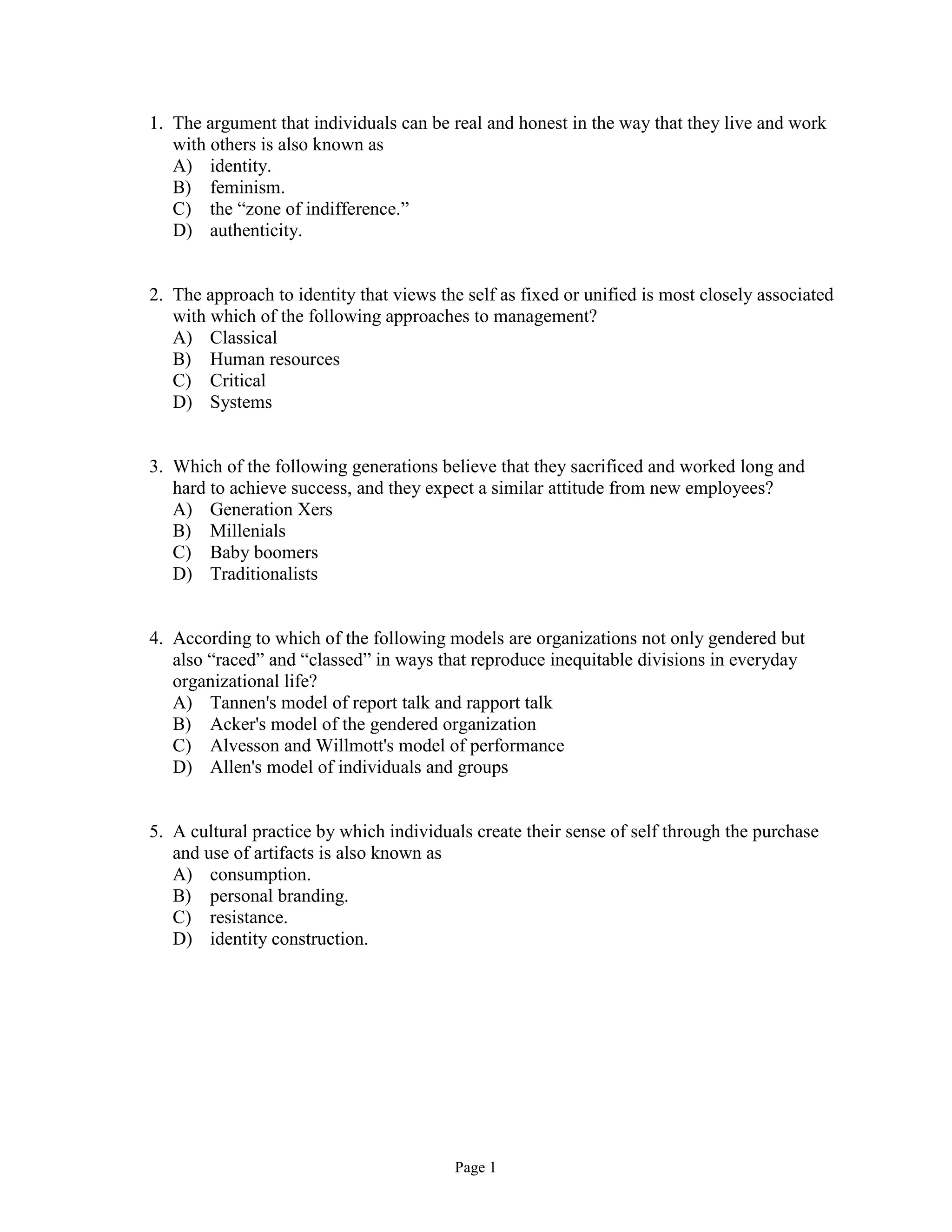
1. The argument that individuals can be real and honest in the way that they live and work
with others is also known as
A) identity.
B) feminism.
C) the “zone of indifference.”
D) authenticity.
2. The approach to identity that views the self as fixed or unified is most closely associated
with which of the following approaches to management?
A) Classical
B) Human resources
C) Critical
D) Systems
3. Which of the following generations believe that they sacrificed and worked long and
hard to achieve success, and they expect a similar attitude from new employees?
A) Generation Xers
B) Millenials
C) Baby boomers
D) Traditionalists
4. According to which of the following models are organizations not only gendered but
also “raced” and “classed” in ways that reproduce inequitable divisions in everyday
organizational life?
A) Tannen's model of report talk and rapport talk
B) Acker's model of the gendered organization
C) Alvesson and Willmott's model of performance
D) Allen's model of individuals and groups
5. A cultural practice by which individuals create their sense of self through the purchase
and use of artifacts is also known as
A) consumption.
B) personal branding.
C) resistance.
D) identity construction.
Page 2
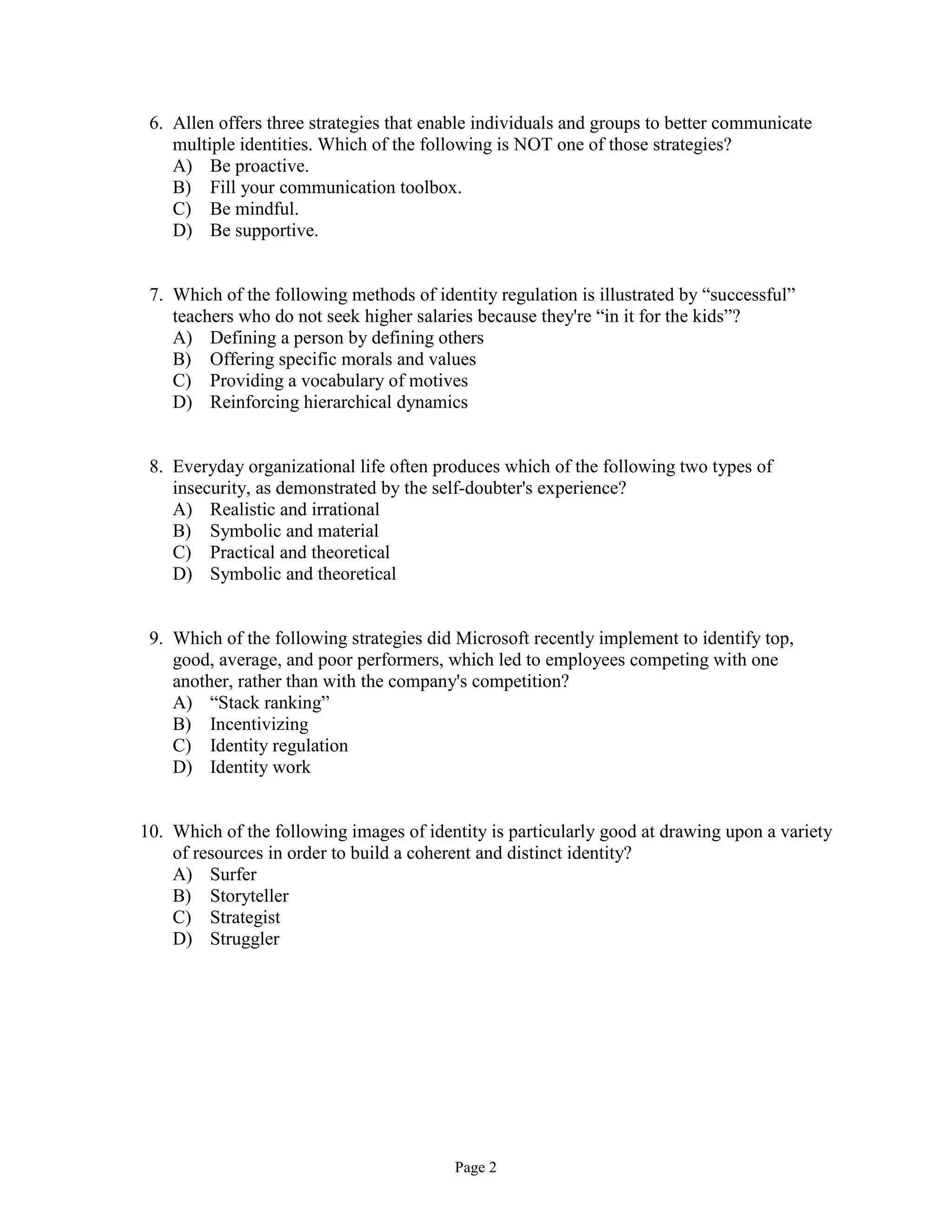
6. Allen offers three strategies that enable individuals and groups to better communicate
multiple identities. Which of the following is NOT one of those strategies?
A) Be proactive.
B) Fill your communication toolbox.
C) Be mindful.
D) Be supportive.
7. Which of the following methods of identity regulation is illustrated by “successful”
teachers who do not seek higher salaries because they're “in it for the kids”?
A) Defining a person by defining others
B) Offering specific morals and values
C) Providing a vocabulary of motives
D) Reinforcing hierarchical dynamics
8. Everyday organizational life often produces which of the following two types of
insecurity, as demonstrated by the self-doubter's experience?
A) Realistic and irrational
B) Symbolic and material
C) Practical and theoretical
D) Symbolic and theoretical
9. Which of the following strategies did Microsoft recently implement to identify top,
good, average, and poor performers, which led to employees competing with one
another, rather than with the company's competition?
A) “Stack ranking”
B) Incentivizing
C) Identity regulation
D) Identity work
10. Which of the following images of identity is particularly good at drawing upon a variety
of resources in order to build a coherent and distinct identity?
A) Surfer
B) Storyteller
C) Strategist
D) Struggler
Page 3
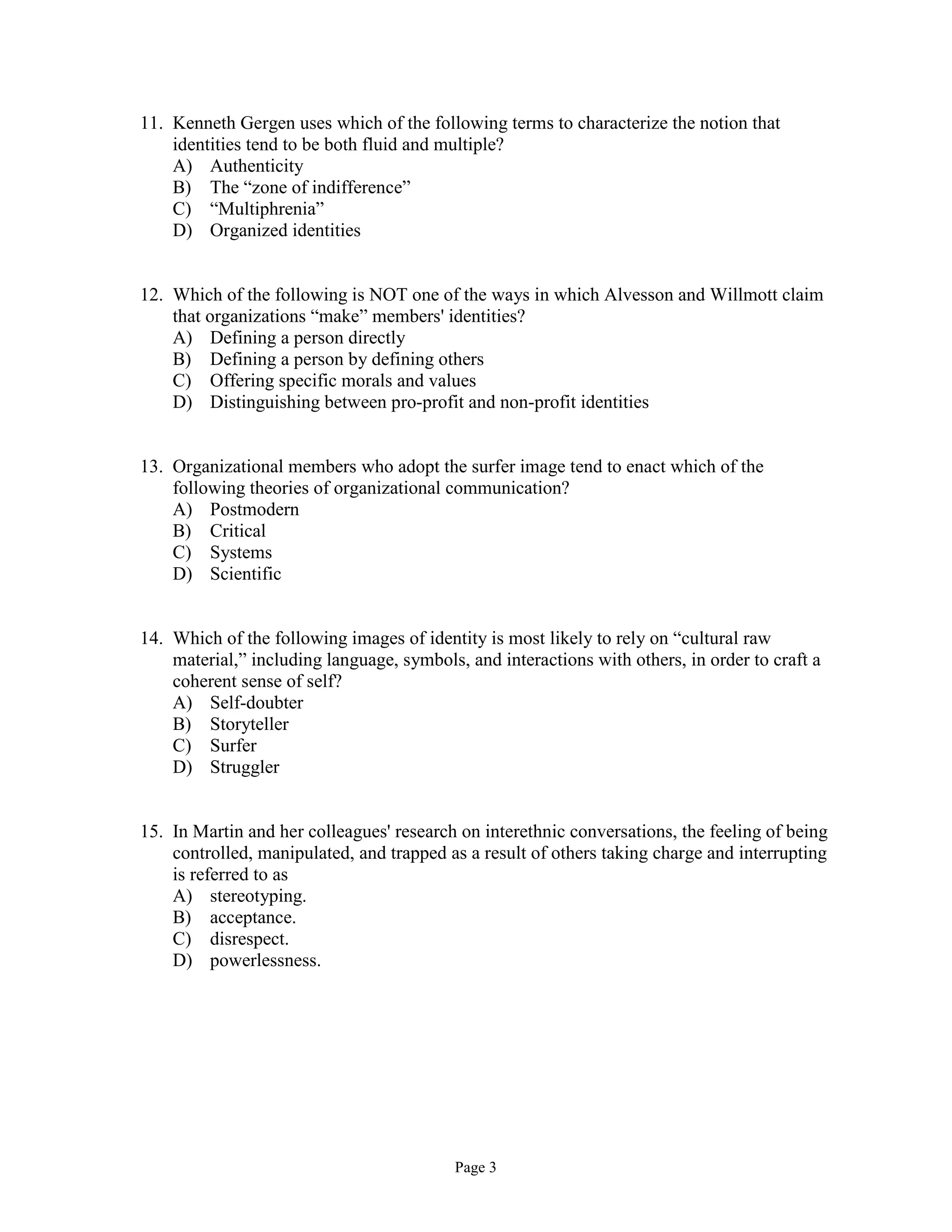
11. Kenneth Gergen uses which of the following terms to characterize the notion that
identities tend to be both fluid and multiple?
A) Authenticity
B) The “zone of indifference”
C) “Multiphrenia”
D) Organized identities
12. Which of the following is NOT one of the ways in which Alvesson and Willmott claim
that organizations “make” members' identities?
A) Defining a person directly
B) Defining a person by defining others
C) Offering specific morals and values
D) Distinguishing between pro-profit and non-profit identities
13. Organizational members who adopt the surfer image tend to enact which of the
following theories of organizational communication?
A) Postmodern
B) Critical
C) Systems
D) Scientific
14. Which of the following images of identity is most likely to rely on “cultural raw
material,” including language, symbols, and interactions with others, in order to craft a
coherent sense of self?
A) Self-doubter
B) Storyteller
C) Surfer
D) Struggler
15. In Martin and her colleagues' research on interethnic conversations, the feeling of being
controlled, manipulated, and trapped as a result of others taking charge and interrupting
is referred to as
A) stereotyping.
B) acceptance.
C) disrespect.
D) powerlessness.
Page 4
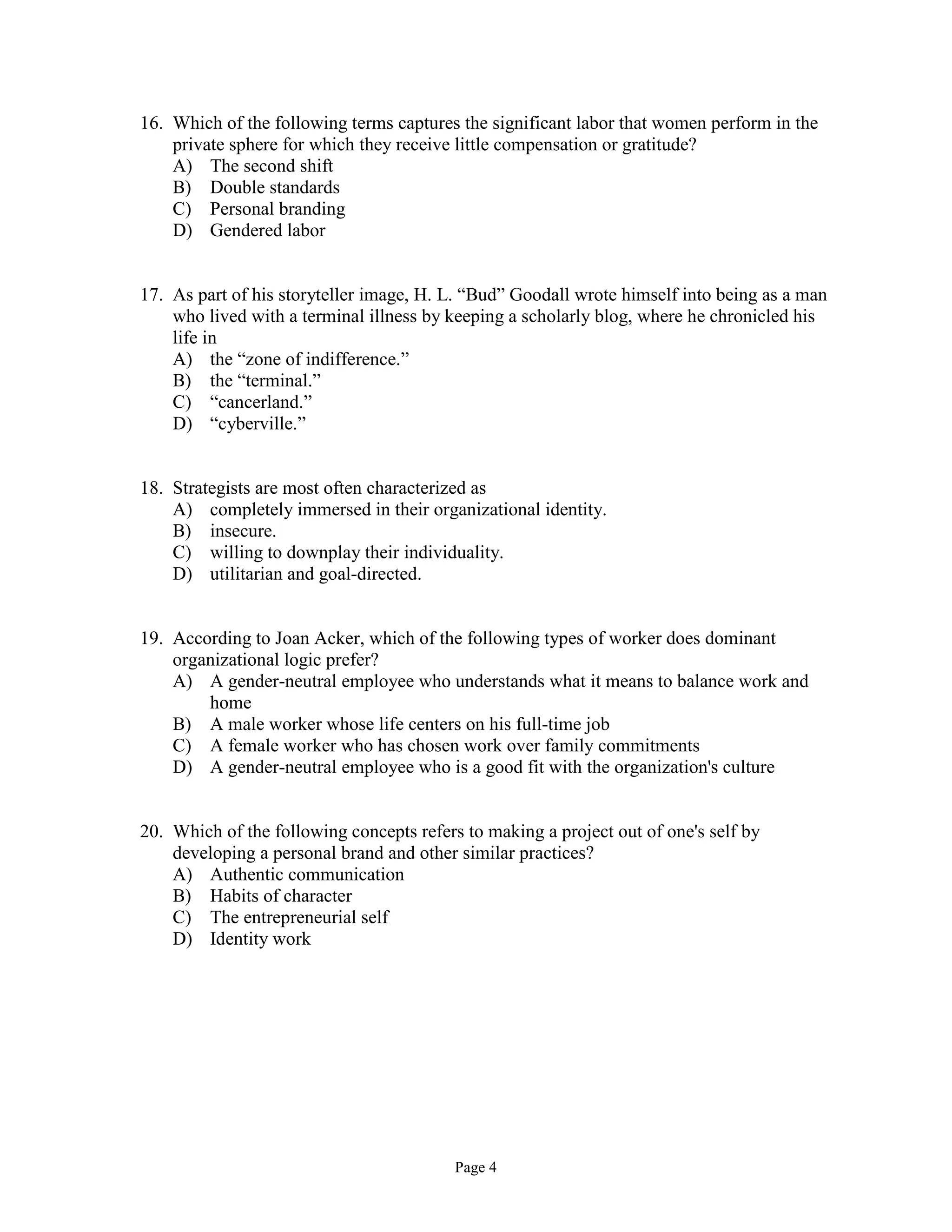
16. Which of the following terms captures the significant labor that women perform in the
private sphere for which they receive little compensation or gratitude?
A) The second shift
B) Double standards
C) Personal branding
D) Gendered labor
17. As part of his storyteller image, H. L. “Bud” Goodall wrote himself into being as a man
who lived with a terminal illness by keeping a scholarly blog, where he chronicled his
life in
A) the “zone of indifference.”
B) the “terminal.”
C) “cancerland.”
D) “cyberville.”
18. Strategists are most often characterized as
A) completely immersed in their organizational identity.
B) insecure.
C) willing to downplay their individuality.
D) utilitarian and goal-directed.
19. According to Joan Acker, which of the following types of worker does dominant
organizational logic prefer?
A) A gender-neutral employee who understands what it means to balance work and
home
B) A male worker whose life centers on his full-time job
C) A female worker who has chosen work over family commitments
D) A gender-neutral employee who is a good fit with the organization's culture
20. Which of the following concepts refers to making a project out of one's self by
developing a personal brand and other similar practices?
A) Authentic communication
B) Habits of character
C) The entrepreneurial self
D) Identity work
Page 5
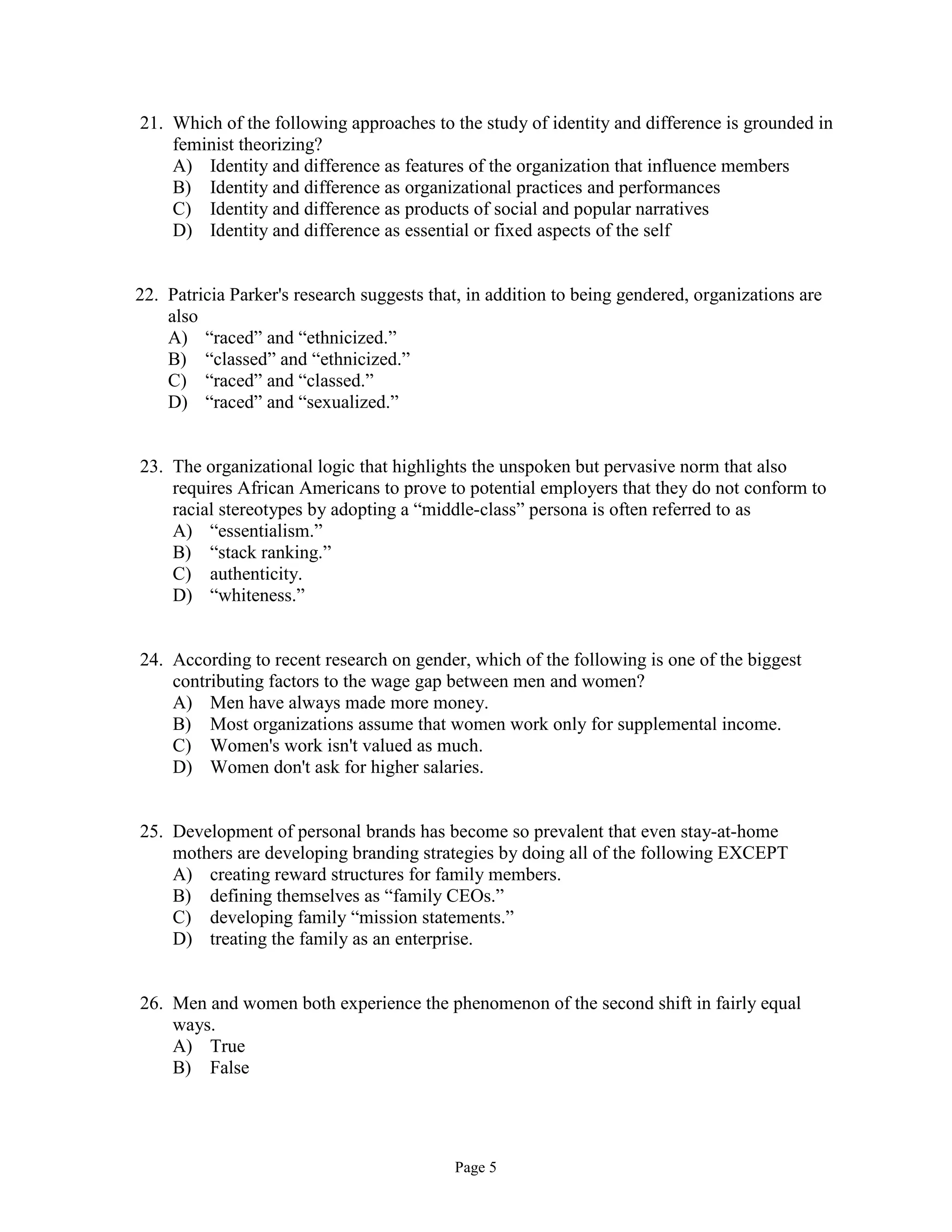
21. Which of the following approaches to the study of identity and difference is grounded in
feminist theorizing?
A) Identity and difference as features of the organization that influence members
B) Identity and difference as organizational practices and performances
C) Identity and difference as products of social and popular narratives
D) Identity and difference as essential or fixed aspects of the self
22. Patricia Parker's research suggests that, in addition to being gendered, organizations are
also
A) “raced” and “ethnicized.”
B) “classed” and “ethnicized.”
C) “raced” and “classed.”
D) “raced” and “sexualized.”
23. The organizational logic that highlights the unspoken but pervasive norm that also
requires African Americans to prove to potential employers that they do not conform to
racial stereotypes by adopting a “middle-class” persona is often referred to as
A) “essentialism.”
B) “stack ranking.”
C) authenticity.
D) “whiteness.”
24. According to recent research on gender, which of the following is one of the biggest
contributing factors to the wage gap between men and women?
A) Men have always made more money.
B) Most organizations assume that women work only for supplemental income.
C) Women's work isn't valued as much.
D) Women don't ask for higher salaries.
25. Development of personal brands has become so prevalent that even stay-at-home
mothers are developing branding strategies by doing all of the following EXCEPT
A) creating reward structures for family members.
B) defining themselves as “family CEOs.”
C) developing family “mission statements.”
D) treating the family as an enterprise.
26. Men and women both experience the phenomenon of the second shift in fairly equal
ways.
A) True
B) False
Page 6
27. Organizations attempt to control member identities by defining people according to their
positions within the organization.
A) True
B) False
28. Identity work and identity regulation are essentially the same process.
A) True
B) False
29. Organizational members often use identity markers, such as gender or race, to highlight
differences between individuals.
A) True
B) False
30. Issues of identity are often value-free and have little to do with power and ideology. We
simply are who we are.
A) True
B) False
31. Women often have a more difficult time negotiating salaries and pay raises than their
male counterparts.
A) True
B) False
32. Identity has less to do with language and action and more to do with simple genetics.
A) True
B) False
33. Authentic communication is impossible in contemporary organizations.
A) True
B) False
34. Gender is a “difference that often makes a difference” in organized contexts.
A) True
B) False
Page 7
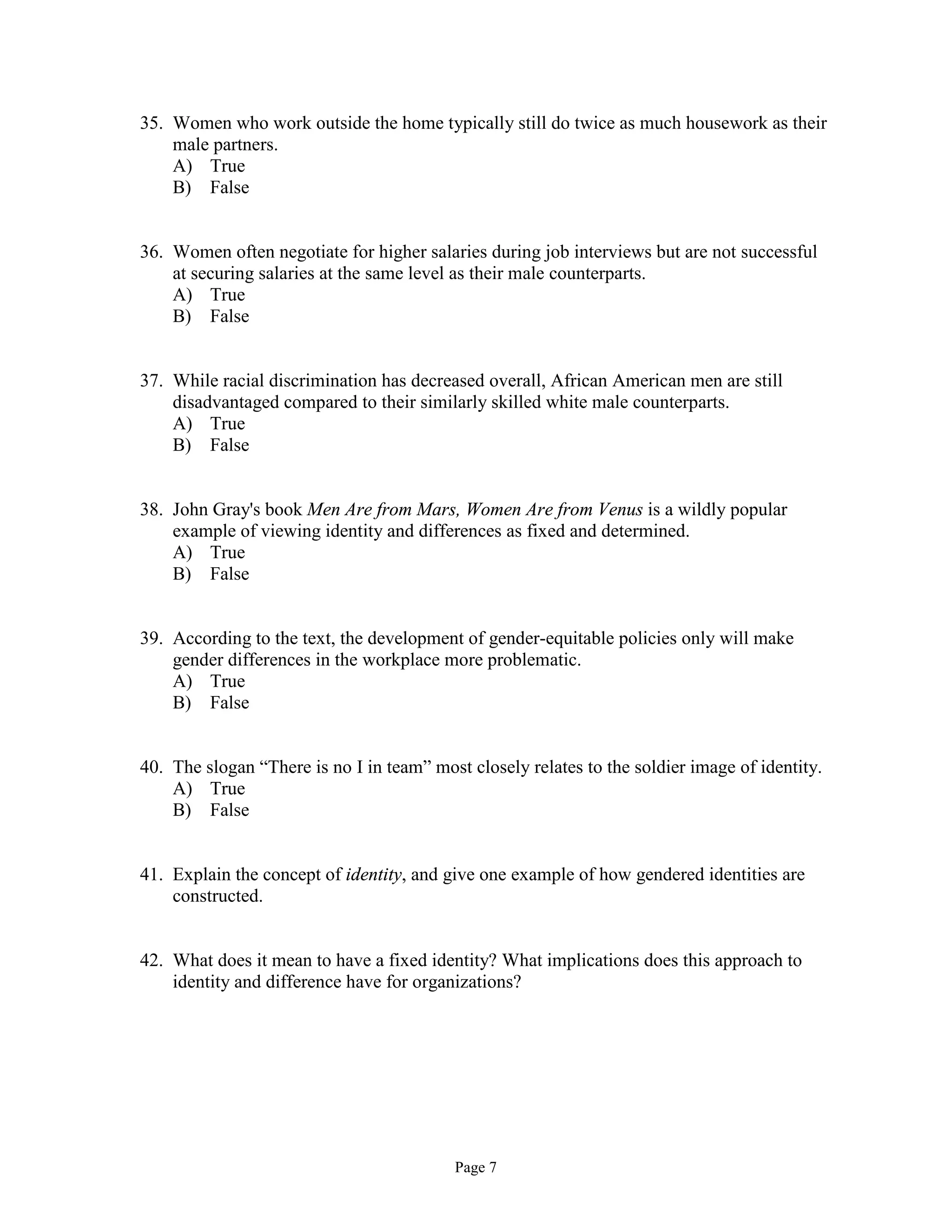
35. Women who work outside the home typically still do twice as much housework as their
male partners.
A) True
B) False
36. Women often negotiate for higher salaries during job interviews but are not successful
at securing salaries at the same level as their male counterparts.
A) True
B) False
37. While racial discrimination has decreased overall, African American men are still
disadvantaged compared to their similarly skilled white male counterparts.
A) True
B) False
38. John Gray's book Men Are from Mars, Women Are from Venus is a wildly popular
example of viewing identity and differences as fixed and determined.
A) True
B) False
39. According to the text, the development of gender-equitable policies only will make
gender differences in the workplace more problematic.
A) True
B) False
40. The slogan “There is no I in team” most closely relates to the soldier image of identity.
A) True
B) False
41. Explain the concept of identity, and give one example of how gendered identities are
constructed.
42. What does it mean to have a fixed identity? What implications does this approach to
identity and difference have for organizations?
Page 8
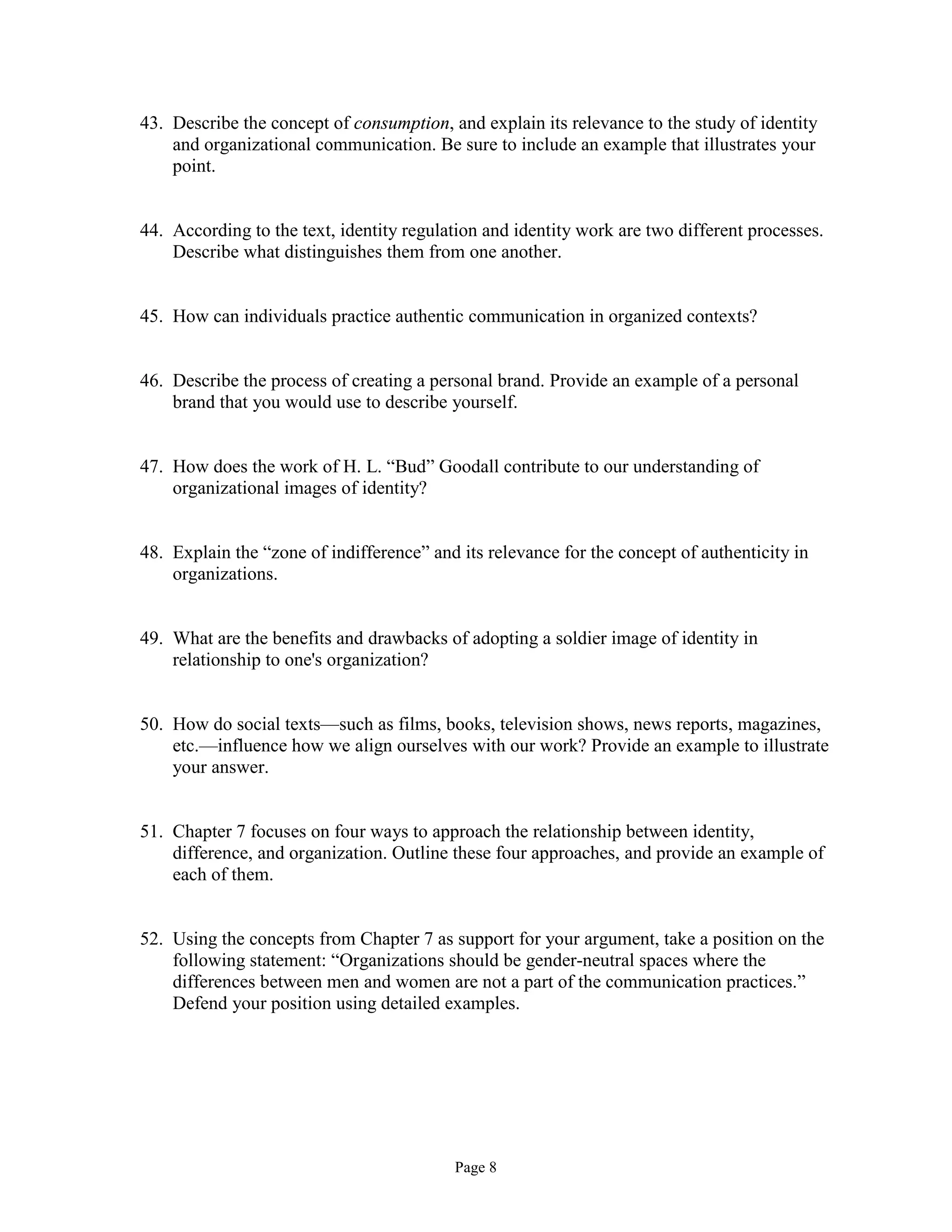
43. Describe the concept of consumption, and explain its relevance to the study of identity
and organizational communication. Be sure to include an example that illustrates your
point.
44. According to the text, identity regulation and identity work are two different processes.
Describe what distinguishes them from one another.
45. How can individuals practice authentic communication in organized contexts?
46. Describe the process of creating a personal brand. Provide an example of a personal
brand that you would use to describe yourself.
47. How does the work of H. L. “Bud” Goodall contribute to our understanding of
organizational images of identity?
48. Explain the “zone of indifference” and its relevance for the concept of authenticity in
organizations.
49. What are the benefits and drawbacks of adopting a soldier image of identity in
relationship to one's organization?
50. How do social texts—such as films, books, television shows, news reports, magazines,
etc.—influence how we align ourselves with our work? Provide an example to illustrate
your answer.
51. Chapter 7 focuses on four ways to approach the relationship between identity,
difference, and organization. Outline these four approaches, and provide an example of
each of them.
52. Using the concepts from Chapter 7 as support for your argument, take a position on the
following statement: “Organizations should be gender-neutral spaces where the
differences between men and women are not a part of the communication practices.”
Defend your position using detailed examples.
Page 9
53. Consider the concept of identity work and how it led to the seven images of identity.
Select three of the seven images. Define the selected images and provide an example for
each image. Conclude your essay by making a case for which image is most likely to fit
the widest variety of contemporary organizations.
Page 10
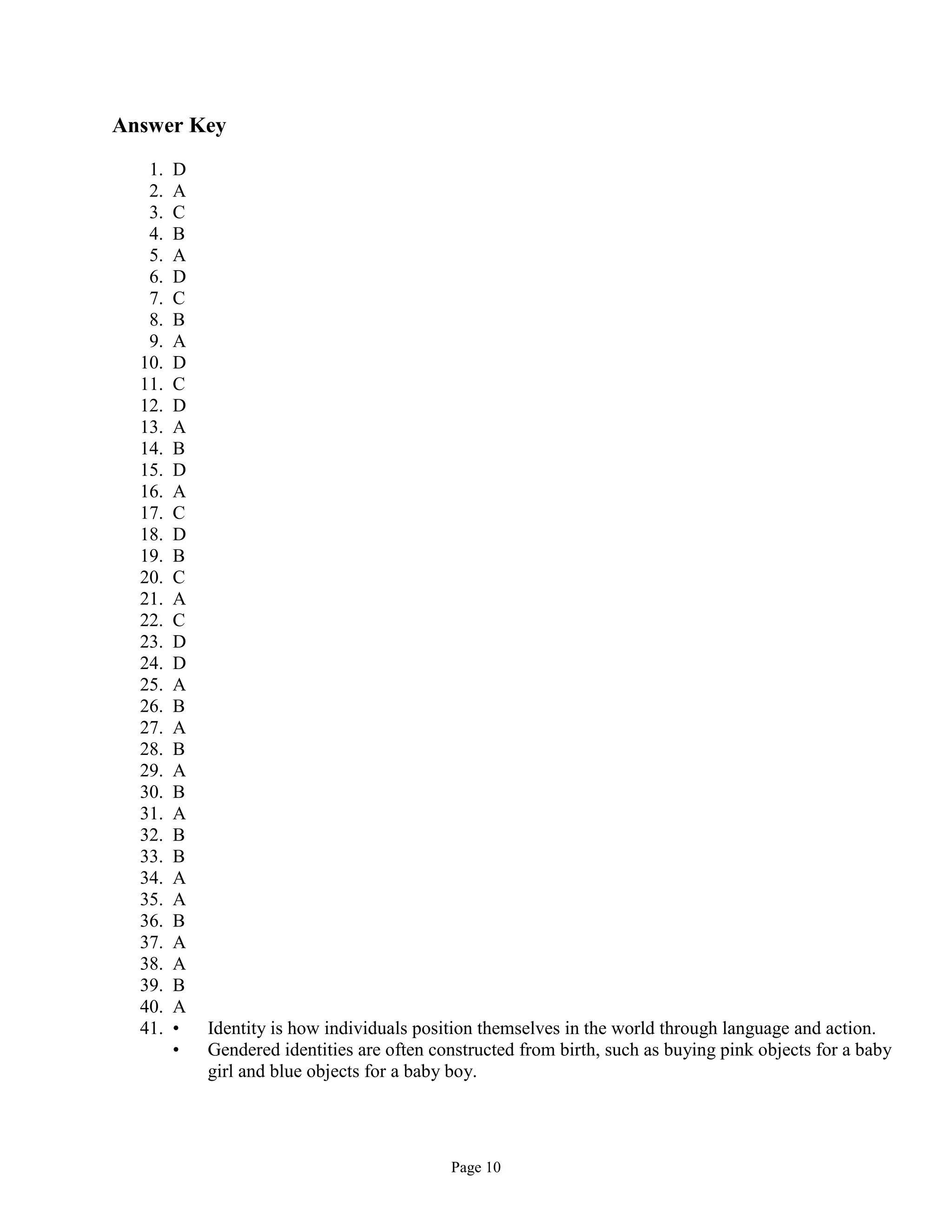
Answer Key
1. D
2. A
3. C
4. B
5. A
6. D
7. C
8. B
9. A
10. D
11. C
12. D
13. A
14. B
15. D
16. A
17. C
18. D
19. B
20. C
21. A
22. C
23. D
24. D
25. A
26. B
27. A
28. B
29. A
30. B
31. A
32. B
33. B
34. A
35. A
36. B
37. A
38. A
39. B
40. A
41. • Identity is how individuals position themselves in the world through language and action.
• Gendered identities are often constructed from birth, such as buying pink objects for a baby
girl and blue objects for a baby boy.
Page 11
42. • This answer should address how identity categories such as race and gender are seen as
“natural”; therefore, differences between men and women and people of different races are
determined by these “natural” categories.
• This answer should also discuss how fixed identities can limit our understanding of
categories such as race and gender because they limit our understanding of communication.
43. • Consumption is a cultural practice through which we construct our sense of self.
• This answer should consider how the products that individuals consume (e.g., an education, a
laptop, a style of dress, etc.) help to construct the identity that they communicate.
44. • This answer should address how identity regulation involves organizations attempting to
control members' identities, while identity work is a member's response to those efforts.
45. • One of the easiest ways to practice authentic communication is through the consistency of
behaviors and the practice of being open and honest in our communication practices.
46. • Individuals often construct a personal brand by consuming specific products and services
(such as developing a specific skill set through education or creating a personal logo).
• Examples should consider how individuals have captured their unique qualities in their
personal brand.
47. • This answer should address how Goodall's work highlights the storyteller image of identity.
• When diagnosed with terminal cancer, he chose to write himself into being as a man who
lived with cancer and who embraced each day.
• His work shows the power of narratives in organizational life.
48. • This answer should explain how the “zone of indifference” refers to the separation of
personal and public selves, with the zone focusing on the side related to work.
• Organizations attempt to capitalize on this “zone of indifference”; however, the concept is
changing since individuals are seeking work that allows for a more authentic portrayal of
their personal selves.
49. • This answer should address how the soldier image is fully immersed in the organization and
embraces the organization's preferred identity; however, they also give up a sense of their
individuality in doing so.
50. • This answer should explain how social texts not only reflect organizational life but also
participate in constructing our views and attitudes toward work.
• This answer should offer an example of popular culture that focuses on work, such as the
television program Celebrity Apprentice.
51. • The four approaches include:
1. Identity and difference as organizational practices and performances
2. Identity and difference as essential or fixed aspects of the self
3. Identity and difference as features of the organization that influence members
4. Identity and difference as products of social and popular narratives
52. • This answer can include a wide range of concepts, including the four approaches to identity
and difference—particularly the approach that treats gender as fixed as well as the approach
that treats gender as an organization practice and performance.
• The important part to remember is that students should take a position on this topic and
defend it using concepts and examples.
53. • Answer should focus on three of the following seven identities:
1. Self-doubter
2. Struggler
3. Surfer
Page 12
4. Storyteller
5. Strategist
6. Stencil
7. Soldier
• The illustrations should focus on how these images of identity are often worked out through
communication practices.
• Students should take a clear position and make a compelling case for which image has the
widest fit.
Other documents randomly have
different content
Having returned him many thanks, I bade him adieu, and took my leave,
feeling like another Jason laden with the golden fleece. On returning home I
forthwith proceeded to examine my prize in all its parts, and could not but
wonder with myself that such a treasure should have lain so long concealed;
and that whilst others produce their trifles and emptinesses with much ado,
their messes twice, aye, an hundred times, heated up, our Harvey should set
so little store by his admirable observations. And indeed, so often as he has
sent forth any of his discoveries to the world, he has not comported himself
like those who, when they publish, would have us believe that an oak had
spoken, and that they had merited the rarest honours,—a draught of hen’s
milk at the least. Our Harvey rather seems as though discovery were natural
to him, a thing of ease and of course, a matter of ordinary business; though
he may nevertheless have expended infinite labour and study on his works.
And we have evidence of his singular candour in this, that he never
hostilely attacks any previous writer, but ever courteously sets down and
comments upon the opinions of each; and indeed he is wont to say, that it is
argument of an indifferent cause when it is contended for with violence and
distemper; and that truth scarce wants an advocate.
It would have been easy for our illustrious colleague to have woven the
whole of this web from materials of his own; but to escape the charge of
envy, he has rather chosen to take Aristotle and Fabricius of Aquapendente
as his guides, and to appear as contributing but his portion to the general
fabric. Of him, whose virtue, candour, and genius are so well known to you
all, I shall say no more, lest I should seem to praise to his face one whose
singular worth has exalted him beyond the reach of all praise. Of myself I
shall only say, that I have done no more than perform the midwife’s office
in this business, ushering into the light this product of our colleague’s
genius as you see it, consummate and complete, but long delayed, and
fearing perchance some envious blast: in other words, I have overlooked the
press; and as our author writes a hand which no one without practice can
easily read (a thing that is common among our men of letters), I have taken
some pains to prevent the printer committing any very grave blunders
through this—a point which I observe not to have been sufficiently attended
to in the small work of his which lately appeared.[121]
Here then, my learned friends, you have the cause of my addressing you
at this time, viz. that you may know that our Harvey presents an offering to
the benefit of the republic of letters, to your honour, to his own eternal
fame.
Farewell, and prosper.
George Ent.
INTRODUCTION.
It will not, I trust, be unwelcome to you, candid reader, if I yield to the
wishes, I might even say the entreaties, of many, and in these Exercises on
Animal Generation, lay before the student and lover of truth what I have
observed on this subject from anatomical dissections, which turns out to be
very different from anything that is delivered by authors, whether
philosophers or physicians.
Physicians, following Galen, teach that from the semen of the male and
female mingled in coition the offspring is produced, and resembles one or
other, according to the predominance of this one or of that; and farther, that
in virtue of the same predominance, it is either male or female. Sometimes
they declare the semen masculinum as the efficient cause, and the semen
femininum as supplying the matter; and sometimes, again, they advocate
precisely the opposite doctrine. Aristotle, one of Nature’s most diligent
inquirers, however affirms the principles of generation to be the male and
the female, she contributing the matter, he the form; and that immediately
after the sexual act the vital principle and the first particle of the future
fœtus, viz. the heart, in animals that have red blood, are formed from the
menstrual blood in the uterus.
But that these are erroneous and hasty conclusions is easily made to
appear: like phantoms of darkness they suddenly vanish before the light of
anatomical inquiry. Nor is any long refutation necessary where the truth can
be seen with one’s proper eyes; where the inquirer by simple inspection
finds everything in conformity with reason; and where at the same time he
is made to understand how unsafe, how base a thing it is to receive
instruction from others’ comments without examination of the objects
themselves, the rather as the book of Nature lies so open and is so easy of
consultation.
What I shall deliver in these my Exercises on Animal Generation I am
anxious to make publicly known, not merely that posterity may there
perceive the sure and obvious truth, but farther, and especially, that by
exhibiting the method of investigation which I have followed, I may
propose to the studious a new and, unless I mistake, a safer way to the
attainment of knowledge.
For although it is a new and difficult road in studying nature, rather to
question things themselves than, by turning over books, to discover the
opinions of philosophers regarding them, still it must be acknowledged that
it is the more open path to the secrets of natural philosophy, and that which
is less likely to lead into error.
Nor is there any just cause wherefore the labour should deter any one, if
he will but think that he himself only lives through the ceaseless working of
his heart. Neither, indeed, would the way I propose be felt as so barren and
lonely, but for the custom, or vice rather, of the age we live in, when men,
inclined to idleness, prefer going wrong with the many, to becoming wise
with the few through dint of toil and outlay of money. The ancient
philosophers, whose industry even we admire, went a different way to
work, and by their unwearied labour and variety of experiments, searching
into the nature of things, have left us no doubtful light to guide us in our
studies. In this way it is that almost everything we yet possess of note or
credit in philosophy, has been transmitted to us through the industry of
ancient Greece. But when we acquiesce in the discoveries of the ancients,
and believe (which we are apt to do through indolence) that nothing farther
remains to be known, we suffer the edge of our ingenuity to be taken off,
and the lamp which they delivered to us to be extinguished. No one of a
surety will allow that all truth was engrossed by the ancients, unless he be
utterly ignorant (to pass by other arts for the present) of the many
remarkable discoveries that have lately been made in anatomy, these having
been principally achieved by individuals who, either intent upon some
particular matter, fell upon the novelty by accident, or (and this is the more
excellent way) who following the traces of nature with their own eyes,
pursued her through devious but most assured ways till they reached her in
the citadel of truth. And truly in such pursuits it is sweet not merely to toil,
but even to grow weary, when the pains of discovering are amply
compensated by the pleasures of discovery. Eager for novelty, we are wont
to travel far into unknown countries, that with our own eyes we may
witness what we have heard reported as having been seen by others, where,
however, we for the most part find
—— minuit præsentia famam:
that the presence lessens the repute. It were disgraceful, therefore, with this
most spacious and admirable realm of nature before us, and where the
reward ever exceeds the promise, did we take the reports of others upon
trust, and go on coining crude problems out of these, and on them hanging
knotty and captious and petty disputations. Nature is herself to be
addressed; the paths she shows us are to be boldly trodden; for thus, and
whilst we consult our proper senses, from inferior advancing to superior
levels, shall we penetrate at length into the heart of her mystery.
Of the Manner and Order of acquiring Knowledge.
Although there is but one road to science, that to wit, in which we
proceed from things more known to things less known, from matters more
manifest to matters more obscure; and universals are principally known to
us, science springing by reasonings from universals to particulars; still the
comprehension of universals by the understanding is based upon the
perception of individual things by the senses. Both of Aristotle’s
propositions, therefore, are true: First, the one in his Physics,[122] where he
says, “The way is naturally prepared, from those things that are more
obvious and clear to us, to those things that are more obvious and clear by
nature. For, indeed, the same things are not both known to us and extant
simply: whence it is indispensable to proceed in this way, viz. from those
things that are of a more obscure nature, but to us are more apparent, to
those that are of a nature more obvious and distinct. Now those things are,
in the first instance, more perspicuous and manifest to us that are most
confused in fact; whence it is necessary to proceed from universals to
particulars; for the whole, according to the dictates of sense, is the more
obvious; and the universal is a certain whole.” And again, that other in his
Analytics,[123] where he thus expresses himself: “Singulars are to us more
known, and are the first that exist according to the information of sense; for,
indeed, there is nothing in the understanding which was not first in the
sense. And although that reasoning is naturally prior and more known
which proceeds by syllogism, still is that more perspicuous to us which is
based on induction. And therefore do we more readily define singulars than
universals, for there is more of equivocation in universals: whence it is
advisable from singulars to pass to universals.”
All this agrees with what we have previously said, although at first blush
it may seem contradictory; inasmuch as universals are first imbibed from
particulars by the senses, and in so far are only known to us as an universal
is a certain whole and indistinct thing, and a whole is known to us
according to sense. For though in all knowledge we begin from sense,
because, as the philosopher quoted has it, sensible particulars are better
known to sense, still the sensation itself is an universal thing. For, if you
observe rightly, although in the external sense the object perceived is
singular, as, for example, the colour which we call yellow in the eye, still
when this impression comes to be made an abstraction, and to be judged of
and understood by the internal sensorium, it is an universal. Whence it
happens that several persons abstract several species, and conceive different
notions, from viewing the same object at the same time. This is conspicuous
among poets and painters, who, although they contemplate one and the
same object in the same place at the same moment, and with all other
circumstances agreeing, nevertheless regard and describe it variously, and
as each has conceived or formed an idea of it in his imagination. In the
same way, the painter having a certain portrait to delineate, if he draw the
outline a thousand times, he will still give a different face, and each not
only differing from the other, but from the original countenance; with such
slight variety, however, that looking at them singly, you shall conceive you
have still the same portrait set before you, although, when set side by side,
you perceive how different they are. Now the reason is this: that in vision,
or the act of seeing itself, each particular is clear and distinct; but the
moment the object is removed, as it is by merely shutting the eyes, when it
becomes an abstraction in the fancy, or is only retained in the memory, it
appears obscure and indistinct; neither is it any longer apprehended as a
particular, but as a something that is common and universal. Seneca[124]
explains this subtlety, according to Plato’s views, in very elegant terms: “An
idea,” he says, “is an eternal copy of the things that have place in nature. I
add an explanation of this definition, that the matter may be made plainer to
you. I desire to take your portrait; I have you as the prototype of the picture,
from which my mind takes a certain impression which it transfers to the
canvass. The countenance, therefore, which teaches and directs me, and
from which the imitation is sought, is the idea.” A little farther on he
proceeds: “I have but just made use of the image which a painter forms in
his mind, by way of illustration. Now, if he would paint a likeness of Virgil,
he forms an intuitive image of his subject: the idea is the face of Virgil, the
type of his future work; and this which the artist conveys and transfers to
his work is the resemblance or portrait. What difference is there? you ask:
the one is the pattern or prototype, the other the form taken from the pattern
and fixed in the work; the artist imitates the one, he creates the other. A
statue has a certain expression of face; this is the Eidos, the species or
representation; the prototype himself has a certain expression, which the
statuary conceiving, transfers to his statue: this is the idea. Do you desire
yet another illustration of the distinction? The Eidos is in the work; the idea
without the work, and not only without the work, but it even existed before
the work was begun.” For the things that have formerly been noted, and that
by use or wont have become firmly fixed in the mind of the artist, do, in
fact, constitute art and the artistic faculty; art, indeed, is the reason of the
work in the mind of the artist. On the same terms, therefore, as art is
attained to, is all knowledge and science acquired; for as art is a habit with
reference to things to be done, so is science a habit in respect of things to be
known: as that proceeds from the imitation of types or forms, so this
proceeds from the knowledge of natural things. Each has its origin in sense
and experience, and it is impossible that there can rightly be either art or
science without visible instance or example. In both, that which we perceive
in sensible objects differs from the image itself which we retain in our
imagination or memory. That is the type, idea, forma informans; this is the
imitation, the Eidos, the abstract species. That is a thing natural, a real
entity; this a representation or similitude, and a thing of the reason. That is
occupied with the individual thing, and itself is single and particular; this is
a certain universal and common thing. That in the artist and man of science
is a sensible thing, clearer, more perfect; this a matter of reason and more
obscure: for things perceived by sense are more assured and manifest than
matters inferred by reason, inasmuch as the latter proceed from and are
illustrated by the former. Finally, sensible things are of themselves and
antecedent; things of intellect, however, are consequent, and arise from the
former, and, indeed, we can in no way attain to them without the help of the
others. And hence it is, that without the due admonition of the senses,
without frequent observation and reiterated experiment, our mind goes
astray after phantoms and appearances. Diligent observation is therefore
requisite in every science, and the senses are frequently to be appealed to.
We are, I say, to strive after personal experience, not to rely on the
experience of others; without which, indeed, no one can properly become a
student of any branch of natural science, nor show himself a competent
judge of what I am about to say on the subject of generation; for without
experience and skill in anatomy, he would not better understand me than
could one born blind appreciate the nature and difference of colours, or one
deaf from birth judge of sounds. I would, therefore, have you, gentle reader,
to take nothing on trust from me concerning the generation of animals; I
appeal to your own eyes as my witnesses and judge. For as all true science
rests upon those principles which have their origin in the operation of the
senses, particular care is to be taken that by repeated dissection the grounds
of our present subject be fully established. If we do otherwise, we shall but
come to empty and unstable opinions; solid and true science will escape us
altogether: just as commonly happens to those who form their notions of
distant countries and cities, or who pretend to get a knowledge of the parts
of the human body, from drawings and engravings, which but too frequently
present things under false and erroneous points of view. And so it is, that in
the present age we have an abundance of writers and pretenders to
knowledge, but very few who are really learned and philosophers.
Thus much have I thought good, gentle reader, to present to you, by way
of preface, that understanding the nature of the assistance to which I have
trusted, and the counsel by which I have been led in publishing these my
observations and experiments; and that you yourself in passing over the
same ground, may not merely be in a condition to judge between Aristotle
and Galen, but, quitting subtleties and fanciful conjectures, embracing
nature with your own eyes, that you may discover many things unknown to
others, and of great importance.
Of the same matters, according to Aristotle.
There is no such thing as innate knowledge, according to Aristotle;
neither opinion, nor art, nor understanding, nor speech, nor reason itself,
inhere in us by nature and from our birth; but all of these, as well as the
qualities and habitudes, which are believed to be spontaneous, and to lie
under the control of our will, are to be regarded as among the number of
those things that reach us from without according to nature: such as the
virtues and the vices, for which men are either praised and rewarded or
reproved and punished. All our knowledge, therefore, of every kind has to
be acquired. But this is not the place to inquire into the first principles of
knowledge.
I believe, however, that it will not be useless if I premise a few words as
to whence and how our knowledge reaches us, both with a view to
rendering what I shall say on the subject of generation more readily
intelligible, and of removing any doubts that may arise out of this opinion
of the Stagirite,[125] who asserts that all doctrine and discipline based on
reason are derived from antecedent knowledge; whence it seems to follow
that there is either no first knowledge, or that this must be innate, a
conclusion which is in contradiction with what has already been stated.
The doubt, however, is by and by resolved by Aristotle[126] himself,
when he treats of the mode in which knowledge is acquired: for after he has
taught that all certain knowledge is obtained through syllogism and
demonstration, and made it manifest that every demonstrative syllogism
proceeds from true and necessary first principles; he goes on to inquire how
principles become known, and what the faculty is that knows; at the same
time, too, he discusses the question, Whether habits, if not innate, are
engendered; and whether, being innate, they lie concealed? “We have not,”
he says, “these habits; for it happens that they are concealed from those
who acquire the most admirable kinds of knowledge through
demonstration. If, however, we receive them, not having had them
previously, how should we become informed, how learn from non-
antecedent knowledge? It is obvious, therefore, that they are neither
possessed, nor can they be engendered in the ignorant and those who are
endowed with no habit. Whence it is essential that some faculty be
possessed, not however any which were more excellent, more exquisite
than they. Now it seems a thing common to all animals, that they have a
congenital power of judging, which we call sense. Since sense is innate,
then, the things perceived by sense remain in some animals; in others they
do not remain. Those in whom they do not remain, however, have either no
knowledge at all, or at least none beyond the simple perception of the things
which do not remain; others, again, when they perceive, retain a certain
something in their soul. Now, as there are many animals of this description,
there is already a distinction between one animal and another; and to this
extent, that in some there is reason from the memory of things; and in
others there is none. Memory, therefore, as is said, follows from sense; but
from repeated recollection of the same thing springs experience (for
repeated acts of memory constitute a single experience). From experience,
however, or from the whole and universal stored quietly in the mind, (one,
to wit, in place of a multitude—because in the whole crowd of particulars
there is one and the same universal,) is derived the principle of art and of
science: of art, if it belong to production (i. e. action); of science, if it
belong to that which is (i. e. the knowledge of entity). Consequently there
are neither any definite habits that are innate, nor any habits that are formed
from other and more known habits, but from sense.”
From which words of Aristotle it plainly appears by what order or
method any art or science is acquired, viz. The thing perceived by sense
remains; from the permanence of the thing perceived results memory; from
multiplied memory, experience; from experience, universal reason,
definitions, and maxims or common axioms, the most certain principles of
knowledge; for example, the same thing under like conditions cannot be
and not be; every affirmation or negation is either true or false; and so on.
Wherefore, as we have said above, there is no perfect knowledge which
can be entitled ours, that is innate; none but what has been obtained from
experience, or derived in some way from our senses; all knowledge, at all
events, is examined by these, approved by them, and finally presents itself
to us firmly grounded upon some pre-existing knowledge which we
possessed: because without memory there is no experience, which is
nothing else than reiterated memory; in like manner memory cannot exist
without endurance of the things perceived, and the thing perceived cannot
remain where it has never been.
The supreme dictator in philosophy again and elsewhere expresses
himself very elegantly in the same direction:[127] “All men desire by nature
to know; the evidence of this is the pleasure they take in using their senses,
among which the sight is that which is particularly preferred, because this
especially serves us to acquire knowledge, and informs us of the greatest
number of differences. Nature, therefore, endowed animals with sense;
some of them, however, have no memory from the operations of their
senses; others, again, have memory; and this is the reason wherefore some
are more intelligent, and some more capable of receiving instruction than
others, those, namely, that want recollection. Some show discretion
independently of tuition: inasmuch as there are many that do not hear, such
as bees and others of the same kind. But all animals which along with
memory have the faculty of hearing are susceptible of education. Other
creatures, again, live possessed of fancy and memory, but they have little
store of experience; the human kind, however, have both art and reasoning.
Now experience comes to man through memory; for many memories of the
same thing have the force of a single experience: so that experience appears
to be almost identical with certain kinds of art and science;[128] and, indeed,
men acquire both art and science by experience: for experience, as Polus
rightly remarks, begets art, inexperience is waited on by accident.”
By this he plainly tells us that no one can truly be entitled discreet or
well-informed, who does not of his own experience, i. e. from repeated
memory, frequent perception by sense, and diligent observation, know that
a thing is so in fact. Without these, indeed, we only imagine or believe, and
such knowledge is rather to be accounted as belonging to others than to us.
The method of investigating truth commonly pursued at this time therefore
is to be held as erroneous and almost foolish, in which so many inquire
what others have said, and omit to ask whether the things themselves be
actually so or not; and single universal conclusions being deduced from
several premises, and analogies being thence shaped out, we have
frequently mere verisimilitudes handed down to us instead of positive
truths. Whence it comes that pretenders to knowledge and sophists,
trimming up the discoveries of others, changing the arrangement only, or
the language, and adding a few things of no importance, audaciously send
them forth as their own, and so render philosophy, which ought to be certain
and perspicuous, obscure and intricate. For he who reads the words of an
author and fails, through his own senses, to obtain images of the things that
are conveyed in these words, derives not true ideas, but false fancies and
empty visions; whence he conjures up shadows and chimeras, and his
whole theory or contemplation, which, however, he regards as knowledge,
is nothing more than a waking dream, or such a delirium as the sick fancy
engenders.
I therefore whisper in your ear, friendly reader, and recommend you to
weigh carefully in the balance of exact experience all that I shall deliver in
these Exercises on the Generation of Animals; I would not that you gave
credit to aught they contain save in so far as you find it confirmed and
borne out by the unquestionable testimony of your own senses.
The same course is even advised by Aristotle, who, after having gone
over a great many particulars about bees, says at length:[129] “That the
generation of bees takes place in this way appears both from reason and
from those things that are seen to occur in their kind. Still all the incidents
have not yet been sufficiently examined. And when the investigation shall
be complete, then will sense be rather to be trusted than reason; reason,
however, will also deserve credit, if the things demonstrated accord with the
things that are perceived by sense.”
Of the Method to be pursued in studying Generation.
Since in Animal Generation, (and, indeed, in all other subjects upon
which information is desired,) inquiry must be begun from the causes,
especially the material and efficient ones, it appears advisable to me to look
back from the perfect animal, and to inquire by what process it has arisen
and grown to maturity, to retrace our steps, as it were, from the goal to the
starting place; so that when at last we can retreat no further, we shall feel
assured that we have attained to the principles; at the same time we shall
perceive from what primary matter, and from what efficient principle, and
in what way from these the plastic force proceeds; as also what processes
nature brings into play in the work. For primary and more remote matter, by
abstraction and negation (being stripped of its garments as it were) becomes
more conspicuous; and whatever is first formed or exists primarily in
generation, is the material cause of everything that succeeds. For example,
before a man attains to maturity, he was a boy, an infant, an embryo. And
then it is indispensable to inquire further as to what he was in his mother’s
womb before he was an embryo or fœtus; whether made up of three
bubbles, or a shapeless mass, or a conception or coagulum proceeding from
the mingled seminal fluids of his parents, or what else, as we have it
delivered to us by writers. In like manner, before a fowl had attained to
maturity or perfection,—because capable of engendering its like,—it was a
chicken; previous to which it was an embryo or fœtus in the egg; and before
this, Hieronymus Fabricius, of Aquapendente, has observed rudiments of
the head, eyes, and spine. But when he asserts that the bones are formed
before the muscles, heart, liver, lungs, and precordial parts, and contends
that all the internal organs must exist before the external ones, he follows
probabilities according to previous notions rather than inspection; and
quitting the evidences of sense that rest on anatomy, he seeks refuge in
reasonings upon mechanical principles; a procedure that is anything but
becoming in a great anatomist, whose duty it was faithfully to narrate the
changes he observed taking place day by day in the egg, up to the period
when the fœtus is perfected; and this the rather as he expressly proposed to
himself to write the history of the formation of the chick in the egg, and to
exhibit in figures what happens in the course of each successive day. It
would have been in harmony with such a design, I say, had we been
informed, on the testimony of the senses, of what parts are formed first,
together, or subsequently in the egg; and not had mere opinions or musty
conjectures, and the instances of houses and ships, adduced in illustration of
the order and mode of formation of the parts.
We, therefore, in conformity with the method proposed, shall show in the
first place in the egg, and then in the conceptions of other animals, what
parts are first, and what are subsequently formed by the great God of Nature
with inimitable providence and intelligence, and most admirable order. Next
we shall inquire into the primary matter out of which, and the efficient
cause by which generation is accomplished, and also the order and
economy of generation, as observed by us; that from thence, from its own
work, we may have some certain information of the several faculties of the
formative and vegetative soul, and of the nature of the soul itself, judging
from its members or organs, and their functions.
This, indeed, cannot be done in all animals: first, because a sufficient
number of several of these cannot be commanded; and again, because, from
the small size of many, they escape our powers of vision. It must suffice,
therefore, that this is done in some kinds which are more familiarly known
to us, and that we refer all the rest to these as types or standards.
We have, therefore, selected those that may tend to render our
experiments more undeniable, viz. the larger and more perfect animals, and
that are easily within reach. For in the larger animals all things are more
conspicuous; in the more perfect, they are also more distinct; and in those
that we can command, and that live with us, everything is more readily
examined: we have it in our power so often as we please to repeat our
observations, and so to free them from all uncertainty and doubt. Now,
among oviparous animals of this description, we have the common fowl,
the goose, duck, pigeon; and then we have frogs, and serpents, and fishes;
crustacea, testacea, and mollusca; among insects, bees, wasps, butterflies,
and silkworms; among viviparous creatures, we have sheep, goats, dogs,
cats, deer, and oxen; lastly, we have the most perfect of all animals, man.
Having studied and made ourselves familiar with these, we may turn to
the consideration of the more abstruse nature of the vegetative soul, and feel
ourselves in a condition to understand the method, order, and causes of
generation in animals generally; for all animals resemble one or other of
those above mentioned, and agree with them either generally or specifically,
and are procreated in the same manner, or the mode of their generation at
least is referrible by analogy to that of one or other of them. For Nature,
perfect and divine, is ever in the same things harmonious with herself, and
as her works either agree or differ, (viz. in genus, species, or some other
proportion,) so is her agency in these (viz. generation or development)
either the same or diverse. He who enters on this new and untrodden path,
and out of the vast realm of Nature endeavours to find the truth by means of
anatomical dissections and experiments, is met by such a multitude of facts,
and these of so unusual an aspect, that he may find it more difficult to
explain and describe to others the things he has seen, than he reckoned it
labour to make his observations; so many things are encountered that
require naming; such is the abundance of matter and the dearth of words.
But if he would have recourse to metaphors, and by means of old and
familiar terms would make known his ideas concerning the things he has
newly discovered, the reader would have little chance of understanding him
better than if they were riddles that were propounded; and of the thing
itself, which he had never seen, he could have no conception. But then, to
have recourse to new and unusual terms were less to bring a torch to
lighten, than to darken things still more with a cloud: it were to attempt an
explanation of a matter unknown by one still more unknown, and to impose
a greater toil on the reader to understand the meaning of words than to
comprehend the things themselves. And so it happens that Aristotle is
believed by the inexperienced to be obscure in many places; and on this
account, perhaps, Fabricius of Aquapendente rather intended to exhibit the
chick in ovo in his figures than to explain its formation in words.
Wherefore, courteous reader, be not displeased with me, if, in illustrating
the history of the egg, and in my account of the generation of the chick, I
follow a new plan, and occasionally have recourse to unusual language.
Think me not eager for vainglorious fame rather than anxious to lay before
you observations that are true, and that are derived immediately from the
nature of things. That you may not do me this injustice, I would have you
know that I tread in the footsteps of those who have already thrown a light
upon this subject, and that, wherever I can, I make use of their words. And
foremost of all among the ancients I follow Aristotle; among the moderns,
Fabricius of Aquapendente; the former as my leader, the latter as my
informant of the way. For even as they who discover new lands, and first set
foot on foreign shores, are wont to give them new names which mostly
descend to posterity, so also do the discoverers of things and the earliest
writers with perfect propriety give names to their discoveries. And now I
seem to hear Galen admonishing us, that we should but agree about the
things, and not dispute greatly about the words.
ON
ANIMAL GENERATION.
EXERCISE THE FIRST.
Wherefore we begin with the history of the hen’s egg.
Hieronymus Fabricius of Aquapendente, (whom, as I have said, I have
chosen my informant of the way I am to follow,) in the beginning of his
book on the Formation of the Ovum and Chick, has these words: “My
purpose is to treat of the formation of the fœtus in every animal, setting out
from that which proceeds from the egg: for this ought to take precedence of
all discussion of the subject, both because from this it is not difficult to
make out Aristotle’s views of the matter, and because his treatise on the
Formation of the Fœtus from the egg, is by far the fullest, and the subject is
by much the most extensive and difficult.”
We, however, commence with the history of the hen’s egg as well for the
reasons above assigned, as because we can thence obtain certain data
which, as more familiar to us, will serve to throw light on the generation of
other animals; for as eggs cost little, and are always to be had, we have an
opportunity from them of observing the first clear and unquestionable
commencements of generation, how nature proceeds in the process, and
with what admirable foresight she governs every part of the work.
Fabricius proceeds: “Now that the contemplation of the formation of the
chick from the egg is of very ample scope, appears from this, that the
greater number of animals are produced from ova. Passing by almost all
insects and the whole of the less perfect animals, which are obviously
produced from eggs, the greater number of the more perfect are also
engendered from eggs.” And then he goes on to particularize: “All feathered
creatures; fishes likewise, with the single exception of the whale tribes;
crustacea, testacea, and all mollusca; among land animals, reptiles,
millepeds, and all creeping things; and among quadrupeds, the entire tribe
of lizards.”
We, however, maintain (and shall take care to show that it is so), that all
animals whatsoever, even the viviparous, and man himself not excepted, are
produced from ova; that the first conception, from which the fœtus proceeds
in all, is an ovum of one description or another, as well as the seeds of all
kinds of plants. Empedocles,[130] therefore, spoke not improperly of the
oviparum genus arboreum, “the egg-bearing race of trees.” The history of
the egg is therefore of the widest scope, inasmuch as it illustrates generation
of every description.
We shall, therefore, begin by showing where, whence, and how eggs are
produced; and then inquire by what means and order and successive steps
the fœtus or chick is formed and perfected in and from the egg.
Fabricius has these additional words: “The fœtus of animals is
engendered in one case from an ovum, in another from the seminal fluid, in
a third from putrefaction; whence some creatures are oviparous, others
viviparous, and yet others, born of putrefaction or by the spontaneous act of
nature, automatically.”
Such a division as this, however, does not satisfy me, inasmuch as all
animals whatsoever may be said in a certain sense to spring from ova, and
in another certain sense from seminal fluid; and they are entitled oviparous,
viviparous, or vermiparous, rather in respect of their mode of bringing forth
than of their first formation. Even the creatures that arise spontaneously are
called automatic, not because they spring from putrefaction, but because
they have their origin from accident, the spontaneous act of nature, and are
equivocally engendered, as it is said, proceeding from parents unlike
themselves. And, then, certain other animals bring forth an egg or a worm
as their conception and semen, from which, after it has been exposed
abroad, a fœtus is produced; whence such animals are called oviparous or
vermiparous. Viviparous animals are so entitled because they retain and
cherish their conception in their interior, until from thence the fœtus comes
forth into the light completely formed and alive.
EXERCISE THE SECOND.
Of the seat of generation.
“Nature,” says Fabricius, “was first solicitous about the place [where
generation should proceed], which she determined should be either within
or without the animal: within she ordained the uterus; without, the ovum: in
the uterus the blood and seminal fluid engendering; in the ovum, however,
the fluids or elements of which it consists supplying pabulum for the
production of the fœtus.”
Now, whatever is procreated of the semen properly so called originates
and is perfected either in the same place or in different places. All
viviparous creatures derive their origin and have their completion in the
uterus itself; but oviparous animals, as they have their beginning within
their parents, and there become ova, so is it beyond their parents that they
are perfected into the fœtal state. Among oviparous animals, however, there
are some that retain their ova till such time as they are mature and perfect;
such as all the feathered tribes, reptiles and serpents. Others, again, extrude
their semina in a state still immature and imperfect, and it is without the
body of the parent that increase, maturity, and perfection, are attained.
Under this head we range frogs, many kinds of fishes, crustaceous,
molluscous, and testaceous animals, the ova of which, when first extruded,
are but beginnings, sketches, yelks which afterwards surround themselves
with whites, and attracting, concocting, and attaching nutriment to
themselves, are changed into perfect seeds or eggs. Such also are the
semina of insects (called worms by Aristotle), which, imperfect on their
extrusion and in the beginning, seek food for themselves, upon which they
are nourished, and grow from a grub into a chrysalis: from an imperfect into
a perfect egg or seed. Birds, however, and the rest of the oviparous tribes,
lay perfect eggs; whence without the uterus the fœtus is engendered. And it
was on this account that Fabricius admitted two seats of generation: one
internal, the uterus; another external, the ovum. But he would have had
more reason, in my opinion, had he called the nest, or place where the eggs
are laid, the external seat, that, to wit, in which the extruded seed or egg is
cherished, matured, and perfected into a fœtus; for it is from the differences
of this seat that the generation of oviparous animals is principally
distinguished. And it is, indeed, a thing most worthy of admiration to see
these creatures selecting and preparing their nests with so much foresight,
and fashioning, and furnishing, and concealing them with such inimitable
art and ingenuity; so that it seems imperative on us to admit in them a
certain spark of the divine flame (as the poet said of bees); and, indeed, we
can more readily admire than imitate their untaught art and sapience.
EXERCISE THE THIRD.
Of the upper part of the hen’s uterus, or the ovary.
The uterus of the fowl is divided by Fabricius into the superior and
inferior portions, and the superior portion he calls the ovary.
The ovary is situated immediately beneath the liver, close to the spine,
over the descending aorta. In this situation, in the larger animals with red
blood, the cœliac artery enters the mesentery, at the origin, namely, of the
emulgent veins, or a little lower; in the situation moreover in which in the
other red-blooded and viviparous animals the vasa præparantia, tending to
the testes, take their origin: in the same place at which the testes of the
cock-bird are situated, there is the ovary of the hen discovered. For some
animals carry their testicles externally; others have them within the body, in
the loins, in the space midway from the origins of the vasa præparantia. But
the cock has his testicles at the very origin of these vessels, as if his
spermatic fluid needed no preparation.
Aristotle[131] says that the ovum begins at the diaphragm; “I, however,”
says Fabricius, “in my treatise on Respiration, have denied that the
feathered kinds have any diaphragm. The difficulty is resolved by admitting
that birds are not entirely destitute of a kind of diaphragm, inasmuch as they
have a delicate membrane in the place of this septum, which Aristotle calls
a cincture and septum. Still they have no diaphragm that is muscular, and
that might aid respiration, like other animals. But, indeed, Aristotle did not
know the muscles.”
Thus is the prince of philosophers accused and excused in the same
breath, his challenger being himself not free from error; because it is certain
that Aristotle both knew the muscles, as I have elsewhere shown, and the
membranes, which in birds are not only situated transversely in the
direction of the cincture of the body, but extended in the line of the
longitudinal direction of the belly, supplying the place of the diaphragm [of
quadrupeds] and being subservient to respiration, as I have shown in the
clearest manner in my disquisitions on the Respiration of Animals. And,
passing over other particulars at this time, I shall only direct attention to the
fact, that birds breathe with great freedom, and in singing also modulate
their voice in the most admirable manner, their lungs all the while being so
closely connected with their sides and ribs, that they can neither be dilated
and rise, nor suffer contraction in any considerable degree.
The bronchia or ends of the trachea in birds, moreover, are perforate, and
open into the abdomen (and this is an observation which I do not remember
to have met with elsewhere), so that the air inspired is received into and
stored up within the cells or cavities formed by the membranes mentioned
above. In the same manner as fishes and serpents draw air into ample
bladders situated in the abdomen, and there store it up, by which they are
thought to swim more lightly; and as frogs and toads, when in the height of
summer they respire more vigorously assume more than the usual quantity
of air into their vesicular lungs, (whence they acquire so large a size,) which
they afterwards freely expire, croaking all the while; so in the feathered
tribes are the lungs rather the route and passage for respiration than its
adequate instrument.
Now, had Fabricius seen this, he would never have denied that these
membranes (with the assistance of the abdominal muscles at all events,)
could subserve respiration and perform the office of the diaphragm, which,
indeed, of itself, and without the assistance of the abdominal muscles, were
incompetent to act as an instrument of respiration. And, then, the diaphragm
has another duty to perform in those creatures in whom it is muscular or
fleshy, viz., to depress the stomach filled with food, and the intestines
distended with flatus, so that the heart and lungs shall not be invaded, and
life itself oppressed in its citadel. But as there was no danger of anything of
this kind in birds, they have a membranous septum, perfectly well adapted
to the purposes of respiration, so that they have very properly been said to
have a diaphragm. And were birds even entirely without anything in the
shape of a diaphragm, still would Aristotle not be liable to criticism for
speaking of the ova commencing at the septum transversum, because by
this title he merely indicates the place where the diaphragm is usually met
with in other animals. In the same way we ourselves say that the ovary is
situated at the origin of the spermatic vasa præparantia, although the hen
has, in fact, no such vessels.
The perforations of the lungs discovered by me (and to which I merely
direct attention in this place,) are neither obscure nor doubtful, but, in birds
especially, sufficiently conspicuous, so that in the ostrich I found many
conduits which readily admitted the points of my fingers. In the turkey,
fowl, and, indeed, almost all birds, you will find that a probe passed
downwards by the trachea makes its way out of the lungs, and is discovered
lying naked and exposed in one or another of the abdominal cells. Air
blown into the lungs of these creatures with a pair of bellows passes on with
a certain force even into the most inferior of these cells.
We may even be permitted to ask, whether in man, whilst he lives, there
is not a passage from openings of the same kind into the cavity of the
thorax? For how else should the pus poured out in empyema and the blood
extravasated in pleurisy make its escape? In penetrating wounds of the
chest, the lungs themselves being uninjured, air often escapes by the
wound; or liquids thrown into the cavity of the thorax, are discharged with
the expectoration. But our views of this subject will be found fully
expressed elsewhere, viz., in our disquisitions on the Causes, Uses, and
Organs of Respiration.
I return to the ovary and the upper portion of the fowl’s uterus, in which
the rudiments of the eggs are produced. These, according to Aristotle,[132]
in the first instance are small, and of a white colour; growing larger, they
subsequently become of a paler and then of a deeper yellow.
The superior uterus of Fabricius, however, has no existence until after
the hen has conceived, and contains the rudiments of ova within it; when it
may be designated as a cluster of papulæ. And he therefore observes very
properly, “The superior uterus is nothing more than an almost infinite
congeries of yelks, which appear collected as it were into a single cluster, of
a rounded form, and of every size, from that of a grain of mustard to that
almost of a walnut or medlar. This multitude of vitelli is aggregated and
conjoined very much in the manner of a bunch of grapes, for which reason I
shall constantly speak of it as the vitellarium or raceme of yelks; a
comparison which Aristotle himself made in speaking of the soft or
scaleless fishes, when he says,[133] their ovary or roe is extruded
agglutinated into a kind of raceme or bunch of grapes. And in the same way
as in a bunch of grapes the several berries are seen to be of different sizes,
some large, some small, some of very diminutive proportions, each hanging
by its several peduncle, so do we find precisely the same thing in the
vitellarium of the fowl.”
In fishes, frogs, crustacea, and testacea, however, matters are otherwise
arranged. The ovary or vitellary here contains ova of one uniform size only,
which being extruded increase, attain maturity, and give birth to fœtuses
simultaneously. But in the ovary of the common fowl, and almost all the
rest of the oviparous tribes, the yelks are found in various stages of their
growth, from dimensions that are scarcely visible up to the full size.
Nevertheless the eggs of the fowl and other birds, (not otherwise than in
those cases where the eggs are all engendered and laid at the same
moment,) ripen their fœtuses under the influence of incubation in the same
nest, and produce them perfect, nearly at the same time. In the family of the
pigeons, however, (which lay and incubate no more than two eggs in the
same nest,) I have observed that all the ova crowded together in the ovary,
with the exception of a single pair, were of the same dimensions; this pair
was very much larger than any of the others, and already prepared to
descend into the second or lower uterus. In these creatures, therefore, the
number of young is great, not because of the multitude produced at a time,
but of the frequency with which births take place, viz., every month. In the
same way, among cartilaginous fishes, such as the skates, dog-fishes, &c.,
two eggs only come to maturity together, one of which descends from the
right the other from the left corner of the uterus into the inferior portion,
where they are cherished, and where they finally produce living fœtuses,
precisely as happens among viviparous animals; in the ovary, nevertheless,
there is almost infinite store of ova of various sizes—in the ray I have
counted upwards of a hundred.
The ova of the other oviparous tribes are either perfected externally, as in
the case of fishes, or they are concocted or matured, as in the instance of
testacea, crustacea, and spiders. Testaceous animals lay their eggs amidst
froth; the crustaceous tribes, such as the shrimp, crab, and lobster, bear
them about with them, attached to certain appendages; and the spiders carry
them about and cherish them, laid up in a kind of purse or basket, made of
their web. The beetle rolls its eggs in dung, using its hind legs in the
operation, and buries them. Now, in all these creatures the quantity of eggs
is almost incredibly great: in fishes they form two oblong bladders or
follicles, as may be seen in the carp, herring, and smelt, in all of which, as
there is no uterus, but merely an ovary present, so is this sometimes
crowded with ova to such a degree, that it comes to surpass the body in
bulk.
Of such ovaries of the mullet and carp, salted and pressed, and dried in
the smoke, was prepared that article of food in such request among the
Greeks and old Italians, (called botorcha by the latter, ώά τάριχα, i. e. salted
eggs, by the former,) and very similar, we may presume, to the masses
which we find in the insides of our smoked herrings, and to the compact
granular red-coloured roe of our lobsters. The article prepared from the
salted roe of the sturgeon, which is called caviare, and resembles black
soap, is still the delight of epicures.
In those fishes that are highly prolific such a quantity of eggs is
engendered, that the whole abdomen can scarcely contain them, even when
they are first produced, still less when they have grown to any size. In
fishes, therefore, there is no part save the ovary dedicated to purposes of
reproduction. The ova of these animals continue to grow without the body,
and do not require the protection of an uterus for their evolution. And the
ovary here appears to bear an analogy to the testicles or vesiculæ seminales,
not only because it is found in the same place as the testes in the male, (the
testes in the cock being situated, as we have said, close to the origin of the
cœliac artery, near the waist, in the very same place as the ovary in the hen,)
but because among fishes, in both sexes, as the time of spawning
approaches, two follicles, alike in situation, size, and shape, are discovered,
extending the whole length of the abdomen; which increase and become
distended at the same period: in the male with a homogeneous milky
spermatic matter, (whence the term milk or milt of fishes;) in the female
with innumerable granules, which, from their diminutive size and close
texture, in the beginning of the season, escape the powers of vision, and
present themselves as constituting an uniform body, bearing the strongest
resemblance to the milt of the male regularly coagulated. By and by they
are seen in the guise of minute grains of sand, adhering together within their
follicles.
In the smaller birds that lay but once a year, and a few eggs only, you
will scarcely discover any ovary. Still, in the place where the testicles are
situated in the male, there in the female, and not less obviously than the
testicles of the male, you will perceive three or four vesicles (the number
being in proportion to that of the eggs of which they are the rudiments), by
way of ovary.
In the cornua of the uterus of snakes (which resemble the vasa deferentia
in male animals), the first rudiments of the ova present themselves as
globules strung upon a thread, in the same way as women’s bracelets, or
like a rosary composed of amber beads.
Those ova that are found in the ovary of the fowl consequently are not to
be regarded as perfect eggs, but only as their rudiments; and they are so
arranged on the cluster, they succeed each other in such an order and of
such dimensions, that they are always ready for each day’s laying. But none
of the eggs in the ovary are surrounded with albumen; there the yelk exists
alone, and each, as it enlarges, extricates itself from the general congeries of
smaller ones, in order that it may the more readily find space to grow.
Fabricius, therefore, is right when he says,[134] “The yelks which are on the
surface of the cluster are larger than those of the middle, which are
surrounded as it were by the larger ones. The very smallest of all the ova are
situated towards the centre.” That is to say, those that grow acquire larger
dimensions and become detached from the rest, and as this proceeds, the
several yelks, besides their tunica propria, are invested with another from
the ovary, which embraces them externally, and connects them with the
base whence they spring. This coat is, therefore, entitled the peduncle by
Fabricius, and its office is that of a foot-stalk, viz. to supply nourishment to
the ovum, in the same way as fruit is nourished through the stalk by which
it is connected with the tree. For this peduncle is a hollow membranous
bond of union, extending from the foundation of the cluster [the stroma of
the ovary] to the yelk, coming into contact with which, it is dilated and
expanded in the same way as the optic nerve in the eye, and covers the
vitellus with an external tunic. This perchance was what Aristotle called the
στόλον ὸμφαλοώδην, or umbilical appendix, and described as forming a
kind of tube. This peduncle includes numerous vessels, which are
distributed on all sides around the yelk.
So much is accurately related by Fabricius; but he errs when he says,
“This tunic does not surround the entire vitellus, but only extends upon it a
little beyond the middle, very much in the manner of an acorn within its
cup; whence it comes that the outer portion of the yelk, which is not
invested by the membrane in question, presents itself free from vessels, and
to appearance naked.” The membrane, nevertheless, surrounds the yelk
completely; but on the outer aspect it is not very easily distinguished from
the tunica propria, both of them being of extreme delicacy. Posteriorly,
however, and where the yelk is turned towards the basis of the cluster, the
tunic in question does not adhere to the vitellus, neither does it send any
vessels to this part, but merely embraces it in the manner of a sac.
Each vitellus receives a distinct tunic from the ovarian basis; whence this
is not to be regarded as the common uterus, since nothing is discovered here
except the cluster or heap of ova, of many different sizes, proceeding from
the same foundation.
Now, this foundation or basis is a body sui generis, arising on the spine
of the feathered kinds, connected by means of large arteries and veins, and
of a loose, porous, and spongy texture, in order that multitudes of ova may
be produced from it, and that it may supply tunics to all; which tunics, when
the yelks have grown to their full size, are distended by them, and then the
tunics surround the vitelli, in the manner of sacks with narrower necks and
more capacious bellies, very much like the flasks that are formed by the
breath of the glass-blower.
Fabricius then proceeds: “The yelks, as they proceed from small
beginnings, from the size of millet or mustard seeds, and are at first not
only extremely small, but colourless, as Aristotle says, so do they increase
by degrees, and, according to Aristotle, become first of a paler and then of a
deeper yellow, until they have attained to the dimensions familiar to all.” I,
however, have observed ova vastly smaller than millet seeds, ova which,
like papulæ or sudamina, or the finest grains of sand, (such as we have
indicated as found in the roe of fishes,) almost escaped the powers of sight;
their places, indeed, were only proclaimed by a kind of roughness of the
membranes.
EXERCISE THE FOURTH.
Of the infundibulum.
The next succeeding portion of the uterus of the common fowl is called
the infundibulum by Fabricius. It forms a kind of funnel or tube, extending
downwards from the ovary, (which it everywhere embraces,) and becoming
gradually wider, terminates in the superior produced portion of the uterus.
This infundibulum yields a passage to the yelks when they have broken
from their foot-stalks in their descent from the ovary into the second uterus
(so it is styled by Fabricius). It resembles the tunica vaginalis in the
scrotum, and is a most delicate membrane, very easily dilatable, fitted to
receive the yelks that are daily cast loose, and to transmit them to the uterus
mentioned.
Would you have an example of these structures? Figure to yourself a
small plant, whose tuberous roots should represent the congeries of yelks;
its stalk the infundibulum. Now, as the stalk of this plant dies in the winter
and disappears, in like manner, when the fowl ceases to lay eggs, the whole
ovary, with the infundibulum, withers, shrinks, and is annulled; the basis
[stroma] and indication of the roots being still left.
This infundibulum seems only to discharge the office of a conduit, or
tube of passage: the yelk is never observed sticking in it; but as the testes at
times creep upwards through the tunicæ vaginales into the groins, and in
some animals—the hare and the mole—even become concealed within the
abdomen, and nevertheless again descend and show themselves externally,
so are the vitelli transmitted through the infundibulum from the ovary into
the uterus. Its office is served, and even its form is imitated, by the funnel
which we make use of when we pour fluids from one vessel into another
having a narrower mouth.
EXERCISE THE FIFTH.
Of the external portion of the uterus of the common fowl.
Fabricius pursues his account of the uterus after having described the
ovary, and in such an inverse order, that he premises a description of the
superior portion or appendage of the uterus before he approaches the uterus
itself. He assigns to it three turns or spirals, with somewhat too much of
precision or determinateness, and settles the respective situations of these
spirals, which are nevertheless of uncertain seat. Here, too, he very
unnecessarily repeats his definition of the infundibulum. I would, therefore,
in this place, beg to be allowed to give my own account of the uterus of the
fowl, according to the anatomical method, which I consider the more
convenient, and proceeding from external to internal parts, in opposition to
the method of Fabricius.
In the fowl stripped of its feathers, the fundament will be observed not
contracted circularly, as in other animals, but forming a depressed orifice,
slit transversely, and consisting of two lips lying over against each other, the
superior of the two covering and concealing the inferior, which is puckered
together. The superior labium, or velabrum, as it is called, arises from the
root of the rump, and as the upper eyelid covers the eye, so does this cover
Welcome to our website – the perfect destination for book lovers and
knowledge seekers. We believe that every book holds a new world,
offering opportunities for learning, discovery, and personal growth.
That’s why we are dedicated to bringing you a diverse collection of
books, ranging from classic literature and specialized publications to
self-development guides and children's books.
More than just a book-buying platform, we strive to be a bridge
connecting you with timeless cultural and intellectual values. With an
elegant, user-friendly interface and a smart search system, you can
quickly find the books that best suit your interests. Additionally,
our special promotions and home delivery services help you save time
and fully enjoy the joy of reading.
Join us on a journey of knowledge exploration, passion nurturing, and
personal growth every day!
testbankdeal.com

Organizational Communication Balancing Creativity and Constraint 7th Edition Eisenberg Test Bank

  • 1.
    Download the fullversion and explore a variety of test banks or solution manuals at https://testbankdeal.com Organizational Communication Balancing Creativity and Constraint 7th Edition Eisenberg Test Bank _____ Follow the link below to get your download now _____ https://testbankdeal.com/product/organizational- communication-balancing-creativity-and-constraint-7th- edition-eisenberg-test-bank/ Access testbankdeal.com now to download high-quality test banks or solution manuals
  • 2.
    We have selectedsome products that you may be interested in Click the link to download now or visit testbankdeal.com for more options!. Organizational Communication Balancing Creativity and Constraint 7th Edition Eisenberg Solutions Manual https://testbankdeal.com/product/organizational-communication- balancing-creativity-and-constraint-7th-edition-eisenberg-solutions- manual/ Organizational Communication Balancing Creativity and Constraint 8th Edition Eisenberg Test Bank https://testbankdeal.com/product/organizational-communication- balancing-creativity-and-constraint-8th-edition-eisenberg-test-bank/ Organizational Communication Balancing Creativity and Constraint 8th Edition Eisenberg Solutions Manual https://testbankdeal.com/product/organizational-communication- balancing-creativity-and-constraint-8th-edition-eisenberg-solutions- manual/ History of Western Society Concise Edition 12th Edition McKay Test Bank https://testbankdeal.com/product/history-of-western-society-concise- edition-12th-edition-mckay-test-bank/
  • 3.
    Essentials of Statistics5th Edition Triola Test Bank https://testbankdeal.com/product/essentials-of-statistics-5th-edition- triola-test-bank/ Earth Science 1st Edition Marshak Test Bank https://testbankdeal.com/product/earth-science-1st-edition-marshak- test-bank/ Applied Circuit Analysis 1st Edition Sadiku Solutions Manual https://testbankdeal.com/product/applied-circuit-analysis-1st-edition- sadiku-solutions-manual/ Finite Mathematics for Business Economics Life Sciences and Social Sciences 12th Edition Barnett Test Bank https://testbankdeal.com/product/finite-mathematics-for-business- economics-life-sciences-and-social-sciences-12th-edition-barnett-test- bank/ MGMT 10th Edition Williams Test Bank https://testbankdeal.com/product/mgmt-10th-edition-williams-test-bank/
  • 4.
    Choices and ConnectionsAn Introduction to Communication 2nd Edition McCornack Solutions Manual https://testbankdeal.com/product/choices-and-connections-an- introduction-to-communication-2nd-edition-mccornack-solutions-manual/
  • 5.
    Page 1 1. Theargument that individuals can be real and honest in the way that they live and work with others is also known as A) identity. B) feminism. C) the “zone of indifference.” D) authenticity. 2. The approach to identity that views the self as fixed or unified is most closely associated with which of the following approaches to management? A) Classical B) Human resources C) Critical D) Systems 3. Which of the following generations believe that they sacrificed and worked long and hard to achieve success, and they expect a similar attitude from new employees? A) Generation Xers B) Millenials C) Baby boomers D) Traditionalists 4. According to which of the following models are organizations not only gendered but also “raced” and “classed” in ways that reproduce inequitable divisions in everyday organizational life? A) Tannen's model of report talk and rapport talk B) Acker's model of the gendered organization C) Alvesson and Willmott's model of performance D) Allen's model of individuals and groups 5. A cultural practice by which individuals create their sense of self through the purchase and use of artifacts is also known as A) consumption. B) personal branding. C) resistance. D) identity construction.
  • 6.
    Page 2 6. Allenoffers three strategies that enable individuals and groups to better communicate multiple identities. Which of the following is NOT one of those strategies? A) Be proactive. B) Fill your communication toolbox. C) Be mindful. D) Be supportive. 7. Which of the following methods of identity regulation is illustrated by “successful” teachers who do not seek higher salaries because they're “in it for the kids”? A) Defining a person by defining others B) Offering specific morals and values C) Providing a vocabulary of motives D) Reinforcing hierarchical dynamics 8. Everyday organizational life often produces which of the following two types of insecurity, as demonstrated by the self-doubter's experience? A) Realistic and irrational B) Symbolic and material C) Practical and theoretical D) Symbolic and theoretical 9. Which of the following strategies did Microsoft recently implement to identify top, good, average, and poor performers, which led to employees competing with one another, rather than with the company's competition? A) “Stack ranking” B) Incentivizing C) Identity regulation D) Identity work 10. Which of the following images of identity is particularly good at drawing upon a variety of resources in order to build a coherent and distinct identity? A) Surfer B) Storyteller C) Strategist D) Struggler
  • 7.
    Page 3 11. KennethGergen uses which of the following terms to characterize the notion that identities tend to be both fluid and multiple? A) Authenticity B) The “zone of indifference” C) “Multiphrenia” D) Organized identities 12. Which of the following is NOT one of the ways in which Alvesson and Willmott claim that organizations “make” members' identities? A) Defining a person directly B) Defining a person by defining others C) Offering specific morals and values D) Distinguishing between pro-profit and non-profit identities 13. Organizational members who adopt the surfer image tend to enact which of the following theories of organizational communication? A) Postmodern B) Critical C) Systems D) Scientific 14. Which of the following images of identity is most likely to rely on “cultural raw material,” including language, symbols, and interactions with others, in order to craft a coherent sense of self? A) Self-doubter B) Storyteller C) Surfer D) Struggler 15. In Martin and her colleagues' research on interethnic conversations, the feeling of being controlled, manipulated, and trapped as a result of others taking charge and interrupting is referred to as A) stereotyping. B) acceptance. C) disrespect. D) powerlessness.
  • 8.
    Page 4 16. Whichof the following terms captures the significant labor that women perform in the private sphere for which they receive little compensation or gratitude? A) The second shift B) Double standards C) Personal branding D) Gendered labor 17. As part of his storyteller image, H. L. “Bud” Goodall wrote himself into being as a man who lived with a terminal illness by keeping a scholarly blog, where he chronicled his life in A) the “zone of indifference.” B) the “terminal.” C) “cancerland.” D) “cyberville.” 18. Strategists are most often characterized as A) completely immersed in their organizational identity. B) insecure. C) willing to downplay their individuality. D) utilitarian and goal-directed. 19. According to Joan Acker, which of the following types of worker does dominant organizational logic prefer? A) A gender-neutral employee who understands what it means to balance work and home B) A male worker whose life centers on his full-time job C) A female worker who has chosen work over family commitments D) A gender-neutral employee who is a good fit with the organization's culture 20. Which of the following concepts refers to making a project out of one's self by developing a personal brand and other similar practices? A) Authentic communication B) Habits of character C) The entrepreneurial self D) Identity work
  • 9.
    Page 5 21. Whichof the following approaches to the study of identity and difference is grounded in feminist theorizing? A) Identity and difference as features of the organization that influence members B) Identity and difference as organizational practices and performances C) Identity and difference as products of social and popular narratives D) Identity and difference as essential or fixed aspects of the self 22. Patricia Parker's research suggests that, in addition to being gendered, organizations are also A) “raced” and “ethnicized.” B) “classed” and “ethnicized.” C) “raced” and “classed.” D) “raced” and “sexualized.” 23. The organizational logic that highlights the unspoken but pervasive norm that also requires African Americans to prove to potential employers that they do not conform to racial stereotypes by adopting a “middle-class” persona is often referred to as A) “essentialism.” B) “stack ranking.” C) authenticity. D) “whiteness.” 24. According to recent research on gender, which of the following is one of the biggest contributing factors to the wage gap between men and women? A) Men have always made more money. B) Most organizations assume that women work only for supplemental income. C) Women's work isn't valued as much. D) Women don't ask for higher salaries. 25. Development of personal brands has become so prevalent that even stay-at-home mothers are developing branding strategies by doing all of the following EXCEPT A) creating reward structures for family members. B) defining themselves as “family CEOs.” C) developing family “mission statements.” D) treating the family as an enterprise. 26. Men and women both experience the phenomenon of the second shift in fairly equal ways. A) True B) False
  • 10.
    Page 6 27. Organizationsattempt to control member identities by defining people according to their positions within the organization. A) True B) False 28. Identity work and identity regulation are essentially the same process. A) True B) False 29. Organizational members often use identity markers, such as gender or race, to highlight differences between individuals. A) True B) False 30. Issues of identity are often value-free and have little to do with power and ideology. We simply are who we are. A) True B) False 31. Women often have a more difficult time negotiating salaries and pay raises than their male counterparts. A) True B) False 32. Identity has less to do with language and action and more to do with simple genetics. A) True B) False 33. Authentic communication is impossible in contemporary organizations. A) True B) False 34. Gender is a “difference that often makes a difference” in organized contexts. A) True B) False
  • 11.
    Page 7 35. Womenwho work outside the home typically still do twice as much housework as their male partners. A) True B) False 36. Women often negotiate for higher salaries during job interviews but are not successful at securing salaries at the same level as their male counterparts. A) True B) False 37. While racial discrimination has decreased overall, African American men are still disadvantaged compared to their similarly skilled white male counterparts. A) True B) False 38. John Gray's book Men Are from Mars, Women Are from Venus is a wildly popular example of viewing identity and differences as fixed and determined. A) True B) False 39. According to the text, the development of gender-equitable policies only will make gender differences in the workplace more problematic. A) True B) False 40. The slogan “There is no I in team” most closely relates to the soldier image of identity. A) True B) False 41. Explain the concept of identity, and give one example of how gendered identities are constructed. 42. What does it mean to have a fixed identity? What implications does this approach to identity and difference have for organizations?
  • 12.
    Page 8 43. Describethe concept of consumption, and explain its relevance to the study of identity and organizational communication. Be sure to include an example that illustrates your point. 44. According to the text, identity regulation and identity work are two different processes. Describe what distinguishes them from one another. 45. How can individuals practice authentic communication in organized contexts? 46. Describe the process of creating a personal brand. Provide an example of a personal brand that you would use to describe yourself. 47. How does the work of H. L. “Bud” Goodall contribute to our understanding of organizational images of identity? 48. Explain the “zone of indifference” and its relevance for the concept of authenticity in organizations. 49. What are the benefits and drawbacks of adopting a soldier image of identity in relationship to one's organization? 50. How do social texts—such as films, books, television shows, news reports, magazines, etc.—influence how we align ourselves with our work? Provide an example to illustrate your answer. 51. Chapter 7 focuses on four ways to approach the relationship between identity, difference, and organization. Outline these four approaches, and provide an example of each of them. 52. Using the concepts from Chapter 7 as support for your argument, take a position on the following statement: “Organizations should be gender-neutral spaces where the differences between men and women are not a part of the communication practices.” Defend your position using detailed examples.
  • 13.
    Page 9 53. Considerthe concept of identity work and how it led to the seven images of identity. Select three of the seven images. Define the selected images and provide an example for each image. Conclude your essay by making a case for which image is most likely to fit the widest variety of contemporary organizations.
  • 14.
    Page 10 Answer Key 1.D 2. A 3. C 4. B 5. A 6. D 7. C 8. B 9. A 10. D 11. C 12. D 13. A 14. B 15. D 16. A 17. C 18. D 19. B 20. C 21. A 22. C 23. D 24. D 25. A 26. B 27. A 28. B 29. A 30. B 31. A 32. B 33. B 34. A 35. A 36. B 37. A 38. A 39. B 40. A 41. • Identity is how individuals position themselves in the world through language and action. • Gendered identities are often constructed from birth, such as buying pink objects for a baby girl and blue objects for a baby boy.
  • 15.
    Page 11 42. •This answer should address how identity categories such as race and gender are seen as “natural”; therefore, differences between men and women and people of different races are determined by these “natural” categories. • This answer should also discuss how fixed identities can limit our understanding of categories such as race and gender because they limit our understanding of communication. 43. • Consumption is a cultural practice through which we construct our sense of self. • This answer should consider how the products that individuals consume (e.g., an education, a laptop, a style of dress, etc.) help to construct the identity that they communicate. 44. • This answer should address how identity regulation involves organizations attempting to control members' identities, while identity work is a member's response to those efforts. 45. • One of the easiest ways to practice authentic communication is through the consistency of behaviors and the practice of being open and honest in our communication practices. 46. • Individuals often construct a personal brand by consuming specific products and services (such as developing a specific skill set through education or creating a personal logo). • Examples should consider how individuals have captured their unique qualities in their personal brand. 47. • This answer should address how Goodall's work highlights the storyteller image of identity. • When diagnosed with terminal cancer, he chose to write himself into being as a man who lived with cancer and who embraced each day. • His work shows the power of narratives in organizational life. 48. • This answer should explain how the “zone of indifference” refers to the separation of personal and public selves, with the zone focusing on the side related to work. • Organizations attempt to capitalize on this “zone of indifference”; however, the concept is changing since individuals are seeking work that allows for a more authentic portrayal of their personal selves. 49. • This answer should address how the soldier image is fully immersed in the organization and embraces the organization's preferred identity; however, they also give up a sense of their individuality in doing so. 50. • This answer should explain how social texts not only reflect organizational life but also participate in constructing our views and attitudes toward work. • This answer should offer an example of popular culture that focuses on work, such as the television program Celebrity Apprentice. 51. • The four approaches include: 1. Identity and difference as organizational practices and performances 2. Identity and difference as essential or fixed aspects of the self 3. Identity and difference as features of the organization that influence members 4. Identity and difference as products of social and popular narratives 52. • This answer can include a wide range of concepts, including the four approaches to identity and difference—particularly the approach that treats gender as fixed as well as the approach that treats gender as an organization practice and performance. • The important part to remember is that students should take a position on this topic and defend it using concepts and examples. 53. • Answer should focus on three of the following seven identities: 1. Self-doubter 2. Struggler 3. Surfer
  • 16.
    Page 12 4. Storyteller 5.Strategist 6. Stencil 7. Soldier • The illustrations should focus on how these images of identity are often worked out through communication practices. • Students should take a clear position and make a compelling case for which image has the widest fit.
  • 17.
    Other documents randomlyhave different content
  • 18.
    Having returned himmany thanks, I bade him adieu, and took my leave, feeling like another Jason laden with the golden fleece. On returning home I forthwith proceeded to examine my prize in all its parts, and could not but wonder with myself that such a treasure should have lain so long concealed; and that whilst others produce their trifles and emptinesses with much ado, their messes twice, aye, an hundred times, heated up, our Harvey should set so little store by his admirable observations. And indeed, so often as he has sent forth any of his discoveries to the world, he has not comported himself like those who, when they publish, would have us believe that an oak had spoken, and that they had merited the rarest honours,—a draught of hen’s milk at the least. Our Harvey rather seems as though discovery were natural to him, a thing of ease and of course, a matter of ordinary business; though he may nevertheless have expended infinite labour and study on his works. And we have evidence of his singular candour in this, that he never hostilely attacks any previous writer, but ever courteously sets down and comments upon the opinions of each; and indeed he is wont to say, that it is argument of an indifferent cause when it is contended for with violence and distemper; and that truth scarce wants an advocate. It would have been easy for our illustrious colleague to have woven the whole of this web from materials of his own; but to escape the charge of envy, he has rather chosen to take Aristotle and Fabricius of Aquapendente as his guides, and to appear as contributing but his portion to the general fabric. Of him, whose virtue, candour, and genius are so well known to you all, I shall say no more, lest I should seem to praise to his face one whose singular worth has exalted him beyond the reach of all praise. Of myself I shall only say, that I have done no more than perform the midwife’s office in this business, ushering into the light this product of our colleague’s genius as you see it, consummate and complete, but long delayed, and fearing perchance some envious blast: in other words, I have overlooked the press; and as our author writes a hand which no one without practice can easily read (a thing that is common among our men of letters), I have taken some pains to prevent the printer committing any very grave blunders through this—a point which I observe not to have been sufficiently attended to in the small work of his which lately appeared.[121] Here then, my learned friends, you have the cause of my addressing you at this time, viz. that you may know that our Harvey presents an offering to
  • 19.
    the benefit ofthe republic of letters, to your honour, to his own eternal fame. Farewell, and prosper. George Ent. INTRODUCTION. It will not, I trust, be unwelcome to you, candid reader, if I yield to the wishes, I might even say the entreaties, of many, and in these Exercises on Animal Generation, lay before the student and lover of truth what I have observed on this subject from anatomical dissections, which turns out to be very different from anything that is delivered by authors, whether philosophers or physicians. Physicians, following Galen, teach that from the semen of the male and female mingled in coition the offspring is produced, and resembles one or other, according to the predominance of this one or of that; and farther, that in virtue of the same predominance, it is either male or female. Sometimes they declare the semen masculinum as the efficient cause, and the semen femininum as supplying the matter; and sometimes, again, they advocate precisely the opposite doctrine. Aristotle, one of Nature’s most diligent inquirers, however affirms the principles of generation to be the male and the female, she contributing the matter, he the form; and that immediately after the sexual act the vital principle and the first particle of the future fœtus, viz. the heart, in animals that have red blood, are formed from the menstrual blood in the uterus. But that these are erroneous and hasty conclusions is easily made to appear: like phantoms of darkness they suddenly vanish before the light of anatomical inquiry. Nor is any long refutation necessary where the truth can be seen with one’s proper eyes; where the inquirer by simple inspection finds everything in conformity with reason; and where at the same time he is made to understand how unsafe, how base a thing it is to receive instruction from others’ comments without examination of the objects themselves, the rather as the book of Nature lies so open and is so easy of consultation. What I shall deliver in these my Exercises on Animal Generation I am anxious to make publicly known, not merely that posterity may there
  • 20.
    perceive the sureand obvious truth, but farther, and especially, that by exhibiting the method of investigation which I have followed, I may propose to the studious a new and, unless I mistake, a safer way to the attainment of knowledge. For although it is a new and difficult road in studying nature, rather to question things themselves than, by turning over books, to discover the opinions of philosophers regarding them, still it must be acknowledged that it is the more open path to the secrets of natural philosophy, and that which is less likely to lead into error. Nor is there any just cause wherefore the labour should deter any one, if he will but think that he himself only lives through the ceaseless working of his heart. Neither, indeed, would the way I propose be felt as so barren and lonely, but for the custom, or vice rather, of the age we live in, when men, inclined to idleness, prefer going wrong with the many, to becoming wise with the few through dint of toil and outlay of money. The ancient philosophers, whose industry even we admire, went a different way to work, and by their unwearied labour and variety of experiments, searching into the nature of things, have left us no doubtful light to guide us in our studies. In this way it is that almost everything we yet possess of note or credit in philosophy, has been transmitted to us through the industry of ancient Greece. But when we acquiesce in the discoveries of the ancients, and believe (which we are apt to do through indolence) that nothing farther remains to be known, we suffer the edge of our ingenuity to be taken off, and the lamp which they delivered to us to be extinguished. No one of a surety will allow that all truth was engrossed by the ancients, unless he be utterly ignorant (to pass by other arts for the present) of the many remarkable discoveries that have lately been made in anatomy, these having been principally achieved by individuals who, either intent upon some particular matter, fell upon the novelty by accident, or (and this is the more excellent way) who following the traces of nature with their own eyes, pursued her through devious but most assured ways till they reached her in the citadel of truth. And truly in such pursuits it is sweet not merely to toil, but even to grow weary, when the pains of discovering are amply compensated by the pleasures of discovery. Eager for novelty, we are wont to travel far into unknown countries, that with our own eyes we may witness what we have heard reported as having been seen by others, where, however, we for the most part find
  • 21.
    —— minuit præsentiafamam: that the presence lessens the repute. It were disgraceful, therefore, with this most spacious and admirable realm of nature before us, and where the reward ever exceeds the promise, did we take the reports of others upon trust, and go on coining crude problems out of these, and on them hanging knotty and captious and petty disputations. Nature is herself to be addressed; the paths she shows us are to be boldly trodden; for thus, and whilst we consult our proper senses, from inferior advancing to superior levels, shall we penetrate at length into the heart of her mystery. Of the Manner and Order of acquiring Knowledge. Although there is but one road to science, that to wit, in which we proceed from things more known to things less known, from matters more manifest to matters more obscure; and universals are principally known to us, science springing by reasonings from universals to particulars; still the comprehension of universals by the understanding is based upon the perception of individual things by the senses. Both of Aristotle’s propositions, therefore, are true: First, the one in his Physics,[122] where he says, “The way is naturally prepared, from those things that are more obvious and clear to us, to those things that are more obvious and clear by nature. For, indeed, the same things are not both known to us and extant simply: whence it is indispensable to proceed in this way, viz. from those things that are of a more obscure nature, but to us are more apparent, to those that are of a nature more obvious and distinct. Now those things are, in the first instance, more perspicuous and manifest to us that are most confused in fact; whence it is necessary to proceed from universals to particulars; for the whole, according to the dictates of sense, is the more obvious; and the universal is a certain whole.” And again, that other in his Analytics,[123] where he thus expresses himself: “Singulars are to us more known, and are the first that exist according to the information of sense; for, indeed, there is nothing in the understanding which was not first in the sense. And although that reasoning is naturally prior and more known which proceeds by syllogism, still is that more perspicuous to us which is based on induction. And therefore do we more readily define singulars than
  • 22.
    universals, for thereis more of equivocation in universals: whence it is advisable from singulars to pass to universals.” All this agrees with what we have previously said, although at first blush it may seem contradictory; inasmuch as universals are first imbibed from particulars by the senses, and in so far are only known to us as an universal is a certain whole and indistinct thing, and a whole is known to us according to sense. For though in all knowledge we begin from sense, because, as the philosopher quoted has it, sensible particulars are better known to sense, still the sensation itself is an universal thing. For, if you observe rightly, although in the external sense the object perceived is singular, as, for example, the colour which we call yellow in the eye, still when this impression comes to be made an abstraction, and to be judged of and understood by the internal sensorium, it is an universal. Whence it happens that several persons abstract several species, and conceive different notions, from viewing the same object at the same time. This is conspicuous among poets and painters, who, although they contemplate one and the same object in the same place at the same moment, and with all other circumstances agreeing, nevertheless regard and describe it variously, and as each has conceived or formed an idea of it in his imagination. In the same way, the painter having a certain portrait to delineate, if he draw the outline a thousand times, he will still give a different face, and each not only differing from the other, but from the original countenance; with such slight variety, however, that looking at them singly, you shall conceive you have still the same portrait set before you, although, when set side by side, you perceive how different they are. Now the reason is this: that in vision, or the act of seeing itself, each particular is clear and distinct; but the moment the object is removed, as it is by merely shutting the eyes, when it becomes an abstraction in the fancy, or is only retained in the memory, it appears obscure and indistinct; neither is it any longer apprehended as a particular, but as a something that is common and universal. Seneca[124] explains this subtlety, according to Plato’s views, in very elegant terms: “An idea,” he says, “is an eternal copy of the things that have place in nature. I add an explanation of this definition, that the matter may be made plainer to you. I desire to take your portrait; I have you as the prototype of the picture, from which my mind takes a certain impression which it transfers to the canvass. The countenance, therefore, which teaches and directs me, and from which the imitation is sought, is the idea.” A little farther on he
  • 23.
    proceeds: “I havebut just made use of the image which a painter forms in his mind, by way of illustration. Now, if he would paint a likeness of Virgil, he forms an intuitive image of his subject: the idea is the face of Virgil, the type of his future work; and this which the artist conveys and transfers to his work is the resemblance or portrait. What difference is there? you ask: the one is the pattern or prototype, the other the form taken from the pattern and fixed in the work; the artist imitates the one, he creates the other. A statue has a certain expression of face; this is the Eidos, the species or representation; the prototype himself has a certain expression, which the statuary conceiving, transfers to his statue: this is the idea. Do you desire yet another illustration of the distinction? The Eidos is in the work; the idea without the work, and not only without the work, but it even existed before the work was begun.” For the things that have formerly been noted, and that by use or wont have become firmly fixed in the mind of the artist, do, in fact, constitute art and the artistic faculty; art, indeed, is the reason of the work in the mind of the artist. On the same terms, therefore, as art is attained to, is all knowledge and science acquired; for as art is a habit with reference to things to be done, so is science a habit in respect of things to be known: as that proceeds from the imitation of types or forms, so this proceeds from the knowledge of natural things. Each has its origin in sense and experience, and it is impossible that there can rightly be either art or science without visible instance or example. In both, that which we perceive in sensible objects differs from the image itself which we retain in our imagination or memory. That is the type, idea, forma informans; this is the imitation, the Eidos, the abstract species. That is a thing natural, a real entity; this a representation or similitude, and a thing of the reason. That is occupied with the individual thing, and itself is single and particular; this is a certain universal and common thing. That in the artist and man of science is a sensible thing, clearer, more perfect; this a matter of reason and more obscure: for things perceived by sense are more assured and manifest than matters inferred by reason, inasmuch as the latter proceed from and are illustrated by the former. Finally, sensible things are of themselves and antecedent; things of intellect, however, are consequent, and arise from the former, and, indeed, we can in no way attain to them without the help of the others. And hence it is, that without the due admonition of the senses, without frequent observation and reiterated experiment, our mind goes astray after phantoms and appearances. Diligent observation is therefore
  • 24.
    requisite in everyscience, and the senses are frequently to be appealed to. We are, I say, to strive after personal experience, not to rely on the experience of others; without which, indeed, no one can properly become a student of any branch of natural science, nor show himself a competent judge of what I am about to say on the subject of generation; for without experience and skill in anatomy, he would not better understand me than could one born blind appreciate the nature and difference of colours, or one deaf from birth judge of sounds. I would, therefore, have you, gentle reader, to take nothing on trust from me concerning the generation of animals; I appeal to your own eyes as my witnesses and judge. For as all true science rests upon those principles which have their origin in the operation of the senses, particular care is to be taken that by repeated dissection the grounds of our present subject be fully established. If we do otherwise, we shall but come to empty and unstable opinions; solid and true science will escape us altogether: just as commonly happens to those who form their notions of distant countries and cities, or who pretend to get a knowledge of the parts of the human body, from drawings and engravings, which but too frequently present things under false and erroneous points of view. And so it is, that in the present age we have an abundance of writers and pretenders to knowledge, but very few who are really learned and philosophers. Thus much have I thought good, gentle reader, to present to you, by way of preface, that understanding the nature of the assistance to which I have trusted, and the counsel by which I have been led in publishing these my observations and experiments; and that you yourself in passing over the same ground, may not merely be in a condition to judge between Aristotle and Galen, but, quitting subtleties and fanciful conjectures, embracing nature with your own eyes, that you may discover many things unknown to others, and of great importance. Of the same matters, according to Aristotle. There is no such thing as innate knowledge, according to Aristotle; neither opinion, nor art, nor understanding, nor speech, nor reason itself, inhere in us by nature and from our birth; but all of these, as well as the qualities and habitudes, which are believed to be spontaneous, and to lie under the control of our will, are to be regarded as among the number of those things that reach us from without according to nature: such as the
  • 25.
    virtues and thevices, for which men are either praised and rewarded or reproved and punished. All our knowledge, therefore, of every kind has to be acquired. But this is not the place to inquire into the first principles of knowledge. I believe, however, that it will not be useless if I premise a few words as to whence and how our knowledge reaches us, both with a view to rendering what I shall say on the subject of generation more readily intelligible, and of removing any doubts that may arise out of this opinion of the Stagirite,[125] who asserts that all doctrine and discipline based on reason are derived from antecedent knowledge; whence it seems to follow that there is either no first knowledge, or that this must be innate, a conclusion which is in contradiction with what has already been stated. The doubt, however, is by and by resolved by Aristotle[126] himself, when he treats of the mode in which knowledge is acquired: for after he has taught that all certain knowledge is obtained through syllogism and demonstration, and made it manifest that every demonstrative syllogism proceeds from true and necessary first principles; he goes on to inquire how principles become known, and what the faculty is that knows; at the same time, too, he discusses the question, Whether habits, if not innate, are engendered; and whether, being innate, they lie concealed? “We have not,” he says, “these habits; for it happens that they are concealed from those who acquire the most admirable kinds of knowledge through demonstration. If, however, we receive them, not having had them previously, how should we become informed, how learn from non- antecedent knowledge? It is obvious, therefore, that they are neither possessed, nor can they be engendered in the ignorant and those who are endowed with no habit. Whence it is essential that some faculty be possessed, not however any which were more excellent, more exquisite than they. Now it seems a thing common to all animals, that they have a congenital power of judging, which we call sense. Since sense is innate, then, the things perceived by sense remain in some animals; in others they do not remain. Those in whom they do not remain, however, have either no knowledge at all, or at least none beyond the simple perception of the things which do not remain; others, again, when they perceive, retain a certain something in their soul. Now, as there are many animals of this description, there is already a distinction between one animal and another; and to this
  • 26.
    extent, that insome there is reason from the memory of things; and in others there is none. Memory, therefore, as is said, follows from sense; but from repeated recollection of the same thing springs experience (for repeated acts of memory constitute a single experience). From experience, however, or from the whole and universal stored quietly in the mind, (one, to wit, in place of a multitude—because in the whole crowd of particulars there is one and the same universal,) is derived the principle of art and of science: of art, if it belong to production (i. e. action); of science, if it belong to that which is (i. e. the knowledge of entity). Consequently there are neither any definite habits that are innate, nor any habits that are formed from other and more known habits, but from sense.” From which words of Aristotle it plainly appears by what order or method any art or science is acquired, viz. The thing perceived by sense remains; from the permanence of the thing perceived results memory; from multiplied memory, experience; from experience, universal reason, definitions, and maxims or common axioms, the most certain principles of knowledge; for example, the same thing under like conditions cannot be and not be; every affirmation or negation is either true or false; and so on. Wherefore, as we have said above, there is no perfect knowledge which can be entitled ours, that is innate; none but what has been obtained from experience, or derived in some way from our senses; all knowledge, at all events, is examined by these, approved by them, and finally presents itself to us firmly grounded upon some pre-existing knowledge which we possessed: because without memory there is no experience, which is nothing else than reiterated memory; in like manner memory cannot exist without endurance of the things perceived, and the thing perceived cannot remain where it has never been. The supreme dictator in philosophy again and elsewhere expresses himself very elegantly in the same direction:[127] “All men desire by nature to know; the evidence of this is the pleasure they take in using their senses, among which the sight is that which is particularly preferred, because this especially serves us to acquire knowledge, and informs us of the greatest number of differences. Nature, therefore, endowed animals with sense; some of them, however, have no memory from the operations of their senses; others, again, have memory; and this is the reason wherefore some are more intelligent, and some more capable of receiving instruction than
  • 27.
    others, those, namely,that want recollection. Some show discretion independently of tuition: inasmuch as there are many that do not hear, such as bees and others of the same kind. But all animals which along with memory have the faculty of hearing are susceptible of education. Other creatures, again, live possessed of fancy and memory, but they have little store of experience; the human kind, however, have both art and reasoning. Now experience comes to man through memory; for many memories of the same thing have the force of a single experience: so that experience appears to be almost identical with certain kinds of art and science;[128] and, indeed, men acquire both art and science by experience: for experience, as Polus rightly remarks, begets art, inexperience is waited on by accident.” By this he plainly tells us that no one can truly be entitled discreet or well-informed, who does not of his own experience, i. e. from repeated memory, frequent perception by sense, and diligent observation, know that a thing is so in fact. Without these, indeed, we only imagine or believe, and such knowledge is rather to be accounted as belonging to others than to us. The method of investigating truth commonly pursued at this time therefore is to be held as erroneous and almost foolish, in which so many inquire what others have said, and omit to ask whether the things themselves be actually so or not; and single universal conclusions being deduced from several premises, and analogies being thence shaped out, we have frequently mere verisimilitudes handed down to us instead of positive truths. Whence it comes that pretenders to knowledge and sophists, trimming up the discoveries of others, changing the arrangement only, or the language, and adding a few things of no importance, audaciously send them forth as their own, and so render philosophy, which ought to be certain and perspicuous, obscure and intricate. For he who reads the words of an author and fails, through his own senses, to obtain images of the things that are conveyed in these words, derives not true ideas, but false fancies and empty visions; whence he conjures up shadows and chimeras, and his whole theory or contemplation, which, however, he regards as knowledge, is nothing more than a waking dream, or such a delirium as the sick fancy engenders. I therefore whisper in your ear, friendly reader, and recommend you to weigh carefully in the balance of exact experience all that I shall deliver in these Exercises on the Generation of Animals; I would not that you gave
  • 28.
    credit to aughtthey contain save in so far as you find it confirmed and borne out by the unquestionable testimony of your own senses. The same course is even advised by Aristotle, who, after having gone over a great many particulars about bees, says at length:[129] “That the generation of bees takes place in this way appears both from reason and from those things that are seen to occur in their kind. Still all the incidents have not yet been sufficiently examined. And when the investigation shall be complete, then will sense be rather to be trusted than reason; reason, however, will also deserve credit, if the things demonstrated accord with the things that are perceived by sense.” Of the Method to be pursued in studying Generation. Since in Animal Generation, (and, indeed, in all other subjects upon which information is desired,) inquiry must be begun from the causes, especially the material and efficient ones, it appears advisable to me to look back from the perfect animal, and to inquire by what process it has arisen and grown to maturity, to retrace our steps, as it were, from the goal to the starting place; so that when at last we can retreat no further, we shall feel assured that we have attained to the principles; at the same time we shall perceive from what primary matter, and from what efficient principle, and in what way from these the plastic force proceeds; as also what processes nature brings into play in the work. For primary and more remote matter, by abstraction and negation (being stripped of its garments as it were) becomes more conspicuous; and whatever is first formed or exists primarily in generation, is the material cause of everything that succeeds. For example, before a man attains to maturity, he was a boy, an infant, an embryo. And then it is indispensable to inquire further as to what he was in his mother’s womb before he was an embryo or fœtus; whether made up of three bubbles, or a shapeless mass, or a conception or coagulum proceeding from the mingled seminal fluids of his parents, or what else, as we have it delivered to us by writers. In like manner, before a fowl had attained to maturity or perfection,—because capable of engendering its like,—it was a chicken; previous to which it was an embryo or fœtus in the egg; and before this, Hieronymus Fabricius, of Aquapendente, has observed rudiments of the head, eyes, and spine. But when he asserts that the bones are formed before the muscles, heart, liver, lungs, and precordial parts, and contends
  • 29.
    that all theinternal organs must exist before the external ones, he follows probabilities according to previous notions rather than inspection; and quitting the evidences of sense that rest on anatomy, he seeks refuge in reasonings upon mechanical principles; a procedure that is anything but becoming in a great anatomist, whose duty it was faithfully to narrate the changes he observed taking place day by day in the egg, up to the period when the fœtus is perfected; and this the rather as he expressly proposed to himself to write the history of the formation of the chick in the egg, and to exhibit in figures what happens in the course of each successive day. It would have been in harmony with such a design, I say, had we been informed, on the testimony of the senses, of what parts are formed first, together, or subsequently in the egg; and not had mere opinions or musty conjectures, and the instances of houses and ships, adduced in illustration of the order and mode of formation of the parts. We, therefore, in conformity with the method proposed, shall show in the first place in the egg, and then in the conceptions of other animals, what parts are first, and what are subsequently formed by the great God of Nature with inimitable providence and intelligence, and most admirable order. Next we shall inquire into the primary matter out of which, and the efficient cause by which generation is accomplished, and also the order and economy of generation, as observed by us; that from thence, from its own work, we may have some certain information of the several faculties of the formative and vegetative soul, and of the nature of the soul itself, judging from its members or organs, and their functions. This, indeed, cannot be done in all animals: first, because a sufficient number of several of these cannot be commanded; and again, because, from the small size of many, they escape our powers of vision. It must suffice, therefore, that this is done in some kinds which are more familiarly known to us, and that we refer all the rest to these as types or standards. We have, therefore, selected those that may tend to render our experiments more undeniable, viz. the larger and more perfect animals, and that are easily within reach. For in the larger animals all things are more conspicuous; in the more perfect, they are also more distinct; and in those that we can command, and that live with us, everything is more readily examined: we have it in our power so often as we please to repeat our observations, and so to free them from all uncertainty and doubt. Now, among oviparous animals of this description, we have the common fowl,
  • 30.
    the goose, duck,pigeon; and then we have frogs, and serpents, and fishes; crustacea, testacea, and mollusca; among insects, bees, wasps, butterflies, and silkworms; among viviparous creatures, we have sheep, goats, dogs, cats, deer, and oxen; lastly, we have the most perfect of all animals, man. Having studied and made ourselves familiar with these, we may turn to the consideration of the more abstruse nature of the vegetative soul, and feel ourselves in a condition to understand the method, order, and causes of generation in animals generally; for all animals resemble one or other of those above mentioned, and agree with them either generally or specifically, and are procreated in the same manner, or the mode of their generation at least is referrible by analogy to that of one or other of them. For Nature, perfect and divine, is ever in the same things harmonious with herself, and as her works either agree or differ, (viz. in genus, species, or some other proportion,) so is her agency in these (viz. generation or development) either the same or diverse. He who enters on this new and untrodden path, and out of the vast realm of Nature endeavours to find the truth by means of anatomical dissections and experiments, is met by such a multitude of facts, and these of so unusual an aspect, that he may find it more difficult to explain and describe to others the things he has seen, than he reckoned it labour to make his observations; so many things are encountered that require naming; such is the abundance of matter and the dearth of words. But if he would have recourse to metaphors, and by means of old and familiar terms would make known his ideas concerning the things he has newly discovered, the reader would have little chance of understanding him better than if they were riddles that were propounded; and of the thing itself, which he had never seen, he could have no conception. But then, to have recourse to new and unusual terms were less to bring a torch to lighten, than to darken things still more with a cloud: it were to attempt an explanation of a matter unknown by one still more unknown, and to impose a greater toil on the reader to understand the meaning of words than to comprehend the things themselves. And so it happens that Aristotle is believed by the inexperienced to be obscure in many places; and on this account, perhaps, Fabricius of Aquapendente rather intended to exhibit the chick in ovo in his figures than to explain its formation in words. Wherefore, courteous reader, be not displeased with me, if, in illustrating the history of the egg, and in my account of the generation of the chick, I follow a new plan, and occasionally have recourse to unusual language.
  • 31.
    Think me noteager for vainglorious fame rather than anxious to lay before you observations that are true, and that are derived immediately from the nature of things. That you may not do me this injustice, I would have you know that I tread in the footsteps of those who have already thrown a light upon this subject, and that, wherever I can, I make use of their words. And foremost of all among the ancients I follow Aristotle; among the moderns, Fabricius of Aquapendente; the former as my leader, the latter as my informant of the way. For even as they who discover new lands, and first set foot on foreign shores, are wont to give them new names which mostly descend to posterity, so also do the discoverers of things and the earliest writers with perfect propriety give names to their discoveries. And now I seem to hear Galen admonishing us, that we should but agree about the things, and not dispute greatly about the words.
  • 32.
    ON ANIMAL GENERATION. EXERCISE THEFIRST. Wherefore we begin with the history of the hen’s egg. Hieronymus Fabricius of Aquapendente, (whom, as I have said, I have chosen my informant of the way I am to follow,) in the beginning of his book on the Formation of the Ovum and Chick, has these words: “My purpose is to treat of the formation of the fœtus in every animal, setting out from that which proceeds from the egg: for this ought to take precedence of all discussion of the subject, both because from this it is not difficult to make out Aristotle’s views of the matter, and because his treatise on the Formation of the Fœtus from the egg, is by far the fullest, and the subject is by much the most extensive and difficult.” We, however, commence with the history of the hen’s egg as well for the reasons above assigned, as because we can thence obtain certain data which, as more familiar to us, will serve to throw light on the generation of other animals; for as eggs cost little, and are always to be had, we have an opportunity from them of observing the first clear and unquestionable commencements of generation, how nature proceeds in the process, and with what admirable foresight she governs every part of the work. Fabricius proceeds: “Now that the contemplation of the formation of the chick from the egg is of very ample scope, appears from this, that the greater number of animals are produced from ova. Passing by almost all insects and the whole of the less perfect animals, which are obviously produced from eggs, the greater number of the more perfect are also engendered from eggs.” And then he goes on to particularize: “All feathered creatures; fishes likewise, with the single exception of the whale tribes; crustacea, testacea, and all mollusca; among land animals, reptiles, millepeds, and all creeping things; and among quadrupeds, the entire tribe of lizards.”
  • 33.
    We, however, maintain(and shall take care to show that it is so), that all animals whatsoever, even the viviparous, and man himself not excepted, are produced from ova; that the first conception, from which the fœtus proceeds in all, is an ovum of one description or another, as well as the seeds of all kinds of plants. Empedocles,[130] therefore, spoke not improperly of the oviparum genus arboreum, “the egg-bearing race of trees.” The history of the egg is therefore of the widest scope, inasmuch as it illustrates generation of every description. We shall, therefore, begin by showing where, whence, and how eggs are produced; and then inquire by what means and order and successive steps the fœtus or chick is formed and perfected in and from the egg. Fabricius has these additional words: “The fœtus of animals is engendered in one case from an ovum, in another from the seminal fluid, in a third from putrefaction; whence some creatures are oviparous, others viviparous, and yet others, born of putrefaction or by the spontaneous act of nature, automatically.” Such a division as this, however, does not satisfy me, inasmuch as all animals whatsoever may be said in a certain sense to spring from ova, and in another certain sense from seminal fluid; and they are entitled oviparous, viviparous, or vermiparous, rather in respect of their mode of bringing forth than of their first formation. Even the creatures that arise spontaneously are called automatic, not because they spring from putrefaction, but because they have their origin from accident, the spontaneous act of nature, and are equivocally engendered, as it is said, proceeding from parents unlike themselves. And, then, certain other animals bring forth an egg or a worm as their conception and semen, from which, after it has been exposed abroad, a fœtus is produced; whence such animals are called oviparous or vermiparous. Viviparous animals are so entitled because they retain and cherish their conception in their interior, until from thence the fœtus comes forth into the light completely formed and alive. EXERCISE THE SECOND. Of the seat of generation. “Nature,” says Fabricius, “was first solicitous about the place [where generation should proceed], which she determined should be either within
  • 34.
    or without theanimal: within she ordained the uterus; without, the ovum: in the uterus the blood and seminal fluid engendering; in the ovum, however, the fluids or elements of which it consists supplying pabulum for the production of the fœtus.” Now, whatever is procreated of the semen properly so called originates and is perfected either in the same place or in different places. All viviparous creatures derive their origin and have their completion in the uterus itself; but oviparous animals, as they have their beginning within their parents, and there become ova, so is it beyond their parents that they are perfected into the fœtal state. Among oviparous animals, however, there are some that retain their ova till such time as they are mature and perfect; such as all the feathered tribes, reptiles and serpents. Others, again, extrude their semina in a state still immature and imperfect, and it is without the body of the parent that increase, maturity, and perfection, are attained. Under this head we range frogs, many kinds of fishes, crustaceous, molluscous, and testaceous animals, the ova of which, when first extruded, are but beginnings, sketches, yelks which afterwards surround themselves with whites, and attracting, concocting, and attaching nutriment to themselves, are changed into perfect seeds or eggs. Such also are the semina of insects (called worms by Aristotle), which, imperfect on their extrusion and in the beginning, seek food for themselves, upon which they are nourished, and grow from a grub into a chrysalis: from an imperfect into a perfect egg or seed. Birds, however, and the rest of the oviparous tribes, lay perfect eggs; whence without the uterus the fœtus is engendered. And it was on this account that Fabricius admitted two seats of generation: one internal, the uterus; another external, the ovum. But he would have had more reason, in my opinion, had he called the nest, or place where the eggs are laid, the external seat, that, to wit, in which the extruded seed or egg is cherished, matured, and perfected into a fœtus; for it is from the differences of this seat that the generation of oviparous animals is principally distinguished. And it is, indeed, a thing most worthy of admiration to see these creatures selecting and preparing their nests with so much foresight, and fashioning, and furnishing, and concealing them with such inimitable art and ingenuity; so that it seems imperative on us to admit in them a certain spark of the divine flame (as the poet said of bees); and, indeed, we can more readily admire than imitate their untaught art and sapience.
  • 35.
    EXERCISE THE THIRD. Ofthe upper part of the hen’s uterus, or the ovary. The uterus of the fowl is divided by Fabricius into the superior and inferior portions, and the superior portion he calls the ovary. The ovary is situated immediately beneath the liver, close to the spine, over the descending aorta. In this situation, in the larger animals with red blood, the cœliac artery enters the mesentery, at the origin, namely, of the emulgent veins, or a little lower; in the situation moreover in which in the other red-blooded and viviparous animals the vasa præparantia, tending to the testes, take their origin: in the same place at which the testes of the cock-bird are situated, there is the ovary of the hen discovered. For some animals carry their testicles externally; others have them within the body, in the loins, in the space midway from the origins of the vasa præparantia. But the cock has his testicles at the very origin of these vessels, as if his spermatic fluid needed no preparation. Aristotle[131] says that the ovum begins at the diaphragm; “I, however,” says Fabricius, “in my treatise on Respiration, have denied that the feathered kinds have any diaphragm. The difficulty is resolved by admitting that birds are not entirely destitute of a kind of diaphragm, inasmuch as they have a delicate membrane in the place of this septum, which Aristotle calls a cincture and septum. Still they have no diaphragm that is muscular, and that might aid respiration, like other animals. But, indeed, Aristotle did not know the muscles.” Thus is the prince of philosophers accused and excused in the same breath, his challenger being himself not free from error; because it is certain that Aristotle both knew the muscles, as I have elsewhere shown, and the membranes, which in birds are not only situated transversely in the direction of the cincture of the body, but extended in the line of the longitudinal direction of the belly, supplying the place of the diaphragm [of quadrupeds] and being subservient to respiration, as I have shown in the clearest manner in my disquisitions on the Respiration of Animals. And, passing over other particulars at this time, I shall only direct attention to the fact, that birds breathe with great freedom, and in singing also modulate their voice in the most admirable manner, their lungs all the while being so
  • 36.
    closely connected withtheir sides and ribs, that they can neither be dilated and rise, nor suffer contraction in any considerable degree. The bronchia or ends of the trachea in birds, moreover, are perforate, and open into the abdomen (and this is an observation which I do not remember to have met with elsewhere), so that the air inspired is received into and stored up within the cells or cavities formed by the membranes mentioned above. In the same manner as fishes and serpents draw air into ample bladders situated in the abdomen, and there store it up, by which they are thought to swim more lightly; and as frogs and toads, when in the height of summer they respire more vigorously assume more than the usual quantity of air into their vesicular lungs, (whence they acquire so large a size,) which they afterwards freely expire, croaking all the while; so in the feathered tribes are the lungs rather the route and passage for respiration than its adequate instrument. Now, had Fabricius seen this, he would never have denied that these membranes (with the assistance of the abdominal muscles at all events,) could subserve respiration and perform the office of the diaphragm, which, indeed, of itself, and without the assistance of the abdominal muscles, were incompetent to act as an instrument of respiration. And, then, the diaphragm has another duty to perform in those creatures in whom it is muscular or fleshy, viz., to depress the stomach filled with food, and the intestines distended with flatus, so that the heart and lungs shall not be invaded, and life itself oppressed in its citadel. But as there was no danger of anything of this kind in birds, they have a membranous septum, perfectly well adapted to the purposes of respiration, so that they have very properly been said to have a diaphragm. And were birds even entirely without anything in the shape of a diaphragm, still would Aristotle not be liable to criticism for speaking of the ova commencing at the septum transversum, because by this title he merely indicates the place where the diaphragm is usually met with in other animals. In the same way we ourselves say that the ovary is situated at the origin of the spermatic vasa præparantia, although the hen has, in fact, no such vessels. The perforations of the lungs discovered by me (and to which I merely direct attention in this place,) are neither obscure nor doubtful, but, in birds especially, sufficiently conspicuous, so that in the ostrich I found many conduits which readily admitted the points of my fingers. In the turkey, fowl, and, indeed, almost all birds, you will find that a probe passed
  • 37.
    downwards by thetrachea makes its way out of the lungs, and is discovered lying naked and exposed in one or another of the abdominal cells. Air blown into the lungs of these creatures with a pair of bellows passes on with a certain force even into the most inferior of these cells. We may even be permitted to ask, whether in man, whilst he lives, there is not a passage from openings of the same kind into the cavity of the thorax? For how else should the pus poured out in empyema and the blood extravasated in pleurisy make its escape? In penetrating wounds of the chest, the lungs themselves being uninjured, air often escapes by the wound; or liquids thrown into the cavity of the thorax, are discharged with the expectoration. But our views of this subject will be found fully expressed elsewhere, viz., in our disquisitions on the Causes, Uses, and Organs of Respiration. I return to the ovary and the upper portion of the fowl’s uterus, in which the rudiments of the eggs are produced. These, according to Aristotle,[132] in the first instance are small, and of a white colour; growing larger, they subsequently become of a paler and then of a deeper yellow. The superior uterus of Fabricius, however, has no existence until after the hen has conceived, and contains the rudiments of ova within it; when it may be designated as a cluster of papulæ. And he therefore observes very properly, “The superior uterus is nothing more than an almost infinite congeries of yelks, which appear collected as it were into a single cluster, of a rounded form, and of every size, from that of a grain of mustard to that almost of a walnut or medlar. This multitude of vitelli is aggregated and conjoined very much in the manner of a bunch of grapes, for which reason I shall constantly speak of it as the vitellarium or raceme of yelks; a comparison which Aristotle himself made in speaking of the soft or scaleless fishes, when he says,[133] their ovary or roe is extruded agglutinated into a kind of raceme or bunch of grapes. And in the same way as in a bunch of grapes the several berries are seen to be of different sizes, some large, some small, some of very diminutive proportions, each hanging by its several peduncle, so do we find precisely the same thing in the vitellarium of the fowl.” In fishes, frogs, crustacea, and testacea, however, matters are otherwise arranged. The ovary or vitellary here contains ova of one uniform size only, which being extruded increase, attain maturity, and give birth to fœtuses
  • 38.
    simultaneously. But inthe ovary of the common fowl, and almost all the rest of the oviparous tribes, the yelks are found in various stages of their growth, from dimensions that are scarcely visible up to the full size. Nevertheless the eggs of the fowl and other birds, (not otherwise than in those cases where the eggs are all engendered and laid at the same moment,) ripen their fœtuses under the influence of incubation in the same nest, and produce them perfect, nearly at the same time. In the family of the pigeons, however, (which lay and incubate no more than two eggs in the same nest,) I have observed that all the ova crowded together in the ovary, with the exception of a single pair, were of the same dimensions; this pair was very much larger than any of the others, and already prepared to descend into the second or lower uterus. In these creatures, therefore, the number of young is great, not because of the multitude produced at a time, but of the frequency with which births take place, viz., every month. In the same way, among cartilaginous fishes, such as the skates, dog-fishes, &c., two eggs only come to maturity together, one of which descends from the right the other from the left corner of the uterus into the inferior portion, where they are cherished, and where they finally produce living fœtuses, precisely as happens among viviparous animals; in the ovary, nevertheless, there is almost infinite store of ova of various sizes—in the ray I have counted upwards of a hundred. The ova of the other oviparous tribes are either perfected externally, as in the case of fishes, or they are concocted or matured, as in the instance of testacea, crustacea, and spiders. Testaceous animals lay their eggs amidst froth; the crustaceous tribes, such as the shrimp, crab, and lobster, bear them about with them, attached to certain appendages; and the spiders carry them about and cherish them, laid up in a kind of purse or basket, made of their web. The beetle rolls its eggs in dung, using its hind legs in the operation, and buries them. Now, in all these creatures the quantity of eggs is almost incredibly great: in fishes they form two oblong bladders or follicles, as may be seen in the carp, herring, and smelt, in all of which, as there is no uterus, but merely an ovary present, so is this sometimes crowded with ova to such a degree, that it comes to surpass the body in bulk. Of such ovaries of the mullet and carp, salted and pressed, and dried in the smoke, was prepared that article of food in such request among the Greeks and old Italians, (called botorcha by the latter, ώά τάριχα, i. e. salted
  • 39.
    eggs, by theformer,) and very similar, we may presume, to the masses which we find in the insides of our smoked herrings, and to the compact granular red-coloured roe of our lobsters. The article prepared from the salted roe of the sturgeon, which is called caviare, and resembles black soap, is still the delight of epicures. In those fishes that are highly prolific such a quantity of eggs is engendered, that the whole abdomen can scarcely contain them, even when they are first produced, still less when they have grown to any size. In fishes, therefore, there is no part save the ovary dedicated to purposes of reproduction. The ova of these animals continue to grow without the body, and do not require the protection of an uterus for their evolution. And the ovary here appears to bear an analogy to the testicles or vesiculæ seminales, not only because it is found in the same place as the testes in the male, (the testes in the cock being situated, as we have said, close to the origin of the cœliac artery, near the waist, in the very same place as the ovary in the hen,) but because among fishes, in both sexes, as the time of spawning approaches, two follicles, alike in situation, size, and shape, are discovered, extending the whole length of the abdomen; which increase and become distended at the same period: in the male with a homogeneous milky spermatic matter, (whence the term milk or milt of fishes;) in the female with innumerable granules, which, from their diminutive size and close texture, in the beginning of the season, escape the powers of vision, and present themselves as constituting an uniform body, bearing the strongest resemblance to the milt of the male regularly coagulated. By and by they are seen in the guise of minute grains of sand, adhering together within their follicles. In the smaller birds that lay but once a year, and a few eggs only, you will scarcely discover any ovary. Still, in the place where the testicles are situated in the male, there in the female, and not less obviously than the testicles of the male, you will perceive three or four vesicles (the number being in proportion to that of the eggs of which they are the rudiments), by way of ovary. In the cornua of the uterus of snakes (which resemble the vasa deferentia in male animals), the first rudiments of the ova present themselves as globules strung upon a thread, in the same way as women’s bracelets, or like a rosary composed of amber beads.
  • 40.
    Those ova thatare found in the ovary of the fowl consequently are not to be regarded as perfect eggs, but only as their rudiments; and they are so arranged on the cluster, they succeed each other in such an order and of such dimensions, that they are always ready for each day’s laying. But none of the eggs in the ovary are surrounded with albumen; there the yelk exists alone, and each, as it enlarges, extricates itself from the general congeries of smaller ones, in order that it may the more readily find space to grow. Fabricius, therefore, is right when he says,[134] “The yelks which are on the surface of the cluster are larger than those of the middle, which are surrounded as it were by the larger ones. The very smallest of all the ova are situated towards the centre.” That is to say, those that grow acquire larger dimensions and become detached from the rest, and as this proceeds, the several yelks, besides their tunica propria, are invested with another from the ovary, which embraces them externally, and connects them with the base whence they spring. This coat is, therefore, entitled the peduncle by Fabricius, and its office is that of a foot-stalk, viz. to supply nourishment to the ovum, in the same way as fruit is nourished through the stalk by which it is connected with the tree. For this peduncle is a hollow membranous bond of union, extending from the foundation of the cluster [the stroma of the ovary] to the yelk, coming into contact with which, it is dilated and expanded in the same way as the optic nerve in the eye, and covers the vitellus with an external tunic. This perchance was what Aristotle called the στόλον ὸμφαλοώδην, or umbilical appendix, and described as forming a kind of tube. This peduncle includes numerous vessels, which are distributed on all sides around the yelk. So much is accurately related by Fabricius; but he errs when he says, “This tunic does not surround the entire vitellus, but only extends upon it a little beyond the middle, very much in the manner of an acorn within its cup; whence it comes that the outer portion of the yelk, which is not invested by the membrane in question, presents itself free from vessels, and to appearance naked.” The membrane, nevertheless, surrounds the yelk completely; but on the outer aspect it is not very easily distinguished from the tunica propria, both of them being of extreme delicacy. Posteriorly, however, and where the yelk is turned towards the basis of the cluster, the tunic in question does not adhere to the vitellus, neither does it send any vessels to this part, but merely embraces it in the manner of a sac.
  • 41.
    Each vitellus receivesa distinct tunic from the ovarian basis; whence this is not to be regarded as the common uterus, since nothing is discovered here except the cluster or heap of ova, of many different sizes, proceeding from the same foundation. Now, this foundation or basis is a body sui generis, arising on the spine of the feathered kinds, connected by means of large arteries and veins, and of a loose, porous, and spongy texture, in order that multitudes of ova may be produced from it, and that it may supply tunics to all; which tunics, when the yelks have grown to their full size, are distended by them, and then the tunics surround the vitelli, in the manner of sacks with narrower necks and more capacious bellies, very much like the flasks that are formed by the breath of the glass-blower. Fabricius then proceeds: “The yelks, as they proceed from small beginnings, from the size of millet or mustard seeds, and are at first not only extremely small, but colourless, as Aristotle says, so do they increase by degrees, and, according to Aristotle, become first of a paler and then of a deeper yellow, until they have attained to the dimensions familiar to all.” I, however, have observed ova vastly smaller than millet seeds, ova which, like papulæ or sudamina, or the finest grains of sand, (such as we have indicated as found in the roe of fishes,) almost escaped the powers of sight; their places, indeed, were only proclaimed by a kind of roughness of the membranes. EXERCISE THE FOURTH. Of the infundibulum. The next succeeding portion of the uterus of the common fowl is called the infundibulum by Fabricius. It forms a kind of funnel or tube, extending downwards from the ovary, (which it everywhere embraces,) and becoming gradually wider, terminates in the superior produced portion of the uterus. This infundibulum yields a passage to the yelks when they have broken from their foot-stalks in their descent from the ovary into the second uterus (so it is styled by Fabricius). It resembles the tunica vaginalis in the scrotum, and is a most delicate membrane, very easily dilatable, fitted to receive the yelks that are daily cast loose, and to transmit them to the uterus mentioned.
  • 42.
    Would you havean example of these structures? Figure to yourself a small plant, whose tuberous roots should represent the congeries of yelks; its stalk the infundibulum. Now, as the stalk of this plant dies in the winter and disappears, in like manner, when the fowl ceases to lay eggs, the whole ovary, with the infundibulum, withers, shrinks, and is annulled; the basis [stroma] and indication of the roots being still left. This infundibulum seems only to discharge the office of a conduit, or tube of passage: the yelk is never observed sticking in it; but as the testes at times creep upwards through the tunicæ vaginales into the groins, and in some animals—the hare and the mole—even become concealed within the abdomen, and nevertheless again descend and show themselves externally, so are the vitelli transmitted through the infundibulum from the ovary into the uterus. Its office is served, and even its form is imitated, by the funnel which we make use of when we pour fluids from one vessel into another having a narrower mouth. EXERCISE THE FIFTH. Of the external portion of the uterus of the common fowl. Fabricius pursues his account of the uterus after having described the ovary, and in such an inverse order, that he premises a description of the superior portion or appendage of the uterus before he approaches the uterus itself. He assigns to it three turns or spirals, with somewhat too much of precision or determinateness, and settles the respective situations of these spirals, which are nevertheless of uncertain seat. Here, too, he very unnecessarily repeats his definition of the infundibulum. I would, therefore, in this place, beg to be allowed to give my own account of the uterus of the fowl, according to the anatomical method, which I consider the more convenient, and proceeding from external to internal parts, in opposition to the method of Fabricius. In the fowl stripped of its feathers, the fundament will be observed not contracted circularly, as in other animals, but forming a depressed orifice, slit transversely, and consisting of two lips lying over against each other, the superior of the two covering and concealing the inferior, which is puckered together. The superior labium, or velabrum, as it is called, arises from the root of the rump, and as the upper eyelid covers the eye, so does this cover
  • 43.
    Welcome to ourwebsite – the perfect destination for book lovers and knowledge seekers. We believe that every book holds a new world, offering opportunities for learning, discovery, and personal growth. That’s why we are dedicated to bringing you a diverse collection of books, ranging from classic literature and specialized publications to self-development guides and children's books. More than just a book-buying platform, we strive to be a bridge connecting you with timeless cultural and intellectual values. With an elegant, user-friendly interface and a smart search system, you can quickly find the books that best suit your interests. Additionally, our special promotions and home delivery services help you save time and fully enjoy the joy of reading. Join us on a journey of knowledge exploration, passion nurturing, and personal growth every day! testbankdeal.com