Visit https://ebookultra.com to download the full version and
explore more ebooks
Organizational Behaviour Concepts Controversies
Applications 7th Canadian Edition Edition Nancy
Langton
_____ Click the link below to download _____
https://ebookultra.com/download/organizational-
behaviour-concepts-controversies-applications-7th-
canadian-edition-edition-nancy-langton/
Explore and download more ebooks at ebookultra.com
Here are some suggested products you might be interested in.
Click the link to download
Organizational behaviour 8th ed. Edition Buchanan
https://ebookultra.com/download/organizational-behaviour-8th-ed-
edition-buchanan/
Organizational Behaviour 3rd Edition Ray French
https://ebookultra.com/download/organizational-behaviour-3rd-edition-
ray-french/
Organizational Behaviour Third CDN Edition Angelo Kinicki
https://ebookultra.com/download/organizational-behaviour-third-cdn-
edition-angelo-kinicki/
Management Organizational Behaviour 1st Edition R. B.
Rudani
https://ebookultra.com/download/management-organizational-
behaviour-1st-edition-r-b-rudani/
Nutrition Concepts and Controversies 12th Edition Frances
Sizer
https://ebookultra.com/download/nutrition-concepts-and-
controversies-12th-edition-frances-sizer/
Microbial Phylogeny and Evolution Concepts and
Controversies Jan Sapp
https://ebookultra.com/download/microbial-phylogeny-and-evolution-
concepts-and-controversies-jan-sapp/
Work and Organizational Behaviour 4th ed. 2021 Edition
John Bratton
https://ebookultra.com/download/work-and-organizational-behaviour-4th-
ed-2021-edition-john-bratton/
Statistics concepts and controversies 8 ed. Edition David
S. Moore
https://ebookultra.com/download/statistics-concepts-and-
controversies-8-ed-edition-david-s-moore/
Evolutionary Concepts in End User Productivity and
Performance Applications for Organizational Progress 1st
Edition Steve Clarke
https://ebookultra.com/download/evolutionary-concepts-in-end-user-
productivity-and-performance-applications-for-organizational-
progress-1st-edition-steve-clarke/
Organizational Behaviour Concepts Controversies
Applications 7th Canadian Edition Edition Nancy
Langton Digital Instant Download
Author(s): Nancy Langton, Stephen P. Robbins, Timothy A. Judge
ISBN(s): 9780134048901, 0134048903
Edition: 7th Canadian Edition
File Details: PDF, 19.73 MB
Year: 2015
Language: english
Organizational Behaviour
Seventh Canadian Edition
Concepts, Controversies, Applications
This page intentionally left blank
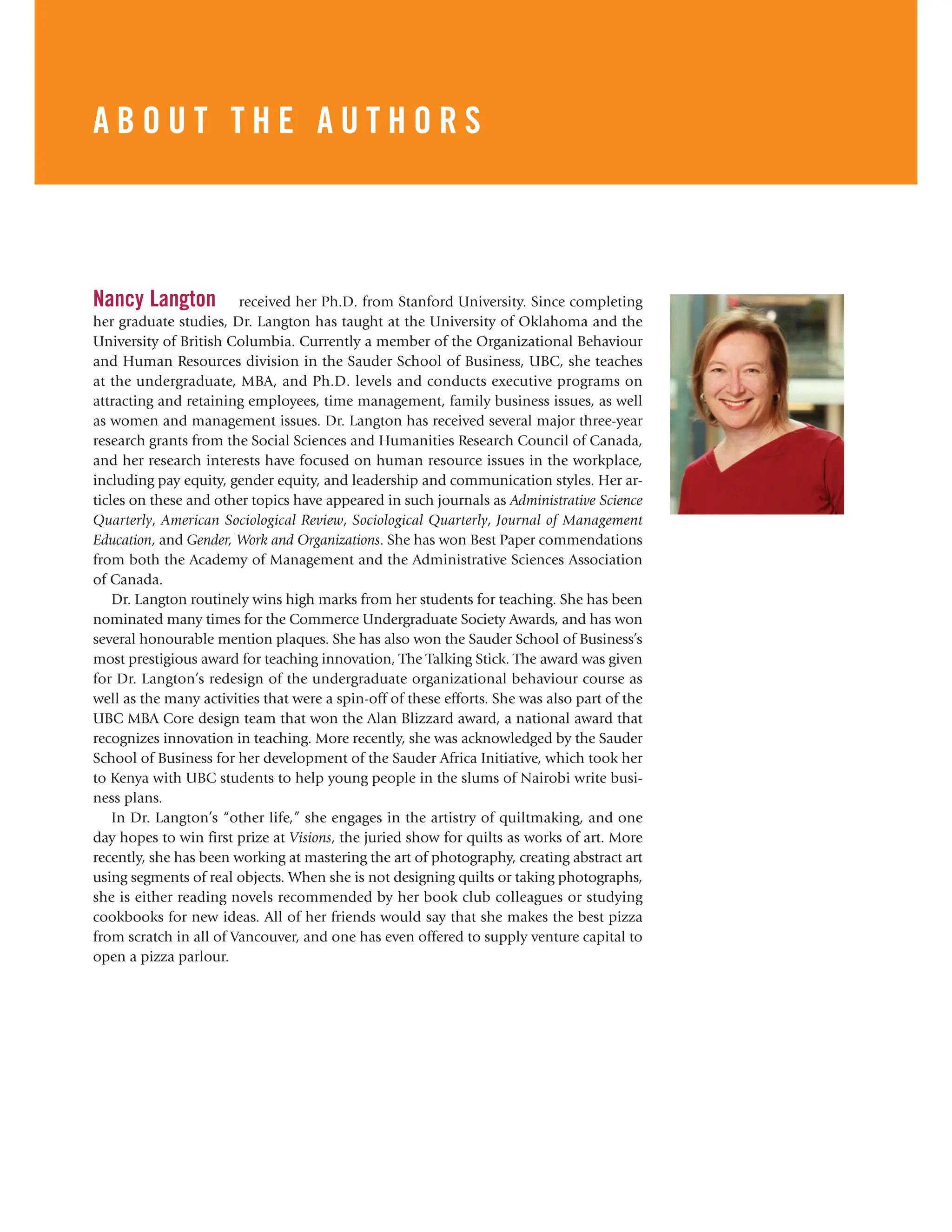
Nancy Langton
University of British Columbia
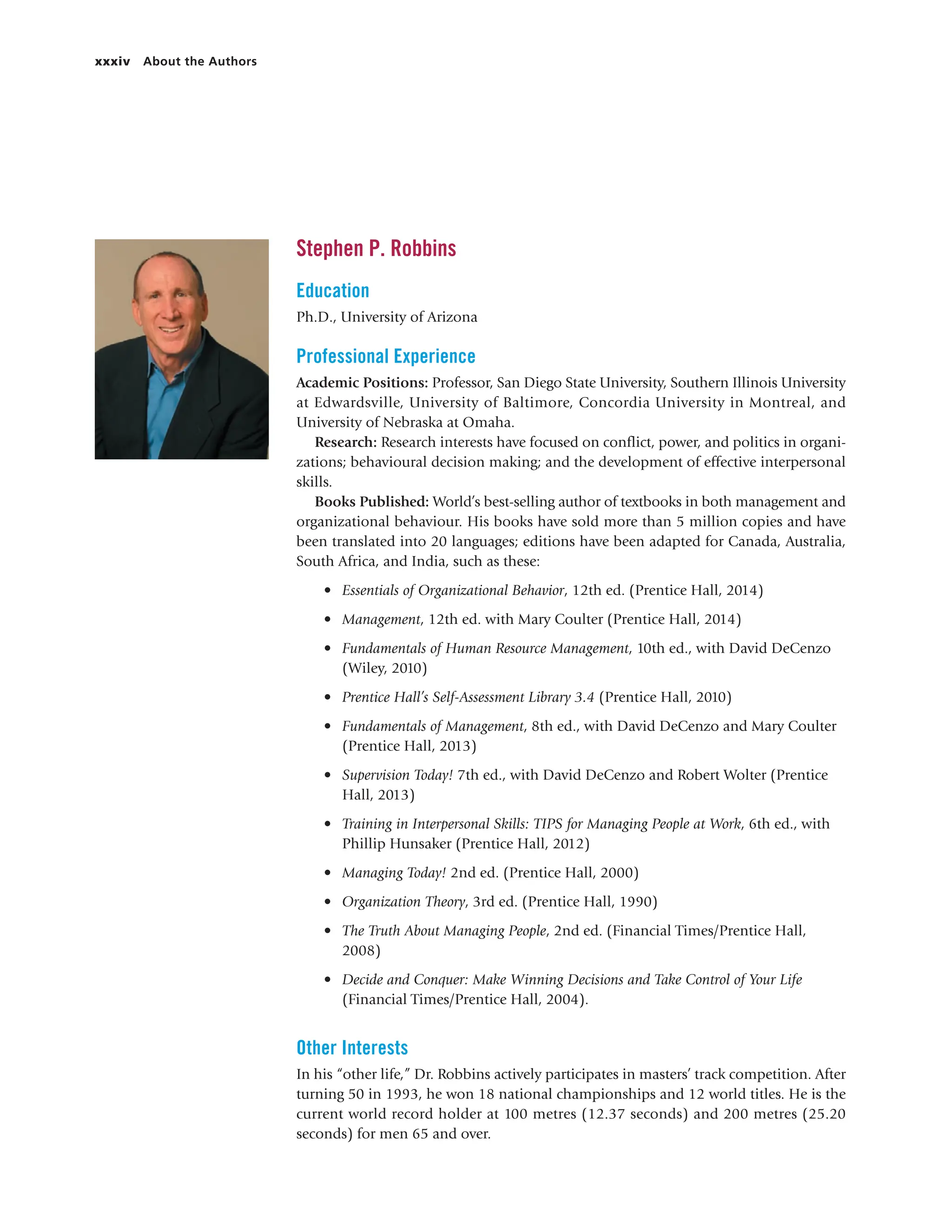
Stephen P. Robbins
San Diego State University
Timothy A. Judge
University of Notre Dame
With contributions by
Katherine Breward, Ph.D.
University of Winnipeg
Toronto
Concepts, Controversies, Applications
Organizational Behaviour
Seventh Canadian Edition
Vice-President, CMPS: Gary Bennett
Editorial Director: Claudine O’Donnell
Acquisitions Editor: Carolin Sweig
Marketing Manager: Jessica Saso
Program Manager: Karen Townsend
Project Manager: Jessica Hellen
Manager of Content Development: Suzanne Schaan
Developmental Editor: Jennifer Murray
Media Editor: Keriann McGoogan
Media Developer: Kelli Cadet
Compositor: Cenveo® Publisher Services
Production Editor: Claudia Forgas
Permissions Project Manager: Joanne Tang
Photo Permissions Research: Steve Merland, Lumina Datamatics
Text Permissions Research: Jen Roach, PMG
Cover and Interior Designer: Alex Li
Cover Image: Jamie Farrant/Digital Vision Vectors/Getty Images
Credits and acknowledgments for material borrowed from other sources and reproduced, with permission,
in this textbook appear on the appropriate page within the text.
If you purchased this book outside the United States or Canada, you should be aware that it has been
imported without the approval of the publisher or the author.
Copyright© 2016, 2013, 2010, 2007, 2003, 2001, 1999 Pearson Canada Inc. All rights reserved. Manufactured
in the United States of America. This publication is protected by copyright and permission should be
obtained from the publisher prior to any prohibited reproduction, storage in a retrieval system, or trans-
mission in any form or by any means, electronic, mechanical, photocopying, recording, or likewise. To
obtain permission(s) to use material from this work, please submit a written request to Pearson Canada
Inc., Permissions Department, 26 Prince Andrew Place, Don Mills, Ontario, M3C 2T8, or fax your request to
416-447-3126, or submit a request to Permissions Requests at www.pearsoncanada.ca.
10 9 8 7 6 5 4 3 2 1 [CKV]
Library and Archives Canada Cataloguing in Publication
Robbins, Stephen P., 1943-, author Organizational behaviour : concepts, controversies, applications /
Nancy Langton (University of British Columbia), Stephen P. Robbins (San Diego State University), Timothy
A. Judge (University of Notre Dame) ; with contributions by Katherine Breward, Ph.D. (University of
Winnipeg). – Seventh Canadian edition.
Includes bibliographical references and index.
ISBN 978-0-13-359178-1 (bound)
1. Organizational behavior—Textbooks. 2. Management—Textbooks. I. Langton, Nancy, author II. Judge,
Tim, author III. Breward, Katherine, author IV. Title.
HD58.7.R62 2015 658 C2014-907198-1
ISBN 978-0-13-359178-1
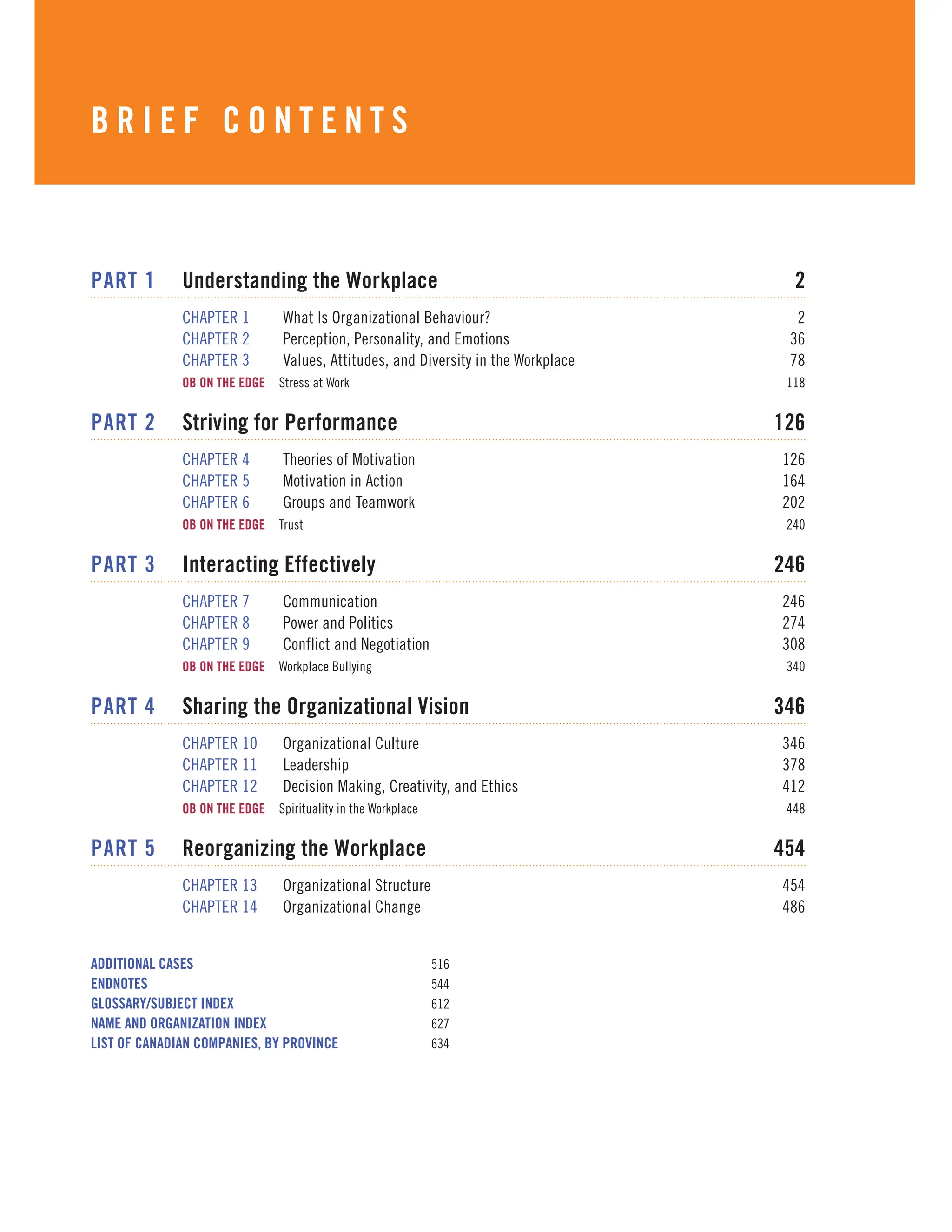
B R I E F C O N T E N T S
PART 1 Understanding the Workplace 2
CHAPTER 1 What Is Organizational Behaviour? 2
CHAPTER 2 Perception, Personality, and Emotions 36
CHAPTER 3 Values, Attitudes, and Diversity in the Workplace 78
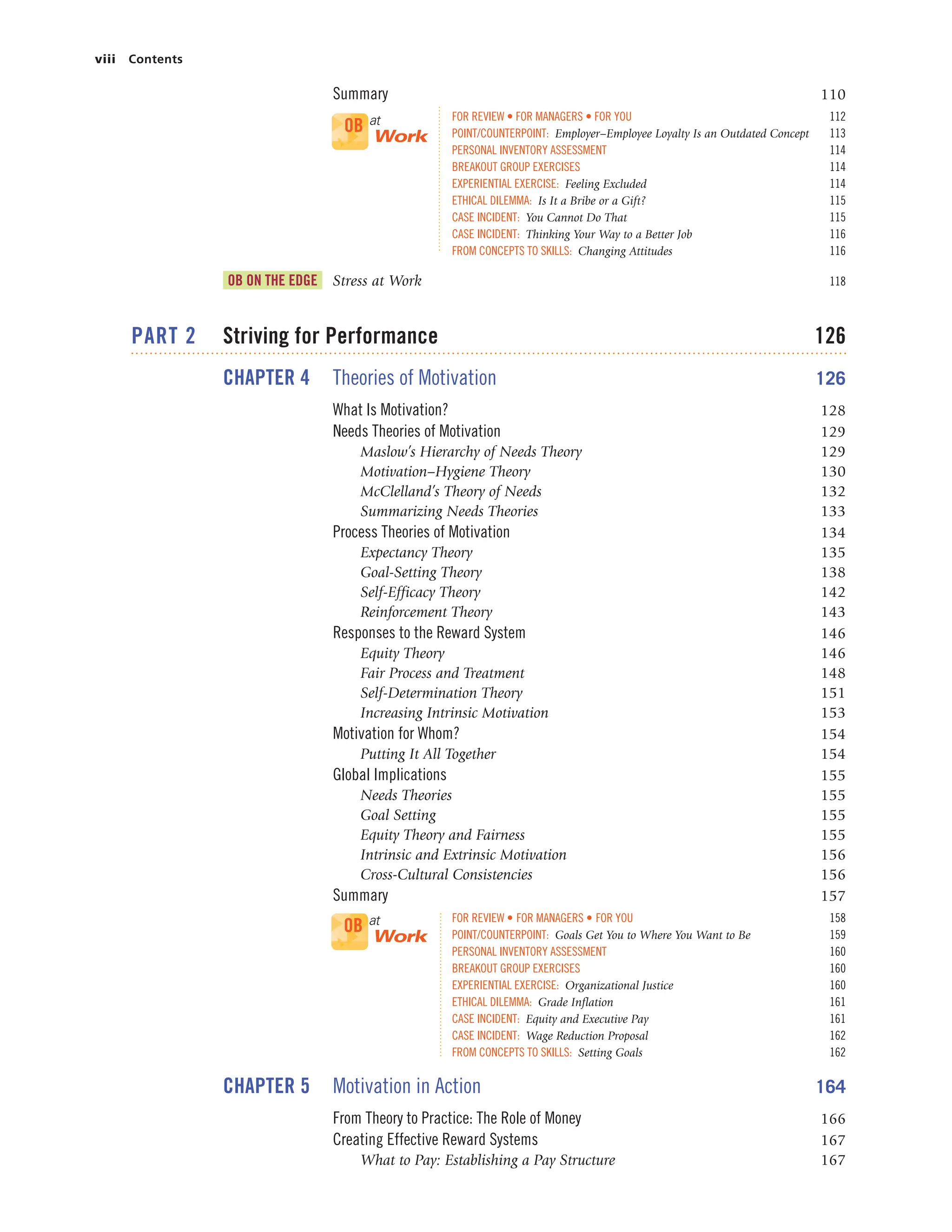
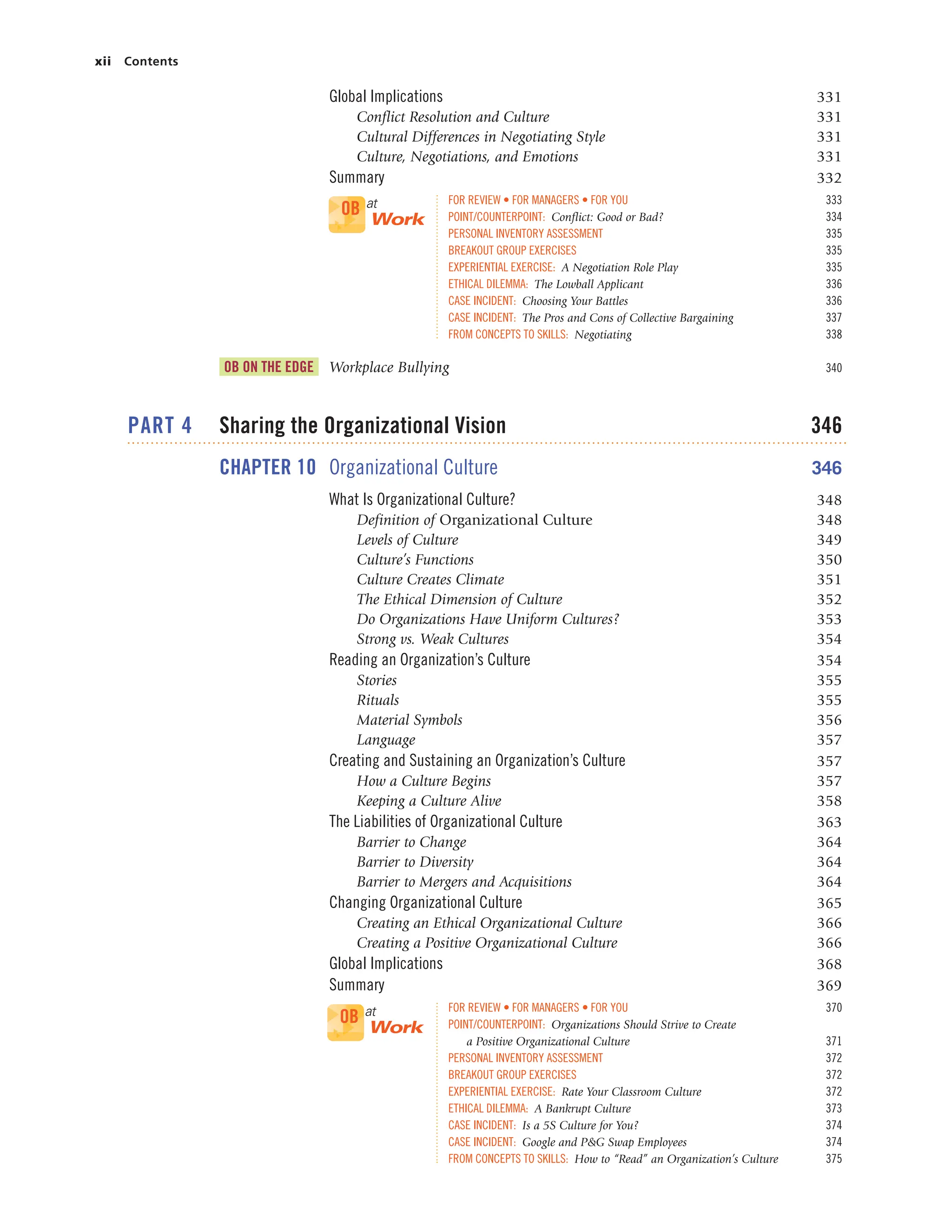
OB ON THE EDGE Stress at Work 118
PART 2 Striving for Performance 126
CHAPTER 4 Theories of Motivation 126
CHAPTER 5 Motivation in Action 164
CHAPTER 6 Groups and Teamwork 202
OB ON THE EDGE Trust 240
PART 3 Interacting Effectively 246
CHAPTER 7 Communication 246
CHAPTER 8 Power and Politics 274
CHAPTER 9 Conflict and Negotiation 308
OB ON THE EDGE Workplace Bullying 340
PART 4 Sharing the Organizational Vision 346
CHAPTER 10 Organizational Culture 346
CHAPTER 11 Leadership 378
CHAPTER 12 Decision Making, Creativity, and Ethics 412
OB ON THE EDGE Spirituality in the Workplace 448
PART 5 Reorganizing the Workplace 454
CHAPTER 13 Organizational Structure 454
CHAPTER 14 Organizational Change 486
ADDITIONAL CASES 516
ENDNOTES 544
GLOSSARY/SUBJECT INDEX 612
NAME AND ORGANIZATION INDEX 627
LIST OF CANADIAN COMPANIES, BY PROVINCE 634
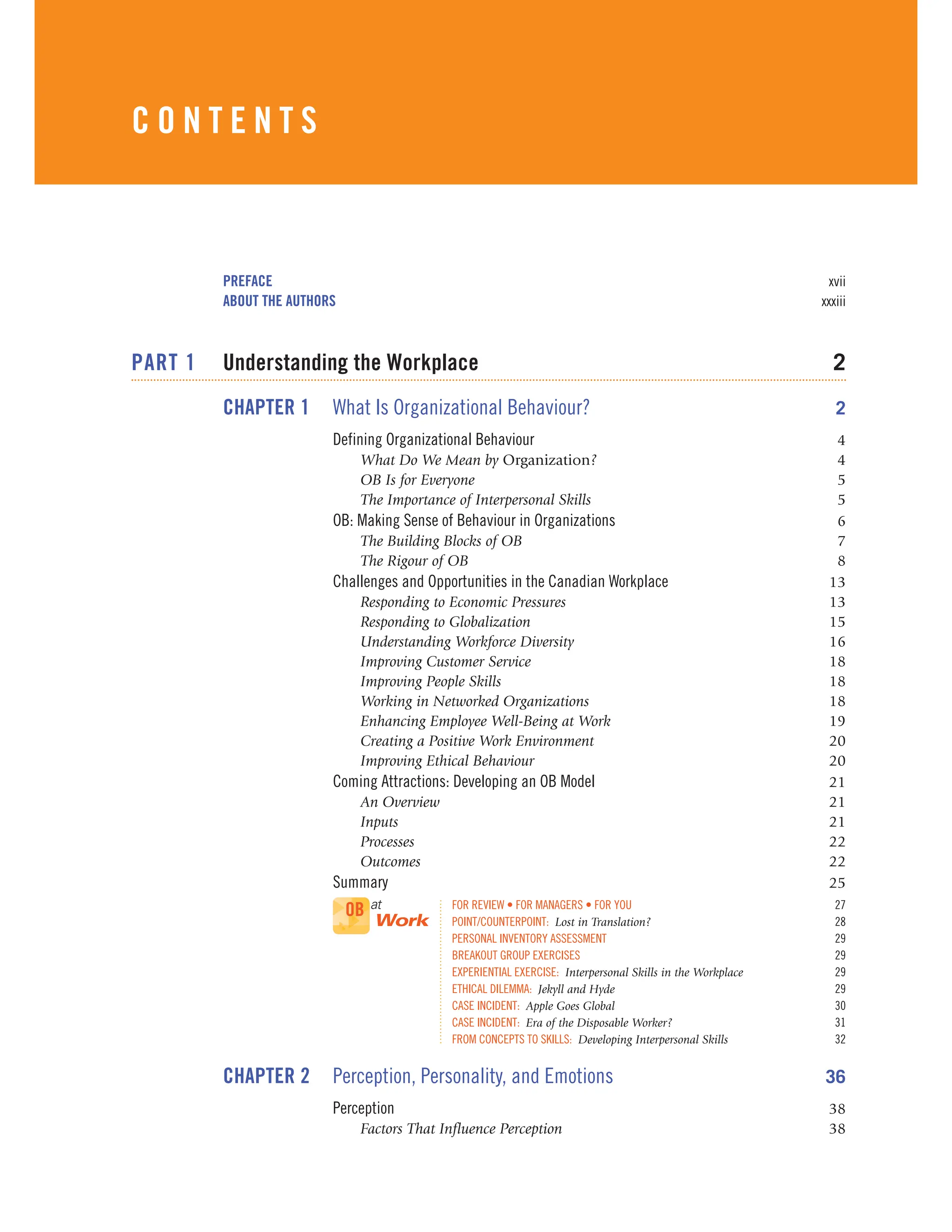
PREFACE xvii
ABOUT THE AUTHORS xxxiii
PART 1 Understanding the Workplace 2
CHAPTER 1 What Is Organizational Behaviour? 2
Defining Organizational Behaviour 4
What Do We Mean by Organization? 4
OB Is for Everyone 5
The Importance of Interpersonal Skills 5
OB: Making Sense of Behaviour in Organizations 6
The Building Blocks of OB 7
The Rigour of OB 8
Challenges and Opportunities in the Canadian Workplace 13
Responding to Economic Pressures 13
Responding to Globalization 15
Understanding Workforce Diversity 16
Improving Customer Service 18
Improving People Skills 18
Working in Networked Organizations 18
Enhancing Employee Well-Being at Work 19
Creating a Positive Work Environment 20
Improving Ethical Behaviour 20
Coming Attractions: Developing an OB Model 21
An Overview 21
Inputs 21
Processes 22
Outcomes 22
Summary 25
FOR REVIEW • FOR MANAGERS • FOR YOU 27
POINT/COUNTERPOINT: Lost in Translation? 28
PERSONAL INVENTORY ASSESSMENT 29
BREAKOUT GROUP EXERCISES 29
EXPERIENTIAL EXERCISE: Interpersonal Skills in the Workplace 29
ETHICAL DILEMMA: Jekyll and Hyde 29
CASE INCIDENT: Apple Goes Global 30
CASE INCIDENT: Era of the Disposable Worker? 31
FROM CONCEPTS TO SKILLS: Developing Interpersonal Skills 32
CHAPTER 2 Perception, Personality, and Emotions 36
Perception 38
Factors That Influence Perception 38
OB at
Work
C O N T E N T S
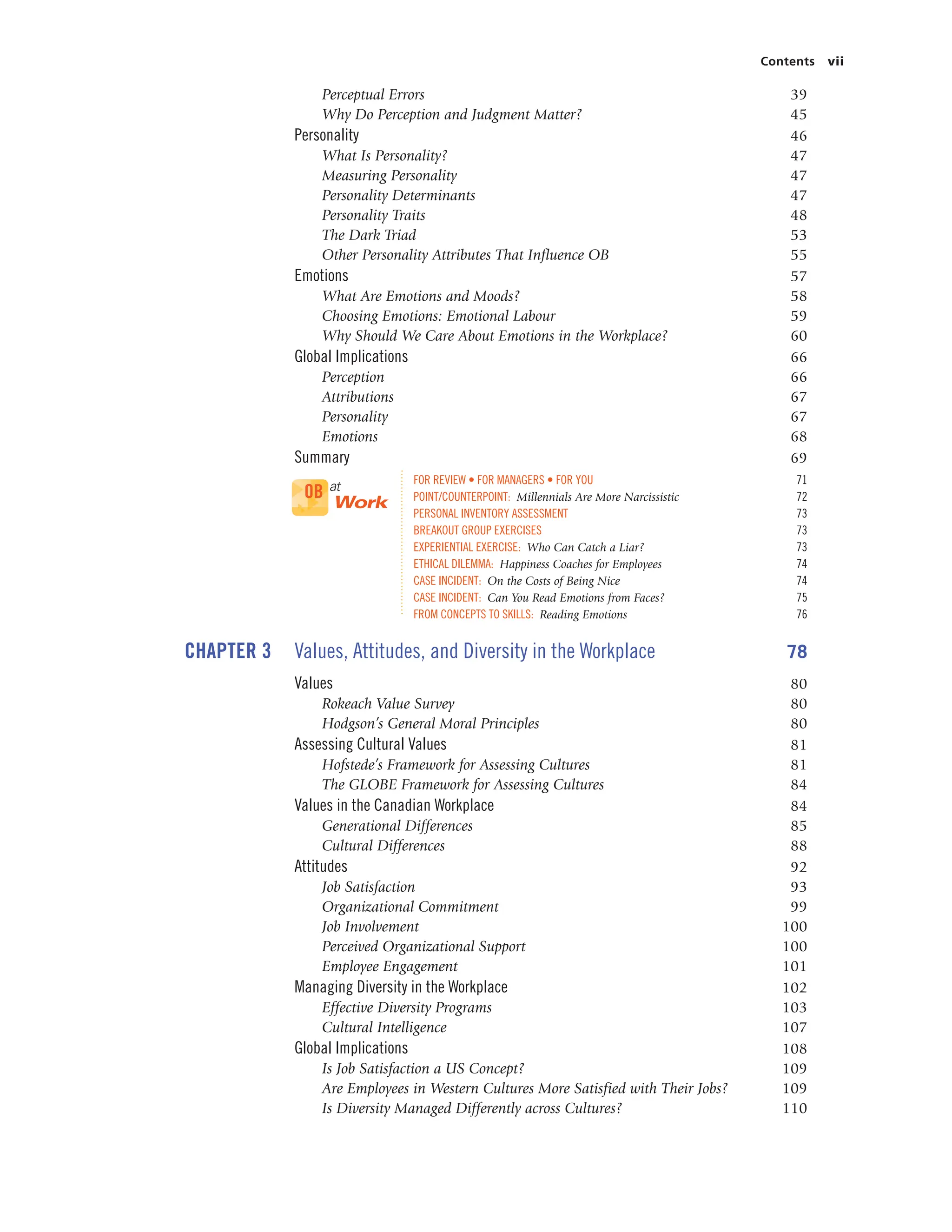
Contents vii
Perceptual Errors 39
Why Do Perception and Judgment Matter? 45
Personality 46
What Is Personality? 47
Measuring Personality 47
Personality Determinants 47
Personality Traits 48
The Dark Triad 53
Other Personality Attributes That Influence OB 55
Emotions 57
What Are Emotions and Moods? 58
Choosing Emotions: Emotional Labour 59
Why Should We Care About Emotions in the Workplace? 60
Global Implications 66
Perception 66
Attributions 67
Personality 67
Emotions 68
Summary 69
FOR REVIEW • FOR MANAGERS • FOR YOU 71
POINT/COUNTERPOINT: Millennials Are More Narcissistic 72
PERSONAL INVENTORY ASSESSMENT 73
BREAKOUT GROUP EXERCISES 73
EXPERIENTIAL EXERCISE: Who Can Catch a Liar? 73
ETHICAL DILEMMA: Happiness Coaches for Employees 74
CASE INCIDENT: On the Costs of Being Nice 74
CASE INCIDENT: Can You Read Emotions from Faces? 75
FROM CONCEPTS TO SKILLS: Reading Emotions 76
CHAPTER 3 Values, Attitudes, and Diversity in the Workplace 78
Values 80
Rokeach Value Survey 80
Hodgson’s General Moral Principles 80
Assessing Cultural Values 81
Hofstede’s Framework for Assessing Cultures 81
The GLOBE Framework for Assessing Cultures 84
Values in the Canadian Workplace 84
Generational Differences 85
Cultural Differences 88
Attitudes 92
Job Satisfaction 93
Organizational Commitment 99
Job Involvement 100
Perceived Organizational Support 100
Employee Engagement 101
Managing Diversity in the Workplace 102
Effective Diversity Programs 103
Cultural Intelligence 107
Global Implications 108
Is Job Satisfaction a US Concept? 109
Are Employees in Western Cultures More Satisfied with Their Jobs? 109
Is Diversity Managed Differently across Cultures? 110
OB at
Work
viii Contents
Summary 110
FOR REVIEW • FOR MANAGERS • FOR YOU 112
POINT/COUNTERPOINT: Employer–Employee Loyalty Is an Outdated Concept 113
PERSONAL INVENTORY ASSESSMENT 114
BREAKOUT GROUP EXERCISES 114
EXPERIENTIAL EXERCISE: Feeling Excluded 114
ETHICAL DILEMMA: Is It a Bribe or a Gift? 115
CASE INCIDENT: You Cannot Do That 115
CASE INCIDENT: Thinking Your Way to a Better Job 116
FROM CONCEPTS TO SKILLS: Changing Attitudes 116
OB ON THE EDGE Stress at Work 118
PART 2 Striving for Performance 126
CHAPTER 4 Theories of Motivation 126
What Is Motivation? 128
Needs Theories of Motivation 129
Maslow’s Hierarchy of Needs Theory 129
Motivation–Hygiene Theory 130
McClelland’s Theory of Needs 132
Summarizing Needs Theories 133
Process Theories of Motivation 134
Expectancy Theory 135
Goal-Setting Theory 138
Self-Efficacy Theory 142
Reinforcement Theory 143
Responses to the Reward System 146
Equity Theory 146
Fair Process and Treatment 148
Self-Determination Theory 151
Increasing Intrinsic Motivation 153
Motivation for Whom? 154
Putting It All Together 154
Global Implications 155
Needs Theories 155
Goal Setting 155
Equity Theory and Fairness 155
Intrinsic and Extrinsic Motivation 156
Cross-Cultural Consistencies 156
Summary 157
FOR REVIEW • FOR MANAGERS • FOR YOU 158
POINT/COUNTERPOINT: Goals Get You to Where You Want to Be 159
PERSONAL INVENTORY ASSESSMENT 160
BREAKOUT GROUP EXERCISES 160
EXPERIENTIAL EXERCISE: Organizational Justice 160
ETHICAL DILEMMA: Grade Inflation 161
CASE INCIDENT: Equity and Executive Pay 161
CASE INCIDENT: Wage Reduction Proposal 162
FROM CONCEPTS TO SKILLS: Setting Goals 162
CHAPTER 5 Motivation in Action 164
From Theory to Practice: The Role of Money 166
Creating Effective Reward Systems 167
What to Pay: Establishing a Pay Structure 167
OB at
Work
OB at
Work
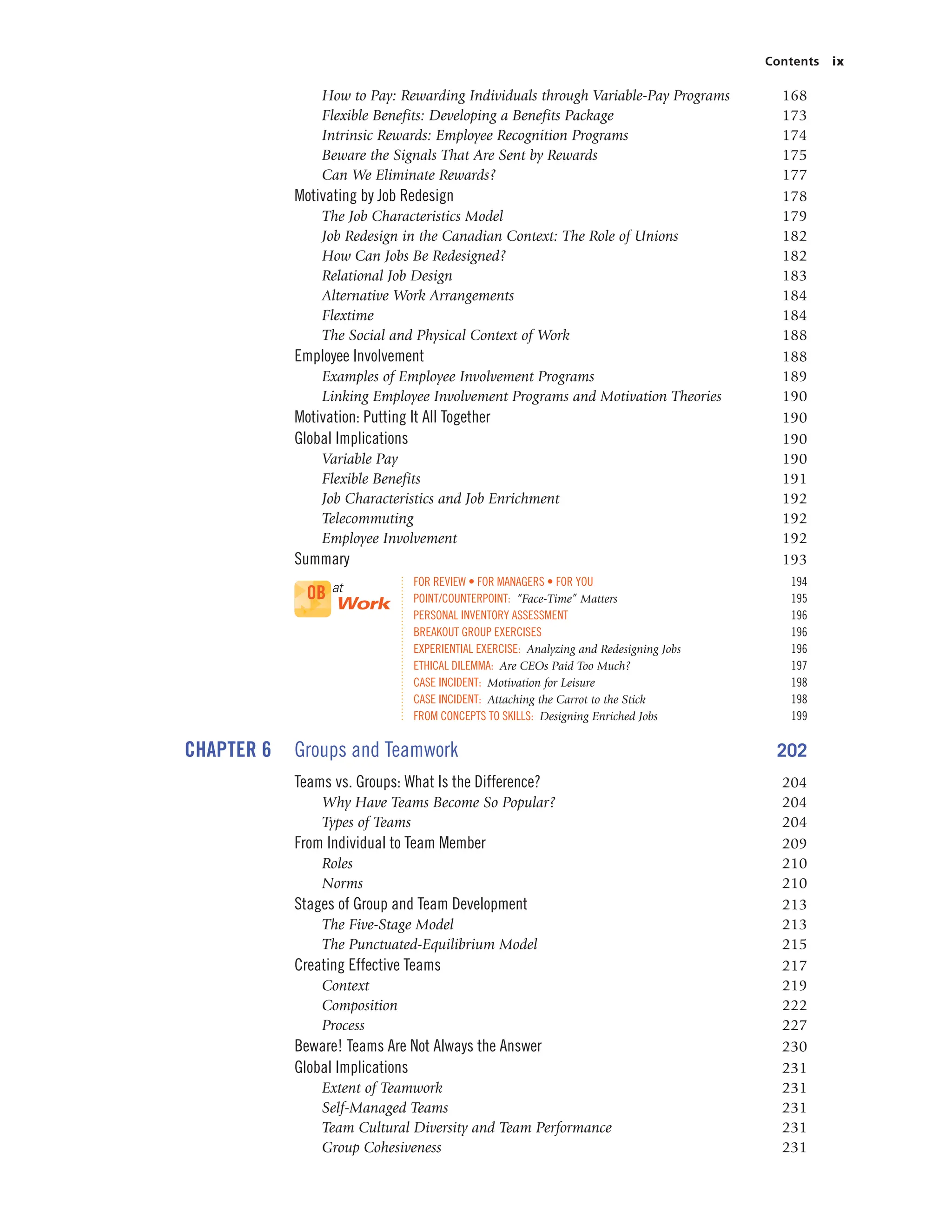
Contents ix
How to Pay: Rewarding Individuals through Variable-Pay Programs 168
Flexible Benefits: Developing a Benefits Package 173
Intrinsic Rewards: Employee Recognition Programs 174
Beware the Signals That Are Sent by Rewards 175
Can We Eliminate Rewards? 177
Motivating by Job Redesign 178
The Job Characteristics Model 179
Job Redesign in the Canadian Context: The Role of Unions 182
How Can Jobs Be Redesigned? 182
Relational Job Design 183
Alternative Work Arrangements 184
Flextime 184
The Social and Physical Context of Work 188
Employee Involvement 188
Examples of Employee Involvement Programs 189
Linking Employee Involvement Programs and Motivation Theories 190
Motivation: Putting It All Together 190
Global Implications 190
Variable Pay 190
Flexible Benefits 191
Job Characteristics and Job Enrichment 192
Telecommuting 192
Employee Involvement 192
Summary 193
FOR REVIEW • FOR MANAGERS • FOR YOU 194
POINT/COUNTERPOINT: “Face-Time” Matters 195
PERSONAL INVENTORY ASSESSMENT 196
BREAKOUT GROUP EXERCISES 196
EXPERIENTIAL EXERCISE: Analyzing and Redesigning Jobs 196
ETHICAL DILEMMA: Are CEOs Paid Too Much? 197
CASE INCIDENT: Motivation for Leisure 198
CASE INCIDENT: Attaching the Carrot to the Stick 198
FROM CONCEPTS TO SKILLS: Designing Enriched Jobs 199
CHAPTER 6 Groups and Teamwork 202
Teams vs. Groups: What Is the Difference? 204
Why Have Teams Become So Popular? 204
Types of Teams 204
From Individual to Team Member 209
Roles 210
Norms 210
Stages of Group and Team Development 213
The Five-Stage Model 213
The Punctuated-Equilibrium Model 215
Creating Effective Teams 217
Context 219
Composition 222
Process 227
Beware! Teams Are Not Always the Answer 230
Global Implications 231
Extent of Teamwork 231
Self-Managed Teams 231
Team Cultural Diversity and Team Performance 231
Group Cohesiveness 231
OB at
Work
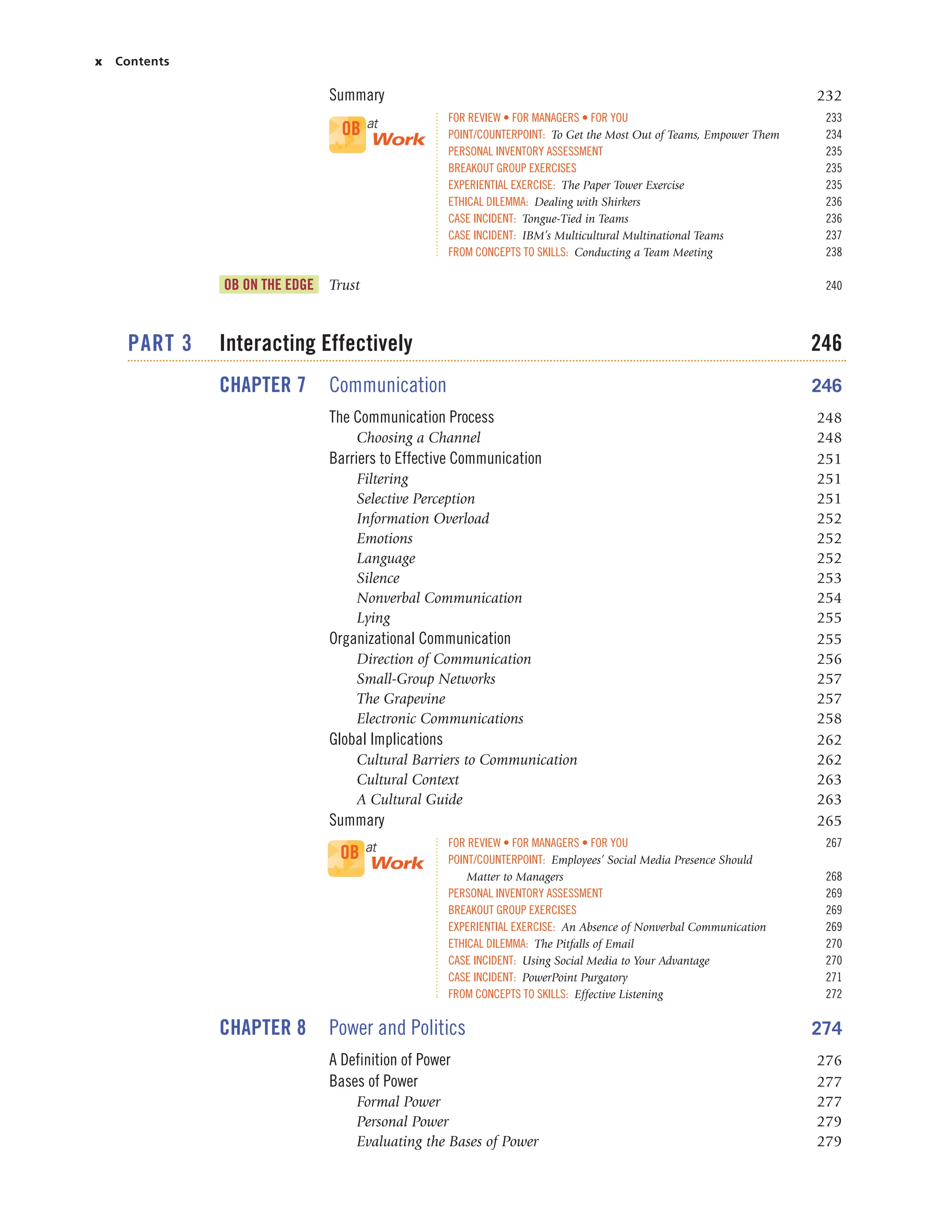
x Contents
Summary 232
FOR REVIEW • FOR MANAGERS • FOR YOU 233
POINT/COUNTERPOINT: To Get the Most Out of Teams, Empower Them 234
PERSONAL INVENTORY ASSESSMENT 235
BREAKOUT GROUP EXERCISES 235
EXPERIENTIAL EXERCISE: The Paper Tower Exercise 235
ETHICAL DILEMMA: Dealing with Shirkers 236
CASE INCIDENT: Tongue-Tied in Teams 236
CASE INCIDENT: IBM’s Multicultural Multinational Teams 237
FROM CONCEPTS TO SKILLS: Conducting a Team Meeting 238
OB ON THE EDGE Trust 240
PART 3 Interacting Effectively 246
CHAPTER 7 Communication 246
The Communication Process 248
Choosing a Channel 248
Barriers to Effective Communication 251
Filtering 251
Selective Perception 251
Information Overload 252
Emotions 252
Language 252
Silence 253
Nonverbal Communication 254
Lying 255
Organizational Communication 255
Direction of Communication 256
Small-Group Networks 257
The Grapevine 257
Electronic Communications 258
Global Implications 262
Cultural Barriers to Communication 262
Cultural Context 263
A Cultural Guide 263
Summary 265
FOR REVIEW • FOR MANAGERS • FOR YOU 267
POINT/COUNTERPOINT: Employees’ Social Media Presence Should
Matter to Managers 268
PERSONAL INVENTORY ASSESSMENT 269
BREAKOUT GROUP EXERCISES 269
EXPERIENTIAL EXERCISE: An Absence of Nonverbal Communication 269
ETHICAL DILEMMA: The Pitfalls of Email 270
CASE INCIDENT: Using Social Media to Your Advantage 270
CASE INCIDENT: PowerPoint Purgatory 271
FROM CONCEPTS TO SKILLS: Effective Listening 272
CHAPTER 8 Power and Politics 274
A Definition of Power 276
Bases of Power 277
Formal Power 277
Personal Power 279
Evaluating the Bases of Power 279
OB at
Work
OB at
Work
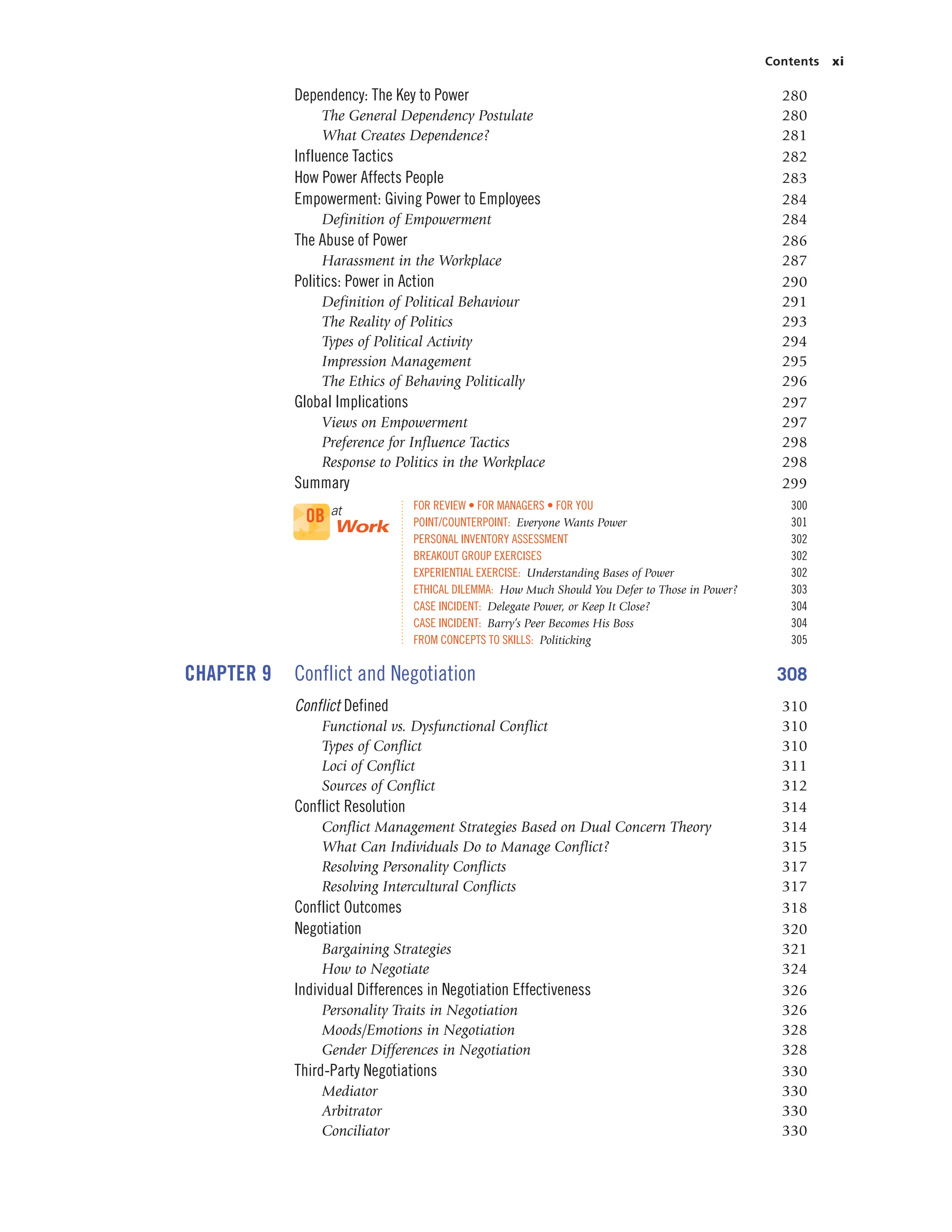
Contents xi
Dependency: The Key to Power 280
The General Dependency Postulate 280
What Creates Dependence? 281
Influence Tactics 282
How Power Affects People 283
Empowerment: Giving Power to Employees 284
Definition of Empowerment 284
The Abuse of Power 286
Harassment in the Workplace 287
Politics: Power in Action 290
Definition of Political Behaviour 291
The Reality of Politics 293
Types of Political Activity 294
Impression Management 295
The Ethics of Behaving Politically 296
Global Implications 297
Views on Empowerment 297
Preference for Influence Tactics 298
Response to Politics in the Workplace 298
Summary 299
FOR REVIEW • FOR MANAGERS • FOR YOU 300
POINT/COUNTERPOINT: Everyone Wants Power 301
PERSONAL INVENTORY ASSESSMENT 302
BREAKOUT GROUP EXERCISES 302
EXPERIENTIAL EXERCISE: Understanding Bases of Power 302
ETHICAL DILEMMA: How Much Should You Defer to Those in Power? 303
CASE INCIDENT: Delegate Power, or Keep It Close? 304
CASE INCIDENT: Barry’s Peer Becomes His Boss 304
FROM CONCEPTS TO SKILLS: Politicking 305
CHAPTER 9 Conflict and Negotiation 308
Conflict Defined 310
Functional vs. Dysfunctional Conflict 310
Types of Conflict 310
Loci of Conflict 311
Sources of Conflict 312
Conflict Resolution 314
Conflict Management Strategies Based on Dual Concern Theory 314
What Can Individuals Do to Manage Conflict? 315
Resolving Personality Conflicts 317
Resolving Intercultural Conflicts 317
Conflict Outcomes 318
Negotiation 320
Bargaining Strategies 321
How to Negotiate 324
Individual Differences in Negotiation Effectiveness 326
Personality Traits in Negotiation 326
Moods/Emotions in Negotiation 328
Gender Differences in Negotiation 328
Third-Party Negotiations 330
Mediator 330
Arbitrator 330
Conciliator 330
OB at
Work
xii Contents
Global Implications 331
Conflict Resolution and Culture 331
Cultural Differences in Negotiating Style 331
Culture, Negotiations, and Emotions 331
Summary 332
FOR REVIEW • FOR MANAGERS • FOR YOU 333
POINT/COUNTERPOINT: Conflict: Good or Bad? 334
PERSONAL INVENTORY ASSESSMENT 335
BREAKOUT GROUP EXERCISES 335
EXPERIENTIAL EXERCISE: A Negotiation Role Play 335
ETHICAL DILEMMA: The Lowball Applicant 336
CASE INCIDENT: Choosing Your Battles 336
CASE INCIDENT: The Pros and Cons of Collective Bargaining 337
FROM CONCEPTS TO SKILLS: Negotiating 338
OB ON THE EDGE Workplace Bullying 340
PART 4 Sharing the Organizational Vision 346
CHAPTER 10 Organizational Culture 346
What Is Organizational Culture? 348
Definition of Organizational Culture 348
Levels of Culture 349
Culture’s Functions 350
Culture Creates Climate 351
The Ethical Dimension of Culture 352
Do Organizations Have Uniform Cultures? 353
Strong vs. Weak Cultures 354
Reading an Organization’s Culture 354
Stories 355
Rituals 355
Material Symbols 356
Language 357
Creating and Sustaining an Organization’s Culture 357
How a Culture Begins 357
Keeping a Culture Alive 358
The Liabilities of Organizational Culture 363
Barrier to Change 364
Barrier to Diversity 364
Barrier to Mergers and Acquisitions 364
Changing Organizational Culture 365
Creating an Ethical Organizational Culture 366
Creating a Positive Organizational Culture 366
Global Implications 368
Summary 369
FOR REVIEW • FOR MANAGERS • FOR YOU 370
POINT/COUNTERPOINT: Organizations Should Strive to Create
a Positive Organizational Culture 371
PERSONAL INVENTORY ASSESSMENT 372
BREAKOUT GROUP EXERCISES 372
EXPERIENTIAL EXERCISE: Rate Your Classroom Culture 372
ETHICAL DILEMMA: A Bankrupt Culture 373
CASE INCIDENT: Is a 5S Culture for You? 374
CASE INCIDENT: Google and P&G Swap Employees 374
FROM CONCEPTS TO SKILLS: How to “Read” an Organization’s Culture 375
OB at
Work
OB at
Work
Contents xiii
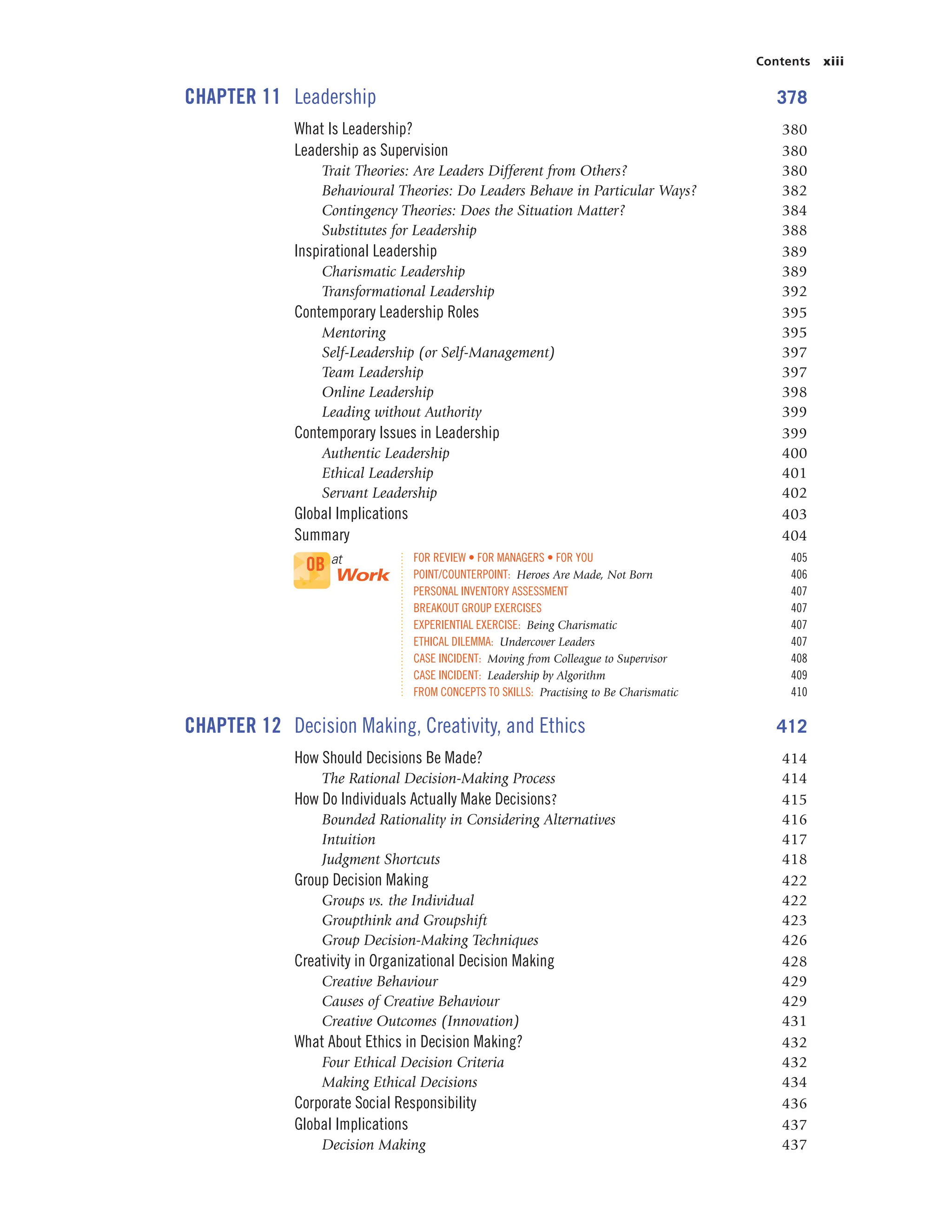
CHAPTER 11 Leadership 378
What Is Leadership? 380
Leadership as Supervision 380
Trait Theories: Are Leaders Different from Others? 380
Behavioural Theories: Do Leaders Behave in Particular Ways? 382
Contingency Theories: Does the Situation Matter? 384
Substitutes for Leadership 388
Inspirational Leadership 389
Charismatic Leadership 389
Transformational Leadership 392
Contemporary Leadership Roles 395
Mentoring 395
Self-Leadership (or Self-Management) 397
Team Leadership 397
Online Leadership 398
Leading without Authority 399
Contemporary Issues in Leadership 399
Authentic Leadership 400
Ethical Leadership 401
Servant Leadership 402
Global Implications 403
Summary 404
FOR REVIEW • FOR MANAGERS • FOR YOU 405
POINT/COUNTERPOINT: Heroes Are Made, Not Born 406
PERSONAL INVENTORY ASSESSMENT 407
BREAKOUT GROUP EXERCISES 407
EXPERIENTIAL EXERCISE: Being Charismatic 407
ETHICAL DILEMMA: Undercover Leaders 407
CASE INCIDENT: Moving from Colleague to Supervisor 408
CASE INCIDENT: Leadership by Algorithm 409
FROM CONCEPTS TO SKILLS: Practising to Be Charismatic 410
CHAPTER 12 Decision Making, Creativity, and Ethics 412
How Should Decisions Be Made? 414
The Rational Decision-Making Process 414
How Do Individuals Actually Make Decisions? 415
Bounded Rationality in Considering Alternatives 416
Intuition 417
Judgment Shortcuts 418
Group Decision Making 422
Groups vs. the Individual 422
Groupthink and Groupshift 423
Group Decision-Making Techniques 426
Creativity in Organizational Decision Making 428
Creative Behaviour 429
Causes of Creative Behaviour 429
Creative Outcomes (Innovation) 431
What About Ethics in Decision Making? 432
Four Ethical Decision Criteria 432
Making Ethical Decisions 434
Corporate Social Responsibility 436
Global Implications 437
Decision Making 437
OB at
Work
xiv Contents
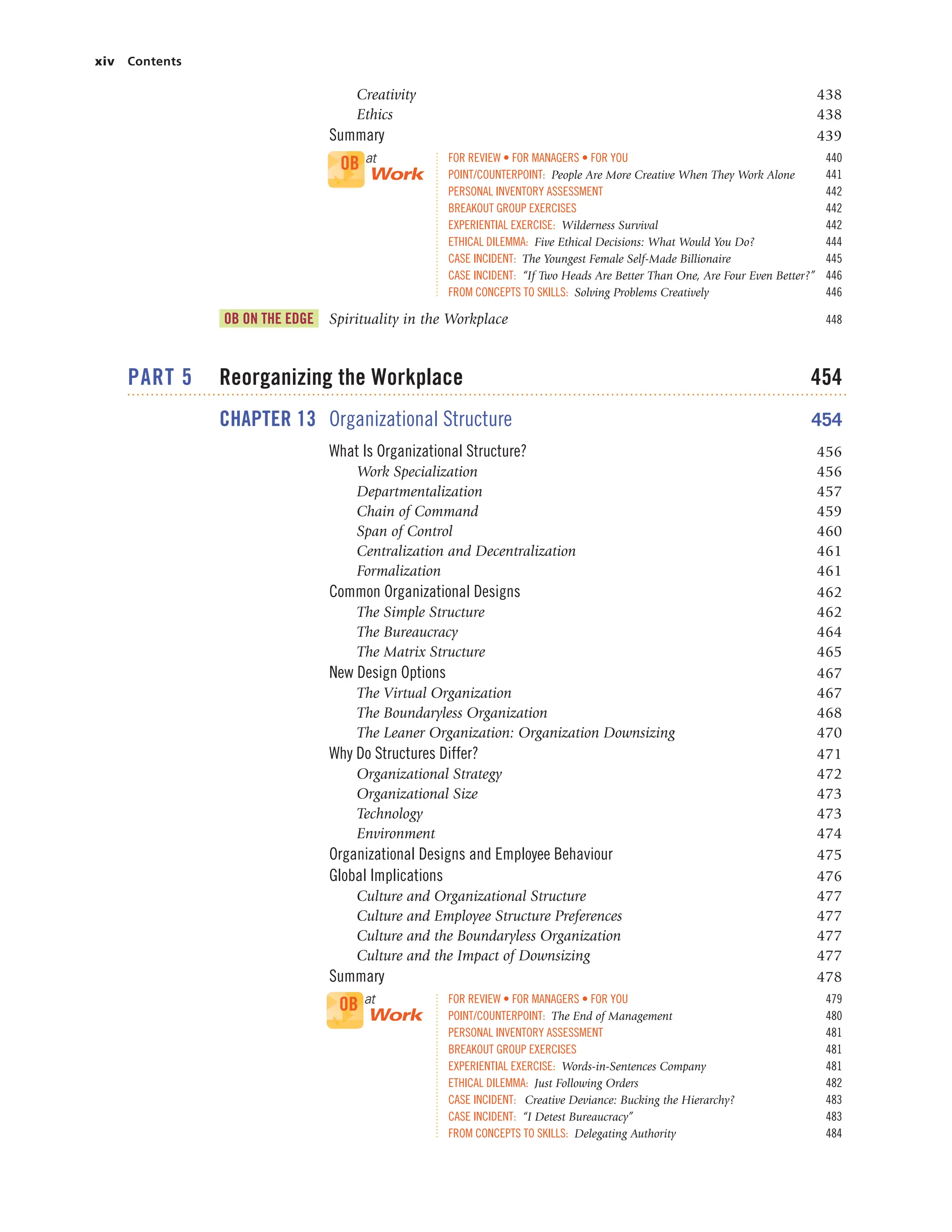
Creativity 438
Ethics 438
Summary 439
FOR REVIEW • FOR MANAGERS • FOR YOU 440
POINT/COUNTERPOINT: People Are More Creative When They Work Alone 441
PERSONAL INVENTORY ASSESSMENT 442
BREAKOUT GROUP EXERCISES 442
EXPERIENTIAL EXERCISE: Wilderness Survival 442
ETHICAL DILEMMA: Five Ethical Decisions: What Would You Do? 444
CASE INCIDENT: The Youngest Female Self-Made Billionaire 445
CASE INCIDENT: “If Two Heads Are Better Than One, Are Four Even Better?” 446
FROM CONCEPTS TO SKILLS: Solving Problems Creatively 446
OB ON THE EDGE Spirituality in the Workplace 448
PART 5 Reorganizing the Workplace 454
CHAPTER 13 Organizational Structure 454
What Is Organizational Structure? 456
Work Specialization 456
Departmentalization 457
Chain of Command 459
Span of Control 460
Centralization and Decentralization 461
Formalization 461
Common Organizational Designs 462
The Simple Structure 462
The Bureaucracy 464
The Matrix Structure 465
New Design Options 467
The Virtual Organization 467
The Boundaryless Organization 468
The Leaner Organization: Organization Downsizing 470
Why Do Structures Differ? 471
Organizational Strategy 472
Organizational Size 473
Technology 473
Environment 474
Organizational Designs and Employee Behaviour 475
Global Implications 476
Culture and Organizational Structure 477
Culture and Employee Structure Preferences 477
Culture and the Boundaryless Organization 477
Culture and the Impact of Downsizing 477
Summary 478
FOR REVIEW • FOR MANAGERS • FOR YOU 479
POINT/COUNTERPOINT: The End of Management 480
PERSONAL INVENTORY ASSESSMENT 481
BREAKOUT GROUP EXERCISES 481
EXPERIENTIAL EXERCISE: Words-in-Sentences Company 481
ETHICAL DILEMMA: Just Following Orders 482
CASE INCIDENT: Creative Deviance: Bucking the Hierarchy? 483
CASE INCIDENT: “I Detest Bureaucracy” 483
FROM CONCEPTS TO SKILLS: Delegating Authority 484
OB at
Work
OB at
Work
Contents xv
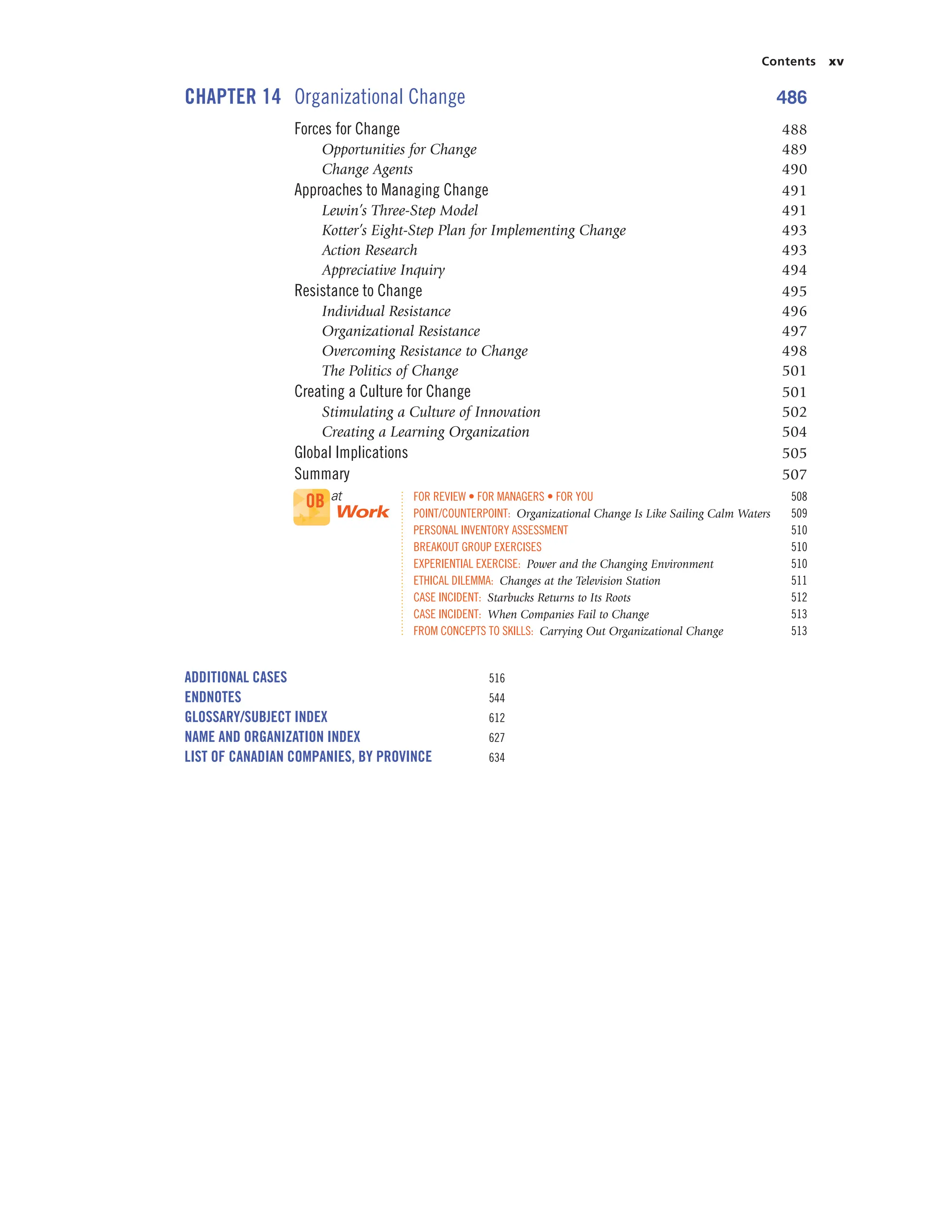
CHAPTER 14 Organizational Change 486
Forces for Change 488
Opportunities for Change 489
Change Agents 490
Approaches to Managing Change 491
Lewin’s Three-Step Model 491
Kotter’s Eight-Step Plan for Implementing Change 493
Action Research 493
Appreciative Inquiry 494
Resistance to Change 495
Individual Resistance 496
Organizational Resistance 497
Overcoming Resistance to Change 498
The Politics of Change 501
Creating a Culture for Change 501
Stimulating a Culture of Innovation 502
Creating a Learning Organization 504
Global Implications 505
Summary 507
FOR REVIEW • FOR MANAGERS • FOR YOU 508
POINT/COUNTERPOINT: Organizational Change Is Like Sailing Calm Waters 509
PERSONAL INVENTORY ASSESSMENT 510
BREAKOUT GROUP EXERCISES 510
EXPERIENTIAL EXERCISE: Power and the Changing Environment 510
ETHICAL DILEMMA: Changes at the Television Station 511
CASE INCIDENT: Starbucks Returns to Its Roots 512
CASE INCIDENT: When Companies Fail to Change 513
FROM CONCEPTS TO SKILLS: Carrying Out Organizational Change 513
ADDITIONAL CASES 516
ENDNOTES 544
GLOSSARY/SUBJECT INDEX 612
NAME AND ORGANIZATION INDEX 627
LIST OF CANADIAN COMPANIES, BY PROVINCE 634
OB at
Work
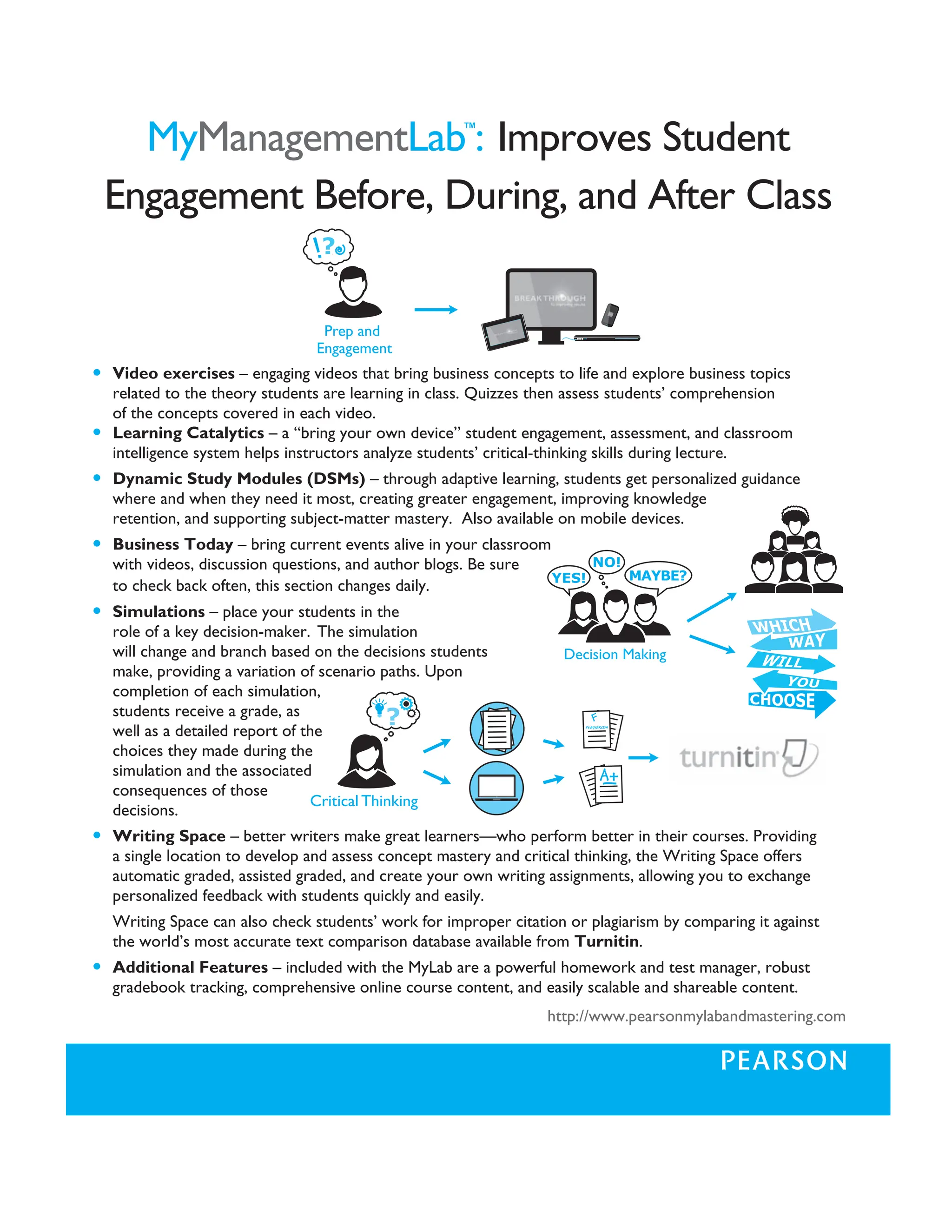
MyManagementLab™
: Improves Student
Engagement Before, During, and After Class
Critical Thinking
Decision Making
Prep and
Engagement
will change and branch based on the decisions students
make, providing a variation of scenario paths. Upon
completion of each simulation,
students receive a grade, as
well as a detailed report of the
choices they made during the
simulation and the associated
consequences of those
decisions.
S Writing Space – better writers make great learners—who perform better in their courses. Providing
a single location to develop and assess concept mastery and critical thinking, the Writing Space offers
automatic graded, assisted graded, and create your own writing assignments, allowing you to exchange
personalized feedback with students quickly and easily.
Writing Space can also check students’ work for improper citation or plagiarism by comparing it against
the world’s most accurate text comparison database available from Turnitin.
S Additional Features – included with the MyLab are a powerful homework and test manager, robust
gradebook tracking, comprehensive online course content, and easily scalable and shareable content.
http://www.pearsonmylabandmastering.com
S Video exercises – engaging videos that bring business concepts to life and explore business topics
related to the theory students are learning in class. Quizzes then assess students’ comprehension
of the concepts covered in each video.
S Learning Catalytics – a “bring your own device” student engagement, assessment, and classroom
intelligence system helps instructors analyze students’ critical-thinking skills during lecture.
S Dynamic Study Modules (DSMs) – through adaptive learning, students get personalized guidance
where and when they need it most, creating greater engagement, improving knowledge
retention, and supporting subject-matter mastery. Also available on mobile devices.
S Business Today – bring current events alive in your classroom
with videos, discussion questions, and author blogs. Be sure
to check back often, this section changes daily.
S Simulations – place your students in the
role of a key decision-maker. The simulation
Preface xvii
Welcome to the seventh Canadian edition of Organizational Behaviour. Since its arrival
in Canada, Organizational Behaviour has enjoyed widespread acclaim across the country
for its rich Canadian content and has quickly established itself as the leading text in
the field.
Organizational Behaviour, Seventh Canadian edition, is truly a Canadian product.
While it draws upon the strongest aspects of its American cousin, it expresses its own
vision and voice. It provides the context for understanding organizational behaviour
(OB) in the Canadian workplace and highlights the many Canadian contributions to
the field. Indeed, it goes a step further than most OB texts prepared for the Canadian
marketplace.
Specifically, it asks, in many instances:
• How does this theory apply in the Canadian workplace of today?
• What are the implications of the theory for managers and employees working
in the twenty-first century?
• What are the implications of the theory for everyday life? OB, after all, is not
something that applies only in the workplace.
This text is sensitive to important Canadian issues. Subject matter reflects the broad
multicultural flavour of Canada and also highlights the roles of women and visible
minorities in the workplace. Examples reflect the broad range of organizations in
Canada: large, small, public and private sector, unionized and non-unionized.
Organizational Behaviour continues to be a vibrant and relevant text because it’s a
product of the Canadian classroom. It is used in Canada by the first author and her
colleagues. Thus, there is a “front-line” approach to considering revisions. We also solicit
considerable feedback from OB instructors and students throughout the country. While
we have kept the features of the previous edition that adopters continue to say they like,
there is also a great deal that is new.
Our Pedagogical Approach in Writing the Text
• Relevance. The text reminds both teacher and student alike that we must
contend with a new paradigm of work that is more globally focused and
competitive, relies more heavily on part-time and contract jobs, and places
a higher premium on entrepreneurial skills, either within the traditional
workplace structure, as an individual seeking out an alternative job, or as the
creator of your own new business. Today’s younger employees can expect to
hold many more jobs, and possibly be self-employed more and longer than
their parents.
From its beginning, this text was the first to emphasize that OB is
for everyone, from the bottom-rung employee to the CEO, as well as to
anyone who has to interact with others to accomplish a task. We continue
to emphasize this theme. We remind readers of the material’s relevance
beyond a “9-to-5” job by concluding each chapter with a summary that out-
lines the implications not only for the workplace and managers, but also for
P R E F A C E
xviii Preface
individuals in their daily lives. We also include the feature OB in the Street,
which further emphasizes how OB applies outside the workplace.
• Writing style. Clarity and readability are the hallmarks of this text. Our
reviewers find the text “conversational,” “interesting,” “student-friendly,” and
“very clear and understandable.” Students say they really like the informal
style and personal examples.
• Examples, examples, examples. From our teaching experience, we know that
students may not remember a concept, but they will remember an example.
This text is packed full of recent real-world examples drawn from a variety
of organizations: business and not-for-profit, large and small, and local and
international. We also use examples taken from the world at large, to illustrate
the broader applicability of OB material.
• Comprehensive literature coverage. This text is regularly singled out for its
comprehensive and up-to-date coverage of OB from both academic journals
as well as business periodicals. The latest research can be found in sections
marked “Research Findings” and “Focus on Research.”
• Skill-building emphasis. Each chapter’s OB at Work section is full of exercises
to help students make the connections between theories and real-world
applications. Exercises at the end of each chapter reinforce critical thinking,
self-analysis, behavioural analysis, and team building.
Highlights of the Seventh Edition
The seventh edition was designed to evolve with today’s students. There are more
relevant examples, updated theory coverage, and a continued emphasis on providing
the latest research findings. Based on reviews from numerous instructors and students
across Canada, we have found that many potential users want chapters that have the
right balance of theory, research, and application material, while being relevant to
student learning. To accomplish this, we have:
• Continued to highlight the importance of Learning Outcomes as a “road
map” leading to focused reading and increased learning comprehension.
Learning Outcomes appear initially as an enumerated list on the chapter-
opening page and then the numbered outcomes appear throughout the
chapter again in the margins to direct readers to the section where the
Learning Outcome is addressed. Finally, the numbered outcomes are linked
to review questions at the end of the chapter so that students can test whether
they have achieved these outcomes.
• Continued to feature current and topical chapter-opening vignettes as well as
the subsequent references back to the vignettes that appear throughout the
chapter, at the start of most major sections.
• At the beginning of each chapter, a “Big Idea” item appears in the margin
which is meant to give readers a big picture view of the topic at hand. Then, at
the end of the chapter a “Lessons Learned” appears in the margin to recap the
key takeaways for the chapter.
• Continued to integrate a series of relevant and helpful questions throughout
the chapters (look for questions that are set in a square design) to encourage
students to think about how OB applies to their everyday lives and engage
students in their reading of the material. These questions first appear as
bullet lists at the bottom of the chapter opener, under the heading “OB Is for
Everyone,” and then appear throughout each chapter.
Preface xix
• Updated the boxed features throughout the text, including OB in Action, OB
in the Street, OB in the Workplace, Focus on Research, Focus on Ethics,
and Focus on Diversity boxes.
• Continued to address and highlight how OB principles vary across cultures in
the Global Implications sections. Chapters now conclude with references to
the cultural differences that exist within and between countries. Until recently,
most OB research was conducted in Western countries. That is changing,
however, and we are now in a much better position to answer the question
“How does what we know about OB vary based on culture?” Some OB prin-
ciples vary little across cultures, while others vary a great deal.
• Continued to include the popular For You feature at the end of each chapter,
to highlight the relevance of the chapter to one’s everyday life.
• Reflected the ever-changing world of organizational behaviour through a
series of new end-of-chapter case incidents.
• Included four new comprehensive cases in the Additional Cases. Case 1:
The Personality Problem deals with the topics of personality, organizational
culture, and work attitudes; Case 4: Bad Faith Bargaining? Government Power
and Negotiations with the Public Service covers power and politics, conflict
and negotiation, and ethics; Case 7: Promotion from Within covers motiva-
tion, work attitudes, communication, and politics. Case 9: Boundaryless
Organizations deals with organizational structure and boundaryless organiza-
tions, organizational culture, diversity and teams, organizational socialization,
and organizational change. In addition, a new table was added at the begin-
ning of the Additional Cases to show the chapters that apply to the major
topic areas addressed in each case for easy reference.
• Continued to include our OB on the Edge feature, which highlights what’s
new and hot in OB. OB on the Edge, which is unique to the Canadian
edition, provides an opportunity to explore challenging issues and encourages
students to read more about these hot topics. In this edition, we cover four
topics in this innovative feature: Stress at Work; Trust; Workplace Bullying; and
Spirituality in the Workplace.
Chapter-by-Chapter Highlights: What’s New
In this seventh edition, we have made a concerted effort to thoroughly update the
text. Taken together, the changes we made render this text the leader in the market
and the undisputed pioneer vis-à-vis meaningful application of OB concepts and
theories. Each chapter offers new examples, the latest cutting-edge research, discus-
sions of current issues, and a wide variety of application material. The key changes
are listed below.
Chapter 1: What Is Organizational Behaviour?
• New Opening Vignette about Lululemon Athletica
• New section: “Big Data”
• New exhibit: “Employment Options”
• New major section: “Challenges and Opportunities in the Canadian
Workplace”
xx Preface
• New Focus on Diversity: “SaskTel Is a Top Diversity Employer”
• New major section: “Coming Attractions: Developing an OB Model”
• New exhibit: “A Basic OB Model”
• New exhibit: “The Plan of the Book”
• New Point/Counterpoint: “Lost in Translation?”
• New Ethical Dilemma: “Jekyll and Hyde”
• New Case Incident: “Apple Goes Global”
• New Case Incident: “Era of the Disposable Worker?”
Chapter 2: Perception, Personality, and Emotions
• New Opening Vignette about Matthew Corrin, the CEO of the restaurant
Freshii
• New Research Findings: “Stereotyping”
• New section: “The Dark Triad”
• New exhibit: “Jobs in Which Certain Big Five Personality Traits Are More
Relevant”
• New exhibit: “Does Business School Make You Narcissistic?”
• New Focus on Research: “First Impressions Count”
• New research and discussion on emotional intelligence
• New exhibit: “A Cascading Model of Emotional Intelligence”
• New Focus on Ethics: “An Ethical Choice”
• New Focus on Research: “Smile, and the Work World Smiles with You”
• New section: “Emotion Regulation”
• New Research Findings: “Emotion Regulation”
• New OB in the Workplace: “Affective Computing: Reading Your State of Mind”
• New exhibit: “Emotional States Cross-Culturally”
• New Point/Counterpoint: “Millennials Are More Narcissistic”
• New Experiential Exercise: “Who Can Catch a Liar?”
• New Ethical Dilemma: “Happiness Coaches for Employees”
• New Case Incident: “On the Costs of Being Nice”
• New Case Incident: “Can You Read Emotions from Faces?”
Chapter 3: Values, Attitudes, and Diversity in the Workplace
• New Opening Vignette about Corus Entertainment partnering with TD Bank to
help a program designed to aid Aboriginal children achieve literacy through
summer camps
• New Research Findings: “Hofstede”
• Updated exhibit: “Hofstede’s Cultural Values by Nation”
Preface xxi
• New exhibit: “Dominant Work Values in Today’s Workforce”
• New Research Findings: “Generational Differences”
• New OB in the Street: “Generation Z: Coming to Your Workplace Soon”
• New research in “Francophone and Anglophone Values”
• Updated major section: “Attitudes”
• New exhibit: “The Components of an Attitude”
• New exhibit: “The Worst Jobs for Job Satisfaction, 2013”
• New exhibit: “Relationship between Average Pay in Job and Job Satisfaction of
Employees in That Job”
• New section: “Perceived Organizational Support”
• New research and discussion in “Employee Engagement”
• New OB in the Workplace: “Minding Manners, Helping Customers”
• Updated exhibit: “Practices Used by a Selected Sample of Canada’s Most
Welcoming Places to Work”
• New exhibit: “Average Levels of Employee Job Satisfaction by Country”
• Updated section with new research: “Are Employees in Western Cultures More
Satisfied with Their Jobs?”
• New Point/Counterpoint: “Employer–Employee Loyalty Is an Outdated
Concept”
• New Experiential Exercise: “Feeling Excluded”
OB on the Edge: Stress at Work
• New research in “Consequences of Stress”
• New discussion of personality in “Why Do Individuals Differ in Their
Experience of Stress?”
• New research and discussion in “Organizational Approaches”
• Updated the list of “The Most and Least Stressful Jobs”
Chapter 4: Theories of Motivation
• New Opening Vignette about how motivation influenced Olympic snowboarder
Mark McMorris to win a medal just weeks after fracturing a rib
• New OB in the Workplace: “Stock Analyst Recommendations and Valence”
• Updated section: “The Importance of Providing Performance Feedback”
• Updated Research Findings: “The Effects of Goal Setting”
• Updated section: “Reinforcement Theory”
• Updated section: “Fair Process and Treatment”
• New Point/Counterpoint: “Goals Get You to Where You Want to Be”
• New Experiential Exercise: “Organizational Justice”
xxii Preface
• New Ethical Dilemma: “Grade Inflation”
• New Case Incident: “Equity and Executive Pay”
Chapter 5: Motivation in Action
• New Opening Vignette about how high-growth social media start-up Hootsuite
manages to keep its workforce engaged and productive
• New research in “What to Pay: Establishing a Pay Structure”
• Updated section: “Merit-Based Pay”
• New research in “Flexible Benefits: Developing a Benefits Package”
• New Focus on Research: “The Reward for Helping Others at Work”
• New OB in the Street: “Rewarding Gym Attendance While Wanting Weight Loss”
• Updated exhibit: “Examples of High and Low Job Characteristics”
• New section: “Relational Job Design”
• New research in “Flextime”
• Updated Research Findings: “Telecommuting”
• New research in “Variable Pay”
• New Point/Counterpoint: “‘Face-Time’ Matters”
• Updated Ethical Dilemma: “Are CEOs Paid Too Much?”
• New Case Incident: “Motivation for Leisure”
• New Case Incident: “Attaching the Carrot to the Stick”
Chapter 6: Groups and Teamwork
• New research in “Self-Managed Teams”
• New research in “Virtual Teams”
• New Focus on Ethics: “Virtual Teams Leave a Smaller Carbon Footprint”
• New section: “Multiteam Systems”
• New OB in the Workplace: “Turning Around a Losing Team”
• New Focus on Diversity: “Developing Team Members’ Trust across Cultures”
• New research in “(Team) Composition”
• Updated section: “Diversity of Members”
• New Point/Counterpoint: “To Get the Most Out of Teams, Empower Them”
• New Case Incident: “Tongue-Tied in Teams”
OB on the Edge: Trust
• Revised section: “What Determines Trust?”
• New box: “What Are the Consequences of Trust?”
• New discussion in “Basic Principles of Trust”
Preface xxiii
Chapter 7: Communication
• New Opening Vignette about how the two young entrepreneurs who launched
Palette, a mechatronics company, use communication to find investors for
their new invention and to stay connected
• Updated major section: “Barriers to Effective Communication”
• New research in “Downward (Communication)”
• New exhibit: “Allocation of Time at Work for Managers and Professionals”
• New OB in the Workplace: “Asleep in Paris, Busy Working in Toronto”
• Updated section: “Social Media”
• Updated section: “A Cultural Guide”
• New Point/Counterpoint: “Employees’ Social Media Presence Should Matter to
Managers”
• New Ethical Dilemma: “The Pitfalls of Email”
• New Case Incident: “Using Social Media to Your Advantage”
• New Case Incident: “PowerPoint Purgatory”
Chapter 8: Power and Politics
• New Opening Vignette about former Toronto mayor Rob Ford
• Updated major section: “Bases of Power”
• New major section: “How Power Affects People”
• New OB in the Workplace: “It’s Not About the Affair, It’s About the Coverup”
• New research in “Sexual Harassment”
• New Focus on Ethics: “Sex at Work”
• Updated Research Findings: “Politicking”
• New Focus on Research: “Powerful Leaders Keep Their (Fr)Enemies Close”
• Updated Research Findings: “Impression Management Techniques”
• New section: “The Ethics of Behaving Politically”
• New Point/Counterpoint: “Everyone Wants Power”
• New Ethical Dilemma: “How Much Should You Defer to Those in Power?”
• New Case Incident: “Delegate Power, or Keep It Close?”
• New Case Incident: “Barry’s Peer Becomes His Boss”
Chapter 9: Conflict and Negotiation
• New Opening Vignette on the BC Teachers’ Federation strike
• New section: “Types of Conflict”
• New section: “Loci of Conflict”
• Updated Research Findings: “The Constructive Effects of Conflict”
xxiv Preface
• New research and discussion in “Personality Traits in Negotiation”
• New Focus on Ethics: “Using Empathy to Negotiate More Ethically”
• New research in “Moods/Emotions in Negotiation”
• New research and discussion in “Gender Differences in Negotiation”
• New major section: “Third-Party Negotiations”
• New Ethical Dilemma: “The Lowball Applicant”
• New Case Incident: “Choosing Your Battles”
• New Case Incident: “The Pros and Cons of Collective Bargaining”
OB on the Edge: Workplace Bullying
• New research and discussion in “Workplace Violence”
• New section: “Legislation to Prevent Bullying”
• New statistics on workplace bullying
Chapter 10: Organizational Culture
• New Opening Vignette about how the Calgary Stampede’s organizational
culture helped it deal with an unexpected crisis
• New discussion in “Definition of Organizational Culture”
• New OB in the Workplace: “WestJet Brings on the Fun”
• New section: “The Ethical Dimension of Culture”
• New research in “Strong vs. Weak Cultures”
• New OB in the Workplace: “Making Culture Work”
• New research and discussion in “Socialization”
• New research and discussion in “Barrier to Mergers and Acquisitions”
• New discussion in major section: “Changing Organizational Culture”
• New research in “Creating an Ethical Organizational Culture”
• New Point/Counterpoint: “Organizations Should Strive to Create a Positive
Organizational Culture”
• New Ethical Dilemma: “A Bankrupt Culture”
• New Case Incident: “Google and P&G Swap Employees”
Chapter 11: Leadership
• New Opening Vignette about Bryce Williams and the leadership issues faced by
the young chief of the Tsawwassen First Nation
• New Research Findings: “Behavioural Theories of Leadership”
• Updated Research Findings: “Path-Goal Theory”
• Updated Research Findings: “Transformational Leadership”
• New research in “Mentoring”
Preface xxv
• New research and discussion in “Ethical Leadership”
• New section: “Servant Leadership”
• New Point/Counterpoint: “Heroes Are Made, Not Born”
• New Ethical Dilemma: “Undercover Leaders”
• New Case Incident: “Leadership by Algorithm”
Chapter 12: Decision Making, Creativity, and Ethics
• New Opening Vignette about Billy-Joe Nachuk, a military veteran who suffered
discrimination by three police officers due to their poor decision making
• New discussion in “Bounded Rationality in Considering Alternatives”
• New Focus on Research: “Putting Intuition to Work in the Workplace”
• New research in “Escalation of Commitment”
• New OB in the Street: “Groupthink at Target Canada”
• New exhibit: “Three-Stage Model of Creativity in Organizations”
• New section: “Creative Behaviour”
• New section: “Causes of Creative Behaviour”
• New discussion in “Creative Potential”
• New section: “Creative Outcomes (Innovation)”
• New discussion in “Four Ethical Decision Criteria”
• New Focus on Research: “Why People Cheat”
• New research and discussion in “Making Ethical Decisions”
• New OB in the Workplace: “The Ethics of Fostering a ‘Culture of Shortcuts’”
• New Global Implications section: “Creativity”
• New Point/Counterpoint: “People Are More Creative When They Work Alone”
• New Case Incident: “The Youngest Female Self-Made Billionaire”
OB on the Edge: Spirituality in the Workplace
• New definition of workplace spirituality
• New discussion in “Why Spirituality Now?”
• New section: “Spirituality and Mindfulness”
• New research and discussion in “Characteristics of a Spiritual Organization”
• New section: “Achieving a Spiritual Organization”
Chapter 13: Organizational Structure
• New Opening Vignette about how the nonprofit Revitalization Saint-Pierre
owes its success to embedding community participation in its organizational
structure
• New research and discussion in “Centralization and Decentralization”
xxvi Preface
• New OB in the Workplace: “The World Is My Corporate Headquarters”
• New research and discussion in “The Virtual Organization”
• New research and discussion in “The Boundaryless Organization”
• New research and discussion in “The Leaner Organization: Organization
Downsizing”
• New Focus on Research: “Working from Home”
• New Global Implications section: “Culture and the Impact of Downsizing”
• New Point/Counterpoint: “The End of Management”
• New Case Incident: “Creative Deviance: Bucking the Hierarchy?”
Chapter 14: Organizational Change
• New Opening Vignette about the organizational changes that the Hudson’s Bay
has undergone to stay relevant and profitable in a competitive marketplace
• New research in “Overcoming Resistance to Change”
• New OB in the Workplace: “Habitat for Humanity and Rockwood Institution
Partner to Change Lives”
• New Ethical Dilemma: “Changes at the Television Station”
• New Case Incident: “Starbucks Returns to Its Roots”
• New Case Incident: “When Companies Fail to Change”
Pedagogical Features
The pedagogical features of Organizational Behaviour: Concepts, Controversies, Applications,
Seventh Canadian edition, are designed to complement and reinforce the textual mate-
rial. This text offers the most complete assortment of pedagogy available in any OB
book on the market.
• The text is developed in a “story-line” format that emphasizes how the topics
fit together. Each chapter opens with a list of learning outcomes related to
a main example that threads through the chapter. The opening vignette is
carried throughout the chapter to help students apply a real-life example to
the concepts they are learning. The learning outcome questions appear in the
margin of the text, to indicate where they are addressed. In “For Review” at the
end of each chapter, students can discover whether they have achieved these
learning outcomes.
• OB Is for Everyone in the chapter-opener highlights
the integrated questions that students will encounter
throughout each chapter. Right from the start, these ques-
tions encourage students to think about how OB applies
to everyday lives.
• A “Big Idea/Lessons Learned” feature appears at the begin-
ning and end of each chapter. These resources are designed
to work hand-in-hand. At the beginning of the chapter, a
“Big Idea” item appears in the margin which is meant to
give readers a big-picture view of the topic at hand. Then,
at the end of the chapter a “Lessons Learned” appears in
the margin to recap the key takeaways from the chapter.
ark McMorris, number one slopestyle rider
on the 2013 World Snowboard Tour, was
“pretty down,” according to his father.1
On January 25, a short time before the
opening of the 2014 Olympics in Sochi, McMorris
crashed during the final of the X Games Aspen
Snowboard Slopestyle, fracturing one of the ribs
on his right side. Even with the crash, which hap-
pened on his third and final run, McMorris won a
silver medal. However, he had won the gold medal
at Aspen in both 2011 and 2012.
But now he had to get himself ready for
the Olympics, which was to start in just
two weeks. His father’s description
of the situation showed what McMorris faced:
“When we left him [the day after the injury occurred], he could
bend over and touch his toes because of where [the injury] is at,” Don
McMorris told The Canadian Press on Monday. “You know a cracked rib in the
front, you couldn’t do that. . . . He’s got five or six days before he has to worry about
riding and he’s got the best people around him.”
It generally takes six weeks to heal from a cracked rib, and McMorris was facing com-
peting in the Olympics just two weeks after his injury. Competing in the Olympics was a
dream of his, and he would have to overcome great odds, not to mention pain, if he were to
successfully compete. He still had to qualify for the Olympics, and the qualification round
would take place one day before the opening ceremony. If he made the team, his event
was scheduled to be held exactly two weeks after the crash. Would McMorris be motivated
enough to make the Olympic team?
In this chapter, we review the basics of motivation, assess motivation theories, and pro-
vide an integrative understanding of how the different theories apply to motivating employ-
ees in organizations.
Theories of Motivation
C H A P T E R
LEARNING OUTCOMES
es of Motiva
Mark McMorris, number one slopestyle rider on
the 2013 World Snowboard Tour, won a bronze
medal in the 2014 Olympics a mere two weeks
after fracturing a rib. How did motivation influence
his impressive performance?
Chapter 4 Theories of Motivation 127
4
After studying this chapter, you should be able to:
1 Describe the three key elements of motivation.
2 Evaluate the applicability of early theories of motivation.
3 Apply the key tenets of expectancy theory to motivating employees.
4 Describe goal-setting theory, self-efficacy theory, and reinforcement
theory.
5 Describe why equity and fairness matter in the workplace.
6 Demonstrate how organizational justice is a refinement of equity theory.
7 Apply the predictions of self-determination theory to intrinsic and extrinsic
rewards.
8 Discuss the ethics behind motivation theories.
9 Summarize the essence of what we know about motivating employees.
M
Nathan
Denette/AP
Images
P A R T 2
S T R I V I N G F O R
P E R F O R M A N C E
Successfully
motivating
individuals requires
identifying their
needs and making it
possible for them to
achieve those needs.
THE BIG IDEA
• Are managers manipulating employees when they link rewards to
productivity? Is this ethical?
• Why do some managers do a better job of motivating people than
others?
• How important is fairness to you?
• What can you do if you think your salary is unfair?
OB IS FOR EVERYONE
Preface xxvii
• Exclusive to the Canadian edition, OB in the Street, OB in the Workplace,
Focus on Ethics, Focus on Diversity, and Focus on Research help students
see the links between theoretical material and applications.
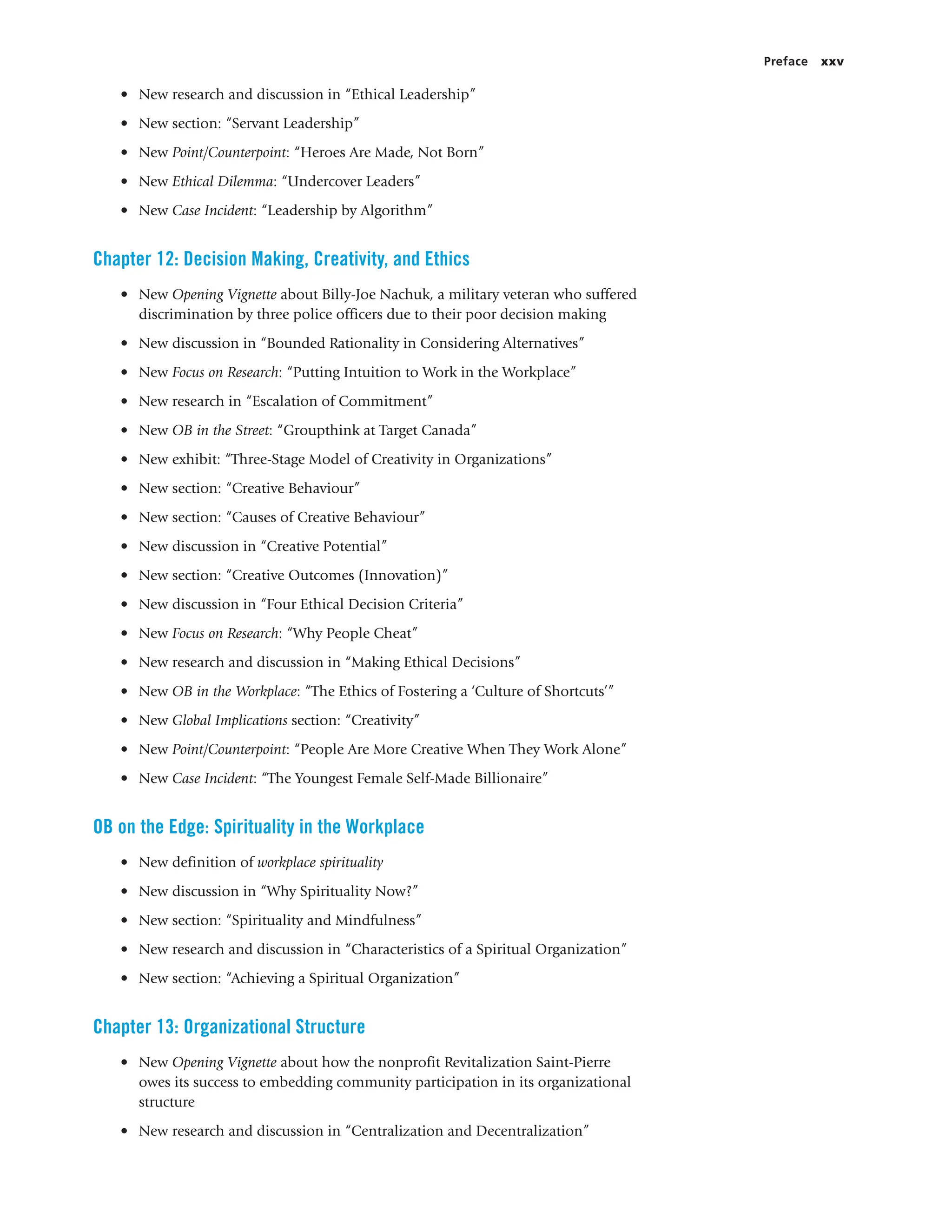
• OB in Action features provide tips for using the concepts of OB in everyday
life, such as Managing Virtual Teams, Choosing Strategies to Deal with
Conflicts, Social Networking Responsibly, and Reducing Biases and Errors in
Decision Making.
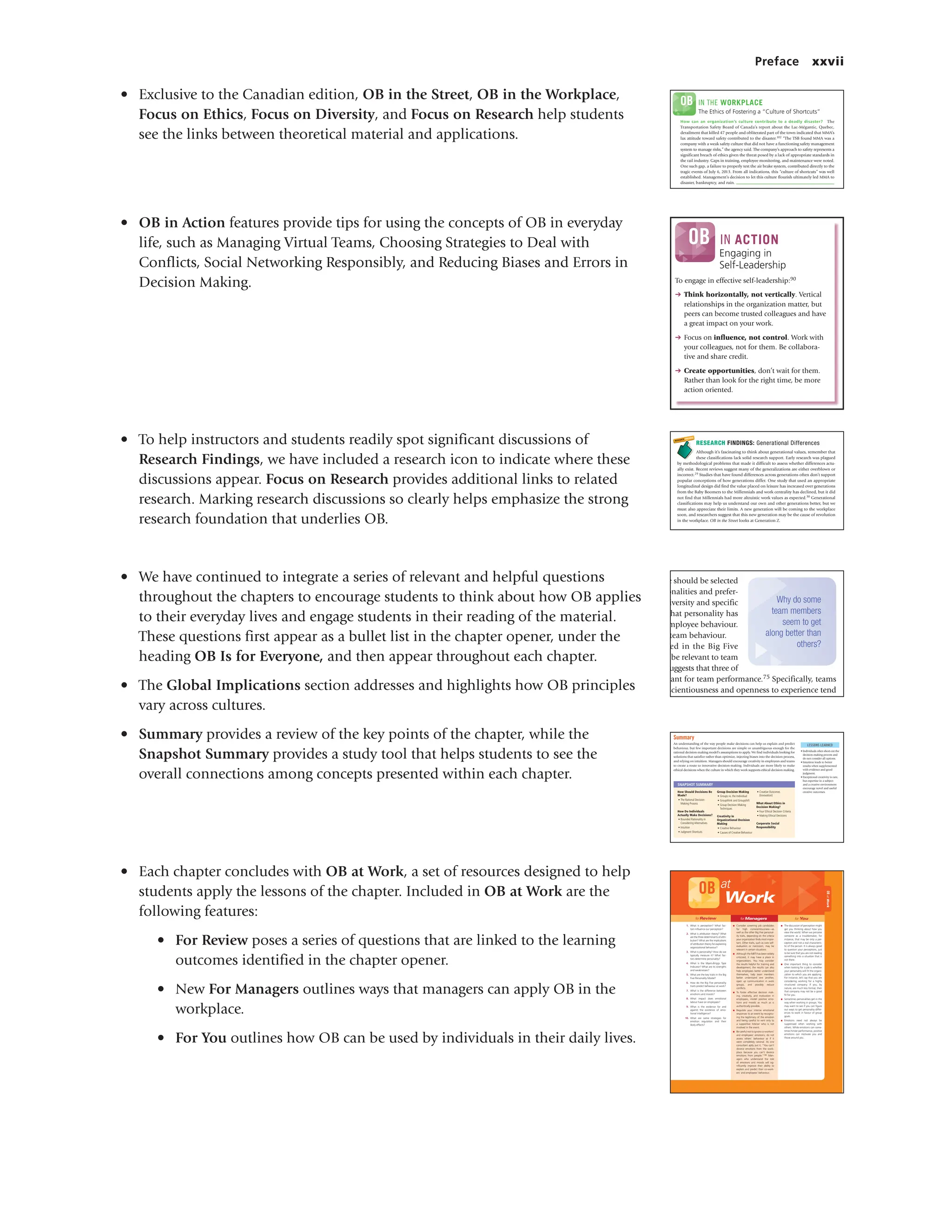
• To help instructors and students readily spot significant discussions of
Research Findings, we have included a research icon to indicate where these
discussions appear. Focus on Research provides additional links to related
research. Marking research discussions so clearly helps emphasize the strong
research foundation that underlies OB.
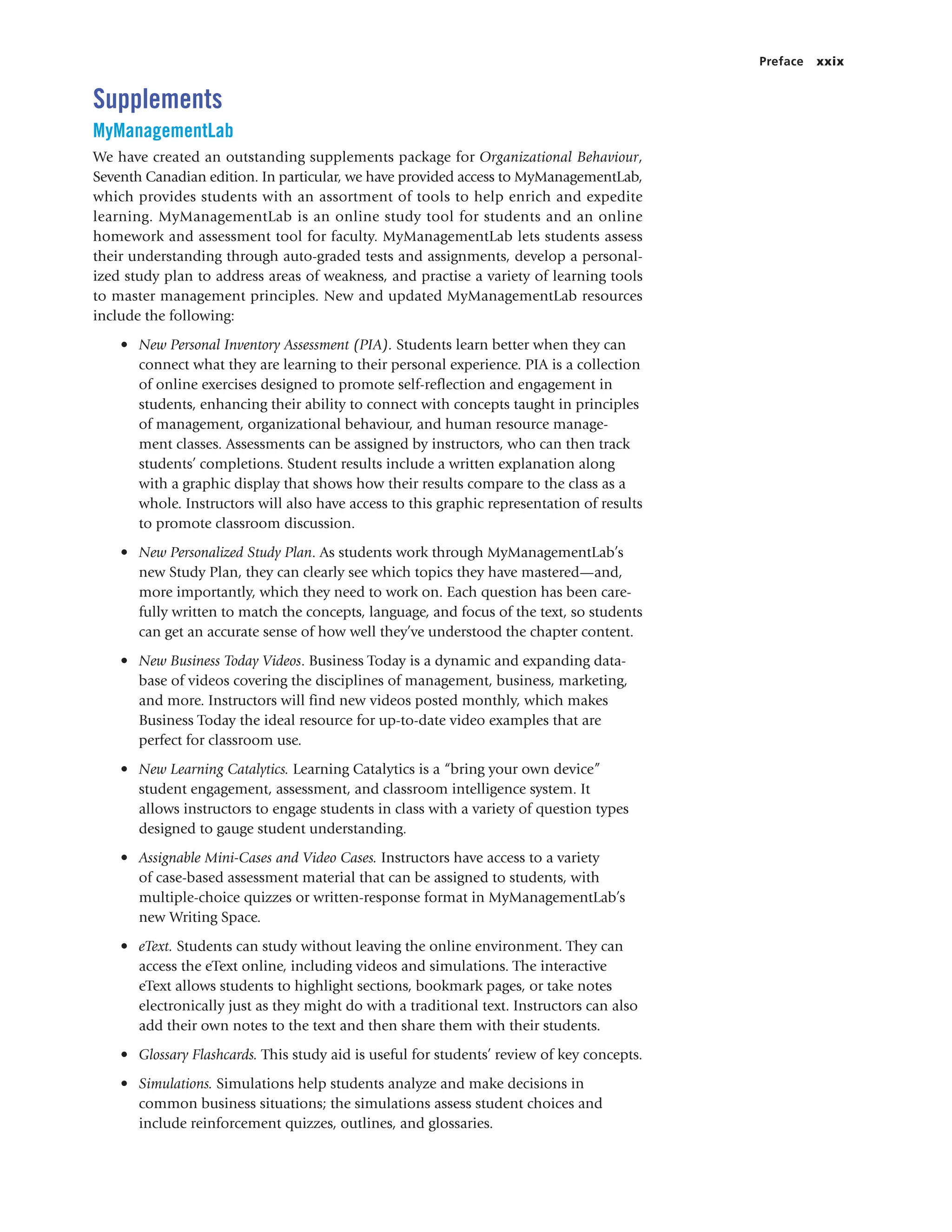
• We have continued to integrate a series of relevant and helpful questions
throughout the chapters to encourage students to think about how OB applies
to their everyday lives and engage students in their reading of the material.
These questions first appear as a bullet list in the chapter opener, under the
heading OB Is for Everyone, and then appear throughout each chapter.
• The Global Implications section addresses and highlights how OB principles
vary across cultures.
• Summary provides a review of the key points of the chapter, while the
Snapshot Summary provides a study tool that helps students to see the
overall connections among concepts presented within each chapter.
• Each chapter concludes with OB at Work, a set of resources designed to help
students apply the lessons of the chapter. Included in OB at Work are the
following features:
• For Review poses a series of questions that are linked to the learning
outcomes identified in the chapter opener.
• New For Managers outlines ways that managers can apply OB in the
workplace.
• For You outlines how OB can be used by individuals in their daily lives.
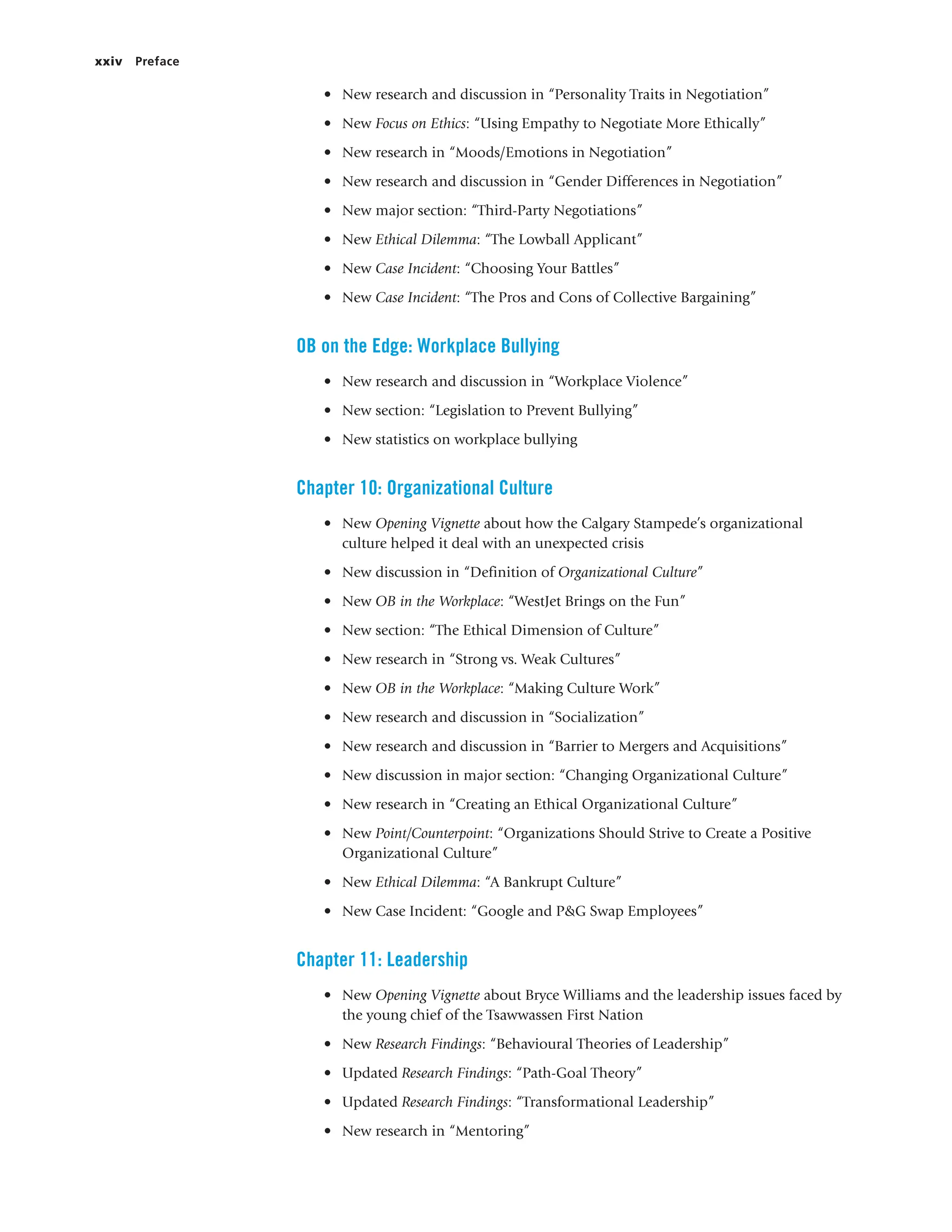
The Ethics of Fostering a “Culture of Shortcuts”
How can an organization’s culture contribute to a deadly disaster? The
Transportation Safety Board of Canada’s report about the Lac-Mégantic, Quebec,
derailment that killed 47 people and obliterated part of the town indicated that MMA’s
lax attitude toward safety contributed to the disaster.102 “The TSB found MMA was a
company with a weak safety culture that did not have a functioning safety management
system to manage risks,” the agency said. The company’s approach to safety represents a
significant breach of ethics given the threat posed by a lack of appropriate standards in
the rail industry. Gaps in training, employee monitoring, and maintenance were noted.
One such gap, a failure to properly test the air brake system, contributed directly to the
tragic events of July 6, 2013. From all indications, this “culture of shortcuts” was well
established. Management’s decision to let this culture flourish ultimately led MMA to
disaster, bankruptcy, and ruin.
OB IN THE WORKPLACE
M12_LANG1781_07_SE_C12.indd 440 1/6/15 3:04 PM
RESEARCH FINDINGS: Generational Differences
Although it’s fascinating to think about generational values, remember that
these classifications lack solid research support. Early research was plagued
by methodological problems that made it difficult to assess whether differences actu-
ally exist. Recent reviews suggest many of the generalizations are either overblown or
incorrect.29 Studies that have found differences across generations often don’t support
popular conceptions of how generations differ. One study that used an appropriate
longitudinal design did find the value placed on leisure has increased over generations
from the Baby Boomers to the Millennials and work centrality has declined, but it did
not find that Millennials had more altruistic work values as expected.30 Generational
classifications may help us understand our own and other generations better, but we
must also appreciate their limits. A new generation will be coming to the workplace
soon, and researchers suggest that this new generation may be the cause of revolution
in the workplace. OB in the Street looks at Generation Z.
M03_LANG1781_07_SE_C03.indd 87 12/29/14 4:56 PM
e should be selected
onalities and prefer-
iversity and specific
that personality has
mployee behaviour.
team behaviour.
ed in the Big Five
be relevant to team
uggests that three of
tant for team performance.75 Specifically, teams
scientiousness and openness to experience tend
Why do some
team members
seem to get
along better than
others?
M06_LANG7855_07_SE_C06.indd 223 12/30/14 11
Summary
An understanding of the way people make decisions can help us explain and predict
behaviour, but few important decisions are simple or unambiguous enough for the
rational decision-making model’s assumptions to apply. We find individuals looking for
solutions that satisfice rather than optimize, injecting biases into the decision process,
and relying on intuition. Managers should encourage creativity in employees and teams
to create a route to innovative decision-making. Individuals are more likely to make
ethical decisions when the culture in which they work supports ethical decision making.
LESSONS LEARNED
• Individuals often short-cut the
decision-making process and
do not consider all options.
• Intuition leads to better
results when supplemented
with evidence and good
judgment.
• Exceptional creativity is rare,
but expertise in a subject
and a creative environment
encourage novel and useful
creative outcomes.
SNAPSHOT SUMMARY
How Should Decisions Be
Made?
• The Rational Decision-
Making Process
How Do Individuals
Actually Make Decisions?
• Bounded Rationality in
Considering Alternatives
• Intuition
• Judgment Shortcuts
Group Decision Making
• Groups vs. the Individual
• Groupthink and Groupshift
• Group Decision-Making
Techniques
Creativity in
Organizational Decision
Making
• Creative Behaviour
• Causes of Creative Behaviour
• Creative Outcomes
(Innovation)
What About Ethics in
Decision Making?
• Four Ethical Decision Criteria
• Making Ethical Decisions
Corporate Social
Responsibility
M12_LANG1781_07_SE_C12.indd 443 1/6/15 3:04 PM
OB
at
Work
for Review
1. What is perception? What fac-
tors influence our perception?
2. What is attribution theory? What
are the three determinants of attri-
bution? What are the implications
of attribution theory for explaining
organizational behaviour?
3. What is personality? How do we
typically measure it? What fac-
tors determine personality?
4. What is the Myers-Briggs Type
Indicator? What are its strengths
and weaknesses?
5. What are the key traits in the Big
Five Personality Model?
6. How do the Big Five personality
traits predict behaviour at work?
7. What is the difference between
emotions and moods?
8. What impact does emotional
labour have on employees?
9. What is the evidence for and
against the existence of emo-
tional intelligence?
10. What are some strategies for
emotion regulation and their
likely effects?
for Managers
■ Consider screening job candidates
for high conscientiousness—as
well as the other Big Five personal-
ity traits, depending on the criteria
your organization finds most impor-
tant. Other traits, such as core self-
evaluation or narcissism, may be
relevant in certain situations.
■ Although the MBTI has been widely
criticized, it may have a place in
organizations. You may consider
the results helpful for training and
development; the results can also
help employees better understand
themselves, help team members
better understand one another,
open up communication in work
groups, and possibly reduce
conflicts.
■ To foster effective decision mak-
ing, creativity, and motivation in
employees, model positive emo-
tions and moods as much as is
authentically possible.
■ Regulate your intense emotional
responses to an event by recogniz-
ing the legitimacy of the emotion
and being careful to vent only to
a supportive listener who is not
involved in the event.
■ Be careful not to ignore co-workers’
and employees’ emotions; do not
assess others’ behaviour as if it
were completely rational. As one
consultant aptly put it, “You can’t
divorce emotions from the work-
place because you can’t divorce
emotions from people.”180 Man-
agers who understand the role
of emotions and moods will sig-
nificantly improve their ability to
explain and predict their co-work-
ers’ and employees’ behaviour.
for You
■ The discussion of perception might
get you thinking about how you
view the world. When we perceive
someone as a troublemaker, for
instance, that may be only a per-
ception and not a real characteris-
tic of the person. It is always good
to question your perceptions, just
to be sure that you are not reading
something into a situation that is
not there.
■ One important thing to consider
when looking for a job is whether
your personality will fit the organi-
zation to which you are applying.
For instance, let’s say that you are
considering working for a highly
structured company. If you, by
nature, are much less formal, then
that company may not be a good
fit for you.
■ Sometimes personalities get in the
way when working in groups. You
may want to see if you can figure
out ways to get personality differ-
ences to work in favour of group
goals.
■ Emotions need not always be
suppressed when working with
others. While emotions can some-
times hinder performance, positive
emotions can motivate you and
those around you.
OB at
Work
M02_LANG7855_07_SE_C02.indd 71 12/29/14 4:55 PM
Engaging in
Self-Leadership
To engage in effective self-leadership:90
➔ Think horizontally, not vertically. Vertical
relationships in the organization matter, but
peers can become trusted colleagues and have
a great impact on your work.
➔ Focus on influence, not control. Work with
your colleagues, not for them. Be collabora-
tive and share credit.
➔ Create opportunities, don’t wait for them.
Rather than look for the right time, be more
action oriented.
OB IN ACTION
M11_LANG1781_07_SE_C11.indd 401 1/6/15 3:03 PM
xxviii Preface
• Point/Counterpoint promotes debate on contentious OB issues. This feature
presents more focused arguments.
• New Personal Inventory Assessment (PIA) is a collection
of online exercises designed to promote self-reflection and
engagement in students, enhancing their ability to connect
with the concepts taught in the text. PIA marginal icons
appear throughout the text.
• Breakout Group Exercises, Experiential Exercise, and
Ethical Dilemma are valuable application exercises for the
classroom. The many new exercises included here are ones
that we have found particularly stimulating in our own
classrooms. Our students say they like these exercises and
they learn from them. Additional exercises can be found
on MyManagementLab.
• Case Incidents (two per chapter) deal with real-world scenarios and require
students to exercise their decision-making skills. Each case enables an
instructor to quickly generate class discussion on a key theme within the
chapter.
• From Concepts to Skills provides a wide range of applications for students.
The section begins with a practical set of tips on topics such as reading
emotions, setting goals, and solving problems creatively, which demonstrate
real-world applications of OB theories. These tips are followed by the features
Practising Skills and Reinforcing Skills. Practising Skills presents an additional
case or group activity to apply the chapter’s learning outcomes. Reinforcing
Skills asks students to talk about the material they have learned with others, or
to apply it to their own personal experiences.
• Exclusive to the Canadian edition, OB on the Edge (following each part)
takes a close look at some of the hottest topics in the field: work-related stress,
trust, behavioural pathologies that can lead to workplace bullying, and spiri-
tuality in the workplace. Since this is a stand-alone feature, these topics can be
introduced at the instructor’s discretion.
• Our reviewers have asked for more cases, and more comprehensive and inte-
grated cases. To address this request, we have included 10 Additional Cases
that feature a variety of challenges and organizations. All of these cases require
students to apply material from a variety of chapters.
Trust
Bruce MacLellan, president
and CEO of Toronto-based
Environics Communications,
finds that building trust in the
workplace has a high payoff.1
In fact, he believes that trust is
a crucial element of his public
relations firm’s success. “Build
trust [because] everything you
say and do will be watched.
… Building a stable and trust-
ing atmosphere is essential to
other success. People may not
always agree, but if they see
transparency, consistency and
candor, it helps.
”
Employees look forward
to the annual ESRA (read it
backward to see where the
name comes from) award.
The award goes to the per-
son who made the biggest
blooper of the year in front
of a client or colleague. One
employee won for recom-
mending a “suitable” park-
ing spot from which the client
got towed. Another employee
was caught on a television
interview looking like she was
falling asleep. “She didn’t
realize she was on camera
and looked like she was fall-
ing asleep while our client
was speaking,
” MacLellan
says. The award ensures that
employees feel safe when
they make mistakes and
that they can trust their col-
leagues.
Another way that MacLellan
builds trust at Environics is
through helping employees
achieve work–life balance.
After working at the firm for
four years, Steve Acken, vice-
president of digital services,
wanted to travel the world
and requested four months of
unpaid leave. “They held my
job for four months and that
was everything,
” said Acken,
making him even more com-
mitted to the firm.
on the
EDGE
Paul
and
Chris
Bennet
t/Enviro
nics
Comm
unicati
ons,
Inc./Ne
wscom
OB
M06_OB_LANG1781_07_SE_C06_OB.indd 242 12/30/14 10:31 AM
334 Part 3 Interacting Effectively
POINT COUNTERPOINT
OB
at
Work
It may be true that conflict is an inherent part of any
group or organization. It may not be possible to elimi-
nate it completely. However, just because conflicts exist is
no reason to glorify them. All conflicts are dysfunctional,
and it’s one of management’s major responsibilities to
keep conflict intensity as low as humanly possible. A few
points will support this case:
• The negative consequences from conflict can be dev-
astating. The list of negatives associated with conflict
is awesome. The most obvious are increased turnover,
decreased employee satisfaction, inefficiencies between
work units, sabotage, labour grievances and strikes,
and physical aggression. One study estimated that
managing conflict at work costs the average employer
nearly 450 days of management time a year.
• Effective managers build teamwork. A good man-
ager builds a coordinated team. Conflict works
against such an objective. A successful work group
is like a successful sports team: Members all know
their roles and support their teammates. When
a team works well, the whole becomes greater than
the sum of the parts. Management creates team-
work by minimizing internal conflicts and facilitat-
ing internal coordination.
• Competition is good for an organization, but not
conflict. Competition and conflict should not be con-
fused with each other. Conflict is behaviour directed
against another party, whereas competition is behav-
iour aimed at obtaining a goal without interference
from another party. Competition is healthy; it’s the
source of organizational vitality. Conflict, on the other
hand, is destructive.
• Conflict is avoidable. It may be true that conflict is
inevitable when an organization is in a downward
spiral, but the goal of good leadership and effective
management is to avoid the spiral to begin with.
Let’s briefly review how stimulating conflict can provide
benefits to the organization:111
• Conflict is a means by which to bring about radical
change. It’s an effective device by which management
can drastically change the existing power structure,
current interaction patterns, and entrenched atti-
tudes. If there is no conflict, it means the real prob-
lems are not being addressed.
• Conflict facilitates group cohesiveness. While conflict
increases hostility between groups, external threats
tend to cause a group to pull together as a unit. Con-
flict with another group brings together those within
each group. Such intragroup cohesion is a critical
resource that groups draw on in good and especially
in bad times.
• Conflict improves group and organizational effective-
ness. Groups or organizations devoid of conflict are
likely to suffer from apathy, stagnation, groupthink,
and other debilitating diseases. In fact, more organi-
zations probably fail because they have too little con-
flict, not because they have too much. Stagnation is
the biggest threat to organizations, but since it occurs
slowly, its ill effects often go unnoticed until it’s too
late. Conflict can break complacency—although most
of us don’t like conflict, it’s often the last best hope of
saving an organization.
• Conflict brings about a slightly higher, more construc-
tive level of tension. Constructive levels of tension
enhance the chances of solving the conflicts in a way
satisfactory to all parties concerned. When the level
of tension is very low, the parties may not be suffi-
ciently motivated to do something about a conflict.
Conflict: Good or Bad?
M09_LANG1781_07_SE_C09.indd 334 1/27/15 4:20 PM
OB
at
Work
374 Part 4 Sharing the Organizational Vision
CAS E IN CI DEN TS
Is a 5S Culture for You?
Jay Scovie looked at his workspace.95 He took pride in
how nice and tidy he had made it look. As it turns out, his
pride was misplaced. Sweeping visible clutter from your
workspace by packing it into boxes hidden in a closet was
not acceptable to his employer, Japanese manufacturer
Kyocera. Scovie’s habit drew the attention of Dan Brown,
Kyocera’s newly appointed inspector. “It became a topic
of repeated conversation,” Scovie said.
Why the obsession with order? Kyocera has joined a
growing list of organizations that base their culture on 5S,
a concept borrowed from lean manufacturing and based
on five phases or principles:
1. Sorting (Seiri). Going through all tools, materials,
and supplies so as to keep only what is essential.
2. Straightening (Seiton). Arranging tools, supplies,
equipment, and parts in a manner that promotes
maximum efficiency. For everything there should be
a place, and everything should be in its place.
3. Shining (Seiso). Systematic cleaning to make the
workplace and workspace as clean and neat as pos-
sible. At the end of the shift or workday, everything
is left as it was when the workday started.
4. Standardizing (Seiketsu). Knowing exactly what your
responsibilities are to keep the first three S’s.
5. Sustaining (Shitsuke). Maintaining and reviewing
standards, rigorous review, and inspection to ensure
order does not slowly slip back into disorder or
chaos.
Other companies are following Kyocera in making
5S an important part of their culture, including London,
Ontario-based 3M Canada, Markham, Ontario-based
Steelcase, and St. Thomas, Ontario-based Waltec. Lawn
mower manufacturer Toro organizes printer output
according to 5S principles, and Virginia Mason Hospital in
Seattle uses 5S to coordinate office space and arrange the
placement of medical equipment, such as stethoscopes.
Paul Levy, president and CEO of Beth Israel Deaconess
Medical Center in Boston, has used 5S to reduce errors
and time lost searching for equipment.
At Kyocera, Brown exercises some discretion—he
asked one employee to remove a hook on her door while
allowing another to keep a whale figurine on her desk.
“You have to figure out how to balance being too picky
with upholding the purpose of the program,” he said.
While Brown was happy with Scovie’s desk (if not the
closet), he wanted to look inside. Scovie tried to redirect
the conversation but relented when Brown pressed. Inside
one of Scovie’s desk drawers was a box full of CDs, small
electronic devices, and items Kyocera no longer makes.
“Obviously, we’re at the sorting stage here,” Scovie told
Brown.
Questions
1. What would you see as the value in Kyocera using
5S?
2. What are some advantages and disadvantages of
trying to impose a similar culture in Canadian com-
panies?
3. What might your response be to having to engage
in the 5S principles in your workplace?
M10_LANG7855_07_SE_C10.indd 374 1/27/15 4:22 PM
OB
at
Work
Reading
Emotions
Understanding another per-
son’s felt emotions is very
difficult. But we can learn to
read others’ displayed emo-
tions.186 We do this by focus-
ing on verbal, nonverbal, and
paralanguage cues.
FROM CONCEPTS TO SKILLS
The easiest way to find out what someone is feeling is to ask them.
Saying something as simple as “Are you okay? What’s the problem?” can
often provide you with the information to assess an individual’s emotional
state. But relying on a verbal response has two drawbacks. First, almost all
of us conceal our emotions to some extent for privacy and to reflect social
expectations. So we might be unwilling to share our true feelings. Second,
even if we want to verbally convey our feelings, we may be unable to do
so. As we noted earlier, some people have difficulty understanding their
own emotions and, hence, are unable to express them verbally. So, at best,
verbal responses provide only partial information.
Let’s say you are talking with a co-worker. Does the fact that his back
is rigid, his teeth clenched, and his facial muscles tight tell you something
about his emotional state? It probably should. Facial expressions, gestures,
body movements, and physical distance are nonverbal cues that can pro-
vide additional insights into what a person is feeling. The facial expressions
shown in Exhibit 2-11, for instance, are a window into a person’s feelings.
Notice the difference in facial features: the height of the cheeks, the rais-
ing or lowering of the brow, the turn of the mouth, the positioning of the
lips, and the configuration of muscles around the eyes. Even something as
subtle as the distance someone chooses to position him- or herself from
you can convey how much intimacy, aggressiveness, repugnance, or with-
drawal that person feels.
76 Part 1 Understanding the Workplace
M02_LANG7855_07_SE_C02.indd 76 2/5/15 11:42 AM
OB
at
Work
Form small groups to discuss the following topics, as assigned by your instructor:
1. How might the job of student be redesigned to make it more motivating?
2. What is your ideal job? To what extent does it match up with the elements of the JCM?
3. Would you prefer working from home or working at the office? Why?
BREAKOUT G RO U P E XERC ISES
Analyzing and Redesigning Jobs
Break into groups of 5 to 7 members each.160 Each student should describe the worst job he or she has ever had. Use
any criteria you want to select 1 of these jobs for analysis by the group.
Members of the group will analyze the job selected by determining how well it scores on the job characteristics model.
Use the following scale for your analysis of each job dimension:
7 = Very high
6 = High
5 = Somewhat high
4 = Moderate
3 = Somewhat low
2 = Low
1 = Very low
The following sample questions can guide the group in its analysis of the job in question:
• Skill variety. Describe the different identifiable skills required to do this job. What is the nature of the oral,
written, and/or quantitative skills needed? Physical skills? Does the job holder get the opportunity to use all of
his or her skills?
• Task identity. What is the product that the job holder creates? Is he or she involved in its production from
beginning to end? If not, is he or she involved in a particular phase of its production from beginning to end?
• Task significance. How important is the product? How important is the job holder’s role in producing it? How
important is the job holder’s contribution to the people he or she works with? If the job holder’s job were
eliminated, how inferior would the product be?
• Autonomy. How much independence does the job holder have? Does he or she have to follow a strict
schedule? How closely is he or she supervised?
• Feedback. Does the job holder get regular feedback from his or her manager? From peers? From his or her
staff? From customers? How about intrinsic performance feedback when doing the job?
EX P ERIEN TIA L EX ER CISE
OB
at
Work
Are CEOs Paid Too Much?
ETH ICAL D ILEMMA
Critics have described the astronomical pay packages given
to Canadian and American CEOs as “rampant greed.”161
In 2013, the median annual compensation of CEOs in
Canada’s 100 largest companies was $5.6 million. That
means that the compensation of CEOs, which had fallen
a bit from 2010 to 2011, is almost back to the levels from
before the downturn, when the median CEO earned
$5.8 million. The 2013 CEO compensation was 171 times
what the average full-time Canadian employee earned
in 2013 ($46 634). Canadian CEOs may feel they are
underpaid, though, if they compare themselves with a
similar group of American CEOs, whose median pay was
US$12.75 million in 2012, and 257 times that of the
average pay for US employees.
How do you explain such large pay packages for CEOs?
Some say that executive compensation represents a classic
economic response to a situation in which the demand is
great for high-quality top-executive talent, and the supply
is low. Other arguments in favour of paying executives
millions a year are the need to compensate people for the
tremendous responsibilities and stress that go with such
jobs; the motivating potential that seven- and eight-figure
annual incomes provide to senior executives and those
who might aspire to be; and the influence of senior execu-
tives on the company’s bottom line.
Critics of executive pay practices in Canada and the
United States argue that CEOs choose board members
whom they can count on to support ever-increasing pay
for top management. If board members fail to “play
along,” they risk losing their positions, their fees, and the
prestige and power inherent in board membership.
In addition, it’s not clear that executive compensation
is tied to firm performance. For example, a 2014 analysis
of compensation data by Equilar showed little correlation
between CEO pay and company performance. Consider
the data in Exhibit 5-8, which illustrates the disconnect
that can sometimes happen between CEO compensation
Chapter 5 Motivation in Action 197
196 Part 2 Striving for Performance
EXHIBIT 5-8 2014 Compensation of Canada’s Most Overpaid CEOs*
CEO(s)
Was Paid
(2-Year Avg.)
Should Have
Been Paid
Amount
Overpaid
1. Gerald Schwartz, Onex Corporation,
Toronto, Ontario
$19 907 000 $8 668 000 $11 239 000
2. Jim Smith, Thomson Reuters Corp.,
Toronto, Ontario
$11 659 000 $4 556 000 $7 103 000
3. Scott Saxberg, Crescent Point Energy Corp.,
Calgary, Alberta
$8 954 000 $2 421 000 $6 533 000
4. Craig Mulhauser, Celestica Inc.,
Toronto, Ontario
$6 595 000 $3 122 000 $3 473 000
5. Mark Davis, Chemtrade Logistics Income
Fund, Toronto, Ontario
$5 042 000 $2 416 000 $2 626 000
*Financial Post Magazine uses a “Bang for the Buck” formula to calculate the amount overpaid, taking into account CEO
performance variables.
Source: A Guide to “Using the CEO Scorecard,” Financial Post Magazine, November 2014, p. 33; and information in “CEO
Scorecard 2014,” Financial Post Magazine, November 2014, pp. 34–37.
P I A
Diagnosing Poor Performance and Enhancing Motivation: Correcting poor performance is a key management
responsibility. This instrument helps you assess your abilities in this area.
Effective Empowerment and Engagement: Some engagement and empowerment techniques are more effective than
others. Use this scale to see how your approach measures up, and to get some ideas for improvement.
PERSO NAL IN VE N TO RY ASSES SMEN T
Using the formula found on page 181, calculate the job’s motivating potential score. Discuss whether you think this
score accurately reflects your perceptions of the motivating potential of these professions.
Using the suggestions offered in the chapter for redesigning jobs, describe specific actions that management could
take to increase this job’s motivating potential.
Calculate the costs to management of redesigning the job in question. Do the benefits exceed the costs?
Conclude the exercise by having a representative of each group share his or her group’s analysis and redesign sugges-
tions with the entire class. Possible topics for class discussion might include similarities in the jobs chosen, problems in
rating job dimensions, and the cost–benefit assessment of design changes.
M05_LANG7855_07_SE_C05.indd 196-197 1/27/15 11:48 AM
Preface xxix
Supplements
MyManagementLab
We have created an outstanding supplements package for Organizational Behaviour,
Seventh Canadian edition. In particular, we have provided access to MyManagementLab,
which provides students with an assortment of tools to help enrich and expedite
learning. MyManagementLab is an online study tool for students and an online
homework and assessment tool for faculty. MyManagementLab lets students assess
their understanding through auto-graded tests and assignments, develop a personal-
ized study plan to address areas of weakness, and practise a variety of learning tools
to master management principles. New and updated MyManagementLab resources
include the following:
• New Personal Inventory Assessment (PIA). Students learn better when they can
connect what they are learning to their personal experience. PIA is a collection
of online exercises designed to promote self-reflection and engagement in
students, enhancing their ability to connect with concepts taught in principles
of management, organizational behaviour, and human resource manage-
ment classes. Assessments can be assigned by instructors, who can then track
students’ completions. Student results include a written explanation along
with a graphic display that shows how their results compare to the class as a
whole. Instructors will also have access to this graphic representation of results
to promote classroom discussion.
• New Personalized Study Plan. As students work through MyManagementLab’s
new Study Plan, they can clearly see which topics they have mastered—and,
more importantly, which they need to work on. Each question has been care-
fully written to match the concepts, language, and focus of the text, so students
can get an accurate sense of how well they’ve understood the chapter content.
• New Business Today Videos. Business Today is a dynamic and expanding data-
base of videos covering the disciplines of management, business, marketing,
and more. Instructors will find new videos posted monthly, which makes
Business Today the ideal resource for up-to-date video examples that are
perfect for classroom use.
• New Learning Catalytics. Learning Catalytics is a “bring your own device”
student engagement, assessment, and classroom intelligence system. It
allows instructors to engage students in class with a variety of question types
designed to gauge student understanding.
• Assignable Mini-Cases and Video Cases. Instructors have access to a variety
of case-based assessment material that can be assigned to students, with
multiple-choice quizzes or written-response format in MyManagementLab’s
new Writing Space.
• eText. Students can study without leaving the online environment. They can
access the eText online, including videos and simulations. The interactive
eText allows students to highlight sections, bookmark pages, or take notes
electronically just as they might do with a traditional text. Instructors can also
add their own notes to the text and then share them with their students.
• Glossary Flashcards. This study aid is useful for students’ review of key concepts.
• Simulations. Simulations help students analyze and make decisions in
common business situations; the simulations assess student choices and
include reinforcement quizzes, outlines, and glossaries.
xxx Preface
Most of the following materials are available for download from a password-
protected section of Pearson Canada’s online catalogue (www.pearsoncanada.ca/
highered). Navigate to your text’s catalogue page to view a list of those supplements
that are available. Contact your local sales representative for details and access.
• Instructor’s Resource Manual with Video Guide. Each chapter of the Instructor’s
Resource Manual with Video Guide includes a chapter outline, learning
outcomes, chapter synopsis, study questions, suggested teaching plan, anno-
tated lecture outlines, answers to questions found under OB at Work’s For
Review, a summary and analysis of Point/Counterpoint features, comments on
end-of-chapter exercises and notes on the Case Incidents, From Concepts to
Skills, and key terms.
• Computerized Test Bank. The Test Bank contains over 1800 items, including
multiple choice, true/false, and discussion questions that relate not only to
the body of the text but to From Concepts to Skills, Point/Counterpoint, and case
materials. For each question we have provided the correct answer, a refer-
ence to the relevant section of the text, a difficulty rating, and a classification
(recall/applied). Pearson’s computerized test banks allow instructors to filter
and select questions to create quizzes, tests, or homework. Instructors can
revise questions or add their own, and may be able to choose print or online
options. These questions are also available in Microsoft Word format.
• PowerPoint Presentation. A ready-to-use PowerPoint slideshow designed for
classroom presentation. Use it as is, or edit content to fit your individual class-
room needs.
• Image Gallery. This package provides instructors with images to enhance their
teaching.
CourseSmart. CourseSmart goes beyond traditional expectations—providing instant,
online access to the texts and course materials you need at a lower cost for students.
And even as students save money, you can save time and hassle with a digital eText
that allows you to search for the most relevant content at the very moment you need
it. Whether it’s evaluating texts or creating lecture notes to help students with difficult
concepts, CourseSmart can make life a little easier. See how when you visit www.cours-
esmart.com/instructors.
Pearson Custom Library. For enrollments of at least 25 students, you can create your
own text by choosing the chapters that best suit your own course needs. To begin
building your custom text, visit www.pearsoncustomlibrary.com. You may also work
with a dedicated Pearson Custom editor to create your ideal text—publishing your own
original content or mixing and matching Pearson content. Contact your local Pearson
Representative to get started.
Learning Solutions Managers. Pearson’s Learning Solutions Managers work with faculty
and campus course designers to ensure that Pearson technology products, assessment
tools, and online course materials are tailored to meet your specific needs. This highly
qualified team is dedicated to helping schools take full advantage of a wide range of
educational resources, by assisting in the integration of a variety of instructional mate-
rials and media formats. Your local Pearson Education sales representative can provide
you with more details on this service program.
Preface xxxi
Acknowledgments
A number of people worked hard to give this seventh Canadian edition of Organizational
Behaviour a new look.
I received incredible support for this project from a variety of people at Pearson
Canada. The three people who worked hardest to keep this project on track were
Jennifer Murray, Developmental Editor, Claudia Forgas, Copy Editor and Production
Editor, and Jessica Hellen, Project Manager. All three were extremely supportive and
helpful. Jennifer supplied a number of great ideas for examples and vignettes, never
complained when I was late with chapters, and she provided much needed cheerful-
ness at some of the most difficult parts of this project. I can’t thank her enough for her
dedication to the task.
Claudia Forgas was the Copy Editor and Production Editor for the project. Claudia
has worked on a number of my projects and still continues to amaze for how well
she makes sure everything is in place and written clearly. Claudia provided a wealth
of support, great ideas, and goodwill throughout the production process. Turning the
manuscript into the text you hold in your hands could not have happened without
her inspired leadership. She was extremely diligent about checking for consistency
throughout the text and performed a number of helpful fact-checking activities. Her
keen eyes helped to make these pages as clean as they are. I am grateful for the oppor-
tunity to work with her again.
There are a variety of other people at Pearson who also had a hand in making sure
that the manuscript would be transformed into this book and then delivered to you.
To all of them I extend my thanks. I know the Pearson sales team will do everything
possible to make this book successful.
I also want to acknowledge my divisional secretary, Nancy Tang, who helps keep
me on track in a variety of ways. I could not ask for a better, more dedicated, or more
cheerful assistant. She really helps keep things together.
In our continuing effort to improve the text, we have conducted many reviews to
elicit feedback over the years and editions. Many thanks to several students from the
Northern Alberta Institute of Technology (NAIT) who provided us with suggestions for
improving the text. The students are Barb Kosak, Prudence Musinguzi, Andres Sarrate,
and Robert Tucci. Student input helps keep the material fresh and alive.
Finally, I want to acknowledge the many reviewers of this text for their detailed,
helpful comments. I appreciate the time and care that they put into their reviewing.
The reviewers include Ian Anderson (Algonquin College), Julia Dotson (Confederation
College), Patricia Fitzgerald (Saint Mary’s University), Judith Hunter (Sheridan Institute
of Technology and Advanced Learning), Martha Reavley (University of Windsor), and
Yanelia Yabar (Red Deer College).
This page intentionally left blank
Preface xxxiii
Nancy Langton received her Ph.D. from Stanford University. Since completing
her graduate studies, Dr. Langton has taught at the University of Oklahoma and the
University of British Columbia. Currently a member of the Organizational Behaviour
and Human Resources division in the Sauder School of Business, UBC, she teaches
at the undergraduate, MBA, and Ph.D. levels and conducts executive programs on
attracting and retaining employees, time management, family business issues, as well
as women and management issues. Dr. Langton has received several major three-year
research grants from the Social Sciences and Humanities Research Council of Canada,
and her research interests have focused on human resource issues in the workplace,
including pay equity, gender equity, and leadership and communication styles. Her ar-
ticles on these and other topics have appeared in such journals as Administrative Science
Quarterly, American Sociological Review, Sociological Quarterly, Journal of Management
Education, and Gender, Work and Organizations. She has won Best Paper commendations
from both the Academy of Management and the Administrative Sciences Association
of Canada.
Dr. Langton routinely wins high marks from her students for teaching. She has been
nominated many times for the Commerce Undergraduate Society Awards, and has won
several honourable mention plaques. She has also won the Sauder School of Business’s
most prestigious award for teaching innovation, The Talking Stick. The award was given
for Dr. Langton’s redesign of the undergraduate organizational behaviour course as
well as the many activities that were a spin-off of these efforts. She was also part of the
UBC MBA Core design team that won the Alan Blizzard award, a national award that
recognizes innovation in teaching. More recently, she was acknowledged by the Sauder
School of Business for her development of the Sauder Africa Initiative, which took her
to Kenya with UBC students to help young people in the slums of Nairobi write busi-
ness plans.
In Dr. Langton’s “other life,” she engages in the artistry of quiltmaking, and one
day hopes to win first prize at Visions, the juried show for quilts as works of art. More
recently, she has been working at mastering the art of photography, creating abstract art
using segments of real objects. When she is not designing quilts or taking photographs,
she is either reading novels recommended by her book club colleagues or studying
cookbooks for new ideas. All of her friends would say that she makes the best pizza
from scratch in all of Vancouver, and one has even offered to supply venture capital to
open a pizza parlour.
A B O U T T H E A U T H O R S
xxxiv About the Authors
Stephen P. Robbins
Education
Ph.D., University of Arizona
Professional Experience
Academic Positions: Professor, San Diego State University, Southern Illinois University
at Edwardsville, University of Baltimore, Concordia University in Montreal, and
University of Nebraska at Omaha.
Research: Research interests have focused on conflict, power, and politics in organi-
zations; behavioural decision making; and the development of effective interpersonal
skills.
Books Published: World’s best-selling author of textbooks in both management and
organizational behaviour. His books have sold more than 5 million copies and have
been translated into 20 languages; editions have been adapted for Canada, Australia,
South Africa, and India, such as these:
• Essentials of Organizational Behavior, 12th ed. (Prentice Hall, 2014)
• Management, 12th ed. with Mary Coulter (Prentice Hall, 2014)
• Fundamentals of Human Resource Management, 10th ed., with David DeCenzo
(Wiley, 2010)
• Prentice Hall’s Self-Assessment Library 3.4 (Prentice Hall, 2010)
• Fundamentals of Management, 8th ed., with David DeCenzo and Mary Coulter
(Prentice Hall, 2013)
• Supervision Today! 7th ed., with David DeCenzo and Robert Wolter (Prentice
Hall, 2013)
• Training in Interpersonal Skills: TIPS for Managing People at Work, 6th ed., with
Phillip Hunsaker (Prentice Hall, 2012)
• Managing Today! 2nd ed. (Prentice Hall, 2000)
• Organization Theory, 3rd ed. (Prentice Hall, 1990)
• The Truth About Managing People, 2nd ed. (Financial Times/Prentice Hall,
2008)
• Decide and Conquer: Make Winning Decisions and Take Control of Your Life
(Financial Times/Prentice Hall, 2004).
Other Interests
In his “other life,” Dr. Robbins actively participates in masters’ track competition. After
turning 50 in 1993, he won 18 national championships and 12 world titles. He is the
current world record holder at 100 metres (12.37 seconds) and 200 metres (25.20
seconds) for men 65 and over.
About the Authors xxxv
Timothy A. Judge
Education
Ph.D., University of Illinois at Urbana-Champaign
Professional Experience
Academic Positions: Franklin D. Schurz Chair, Department of Management, Mendoza
College of Business, University of Notre Dame; Visiting Distinguished Adjunct Professor
of King Abdulaziz University, Saudi Arabia; Visiting Professor, Division of Psychology
& Language Sciences, University College London; Matherly-McKethan Eminent
Scholar in Management, Warrington College of Business Administration, University of
Florida; Stanley M. Howe Professor in Leadership, Henry B. Tippie College of Business,
University of Iowa; Associate Professor (with tenure), Department of Human Resource
Studies, School of Industrial and Labor Relations, Cornell University; Lecturer, Charles
University, Czech Republic, and Comenius University, Slovakia; Instructor, Industrial/
Organizational Psychology, Department of Psychology, University of Illinois at Urbana-
Champaign.
Research: Dr. Judge’s primary research interests are in (1) personality, moods, and
emotions; (2) job attitudes; (3) leadership and influence behaviours; and (4) careers
(person–organization fit, career success). Dr. Judge has published more than 145 articles
on these and other major topics in journals such as Journal of Organizational Behavior,
Personnel Psychology, Academy of Management Journal, Journal of Applied Psychology,
European Journal of Personality, and European Journal of Work and Organizational Psychology.
Fellowship: Dr. Judge is a fellow of the American Psychological Association, the
Academy of Management, the Society for Industrial and Organizational Psychology,
and the American Psychological Society.
Awards: In 1995, Dr. Judge received the Ernest J. McCormick Award for Distinguished
Early Career Contributions from the Society for Industrial and Organizational
Psychology. In 2001, he received the Larry L. Cummings Award for mid-career contri-
butions from the Organizational Behavior Division of the Academy of Management. In
2007, he received the Professional Practice Award from the Institute of Industrial and
Labor Relations, University of Illinois. In 2008, he received the University of Florida
Doctoral Mentoring Award. And in 2012, he received the Editorial Board of the European
Journal of Work and Organizational Psychology (EJWOP) best paper of the year award.
Other Books Published: H. G. Heneman III, T. A. Judge, and J. D. Kammeyer-
Mueller, Staffing Organizations, 7th ed. (Madison, WI: Mendota House/Irwin, 2012)
Other Interests
Although he cannot keep up (literally!) with Dr. Robbins’ accomplishments on the
track, Dr. Judge enjoys golf, cooking and baking, literature (he’s a particular fan of
Thomas Hardy and is a member of the Thomas Hardy Society), and keeping up with
his three children, who range in age from 24 to 10.
C H A P T E R
LEARNING OUTCOMES
How can people skills help you run a successful
business?
1
After studying this chapter, you should be able to:
1 Define organizational behaviour (OB).
2 Demonstrate the importance of interpersonal skills in the workplace.
3 Identify the major behavioural science disciplines that contribute to OB.
4 Understand the value of systematic study to OB.
5 Demonstrate why few absolutes apply to OB.
6 Identify workplace challenges that provide opportunities to apply
OB concepts.
7 Describe the three levels of analysis in this book’s OB model.
P A R T 1
U N D E R S T A N D I N G
T H E W O R K P L A C E
What Is Organizational
Behaviour?
V
ancouver-based Lululemon Athletica is
known for its fashionable yoga wear, as
well as its promotion of yoga.1 Founded in
1998 by Chip Wilson, the company has
grown rapidly, although not without some stumbles.
The company originally manufactured all of its
clothing in Canada, but by 2007 only 50 percent
of its factories were in Canada, and by 2014 only
3 percent of its factories were in Canada. By locat-
ing so much of its manufacturing in other countries,
Lululemon no longer has complete control over
the production of its clothing. This became
embarrassingly clear when black yoga
pants had to be pulled off the
shelves in 2012 because they
were too sheer to be worn.
Christine Day, the former CEO,
said at the time that Lululemon had given too much control over production
to its overseas partners rather than staying personally involved. “If there were 10
technical specs,” she said, “we were probably controlling four. Every single factory has
all the same patterns now.”
Lululemon has acquired cult-brand status, with sales of $1.37 billion in 2012. Wilson
no longer heads the company, although he worries that the board of directors has lost sight
of what Lululemon is about. He also believes the board is focused on short-term goals, to
the detriment of the overall vision of the company.
The challenges that organizations such as Lululemon face illustrate several concepts
you will find as you study the field of organizational behaviour. Let’s take a look, then, at
what organizational behaviour is.
Chapter 1 What Is Organizational Behaviour? 3
THE BIG IDEA
OB helps managers
and employees
make sense of the
workplace and also
applies to work in
groups of all kinds.
• Why do some people do well in organizational settings while others
have difficulty?
• Do you know what a “typical” organization looks like?
• Does job satisfaction really make a difference?
• What people-related challenges have you noticed in the workplace?
• Why should you care about understanding other people?
• Are you ready to take on more responsibility at work?
OB IS FOR EVERYONE THE
CANADIAN
PRESS/Jonathan
Hayward
4 Part 1 Understanding the Workplace
Defining Organizational Behaviour
Organizational behaviour (often abbreviated as OB) is a field of study that looks at
the impact that individuals, groups, and structure have on behaviour within organiza-
tions for the purpose of applying such knowledge toward improving an organization’s
effectiveness. Because the organizations studied are often business organizations, OB
is often applied to topics such as jobs, work, absenteeism, employment turnover,
productivity, human performance, and management. OB also examines the following
core topics, although debate exists about their relative importance:2
• Motivation
• Leader behaviour and power
• Interpersonal communication
• Group structure and processes
• Attitude development and perception
• Change processes
• Conflict and negotiation
Much of OB is relevant beyond the workplace. The study
of OB can cast light on the interactions among family
members, students working as a team on a class project,
the voluntary group that comes together to do something
about reviving the downtown area, the parents who sit on
the board of their children’s daycare centre, or even the
members of a lunchtime pickup basketball team.
What Do We Mean by Organization?
An organization is a consciously coordinated social unit, composed of a group of
people, that functions on a relatively continuous basis to achieve a common goal or
set of goals. Manufacturing and service firms are organizations, and so are schools,
hospitals, churches, military units, retail stores, police departments, volunteer organiza-
tions, start-ups, and local, provincial, and federal government agencies. Thus, when we
use the term organization in this book, we are referring not only to large manufacturing
firms but also to small mom-and-pop stores, as well as to the variety of other forms of
organization that exist. Small businesses with less than 100 people made up 98 percent
of the employers in Canada in 2012, and they employed 69.7 percent of the private
sector workforce. Only 14 percent of businesses have more than 500 employees, and
they employ 46 percent of the workforce. Most of these large organizations are in the
public sector.3
The examples in this book present various organizations so that you can gain a better
understanding of the many types of organizations that exist. Although you might not
have considered this before, the college or university you attend is every bit as much a
“real” organization as is Lululemon Athletica, Air Canada,
or the Vancouver Canucks. A small for-profit organization
that hires unskilled workers to renovate and build in the
inner city of Winnipeg is as much a real organization as is
London, Ontario-based EllisDon, one of North America’s
largest construction companies. Therefore, the theories we
cover should be considered in light of the variety of orga-
nizations you may encounter. We try to point out instances
where the theory may be less applicable (or especially
1 Define organizational
behaviour (OB).
organizational behaviour A field
of study that investigates the impact of
individuals, groups, and structure on
behaviour within organizations; its
purpose is to apply such knowledge
toward improving an organization’s
effectiveness.
organization A consciously
coordinated social unit, composed of
a group of people, that functions on a
relatively continuous basis to achieve
a common goal or set of goals.
Why do some
people do well
in organizational
settings while
others have
difficulty?
Do you know
what a “typical”
organization
looks like?
Chapter 1 What Is Organizational Behaviour? 5
applicable) to a particular type of organization. For the most part, however, you should
expect that the discussions in this book apply across the broad spectrum of organiza-
tions. Throughout, we highlight applications to a variety of organizations in our feature
OB in the Workplace.
OB Is for Everyone
It might seem natural to think that the study of OB is for leaders and managers of
organizations. However, many organizations also have informal leadership opportu-
nities. In organizations in which employees are asked to share in a greater number of
decision-making processes rather than simply follow orders, the roles of managers and
employees are becoming blurred.4 For instance, employees in some retail operations
are asked to make decisions about when to accept returned items rather than defer the
decision to the manager.
OB is not just for managers and employees. Entrepreneurs and self-employed indi-
viduals may not act as managers, but they certainly interact with other individuals
and organizations as part of their work. OB applies equally well to all situations
in which you interact with others: on the basketball court, at the grocery store, in
school, or in church. In fact, OB is relevant anywhere that people come together and
share experiences, work on goals, or meet to solve problems. To help you understand
these broader connections, you will find a feature called OB in the Street throughout
the book.
The Importance of Interpersonal Skills
Until the late 1980s, business school curricula emphasized the technical aspects of
management, focusing on economics, accounting, finance, and quantitative techniques.
2 Demonstrate the impor-
tance of interpersonal
skills in the workplace.
David and Penny Chapman understand the importance of organizational behaviour and treating employ-
ees well. When Markdale, Ontario-based Chapman’s Ice Cream factory burned down in September 2009,
many employees feared that they had lost their jobs. However, the owners quickly put together plans with
senior managers on rebuilding the factory and keeping ice cream production going by working with other
nearby ice cream producers. Not one employee lost a paycheque, although many had to be bussed to jobs
at other locations or put up in hotels.
Ian
Willms/GetStock.com
6 Part 1 Understanding the Workplace
Course work in human behaviour and people skills received minimal attention. Over
the past three decades, however, business school faculty have come to realize the signifi-
cant role that understanding human behaviour plays in determining organizational
effectiveness; required courses on people skills have been added to many curricula.
Employers are looking for people skills as well. In a 2012 survey, executives said that
employees lack “communication, collaboration, critical thinking and creative skills.”5 In
a recent survey, 34 percent of Canadian chief financial officers said that a job applicant’s
people skills were more important than industry experience
and software proficiency. Five years earlier, only 1 percent
cared about interpersonal skills.6
Organizations that invest in the development of
employees’ interpersonal skills are more likely to attract
and keep high-performers. Regardless of labour market
conditions, outstanding employees are always in short
supply.7 Companies known as great places to work in
2014—such as Toronto-based Royal Bank of Canada (RBC),
Woodstock, New Brunswick-based Xplornet Communications, Dartmouth-based Jazz
Aviation, Winnipeg-based Aboriginal Peoples Television Network, Regina-based SaskTel,
Calgary-based Agrium, and Vancouver-based Mountain Equipment Co-op8—have been
found to generate superior financial performance.9 A recent survey of hundreds of
workplaces, and more than 200 000 respondents, showed that the social relationships
among co-workers and supervisors were strongly related to overall job satisfaction.
Positive social relationships also were associated with lower stress at work and lower
intentions to quit.10 Having managers with good interpersonal skills is likely to make
the workplace more pleasant, and research indicates that employees who know how to
relate to their managers well with supportive dialogue and proactivity find that their
ideas are endorsed more often, further improving workplace satisfaction.11 Creating a
pleasant workplace appears to make good economic sense, particularly because wages
and benefits are not the main reasons people like their jobs or stay with an employer.12
Partially for these reasons, universities have begun to incorporate social entrepreneur-
ship education into their curricula in order to train future leaders to address social
issues within their organizations with interpersonal skills.13 This is especially important
because there is a growing awareness of the need for understanding the means and
outcomes of corporate social responsibility.14
Succeeding in the workplace takes good people skills. This book has been written
to help managers and employees develop those people skills. To learn more about the
kinds of people skills needed in the workplace, see the Experiential Exercise on page 29
and From Concepts to Skills—Developing Interpersonal Skills on pages 32–35.
OB: Making Sense of Behaviour in Organizations
When Lululemon Athletica faced the sheer yoga pants issue, company CEO Christine Day said
that it was an isolated issue, thus making light of customer complaints.15 The supplier was
then blamed, although the supplier responded by saying that the product had been made to
specification and that the problem was “a gap between Lululemon’s expectations and reaction
from the market.”
Founder Chip Wilson offered another explanation: Women were buying the wrong size yoga
pants, and this was causing them to stretch out. Eventually the company decided to pull the
product off its shelves and offered refunds to those who had bought the defective product, but
not before creating much customer dissatisfaction with the company.
About six months later, customers again started complaining about some of the yoga pants,
noting that they were pilling. Wilson, in an interview with Bloomberg News, blamed it on women’s
Does job satisfac-
tion really make a
difference?
Watch on MyManagementLab
2012 Gavina Gourmet Coffee:
Organizational Behaviour
Chapter 1 What Is Organizational Behaviour? 7
thighs, not the pants themselves. “It’s really about the rubbing through the thighs, how much
pressure is there. I mean over a period of time, and how much they use it,” he said. What can
Lululemon learn from OB to do a better job of managing customer satisfaction and engaging
in better communication?
In this next section, we consider the discipline of OB, looking first at the fields of study
that have contributed to it. We then discuss the fact that OB is a scientific discipline
based on careful research that is conducted to test and evaluate theories.
The Building Blocks of OB
OB emerged as a distinct field in the 1940s in the United States.16 It is an applied
behavioural science that builds upon contributions from a number of behavioural disci-
plines: mainly psychology, social psychology, sociology, and anthropology. Psychology’s
contributions have been primarily at the individual, or micro, level of analysis, while
the other three disciplines have contributed to our understanding of macro concepts,
such as group processes and organization. Exhibit 1-1 presents an overview of the major
contributions of behavioural science to the study of OB.
3 Identify the major behav-
ioural science disciplines
that contribute to OB.
EXHIBIT 1-1 Toward an OB Discipline
Behavioural
science
Output
Unit of
analysis
Contribution
Learning
Motivation
Personality
Emotions
Perception
Training
Leadership effectiveness
Job satisfaction
Individual decision making
Performance appraisal
Attitude measurement
Employee selection
Work design
Work stress
Behavioural change
Attitude change
Communication
Group processes
Group decision making
Formal organization theory
Organizational technology
Organizational change
Organizational culture
Comparative values
Comparative attitudes
Cross-cultural analysis
Organizational culture
Organizational environment
Power
Communication
Power
Conflict
Intergroup behaviour
Study of
organizational
behaviour
Organization
system
Individual
Group
Sociology
Social psychology
Anthropology
Psychology
8 Part 1 Understanding the Workplace
Psychology
Psychology seeks to measure, explain, and sometimes change the behaviour of humans
and other animals. Those who have contributed and continue to add to the knowledge
of OB are learning theorists, personality theorists, counselling psychologists, and, most
important, industrial and organizational psychologists.
Early industrial and organizational psychologists studied the problems of fatigue,
boredom, and other working conditions that could impede efficient work performance.
More recently, their contributions have been expanded to include learning, perception,
personality, emotions, training, leadership effectiveness, needs and motivational forces,
job satisfaction, individual decision making, performance appraisal, attitude measure-
ment, employee selection techniques, work design, and work stress.
Social Psychology
Social psychology, generally considered a branch of psychology, blends concepts from
both psychology and sociology to focus on people’s influence on one another. One
major study area is behavioural change—how to implement it and how to reduce barriers
to its acceptance. Social psychologists also contribute to measuring, understanding, and
changing attitudes; identifying communication patterns; and building trust. Finally,
they have made important contributions to our study of communication, intergroup
behaviour, power, and conflict.
Sociology
While psychology focuses on the individual, sociology studies people in relation to their
social environment or culture. Sociologists have contributed to OB through their study
of group behaviour in organizations, particularly formal and complex organizations.
Perhaps most important, sociologists have studied organizational culture and change,
formal organizational theory and structure, organizational technology, communication,
power, and conflict.
Anthropology
Anthropology is the study of societies to learn about human beings and their activi-
ties. Anthropologists’ work on cultures and environments has helped us understand
differences in fundamental values, attitudes, and behaviour between people in different
countries and within different organizations. Much of our current understanding of
organizational culture, organizational environments, and differences among national
cultures is the result of the work of anthropologists or those using their methodologies.
The Rigour of OB
Whether you want to respond to the challenges of the Canadian workplace, manage
well, or guarantee satisfying and rewarding employment for yourself, it pays to under-
stand organizational behaviour. OB provides a systematic approach to the study of
behaviour in organizations. Underlying this systematic approach is the belief that
behaviour is not random. It stems from and is directed toward some end that the
individual believes, rightly or wrongly, is in his or her best interest. OB is even being
adopted by other disciplines, as OB in the Street shows.
Is OB Just for the Workplace?
Can finance learn anything from OB? It may surprise you to learn that, increasingly,
other business disciplines are employing OB concepts.17 Marketing has the closest
overlap with OB. Trying to predict consumer behaviour is not that different from trying
OB IN THE STREET
Chapter 1 What Is Organizational Behaviour? 9
OB Looks at Consistencies
Certainly there are differences among individuals. Placed in similar situations, all
people don’t act exactly alike. However, there are certain fundamental consistencies
underlying the behaviour of most individuals that can be identified and then modified
to reflect individual differences.
These fundamental consistencies are very important because they allow predict-
ability. When you get into your car, you make some definite and usually highly accurate
predictions about how other people will behave. In North America, for instance, you
predict that other drivers will stop at stop signs and red lights, drive on the right side
of the road, pass on your left, and not cross the solid double line on mountain roads.
Your predictions about the behaviour of people behind the wheels of their cars are
almost always correct. Obviously, the rules of driving make predictions about driving
behaviour fairly easy.
What may be less obvious is that rules (written and unwritten) exist in almost every
setting. Therefore, it can be argued that it’s possible to predict behaviour (undoubtedly,
not always with 100 percent accuracy) in supermarkets, classrooms, doctors’ offices,
elevators, and in most structured situations. For instance, do you turn around and face
the doors when you get into an elevator? Almost everyone does. Is there a sign inside
the elevator that tells you to do this? Probably not! Just as we make predictions about
drivers, where there are definite rules of the road, we can make predictions about
the behaviour of people in elevators, where there are few written rules. This example
supports a major point of this book: Behaviour is generally predictable, and the system-
atic study of behaviour is a means to making reasonably accurate predictions.
OB Looks Beyond Common Sense
Each of us is a student of behaviour. Whether or not you have explicitly thought about
it before, you have been “reading” people almost all your life, watching their actions
and trying to interpret what you see and predict what people might do under different
4 Understand the value of
systematic study to OB.
to predict employee behaviour. Both require an understanding of the dynamics and
underlying causes of human behaviour, and there is a lot of correspondence between
the disciplines.
What is perhaps more surprising is the degree to which the so-called hard disciplines
are making use of soft OB concepts. Behavioural finance, behavioural accounting, and
behavioural economics (also called economic psychology) all have grown in importance
and interest in the past several years.
On reflection, the use of OB by these disciplines should not be so surprising. Your
common sense will tell you that humans are not perfectly rational creatures, and in
many cases, our actions don’t conform to a rational model of behaviour. Although some
elements of irrationality are incorporated into economic thought, finance, accounting,
and economics, researchers find it increasingly useful to draw from OB concepts.
For example, investors have a tendency to place more weight on private informa-
tion (information that only they, or a limited group of people, know) than on public
information, even when there is reason to believe that the public information is more
accurate. To understand this phenomenon, finance researchers use OB concepts. In
addition, behavioural accounting research might study how feedback influences audi-
tors’ behaviour, or the functional and dysfunctional implications of earnings warnings
on investor behaviour.
The point is that while you take separate courses in various business disciplines, the
lines between them are increasingly being blurred as researchers draw from common
disciplines to explain behaviour. We think that this is a good thing because it more
accurately matches the way managers actually work, think, and behave.
Watch on MyManagementLab
Herman Miller
10 Part 1 Understanding the Workplace
conditions. Unfortunately, the casual or common sense approach to reading others can
often lead to erroneous predictions. However, you can improve your predictive ability
by supplementing intuition with a more systematic approach.
The systematic approach used in this book uncovers important facts and relation-
ships and provides a base from which to make more accurate predictions of behaviour.
Underlying this systematic approach is the belief that behaviour is not random. Rather,
we can identify certain fundamental consistencies underlying the behaviour of all indi-
viduals and modify them to reflect individual differences.
These fundamental consistencies are very important. Why? Because they allow
predictability. Behaviour is generally predictable, and the systematic study of behaviour
is a means to making reasonably accurate predictions. When we use the phrase system-
atic study, we mean looking at relationships, attempting to attribute causes and effects,
and basing our conclusions on scientific evidence—that is, on data gathered under
controlled conditions and measured and interpreted in a reasonably rigorous manner.
Exhibit 1-2 illustrates the common methods researchers use to study topics in OB.
Evidence-based management (EBM) complements systematic study by basing
managerial decisions on the best available scientific evidence. We would want doctors
to make decisions about patient care based on the latest available evidence, and EBM
argues that managers should do the same, becoming more scientific in how they think
about management problems. For example, a manager might pose a managerial ques-
tion, search for the best available evidence, and apply the relevant information to
the question or case at hand. You might think it’s difficult to argue against this (what
manager would say that decisions should not be based on evidence?), but the vast
majority of management decisions are still made “on the fly,” with little or no system-
atic study of available evidence.18
systematic study Looking at
relationships, attempting to attribute
causes and effects, and drawing con-
clusions based on scientific evidence.
evidence-based management
(EBM) Basing managerial deci-
sions on the best available scientific
evidence.
EXHIBIT 1-2 Research Methods in OB
Research
Methods
in OB
Field Studies
Surveys
Laboratory Studies
Case Studies
Meta-analyses
• Data collected on-site
• Investigation generally
involves observation
of individuals and
groups
• Data collected in
laboratory settings
• Sometimes difficult to
generalize the findings
to everyday settings
• Data collected by
combining and analyzing
the findings of multiple
studies
• Method permits
stronger conclusions
about hypothesis
• Data collected
through questions
• Surveys usually
conducted by phone,
email, interview, or
online
• Data collected through
an in-depth investigation
of an individual or a
group over time
• Methods used include
direct observation,
interviews, and
document research
Another Random Scribd Document
with Unrelated Content
olevasta huoneustosta voitaisi mitenkään nähdä, mitä hra Jacquesin
kamarissa tapahtui.
Gilbert hervahti alas tuolilleen.
— Oi, minä en kuuntele enää ovien takana, — ajatteli hän. — Minä
en koeta enää urkkia tämän köyhän porvarin, suojelijani, tuon
kirjurin salaisuuksia, hänen, jota sellainen mies kuin prinssi sanoo
ystäväkseen ja jonka hän tahtoo esitellä Ranskan tulevalle
kuningattarelle, keisarin tyttärelle, jolle neiti Andrée puhui melkein
polvillaan maassa. Ja kuitenkin, ehkä saisin kuulla jotakin neiti
Andréesta, jos kuuntelisin oven takana. Ei, ei, silloinhan olisin kuin
mikä lakeija. Myöskin la Grien tapana oli kuunnella oven takana.
Ja hän loittoni päättävästi pois ovelta, jonne hän oli jälleen
mennyt. Hänen kätensä vapisivat, ja hänen silmiään pimensi
ikäänkuin pilvi.
Hän tarvitsi nyt voimakkaampaa ajanvietettä, kopioiminen ei olisi
jaksanut hänen ajatuksiaan kiinnittää. Hän otti erään kirjan hra
Jacquesin pöydältä.
— Tunnustuksia, — luki hän hämmästyen ja ihastuen. —
Tunnustuksia, sama, jota minä olen lukenut niin innokkaasti satasen
sivua. 'Tekijän muotokuvalla varustettu painos.' Ah, ja minä kun en
ole koskaan nähnyt Rousseaun kuvaa. Nyt, nyt sen näen.
Ja hän käänsi nopeasti silkkipaperilehden, joka peitti teräspiirrosta,
näki kuvan ja huudahti.
Samassa aukesi ovi; Jacques tuli takaisin sisään.
Gilbert vertaili häntä kädessään pitämäänsä kuvaan, ja kirja heltisi
hänen kädestään, sillä hän ojensi molemmat kätensä ja hänen koko
ruumiinsa vapisi.
"Minä olen Jean Jacques Rousseaun luona!" mutisi hän.
"Katsotaanpa, mitenkä nuottien kopioimisen käy, lapseni", vastasi
Jean Jacques hymyillen ja paljon onnellisempana tästä
odottamattomasta tunteenpurkauksesta kuin tuhansista muista
kunniakkaan elämänsä voitoista.
Ja hän meni vapisevan Gilbertin ohitse pöydän luo ja vilkaisi
nuorukaisen paperia.
"Nuotit eivät ole huonosti tehtyjä", virkkoi hän, "mutta te ette
muista säilyttää kyllin hyvin tyhjää reunustaa. Sitäpaitsi te ette
yhdistä aivan tarkoin yhteenkuuluvia nuotteja. Malttakaahan, tuosta
tahdista puuttuu tahtimerkki; ja sitten vielä nuo tahtiviivat eivät ole
suoria. Ja avonaiset nuotit on piirrettävä kahdella pikku kaarella. Ei
haittaa, vaikkeivät ne aivan tarkoin yhdykään. Aivan pyöreä nuotti ei
ole siro, ja kaula ei sulaudu siihen kauniisti. — Niin, ystäväni, te
olette tosiaan Jean Jacques Rousseaun luona."
"Oi, antakaa anteeksi kaikki tyhmyydet, mitä olen täällä puhunut",
huudahti Gilbert ja näytti olevan valmis heittäytymään polvilleen.
"Tänne täytyi siis tulla prinssin", vastasi Rousseau olkapäitään
kohauttaen, "että olisitte tuntenut vainotun ja onnettoman Geneven
filosofin? Poloinen lapsi, tai onnellinen lapsi, te, joka ette tiedä, mitä
vaino on!"
"Oh, minä olen onnellinen, niin kovin onnellinen, mutta siitä, että
näen nyt teidät ja tunnen teidät ja olen teidän luonanne."
"Kiitokset, lapseni, kiitokset; mutta eipä riitä olla onnellinen, täytyy
myöskin tehdä työtä. Nyt, kun olette kokeillut, ottakaa tämä rondo ja
koettakaa kopioida se oikealle nuottipaperille. Se on lyhyt eikä kovin
vaikea. Ennen kaikkea siististi. Mutta kuinka te tunsitte?…"
Gilbert nosti ylpeyttä paisuvin sydämin maasta Tunnustuksia ja
näytti Jean Jacquesille kuvaa.
"Ahaa, nyt ymmärrän, kuvani, joka tuomittiin poltettavaksi ja
poltettiin Émilen ensi sivulla. Mutta ei väliä, tuli valaisee, tulkoon se
auringosta tai polttoroviolta."
"Monsieur, tiedättekö, että minä en ole koskaan uneksinut
parempaa kuin saada olla luonanne? Tiedättekö, että kunnianhimoni
ei ole toivonut koskaan mitään suurempaa?"
"Luonani te ette voi olla, ystäväni", vastasi Jean Jacques, "sillä
minä en pidä oppilaita. Mitä jälleen vieraihin tulee, olettehan nähnyt,
etten ole kyllin rikas ottamaan niitä vastaan ja varsinkaan pitämään
niitä luonani kauempaa."
Gilbert värähti, Jean Jacques tarttui hänen käteensä.
"Mutta älkäähän kuitenkaan huoliko. Siitä saakka kun teidät
tapasin, olen teitä tutkinut, lapseni. Teissä on paljon pahaa, mutta
myöskin paljon hyvää; taistelkaa koko tahdonvoimallanne pahoja
vaistojanne vastaan, varokaa ylpeyttä, tuota filosofian syöpää, ja
kopioikaa nuotteja parempaa odottaessanne."
"Oi, hyvä Jumala", huudahti Gilbert, "minä olen aivan päästä
pyörällä siitä, mitä minulle nyt on tapahtunut".
"Eikä teille kuitenkaan ole tapahtunut mitään muuta kuin sangen
yksinkertaista ja luonnollista, lapseni; mutta onhan totta, että juuri
yksinkertaisimmat asiat järkyttävät enimmän herkkiä sydämiä ja
älykkäitä mieliä. Te olette paennut jostakin, enkä minä ole pyytänyt
saada tietää salaisuuttanne; te pakenette läpi metsien; siellä
metsissä tapaatte miehen, joka kokoaa lääkekasveja, hänellä on
leipää, teillä ei sitä ole, hän jakaa leipänsä kanssanne. Te ette tiedä,
mistä saada asumusta, tuo mies tarjoaa teille turvapaikan; hänen
nimensä on Rousseau, siinä koko asia; ja hän sanoo nyt teille:
'Filosofian ensimmäinen sääntö on: Ihminen, riitä itse itsellesi.' — No
niin, ystäväni, kun olette kirjoittanut tuon rondon, olette ansainnut
tämänpäiväisen ravintonne. Kopioikaa siis rondonne."
"Oi, monsieur, kuinka te olette hyvä!"
"Mitä asuntoon jälleen tulee, saatte sen kaupanpäällisiksi. Mutta ei
yölukemisia; tai jos aiotte polttaa kynttilöitä öisin, saatte polttaa
omianne, muuten Teresia murisee kovasti. Onko teillä nyt nälkä?"
"Oi, ei, monsieur", vastasi Gilbert itku kurkussa.
"Eilistä illallista on vielä jäljellä tämän päivän aamiaiseksi, älkää
kursailko. Tämä ateria on viimeinen, mitä syötte pöydässäni,
lukuunottamatta jotakin vieraskutsua silloin tällöin."
Gilbert aikoi tehdä jonkun kieltävän liikkeen, mutta Rousseau
keskeytti sen nyökäyttäen päätänsä:
"Rue Plâtrièren varrella on pieni työväen ruokala", jatkoi hän.
"Siellä saatte halvalla ruokaa, sillä minä suosittelen teitä siellä.
Mutta sitä ennen, tulkaa nyt aamiaiselle."
Gilbert läksi ääneti Rousseaun perässä. Ensi kertaa elämässään
hänen tahtonsa oli masennettu; puolustukseksi mainittakoon
ainoastaan, että sen oli masentanut muita miehiä mainiompi olento.
Muutaman suupalan syötyään nousi Gilbert pöydästä ja meni
takaisin työnsä ääreen. Hän puhui totta: hänen vatsansa oli paljosta
mielenliikutuksesta ikäänkuin kutistunut, niin ettei se voinut ottaa
vastaan minkäänlaista ravintoa. Koko päivänä ei hän vilkaissutkaan
työstään, ja kello kahdeksan tienoissa illalla, revittyään palasiksi
kolme pilaantunutta lehteä, oli hänen onnistunut kopioida neljä sivua
pitkä rondo luettavasti ja puhtaasti.
"En tahdo teitä imarrella", sanoi Rousseau, "se on vielä huonoa,
mutta siitä saa selvän; se on kymmenen soun arvoinen; kas tässä
rahat!"
Gilbert otti ne kumartaen vastaan.
"Tuolla kaapissa on leipää, hra Gilbert", virkkoi Teresia, johon
Gilbertin vaiteliaisuus, lauhkeus ja uutteruus olivat tehneet hyvän
vaikutuksen.
"Kiitoksia, madame", vastasi Gilbert; "olkaa vakuutettu, etten
koskaan unohda hyvyyttänne".
"Kas tuossa, ottakaa vain", sanoi Teresia ja antoi hänelle leivän.
Gilbert aikoi kieltäytyä sitä ottamasta. Mutta hän sattui katsomaan
Jean Jacquesiin ja ymmärsi hänen kulmakarvainsa rypistyksestä,
läpitunkevasta katseestaan ja hienoista huulistaan, jotka alkoivat jo
mennä suppuun, että moinen kielto saattaisi vierasisäntää loukata.
"No, minä otan", sanoi Gilbert.
Sitten hän läksi takaisin pieneen kamariinsa, kädessä kuuden soun
hopearaha ja neljä yhden soun kuparikolikkoa, jotka Jean Jacques oli
hänelle antanut.
"Viimeinkin", virkkoi hän tullen omaan kammioonsa, "olen oma
isäntäni; niin, joskaan en aivan vielä, koska tämä leipä on almua".
Ja vaikka hänellä oli nälkä, pani hän leivän pois ikkunalaudalle eikä
koskenutkaan siihen.
Sitten hän ajatteli, että hän voi unohtaa nälkänsä unessa, ja
sammutti kynttilän ja heittäytyi olkipatjalle.
Seuraavana päivänä, — edellisenä yönä oli Gilbert nukkunut
sangen vähän, — seuraavana päivänä näki nouseva aurinko hänet jo
valveilla. Hän muisti, mitä Rousseau oli puhunut hänelle puutarhasta,
jonne päin ikkunaluukku oli. Hän kurkisti ulos luukusta ja näki
tosiaan puutarhan komeine puineen; puitten takana kohosi
yksityishotelli, jonka tonttiin puutarha kuului ja jonka portti oli
Jussienne-kadulle päin.
Eräässä puutarhan kulmassa pilkotti aivan nuorten puitten ja
kukkien keskeltä pieni paviljonki suljetuin ikkunaluukuin.
Gilbert luuli ensin, että ne luukut olivat vielä siksi kiinni, että oli
näin aikaista aamulla ja etteivät paviljongin asukkaat olleet vielä
heränneet. Mutta kun hän sitten piankin huomasi, että puut olivat
saaneet kasvaa ja versoa aivan luukkuihin asti, ymmärsi hän, että
tuo paviljonki oli ollut asumattomana ainakin jo edellisen talven.
Sitten alkoi hän jälleen katsella ja ihailla kauniita lehmuksia, jotka
estivät häntä näkemästä päärakennusta.
Pari kolme kertaa sai nälkä Gilbertin vilkaisemaan
leivänkannikkaan, jonka Teresia eilis-iltana oli hänelle leikannut.
Mutta vaikka hän katselikin sitä ahnaasti, oli hän kuitenkin siinä
määrin oman tahtonsa herra, ettei hän siihen koskenut.
Kello löi viisi. Silloin hän arveli, että eteisen ovi oli jo avattu. Ja kun
hän oli peseytynyt, sukinut päänsä ja harjannut vaatteensa! — sillä
Jean Jacques oli pitänyt huolen, että Gilbert tapasi ullakkokamariinsa
palatessaan siellä kaikki vaatimansa pukeutumiseen tarvittavat
välineet, — niin, kun hän oli peseytynyt, sukinut päänsä ja harjannut
vaatteensa, otti hän leivänkannikkansa ja meni ulos.
Rousseau ei tällä kertaa ollut häntä herättänyt eikä ollut edellisenä
iltana lukinnut hänen oveansakaan, varmaankin liiallisen epäluulonsa
neuvomana tutkimaan tällä tavoin tehokkaammin vieraansa
elämäntapoja. Ja nyt kuuli Rousseau hänen tulevan alas ja piti häntä
silmällä.
Hän näki Gilbertin menevän ulos leipä kainalossa.
Muuan kerjäläinen tuli Gilbertin luokse, Rousseau näki nuorukaisen
antavan leivän kerjäläiselle ja sitten menevän erääseen
leipurikauppaan, jonka ovet juuri oli avattu, ja ostavan sieltä uuden
kimpaleen leipää.
— Nyt hän lähtee varmaankin ruokapaikkaan, — ajatteli Rousseau,
— ja pääsee siten lanteistansa.
Rousseau erehtyi; kävellessään Gilbert söi osan leipäänsä. Sitten
hän pysähtyi kadun kulmaan suihkulähteen luo ja joi siitä vettä. Söi
lopun leipäänsä, joi vielä, huuhteli suunsa, pesi kätensä ja tuli
takaisin.
— Totisesti, — tuumi Rousseau, — taidanpa olla nyt onnellisempi
kuin Diogenes, nimittäin että olen löytänyt ihmisen.
Ja kun hän kuuli Gilbertin nousevan ylös portaita, riensi hän
avaamaan hänelle oven.
Päivä meni kokonaan keskeytymättömässä työssä. Gilbert kohdisti
kaiken ahkeruutensa, terävyytensä ja itsepäisyytensä tuohon
kopioimistyöhön. Seikat, joita hän ei ymmärtänyt, hän osasi
aavistaa. Ja Gilbertin käsi piirsi hänen rautaisen tahtonsa orjana
nuotit arkailematta ja virheitä tekemättä. Ja niinpä hän illan tullen oli
kopioinut kokonaista seitsemän sivua, ellei juuri erittäin kauniisti, niin
ainakin moitteettomasti.
Rousseau katseli työtä sekä arvostelijana että filosofina.
Arvostelijana hän moitti nuottimerkkien muotoa, yhdysviivain
ohuutta, paussien ja pisteiden liian suurta välimatkaa. Mutta hän
myönsi, että tämänpäiväinen jäljennös oli huomattava edistysaskel
eilisestä. Ja hän antoi Gilbertille viisikolmatta souta palkaksi.
Filosofina hän ihaili ihmistahdon voimaa, joka sai nuoren
kahdeksantoista-vuotiaan pojan istumaan selkä kumarassa työssä,
kaksitoista tuntia yhtä mittaa, nuorukaisen, jonka vartalo oli hento ja
notkea ja luonne intohimoinen. Sillä Rousseau oli helpostikin nähnyt
intohimon tulen, joka leimusi Gilbertin sydämessä. Hän ei vielä vain
varmaan tiennyt, oliko tuo intohimo kunnianhimoa vai rakkautta.
Gilbert punnitsi kämmenellään saamiaan rahoja: siinä oli
neljänkolmatta soun hopearaha ja yksi soun kuparikolikko. Hän pisti
kuparikolikon liiviensä taskuun, luultavasti toisten, eilisestä
säästämiensä joukkoon, ja puristi kiihkeän tyytyväisenä oikeaan
kouraansa neljänkolmatta soun hopearahaa ja sanoi:
"Olette nyt isäntäni, koska olette antanut minulle työtä; ja teiltä
saan ilmaisen asunnonkin. Sentähden luulisin teidän ajattelevan
minusta pahaa, jos tekisin jotakin ilmoittamatta teille aikeitani."
Rousseau katseli häntä säikkynein silmin.
"Mitä jo sitten aiotte tehdä?" kysyi hän. "Onko teillä huomenna
joitakin muita suunnitelmia kuin työ?"
"Kyllä, monsieur, huomenna tahtoisin olla vapaa, jos sallitte."
"Mitä varten?" kysyi Rousseau; "voidaksenne kuljeskella
joutilaana?"
"Monsieur, minä tahtoisin lähteä Saint-Denisiin", vastasi Gilbert.
"Miksi juuri sinne?"
"Madame la dauphine saapuu sinne huomenna."
"Ah, se on totta; huomenna ovat Saint-Denisissä dauphinen
vastaanottojuhlat."
"Ne juuri", virkkoi Gilbert.
"Minä luulin teitä vähemmän uteliaaksi", sanoi Rousseau, "ensin
minusta päinvastoin tuntui siltä kuin te olisitte halveksinut
yksinvallan komeuksia".
"Monsieur…"
"Ajatelkaa minua, jota te joskus väitätte pitävänne esikuvananne.
Eilen tuli tänne luokseni kuninkaallinen prinssi ja houkutteli minua
hoviin, ei sillä tavalla kuin te menette, poikaparka, heilumaan
varpaillanne nähdäksenne jonkun kuninkaallisen kaartilaisen olan
ylitse kuninkaan ajavan ohitse vaunuillaan, joille tehdään kunniaa
kivääreillä aivan kuin pyhälle sakramentille. Ei sillä tavoin, vaan
ainoastaan suvaitakseni astua prinssien eteen ja huoliakseni
prinsessain hymyilyjä. Kas niin, minä vähäpätöinen kansalainen,
hylkäsi kuitenkin noiden mahtavain kutsut."
Gilbert nyökäytti hyväksyen päätänsä.
"Ja miksikä ne hylkäsin?" jatkoi Rousseau kiivaasti. "Siksi, että
ihminen ei voi palvella kahta herraa, siksi, että käsi, joka on
kirjoittanut, että yksinvalta on väärinkäytöstä, ei voi ojentua
pyytämään kuninkaalta hänen suosionsa almua. Siksi, että minä
tiedän, että jokainen tuollainen juhla riistää kansalta osan sen
toimeentuloa, jota sillä on niin vähän, että se tuskin enää jaksaa
kestää nousematta kapinaan. Siksi minä panen poissa pysymällä
vastalauseeni kaikki moisia juhlia vastaan."
"Monsieur", sanoi Gilbert, "pyydän teitä uskomaan, että minä olen
ymmärtänyt teidän filosofianne ylevät ajatukset".
"Varmaankin; — mutta koska ette niitä noudata, niin suvainnette,
että sanon teille…"
"Monsieur", vastasi Gilbert, "minä en ole filosofi".
"Sanokaa edes, mitä te aiotte Saint-Denisissä tehdä?"
"Monsieur, minä olen yleensä omista asioistani vaiti", vastasi
Gilbert.
Nämä sanat tekivät Rousseauhin suuren vaikutuksen. Hän aavisti
että tuollaisessa itsepäisessä vaikenemisessa piili jokin salaisuus, ja
hän katseli nuorukaista tavallaan ihaillen moista lujaa luonnetta.
"No, olkoon", sanoi hän, "teillä lienevät syynne. Se on toista se".
"Kyllä, monsieur, minulla on omat syyni, eivätkä ne ole läheskään
sitä uteliaisuutta, joka vetää ihmisiä näkemään harvinaisia näytöksiä,
sen voin teille vakuuttaa."
"Sen parempi, tai ehkä sen pahempi, sillä teillä on syvä katse,
nuori mies, ja minä etsin turhaan siitä nuoruuden kirkkautta ja
rauhaa."
"Olenhan teille sanonut", vastasi Gilbert surullisena, "että minä
olen ollut onneton, ja ettei onnettomilla ole nuoruutta. Onko siis nyt
sovittu, että saan teiltä huomiseksi lomaa?"
"Saatte, ystäväni."
"Kiitoksia, monsieur."
"Mutta kun te katselette maailman komeuden menoa ohitsenne
minä avaan täällä silloin kasviston ja ihailen niistä luonnon
ihanuuksia", jatkoi Rousseau.
"Monsieur", vastasi Gilbert, "ettekö te olisi hyljännyt kaiken
maailman kasvistot sinä päivänä, jolloin te toivoitte saada nähdä
jälleen neiti Galleyn, heitettyänne hänen helmaansa kirsikkatertun?"
"Se on aivan totta", virkkoi Rousseau; "nyt ymmärrän: te olette
nuori. Lähtekää vaan Saint-Denisiin, lapseni."
Kun Gilbert oli iloissaan poistunut ja sulkenut oven mennessään,
virkkoi Rousseau itsekseen:
"Se ei ole kunnianhimoa, se on rakkautta!"
KUUDES LUKU
Noidan vaimo
Samalla hetkellä, jolloin Gilbert hyvin käytetyn työpäivänsä jälkeen
pureskeli ullakkokamarissaan raikkaaseen veteen kastettua leipää ja
hengitti täysin rinnoin puutarhan puhdasta ilmaa, samalla hetkellä,
sanomme, laskeutui muuan nainen ratsun selästä Saint-Denisin
karmeliittiluostarin portilla. Hänen pukunsa oli hieno ja komea, mutta
hiukan omituinen kuosiltaan, ja kokonaan peitti häntä pitkä harso.
Hän oli laskettanut täyttä laukkaa uljaalla arabialaisella hevosella
Saint-Denisiin tuovaa tietä, joka nyt vielä oli tyhjä, mutta joka
huomenna olisi kansaa tulvillaan. Nyt naputti hän pienillä ja hennoilla
sormillaan luostarin rautaiseen säleporttiin, ja silloin hevonen, jonka
ohjat hänellä oli käsivarrellaan, tepasteli pystyssä tai kuopi
kärsimättömästi hiekkaa.
Joitakuita kaupungin porvareita pysähtyi tuon tuntemattoman
ympärille. Heitä houkutteli paikalle sekä hänen omituinen pukunsa,
josta olemme jo maininneet, että hänen hellittämätön halunsa
päästä sisälle.
"Mitä te tahdotte, madame?" kysyi eräs porvareista.
"Näettehän, monsieur, että tahdon päästä sisälle", vastasi
tuntematon nainen hyvin italianvoittoisella ranskankielellä.
"Silloinpa kolkutatte väärään porttiin. Tämä portti avataan
ainoastaan kerran päivässä köyhille, ja se hetki, jolloin se avataan,
on nyt mennyt."
"Mitä sitten on tehtävä päästäkseen luostarin johtajattaren
puheille?" kysyi nyt kolkuttaja.
"On naputettava pieneen porttiin, joka on tuolla muurin päässä tai
soitettava suuren portin kelloa."
Toinen porvari tuli luokse.
"Tiennettehän, madame", sanoi hän, "että nykyään on
johtajattarena hänen kuninkaallinen korkeutensa Ranskan Madame
Louise?"
"Kyllä, sen tiedän."
"Vertudieu! Kuinka kaunis hevonen!" huudahti eräs kuningattaren
rakuunarykmentin sotilas katsellen vieraan juoksijaa. "Tiedättekös,
että jos tuo ratsu ei ole yli-ikäinen, on se hyvinkin viidensadan
louisdorin arvoinen, yhtä totta kuin minun on sadan pistolin?"
Nämä kehut vaikuttivat sangen tehokkaasti katselijajoukkoon.
Eräs kanunki, joka katseli itse ratsastajatarta, eikä niinkuin
rakuuna ratsua, tunkeusi joukon läpi vieraan naisen luo ja avasi
hänelle portin jollakin salaisella tavalla, jonka hän tiesi.
"Menkää sisään, madame", kehoitti hän, "ja viekää hevosenne
sinne myöskin".
Nainen näytti suuresti haluavan päästä pois keskeltä
kansanjoukkoa, jonka uteliaat silmät näyttivät kovin vaivaavan
häntä; hän noudatti nopeasti neuvoa ja katosi ratsuineen portin
sisäpuolelle.
Tultuaan avaralle pihalle tuntematon nainen pudisteli hevosensa
suitsia ja hevonen ravisteli niin rajusti valjaitaan ja tömisti niin
ankarasti pihakiveystä raudoitetuilla kavioillaan, että portinvahti-
nunna, joka oli sattunut hetkeksi poistumaan portin vieressä olevasta
kojustaan, riensi kiireesti ulos luostarirakennuksesta.
"Mitä te tahdotte, madame?" huudahti hän; "ja kuinka te olette
päässyt tänne?"
"Muuan kiltti kanunki avasi minulle portin", vastasi vieras; "ja mitä
taas tahtooni tulee, haluan, jos suinkin mahdollista, päästä luostarin
johtajattaren puheille".
"Madame ei ota vastaan tänä iltana."
"Mutta minä tiedän, että luostarin johtajattaren velvollisuus on
ottaa joka aika päivästä ja yöstä vastaan sellaisia maallikkosisariaan,
jotka tulevat anomaan häneltä apua."
"Se on kyllä mahdollista tavallisissa olosuhteissa; mutta hänen
kuninkaallinen korkeutensa tuli tänne vasta toissapäivänä ja on
tuskin vielä virkaansa asettunut, ja tänä iltana hän johtaa kapitulin
kokousta."
"Hyvä siskoni", jatkoi vieras nainen, "minä tulen kovin kaukaa,
minä tulen Roomasta asti. Minä olen ratsastanut kolmekymmentä
penikulmaa, ja voimani aivan pettävät."
"Minkä minä tälle voin? Olen saanut madamelta nimenomaisen
käskyn."
"Sisko, minun on ilmoitettava abbedissalle kovin tärkeitä asioita."
"Tulkaa huomenna uudestaan."
"Mahdotonta… Minä olin Pariisissa yhden päivän, ja jo tuona
yhtenä päivänä… muuten, minä en voi mennä yöksi majataloon."
"Miksi ette?"
"Siksi, että minulla ei ole rahaa."
Portinvahti-nunna katseli kummissaan vallasnaista, jonka puku oli
täynnä jalokiviä, ja jolla oli noin kaunis hevonen, mutta joka
kuitenkin väitti, ettei hänellä ollut rahaa maksaa yösijaansa.
"Oh, älkää välittäkö sanoistani tai sen paremmin vaatteistani",
vastasi vieras nainen; "ei, minä en puhunut totta sanoessani, ettei
minulla ole rahaa, sillä varmaan päästettäisiin minut velaksikin mihin
majataloon tahansa. Ei, ei, minä en etsi täällä yösijaa, vaan turvaa."
"Madame, tämä luostari ei ole Saint-Denisin ainoa, ja kaikissa
muissakin on abbedissa."
"Kyllä, sen tiedän hyvin; mutta minä en voi kääntyä tavallisen
abbedissan puoleen, hyvä sisko."
"Luulen, ettei teidän maksa vaivaa yhä vaatia pääsyä hänen
luokseen.
Ranskan Madame Louise ei sekaannu enää maailmallisiin asioihin."
"Ei haittaa; ilmoittakaa hänelle vain, että tahdon puhua hänen
kanssaan."
"Hän on kapitulin kokouksessa, sanoin."
"Entä kokouksen jälkeen?"
"Se on parhaiksi vasta alkanut."
"Menen siis kirkkoon ja odotan siellä ja rukoilen."
"Minun täytyy pahoitella, madame."
"Miksikä niin?"
"Te ette saa häntä odottaa."
"Enkö minä saa odottaa?"
"Ette."
"Oi, minä olen siis tullut väärään paikkaan! Minä en olekaan täällä
Jumalan talossa?" huudahti tuntematon nainen niin kiivain äänin ja
katsein, ettei nunna enää uskaltanut ottaa vastuuta estellen häntä,
vaan virkkoi:
"Jos asia on niin tärkeä, niin koetan parastani."
"Oi, ilmoittakaa hänen korkeudelleen, että minä tulen Roomasta",
lisäsi tuntematon nainen. "Että minä en ole pysähtynyt koko matkalla
paitsi kahdessa paikassa, Mainzissa ja Strassburgissa, muuta kuin
sen verran, mitä välttämättä olen tarvinnut nukahtaakseni ja että
minä en ole varsinkaan viimeisinä neljänä päivänä levännyt enempää
kuin saadakseni voimia, voidakseni pysyä satulassa ja lepuuttaakseni
hevostani, että se jaksoi minua kantaa."
"Minä ilmoitan, siskoni."
Ja nunna meni sisään.
Tuokion päästä ilmestyi ovelle muuan palvelijasisar.
Portinvahti-nunna tuli hänen perässään.
"No niin?" kysyi heti vieras nainen jouduttaakseen vastausta, jonka
hän ehdottomasti tahtoi kuulla.
"Hänen kuninkaallinen korkeutensa sanoo, madame, että hänen
on aivan mahdotonta tänä iltana ottaa teitä vastaan, mutta että teille
siitä huolimatta tarjotaan vieraanvaraisuutta luostarissa, koska
väitätte välttämättä tarvitsevanne turvaa", vastasi palvelijasisar. "Te
voitte siis astua sisään, siskoni, ja jos tosiaan olette ajanut niin
pitkän matkan ja olette niin väsynyt kuin sanotte, saatte aivan heti
mennä levolle."
"Entä hevoseni?"
"Siitä kyllä pidetään huoli; olkaa rauhassa, siskoni."
"Se on lauhkea kuin lammas. Sen nimi on Djerid ja se tulee
luokse, kun kutsuu sitä sillä nimellä. Minä pyydän teitä vaalimaan
sitä hyvin, sillä se on harvinaisen oivallinen hevonen."
"Sitä vaalitaan niinkuin kuninkaan omia hevosia."
"Monet kiitokset!"
"Viekää nyt madame huoneeseensa", käski palvelijasisar
portinvahti-nunnaa.
"Ei huoneeseen, vaan kirkkoon! Minä en tarvitse unta, vaan
kylläkin rukoilua."
"Kappeli on auki, siskoni", vastasi nunna osoittaen pientä
sivuovea, joka vei kirkkoon.
"Ja minä saan tavata johtajatarta?" kysyi muukalainen.
"Huomenna."
"Varhain aamulla?"
"Ei varhain aamulla, se ei vielä käy päinsä."
"Miksikä ei?"
"Siksi, että varhain huomisaamuna täällä on suuri vastaanotto."
"Oi, kuka on tuo vastaanotettava, jolla on suurempi kiire ja joka
on onnettomampi minua?"
"Madame la dauphine suo meille kunnian pysähtymällä
ohimennessään pariksi tunniksi luoksemme. Se on suuri
armonosoitus luostariamme kohtaan, juhlahetki meille siskoraukoille:
joten te siis ymmärtänette…"
"Voi minua!"
"Abbedissa toivoo, että kaikki täällä saataisiin kuninkaallisten
vieraitten arvon mukaiseen kuntoon."
"Ja sillä välin, kunnes saan tavata teidän korkeaa johtajatartanne,
olenko täällä varmassa turvassa?" kysyi tuntematon nainen katsellen
ympärilleen ja vavahtaen selvästi kauhusta.
"Kyllä, siskoni, aivan varmaan. Meidän luostarimme on turvapaikka
yksin rikollisillekin, sitä suuremmalla syyllä…"
"Pakolaisille", jatkoi vieras nainen. "Hyvä, tänne ei siis kukaan voi
päästä, eikö niin?"
"Ei ilman lupaa kukaan."
"Oi, mutta jos hän hankkii itselleen tuon luvan, oi, hyvä Jumala,
hyvä Jumala, tuo mies, joka on niin mahtava, että hänen voimansa
minua usein kauhistaa!" huudahti tuntematon nainen.
"Mikä mies?" kysyi nunna.
"Ei mikään, ei mikään."
— Hän raukka lienee heikkopäinen, — mutisi nunna itsekseen.
"Viekää minut kirkkoon, kirkkoon!" jatkoi muukalainen aivan kuin
todistaakseen oikeaksi toisen ajatuksen itsestään.
"Tulkaa, siskoni, niin vien teidät sinne."
"Minua ajetaan näet takaa; kiireesti, kiireesti kirkkoon!"
"Oh, Saint-Denisin luostarin muurit ovat lujat", vastasi
palvelijasisar säälivästi hymyillen. "Siksi voitte huoletta noudattaa
minun neuvoani ja mennä, noin väsynyt kun olette, lepäämään
hyvään vuoteeseen, sen sijaan että vaivaisitte polvianne kappelin
kovalla kivilattialla."
"Ei, ei, minä tahdon rukoilla. Minä tahdon rukoilla Jumalaa
päästämään minua niistä, jotka ajavat minua takaa", huudahti nuori
nainen ja pujahti sisään nunnan hänelle näyttämästä ovesta ja sulki
sen mennessään.
Nunna oli utelias, kuten ainakin nunna, ja kiersi kappeliin suuresta
ovesta, hiipi siellä hiljaa ja näki tuntemattoman naisen maassa
alttarin juuressa, rukoilemassa nyyhkyttäen ja painaen kasvojaan
lattiaa vasten.
SEITSEMÄS LUKU
Pariisin porvaristo liikkeellä
Kuten nunnat olivat vieraalle ilmoittaneet, istui luostarin kapituli
paraikaa koolla pohtien, miten keisarin tytär otettaisiin kaikkein
loistavimmalla tavalla luostarissa vastaan.
Täten aloitti hänen kuninkaallinen korkeutensa Madame Louise
abbedissantoimensa Saint-Denisissä.
Luostarin koristusvarasto oli tätä nykyä melkoisen köyhä. Entinen
johtajatar oli vallastaan luopuessaan vienyt mennessään suurimman
osan pitsejä, jotka olivat hänen yksityisomaisuuttaan, samoin kuin
pyhäinjäännöslippaatkin ja ehtoollisleipä-astiat, sillä abbedissoilla,
jotka valittiin aina ylhäisimmistä perheistä, oli tapana ainoastaan
lainata moisia laitoksia luostareillensa, silloin kun he mitä
maallisimmilla ehdoilla antautuivat joksikin aikaa palvelemaan
Herraa.
Kun Madame Louise oli saanut kuulla dauphinen poikkeavan
Saint-Denisin luostariin, lähetti hän erikoisen viestin
Versaillesiin, ja jo samana yönä tuotiin Saint-Denisiin vaunukuorma
seinäverhoja, pitsejä ja muita koristuksia.
Niitä tuotiin kaikkiaan kuudensadantuhannen livren arvosta.
Ja heti kun levisi huhu, kuinka kuninkaallisen loistaviksi nämä
juhlat suunniteltiin, huomattiin pariisilaisten tavallisen uteliaisuuden
kasvavan moninkertaiseksi, tuon voittamattoman, hirveän
uteliaisuuden, joka, kuten Mercier [kirjailija, 1740-1840; kuvasi m.m.
Pariisin yhteiskunnallisia puutteita ja paheita. Suom.] aikoinaan
lausui, saattaa pikku annoksissa olla sangen hassunkurista, mutta
joka panee aina ajattelemaan, jopa itkettää, kun kaikki pariisilaiset
ryntäävät sitä tyydyttämään.
Niinpä nähtiinkin Pariisin porvarien kömpivän ilmoille kojuistaan ja
rientävän jo varhain aamulla, heti kun dauphinen saapuminen oli
virallisesti julistettu, Saint-Denisiin ryhmin, joissa oli kymmeniä,
satoja, jopa tuhansia.
Ranskan kaarti, sveitsiläiset ja Saint-Denisiin sijoitetut rykmentit oli
pantu aseisiin, ja ne olivat asettuneet pitkäksi kujaksi estämään tuon
kansanmeren vyöryviä aaltoja, jotka olivatkin jo nousseet hirveinä
hyökyinä kirkon pääportaille ja kiivenneet luostarin porttikaaria
koristavien kuvanveistosten päälle. Kaikkialla näki pään toisensa
vieressä. Lapsia oli ovikatoksilla, miehiä ja naisia ikkunoissa, ja
tuhannet uteliaat, jotka olivat tulleet liian myöhään tai jotka pitivät,
kuten esimerkiksi Gilbert, parempana vapauttaan kuin anastaa ja
suojella paikkaa tungoksessa, — tuhannet uteliaat, sanomme,
kiipesivät kuin mitkä ahkerat muurahaiset joka oksalle asettuen
niihin puihin, jotka muodostivat Saint-Denisistä la Muetteen saakka
kujan, jota pitkin dauphine tulisi.
Welcome to our website – the ideal destination for book lovers and
knowledge seekers. With a mission to inspire endlessly, we offer a
vast collection of books, ranging from classic literary works to
specialized publications, self-development books, and children's
literature. Each book is a new journey of discovery, expanding
knowledge and enriching the soul of the reade
Our website is not just a platform for buying books, but a bridge
connecting readers to the timeless values of culture and wisdom. With
an elegant, user-friendly interface and an intelligent search system,
we are committed to providing a quick and convenient shopping
experience. Additionally, our special promotions and home delivery
services ensure that you save time and fully enjoy the joy of reading.
Let us accompany you on the journey of exploring knowledge and
personal growth!
ebookultra.com

Organizational Behaviour Concepts Controversies Applications 7th Canadian Edition Edition Nancy Langton
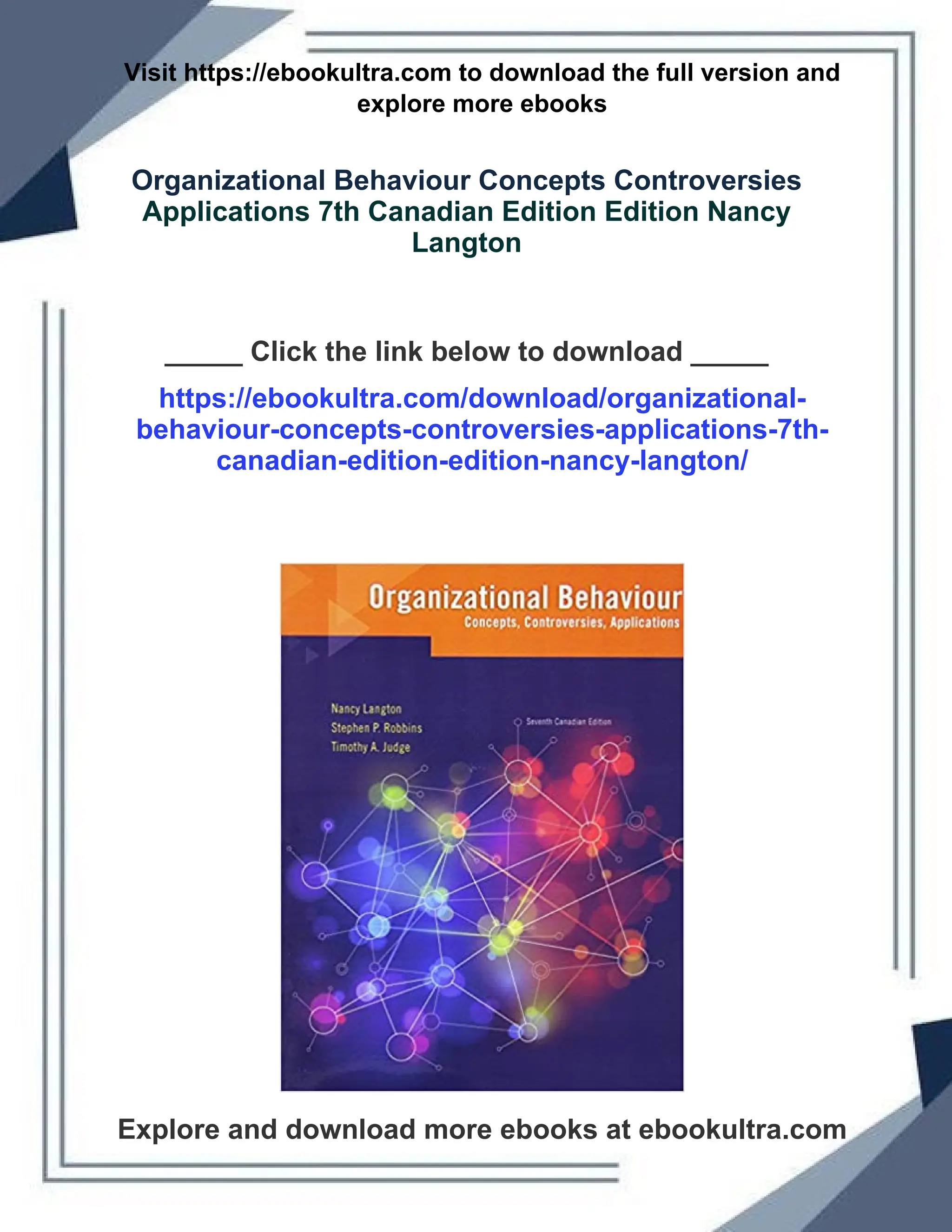
  • 1.
    Visit https://ebookultra.com todownload the full version and explore more ebooks Organizational Behaviour Concepts Controversies Applications 7th Canadian Edition Edition Nancy Langton _____ Click the link below to download _____ https://ebookultra.com/download/organizational- behaviour-concepts-controversies-applications-7th- canadian-edition-edition-nancy-langton/ Explore and download more ebooks at ebookultra.com
  • 2.
    Here are somesuggested products you might be interested in. Click the link to download Organizational behaviour 8th ed. Edition Buchanan https://ebookultra.com/download/organizational-behaviour-8th-ed- edition-buchanan/ Organizational Behaviour 3rd Edition Ray French https://ebookultra.com/download/organizational-behaviour-3rd-edition- ray-french/ Organizational Behaviour Third CDN Edition Angelo Kinicki https://ebookultra.com/download/organizational-behaviour-third-cdn- edition-angelo-kinicki/ Management Organizational Behaviour 1st Edition R. B. Rudani https://ebookultra.com/download/management-organizational- behaviour-1st-edition-r-b-rudani/
  • 3.
    Nutrition Concepts andControversies 12th Edition Frances Sizer https://ebookultra.com/download/nutrition-concepts-and- controversies-12th-edition-frances-sizer/ Microbial Phylogeny and Evolution Concepts and Controversies Jan Sapp https://ebookultra.com/download/microbial-phylogeny-and-evolution- concepts-and-controversies-jan-sapp/ Work and Organizational Behaviour 4th ed. 2021 Edition John Bratton https://ebookultra.com/download/work-and-organizational-behaviour-4th- ed-2021-edition-john-bratton/ Statistics concepts and controversies 8 ed. Edition David S. Moore https://ebookultra.com/download/statistics-concepts-and- controversies-8-ed-edition-david-s-moore/ Evolutionary Concepts in End User Productivity and Performance Applications for Organizational Progress 1st Edition Steve Clarke https://ebookultra.com/download/evolutionary-concepts-in-end-user- productivity-and-performance-applications-for-organizational- progress-1st-edition-steve-clarke/
  • 5.
    Organizational Behaviour ConceptsControversies Applications 7th Canadian Edition Edition Nancy Langton Digital Instant Download Author(s): Nancy Langton, Stephen P. Robbins, Timothy A. Judge ISBN(s): 9780134048901, 0134048903 Edition: 7th Canadian Edition File Details: PDF, 19.73 MB Year: 2015 Language: english

  • 7.
    Organizational Behaviour Seventh CanadianEdition Concepts, Controversies, Applications
  • 8.
  • 9.
    Nancy Langton University ofBritish Columbia Stephen P. Robbins San Diego State University Timothy A. Judge University of Notre Dame With contributions by Katherine Breward, Ph.D. University of Winnipeg Toronto Concepts, Controversies, Applications Organizational Behaviour Seventh Canadian Edition
  • 10.
    Vice-President, CMPS: GaryBennett Editorial Director: Claudine O’Donnell Acquisitions Editor: Carolin Sweig Marketing Manager: Jessica Saso Program Manager: Karen Townsend Project Manager: Jessica Hellen Manager of Content Development: Suzanne Schaan Developmental Editor: Jennifer Murray Media Editor: Keriann McGoogan Media Developer: Kelli Cadet Compositor: Cenveo® Publisher Services Production Editor: Claudia Forgas Permissions Project Manager: Joanne Tang Photo Permissions Research: Steve Merland, Lumina Datamatics Text Permissions Research: Jen Roach, PMG Cover and Interior Designer: Alex Li Cover Image: Jamie Farrant/Digital Vision Vectors/Getty Images Credits and acknowledgments for material borrowed from other sources and reproduced, with permission, in this textbook appear on the appropriate page within the text. If you purchased this book outside the United States or Canada, you should be aware that it has been imported without the approval of the publisher or the author. Copyright© 2016, 2013, 2010, 2007, 2003, 2001, 1999 Pearson Canada Inc. All rights reserved. Manufactured in the United States of America. This publication is protected by copyright and permission should be obtained from the publisher prior to any prohibited reproduction, storage in a retrieval system, or trans- mission in any form or by any means, electronic, mechanical, photocopying, recording, or likewise. To obtain permission(s) to use material from this work, please submit a written request to Pearson Canada Inc., Permissions Department, 26 Prince Andrew Place, Don Mills, Ontario, M3C 2T8, or fax your request to 416-447-3126, or submit a request to Permissions Requests at www.pearsoncanada.ca. 10 9 8 7 6 5 4 3 2 1 [CKV] Library and Archives Canada Cataloguing in Publication Robbins, Stephen P., 1943-, author Organizational behaviour : concepts, controversies, applications / Nancy Langton (University of British Columbia), Stephen P. Robbins (San Diego State University), Timothy A. Judge (University of Notre Dame) ; with contributions by Katherine Breward, Ph.D. (University of Winnipeg). – Seventh Canadian edition. Includes bibliographical references and index. ISBN 978-0-13-359178-1 (bound) 1. Organizational behavior—Textbooks. 2. Management—Textbooks. I. Langton, Nancy, author II. Judge, Tim, author III. Breward, Katherine, author IV. Title. HD58.7.R62 2015 658 C2014-907198-1 ISBN 978-0-13-359178-1
  • 11.
    B R IE F C O N T E N T S PART 1 Understanding the Workplace 2 CHAPTER 1 What Is Organizational Behaviour? 2 CHAPTER 2 Perception, Personality, and Emotions 36 CHAPTER 3 Values, Attitudes, and Diversity in the Workplace 78 OB ON THE EDGE Stress at Work 118 PART 2 Striving for Performance 126 CHAPTER 4 Theories of Motivation 126 CHAPTER 5 Motivation in Action 164 CHAPTER 6 Groups and Teamwork 202 OB ON THE EDGE Trust 240 PART 3 Interacting Effectively 246 CHAPTER 7 Communication 246 CHAPTER 8 Power and Politics 274 CHAPTER 9 Conflict and Negotiation 308 OB ON THE EDGE Workplace Bullying 340 PART 4 Sharing the Organizational Vision 346 CHAPTER 10 Organizational Culture 346 CHAPTER 11 Leadership 378 CHAPTER 12 Decision Making, Creativity, and Ethics 412 OB ON THE EDGE Spirituality in the Workplace 448 PART 5 Reorganizing the Workplace 454 CHAPTER 13 Organizational Structure 454 CHAPTER 14 Organizational Change 486 ADDITIONAL CASES 516 ENDNOTES 544 GLOSSARY/SUBJECT INDEX 612 NAME AND ORGANIZATION INDEX 627 LIST OF CANADIAN COMPANIES, BY PROVINCE 634
  • 12.
    PREFACE xvii ABOUT THEAUTHORS xxxiii PART 1 Understanding the Workplace 2 CHAPTER 1 What Is Organizational Behaviour? 2 Defining Organizational Behaviour 4 What Do We Mean by Organization? 4 OB Is for Everyone 5 The Importance of Interpersonal Skills 5 OB: Making Sense of Behaviour in Organizations 6 The Building Blocks of OB 7 The Rigour of OB 8 Challenges and Opportunities in the Canadian Workplace 13 Responding to Economic Pressures 13 Responding to Globalization 15 Understanding Workforce Diversity 16 Improving Customer Service 18 Improving People Skills 18 Working in Networked Organizations 18 Enhancing Employee Well-Being at Work 19 Creating a Positive Work Environment 20 Improving Ethical Behaviour 20 Coming Attractions: Developing an OB Model 21 An Overview 21 Inputs 21 Processes 22 Outcomes 22 Summary 25 FOR REVIEW • FOR MANAGERS • FOR YOU 27 POINT/COUNTERPOINT: Lost in Translation? 28 PERSONAL INVENTORY ASSESSMENT 29 BREAKOUT GROUP EXERCISES 29 EXPERIENTIAL EXERCISE: Interpersonal Skills in the Workplace 29 ETHICAL DILEMMA: Jekyll and Hyde 29 CASE INCIDENT: Apple Goes Global 30 CASE INCIDENT: Era of the Disposable Worker? 31 FROM CONCEPTS TO SKILLS: Developing Interpersonal Skills 32 CHAPTER 2 Perception, Personality, and Emotions 36 Perception 38 Factors That Influence Perception 38 OB at Work C O N T E N T S
  • 13.
    Contents vii Perceptual Errors39 Why Do Perception and Judgment Matter? 45 Personality 46 What Is Personality? 47 Measuring Personality 47 Personality Determinants 47 Personality Traits 48 The Dark Triad 53 Other Personality Attributes That Influence OB 55 Emotions 57 What Are Emotions and Moods? 58 Choosing Emotions: Emotional Labour 59 Why Should We Care About Emotions in the Workplace? 60 Global Implications 66 Perception 66 Attributions 67 Personality 67 Emotions 68 Summary 69 FOR REVIEW • FOR MANAGERS • FOR YOU 71 POINT/COUNTERPOINT: Millennials Are More Narcissistic 72 PERSONAL INVENTORY ASSESSMENT 73 BREAKOUT GROUP EXERCISES 73 EXPERIENTIAL EXERCISE: Who Can Catch a Liar? 73 ETHICAL DILEMMA: Happiness Coaches for Employees 74 CASE INCIDENT: On the Costs of Being Nice 74 CASE INCIDENT: Can You Read Emotions from Faces? 75 FROM CONCEPTS TO SKILLS: Reading Emotions 76 CHAPTER 3 Values, Attitudes, and Diversity in the Workplace 78 Values 80 Rokeach Value Survey 80 Hodgson’s General Moral Principles 80 Assessing Cultural Values 81 Hofstede’s Framework for Assessing Cultures 81 The GLOBE Framework for Assessing Cultures 84 Values in the Canadian Workplace 84 Generational Differences 85 Cultural Differences 88 Attitudes 92 Job Satisfaction 93 Organizational Commitment 99 Job Involvement 100 Perceived Organizational Support 100 Employee Engagement 101 Managing Diversity in the Workplace 102 Effective Diversity Programs 103 Cultural Intelligence 107 Global Implications 108 Is Job Satisfaction a US Concept? 109 Are Employees in Western Cultures More Satisfied with Their Jobs? 109 Is Diversity Managed Differently across Cultures? 110 OB at Work
  • 14.
    viii Contents Summary 110 FORREVIEW • FOR MANAGERS • FOR YOU 112 POINT/COUNTERPOINT: Employer–Employee Loyalty Is an Outdated Concept 113 PERSONAL INVENTORY ASSESSMENT 114 BREAKOUT GROUP EXERCISES 114 EXPERIENTIAL EXERCISE: Feeling Excluded 114 ETHICAL DILEMMA: Is It a Bribe or a Gift? 115 CASE INCIDENT: You Cannot Do That 115 CASE INCIDENT: Thinking Your Way to a Better Job 116 FROM CONCEPTS TO SKILLS: Changing Attitudes 116 OB ON THE EDGE Stress at Work 118 PART 2 Striving for Performance 126 CHAPTER 4 Theories of Motivation 126 What Is Motivation? 128 Needs Theories of Motivation 129 Maslow’s Hierarchy of Needs Theory 129 Motivation–Hygiene Theory 130 McClelland’s Theory of Needs 132 Summarizing Needs Theories 133 Process Theories of Motivation 134 Expectancy Theory 135 Goal-Setting Theory 138 Self-Efficacy Theory 142 Reinforcement Theory 143 Responses to the Reward System 146 Equity Theory 146 Fair Process and Treatment 148 Self-Determination Theory 151 Increasing Intrinsic Motivation 153 Motivation for Whom? 154 Putting It All Together 154 Global Implications 155 Needs Theories 155 Goal Setting 155 Equity Theory and Fairness 155 Intrinsic and Extrinsic Motivation 156 Cross-Cultural Consistencies 156 Summary 157 FOR REVIEW • FOR MANAGERS • FOR YOU 158 POINT/COUNTERPOINT: Goals Get You to Where You Want to Be 159 PERSONAL INVENTORY ASSESSMENT 160 BREAKOUT GROUP EXERCISES 160 EXPERIENTIAL EXERCISE: Organizational Justice 160 ETHICAL DILEMMA: Grade Inflation 161 CASE INCIDENT: Equity and Executive Pay 161 CASE INCIDENT: Wage Reduction Proposal 162 FROM CONCEPTS TO SKILLS: Setting Goals 162 CHAPTER 5 Motivation in Action 164 From Theory to Practice: The Role of Money 166 Creating Effective Reward Systems 167 What to Pay: Establishing a Pay Structure 167 OB at Work OB at Work
  • 15.
    Contents ix How toPay: Rewarding Individuals through Variable-Pay Programs 168 Flexible Benefits: Developing a Benefits Package 173 Intrinsic Rewards: Employee Recognition Programs 174 Beware the Signals That Are Sent by Rewards 175 Can We Eliminate Rewards? 177 Motivating by Job Redesign 178 The Job Characteristics Model 179 Job Redesign in the Canadian Context: The Role of Unions 182 How Can Jobs Be Redesigned? 182 Relational Job Design 183 Alternative Work Arrangements 184 Flextime 184 The Social and Physical Context of Work 188 Employee Involvement 188 Examples of Employee Involvement Programs 189 Linking Employee Involvement Programs and Motivation Theories 190 Motivation: Putting It All Together 190 Global Implications 190 Variable Pay 190 Flexible Benefits 191 Job Characteristics and Job Enrichment 192 Telecommuting 192 Employee Involvement 192 Summary 193 FOR REVIEW • FOR MANAGERS • FOR YOU 194 POINT/COUNTERPOINT: “Face-Time” Matters 195 PERSONAL INVENTORY ASSESSMENT 196 BREAKOUT GROUP EXERCISES 196 EXPERIENTIAL EXERCISE: Analyzing and Redesigning Jobs 196 ETHICAL DILEMMA: Are CEOs Paid Too Much? 197 CASE INCIDENT: Motivation for Leisure 198 CASE INCIDENT: Attaching the Carrot to the Stick 198 FROM CONCEPTS TO SKILLS: Designing Enriched Jobs 199 CHAPTER 6 Groups and Teamwork 202 Teams vs. Groups: What Is the Difference? 204 Why Have Teams Become So Popular? 204 Types of Teams 204 From Individual to Team Member 209 Roles 210 Norms 210 Stages of Group and Team Development 213 The Five-Stage Model 213 The Punctuated-Equilibrium Model 215 Creating Effective Teams 217 Context 219 Composition 222 Process 227 Beware! Teams Are Not Always the Answer 230 Global Implications 231 Extent of Teamwork 231 Self-Managed Teams 231 Team Cultural Diversity and Team Performance 231 Group Cohesiveness 231 OB at Work
  • 16.
    x Contents Summary 232 FORREVIEW • FOR MANAGERS • FOR YOU 233 POINT/COUNTERPOINT: To Get the Most Out of Teams, Empower Them 234 PERSONAL INVENTORY ASSESSMENT 235 BREAKOUT GROUP EXERCISES 235 EXPERIENTIAL EXERCISE: The Paper Tower Exercise 235 ETHICAL DILEMMA: Dealing with Shirkers 236 CASE INCIDENT: Tongue-Tied in Teams 236 CASE INCIDENT: IBM’s Multicultural Multinational Teams 237 FROM CONCEPTS TO SKILLS: Conducting a Team Meeting 238 OB ON THE EDGE Trust 240 PART 3 Interacting Effectively 246 CHAPTER 7 Communication 246 The Communication Process 248 Choosing a Channel 248 Barriers to Effective Communication 251 Filtering 251 Selective Perception 251 Information Overload 252 Emotions 252 Language 252 Silence 253 Nonverbal Communication 254 Lying 255 Organizational Communication 255 Direction of Communication 256 Small-Group Networks 257 The Grapevine 257 Electronic Communications 258 Global Implications 262 Cultural Barriers to Communication 262 Cultural Context 263 A Cultural Guide 263 Summary 265 FOR REVIEW • FOR MANAGERS • FOR YOU 267 POINT/COUNTERPOINT: Employees’ Social Media Presence Should Matter to Managers 268 PERSONAL INVENTORY ASSESSMENT 269 BREAKOUT GROUP EXERCISES 269 EXPERIENTIAL EXERCISE: An Absence of Nonverbal Communication 269 ETHICAL DILEMMA: The Pitfalls of Email 270 CASE INCIDENT: Using Social Media to Your Advantage 270 CASE INCIDENT: PowerPoint Purgatory 271 FROM CONCEPTS TO SKILLS: Effective Listening 272 CHAPTER 8 Power and Politics 274 A Definition of Power 276 Bases of Power 277 Formal Power 277 Personal Power 279 Evaluating the Bases of Power 279 OB at Work OB at Work
  • 17.
    Contents xi Dependency: TheKey to Power 280 The General Dependency Postulate 280 What Creates Dependence? 281 Influence Tactics 282 How Power Affects People 283 Empowerment: Giving Power to Employees 284 Definition of Empowerment 284 The Abuse of Power 286 Harassment in the Workplace 287 Politics: Power in Action 290 Definition of Political Behaviour 291 The Reality of Politics 293 Types of Political Activity 294 Impression Management 295 The Ethics of Behaving Politically 296 Global Implications 297 Views on Empowerment 297 Preference for Influence Tactics 298 Response to Politics in the Workplace 298 Summary 299 FOR REVIEW • FOR MANAGERS • FOR YOU 300 POINT/COUNTERPOINT: Everyone Wants Power 301 PERSONAL INVENTORY ASSESSMENT 302 BREAKOUT GROUP EXERCISES 302 EXPERIENTIAL EXERCISE: Understanding Bases of Power 302 ETHICAL DILEMMA: How Much Should You Defer to Those in Power? 303 CASE INCIDENT: Delegate Power, or Keep It Close? 304 CASE INCIDENT: Barry’s Peer Becomes His Boss 304 FROM CONCEPTS TO SKILLS: Politicking 305 CHAPTER 9 Conflict and Negotiation 308 Conflict Defined 310 Functional vs. Dysfunctional Conflict 310 Types of Conflict 310 Loci of Conflict 311 Sources of Conflict 312 Conflict Resolution 314 Conflict Management Strategies Based on Dual Concern Theory 314 What Can Individuals Do to Manage Conflict? 315 Resolving Personality Conflicts 317 Resolving Intercultural Conflicts 317 Conflict Outcomes 318 Negotiation 320 Bargaining Strategies 321 How to Negotiate 324 Individual Differences in Negotiation Effectiveness 326 Personality Traits in Negotiation 326 Moods/Emotions in Negotiation 328 Gender Differences in Negotiation 328 Third-Party Negotiations 330 Mediator 330 Arbitrator 330 Conciliator 330 OB at Work
  • 18.
    xii Contents Global Implications331 Conflict Resolution and Culture 331 Cultural Differences in Negotiating Style 331 Culture, Negotiations, and Emotions 331 Summary 332 FOR REVIEW • FOR MANAGERS • FOR YOU 333 POINT/COUNTERPOINT: Conflict: Good or Bad? 334 PERSONAL INVENTORY ASSESSMENT 335 BREAKOUT GROUP EXERCISES 335 EXPERIENTIAL EXERCISE: A Negotiation Role Play 335 ETHICAL DILEMMA: The Lowball Applicant 336 CASE INCIDENT: Choosing Your Battles 336 CASE INCIDENT: The Pros and Cons of Collective Bargaining 337 FROM CONCEPTS TO SKILLS: Negotiating 338 OB ON THE EDGE Workplace Bullying 340 PART 4 Sharing the Organizational Vision 346 CHAPTER 10 Organizational Culture 346 What Is Organizational Culture? 348 Definition of Organizational Culture 348 Levels of Culture 349 Culture’s Functions 350 Culture Creates Climate 351 The Ethical Dimension of Culture 352 Do Organizations Have Uniform Cultures? 353 Strong vs. Weak Cultures 354 Reading an Organization’s Culture 354 Stories 355 Rituals 355 Material Symbols 356 Language 357 Creating and Sustaining an Organization’s Culture 357 How a Culture Begins 357 Keeping a Culture Alive 358 The Liabilities of Organizational Culture 363 Barrier to Change 364 Barrier to Diversity 364 Barrier to Mergers and Acquisitions 364 Changing Organizational Culture 365 Creating an Ethical Organizational Culture 366 Creating a Positive Organizational Culture 366 Global Implications 368 Summary 369 FOR REVIEW • FOR MANAGERS • FOR YOU 370 POINT/COUNTERPOINT: Organizations Should Strive to Create a Positive Organizational Culture 371 PERSONAL INVENTORY ASSESSMENT 372 BREAKOUT GROUP EXERCISES 372 EXPERIENTIAL EXERCISE: Rate Your Classroom Culture 372 ETHICAL DILEMMA: A Bankrupt Culture 373 CASE INCIDENT: Is a 5S Culture for You? 374 CASE INCIDENT: Google and P&G Swap Employees 374 FROM CONCEPTS TO SKILLS: How to “Read” an Organization’s Culture 375 OB at Work OB at Work
  • 19.
    Contents xiii CHAPTER 11Leadership 378 What Is Leadership? 380 Leadership as Supervision 380 Trait Theories: Are Leaders Different from Others? 380 Behavioural Theories: Do Leaders Behave in Particular Ways? 382 Contingency Theories: Does the Situation Matter? 384 Substitutes for Leadership 388 Inspirational Leadership 389 Charismatic Leadership 389 Transformational Leadership 392 Contemporary Leadership Roles 395 Mentoring 395 Self-Leadership (or Self-Management) 397 Team Leadership 397 Online Leadership 398 Leading without Authority 399 Contemporary Issues in Leadership 399 Authentic Leadership 400 Ethical Leadership 401 Servant Leadership 402 Global Implications 403 Summary 404 FOR REVIEW • FOR MANAGERS • FOR YOU 405 POINT/COUNTERPOINT: Heroes Are Made, Not Born 406 PERSONAL INVENTORY ASSESSMENT 407 BREAKOUT GROUP EXERCISES 407 EXPERIENTIAL EXERCISE: Being Charismatic 407 ETHICAL DILEMMA: Undercover Leaders 407 CASE INCIDENT: Moving from Colleague to Supervisor 408 CASE INCIDENT: Leadership by Algorithm 409 FROM CONCEPTS TO SKILLS: Practising to Be Charismatic 410 CHAPTER 12 Decision Making, Creativity, and Ethics 412 How Should Decisions Be Made? 414 The Rational Decision-Making Process 414 How Do Individuals Actually Make Decisions? 415 Bounded Rationality in Considering Alternatives 416 Intuition 417 Judgment Shortcuts 418 Group Decision Making 422 Groups vs. the Individual 422 Groupthink and Groupshift 423 Group Decision-Making Techniques 426 Creativity in Organizational Decision Making 428 Creative Behaviour 429 Causes of Creative Behaviour 429 Creative Outcomes (Innovation) 431 What About Ethics in Decision Making? 432 Four Ethical Decision Criteria 432 Making Ethical Decisions 434 Corporate Social Responsibility 436 Global Implications 437 Decision Making 437 OB at Work
  • 20.
    xiv Contents Creativity 438 Ethics438 Summary 439 FOR REVIEW • FOR MANAGERS • FOR YOU 440 POINT/COUNTERPOINT: People Are More Creative When They Work Alone 441 PERSONAL INVENTORY ASSESSMENT 442 BREAKOUT GROUP EXERCISES 442 EXPERIENTIAL EXERCISE: Wilderness Survival 442 ETHICAL DILEMMA: Five Ethical Decisions: What Would You Do? 444 CASE INCIDENT: The Youngest Female Self-Made Billionaire 445 CASE INCIDENT: “If Two Heads Are Better Than One, Are Four Even Better?” 446 FROM CONCEPTS TO SKILLS: Solving Problems Creatively 446 OB ON THE EDGE Spirituality in the Workplace 448 PART 5 Reorganizing the Workplace 454 CHAPTER 13 Organizational Structure 454 What Is Organizational Structure? 456 Work Specialization 456 Departmentalization 457 Chain of Command 459 Span of Control 460 Centralization and Decentralization 461 Formalization 461 Common Organizational Designs 462 The Simple Structure 462 The Bureaucracy 464 The Matrix Structure 465 New Design Options 467 The Virtual Organization 467 The Boundaryless Organization 468 The Leaner Organization: Organization Downsizing 470 Why Do Structures Differ? 471 Organizational Strategy 472 Organizational Size 473 Technology 473 Environment 474 Organizational Designs and Employee Behaviour 475 Global Implications 476 Culture and Organizational Structure 477 Culture and Employee Structure Preferences 477 Culture and the Boundaryless Organization 477 Culture and the Impact of Downsizing 477 Summary 478 FOR REVIEW • FOR MANAGERS • FOR YOU 479 POINT/COUNTERPOINT: The End of Management 480 PERSONAL INVENTORY ASSESSMENT 481 BREAKOUT GROUP EXERCISES 481 EXPERIENTIAL EXERCISE: Words-in-Sentences Company 481 ETHICAL DILEMMA: Just Following Orders 482 CASE INCIDENT: Creative Deviance: Bucking the Hierarchy? 483 CASE INCIDENT: “I Detest Bureaucracy” 483 FROM CONCEPTS TO SKILLS: Delegating Authority 484 OB at Work OB at Work
  • 21.
    Contents xv CHAPTER 14Organizational Change 486 Forces for Change 488 Opportunities for Change 489 Change Agents 490 Approaches to Managing Change 491 Lewin’s Three-Step Model 491 Kotter’s Eight-Step Plan for Implementing Change 493 Action Research 493 Appreciative Inquiry 494 Resistance to Change 495 Individual Resistance 496 Organizational Resistance 497 Overcoming Resistance to Change 498 The Politics of Change 501 Creating a Culture for Change 501 Stimulating a Culture of Innovation 502 Creating a Learning Organization 504 Global Implications 505 Summary 507 FOR REVIEW • FOR MANAGERS • FOR YOU 508 POINT/COUNTERPOINT: Organizational Change Is Like Sailing Calm Waters 509 PERSONAL INVENTORY ASSESSMENT 510 BREAKOUT GROUP EXERCISES 510 EXPERIENTIAL EXERCISE: Power and the Changing Environment 510 ETHICAL DILEMMA: Changes at the Television Station 511 CASE INCIDENT: Starbucks Returns to Its Roots 512 CASE INCIDENT: When Companies Fail to Change 513 FROM CONCEPTS TO SKILLS: Carrying Out Organizational Change 513 ADDITIONAL CASES 516 ENDNOTES 544 GLOSSARY/SUBJECT INDEX 612 NAME AND ORGANIZATION INDEX 627 LIST OF CANADIAN COMPANIES, BY PROVINCE 634 OB at Work
  • 22.
    MyManagementLab™ : Improves Student EngagementBefore, During, and After Class Critical Thinking Decision Making Prep and Engagement will change and branch based on the decisions students make, providing a variation of scenario paths. Upon completion of each simulation, students receive a grade, as well as a detailed report of the choices they made during the simulation and the associated consequences of those decisions. S Writing Space – better writers make great learners—who perform better in their courses. Providing a single location to develop and assess concept mastery and critical thinking, the Writing Space offers automatic graded, assisted graded, and create your own writing assignments, allowing you to exchange personalized feedback with students quickly and easily. Writing Space can also check students’ work for improper citation or plagiarism by comparing it against the world’s most accurate text comparison database available from Turnitin. S Additional Features – included with the MyLab are a powerful homework and test manager, robust gradebook tracking, comprehensive online course content, and easily scalable and shareable content. http://www.pearsonmylabandmastering.com S Video exercises – engaging videos that bring business concepts to life and explore business topics related to the theory students are learning in class. Quizzes then assess students’ comprehension of the concepts covered in each video. S Learning Catalytics – a “bring your own device” student engagement, assessment, and classroom intelligence system helps instructors analyze students’ critical-thinking skills during lecture. S Dynamic Study Modules (DSMs) – through adaptive learning, students get personalized guidance where and when they need it most, creating greater engagement, improving knowledge retention, and supporting subject-matter mastery. Also available on mobile devices. S Business Today – bring current events alive in your classroom with videos, discussion questions, and author blogs. Be sure to check back often, this section changes daily. S Simulations – place your students in the role of a key decision-maker. The simulation
  • 23.
    Preface xvii Welcome tothe seventh Canadian edition of Organizational Behaviour. Since its arrival in Canada, Organizational Behaviour has enjoyed widespread acclaim across the country for its rich Canadian content and has quickly established itself as the leading text in the field. Organizational Behaviour, Seventh Canadian edition, is truly a Canadian product. While it draws upon the strongest aspects of its American cousin, it expresses its own vision and voice. It provides the context for understanding organizational behaviour (OB) in the Canadian workplace and highlights the many Canadian contributions to the field. Indeed, it goes a step further than most OB texts prepared for the Canadian marketplace. Specifically, it asks, in many instances: • How does this theory apply in the Canadian workplace of today? • What are the implications of the theory for managers and employees working in the twenty-first century? • What are the implications of the theory for everyday life? OB, after all, is not something that applies only in the workplace. This text is sensitive to important Canadian issues. Subject matter reflects the broad multicultural flavour of Canada and also highlights the roles of women and visible minorities in the workplace. Examples reflect the broad range of organizations in Canada: large, small, public and private sector, unionized and non-unionized. Organizational Behaviour continues to be a vibrant and relevant text because it’s a product of the Canadian classroom. It is used in Canada by the first author and her colleagues. Thus, there is a “front-line” approach to considering revisions. We also solicit considerable feedback from OB instructors and students throughout the country. While we have kept the features of the previous edition that adopters continue to say they like, there is also a great deal that is new. Our Pedagogical Approach in Writing the Text • Relevance. The text reminds both teacher and student alike that we must contend with a new paradigm of work that is more globally focused and competitive, relies more heavily on part-time and contract jobs, and places a higher premium on entrepreneurial skills, either within the traditional workplace structure, as an individual seeking out an alternative job, or as the creator of your own new business. Today’s younger employees can expect to hold many more jobs, and possibly be self-employed more and longer than their parents. From its beginning, this text was the first to emphasize that OB is for everyone, from the bottom-rung employee to the CEO, as well as to anyone who has to interact with others to accomplish a task. We continue to emphasize this theme. We remind readers of the material’s relevance beyond a “9-to-5” job by concluding each chapter with a summary that out- lines the implications not only for the workplace and managers, but also for P R E F A C E
  • 24.
    xviii Preface individuals intheir daily lives. We also include the feature OB in the Street, which further emphasizes how OB applies outside the workplace. • Writing style. Clarity and readability are the hallmarks of this text. Our reviewers find the text “conversational,” “interesting,” “student-friendly,” and “very clear and understandable.” Students say they really like the informal style and personal examples. • Examples, examples, examples. From our teaching experience, we know that students may not remember a concept, but they will remember an example. This text is packed full of recent real-world examples drawn from a variety of organizations: business and not-for-profit, large and small, and local and international. We also use examples taken from the world at large, to illustrate the broader applicability of OB material. • Comprehensive literature coverage. This text is regularly singled out for its comprehensive and up-to-date coverage of OB from both academic journals as well as business periodicals. The latest research can be found in sections marked “Research Findings” and “Focus on Research.” • Skill-building emphasis. Each chapter’s OB at Work section is full of exercises to help students make the connections between theories and real-world applications. Exercises at the end of each chapter reinforce critical thinking, self-analysis, behavioural analysis, and team building. Highlights of the Seventh Edition The seventh edition was designed to evolve with today’s students. There are more relevant examples, updated theory coverage, and a continued emphasis on providing the latest research findings. Based on reviews from numerous instructors and students across Canada, we have found that many potential users want chapters that have the right balance of theory, research, and application material, while being relevant to student learning. To accomplish this, we have: • Continued to highlight the importance of Learning Outcomes as a “road map” leading to focused reading and increased learning comprehension. Learning Outcomes appear initially as an enumerated list on the chapter- opening page and then the numbered outcomes appear throughout the chapter again in the margins to direct readers to the section where the Learning Outcome is addressed. Finally, the numbered outcomes are linked to review questions at the end of the chapter so that students can test whether they have achieved these outcomes. • Continued to feature current and topical chapter-opening vignettes as well as the subsequent references back to the vignettes that appear throughout the chapter, at the start of most major sections. • At the beginning of each chapter, a “Big Idea” item appears in the margin which is meant to give readers a big picture view of the topic at hand. Then, at the end of the chapter a “Lessons Learned” appears in the margin to recap the key takeaways for the chapter. • Continued to integrate a series of relevant and helpful questions throughout the chapters (look for questions that are set in a square design) to encourage students to think about how OB applies to their everyday lives and engage students in their reading of the material. These questions first appear as bullet lists at the bottom of the chapter opener, under the heading “OB Is for Everyone,” and then appear throughout each chapter.
  • 25.
    Preface xix • Updatedthe boxed features throughout the text, including OB in Action, OB in the Street, OB in the Workplace, Focus on Research, Focus on Ethics, and Focus on Diversity boxes. • Continued to address and highlight how OB principles vary across cultures in the Global Implications sections. Chapters now conclude with references to the cultural differences that exist within and between countries. Until recently, most OB research was conducted in Western countries. That is changing, however, and we are now in a much better position to answer the question “How does what we know about OB vary based on culture?” Some OB prin- ciples vary little across cultures, while others vary a great deal. • Continued to include the popular For You feature at the end of each chapter, to highlight the relevance of the chapter to one’s everyday life. • Reflected the ever-changing world of organizational behaviour through a series of new end-of-chapter case incidents. • Included four new comprehensive cases in the Additional Cases. Case 1: The Personality Problem deals with the topics of personality, organizational culture, and work attitudes; Case 4: Bad Faith Bargaining? Government Power and Negotiations with the Public Service covers power and politics, conflict and negotiation, and ethics; Case 7: Promotion from Within covers motiva- tion, work attitudes, communication, and politics. Case 9: Boundaryless Organizations deals with organizational structure and boundaryless organiza- tions, organizational culture, diversity and teams, organizational socialization, and organizational change. In addition, a new table was added at the begin- ning of the Additional Cases to show the chapters that apply to the major topic areas addressed in each case for easy reference. • Continued to include our OB on the Edge feature, which highlights what’s new and hot in OB. OB on the Edge, which is unique to the Canadian edition, provides an opportunity to explore challenging issues and encourages students to read more about these hot topics. In this edition, we cover four topics in this innovative feature: Stress at Work; Trust; Workplace Bullying; and Spirituality in the Workplace. Chapter-by-Chapter Highlights: What’s New In this seventh edition, we have made a concerted effort to thoroughly update the text. Taken together, the changes we made render this text the leader in the market and the undisputed pioneer vis-à-vis meaningful application of OB concepts and theories. Each chapter offers new examples, the latest cutting-edge research, discus- sions of current issues, and a wide variety of application material. The key changes are listed below. Chapter 1: What Is Organizational Behaviour? • New Opening Vignette about Lululemon Athletica • New section: “Big Data” • New exhibit: “Employment Options” • New major section: “Challenges and Opportunities in the Canadian Workplace”
  • 26.
    xx Preface • NewFocus on Diversity: “SaskTel Is a Top Diversity Employer” • New major section: “Coming Attractions: Developing an OB Model” • New exhibit: “A Basic OB Model” • New exhibit: “The Plan of the Book” • New Point/Counterpoint: “Lost in Translation?” • New Ethical Dilemma: “Jekyll and Hyde” • New Case Incident: “Apple Goes Global” • New Case Incident: “Era of the Disposable Worker?” Chapter 2: Perception, Personality, and Emotions • New Opening Vignette about Matthew Corrin, the CEO of the restaurant Freshii • New Research Findings: “Stereotyping” • New section: “The Dark Triad” • New exhibit: “Jobs in Which Certain Big Five Personality Traits Are More Relevant” • New exhibit: “Does Business School Make You Narcissistic?” • New Focus on Research: “First Impressions Count” • New research and discussion on emotional intelligence • New exhibit: “A Cascading Model of Emotional Intelligence” • New Focus on Ethics: “An Ethical Choice” • New Focus on Research: “Smile, and the Work World Smiles with You” • New section: “Emotion Regulation” • New Research Findings: “Emotion Regulation” • New OB in the Workplace: “Affective Computing: Reading Your State of Mind” • New exhibit: “Emotional States Cross-Culturally” • New Point/Counterpoint: “Millennials Are More Narcissistic” • New Experiential Exercise: “Who Can Catch a Liar?” • New Ethical Dilemma: “Happiness Coaches for Employees” • New Case Incident: “On the Costs of Being Nice” • New Case Incident: “Can You Read Emotions from Faces?” Chapter 3: Values, Attitudes, and Diversity in the Workplace • New Opening Vignette about Corus Entertainment partnering with TD Bank to help a program designed to aid Aboriginal children achieve literacy through summer camps • New Research Findings: “Hofstede” • Updated exhibit: “Hofstede’s Cultural Values by Nation”
  • 27.
    Preface xxi • Newexhibit: “Dominant Work Values in Today’s Workforce” • New Research Findings: “Generational Differences” • New OB in the Street: “Generation Z: Coming to Your Workplace Soon” • New research in “Francophone and Anglophone Values” • Updated major section: “Attitudes” • New exhibit: “The Components of an Attitude” • New exhibit: “The Worst Jobs for Job Satisfaction, 2013” • New exhibit: “Relationship between Average Pay in Job and Job Satisfaction of Employees in That Job” • New section: “Perceived Organizational Support” • New research and discussion in “Employee Engagement” • New OB in the Workplace: “Minding Manners, Helping Customers” • Updated exhibit: “Practices Used by a Selected Sample of Canada’s Most Welcoming Places to Work” • New exhibit: “Average Levels of Employee Job Satisfaction by Country” • Updated section with new research: “Are Employees in Western Cultures More Satisfied with Their Jobs?” • New Point/Counterpoint: “Employer–Employee Loyalty Is an Outdated Concept” • New Experiential Exercise: “Feeling Excluded” OB on the Edge: Stress at Work • New research in “Consequences of Stress” • New discussion of personality in “Why Do Individuals Differ in Their Experience of Stress?” • New research and discussion in “Organizational Approaches” • Updated the list of “The Most and Least Stressful Jobs” Chapter 4: Theories of Motivation • New Opening Vignette about how motivation influenced Olympic snowboarder Mark McMorris to win a medal just weeks after fracturing a rib • New OB in the Workplace: “Stock Analyst Recommendations and Valence” • Updated section: “The Importance of Providing Performance Feedback” • Updated Research Findings: “The Effects of Goal Setting” • Updated section: “Reinforcement Theory” • Updated section: “Fair Process and Treatment” • New Point/Counterpoint: “Goals Get You to Where You Want to Be” • New Experiential Exercise: “Organizational Justice”
  • 28.
    xxii Preface • NewEthical Dilemma: “Grade Inflation” • New Case Incident: “Equity and Executive Pay” Chapter 5: Motivation in Action • New Opening Vignette about how high-growth social media start-up Hootsuite manages to keep its workforce engaged and productive • New research in “What to Pay: Establishing a Pay Structure” • Updated section: “Merit-Based Pay” • New research in “Flexible Benefits: Developing a Benefits Package” • New Focus on Research: “The Reward for Helping Others at Work” • New OB in the Street: “Rewarding Gym Attendance While Wanting Weight Loss” • Updated exhibit: “Examples of High and Low Job Characteristics” • New section: “Relational Job Design” • New research in “Flextime” • Updated Research Findings: “Telecommuting” • New research in “Variable Pay” • New Point/Counterpoint: “‘Face-Time’ Matters” • Updated Ethical Dilemma: “Are CEOs Paid Too Much?” • New Case Incident: “Motivation for Leisure” • New Case Incident: “Attaching the Carrot to the Stick” Chapter 6: Groups and Teamwork • New research in “Self-Managed Teams” • New research in “Virtual Teams” • New Focus on Ethics: “Virtual Teams Leave a Smaller Carbon Footprint” • New section: “Multiteam Systems” • New OB in the Workplace: “Turning Around a Losing Team” • New Focus on Diversity: “Developing Team Members’ Trust across Cultures” • New research in “(Team) Composition” • Updated section: “Diversity of Members” • New Point/Counterpoint: “To Get the Most Out of Teams, Empower Them” • New Case Incident: “Tongue-Tied in Teams” OB on the Edge: Trust • Revised section: “What Determines Trust?” • New box: “What Are the Consequences of Trust?” • New discussion in “Basic Principles of Trust”
  • 29.
    Preface xxiii Chapter 7:Communication • New Opening Vignette about how the two young entrepreneurs who launched Palette, a mechatronics company, use communication to find investors for their new invention and to stay connected • Updated major section: “Barriers to Effective Communication” • New research in “Downward (Communication)” • New exhibit: “Allocation of Time at Work for Managers and Professionals” • New OB in the Workplace: “Asleep in Paris, Busy Working in Toronto” • Updated section: “Social Media” • Updated section: “A Cultural Guide” • New Point/Counterpoint: “Employees’ Social Media Presence Should Matter to Managers” • New Ethical Dilemma: “The Pitfalls of Email” • New Case Incident: “Using Social Media to Your Advantage” • New Case Incident: “PowerPoint Purgatory” Chapter 8: Power and Politics • New Opening Vignette about former Toronto mayor Rob Ford • Updated major section: “Bases of Power” • New major section: “How Power Affects People” • New OB in the Workplace: “It’s Not About the Affair, It’s About the Coverup” • New research in “Sexual Harassment” • New Focus on Ethics: “Sex at Work” • Updated Research Findings: “Politicking” • New Focus on Research: “Powerful Leaders Keep Their (Fr)Enemies Close” • Updated Research Findings: “Impression Management Techniques” • New section: “The Ethics of Behaving Politically” • New Point/Counterpoint: “Everyone Wants Power” • New Ethical Dilemma: “How Much Should You Defer to Those in Power?” • New Case Incident: “Delegate Power, or Keep It Close?” • New Case Incident: “Barry’s Peer Becomes His Boss” Chapter 9: Conflict and Negotiation • New Opening Vignette on the BC Teachers’ Federation strike • New section: “Types of Conflict” • New section: “Loci of Conflict” • Updated Research Findings: “The Constructive Effects of Conflict”
  • 30.
    xxiv Preface • Newresearch and discussion in “Personality Traits in Negotiation” • New Focus on Ethics: “Using Empathy to Negotiate More Ethically” • New research in “Moods/Emotions in Negotiation” • New research and discussion in “Gender Differences in Negotiation” • New major section: “Third-Party Negotiations” • New Ethical Dilemma: “The Lowball Applicant” • New Case Incident: “Choosing Your Battles” • New Case Incident: “The Pros and Cons of Collective Bargaining” OB on the Edge: Workplace Bullying • New research and discussion in “Workplace Violence” • New section: “Legislation to Prevent Bullying” • New statistics on workplace bullying Chapter 10: Organizational Culture • New Opening Vignette about how the Calgary Stampede’s organizational culture helped it deal with an unexpected crisis • New discussion in “Definition of Organizational Culture” • New OB in the Workplace: “WestJet Brings on the Fun” • New section: “The Ethical Dimension of Culture” • New research in “Strong vs. Weak Cultures” • New OB in the Workplace: “Making Culture Work” • New research and discussion in “Socialization” • New research and discussion in “Barrier to Mergers and Acquisitions” • New discussion in major section: “Changing Organizational Culture” • New research in “Creating an Ethical Organizational Culture” • New Point/Counterpoint: “Organizations Should Strive to Create a Positive Organizational Culture” • New Ethical Dilemma: “A Bankrupt Culture” • New Case Incident: “Google and P&G Swap Employees” Chapter 11: Leadership • New Opening Vignette about Bryce Williams and the leadership issues faced by the young chief of the Tsawwassen First Nation • New Research Findings: “Behavioural Theories of Leadership” • Updated Research Findings: “Path-Goal Theory” • Updated Research Findings: “Transformational Leadership” • New research in “Mentoring”
  • 31.
    Preface xxv • Newresearch and discussion in “Ethical Leadership” • New section: “Servant Leadership” • New Point/Counterpoint: “Heroes Are Made, Not Born” • New Ethical Dilemma: “Undercover Leaders” • New Case Incident: “Leadership by Algorithm” Chapter 12: Decision Making, Creativity, and Ethics • New Opening Vignette about Billy-Joe Nachuk, a military veteran who suffered discrimination by three police officers due to their poor decision making • New discussion in “Bounded Rationality in Considering Alternatives” • New Focus on Research: “Putting Intuition to Work in the Workplace” • New research in “Escalation of Commitment” • New OB in the Street: “Groupthink at Target Canada” • New exhibit: “Three-Stage Model of Creativity in Organizations” • New section: “Creative Behaviour” • New section: “Causes of Creative Behaviour” • New discussion in “Creative Potential” • New section: “Creative Outcomes (Innovation)” • New discussion in “Four Ethical Decision Criteria” • New Focus on Research: “Why People Cheat” • New research and discussion in “Making Ethical Decisions” • New OB in the Workplace: “The Ethics of Fostering a ‘Culture of Shortcuts’” • New Global Implications section: “Creativity” • New Point/Counterpoint: “People Are More Creative When They Work Alone” • New Case Incident: “The Youngest Female Self-Made Billionaire” OB on the Edge: Spirituality in the Workplace • New definition of workplace spirituality • New discussion in “Why Spirituality Now?” • New section: “Spirituality and Mindfulness” • New research and discussion in “Characteristics of a Spiritual Organization” • New section: “Achieving a Spiritual Organization” Chapter 13: Organizational Structure • New Opening Vignette about how the nonprofit Revitalization Saint-Pierre owes its success to embedding community participation in its organizational structure • New research and discussion in “Centralization and Decentralization”
  • 32.
    xxvi Preface • NewOB in the Workplace: “The World Is My Corporate Headquarters” • New research and discussion in “The Virtual Organization” • New research and discussion in “The Boundaryless Organization” • New research and discussion in “The Leaner Organization: Organization Downsizing” • New Focus on Research: “Working from Home” • New Global Implications section: “Culture and the Impact of Downsizing” • New Point/Counterpoint: “The End of Management” • New Case Incident: “Creative Deviance: Bucking the Hierarchy?” Chapter 14: Organizational Change • New Opening Vignette about the organizational changes that the Hudson’s Bay has undergone to stay relevant and profitable in a competitive marketplace • New research in “Overcoming Resistance to Change” • New OB in the Workplace: “Habitat for Humanity and Rockwood Institution Partner to Change Lives” • New Ethical Dilemma: “Changes at the Television Station” • New Case Incident: “Starbucks Returns to Its Roots” • New Case Incident: “When Companies Fail to Change” Pedagogical Features The pedagogical features of Organizational Behaviour: Concepts, Controversies, Applications, Seventh Canadian edition, are designed to complement and reinforce the textual mate- rial. This text offers the most complete assortment of pedagogy available in any OB book on the market. • The text is developed in a “story-line” format that emphasizes how the topics fit together. Each chapter opens with a list of learning outcomes related to a main example that threads through the chapter. The opening vignette is carried throughout the chapter to help students apply a real-life example to the concepts they are learning. The learning outcome questions appear in the margin of the text, to indicate where they are addressed. In “For Review” at the end of each chapter, students can discover whether they have achieved these learning outcomes. • OB Is for Everyone in the chapter-opener highlights the integrated questions that students will encounter throughout each chapter. Right from the start, these ques- tions encourage students to think about how OB applies to everyday lives. • A “Big Idea/Lessons Learned” feature appears at the begin- ning and end of each chapter. These resources are designed to work hand-in-hand. At the beginning of the chapter, a “Big Idea” item appears in the margin which is meant to give readers a big-picture view of the topic at hand. Then, at the end of the chapter a “Lessons Learned” appears in the margin to recap the key takeaways from the chapter. ark McMorris, number one slopestyle rider on the 2013 World Snowboard Tour, was “pretty down,” according to his father.1 On January 25, a short time before the opening of the 2014 Olympics in Sochi, McMorris crashed during the final of the X Games Aspen Snowboard Slopestyle, fracturing one of the ribs on his right side. Even with the crash, which hap- pened on his third and final run, McMorris won a silver medal. However, he had won the gold medal at Aspen in both 2011 and 2012. But now he had to get himself ready for the Olympics, which was to start in just two weeks. His father’s description of the situation showed what McMorris faced: “When we left him [the day after the injury occurred], he could bend over and touch his toes because of where [the injury] is at,” Don McMorris told The Canadian Press on Monday. “You know a cracked rib in the front, you couldn’t do that. . . . He’s got five or six days before he has to worry about riding and he’s got the best people around him.” It generally takes six weeks to heal from a cracked rib, and McMorris was facing com- peting in the Olympics just two weeks after his injury. Competing in the Olympics was a dream of his, and he would have to overcome great odds, not to mention pain, if he were to successfully compete. He still had to qualify for the Olympics, and the qualification round would take place one day before the opening ceremony. If he made the team, his event was scheduled to be held exactly two weeks after the crash. Would McMorris be motivated enough to make the Olympic team? In this chapter, we review the basics of motivation, assess motivation theories, and pro- vide an integrative understanding of how the different theories apply to motivating employ- ees in organizations. Theories of Motivation C H A P T E R LEARNING OUTCOMES es of Motiva Mark McMorris, number one slopestyle rider on the 2013 World Snowboard Tour, won a bronze medal in the 2014 Olympics a mere two weeks after fracturing a rib. How did motivation influence his impressive performance? Chapter 4 Theories of Motivation 127 4 After studying this chapter, you should be able to: 1 Describe the three key elements of motivation. 2 Evaluate the applicability of early theories of motivation. 3 Apply the key tenets of expectancy theory to motivating employees. 4 Describe goal-setting theory, self-efficacy theory, and reinforcement theory. 5 Describe why equity and fairness matter in the workplace. 6 Demonstrate how organizational justice is a refinement of equity theory. 7 Apply the predictions of self-determination theory to intrinsic and extrinsic rewards. 8 Discuss the ethics behind motivation theories. 9 Summarize the essence of what we know about motivating employees. M Nathan Denette/AP Images P A R T 2 S T R I V I N G F O R P E R F O R M A N C E Successfully motivating individuals requires identifying their needs and making it possible for them to achieve those needs. THE BIG IDEA • Are managers manipulating employees when they link rewards to productivity? Is this ethical? • Why do some managers do a better job of motivating people than others? • How important is fairness to you? • What can you do if you think your salary is unfair? OB IS FOR EVERYONE
  • 33.
    Preface xxvii • Exclusiveto the Canadian edition, OB in the Street, OB in the Workplace, Focus on Ethics, Focus on Diversity, and Focus on Research help students see the links between theoretical material and applications. • OB in Action features provide tips for using the concepts of OB in everyday life, such as Managing Virtual Teams, Choosing Strategies to Deal with Conflicts, Social Networking Responsibly, and Reducing Biases and Errors in Decision Making. • To help instructors and students readily spot significant discussions of Research Findings, we have included a research icon to indicate where these discussions appear. Focus on Research provides additional links to related research. Marking research discussions so clearly helps emphasize the strong research foundation that underlies OB. • We have continued to integrate a series of relevant and helpful questions throughout the chapters to encourage students to think about how OB applies to their everyday lives and engage students in their reading of the material. These questions first appear as a bullet list in the chapter opener, under the heading OB Is for Everyone, and then appear throughout each chapter. • The Global Implications section addresses and highlights how OB principles vary across cultures. • Summary provides a review of the key points of the chapter, while the Snapshot Summary provides a study tool that helps students to see the overall connections among concepts presented within each chapter. • Each chapter concludes with OB at Work, a set of resources designed to help students apply the lessons of the chapter. Included in OB at Work are the following features: • For Review poses a series of questions that are linked to the learning outcomes identified in the chapter opener. • New For Managers outlines ways that managers can apply OB in the workplace. • For You outlines how OB can be used by individuals in their daily lives. The Ethics of Fostering a “Culture of Shortcuts” How can an organization’s culture contribute to a deadly disaster? The Transportation Safety Board of Canada’s report about the Lac-Mégantic, Quebec, derailment that killed 47 people and obliterated part of the town indicated that MMA’s lax attitude toward safety contributed to the disaster.102 “The TSB found MMA was a company with a weak safety culture that did not have a functioning safety management system to manage risks,” the agency said. The company’s approach to safety represents a significant breach of ethics given the threat posed by a lack of appropriate standards in the rail industry. Gaps in training, employee monitoring, and maintenance were noted. One such gap, a failure to properly test the air brake system, contributed directly to the tragic events of July 6, 2013. From all indications, this “culture of shortcuts” was well established. Management’s decision to let this culture flourish ultimately led MMA to disaster, bankruptcy, and ruin. OB IN THE WORKPLACE M12_LANG1781_07_SE_C12.indd 440 1/6/15 3:04 PM RESEARCH FINDINGS: Generational Differences Although it’s fascinating to think about generational values, remember that these classifications lack solid research support. Early research was plagued by methodological problems that made it difficult to assess whether differences actu- ally exist. Recent reviews suggest many of the generalizations are either overblown or incorrect.29 Studies that have found differences across generations often don’t support popular conceptions of how generations differ. One study that used an appropriate longitudinal design did find the value placed on leisure has increased over generations from the Baby Boomers to the Millennials and work centrality has declined, but it did not find that Millennials had more altruistic work values as expected.30 Generational classifications may help us understand our own and other generations better, but we must also appreciate their limits. A new generation will be coming to the workplace soon, and researchers suggest that this new generation may be the cause of revolution in the workplace. OB in the Street looks at Generation Z. M03_LANG1781_07_SE_C03.indd 87 12/29/14 4:56 PM e should be selected onalities and prefer- iversity and specific that personality has mployee behaviour. team behaviour. ed in the Big Five be relevant to team uggests that three of tant for team performance.75 Specifically, teams scientiousness and openness to experience tend Why do some team members seem to get along better than others? M06_LANG7855_07_SE_C06.indd 223 12/30/14 11 Summary An understanding of the way people make decisions can help us explain and predict behaviour, but few important decisions are simple or unambiguous enough for the rational decision-making model’s assumptions to apply. We find individuals looking for solutions that satisfice rather than optimize, injecting biases into the decision process, and relying on intuition. Managers should encourage creativity in employees and teams to create a route to innovative decision-making. Individuals are more likely to make ethical decisions when the culture in which they work supports ethical decision making. LESSONS LEARNED • Individuals often short-cut the decision-making process and do not consider all options. • Intuition leads to better results when supplemented with evidence and good judgment. • Exceptional creativity is rare, but expertise in a subject and a creative environment encourage novel and useful creative outcomes. SNAPSHOT SUMMARY How Should Decisions Be Made? • The Rational Decision- Making Process How Do Individuals Actually Make Decisions? • Bounded Rationality in Considering Alternatives • Intuition • Judgment Shortcuts Group Decision Making • Groups vs. the Individual • Groupthink and Groupshift • Group Decision-Making Techniques Creativity in Organizational Decision Making • Creative Behaviour • Causes of Creative Behaviour • Creative Outcomes (Innovation) What About Ethics in Decision Making? • Four Ethical Decision Criteria • Making Ethical Decisions Corporate Social Responsibility M12_LANG1781_07_SE_C12.indd 443 1/6/15 3:04 PM OB at Work for Review 1. What is perception? What fac- tors influence our perception? 2. What is attribution theory? What are the three determinants of attri- bution? What are the implications of attribution theory for explaining organizational behaviour? 3. What is personality? How do we typically measure it? What fac- tors determine personality? 4. What is the Myers-Briggs Type Indicator? What are its strengths and weaknesses? 5. What are the key traits in the Big Five Personality Model? 6. How do the Big Five personality traits predict behaviour at work? 7. What is the difference between emotions and moods? 8. What impact does emotional labour have on employees? 9. What is the evidence for and against the existence of emo- tional intelligence? 10. What are some strategies for emotion regulation and their likely effects? for Managers ■ Consider screening job candidates for high conscientiousness—as well as the other Big Five personal- ity traits, depending on the criteria your organization finds most impor- tant. Other traits, such as core self- evaluation or narcissism, may be relevant in certain situations. ■ Although the MBTI has been widely criticized, it may have a place in organizations. You may consider the results helpful for training and development; the results can also help employees better understand themselves, help team members better understand one another, open up communication in work groups, and possibly reduce conflicts. ■ To foster effective decision mak- ing, creativity, and motivation in employees, model positive emo- tions and moods as much as is authentically possible. ■ Regulate your intense emotional responses to an event by recogniz- ing the legitimacy of the emotion and being careful to vent only to a supportive listener who is not involved in the event. ■ Be careful not to ignore co-workers’ and employees’ emotions; do not assess others’ behaviour as if it were completely rational. As one consultant aptly put it, “You can’t divorce emotions from the work- place because you can’t divorce emotions from people.”180 Man- agers who understand the role of emotions and moods will sig- nificantly improve their ability to explain and predict their co-work- ers’ and employees’ behaviour. for You ■ The discussion of perception might get you thinking about how you view the world. When we perceive someone as a troublemaker, for instance, that may be only a per- ception and not a real characteris- tic of the person. It is always good to question your perceptions, just to be sure that you are not reading something into a situation that is not there. ■ One important thing to consider when looking for a job is whether your personality will fit the organi- zation to which you are applying. For instance, let’s say that you are considering working for a highly structured company. If you, by nature, are much less formal, then that company may not be a good fit for you. ■ Sometimes personalities get in the way when working in groups. You may want to see if you can figure out ways to get personality differ- ences to work in favour of group goals. ■ Emotions need not always be suppressed when working with others. While emotions can some- times hinder performance, positive emotions can motivate you and those around you. OB at Work M02_LANG7855_07_SE_C02.indd 71 12/29/14 4:55 PM Engaging in Self-Leadership To engage in effective self-leadership:90 ➔ Think horizontally, not vertically. Vertical relationships in the organization matter, but peers can become trusted colleagues and have a great impact on your work. ➔ Focus on influence, not control. Work with your colleagues, not for them. Be collabora- tive and share credit. ➔ Create opportunities, don’t wait for them. Rather than look for the right time, be more action oriented. OB IN ACTION M11_LANG1781_07_SE_C11.indd 401 1/6/15 3:03 PM
  • 34.
    xxviii Preface • Point/Counterpointpromotes debate on contentious OB issues. This feature presents more focused arguments. • New Personal Inventory Assessment (PIA) is a collection of online exercises designed to promote self-reflection and engagement in students, enhancing their ability to connect with the concepts taught in the text. PIA marginal icons appear throughout the text. • Breakout Group Exercises, Experiential Exercise, and Ethical Dilemma are valuable application exercises for the classroom. The many new exercises included here are ones that we have found particularly stimulating in our own classrooms. Our students say they like these exercises and they learn from them. Additional exercises can be found on MyManagementLab. • Case Incidents (two per chapter) deal with real-world scenarios and require students to exercise their decision-making skills. Each case enables an instructor to quickly generate class discussion on a key theme within the chapter. • From Concepts to Skills provides a wide range of applications for students. The section begins with a practical set of tips on topics such as reading emotions, setting goals, and solving problems creatively, which demonstrate real-world applications of OB theories. These tips are followed by the features Practising Skills and Reinforcing Skills. Practising Skills presents an additional case or group activity to apply the chapter’s learning outcomes. Reinforcing Skills asks students to talk about the material they have learned with others, or to apply it to their own personal experiences. • Exclusive to the Canadian edition, OB on the Edge (following each part) takes a close look at some of the hottest topics in the field: work-related stress, trust, behavioural pathologies that can lead to workplace bullying, and spiri- tuality in the workplace. Since this is a stand-alone feature, these topics can be introduced at the instructor’s discretion. • Our reviewers have asked for more cases, and more comprehensive and inte- grated cases. To address this request, we have included 10 Additional Cases that feature a variety of challenges and organizations. All of these cases require students to apply material from a variety of chapters. Trust Bruce MacLellan, president and CEO of Toronto-based Environics Communications, finds that building trust in the workplace has a high payoff.1 In fact, he believes that trust is a crucial element of his public relations firm’s success. “Build trust [because] everything you say and do will be watched. … Building a stable and trust- ing atmosphere is essential to other success. People may not always agree, but if they see transparency, consistency and candor, it helps. ” Employees look forward to the annual ESRA (read it backward to see where the name comes from) award. The award goes to the per- son who made the biggest blooper of the year in front of a client or colleague. One employee won for recom- mending a “suitable” park- ing spot from which the client got towed. Another employee was caught on a television interview looking like she was falling asleep. “She didn’t realize she was on camera and looked like she was fall- ing asleep while our client was speaking, ” MacLellan says. The award ensures that employees feel safe when they make mistakes and that they can trust their col- leagues. Another way that MacLellan builds trust at Environics is through helping employees achieve work–life balance. After working at the firm for four years, Steve Acken, vice- president of digital services, wanted to travel the world and requested four months of unpaid leave. “They held my job for four months and that was everything, ” said Acken, making him even more com- mitted to the firm. on the EDGE Paul and Chris Bennet t/Enviro nics Comm unicati ons, Inc./Ne wscom OB M06_OB_LANG1781_07_SE_C06_OB.indd 242 12/30/14 10:31 AM 334 Part 3 Interacting Effectively POINT COUNTERPOINT OB at Work It may be true that conflict is an inherent part of any group or organization. It may not be possible to elimi- nate it completely. However, just because conflicts exist is no reason to glorify them. All conflicts are dysfunctional, and it’s one of management’s major responsibilities to keep conflict intensity as low as humanly possible. A few points will support this case: • The negative consequences from conflict can be dev- astating. The list of negatives associated with conflict is awesome. The most obvious are increased turnover, decreased employee satisfaction, inefficiencies between work units, sabotage, labour grievances and strikes, and physical aggression. One study estimated that managing conflict at work costs the average employer nearly 450 days of management time a year. • Effective managers build teamwork. A good man- ager builds a coordinated team. Conflict works against such an objective. A successful work group is like a successful sports team: Members all know their roles and support their teammates. When a team works well, the whole becomes greater than the sum of the parts. Management creates team- work by minimizing internal conflicts and facilitat- ing internal coordination. • Competition is good for an organization, but not conflict. Competition and conflict should not be con- fused with each other. Conflict is behaviour directed against another party, whereas competition is behav- iour aimed at obtaining a goal without interference from another party. Competition is healthy; it’s the source of organizational vitality. Conflict, on the other hand, is destructive. • Conflict is avoidable. It may be true that conflict is inevitable when an organization is in a downward spiral, but the goal of good leadership and effective management is to avoid the spiral to begin with. Let’s briefly review how stimulating conflict can provide benefits to the organization:111 • Conflict is a means by which to bring about radical change. It’s an effective device by which management can drastically change the existing power structure, current interaction patterns, and entrenched atti- tudes. If there is no conflict, it means the real prob- lems are not being addressed. • Conflict facilitates group cohesiveness. While conflict increases hostility between groups, external threats tend to cause a group to pull together as a unit. Con- flict with another group brings together those within each group. Such intragroup cohesion is a critical resource that groups draw on in good and especially in bad times. • Conflict improves group and organizational effective- ness. Groups or organizations devoid of conflict are likely to suffer from apathy, stagnation, groupthink, and other debilitating diseases. In fact, more organi- zations probably fail because they have too little con- flict, not because they have too much. Stagnation is the biggest threat to organizations, but since it occurs slowly, its ill effects often go unnoticed until it’s too late. Conflict can break complacency—although most of us don’t like conflict, it’s often the last best hope of saving an organization. • Conflict brings about a slightly higher, more construc- tive level of tension. Constructive levels of tension enhance the chances of solving the conflicts in a way satisfactory to all parties concerned. When the level of tension is very low, the parties may not be suffi- ciently motivated to do something about a conflict. Conflict: Good or Bad? M09_LANG1781_07_SE_C09.indd 334 1/27/15 4:20 PM OB at Work 374 Part 4 Sharing the Organizational Vision CAS E IN CI DEN TS Is a 5S Culture for You? Jay Scovie looked at his workspace.95 He took pride in how nice and tidy he had made it look. As it turns out, his pride was misplaced. Sweeping visible clutter from your workspace by packing it into boxes hidden in a closet was not acceptable to his employer, Japanese manufacturer Kyocera. Scovie’s habit drew the attention of Dan Brown, Kyocera’s newly appointed inspector. “It became a topic of repeated conversation,” Scovie said. Why the obsession with order? Kyocera has joined a growing list of organizations that base their culture on 5S, a concept borrowed from lean manufacturing and based on five phases or principles: 1. Sorting (Seiri). Going through all tools, materials, and supplies so as to keep only what is essential. 2. Straightening (Seiton). Arranging tools, supplies, equipment, and parts in a manner that promotes maximum efficiency. For everything there should be a place, and everything should be in its place. 3. Shining (Seiso). Systematic cleaning to make the workplace and workspace as clean and neat as pos- sible. At the end of the shift or workday, everything is left as it was when the workday started. 4. Standardizing (Seiketsu). Knowing exactly what your responsibilities are to keep the first three S’s. 5. Sustaining (Shitsuke). Maintaining and reviewing standards, rigorous review, and inspection to ensure order does not slowly slip back into disorder or chaos. Other companies are following Kyocera in making 5S an important part of their culture, including London, Ontario-based 3M Canada, Markham, Ontario-based Steelcase, and St. Thomas, Ontario-based Waltec. Lawn mower manufacturer Toro organizes printer output according to 5S principles, and Virginia Mason Hospital in Seattle uses 5S to coordinate office space and arrange the placement of medical equipment, such as stethoscopes. Paul Levy, president and CEO of Beth Israel Deaconess Medical Center in Boston, has used 5S to reduce errors and time lost searching for equipment. At Kyocera, Brown exercises some discretion—he asked one employee to remove a hook on her door while allowing another to keep a whale figurine on her desk. “You have to figure out how to balance being too picky with upholding the purpose of the program,” he said. While Brown was happy with Scovie’s desk (if not the closet), he wanted to look inside. Scovie tried to redirect the conversation but relented when Brown pressed. Inside one of Scovie’s desk drawers was a box full of CDs, small electronic devices, and items Kyocera no longer makes. “Obviously, we’re at the sorting stage here,” Scovie told Brown. Questions 1. What would you see as the value in Kyocera using 5S? 2. What are some advantages and disadvantages of trying to impose a similar culture in Canadian com- panies? 3. What might your response be to having to engage in the 5S principles in your workplace? M10_LANG7855_07_SE_C10.indd 374 1/27/15 4:22 PM OB at Work Reading Emotions Understanding another per- son’s felt emotions is very difficult. But we can learn to read others’ displayed emo- tions.186 We do this by focus- ing on verbal, nonverbal, and paralanguage cues. FROM CONCEPTS TO SKILLS The easiest way to find out what someone is feeling is to ask them. Saying something as simple as “Are you okay? What’s the problem?” can often provide you with the information to assess an individual’s emotional state. But relying on a verbal response has two drawbacks. First, almost all of us conceal our emotions to some extent for privacy and to reflect social expectations. So we might be unwilling to share our true feelings. Second, even if we want to verbally convey our feelings, we may be unable to do so. As we noted earlier, some people have difficulty understanding their own emotions and, hence, are unable to express them verbally. So, at best, verbal responses provide only partial information. Let’s say you are talking with a co-worker. Does the fact that his back is rigid, his teeth clenched, and his facial muscles tight tell you something about his emotional state? It probably should. Facial expressions, gestures, body movements, and physical distance are nonverbal cues that can pro- vide additional insights into what a person is feeling. The facial expressions shown in Exhibit 2-11, for instance, are a window into a person’s feelings. Notice the difference in facial features: the height of the cheeks, the rais- ing or lowering of the brow, the turn of the mouth, the positioning of the lips, and the configuration of muscles around the eyes. Even something as subtle as the distance someone chooses to position him- or herself from you can convey how much intimacy, aggressiveness, repugnance, or with- drawal that person feels. 76 Part 1 Understanding the Workplace M02_LANG7855_07_SE_C02.indd 76 2/5/15 11:42 AM OB at Work Form small groups to discuss the following topics, as assigned by your instructor: 1. How might the job of student be redesigned to make it more motivating? 2. What is your ideal job? To what extent does it match up with the elements of the JCM? 3. Would you prefer working from home or working at the office? Why? BREAKOUT G RO U P E XERC ISES Analyzing and Redesigning Jobs Break into groups of 5 to 7 members each.160 Each student should describe the worst job he or she has ever had. Use any criteria you want to select 1 of these jobs for analysis by the group. Members of the group will analyze the job selected by determining how well it scores on the job characteristics model. Use the following scale for your analysis of each job dimension: 7 = Very high 6 = High 5 = Somewhat high 4 = Moderate 3 = Somewhat low 2 = Low 1 = Very low The following sample questions can guide the group in its analysis of the job in question: • Skill variety. Describe the different identifiable skills required to do this job. What is the nature of the oral, written, and/or quantitative skills needed? Physical skills? Does the job holder get the opportunity to use all of his or her skills? • Task identity. What is the product that the job holder creates? Is he or she involved in its production from beginning to end? If not, is he or she involved in a particular phase of its production from beginning to end? • Task significance. How important is the product? How important is the job holder’s role in producing it? How important is the job holder’s contribution to the people he or she works with? If the job holder’s job were eliminated, how inferior would the product be? • Autonomy. How much independence does the job holder have? Does he or she have to follow a strict schedule? How closely is he or she supervised? • Feedback. Does the job holder get regular feedback from his or her manager? From peers? From his or her staff? From customers? How about intrinsic performance feedback when doing the job? EX P ERIEN TIA L EX ER CISE OB at Work Are CEOs Paid Too Much? ETH ICAL D ILEMMA Critics have described the astronomical pay packages given to Canadian and American CEOs as “rampant greed.”161 In 2013, the median annual compensation of CEOs in Canada’s 100 largest companies was $5.6 million. That means that the compensation of CEOs, which had fallen a bit from 2010 to 2011, is almost back to the levels from before the downturn, when the median CEO earned $5.8 million. The 2013 CEO compensation was 171 times what the average full-time Canadian employee earned in 2013 ($46 634). Canadian CEOs may feel they are underpaid, though, if they compare themselves with a similar group of American CEOs, whose median pay was US$12.75 million in 2012, and 257 times that of the average pay for US employees. How do you explain such large pay packages for CEOs? Some say that executive compensation represents a classic economic response to a situation in which the demand is great for high-quality top-executive talent, and the supply is low. Other arguments in favour of paying executives millions a year are the need to compensate people for the tremendous responsibilities and stress that go with such jobs; the motivating potential that seven- and eight-figure annual incomes provide to senior executives and those who might aspire to be; and the influence of senior execu- tives on the company’s bottom line. Critics of executive pay practices in Canada and the United States argue that CEOs choose board members whom they can count on to support ever-increasing pay for top management. If board members fail to “play along,” they risk losing their positions, their fees, and the prestige and power inherent in board membership. In addition, it’s not clear that executive compensation is tied to firm performance. For example, a 2014 analysis of compensation data by Equilar showed little correlation between CEO pay and company performance. Consider the data in Exhibit 5-8, which illustrates the disconnect that can sometimes happen between CEO compensation Chapter 5 Motivation in Action 197 196 Part 2 Striving for Performance EXHIBIT 5-8 2014 Compensation of Canada’s Most Overpaid CEOs* CEO(s) Was Paid (2-Year Avg.) Should Have Been Paid Amount Overpaid 1. Gerald Schwartz, Onex Corporation, Toronto, Ontario $19 907 000 $8 668 000 $11 239 000 2. Jim Smith, Thomson Reuters Corp., Toronto, Ontario $11 659 000 $4 556 000 $7 103 000 3. Scott Saxberg, Crescent Point Energy Corp., Calgary, Alberta $8 954 000 $2 421 000 $6 533 000 4. Craig Mulhauser, Celestica Inc., Toronto, Ontario $6 595 000 $3 122 000 $3 473 000 5. Mark Davis, Chemtrade Logistics Income Fund, Toronto, Ontario $5 042 000 $2 416 000 $2 626 000 *Financial Post Magazine uses a “Bang for the Buck” formula to calculate the amount overpaid, taking into account CEO performance variables. Source: A Guide to “Using the CEO Scorecard,” Financial Post Magazine, November 2014, p. 33; and information in “CEO Scorecard 2014,” Financial Post Magazine, November 2014, pp. 34–37. P I A Diagnosing Poor Performance and Enhancing Motivation: Correcting poor performance is a key management responsibility. This instrument helps you assess your abilities in this area. Effective Empowerment and Engagement: Some engagement and empowerment techniques are more effective than others. Use this scale to see how your approach measures up, and to get some ideas for improvement. PERSO NAL IN VE N TO RY ASSES SMEN T Using the formula found on page 181, calculate the job’s motivating potential score. Discuss whether you think this score accurately reflects your perceptions of the motivating potential of these professions. Using the suggestions offered in the chapter for redesigning jobs, describe specific actions that management could take to increase this job’s motivating potential. Calculate the costs to management of redesigning the job in question. Do the benefits exceed the costs? Conclude the exercise by having a representative of each group share his or her group’s analysis and redesign sugges- tions with the entire class. Possible topics for class discussion might include similarities in the jobs chosen, problems in rating job dimensions, and the cost–benefit assessment of design changes. M05_LANG7855_07_SE_C05.indd 196-197 1/27/15 11:48 AM
  • 35.
    Preface xxix Supplements MyManagementLab We havecreated an outstanding supplements package for Organizational Behaviour, Seventh Canadian edition. In particular, we have provided access to MyManagementLab, which provides students with an assortment of tools to help enrich and expedite learning. MyManagementLab is an online study tool for students and an online homework and assessment tool for faculty. MyManagementLab lets students assess their understanding through auto-graded tests and assignments, develop a personal- ized study plan to address areas of weakness, and practise a variety of learning tools to master management principles. New and updated MyManagementLab resources include the following: • New Personal Inventory Assessment (PIA). Students learn better when they can connect what they are learning to their personal experience. PIA is a collection of online exercises designed to promote self-reflection and engagement in students, enhancing their ability to connect with concepts taught in principles of management, organizational behaviour, and human resource manage- ment classes. Assessments can be assigned by instructors, who can then track students’ completions. Student results include a written explanation along with a graphic display that shows how their results compare to the class as a whole. Instructors will also have access to this graphic representation of results to promote classroom discussion. • New Personalized Study Plan. As students work through MyManagementLab’s new Study Plan, they can clearly see which topics they have mastered—and, more importantly, which they need to work on. Each question has been care- fully written to match the concepts, language, and focus of the text, so students can get an accurate sense of how well they’ve understood the chapter content. • New Business Today Videos. Business Today is a dynamic and expanding data- base of videos covering the disciplines of management, business, marketing, and more. Instructors will find new videos posted monthly, which makes Business Today the ideal resource for up-to-date video examples that are perfect for classroom use. • New Learning Catalytics. Learning Catalytics is a “bring your own device” student engagement, assessment, and classroom intelligence system. It allows instructors to engage students in class with a variety of question types designed to gauge student understanding. • Assignable Mini-Cases and Video Cases. Instructors have access to a variety of case-based assessment material that can be assigned to students, with multiple-choice quizzes or written-response format in MyManagementLab’s new Writing Space. • eText. Students can study without leaving the online environment. They can access the eText online, including videos and simulations. The interactive eText allows students to highlight sections, bookmark pages, or take notes electronically just as they might do with a traditional text. Instructors can also add their own notes to the text and then share them with their students. • Glossary Flashcards. This study aid is useful for students’ review of key concepts. • Simulations. Simulations help students analyze and make decisions in common business situations; the simulations assess student choices and include reinforcement quizzes, outlines, and glossaries.
  • 36.
    xxx Preface Most ofthe following materials are available for download from a password- protected section of Pearson Canada’s online catalogue (www.pearsoncanada.ca/ highered). Navigate to your text’s catalogue page to view a list of those supplements that are available. Contact your local sales representative for details and access. • Instructor’s Resource Manual with Video Guide. Each chapter of the Instructor’s Resource Manual with Video Guide includes a chapter outline, learning outcomes, chapter synopsis, study questions, suggested teaching plan, anno- tated lecture outlines, answers to questions found under OB at Work’s For Review, a summary and analysis of Point/Counterpoint features, comments on end-of-chapter exercises and notes on the Case Incidents, From Concepts to Skills, and key terms. • Computerized Test Bank. The Test Bank contains over 1800 items, including multiple choice, true/false, and discussion questions that relate not only to the body of the text but to From Concepts to Skills, Point/Counterpoint, and case materials. For each question we have provided the correct answer, a refer- ence to the relevant section of the text, a difficulty rating, and a classification (recall/applied). Pearson’s computerized test banks allow instructors to filter and select questions to create quizzes, tests, or homework. Instructors can revise questions or add their own, and may be able to choose print or online options. These questions are also available in Microsoft Word format. • PowerPoint Presentation. A ready-to-use PowerPoint slideshow designed for classroom presentation. Use it as is, or edit content to fit your individual class- room needs. • Image Gallery. This package provides instructors with images to enhance their teaching. CourseSmart. CourseSmart goes beyond traditional expectations—providing instant, online access to the texts and course materials you need at a lower cost for students. And even as students save money, you can save time and hassle with a digital eText that allows you to search for the most relevant content at the very moment you need it. Whether it’s evaluating texts or creating lecture notes to help students with difficult concepts, CourseSmart can make life a little easier. See how when you visit www.cours- esmart.com/instructors. Pearson Custom Library. For enrollments of at least 25 students, you can create your own text by choosing the chapters that best suit your own course needs. To begin building your custom text, visit www.pearsoncustomlibrary.com. You may also work with a dedicated Pearson Custom editor to create your ideal text—publishing your own original content or mixing and matching Pearson content. Contact your local Pearson Representative to get started. Learning Solutions Managers. Pearson’s Learning Solutions Managers work with faculty and campus course designers to ensure that Pearson technology products, assessment tools, and online course materials are tailored to meet your specific needs. This highly qualified team is dedicated to helping schools take full advantage of a wide range of educational resources, by assisting in the integration of a variety of instructional mate- rials and media formats. Your local Pearson Education sales representative can provide you with more details on this service program.
  • 37.
    Preface xxxi Acknowledgments A numberof people worked hard to give this seventh Canadian edition of Organizational Behaviour a new look. I received incredible support for this project from a variety of people at Pearson Canada. The three people who worked hardest to keep this project on track were Jennifer Murray, Developmental Editor, Claudia Forgas, Copy Editor and Production Editor, and Jessica Hellen, Project Manager. All three were extremely supportive and helpful. Jennifer supplied a number of great ideas for examples and vignettes, never complained when I was late with chapters, and she provided much needed cheerful- ness at some of the most difficult parts of this project. I can’t thank her enough for her dedication to the task. Claudia Forgas was the Copy Editor and Production Editor for the project. Claudia has worked on a number of my projects and still continues to amaze for how well she makes sure everything is in place and written clearly. Claudia provided a wealth of support, great ideas, and goodwill throughout the production process. Turning the manuscript into the text you hold in your hands could not have happened without her inspired leadership. She was extremely diligent about checking for consistency throughout the text and performed a number of helpful fact-checking activities. Her keen eyes helped to make these pages as clean as they are. I am grateful for the oppor- tunity to work with her again. There are a variety of other people at Pearson who also had a hand in making sure that the manuscript would be transformed into this book and then delivered to you. To all of them I extend my thanks. I know the Pearson sales team will do everything possible to make this book successful. I also want to acknowledge my divisional secretary, Nancy Tang, who helps keep me on track in a variety of ways. I could not ask for a better, more dedicated, or more cheerful assistant. She really helps keep things together. In our continuing effort to improve the text, we have conducted many reviews to elicit feedback over the years and editions. Many thanks to several students from the Northern Alberta Institute of Technology (NAIT) who provided us with suggestions for improving the text. The students are Barb Kosak, Prudence Musinguzi, Andres Sarrate, and Robert Tucci. Student input helps keep the material fresh and alive. Finally, I want to acknowledge the many reviewers of this text for their detailed, helpful comments. I appreciate the time and care that they put into their reviewing. The reviewers include Ian Anderson (Algonquin College), Julia Dotson (Confederation College), Patricia Fitzgerald (Saint Mary’s University), Judith Hunter (Sheridan Institute of Technology and Advanced Learning), Martha Reavley (University of Windsor), and Yanelia Yabar (Red Deer College).
  • 38.
  • 39.
    Preface xxxiii Nancy Langtonreceived her Ph.D. from Stanford University. Since completing her graduate studies, Dr. Langton has taught at the University of Oklahoma and the University of British Columbia. Currently a member of the Organizational Behaviour and Human Resources division in the Sauder School of Business, UBC, she teaches at the undergraduate, MBA, and Ph.D. levels and conducts executive programs on attracting and retaining employees, time management, family business issues, as well as women and management issues. Dr. Langton has received several major three-year research grants from the Social Sciences and Humanities Research Council of Canada, and her research interests have focused on human resource issues in the workplace, including pay equity, gender equity, and leadership and communication styles. Her ar- ticles on these and other topics have appeared in such journals as Administrative Science Quarterly, American Sociological Review, Sociological Quarterly, Journal of Management Education, and Gender, Work and Organizations. She has won Best Paper commendations from both the Academy of Management and the Administrative Sciences Association of Canada. Dr. Langton routinely wins high marks from her students for teaching. She has been nominated many times for the Commerce Undergraduate Society Awards, and has won several honourable mention plaques. She has also won the Sauder School of Business’s most prestigious award for teaching innovation, The Talking Stick. The award was given for Dr. Langton’s redesign of the undergraduate organizational behaviour course as well as the many activities that were a spin-off of these efforts. She was also part of the UBC MBA Core design team that won the Alan Blizzard award, a national award that recognizes innovation in teaching. More recently, she was acknowledged by the Sauder School of Business for her development of the Sauder Africa Initiative, which took her to Kenya with UBC students to help young people in the slums of Nairobi write busi- ness plans. In Dr. Langton’s “other life,” she engages in the artistry of quiltmaking, and one day hopes to win first prize at Visions, the juried show for quilts as works of art. More recently, she has been working at mastering the art of photography, creating abstract art using segments of real objects. When she is not designing quilts or taking photographs, she is either reading novels recommended by her book club colleagues or studying cookbooks for new ideas. All of her friends would say that she makes the best pizza from scratch in all of Vancouver, and one has even offered to supply venture capital to open a pizza parlour. A B O U T T H E A U T H O R S
  • 40.
    xxxiv About theAuthors Stephen P. Robbins Education Ph.D., University of Arizona Professional Experience Academic Positions: Professor, San Diego State University, Southern Illinois University at Edwardsville, University of Baltimore, Concordia University in Montreal, and University of Nebraska at Omaha. Research: Research interests have focused on conflict, power, and politics in organi- zations; behavioural decision making; and the development of effective interpersonal skills. Books Published: World’s best-selling author of textbooks in both management and organizational behaviour. His books have sold more than 5 million copies and have been translated into 20 languages; editions have been adapted for Canada, Australia, South Africa, and India, such as these: • Essentials of Organizational Behavior, 12th ed. (Prentice Hall, 2014) • Management, 12th ed. with Mary Coulter (Prentice Hall, 2014) • Fundamentals of Human Resource Management, 10th ed., with David DeCenzo (Wiley, 2010) • Prentice Hall’s Self-Assessment Library 3.4 (Prentice Hall, 2010) • Fundamentals of Management, 8th ed., with David DeCenzo and Mary Coulter (Prentice Hall, 2013) • Supervision Today! 7th ed., with David DeCenzo and Robert Wolter (Prentice Hall, 2013) • Training in Interpersonal Skills: TIPS for Managing People at Work, 6th ed., with Phillip Hunsaker (Prentice Hall, 2012) • Managing Today! 2nd ed. (Prentice Hall, 2000) • Organization Theory, 3rd ed. (Prentice Hall, 1990) • The Truth About Managing People, 2nd ed. (Financial Times/Prentice Hall, 2008) • Decide and Conquer: Make Winning Decisions and Take Control of Your Life (Financial Times/Prentice Hall, 2004). Other Interests In his “other life,” Dr. Robbins actively participates in masters’ track competition. After turning 50 in 1993, he won 18 national championships and 12 world titles. He is the current world record holder at 100 metres (12.37 seconds) and 200 metres (25.20 seconds) for men 65 and over.
  • 41.
    About the Authorsxxxv Timothy A. Judge Education Ph.D., University of Illinois at Urbana-Champaign Professional Experience Academic Positions: Franklin D. Schurz Chair, Department of Management, Mendoza College of Business, University of Notre Dame; Visiting Distinguished Adjunct Professor of King Abdulaziz University, Saudi Arabia; Visiting Professor, Division of Psychology & Language Sciences, University College London; Matherly-McKethan Eminent Scholar in Management, Warrington College of Business Administration, University of Florida; Stanley M. Howe Professor in Leadership, Henry B. Tippie College of Business, University of Iowa; Associate Professor (with tenure), Department of Human Resource Studies, School of Industrial and Labor Relations, Cornell University; Lecturer, Charles University, Czech Republic, and Comenius University, Slovakia; Instructor, Industrial/ Organizational Psychology, Department of Psychology, University of Illinois at Urbana- Champaign. Research: Dr. Judge’s primary research interests are in (1) personality, moods, and emotions; (2) job attitudes; (3) leadership and influence behaviours; and (4) careers (person–organization fit, career success). Dr. Judge has published more than 145 articles on these and other major topics in journals such as Journal of Organizational Behavior, Personnel Psychology, Academy of Management Journal, Journal of Applied Psychology, European Journal of Personality, and European Journal of Work and Organizational Psychology. Fellowship: Dr. Judge is a fellow of the American Psychological Association, the Academy of Management, the Society for Industrial and Organizational Psychology, and the American Psychological Society. Awards: In 1995, Dr. Judge received the Ernest J. McCormick Award for Distinguished Early Career Contributions from the Society for Industrial and Organizational Psychology. In 2001, he received the Larry L. Cummings Award for mid-career contri- butions from the Organizational Behavior Division of the Academy of Management. In 2007, he received the Professional Practice Award from the Institute of Industrial and Labor Relations, University of Illinois. In 2008, he received the University of Florida Doctoral Mentoring Award. And in 2012, he received the Editorial Board of the European Journal of Work and Organizational Psychology (EJWOP) best paper of the year award. Other Books Published: H. G. Heneman III, T. A. Judge, and J. D. Kammeyer- Mueller, Staffing Organizations, 7th ed. (Madison, WI: Mendota House/Irwin, 2012) Other Interests Although he cannot keep up (literally!) with Dr. Robbins’ accomplishments on the track, Dr. Judge enjoys golf, cooking and baking, literature (he’s a particular fan of Thomas Hardy and is a member of the Thomas Hardy Society), and keeping up with his three children, who range in age from 24 to 10.
  • 42.
    C H AP T E R LEARNING OUTCOMES How can people skills help you run a successful business? 1 After studying this chapter, you should be able to: 1 Define organizational behaviour (OB). 2 Demonstrate the importance of interpersonal skills in the workplace. 3 Identify the major behavioural science disciplines that contribute to OB. 4 Understand the value of systematic study to OB. 5 Demonstrate why few absolutes apply to OB. 6 Identify workplace challenges that provide opportunities to apply OB concepts. 7 Describe the three levels of analysis in this book’s OB model. P A R T 1 U N D E R S T A N D I N G T H E W O R K P L A C E What Is Organizational Behaviour?
  • 43.
    V ancouver-based Lululemon Athleticais known for its fashionable yoga wear, as well as its promotion of yoga.1 Founded in 1998 by Chip Wilson, the company has grown rapidly, although not without some stumbles. The company originally manufactured all of its clothing in Canada, but by 2007 only 50 percent of its factories were in Canada, and by 2014 only 3 percent of its factories were in Canada. By locat- ing so much of its manufacturing in other countries, Lululemon no longer has complete control over the production of its clothing. This became embarrassingly clear when black yoga pants had to be pulled off the shelves in 2012 because they were too sheer to be worn. Christine Day, the former CEO, said at the time that Lululemon had given too much control over production to its overseas partners rather than staying personally involved. “If there were 10 technical specs,” she said, “we were probably controlling four. Every single factory has all the same patterns now.” Lululemon has acquired cult-brand status, with sales of $1.37 billion in 2012. Wilson no longer heads the company, although he worries that the board of directors has lost sight of what Lululemon is about. He also believes the board is focused on short-term goals, to the detriment of the overall vision of the company. The challenges that organizations such as Lululemon face illustrate several concepts you will find as you study the field of organizational behaviour. Let’s take a look, then, at what organizational behaviour is. Chapter 1 What Is Organizational Behaviour? 3 THE BIG IDEA OB helps managers and employees make sense of the workplace and also applies to work in groups of all kinds. • Why do some people do well in organizational settings while others have difficulty? • Do you know what a “typical” organization looks like? • Does job satisfaction really make a difference? • What people-related challenges have you noticed in the workplace? • Why should you care about understanding other people? • Are you ready to take on more responsibility at work? OB IS FOR EVERYONE THE CANADIAN PRESS/Jonathan Hayward
  • 44.
    4 Part 1Understanding the Workplace Defining Organizational Behaviour Organizational behaviour (often abbreviated as OB) is a field of study that looks at the impact that individuals, groups, and structure have on behaviour within organiza- tions for the purpose of applying such knowledge toward improving an organization’s effectiveness. Because the organizations studied are often business organizations, OB is often applied to topics such as jobs, work, absenteeism, employment turnover, productivity, human performance, and management. OB also examines the following core topics, although debate exists about their relative importance:2 • Motivation • Leader behaviour and power • Interpersonal communication • Group structure and processes • Attitude development and perception • Change processes • Conflict and negotiation Much of OB is relevant beyond the workplace. The study of OB can cast light on the interactions among family members, students working as a team on a class project, the voluntary group that comes together to do something about reviving the downtown area, the parents who sit on the board of their children’s daycare centre, or even the members of a lunchtime pickup basketball team. What Do We Mean by Organization? An organization is a consciously coordinated social unit, composed of a group of people, that functions on a relatively continuous basis to achieve a common goal or set of goals. Manufacturing and service firms are organizations, and so are schools, hospitals, churches, military units, retail stores, police departments, volunteer organiza- tions, start-ups, and local, provincial, and federal government agencies. Thus, when we use the term organization in this book, we are referring not only to large manufacturing firms but also to small mom-and-pop stores, as well as to the variety of other forms of organization that exist. Small businesses with less than 100 people made up 98 percent of the employers in Canada in 2012, and they employed 69.7 percent of the private sector workforce. Only 14 percent of businesses have more than 500 employees, and they employ 46 percent of the workforce. Most of these large organizations are in the public sector.3 The examples in this book present various organizations so that you can gain a better understanding of the many types of organizations that exist. Although you might not have considered this before, the college or university you attend is every bit as much a “real” organization as is Lululemon Athletica, Air Canada, or the Vancouver Canucks. A small for-profit organization that hires unskilled workers to renovate and build in the inner city of Winnipeg is as much a real organization as is London, Ontario-based EllisDon, one of North America’s largest construction companies. Therefore, the theories we cover should be considered in light of the variety of orga- nizations you may encounter. We try to point out instances where the theory may be less applicable (or especially 1 Define organizational behaviour (OB). organizational behaviour A field of study that investigates the impact of individuals, groups, and structure on behaviour within organizations; its purpose is to apply such knowledge toward improving an organization’s effectiveness. organization A consciously coordinated social unit, composed of a group of people, that functions on a relatively continuous basis to achieve a common goal or set of goals. Why do some people do well in organizational settings while others have difficulty? Do you know what a “typical” organization looks like?
  • 45.
    Chapter 1 WhatIs Organizational Behaviour? 5 applicable) to a particular type of organization. For the most part, however, you should expect that the discussions in this book apply across the broad spectrum of organiza- tions. Throughout, we highlight applications to a variety of organizations in our feature OB in the Workplace. OB Is for Everyone It might seem natural to think that the study of OB is for leaders and managers of organizations. However, many organizations also have informal leadership opportu- nities. In organizations in which employees are asked to share in a greater number of decision-making processes rather than simply follow orders, the roles of managers and employees are becoming blurred.4 For instance, employees in some retail operations are asked to make decisions about when to accept returned items rather than defer the decision to the manager. OB is not just for managers and employees. Entrepreneurs and self-employed indi- viduals may not act as managers, but they certainly interact with other individuals and organizations as part of their work. OB applies equally well to all situations in which you interact with others: on the basketball court, at the grocery store, in school, or in church. In fact, OB is relevant anywhere that people come together and share experiences, work on goals, or meet to solve problems. To help you understand these broader connections, you will find a feature called OB in the Street throughout the book. The Importance of Interpersonal Skills Until the late 1980s, business school curricula emphasized the technical aspects of management, focusing on economics, accounting, finance, and quantitative techniques. 2 Demonstrate the impor- tance of interpersonal skills in the workplace. David and Penny Chapman understand the importance of organizational behaviour and treating employ- ees well. When Markdale, Ontario-based Chapman’s Ice Cream factory burned down in September 2009, many employees feared that they had lost their jobs. However, the owners quickly put together plans with senior managers on rebuilding the factory and keeping ice cream production going by working with other nearby ice cream producers. Not one employee lost a paycheque, although many had to be bussed to jobs at other locations or put up in hotels. Ian Willms/GetStock.com
  • 46.
    6 Part 1Understanding the Workplace Course work in human behaviour and people skills received minimal attention. Over the past three decades, however, business school faculty have come to realize the signifi- cant role that understanding human behaviour plays in determining organizational effectiveness; required courses on people skills have been added to many curricula. Employers are looking for people skills as well. In a 2012 survey, executives said that employees lack “communication, collaboration, critical thinking and creative skills.”5 In a recent survey, 34 percent of Canadian chief financial officers said that a job applicant’s people skills were more important than industry experience and software proficiency. Five years earlier, only 1 percent cared about interpersonal skills.6 Organizations that invest in the development of employees’ interpersonal skills are more likely to attract and keep high-performers. Regardless of labour market conditions, outstanding employees are always in short supply.7 Companies known as great places to work in 2014—such as Toronto-based Royal Bank of Canada (RBC), Woodstock, New Brunswick-based Xplornet Communications, Dartmouth-based Jazz Aviation, Winnipeg-based Aboriginal Peoples Television Network, Regina-based SaskTel, Calgary-based Agrium, and Vancouver-based Mountain Equipment Co-op8—have been found to generate superior financial performance.9 A recent survey of hundreds of workplaces, and more than 200 000 respondents, showed that the social relationships among co-workers and supervisors were strongly related to overall job satisfaction. Positive social relationships also were associated with lower stress at work and lower intentions to quit.10 Having managers with good interpersonal skills is likely to make the workplace more pleasant, and research indicates that employees who know how to relate to their managers well with supportive dialogue and proactivity find that their ideas are endorsed more often, further improving workplace satisfaction.11 Creating a pleasant workplace appears to make good economic sense, particularly because wages and benefits are not the main reasons people like their jobs or stay with an employer.12 Partially for these reasons, universities have begun to incorporate social entrepreneur- ship education into their curricula in order to train future leaders to address social issues within their organizations with interpersonal skills.13 This is especially important because there is a growing awareness of the need for understanding the means and outcomes of corporate social responsibility.14 Succeeding in the workplace takes good people skills. This book has been written to help managers and employees develop those people skills. To learn more about the kinds of people skills needed in the workplace, see the Experiential Exercise on page 29 and From Concepts to Skills—Developing Interpersonal Skills on pages 32–35. OB: Making Sense of Behaviour in Organizations When Lululemon Athletica faced the sheer yoga pants issue, company CEO Christine Day said that it was an isolated issue, thus making light of customer complaints.15 The supplier was then blamed, although the supplier responded by saying that the product had been made to specification and that the problem was “a gap between Lululemon’s expectations and reaction from the market.” Founder Chip Wilson offered another explanation: Women were buying the wrong size yoga pants, and this was causing them to stretch out. Eventually the company decided to pull the product off its shelves and offered refunds to those who had bought the defective product, but not before creating much customer dissatisfaction with the company. About six months later, customers again started complaining about some of the yoga pants, noting that they were pilling. Wilson, in an interview with Bloomberg News, blamed it on women’s Does job satisfac- tion really make a difference? Watch on MyManagementLab 2012 Gavina Gourmet Coffee: Organizational Behaviour
  • 47.
    Chapter 1 WhatIs Organizational Behaviour? 7 thighs, not the pants themselves. “It’s really about the rubbing through the thighs, how much pressure is there. I mean over a period of time, and how much they use it,” he said. What can Lululemon learn from OB to do a better job of managing customer satisfaction and engaging in better communication? In this next section, we consider the discipline of OB, looking first at the fields of study that have contributed to it. We then discuss the fact that OB is a scientific discipline based on careful research that is conducted to test and evaluate theories. The Building Blocks of OB OB emerged as a distinct field in the 1940s in the United States.16 It is an applied behavioural science that builds upon contributions from a number of behavioural disci- plines: mainly psychology, social psychology, sociology, and anthropology. Psychology’s contributions have been primarily at the individual, or micro, level of analysis, while the other three disciplines have contributed to our understanding of macro concepts, such as group processes and organization. Exhibit 1-1 presents an overview of the major contributions of behavioural science to the study of OB. 3 Identify the major behav- ioural science disciplines that contribute to OB. EXHIBIT 1-1 Toward an OB Discipline Behavioural science Output Unit of analysis Contribution Learning Motivation Personality Emotions Perception Training Leadership effectiveness Job satisfaction Individual decision making Performance appraisal Attitude measurement Employee selection Work design Work stress Behavioural change Attitude change Communication Group processes Group decision making Formal organization theory Organizational technology Organizational change Organizational culture Comparative values Comparative attitudes Cross-cultural analysis Organizational culture Organizational environment Power Communication Power Conflict Intergroup behaviour Study of organizational behaviour Organization system Individual Group Sociology Social psychology Anthropology Psychology
  • 48.
    8 Part 1Understanding the Workplace Psychology Psychology seeks to measure, explain, and sometimes change the behaviour of humans and other animals. Those who have contributed and continue to add to the knowledge of OB are learning theorists, personality theorists, counselling psychologists, and, most important, industrial and organizational psychologists. Early industrial and organizational psychologists studied the problems of fatigue, boredom, and other working conditions that could impede efficient work performance. More recently, their contributions have been expanded to include learning, perception, personality, emotions, training, leadership effectiveness, needs and motivational forces, job satisfaction, individual decision making, performance appraisal, attitude measure- ment, employee selection techniques, work design, and work stress. Social Psychology Social psychology, generally considered a branch of psychology, blends concepts from both psychology and sociology to focus on people’s influence on one another. One major study area is behavioural change—how to implement it and how to reduce barriers to its acceptance. Social psychologists also contribute to measuring, understanding, and changing attitudes; identifying communication patterns; and building trust. Finally, they have made important contributions to our study of communication, intergroup behaviour, power, and conflict. Sociology While psychology focuses on the individual, sociology studies people in relation to their social environment or culture. Sociologists have contributed to OB through their study of group behaviour in organizations, particularly formal and complex organizations. Perhaps most important, sociologists have studied organizational culture and change, formal organizational theory and structure, organizational technology, communication, power, and conflict. Anthropology Anthropology is the study of societies to learn about human beings and their activi- ties. Anthropologists’ work on cultures and environments has helped us understand differences in fundamental values, attitudes, and behaviour between people in different countries and within different organizations. Much of our current understanding of organizational culture, organizational environments, and differences among national cultures is the result of the work of anthropologists or those using their methodologies. The Rigour of OB Whether you want to respond to the challenges of the Canadian workplace, manage well, or guarantee satisfying and rewarding employment for yourself, it pays to under- stand organizational behaviour. OB provides a systematic approach to the study of behaviour in organizations. Underlying this systematic approach is the belief that behaviour is not random. It stems from and is directed toward some end that the individual believes, rightly or wrongly, is in his or her best interest. OB is even being adopted by other disciplines, as OB in the Street shows. Is OB Just for the Workplace? Can finance learn anything from OB? It may surprise you to learn that, increasingly, other business disciplines are employing OB concepts.17 Marketing has the closest overlap with OB. Trying to predict consumer behaviour is not that different from trying OB IN THE STREET
  • 49.
    Chapter 1 WhatIs Organizational Behaviour? 9 OB Looks at Consistencies Certainly there are differences among individuals. Placed in similar situations, all people don’t act exactly alike. However, there are certain fundamental consistencies underlying the behaviour of most individuals that can be identified and then modified to reflect individual differences. These fundamental consistencies are very important because they allow predict- ability. When you get into your car, you make some definite and usually highly accurate predictions about how other people will behave. In North America, for instance, you predict that other drivers will stop at stop signs and red lights, drive on the right side of the road, pass on your left, and not cross the solid double line on mountain roads. Your predictions about the behaviour of people behind the wheels of their cars are almost always correct. Obviously, the rules of driving make predictions about driving behaviour fairly easy. What may be less obvious is that rules (written and unwritten) exist in almost every setting. Therefore, it can be argued that it’s possible to predict behaviour (undoubtedly, not always with 100 percent accuracy) in supermarkets, classrooms, doctors’ offices, elevators, and in most structured situations. For instance, do you turn around and face the doors when you get into an elevator? Almost everyone does. Is there a sign inside the elevator that tells you to do this? Probably not! Just as we make predictions about drivers, where there are definite rules of the road, we can make predictions about the behaviour of people in elevators, where there are few written rules. This example supports a major point of this book: Behaviour is generally predictable, and the system- atic study of behaviour is a means to making reasonably accurate predictions. OB Looks Beyond Common Sense Each of us is a student of behaviour. Whether or not you have explicitly thought about it before, you have been “reading” people almost all your life, watching their actions and trying to interpret what you see and predict what people might do under different 4 Understand the value of systematic study to OB. to predict employee behaviour. Both require an understanding of the dynamics and underlying causes of human behaviour, and there is a lot of correspondence between the disciplines. What is perhaps more surprising is the degree to which the so-called hard disciplines are making use of soft OB concepts. Behavioural finance, behavioural accounting, and behavioural economics (also called economic psychology) all have grown in importance and interest in the past several years. On reflection, the use of OB by these disciplines should not be so surprising. Your common sense will tell you that humans are not perfectly rational creatures, and in many cases, our actions don’t conform to a rational model of behaviour. Although some elements of irrationality are incorporated into economic thought, finance, accounting, and economics, researchers find it increasingly useful to draw from OB concepts. For example, investors have a tendency to place more weight on private informa- tion (information that only they, or a limited group of people, know) than on public information, even when there is reason to believe that the public information is more accurate. To understand this phenomenon, finance researchers use OB concepts. In addition, behavioural accounting research might study how feedback influences audi- tors’ behaviour, or the functional and dysfunctional implications of earnings warnings on investor behaviour. The point is that while you take separate courses in various business disciplines, the lines between them are increasingly being blurred as researchers draw from common disciplines to explain behaviour. We think that this is a good thing because it more accurately matches the way managers actually work, think, and behave. Watch on MyManagementLab Herman Miller
  • 50.
    10 Part 1Understanding the Workplace conditions. Unfortunately, the casual or common sense approach to reading others can often lead to erroneous predictions. However, you can improve your predictive ability by supplementing intuition with a more systematic approach. The systematic approach used in this book uncovers important facts and relation- ships and provides a base from which to make more accurate predictions of behaviour. Underlying this systematic approach is the belief that behaviour is not random. Rather, we can identify certain fundamental consistencies underlying the behaviour of all indi- viduals and modify them to reflect individual differences. These fundamental consistencies are very important. Why? Because they allow predictability. Behaviour is generally predictable, and the systematic study of behaviour is a means to making reasonably accurate predictions. When we use the phrase system- atic study, we mean looking at relationships, attempting to attribute causes and effects, and basing our conclusions on scientific evidence—that is, on data gathered under controlled conditions and measured and interpreted in a reasonably rigorous manner. Exhibit 1-2 illustrates the common methods researchers use to study topics in OB. Evidence-based management (EBM) complements systematic study by basing managerial decisions on the best available scientific evidence. We would want doctors to make decisions about patient care based on the latest available evidence, and EBM argues that managers should do the same, becoming more scientific in how they think about management problems. For example, a manager might pose a managerial ques- tion, search for the best available evidence, and apply the relevant information to the question or case at hand. You might think it’s difficult to argue against this (what manager would say that decisions should not be based on evidence?), but the vast majority of management decisions are still made “on the fly,” with little or no system- atic study of available evidence.18 systematic study Looking at relationships, attempting to attribute causes and effects, and drawing con- clusions based on scientific evidence. evidence-based management (EBM) Basing managerial deci- sions on the best available scientific evidence. EXHIBIT 1-2 Research Methods in OB Research Methods in OB Field Studies Surveys Laboratory Studies Case Studies Meta-analyses • Data collected on-site • Investigation generally involves observation of individuals and groups • Data collected in laboratory settings • Sometimes difficult to generalize the findings to everyday settings • Data collected by combining and analyzing the findings of multiple studies • Method permits stronger conclusions about hypothesis • Data collected through questions • Surveys usually conducted by phone, email, interview, or online • Data collected through an in-depth investigation of an individual or a group over time • Methods used include direct observation, interviews, and document research
  • 51.
    Another Random ScribdDocument with Unrelated Content
  • 52.
    olevasta huoneustosta voitaisimitenkään nähdä, mitä hra Jacquesin kamarissa tapahtui. Gilbert hervahti alas tuolilleen. — Oi, minä en kuuntele enää ovien takana, — ajatteli hän. — Minä en koeta enää urkkia tämän köyhän porvarin, suojelijani, tuon kirjurin salaisuuksia, hänen, jota sellainen mies kuin prinssi sanoo ystäväkseen ja jonka hän tahtoo esitellä Ranskan tulevalle kuningattarelle, keisarin tyttärelle, jolle neiti Andrée puhui melkein polvillaan maassa. Ja kuitenkin, ehkä saisin kuulla jotakin neiti Andréesta, jos kuuntelisin oven takana. Ei, ei, silloinhan olisin kuin mikä lakeija. Myöskin la Grien tapana oli kuunnella oven takana. Ja hän loittoni päättävästi pois ovelta, jonne hän oli jälleen mennyt. Hänen kätensä vapisivat, ja hänen silmiään pimensi ikäänkuin pilvi. Hän tarvitsi nyt voimakkaampaa ajanvietettä, kopioiminen ei olisi jaksanut hänen ajatuksiaan kiinnittää. Hän otti erään kirjan hra Jacquesin pöydältä. — Tunnustuksia, — luki hän hämmästyen ja ihastuen. — Tunnustuksia, sama, jota minä olen lukenut niin innokkaasti satasen sivua. 'Tekijän muotokuvalla varustettu painos.' Ah, ja minä kun en ole koskaan nähnyt Rousseaun kuvaa. Nyt, nyt sen näen. Ja hän käänsi nopeasti silkkipaperilehden, joka peitti teräspiirrosta, näki kuvan ja huudahti. Samassa aukesi ovi; Jacques tuli takaisin sisään.
  • 53.
    Gilbert vertaili häntäkädessään pitämäänsä kuvaan, ja kirja heltisi hänen kädestään, sillä hän ojensi molemmat kätensä ja hänen koko ruumiinsa vapisi. "Minä olen Jean Jacques Rousseaun luona!" mutisi hän. "Katsotaanpa, mitenkä nuottien kopioimisen käy, lapseni", vastasi Jean Jacques hymyillen ja paljon onnellisempana tästä odottamattomasta tunteenpurkauksesta kuin tuhansista muista kunniakkaan elämänsä voitoista. Ja hän meni vapisevan Gilbertin ohitse pöydän luo ja vilkaisi nuorukaisen paperia. "Nuotit eivät ole huonosti tehtyjä", virkkoi hän, "mutta te ette muista säilyttää kyllin hyvin tyhjää reunustaa. Sitäpaitsi te ette yhdistä aivan tarkoin yhteenkuuluvia nuotteja. Malttakaahan, tuosta tahdista puuttuu tahtimerkki; ja sitten vielä nuo tahtiviivat eivät ole suoria. Ja avonaiset nuotit on piirrettävä kahdella pikku kaarella. Ei haittaa, vaikkeivät ne aivan tarkoin yhdykään. Aivan pyöreä nuotti ei ole siro, ja kaula ei sulaudu siihen kauniisti. — Niin, ystäväni, te olette tosiaan Jean Jacques Rousseaun luona." "Oi, antakaa anteeksi kaikki tyhmyydet, mitä olen täällä puhunut", huudahti Gilbert ja näytti olevan valmis heittäytymään polvilleen. "Tänne täytyi siis tulla prinssin", vastasi Rousseau olkapäitään kohauttaen, "että olisitte tuntenut vainotun ja onnettoman Geneven filosofin? Poloinen lapsi, tai onnellinen lapsi, te, joka ette tiedä, mitä vaino on!"
  • 54.
    "Oh, minä olenonnellinen, niin kovin onnellinen, mutta siitä, että näen nyt teidät ja tunnen teidät ja olen teidän luonanne." "Kiitokset, lapseni, kiitokset; mutta eipä riitä olla onnellinen, täytyy myöskin tehdä työtä. Nyt, kun olette kokeillut, ottakaa tämä rondo ja koettakaa kopioida se oikealle nuottipaperille. Se on lyhyt eikä kovin vaikea. Ennen kaikkea siististi. Mutta kuinka te tunsitte?…" Gilbert nosti ylpeyttä paisuvin sydämin maasta Tunnustuksia ja näytti Jean Jacquesille kuvaa. "Ahaa, nyt ymmärrän, kuvani, joka tuomittiin poltettavaksi ja poltettiin Émilen ensi sivulla. Mutta ei väliä, tuli valaisee, tulkoon se auringosta tai polttoroviolta." "Monsieur, tiedättekö, että minä en ole koskaan uneksinut parempaa kuin saada olla luonanne? Tiedättekö, että kunnianhimoni ei ole toivonut koskaan mitään suurempaa?" "Luonani te ette voi olla, ystäväni", vastasi Jean Jacques, "sillä minä en pidä oppilaita. Mitä jälleen vieraihin tulee, olettehan nähnyt, etten ole kyllin rikas ottamaan niitä vastaan ja varsinkaan pitämään niitä luonani kauempaa." Gilbert värähti, Jean Jacques tarttui hänen käteensä. "Mutta älkäähän kuitenkaan huoliko. Siitä saakka kun teidät tapasin, olen teitä tutkinut, lapseni. Teissä on paljon pahaa, mutta myöskin paljon hyvää; taistelkaa koko tahdonvoimallanne pahoja vaistojanne vastaan, varokaa ylpeyttä, tuota filosofian syöpää, ja kopioikaa nuotteja parempaa odottaessanne."
  • 55.
    "Oi, hyvä Jumala",huudahti Gilbert, "minä olen aivan päästä pyörällä siitä, mitä minulle nyt on tapahtunut". "Eikä teille kuitenkaan ole tapahtunut mitään muuta kuin sangen yksinkertaista ja luonnollista, lapseni; mutta onhan totta, että juuri yksinkertaisimmat asiat järkyttävät enimmän herkkiä sydämiä ja älykkäitä mieliä. Te olette paennut jostakin, enkä minä ole pyytänyt saada tietää salaisuuttanne; te pakenette läpi metsien; siellä metsissä tapaatte miehen, joka kokoaa lääkekasveja, hänellä on leipää, teillä ei sitä ole, hän jakaa leipänsä kanssanne. Te ette tiedä, mistä saada asumusta, tuo mies tarjoaa teille turvapaikan; hänen nimensä on Rousseau, siinä koko asia; ja hän sanoo nyt teille: 'Filosofian ensimmäinen sääntö on: Ihminen, riitä itse itsellesi.' — No niin, ystäväni, kun olette kirjoittanut tuon rondon, olette ansainnut tämänpäiväisen ravintonne. Kopioikaa siis rondonne." "Oi, monsieur, kuinka te olette hyvä!" "Mitä asuntoon jälleen tulee, saatte sen kaupanpäällisiksi. Mutta ei yölukemisia; tai jos aiotte polttaa kynttilöitä öisin, saatte polttaa omianne, muuten Teresia murisee kovasti. Onko teillä nyt nälkä?" "Oi, ei, monsieur", vastasi Gilbert itku kurkussa. "Eilistä illallista on vielä jäljellä tämän päivän aamiaiseksi, älkää kursailko. Tämä ateria on viimeinen, mitä syötte pöydässäni, lukuunottamatta jotakin vieraskutsua silloin tällöin." Gilbert aikoi tehdä jonkun kieltävän liikkeen, mutta Rousseau keskeytti sen nyökäyttäen päätänsä:
  • 56.
    "Rue Plâtrièren varrellaon pieni työväen ruokala", jatkoi hän. "Siellä saatte halvalla ruokaa, sillä minä suosittelen teitä siellä. Mutta sitä ennen, tulkaa nyt aamiaiselle." Gilbert läksi ääneti Rousseaun perässä. Ensi kertaa elämässään hänen tahtonsa oli masennettu; puolustukseksi mainittakoon ainoastaan, että sen oli masentanut muita miehiä mainiompi olento. Muutaman suupalan syötyään nousi Gilbert pöydästä ja meni takaisin työnsä ääreen. Hän puhui totta: hänen vatsansa oli paljosta mielenliikutuksesta ikäänkuin kutistunut, niin ettei se voinut ottaa vastaan minkäänlaista ravintoa. Koko päivänä ei hän vilkaissutkaan työstään, ja kello kahdeksan tienoissa illalla, revittyään palasiksi kolme pilaantunutta lehteä, oli hänen onnistunut kopioida neljä sivua pitkä rondo luettavasti ja puhtaasti. "En tahdo teitä imarrella", sanoi Rousseau, "se on vielä huonoa, mutta siitä saa selvän; se on kymmenen soun arvoinen; kas tässä rahat!" Gilbert otti ne kumartaen vastaan. "Tuolla kaapissa on leipää, hra Gilbert", virkkoi Teresia, johon Gilbertin vaiteliaisuus, lauhkeus ja uutteruus olivat tehneet hyvän vaikutuksen. "Kiitoksia, madame", vastasi Gilbert; "olkaa vakuutettu, etten koskaan unohda hyvyyttänne". "Kas tuossa, ottakaa vain", sanoi Teresia ja antoi hänelle leivän. Gilbert aikoi kieltäytyä sitä ottamasta. Mutta hän sattui katsomaan Jean Jacquesiin ja ymmärsi hänen kulmakarvainsa rypistyksestä,
  • 57.
    läpitunkevasta katseestaan jahienoista huulistaan, jotka alkoivat jo mennä suppuun, että moinen kielto saattaisi vierasisäntää loukata. "No, minä otan", sanoi Gilbert. Sitten hän läksi takaisin pieneen kamariinsa, kädessä kuuden soun hopearaha ja neljä yhden soun kuparikolikkoa, jotka Jean Jacques oli hänelle antanut. "Viimeinkin", virkkoi hän tullen omaan kammioonsa, "olen oma isäntäni; niin, joskaan en aivan vielä, koska tämä leipä on almua". Ja vaikka hänellä oli nälkä, pani hän leivän pois ikkunalaudalle eikä koskenutkaan siihen. Sitten hän ajatteli, että hän voi unohtaa nälkänsä unessa, ja sammutti kynttilän ja heittäytyi olkipatjalle. Seuraavana päivänä, — edellisenä yönä oli Gilbert nukkunut sangen vähän, — seuraavana päivänä näki nouseva aurinko hänet jo valveilla. Hän muisti, mitä Rousseau oli puhunut hänelle puutarhasta, jonne päin ikkunaluukku oli. Hän kurkisti ulos luukusta ja näki tosiaan puutarhan komeine puineen; puitten takana kohosi yksityishotelli, jonka tonttiin puutarha kuului ja jonka portti oli Jussienne-kadulle päin. Eräässä puutarhan kulmassa pilkotti aivan nuorten puitten ja kukkien keskeltä pieni paviljonki suljetuin ikkunaluukuin. Gilbert luuli ensin, että ne luukut olivat vielä siksi kiinni, että oli näin aikaista aamulla ja etteivät paviljongin asukkaat olleet vielä heränneet. Mutta kun hän sitten piankin huomasi, että puut olivat
  • 58.
    saaneet kasvaa javersoa aivan luukkuihin asti, ymmärsi hän, että tuo paviljonki oli ollut asumattomana ainakin jo edellisen talven. Sitten alkoi hän jälleen katsella ja ihailla kauniita lehmuksia, jotka estivät häntä näkemästä päärakennusta. Pari kolme kertaa sai nälkä Gilbertin vilkaisemaan leivänkannikkaan, jonka Teresia eilis-iltana oli hänelle leikannut. Mutta vaikka hän katselikin sitä ahnaasti, oli hän kuitenkin siinä määrin oman tahtonsa herra, ettei hän siihen koskenut. Kello löi viisi. Silloin hän arveli, että eteisen ovi oli jo avattu. Ja kun hän oli peseytynyt, sukinut päänsä ja harjannut vaatteensa! — sillä Jean Jacques oli pitänyt huolen, että Gilbert tapasi ullakkokamariinsa palatessaan siellä kaikki vaatimansa pukeutumiseen tarvittavat välineet, — niin, kun hän oli peseytynyt, sukinut päänsä ja harjannut vaatteensa, otti hän leivänkannikkansa ja meni ulos. Rousseau ei tällä kertaa ollut häntä herättänyt eikä ollut edellisenä iltana lukinnut hänen oveansakaan, varmaankin liiallisen epäluulonsa neuvomana tutkimaan tällä tavoin tehokkaammin vieraansa elämäntapoja. Ja nyt kuuli Rousseau hänen tulevan alas ja piti häntä silmällä. Hän näki Gilbertin menevän ulos leipä kainalossa. Muuan kerjäläinen tuli Gilbertin luokse, Rousseau näki nuorukaisen antavan leivän kerjäläiselle ja sitten menevän erääseen leipurikauppaan, jonka ovet juuri oli avattu, ja ostavan sieltä uuden kimpaleen leipää.
  • 59.
    — Nyt hänlähtee varmaankin ruokapaikkaan, — ajatteli Rousseau, — ja pääsee siten lanteistansa. Rousseau erehtyi; kävellessään Gilbert söi osan leipäänsä. Sitten hän pysähtyi kadun kulmaan suihkulähteen luo ja joi siitä vettä. Söi lopun leipäänsä, joi vielä, huuhteli suunsa, pesi kätensä ja tuli takaisin. — Totisesti, — tuumi Rousseau, — taidanpa olla nyt onnellisempi kuin Diogenes, nimittäin että olen löytänyt ihmisen. Ja kun hän kuuli Gilbertin nousevan ylös portaita, riensi hän avaamaan hänelle oven. Päivä meni kokonaan keskeytymättömässä työssä. Gilbert kohdisti kaiken ahkeruutensa, terävyytensä ja itsepäisyytensä tuohon kopioimistyöhön. Seikat, joita hän ei ymmärtänyt, hän osasi aavistaa. Ja Gilbertin käsi piirsi hänen rautaisen tahtonsa orjana nuotit arkailematta ja virheitä tekemättä. Ja niinpä hän illan tullen oli kopioinut kokonaista seitsemän sivua, ellei juuri erittäin kauniisti, niin ainakin moitteettomasti. Rousseau katseli työtä sekä arvostelijana että filosofina. Arvostelijana hän moitti nuottimerkkien muotoa, yhdysviivain ohuutta, paussien ja pisteiden liian suurta välimatkaa. Mutta hän myönsi, että tämänpäiväinen jäljennös oli huomattava edistysaskel eilisestä. Ja hän antoi Gilbertille viisikolmatta souta palkaksi. Filosofina hän ihaili ihmistahdon voimaa, joka sai nuoren kahdeksantoista-vuotiaan pojan istumaan selkä kumarassa työssä, kaksitoista tuntia yhtä mittaa, nuorukaisen, jonka vartalo oli hento ja notkea ja luonne intohimoinen. Sillä Rousseau oli helpostikin nähnyt
  • 60.
    intohimon tulen, jokaleimusi Gilbertin sydämessä. Hän ei vielä vain varmaan tiennyt, oliko tuo intohimo kunnianhimoa vai rakkautta. Gilbert punnitsi kämmenellään saamiaan rahoja: siinä oli neljänkolmatta soun hopearaha ja yksi soun kuparikolikko. Hän pisti kuparikolikon liiviensä taskuun, luultavasti toisten, eilisestä säästämiensä joukkoon, ja puristi kiihkeän tyytyväisenä oikeaan kouraansa neljänkolmatta soun hopearahaa ja sanoi: "Olette nyt isäntäni, koska olette antanut minulle työtä; ja teiltä saan ilmaisen asunnonkin. Sentähden luulisin teidän ajattelevan minusta pahaa, jos tekisin jotakin ilmoittamatta teille aikeitani." Rousseau katseli häntä säikkynein silmin. "Mitä jo sitten aiotte tehdä?" kysyi hän. "Onko teillä huomenna joitakin muita suunnitelmia kuin työ?" "Kyllä, monsieur, huomenna tahtoisin olla vapaa, jos sallitte." "Mitä varten?" kysyi Rousseau; "voidaksenne kuljeskella joutilaana?" "Monsieur, minä tahtoisin lähteä Saint-Denisiin", vastasi Gilbert. "Miksi juuri sinne?" "Madame la dauphine saapuu sinne huomenna." "Ah, se on totta; huomenna ovat Saint-Denisissä dauphinen vastaanottojuhlat." "Ne juuri", virkkoi Gilbert.
  • 61.
    "Minä luulin teitävähemmän uteliaaksi", sanoi Rousseau, "ensin minusta päinvastoin tuntui siltä kuin te olisitte halveksinut yksinvallan komeuksia". "Monsieur…" "Ajatelkaa minua, jota te joskus väitätte pitävänne esikuvananne. Eilen tuli tänne luokseni kuninkaallinen prinssi ja houkutteli minua hoviin, ei sillä tavalla kuin te menette, poikaparka, heilumaan varpaillanne nähdäksenne jonkun kuninkaallisen kaartilaisen olan ylitse kuninkaan ajavan ohitse vaunuillaan, joille tehdään kunniaa kivääreillä aivan kuin pyhälle sakramentille. Ei sillä tavoin, vaan ainoastaan suvaitakseni astua prinssien eteen ja huoliakseni prinsessain hymyilyjä. Kas niin, minä vähäpätöinen kansalainen, hylkäsi kuitenkin noiden mahtavain kutsut." Gilbert nyökäytti hyväksyen päätänsä. "Ja miksikä ne hylkäsin?" jatkoi Rousseau kiivaasti. "Siksi, että ihminen ei voi palvella kahta herraa, siksi, että käsi, joka on kirjoittanut, että yksinvalta on väärinkäytöstä, ei voi ojentua pyytämään kuninkaalta hänen suosionsa almua. Siksi, että minä tiedän, että jokainen tuollainen juhla riistää kansalta osan sen toimeentuloa, jota sillä on niin vähän, että se tuskin enää jaksaa kestää nousematta kapinaan. Siksi minä panen poissa pysymällä vastalauseeni kaikki moisia juhlia vastaan." "Monsieur", sanoi Gilbert, "pyydän teitä uskomaan, että minä olen ymmärtänyt teidän filosofianne ylevät ajatukset". "Varmaankin; — mutta koska ette niitä noudata, niin suvainnette, että sanon teille…"
  • 62.
    "Monsieur", vastasi Gilbert,"minä en ole filosofi". "Sanokaa edes, mitä te aiotte Saint-Denisissä tehdä?" "Monsieur, minä olen yleensä omista asioistani vaiti", vastasi Gilbert. Nämä sanat tekivät Rousseauhin suuren vaikutuksen. Hän aavisti että tuollaisessa itsepäisessä vaikenemisessa piili jokin salaisuus, ja hän katseli nuorukaista tavallaan ihaillen moista lujaa luonnetta. "No, olkoon", sanoi hän, "teillä lienevät syynne. Se on toista se". "Kyllä, monsieur, minulla on omat syyni, eivätkä ne ole läheskään sitä uteliaisuutta, joka vetää ihmisiä näkemään harvinaisia näytöksiä, sen voin teille vakuuttaa." "Sen parempi, tai ehkä sen pahempi, sillä teillä on syvä katse, nuori mies, ja minä etsin turhaan siitä nuoruuden kirkkautta ja rauhaa." "Olenhan teille sanonut", vastasi Gilbert surullisena, "että minä olen ollut onneton, ja ettei onnettomilla ole nuoruutta. Onko siis nyt sovittu, että saan teiltä huomiseksi lomaa?" "Saatte, ystäväni." "Kiitoksia, monsieur." "Mutta kun te katselette maailman komeuden menoa ohitsenne minä avaan täällä silloin kasviston ja ihailen niistä luonnon ihanuuksia", jatkoi Rousseau.
  • 63.
    "Monsieur", vastasi Gilbert,"ettekö te olisi hyljännyt kaiken maailman kasvistot sinä päivänä, jolloin te toivoitte saada nähdä jälleen neiti Galleyn, heitettyänne hänen helmaansa kirsikkatertun?" "Se on aivan totta", virkkoi Rousseau; "nyt ymmärrän: te olette nuori. Lähtekää vaan Saint-Denisiin, lapseni." Kun Gilbert oli iloissaan poistunut ja sulkenut oven mennessään, virkkoi Rousseau itsekseen: "Se ei ole kunnianhimoa, se on rakkautta!"
  • 64.
    KUUDES LUKU Noidan vaimo Samallahetkellä, jolloin Gilbert hyvin käytetyn työpäivänsä jälkeen pureskeli ullakkokamarissaan raikkaaseen veteen kastettua leipää ja hengitti täysin rinnoin puutarhan puhdasta ilmaa, samalla hetkellä, sanomme, laskeutui muuan nainen ratsun selästä Saint-Denisin karmeliittiluostarin portilla. Hänen pukunsa oli hieno ja komea, mutta hiukan omituinen kuosiltaan, ja kokonaan peitti häntä pitkä harso. Hän oli laskettanut täyttä laukkaa uljaalla arabialaisella hevosella Saint-Denisiin tuovaa tietä, joka nyt vielä oli tyhjä, mutta joka huomenna olisi kansaa tulvillaan. Nyt naputti hän pienillä ja hennoilla sormillaan luostarin rautaiseen säleporttiin, ja silloin hevonen, jonka ohjat hänellä oli käsivarrellaan, tepasteli pystyssä tai kuopi kärsimättömästi hiekkaa. Joitakuita kaupungin porvareita pysähtyi tuon tuntemattoman ympärille. Heitä houkutteli paikalle sekä hänen omituinen pukunsa, josta olemme jo maininneet, että hänen hellittämätön halunsa päästä sisälle. "Mitä te tahdotte, madame?" kysyi eräs porvareista.
  • 65.
    "Näettehän, monsieur, ettätahdon päästä sisälle", vastasi tuntematon nainen hyvin italianvoittoisella ranskankielellä. "Silloinpa kolkutatte väärään porttiin. Tämä portti avataan ainoastaan kerran päivässä köyhille, ja se hetki, jolloin se avataan, on nyt mennyt." "Mitä sitten on tehtävä päästäkseen luostarin johtajattaren puheille?" kysyi nyt kolkuttaja. "On naputettava pieneen porttiin, joka on tuolla muurin päässä tai soitettava suuren portin kelloa." Toinen porvari tuli luokse. "Tiennettehän, madame", sanoi hän, "että nykyään on johtajattarena hänen kuninkaallinen korkeutensa Ranskan Madame Louise?" "Kyllä, sen tiedän." "Vertudieu! Kuinka kaunis hevonen!" huudahti eräs kuningattaren rakuunarykmentin sotilas katsellen vieraan juoksijaa. "Tiedättekös, että jos tuo ratsu ei ole yli-ikäinen, on se hyvinkin viidensadan louisdorin arvoinen, yhtä totta kuin minun on sadan pistolin?" Nämä kehut vaikuttivat sangen tehokkaasti katselijajoukkoon. Eräs kanunki, joka katseli itse ratsastajatarta, eikä niinkuin rakuuna ratsua, tunkeusi joukon läpi vieraan naisen luo ja avasi hänelle portin jollakin salaisella tavalla, jonka hän tiesi.
  • 66.
    "Menkää sisään, madame",kehoitti hän, "ja viekää hevosenne sinne myöskin". Nainen näytti suuresti haluavan päästä pois keskeltä kansanjoukkoa, jonka uteliaat silmät näyttivät kovin vaivaavan häntä; hän noudatti nopeasti neuvoa ja katosi ratsuineen portin sisäpuolelle. Tultuaan avaralle pihalle tuntematon nainen pudisteli hevosensa suitsia ja hevonen ravisteli niin rajusti valjaitaan ja tömisti niin ankarasti pihakiveystä raudoitetuilla kavioillaan, että portinvahti- nunna, joka oli sattunut hetkeksi poistumaan portin vieressä olevasta kojustaan, riensi kiireesti ulos luostarirakennuksesta. "Mitä te tahdotte, madame?" huudahti hän; "ja kuinka te olette päässyt tänne?" "Muuan kiltti kanunki avasi minulle portin", vastasi vieras; "ja mitä taas tahtooni tulee, haluan, jos suinkin mahdollista, päästä luostarin johtajattaren puheille". "Madame ei ota vastaan tänä iltana." "Mutta minä tiedän, että luostarin johtajattaren velvollisuus on ottaa joka aika päivästä ja yöstä vastaan sellaisia maallikkosisariaan, jotka tulevat anomaan häneltä apua." "Se on kyllä mahdollista tavallisissa olosuhteissa; mutta hänen kuninkaallinen korkeutensa tuli tänne vasta toissapäivänä ja on tuskin vielä virkaansa asettunut, ja tänä iltana hän johtaa kapitulin kokousta."
  • 67.
    "Hyvä siskoni", jatkoivieras nainen, "minä tulen kovin kaukaa, minä tulen Roomasta asti. Minä olen ratsastanut kolmekymmentä penikulmaa, ja voimani aivan pettävät." "Minkä minä tälle voin? Olen saanut madamelta nimenomaisen käskyn." "Sisko, minun on ilmoitettava abbedissalle kovin tärkeitä asioita." "Tulkaa huomenna uudestaan." "Mahdotonta… Minä olin Pariisissa yhden päivän, ja jo tuona yhtenä päivänä… muuten, minä en voi mennä yöksi majataloon." "Miksi ette?" "Siksi, että minulla ei ole rahaa." Portinvahti-nunna katseli kummissaan vallasnaista, jonka puku oli täynnä jalokiviä, ja jolla oli noin kaunis hevonen, mutta joka kuitenkin väitti, ettei hänellä ollut rahaa maksaa yösijaansa. "Oh, älkää välittäkö sanoistani tai sen paremmin vaatteistani", vastasi vieras nainen; "ei, minä en puhunut totta sanoessani, ettei minulla ole rahaa, sillä varmaan päästettäisiin minut velaksikin mihin majataloon tahansa. Ei, ei, minä en etsi täällä yösijaa, vaan turvaa." "Madame, tämä luostari ei ole Saint-Denisin ainoa, ja kaikissa muissakin on abbedissa." "Kyllä, sen tiedän hyvin; mutta minä en voi kääntyä tavallisen abbedissan puoleen, hyvä sisko."
  • 68.
    "Luulen, ettei teidänmaksa vaivaa yhä vaatia pääsyä hänen luokseen. Ranskan Madame Louise ei sekaannu enää maailmallisiin asioihin." "Ei haittaa; ilmoittakaa hänelle vain, että tahdon puhua hänen kanssaan." "Hän on kapitulin kokouksessa, sanoin." "Entä kokouksen jälkeen?" "Se on parhaiksi vasta alkanut." "Menen siis kirkkoon ja odotan siellä ja rukoilen." "Minun täytyy pahoitella, madame." "Miksikä niin?" "Te ette saa häntä odottaa." "Enkö minä saa odottaa?" "Ette." "Oi, minä olen siis tullut väärään paikkaan! Minä en olekaan täällä Jumalan talossa?" huudahti tuntematon nainen niin kiivain äänin ja katsein, ettei nunna enää uskaltanut ottaa vastuuta estellen häntä, vaan virkkoi: "Jos asia on niin tärkeä, niin koetan parastani." "Oi, ilmoittakaa hänen korkeudelleen, että minä tulen Roomasta", lisäsi tuntematon nainen. "Että minä en ole pysähtynyt koko matkalla
  • 69.
    paitsi kahdessa paikassa,Mainzissa ja Strassburgissa, muuta kuin sen verran, mitä välttämättä olen tarvinnut nukahtaakseni ja että minä en ole varsinkaan viimeisinä neljänä päivänä levännyt enempää kuin saadakseni voimia, voidakseni pysyä satulassa ja lepuuttaakseni hevostani, että se jaksoi minua kantaa." "Minä ilmoitan, siskoni." Ja nunna meni sisään. Tuokion päästä ilmestyi ovelle muuan palvelijasisar. Portinvahti-nunna tuli hänen perässään. "No niin?" kysyi heti vieras nainen jouduttaakseen vastausta, jonka hän ehdottomasti tahtoi kuulla. "Hänen kuninkaallinen korkeutensa sanoo, madame, että hänen on aivan mahdotonta tänä iltana ottaa teitä vastaan, mutta että teille siitä huolimatta tarjotaan vieraanvaraisuutta luostarissa, koska väitätte välttämättä tarvitsevanne turvaa", vastasi palvelijasisar. "Te voitte siis astua sisään, siskoni, ja jos tosiaan olette ajanut niin pitkän matkan ja olette niin väsynyt kuin sanotte, saatte aivan heti mennä levolle." "Entä hevoseni?" "Siitä kyllä pidetään huoli; olkaa rauhassa, siskoni." "Se on lauhkea kuin lammas. Sen nimi on Djerid ja se tulee luokse, kun kutsuu sitä sillä nimellä. Minä pyydän teitä vaalimaan sitä hyvin, sillä se on harvinaisen oivallinen hevonen."
  • 70.
    "Sitä vaalitaan niinkuinkuninkaan omia hevosia." "Monet kiitokset!" "Viekää nyt madame huoneeseensa", käski palvelijasisar portinvahti-nunnaa. "Ei huoneeseen, vaan kirkkoon! Minä en tarvitse unta, vaan kylläkin rukoilua." "Kappeli on auki, siskoni", vastasi nunna osoittaen pientä sivuovea, joka vei kirkkoon. "Ja minä saan tavata johtajatarta?" kysyi muukalainen. "Huomenna." "Varhain aamulla?" "Ei varhain aamulla, se ei vielä käy päinsä." "Miksikä ei?" "Siksi, että varhain huomisaamuna täällä on suuri vastaanotto." "Oi, kuka on tuo vastaanotettava, jolla on suurempi kiire ja joka on onnettomampi minua?" "Madame la dauphine suo meille kunnian pysähtymällä ohimennessään pariksi tunniksi luoksemme. Se on suuri armonosoitus luostariamme kohtaan, juhlahetki meille siskoraukoille: joten te siis ymmärtänette…" "Voi minua!"
  • 71.
    "Abbedissa toivoo, ettäkaikki täällä saataisiin kuninkaallisten vieraitten arvon mukaiseen kuntoon." "Ja sillä välin, kunnes saan tavata teidän korkeaa johtajatartanne, olenko täällä varmassa turvassa?" kysyi tuntematon nainen katsellen ympärilleen ja vavahtaen selvästi kauhusta. "Kyllä, siskoni, aivan varmaan. Meidän luostarimme on turvapaikka yksin rikollisillekin, sitä suuremmalla syyllä…" "Pakolaisille", jatkoi vieras nainen. "Hyvä, tänne ei siis kukaan voi päästä, eikö niin?" "Ei ilman lupaa kukaan." "Oi, mutta jos hän hankkii itselleen tuon luvan, oi, hyvä Jumala, hyvä Jumala, tuo mies, joka on niin mahtava, että hänen voimansa minua usein kauhistaa!" huudahti tuntematon nainen. "Mikä mies?" kysyi nunna. "Ei mikään, ei mikään." — Hän raukka lienee heikkopäinen, — mutisi nunna itsekseen. "Viekää minut kirkkoon, kirkkoon!" jatkoi muukalainen aivan kuin todistaakseen oikeaksi toisen ajatuksen itsestään. "Tulkaa, siskoni, niin vien teidät sinne." "Minua ajetaan näet takaa; kiireesti, kiireesti kirkkoon!" "Oh, Saint-Denisin luostarin muurit ovat lujat", vastasi palvelijasisar säälivästi hymyillen. "Siksi voitte huoletta noudattaa
  • 72.
    minun neuvoani jamennä, noin väsynyt kun olette, lepäämään hyvään vuoteeseen, sen sijaan että vaivaisitte polvianne kappelin kovalla kivilattialla." "Ei, ei, minä tahdon rukoilla. Minä tahdon rukoilla Jumalaa päästämään minua niistä, jotka ajavat minua takaa", huudahti nuori nainen ja pujahti sisään nunnan hänelle näyttämästä ovesta ja sulki sen mennessään. Nunna oli utelias, kuten ainakin nunna, ja kiersi kappeliin suuresta ovesta, hiipi siellä hiljaa ja näki tuntemattoman naisen maassa alttarin juuressa, rukoilemassa nyyhkyttäen ja painaen kasvojaan lattiaa vasten.
  • 73.
    SEITSEMÄS LUKU Pariisin porvaristoliikkeellä Kuten nunnat olivat vieraalle ilmoittaneet, istui luostarin kapituli paraikaa koolla pohtien, miten keisarin tytär otettaisiin kaikkein loistavimmalla tavalla luostarissa vastaan. Täten aloitti hänen kuninkaallinen korkeutensa Madame Louise abbedissantoimensa Saint-Denisissä. Luostarin koristusvarasto oli tätä nykyä melkoisen köyhä. Entinen johtajatar oli vallastaan luopuessaan vienyt mennessään suurimman osan pitsejä, jotka olivat hänen yksityisomaisuuttaan, samoin kuin pyhäinjäännöslippaatkin ja ehtoollisleipä-astiat, sillä abbedissoilla, jotka valittiin aina ylhäisimmistä perheistä, oli tapana ainoastaan lainata moisia laitoksia luostareillensa, silloin kun he mitä maallisimmilla ehdoilla antautuivat joksikin aikaa palvelemaan Herraa. Kun Madame Louise oli saanut kuulla dauphinen poikkeavan Saint-Denisin luostariin, lähetti hän erikoisen viestin
  • 74.
    Versaillesiin, ja josamana yönä tuotiin Saint-Denisiin vaunukuorma seinäverhoja, pitsejä ja muita koristuksia. Niitä tuotiin kaikkiaan kuudensadantuhannen livren arvosta. Ja heti kun levisi huhu, kuinka kuninkaallisen loistaviksi nämä juhlat suunniteltiin, huomattiin pariisilaisten tavallisen uteliaisuuden kasvavan moninkertaiseksi, tuon voittamattoman, hirveän uteliaisuuden, joka, kuten Mercier [kirjailija, 1740-1840; kuvasi m.m. Pariisin yhteiskunnallisia puutteita ja paheita. Suom.] aikoinaan lausui, saattaa pikku annoksissa olla sangen hassunkurista, mutta joka panee aina ajattelemaan, jopa itkettää, kun kaikki pariisilaiset ryntäävät sitä tyydyttämään. Niinpä nähtiinkin Pariisin porvarien kömpivän ilmoille kojuistaan ja rientävän jo varhain aamulla, heti kun dauphinen saapuminen oli virallisesti julistettu, Saint-Denisiin ryhmin, joissa oli kymmeniä, satoja, jopa tuhansia. Ranskan kaarti, sveitsiläiset ja Saint-Denisiin sijoitetut rykmentit oli pantu aseisiin, ja ne olivat asettuneet pitkäksi kujaksi estämään tuon kansanmeren vyöryviä aaltoja, jotka olivatkin jo nousseet hirveinä hyökyinä kirkon pääportaille ja kiivenneet luostarin porttikaaria koristavien kuvanveistosten päälle. Kaikkialla näki pään toisensa vieressä. Lapsia oli ovikatoksilla, miehiä ja naisia ikkunoissa, ja tuhannet uteliaat, jotka olivat tulleet liian myöhään tai jotka pitivät, kuten esimerkiksi Gilbert, parempana vapauttaan kuin anastaa ja suojella paikkaa tungoksessa, — tuhannet uteliaat, sanomme, kiipesivät kuin mitkä ahkerat muurahaiset joka oksalle asettuen niihin puihin, jotka muodostivat Saint-Denisistä la Muetteen saakka kujan, jota pitkin dauphine tulisi.
  • 75.
    Welcome to ourwebsite – the ideal destination for book lovers and knowledge seekers. With a mission to inspire endlessly, we offer a vast collection of books, ranging from classic literary works to specialized publications, self-development books, and children's literature. Each book is a new journey of discovery, expanding knowledge and enriching the soul of the reade Our website is not just a platform for buying books, but a bridge connecting readers to the timeless values of culture and wisdom. With an elegant, user-friendly interface and an intelligent search system, we are committed to providing a quick and convenient shopping experience. Additionally, our special promotions and home delivery services ensure that you save time and fully enjoy the joy of reading. Let us accompany you on the journey of exploring knowledge and personal growth! ebookultra.com