Management and theEnvironment
–
The Management Environment
Lesson # 2
Prepared by : Patricia Thompson
Date: February 6, 2019
Revised September 15, 2021
Rev. : 1
Email: pt_patricia@yahoo.com
Contact: 876-848-6958
2.
Areas to cover
•What the external environment is and why it is important.
• Define the External Environment
• Discuss how the external environment affects managers.
• Assessing environmental uncertainty
• Managing Stakeholders relationship
• Define organization culture and find out why it is important.
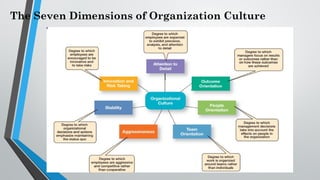
• Describe the dimension of organization culture
• Strong organization culture verses weak organization culture
• Source of organization culture
• Describe how organization culture affects managers.
3.
Learning Outcomes
• Describethe constraints and challenges facing managers in today’s
external environment.
• Discuss the characteristics and importance of organizational culture.
• Understand different dimensions of organizational culture.
• Understand the role of culture strength.
• Explore subcultures within organizations.
4.
The Manager -Omnipotent or Symbolic?
•How much difference does a manager make in how an
organization performs? The dominant view in
management theory and society in general is that
managers are directly responsible for an organization’s
success or failure.
•This perspective is called the omnipotent view of
management.
•The Omnipotent view of management - the view
that managers are directly responsible for an
organization success or failure.
5.
The Manager -Omnipotent or Symbolic?
•Others have argued that much of an organization’s
success or failure is due to external forces outside
managers’ control. This perspective is called the
symbolic view of management.
Symbolic View of Management – the view that
much of an organization’s success or failure is due
to external forces outside the manager’s control.
Context in whichthe Organization Functions:
• An organization is not a stand alone entity, it operates within a context
which includes the following:
1. The environment of the organization is made up of all external factors
that have the potential to affect the organization.
2. Technology is the knowledge, tools techniques and processes used to
create the goods and services of an organization.
3. The Strategy – of a firm is how it achieves its mission and goals.
4. Structure –refers to how people are organized to achieve the company’s
mission.
5. Culture – is defines as the values commonly held among a group of
people.
8.
Define the ExternalEnvironment
• Organizations are groups of people deliberately formed together
to serve a purpose through structured and coordinated goals and
plans.
• Organizations operate in different external environments and are
organized and structured internally to meet both external and
internal demands and opportunities.
• The different types of organizations includes: not-for-profit, for-
profit, public, private, government, voluntary, family owned and
operated, and publicly traded on stock exchanges.
• Organizations are commonly referred to as companies, firms,
corporations, institutions, agencies, associations, groups,
consortiums, and conglomerates.
9.
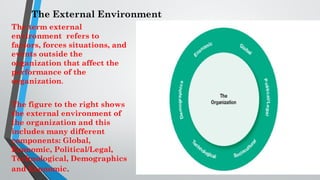
The External Environment
Theterm external
environment refers to
factors, forces situations, and
events outside the
organization that affect the
performance of the
organization.
The figure to the right shows
the external environment of
the organization and this
includes many different
components: Global,
Economic, Political/Legal,
Technological, Demographics
and Economic.
10.
The External Environment
•The economic component encompasses factors such as interest rates,
inflation, changes in disposable income, stock market fluctuations, and
business cycle stages.
• The demographic component is concerned with trends in population
characteristics such as age, race, gender, education level, geographic
location, income, and family composition.
• The political/legal component looks at federal, state, and local laws, as
well as global laws and laws of other countries. It also includes a country’s
political conditions and stability.
11.
The External Environment
•The sociocultural component is concerned with societal and cultural factors such as
values, attitudes, trends, traditions, lifestyles, beliefs, tastes, and patterns of behavior.
• The technological component is concerned with scientific or industrial innovations.
• The global component encompasses those issues associated with globalization and a
world economy.
• All these components pose potential constraints on managers’ decisions and actions,
however, lets take a closer look at two of them—the economic and demographic aspects.
12.
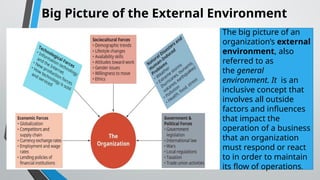
Big Picture ofthe External Environment
The big picture of an
organization’s external
environment, also
referred to as
the general
environment. It is an
inclusive concept that
involves all outside
factors and influences
that impact the
operation of a business
that an organization
must respond or react
to in order to maintain
its flow of operations.
13.
Big Picture ofthe External Environment
• The previous diagram illustrates the types of general macro
environments and forces that are interrelated and affect organizations:
sociocultural, technological, economic, government and political, natural
disasters, and human-induced problems that affect industries and
organizations.
• Economic environmental forces generally include such elements in
the economy as exchange rates and wages, employment statistics, and
related factors such as inflation, recessions, and other shocks—negative
and positive. Hiring and unemployment, employee benefits, factors
affecting organizational operating costs, revenues, and profits are affected
by global, national, regional, and local economies.
14.
Big Picture ofthe External
Environment
• Other factors to keep in mind as we discuss the external environment
of the organization are politics and governmental policies,
international wars, natural disasters, technological inventions, and
sociocultural forces.
• The Demographic - Baby Boomers. Gen Y. Post-Millennials.
• Maybe you’ve heard or seen these terms before.
Population researchers refer to three of the more well-known age
groups found in the U.S. population by these terms.
15.
External Environment -Demographic
• Baby Boomers are those individuals born between 1946 and 1964.
• So much is written and reported about “boomers” because there are so many
of them. The sheer numbers of people in that cohort means they’ve
significantly affected every aspect of the external environment (from the
educational system to entertainment/lifestyle choices to the Social Security
system and so forth) as they cycle through the various life stages.
• Gen Y (or the “Millennials”) is typically considered to encompass those
individuals born between 1978 and 1994. As the children of the Baby
Boomers, this age group is also large in number and making its imprint on
external environmental conditions as well. From technology to clothing styles
to work attitudes, Gen Y is affecting organizational workplaces.
16.
The Demographic
• Then,we have the Post-Millennials—the youngest identified age group—
basically teens and middle-schoolers. This group has also been called the
iGeneration, primarily because they’ve grown up with technology that
customizes everything to the individual.
• Population experts say it’s too early to tell whether elementary school-aged
children and younger are part of this demographic group or whether the world
they live in will be so different that they’ll comprise a different demographic
cohort.
17.
The Demographic
• Demographicage cohorts are important to our study of management
because, as we said earlier, large numbers of people at certain stages in the
life cycle can constrain decisions and actions taken by businesses,
governments, educational institutions, and other organizations.
• But demographics doesn’t only look at current statistics, it also looks to the
future. For instance, recent analysis of birth rates shows that more than 80
percent of babies being born worldwide are from Africa and Asia.
• And here’s an interesting fact: India has one of the world’s youngest
populations with more males under the age of 5 than the entire population
of France. And by 2050, it’s predicted that China will have more people age
65 and older than the rest of the world combined.13 Consider the impact of
such population trends on organizations and managers in the future
18.
How the ExternalEnvironment Affects Managers
There are three ways in which the external environment constraints and affect
managers:
1. The impact it has on jobs and employment.
2. The environmental uncertainty that exist.
3. Through the various stakeholder relationships that exist between an
organization and its external constituencies.
19.
The Impact onJobs & Employment
• As some or all the factors in the external environment changed, it has the most
powerful impact on employment and jobs. For example during the last world
recession, thousands of jobs were eliminated from the market place. Managers
had the challenge of how to rebalance the demand of what is needed for the
work place, having enough people with the right skills, to do the work requires
by the organization.
• The external conditions not only affects the types of jobs that are available but
how these jobs are created and managed. For examples many employers are
using flexible work arrangement using flexible work arrangements with work
tasks done by freelancers hired to work on an as-needed basis or by temporary
workers who work full-time but are not permanent employees or by individuals
who share jobs. An example is many bank tellers are given part time contract
which are full time employment. They can only work x number of hours per
week but they have all full time benefits.
Assessing Environmental Uncertainty
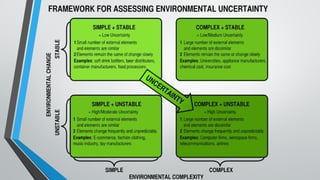
•Another constraint is the amount of uncertainty found in that environment,
which can affect organizational outcomes.
• Environmental uncertainty refers to the degree of change and complexity in
an organization’s environment.
• The first dimension of uncertainty is the degree of change. If the components in
an organization’s environment change frequently, it’s a dynamic
environment.
• If change is minimal, it’s a stable one. A stable environment might be one with
no new competitors, few technological breakthroughs by current competitors,
little activity by pressure groups to influence the organization, and so forth.
The recorded music industry could be considered a dynamic. It is a high uncertain
and high unpredictable environment. Digital formats and music-downloading
sites turned the industry upside down and brought high levels of uncertainty.
23.
Assessing Environmental Uncertainty
•If change is predictable, is that considered dynamic? No. Think of department
stores that typically make one-quarter to one-third of their sales in November
and December. The drop-off from December to January is significant. But because
the change is predictable, the environment isn’t considered dynamic. When we
talk about degree of change, we mean change that’s unpredictable. If change can
be accurately anticipated, it’s not an uncertainty for managers.
• The other dimension of uncertainty describes the degree of environmental
complexity, which looks at the number of components in an organization’s
environment and the extent of the knowledge that the organization has about
those components. An organization with fewer competitors, customers, suppliers,
government agencies, and so forth faces a less complex and uncertain
environment.
•
24.
Assessing Environmental Uncertainty
•Complexity is also measured in terms of the knowledge an organization
needs about its environment.
• For instance, managers at E*Trade must know a great deal about their
Internet service provider’s operations if they want to ensure that their
Web site is available, reliable, and secure for their customers. On the
other hand, managers of college bookstores have a minimal need for
sophisticated knowledge about their suppliers.
• How does the concept of environmental uncertainty influence managers?
25.
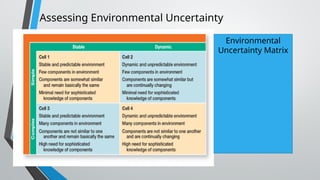
Examination of theEnvironmental Uncertainty Matrix
• Cell 1 (stable and simple environment) represents the lowest level of
environmental uncertainty and Cell 4 (dynamic and complex
environment) the highest.
• Managers have the greatest influence on organizational outcomes in cell
1 and the least in cell 4.
• Because uncertainty poses a threat to an organization’s effectiveness,
managers try to minimize it. Given a choice, managers would prefer to
operate in the least uncertain environments.
• However, they rarely control that choice. In addition, the nature of the
external environment today is that most industries today are facing more
dynamic change, making their environments more uncertain.
26.
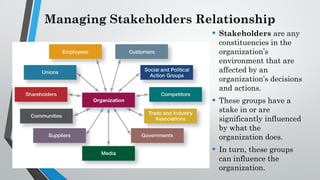
Managing Stakeholders Relationship
•Stakeholders are any
constituencies in the
organization’s
environment that are
affected by an
organization’s decisions
and actions.
• These groups have a
stake in or are
significantly influenced
by what the
organization does.
• In turn, these groups
can influence the
organization.
27.
Managing Stakeholders Relationship
•Stakeholders are the people or groups who have an interest, claim, or stake in
the organization. Stakeholders usually focus on the performance of the
organization and ensure that it remains at an acceptable level. Stakeholders
do not have any role in the management of the organization, but they do
influence the organizational management.
• The figure on the previous page identifies the most common stakeholders that
an organization might have to deal with. Note that these stakeholders include
internal and external groups. Why? Because both can affect what an
organization does and how it operates.
28.
Managing Stakeholders Relationship
•Managers should care about handling stakeholders’ relationship
because it can lead to desirable organizational outcomes such as
improved predictability of environmental changes, more
successful innovations, greater degree of trust among
stakeholders, and greater organizational flexibility to reduce the
impact of change.
• Another reason the external stakeholder relationships should be
managed is that it’s the “right” thing to do. Because an organization
depends on these external groups as sources of inputs (resources) and
as outlets for outputs (goods and services), managers should consider
the interests of stakeholders as they make decisions.
29.
Managing Stakeholders Relationship
•Stakeholders have their own interests which are required to be satisfied by
the organization. These interests can vary and can relate to productivity,
environment, quality, technology, as well as financial, regulatory, welfare, or
ethical issues etc. The organization is required to define, fully understand
and address the interests of the stakeholders. The organization which does
not have the ability to satisfy its stakeholders defeats the purpose of its
existence.
Management is required to assess the organizational setting and its own role.
The major task of the management is to build relationships and to develop a
framework for partnership. This framework connects the people of the
organization with one another, and with its stakeholders with the stakeholders.
30.
Organization Culture
• Whatare some words do you use to
describe someone?
• What are you describing?
• Personality Traits
• Do you know that an
organization also has
personality which we call
“culture”?
• Also do you know that
culture influence the way in
which employees act and
interact with each other?
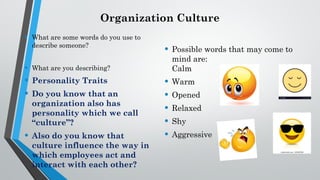
• Possible words that may come to
mind are:
Calm
• Warm
• Opened
• Relaxed
• Shy
• Aggressive
31.
What is OrganizationCulture?
•Organizational culture has been described as the
shared values, principles, traditions, and ways of doing
things that influence the way organizational members
act.
•In most organizations, these shared values and
practices have evolved over time and determine, to a
large extent, how “things are done around here.
32.
Organization Culture
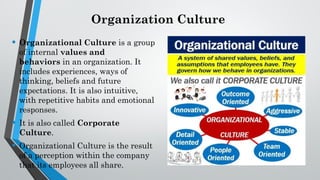
• OrganizationalCulture is a group
of internal values and
behaviors in an organization. It
includes experiences, ways of
thinking, beliefs and future
expectations. It is also intuitive,
with repetitive habits and emotional
responses.
• It is also called Corporate
Culture.
• Organizational Culture is the result
of a perception within the company
that its employees all share.
33.
Organization Culture
• Thedefinition of culture implies three things:
(1)
Culture is a perception. It’s not something that can be physically touched or seen,
employees perceive it on the basis of what they experience within the organization.
(2)
Organizational culture is Descriptive. It’s concerned with how members perceive the
culture and describe it, not with whether they like it.
(3)Even though individuals may have different backgrounds or work at different
organizational levels, they tend to describe the organization’s culture in similar terms. This
is the Shared Aspect of Culture.
• The employees have a different culture which they follow. All the employees are from different
backgrounds, and all tend to respect the culture of each other. This increases the respect among the
employees, and they learn different things. All the employees work at different organizational levels,
but the value of culture in the eyes of all employees is similar. The culture is essential to understand
because if one employee makes mischief with the other employee's culture, that may hurt them and
cause a bad reputation for the organization.
Dimensions of OrganizationCulture
• Which values characterize an organization’s culture?
• Understanding a set of values that might be used to describe an
organization’s culture helps us identify, measure, and manage that culture
more effectively.
• One framework that provides insight into the different types of
organizational culture is the seven-dimension Organizational Culture
Profile (OCP).
• The OCP is an instrument initially developed by consultants Charles A.
O’Reilly III, Jennifer Chatman, and David F. Caldwell to assess person-
organization fit. In theory, employees should have the same basic cultural
assumptions and values as the company for which they work.
36.
Dimensions of OrganizationCulture
(1) Innovative Cultures
• According to the OCP framework, companies that have innovative
cultures are flexible and adaptable, and experiment with new ideas. These
companies are characterized by a flat hierarchy in which titles and other status
distinctions tend to be downplayed.
• For example, W. L. Gore & Associates Inc. is a company with innovative
products such as GORE-TEX® (the breathable fabric that is windproof and
waterproof), Glide dental floss, and Elixir guitar strings, earning the company
the distinction of being elected as the most innovative company in the United
States by Fast Company magazine in 2004.
• W. L. Gore consistently manages to innovate and capture the majority of market
share in a wide variety of industries, in large part due to its unique culture. In
this company, employees do not have bosses in the traditional sense, and risk
taking is encouraged by celebrating failures as well as successes.
37.
Dimensions of OrganizationCulture
(2) Aggressive Culture
• Companies with aggressive cultures value competitiveness and
outperforming competitors: By emphasizing this, they may fall short in the
area of corporate social responsibility.
• For example, Microsoft Corporation is often identified as a company with an
aggressive culture. The company has faced a number of antitrust lawsuits
and disputes with competitors over the years.
• In aggressive companies, people may use language such as “We will kill our
competition.” In the past, Microsoft executives often made statements such
as “We are going to cut off Netscape’s air supply.…Everything they are
selling, we are going to give away.”
• Its aggressive culture is cited as a reason for getting into new legal troubles
before old ones are resolved
38.
Dimensions of OrganizationCulture
(3) Outcome orientation. - Degree to which management focuses on results rather
than on processes used to achieve them.
Outcome-Oriented Cultures: - The OCP framework describes outcome-oriented
cultures as those that emphasize achievement, results, and action as important values.
• A good example of an outcome-oriented culture may be Best Buy Co. Inc. Having a
culture emphasizing sales performance, Best Buy tallies revenues and other relevant
figures daily by department. Employees are trained and mentored to sell company
products effectively, and they learn how much money their department made every
day.
• In 2005, the company implemented a results oriented work environment (ROWE)
program that allows employees to work anywhere and anytime; they are evaluated
based on results and fulfillment of clearly outlined objectives.
39.
Dimensions of OrganizationCulture
• Outcome-oriented cultures hold employees as well as managers accountable
for success and utilize systems that reward employee and group output. In
these companies, it is more common to see rewards tied to performance
indicators as opposed to seniority or loyalty.
• Research indicates that organizations that have a performance-oriented culture
tend to outperform companies that are lacking such a culture.
• At the same time, some outcome-oriented companies may have such a high
drive for outcomes and measurable performance objectives that they may suffer
negative consequences. Companies over rewarding employee performance such
as Enron Corporation and WorldCom experienced well-publicized business and
ethical failures. When performance pressures lead to a culture where unethical
behaviors become the norm, individuals see their peers as rivals and short-term
results are rewarded; the resulting unhealthy work environment serves as a
liability.
40.
Dimensions of OrganizationCulture
(4) Stability cultures - Degree to which activities emphasize maintaining the
status quo.
• Stable cultures are predictable, rule-oriented, and bureaucratic. These
organizations aim to coordinate and align individual effort for greatest levels of
efficiency. When the environment is stable and certain, these cultures may help
the organization be effective by providing stable and constant levels of output,
• These cultures prevent quick action, and as a result may be a misfit to a
changing and dynamic environment. Public sector institutions may be viewed
as stable cultures. In the private sector, Kraft Foods Inc. is an example of a
company with centralized decision making and rule orientation that suffered as
a result of the culture-environment mismatch.
• Its bureaucratic culture is blamed for killing good ideas in early stages and
preventing the company from innovating.
41.
Dimensions of OrganizationCulture
(5) People orientation cultures - Degree to which management decisions consider
the effect of outcomes on people within the organization.
• People-oriented cultures value fairness, supportiveness, and respect for
individual rights. These organizations truly live the mantra that “people are their
greatest asset.” In addition to having fair procedures and management styles, these
companies create an atmosphere where work is fun and employees do not feel
required to choose between work and other aspects of their lives. In these
organizations, there is a greater emphasis on and expectation of treating people
with respect and dignity.
• Starbucks Corporation is an example of a people-oriented culture. The company
pays employees above minimum wage, offers health care and tuition reimbursement
benefits to its part-time as well as full-time employees, and has creative perks such
as weekly free coffee for all associates. As a result of these policies, the company
benefits from a turnover rate lower than the industry average.
42.
Dimensions of OrganizationCulture
(6) Team orientation Cultures - Degree to which work activities are
organized around teams rather than individuals.
• Companies with team-oriented cultures are collaborative and emphasize
cooperation among employees. For example, Southwest Airlines Company
facilitates a team-oriented culture by cross-training its employees so that
they are capable of helping each other when needed. The company also places
emphasis on training intact work teams.
• In Southwest’s selection system, applicants who are not viewed as team
players are not hired as employees.
• In team-oriented organizations, members tend to have more positive
relationships with their coworkers and particularly with their managers.
43.
Dimensions of OrganizationCulture
• (7) Attention to detail. - Degree to which employees are expected to exhibit
precision, analysis, and attention to detail.
• Organizations with detail-oriented cultures are characterized in the OCP
framework as emphasizing precision and paying attention to details. Such a culture
gives a competitive advantage to companies in the hospitality industry by helping
them differentiate themselves from others.
• For example, Four Seasons Hotels Ltd. and the Ritz-Carlton Company LLC are
among hotels who keep records of all customer requests, such as which newspaper
the guest prefers or what type of pillow the customer uses. This information is put
into a computer system and used to provide better service to returning customers.
Any requests hotel employees receive, as well as overhear, might be entered into the
database to serve customers better. Recent guests to Four Seasons Paris who were
celebrating their 21st anniversary were greeted with a bouquet of 21 roses on their
bed. Such clear attention to detail is an effective way of impressing customers and
ensuring repeat visits.
44.
Dimensions of OrganizationCulture
• McDonald’s Corporation is another company that specifies in detail how
employees should perform their jobs by including photos of exactly how
French fries and hamburgers should look when prepared properly.
45.
Culture outside theOCP Framework
• There are two other cultures that are not of the OCP Framework – service
culture and safety culture.
• Service culture is importance to the retail industry, tourism industry etc.
• Southwest Airlines, Ritz-Carlton, and Four Seasons are famous for their
service culture. In these organizations, employees are trained to serve the
customer well, and cross-training is the norm. Employees are empowered to
resolve customer problems in ways they see fit. Because employees with
direct customer contact are in the best position to resolve any issues,
employee empowerment is truly valued in these companies.
• What differentiates companies with service culture from those without such
a culture may be the desire to solve customer-related problems proactively.
In other words, in these cultures employees are engaged in their jobs and
personally invested in improving customer experience such that they identify
issues and come up with solutions without necessarily being told what to do.
46.
Culture outside theOCP Framework
• Safety Culture – are for some jobs are safety sensitive.
• In organizations where safety-sensitive jobs are performed, creating and
maintaining a safety culture provides a competitive advantage, because
the organization can reduce accidents, maintain high levels of morale and
employee retention, and increase profitability by cutting workers’
compensation insurance costs. Some companies suffer severe
consequences when they are unable to develop such a culture.
• Examples of a safety culture company in Jamaica – Petrojam, bauxite
industry
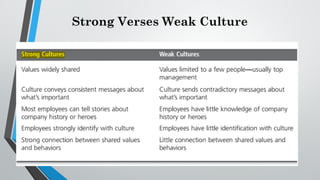
Strong Culture
• Allorganizations have cultures, but not all cultures equally influence employees’
behavior sand actions.
• Strong cultures—those in which the key values are deeply held and widely shared—
have a greater influence on employees than do weaker cultures.
• Strong cultures: Here, organizational values and beliefs are widely shared with
significant influence on people’s behaviour with respect to their job. It encompasses
the ability to influence and motivate organizational members to act in an approved
manner in the organization, and also an agreement on the part of members, regarding
the importance of the organizational values.
• Weak cultures: Here, there is lack of motivation by the members of the organization,
and it encompasses little or no strategy-implementing assistance since there are no
traditions, beliefs, values, common bonds, or behavioural norms that management can
use to motivate to execute the chosen strategy .
49.
Strong Culture
• Mostorganizations have moderate to strong cultures; that is, there is
relatively, high agreement on what’s important, what defines “good”
employee behavior, what it takes to get ahead, and so forth.
• The stronger a culture becomes, the more it affects the way managers
plan, organize, lead, and control.
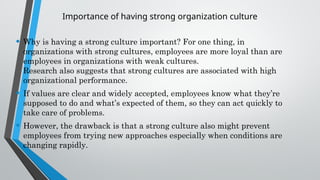
Importance of havingstrong organization culture
• Why is having a strong culture important? For one thing, in
organizations with strong cultures, employees are more loyal than are
employees in organizations with weak cultures.
Research also suggests that strong cultures are associated with high
organizational performance.
• If values are clear and widely accepted, employees know what they’re
supposed to do and what’s expected of them, so they can act quickly to
take care of problems.
• However, the drawback is that a strong culture also might prevent
employees from trying new approaches especially when conditions are
changing rapidly.
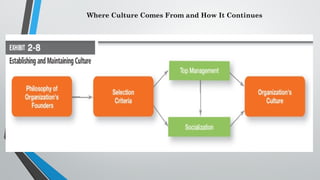
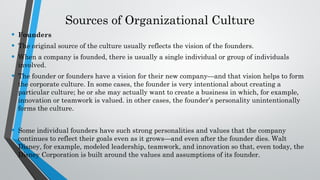
Sources of OrganizationalCulture
• Founders
• The original source of the culture usually reflects the vision of the founders.
• When a company is founded, there is usually a single individual or group of individuals
involved.
• The founder or founders have a vision for their new company—and that vision helps to form
the corporate culture. In some cases, the founder is very intentional about creating a
particular culture; he or she may actually want to create a business in which, for example,
innovation or teamwork is valued. in other cases, the founder’s personality unintentionally
forms the culture.
• Some individual founders have such strong personalities and values that the company
continues to reflect their goals even as it grows—and even after the founder dies. Walt
Disney, for example, modeled leadership, teamwork, and innovation so that, even today, the
Disney Corporation is built around the values and assumptions of its founder.
54.
Sources of OrganizationalCulture
• Another good example of the way that founders’ values create corporate culture
is Ben and Jerry’s Ice Cream. Founders Ben Cohen and Jerry Greenfield
started out to create a company with strong social values—and they succeeded.
The company started in 1978, but even today the company continues to focus on
sustainability, environmental activism, social activism, and charity.
• Industry
• It’s one thing to be creative, innovative, and fun in the hospitality or
entertainment business. But that type of culture won’t work well in an industry
that’s built around regulations and policies that cannot be changed or bent.
Industries such as pharmaceuticals and nuclear power require attention to
detail and cannot tolerate a “creative” approach to following rules. True, a
pharmaceutical company can be people-oriented to a degree, but its willingness
to support the individual needs of employees must be secondary to its absolute
compliance with regulations and the law.
55.
Sources of OrganizationalCulture Cont’d
• Organizations help employees adapt to the culture through socialization,
a process that helps new employees learn the organization’s way of doing
things.
• For instance, new employees at Starbucks stores go through 24 hours of
intensive training that helps turn them into brewing consultants
(baristas). They learn company philosophy, company jargon, and even
how to assist customers with decisions about beans, grind, and espresso
machines.
56.
Methods for MaintainingCorporate Culture
• Why do some companies maintain their culture whereas others see it fall
apart? The answer lies in how the company goes about recruiting, hiring,
onboarding, and training its employees.
• Recruiting. To find employees who will fit into the corporate culture,
recruiters must look in the right places. When looking for upper-level
managers, recruiters should look at corporations with a similar culture to
their own. When looking for entry-level employees, recruiters should tap
college programs or websites that reflect their corporate culture.
• Hiring. When interviewing job candidates, managers and human resources
managers must spend some time assessing the candidate’s assumptions and
values. Is this person a collaborator or a competitor? Are candidates detail-
oriented or innovative? Candidates whose personal assumptions and values
match the corporate culture are much more likely to help maintain that
culture over time.
57.
Methods for MaintainingCorporate Culture
• Onboarding. The “onboarding” process is really a new employee orientation process. During
onboarding, human resources personnel help the new employee get to know company policies and
practices. It’s during onboarding, for example, that a new employee may learn that each team puts
together a skit for the company holiday party or that bonuses can be earned as a result of exceeding
sales goals.
• Training. Training can be both formal and informal. Whereas formal training may teach new
employees how to use company software or systems, informal training may involve one-on-one
conversations with peers and managers. During those conversations, new employees learn how the
company culture manifests itself in the workplace. For example, they may learn that everyone—even
bad players—take part in departmental softball games, or that recycling is a “must” in the lunchroom.
All these subtle bits of information add up to an understanding of corporate culture.
• Once an employee is hired, he or she may feel comfortable or uncomfortable in the new workplace.
Typically, those employees who feel “at home” in the corporate culture tend to stick around, whereas
those who feel like outsiders tend to leave at the first good opportunity.
58.
How Culture isLearned?
• Employees “learn” an organization’s culture in a number of ways. The most
common are stories, rituals, material symbols, and language.
• Stories: Organizational “stories” typically contain a narrative of significant
events or people including such things as the organization’s founders, rule
breaking, reactions to past mistakes, and so forth. Then, there’s the story
about Art Fry, a 3M researcher, who wanted a better way to mark the pages of
his church hymnal and invented the Post-It Note. These stories reflect what
made 3M great and what it will take to continue that success. To help
employees learn the culture, organizational stories anchor the present in the
past, provide explanations and legitimacy for current practices, exemplify
what is important to the organization, and provide compelling pictures of an
organization’s goals.
59.
How Culture isLearned?
• Rituals: New hires training, new hire welcome lunches, annual; corporate
conferences, awards, off site meetings and trainings are a few examples of the most
common rituals and training.
• Material Artifacts and Symbols When you walk into different businesses, do
you get a “feel” for what type of work environment it is—formal, casual, fun,
serious, and so forth? These reactions demonstrate the power of material symbols
or artifacts in creating an organization’s personality. The layout of an
organization’s facilities, how employees dress, the types of automobiles provided to
top executives, and the availability of corporate aircraft are examples of material
symbols. Others include the size of offices, the elegance of furnishings, executive
“perks” (extra benefits provided to managers such as health club member ships,
use of company-owned facilities, and so forth), employee fitness centers, on-site
dining facilities, and reserved parking spaces for certain employees.
60.
How Culture isLearned?
• Language – identifies members of cultures or subcultures, if used
by all then it’s accepted and preserved (ex. Slang used by
companies like Boeing)
61.
Visible Signs ofCompany’s Culture
When you walk into a business setting, you should be able to see visible signs
of the business’s organizational culture. If you spend a few weeks on the job,
you should see even more. Here are just a few things to look out for:
• How employees dress. Most employers have some kind of dress code. Some
are quite casual whereas others require more formal clothing. In a minority
of businesses there is no dress code at all, and employees are welcome to
wear short, sleeveless tops, and even flip-flops to work.
• Snack areas and candy jars. How people-oriented is your business? In
some workplaces, employees have all-day access to snack bars, free soft
drinks, coffee, and other goodies. Candy jars are also a sign that a business is
open to people-oriented treats.
62.
Visible Signs ofCompany’s Culture
• Plaques and awards. In some businesses, plaques and awards honoring employees
are placed front and center. Some honor individuals as “employee of the month,”
whereas others recognize specific achievements such as “most sales made in a month.”
• Mission statement. In many corporations, the organizational mission is posted on
every floor. The mission is intended to remind employees why they are there and what
their goals and attitudes should be.
• Events and rituals. Many workplaces have customs or rituals that become obvious
within just a couple of weeks on the job. Whether it’s “happy hour Friday,” “dress
down Tuesday,” or weekly update meetings, employees quickly learn the routines.
• Physical layout and décor. When you walk into a workplace, what do you see? In
some offices, gray cubicles dominate; in others, the workspace is wide open. In some
businesses, individuals are encouraged to bring in and show off photos, posters, and
plants; in others employees are asked to keep personal items to a minimum.
63.
Importance of OrganizationCulture
• Why is organizational culture important, you ask? Your culture impacts
everything from performance to how your company is perceived in the media.
(1) It defines your company’s internal and external identity
• Here’s a thought exercise: write down on a piece of paper five attributes that
best describe your organization’s culture. You might write something like
“good work-life balance” or “lots of meetings” or maybe “team-oriented.”
• Peter Ashworth explains that your organizational culture “defines for you
and for all others, how your organization does business, how your
organization interacts with one another and how the team interacts with the
outside world, specifically your customers, employees, partners, suppliers,
media and all other stakeholders.”
64.
Importance of OrganizationCulture
• 2. Organizational culture is about living your company’s core values
• Your culture can be a reflection (or a betrayal) of your company’s core
values. The ways in which you conduct business, manage workflow, interact
as a team, and treat your customers all add up to an experience that should
represent who you are as an organization and how you believe a company
should be run. In short, your culture is the sum of your company’s beliefs in
action.
• But if your espoused values don’t match your culture, that’s a problem. It
could mean that your “core values” are a list of meaningless buzzwords, and
your people know it.
• A strong organizational culture keeps your company’s core values front and
center in all aspects of its day-to-day operations and organizational
structure.
65.
Importance of OrganizationCulture
• 3. Your culture can transform employees into advocates (or critics)
• One of the greatest advantages of a strong organizational culture is that it has
the power to turn employees into advocates.
• Your people want more than a steady paycheck and good benefits; they want to
feel like what they do matters. And when your people feel like they matter,
they’re more likely to become culture advocates—that is, people who not only
contribute to your organization’s culture, but also promote it and live it
internally and externally.
• How do you achieve this? One way is to recognize good work. A culture that
celebrates individual and team successes, that gives credit when credit is due, is
a culture that offers a sense of accomplishment. And that’s one way to turn
employees into advocates.
• Then again, if your company culture doesn’t do this, you may be inviting
criticism.
66.
Importance of OrganizationCulture
• 4. A strong organizational culture helps you keep your best people
• Ask any top performer what keeps them at their company and you’re bound to
hear this answer: the people. It’s because a workplace culture focused on people
has profound appeal. It helps improve engagement, deliver a unique employee
experience, and makes your people feel more connected.
• One way to attract top performers that are natural culture champions is to hire
for cultural fit.
• 5. A well-functioning culture assists with onboarding
• Organizational culture also has the potential to act as an aligning force at your
company. This is particularly the case with new hires who, more often than not,
have put some considerable thought into the type of culture they’re entering into.
• The culture at your organization is essentially a guiding force for them, so it’s
important that it starts with onboarding.
67.
Importance of OrganizationCulture
• 6. Your culture transforms your company into a team
• A successful organizational culture brings together the people at your
company and keeps them aligned. When your culture is clear, different
perspectives can gather behind it with common purpose. The culture at your
organization sets expectations for how people behave and work together, and
how well they function as a team.
• In this way, culture can break down the boundaries between siloed teams,
guide decision-making, and improve workflow overall. On the flip side, a toxic
organizational culture has the capacity to do just the opposite.
68.
Importance of OrganizationCulture
• 7. Culture impacts performance and employee wellbeing
• Reports show that organizational culture has a direct impact on
performance and, more importantly, your employees’ wellbeing. A
healthy culture addresses both of these areas by finding an appropriate
balance based on company values.
• Does your company stress performance to such a degree that you feel
like your physical and mental health are being overlooked?
There might be instances when that may not be a problem, but for the
vast majority of cases, it’ll have a negative effect on your company.
• How 1:1 meetings make or break your workplace culture [video
recording]
69.
Importance of OrganizationCulture
• Paul Barrett sums it up nicely, writing that “Employee wellbeing
strategies have the potential to bring huge benefits to employees and
employers alike but they need to be introduced in the right way for the
right reasons, and at the right time.
• To be properly effective they need to be developed in a holistic way,
consistent with a business culture that is conducive to their success.
• That means supportive management behaviours, flexible working options
and an open culture that allows employees a voice and some say in
shaping the working environment.”
70.
The Effect ofOrganizational Culture on Decision Making
• The effect that organizational culture has on managerial decisions depends on
whether the organization has a strong or a weak culture. Organizational culture
determines the decision making process as well as decision making speed. Some
cultures permit all employees to participate in the decision making process.
• Other cultures only allow the management to make decisions. Those
organizations that allow all employees to participate in decision making process,
might take long to make decisions due to the lengthy process. However, such
decisions are likely to be effective since they incorporate different ideas from
different people (Connolly, 2008).
• Organizational culture determines the kind of employees that an organization
will hire. The culture that exists determines who should be hired by the
organization. Clear guidelines are written down to specify qualifications required
for a specific job. Good criteria exist for recruitment, selection, promotion, lying
off as well as retirement. In this case, the management has to comply with the
criteria (Robbins, 2003)
71.
The Effect ofOrganizational Culture on Decision Making
• Organizational culture determines the level of formalization. Formalization in
this case means the extent to which written rules and procedures are
followed in an organization. Organizational cultures with high degree of
formalization make it easy for management to regulate. This is because there
is a clear outline of how one is expected to carry himself/herself out, and so
the employees strictly follow rules (Robbins, 2003).
• The link for reading
• https://ivypanda.com/essays/management-4/
• https://www.vital-learning.com/blog/leadership-and-organizational-culture

![Importance of Organization Culture
• 7. Culture impacts performance and employee wellbeing
• Reports show that organizational culture has a direct impact on
performance and, more importantly, your employees’ wellbeing. A
healthy culture addresses both of these areas by finding an appropriate
balance based on company values.
• Does your company stress performance to such a degree that you feel
like your physical and mental health are being overlooked?
There might be instances when that may not be a problem, but for the
vast majority of cases, it’ll have a negative effect on your company.
• How 1:1 meetings make or break your workplace culture [video
recording]](https://image.slidesharecdn.com/lesson2-250320153931-c891d4e1/85/Lesson-2-pptx-Management-and-the-Environment-68-320.jpg)