VIVEKANANDHA ARTS AND SCIENCE COLLEGE FOR WOMEN
VEERCHIPALYAM-637303,SANKAGIRI,SALEM Dt.,TAMILNADU,INDIA.
AFFILIATED TO PERIYAR UNIVERSITY,SALEM;RECOGNISED UNDER SECTION 2(F)&12(B) OF THE UGC
ACT 1956)
SUBMITTED BY:
KANIMOZHI.I.S.,
III B.SC.MICROBIOLOGY,
DEPARTMENT OF
MICROBIOLGY,VIAAS,
Sankagiri.
DEPARTMENT OF MICROBIOLOGY
SUBJECT INCHARGE;
Dr.R.DINESHKUMAR,
APMICROBIOLOGY,
Assistant professor,
Department of
Microbiology,
VIAAS,Sankagiri.
SUBJECT:SOIL AND AGRICULTURAL MICROBIOLOGY
TOPIC :ORGANISMS INVOLVED IN NITRIFICATION AND DENITRIFICATION IN SOIL
ORGANISMS INVOLVED IN
NITRIFICATION AND
DENTRIFICATION IN SOIL
BY;
Kanimozhi.I.S.
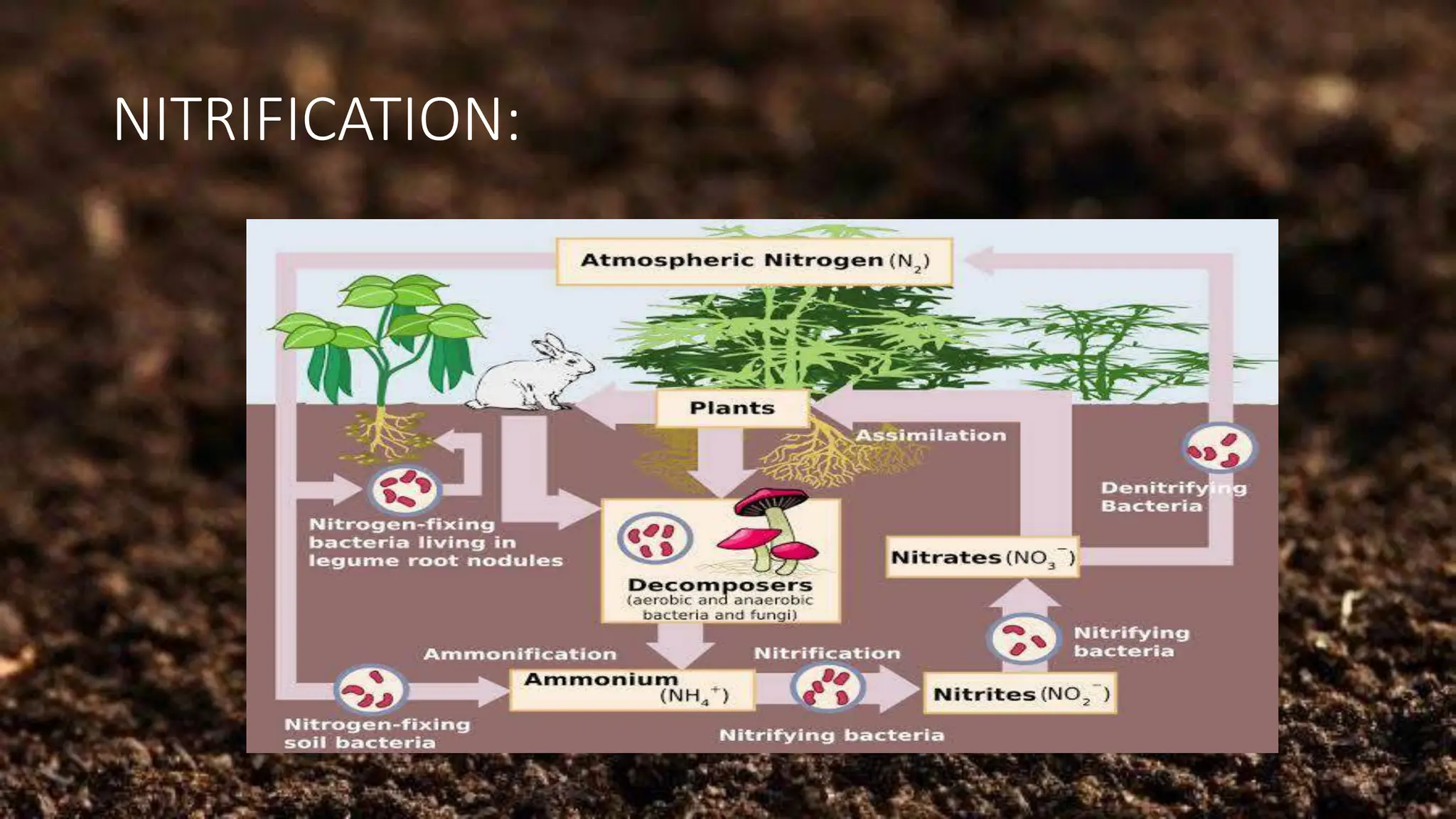
NITRIFICATION:
➢Nitrosomonas: These bacteria convert ammonia (NH₃) into nitrite
(NO₂⁻).
➢Nitrobacter: Following the conversion by Nitrosomonas, these
bacteria convert nitrite (NO₂⁻) into nitrate (NO₃⁻).
ORGANISMS INVOLED IN NITRIFICATION IN SOIL
Nitrification in soil is a two-step process, and different bacteria
are involved at each stage:
Ammonia Oxidizers:
➢Nitrosomonas: These bacteria are primarily responsible for
converting ammonia (NH₃) into nitrite (NO₂⁻).
➢Nitrosospira: Another type of bacteria that also plays a role in
ammonia oxidation.
NITRIFICATION:
Nitrite Oxidizers:
➢Nitrobacter: These bacteria take the nitrite (NO₂⁻) produced by
ammonia oxidizers and convert it into nitrate (NO₃⁻).
➢Nitrospira: Another group of bacteria involved in the conversion of
nitrite to nitrate.
✓This transformation is crucial for providing plants with a usable form
of nitrogen.
NH4+(Ammonium) → NO2– (Nitrite) → NO3– (Nitrate)
DENITRIFICATION:
➢Pseudomonas and Clostridium: These bacteria convert nitrate (NO₃⁻)
into nitrogen gas (N₂), which is released into the atmosphere.
➢Thiobacillus: This bacteria also participates in the reduction process
during denitrification.
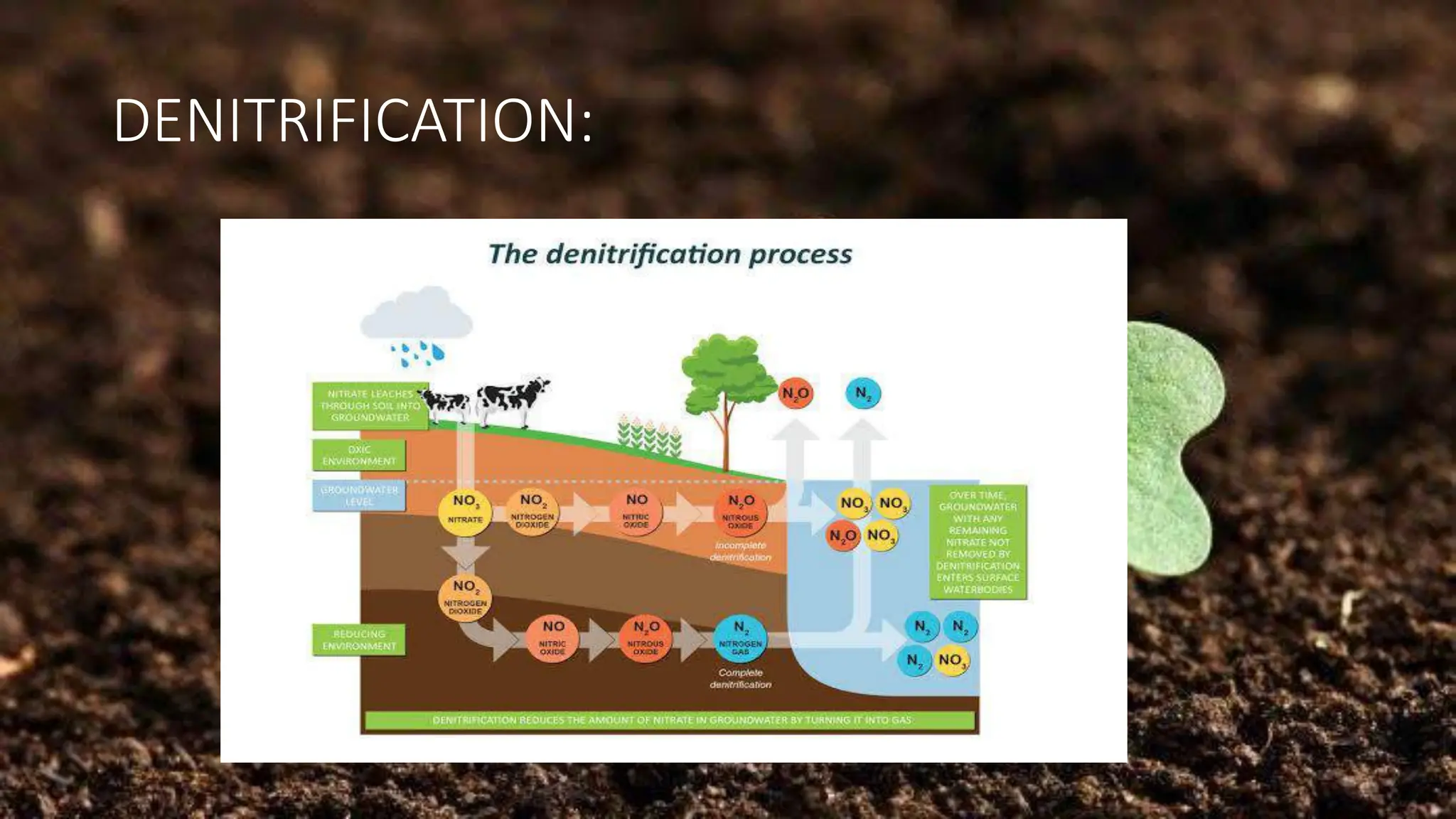
DENITRIFICATION:
ORGANISMS INVOLED IN DENITRIFICATION IN SOIL
Denitrification is an essential process in the nitrogen cycle, where
nitrate (NO₃⁻) is reduced to nitrogen gases (N₂ or N₂O), and various
bacteria are involved in this process:
➢Pseudomonas: These bacteria are among the most common
denitrifiers in soil. They reduce nitrate to nitrogen gas.
➢Clostridium: These anaerobic bacteria contribute to the
denitrification process, especially in oxygen-depleted environments.
➢Thiobacillus: These bacteria participate in reducing nitrate to nitrogen
gas, often found in sulfur-rich environments.
➢Paracoccus: Another group of bacteria involved in the denitrification
process.
➢Bacillus: These bacteria can also reduce nitrate under anaerobic
conditions.
✓Reduction of Nitrate to Nitrite: This is the first step where bacteria
like Pseudomonas reduce nitrate (NO₃⁻) to nitrite (NO₂⁻).
✓Reduction of Nitrite to Nitric Oxide: Nitrite is further reduced to nitric
oxide (NO) by the action of denitrifying bacteria.
✓Reduction of Nitric Oxide to Nitrous Oxide: The nitric oxide is then
reduced to nitrous oxide (N₂O).
✓Reduction of Nitrous Oxide to Nitrogen Gas: Finally, nitrous oxide is
reduced to nitrogen gas (N₂), which is released into the atmosphere.
Denitrification primarily occurs in anaerobic conditions (absence of
oxygen), which are commonly found in waterlogged soils or sediments.
➢This process is carried out by various bacteria, such as:
✓Pseudomonas
✓Clostridium
✓Thiobacillus
✓Paracoccus
✓Bacillus
➢These bacteria use nitrate as an electron acceptor instead of oxygen
during their respiration. This not only helps in maintaining soil health
but also in reducing the loss of soil fertility by preventing the leaching
of nitrate into water bodies.
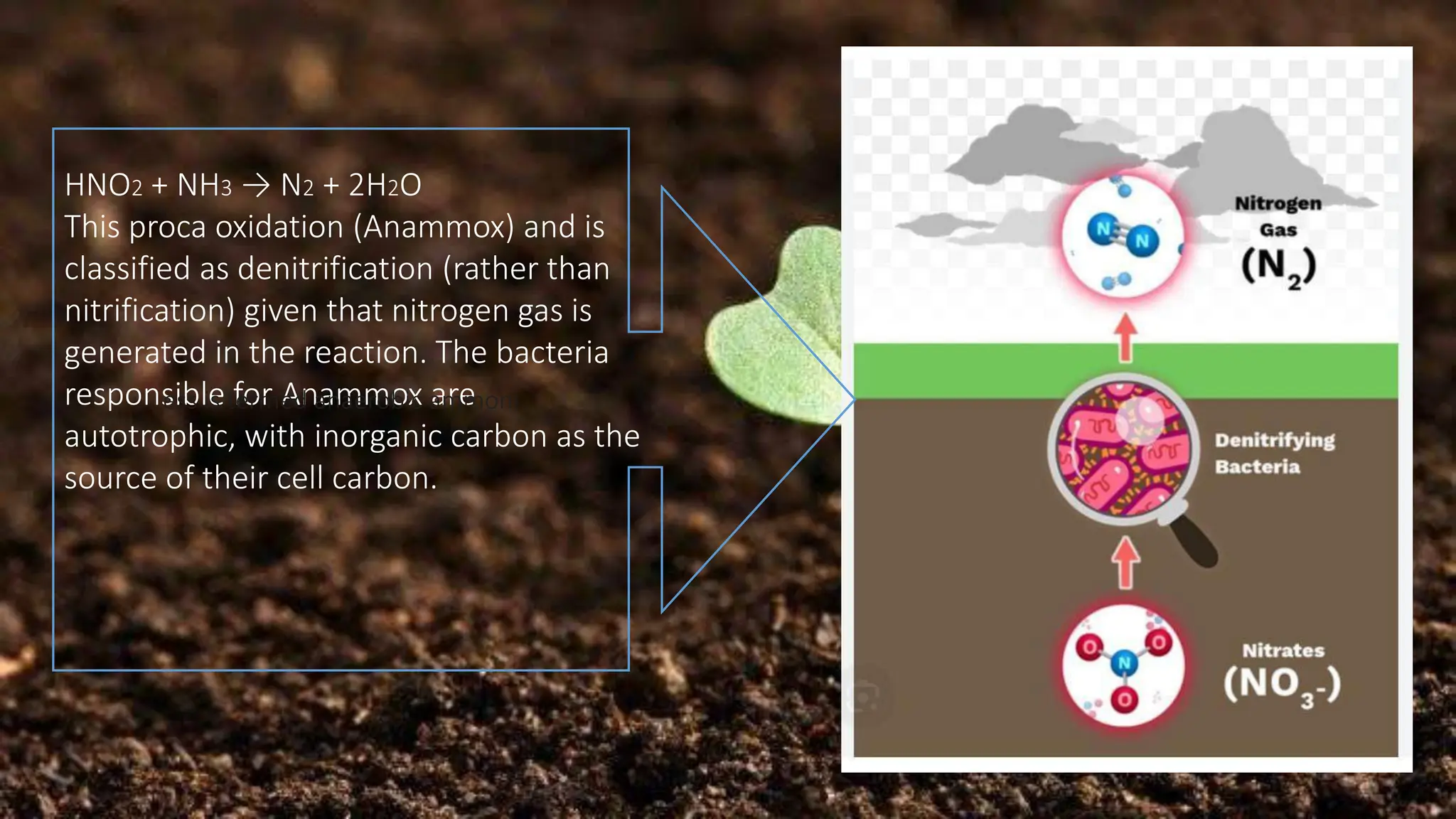
HNO2 + NH3 → N2 + 2H2O
This proca oxidation (Anammox) and is
classified as denitrification (rather than
nitrification) given that nitrogen gas is
generated in the reaction. The bacteria
responsible for Anammox are
autotrophic, with inorganic carbon as the
source of their cell carbon.
ess is termed anaerobic ammoni
Organic denitrification:
➢Denitrification with an organic material relies on facultative
heterotrophs that are capable of using nitrite and nitrate as the
terminal electron acceptors in their respiratory chain.
➢ In the coupled redox reactions, nitrate and nitrite is reduced to
nitrogen gas while the organic material is oxidized to carbon dioxide
and water.
➢Virtually all bacteria that are able to reduce nitrate are also able to
reduce nitrite.
➢ Thus, for simplicity, sometimes a single group of denitrifiers capable
of both nitrite and nitrate reduction is assumed.
➢Organic carbon is the source of cell carbon.
➢ Thus, for example, with acetate as the energy source and ammonia as the
source of cell nitrogen, the overall stoichiometry for catabolism and anabolism
is:
1 . 77CH2O + 0.62HNO3 + 0.2NH3 → CH1.4O0.4N0.2 + 0.77CO2 +1.68H2O +
0.305N2
➢The stoichiometry of endogenous metabolism can be derived as for
nitrification, except that nitrate is the electron acceptor in this case:
CH1.4O0.4N0.2 + 0.8HNO3 → 0.2NH3 + 0.8H2O + CO2 + 0.4N2
➢The actual growth yield can be derived from Equation , considering only one
group of denitrifiers, as 0.43-g biomass/g-CH2O, or 0.40-g biomass/g-COD.
➢The sludge yield from such heterotrophic denitrification is higher than that for
nitrification, while denitrification generates alkalinity and, thus, the
wastewater pH will increase as a result of this process.
➢Apart from extracellular substrates, denitrification is also occur using
intracellular organic polymer.
➢ Heinemann and Mòller (1991) co-immobilized denitrifying bacteria
with poly-$bT-hydroxylbutyric (PHB) acid in biopolymeric matrix to
denitrify water
➢ The possibility of using PHB for denitrification allows for combined
removal of nitrogen and phosphorus from sewage
Inorganic denitrification:
➢Autotrophic denitrification can be achieved with sulphide, hydrogen and
ammonia as the electron donor.
➢ In general, however, the concentrations of hydrogen and sulphide in
wastewater are too low for them to be regarded as significant electron
donors.
➢Van de Graaf (1997) showed that ammonia could be an electron
donor for the reduction of nitrite to nitrogen gas.
➢The ammonia is oxidized under anaerobic (or strictly speaking, anoxic
or denitrifying) conditions by nitrite, with both species contributing
equally to the nitrogen content in the resultant nitrogen gas.
HNO2 + NH3 → N2 + 2H2O
➢This process is termed anaerobic ammonia oxidation (Anammox) and
is classified as denitrification (rather than nitrification) given that
nitrogen gas is generated in the reaction.
➢The bacteria responsible for Anammox are autotrophic, with
inorganic carbon as the source of their cell carbon.
➢Van de Graaf (1997) showed that ammonia could be an electron
donor for the reduction of nitrite to nitrogen gas.
➢The ammonia is oxidized under anaerobic (or strictly speaking, anoxic
or denitrifying) conditions by nitrite, with both species contributing
equally to the nitrogen content in the resultant nitrogen gas.
HNO2 + NH3 → N2 + 2H2O
➢This process is termed anaerobic ammonia oxidation (Anammox) and
is classified as denitrification (rather than nitrification) given that
nitrogen gas is generated in the reaction.
➢The bacteria responsible for Anammox are autotrophic, with
inorganic carbon as the source of their cell carbon.
➢Van de Graaf (1997) showed that ammonia could be an electron
donor for the reduction of nitrite to nitrogen gas.
➢The ammonia is oxidized under anaerobic (or strictly speaking, anoxic
or denitrifying) conditions by nitrite, with both species contributing
equally to the nitrogen content in the resultant nitrogen gas.
HNO2 + NH3 → N2 + 2H2O
➢This process is termed anaerobic ammonia oxidation (Anammox) and
is classified as denitrification (rather than nitrification) given that
nitrogen gas is generated in the reaction.
➢The bacteria responsible for Anammox are autotrophic, with
inorganic carbon as the source of their cell carbon.
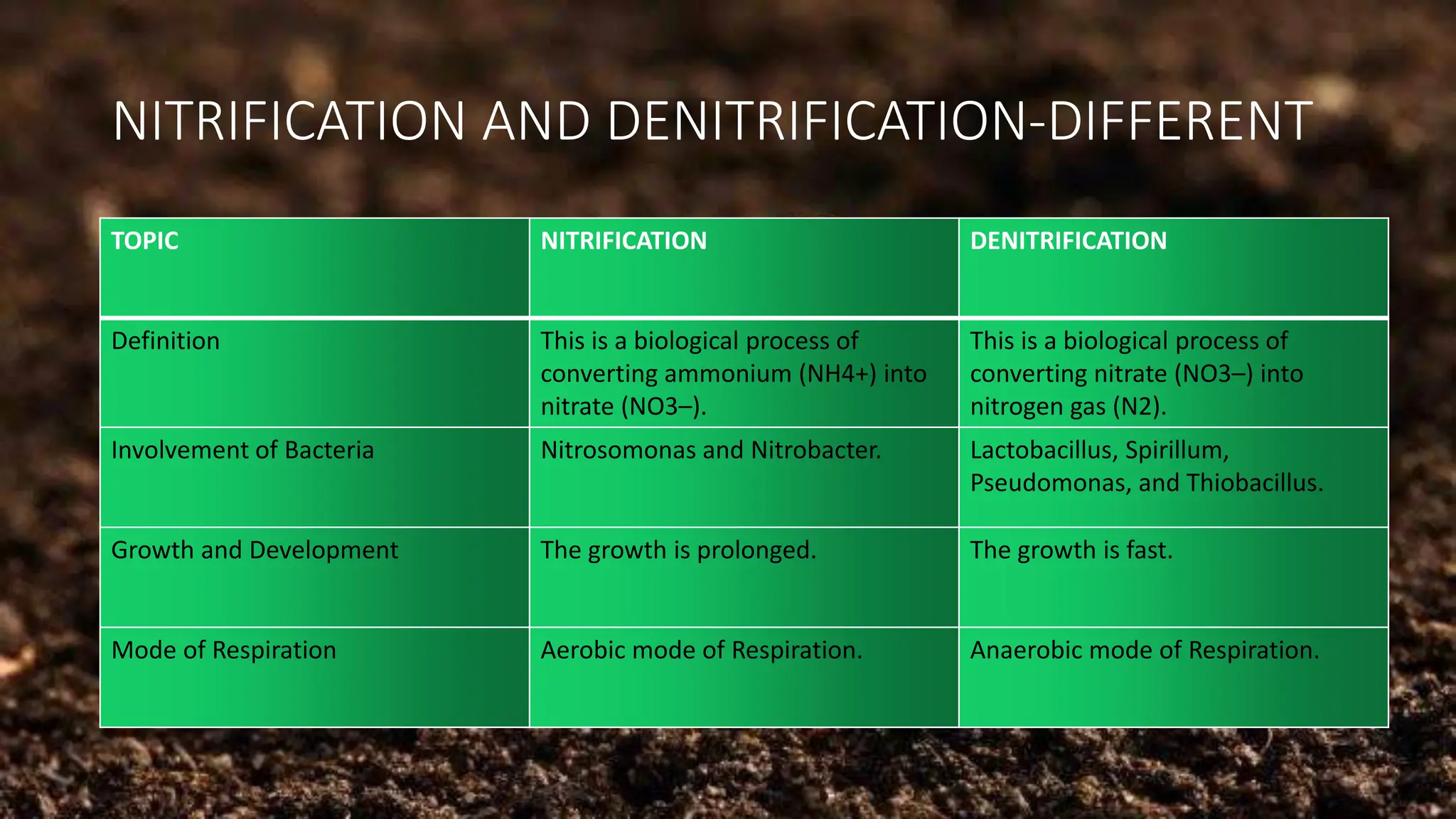
NITRIFICATION AND DENITRIFICATION-DIFFERENT
TOPIC NITRIFICATION DENITRIFICATION
Definition This is a biological process of
converting ammonium (NH4+) into
nitrate (NO3–).
This is a biological process of
converting nitrate (NO3–) into
nitrogen gas (N2).
Involvement of Bacteria Nitrosomonas and Nitrobacter. Lactobacillus, Spirillum,
Pseudomonas, and Thiobacillus.
Growth and Development The growth is prolonged. The growth is fast.
Mode of Respiration Aerobic mode of Respiration. Anaerobic mode of Respiration.
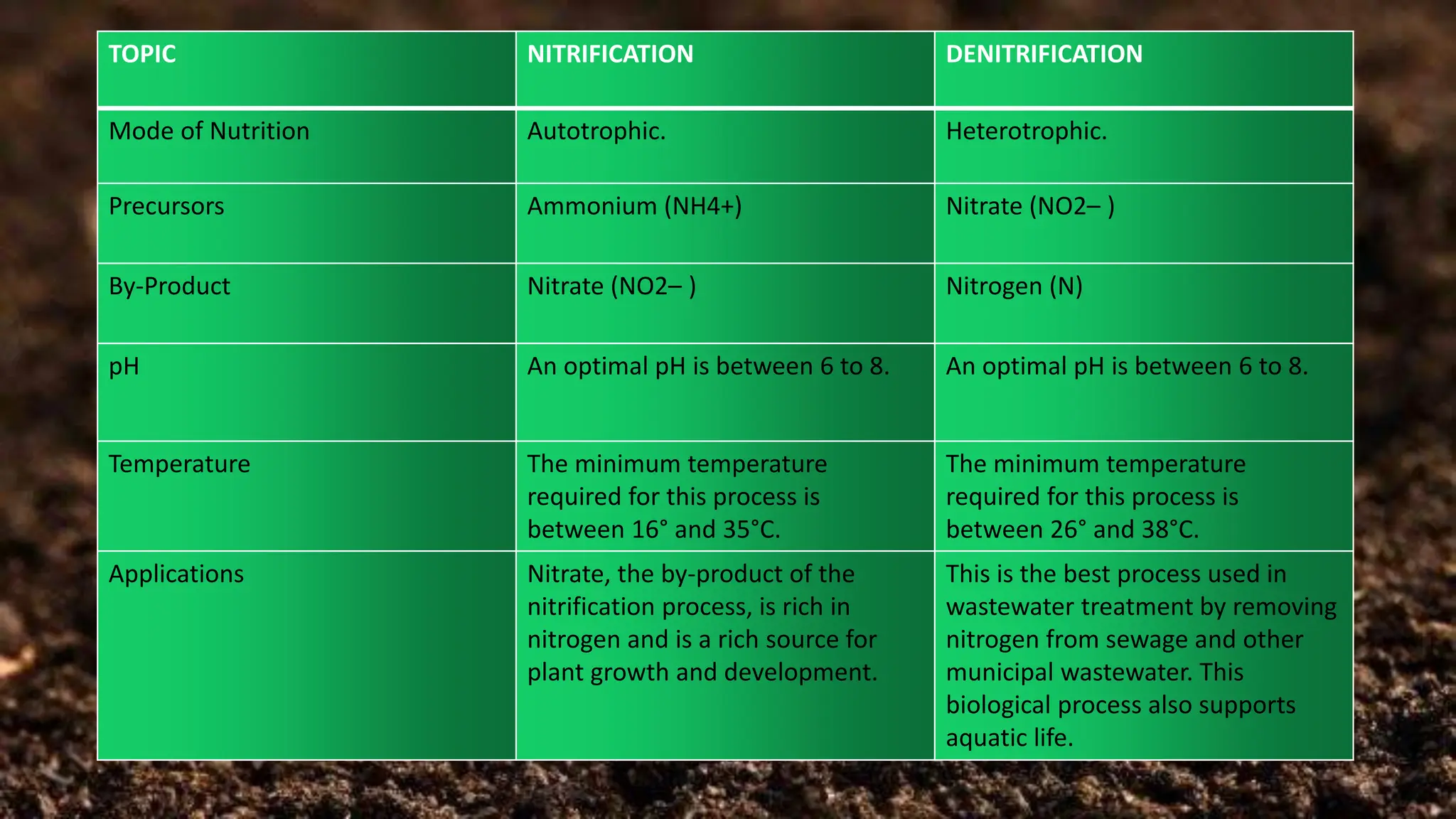
TOPIC NITRIFICATION DENITRIFICATION
Mode of Nutrition Autotrophic. Heterotrophic.
Precursors Ammonium (NH4+) Nitrate (NO2– )
By-Product Nitrate (NO2– ) Nitrogen (N)
pH An optimal pH is between 6 to 8. An optimal pH is between 6 to 8.
Temperature The minimum temperature
required for this process is
between 16° and 35°C.
The minimum temperature
required for this process is
between 26° and 38°C.
Applications Nitrate, the by-product of the
nitrification process, is rich in
nitrogen and is a rich source for
plant growth and development.
This is the best process used in
wastewater treatment by removing
nitrogen from sewage and other
municipal wastewater. This
biological process also supports
aquatic life.
THANK YOU

ORGANISMS INVOLVED IN NITRIFICATION AND DENTRIFICATION IN SOIL-compressed.pdf

  • 1.
    VIVEKANANDHA ARTS ANDSCIENCE COLLEGE FOR WOMEN VEERCHIPALYAM-637303,SANKAGIRI,SALEM Dt.,TAMILNADU,INDIA. AFFILIATED TO PERIYAR UNIVERSITY,SALEM;RECOGNISED UNDER SECTION 2(F)&12(B) OF THE UGC ACT 1956) SUBMITTED BY: KANIMOZHI.I.S., III B.SC.MICROBIOLOGY, DEPARTMENT OF MICROBIOLGY,VIAAS, Sankagiri. DEPARTMENT OF MICROBIOLOGY SUBJECT INCHARGE; Dr.R.DINESHKUMAR, APMICROBIOLOGY, Assistant professor, Department of Microbiology, VIAAS,Sankagiri. SUBJECT:SOIL AND AGRICULTURAL MICROBIOLOGY TOPIC :ORGANISMS INVOLVED IN NITRIFICATION AND DENITRIFICATION IN SOIL
  • 2.
    ORGANISMS INVOLVED IN NITRIFICATIONAND DENTRIFICATION IN SOIL BY; Kanimozhi.I.S.
  • 3.
    NITRIFICATION: ➢Nitrosomonas: These bacteriaconvert ammonia (NH₃) into nitrite (NO₂⁻). ➢Nitrobacter: Following the conversion by Nitrosomonas, these bacteria convert nitrite (NO₂⁻) into nitrate (NO₃⁻).
  • 4.
    ORGANISMS INVOLED INNITRIFICATION IN SOIL Nitrification in soil is a two-step process, and different bacteria are involved at each stage: Ammonia Oxidizers: ➢Nitrosomonas: These bacteria are primarily responsible for converting ammonia (NH₃) into nitrite (NO₂⁻). ➢Nitrosospira: Another type of bacteria that also plays a role in ammonia oxidation.
  • 5.
  • 6.
    Nitrite Oxidizers: ➢Nitrobacter: Thesebacteria take the nitrite (NO₂⁻) produced by ammonia oxidizers and convert it into nitrate (NO₃⁻). ➢Nitrospira: Another group of bacteria involved in the conversion of nitrite to nitrate. ✓This transformation is crucial for providing plants with a usable form of nitrogen. NH4+(Ammonium) → NO2– (Nitrite) → NO3– (Nitrate)
  • 7.
    DENITRIFICATION: ➢Pseudomonas and Clostridium:These bacteria convert nitrate (NO₃⁻) into nitrogen gas (N₂), which is released into the atmosphere. ➢Thiobacillus: This bacteria also participates in the reduction process during denitrification.
  • 8.
  • 9.
    ORGANISMS INVOLED INDENITRIFICATION IN SOIL Denitrification is an essential process in the nitrogen cycle, where nitrate (NO₃⁻) is reduced to nitrogen gases (N₂ or N₂O), and various bacteria are involved in this process: ➢Pseudomonas: These bacteria are among the most common denitrifiers in soil. They reduce nitrate to nitrogen gas. ➢Clostridium: These anaerobic bacteria contribute to the denitrification process, especially in oxygen-depleted environments. ➢Thiobacillus: These bacteria participate in reducing nitrate to nitrogen gas, often found in sulfur-rich environments.
  • 10.
    ➢Paracoccus: Another groupof bacteria involved in the denitrification process. ➢Bacillus: These bacteria can also reduce nitrate under anaerobic conditions. ✓Reduction of Nitrate to Nitrite: This is the first step where bacteria like Pseudomonas reduce nitrate (NO₃⁻) to nitrite (NO₂⁻). ✓Reduction of Nitrite to Nitric Oxide: Nitrite is further reduced to nitric oxide (NO) by the action of denitrifying bacteria. ✓Reduction of Nitric Oxide to Nitrous Oxide: The nitric oxide is then reduced to nitrous oxide (N₂O). ✓Reduction of Nitrous Oxide to Nitrogen Gas: Finally, nitrous oxide is reduced to nitrogen gas (N₂), which is released into the atmosphere.
  • 11.
    Denitrification primarily occursin anaerobic conditions (absence of oxygen), which are commonly found in waterlogged soils or sediments. ➢This process is carried out by various bacteria, such as: ✓Pseudomonas ✓Clostridium ✓Thiobacillus ✓Paracoccus ✓Bacillus ➢These bacteria use nitrate as an electron acceptor instead of oxygen during their respiration. This not only helps in maintaining soil health but also in reducing the loss of soil fertility by preventing the leaching of nitrate into water bodies.
  • 12.
    HNO2 + NH3→ N2 + 2H2O This proca oxidation (Anammox) and is classified as denitrification (rather than nitrification) given that nitrogen gas is generated in the reaction. The bacteria responsible for Anammox are autotrophic, with inorganic carbon as the source of their cell carbon. ess is termed anaerobic ammoni
  • 13.
    Organic denitrification: ➢Denitrification withan organic material relies on facultative heterotrophs that are capable of using nitrite and nitrate as the terminal electron acceptors in their respiratory chain. ➢ In the coupled redox reactions, nitrate and nitrite is reduced to nitrogen gas while the organic material is oxidized to carbon dioxide and water. ➢Virtually all bacteria that are able to reduce nitrate are also able to reduce nitrite. ➢ Thus, for simplicity, sometimes a single group of denitrifiers capable of both nitrite and nitrate reduction is assumed.
  • 14.
    ➢Organic carbon isthe source of cell carbon. ➢ Thus, for example, with acetate as the energy source and ammonia as the source of cell nitrogen, the overall stoichiometry for catabolism and anabolism is: 1 . 77CH2O + 0.62HNO3 + 0.2NH3 → CH1.4O0.4N0.2 + 0.77CO2 +1.68H2O + 0.305N2 ➢The stoichiometry of endogenous metabolism can be derived as for nitrification, except that nitrate is the electron acceptor in this case: CH1.4O0.4N0.2 + 0.8HNO3 → 0.2NH3 + 0.8H2O + CO2 + 0.4N2 ➢The actual growth yield can be derived from Equation , considering only one group of denitrifiers, as 0.43-g biomass/g-CH2O, or 0.40-g biomass/g-COD. ➢The sludge yield from such heterotrophic denitrification is higher than that for nitrification, while denitrification generates alkalinity and, thus, the wastewater pH will increase as a result of this process.
  • 15.
    ➢Apart from extracellularsubstrates, denitrification is also occur using intracellular organic polymer. ➢ Heinemann and Mòller (1991) co-immobilized denitrifying bacteria with poly-$bT-hydroxylbutyric (PHB) acid in biopolymeric matrix to denitrify water ➢ The possibility of using PHB for denitrification allows for combined removal of nitrogen and phosphorus from sewage Inorganic denitrification: ➢Autotrophic denitrification can be achieved with sulphide, hydrogen and ammonia as the electron donor. ➢ In general, however, the concentrations of hydrogen and sulphide in wastewater are too low for them to be regarded as significant electron donors.
  • 16.
    ➢Van de Graaf(1997) showed that ammonia could be an electron donor for the reduction of nitrite to nitrogen gas. ➢The ammonia is oxidized under anaerobic (or strictly speaking, anoxic or denitrifying) conditions by nitrite, with both species contributing equally to the nitrogen content in the resultant nitrogen gas. HNO2 + NH3 → N2 + 2H2O ➢This process is termed anaerobic ammonia oxidation (Anammox) and is classified as denitrification (rather than nitrification) given that nitrogen gas is generated in the reaction. ➢The bacteria responsible for Anammox are autotrophic, with inorganic carbon as the source of their cell carbon.
  • 17.
    ➢Van de Graaf(1997) showed that ammonia could be an electron donor for the reduction of nitrite to nitrogen gas. ➢The ammonia is oxidized under anaerobic (or strictly speaking, anoxic or denitrifying) conditions by nitrite, with both species contributing equally to the nitrogen content in the resultant nitrogen gas. HNO2 + NH3 → N2 + 2H2O ➢This process is termed anaerobic ammonia oxidation (Anammox) and is classified as denitrification (rather than nitrification) given that nitrogen gas is generated in the reaction. ➢The bacteria responsible for Anammox are autotrophic, with inorganic carbon as the source of their cell carbon.
  • 18.
    ➢Van de Graaf(1997) showed that ammonia could be an electron donor for the reduction of nitrite to nitrogen gas. ➢The ammonia is oxidized under anaerobic (or strictly speaking, anoxic or denitrifying) conditions by nitrite, with both species contributing equally to the nitrogen content in the resultant nitrogen gas. HNO2 + NH3 → N2 + 2H2O ➢This process is termed anaerobic ammonia oxidation (Anammox) and is classified as denitrification (rather than nitrification) given that nitrogen gas is generated in the reaction. ➢The bacteria responsible for Anammox are autotrophic, with inorganic carbon as the source of their cell carbon.
  • 19.
    NITRIFICATION AND DENITRIFICATION-DIFFERENT TOPICNITRIFICATION DENITRIFICATION Definition This is a biological process of converting ammonium (NH4+) into nitrate (NO3–). This is a biological process of converting nitrate (NO3–) into nitrogen gas (N2). Involvement of Bacteria Nitrosomonas and Nitrobacter. Lactobacillus, Spirillum, Pseudomonas, and Thiobacillus. Growth and Development The growth is prolonged. The growth is fast. Mode of Respiration Aerobic mode of Respiration. Anaerobic mode of Respiration.
  • 20.
    TOPIC NITRIFICATION DENITRIFICATION Modeof Nutrition Autotrophic. Heterotrophic. Precursors Ammonium (NH4+) Nitrate (NO2– ) By-Product Nitrate (NO2– ) Nitrogen (N) pH An optimal pH is between 6 to 8. An optimal pH is between 6 to 8. Temperature The minimum temperature required for this process is between 16° and 35°C. The minimum temperature required for this process is between 26° and 38°C. Applications Nitrate, the by-product of the nitrification process, is rich in nitrogen and is a rich source for plant growth and development. This is the best process used in wastewater treatment by removing nitrogen from sewage and other municipal wastewater. This biological process also supports aquatic life.
  • 21.