UNIT 3
Group dynamics
• Groups are important for organisational life. Managers
spend substantial time in managing groups and teams
so that groups contribute to organisational and group
goals. How effectively a manager plans, organises,
staffs, leads and controls depends upon how effectively
he manages the groups. A group means “two or more
people who interact with one another, are
psychologically aware of one another, perceive
themselves to be members of the group, and work
towards a common goal.”
• Group dynamics studies the nature, formation and
reasons for forming the groups. It studies how groups
affect the behaviour and attitude of members and the
organisation. It is a process by which people interact
with each other. If groups are effectively managed,
they contribute a lot to organisational goals.
Meaning, Concept
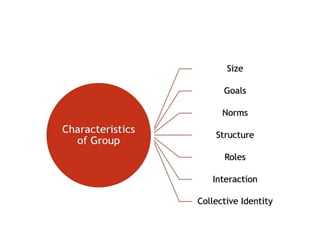
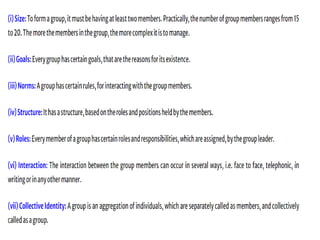
Group has the following features :
1. It consists of two or more persons who interact
with each other.
2. Group members have reciprocal influence on
each other. Each member influences and is
influenced by others in the group.
3. People develop mutual perceptions and
emotions. They perceive and recognise each other
as members of the group.
4. Every group has
• formal leader elected by group members, and
• informal leader “who engages in leadership activities but
whose right to do so has not been formally recognised by
the organisation or group.”
5. Each individual performs specific role which
influences expectations of group members from
each other. Role structure is “the set of defined
roles and inter-relationships among those roles that
the group or team members define and accept.”
6. Every group has group norms. “Norm is a
standard of behaviour that the group accepts and
expects of its members. It represents standards of
work to promote group activity.”
7. It maintains stability through group cohesiveness.
Members
• develop liking for each other,
• develop sense of identification with each other, and
• remain attached to each other.
8. Members work for common interests and goals.
• (1) The term group refers to two or more
individuals who bear an explicit psychological
relationship to one another.
• (2) The group consists of two or more individuals
and possesses some cohesiveness. It reveals
some amount of interaction among its members
who have definite ideas of their position and role
in it.
• (3) Relationships concentrating on status and roll
along with common values or norms are
characteristics features of the group.
• (4) As the group operates on a common task,
common attitudes develop and members become
aware that they are part of it.
• (i) Group dynamics describes how a group should
be organised and operated. This includes pattern
of leadership and cooperation.
• (ii) Group dynamics consists of a set of
techniques such as role playing, brainstorming,
group therapy, sensitivity training etc.
• (iii) Group dynamics deals with internal nature of
groups, their formation, structure and process,
and the way they affect individual members,
other groups and the organisation as a whole.
• (iv) Group dynamics refers to changes which take
place within groups and is concerned with the
interaction and forces obtained between group
members in a social setting.
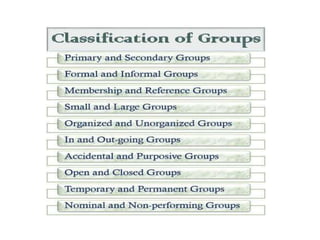
• Primary and Secondary Groups
• In terms of face to face or indirect interaction between
the parties, groups can be bifurcated as follows:
• Primary Group: The group where an individual directly
interacts with other members is termed as the primary
group. It is responsible for the initial learning and social
behaviour of an individual.
Secondary Group: When a person in a group is
indirectly associated with or influenced by other
members, he/she is said to be in a secondary group.
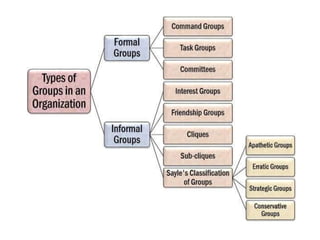
• Formal Groups
• When people collaborate to attain the organizational goals
or objectives, they are said to form a formal group.
• Following are the three major types of formal groups
existing in an organization:
• Command Group: As a result of hierarchical arrangement in
an organization, a command group is made of the superiors
and their subordinates representing the flow of command
or orders from top to bottom level.
• Task Group: A group which includes individuals with
different skills and knowledge, to successfully carry out the
assigned project, is called as a task group.
• Committees: For the special assignments or projects, a
group is formed by appointing the specialists or people
with superior knowledge; which is termed as a committee.
After the project responsibilities are executed successfully,
the members can disassociate from the committee.
Informal Groups
• When the individuals associate with one another to serve their
common interest or for self-satisfaction, they are known to form
an informal group. Some of the most common informal groups
are:
• Interest Groups: The individuals who join hands for a common
purpose (related to self-interest) create an interest group.
• Friendship Groups: The group which is formed as a result of
personal choice by the individuals who are already familiar and
feel comfortable with one another, is called a friendship group.
• Cliques: In a workplace, few colleagues join hands to form a small
group (usually with two to six members) to share ideas and
thoughts on their mutual interest.
• Sub-cliques: When a clique comprises of few organizational
employees along with some non-employees (who are associated
with the other members in either way), it termed as a sub-clique.
Sayles’ Classification of Groups: L.R. Sayles categorized the groups
into the following types depending upon the degree of pressure
prevalent in each:
• Apathetic Groups: The group in which the leader does not
pressurize the members; moreover, leadership is hardly
widespread; it is termed as an apathetic group. Usually, it is
formed by the lower-level workers who are unskilled and work on
low wages.
• Erratic Groups: When the people belonging to a group gets
enraged quickly and similarly calms down, they are said to be in
an erratic group. Such a group comprises of semi-skilled workers
who perform task desiring communication between them.
• Strategic Groups: Such a group includes skilled
workers, who hold various job positions to
execute the independent technological task.
These members have the skills of systematically
applying pressure on the management and the
other groups, by framing a suitable strategy.
• Conservative Groups: The group which comprises
of the stable and highly skilled individuals or
professional, who have extreme powers to
regulate the functioning of the organization, is
called as a conservative group.
• Membership and Reference Groups
• We can also distinguish between the different groups
by the need for official registration of the members,
into the following two categories:
• Membership Group: A group in which the members
must get themselves registered and acquire a
membership card or certificate for becoming a part of
it, is termed as a membership group.
• Reference Group: It may not be a real association of
individuals, an illusionary group to which an individual
relates himself/herself due to the same profession or
other similar attributes is called a reference group.
• Small and Large Groups
• Based on the number of members involved in a
group, we can classify it as follows:
• Small Group: Small groups consist of as little as
three to ten members. Such groups are usually
well managed and organized.
• Large Group: The groups made up of more than
ten members are considered to be large groups.
These massive groups are challenging to handle
and unsystematic at times.
• Organized and Unorganized Groups
• Given below is the categorization of the groups in terms of
its structure and bonding among the group members:
• Organized Group: When the individuals belonging to a
particular discipline work together systematically as
a team by supporting each other, they are said to be in an
organized group.
• Unorganized Group: The disorganized group is not formed
purposefully. Instead, the individuals just happened to fall
into a single group where they neither have any attachment
to one another nor have any belongingness.
• In and Out-going Groups
• We can also distinguish among groups according
to the belongingness and involvement of the
individuals, as below:
• In-Group: A group where an individual is socially
active and adopts strong values from the other
members is termed as an in-group.
• Out-going Group: The other groups, except the
prevalent in-group, where no inter-group
exchange of values is facilitated is termed as out-
going groups
• Accidental and Purposive Groups
• The purpose of the group formation provides a
basis for its classification into the following two
categories:
• Accidental Group: When a group is formed
coincidently or unknowingly, that too without any
purpose, it is known as an accidental group.
• Purposive Group: The group which is made for a
definite reason or aim of task fulfilment is termed
as a purposive group.
• Open and Closed Groups
• Based on the scope for entry and exit of the members in a group, it
can be distinguished as follows:
• Open Group: The group where the new individuals can freely enter
and old members can exit anytime, is known as an open group.
• Closed Group: The restricted group where no further entries are
entertained, is called as a closed group.
• Temporary and Permanent Groups
• A group can be formed for a short period or a long duration. Let us
now discuss the two categories of groups based on these criteria:
• Temporary Group: When the individuals come together for a
particular project or task accomplishment, they are known to be in
a temporary group. Such a group disintegrates after the successful
performance of the task.
• Permanent Group: Such groups represent a long-term association
of the group members. Here, people belonging to a particular
organization are known to be in a single group.
• Nominal and Non-performing Groups
• Based on the need for action, groups can also be
bifurcated into the following types:
• Nominal Group: The group in which the members are
involved in problem-solving, take up challenges and
carry out operations, is termed as a nominal group.
• Non-performing Group: Whenever the individuals are
put together in a single group, just on a sheet of paper;
however, they need not carry out any task, they tend to
be in a non-performing group.
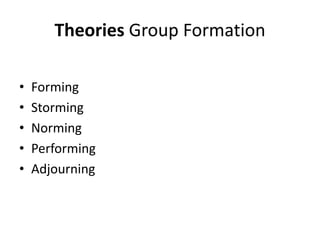
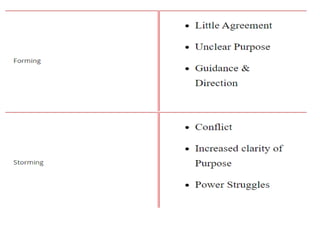
Theories Group Formation
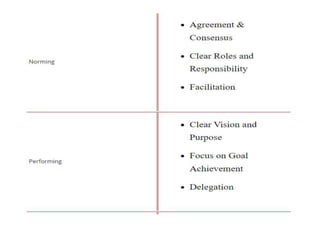
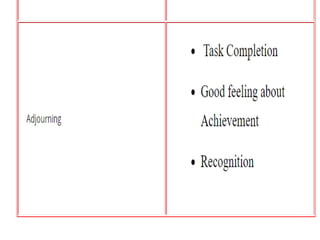
• Forming
• Storming
• Norming
• Performing
• Adjourning
• 1. Propinquity Theory:
• The most basic theory explaining affiliation is
propinquity. This interesting word simply means that
individuals affiliate with one another because of
spatial or geographical proximity. In an organisation
employees who work in the same area of the plant
or office or managers with offices close to one
another would more probably form into groups than
would those who are not physically located together.
There is some research evidence to support the
propinquity theory and on the surface, it has a great
deal of merit for explaining group formation. The
drawback of this theory is that it is not analytical and
does not begin to explain some of the complexities
of group formation. Some more theoretical and
practical reasons need to be explored.
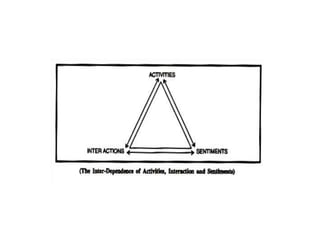
• 2. Homan’s Theory:
• According to George C. Homans, “The more
activities persons share, the more numerous
will be there interactions and the stronger will
be their shared activities and sentiments, and
the more sentiments people have for one
another, the more will be their shared
activities and interactions.”
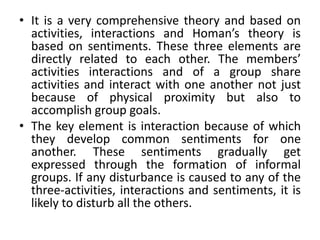
• It is a very comprehensive theory and based on
activities, interactions and Homan’s theory is
based on sentiments. These three elements are
directly related to each other. The members’
activities interactions and of a group share
activities and interact with one another not just
because of physical proximity but also to
accomplish group goals.
• The key element is interaction because of which
they develop common sentiments for one
another. These sentiments gradually get
expressed through the formation of informal
groups. If any disturbance is caused to any of the
three-activities, interactions and sentiments, it is
likely to disturb all the others.
3. Balance Theory:
• Another very comprehensive theory is a
Balance Theory of group formation. This
theory as proposed by Theodore Newcomb
states that “Persons are attracted to one
another on the basis of similar attitudes
towards commonly relevant objects and goals.
Once a relationship is formed, it strives to
maintain a symmetrical balance between the
attraction and the common attitudes. If an
imbalance occurs, attempts are made to
restore the balance. If the balance cannot be
restored, the relationship dissolves.”
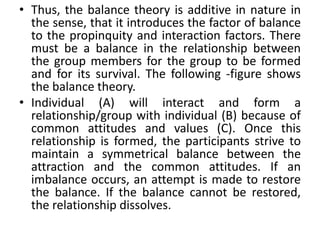
• Thus, the balance theory is additive in nature in
the sense, that it introduces the factor of balance
to the propinquity and interaction factors. There
must be a balance in the relationship between
the group members for the group to be formed
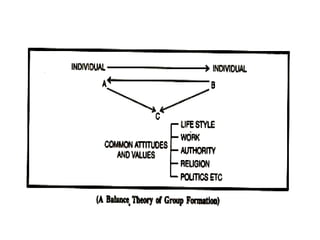
and for its survival. The following -figure shows
the balance theory.
• Individual (A) will interact and form a
relationship/group with individual (B) because of
common attitudes and values (C). Once this
relationship is formed, the participants strive to
maintain a symmetrical balance between the
attraction and the common attitudes. If an
imbalance occurs, an attempt is made to restore
the balance. If the balance cannot be restored,
the relationship dissolves.
4. Exchange Theory:
• This theory is based on reward-cost outcomes of
interactions. To be attracted towards a group, a person
thinks in terms of what he will get in exchange of
interaction with group members. A minimum positive
level (rewards greater than costs) of an outcome must
exist in order for attraction or affiliation to take place.
Rewards from interactions gratify needs while costs
incur anxiety, frustrations, embarrassment or fatigue.
Propinquity, interaction and common attitudes all have
roles in the exchange theory.
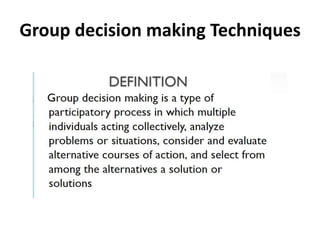
Group decision making Techniques
• 2.Problem Diagnosis Develop a model of
the problem using the behavior or
objective as the dependent variable. The
independent variables in the model
should represent the potential causes of
the problem.Avoid the trap of assessing
the blame. Issues: Developing a model or
construct is an "intuitive" exercise. Once
the model is established, it tend to
become the basis the remainder of the
process.
• 3. Solution Generation Generate a
number of possible solutions before
starting evaluation. Issues: Don't get
locked into a limited solution set too
early Work to encourage new and
different approaches. Consensual
schema often limit the range of
alternatives groups consider
• 4. Solution Evaluation And Choice Evaluation
should be based on comparing alternative
solutions to constraint set developed in the
problem identification phase Develop strategy
for dealing with multiple conflicting criteria:
Maximizing versus satisficing Issues: The method
used to resolve intra-group conflicts is important
at this point. The use of forcing (voting),
smoothing, withdrawal, compromise, and
integrative decision making (win-win) method
have different consequence in terms of solution
quality, solution acceptance, and group
maintenance
• 5) Framing a Decision: When the possible
outcomes of possible courses of action are thus
analysed with the help of data and models, it
becomes easy to select a particular course of
action to cope with a particular problem.
• 6) Follow up Actions: The decision maker has to
plan follow up strategies and actions. He has to
anticipate reactions of others who are affected by
the decisions. He has to make short run and long
run decisions. Decision making is a continuous
process where decision made induces a new
problem which may call for a new decisions and
so on
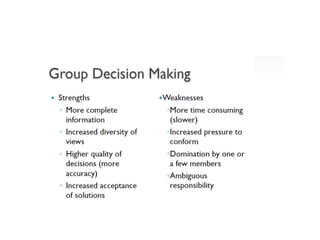
ADVANTAGES
• Synergy
• It is the idea that the whole is greater than the
aggregate of its parts. When a group makes a decision
collectively, its judgment can be powerful than that of
any of its members. Through discussing, questioning,
and collaborative approach, group members can
identify more complete and robust solutions and
recommendations.
• Sharing of information
• Group decisions take into account a wider scope of
information as each group member may contribute
distinct information and expertise. Sharing information
increases understanding, clarifies issues, and facilitates
movement towards a collective decision.
DISADVANTAGES
• Diffusion of Responsibility
• Group decision making results in distribution of
responsibility that results in lack of accountability for
outcomes. In this way, everyone is responsible for a
decision, and no one really is. Moreover, group decisions
can make it easier for members to refuse personal
responsibilities and blame others for bad decisions.
• Lower Efficiency
• Group decisions can sometimes be less efficient than
individual decisions. It takes additional time because there
is a need of active participation, discussion, and
coordination among group members. Without good
facilitation and structure, meetings can get eliminated in
trivial details that may matter a lot to one person but not to
the others.
• Groupthink
• One of the biggest disadvantage of effective group
decision making is groupthink. It is a psychological
phenomenon that occurs within a group of people in
which the wish for harmony or conformity results in an
illogical or dysfunctional decision-making outcome.
• By refraining themselves from outside influences and
actively suppressing opposing viewpoints in the
interest of minimizing conflict, group members reach a
consensus decision without critical evaluation of
substitute viewpoints.
Group Decision-Making Techniques
Brainstorming
• This technique includes a group of people, mostly
between five and ten in number, sitting around a table,
producing ideas in the form of free association. The
main focus is on generation of ideas and not on
evaluation of these ideas.
• If more ideas can be originated, then it is likely that
there will be a unique and creative idea among them.
All these ideas are written on the blackboard with a
piece of chalk so that all the team members can see
every idea and try to improvise these ideas.
• Brainstorming technique is very effective when the
problem is comparatively precise and can be simply
defined. A complex problem can be divided into parts
and each part can be dealt with separately at a time.
• Nominal Group Thinking
• This technique is similar to brainstorming except that this
approach is more structured. It motivates individual
creativity. Members form the group for namesake and
operate independently, originate ideas for solving the
problem on their own, in silence and in writing. Members
do not communicate well with each other so that strong
personality domination is evaded.
• The group coordinator either collects the written ideas or
writes them on a large blackboard so that each member of
the group can see what the ideas are. These ideas are
further discussed one by one in turn and each participant is
motivated to comment on these ideas in order to clarify
and improve them. After all these ideas have been
discussed, they are evaluated for their merits and
drawbacks and each actively participating member is
needed to vote on each idea and allot it a rank on the basis
of priority of each alternative solution.
• The idea with the highest cumulative ranking is selected as
the final solution to the problem.
Didactic Interaction
This technique is applicable only in certain situations, but is an
excellent method when a situation actually demands it. The type of
problem should be such that it generates output in the form of yes
or no. Say for example, a decision is to be made whether to buy or
not to buy a product, to merge or not to merge, to expand or not to
expand and so on. These types of decision requires an extensive
and exhaustive discussion and investigation since a wrong decision
can have serious consequences.
There are many advantages as well as disadvantages of this type of
situation. The group that makes the decision is divided into two
sub-groups, one in favor of the “go” decision and the opposing in
favor of “no go” decision.
The first group enlists all the “pros” of the problem solution and the
second group lists all the “cons”. These groups meet and discuss
their discoveries and their reasons.
After tiring discussions, the groups switch sides and try to find
weaknesses in their own original standpoints. This interchange of
ideas and understanding of various viewpoints results in mutual
acceptance of the facts as they exist so that a solution can be put
together around these facts and ultimately a final decision is
reached.
• Delphi Technique
• This technique is the improvised version of the nominal
group technique, except that it involves obtaining the
opinions of experts physically distant from each other and
unknown to each other.
• This isolates group members from the undue influence of
others. Basically, the types of problems sorted by this
technique are not specific in nature or related to a
particular situation at a given time.
• For example, the technique could be used to explain the
problems that could be created in the event of a war. The
Delphi technique includes the following steps −
• The problem is first identified and a panel of experts
are selected. These experts are asked to provide
potential solutions through a series of thoughtfully
designed questionnaires.
• Each expert concludes and returns the initial
questionnaire.
• The results of the questionnaire are composed at a
central location and the central coordinator prepares
a second set of questionnaire based on the previous
answers.
• Each member receives a copy of the results
accompanied by the second questionnaire.
• Members are required to review the results and
respond to the second questionnaire. The results
typically trigger new solutions or motivate changes in
the original ideas.
• The process is repeated until a general agreement is
obtained.
Team building
• Team building is the process of bringing individuals
together to build a team. Team building is required for
making a strong cohesive team which works together
for a common goal. Team building consists of different
activities and techniques that are used by
organizations, sports teams and schools so that the
students and employees view each other as a part of
teams who can coordinate and work together to
improve overall performance.
•
IMPORTANCE
• Any group of individuals comprises of people of different
skills, values, beliefs, experience, background etc. A group
of people will not be able to give high efficiency in their
collective output unless they work as a team. The main
objective of these team building exercises is to understand
and improve team dynamics, increase communication and
flexibility amongst the different members. Team building is
an important aspect of team management which is
important for the success for any business or organization.
Team building helps to develop a bond among individuals,
helps understand each other’s strengths & weaknesses,
improve skills like leadership, time management, decision
making etc. Team building is thus the process of making a
team.
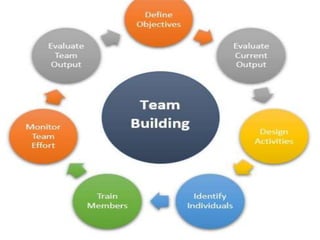
• 1. Define Objectives: The first step in the team building
process is to identify the final objective or goal which
needs to be achieved. Based on this, other criteria like
team members, tasks, budget etc are decided.
• 2. Evaluate Current Output: The second step in the
team building process is to understand the current
output and the gap which is there in meeting the final
objectives. This shows the extra efforts needed to
achieve the final goal.
• 3. Design Activities & Tasks: The next step involves
designing tasks and activities which would help in
reaching the final goals.
• 4. Identify Individuals: The fourth step in the team
building process is to identify individuals or employees
based on their skills, experience, education etc who
would be able to execute these tasks.
• 5. Training of Members: Once the individuals are identified,
training and development of these people are done with a
clear understanding of each one’s roles and responsibilities.
• 6. Monitor Team Effort: The next step in the team building
process is to closely monitor the team effort, their
behaviour etc.
• 7. Evaluate Team Output: The final step in the team
building process is to evaluate and see the overall output of
the team and compare it with the original objective which
was set.
• Team building is a reiterative and continuous process which
requires time, patience, resources, efforts etc until an
effective team is created or built.
Understanding team design Characteristics
• Team design is the process of organizing individuals into a cohesive
coalition—one that makes a concerted effort to achieve a shared
outcome.
• Teamwork has a lot of advantages: combined brain power,
complementary skills, and a broad range of information and
experience, to name a few. Yet, it can also present a variety of
challenges.
• Poor project management, dysfunctional communication,
inconsistent instructions, and unrealistic expectations can be
disruptive under any circumstances. At worst, those disruptions can
be exponentially damaging to your organization, especially when
multiple people (or teams) are involved or affected.
• Team design helps you structure a team and its goals in a way that
minimizes disruptions and maximizes efficiency. By practicing team
design principles, you can boost morale, improve engagement, and
unlock a new level of team productivity.
CHARACTERISTICS
GOOD COMMUNICATION
INDIVIDUAL TALENT
BELONGINGNESS
LEADERSHIP
STRUCTURE
ACHIEVABLE GOALS
FEEDBACK
POSITIVE ATTITUDE
SOLUTION FOCUSSED TEAM
Interpersonal relations,
Communication
• Interpersonal skills are the skills we use every day when
we communicate and interact with other people, both
individually and in groups. They include a wide range of
skills, but particularly communication skills such as
listening and effective speaking. They also include the
ability to control and manage your emotions.
• It is no exaggeration to say that interpersonal skills are
the foundation for success in life. People with strong
interpersonal skills tend to be able to work well with
other people, including in teams or groups, formally
and informally. They communicate effectively with
others, whether family, friends, colleagues, customers
or clients. They also have better relationships at home
and at work.
• Interpersonal skills are sometimes referred to
as social skills, people skills, soft skills, or life
skills.
• However, these terms can be used both more
narrowly and more broadly than
‘interpersonal skills’. we define interpersonal
skills as:
• “The skills you need and use to communicate
and interact with other people.”
• This definitionmeans that interpersonal skills therefore include:
• Communicationskills, which in turncovers:
– VerbalCommunication– what we say and how we say it;
– Non-Verbal Communication – what we communicate without
words, for example through body language, or tone of voice; and
– Listening Skills – how we interpret both the verbal and non-verbal
messages sent by others.
• Emotional intelligence – being able to understand and manage
your own and others’ emotions.
• Team-working – being able to work with others in groups and
teams, both formal and informal.
• Negotiation, persuasion and influencing skills – working with
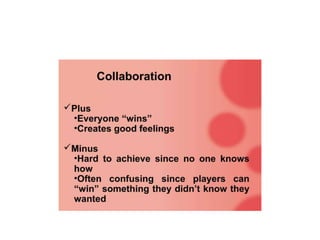
others to find a mutually agreeable (Win/Win) outcome. This may
be considered a subset of communication, but it is often treated
separately.
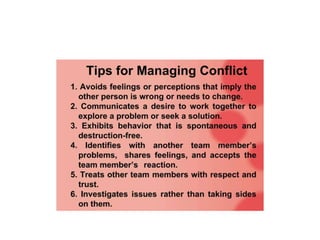
• Conflict resolution and mediation – working with others to resolve
interpersonal conflict and disagreements in a positive way, which
again may be considered a subset of communication.
• Problem solving and decision-making – working with others to
identify, define and solve problems, which includes making
decisions about the best course of action.
• Interpersonal relationship refers to a strong association among
individuals working together in the same organization. Employees
working together ought to share a special bond for them to deliver their
level best. It is essential for individuals to be honest with each other for a
healthy interpersonal relationship and eventually positive ambience at
the workplace.
• Howto Improve Interpersonal Relationship at Workplace?
• An association between individuals working together in the same
organization is called interpersonal relationship. An individual spends
around seven to eight hours at his workplace and it is practically not
possible for him to work all alone. One needs people to talk to and
discuss various issues at the workplace. Research says productivity
increases manifold when individuals work in groups as compared to an
individual working alone.
Employees must communicate with each other effectively for a
healthy relationship.
• Interact with your co-workers more often.
• Even employees from a different team can be your friends.
• Team leaders and supervisors should conduct morning
meetings with their team members.
• Do not favour any employee just because he is your relative or
you know him personally.
• Take your team out for lunch, picnics or get together once in a
while.
• Greet your colleagues on their birthdays or anniversaries.
• Individuals should be motivated to work in teams.
• One needs to be a little more adjusting and compromising at
the workplace.
• Avoid being jealous.
• Stand by your colleagues when needed.
• Stay positive at the workplace
• Respect your colleagues
• Being rude to fellowworkers spoils the relationship amongemployees.
• An individual needsto have effective communication skills(bothoral as
well as written) for a healthy interpersonal relationship at workplace
• Be cheerful at the workplace
• Make your fellow workersfeel important
• Standby your colleagues at the times of crisis
• Be honest to others andbe a patient listener
• Being trustworthy helps yougain confidence of fellow workers
• An individual’s personal interest ought to take a backseat at workplace
• Be a little more understanding and compromisingto avoid unnecessary
conflicts at the workplace
• Be nice andkind to everyone
• Communications is fundamental to the existence and survival
of humans as well as to an organization. It is a process of
creating and sharing ideas, information, views, facts, feelings,
etc. among the people to reach a common understanding.
Communication is the key to the directing function of
management.
• A manager may be highly qualified and skilled but if he does
not possess good communication skills, all his ability becomes
irrelevant. A manager must communicate his directions
effectively to the subordinates to get the work done from them
properly.
Communication
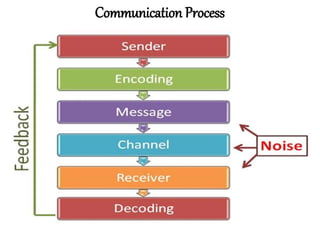
Communication Process
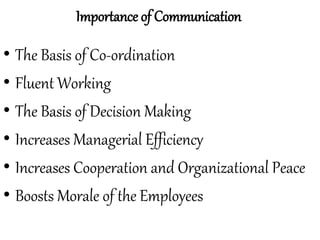
• The Basis of Co-ordination
• Fluent Working
• The Basis of Decision Making
• Increases Managerial Efficiency
• Increases Cooperation and Organizational Peace
• Boosts Morale of the Employees
Importance of Communication
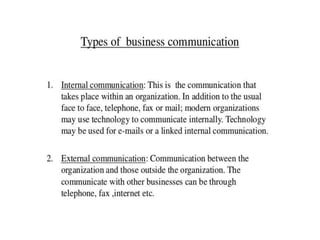
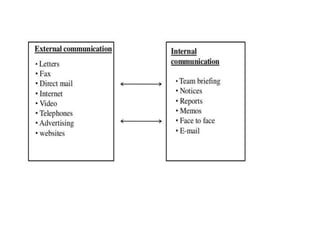
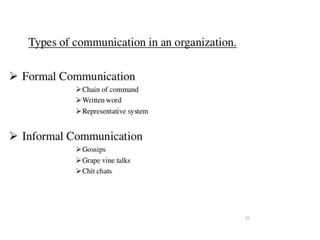
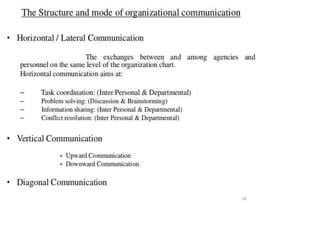
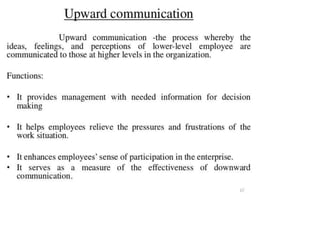
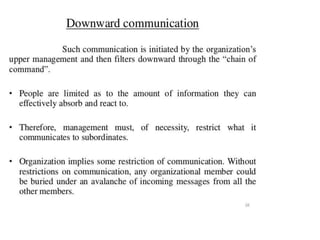
1. Formal Communication
• VerticalCommunication
• HorizontalCommunication
Types of communication networks in formal communication:
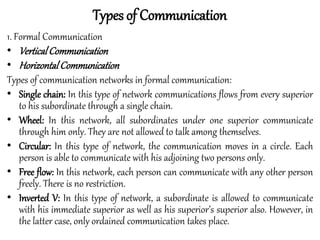
• Single chain: In this type of network communications flows from every superior
to his subordinate through a single chain.
• Wheel: In this network, all subordinates under one superior communicate
through him only. They are not allowed to talk among themselves.
• Circular: In this type of network, the communication moves in a circle. Each
person is able to communicate with his adjoining two persons only.
• Free flow: In this network, each person can communicate with any other person
freely. There is no restriction.
• Inverted V: In this type of network, a subordinate is allowed to communicate
with his immediate superior as well as his superior’s superior also. However, in
the latter case, only ordained communication takes place.
Types of Communication
2. Informal Communication
• Any communication that takes place without following the formal channels of
communication is said to be informal communication. The Informal
communication is often referred to as the ‘grapevine’ as it spreads throughout the
organization and in all directions without any regard to the levels of authority.
• The informal communication spreads rapidly, often gets distorted and it is very
difficult to detect the source of such communication. It also leads to rumours
which are not true. People’s behaviour is often affected by the rumours and
informal discussions which sometimes may hamper the work environment.
• However, sometimes these channels may be helpful as they carry information
rapidly and, therefore, may be useful to the manager at times. Informal channels
are also used by the managers to transmit information in order to know the
reactions of his/her subordinates
Types of Communication
• Typesof Grapevine network:
• Single strand: In this network, each person communicates with
the other in a sequence.
• Gossip network: In this type of network, each person
communicates with all other persons on a non-selective basis.
• Probability network: In this network, the individual communicates
randomly with other individuals.
• Cluster Network: In this network, the individual communicates
with only those people whom he trusts. Out of these four types of
networks, the Cluster network is the most popular in
organizations.
Types of Communication
• Barriers to Communication
• The communication barriers may prevent communication or carry
incorrect meaning due to which misunderstandings may be
created. Therefore, it is essential for a manager to identify such
barriers and take appropriate measures to overcome them. The
barriers to communication in organizations can be broadly
grouped as follows:
• Semantic Barriers
• Psychological Barriers
• Organizational Barriers
• Personal Barriers
Barriers to Communication
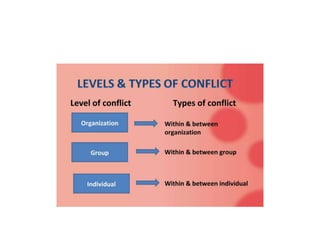
Conflict Management, Levels of
Conflict
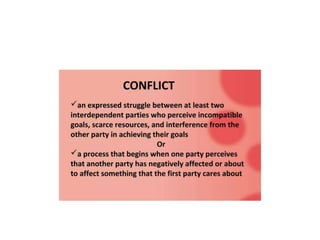
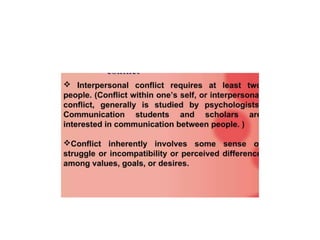
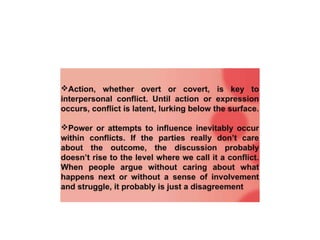
Conflict may occur in our day today life in our work
environment, it is said to be a natural occurrence .It is
found in almost all organization which may result due to
different needs, interests, different way of thinking,
differences in goals etc. The term conflict is derived from
the Latin word Com+Flagrare in which “com” means
together and “flagrare means to strike to be opposed or
to be incompatible and so on .According to Chung and
Megginson conflict as “ the struggle between
incompatible or opposing needs,wishes,ideas,interests,or
people. Conflict arises when individuals or groups
encounter goals that both parties cannot obtain
satisfactorily.
• Control mechanisms play an important role in any business organization, without
which the roles of managers get constrained. Control is required for achieving the
goals in a predefined manner because it provides the instruments which influence the
performance and decision-making process of an organization. Control is in fact
concerned with the regulations applied to the activities within an organization to
attain expected results in establishing policies, plans, and practices.
• Control mechanisms can be set according to functions, product attributes,
geographical attributes, and the overall strategic and financial objectives.
• Objectives of Control
• There are three major objectives for having a control mechanism in an international
firm. They are −
• To get data and clues for the top management for monitoring, evaluating, and
adjusting their decisions and operational objectives.
• To get clues based on which common objectives can be set to get optimum
coordination among units.
• To evaluate the performance metrics of managers at each level.
Authority and organizational control
mechanisms
• There are various modes of control. The most
influential ones are the following −
• Personal Controls
• Bureaucratic Controls
• Output Controls
• Cultural Controls
• https://www.tutorialspoint.com/strategic_manag
ement/organizational_control_systems.html
Types of Control Mechanisms
• Market Approach
• Rules Approach
• Corporate Culture Approach
• Reporting Culture
• Visits to Subsidiaries
• Management Performance Evaluation
• Cost and Accounting Comparisons
Approaches to Control Mechanisms
• Control mechanisms can never be uniform in every
country. International firms have to face severe
constraints based on which they modify their control
mechanisms in every country. Here is a list of major
constraints that affect an organization in setting its
managerial control mechanism −
• Distance
• Diversity
• Degree of Uncertainty
Constraints of Control Approaches
Distinction between organizational
culture and climate, Creating and
Sustaining Culture
• https://egyankosh.ac.in/bitstream/123456789
/12256/1/Unit-17.pdf

Organisational Bvr UnIT 3 Editd (2).pptx

  • 1.
  • 2.
  • 4.
    • Groups areimportant for organisational life. Managers spend substantial time in managing groups and teams so that groups contribute to organisational and group goals. How effectively a manager plans, organises, staffs, leads and controls depends upon how effectively he manages the groups. A group means “two or more people who interact with one another, are psychologically aware of one another, perceive themselves to be members of the group, and work towards a common goal.” • Group dynamics studies the nature, formation and reasons for forming the groups. It studies how groups affect the behaviour and attitude of members and the organisation. It is a process by which people interact with each other. If groups are effectively managed, they contribute a lot to organisational goals.
  • 5.
  • 6.
    Group has thefollowing features : 1. It consists of two or more persons who interact with each other. 2. Group members have reciprocal influence on each other. Each member influences and is influenced by others in the group. 3. People develop mutual perceptions and emotions. They perceive and recognise each other as members of the group. 4. Every group has • formal leader elected by group members, and • informal leader “who engages in leadership activities but whose right to do so has not been formally recognised by the organisation or group.”
  • 7.
    5. Each individualperforms specific role which influences expectations of group members from each other. Role structure is “the set of defined roles and inter-relationships among those roles that the group or team members define and accept.” 6. Every group has group norms. “Norm is a standard of behaviour that the group accepts and expects of its members. It represents standards of work to promote group activity.” 7. It maintains stability through group cohesiveness. Members • develop liking for each other, • develop sense of identification with each other, and • remain attached to each other. 8. Members work for common interests and goals.
  • 8.
    • (1) Theterm group refers to two or more individuals who bear an explicit psychological relationship to one another. • (2) The group consists of two or more individuals and possesses some cohesiveness. It reveals some amount of interaction among its members who have definite ideas of their position and role in it. • (3) Relationships concentrating on status and roll along with common values or norms are characteristics features of the group. • (4) As the group operates on a common task, common attitudes develop and members become aware that they are part of it.
  • 9.
    • (i) Groupdynamics describes how a group should be organised and operated. This includes pattern of leadership and cooperation. • (ii) Group dynamics consists of a set of techniques such as role playing, brainstorming, group therapy, sensitivity training etc. • (iii) Group dynamics deals with internal nature of groups, their formation, structure and process, and the way they affect individual members, other groups and the organisation as a whole. • (iv) Group dynamics refers to changes which take place within groups and is concerned with the interaction and forces obtained between group members in a social setting.
  • 13.
    • Primary andSecondary Groups • In terms of face to face or indirect interaction between the parties, groups can be bifurcated as follows: • Primary Group: The group where an individual directly interacts with other members is termed as the primary group. It is responsible for the initial learning and social behaviour of an individual. Secondary Group: When a person in a group is indirectly associated with or influenced by other members, he/she is said to be in a secondary group.
  • 15.
    • Formal Groups •When people collaborate to attain the organizational goals or objectives, they are said to form a formal group. • Following are the three major types of formal groups existing in an organization: • Command Group: As a result of hierarchical arrangement in an organization, a command group is made of the superiors and their subordinates representing the flow of command or orders from top to bottom level. • Task Group: A group which includes individuals with different skills and knowledge, to successfully carry out the assigned project, is called as a task group. • Committees: For the special assignments or projects, a group is formed by appointing the specialists or people with superior knowledge; which is termed as a committee. After the project responsibilities are executed successfully, the members can disassociate from the committee.
  • 16.
    Informal Groups • Whenthe individuals associate with one another to serve their common interest or for self-satisfaction, they are known to form an informal group. Some of the most common informal groups are: • Interest Groups: The individuals who join hands for a common purpose (related to self-interest) create an interest group. • Friendship Groups: The group which is formed as a result of personal choice by the individuals who are already familiar and feel comfortable with one another, is called a friendship group. • Cliques: In a workplace, few colleagues join hands to form a small group (usually with two to six members) to share ideas and thoughts on their mutual interest. • Sub-cliques: When a clique comprises of few organizational employees along with some non-employees (who are associated with the other members in either way), it termed as a sub-clique.
  • 17.
    Sayles’ Classification ofGroups: L.R. Sayles categorized the groups into the following types depending upon the degree of pressure prevalent in each: • Apathetic Groups: The group in which the leader does not pressurize the members; moreover, leadership is hardly widespread; it is termed as an apathetic group. Usually, it is formed by the lower-level workers who are unskilled and work on low wages. • Erratic Groups: When the people belonging to a group gets enraged quickly and similarly calms down, they are said to be in an erratic group. Such a group comprises of semi-skilled workers who perform task desiring communication between them.
  • 18.
    • Strategic Groups:Such a group includes skilled workers, who hold various job positions to execute the independent technological task. These members have the skills of systematically applying pressure on the management and the other groups, by framing a suitable strategy. • Conservative Groups: The group which comprises of the stable and highly skilled individuals or professional, who have extreme powers to regulate the functioning of the organization, is called as a conservative group.
  • 19.
    • Membership andReference Groups • We can also distinguish between the different groups by the need for official registration of the members, into the following two categories: • Membership Group: A group in which the members must get themselves registered and acquire a membership card or certificate for becoming a part of it, is termed as a membership group. • Reference Group: It may not be a real association of individuals, an illusionary group to which an individual relates himself/herself due to the same profession or other similar attributes is called a reference group.
  • 20.
    • Small andLarge Groups • Based on the number of members involved in a group, we can classify it as follows: • Small Group: Small groups consist of as little as three to ten members. Such groups are usually well managed and organized. • Large Group: The groups made up of more than ten members are considered to be large groups. These massive groups are challenging to handle and unsystematic at times.
  • 21.
    • Organized andUnorganized Groups • Given below is the categorization of the groups in terms of its structure and bonding among the group members: • Organized Group: When the individuals belonging to a particular discipline work together systematically as a team by supporting each other, they are said to be in an organized group. • Unorganized Group: The disorganized group is not formed purposefully. Instead, the individuals just happened to fall into a single group where they neither have any attachment to one another nor have any belongingness.
  • 22.
    • In andOut-going Groups • We can also distinguish among groups according to the belongingness and involvement of the individuals, as below: • In-Group: A group where an individual is socially active and adopts strong values from the other members is termed as an in-group. • Out-going Group: The other groups, except the prevalent in-group, where no inter-group exchange of values is facilitated is termed as out- going groups
  • 23.
    • Accidental andPurposive Groups • The purpose of the group formation provides a basis for its classification into the following two categories: • Accidental Group: When a group is formed coincidently or unknowingly, that too without any purpose, it is known as an accidental group. • Purposive Group: The group which is made for a definite reason or aim of task fulfilment is termed as a purposive group.
  • 24.
    • Open andClosed Groups • Based on the scope for entry and exit of the members in a group, it can be distinguished as follows: • Open Group: The group where the new individuals can freely enter and old members can exit anytime, is known as an open group. • Closed Group: The restricted group where no further entries are entertained, is called as a closed group. • Temporary and Permanent Groups • A group can be formed for a short period or a long duration. Let us now discuss the two categories of groups based on these criteria: • Temporary Group: When the individuals come together for a particular project or task accomplishment, they are known to be in a temporary group. Such a group disintegrates after the successful performance of the task. • Permanent Group: Such groups represent a long-term association of the group members. Here, people belonging to a particular organization are known to be in a single group.
  • 25.
    • Nominal andNon-performing Groups • Based on the need for action, groups can also be bifurcated into the following types: • Nominal Group: The group in which the members are involved in problem-solving, take up challenges and carry out operations, is termed as a nominal group. • Non-performing Group: Whenever the individuals are put together in a single group, just on a sheet of paper; however, they need not carry out any task, they tend to be in a non-performing group.
  • 26.
    Theories Group Formation •Forming • Storming • Norming • Performing • Adjourning
  • 30.
    • 1. PropinquityTheory: • The most basic theory explaining affiliation is propinquity. This interesting word simply means that individuals affiliate with one another because of spatial or geographical proximity. In an organisation employees who work in the same area of the plant or office or managers with offices close to one another would more probably form into groups than would those who are not physically located together. There is some research evidence to support the propinquity theory and on the surface, it has a great deal of merit for explaining group formation. The drawback of this theory is that it is not analytical and does not begin to explain some of the complexities of group formation. Some more theoretical and practical reasons need to be explored.
  • 31.
    • 2. Homan’sTheory: • According to George C. Homans, “The more activities persons share, the more numerous will be there interactions and the stronger will be their shared activities and sentiments, and the more sentiments people have for one another, the more will be their shared activities and interactions.”
  • 32.
    • It isa very comprehensive theory and based on activities, interactions and Homan’s theory is based on sentiments. These three elements are directly related to each other. The members’ activities interactions and of a group share activities and interact with one another not just because of physical proximity but also to accomplish group goals. • The key element is interaction because of which they develop common sentiments for one another. These sentiments gradually get expressed through the formation of informal groups. If any disturbance is caused to any of the three-activities, interactions and sentiments, it is likely to disturb all the others.
  • 34.
    3. Balance Theory: •Another very comprehensive theory is a Balance Theory of group formation. This theory as proposed by Theodore Newcomb states that “Persons are attracted to one another on the basis of similar attitudes towards commonly relevant objects and goals. Once a relationship is formed, it strives to maintain a symmetrical balance between the attraction and the common attitudes. If an imbalance occurs, attempts are made to restore the balance. If the balance cannot be restored, the relationship dissolves.”
  • 35.
    • Thus, thebalance theory is additive in nature in the sense, that it introduces the factor of balance to the propinquity and interaction factors. There must be a balance in the relationship between the group members for the group to be formed and for its survival. The following -figure shows the balance theory. • Individual (A) will interact and form a relationship/group with individual (B) because of common attitudes and values (C). Once this relationship is formed, the participants strive to maintain a symmetrical balance between the attraction and the common attitudes. If an imbalance occurs, an attempt is made to restore the balance. If the balance cannot be restored, the relationship dissolves.
  • 37.
    4. Exchange Theory: •This theory is based on reward-cost outcomes of interactions. To be attracted towards a group, a person thinks in terms of what he will get in exchange of interaction with group members. A minimum positive level (rewards greater than costs) of an outcome must exist in order for attraction or affiliation to take place. Rewards from interactions gratify needs while costs incur anxiety, frustrations, embarrassment or fatigue. Propinquity, interaction and common attitudes all have roles in the exchange theory.
  • 38.
  • 41.
    • 2.Problem DiagnosisDevelop a model of the problem using the behavior or objective as the dependent variable. The independent variables in the model should represent the potential causes of the problem.Avoid the trap of assessing the blame. Issues: Developing a model or construct is an "intuitive" exercise. Once the model is established, it tend to become the basis the remainder of the process.
  • 42.
    • 3. SolutionGeneration Generate a number of possible solutions before starting evaluation. Issues: Don't get locked into a limited solution set too early Work to encourage new and different approaches. Consensual schema often limit the range of alternatives groups consider
  • 43.
    • 4. SolutionEvaluation And Choice Evaluation should be based on comparing alternative solutions to constraint set developed in the problem identification phase Develop strategy for dealing with multiple conflicting criteria: Maximizing versus satisficing Issues: The method used to resolve intra-group conflicts is important at this point. The use of forcing (voting), smoothing, withdrawal, compromise, and integrative decision making (win-win) method have different consequence in terms of solution quality, solution acceptance, and group maintenance
  • 44.
    • 5) Framinga Decision: When the possible outcomes of possible courses of action are thus analysed with the help of data and models, it becomes easy to select a particular course of action to cope with a particular problem. • 6) Follow up Actions: The decision maker has to plan follow up strategies and actions. He has to anticipate reactions of others who are affected by the decisions. He has to make short run and long run decisions. Decision making is a continuous process where decision made induces a new problem which may call for a new decisions and so on
  • 45.
    ADVANTAGES • Synergy • Itis the idea that the whole is greater than the aggregate of its parts. When a group makes a decision collectively, its judgment can be powerful than that of any of its members. Through discussing, questioning, and collaborative approach, group members can identify more complete and robust solutions and recommendations. • Sharing of information • Group decisions take into account a wider scope of information as each group member may contribute distinct information and expertise. Sharing information increases understanding, clarifies issues, and facilitates movement towards a collective decision.
  • 46.
    DISADVANTAGES • Diffusion ofResponsibility • Group decision making results in distribution of responsibility that results in lack of accountability for outcomes. In this way, everyone is responsible for a decision, and no one really is. Moreover, group decisions can make it easier for members to refuse personal responsibilities and blame others for bad decisions. • Lower Efficiency • Group decisions can sometimes be less efficient than individual decisions. It takes additional time because there is a need of active participation, discussion, and coordination among group members. Without good facilitation and structure, meetings can get eliminated in trivial details that may matter a lot to one person but not to the others.
  • 47.
    • Groupthink • Oneof the biggest disadvantage of effective group decision making is groupthink. It is a psychological phenomenon that occurs within a group of people in which the wish for harmony or conformity results in an illogical or dysfunctional decision-making outcome. • By refraining themselves from outside influences and actively suppressing opposing viewpoints in the interest of minimizing conflict, group members reach a consensus decision without critical evaluation of substitute viewpoints.
  • 48.
    Group Decision-Making Techniques Brainstorming •This technique includes a group of people, mostly between five and ten in number, sitting around a table, producing ideas in the form of free association. The main focus is on generation of ideas and not on evaluation of these ideas. • If more ideas can be originated, then it is likely that there will be a unique and creative idea among them. All these ideas are written on the blackboard with a piece of chalk so that all the team members can see every idea and try to improvise these ideas. • Brainstorming technique is very effective when the problem is comparatively precise and can be simply defined. A complex problem can be divided into parts and each part can be dealt with separately at a time.
  • 49.
    • Nominal GroupThinking • This technique is similar to brainstorming except that this approach is more structured. It motivates individual creativity. Members form the group for namesake and operate independently, originate ideas for solving the problem on their own, in silence and in writing. Members do not communicate well with each other so that strong personality domination is evaded. • The group coordinator either collects the written ideas or writes them on a large blackboard so that each member of the group can see what the ideas are. These ideas are further discussed one by one in turn and each participant is motivated to comment on these ideas in order to clarify and improve them. After all these ideas have been discussed, they are evaluated for their merits and drawbacks and each actively participating member is needed to vote on each idea and allot it a rank on the basis of priority of each alternative solution. • The idea with the highest cumulative ranking is selected as the final solution to the problem.
  • 50.
    Didactic Interaction This techniqueis applicable only in certain situations, but is an excellent method when a situation actually demands it. The type of problem should be such that it generates output in the form of yes or no. Say for example, a decision is to be made whether to buy or not to buy a product, to merge or not to merge, to expand or not to expand and so on. These types of decision requires an extensive and exhaustive discussion and investigation since a wrong decision can have serious consequences. There are many advantages as well as disadvantages of this type of situation. The group that makes the decision is divided into two sub-groups, one in favor of the “go” decision and the opposing in favor of “no go” decision. The first group enlists all the “pros” of the problem solution and the second group lists all the “cons”. These groups meet and discuss their discoveries and their reasons. After tiring discussions, the groups switch sides and try to find weaknesses in their own original standpoints. This interchange of ideas and understanding of various viewpoints results in mutual acceptance of the facts as they exist so that a solution can be put together around these facts and ultimately a final decision is reached.
  • 51.
    • Delphi Technique •This technique is the improvised version of the nominal group technique, except that it involves obtaining the opinions of experts physically distant from each other and unknown to each other. • This isolates group members from the undue influence of others. Basically, the types of problems sorted by this technique are not specific in nature or related to a particular situation at a given time. • For example, the technique could be used to explain the problems that could be created in the event of a war. The Delphi technique includes the following steps −
  • 52.
    • The problemis first identified and a panel of experts are selected. These experts are asked to provide potential solutions through a series of thoughtfully designed questionnaires. • Each expert concludes and returns the initial questionnaire. • The results of the questionnaire are composed at a central location and the central coordinator prepares a second set of questionnaire based on the previous answers. • Each member receives a copy of the results accompanied by the second questionnaire. • Members are required to review the results and respond to the second questionnaire. The results typically trigger new solutions or motivate changes in the original ideas. • The process is repeated until a general agreement is obtained.
  • 53.
    Team building • Teambuilding is the process of bringing individuals together to build a team. Team building is required for making a strong cohesive team which works together for a common goal. Team building consists of different activities and techniques that are used by organizations, sports teams and schools so that the students and employees view each other as a part of teams who can coordinate and work together to improve overall performance. •
  • 54.
    IMPORTANCE • Any groupof individuals comprises of people of different skills, values, beliefs, experience, background etc. A group of people will not be able to give high efficiency in their collective output unless they work as a team. The main objective of these team building exercises is to understand and improve team dynamics, increase communication and flexibility amongst the different members. Team building is an important aspect of team management which is important for the success for any business or organization. Team building helps to develop a bond among individuals, helps understand each other’s strengths & weaknesses, improve skills like leadership, time management, decision making etc. Team building is thus the process of making a team.
  • 56.
    • 1. DefineObjectives: The first step in the team building process is to identify the final objective or goal which needs to be achieved. Based on this, other criteria like team members, tasks, budget etc are decided. • 2. Evaluate Current Output: The second step in the team building process is to understand the current output and the gap which is there in meeting the final objectives. This shows the extra efforts needed to achieve the final goal. • 3. Design Activities & Tasks: The next step involves designing tasks and activities which would help in reaching the final goals. • 4. Identify Individuals: The fourth step in the team building process is to identify individuals or employees based on their skills, experience, education etc who would be able to execute these tasks.
  • 57.
    • 5. Trainingof Members: Once the individuals are identified, training and development of these people are done with a clear understanding of each one’s roles and responsibilities. • 6. Monitor Team Effort: The next step in the team building process is to closely monitor the team effort, their behaviour etc. • 7. Evaluate Team Output: The final step in the team building process is to evaluate and see the overall output of the team and compare it with the original objective which was set. • Team building is a reiterative and continuous process which requires time, patience, resources, efforts etc until an effective team is created or built.
  • 58.
    Understanding team designCharacteristics • Team design is the process of organizing individuals into a cohesive coalition—one that makes a concerted effort to achieve a shared outcome. • Teamwork has a lot of advantages: combined brain power, complementary skills, and a broad range of information and experience, to name a few. Yet, it can also present a variety of challenges. • Poor project management, dysfunctional communication, inconsistent instructions, and unrealistic expectations can be disruptive under any circumstances. At worst, those disruptions can be exponentially damaging to your organization, especially when multiple people (or teams) are involved or affected. • Team design helps you structure a team and its goals in a way that minimizes disruptions and maximizes efficiency. By practicing team design principles, you can boost morale, improve engagement, and unlock a new level of team productivity.
  • 59.
  • 60.
    Interpersonal relations, Communication • Interpersonalskills are the skills we use every day when we communicate and interact with other people, both individually and in groups. They include a wide range of skills, but particularly communication skills such as listening and effective speaking. They also include the ability to control and manage your emotions. • It is no exaggeration to say that interpersonal skills are the foundation for success in life. People with strong interpersonal skills tend to be able to work well with other people, including in teams or groups, formally and informally. They communicate effectively with others, whether family, friends, colleagues, customers or clients. They also have better relationships at home and at work.
  • 61.
    • Interpersonal skillsare sometimes referred to as social skills, people skills, soft skills, or life skills. • However, these terms can be used both more narrowly and more broadly than ‘interpersonal skills’. we define interpersonal skills as: • “The skills you need and use to communicate and interact with other people.”
  • 62.
    • This definitionmeansthat interpersonal skills therefore include: • Communicationskills, which in turncovers: – VerbalCommunication– what we say and how we say it; – Non-Verbal Communication – what we communicate without words, for example through body language, or tone of voice; and – Listening Skills – how we interpret both the verbal and non-verbal messages sent by others.
  • 63.
    • Emotional intelligence– being able to understand and manage your own and others’ emotions. • Team-working – being able to work with others in groups and teams, both formal and informal. • Negotiation, persuasion and influencing skills – working with others to find a mutually agreeable (Win/Win) outcome. This may be considered a subset of communication, but it is often treated separately. • Conflict resolution and mediation – working with others to resolve interpersonal conflict and disagreements in a positive way, which again may be considered a subset of communication. • Problem solving and decision-making – working with others to identify, define and solve problems, which includes making decisions about the best course of action.
  • 64.
    • Interpersonal relationshiprefers to a strong association among individuals working together in the same organization. Employees working together ought to share a special bond for them to deliver their level best. It is essential for individuals to be honest with each other for a healthy interpersonal relationship and eventually positive ambience at the workplace. • Howto Improve Interpersonal Relationship at Workplace? • An association between individuals working together in the same organization is called interpersonal relationship. An individual spends around seven to eight hours at his workplace and it is practically not possible for him to work all alone. One needs people to talk to and discuss various issues at the workplace. Research says productivity increases manifold when individuals work in groups as compared to an individual working alone.
  • 65.
    Employees must communicatewith each other effectively for a healthy relationship. • Interact with your co-workers more often. • Even employees from a different team can be your friends. • Team leaders and supervisors should conduct morning meetings with their team members. • Do not favour any employee just because he is your relative or you know him personally.
  • 66.
    • Take yourteam out for lunch, picnics or get together once in a while. • Greet your colleagues on their birthdays or anniversaries. • Individuals should be motivated to work in teams. • One needs to be a little more adjusting and compromising at the workplace. • Avoid being jealous. • Stand by your colleagues when needed.
  • 67.
    • Stay positiveat the workplace • Respect your colleagues • Being rude to fellowworkers spoils the relationship amongemployees. • An individual needsto have effective communication skills(bothoral as well as written) for a healthy interpersonal relationship at workplace • Be cheerful at the workplace • Make your fellow workersfeel important • Standby your colleagues at the times of crisis • Be honest to others andbe a patient listener • Being trustworthy helps yougain confidence of fellow workers • An individual’s personal interest ought to take a backseat at workplace • Be a little more understanding and compromisingto avoid unnecessary conflicts at the workplace • Be nice andkind to everyone
  • 68.
    • Communications isfundamental to the existence and survival of humans as well as to an organization. It is a process of creating and sharing ideas, information, views, facts, feelings, etc. among the people to reach a common understanding. Communication is the key to the directing function of management. • A manager may be highly qualified and skilled but if he does not possess good communication skills, all his ability becomes irrelevant. A manager must communicate his directions effectively to the subordinates to get the work done from them properly. Communication
  • 69.
  • 70.
    • The Basisof Co-ordination • Fluent Working • The Basis of Decision Making • Increases Managerial Efficiency • Increases Cooperation and Organizational Peace • Boosts Morale of the Employees Importance of Communication
  • 81.
    1. Formal Communication •VerticalCommunication • HorizontalCommunication Types of communication networks in formal communication: • Single chain: In this type of network communications flows from every superior to his subordinate through a single chain. • Wheel: In this network, all subordinates under one superior communicate through him only. They are not allowed to talk among themselves. • Circular: In this type of network, the communication moves in a circle. Each person is able to communicate with his adjoining two persons only. • Free flow: In this network, each person can communicate with any other person freely. There is no restriction. • Inverted V: In this type of network, a subordinate is allowed to communicate with his immediate superior as well as his superior’s superior also. However, in the latter case, only ordained communication takes place. Types of Communication
  • 82.
    2. Informal Communication •Any communication that takes place without following the formal channels of communication is said to be informal communication. The Informal communication is often referred to as the ‘grapevine’ as it spreads throughout the organization and in all directions without any regard to the levels of authority. • The informal communication spreads rapidly, often gets distorted and it is very difficult to detect the source of such communication. It also leads to rumours which are not true. People’s behaviour is often affected by the rumours and informal discussions which sometimes may hamper the work environment. • However, sometimes these channels may be helpful as they carry information rapidly and, therefore, may be useful to the manager at times. Informal channels are also used by the managers to transmit information in order to know the reactions of his/her subordinates Types of Communication
  • 83.
    • Typesof Grapevinenetwork: • Single strand: In this network, each person communicates with the other in a sequence. • Gossip network: In this type of network, each person communicates with all other persons on a non-selective basis. • Probability network: In this network, the individual communicates randomly with other individuals. • Cluster Network: In this network, the individual communicates with only those people whom he trusts. Out of these four types of networks, the Cluster network is the most popular in organizations. Types of Communication
  • 84.
    • Barriers toCommunication • The communication barriers may prevent communication or carry incorrect meaning due to which misunderstandings may be created. Therefore, it is essential for a manager to identify such barriers and take appropriate measures to overcome them. The barriers to communication in organizations can be broadly grouped as follows: • Semantic Barriers • Psychological Barriers • Organizational Barriers • Personal Barriers Barriers to Communication
  • 85.
    Conflict Management, Levelsof Conflict Conflict may occur in our day today life in our work environment, it is said to be a natural occurrence .It is found in almost all organization which may result due to different needs, interests, different way of thinking, differences in goals etc. The term conflict is derived from the Latin word Com+Flagrare in which “com” means together and “flagrare means to strike to be opposed or to be incompatible and so on .According to Chung and Megginson conflict as “ the struggle between incompatible or opposing needs,wishes,ideas,interests,or people. Conflict arises when individuals or groups encounter goals that both parties cannot obtain satisfactorily.
  • 100.
    • Control mechanismsplay an important role in any business organization, without which the roles of managers get constrained. Control is required for achieving the goals in a predefined manner because it provides the instruments which influence the performance and decision-making process of an organization. Control is in fact concerned with the regulations applied to the activities within an organization to attain expected results in establishing policies, plans, and practices. • Control mechanisms can be set according to functions, product attributes, geographical attributes, and the overall strategic and financial objectives. • Objectives of Control • There are three major objectives for having a control mechanism in an international firm. They are − • To get data and clues for the top management for monitoring, evaluating, and adjusting their decisions and operational objectives. • To get clues based on which common objectives can be set to get optimum coordination among units. • To evaluate the performance metrics of managers at each level. Authority and organizational control mechanisms
  • 101.
    • There arevarious modes of control. The most influential ones are the following − • Personal Controls • Bureaucratic Controls • Output Controls • Cultural Controls • https://www.tutorialspoint.com/strategic_manag ement/organizational_control_systems.html Types of Control Mechanisms
  • 102.
    • Market Approach •Rules Approach • Corporate Culture Approach • Reporting Culture • Visits to Subsidiaries • Management Performance Evaluation • Cost and Accounting Comparisons Approaches to Control Mechanisms
  • 103.
    • Control mechanismscan never be uniform in every country. International firms have to face severe constraints based on which they modify their control mechanisms in every country. Here is a list of major constraints that affect an organization in setting its managerial control mechanism − • Distance • Diversity • Degree of Uncertainty Constraints of Control Approaches
  • 104.
    Distinction between organizational cultureand climate, Creating and Sustaining Culture • https://egyankosh.ac.in/bitstream/123456789 /12256/1/Unit-17.pdf