06/12/2016
Organ on a chip:
A Commercialisation Report Card
Trying to make an objective assessment on the
status of a new technology (and avoid the hype)
Dr JM Wilkinson, Dr K Davidge
Kirkstall Ltd.
06/12/2016
Content
• Challenges facing new technology introduction
• Hype vs reality
• Market need
• Key factors for tracking success
• Introducing a Report Card Format
• Trial run with status of some key players
• Recommendations for 2017
06/12/2016
Some challenges for new technology
• New technology must meet a market need
• Winning grants is helpful but is not same as
winning customers
• $ millions from VC’s does not guarantee success
(money does not change the laws of physics)
• Early engagement with customers is essential
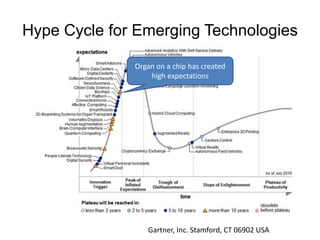
Hype Cycle for Emerging Technologies
Gartner, Inc. Stamford, CT 06902 USA
Organ on a chip has created
high expectations
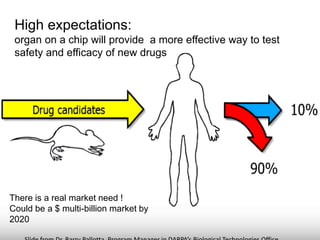
High expectations:
organ on a chip will provide a more effective way to test
safety and efficacy of new drugs
There is a real market need !
Could be a $ multi-billion market by
2020
06/12/2016
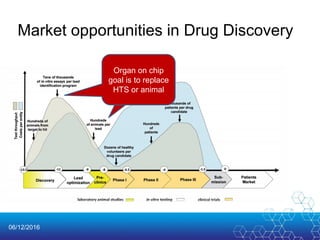
Market opportunities in Drug Discovery
Organ on chip
goal is to replace
HTS or animal
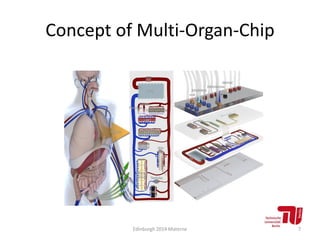
Concept of Multi-Organ-Chip
Edinburgh 2014 Materne 7
06/12/2016
A Multitude of Approaches
• There is little standardisation
• Players are mainly start-up companies commercialising
OOC prototypes developed in the universities
• Mainly plastic materials
• Different chamber and plate sizes
– Hurel, CN Bio, Mimetas use 96 well plate size
– TissUse and Kirkstall use 24 well plate size
– Wyss/Emulate has custom plates for each organ
• Pneumatic, Peristaltic, & Syringe pumps as well as
gravity fed
• In general the control systems are more complex than
the ‘chips’
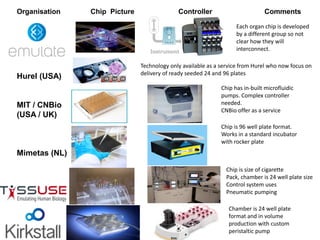
Organisation Chip Picture Controller Comments
Hurel (USA)
MIT / CNBio
(USA / UK)
Mimetas (NL)
Chip is size of cigarette
Pack, chamber is 24 well plate size
Control system uses
Pneumatic pumping
Chip is 96 well plate format.
Works in a standard incubator
with rocker plate
Chip has in-built microfluidic
pumps. Complex controller
needed.
CNBio offer as a service
Each organ chip is developed
by a different group so not
clear how they will
interconnect.
Technology only available as a service from Hurel who now focus on
delivery of ready seeded 24 and 96 plates
Chamber is 24 well plate
format and in volume
production with custom
peristaltic pump
06/12/2016
Key Requirements to replace animals
• Biological
• Physiologically relevant organoid models
• Connected organoids
• Long term culture /homeostasis
• Practical
• Easy to use and fast to set up
• Robust/repeatable
• No bubbles/blockages
• Scale
• 100’s animals/drug lead not 10,000’s as in HTS assays
• Economical
• Capital and consumable cost < animals
• Replacing HTS will require much lower cost
06/12/2016
Some Technical Challenges
• Obtaining representative human cells
• Media selection for co-culture of different cells
• Seeding cells inside microstructured chambers
• Getting adequate nutrient and oxygen to cells
• Connecting multiple chambers and flowing
media
• Getting enough biological material for an
accurate assay
06/12/2016
Cells for human on a chip?
• Animal cells may be easy to obtain and keep
alive – but they are not moving us forward
• Human tumour derived cell lines are easy to
culture but are not representative of healthy
tissue (basically cancer cells)
• iPSC (Induced Pluripotent Stem Cells) look
promising but expensive and tough to grow
• Human Donor Tissue is gold standard but
cryopreservation does compromise function
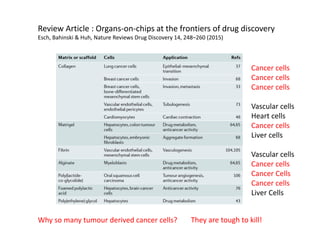
Review Article : Organs-on-chips at the frontiers of drug discovery
Esch, Bahinski & Huh, Nature Reviews Drug Discovery 14, 248–260 (2015)
Cancer cells
Cancer cells
Cancer cells
Vascular cells
Heart cells
Cancer cells
Liver cells
Vascular cells
Cancer cells
Cancer Cells
Cancer cells
Liver Cells
Why so many tumour derived cancer cells? They are tough to kill!
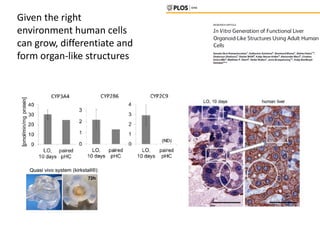
Given the right
environment human cells
can grow, differentiate and
form organ-like structures
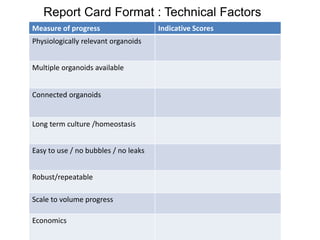
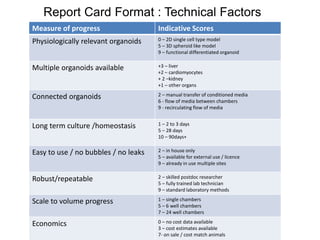
Report Card Format : Technical Factors
Measure of progress Indicative Scores
Physiologically relevant organoids
Multiple organoids available
Connected organoids
Long term culture /homeostasis
Easy to use / no bubbles / no leaks
Robust/repeatable
Scale to volume progress
Economics
Report Card Format : Technical Factors
Measure of progress Indicative Scores
Physiologically relevant organoids 0 – 2D single cell type model
5 – 3D spheroid like model
9 – functional differentiated organoid
Multiple organoids available +3 – liver
+2 – cardiomyocytes
+ 2 –kidney
+1 – other organs
Connected organoids 2 – manual transfer of conditioned media
6 - flow of media between chambers
9 - recirculating flow of media
Long term culture /homeostasis 1 – 2 to 3 days
5 – 28 days
10 – 90days+
Easy to use / no bubbles / no leaks 2 – in house only
5 – available for external use / licence
9 – already in use multiple sites
Robust/repeatable 2 – skilled postdoc researcher
5 – fully trained lab technician
9 – standard laboratory methods
Scale to volume progress 1 – single chambers
5 – 6 well chambers
7 – 24 well chambers
Economics 0 – no cost data available
3 – cost estimates available
7- on sale / cost match animals
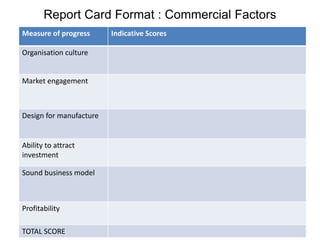
Report Card Format : Commercial Factors
Measure of progress Indicative Scores
Organisation culture
Market engagement
Design for manufacture
Ability to attract
investment
Sound business model
Profitability
TOTAL SCORE
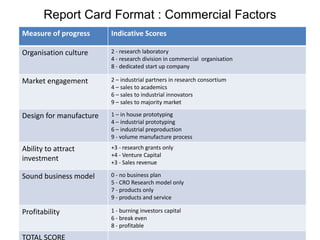
Report Card Format : Commercial Factors
Measure of progress Indicative Scores
Organisation culture 2 - research laboratory
4 - research division in commercial organisation
8 - dedicated start up company
Market engagement 2 – industrial partners in research consortium
4 – sales to academics
6 – sales to industrial innovators
9 – sales to majority market
Design for manufacture 1 – in house prototyping
4 – industrial prototyping
6 – industrial preproduction
9 - volume manufacture process
Ability to attract
investment
+3 - research grants only
+4 - Venture Capital
+3 - Sales revenue
Sound business model 0 - no business plan
5 - CRO Research model only
7 - products only
9 - products and service
Profitability 1 - burning investors capital
6 - break even
8 - profitable
TOTAL SCORE
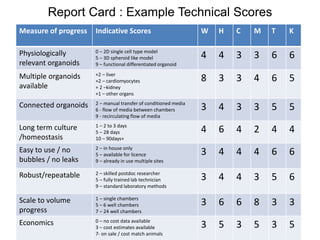
Report Card : Example Technical Scores
Measure of progress Indicative Scores W H C M T K
Physiologically
relevant organoids
0 – 2D single cell type model
5 – 3D spheroid like model
9 – functional differentiated organoid
4 4 3 3 6 6
Multiple organoids
available
+2 – liver
+2 – cardiomyocytes
+ 2 –kidney
+1 – other organs
8 3 3 4 6 5
Connected organoids 2 – manual transfer of conditioned media
6 - flow of media between chambers
9 - recirculating flow of media
3 4 3 3 5 5
Long term culture
/homeostasis
1 – 2 to 3 days
5 – 28 days
10 – 90days+
4 6 4 2 4 4
Easy to use / no
bubbles / no leaks
2 – in house only
5 – available for licence
9 – already in use multiple sites
3 4 4 4 6 6
Robust/repeatable 2 – skilled postdoc researcher
5 – fully trained lab technician
9 – standard laboratory methods
3 4 4 3 5 6
Scale to volume
progress
1 – single chambers
5 – 6 well chambers
7 – 24 well chambers
3 6 6 8 3 3
Economics 0 – no cost data available
3 – cost estimates available
7- on sale / cost match animals
3 5 3 5 3 5
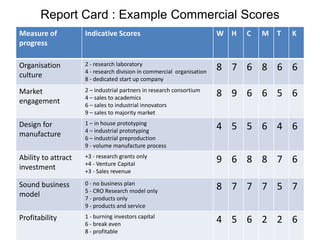
Report Card : Example Commercial Scores
Measure of
progress
Indicative Scores W H C M T K
Organisation
culture
2 - research laboratory
4 - research division in commercial organisation
8 - dedicated start up company
8 7 6 8 6 6
Market
engagement
2 – industrial partners in research consortium
4 – sales to academics
6 – sales to industrial innovators
9 – sales to majority market
8 9 6 6 5 6
Design for
manufacture
1 – in house prototyping
4 – industrial prototyping
6 – industrial preproduction
9 - volume manufacture process
4 5 5 6 4 6
Ability to attract
investment
+3 - research grants only
+4 - Venture Capital
+3 - Sales revenue
9 6 8 8 7 6
Sound business
model
0 - no business plan
5 - CRO Research model only
7 - products only
9 - products and service
8 7 7 7 5 7
Profitability 1 - burning investors capital
6 - break even
8 - profitable
4 5 6 2 2 6
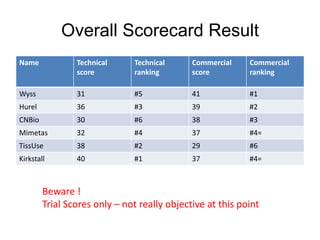
Overall Scorecard Result
Name Technical
score
Technical
ranking
Commercial
score
Commercial
ranking
Wyss 31 #5 41 #1
Hurel 36 #3 39 #2
CNBio 30 #6 38 #3
Mimetas 32 #4 37 #4=
TissUse 38 #2 29 #6
Kirkstall 40 #1 37 #4=
Beware !
Trial Scores only – not really objective at this point
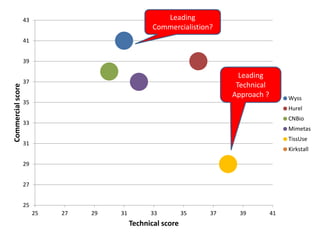
25
27
29
31
33
35
37
39
41
43
25 27 29 31 33 35 37 39 41
Commercialscore
Technical score
Wyss
Hurel
CNBio
Mimetas
TissUse
Kirkstall
Leading
Commercialistion?
Leading
Technical
Approach ?
0
10
20
30
40
50
60
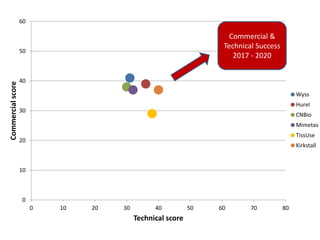
0 10 20 30 40 50 60 70 80
Commercialscore
Technical score
Wyss
Hurel
CNBio
Mimetas
TissUse
Kirkstall
Commercial &
Technical Success
2017 - 2020
06/12/2016
Recommendations
• Refine the scoring criteria
• Add weighting factors? – which criteria are more
important
• Use some independent assessors
• Revisit scoring and ranking each year to track
progress
Thanks for your attention!

Organ on a chip

  • 1.
    06/12/2016 Organ on achip: A Commercialisation Report Card Trying to make an objective assessment on the status of a new technology (and avoid the hype) Dr JM Wilkinson, Dr K Davidge Kirkstall Ltd.
  • 2.
    06/12/2016 Content • Challenges facingnew technology introduction • Hype vs reality • Market need • Key factors for tracking success • Introducing a Report Card Format • Trial run with status of some key players • Recommendations for 2017
  • 3.
    06/12/2016 Some challenges fornew technology • New technology must meet a market need • Winning grants is helpful but is not same as winning customers • $ millions from VC’s does not guarantee success (money does not change the laws of physics) • Early engagement with customers is essential
  • 4.
    Hype Cycle forEmerging Technologies Gartner, Inc. Stamford, CT 06902 USA Organ on a chip has created high expectations
  • 5.
    High expectations: organ ona chip will provide a more effective way to test safety and efficacy of new drugs There is a real market need ! Could be a $ multi-billion market by 2020
  • 6.
    06/12/2016 Market opportunities inDrug Discovery Organ on chip goal is to replace HTS or animal
  • 7.
  • 8.
    06/12/2016 A Multitude ofApproaches • There is little standardisation • Players are mainly start-up companies commercialising OOC prototypes developed in the universities • Mainly plastic materials • Different chamber and plate sizes – Hurel, CN Bio, Mimetas use 96 well plate size – TissUse and Kirkstall use 24 well plate size – Wyss/Emulate has custom plates for each organ • Pneumatic, Peristaltic, & Syringe pumps as well as gravity fed • In general the control systems are more complex than the ‘chips’
  • 9.
    Organisation Chip PictureController Comments Hurel (USA) MIT / CNBio (USA / UK) Mimetas (NL) Chip is size of cigarette Pack, chamber is 24 well plate size Control system uses Pneumatic pumping Chip is 96 well plate format. Works in a standard incubator with rocker plate Chip has in-built microfluidic pumps. Complex controller needed. CNBio offer as a service Each organ chip is developed by a different group so not clear how they will interconnect. Technology only available as a service from Hurel who now focus on delivery of ready seeded 24 and 96 plates Chamber is 24 well plate format and in volume production with custom peristaltic pump
  • 10.
    06/12/2016 Key Requirements toreplace animals • Biological • Physiologically relevant organoid models • Connected organoids • Long term culture /homeostasis • Practical • Easy to use and fast to set up • Robust/repeatable • No bubbles/blockages • Scale • 100’s animals/drug lead not 10,000’s as in HTS assays • Economical • Capital and consumable cost < animals • Replacing HTS will require much lower cost
  • 11.
    06/12/2016 Some Technical Challenges •Obtaining representative human cells • Media selection for co-culture of different cells • Seeding cells inside microstructured chambers • Getting adequate nutrient and oxygen to cells • Connecting multiple chambers and flowing media • Getting enough biological material for an accurate assay
  • 12.
    06/12/2016 Cells for humanon a chip? • Animal cells may be easy to obtain and keep alive – but they are not moving us forward • Human tumour derived cell lines are easy to culture but are not representative of healthy tissue (basically cancer cells) • iPSC (Induced Pluripotent Stem Cells) look promising but expensive and tough to grow • Human Donor Tissue is gold standard but cryopreservation does compromise function
  • 13.
    Review Article :Organs-on-chips at the frontiers of drug discovery Esch, Bahinski & Huh, Nature Reviews Drug Discovery 14, 248–260 (2015) Cancer cells Cancer cells Cancer cells Vascular cells Heart cells Cancer cells Liver cells Vascular cells Cancer cells Cancer Cells Cancer cells Liver Cells Why so many tumour derived cancer cells? They are tough to kill!
  • 14.
    Given the right environmenthuman cells can grow, differentiate and form organ-like structures
  • 15.
    Report Card Format: Technical Factors Measure of progress Indicative Scores Physiologically relevant organoids Multiple organoids available Connected organoids Long term culture /homeostasis Easy to use / no bubbles / no leaks Robust/repeatable Scale to volume progress Economics
  • 16.
    Report Card Format: Technical Factors Measure of progress Indicative Scores Physiologically relevant organoids 0 – 2D single cell type model 5 – 3D spheroid like model 9 – functional differentiated organoid Multiple organoids available +3 – liver +2 – cardiomyocytes + 2 –kidney +1 – other organs Connected organoids 2 – manual transfer of conditioned media 6 - flow of media between chambers 9 - recirculating flow of media Long term culture /homeostasis 1 – 2 to 3 days 5 – 28 days 10 – 90days+ Easy to use / no bubbles / no leaks 2 – in house only 5 – available for external use / licence 9 – already in use multiple sites Robust/repeatable 2 – skilled postdoc researcher 5 – fully trained lab technician 9 – standard laboratory methods Scale to volume progress 1 – single chambers 5 – 6 well chambers 7 – 24 well chambers Economics 0 – no cost data available 3 – cost estimates available 7- on sale / cost match animals
  • 17.
    Report Card Format: Commercial Factors Measure of progress Indicative Scores Organisation culture Market engagement Design for manufacture Ability to attract investment Sound business model Profitability TOTAL SCORE
  • 18.
    Report Card Format: Commercial Factors Measure of progress Indicative Scores Organisation culture 2 - research laboratory 4 - research division in commercial organisation 8 - dedicated start up company Market engagement 2 – industrial partners in research consortium 4 – sales to academics 6 – sales to industrial innovators 9 – sales to majority market Design for manufacture 1 – in house prototyping 4 – industrial prototyping 6 – industrial preproduction 9 - volume manufacture process Ability to attract investment +3 - research grants only +4 - Venture Capital +3 - Sales revenue Sound business model 0 - no business plan 5 - CRO Research model only 7 - products only 9 - products and service Profitability 1 - burning investors capital 6 - break even 8 - profitable TOTAL SCORE
  • 19.
    Report Card :Example Technical Scores Measure of progress Indicative Scores W H C M T K Physiologically relevant organoids 0 – 2D single cell type model 5 – 3D spheroid like model 9 – functional differentiated organoid 4 4 3 3 6 6 Multiple organoids available +2 – liver +2 – cardiomyocytes + 2 –kidney +1 – other organs 8 3 3 4 6 5 Connected organoids 2 – manual transfer of conditioned media 6 - flow of media between chambers 9 - recirculating flow of media 3 4 3 3 5 5 Long term culture /homeostasis 1 – 2 to 3 days 5 – 28 days 10 – 90days+ 4 6 4 2 4 4 Easy to use / no bubbles / no leaks 2 – in house only 5 – available for licence 9 – already in use multiple sites 3 4 4 4 6 6 Robust/repeatable 2 – skilled postdoc researcher 5 – fully trained lab technician 9 – standard laboratory methods 3 4 4 3 5 6 Scale to volume progress 1 – single chambers 5 – 6 well chambers 7 – 24 well chambers 3 6 6 8 3 3 Economics 0 – no cost data available 3 – cost estimates available 7- on sale / cost match animals 3 5 3 5 3 5
  • 20.
    Report Card :Example Commercial Scores Measure of progress Indicative Scores W H C M T K Organisation culture 2 - research laboratory 4 - research division in commercial organisation 8 - dedicated start up company 8 7 6 8 6 6 Market engagement 2 – industrial partners in research consortium 4 – sales to academics 6 – sales to industrial innovators 9 – sales to majority market 8 9 6 6 5 6 Design for manufacture 1 – in house prototyping 4 – industrial prototyping 6 – industrial preproduction 9 - volume manufacture process 4 5 5 6 4 6 Ability to attract investment +3 - research grants only +4 - Venture Capital +3 - Sales revenue 9 6 8 8 7 6 Sound business model 0 - no business plan 5 - CRO Research model only 7 - products only 9 - products and service 8 7 7 7 5 7 Profitability 1 - burning investors capital 6 - break even 8 - profitable 4 5 6 2 2 6
  • 21.
    Overall Scorecard Result NameTechnical score Technical ranking Commercial score Commercial ranking Wyss 31 #5 41 #1 Hurel 36 #3 39 #2 CNBio 30 #6 38 #3 Mimetas 32 #4 37 #4= TissUse 38 #2 29 #6 Kirkstall 40 #1 37 #4= Beware ! Trial Scores only – not really objective at this point
  • 22.
    25 27 29 31 33 35 37 39 41 43 25 27 2931 33 35 37 39 41 Commercialscore Technical score Wyss Hurel CNBio Mimetas TissUse Kirkstall Leading Commercialistion? Leading Technical Approach ?
  • 23.
    0 10 20 30 40 50 60 0 10 2030 40 50 60 70 80 Commercialscore Technical score Wyss Hurel CNBio Mimetas TissUse Kirkstall Commercial & Technical Success 2017 - 2020
  • 24.
    06/12/2016 Recommendations • Refine thescoring criteria • Add weighting factors? – which criteria are more important • Use some independent assessors • Revisit scoring and ranking each year to track progress Thanks for your attention!