


Continuous Delivery Patterns for
Contemporary Architectures
Daniel Bryant
@danielbryantuk
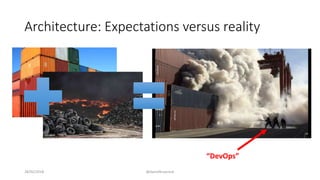
Architecture: Expectations versus reality
28/02/2018 @danielbryantuk
“DevOps”
tl;dr
• We are moving from complicated systems to complex systems
• Architecture is becoming more about technical leadership
• We must encode all requirements into a continuous delivery pipeline
28/02/2018 @danielbryantuk
@danielbryantuk
• Independent Technical Consultant
• Architecture, DevOps, Java, microservices, cloud, containers
• Continuous Delivery (CI/CD) advocate
• Leading change through technology and teams
28/02/2018 @danielbryantuk
bit.ly/2jWDSF7
Setting the Scene
28/02/2018 @danielbryantuk
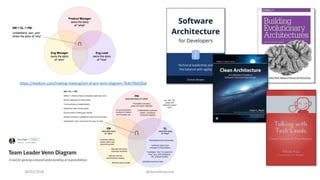
https://medium.com/making-meetup/em-el-pm-venn-diagram-764e79b42baf
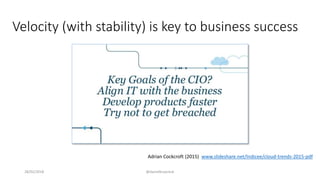
Velocity (with stability) is key to business success
28/02/2018 @danielbryantuk
Adrian Cockcroft (2015) www.slideshare.net/Indicee/cloud-trends-2015-pdf
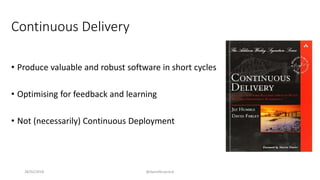
Continuous Delivery
• Produce valuable and robust software in short cycles
• Optimising for feedback and learning
• Not (necessarily) Continuous Deployment
28/02/2018 @danielbryantuk
Velocity (with stability) is key to business success
“Continuous delivery is achieved when stability and
speed can satisfy business demand.
Discontinuous delivery occurs when stability and speed
are insufficient.”
- Steve Smith (@SteveSmithCD)
28/02/2018 @danielbryantuk
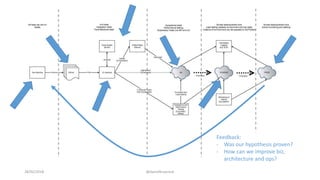
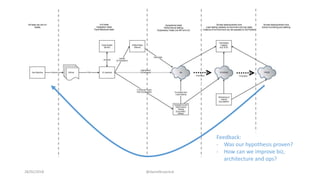
Feedback:
- Was our hypothesis proven?
- How can we improve biz,
architecture and ops?
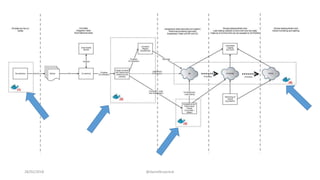
Let’s bring in some containers (or additional packaging)
28/02/2018 @danielbryantuk
What are our core challenges with modern application architectures?
28/02/2018 @danielbryantuk
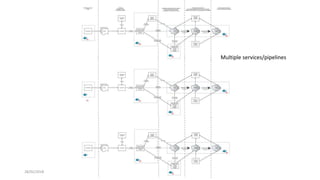
Multiple services/pipelines
28/02/2018 @danielbryantuk
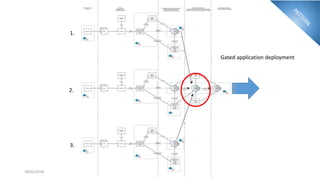
Gated application deployment
1.
2.
3.
28/02/2018 @danielbryantuk
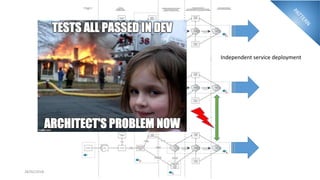
Independent service deployment
Architecture
28/02/2018 @danielbryantuk
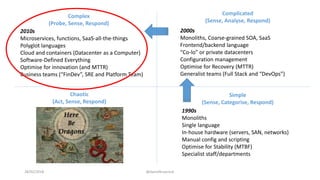
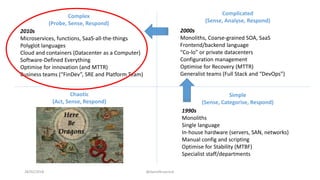
Simple
(Sense, Categorise, Respond)
Complicated
(Sense, Analyse, Respond)
Complex
(Probe, Sense, Respond)
1990s
Monoliths
Single language
In-house hardware (servers, SAN, networks)
Manual config and scripting
Optimise for Stability (MTBF)
Specialist staff/departments
2010s
Microservices, functions, SaaS-all-the-things
Polyglot languages
Cloud and containers (Datacenter as a Computer)
Software-Defined Everything
Optimise for innovation (and MTTR)
Business teams (“FinDev”, SRE and Platform Team)
2000s
Monoliths, Coarse-grained SOA, SaaS
Frontend/backend language
“Co-lo” or private datacenters
Configuration management
Optimise for Recovery (MTTR)
Generalist teams (Full Stack and “DevOps”)
Chaotic
(Act, Sense, Respond)
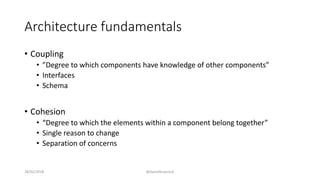
Architecture fundamentals
• Coupling
• ”Degree to which components have knowledge of other components”
• Interfaces
• Schema
• Cohesion
• “Degree to which the elements within a component belong together”
• Single reason to change
• Separation of concerns
28/02/2018 @danielbryantuk
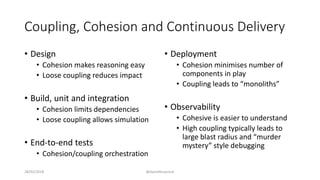
Coupling, Cohesion and Continuous Delivery
• Design
• Cohesion makes reasoning easy
• Loose coupling reduces impact
• Build, unit and integration
• Cohesion limits dependencies
• Loose coupling allows simulation
• End-to-end tests
• Cohesion/coupling orchestration
• Deployment
• Cohesion minimises number of
components in play
• Coupling leads to “monoliths”
• Observability
• Cohesive is easier to understand
• High coupling typically leads to
large blast radius and “murder
mystery” style debugging
28/02/2018 @danielbryantuk
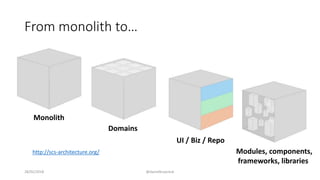
From monolith to…
28/02/2018 @danielbryantuk
UI / Biz / Repo
Monolith
Domains
Modules, components,
frameworks, libraries
http://scs-architecture.org/
28/02/2018 @danielbryantuk
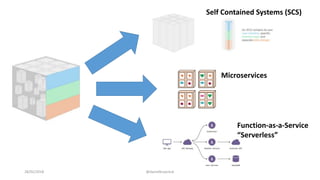
Self Contained Systems (SCS)
Microservices
Function-as-a-Service
“Serverless”
28/02/2018 @danielbryantuk
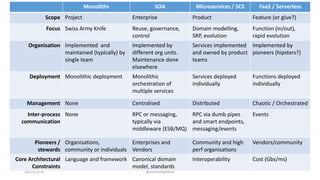
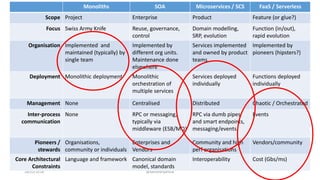
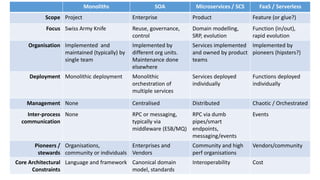
Monoliths SOA Microservices / SCS FaaS / Serverless
Scope Project Enterprise Product Feature (or glue?)
Focus Swiss Army Knife Reuse, governance,
control
Domain modelling,
SRP, evolution
Function (in/out),
rapid evolution
Organisation Implemented and
maintained (typically) by
single team
Implemented by
different org units.
Maintenance done
elsewhere
Services implemented
and owned by product
teams
Implemented by
pioneers (hipsters?)
Deployment Monolithic deployment Monolithic
orchestration of
multiple services
Services deployed
individually
Functions deployed
individually
Management None Centralised Distributed Chaotic / Orchestrated
Inter-process
communication
None RPC or messaging,
typically via
middleware (ESB/MQ)
RPC via dumb pipes
and smart endpoints,
messaging/events
Events
Pioneers /
stewards
Organisations,
community or individuals
Enterprises and
Vendors
Community and high
perf organisations
Vendors/community
Core Architectural
Constraints
Language and framework Canonical domain
model, standards
Interoperability Cost (Gbs/ms)
28/02/2018 @danielbryantuk
Monoliths SOA Microservices / SCS FaaS / Serverless
Scope Project Enterprise Product Feature (or glue?)
Focus Swiss Army Knife Reuse, governance,
control
Domain modelling,
SRP, evolution
Function (in/out),
rapid evolution
Organisation Implemented and
maintained (typically) by
single team
Implemented by
different org units.
Maintenance done
elsewhere
Services implemented
and owned by product
teams
Implemented by
pioneers (hipsters?)
Deployment Monolithic deployment Monolithic
orchestration of
multiple services
Services deployed
individually
Functions deployed
individually
Management None Centralised Distributed Chaotic / Orchestrated
Inter-process
communication
None RPC or messaging,
typically via
middleware (ESB/MQ)
RPC via dumb pipes
and smart endpoints,
messaging/events
Events
Pioneers /
stewards
Organisations,
community or individuals
Enterprises and
Vendors
Community and high
perf organisations
Vendors/community
Core Architectural
Constraints
Language and framework Canonical domain
model, standards
Interoperability Cost (Gbs/ms)
Testing 101
28/02/2018 @danielbryantuk
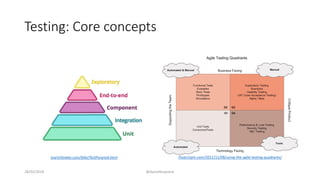
Testing: Core concepts
28/02/2018 @danielbryantuk
/lisacrispin.com/2011/11/08/using-the-agile-testing-quadrants/martinfowler.com/bliki/TestPyramid.html
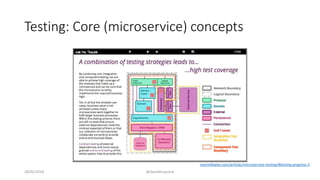
Testing: Core (microservice) concepts
28/02/2018 @danielbryantuk
martinfowler.com/articles/microservice-testing/#testing-progress-3
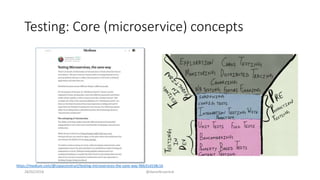
Testing: Core (microservice) concepts
28/02/2018 @danielbryantuk
https://medium.com/@copyconstruct/testing-microservices-the-sane-way-9bb31d158c16
Testing microservice integration
28/02/2018 @danielbryantuk
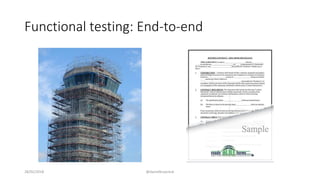
Functional testing: End-to-end
28/02/2018 @danielbryantuk
Functional Testing: Outside-in
28/02/2018 @danielbryantuk
https://specto.io/blog/2016/8/16/recipe-for-designing-building-testing-microservices/
http://www.thucydides.info/docs/serenity/
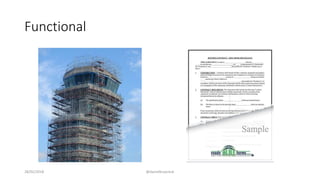
Functional
28/02/2018 @danielbryantuk
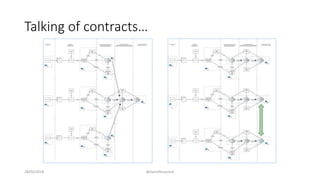
Talking of contracts…
28/02/2018 @danielbryantuk
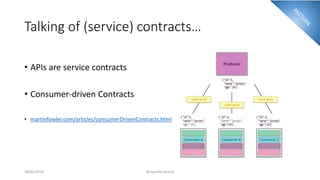
Talking of (service) contracts…
• APIs are service contracts
• Consumer-driven Contracts
• martinfowler.com/articles/consumerDrivenContracts.html
28/02/2018 @danielbryantuk
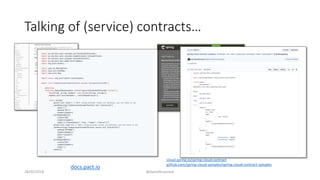
Talking of (service) contracts…
28/02/2018 @danielbryantuk
docs.pact.io
cloud.spring.io/spring-cloud-contract
github.com/spring-cloud-samples/spring-cloud-contract-samples
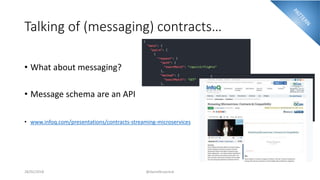
Talking of (messaging) contracts…
• What about messaging?
• Message schema are an API
• www.infoq.com/presentations/contracts-streaming-microservices
28/02/2018 @danielbryantuk
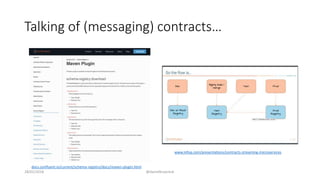
Talking of (messaging) contracts…
28/02/2018 @danielbryantuk
www.infoq.com/presentations/contracts-streaming-microservices
docs.confluent.io/current/schema-registry/docs/maven-plugin.html
Contract verification
• Is it worth the cost?
• Tradeoff: Trust/comms vs time
• Startups / SMEs
• Enterprises…
• My (anecdotal) experience
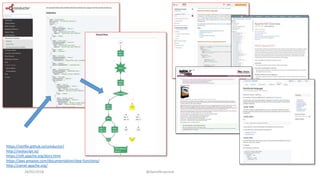
• Choreography vs orchestration
28/02/2018 @danielbryantuk
https://netflix.github.io/conductor/
http://rockscript.io/
https://nifi.apache.org/docs.html
https://aws.amazon.com/documentation/step-functions/
http://camel.apache.org/
Contract verification
• Is it worth the cost?
• Tradeoff: Trust and comms
• Startups / SMEs
• Enterprises…
• My (anecdotal) experience
• Choreography vs orchestration
• Choreography
• Asserting behaviour (interactions)
• Contracts are part of this!
• Orchestration:
• Verify orchestration DSL
• Asserting state (output)
28/02/2018 @danielbryantuk
Measure what matters
28/02/2018 @danielbryantuk
Feedback:
- Was our hypothesis proven?
- How can we improve biz,
architecture and ops?
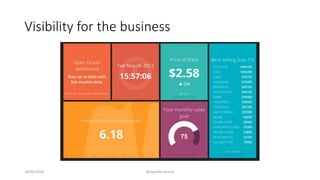
Visibility for the business
28/02/2018 @danielbryantuk
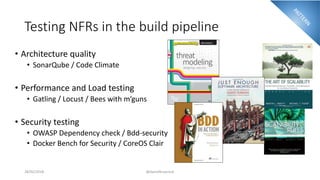
Testing NFRs in the build pipeline
• Architecture quality
• SonarQube / Code Climate
• Performance and Load testing
• Gatling / Locust / Bees with m’guns
• Security testing
• OWASP Dependency check / Bdd-security
• Docker Bench for Security / CoreOS Clair
28/02/2018 @danielbryantuk
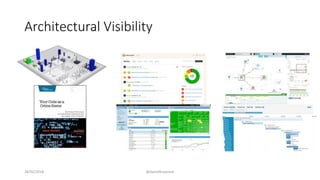
Architectural Visibility
28/02/2018 @danielbryantuk
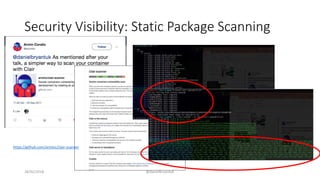
Security Visibility: Static Package Scanning
28/02/2018 @danielbryantuk
https://github.com/arminc/clair-scanner
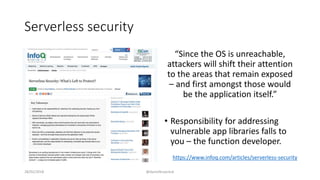
Serverless security
“Since the OS is unreachable,
attackers will shift their attention
to the areas that remain exposed
– and first amongst those would
be the application itself.”
• Responsibility for addressing
vulnerable app libraries falls to
you – the function developer.
28/02/2018 @danielbryantuk
https://www.infoq.com/articles/serverless-security
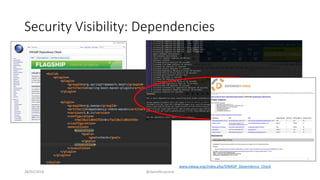
Security Visibility: Dependencies
28/02/2018 @danielbryantuk
www.owasp.org/index.php/OWASP_Dependency_Check
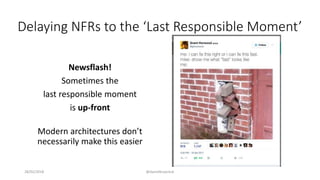
Delaying NFRs to the ‘Last Responsible Moment’
Newsflash!
Sometimes the
last responsible moment
is up-front
Modern architectures don’t
necessarily make this easier
28/02/2018 @danielbryantuk
Wrapping up
28/02/2018 @danielbryantuk
Simple
(Sense, Categorise, Respond)
Complicated
(Sense, Analyse, Respond)
Complex
(Probe, Sense, Respond)
1990s
Monoliths
Single language
In-house hardware (servers, SAN, networks)
Manual config and scripting
Optimise for Stability (MTBF)
Specialist staff/departments
2010s
Microservices, functions, SaaS-all-the-things
Polyglot languages
Cloud and containers (Datacenter as a Computer)
Software-Defined Everything
Optimise for innovation (and MTTR)
Business teams (“FinDev”, SRE and Platform Team)
2000s
Monoliths, Coarse-grained SOA, SaaS
Frontend/backend language
“Co-lo” or private datacenters
Configuration management
Optimise for Recovery (MTTR)
Generalist teams (Full Stack and “DevOps”)
Chaotic
(Act, Sense, Respond)
28/02/2018 @danielbryantuk
Monoliths SOA Microservices / SCS FaaS / Serverless
Scope Project Enterprise Product Feature (or glue?)
Focus Swiss Army Knife Reuse, governance,
control
Domain modelling,
SRP, evolution
Function (in/out),
rapid evolution
Organisation Implemented and
maintained (typically) by
single team
Implemented by
different org units.
Maintenance done
elsewhere
Services implemented
and owned by product
teams
Implemented by
pioneers (hipsters?)
Deployment Monolithic deployment Monolithic
orchestration of
multiple services
Services deployed
individually
Functions deployed
individually
Management None Centralised Distributed Chaotic / Orchestrated
Inter-process
communication
None RPC or messaging,
typically via
middleware (ESB/MQ)
RPC via dumb
pipes/smart
endpoints,
messaging/events
Events
Pioneers /
stewards
Organisations,
community or individuals
Enterprises and
Vendors
Community and high
perf organisations
Vendors/community
Core Architectural
Constraints
Language and framework Canonical domain
model, standards
Interoperability Cost
28/02/2018 @danielbryantuk
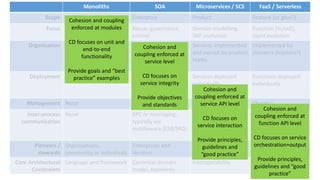
Monoliths SOA Microservices / SCS FaaS / Serverless
Cohesion and coupling
enforced at modules
CD focuses on unit and
end-to-end
functionality
Provide goals and “best
practice” examples
Cohesion and
coupling enforced at
service level
CD focuses on
service integrity
Provide objectives
and standards
Cohesion and
coupling enforced at
service API level
CD focuses on
service interaction
Provide principles,
guidelines and
“good practice”
Cohesion and
coupling enforced at
function API level
CD focuses on service
orchestration+output
Provide principles,
guidelines and “good
practice”
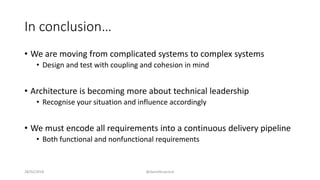
In conclusion…
• We are moving from complicated systems to complex systems
• Design and test with coupling and cohesion in mind
• Architecture is becoming more about technical leadership
• Recognise your situation and influence accordingly
• We must encode all requirements into a continuous delivery pipeline
• Both functional and nonfunctional requirements
28/02/2018 @danielbryantuk
Thanks for listening…
Twitter: @danielbryantuk
Email: daniel.bryant@tai-dev.co.uk
Writing: https://www.infoq.com/profile/Daniel-Bryant
Talks: https://www.youtube.com/playlist?list=PLoVYf_0qOYNeBmrpjuBOOAqJnQb3QAEtM
28/02/2018 @danielbryantuk
Early Access edition
book signing at the
O’Reilly booth now!
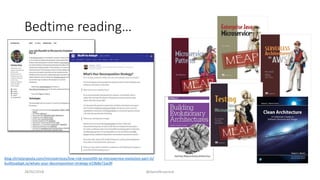
Bedtime reading…
28/02/2018 @danielbryantuk
blog.christianposta.com/microservices/low-risk-monolith-to-microservice-evolution-part-iii/
builttoadapt.io/whats-your-decomposition-strategy-e19b8e72ac8f

O'Reilly SACON NY 2018 "Continuous Delivery Patterns for Contemporary Architecture"

  • 1.
    Continuous Delivery Patternsfor Contemporary Architectures Daniel Bryant @danielbryantuk
  • 2.
    Architecture: Expectations versusreality 28/02/2018 @danielbryantuk “DevOps”
  • 3.
    tl;dr • We aremoving from complicated systems to complex systems • Architecture is becoming more about technical leadership • We must encode all requirements into a continuous delivery pipeline 28/02/2018 @danielbryantuk
  • 4.
    @danielbryantuk • Independent TechnicalConsultant • Architecture, DevOps, Java, microservices, cloud, containers • Continuous Delivery (CI/CD) advocate • Leading change through technology and teams 28/02/2018 @danielbryantuk bit.ly/2jWDSF7
  • 5.
  • 6.
  • 7.
    Velocity (with stability)is key to business success 28/02/2018 @danielbryantuk Adrian Cockcroft (2015) www.slideshare.net/Indicee/cloud-trends-2015-pdf
  • 8.
    Continuous Delivery • Producevaluable and robust software in short cycles • Optimising for feedback and learning • Not (necessarily) Continuous Deployment 28/02/2018 @danielbryantuk
  • 9.
    Velocity (with stability)is key to business success “Continuous delivery is achieved when stability and speed can satisfy business demand. Discontinuous delivery occurs when stability and speed are insufficient.” - Steve Smith (@SteveSmithCD) 28/02/2018 @danielbryantuk
  • 10.
    28/02/2018 @danielbryantuk Feedback: - Wasour hypothesis proven? - How can we improve biz, architecture and ops?
  • 11.
    Let’s bring insome containers (or additional packaging) 28/02/2018 @danielbryantuk
  • 12.
  • 13.
    What are ourcore challenges with modern application architectures? 28/02/2018 @danielbryantuk
  • 14.
  • 15.
  • 16.
  • 17.
  • 18.
  • 19.
    28/02/2018 @danielbryantuk Simple (Sense, Categorise,Respond) Complicated (Sense, Analyse, Respond) Complex (Probe, Sense, Respond) 1990s Monoliths Single language In-house hardware (servers, SAN, networks) Manual config and scripting Optimise for Stability (MTBF) Specialist staff/departments 2010s Microservices, functions, SaaS-all-the-things Polyglot languages Cloud and containers (Datacenter as a Computer) Software-Defined Everything Optimise for innovation (and MTTR) Business teams (“FinDev”, SRE and Platform Team) 2000s Monoliths, Coarse-grained SOA, SaaS Frontend/backend language “Co-lo” or private datacenters Configuration management Optimise for Recovery (MTTR) Generalist teams (Full Stack and “DevOps”) Chaotic (Act, Sense, Respond)
  • 20.
    Architecture fundamentals • Coupling •”Degree to which components have knowledge of other components” • Interfaces • Schema • Cohesion • “Degree to which the elements within a component belong together” • Single reason to change • Separation of concerns 28/02/2018 @danielbryantuk
  • 21.
    Coupling, Cohesion andContinuous Delivery • Design • Cohesion makes reasoning easy • Loose coupling reduces impact • Build, unit and integration • Cohesion limits dependencies • Loose coupling allows simulation • End-to-end tests • Cohesion/coupling orchestration • Deployment • Cohesion minimises number of components in play • Coupling leads to “monoliths” • Observability • Cohesive is easier to understand • High coupling typically leads to large blast radius and “murder mystery” style debugging 28/02/2018 @danielbryantuk
  • 22.
    From monolith to… 28/02/2018@danielbryantuk UI / Biz / Repo Monolith Domains Modules, components, frameworks, libraries http://scs-architecture.org/
  • 23.
    28/02/2018 @danielbryantuk Self ContainedSystems (SCS) Microservices Function-as-a-Service “Serverless”
  • 24.
    28/02/2018 @danielbryantuk Monoliths SOAMicroservices / SCS FaaS / Serverless Scope Project Enterprise Product Feature (or glue?) Focus Swiss Army Knife Reuse, governance, control Domain modelling, SRP, evolution Function (in/out), rapid evolution Organisation Implemented and maintained (typically) by single team Implemented by different org units. Maintenance done elsewhere Services implemented and owned by product teams Implemented by pioneers (hipsters?) Deployment Monolithic deployment Monolithic orchestration of multiple services Services deployed individually Functions deployed individually Management None Centralised Distributed Chaotic / Orchestrated Inter-process communication None RPC or messaging, typically via middleware (ESB/MQ) RPC via dumb pipes and smart endpoints, messaging/events Events Pioneers / stewards Organisations, community or individuals Enterprises and Vendors Community and high perf organisations Vendors/community Core Architectural Constraints Language and framework Canonical domain model, standards Interoperability Cost (Gbs/ms)
  • 25.
    28/02/2018 @danielbryantuk Monoliths SOAMicroservices / SCS FaaS / Serverless Scope Project Enterprise Product Feature (or glue?) Focus Swiss Army Knife Reuse, governance, control Domain modelling, SRP, evolution Function (in/out), rapid evolution Organisation Implemented and maintained (typically) by single team Implemented by different org units. Maintenance done elsewhere Services implemented and owned by product teams Implemented by pioneers (hipsters?) Deployment Monolithic deployment Monolithic orchestration of multiple services Services deployed individually Functions deployed individually Management None Centralised Distributed Chaotic / Orchestrated Inter-process communication None RPC or messaging, typically via middleware (ESB/MQ) RPC via dumb pipes and smart endpoints, messaging/events Events Pioneers / stewards Organisations, community or individuals Enterprises and Vendors Community and high perf organisations Vendors/community Core Architectural Constraints Language and framework Canonical domain model, standards Interoperability Cost (Gbs/ms)
  • 26.
  • 27.
    Testing: Core concepts 28/02/2018@danielbryantuk /lisacrispin.com/2011/11/08/using-the-agile-testing-quadrants/martinfowler.com/bliki/TestPyramid.html
  • 28.
    Testing: Core (microservice)concepts 28/02/2018 @danielbryantuk martinfowler.com/articles/microservice-testing/#testing-progress-3
  • 29.
    Testing: Core (microservice)concepts 28/02/2018 @danielbryantuk https://medium.com/@copyconstruct/testing-microservices-the-sane-way-9bb31d158c16
  • 30.
  • 31.
  • 32.
    Functional Testing: Outside-in 28/02/2018@danielbryantuk https://specto.io/blog/2016/8/16/recipe-for-designing-building-testing-microservices/ http://www.thucydides.info/docs/serenity/
  • 33.
  • 34.
  • 35.
    Talking of (service)contracts… • APIs are service contracts • Consumer-driven Contracts • martinfowler.com/articles/consumerDrivenContracts.html 28/02/2018 @danielbryantuk
  • 36.
    Talking of (service)contracts… 28/02/2018 @danielbryantuk docs.pact.io cloud.spring.io/spring-cloud-contract github.com/spring-cloud-samples/spring-cloud-contract-samples
  • 37.
    Talking of (messaging)contracts… • What about messaging? • Message schema are an API • www.infoq.com/presentations/contracts-streaming-microservices 28/02/2018 @danielbryantuk
  • 38.
    Talking of (messaging)contracts… 28/02/2018 @danielbryantuk www.infoq.com/presentations/contracts-streaming-microservices docs.confluent.io/current/schema-registry/docs/maven-plugin.html
  • 39.
    Contract verification • Isit worth the cost? • Tradeoff: Trust/comms vs time • Startups / SMEs • Enterprises… • My (anecdotal) experience • Choreography vs orchestration 28/02/2018 @danielbryantuk
  • 40.
  • 41.
    Contract verification • Isit worth the cost? • Tradeoff: Trust and comms • Startups / SMEs • Enterprises… • My (anecdotal) experience • Choreography vs orchestration • Choreography • Asserting behaviour (interactions) • Contracts are part of this! • Orchestration: • Verify orchestration DSL • Asserting state (output) 28/02/2018 @danielbryantuk
  • 42.
  • 43.
    28/02/2018 @danielbryantuk Feedback: - Wasour hypothesis proven? - How can we improve biz, architecture and ops?
  • 44.
    Visibility for thebusiness 28/02/2018 @danielbryantuk
  • 45.
    Testing NFRs inthe build pipeline • Architecture quality • SonarQube / Code Climate • Performance and Load testing • Gatling / Locust / Bees with m’guns • Security testing • OWASP Dependency check / Bdd-security • Docker Bench for Security / CoreOS Clair 28/02/2018 @danielbryantuk
  • 46.
  • 47.
    Security Visibility: StaticPackage Scanning 28/02/2018 @danielbryantuk https://github.com/arminc/clair-scanner
  • 48.
    Serverless security “Since theOS is unreachable, attackers will shift their attention to the areas that remain exposed – and first amongst those would be the application itself.” • Responsibility for addressing vulnerable app libraries falls to you – the function developer. 28/02/2018 @danielbryantuk https://www.infoq.com/articles/serverless-security
  • 49.
    Security Visibility: Dependencies 28/02/2018@danielbryantuk www.owasp.org/index.php/OWASP_Dependency_Check
  • 50.
    Delaying NFRs tothe ‘Last Responsible Moment’ Newsflash! Sometimes the last responsible moment is up-front Modern architectures don’t necessarily make this easier 28/02/2018 @danielbryantuk
  • 51.
  • 52.
    28/02/2018 @danielbryantuk Simple (Sense, Categorise,Respond) Complicated (Sense, Analyse, Respond) Complex (Probe, Sense, Respond) 1990s Monoliths Single language In-house hardware (servers, SAN, networks) Manual config and scripting Optimise for Stability (MTBF) Specialist staff/departments 2010s Microservices, functions, SaaS-all-the-things Polyglot languages Cloud and containers (Datacenter as a Computer) Software-Defined Everything Optimise for innovation (and MTTR) Business teams (“FinDev”, SRE and Platform Team) 2000s Monoliths, Coarse-grained SOA, SaaS Frontend/backend language “Co-lo” or private datacenters Configuration management Optimise for Recovery (MTTR) Generalist teams (Full Stack and “DevOps”) Chaotic (Act, Sense, Respond)
  • 53.
    28/02/2018 @danielbryantuk Monoliths SOAMicroservices / SCS FaaS / Serverless Scope Project Enterprise Product Feature (or glue?) Focus Swiss Army Knife Reuse, governance, control Domain modelling, SRP, evolution Function (in/out), rapid evolution Organisation Implemented and maintained (typically) by single team Implemented by different org units. Maintenance done elsewhere Services implemented and owned by product teams Implemented by pioneers (hipsters?) Deployment Monolithic deployment Monolithic orchestration of multiple services Services deployed individually Functions deployed individually Management None Centralised Distributed Chaotic / Orchestrated Inter-process communication None RPC or messaging, typically via middleware (ESB/MQ) RPC via dumb pipes/smart endpoints, messaging/events Events Pioneers / stewards Organisations, community or individuals Enterprises and Vendors Community and high perf organisations Vendors/community Core Architectural Constraints Language and framework Canonical domain model, standards Interoperability Cost
  • 54.
    28/02/2018 @danielbryantuk Monoliths SOAMicroservices / SCS FaaS / Serverless Cohesion and coupling enforced at modules CD focuses on unit and end-to-end functionality Provide goals and “best practice” examples Cohesion and coupling enforced at service level CD focuses on service integrity Provide objectives and standards Cohesion and coupling enforced at service API level CD focuses on service interaction Provide principles, guidelines and “good practice” Cohesion and coupling enforced at function API level CD focuses on service orchestration+output Provide principles, guidelines and “good practice”
  • 55.
    In conclusion… • Weare moving from complicated systems to complex systems • Design and test with coupling and cohesion in mind • Architecture is becoming more about technical leadership • Recognise your situation and influence accordingly • We must encode all requirements into a continuous delivery pipeline • Both functional and nonfunctional requirements 28/02/2018 @danielbryantuk
  • 56.
    Thanks for listening… Twitter:@danielbryantuk Email: daniel.bryant@tai-dev.co.uk Writing: https://www.infoq.com/profile/Daniel-Bryant Talks: https://www.youtube.com/playlist?list=PLoVYf_0qOYNeBmrpjuBOOAqJnQb3QAEtM 28/02/2018 @danielbryantuk Early Access edition book signing at the O’Reilly booth now!
  • 57.