THE NATURE AND ELEMENTS OF
COMMUNICATION
GROUP ACTIVITY 1: PASS THE MESSAGE
• Students will be divided into small group of ten members.Arrange
yourselves in lines from the front to the back of the classroom.
The last persons at the back shall be given a paragraph of five to
eight sentences to whisper to the persons in front of them.
Repeat the procedure until it reaches the first persons in the lines,
who then will write the paragraph on the board. The group that
finishes first with the most accurate output wins the game.The
activity is good for five to eight minutes.
WHAT IS COMMUNICATION?
• Communication is a process by which information is exchanged between
individuals through a common system of symbols, signs, or behavior. (Merriam-
Webster’s Online Dictionary)
• Communication is a process of exchanging information usually via a common
system of symbols. (Encylopedia)
• Communication is the process of sending and receiving messages, and it occurs
whenever we express ourselves in a manner that is clearly understood.
(GLENCOE Speech by McCutcheon, Schaffer, and Wycoff).
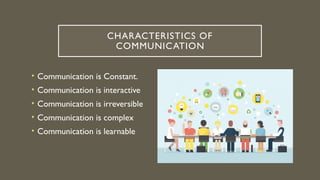
CHARACTERISTICS OF
COMMUNICATION
• Communication is Constant.
• Communication is interactive
• Communication is irreversible
• Communication is complex
• Communication is learnable
TYPES OF COMMUNICATION
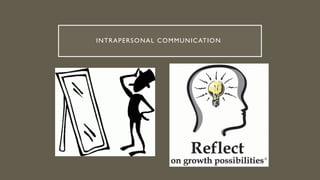
INTRAPERSONAL COMMUNICATION
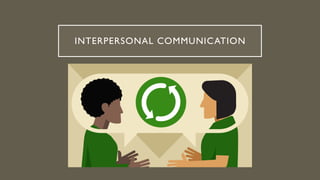
INTERPERSONAL COMMUNICATION
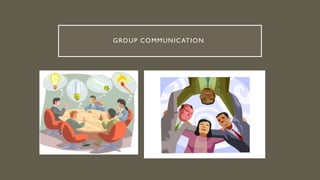
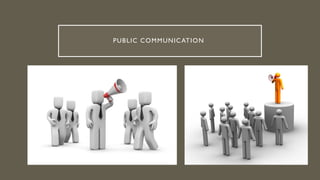
GROUP COMMUNICATION
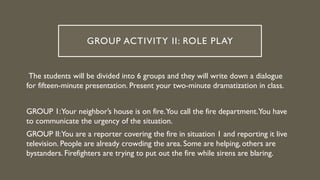
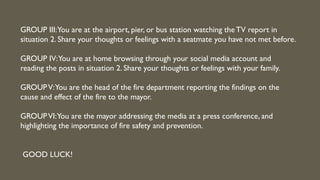
PUBLIC COMMUNICATION
MASS COMMUNICATION
GROUP ACTIVITY II: ROLE PLAY
The students will be divided into 6 groups and they will write down a dialogue
for fifteen-minute presentation. Present your two-minute dramatization in class.
GROUP 1:Your neighbor’s house is on fire.You call the fire department.You have
to communicate the urgency of the situation.
GROUP II:You are a reporter covering the fire in situation 1 and reporting it live
television. People are already crowding the area. Some are helping, others are
bystanders. Firefighters are trying to put out the fire while sirens are blaring.
GROUP III:You are at the airport, pier, or bus station watching the TV report in
situation 2. Share your thoughts or feelings with a seatmate you have not met before.
GROUP IV:You are at home browsing through your social media account and
reading the posts in situation 2. Share your thoughts or feelings with your family.
GROUPV:You are the head of the fire department reporting the findings on the
cause and effect of the fire to the mayor.
GROUPVI:You are the mayor addressing the media at a press conference, and
highlighting the importance of fire safety and prevention.
GOOD LUCK!
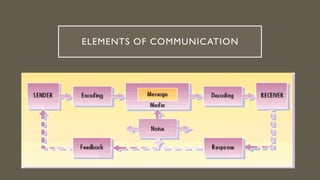
ELEMENTS OF COMMUNICATION
SENDER
The sender plays the specific role of initiating
communication.To communicate effectively, the sender
must use effective verbal as well as nonverbal techniques.
Speaking or writing clearly, organizing your points to make
them easy to follow and understand, maintaining eye
contact, using proper grammar and giving accurate
information are all essential in the effectiveness of your
message.
RECEIVER
The receiver means the party to whom the sender
transmits the message.A receiver can be one person or an
entire audience of people. In the basic communication
model, the receiver, is directly across from the speaker.The
receiver can also communicate verbally and nonverbally.The
best way to receive a message is to listen carefully, sitting up
straight and making eye contact.
MESSAGE
The message may be the most crucial element of effective
communication.A message can come in many different
forms, such as an oral presentation, a written document, an
advertisement or just a comment. In the basic
communication model, the way from one point to another
represents the sender's message traveling to the receiver.
CHANNEL
The message travels from one point to another via a channel of communication.The channel
sits between the sender and receiver. Many channels, or types, of communication exist, from
the spoken word to radio, television, an Internet site or something written, like a book, letter
or magazine. Every channel of communication has its advantages and disadvantages. For
example, one disadvantage of the written word, on a computer screen or in a book, is that
the receiver cannot evaluate the tone of the message. For this reason, effective
communicators word written communications clearly so they don't rely on a specific tone of
voice to convey the message accurately.The advantages of television as a channel for
communication include its expansive reach to a wide audience and the sender's ability to
further manipulate the message using editing and special effects.
FEEDBACK/RESPONSE
The last element of effective communication, feedback, describes the receiver's
response or reaction to the sender's message.The receiver can transmit feedback
through asking questions, making comments or just supporting the message that was
delivered. Feedback helps the sender to determine how the receiver interpreted the
message and how it can be improved.
THE MOST IMPORTANT IN EFFECTIVE COMMUNICATION
WHO you are communicating with
WHAT you are communicating – the communication should be adequate to the
subject
WHY - what the goal of your communicate is, what you want to achieve
WHEN you will communicate the issue
HOW you will communicate the issue – think about the method you will choose,.
oralcommunicationlesson1-180617144704.pptx

oralcommunicationlesson1-180617144704.pptx

  • 1.
    THE NATURE ANDELEMENTS OF COMMUNICATION
  • 2.
    GROUP ACTIVITY 1:PASS THE MESSAGE • Students will be divided into small group of ten members.Arrange yourselves in lines from the front to the back of the classroom. The last persons at the back shall be given a paragraph of five to eight sentences to whisper to the persons in front of them. Repeat the procedure until it reaches the first persons in the lines, who then will write the paragraph on the board. The group that finishes first with the most accurate output wins the game.The activity is good for five to eight minutes.
  • 3.
  • 4.
    WHAT IS COMMUNICATION? •Communication is a process by which information is exchanged between individuals through a common system of symbols, signs, or behavior. (Merriam- Webster’s Online Dictionary) • Communication is a process of exchanging information usually via a common system of symbols. (Encylopedia) • Communication is the process of sending and receiving messages, and it occurs whenever we express ourselves in a manner that is clearly understood. (GLENCOE Speech by McCutcheon, Schaffer, and Wycoff).
  • 5.
    CHARACTERISTICS OF COMMUNICATION • Communicationis Constant. • Communication is interactive • Communication is irreversible • Communication is complex • Communication is learnable
  • 6.
  • 7.
  • 8.
  • 9.
  • 10.
  • 11.
  • 12.
    GROUP ACTIVITY II:ROLE PLAY The students will be divided into 6 groups and they will write down a dialogue for fifteen-minute presentation. Present your two-minute dramatization in class. GROUP 1:Your neighbor’s house is on fire.You call the fire department.You have to communicate the urgency of the situation. GROUP II:You are a reporter covering the fire in situation 1 and reporting it live television. People are already crowding the area. Some are helping, others are bystanders. Firefighters are trying to put out the fire while sirens are blaring.
  • 13.
    GROUP III:You areat the airport, pier, or bus station watching the TV report in situation 2. Share your thoughts or feelings with a seatmate you have not met before. GROUP IV:You are at home browsing through your social media account and reading the posts in situation 2. Share your thoughts or feelings with your family. GROUPV:You are the head of the fire department reporting the findings on the cause and effect of the fire to the mayor. GROUPVI:You are the mayor addressing the media at a press conference, and highlighting the importance of fire safety and prevention. GOOD LUCK!
  • 14.
  • 15.
  • 16.
    SENDER The sender playsthe specific role of initiating communication.To communicate effectively, the sender must use effective verbal as well as nonverbal techniques. Speaking or writing clearly, organizing your points to make them easy to follow and understand, maintaining eye contact, using proper grammar and giving accurate information are all essential in the effectiveness of your message.
  • 17.
    RECEIVER The receiver meansthe party to whom the sender transmits the message.A receiver can be one person or an entire audience of people. In the basic communication model, the receiver, is directly across from the speaker.The receiver can also communicate verbally and nonverbally.The best way to receive a message is to listen carefully, sitting up straight and making eye contact.
  • 18.
    MESSAGE The message maybe the most crucial element of effective communication.A message can come in many different forms, such as an oral presentation, a written document, an advertisement or just a comment. In the basic communication model, the way from one point to another represents the sender's message traveling to the receiver.
  • 19.
    CHANNEL The message travelsfrom one point to another via a channel of communication.The channel sits between the sender and receiver. Many channels, or types, of communication exist, from the spoken word to radio, television, an Internet site or something written, like a book, letter or magazine. Every channel of communication has its advantages and disadvantages. For example, one disadvantage of the written word, on a computer screen or in a book, is that the receiver cannot evaluate the tone of the message. For this reason, effective communicators word written communications clearly so they don't rely on a specific tone of voice to convey the message accurately.The advantages of television as a channel for communication include its expansive reach to a wide audience and the sender's ability to further manipulate the message using editing and special effects.
  • 20.
    FEEDBACK/RESPONSE The last elementof effective communication, feedback, describes the receiver's response or reaction to the sender's message.The receiver can transmit feedback through asking questions, making comments or just supporting the message that was delivered. Feedback helps the sender to determine how the receiver interpreted the message and how it can be improved.
  • 21.
    THE MOST IMPORTANTIN EFFECTIVE COMMUNICATION WHO you are communicating with WHAT you are communicating – the communication should be adequate to the subject WHY - what the goal of your communicate is, what you want to achieve WHEN you will communicate the issue HOW you will communicate the issue – think about the method you will choose,.