ORAL FLUID AS A CHEMICAL TEST FOR THE DRE PROGRAM : HISTORY, THE FUTURE, AND PRACTICAL CONSIDERATIONS Barry K Logan PhD, DABFT National Director of Forensic Services, NMS Labs Willow Grove PA
Disclaimer NMS Labs and Dräger Safety Diagnostics have created a partnership to develop and market oral fluid tests for the DRE marketplace.
Current Options in Drug Testing
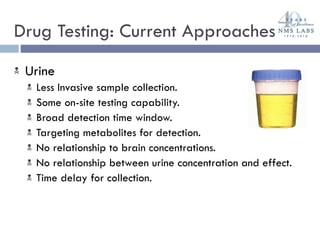
Drug Testing: Current Approaches  Urine Less Invasive sample collection. Some on-site testing capability. Broad detection time window. Targeting metabolites for detection. No relationship to brain concentrations. No relationship between urine concentration and effect. Time delay for collection.
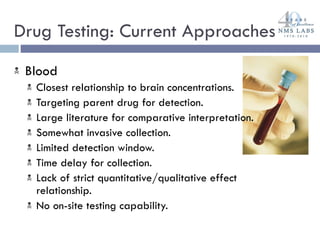
Drug Testing: Current Approaches  Blood Closest relationship to brain concentrations. Targeting parent drug for detection. Large literature for comparative interpretation. Somewhat invasive collection. Limited detection window. Time delay for collection. Lack of strict quantitative/qualitative effect relationship. No on-site testing capability.
Drug Testing: Current Approaches  Oral Fluid Least invasive collection. No time delay for collection. Targeting parent drug for detection. Potential for on-site testing capability. Limited relationship to blood concentrations. No relationship between OF concentration and effect. Limited detection window. Limited specimen volume. Workplace considerations
Drugs in Oral Fluid
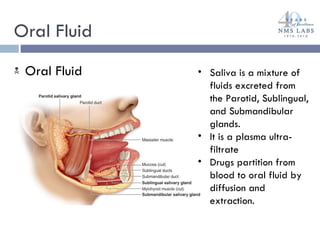
Oral Fluid Oral Fluid Saliva is a mixture of fluids excreted from the Parotid, Sublingual, and Submandibular glands. It is a plasma ultra-filtrate Drugs partition from blood to oral fluid by diffusion and extraction.
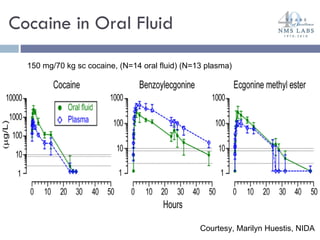
Cocaine in Oral Fluid  150 mg/70 kg sc cocaine, (N=14 oral fluid) (N=13 plasma) Courtesy, Marilyn Huestis, NIDA
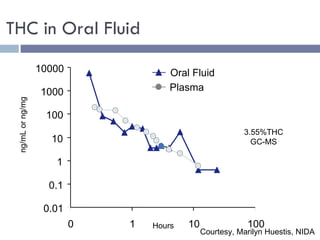
THC in Oral Fluid Courtesy, Marilyn Huestis, NIDA Hours 0.01 0.1 1 10 100 1000 10000 0 1 10 100 Oral Fluid Plasma 3.55%THC GC-MS ng/mL or ng/mg
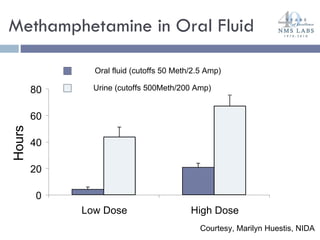
Methamphetamine in Oral Fluid 0 20 40 60 80 Low Dose High Dose Hours Oral fluid (cutoffs 50 Meth/2.5 Amp) Urine (cutoffs 500Meth/200 Amp) Courtesy, Marilyn Huestis, NIDA
History of OF Drug Testing
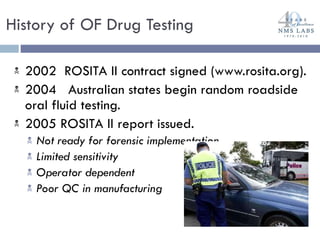
2002  ROSITA II contract signed (www.rosita.org).  2004  Australian states begin random roadside oral fluid testing. 2005 ROSITA II report issued.  Not ready for forensic implementation Limited sensitivity Operator dependent  Poor QC in manufacturing History of OF Drug Testing
2006  DRUID Project begins 2009 “ESTHER” report issued.  Evaluation of oral fluid Screening devices by TISPOL to Harmonise European police Requirements. 16 Devices evaluated Technology has improved and devices are being evaluated in roadside surveys through DRUID project. History of OF Drug Testing
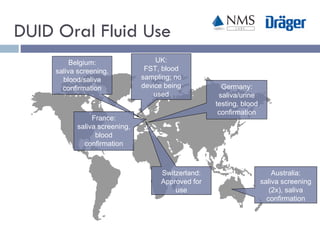
DUID Oral Fluid Use Belgium: saliva screening, blood/saliva confirmation Australia: saliva screening (2x), saliva confirmation Germany: saliva/urine testing, blood confirmation UK: FST, blood sampling; no device being used France: saliva screening, blood confirmation Switzerland: Approved for use
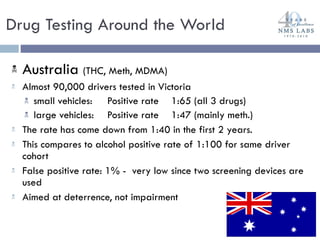
Australia  (THC, Meth, MDMA) Almost 90,000 drivers tested in Victoria small vehicles:  Positive rate  1:65 (all 3 drugs) large vehicles:  Positive rate 1:47 (mainly meth.) The rate has come down from 1:40 in the first 2 years.  This compares to alcohol positive rate of 1:100 for same driver cohort False positive rate: 1% -  very low since two screening devices are used Aimed at deterrence, not impairment Drug Testing Around the World
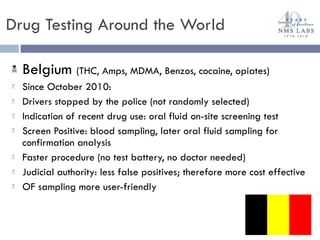
Belgium  (THC, Amps, MDMA, Benzos, cocaine, opiates) Since October 2010: Drivers stopped by the police (not randomly selected)  Indication of recent drug use: oral fluid on-site screening test  Screen Positive: blood sampling, later oral fluid sampling for confirmation analysis Faster procedure (no test battery, no doctor needed) Judicial authority: less false positives; therefore more cost effective OF sampling more user-friendly Drug Testing Around the World
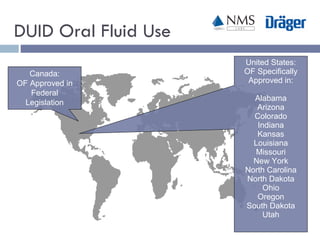
DUID Oral Fluid Use United States: OF Specifically Approved in: Alabama Arizona Colorado Indiana Kansas Louisiana Missouri New York North Carolina North Dakota Ohio Oregon South Dakota Utah Canada: OF Approved in Federal Legislation
Cut-Offs - Amphetamines Belgian legislation Screen 50 ng/mL Confirm 25 ng/mL (AMP, MDMA) French legislation Confirm 50 ng/mL (AMP, MAMP, MDMA) Australian legislation Screen must be positive by 2 POCT devices Confirm MAMP, MDMA & THC on any amphetamines or cannabinoids positive screen
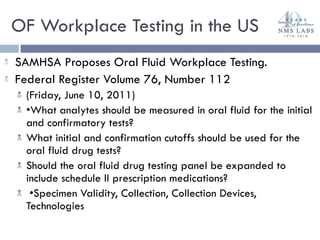
OF Workplace Testing in the US SAMHSA Proposes Oral Fluid Workplace Testing.  Federal Register Volume 76, Number 112  (Friday, June 10, 2011) • What analytes should be measured in oral fluid for the initial and confirmatory tests?  What initial and confirmation cutoffs should be used for the oral fluid drug tests?  Should the oral fluid drug testing panel be expanded to include schedule II prescription medications? • Specimen Validity, Collection, Collection Devices, Technologies
US National Roadside Survey 2007
2007 US National Roadside Survey Conducted in Fall 2007 7000 drivers at 63 sites 6000 Oral Fluid Samples 3000 Blood samples Tested for therapeutic and abused drugs Preliminary results July 2009
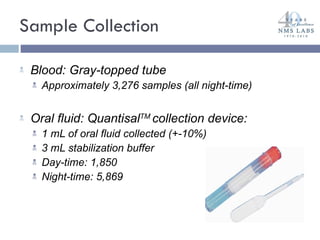
Sample Collection Blood: Gray-topped tube Approximately 3,276 samples (all night-time)  Oral fluid: Quantisal TM  collection device: 1 mL of oral fluid collected (+-10%) 3 mL stabilization buffer  Day-time: 1,850 Night-time: 5,869
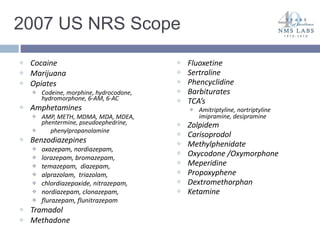
2007 US NRS Scope Cocaine Marijuana Opiates  Codeine, morphine, hydrocodone,  hydromorphone, 6-AM, 6-AC Amphetamines  AMP, METH, MDMA, MDA, MDEA, phentermine, pseudoephedrine,  phenylpropanolamine Benzodiazepines oxazepam, nordiazepam,  lorazepam, bromazepam,  temazepam,  diazepam,  alprazolam,  triazolam,  chlordiazepoxide, nitrazepam,  nordiazepam, clonazepam,  flurazepam, flunitrazepam Tramadol Methadone Fluoxetine Sertraline Phencyclidine Barbiturates TCA’s Amitriptyline, nortriptyline imipramine, desipramine Zolpidem Carisoprodol Methylphenidate Oxycodone /Oxymorphone Meperidine Propoxyphene Dextromethorphan Ketamine
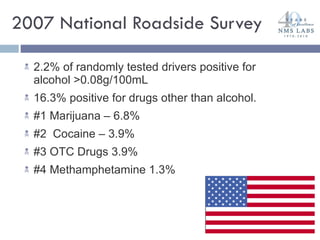
2007 National Roadside Survey 2.2% of randomly tested drivers positive for alcohol >0.08g/100mL 16.3% positive for drugs other than alcohol. #1 Marijuana – 6.8% #2  Cocaine – 3.9% #3 OTC Drugs 3.9% #4 Methamphetamine 1.3%
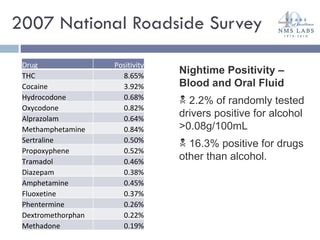
2007 National Roadside Survey Nightime Positivity – Blood and Oral Fluid 2.2% of randomly tested drivers positive for alcohol >0.08g/100mL 16.3% positive for drugs other than alcohol. Drug Positivity THC 8.65% Cocaine 3.92% Hydrocodone 0.68% Oxycodone 0.82% Alprazolam 0.64% Methamphetamine 0.84% Sertraline 0.50% Propoxyphene 0.52% Tramadol 0.46% Diazepam 0.38% Amphetamine 0.45% Fluoxetine 0.37% Phentermine 0.26% Dextromethorphan 0.22% Methadone 0.19%
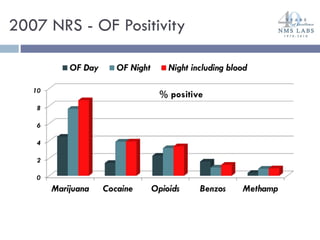
2007 NRS - OF Positivity
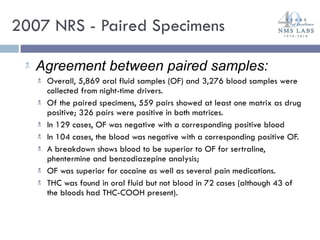
2007 NRS - Paired Specimens Agreement between paired samples: Overall, 5,869 oral fluid samples (OF) and 3,276 blood samples were collected from night-time drivers.  Of the paired specimens, 559 pairs showed at least one matrix as drug positive; 326 pairs were positive in both matrices. In 129 cases, OF was negative with a corresponding positive blood In 104 cases, the blood was negative with a corresponding positive OF.  A breakdown shows blood to be superior to OF for sertraline, phentermine and benzodiazepine analysis;  OF was superior for cocaine as well as several pain medications. THC was found in oral fluid but not blood in 72 cases (although 43 of the bloods had THC-COOH present).
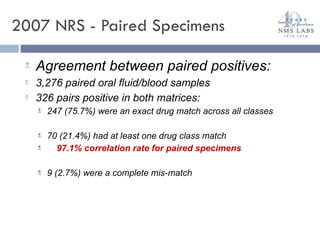
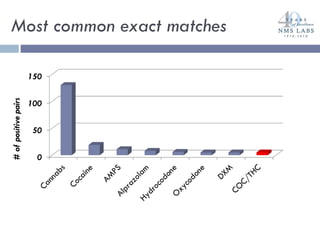
2007 NRS - Paired Specimens Agreement between paired positives: 3,276 paired oral fluid/blood samples 326 pairs positive in both matrices: 247 (75.7%) were an exact drug match across all classes 70 (21.4%) had at least one drug class match 97.1% correlation rate for paired specimens 9 (2.7%) were a complete mis-match
Most common exact matches
Implementing OF Testing
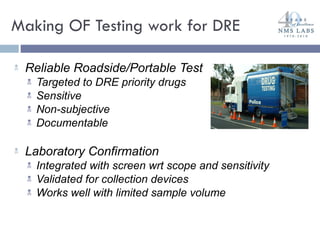
Making OF Testing work for DRE Reliable Roadside/Portable Test Targeted to DRE priority drugs Sensitive Non-subjective Documentable Laboratory Confirmation Integrated with screen wrt scope and sensitivity Validated for collection devices Works well with limited sample volume
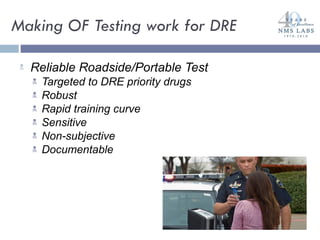
Making OF Testing work for DRE Reliable Roadside/Portable Test Targeted to DRE priority drugs Robust Rapid training curve Sensitive Non-subjective Documentable
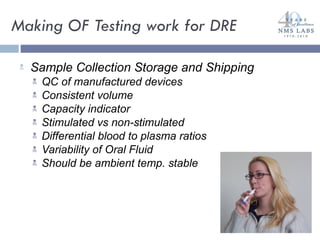
Making OF Testing work for DRE Sample Collection Storage and Shipping QC of manufactured devices Consistent volume Capacity indicator Stimulated vs non-stimulated Differential blood to plasma ratios Variability of Oral Fluid Should be ambient temp. stable
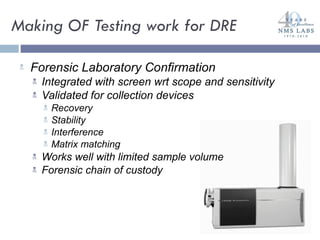
Making OF Testing work for DRE Forensic Laboratory Confirmation Integrated with screen wrt scope and sensitivity Validated for collection devices Recovery Stability Interference Matrix matching Works well with limited sample volume Forensic chain of custody
Summary Oral Fluid testing for Law Enforcement purposes is a proven strategy. Advantages center around ease of collection. Oral Fluid ≠Blood. Screen, collection and confirmation phases must be carefully planned and validated. Adoption requires management  support and buy in from prosecutors.

Oral Fluid as a Chemical Test for the DRE Program

  • 1.
    ORAL FLUID ASA CHEMICAL TEST FOR THE DRE PROGRAM : HISTORY, THE FUTURE, AND PRACTICAL CONSIDERATIONS Barry K Logan PhD, DABFT National Director of Forensic Services, NMS Labs Willow Grove PA
  • 2.
    Disclaimer NMS Labsand Dräger Safety Diagnostics have created a partnership to develop and market oral fluid tests for the DRE marketplace.
  • 3.
    Current Options inDrug Testing
  • 4.
    Drug Testing: CurrentApproaches Urine Less Invasive sample collection. Some on-site testing capability. Broad detection time window. Targeting metabolites for detection. No relationship to brain concentrations. No relationship between urine concentration and effect. Time delay for collection.
  • 5.
    Drug Testing: CurrentApproaches Blood Closest relationship to brain concentrations. Targeting parent drug for detection. Large literature for comparative interpretation. Somewhat invasive collection. Limited detection window. Time delay for collection. Lack of strict quantitative/qualitative effect relationship. No on-site testing capability.
  • 6.
    Drug Testing: CurrentApproaches Oral Fluid Least invasive collection. No time delay for collection. Targeting parent drug for detection. Potential for on-site testing capability. Limited relationship to blood concentrations. No relationship between OF concentration and effect. Limited detection window. Limited specimen volume. Workplace considerations
  • 7.
  • 8.
    Oral Fluid OralFluid Saliva is a mixture of fluids excreted from the Parotid, Sublingual, and Submandibular glands. It is a plasma ultra-filtrate Drugs partition from blood to oral fluid by diffusion and extraction.
  • 9.
    Cocaine in OralFluid 150 mg/70 kg sc cocaine, (N=14 oral fluid) (N=13 plasma) Courtesy, Marilyn Huestis, NIDA
  • 10.
    THC in OralFluid Courtesy, Marilyn Huestis, NIDA Hours 0.01 0.1 1 10 100 1000 10000 0 1 10 100 Oral Fluid Plasma 3.55%THC GC-MS ng/mL or ng/mg
  • 11.
    Methamphetamine in OralFluid 0 20 40 60 80 Low Dose High Dose Hours Oral fluid (cutoffs 50 Meth/2.5 Amp) Urine (cutoffs 500Meth/200 Amp) Courtesy, Marilyn Huestis, NIDA
  • 12.
    History of OFDrug Testing
  • 13.
    2002 ROSITAII contract signed (www.rosita.org). 2004 Australian states begin random roadside oral fluid testing. 2005 ROSITA II report issued. Not ready for forensic implementation Limited sensitivity Operator dependent Poor QC in manufacturing History of OF Drug Testing
  • 14.
    2006 DRUIDProject begins 2009 “ESTHER” report issued. Evaluation of oral fluid Screening devices by TISPOL to Harmonise European police Requirements. 16 Devices evaluated Technology has improved and devices are being evaluated in roadside surveys through DRUID project. History of OF Drug Testing
  • 15.
    DUID Oral FluidUse Belgium: saliva screening, blood/saliva confirmation Australia: saliva screening (2x), saliva confirmation Germany: saliva/urine testing, blood confirmation UK: FST, blood sampling; no device being used France: saliva screening, blood confirmation Switzerland: Approved for use
  • 16.
    Australia (THC,Meth, MDMA) Almost 90,000 drivers tested in Victoria small vehicles: Positive rate 1:65 (all 3 drugs) large vehicles: Positive rate 1:47 (mainly meth.) The rate has come down from 1:40 in the first 2 years. This compares to alcohol positive rate of 1:100 for same driver cohort False positive rate: 1% - very low since two screening devices are used Aimed at deterrence, not impairment Drug Testing Around the World
  • 17.
    Belgium (THC,Amps, MDMA, Benzos, cocaine, opiates) Since October 2010: Drivers stopped by the police (not randomly selected) Indication of recent drug use: oral fluid on-site screening test Screen Positive: blood sampling, later oral fluid sampling for confirmation analysis Faster procedure (no test battery, no doctor needed) Judicial authority: less false positives; therefore more cost effective OF sampling more user-friendly Drug Testing Around the World
  • 18.
    DUID Oral FluidUse United States: OF Specifically Approved in: Alabama Arizona Colorado Indiana Kansas Louisiana Missouri New York North Carolina North Dakota Ohio Oregon South Dakota Utah Canada: OF Approved in Federal Legislation
  • 19.
    Cut-Offs - AmphetaminesBelgian legislation Screen 50 ng/mL Confirm 25 ng/mL (AMP, MDMA) French legislation Confirm 50 ng/mL (AMP, MAMP, MDMA) Australian legislation Screen must be positive by 2 POCT devices Confirm MAMP, MDMA & THC on any amphetamines or cannabinoids positive screen
  • 20.
    OF Workplace Testingin the US SAMHSA Proposes Oral Fluid Workplace Testing. Federal Register Volume 76, Number 112 (Friday, June 10, 2011) • What analytes should be measured in oral fluid for the initial and confirmatory tests? What initial and confirmation cutoffs should be used for the oral fluid drug tests? Should the oral fluid drug testing panel be expanded to include schedule II prescription medications? • Specimen Validity, Collection, Collection Devices, Technologies
  • 21.
  • 22.
    2007 US NationalRoadside Survey Conducted in Fall 2007 7000 drivers at 63 sites 6000 Oral Fluid Samples 3000 Blood samples Tested for therapeutic and abused drugs Preliminary results July 2009
  • 23.
    Sample Collection Blood:Gray-topped tube Approximately 3,276 samples (all night-time) Oral fluid: Quantisal TM collection device: 1 mL of oral fluid collected (+-10%) 3 mL stabilization buffer Day-time: 1,850 Night-time: 5,869
  • 24.
    2007 US NRSScope Cocaine Marijuana Opiates Codeine, morphine, hydrocodone, hydromorphone, 6-AM, 6-AC Amphetamines AMP, METH, MDMA, MDA, MDEA, phentermine, pseudoephedrine, phenylpropanolamine Benzodiazepines oxazepam, nordiazepam, lorazepam, bromazepam, temazepam, diazepam, alprazolam, triazolam, chlordiazepoxide, nitrazepam, nordiazepam, clonazepam, flurazepam, flunitrazepam Tramadol Methadone Fluoxetine Sertraline Phencyclidine Barbiturates TCA’s Amitriptyline, nortriptyline imipramine, desipramine Zolpidem Carisoprodol Methylphenidate Oxycodone /Oxymorphone Meperidine Propoxyphene Dextromethorphan Ketamine
  • 25.
    2007 National RoadsideSurvey 2.2% of randomly tested drivers positive for alcohol >0.08g/100mL 16.3% positive for drugs other than alcohol. #1 Marijuana – 6.8% #2 Cocaine – 3.9% #3 OTC Drugs 3.9% #4 Methamphetamine 1.3%
  • 26.
    2007 National RoadsideSurvey Nightime Positivity – Blood and Oral Fluid 2.2% of randomly tested drivers positive for alcohol >0.08g/100mL 16.3% positive for drugs other than alcohol. Drug Positivity THC 8.65% Cocaine 3.92% Hydrocodone 0.68% Oxycodone 0.82% Alprazolam 0.64% Methamphetamine 0.84% Sertraline 0.50% Propoxyphene 0.52% Tramadol 0.46% Diazepam 0.38% Amphetamine 0.45% Fluoxetine 0.37% Phentermine 0.26% Dextromethorphan 0.22% Methadone 0.19%
  • 27.
    2007 NRS -OF Positivity
  • 28.
    2007 NRS -Paired Specimens Agreement between paired samples: Overall, 5,869 oral fluid samples (OF) and 3,276 blood samples were collected from night-time drivers. Of the paired specimens, 559 pairs showed at least one matrix as drug positive; 326 pairs were positive in both matrices. In 129 cases, OF was negative with a corresponding positive blood In 104 cases, the blood was negative with a corresponding positive OF. A breakdown shows blood to be superior to OF for sertraline, phentermine and benzodiazepine analysis; OF was superior for cocaine as well as several pain medications. THC was found in oral fluid but not blood in 72 cases (although 43 of the bloods had THC-COOH present).
  • 29.
    2007 NRS -Paired Specimens Agreement between paired positives: 3,276 paired oral fluid/blood samples 326 pairs positive in both matrices: 247 (75.7%) were an exact drug match across all classes 70 (21.4%) had at least one drug class match 97.1% correlation rate for paired specimens 9 (2.7%) were a complete mis-match
  • 30.
  • 31.
  • 32.
    Making OF Testingwork for DRE Reliable Roadside/Portable Test Targeted to DRE priority drugs Sensitive Non-subjective Documentable Laboratory Confirmation Integrated with screen wrt scope and sensitivity Validated for collection devices Works well with limited sample volume
  • 33.
    Making OF Testingwork for DRE Reliable Roadside/Portable Test Targeted to DRE priority drugs Robust Rapid training curve Sensitive Non-subjective Documentable
  • 34.
    Making OF Testingwork for DRE Sample Collection Storage and Shipping QC of manufactured devices Consistent volume Capacity indicator Stimulated vs non-stimulated Differential blood to plasma ratios Variability of Oral Fluid Should be ambient temp. stable
  • 35.
    Making OF Testingwork for DRE Forensic Laboratory Confirmation Integrated with screen wrt scope and sensitivity Validated for collection devices Recovery Stability Interference Matrix matching Works well with limited sample volume Forensic chain of custody
  • 36.
    Summary Oral Fluidtesting for Law Enforcement purposes is a proven strategy. Advantages center around ease of collection. Oral Fluid ≠Blood. Screen, collection and confirmation phases must be carefully planned and validated. Adoption requires management support and buy in from prosecutors.

Editor's Notes

  • #9 Lipophilicity of drug Non-polar analytes (THC) partition into oral fluid more readily than polar metabolites (11-nor-9-carboxy-THC) Usually more parent drug than metabolites pKa of drug Non-ionized basic drugs in blood partition into more acidic oral fluid, become ionized & accumulate, “ion trapping of basic drugs” Molecular size of drug
  • #10 Median and interquartile ranges presented on log axis. Dasehed lines indicate LOQ (2.5ug/L), SAMHSA (8ug/L) and DRUID (10ug/L) oral fluid cutoffs.
  • #12 Time To Last Positive Methamphetamine oral fluid positive at 50 ng/mL requires 2.5 ng/mL amphetamine presence Methamphetamine urine positive at 500 ng/mL requires 200 ng/mL amphetamine presence After how many doses? After the last?