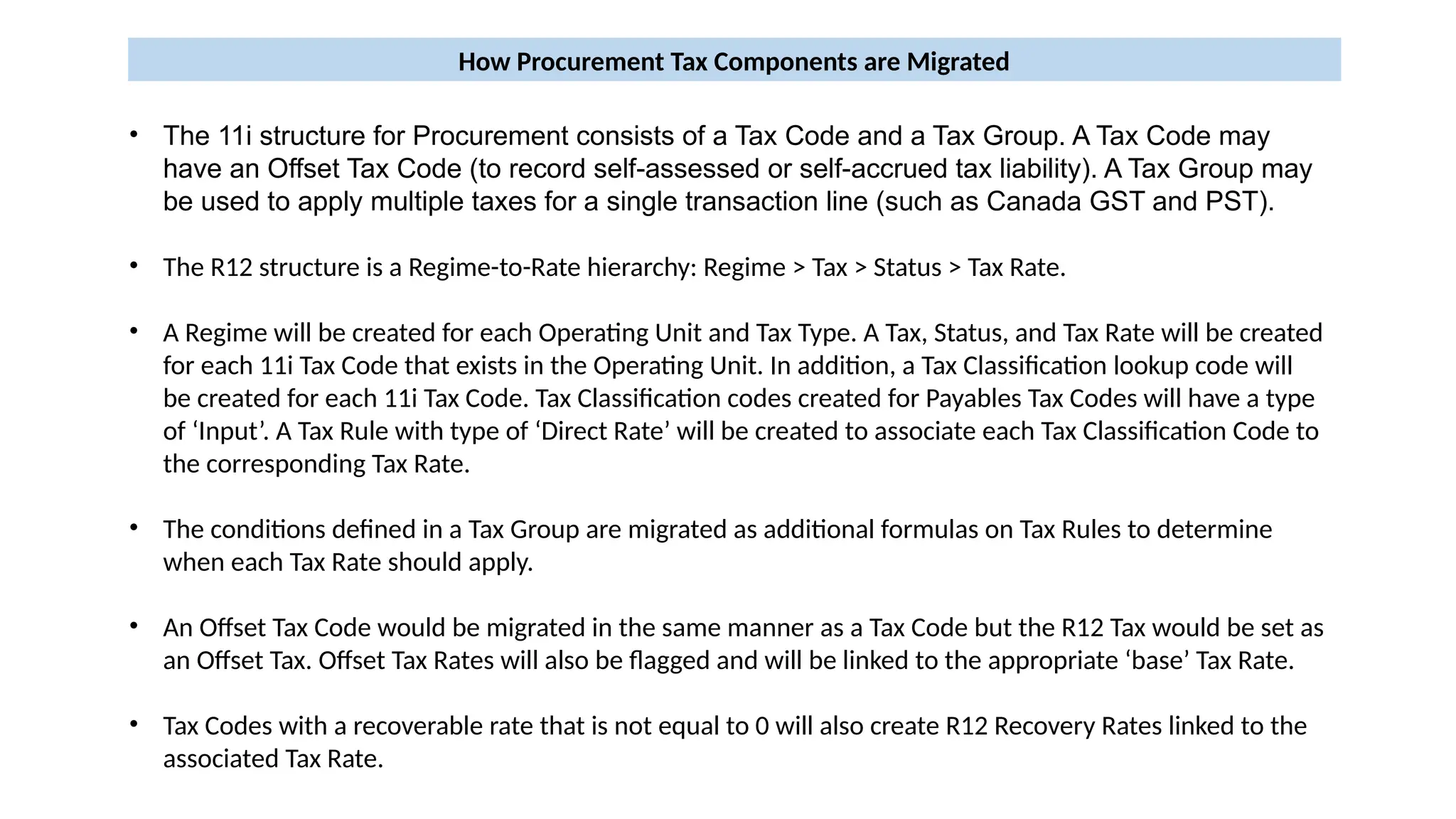
• The 11istructure for Procurement consists of a Tax Code and a Tax Group. A Tax Code may
have an Offset Tax Code (to record self-assessed or self-accrued tax liability). A Tax Group may
be used to apply multiple taxes for a single transaction line (such as Canada GST and PST).
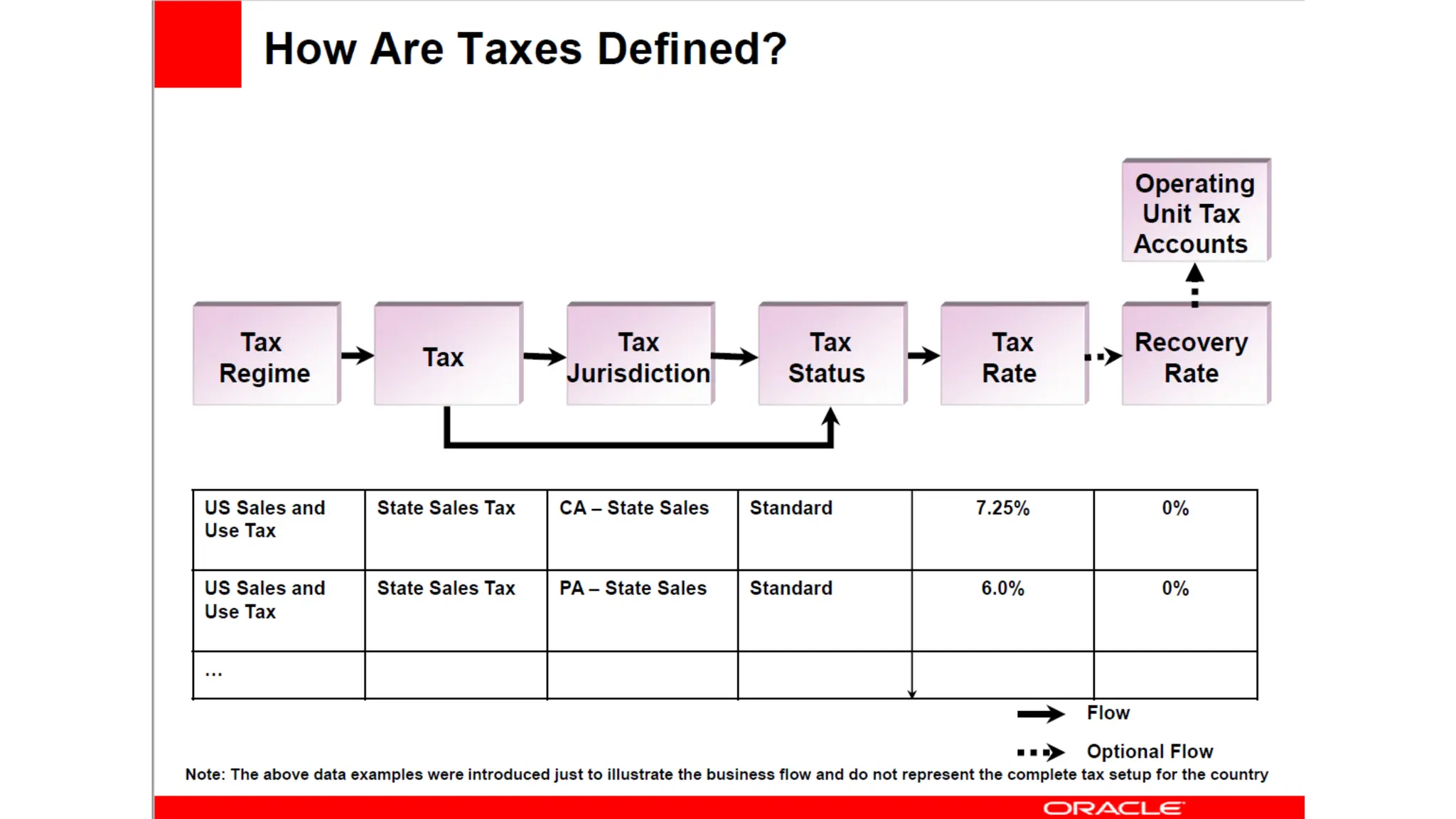
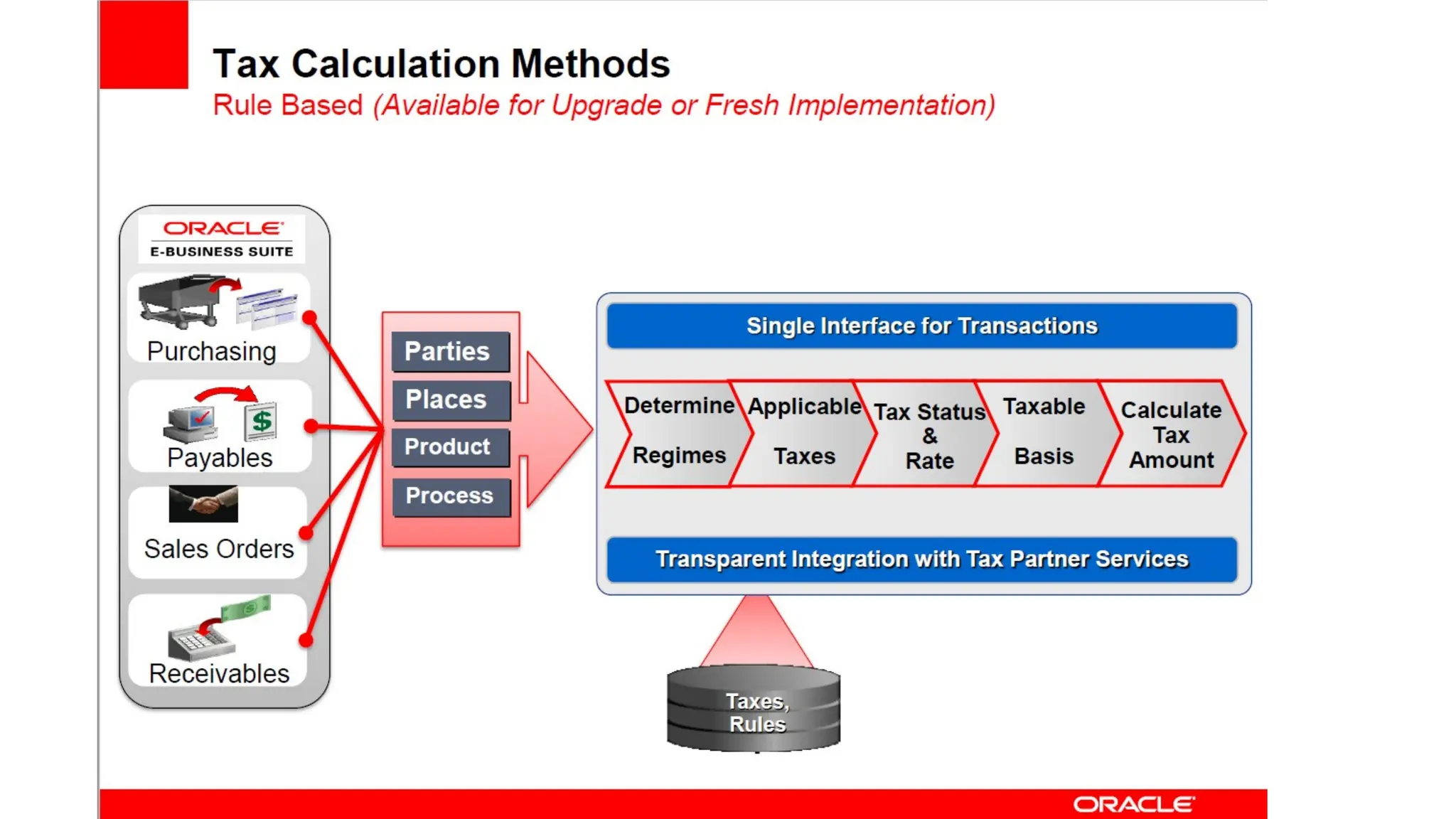
• The R12 structure is a Regime-to-Rate hierarchy: Regime > Tax > Status > Tax Rate.
• A Regime will be created for each Operating Unit and Tax Type. A Tax, Status, and Tax Rate will be created
for each 11i Tax Code that exists in the Operating Unit. In addition, a Tax Classification lookup code will
be created for each 11i Tax Code. Tax Classification codes created for Payables Tax Codes will have a type
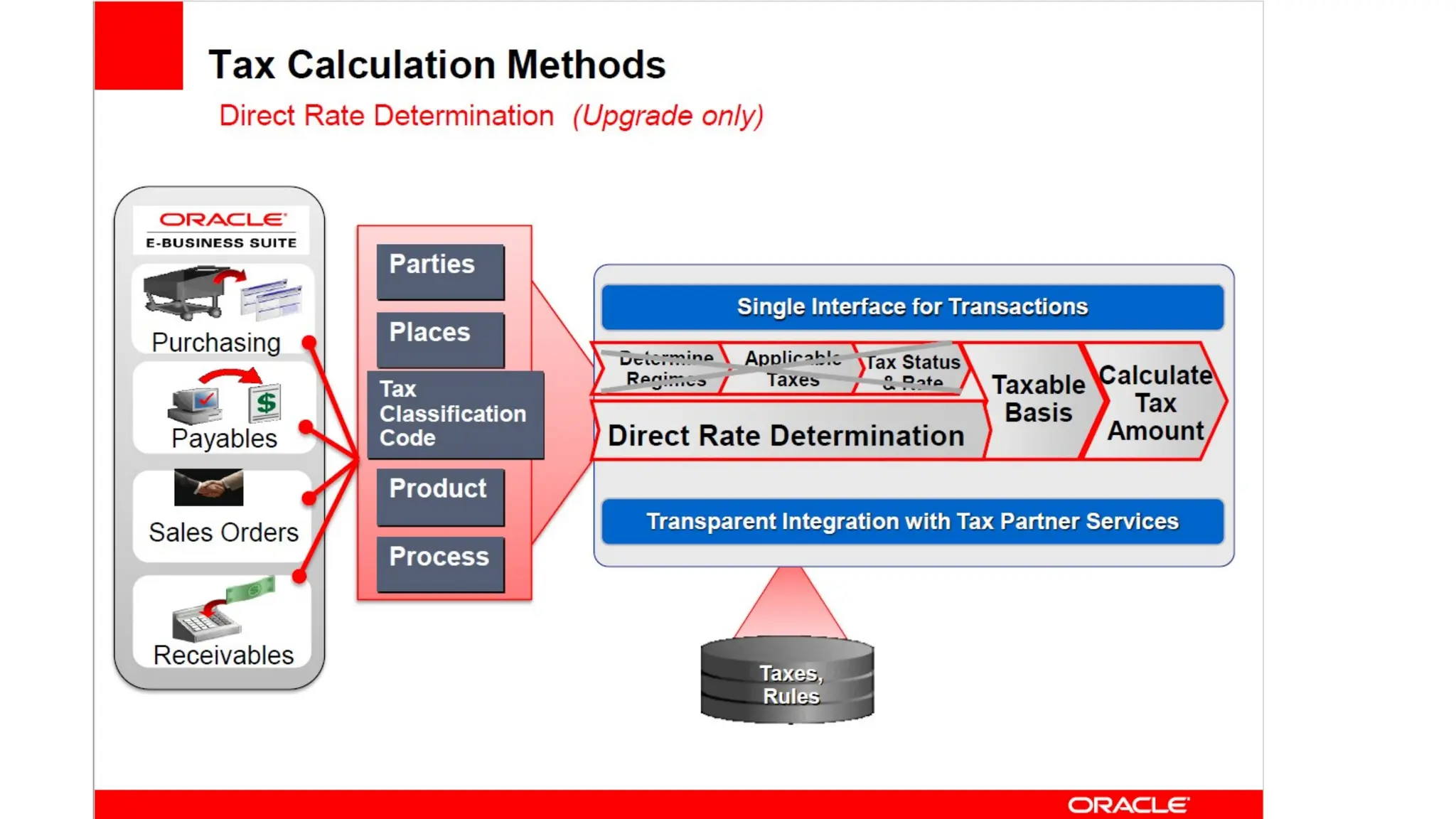
of ‘Input’. A Tax Rule with type of ‘Direct Rate’ will be created to associate each Tax Classification Code to
the corresponding Tax Rate.
• The conditions defined in a Tax Group are migrated as additional formulas on Tax Rules to determine
when each Tax Rate should apply.
• An Offset Tax Code would be migrated in the same manner as a Tax Code but the R12 Tax would be set as
an Offset Tax. Offset Tax Rates will also be flagged and will be linked to the appropriate ‘base’ Tax Rate.
• Tax Codes with a recoverable rate that is not equal to 0 will also create R12 Recovery Rates linked to the
associated Tax Rate.
How Procurement Tax Components are Migrated
14.
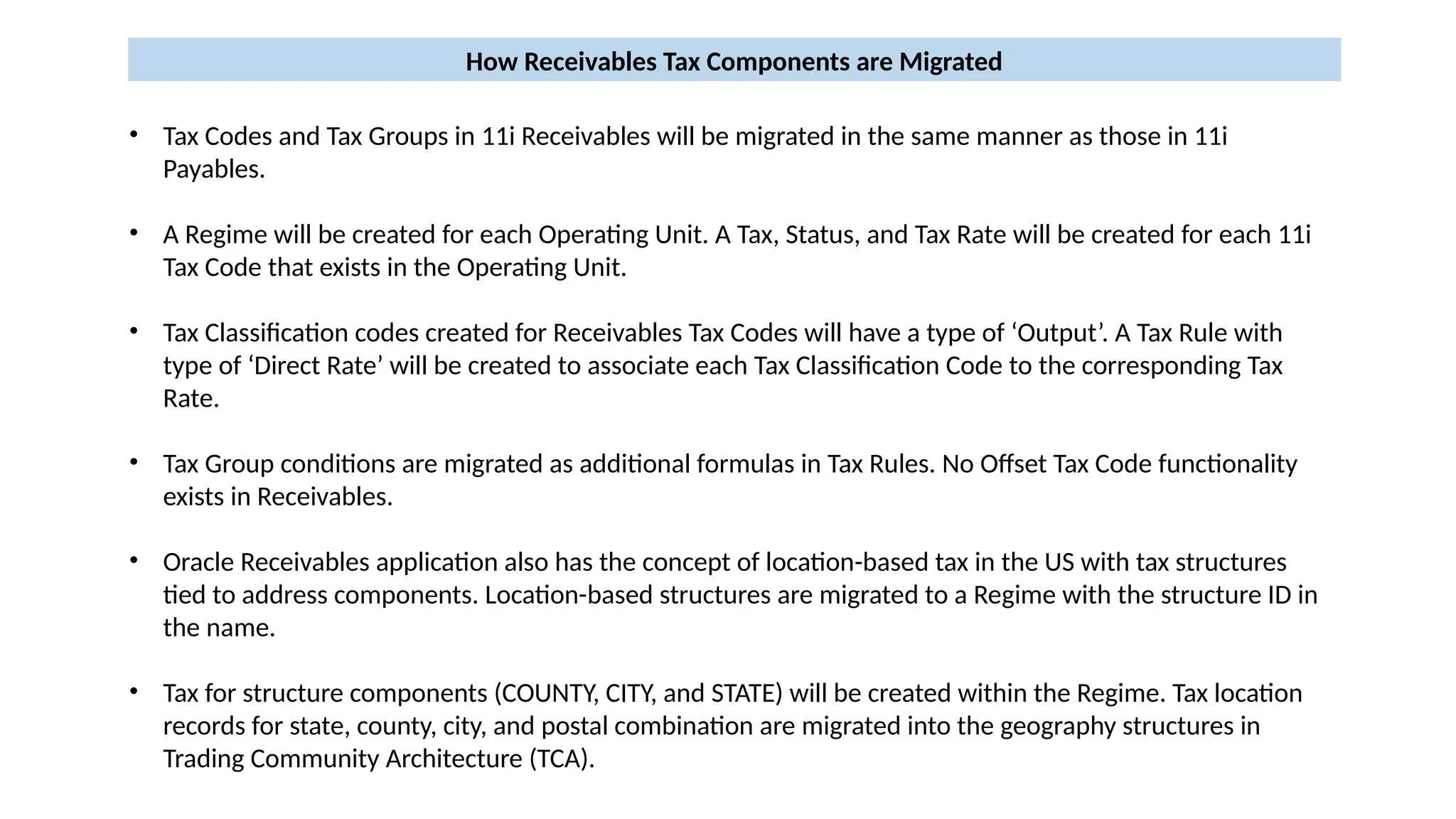
• Tax Codesand Tax Groups in 11i Receivables will be migrated in the same manner as those in 11i
Payables.
• A Regime will be created for each Operating Unit. A Tax, Status, and Tax Rate will be created for each 11i
Tax Code that exists in the Operating Unit.
• Tax Classification codes created for Receivables Tax Codes will have a type of ‘Output’. A Tax Rule with
type of ‘Direct Rate’ will be created to associate each Tax Classification Code to the corresponding Tax
Rate.
• Tax Group conditions are migrated as additional formulas in Tax Rules. No Offset Tax Code functionality
exists in Receivables.
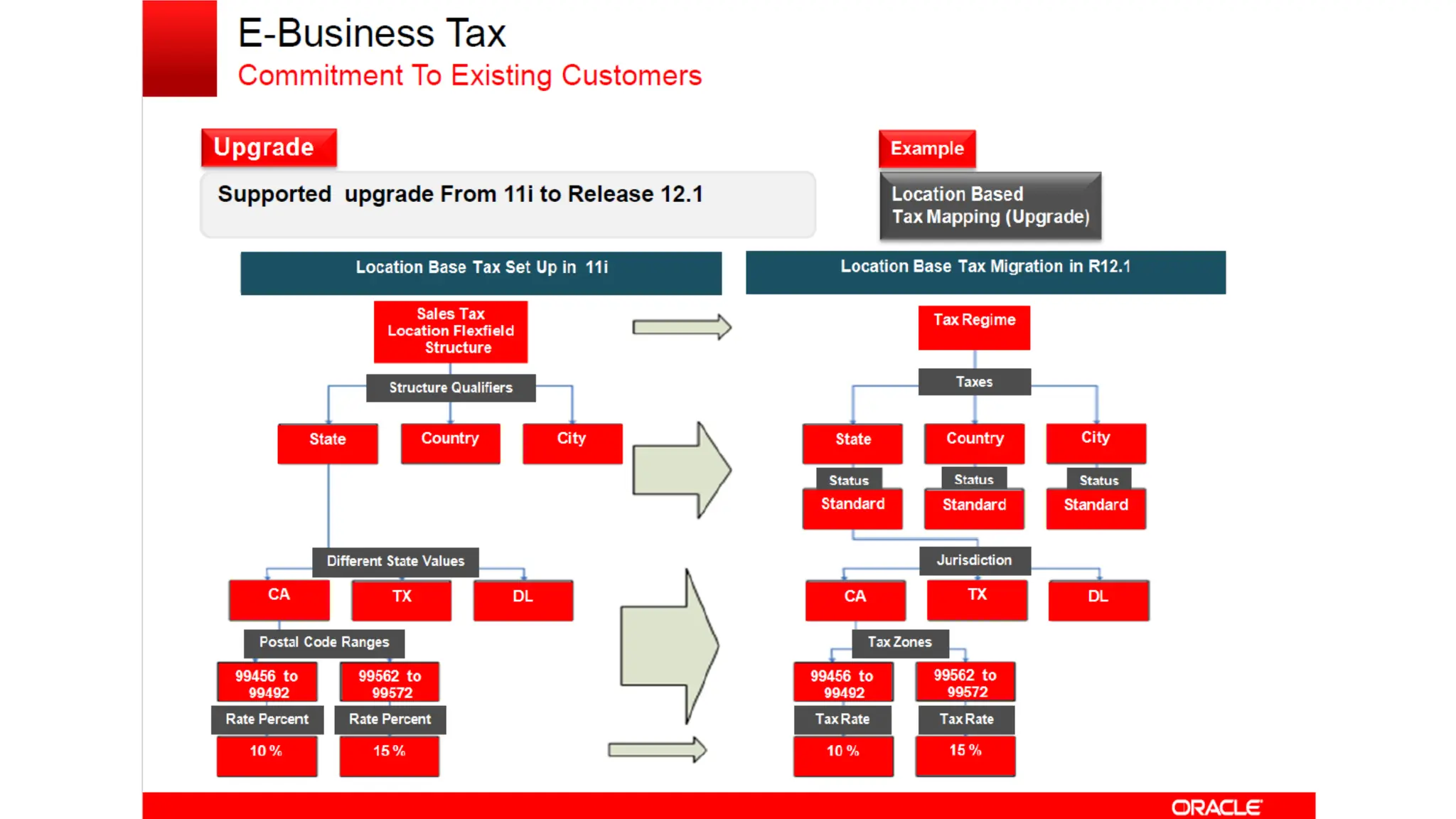
• Oracle Receivables application also has the concept of location-based tax in the US with tax structures
tied to address components. Location-based structures are migrated to a Regime with the structure ID in
the name.
• Tax for structure components (COUNTY, CITY, and STATE) will be created within the Regime. Tax location
records for state, county, city, and postal combination are migrated into the geography structures in
Trading Community Architecture (TCA).
How Receivables Tax Components are Migrated
15.
How Receivables TaxComponents are Migrated Contd.
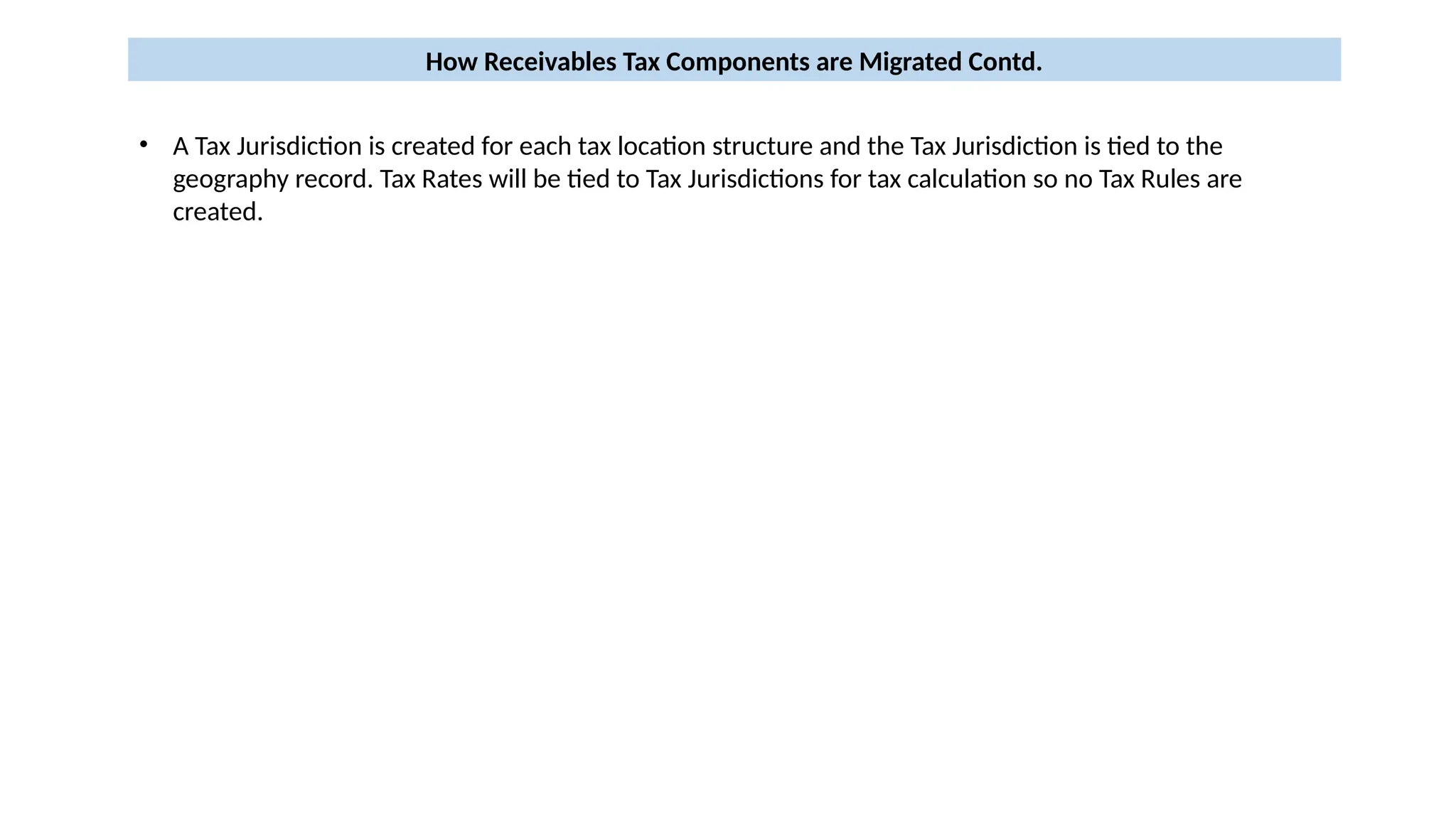
• A Tax Jurisdiction is created for each tax location structure and the Tax Jurisdiction is tied to the
geography record. Tax Rates will be tied to Tax Jurisdictions for tax calculation so no Tax Rules are
created.
16.
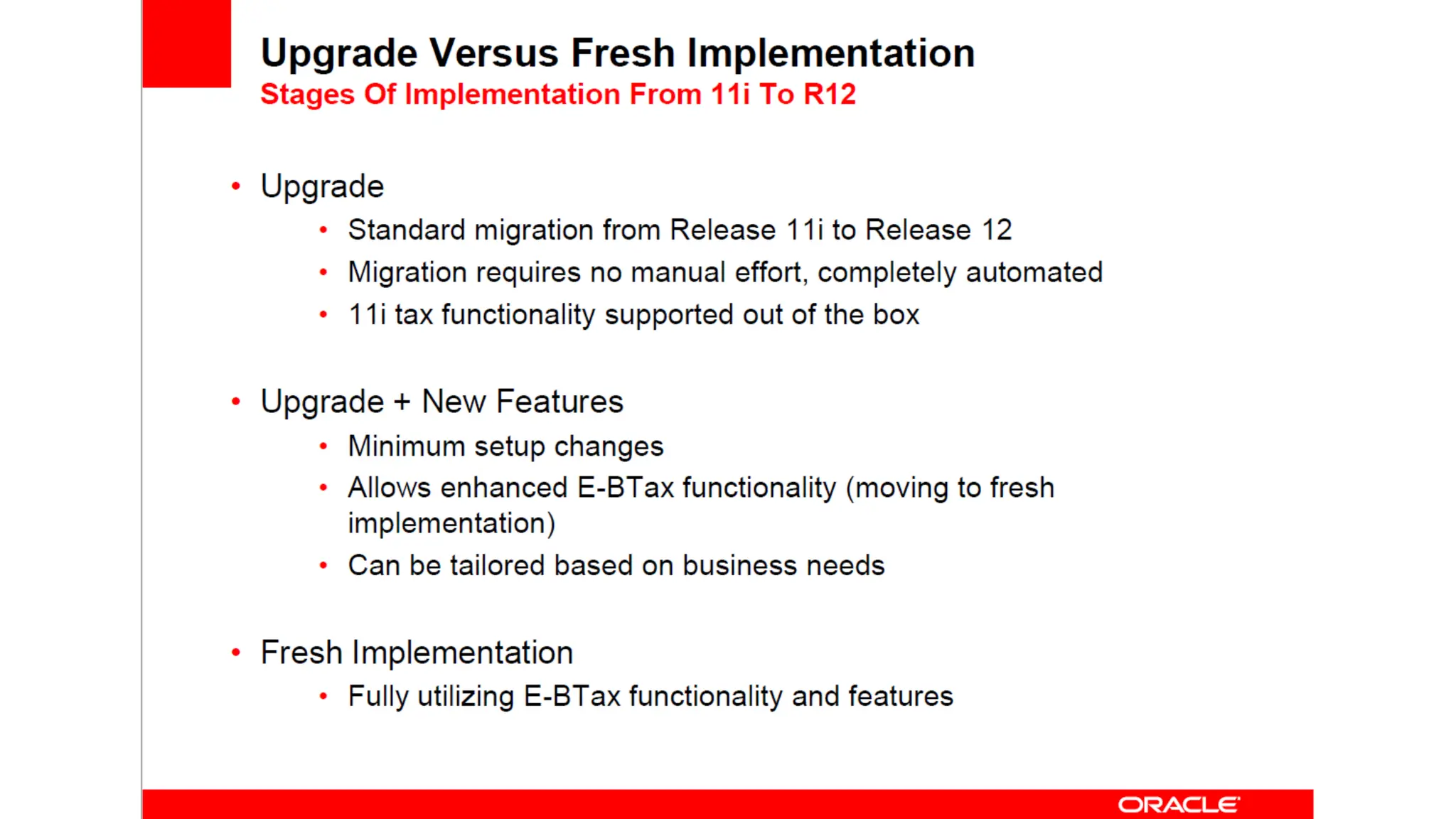
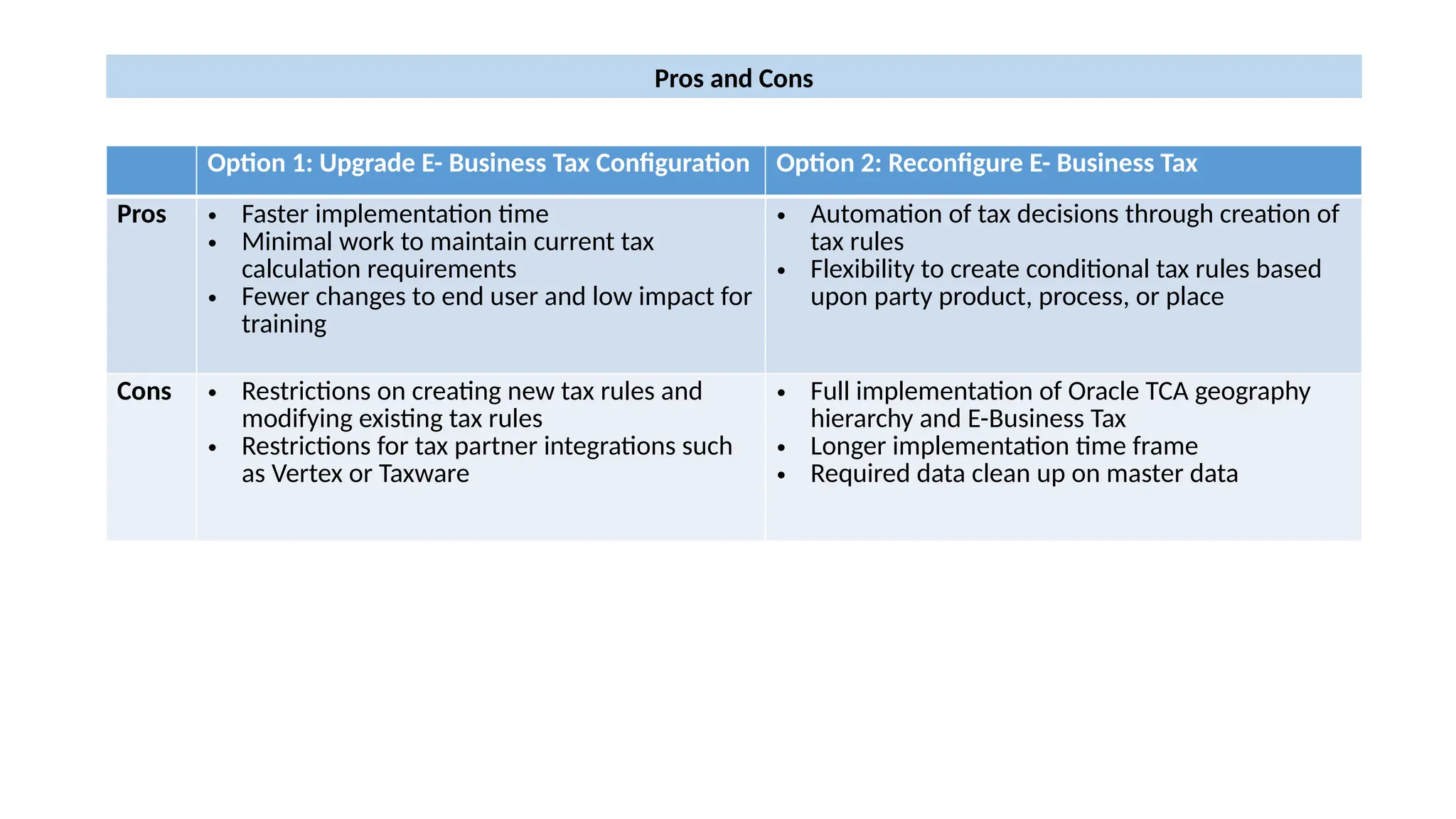
Option 1: UpgradeE- Business Tax Configuration Option 2: Reconfigure E- Business Tax
Pros • Faster implementation time
• Minimal work to maintain current tax
calculation requirements
• Fewer changes to end user and low impact for
training
• Automation of tax decisions through creation of
tax rules
• Flexibility to create conditional tax rules based
upon party product, process, or place
Cons • Restrictions on creating new tax rules and
modifying existing tax rules
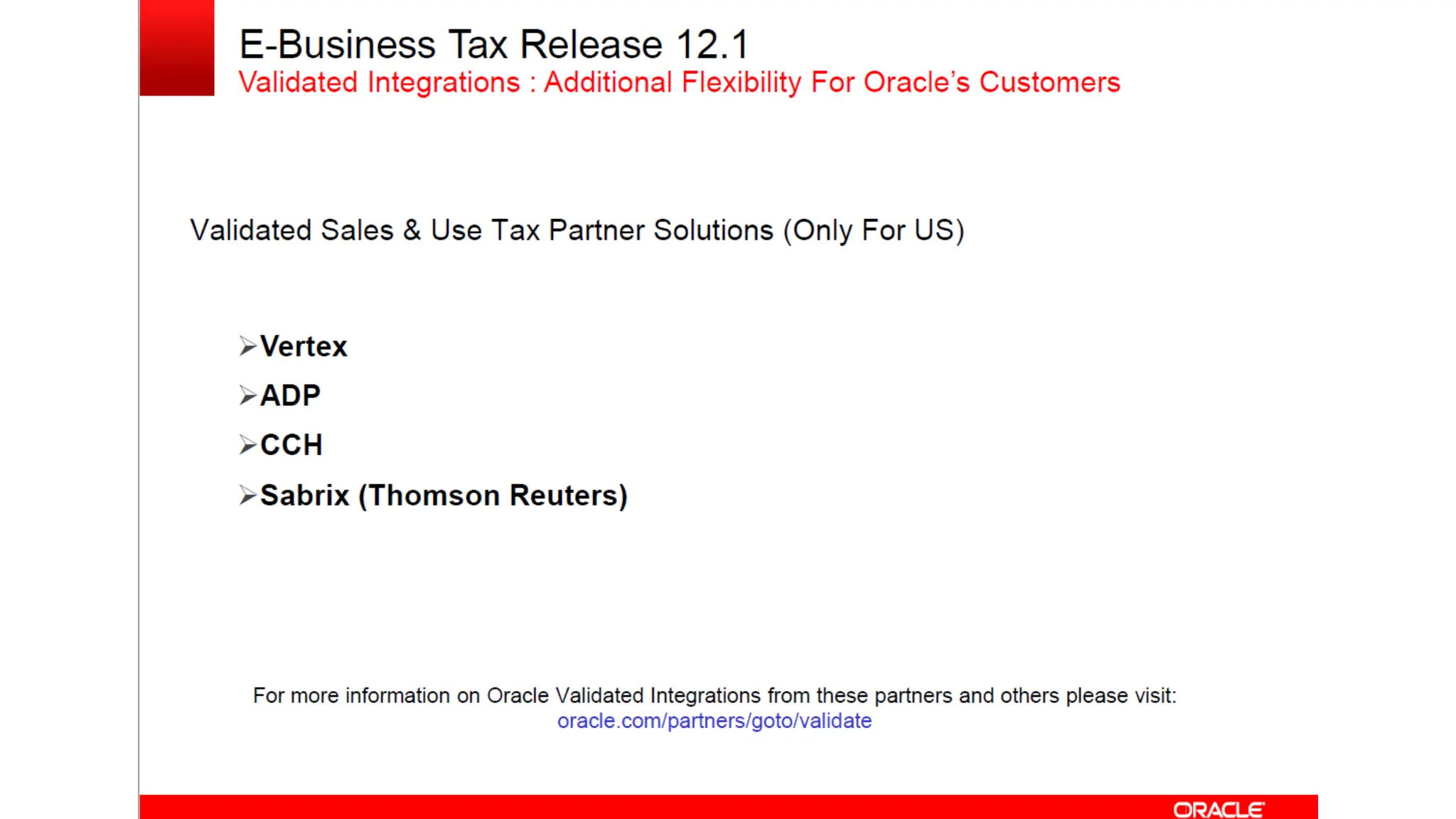
• Restrictions for tax partner integrations such
as Vertex or Taxware
• Full implementation of Oracle TCA geography
hierarchy and E-Business Tax
• Longer implementation time frame
• Required data clean up on master data
Pros and Cons