CONFERENCE WATCH 
Inspirational young leaders spearhead 
One Young World Summit 
As one of the founding supporters of the One Young World annual summit, 
OFID once again brought young delegates from unrepresented countries 
to the 2013 gathering in Johannesburg. 
by Reem Aljarbou 
ne Young World 2013 took place in Africa 
for the first time on October 2–5. Once 
O 
again, OFID was a Delegate Partner, joining oth-ers 
in gathering the brightest young people from 
around the world and empowering them to make 
positive change. 
This year, over 1,250 delegates from 190 
countries attended. Sir Richard Branson made his 
first appearance as a One Young World Coun-selor, 
and Winnie Mandela addressed the delega-tion 
during the closing ceremony. 
The Summit provides delegates with the op-portunity 
to debate, formulate and create inno-vative 
solutions to some of the most pressing 
issues challenging their societies. 
Many delegates describe their experience at 
the Summit as “life-changing.” Their ability to in-teract 
with and listen to some of the most inspira-tional 
leaders on the planet provides them with in-sight 
into the power they hold to change the future. 
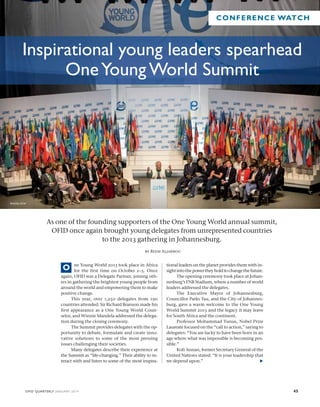
The opening ceremony took place at Johan-nesburg’s 
FNB Stadium, where a number of world 
leaders addressed the delegates. 
The Executive Mayor of Johannesburg, 
Councillor Parks Tau, and the City of Johannes-burg, 
gave a warm welcome to the One Young 
World Summit 2013 and the legacy it may leave 
for South Africa and the continent. 
Professor Mohammad Yunus, Nobel Prize 
Laureate focused on the “call to action,” saying to 
delegates: “You are lucky to have been born in an 
age where what was impossible is becoming pos-sible.” 
Kofi Annan, former Secretary General of the 
United Nations stated: “It is your leadership that 
we depend upon.”  
PHOTO: OYW 
OFID QUARTERLY JANUARY 2014 45
CONFERENCE WATCH 
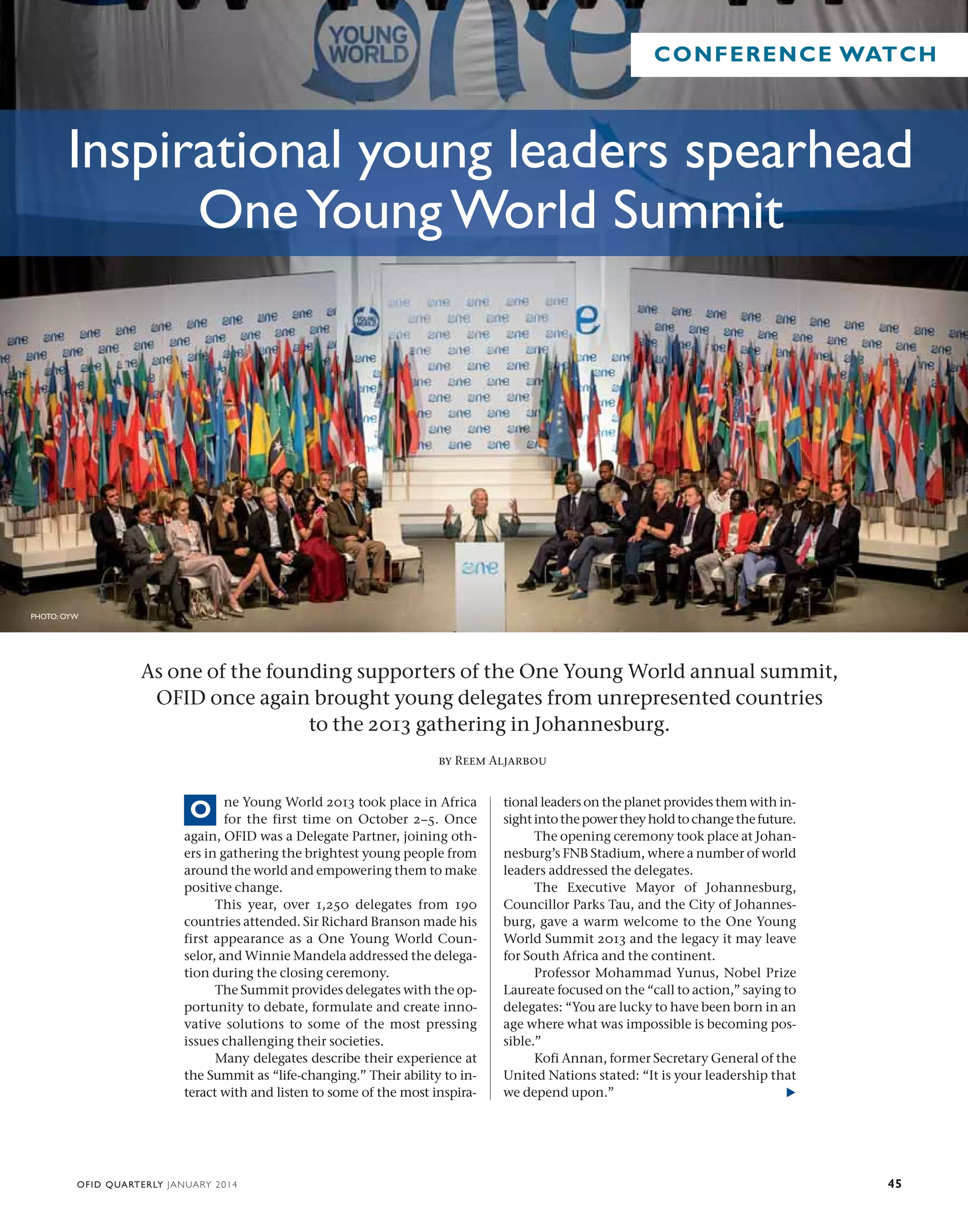
Voices of Youth 
OFID-sponsored delegates reflect 
Tabassum Mokhduma, Bangladesh 
“I was really amazed to see so many young 
people full of passion for what they are 
doing. These people are the true change 
makers, and I was really surprised despite 
their young age, how they try to make a 
change in the best possible way they can. 
I want to tell all of you hearing me today, 
to speak up and raise your voice on violence against women, or any 
form of violence it doesn’t really matter, be it inside your home or 
outside your home, if you suffer or anyone you know is suffering, 
please speak up, because it happens that sometimes that one who is 
suffering does not have the chance to speak up.” 
Kingsley Ofosu-Ampong, Ghana 
“If I am able to make my voice be heard, 
in one way or another I can help someone, 
those who are de-privileged and those 
who cannot do anything about their own 
situation. It is the power of voice that really 
inspires me.” 
Adrianova Emilia, 
Nicaragua 
“I have had the chance 
to learn about educa-tion 
and women’s em-powerment, 
which has 
opened my mind, and 
made me ask myself 
what am I doing and 
what can I do when I 
return to my country.” 
46 OFID QUARTERLY JANUARY 2014
CONFERENCE WATCH 
 Reflecting on the shortcomings of his own gen-eration, 
Sir Bob Geldof, musician and activist 
warned the delegates: “You cannot afford to let 
your generation fail.” 
Since One Young World was launched in 
2010, OFID has sponsored 84 young delegates 
from 47 countries. Delegates from developing and 
Member Countries are given the opportunity to 
attend the summit through an extensive applica-tion 
process. 
Each year in advance of the Summit, One 
Young World commissions global research based 
on the topics and themes Ambassadors have 
agreed should be up for discussion. The findings 
help inform content for the plenary sessions and 
assist in identifying areas of interest for special 
sessions and debates. 
Main topics debated 
The plenary sessions are the foundations from 
which all content at the Summit is developed. 
The 2013 topics were arrived at following a year-long 
consultation process with Ambassadors and 
incoming delegates. 
The 2013 Summit held plenary sessions on 
the following six themes: Education; Global Busi-ness; 
Human Rights; Leadership and Governance; 
Sustainable Development; and Youth Unemploy-ment. 
Each plenary session featured six speeches 
given by delegates who were personally intro-duced 
by a Counselor. 
The question posed at the plenary on Edu-cation 
was: How can tomorrow’s skills be taught 
today? 
Education systems are at a crossroad and ed-ucators 
are grappling with how to meet the 
changing requirements of today’s employment 
landscape. 
In the developing world especially, progress 
in getting every child into school is at a halt, with 
57 million children still without access to basic 
education. 
During this session, delegates discussed the 
importance of technology and alternative school-ing 
methods which can better prepare young peo-ple 
for life. 
Around 62 percent of One Young World Am-bassadors 
and delegates are active or have a spe-cial 
interest in education. In the polls, the One 
Young World community selected education as 
the top choice of topics for the 2013 Summit. 
The Global Business plenary explored how 
young employees could be the key to better busi-ness. 
For this generation, technology has enabled 
them to be more informed, making them one  
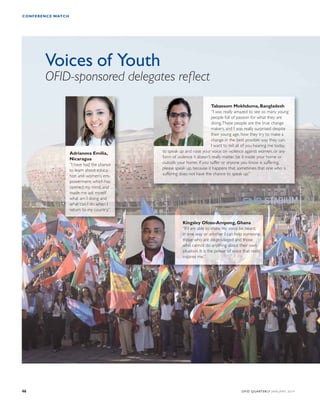
Howard Woodrow Chidinma 
Nelson-Williams, Sierra Leone 
“What captivated me the most about what 
Kofi Annan said was: ‘Change is not an event, 
but it is a process and it takes continuous effort, 
it takes relentlessness, it takes perseverance, 
hard work, discipline and commitment, knowing 
what we want and focusing on the objective, 
and then eventually together we can achieve what we want to achieve.’ 
I am very happy that I am in the midst of so many like-minded young 
people from all over the world representing various diversities and cultures 
here in one place, it gives me and every other person the opportunity 
to network and share ideas to build on ideas and create platforms and 
solutions to our problems, and make a change in the world.” 
Sumudu Paragoda Vithanage, Sri Lanka 
“Sri Lanka’s education system is evolving; it’s not 
like when we were in school, its more knowledge 
based, including more skills and practical sessions. 
To change the world we should be more ori-ented, 
work, and develop our skills. Communica-tion 
skills are now playing a bigger role in 
leadership; it’s a good powerful method to bring 
people together to share their knowledge and our experiences. 
After coming here, many young people have done the smallest things that 
have made such a difference. So it’s not about gathering knowledge and get-ting 
experience, it is about your willingness that will make a change. We 
should act on what we do without waiting to get experience or recognition, 
because they are not needed to make a difference.” 
PHOTOS: OYW; OFID/REEM ALJARBOU 
OFID QUARTERLY JANUARY 2014 47
of the most influential generation of young 
adults that has ever existed. 
Because of their power to drive change and 
make business more responsible and sustainable, 
business leaders are understanding the impor-tance 
of listening to this generation’s needs. 
During the Global Business plenary various 
delegates and Ambassadors who work in busi-nesses 
shared the roles they hold within their 
organizations and the changes they try to imple-ment 
despite being young. 
The poll for this session showed that 93 per-cent 
of the One Young World community be-lieved 
that business should have a purpose 
beyond profit. 
The Human Rights plenary looked at gen-der 
equality and the challenge of turning rhetoric 
into reality. 
Disabled people, women and young girls are 
considered some of the top groups of people 
whose rights are least protected. Women’s rights 
are routinely violated on a daily basis whether 
from discrimination, poverty or violence. 
Violence causes more death and disability 
amongst women aged 15 to 44 than war, cancer, 
malaria and traffic accidents combined. Two-thirds 
of illiterate adults in this world are women. 
The Session examined how to improve the 
rights of marginalized women and girls and ex-plore 
ways to address the structural causes of gen-der 
inequality. 
A substantial 88 percent of One Young 
World delegates said that upholding the rights of 
women and girls was vital to progress in their 
country. 
At the plenary on Leadership  Gover-nance, 
delegates considered the question: What 
is the new democracy? 
CONFERENCE WATCH 
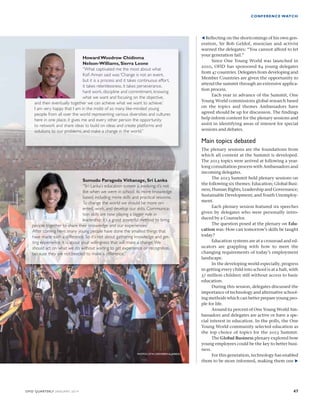
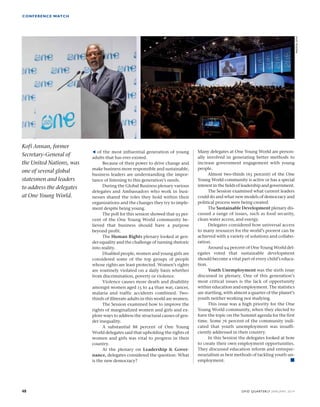
Kofi Annan, former 
Secretary-General of 
the United Nations, was 
one of several global 
statesmen and leaders 
to address the delegates 
at One Young World. 
Many delegates at One Young World are person-ally 
involved in generating better methods to 
increase government engagement with young 
people. 
Almost two-thirds (63 percent) of the One 
Young World community is active or has a special 
interest in the fields of leadership and government. 
The Session examined what current leaders 
could do and what new models of democracy and 
political process were being created. 
The Sustainable Development plenary dis-cussed 
a range of issues, such as food security, 
clean water access, and energy. 
Delegates considered how universal access 
to many resources for the world’s poorest can be 
achieved with a variety of solutions and collabo-ration. 
Around 94 percent of One Young World del-egates 
voted that sustainable development 
should become a vital part of every child’s educa-tion. 
Youth Unemployment was the sixth issue 
discussed in plenary. One of this generation’s 
most critical issues is the lack of opportunity 
within education and employment. The statistics 
are startling, with almost a quarter of the planet’s 
youth neither working nor studying. 
This issue was a high priority for the One 
Young World community, when they elected to 
have the topic on the Summit agenda for the first 
time. Some 76 percent of the community indi-cated 
that youth unemployment was insuffi-ciently 
addressed in their country. 
In this Session the delegates looked at how 
to create their own employment opportunities. 
They discussed education reform and entrepre-neurialism 
as best methods of tackling youth un-employment. 
 
48 OFID QUARTERLY JANUARY 2014 
PHOTOS: OYW

Oq january 2014_oyw

  • 1.
    CONFERENCE WATCH Inspirationalyoung leaders spearhead One Young World Summit As one of the founding supporters of the One Young World annual summit, OFID once again brought young delegates from unrepresented countries to the 2013 gathering in Johannesburg. by Reem Aljarbou ne Young World 2013 took place in Africa for the first time on October 2–5. Once O again, OFID was a Delegate Partner, joining oth-ers in gathering the brightest young people from around the world and empowering them to make positive change. This year, over 1,250 delegates from 190 countries attended. Sir Richard Branson made his first appearance as a One Young World Coun-selor, and Winnie Mandela addressed the delega-tion during the closing ceremony. The Summit provides delegates with the op-portunity to debate, formulate and create inno-vative solutions to some of the most pressing issues challenging their societies. Many delegates describe their experience at the Summit as “life-changing.” Their ability to in-teract with and listen to some of the most inspira-tional leaders on the planet provides them with in-sight into the power they hold to change the future. The opening ceremony took place at Johan-nesburg’s FNB Stadium, where a number of world leaders addressed the delegates. The Executive Mayor of Johannesburg, Councillor Parks Tau, and the City of Johannes-burg, gave a warm welcome to the One Young World Summit 2013 and the legacy it may leave for South Africa and the continent. Professor Mohammad Yunus, Nobel Prize Laureate focused on the “call to action,” saying to delegates: “You are lucky to have been born in an age where what was impossible is becoming pos-sible.” Kofi Annan, former Secretary General of the United Nations stated: “It is your leadership that we depend upon.” PHOTO: OYW OFID QUARTERLY JANUARY 2014 45
  • 2.
    CONFERENCE WATCH Voicesof Youth OFID-sponsored delegates reflect Tabassum Mokhduma, Bangladesh “I was really amazed to see so many young people full of passion for what they are doing. These people are the true change makers, and I was really surprised despite their young age, how they try to make a change in the best possible way they can. I want to tell all of you hearing me today, to speak up and raise your voice on violence against women, or any form of violence it doesn’t really matter, be it inside your home or outside your home, if you suffer or anyone you know is suffering, please speak up, because it happens that sometimes that one who is suffering does not have the chance to speak up.” Kingsley Ofosu-Ampong, Ghana “If I am able to make my voice be heard, in one way or another I can help someone, those who are de-privileged and those who cannot do anything about their own situation. It is the power of voice that really inspires me.” Adrianova Emilia, Nicaragua “I have had the chance to learn about educa-tion and women’s em-powerment, which has opened my mind, and made me ask myself what am I doing and what can I do when I return to my country.” 46 OFID QUARTERLY JANUARY 2014
  • 3.
    CONFERENCE WATCH Reflecting on the shortcomings of his own gen-eration, Sir Bob Geldof, musician and activist warned the delegates: “You cannot afford to let your generation fail.” Since One Young World was launched in 2010, OFID has sponsored 84 young delegates from 47 countries. Delegates from developing and Member Countries are given the opportunity to attend the summit through an extensive applica-tion process. Each year in advance of the Summit, One Young World commissions global research based on the topics and themes Ambassadors have agreed should be up for discussion. The findings help inform content for the plenary sessions and assist in identifying areas of interest for special sessions and debates. Main topics debated The plenary sessions are the foundations from which all content at the Summit is developed. The 2013 topics were arrived at following a year-long consultation process with Ambassadors and incoming delegates. The 2013 Summit held plenary sessions on the following six themes: Education; Global Busi-ness; Human Rights; Leadership and Governance; Sustainable Development; and Youth Unemploy-ment. Each plenary session featured six speeches given by delegates who were personally intro-duced by a Counselor. The question posed at the plenary on Edu-cation was: How can tomorrow’s skills be taught today? Education systems are at a crossroad and ed-ucators are grappling with how to meet the changing requirements of today’s employment landscape. In the developing world especially, progress in getting every child into school is at a halt, with 57 million children still without access to basic education. During this session, delegates discussed the importance of technology and alternative school-ing methods which can better prepare young peo-ple for life. Around 62 percent of One Young World Am-bassadors and delegates are active or have a spe-cial interest in education. In the polls, the One Young World community selected education as the top choice of topics for the 2013 Summit. The Global Business plenary explored how young employees could be the key to better busi-ness. For this generation, technology has enabled them to be more informed, making them one Howard Woodrow Chidinma Nelson-Williams, Sierra Leone “What captivated me the most about what Kofi Annan said was: ‘Change is not an event, but it is a process and it takes continuous effort, it takes relentlessness, it takes perseverance, hard work, discipline and commitment, knowing what we want and focusing on the objective, and then eventually together we can achieve what we want to achieve.’ I am very happy that I am in the midst of so many like-minded young people from all over the world representing various diversities and cultures here in one place, it gives me and every other person the opportunity to network and share ideas to build on ideas and create platforms and solutions to our problems, and make a change in the world.” Sumudu Paragoda Vithanage, Sri Lanka “Sri Lanka’s education system is evolving; it’s not like when we were in school, its more knowledge based, including more skills and practical sessions. To change the world we should be more ori-ented, work, and develop our skills. Communica-tion skills are now playing a bigger role in leadership; it’s a good powerful method to bring people together to share their knowledge and our experiences. After coming here, many young people have done the smallest things that have made such a difference. So it’s not about gathering knowledge and get-ting experience, it is about your willingness that will make a change. We should act on what we do without waiting to get experience or recognition, because they are not needed to make a difference.” PHOTOS: OYW; OFID/REEM ALJARBOU OFID QUARTERLY JANUARY 2014 47
  • 4.
    of the mostinfluential generation of young adults that has ever existed. Because of their power to drive change and make business more responsible and sustainable, business leaders are understanding the impor-tance of listening to this generation’s needs. During the Global Business plenary various delegates and Ambassadors who work in busi-nesses shared the roles they hold within their organizations and the changes they try to imple-ment despite being young. The poll for this session showed that 93 per-cent of the One Young World community be-lieved that business should have a purpose beyond profit. The Human Rights plenary looked at gen-der equality and the challenge of turning rhetoric into reality. Disabled people, women and young girls are considered some of the top groups of people whose rights are least protected. Women’s rights are routinely violated on a daily basis whether from discrimination, poverty or violence. Violence causes more death and disability amongst women aged 15 to 44 than war, cancer, malaria and traffic accidents combined. Two-thirds of illiterate adults in this world are women. The Session examined how to improve the rights of marginalized women and girls and ex-plore ways to address the structural causes of gen-der inequality. A substantial 88 percent of One Young World delegates said that upholding the rights of women and girls was vital to progress in their country. At the plenary on Leadership Gover-nance, delegates considered the question: What is the new democracy? CONFERENCE WATCH Kofi Annan, former Secretary-General of the United Nations, was one of several global statesmen and leaders to address the delegates at One Young World. Many delegates at One Young World are person-ally involved in generating better methods to increase government engagement with young people. Almost two-thirds (63 percent) of the One Young World community is active or has a special interest in the fields of leadership and government. The Session examined what current leaders could do and what new models of democracy and political process were being created. The Sustainable Development plenary dis-cussed a range of issues, such as food security, clean water access, and energy. Delegates considered how universal access to many resources for the world’s poorest can be achieved with a variety of solutions and collabo-ration. Around 94 percent of One Young World del-egates voted that sustainable development should become a vital part of every child’s educa-tion. Youth Unemployment was the sixth issue discussed in plenary. One of this generation’s most critical issues is the lack of opportunity within education and employment. The statistics are startling, with almost a quarter of the planet’s youth neither working nor studying. This issue was a high priority for the One Young World community, when they elected to have the topic on the Summit agenda for the first time. Some 76 percent of the community indi-cated that youth unemployment was insuffi-ciently addressed in their country. In this Session the delegates looked at how to create their own employment opportunities. They discussed education reform and entrepre-neurialism as best methods of tackling youth un-employment. 48 OFID QUARTERLY JANUARY 2014 PHOTOS: OYW