Blogs, Podcasts, and Other Ways to Promote Cancer Research
Lance Catedral, MD, MCMMO, FPCP
Assistant Professor, Mindanao State University
Member, Research Committee and Multimedia Committee, PSMO (2022)
@lanceoncology
Disclosures
I HAVE NOTHING TO DISCLOSE
You may take screenshots, photos, or recordings of this talk. A copy will be posted at
the PSMO Microsite.
Alternatively, you may access the slideset at http://bottledbrain.com after the session.
Get in touch with me: @lanceoncology (Twitter), or lance@bottledbrain.com.
OUTLINE
WHY LOOK FOR ALTERNATIVES?
Knowledge transfer and mobilization
BLOGGING YOUR RESEARCH
PODCASTING YOUR RESEARCH
Academic podcasting
Miniworkshop
OUTLINE
WHY LOOK FOR ALTERNATIVES?
Knowledge transfer and mobilization
BLOGGING YOUR RESEARCH
PODCASTING YOUR RESEARCH
Academic podcasting
Miniworkshop
Research
World
TheGoal
Researchdissemination
• A planned process that involves consideration
of target audiences, consideration of the
settings in which research findings are to be
received, and communicating and interacting
with wider audiences in ways that will facilitate
research uptake and understanding.
Ross-Hellauer T, Tennant JP, Banelytė V, Gorogh E, Luzi D, Kraker P, et al. (2020) Ten simple rules for innovative dissemination of research. PLoS Comput Biol 16(4): e1007704.
https://doi.org/10.1371/journal.pcbi.1007704
Knowledge translation is moving research from the
laboratory, the research journal, and the academic
conference into the hands of people and organizations who
can put it to practical use
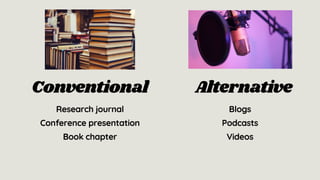
Research journal
Conference presentation
Book chapter
Conventional
Blogs
Podcasts
Videos
Alternative
17
years
Committee on Quality of Health Care in America, Institute of Medicine. Crossing the Quality Chasm: A New Health System for the 21st Century. Washington, DC: National Academies Press;
2001.
Principles of
storytelling
Outline
Why look for alternatives?
Knowledge transfer and mobilization
Blogging your research
Podcasting your research
Academic podcasting
Miniworkshop
BLOGGINGYOURRESEARCH
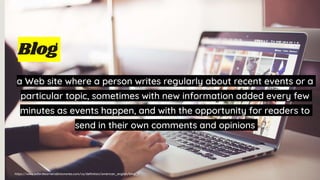
Blog
a Web site where a person writes regularly about recent events or a
particular topic, sometimes with new information added every few
minutes as events happen, and with the opportunity for readers to
send in their own comments and opinions
https://www.oxfordlearnersdictionaries.com/us/definition/american_english/blog_1
Blogging is quite simply, one of the most important
things that an academic should be doing right
now.
http://blogs.lse.ac.uk/impactofsocialsciences/2012/02/24/five-minutes-patrick-dunleavy-chris-gilson/
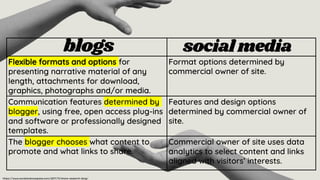
socialmedia
https://www.socialsciencespace.com/2017/11/share-research-blog/
Flexible formats and options for
presenting narrative material of any
length, attachments for download,
graphics, photographs and/or media.
Format options determined by
commercial owner of site.
Communication features determined by
blogger, using free, open access plug-ins
and software or professionally designed
templates.
Features and design options
determined by commercial owner of
site.
The blogger chooses what content to
promote and what links to share.
Commercial owner of site uses data
analytics to select content and links
aligned with visitors’ interests.
blogs
Research
blogs
• Scholarly
• Web-friendly
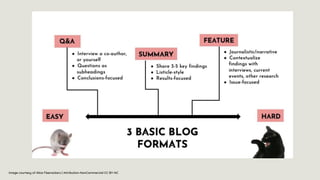
Image courtesy of Alice Fleerackers | Attribution-NonCommercial CC BY-NC
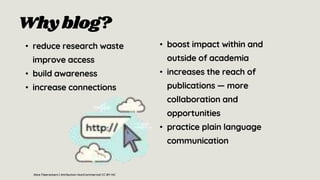
Why blog?
• reduce research waste
improve access
• build awareness
• increase connections
• boost impact within and
outside of academia
• increases the reach of
publications — more
collaboration and
opportunities
• practice plain language
communication
Alice Fleerackers | Attribution-NonCommercial CC BY-NC
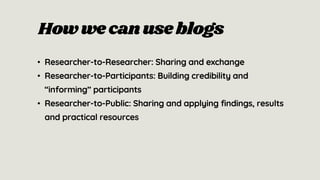
How we canuse blogs
• Researcher-to-Researcher: Sharing and exchange
• Researcher-to-Participants: Building credibility and
“informing” participants
• Researcher-to-Public: Sharing and applying findings, results
and practical resources
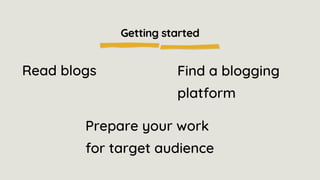
Getting started
Read blogs Find a blogging
platform
Prepare your work
for target audience
Considerations
• Target audience
• Discoverability
• Tone
• Shorter blogs are preferable to long essays
• Strong and entertaining keywords
• Videos and images
• Guest blogs
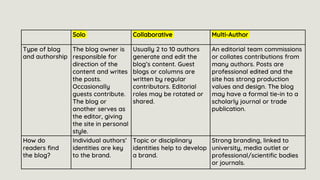
Solo Collaborative Multi-Author
Type of blog
and authorship
The blog owner is
responsible for
direction of the
content and writes
the posts.
Occasionally
guests contribute.

The blog or
another serves as
the editor, giving
the site in personal
style.
Usually 2 to 10 authors
generate and edit the
blog’s content. Guest
blogs or columns are
written by regular
contributors. Editorial
roles may be rotated or
shared.
An editorial team commissions
or collates contributions from
many authors. Posts are
professional edited and the
site has strong production
values and design. The blog
may have a formal tie-in to a
scholarly journal or trade
publication.
How do
readers find
the blog?
Individual authors’
identities are key
to the brand.
Topic or disciplinary
identities help to develop
a brand.
Strong branding, linked to
university, media outlet or
professional/scientific bodies
or journals.
Examples
• Researcher-to-Researcher
⚬ Solo: This Sociological Life from Deborah Lupton, Helen Kara, Patter, from Pat Thompson, and The
Academic Creative from Katie Linder.
⚬ Collaborative: Sociological Imagination , The Thesis Whisperer, and Small Pond Research
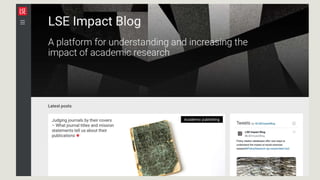
⚬ Multi-Author: London School of Economics Impact of Social Sciences, and ACRLog, a blog for academic
and research librarians. SAGE Methodspace is also an example of this type.
• Researcher-to-Participant
⚬ Specific to the research project and taken offline when project is completed.
• Researcher-to-Audience
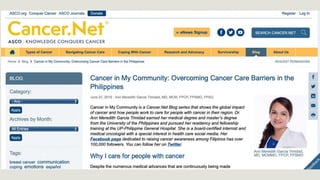
⚬ Collaborative: Savage Minds, anthropology for a public audience, Division of Environmental Biology (DEB),
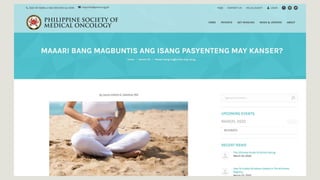
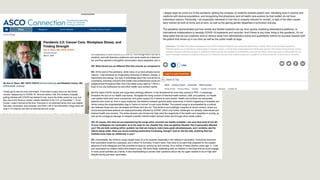
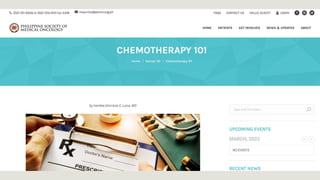
PSMO Website
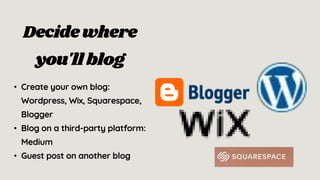
• Create your own blog:
Wordpress, Wix, Squarespace,
Blogger
• Blog on a third-party platform:
Medium
• Guest post on another blog
Decidewhere
you'llblog
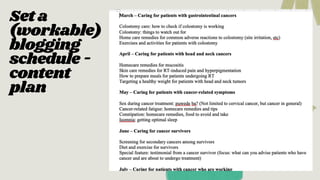
Seta
(workable)
blogging
schedule-
content
plan
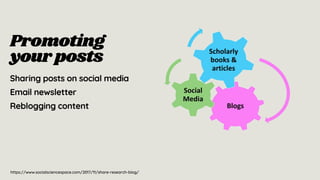
Promoting
yourposts
Sharing posts on social media
Email newsletter
Reblogging content
https://www.socialsciencespace.com/2017/11/share-research-blog/
Set
worthwhile
goals
• Fulfillment—improved
writing skills?
• Google Analytics
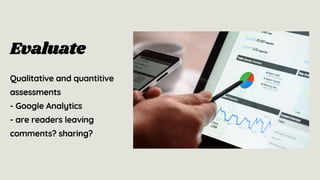
Evaluate
Qualitative and quantitive
assessments
- Google Analytics
- are readers leaving
comments? sharing?
Outline
Why look for alternatives?
Knowledge transfer and mobilization
Blogging your research
Podcasting your research
Academic podcasting
Miniworkshop
https://library.ucalgary.ca/guides/media-
creation/podcast
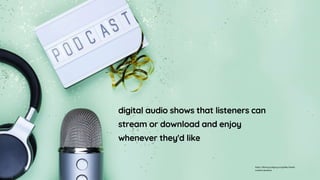
digital audio shows that listeners can
stream or download and enjoy
whenever they'd like
Podcasting is a great way to synthesize research into bite-sized
pieces for listeners who come from a range of backgrounds. Not only
does podcasting help researchers think through how to communicate
their work to different audiences, but the medium can also go a long
way to increase research literacy at scale.
Research and Academic Podcasting. https://www.methodspace.com/blog/research-and-academic-podcasting
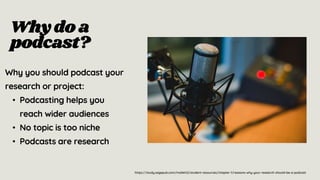
Whydo a
podcast?
Why you should podcast your
research or project:
• Podcasting helps you
reach wider audiences
• No topic is too niche
• Podcasts are research
https://study.sagepub.com/mollett2/student-resources/chapter-1/reasons-why-your-research-should-be-a-podcast
Findyour
niche
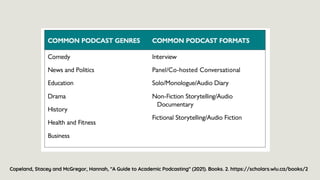
what you want your podcast to be
Copeland, Stacey and McGregor, Hannah, "A Guide to Academic Podcasting" (2021). Books. 2. https://scholars.wlu.ca/books/2
Identifyyour
audience
Who are you speaking to?
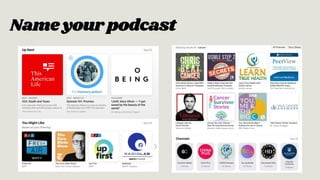
Nameyour podcast
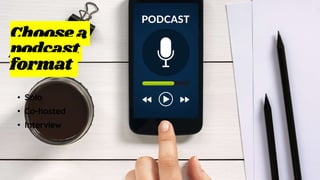
Choosea
podcast
format
• Solo
• Co-hosted
• Interview
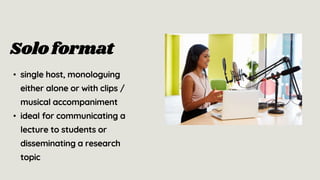
Soloformat
• single host, monologuing
either alone or with clips /
musical accompaniment
• ideal for communicating a
lecture to students or
disseminating a research
topic
Co-hosted
format
• two or more regular hosts
working together.
• disseminating group work or
debating real-world issues.
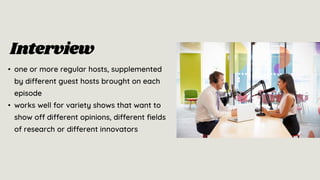
• one or more regular hosts, supplemented
by different guest hosts brought on each
episode
• works well for variety shows that want to
show off different opinions, different fields
of research or different innovators
Interview
• Teaser
• Introduction
• Welcome
• Content
• Shout-out Yourself
• Outro
• Next episode teaser
Basiclayout
Podcast
Script
Thescript is a
roadmap
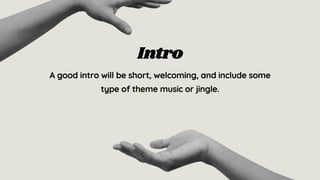
A good intro will be short, welcoming, and include some
type of theme music or jingle.
Intro
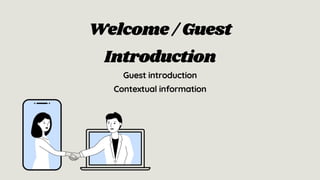
Guest introduction
Contextual information
Welcome/ Guest
Introduction
Actualcontent
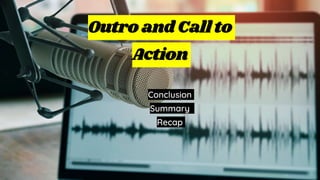
Conclusion
Summary
Recap
Outro andCallto
Action
Soloshow
• Intro: Brief summary of the episode’s contents. Introduce yourself, your podcast,
and any guests. (Duration: _____ )
• [Sponsor message]
• [Theme music]
• Topic 1: _______________ (Duration: ___ )
• Main point
• Supporting points
• Data, quotes, or other information
• Topic 2: _______________ (Duration: ___ )
• Main point
• Supporting points
• Data, quotes, or other information
• Segue
• Topic 3: _______________ (Duration: ___ )
• Main point
• Supporting points
• Data, quotes, or other information
• Outro: _____ (Duration: ____ )
• Recap
• Call to action
• [Closing theme music]
Conversation/interviewshow
• Intro: Brief summary of the episode’s contents. Introduce yourself, your podcast, and any guests. (Duration: _____ )
• [Sponsor message]
• [Theme music]
• Guest introduction: include a guest bio, including their title, experience, and any relevant accomplishments. Thank
them for joining the podcast.
• Question 1 (Duration: ____ )
• Question 2 (Duration: ____ )
• [Sponsor message]
• Question 3 (Duration: ____ )
• Outro: _____ (Duration: ____ )
• Recap
• Call to action
• [Closing theme music]
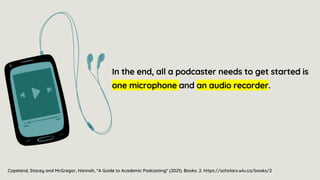
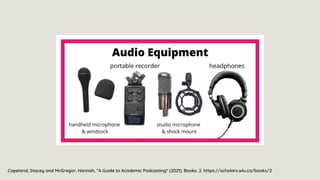
In the end, all a podcaster needs to get started is
one microphone and an audio recorder.
Copeland, Stacey and McGregor, Hannah, "A Guide to Academic Podcasting" (2021). Books. 2. https://scholars.wlu.ca/books/2
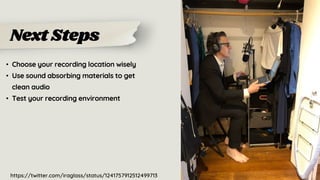
Next Steps
• Choose your recording location wisely
• Use sound absorbing materials to get
clean audio
• Test your recording environment
https://twitter.com/iraglass/status/1241757912512499713
University of Calgary. https://library.ucalgary.ca/c.php?g=255288&p=5100826
Usingthe
microphone
• Get comfortable
• Stretch your vocal cords
• Don't shout or whisper
• Eat an apple
• Avoid dairy and coffee
• Avoid uptalking
• Ideally: fist length away from mic
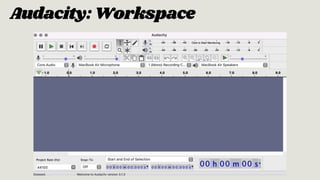
Audacity
Audacity: Workspace
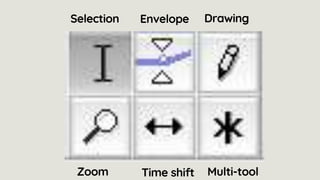
Selection Envelope Drawing
Zoom Time shift Multi-tool
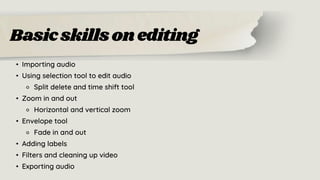
Basicskillsonediting
• Importing audio
• Using selection tool to edit audio
⚬ Split delete and time shift tool
• Zoom in and out
⚬ Horizontal and vertical zoom
• Envelope tool
⚬ Fade in and out
• Adding labels
• Filters and cleaning up video
• Exporting audio
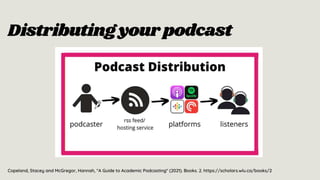
Distributingyour podcast
Copeland, Stacey and McGregor, Hannah, "A Guide to Academic Podcasting" (2021). Books. 2. https://scholars.wlu.ca/books/2
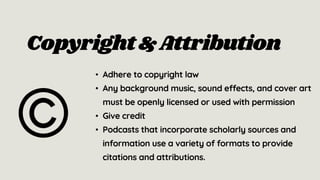
• Adhere to copyright law
• Any background music, sound effects, and cover art
must be openly licensed or used with permission
• Give credit
• Podcasts that incorporate scholarly sources and
information use a variety of formats to provide
citations and attributions.
Copyright &Attribution
Othermedia
• Digital video
⚬ Video abstract
■ https://libraries.ou.edu/content/make-video-abstract-your-
research
Outline
Why look for alternatives?
Knowledge transfer and mobilization
Blogging your research
Podcasting your research
Academic podcasting
Miniworkshop
• Participate in knowledge mobilization
• Incorporate innovative research dissemination
strategies
• Publication AND blog/podcast/video
Calltoaction

Optimizing Your Research Impact

  • 1.
    Blogs, Podcasts, andOther Ways to Promote Cancer Research Lance Catedral, MD, MCMMO, FPCP Assistant Professor, Mindanao State University Member, Research Committee and Multimedia Committee, PSMO (2022) @lanceoncology
  • 2.
    Disclosures I HAVE NOTHINGTO DISCLOSE You may take screenshots, photos, or recordings of this talk. A copy will be posted at the PSMO Microsite. Alternatively, you may access the slideset at http://bottledbrain.com after the session. Get in touch with me: @lanceoncology (Twitter), or lance@bottledbrain.com.
  • 3.
    OUTLINE WHY LOOK FORALTERNATIVES? Knowledge transfer and mobilization BLOGGING YOUR RESEARCH PODCASTING YOUR RESEARCH Academic podcasting Miniworkshop
  • 4.
    OUTLINE WHY LOOK FORALTERNATIVES? Knowledge transfer and mobilization BLOGGING YOUR RESEARCH PODCASTING YOUR RESEARCH Academic podcasting Miniworkshop
  • 5.
  • 6.
    Researchdissemination • A plannedprocess that involves consideration of target audiences, consideration of the settings in which research findings are to be received, and communicating and interacting with wider audiences in ways that will facilitate research uptake and understanding. Ross-Hellauer T, Tennant JP, Banelytė V, Gorogh E, Luzi D, Kraker P, et al. (2020) Ten simple rules for innovative dissemination of research. PLoS Comput Biol 16(4): e1007704. https://doi.org/10.1371/journal.pcbi.1007704
  • 7.
    Knowledge translation ismoving research from the laboratory, the research journal, and the academic conference into the hands of people and organizations who can put it to practical use
  • 8.
    Research journal Conference presentation Bookchapter Conventional Blogs Podcasts Videos Alternative
  • 9.
    17 years Committee on Qualityof Health Care in America, Institute of Medicine. Crossing the Quality Chasm: A New Health System for the 21st Century. Washington, DC: National Academies Press; 2001.
  • 10.
  • 11.
    Outline Why look foralternatives? Knowledge transfer and mobilization Blogging your research Podcasting your research Academic podcasting Miniworkshop
  • 12.
  • 13.
    Blog a Web sitewhere a person writes regularly about recent events or a particular topic, sometimes with new information added every few minutes as events happen, and with the opportunity for readers to send in their own comments and opinions https://www.oxfordlearnersdictionaries.com/us/definition/american_english/blog_1
  • 14.
    Blogging is quitesimply, one of the most important things that an academic should be doing right now. http://blogs.lse.ac.uk/impactofsocialsciences/2012/02/24/five-minutes-patrick-dunleavy-chris-gilson/
  • 15.
    socialmedia https://www.socialsciencespace.com/2017/11/share-research-blog/ Flexible formats andoptions for presenting narrative material of any length, attachments for download, graphics, photographs and/or media. Format options determined by commercial owner of site. Communication features determined by blogger, using free, open access plug-ins and software or professionally designed templates. Features and design options determined by commercial owner of site. The blogger chooses what content to promote and what links to share. Commercial owner of site uses data analytics to select content and links aligned with visitors’ interests. blogs
  • 16.
  • 17.
    Image courtesy ofAlice Fleerackers | Attribution-NonCommercial CC BY-NC
  • 18.
    Why blog? • reduceresearch waste improve access • build awareness • increase connections • boost impact within and outside of academia • increases the reach of publications — more collaboration and opportunities • practice plain language communication Alice Fleerackers | Attribution-NonCommercial CC BY-NC
  • 19.
    How we canuseblogs • Researcher-to-Researcher: Sharing and exchange • Researcher-to-Participants: Building credibility and “informing” participants • Researcher-to-Public: Sharing and applying findings, results and practical resources
  • 20.
    Getting started Read blogsFind a blogging platform Prepare your work for target audience
  • 21.
    Considerations • Target audience •Discoverability • Tone • Shorter blogs are preferable to long essays • Strong and entertaining keywords • Videos and images • Guest blogs
  • 22.
    Solo Collaborative Multi-Author Typeof blog and authorship The blog owner is responsible for direction of the content and writes the posts. Occasionally guests contribute. The blog or another serves as the editor, giving the site in personal style. Usually 2 to 10 authors generate and edit the blog’s content. Guest blogs or columns are written by regular contributors. Editorial roles may be rotated or shared. An editorial team commissions or collates contributions from many authors. Posts are professional edited and the site has strong production values and design. The blog may have a formal tie-in to a scholarly journal or trade publication. How do readers find the blog? Individual authors’ identities are key to the brand. Topic or disciplinary identities help to develop a brand. Strong branding, linked to university, media outlet or professional/scientific bodies or journals.
  • 23.
    Examples • Researcher-to-Researcher ⚬ Solo:This Sociological Life from Deborah Lupton, Helen Kara, Patter, from Pat Thompson, and The Academic Creative from Katie Linder. ⚬ Collaborative: Sociological Imagination , The Thesis Whisperer, and Small Pond Research ⚬ Multi-Author: London School of Economics Impact of Social Sciences, and ACRLog, a blog for academic and research librarians. SAGE Methodspace is also an example of this type. • Researcher-to-Participant ⚬ Specific to the research project and taken offline when project is completed. • Researcher-to-Audience ⚬ Collaborative: Savage Minds, anthropology for a public audience, Division of Environmental Biology (DEB), PSMO Website
  • 29.
    • Create yourown blog: Wordpress, Wix, Squarespace, Blogger • Blog on a third-party platform: Medium • Guest post on another blog Decidewhere you'llblog
  • 30.
  • 31.
    Promoting yourposts Sharing posts onsocial media Email newsletter Reblogging content https://www.socialsciencespace.com/2017/11/share-research-blog/
  • 32.
  • 33.
    Evaluate Qualitative and quantitive assessments -Google Analytics - are readers leaving comments? sharing?
  • 34.
    Outline Why look foralternatives? Knowledge transfer and mobilization Blogging your research Podcasting your research Academic podcasting Miniworkshop
  • 35.
    https://library.ucalgary.ca/guides/media- creation/podcast digital audio showsthat listeners can stream or download and enjoy whenever they'd like
  • 37.
    Podcasting is agreat way to synthesize research into bite-sized pieces for listeners who come from a range of backgrounds. Not only does podcasting help researchers think through how to communicate their work to different audiences, but the medium can also go a long way to increase research literacy at scale. Research and Academic Podcasting. https://www.methodspace.com/blog/research-and-academic-podcasting
  • 38.
    Whydo a podcast? Why youshould podcast your research or project: • Podcasting helps you reach wider audiences • No topic is too niche • Podcasts are research https://study.sagepub.com/mollett2/student-resources/chapter-1/reasons-why-your-research-should-be-a-podcast
  • 39.
    Findyour niche what you wantyour podcast to be
  • 40.
    Copeland, Stacey andMcGregor, Hannah, "A Guide to Academic Podcasting" (2021). Books. 2. https://scholars.wlu.ca/books/2
  • 41.
  • 42.
  • 43.
  • 44.
    Soloformat • single host,monologuing either alone or with clips / musical accompaniment • ideal for communicating a lecture to students or disseminating a research topic
  • 45.
    Co-hosted format • two ormore regular hosts working together. • disseminating group work or debating real-world issues.
  • 46.
    • one ormore regular hosts, supplemented by different guest hosts brought on each episode • works well for variety shows that want to show off different opinions, different fields of research or different innovators Interview
  • 47.
    • Teaser • Introduction •Welcome • Content • Shout-out Yourself • Outro • Next episode teaser Basiclayout
  • 48.
  • 49.
  • 50.
    A good introwill be short, welcoming, and include some type of theme music or jingle. Intro
  • 51.
  • 52.
  • 53.
  • 54.
    Soloshow • Intro: Briefsummary of the episode’s contents. Introduce yourself, your podcast, and any guests. (Duration: _____ ) • [Sponsor message] • [Theme music] • Topic 1: _______________ (Duration: ___ ) • Main point • Supporting points • Data, quotes, or other information • Topic 2: _______________ (Duration: ___ ) • Main point • Supporting points • Data, quotes, or other information • Segue • Topic 3: _______________ (Duration: ___ ) • Main point • Supporting points • Data, quotes, or other information • Outro: _____ (Duration: ____ ) • Recap • Call to action • [Closing theme music]
  • 55.
    Conversation/interviewshow • Intro: Briefsummary of the episode’s contents. Introduce yourself, your podcast, and any guests. (Duration: _____ ) • [Sponsor message] • [Theme music] • Guest introduction: include a guest bio, including their title, experience, and any relevant accomplishments. Thank them for joining the podcast. • Question 1 (Duration: ____ ) • Question 2 (Duration: ____ ) • [Sponsor message] • Question 3 (Duration: ____ ) • Outro: _____ (Duration: ____ ) • Recap • Call to action • [Closing theme music]
  • 56.
    In the end,all a podcaster needs to get started is one microphone and an audio recorder. Copeland, Stacey and McGregor, Hannah, "A Guide to Academic Podcasting" (2021). Books. 2. https://scholars.wlu.ca/books/2
  • 57.
    Copeland, Stacey andMcGregor, Hannah, "A Guide to Academic Podcasting" (2021). Books. 2. https://scholars.wlu.ca/books/2
  • 58.
    Next Steps • Chooseyour recording location wisely • Use sound absorbing materials to get clean audio • Test your recording environment https://twitter.com/iraglass/status/1241757912512499713
  • 59.
    University of Calgary.https://library.ucalgary.ca/c.php?g=255288&p=5100826 Usingthe microphone • Get comfortable • Stretch your vocal cords • Don't shout or whisper • Eat an apple • Avoid dairy and coffee • Avoid uptalking • Ideally: fist length away from mic
  • 60.
  • 61.
  • 62.
    Selection Envelope Drawing ZoomTime shift Multi-tool
  • 63.
    Basicskillsonediting • Importing audio •Using selection tool to edit audio ⚬ Split delete and time shift tool • Zoom in and out ⚬ Horizontal and vertical zoom • Envelope tool ⚬ Fade in and out • Adding labels • Filters and cleaning up video • Exporting audio
  • 64.
    Distributingyour podcast Copeland, Staceyand McGregor, Hannah, "A Guide to Academic Podcasting" (2021). Books. 2. https://scholars.wlu.ca/books/2
  • 67.
    • Adhere tocopyright law • Any background music, sound effects, and cover art must be openly licensed or used with permission • Give credit • Podcasts that incorporate scholarly sources and information use a variety of formats to provide citations and attributions. Copyright &Attribution
  • 68.
    Othermedia • Digital video ⚬Video abstract ■ https://libraries.ou.edu/content/make-video-abstract-your- research
  • 69.
    Outline Why look foralternatives? Knowledge transfer and mobilization Blogging your research Podcasting your research Academic podcasting Miniworkshop
  • 70.
    • Participate inknowledge mobilization • Incorporate innovative research dissemination strategies • Publication AND blog/podcast/video Calltoaction