University of Luxembourg
Multilingual. Personalized. Connected.
Optimizing the Performance of an Unpredictable
UAV Swarm for Intruder Detection
Daniel H. Stolfi1 Matthias R. Brust1 Grégoire Danoy1,2 Pascal Bouvry1,2
OLA’2020 – International Conference on Optimization and Learning
February 17
th
-19
th
, 2020
1
SnT - Interdisciplinary Centre for Security, Reliability and Trust, University of Luxembourg, Luxembourg
2
FSTM/DCS, University of Luxembourg, Luxembourg
CONTENTS
1 INTRODUCTION
2 CACOC MOBILITY MODEL
3 PARAMETER OPTIMIZATION
4 RESULTS
5 CONCLUSION AND FUTURE WORK
1/13
CONTENTS
1 INTRODUCTION
2 CACOC MOBILITY MODEL
3 PARAMETER OPTIMIZATION
4 RESULTS
5 CONCLUSION AND FUTURE WORK
1/13
CONTENTS
1 INTRODUCTION
2 CACOC MOBILITY MODEL
3 PARAMETER OPTIMIZATION
4 RESULTS
5 CONCLUSION AND FUTURE WORK
1/13
CONTENTS
1 INTRODUCTION
2 CACOC MOBILITY MODEL
3 PARAMETER OPTIMIZATION
4 RESULTS
5 CONCLUSION AND FUTURE WORK
1/13
CONTENTS
1 INTRODUCTION
2 CACOC MOBILITY MODEL
3 PARAMETER OPTIMIZATION
4 RESULTS
5 CONCLUSION AND FUTURE WORK
1/13
INTRODUCTION
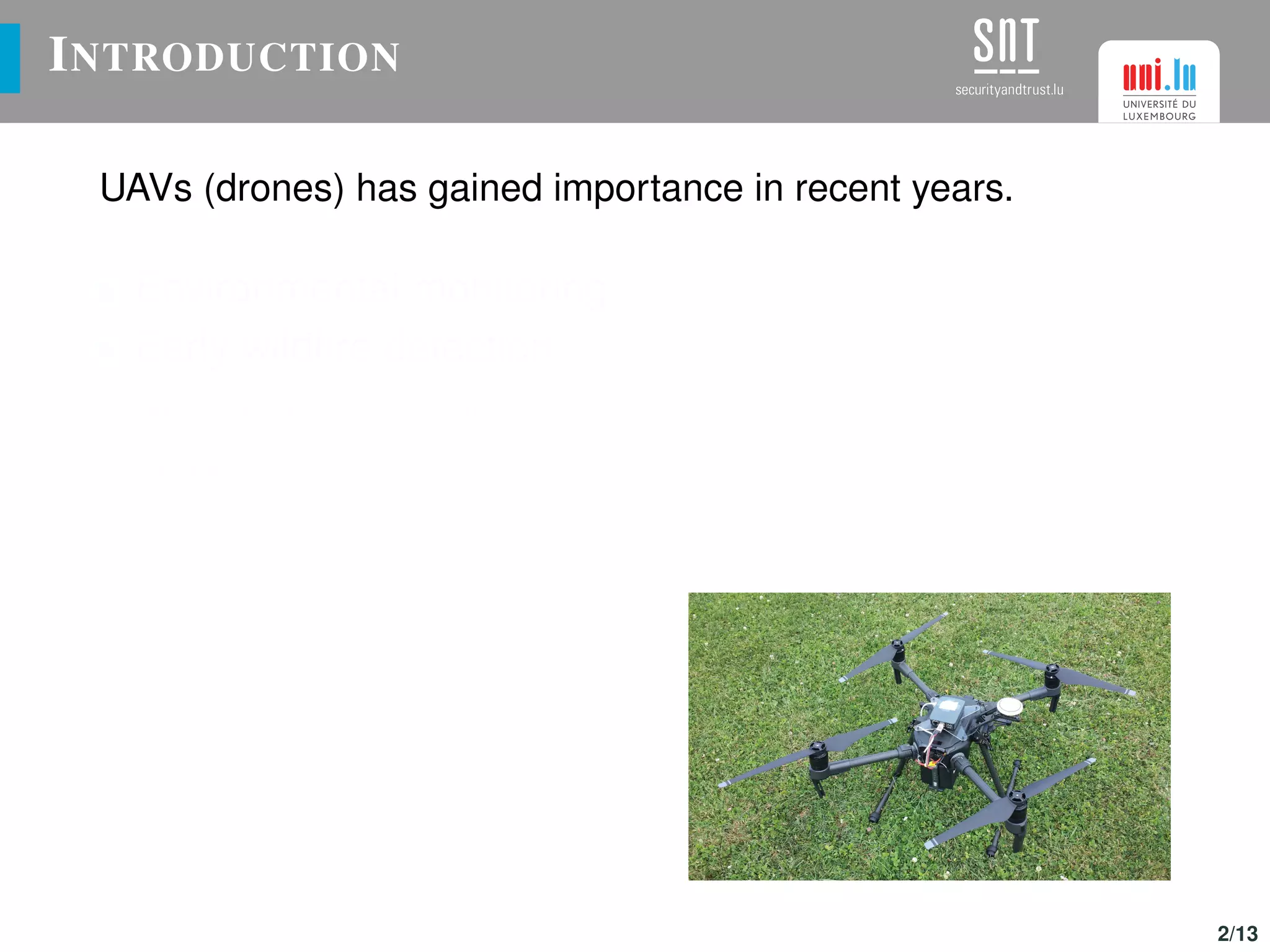
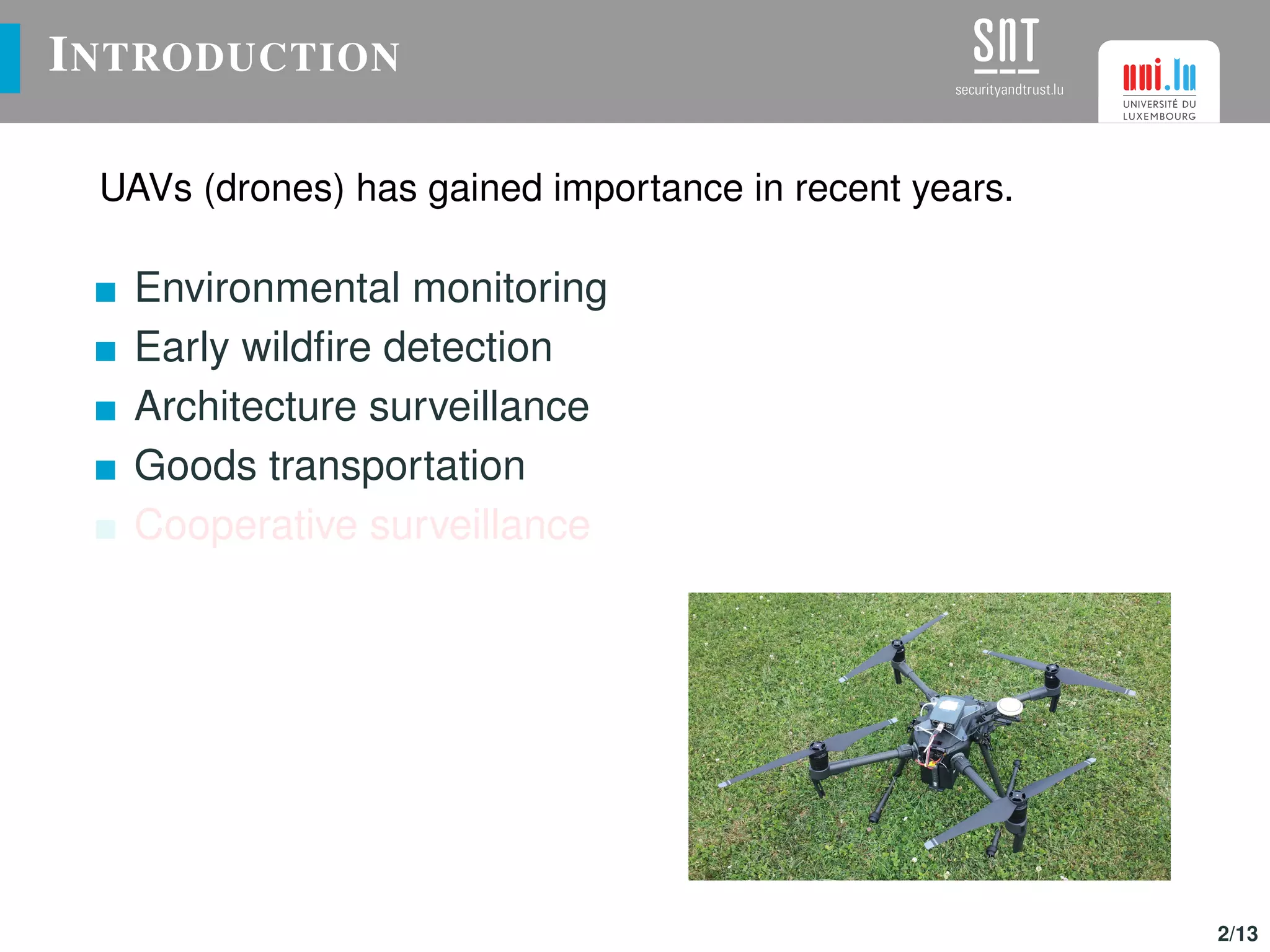
UAVs (drones) has gained importance in recent years.
Environmental monitoring
Early wildfire detection
Architecture surveillance
Goods transportation
Cooperative surveillance
2/13
INTRODUCTION
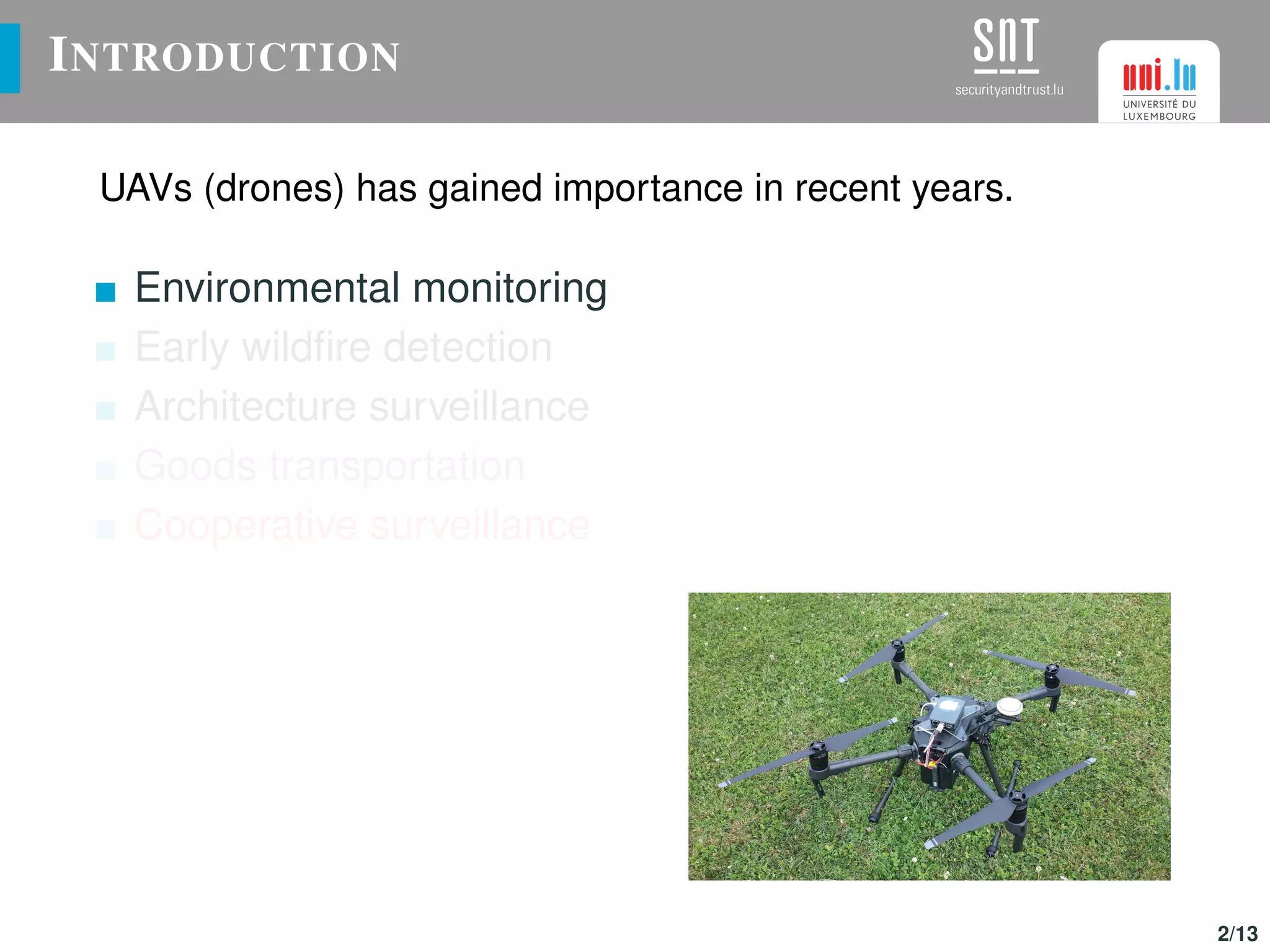
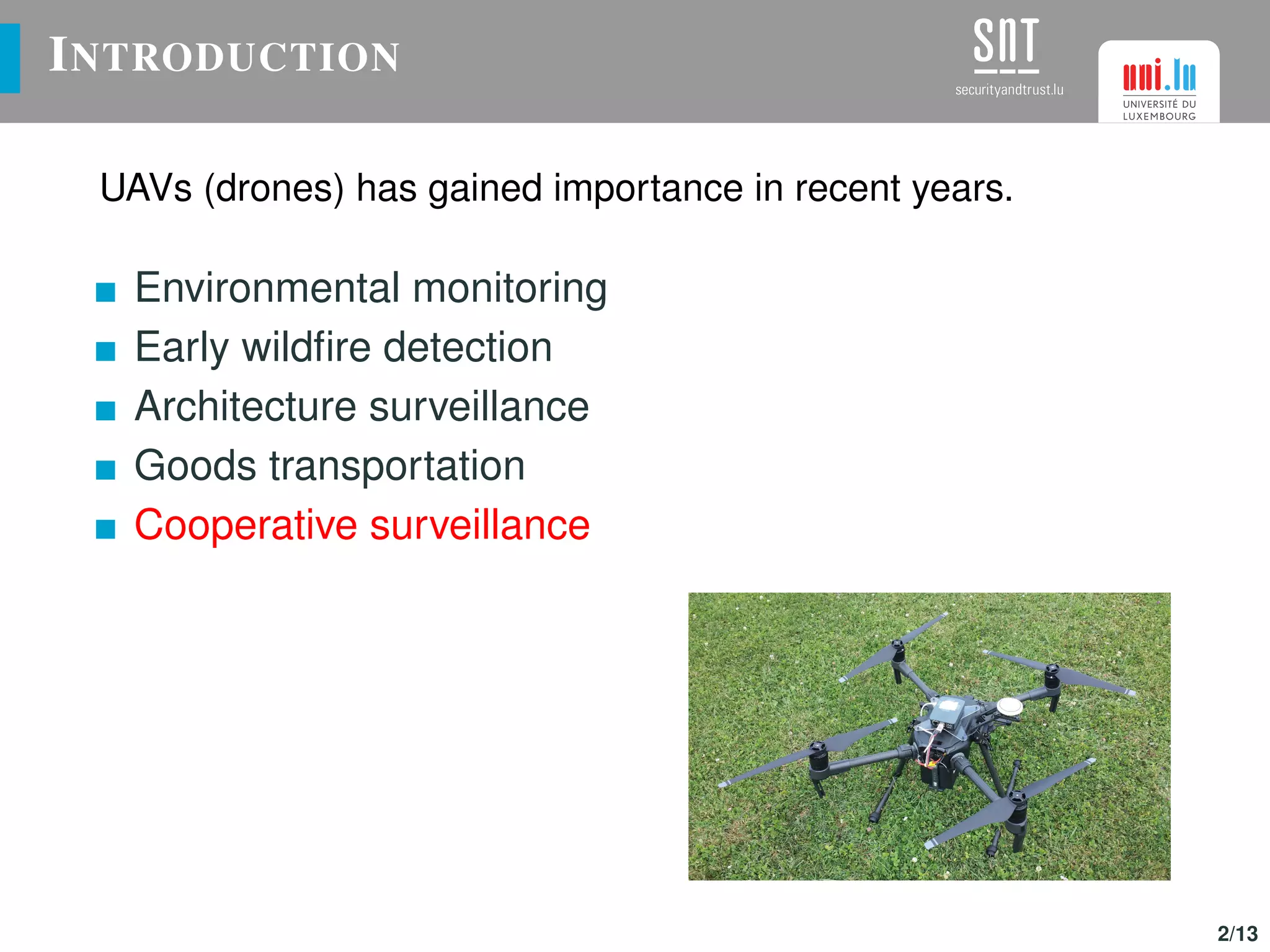
UAVs (drones) has gained importance in recent years.
Environmental monitoring
Early wildfire detection
Architecture surveillance
Goods transportation
Cooperative surveillance
2/13
INTRODUCTION
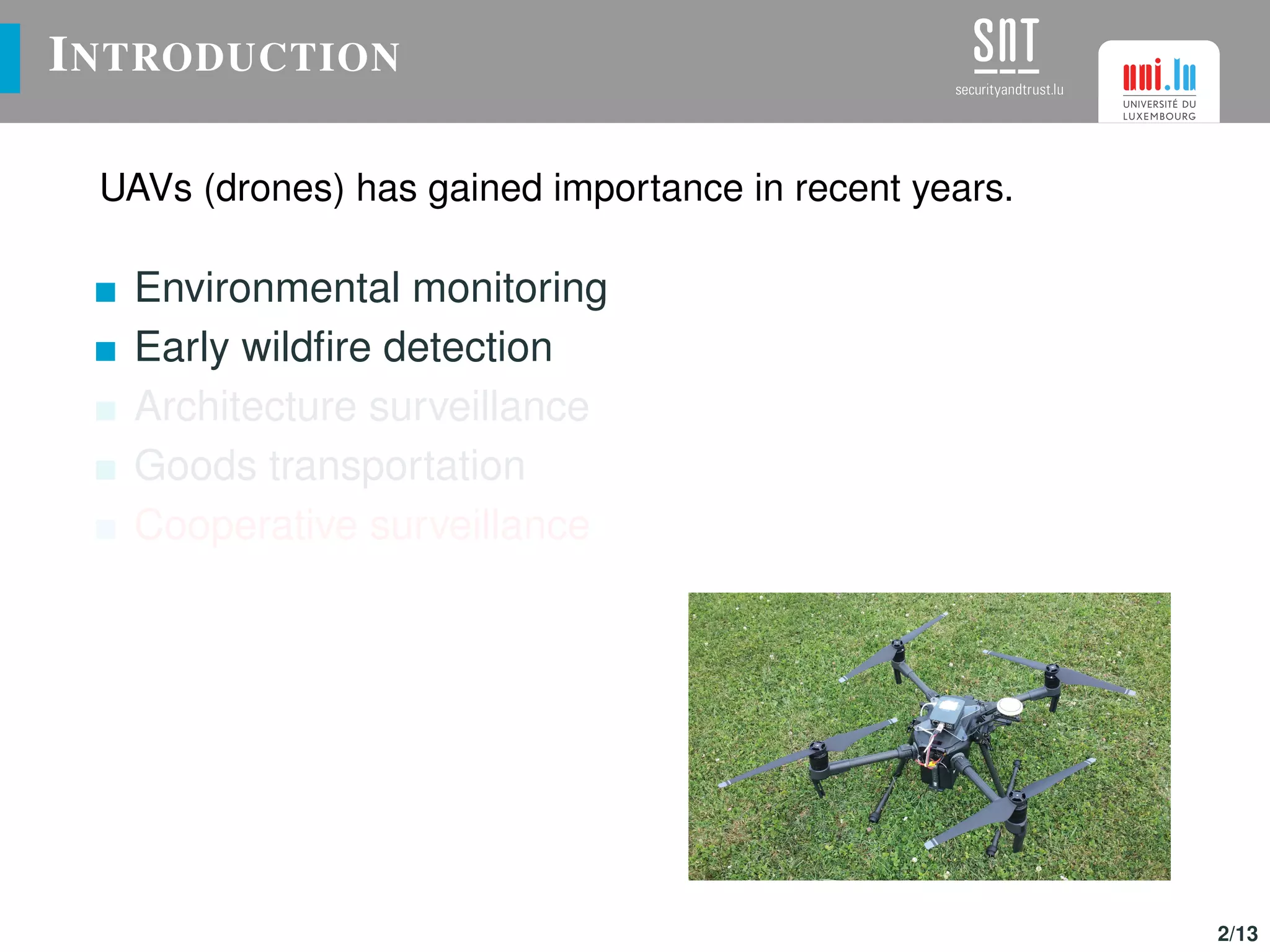
UAVs (drones) has gained importance in recent years.
Environmental monitoring
Early wildfire detection
Architecture surveillance
Goods transportation
Cooperative surveillance
2/13
INTRODUCTION
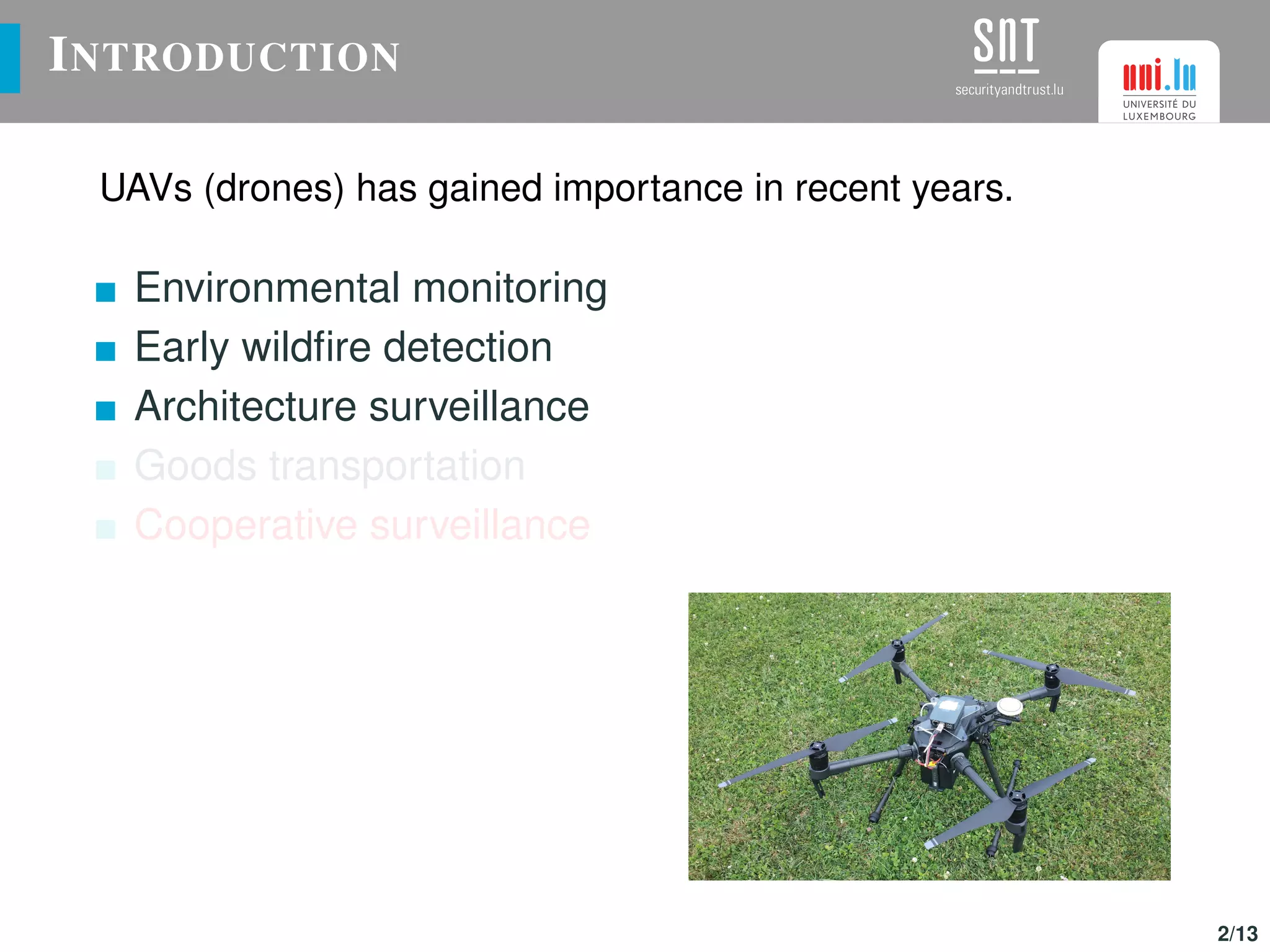
UAVs (drones) has gained importance in recent years.
Environmental monitoring
Early wildfire detection
Architecture surveillance
Goods transportation
Cooperative surveillance
2/13
INTRODUCTION
UAVs (drones) has gained importance in recent years.
Environmental monitoring
Early wildfire detection
Architecture surveillance
Goods transportation
Cooperative surveillance
2/13
INTRODUCTION
UAVs (drones) has gained importance in recent years.
Environmental monitoring
Early wildfire detection
Architecture surveillance
Goods transportation
Cooperative surveillance
2/13
MOTIVATION
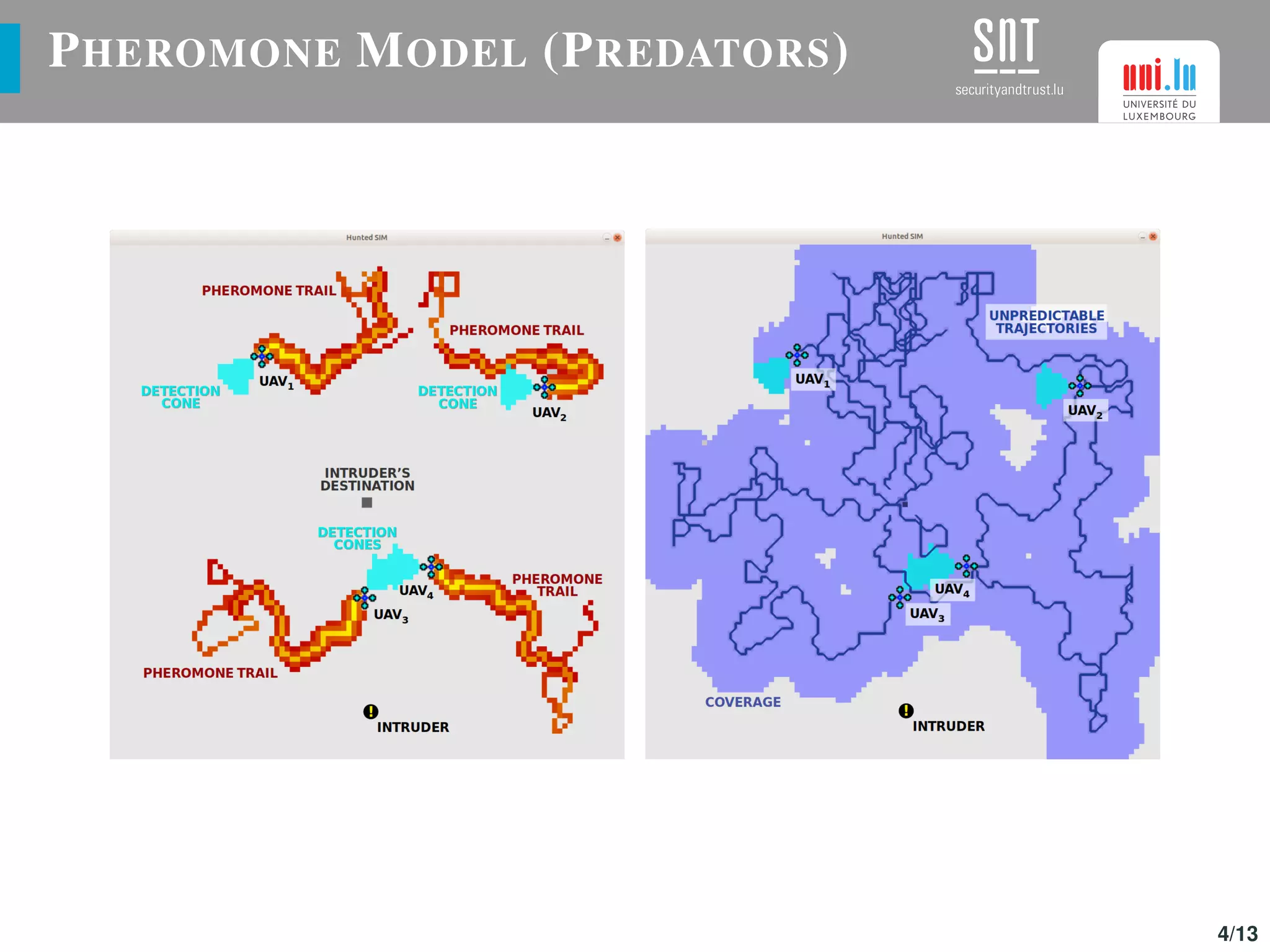
Mobility model for surveillance tasks.
Swarm of UAVs (and UGVs, etc.)
Improve coverage
Unpredictable trajectories
Deterministic routes (for the Ground Control Station)
Bioinspired Predator-Prey approach
3/13
MOTIVATION
Mobility model for surveillance tasks.
Swarm of UAVs (and UGVs, etc.)
Improve coverage
Unpredictable trajectories
Deterministic routes (for the Ground Control Station)
Bioinspired Predator-Prey approach
3/13
PHEROMONE MODEL (PREDATORS)
4/13
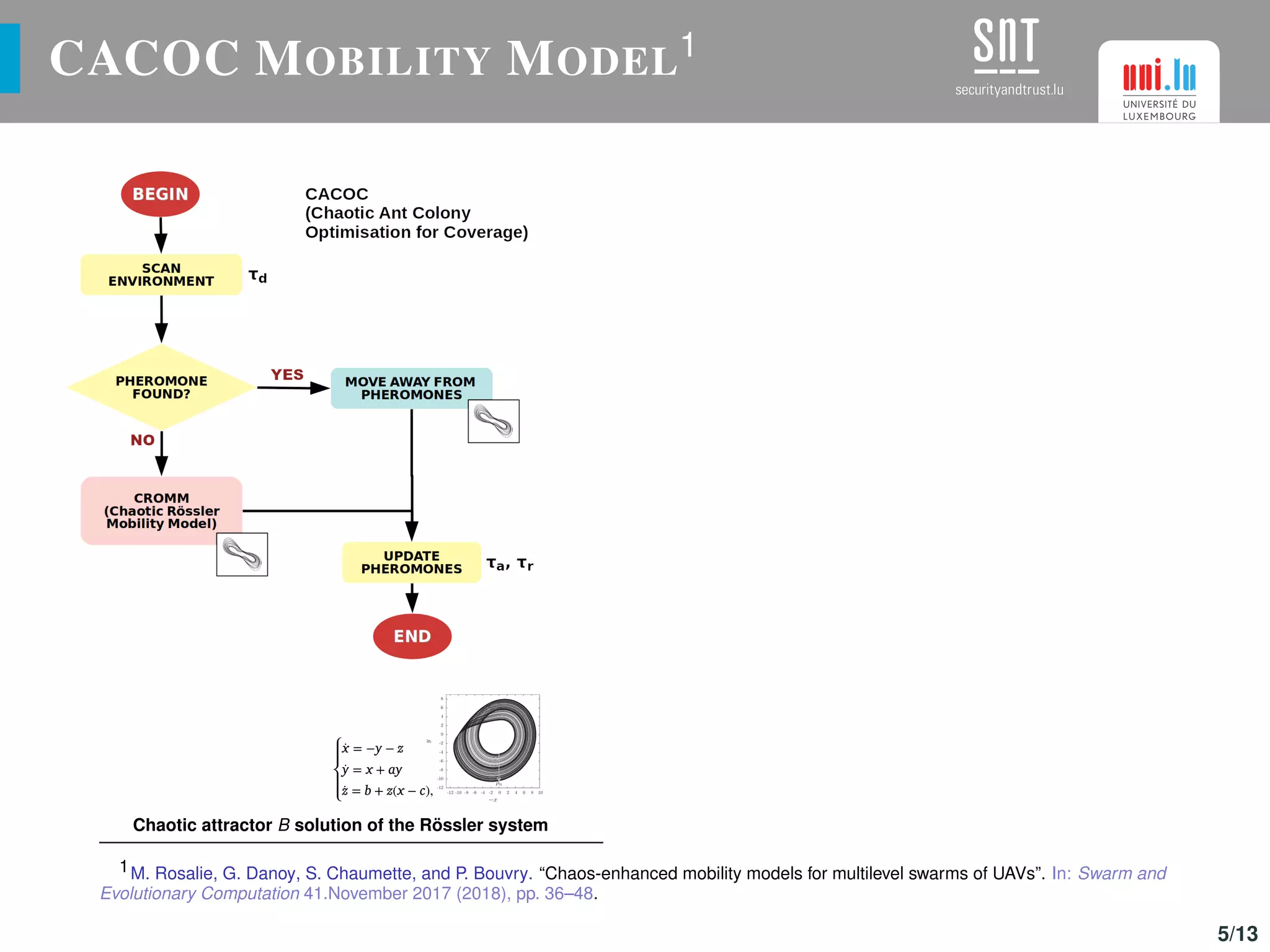
CACOC MOBILITY MODEL1
Chaotic attractor B solution of the Rössler system
1M. Rosalie, G. Danoy, S. Chaumette, and P. Bouvry. “Chaos-enhanced mobility models for multilevel swarms of UAVs”. In: Swarm and
Evolutionary Computation 41.November 2017 (2018), pp. 36–48.
5/13
CACOC MOBILITY MODEL1
Chaotic attractor B solution of the Rössler system
TABLE: Parameters proposed for CACOC.
Parameter Units Range
Pheromone amount (τa) % [1 − 100]
Pheromone radius (τr ) cells [0.5 − 2.5]
Pheromone scan depth (τd ) cells [1 − 10]
1M. Rosalie, G. Danoy, S. Chaumette, and P. Bouvry. “Chaos-enhanced mobility models for multilevel swarms of UAVs”. In: Swarm and
Evolutionary Computation 41.November 2017 (2018), pp. 36–48.
5/13
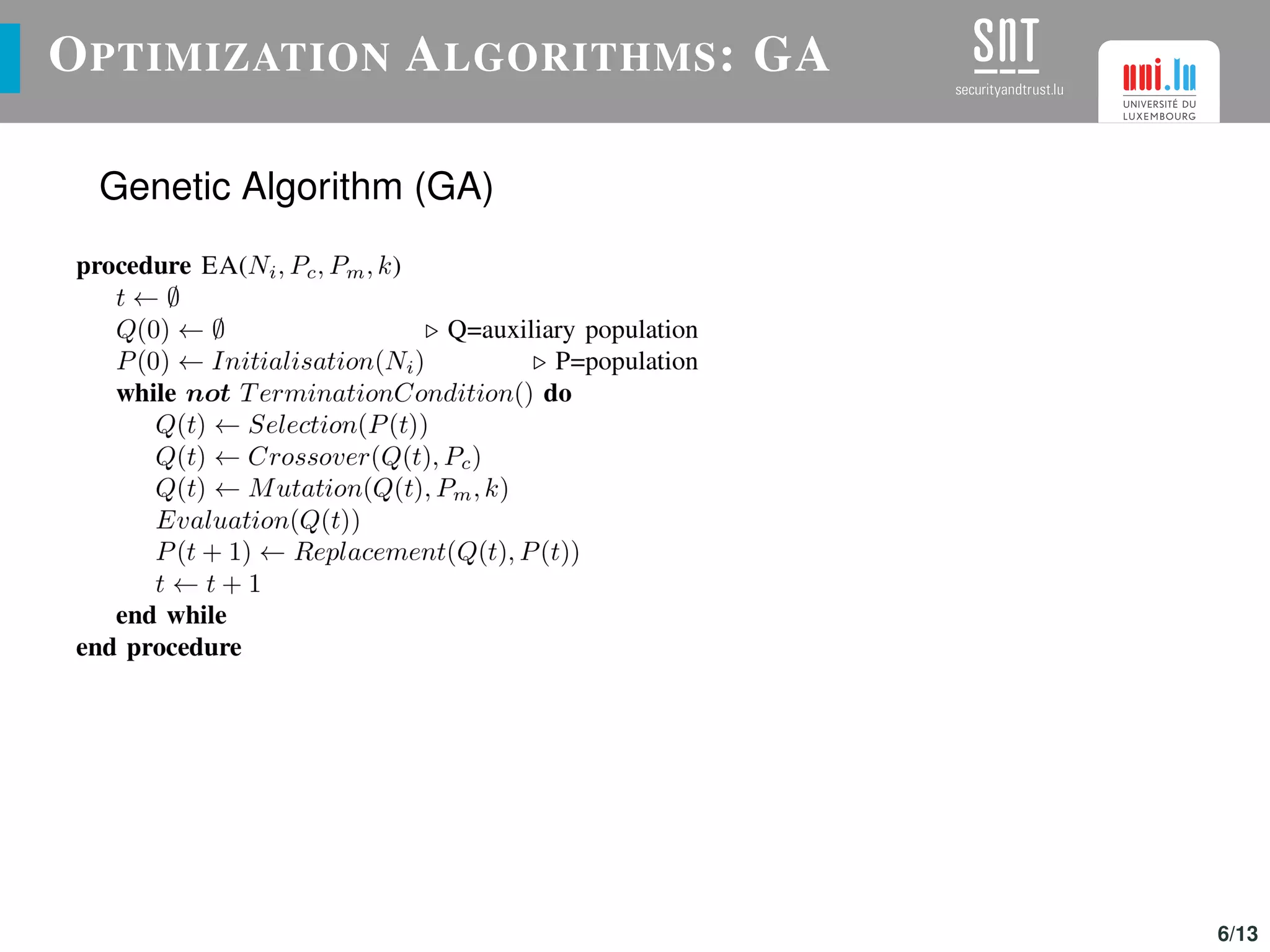
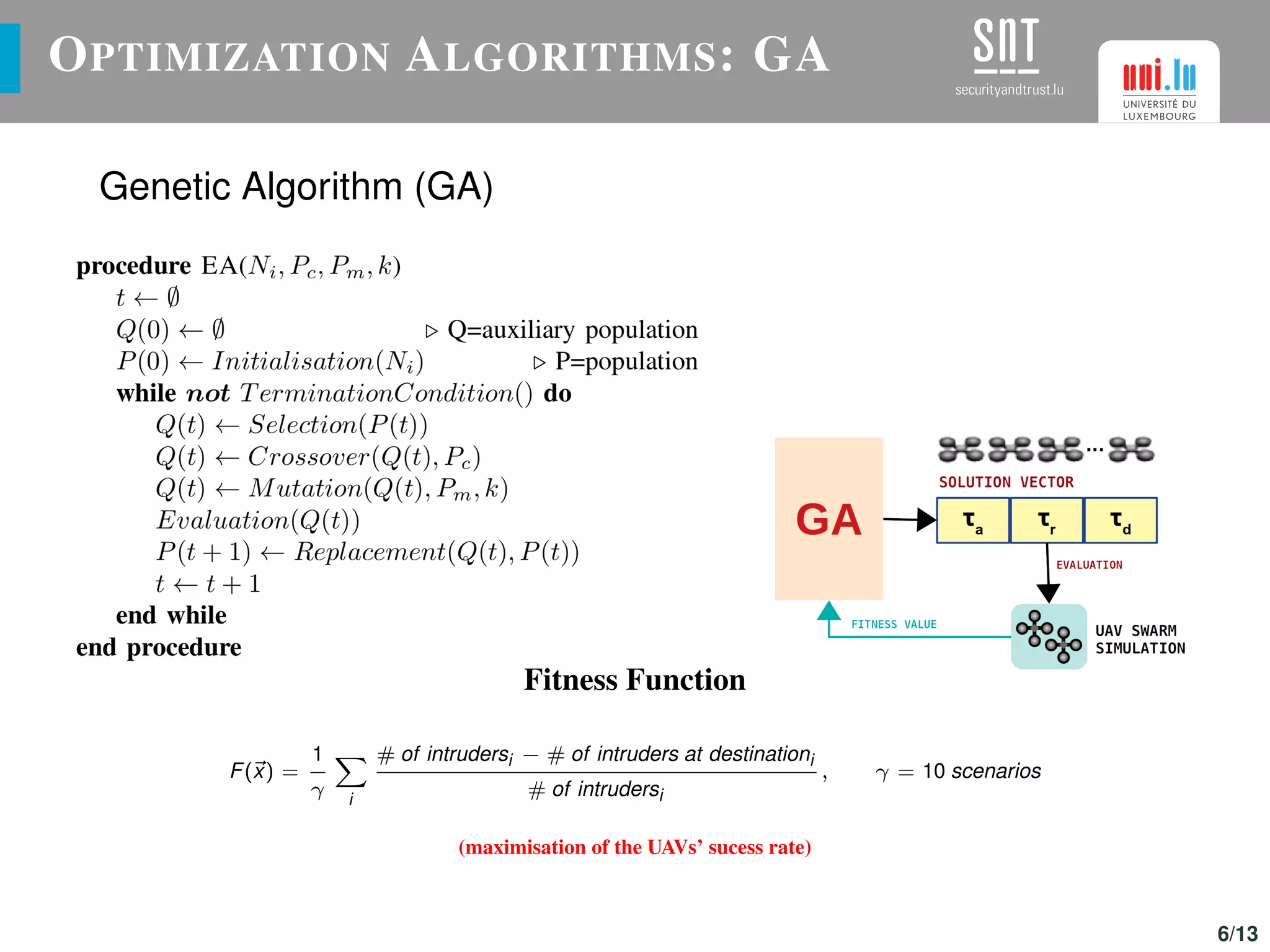
OPTIMIZATION ALGORITHMS: GA
Genetic Algorithm (GA)
6/13
OPTIMIZATION ALGORITHMS: GA
Genetic Algorithm (GA)
6/13
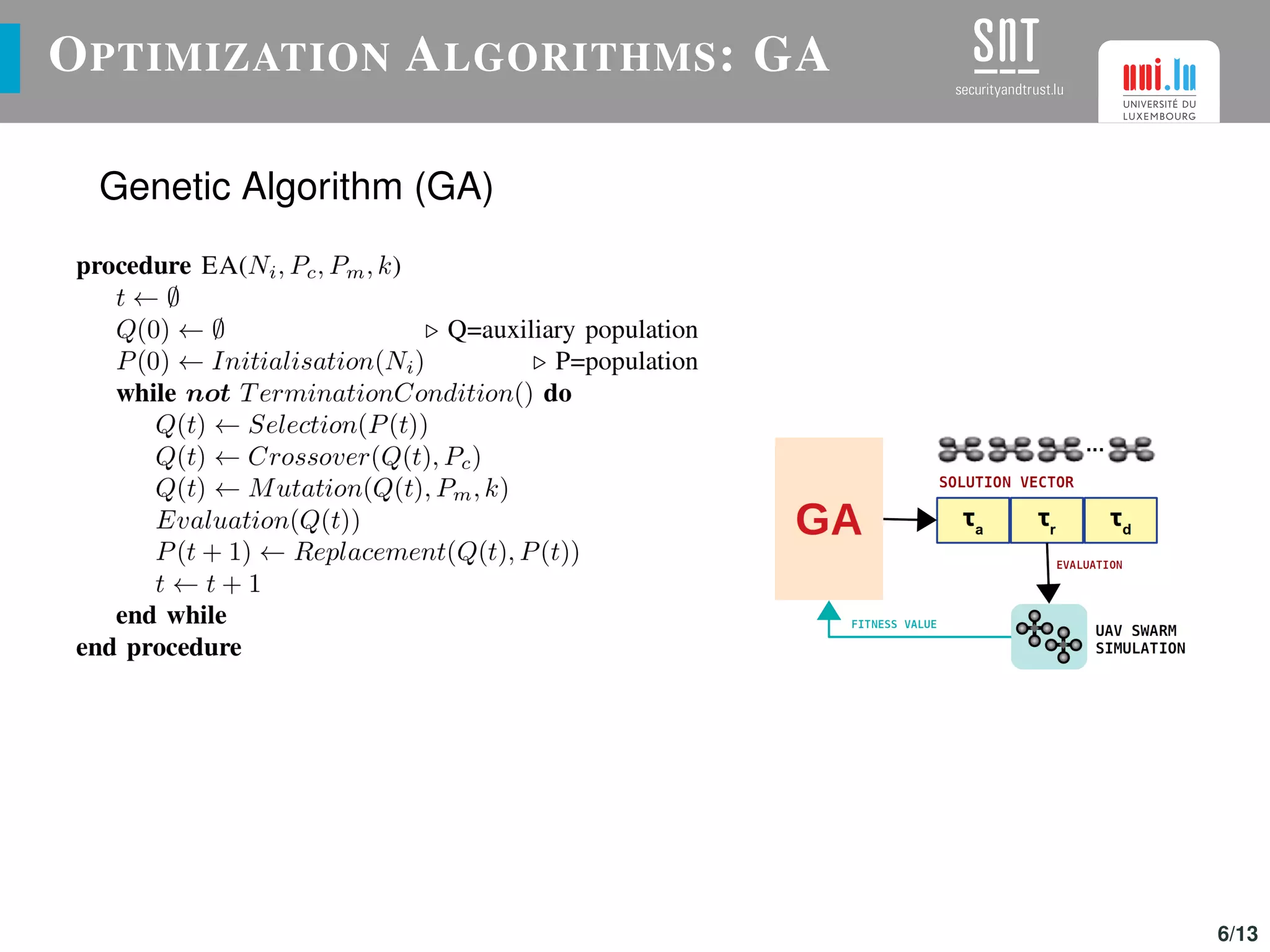
OPTIMIZATION ALGORITHMS: GA
Genetic Algorithm (GA)
Fitness Function
F(x) =
1
γ i
# of intrudersi − # of intruders at destinationi
# of intrudersi
, γ = 10 scenarios
(maximisation of the UAVs’ sucess rate)
6/13
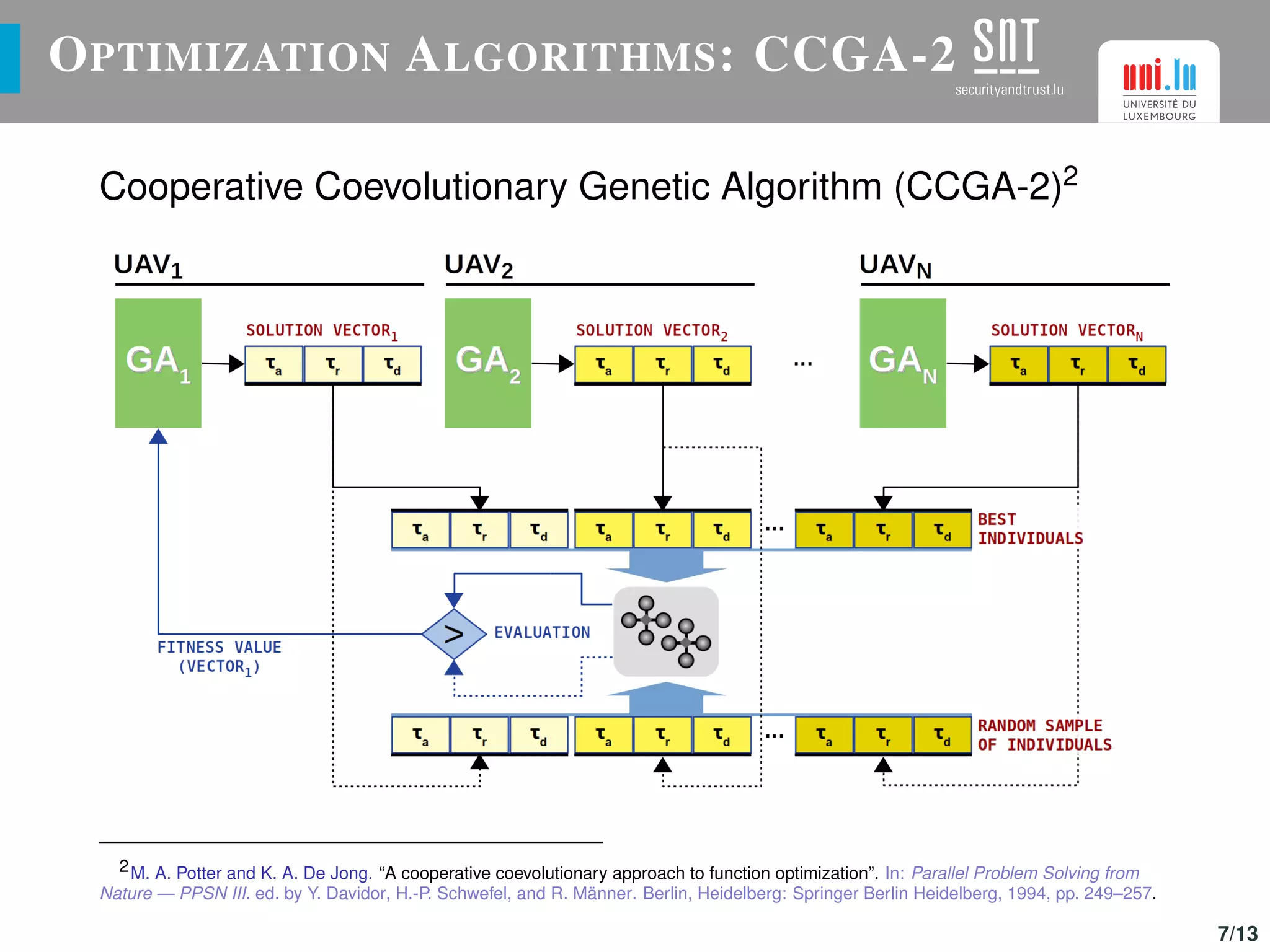
OPTIMIZATION ALGORITHMS: CCGA-2
Cooperative Coevolutionary Genetic Algorithm (CCGA-2)2
2M. A. Potter and K. A. De Jong. “A cooperative coevolutionary approach to function optimization”. In: Parallel Problem Solving from
Nature — PPSN III. ed. by Y. Davidor, H.-P. Schwefel, and R. Männer. Berlin, Heidelberg: Springer Berlin Heidelberg, 1994, pp. 249–257.
7/13
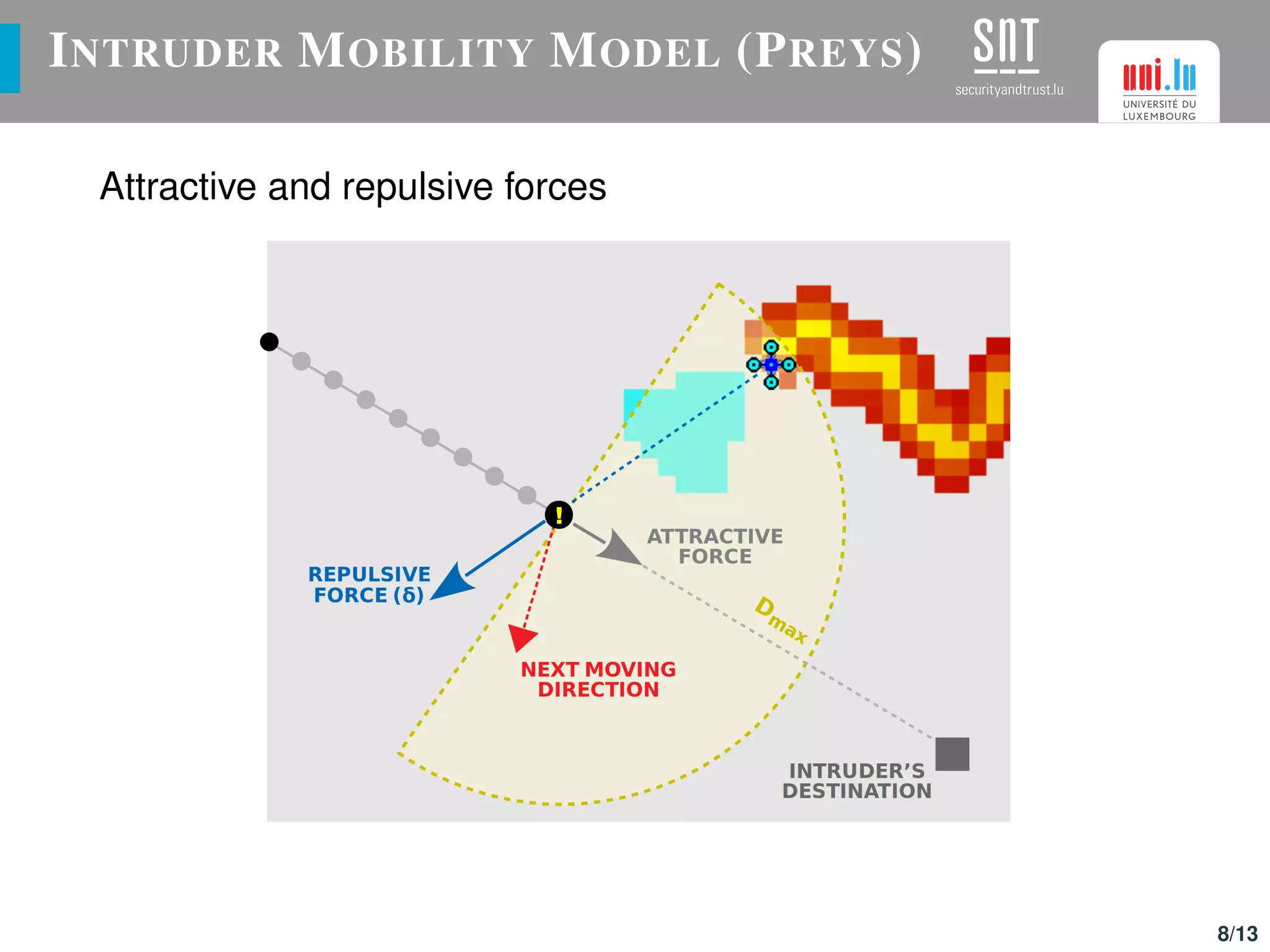
INTRUDER MOBILITY MODEL (PREYS)
Attractive and repulsive forces
8/13
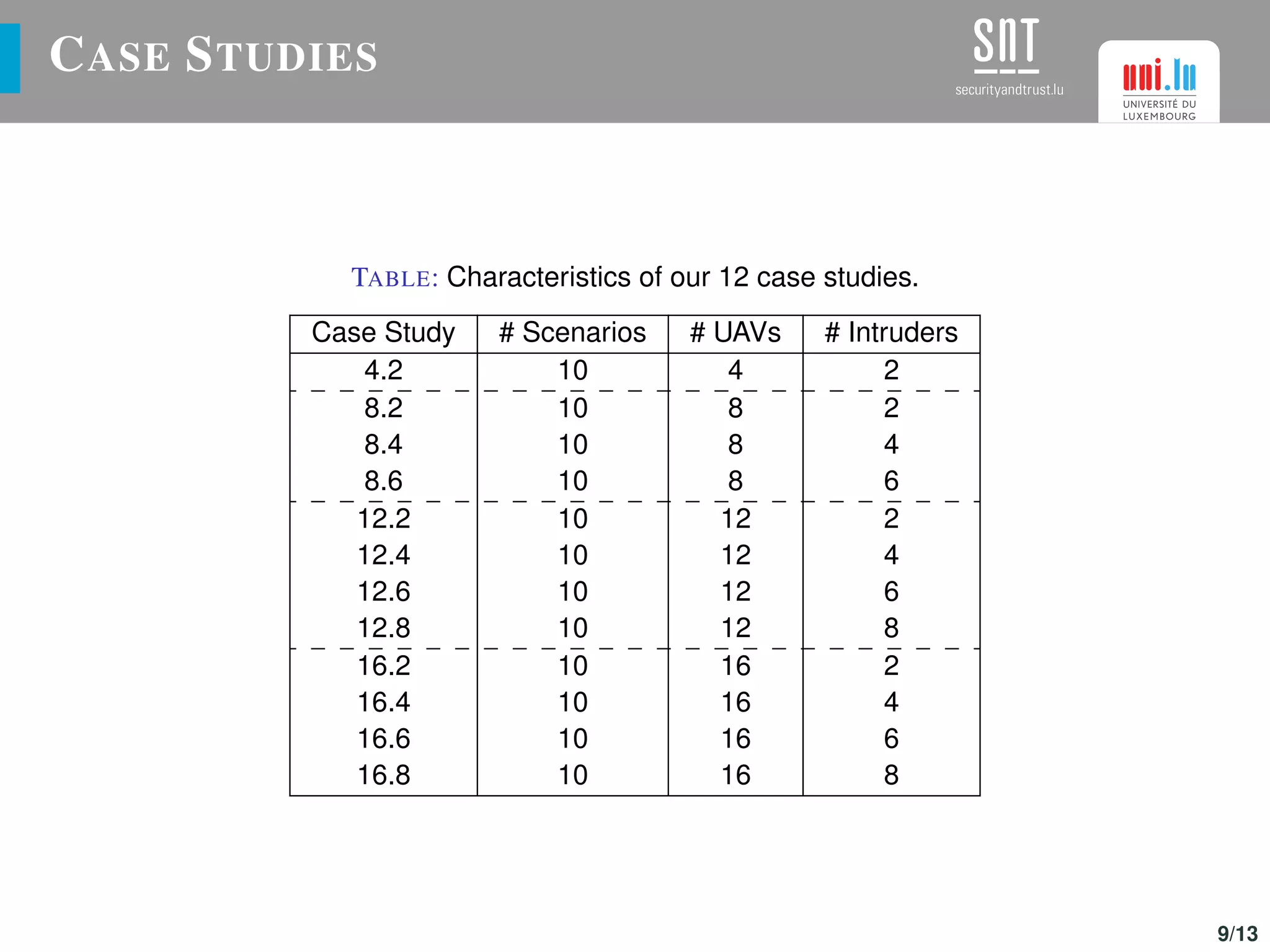
CASE STUDIES
TABLE: Characteristics of our 12 case studies.
Case Study # Scenarios # UAVs # Intruders
4.2 10 4 2
8.2 10 8 2
8.4 10 8 4
8.6 10 8 6
12.2 10 12 2
12.4 10 12 4
12.6 10 12 6
12.8 10 12 8
16.2 10 16 2
16.4 10 16 4
16.6 10 16 6
16.8 10 16 8
9/13
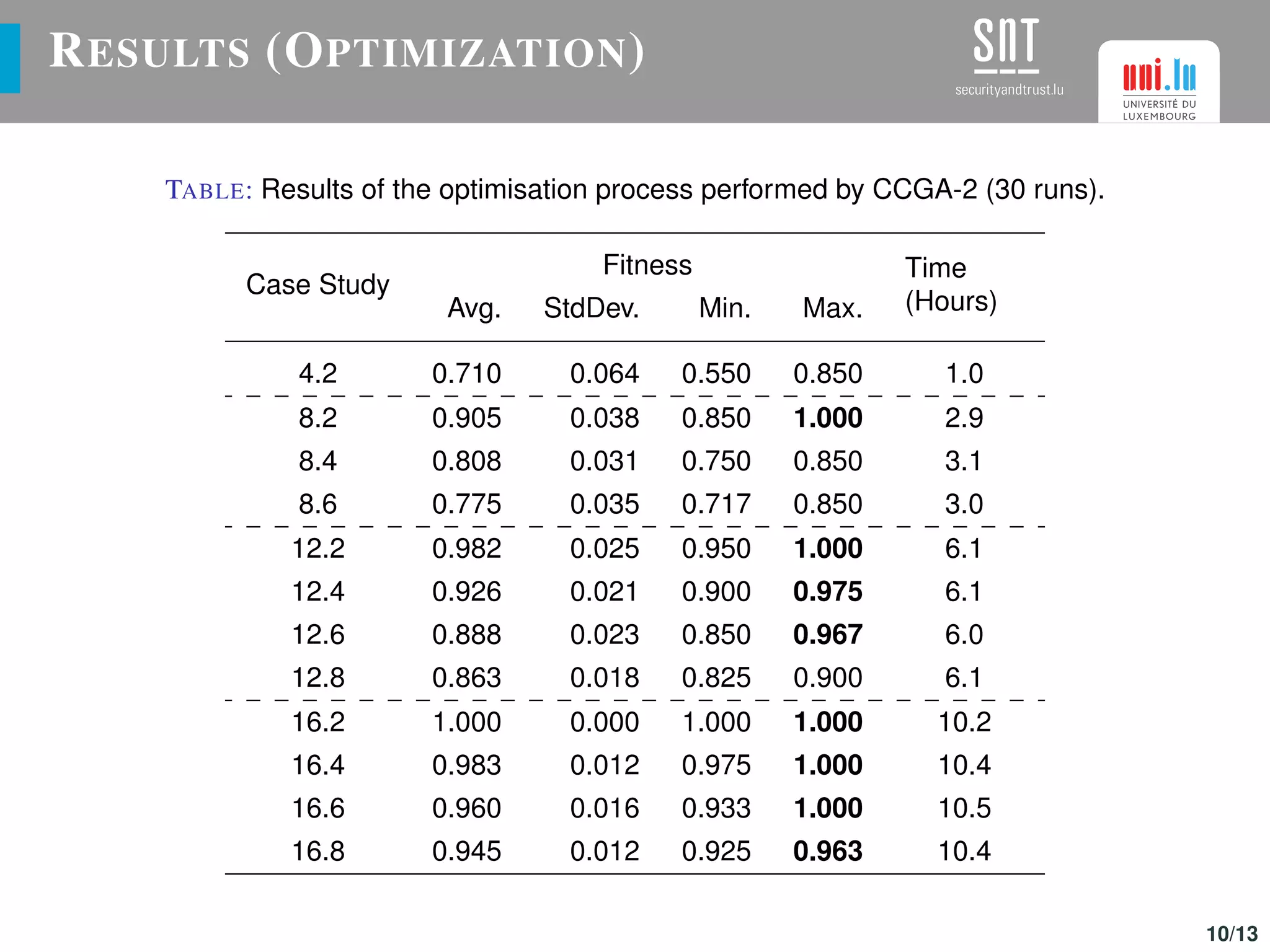
RESULTS (OPTIMIZATION)
TABLE: Results of the optimisation process performed by CCGA-2 (30 runs).
Case Study
Fitness Time
(Hours)Avg. StdDev. Min. Max.
4.2 0.710 0.064 0.550 0.850 1.0
8.2 0.905 0.038 0.850 1.000 2.9
8.4 0.808 0.031 0.750 0.850 3.1
8.6 0.775 0.035 0.717 0.850 3.0
12.2 0.982 0.025 0.950 1.000 6.1
12.4 0.926 0.021 0.900 0.975 6.1
12.6 0.888 0.023 0.850 0.967 6.0
12.8 0.863 0.018 0.825 0.900 6.1
16.2 1.000 0.000 1.000 1.000 10.2
16.4 0.983 0.012 0.975 1.000 10.4
16.6 0.960 0.016 0.933 1.000 10.5
16.8 0.945 0.012 0.925 0.963 10.4
10/13
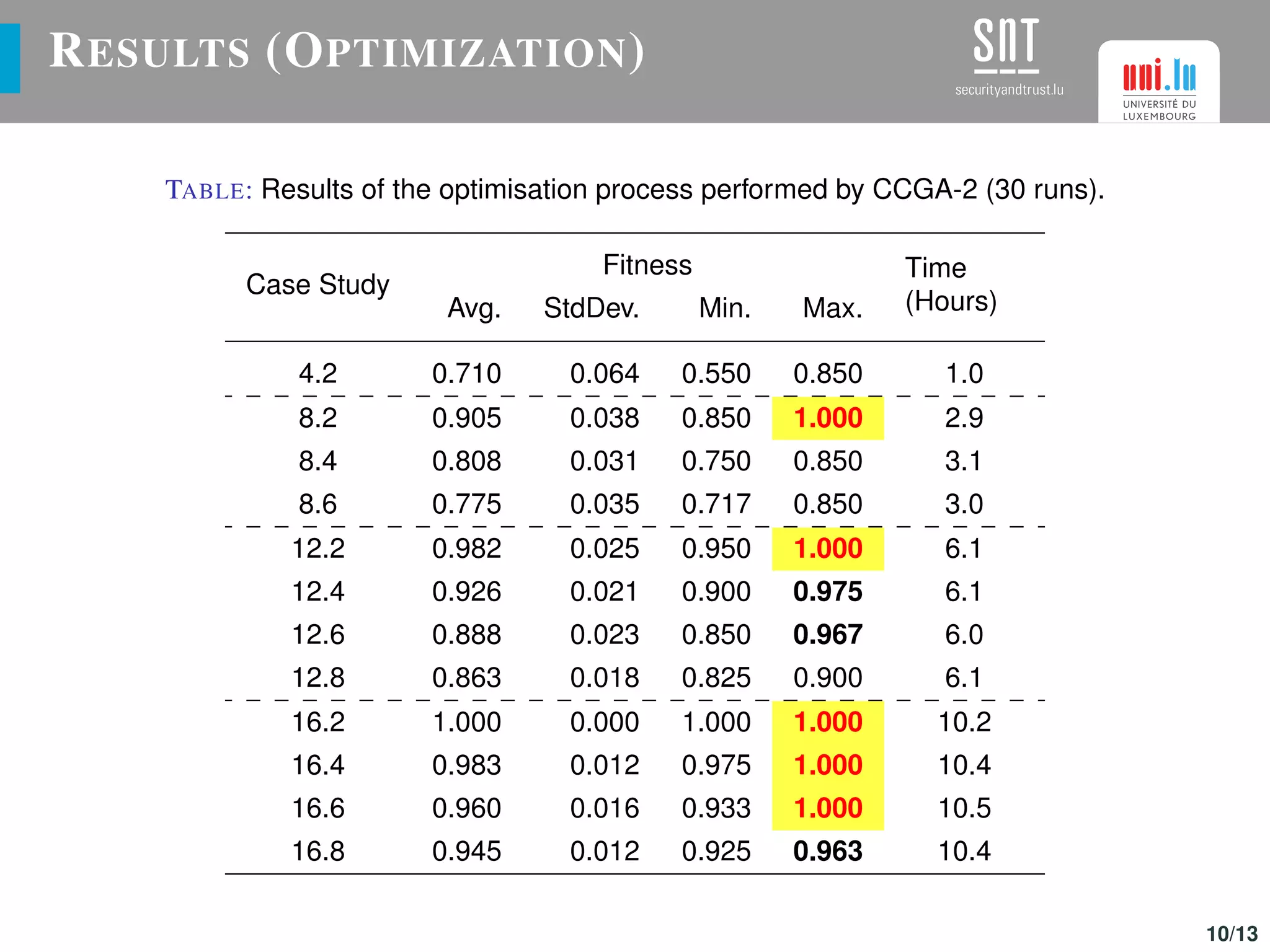
RESULTS (OPTIMIZATION)
TABLE: Results of the optimisation process performed by CCGA-2 (30 runs).
Case Study
Fitness Time
(Hours)Avg. StdDev. Min. Max.
4.2 0.710 0.064 0.550 0.850 1.0
8.2 0.905 0.038 0.850 1.000 2.9
8.4 0.808 0.031 0.750 0.850 3.1
8.6 0.775 0.035 0.717 0.850 3.0
12.2 0.982 0.025 0.950 1.000 6.1
12.4 0.926 0.021 0.900 0.975 6.1
12.6 0.888 0.023 0.850 0.967 6.0
12.8 0.863 0.018 0.825 0.900 6.1
16.2 1.000 0.000 1.000 1.000 10.2
16.4 0.983 0.012 0.975 1.000 10.4
16.6 0.960 0.016 0.933 1.000 10.5
16.8 0.945 0.012 0.925 0.963 10.4
10/13
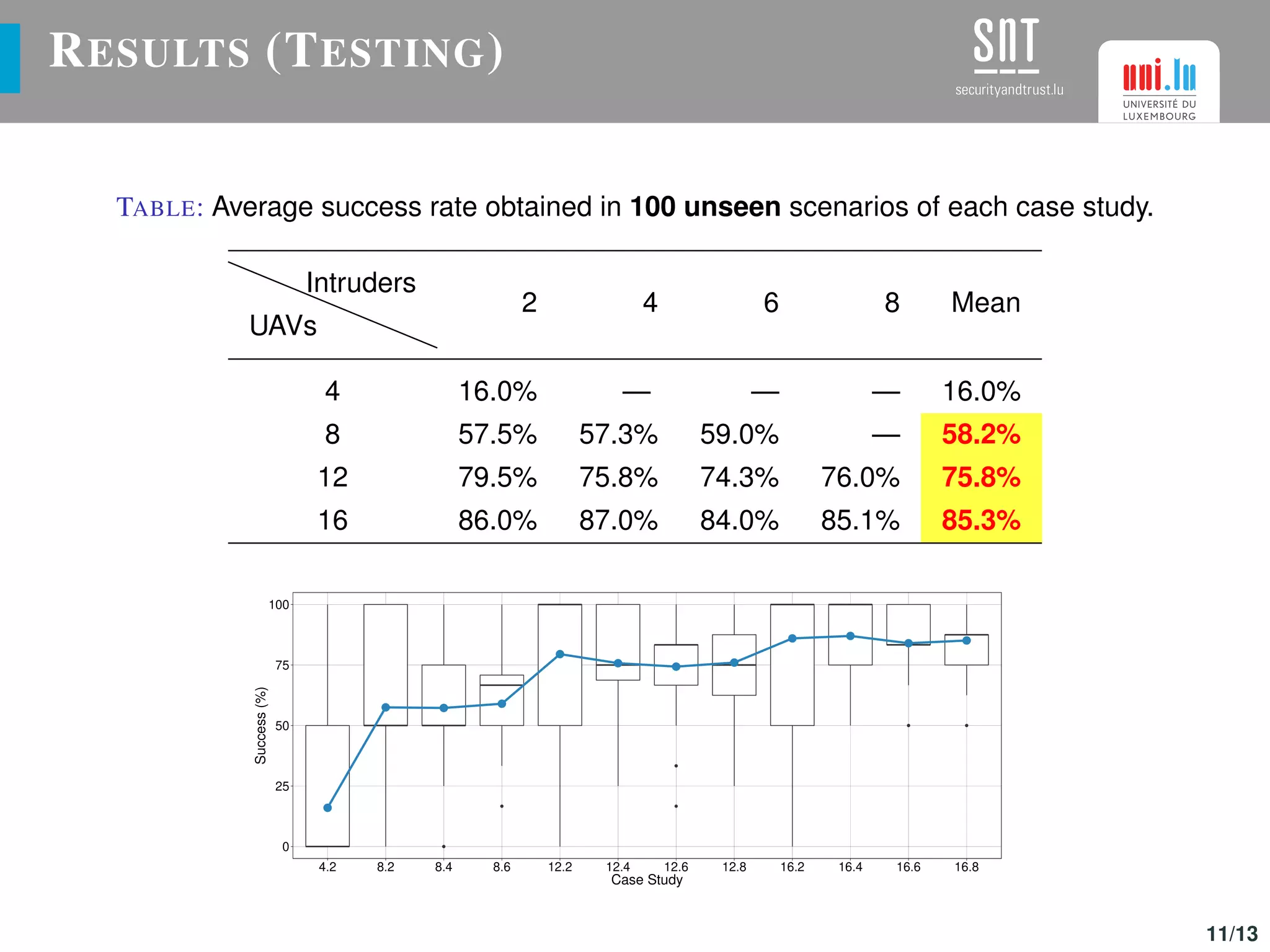
RESULTS (TESTING)
What happens if the intruders have a different behaviour?
11/13
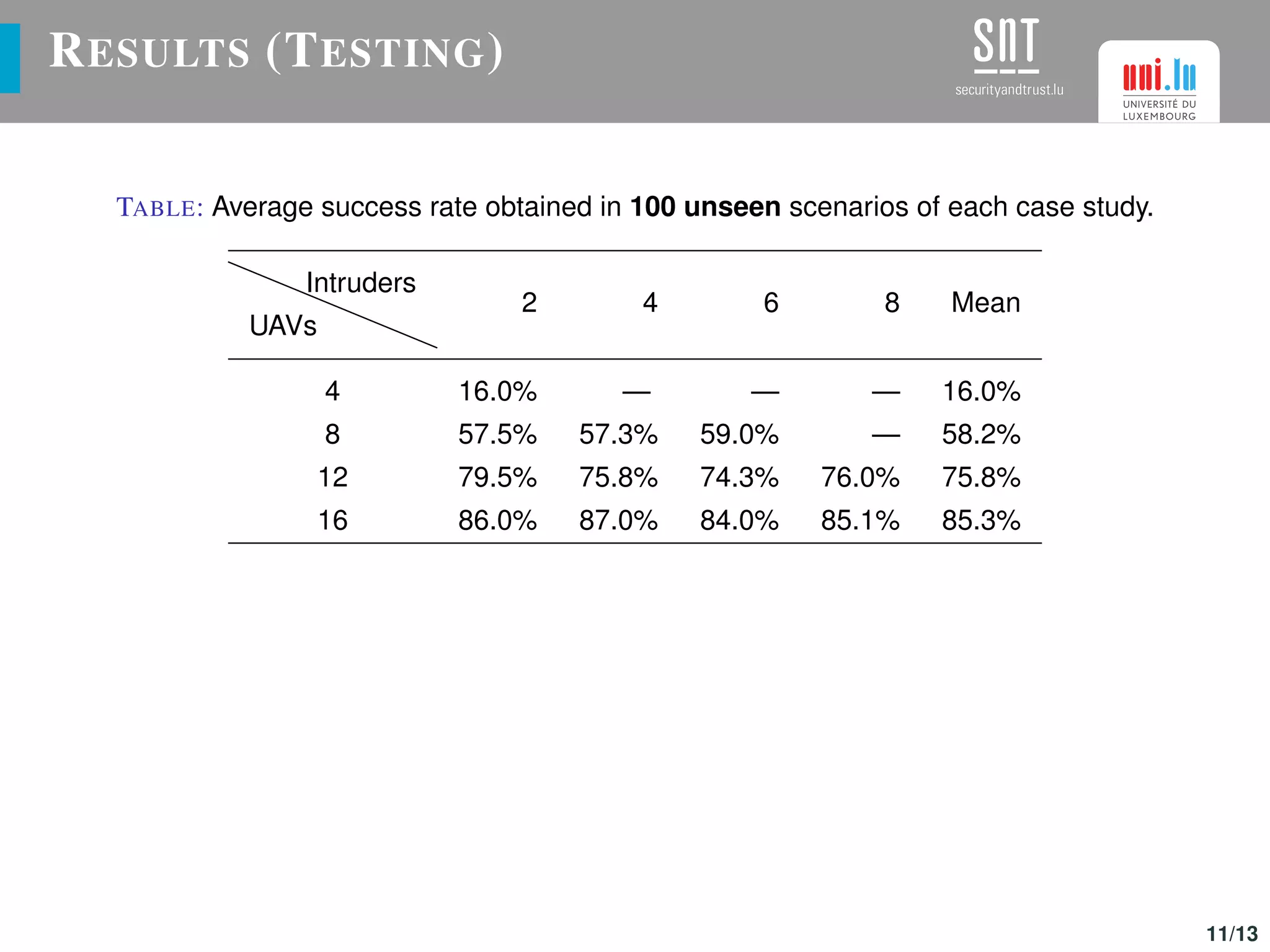
RESULTS (TESTING)
TABLE: Average success rate obtained in 100 unseen scenarios of each case study.
UAVs
Intruders
2 4 6 8 Mean
4 16.0% — — — 16.0%
8 57.5% 57.3% 59.0% — 58.2%
12 79.5% 75.8% 74.3% 76.0% 75.8%
16 86.0% 87.0% 84.0% 85.1% 85.3%
11/13
RESULTS (TESTING)
TABLE: Average success rate obtained in 100 unseen scenarios of each case study.
UAVs
Intruders
2 4 6 8 Mean
4 16.0% — — — 16.0%
8 57.5% 57.3% 59.0% — 58.2%
12 79.5% 75.8% 74.3% 76.0% 75.8%
16 86.0% 87.0% 84.0% 85.1% 85.3%
11/13
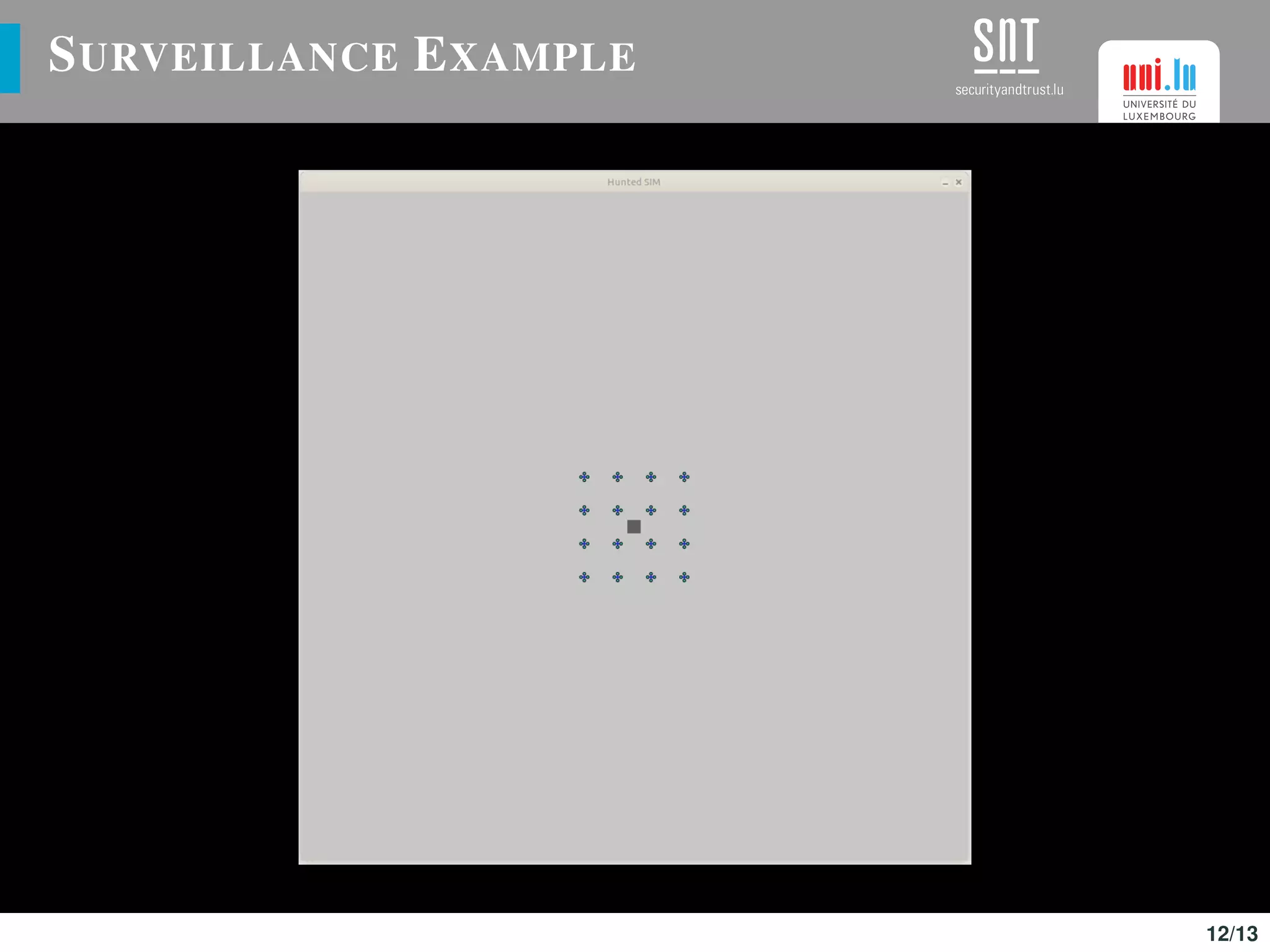
SURVEILLANCE EXAMPLE
12/13
CONCLUSION AND FUTURE WORK
We have. . .
. . . added new features to CACOC (parameters)
. . . optimised these parameters using CCGA-2
. . . improved the intruder detection rate
We plan to. . .
. . . use CACOC in other different scenarios
. . . implement inter-swarm collaborations (different vehicles)
. . . improve this P-P approach using a competitive algorithm
13/13
CONCLUSION AND FUTURE WORK
We have. . .
. . . added new features to CACOC (parameters)
. . . optimised these parameters using CCGA-2
. . . improved the intruder detection rate
We plan to. . .
. . . use CACOC in other different scenarios
. . . implement inter-swarm collaborations (different vehicles)
. . . improve this P-P approach using a competitive algorithm
13/13
CONCLUSION AND FUTURE WORK
We have. . .
. . . added new features to CACOC (parameters)
. . . optimised these parameters using CCGA-2
. . . improved the intruder detection rate
We plan to. . .
. . . use CACOC in other different scenarios
. . . implement inter-swarm collaborations (different vehicles)
. . . improve this P-P approach using a competitive algorithm
13/13
CONCLUSION AND FUTURE WORK
We have. . .
. . . added new features to CACOC (parameters)
. . . optimised these parameters using CCGA-2
. . . improved the intruder detection rate
We plan to. . .
. . . use CACOC in other different scenarios
. . . implement inter-swarm collaborations (different vehicles)
. . . improve this P-P approach using a competitive algorithm
13/13
CONCLUSION AND FUTURE WORK
We have. . .
. . . added new features to CACOC (parameters)
. . . optimised these parameters using CCGA-2
. . . improved the intruder detection rate
We plan to. . .
. . . use CACOC in other different scenarios
. . . implement inter-swarm collaborations (different vehicles)
. . . improve this P-P approach using a competitive algorithm
13/13
CONCLUSION AND FUTURE WORK
We have. . .
. . . added new features to CACOC (parameters)
. . . optimised these parameters using CCGA-2
. . . improved the intruder detection rate
We plan to. . .
. . . use CACOC in other different scenarios
. . . implement inter-swarm collaborations (different vehicles)
. . . improve this P-P approach using a competitive algorithm
13/13
CONCLUSION AND FUTURE WORK
We have. . .
. . . added new features to CACOC (parameters)
. . . optimised these parameters using CCGA-2
. . . improved the intruder detection rate
We plan to. . .
. . . use CACOC in other different scenarios
. . . implement inter-swarm collaborations (different vehicles)
. . . improve this P-P approach using a competitive algorithm
13/13
CONCLUSION AND FUTURE WORK
We have. . .
. . . added new features to CACOC (parameters)
. . . optimised these parameters using CCGA-2
. . . improved the intruder detection rate
We plan to. . .
. . . use CACOC in other different scenarios
. . . implement inter-swarm collaborations (different vehicles)
. . . improve this P-P approach using a competitive algorithm
13/13
QUESTIONS?
https://hunted.gforge.uni.lu/
https://pcog.uni.lu/
https://wwwen.uni.lu/snt/
https://wwwen.uni.lu/
Optimizing the Performance of an Unpredictable UAV Swarm for Intruder Detection
Daniel H. Stolfi1, Matthias R. Brust1, Grégoire Danoy1,2, Pascal Bouvry1,2
1 SnT - Interdisciplinary Centre for Security, Reliability and Trust, University of Luxembourg, Luxembourg
2 FSTM/DCS, University of Luxembourg, Luxembourg
This work relates to Department of Navy award N62909-18-1-2176 issued by the Office of Naval Research. The United States Government has a royalty-free license throughout the
world in all copyrightable material contained herein. This work is partially funded by the joint research programme UL/SnT-ILNAS on Digital Trust for Smart-ICT. The experiments
presented in this paper were carried out using the HPC facilities of the University of Luxembourg – see https://hpc.uni.lu.

Optimizing the Performance of an Unpredictable UAV Swarm for Intruder Detection

  • 1.
    University of Luxembourg Multilingual.Personalized. Connected. Optimizing the Performance of an Unpredictable UAV Swarm for Intruder Detection Daniel H. Stolfi1 Matthias R. Brust1 Grégoire Danoy1,2 Pascal Bouvry1,2 OLA’2020 – International Conference on Optimization and Learning February 17 th -19 th , 2020 1 SnT - Interdisciplinary Centre for Security, Reliability and Trust, University of Luxembourg, Luxembourg 2 FSTM/DCS, University of Luxembourg, Luxembourg
  • 2.
    CONTENTS 1 INTRODUCTION 2 CACOCMOBILITY MODEL 3 PARAMETER OPTIMIZATION 4 RESULTS 5 CONCLUSION AND FUTURE WORK 1/13
  • 3.
    CONTENTS 1 INTRODUCTION 2 CACOCMOBILITY MODEL 3 PARAMETER OPTIMIZATION 4 RESULTS 5 CONCLUSION AND FUTURE WORK 1/13
  • 4.
    CONTENTS 1 INTRODUCTION 2 CACOCMOBILITY MODEL 3 PARAMETER OPTIMIZATION 4 RESULTS 5 CONCLUSION AND FUTURE WORK 1/13
  • 5.
    CONTENTS 1 INTRODUCTION 2 CACOCMOBILITY MODEL 3 PARAMETER OPTIMIZATION 4 RESULTS 5 CONCLUSION AND FUTURE WORK 1/13
  • 6.
    CONTENTS 1 INTRODUCTION 2 CACOCMOBILITY MODEL 3 PARAMETER OPTIMIZATION 4 RESULTS 5 CONCLUSION AND FUTURE WORK 1/13
  • 7.
    INTRODUCTION UAVs (drones) hasgained importance in recent years. Environmental monitoring Early wildfire detection Architecture surveillance Goods transportation Cooperative surveillance 2/13
  • 8.
    INTRODUCTION UAVs (drones) hasgained importance in recent years. Environmental monitoring Early wildfire detection Architecture surveillance Goods transportation Cooperative surveillance 2/13
  • 9.
    INTRODUCTION UAVs (drones) hasgained importance in recent years. Environmental monitoring Early wildfire detection Architecture surveillance Goods transportation Cooperative surveillance 2/13
  • 10.
    INTRODUCTION UAVs (drones) hasgained importance in recent years. Environmental monitoring Early wildfire detection Architecture surveillance Goods transportation Cooperative surveillance 2/13
  • 11.
    INTRODUCTION UAVs (drones) hasgained importance in recent years. Environmental monitoring Early wildfire detection Architecture surveillance Goods transportation Cooperative surveillance 2/13
  • 12.
    INTRODUCTION UAVs (drones) hasgained importance in recent years. Environmental monitoring Early wildfire detection Architecture surveillance Goods transportation Cooperative surveillance 2/13
  • 13.
    MOTIVATION Mobility model forsurveillance tasks. Swarm of UAVs (and UGVs, etc.) Improve coverage Unpredictable trajectories Deterministic routes (for the Ground Control Station) Bioinspired Predator-Prey approach 3/13
  • 14.
    MOTIVATION Mobility model forsurveillance tasks. Swarm of UAVs (and UGVs, etc.) Improve coverage Unpredictable trajectories Deterministic routes (for the Ground Control Station) Bioinspired Predator-Prey approach 3/13
  • 15.
  • 16.
    CACOC MOBILITY MODEL1 Chaoticattractor B solution of the Rössler system 1M. Rosalie, G. Danoy, S. Chaumette, and P. Bouvry. “Chaos-enhanced mobility models for multilevel swarms of UAVs”. In: Swarm and Evolutionary Computation 41.November 2017 (2018), pp. 36–48. 5/13
  • 17.
    CACOC MOBILITY MODEL1 Chaoticattractor B solution of the Rössler system TABLE: Parameters proposed for CACOC. Parameter Units Range Pheromone amount (τa) % [1 − 100] Pheromone radius (τr ) cells [0.5 − 2.5] Pheromone scan depth (τd ) cells [1 − 10] 1M. Rosalie, G. Danoy, S. Chaumette, and P. Bouvry. “Chaos-enhanced mobility models for multilevel swarms of UAVs”. In: Swarm and Evolutionary Computation 41.November 2017 (2018), pp. 36–48. 5/13
  • 18.
  • 19.
  • 20.
    OPTIMIZATION ALGORITHMS: GA GeneticAlgorithm (GA) Fitness Function F(x) = 1 γ i # of intrudersi − # of intruders at destinationi # of intrudersi , γ = 10 scenarios (maximisation of the UAVs’ sucess rate) 6/13
  • 21.
    OPTIMIZATION ALGORITHMS: CCGA-2 CooperativeCoevolutionary Genetic Algorithm (CCGA-2)2 2M. A. Potter and K. A. De Jong. “A cooperative coevolutionary approach to function optimization”. In: Parallel Problem Solving from Nature — PPSN III. ed. by Y. Davidor, H.-P. Schwefel, and R. Männer. Berlin, Heidelberg: Springer Berlin Heidelberg, 1994, pp. 249–257. 7/13
  • 22.
    INTRUDER MOBILITY MODEL(PREYS) Attractive and repulsive forces 8/13
  • 23.
    CASE STUDIES TABLE: Characteristicsof our 12 case studies. Case Study # Scenarios # UAVs # Intruders 4.2 10 4 2 8.2 10 8 2 8.4 10 8 4 8.6 10 8 6 12.2 10 12 2 12.4 10 12 4 12.6 10 12 6 12.8 10 12 8 16.2 10 16 2 16.4 10 16 4 16.6 10 16 6 16.8 10 16 8 9/13
  • 24.
    RESULTS (OPTIMIZATION) TABLE: Resultsof the optimisation process performed by CCGA-2 (30 runs). Case Study Fitness Time (Hours)Avg. StdDev. Min. Max. 4.2 0.710 0.064 0.550 0.850 1.0 8.2 0.905 0.038 0.850 1.000 2.9 8.4 0.808 0.031 0.750 0.850 3.1 8.6 0.775 0.035 0.717 0.850 3.0 12.2 0.982 0.025 0.950 1.000 6.1 12.4 0.926 0.021 0.900 0.975 6.1 12.6 0.888 0.023 0.850 0.967 6.0 12.8 0.863 0.018 0.825 0.900 6.1 16.2 1.000 0.000 1.000 1.000 10.2 16.4 0.983 0.012 0.975 1.000 10.4 16.6 0.960 0.016 0.933 1.000 10.5 16.8 0.945 0.012 0.925 0.963 10.4 10/13
  • 25.
    RESULTS (OPTIMIZATION) TABLE: Resultsof the optimisation process performed by CCGA-2 (30 runs). Case Study Fitness Time (Hours)Avg. StdDev. Min. Max. 4.2 0.710 0.064 0.550 0.850 1.0 8.2 0.905 0.038 0.850 1.000 2.9 8.4 0.808 0.031 0.750 0.850 3.1 8.6 0.775 0.035 0.717 0.850 3.0 12.2 0.982 0.025 0.950 1.000 6.1 12.4 0.926 0.021 0.900 0.975 6.1 12.6 0.888 0.023 0.850 0.967 6.0 12.8 0.863 0.018 0.825 0.900 6.1 16.2 1.000 0.000 1.000 1.000 10.2 16.4 0.983 0.012 0.975 1.000 10.4 16.6 0.960 0.016 0.933 1.000 10.5 16.8 0.945 0.012 0.925 0.963 10.4 10/13
  • 26.
    RESULTS (TESTING) What happensif the intruders have a different behaviour? 11/13
  • 27.
    RESULTS (TESTING) TABLE: Averagesuccess rate obtained in 100 unseen scenarios of each case study. UAVs Intruders 2 4 6 8 Mean 4 16.0% — — — 16.0% 8 57.5% 57.3% 59.0% — 58.2% 12 79.5% 75.8% 74.3% 76.0% 75.8% 16 86.0% 87.0% 84.0% 85.1% 85.3% 11/13
  • 28.
    RESULTS (TESTING) TABLE: Averagesuccess rate obtained in 100 unseen scenarios of each case study. UAVs Intruders 2 4 6 8 Mean 4 16.0% — — — 16.0% 8 57.5% 57.3% 59.0% — 58.2% 12 79.5% 75.8% 74.3% 76.0% 75.8% 16 86.0% 87.0% 84.0% 85.1% 85.3% 11/13
  • 29.
  • 30.
    CONCLUSION AND FUTUREWORK We have. . . . . . added new features to CACOC (parameters) . . . optimised these parameters using CCGA-2 . . . improved the intruder detection rate We plan to. . . . . . use CACOC in other different scenarios . . . implement inter-swarm collaborations (different vehicles) . . . improve this P-P approach using a competitive algorithm 13/13
  • 31.
    CONCLUSION AND FUTUREWORK We have. . . . . . added new features to CACOC (parameters) . . . optimised these parameters using CCGA-2 . . . improved the intruder detection rate We plan to. . . . . . use CACOC in other different scenarios . . . implement inter-swarm collaborations (different vehicles) . . . improve this P-P approach using a competitive algorithm 13/13
  • 32.
    CONCLUSION AND FUTUREWORK We have. . . . . . added new features to CACOC (parameters) . . . optimised these parameters using CCGA-2 . . . improved the intruder detection rate We plan to. . . . . . use CACOC in other different scenarios . . . implement inter-swarm collaborations (different vehicles) . . . improve this P-P approach using a competitive algorithm 13/13
  • 33.
    CONCLUSION AND FUTUREWORK We have. . . . . . added new features to CACOC (parameters) . . . optimised these parameters using CCGA-2 . . . improved the intruder detection rate We plan to. . . . . . use CACOC in other different scenarios . . . implement inter-swarm collaborations (different vehicles) . . . improve this P-P approach using a competitive algorithm 13/13
  • 34.
    CONCLUSION AND FUTUREWORK We have. . . . . . added new features to CACOC (parameters) . . . optimised these parameters using CCGA-2 . . . improved the intruder detection rate We plan to. . . . . . use CACOC in other different scenarios . . . implement inter-swarm collaborations (different vehicles) . . . improve this P-P approach using a competitive algorithm 13/13
  • 35.
    CONCLUSION AND FUTUREWORK We have. . . . . . added new features to CACOC (parameters) . . . optimised these parameters using CCGA-2 . . . improved the intruder detection rate We plan to. . . . . . use CACOC in other different scenarios . . . implement inter-swarm collaborations (different vehicles) . . . improve this P-P approach using a competitive algorithm 13/13
  • 36.
    CONCLUSION AND FUTUREWORK We have. . . . . . added new features to CACOC (parameters) . . . optimised these parameters using CCGA-2 . . . improved the intruder detection rate We plan to. . . . . . use CACOC in other different scenarios . . . implement inter-swarm collaborations (different vehicles) . . . improve this P-P approach using a competitive algorithm 13/13
  • 37.
    CONCLUSION AND FUTUREWORK We have. . . . . . added new features to CACOC (parameters) . . . optimised these parameters using CCGA-2 . . . improved the intruder detection rate We plan to. . . . . . use CACOC in other different scenarios . . . implement inter-swarm collaborations (different vehicles) . . . improve this P-P approach using a competitive algorithm 13/13
  • 38.
    QUESTIONS? https://hunted.gforge.uni.lu/ https://pcog.uni.lu/ https://wwwen.uni.lu/snt/ https://wwwen.uni.lu/ Optimizing the Performanceof an Unpredictable UAV Swarm for Intruder Detection Daniel H. Stolfi1, Matthias R. Brust1, Grégoire Danoy1,2, Pascal Bouvry1,2 1 SnT - Interdisciplinary Centre for Security, Reliability and Trust, University of Luxembourg, Luxembourg 2 FSTM/DCS, University of Luxembourg, Luxembourg This work relates to Department of Navy award N62909-18-1-2176 issued by the Office of Naval Research. The United States Government has a royalty-free license throughout the world in all copyrightable material contained herein. This work is partially funded by the joint research programme UL/SnT-ILNAS on Digital Trust for Smart-ICT. The experiments presented in this paper were carried out using the HPC facilities of the University of Luxembourg – see https://hpc.uni.lu.