Contents
Introduction
UnderstandingMechanical Control Systems
Challenges in Mechanical Control Systems
Numerical Analysis Techniques
Enhancing Efficiency
Improving Precision
Case Study
Approach
Results
Benefits of Optimization
Key Takeaways
Conclusion
4.
Introduction
In this presentation,we will explore
the optimization of mechanical
control systems through numerical
analysis. We will focus on enhancing
efficiency and precision in mechanical
control systems to achieve superior
performance and reliability.
5.
Understanding Mechanical
Control Systems
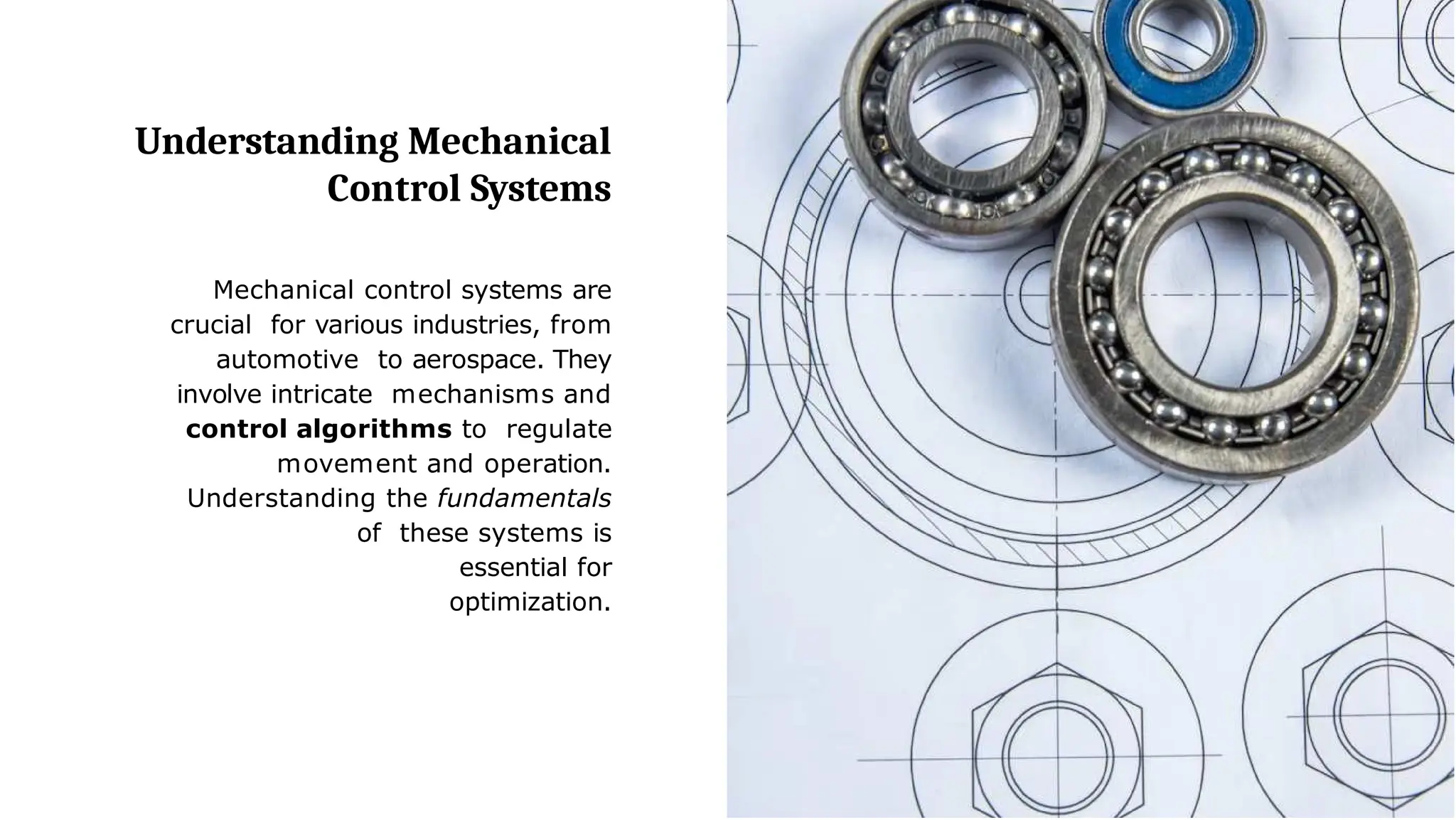
Mechanicalcontrol systems are
crucial for various industries, from
automotive to aerospace. They
involve intricate mechanisms and
control algorithms to regulate
movement and operation.
Understanding the fundamentals
of these systems is
essential for
optimization.
6.
Challenges in Mechanical
ControlSystems
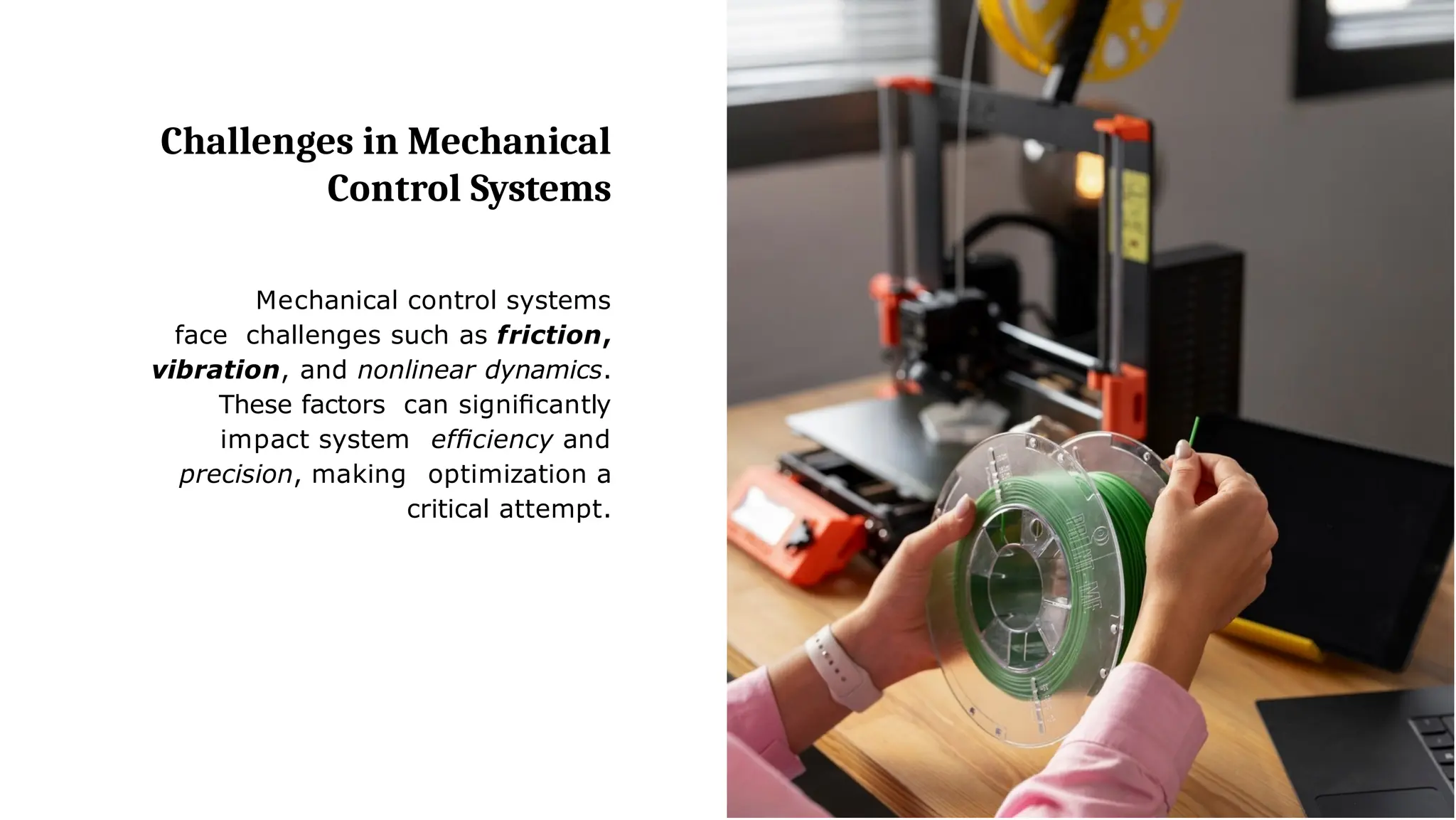
Mechanical control systems
face challenges such as friction,
vibration, and nonlinear dynamics.
These factors can significantly
impact system efficiency and
precision, making optimization a
critical attempt.
7.
Numerical Analysis
Techniques
Numerical analysistechniques,
including finite element
analysis and computationalfluid
dynamics, play a pivotal role in
optimizing mechanical control
systems. These methods enable
precise simulation and analysis
of system behavior.
8.
Enhancing Efficiency
By leveragingnumerical analysis,
we can identify and mitigate
energy losses, minimize wasteful
motion, and streamline system
operations. This leads to
substantial improvements in
overall efficiency and
performance.
9.
Improving Precision
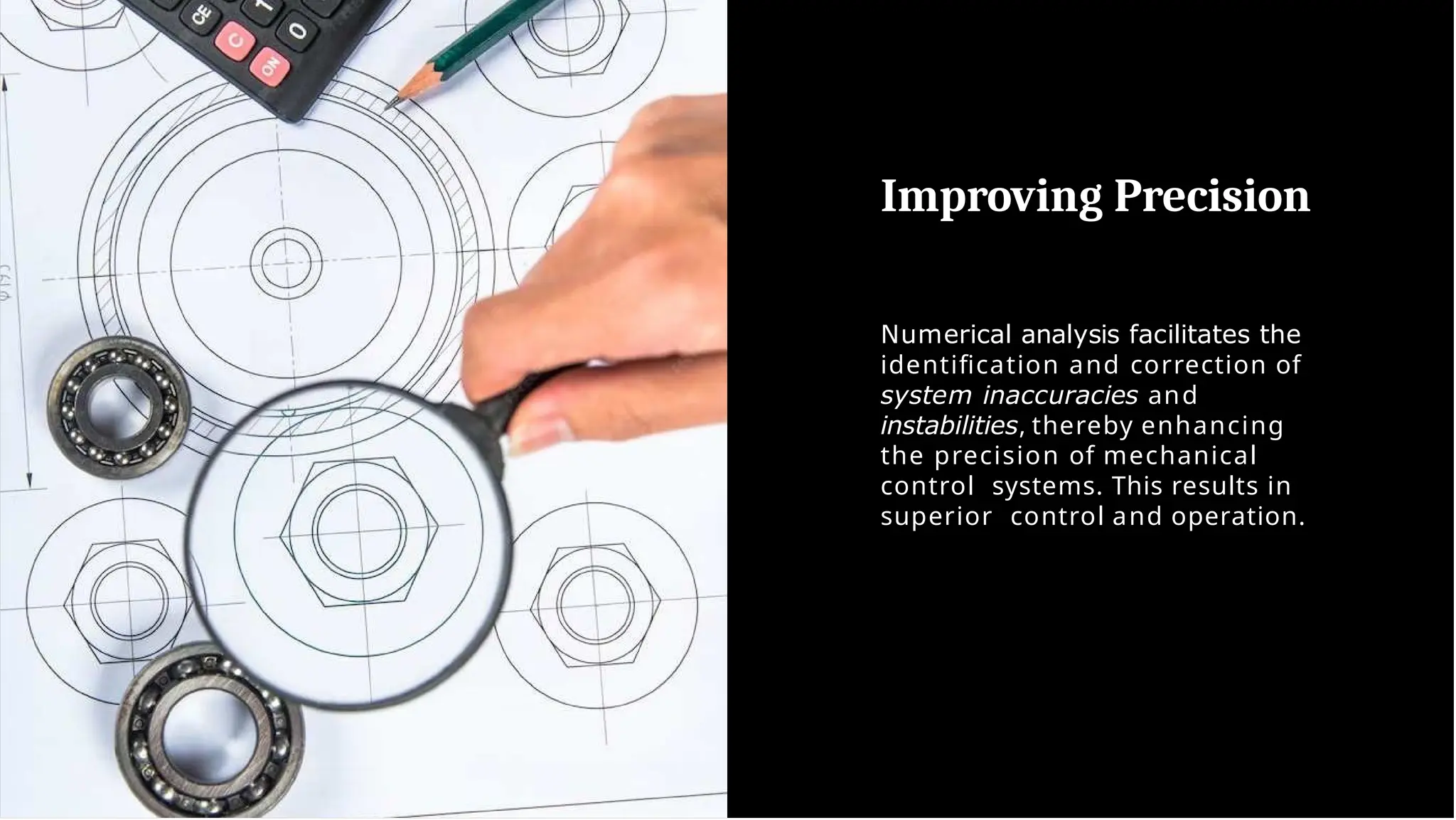
Numerical analysisfacilitates the
identification and correction of
system inaccuracies and
instabilities, thereby enhancing
the precision of mechanical
control systems. This results in
superior control and operation.
10.
Case Study: Optimizationof
Automotive Suspension System
Background: A leading automotive
manufacturer aimed to enhance the ride
comfort, stability, and overall performance of
one of their popular sedan models.
Objective: The primary objective was to use
numerical analysis techniques to optimize the
design parameters of the suspension system,
including spring rates, damping coefficients, and
geometry, to maximize ride comfort while
maintaining excellent handling characteristics.
11.
Approach
Multibody Dynamics Simulation:Engineers
conducted a multibody dynamics simulation using
advanced numerical tools.
Design of Experiments (DOE): A systematic Design of
Experiments approach was employed to vary the
suspension parameters within specified ranges.
Finite Element Analysis (FEA): Finite Element Analysis
was used to study the structural integrity of the
suspension components under various loading
conditions.
Optimization Algorithms: Numerical optimization
algorithms were applied to find the optimal
combination of suspension parameters.
12.
Results
The optimized suspensionsystem
demonstrated significant improvements in-
Enhanced Ride Comfort
Reduced Body Roll
Enhanced Braking Stability
Improved Absorption
Increased Fuel Efficiency
13.
Benefits of Optimization
Optimizingmechanical control systems
through numerical analysis offers a multitude
of benefits, including enhanced reliability,
reduced maintenance costs, and improved
overall performance.
14.
Key Takeaways
Key takeawaysfrom this presentation include
the significance of numerical analysis in
optimizing mechanical control systems, the
impact on efficiency and precision, and the
potential for substantial improvements in
system performance.
15.
Conclusion
In conclusion, theoptimization of mechanical control
systems through numerical analysis is a critical pursuit for
enhancing efficiency and precision. By leveraging advanced
analysis techniques, industries can achieve superior
performance and reliability, paving the way for
groundbreaking innovations and advancements.