System Modeling
Identification
Lecturer: VU VAN PHONG
Dr. Van-Phong Vu-Department of Automatic Control
Textbook and References
 [1] Bài gi ng Mô hình hóa và nh n d ng h th ng
ả ậ ạ ệ ố , PGS. TS. Huỳnh Thái
Hoàng, ĐHQG TPHCM.
 [2] Giáo trình mô hình hóa và mô ph ng
ỏ , PGS. TS. Quy n Huy Ánh,
ề
ĐHSPKT 2010.
 [3] D. L. Smith, Introduction to Dynamic Systems Modeling for Design,
Prentice-Hall, 1994.
 [4] L. Ljung, System Identification – Theory for the users, 2nd
Edition,
Prentice-Hall, 1999.
 [5] R. Johansson, System Modeling and Identification, Prentice-Hall,
1993.
 [6] L. Ljung, System Identification ToolboxTM
Getting Started Guide in
Matlab, The MathWorks, Inc, 2016
Dr. Van-Phong Vu-Department of Automatic Control
Contents of This course
 Chapter 1: Introduction
 Chapter 2: System Modeling
 Chapter 3: Non-parameter System Identification
 Chapter 4: Structure of the Parameter System
 Chapter 5: Parameter Estimation System Identification
 Chapter 6: Evaluation model
 Chapter 7: System Identification in Practice
Dr. Van-Phong Vu-Department of Automatic Control
Chapter 2: System Modeling
Dr. Van-Phong Vu-Department of Automatic Control
Contents of Chapter 2
 2.1 Introduction
 2.2 Functional Analysis
 2.3 Physical Characteristic Analysis
2.3.1 Modeling a Mechanical System
2.3.2 Modeling an Electrical System
2.3.3 Modeling of Electromechanical Systems
2.3.4 Modeling of Fluid Systems
2.3.5 Modeling of Thermal Systems
 2.4 Mathematical Model Analysis
2.1 Introduction
 System Modeling: procedure to build the mathematical
model of the system based on the physical laws of the
system
Dr. Van-Phong Vu-Department of Automatic Control
2.1 Introduction
Dr. Van-Phong Vu-Department of Automatic Control
System Modeling
Functional
Analysis
Physical
Characteristic
Analysis
Mathematical
Model Analysis
Dr. Van-Phong Vu-Department of Automatic Control
2.2 Functional Analysis
Dr. Van-Phong Vu-Department of Automatic Control
2.2 Function Analysis of the System
 Functional analysis: analyze the system into a set of
subsystems which consist of the functional components.
 During functional analysis, we need to note the
Connectivity: which parts of the system connect together.
Causality: How the parts of the system connect?
Dr. Van-Phong Vu-Department of Automatic Control
2.2 Functional Analysis of the System
 Procedure for Functional Analysis:
Step 1: Isolate the system with environment.
Step 2: Analyze the subsystems
Step 3: Determine the causality
Dr. Van-Phong Vu-Department of Automatic Control
2.2 Functional Analysis of the System
 Isolate the system with environment:
Determine the limited area of the system.
Cut off all connections between the system with outside
environment.
Replace each connection by a port to describe the
interactions between system and environment.
Dr. Van-Phong Vu-Department of Automatic Control
2.2 Functional Analysis of the System
 Ports: are the terminals (thi t b đ u cu i) of the system in
ế ị ầ ố
which the energy is transferred in or out. The system can
have single or multiple ports.
 One port can have one/two inputs (U) one/two ouput
(Y).
 Common ports:
Structural (c khí)
ơ
Electrical (Đi n)
ệ
Thermal (Nhi t)
ệ
Fluid (L u ch t)
ư ấ
Dr. Van-Phong Vu-Department of Automatic Control
2.2 Functional Analysis of the System
 Structural
Dr. Van-Phong Vu-Department of Automatic Control
2.2 Functional Analysis of the System
 Electrical
Dr. Van-Phong Vu-Department of Automatic Control
2.2 Functional Analysis of the System
 Thermal
Dr. Van-Phong Vu-Department of Automatic Control
2.2 Functional Analysis of the System
 Fluid
Dr. Van-Phong Vu-Department of Automatic Control
2.2 Functional Analysis of the System
 Example:
Dr. Van-Phong Vu-Department of Automatic Control
2.2 Functional Analysis of the System
 Example:
Dr. Van-Phong Vu-Department of Automatic Control
2.2 Functional Analysis of the System
 Example: Cooling system
Dr. Van-Phong Vu-Department of Automatic Control
2.2 Functional Analysis of the System
 Example: Cooling system
Dr. Van-Phong Vu-Department of Automatic Control
2.2 Functional Analysis of the System
 Subsystem Analysis:
Divide the system into subsystems
Divide the subsystems into components.
Replace the connectivity among components by
ports.
Dr. Van-Phong Vu-Department of Automatic Control
2.2 Functional Analysis of the System
 Subsystem Analysis:
Dr. Van-Phong Vu-Department of Automatic Control
2.2 Functional Analysis of the System
 Subsystem Analysis:
Dr. Van-Phong Vu-Department of Automatic Control
2.2 Functional Analysis of the System
 Determine Causality:
 Causality is determined by the variables at the ports.
Dr. Van-Phong Vu-Department of Automatic Control
2.2 Functional Analysis of the System
Dr. Van-Phong Vu-Department of Automatic Control
2.3 Physical Characteristic
Analysis
Dr. Van-Phong Vu-Department of Automatic Control
 Physical Characteristic Analysis: a process to obtain the
mathematical model of each functional component based
on the physical laws.
 Basic physical systems:
Electrical system
Mechanical System
Thermal system
Fluid system
2.3 Physical Characteristic Analysis
Dr. Van-Phong Vu-Department of Automatic Control

2.3 Physical Characteristic Analysis
Physical systems
Basic Elements Basic Variables Conservation laws
1. Resistance
2. Capacitance
3. Inductance/
Inertia
1. Quantity
2. Potentiality
3. Time
Electrical,
Mechanical,
Thermal,
Fluid
Dr. Van-Phong Vu-Department of Automatic Control
 Mechanical System:
 Basic Variables:
Distance (quantity) x [m]
Force (potentiality) F [N]
Velocity v [m/s]
 Basic elements:
Dashpot ( Piston cylinder):
2.3 .1 Modeling of Mechanical Systems
𝑓 =𝑏
𝑑𝑥
𝑑𝑡
=𝑏𝑣
Spring.
Mass:
Dr. Van-Phong Vu-Department of Automatic Control
2.3 .1 Modeling of Mechanical Systems
Energy : 𝐸=
1
2
𝑘 𝑥
2
Newton law 2:
𝑓 =𝑚𝑎=𝑚
𝑑𝑣
𝑑𝑡
=𝑚
𝑑2
𝑥
𝑑𝑡
2 𝐸=
1
2
𝑚𝑣
2
Energy:
Dr. Van-Phong Vu-Department of Automatic Control
 Conservation Laws:
Force equilibrium equations, Newton Laws.
Euler-Lagrange Equations
2.3 .1 Modeling of Mechanical Systems
Dr. Van-Phong Vu-Department of Automatic Control
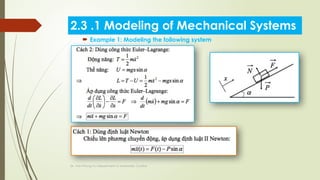
 Example 1: Modeling the following system
2.3 .1 Modeling of Mechanical Systems
 Example 2:
m
F1=kX(t)
Fms=bv(t)
F(t)
b
F: Force
X(t): Displacement
v: velocity
m: mass
K: spring constant
b: Damping coefficient
2.3 Physical Characteristic Analysis
 Example 3:
2.3 Physical Characteristic Analysis
 Example 3:
Dr. Van-Phong Vu-Department of Automatic Control
 Example 3: Modeling the following system
2.3 .1 Modeling of Mechanical Systems
Dr. Van-Phong Vu-Department of Automatic Control
 Example 4: Modeling the train
2.3 .1 Modeling of Mechanical Systems
Dr. Van-Phong Vu-Department of Automatic Control
 Example 3: Modeling the train
2.3 .1 Modeling of Mechanical Systems
Dr. Van-Phong Vu-Department of Automatic Control
 Example 3: Modeling the train
2.3 .1 Modeling of Mechanical Systems
Dr. Van-Phong Vu-Department of Automatic Control
 Example 3: Modeling the train
2.3 .1 Modeling of Mechanical Systems
Dr. Van-Phong Vu-Department of Automatic Control
 Example 3: Modeling the train
2.3 .1 Modeling of Mechanical Systems
Dr. Van-Phong Vu-Department of Automatic Control
 Consider a system illustrated in Fig. 6. and are the external force (inputs) ;
and and are the displacement of m1 and m2, respectively.
 Please determine the mathematical model in term of state-space
equation.
 Please simulate the system using Matlab/Simulink
 with inputs are step signal m1=1, m2=2 b=0.1, k1=0.15, k2=0.15
Dr. Van-Phong Vu-Department of Automatic Control
 Rotational Mechanical Systems : The input to a rotational
mechanical system may be the torque T and the output
the rotational displacement, or angle.
Torsional spring: relationship between torque T and the
angle θ rotated by the spring
2.3 .1 Modeling of Mechanical Systems
Dr. Van-Phong Vu-Department of Automatic Control
 Rotational Mechanical Systems :
 Rotational dashpot:
 Moment of inertia: torque T, angular acceleration a, and
the moment of inertia I,

2.3 .1 Modeling of Mechanical Systems
Dr. Van-Phong Vu-Department of Automatic Control
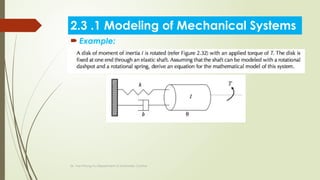
 Example:
2.3 .1 Modeling of Mechanical Systems
Dr. Van-Phong Vu-Department of Automatic Control
 Example:
2.3 .1 Modeling of Mechanical Systems
Dr. Van-Phong Vu-Department of Automatic Control
 Example:
2.3 .1 Modeling of Mechanical Systems
Dr. Van-Phong Vu-Department of Automatic Control
Electrical System:
Basic variables:
Charge (đi n l ng) q [C]
ệ ượ
Voltage (đi n th ) u [V]
ệ ế
Current ( dòng đi n) I [A]
ệ
Basic elements
Resistance: Capacitance:
Inductance:
2.3.2 Modeling Electrical System
Dr. Van-Phong Vu-Department of Automatic Control
Conservation Laws:
2.3.2 Modeling Electrical System
v21 L
t
i
d
d
 E
1
2
L
 i
2

i C
t
v21
d
d
 E
1
2
M
 v21
2

Kirchhoff’s voltage law
Dr. Van-Phong Vu-Department of Automatic Control
Conservation Laws:
Kirchoff Law for current
Kirchoff law for voltage
 Analysis circuit methods
2.3.2 Modeling Electrical System
Dr. Van-Phong Vu-Department of Automatic Control
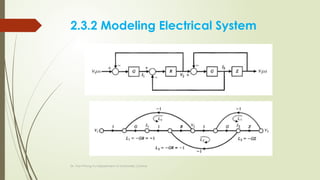
 Example 1:
2.3.2 Modeling Electrical System
C
C
C
C
v
dt
v
d
LC
dt
dv
RC
v
dt
di
L
R
i
v






2
2
.
Dr. Van-Phong Vu-Department of Automatic Control
 Example 2:
2.3.2 Modeling Electrical System
Dr. Van-Phong Vu-Department of Automatic Control
 Example 2:
2.3.2 Modeling Electrical System
Dr. Van-Phong Vu-Department of Automatic Control
 Example 2:
2.3.2 Modeling Electrical System
Dr. Van-Phong Vu-Department of Automatic Control
2.3.2 Modeling Electrical System
Dr. Van-Phong Vu-Department of Automatic Control
2.3.3 Modeling of Electromechanical Systems
 Transfer function of DC motor
T w
U
R
J
+
L
Kf
-
i
Lư
Rư
Uư
Eư

Mt
B
J
Điện cảm phần ứng
Điện trở phần ứng
Điện áp phần ứng
Sức điện động phần ứng
Tốc độ động cơ
Mô men tải
Hệ số ma sát
Mô men quán tính
Dr. Van-Phong Vu-Department of Automatic Control
 Ph ng trình cân b ng đi n
ươ ằ ệ

2.3.3 Modeling of Electromechanical Systems
)
(
)
(
)
(
)
(
.
).
(
)
(
u
t
K
t
E
t
E
dt
t
di
L
R
t
i
t
U
u
u
u
u
u
u





Dr. Van-Phong Vu-Department of Automatic Control
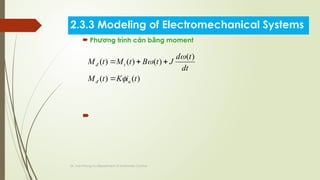
 Ph ng trình cân b ng moment
ươ ằ

2.3.3 Modeling of Electromechanical Systems
)
(
)
(
)
(
)
(
)
(
)
(
t
i
K
t
M
dt
t
d
J
t
B
t
M
t
M
u
đ
t
đ







Dr. Van-Phong Vu-Department of Automatic Control
Fluid Systems:
Basic variables:
Pressure (áp su t) p [N/m
ấ 2
]
Volume (th tích) V [m
ể 3
]
Flow ( l u l ng) z [m
ư ượ 3
/s]
Basic elements
Hydraulic resistance
2.3.4 Modeling the Fluid Systems
Dr. Van-Phong Vu-Department of Automatic Control
Fluid Systems:
Hydraulic resistance R:
2.3.4 Modeling the Fluid Systems
Fluid Systems:
Hydraulic Capacitance C:
Dr. Van-Phong Vu-Department of Automatic Control
2.3.4 Modeling the Fluid Systems
(1)
(2)
Hydraulic Capacitance C
Dr. Van-Phong Vu-Department of Automatic Control
Fluid Systems:
Hydraulic inertance: Hydraulic capacitance is a measure of
the energy storage in a hydraulic system.
P1 − P2 be the pressure drop
cross-sectional area A
 m is the uid mass and
v is the fluid velocity
 pipe length is L
Newton’s second law
2.3.4 Modeling the Fluid Systems
 Example:
L
Dr. Van-Phong Vu-Department of Automatic Control
 Thermal Systems:
Thermal resistance R is the resistance offered to the
heat flow

2.3.5 Modeling of Thermal System
Dr. Van-Phong Vu-Department of Automatic Control
 Thermal Systems:
Thermal capacitance is a measure of the energy
storage in a thermal system
 q1 is the heat flowing into a body
q2 is the heat owing out
the difference q2 − q1 is stored by the body
heat capacity be denoted by C
2.3.5 Modeling of Thermal System
Dr. Van-Phong Vu-Department of Automatic Control
Example:
2.3.5 Modeling of Thermal System
Dr. Van-Phong Vu-Department of Automatic Control
Example:
2.3.5 Modeling of Thermal System
Dr. Van-Phong Vu-Department of Automatic Control
Example:
2.3.5 Modeling of Thermal System
Dr. Van-Phong Vu-Department of Automatic Control
Example:
2.3.5 Modeling of Thermal System
Dr. Van-Phong Vu-Department of Automatic Control
2.4 Mathematical Model
Analysis
2.4 Mathematical Model Analysis
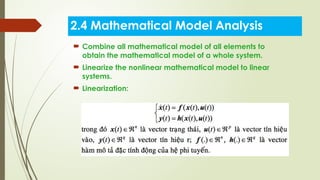
 Combine all mathematical model of all elements to
obtain the mathematical model of a whole system.
 Linearize the nonlinear mathematical model to linear
systems.
 Linearization:
2.4 Mathematical Model Analysis
 Equilibrium point (Đi m d ng).
ể ừ
2.4 Mathematical Model Analysis
 How to find Equilibrium point
2.4 Mathematical Model Analysis
Dr. Van-Phong Vu-Department of Automatic Control
Thank You For Your Listening

Chapter 2_System Modeling using computer(1).pptx

  • 1.
    System Modeling Identification Lecturer: VUVAN PHONG Dr. Van-Phong Vu-Department of Automatic Control
  • 2.
    Textbook and References [1] Bài gi ng Mô hình hóa và nh n d ng h th ng ả ậ ạ ệ ố , PGS. TS. Huỳnh Thái Hoàng, ĐHQG TPHCM.  [2] Giáo trình mô hình hóa và mô ph ng ỏ , PGS. TS. Quy n Huy Ánh, ề ĐHSPKT 2010.  [3] D. L. Smith, Introduction to Dynamic Systems Modeling for Design, Prentice-Hall, 1994.  [4] L. Ljung, System Identification – Theory for the users, 2nd Edition, Prentice-Hall, 1999.  [5] R. Johansson, System Modeling and Identification, Prentice-Hall, 1993.  [6] L. Ljung, System Identification ToolboxTM Getting Started Guide in Matlab, The MathWorks, Inc, 2016 Dr. Van-Phong Vu-Department of Automatic Control
  • 3.
    Dr. Van-Phong Vu-Departmentof Automatic Control Contents of This course  Chapter 1: Introduction  Chapter 2: System Modeling  Chapter 3: Non-parameter System Identification  Chapter 4: Structure of the Parameter System  Chapter 5: Parameter Estimation System Identification  Chapter 6: Evaluation model  Chapter 7: System Identification in Practice
  • 4.
    Dr. Van-Phong Vu-Departmentof Automatic Control Chapter 2: System Modeling
  • 5.
    Dr. Van-Phong Vu-Departmentof Automatic Control Contents of Chapter 2  2.1 Introduction  2.2 Functional Analysis  2.3 Physical Characteristic Analysis 2.3.1 Modeling a Mechanical System 2.3.2 Modeling an Electrical System 2.3.3 Modeling of Electromechanical Systems 2.3.4 Modeling of Fluid Systems 2.3.5 Modeling of Thermal Systems  2.4 Mathematical Model Analysis
  • 6.
    2.1 Introduction  SystemModeling: procedure to build the mathematical model of the system based on the physical laws of the system Dr. Van-Phong Vu-Department of Automatic Control
  • 7.
    2.1 Introduction Dr. Van-PhongVu-Department of Automatic Control System Modeling Functional Analysis Physical Characteristic Analysis Mathematical Model Analysis
  • 8.
    Dr. Van-Phong Vu-Departmentof Automatic Control 2.2 Functional Analysis
  • 9.
    Dr. Van-Phong Vu-Departmentof Automatic Control 2.2 Function Analysis of the System  Functional analysis: analyze the system into a set of subsystems which consist of the functional components.  During functional analysis, we need to note the Connectivity: which parts of the system connect together. Causality: How the parts of the system connect?
  • 10.
    Dr. Van-Phong Vu-Departmentof Automatic Control 2.2 Functional Analysis of the System  Procedure for Functional Analysis: Step 1: Isolate the system with environment. Step 2: Analyze the subsystems Step 3: Determine the causality
  • 11.
    Dr. Van-Phong Vu-Departmentof Automatic Control 2.2 Functional Analysis of the System  Isolate the system with environment: Determine the limited area of the system. Cut off all connections between the system with outside environment. Replace each connection by a port to describe the interactions between system and environment.
  • 12.
    Dr. Van-Phong Vu-Departmentof Automatic Control 2.2 Functional Analysis of the System  Ports: are the terminals (thi t b đ u cu i) of the system in ế ị ầ ố which the energy is transferred in or out. The system can have single or multiple ports.  One port can have one/two inputs (U) one/two ouput (Y).  Common ports: Structural (c khí) ơ Electrical (Đi n) ệ Thermal (Nhi t) ệ Fluid (L u ch t) ư ấ
  • 13.
    Dr. Van-Phong Vu-Departmentof Automatic Control 2.2 Functional Analysis of the System  Structural
  • 14.
    Dr. Van-Phong Vu-Departmentof Automatic Control 2.2 Functional Analysis of the System  Electrical
  • 15.
    Dr. Van-Phong Vu-Departmentof Automatic Control 2.2 Functional Analysis of the System  Thermal
  • 16.
    Dr. Van-Phong Vu-Departmentof Automatic Control 2.2 Functional Analysis of the System  Fluid
  • 17.
    Dr. Van-Phong Vu-Departmentof Automatic Control 2.2 Functional Analysis of the System  Example:
  • 18.
    Dr. Van-Phong Vu-Departmentof Automatic Control 2.2 Functional Analysis of the System  Example:
  • 19.
    Dr. Van-Phong Vu-Departmentof Automatic Control 2.2 Functional Analysis of the System  Example: Cooling system
  • 20.
    Dr. Van-Phong Vu-Departmentof Automatic Control 2.2 Functional Analysis of the System  Example: Cooling system
  • 21.
    Dr. Van-Phong Vu-Departmentof Automatic Control 2.2 Functional Analysis of the System  Subsystem Analysis: Divide the system into subsystems Divide the subsystems into components. Replace the connectivity among components by ports.
  • 22.
    Dr. Van-Phong Vu-Departmentof Automatic Control 2.2 Functional Analysis of the System  Subsystem Analysis:
  • 23.
    Dr. Van-Phong Vu-Departmentof Automatic Control 2.2 Functional Analysis of the System  Subsystem Analysis:
  • 24.
    Dr. Van-Phong Vu-Departmentof Automatic Control 2.2 Functional Analysis of the System  Determine Causality:  Causality is determined by the variables at the ports.
  • 25.
    Dr. Van-Phong Vu-Departmentof Automatic Control 2.2 Functional Analysis of the System
  • 26.
    Dr. Van-Phong Vu-Departmentof Automatic Control 2.3 Physical Characteristic Analysis
  • 27.
    Dr. Van-Phong Vu-Departmentof Automatic Control  Physical Characteristic Analysis: a process to obtain the mathematical model of each functional component based on the physical laws.  Basic physical systems: Electrical system Mechanical System Thermal system Fluid system 2.3 Physical Characteristic Analysis
  • 28.
    Dr. Van-Phong Vu-Departmentof Automatic Control  2.3 Physical Characteristic Analysis Physical systems Basic Elements Basic Variables Conservation laws 1. Resistance 2. Capacitance 3. Inductance/ Inertia 1. Quantity 2. Potentiality 3. Time Electrical, Mechanical, Thermal, Fluid
  • 29.
    Dr. Van-Phong Vu-Departmentof Automatic Control  Mechanical System:  Basic Variables: Distance (quantity) x [m] Force (potentiality) F [N] Velocity v [m/s]  Basic elements: Dashpot ( Piston cylinder): 2.3 .1 Modeling of Mechanical Systems 𝑓 =𝑏 𝑑𝑥 𝑑𝑡 =𝑏𝑣
  • 30.
    Spring. Mass: Dr. Van-Phong Vu-Departmentof Automatic Control 2.3 .1 Modeling of Mechanical Systems Energy : 𝐸= 1 2 𝑘 𝑥 2 Newton law 2: 𝑓 =𝑚𝑎=𝑚 𝑑𝑣 𝑑𝑡 =𝑚 𝑑2 𝑥 𝑑𝑡 2 𝐸= 1 2 𝑚𝑣 2 Energy:
  • 31.
    Dr. Van-Phong Vu-Departmentof Automatic Control  Conservation Laws: Force equilibrium equations, Newton Laws. Euler-Lagrange Equations 2.3 .1 Modeling of Mechanical Systems
  • 32.
    Dr. Van-Phong Vu-Departmentof Automatic Control  Example 1: Modeling the following system 2.3 .1 Modeling of Mechanical Systems
  • 33.
     Example 2: m F1=kX(t) Fms=bv(t) F(t) b F:Force X(t): Displacement v: velocity m: mass K: spring constant b: Damping coefficient 2.3 Physical Characteristic Analysis
  • 34.
    2.3 Physical CharacteristicAnalysis  Example 3:
  • 35.
    2.3 Physical CharacteristicAnalysis  Example 3:
  • 36.
    Dr. Van-Phong Vu-Departmentof Automatic Control  Example 3: Modeling the following system 2.3 .1 Modeling of Mechanical Systems
  • 37.
    Dr. Van-Phong Vu-Departmentof Automatic Control  Example 4: Modeling the train 2.3 .1 Modeling of Mechanical Systems
  • 38.
    Dr. Van-Phong Vu-Departmentof Automatic Control  Example 3: Modeling the train 2.3 .1 Modeling of Mechanical Systems
  • 39.
    Dr. Van-Phong Vu-Departmentof Automatic Control  Example 3: Modeling the train 2.3 .1 Modeling of Mechanical Systems
  • 40.
    Dr. Van-Phong Vu-Departmentof Automatic Control  Example 3: Modeling the train 2.3 .1 Modeling of Mechanical Systems
  • 41.
    Dr. Van-Phong Vu-Departmentof Automatic Control  Example 3: Modeling the train 2.3 .1 Modeling of Mechanical Systems
  • 42.
    Dr. Van-Phong Vu-Departmentof Automatic Control  Consider a system illustrated in Fig. 6. and are the external force (inputs) ; and and are the displacement of m1 and m2, respectively.  Please determine the mathematical model in term of state-space equation.  Please simulate the system using Matlab/Simulink  with inputs are step signal m1=1, m2=2 b=0.1, k1=0.15, k2=0.15
  • 43.
    Dr. Van-Phong Vu-Departmentof Automatic Control  Rotational Mechanical Systems : The input to a rotational mechanical system may be the torque T and the output the rotational displacement, or angle. Torsional spring: relationship between torque T and the angle θ rotated by the spring 2.3 .1 Modeling of Mechanical Systems
  • 44.
    Dr. Van-Phong Vu-Departmentof Automatic Control  Rotational Mechanical Systems :  Rotational dashpot:  Moment of inertia: torque T, angular acceleration a, and the moment of inertia I,  2.3 .1 Modeling of Mechanical Systems
  • 45.
    Dr. Van-Phong Vu-Departmentof Automatic Control  Example: 2.3 .1 Modeling of Mechanical Systems
  • 46.
    Dr. Van-Phong Vu-Departmentof Automatic Control  Example: 2.3 .1 Modeling of Mechanical Systems
  • 47.
    Dr. Van-Phong Vu-Departmentof Automatic Control  Example: 2.3 .1 Modeling of Mechanical Systems
  • 48.
    Dr. Van-Phong Vu-Departmentof Automatic Control Electrical System: Basic variables: Charge (đi n l ng) q [C] ệ ượ Voltage (đi n th ) u [V] ệ ế Current ( dòng đi n) I [A] ệ Basic elements Resistance: Capacitance: Inductance: 2.3.2 Modeling Electrical System
  • 49.
    Dr. Van-Phong Vu-Departmentof Automatic Control Conservation Laws: 2.3.2 Modeling Electrical System v21 L t i d d  E 1 2 L  i 2  i C t v21 d d  E 1 2 M  v21 2  Kirchhoff’s voltage law
  • 50.
    Dr. Van-Phong Vu-Departmentof Automatic Control Conservation Laws: Kirchoff Law for current Kirchoff law for voltage  Analysis circuit methods 2.3.2 Modeling Electrical System
  • 51.
    Dr. Van-Phong Vu-Departmentof Automatic Control  Example 1: 2.3.2 Modeling Electrical System C C C C v dt v d LC dt dv RC v dt di L R i v       2 2 .
  • 52.
    Dr. Van-Phong Vu-Departmentof Automatic Control  Example 2: 2.3.2 Modeling Electrical System
  • 53.
    Dr. Van-Phong Vu-Departmentof Automatic Control  Example 2: 2.3.2 Modeling Electrical System
  • 54.
    Dr. Van-Phong Vu-Departmentof Automatic Control  Example 2: 2.3.2 Modeling Electrical System
  • 55.
    Dr. Van-Phong Vu-Departmentof Automatic Control 2.3.2 Modeling Electrical System
  • 56.
    2.3.2 Modeling ElectricalSystem Dr. Van-Phong Vu-Department of Automatic Control
  • 57.
    2.3.3 Modeling ofElectromechanical Systems  Transfer function of DC motor T w U R J + L Kf - i Lư Rư Uư Eư  Mt B J Điện cảm phần ứng Điện trở phần ứng Điện áp phần ứng Sức điện động phần ứng Tốc độ động cơ Mô men tải Hệ số ma sát Mô men quán tính
  • 58.
    Dr. Van-Phong Vu-Departmentof Automatic Control  Ph ng trình cân b ng đi n ươ ằ ệ  2.3.3 Modeling of Electromechanical Systems ) ( ) ( ) ( ) ( . ). ( ) ( u t K t E t E dt t di L R t i t U u u u u u u     
  • 59.
    Dr. Van-Phong Vu-Departmentof Automatic Control  Ph ng trình cân b ng moment ươ ằ  2.3.3 Modeling of Electromechanical Systems ) ( ) ( ) ( ) ( ) ( ) ( t i K t M dt t d J t B t M t M u đ t đ       
  • 60.
    Dr. Van-Phong Vu-Departmentof Automatic Control Fluid Systems: Basic variables: Pressure (áp su t) p [N/m ấ 2 ] Volume (th tích) V [m ể 3 ] Flow ( l u l ng) z [m ư ượ 3 /s] Basic elements Hydraulic resistance 2.3.4 Modeling the Fluid Systems
  • 61.
    Dr. Van-Phong Vu-Departmentof Automatic Control Fluid Systems: Hydraulic resistance R: 2.3.4 Modeling the Fluid Systems
  • 62.
    Fluid Systems: Hydraulic CapacitanceC: Dr. Van-Phong Vu-Department of Automatic Control 2.3.4 Modeling the Fluid Systems (1) (2) Hydraulic Capacitance C
  • 63.
    Dr. Van-Phong Vu-Departmentof Automatic Control Fluid Systems: Hydraulic inertance: Hydraulic capacitance is a measure of the energy storage in a hydraulic system. P1 − P2 be the pressure drop cross-sectional area A  m is the uid mass and v is the fluid velocity  pipe length is L Newton’s second law 2.3.4 Modeling the Fluid Systems
  • 64.
    2.3.4 Modeling theFluid Systems  Example: L
  • 65.
    Dr. Van-Phong Vu-Departmentof Automatic Control  Thermal Systems: Thermal resistance R is the resistance offered to the heat flow  2.3.5 Modeling of Thermal System
  • 66.
    Dr. Van-Phong Vu-Departmentof Automatic Control  Thermal Systems: Thermal capacitance is a measure of the energy storage in a thermal system  q1 is the heat flowing into a body q2 is the heat owing out the difference q2 − q1 is stored by the body heat capacity be denoted by C 2.3.5 Modeling of Thermal System
  • 67.
    Dr. Van-Phong Vu-Departmentof Automatic Control Example: 2.3.5 Modeling of Thermal System
  • 68.
    Dr. Van-Phong Vu-Departmentof Automatic Control Example: 2.3.5 Modeling of Thermal System
  • 69.
    Dr. Van-Phong Vu-Departmentof Automatic Control Example: 2.3.5 Modeling of Thermal System
  • 70.
    Dr. Van-Phong Vu-Departmentof Automatic Control Example: 2.3.5 Modeling of Thermal System
  • 71.
    Dr. Van-Phong Vu-Departmentof Automatic Control 2.4 Mathematical Model Analysis
  • 72.
    2.4 Mathematical ModelAnalysis  Combine all mathematical model of all elements to obtain the mathematical model of a whole system.  Linearize the nonlinear mathematical model to linear systems.  Linearization:
  • 73.
    2.4 Mathematical ModelAnalysis  Equilibrium point (Đi m d ng). ể ừ
  • 74.
    2.4 Mathematical ModelAnalysis  How to find Equilibrium point
  • 75.
  • 76.
  • 77.
    Dr. Van-Phong Vu-Departmentof Automatic Control Thank You For Your Listening