How Twin Screw Multiphase Pumps Supplement Artificial Lift
Luis Martinez P.Eng. MBA
Email: lmartinez@leistritzcorp.com
Optimizing Artificial Lift with Surface
Multiphase Boosting
2
Optimizing Artificial Lift with Surface Multiphase Boosting
3
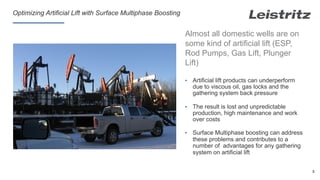
Almost all domestic wells are on
some kind of artificial lift (ESP,
Rod Pumps, Gas Lift, Plunger
Lift)
• Artificial lift products can underperform
due to viscous oil, gas locks and the
gathering system back pressure
• The result is lost and unpredictable
production, high maintenance and work
over costs
• Surface Multiphase boosting can address
these problems and contributes to a
number of advantages for any gathering
system on artificial lift
Optimizing Artificial Lift with Surface Multiphase Boosting
4
Agenda
I. Advantages and technology background of surface multiphase
boosting systems
II. Benefits of the combination of artificial lift with surface multiphase
boosting
III. Applications of multiphase boosting in oil and gas fields
Optimizing Artificial Lift with Surface Multiphase Boosting
5
I. Advantages and technology
background of surface multiphase
boosting systems
Optimizing Artificial Lift with Surface Multiphase Boosting
Overall Advantages with Multiphase Pumping
• Increase hydrocarbons production and total recovery by
improving well inflow/outflow performance
• Make up for fast declining reservoir pressure and mitigate
slugging and surging wells
• Reduce the gathering system back pressure to allow and
maintain plateau production
• Minimize facility footprint, limit exposure to flaring and GHG
releases and reduce overall complexity
• Allow remote multiphase pad production to reach central
processing and lowering CAPEX and OPEX
• Able to handle varying flow regimes and terrain induced
slugging
• Improved flow assurance with heavy and waxy crudes and
operation in cold weather (hydrate mitigation)
Optimizing Artificial Lift with Surface Multiphase Boosting
Multiphase Pumps Technologies
Roto-dynamic pumps Positive displacement pump
Optimizing Artificial Lift with Surface Multiphase Boosting
Roto-dynamic pumps Positive displacement pumps
low high
Low Inlet Pressure
GVF
Viscosity
Density
low high
Favorable operating conditions shown in green
Pump Technology Characteristics
Optimizing Artificial Lift with Surface Multiphase Boosting
Twin Screw Multiphase Pump
9
Optimizing Artificial Lift with Surface Multiphase Boosting
Multiphase Pumping Principle
10
Pumping liquids Compressing gas
Gas
Liquid
Slip (enlarged for illustration purposes only)
P P
L L
Qo Q
S
S
Q = Qo – S
Q = Actual flow
Qo = Theoretical Flow
S = Slip
Optimizing Artificial Lift with Surface Multiphase Boosting
Multiphase Pumping Performance
11
Optimizing Artificial Lift with Surface Multiphase Boosting
Multiphase Pumping Performance
12
Optimizing Artificial Lift with Surface Multiphase Boosting
Design Point
Design Point
13
Gathering Facility
Reduction with MPP
Eliminate and simplify production
facilities and handle transient
and unstable flow regimes from
horizontal wells (put back pump
jacks)
Conventional
Production
Multiphase
Pumping
Optimizing Artificial Lift with Surface Multiphase Boosting
MPP System
14
Optimizing Artificial Lift with Surface Multiphase Boosting
Typical Leistritz Gathering System
Electric Motor
Liquid
Knockout
Boot
Pilot Operated
Relief Valve
Discharge Header
ESD Ball Valve
Suction Header
ESD Ball Valve
Basket Strainer
Gauge Panel
Auxiliary Junction Box
Main Junction Box
Plan 54
Seal Oil System
w/Air Cooler
Leistritz
Multiphase Pump
Optimizing Artificial Lift with Surface Multiphase Boosting
MPP SYSTEM
16
II. Benefits of the combination of
artificial lift with surface multiphase
boosting
Optimizing Artificial Lift with Surface Multiphase Boosting
17
Optimizing Artificial Lift with Surface Multiphase Boosting
• Increased down-hole
pump submergence
• Higher static liquid level
improved NPSH (a)
• Gas stays in solution
• Operation above bubble
point
• Increase production rate
Lowering WHP =
To Battery
(via MP Pipeline)
MPP
System
Surface Header
Down Hole Pump
Liquid Level
Annular / Casing Gas
Production Tubing
18
Optimizing Artificial Lift with Surface Multiphase Boosting
Q (flow rate)
P
(buttonhole
pressure)
Inflow performance
Outflow
without MPP
Outflow
with MPP
1
2
Q1 Q2
P1
P2
Production rate
increment
Pressure
drawdown
19
Optimizing Artificial Lift with Surface Multiphase Boosting
Q (flow rate)
P
(wellhead
pressure)
Inflow performance
Outflow without MPP
Outflow with MPP
1
2
Q1 Q2
P1
P2
Production rate
increment
Pressure
drawdown
N0 MPP operating points via speed control
20
Optimizing Artificial Lift with Surface Multiphase Boosting
Change in Production
Reduction
in
FWHP
Inflow 1
Outflow
1
2
Inflow 2
• Increased down-hole
pump submergence
• Higher static liquid level
improved NPSH (a)
• Gas stays in solution
• Operation above bubble
point
Lowering WHP =
Gathering System with
Multiphase Pumps
Enhance production from
low pressure well and extend
plateau production with a
multiphase pump:
• Increase total recovery
• Reduce total production time
21
With Multiphase Pumping
Plateau Production
Shortened
Production Time
Optimizing Artificial Lift with Surface Multiphase Boosting
PRODUCTION
RATE
Extra Recovery
Original Expected Recovery
Simulator Run and Nodal Analysis
of the Gathering System
• Two satellites evaluated: (SF-21 & SF-44).
• Wells on ESP and rod pumps. Rod pumps
on pump-off control.
• Uptime increased close to 100%.
• The results in added production:
SF-21: 359 bopd.
SF-44: 235 bopd.
22
Optimizing Artificial Lift with Surface Multiphase Boosting
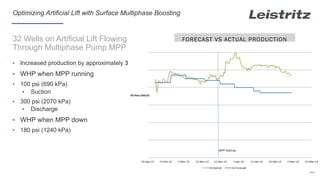
32 Wells on Artificial Lift Flowing
Through Multiphase Pump MPP
• Increased production by approximately 30%
• WHP when MPP running
• 100 psi (690 kPa)
• Suction
• 300 psi (2070 kPa)
• Discharge
• WHP when MPP down
• 180 psi (1240 kPa)
23
FORECAST VS ACTUAL PRODUCTION
Optimizing Artificial Lift with Surface Multiphase Boosting
24
UNLOADING GAS LIFTED WELL
(MPP DBU Application)
Optimizing Artificial Lift with Surface Multiphase Boosting
25
Manifold CP-1391 =
responsible per 3.4%
of Oil Production of
the Carmópolis Field
Well/Artificial
Lift Method
Pwh before
(kgf/cm2)
Pwh after
(kgf/cm2)
Pcasing before
(kgf/cm2)
Pcasing after
(kgf/cm2)
Sub before
(m)
Sub after
(m)
CP-1464/SRP
11 5 9,4 4,4 130 265
Increasing of the downhole pump submergence
CP-1461/ESP
20 8 9,3 4 0 90
Reduction of the motor current—10% (less DP required on ESP)
and increasing of the ESP submergence
Flowing Studies
Steady State and
Transient Model
Optimizing Artificial Lift with Surface Multiphase Boosting
26
III. Applications of multiphase
boosting in oil and gas fields
Optimizing Artificial Lift with Surface Multiphase Boosting
On-Shore Gathering System
27
Optimizing Artificial Lift with Surface Multiphase Boosting
Off-Shore Gathering System
28
Optimizing Artificial Lift with Surface Multiphase Boosting
29
Casing Gas Compression
Optimizing Artificial Lift with Surface Multiphase Boosting
Gas well – Blow Down Unit
30
Optimizing Artificial Lift with Surface Multiphase Boosting
1. Normally flowing through V2
and V3
2. Well gets liquid loaded. Flow
drops and V3 closes
3. Plunger drops and MPP gets
ready to start.
4. After preset time (=plunger
drop),V1 & V4 open, V2 closes
and the MPP starts
5. MPP draws gas and liquids
from tubing and lubricator and
pumps it to the annulus.
6. Plunger reaches the lubricator
pushed and pulled by the MPP
7. V3 opens and V4 closes and
MPP flows down stream
8. When steady flow is reached
MPP stops, V1 closes and V2
opens. Well now flows freely.
Plunger Assist Multiphase Pump PAMP
Multiphase Pumping for Liquid Rich Basins
TM
Optimizing Artificial Lift with Surface Multiphase Boosting
Vapor Recovery Units (VRU)
Optimizing Artificial Lift with Surface Multiphase Boosting
Conclusions
Optimizing Artificial Lift with Surface Multiphase Boosting
Surface multiphase boosting systems can lower casing, production tubing and
flowline pressures simultaneously, increasing production flow rates by
improving the Inflow and Outflow performance of Production System, in
addition it will:
1.Extend downhole equipment run life.
2.Lower stuffing box pressures of down hole pumps.
3.Reduce workover frequencies.
4.Reduce PCP torque rates.
5.Reduce ESP speeds/pump lengths (less stages).
6.Increase plunger lift system’s trip rates.
7.Reduce injection pressures and volumes for gas lift systems.
Thank you for your attention!
34
Optimizing Artificial Lift with Surface Multiphase Boosting

OPTIMIZING ARTIFICIAL LIFT WITH SURFACE MULTIPHASE BOOSTING

  • 1.
    How Twin ScrewMultiphase Pumps Supplement Artificial Lift Luis Martinez P.Eng. MBA Email: lmartinez@leistritzcorp.com Optimizing Artificial Lift with Surface Multiphase Boosting
  • 2.
    2 Optimizing Artificial Liftwith Surface Multiphase Boosting
  • 3.
    3 Almost all domesticwells are on some kind of artificial lift (ESP, Rod Pumps, Gas Lift, Plunger Lift) • Artificial lift products can underperform due to viscous oil, gas locks and the gathering system back pressure • The result is lost and unpredictable production, high maintenance and work over costs • Surface Multiphase boosting can address these problems and contributes to a number of advantages for any gathering system on artificial lift Optimizing Artificial Lift with Surface Multiphase Boosting
  • 4.
    4 Agenda I. Advantages andtechnology background of surface multiphase boosting systems II. Benefits of the combination of artificial lift with surface multiphase boosting III. Applications of multiphase boosting in oil and gas fields Optimizing Artificial Lift with Surface Multiphase Boosting
  • 5.
    5 I. Advantages andtechnology background of surface multiphase boosting systems Optimizing Artificial Lift with Surface Multiphase Boosting
  • 6.
    Overall Advantages withMultiphase Pumping • Increase hydrocarbons production and total recovery by improving well inflow/outflow performance • Make up for fast declining reservoir pressure and mitigate slugging and surging wells • Reduce the gathering system back pressure to allow and maintain plateau production • Minimize facility footprint, limit exposure to flaring and GHG releases and reduce overall complexity • Allow remote multiphase pad production to reach central processing and lowering CAPEX and OPEX • Able to handle varying flow regimes and terrain induced slugging • Improved flow assurance with heavy and waxy crudes and operation in cold weather (hydrate mitigation) Optimizing Artificial Lift with Surface Multiphase Boosting
  • 7.
    Multiphase Pumps Technologies Roto-dynamicpumps Positive displacement pump Optimizing Artificial Lift with Surface Multiphase Boosting
  • 8.
    Roto-dynamic pumps Positivedisplacement pumps low high Low Inlet Pressure GVF Viscosity Density low high Favorable operating conditions shown in green Pump Technology Characteristics Optimizing Artificial Lift with Surface Multiphase Boosting
  • 9.
    Twin Screw MultiphasePump 9 Optimizing Artificial Lift with Surface Multiphase Boosting
  • 10.
    Multiphase Pumping Principle 10 Pumpingliquids Compressing gas Gas Liquid Slip (enlarged for illustration purposes only) P P L L Qo Q S S Q = Qo – S Q = Actual flow Qo = Theoretical Flow S = Slip Optimizing Artificial Lift with Surface Multiphase Boosting
  • 11.
    Multiphase Pumping Performance 11 OptimizingArtificial Lift with Surface Multiphase Boosting
  • 12.
    Multiphase Pumping Performance 12 OptimizingArtificial Lift with Surface Multiphase Boosting Design Point Design Point
  • 13.
    13 Gathering Facility Reduction withMPP Eliminate and simplify production facilities and handle transient and unstable flow regimes from horizontal wells (put back pump jacks) Conventional Production Multiphase Pumping Optimizing Artificial Lift with Surface Multiphase Boosting
  • 14.
    MPP System 14 Optimizing ArtificialLift with Surface Multiphase Boosting
  • 15.
    Typical Leistritz GatheringSystem Electric Motor Liquid Knockout Boot Pilot Operated Relief Valve Discharge Header ESD Ball Valve Suction Header ESD Ball Valve Basket Strainer Gauge Panel Auxiliary Junction Box Main Junction Box Plan 54 Seal Oil System w/Air Cooler Leistritz Multiphase Pump Optimizing Artificial Lift with Surface Multiphase Boosting MPP SYSTEM
  • 16.
    16 II. Benefits ofthe combination of artificial lift with surface multiphase boosting Optimizing Artificial Lift with Surface Multiphase Boosting
  • 17.
    17 Optimizing Artificial Liftwith Surface Multiphase Boosting • Increased down-hole pump submergence • Higher static liquid level improved NPSH (a) • Gas stays in solution • Operation above bubble point • Increase production rate Lowering WHP = To Battery (via MP Pipeline) MPP System Surface Header Down Hole Pump Liquid Level Annular / Casing Gas Production Tubing
  • 18.
    18 Optimizing Artificial Liftwith Surface Multiphase Boosting Q (flow rate) P (buttonhole pressure) Inflow performance Outflow without MPP Outflow with MPP 1 2 Q1 Q2 P1 P2 Production rate increment Pressure drawdown
  • 19.
    19 Optimizing Artificial Liftwith Surface Multiphase Boosting Q (flow rate) P (wellhead pressure) Inflow performance Outflow without MPP Outflow with MPP 1 2 Q1 Q2 P1 P2 Production rate increment Pressure drawdown N0 MPP operating points via speed control
  • 20.
    20 Optimizing Artificial Liftwith Surface Multiphase Boosting Change in Production Reduction in FWHP Inflow 1 Outflow 1 2 Inflow 2 • Increased down-hole pump submergence • Higher static liquid level improved NPSH (a) • Gas stays in solution • Operation above bubble point Lowering WHP =
  • 21.
    Gathering System with MultiphasePumps Enhance production from low pressure well and extend plateau production with a multiphase pump: • Increase total recovery • Reduce total production time 21 With Multiphase Pumping Plateau Production Shortened Production Time Optimizing Artificial Lift with Surface Multiphase Boosting PRODUCTION RATE Extra Recovery Original Expected Recovery
  • 22.
    Simulator Run andNodal Analysis of the Gathering System • Two satellites evaluated: (SF-21 & SF-44). • Wells on ESP and rod pumps. Rod pumps on pump-off control. • Uptime increased close to 100%. • The results in added production: SF-21: 359 bopd. SF-44: 235 bopd. 22 Optimizing Artificial Lift with Surface Multiphase Boosting
  • 23.
    32 Wells onArtificial Lift Flowing Through Multiphase Pump MPP • Increased production by approximately 30% • WHP when MPP running • 100 psi (690 kPa) • Suction • 300 psi (2070 kPa) • Discharge • WHP when MPP down • 180 psi (1240 kPa) 23 FORECAST VS ACTUAL PRODUCTION Optimizing Artificial Lift with Surface Multiphase Boosting
  • 24.
    24 UNLOADING GAS LIFTEDWELL (MPP DBU Application) Optimizing Artificial Lift with Surface Multiphase Boosting
  • 25.
    25 Manifold CP-1391 = responsibleper 3.4% of Oil Production of the Carmópolis Field Well/Artificial Lift Method Pwh before (kgf/cm2) Pwh after (kgf/cm2) Pcasing before (kgf/cm2) Pcasing after (kgf/cm2) Sub before (m) Sub after (m) CP-1464/SRP 11 5 9,4 4,4 130 265 Increasing of the downhole pump submergence CP-1461/ESP 20 8 9,3 4 0 90 Reduction of the motor current—10% (less DP required on ESP) and increasing of the ESP submergence Flowing Studies Steady State and Transient Model Optimizing Artificial Lift with Surface Multiphase Boosting
  • 26.
    26 III. Applications ofmultiphase boosting in oil and gas fields Optimizing Artificial Lift with Surface Multiphase Boosting
  • 27.
    On-Shore Gathering System 27 OptimizingArtificial Lift with Surface Multiphase Boosting
  • 28.
    Off-Shore Gathering System 28 OptimizingArtificial Lift with Surface Multiphase Boosting
  • 29.
    29 Casing Gas Compression OptimizingArtificial Lift with Surface Multiphase Boosting
  • 30.
    Gas well –Blow Down Unit 30 Optimizing Artificial Lift with Surface Multiphase Boosting
  • 31.
    1. Normally flowingthrough V2 and V3 2. Well gets liquid loaded. Flow drops and V3 closes 3. Plunger drops and MPP gets ready to start. 4. After preset time (=plunger drop),V1 & V4 open, V2 closes and the MPP starts 5. MPP draws gas and liquids from tubing and lubricator and pumps it to the annulus. 6. Plunger reaches the lubricator pushed and pulled by the MPP 7. V3 opens and V4 closes and MPP flows down stream 8. When steady flow is reached MPP stops, V1 closes and V2 opens. Well now flows freely. Plunger Assist Multiphase Pump PAMP Multiphase Pumping for Liquid Rich Basins TM Optimizing Artificial Lift with Surface Multiphase Boosting
  • 32.
    Vapor Recovery Units(VRU) Optimizing Artificial Lift with Surface Multiphase Boosting
  • 33.
    Conclusions Optimizing Artificial Liftwith Surface Multiphase Boosting Surface multiphase boosting systems can lower casing, production tubing and flowline pressures simultaneously, increasing production flow rates by improving the Inflow and Outflow performance of Production System, in addition it will: 1.Extend downhole equipment run life. 2.Lower stuffing box pressures of down hole pumps. 3.Reduce workover frequencies. 4.Reduce PCP torque rates. 5.Reduce ESP speeds/pump lengths (less stages). 6.Increase plunger lift system’s trip rates. 7.Reduce injection pressures and volumes for gas lift systems.
  • 34.
    Thank you foryour attention! 34 Optimizing Artificial Lift with Surface Multiphase Boosting