International Research Journal of Engineering and Technology (IRJET) e-ISSN: 2395-0056
Volume: 09 Issue: 08 | Aug 2022 www.irjet.net p-ISSN: 2395-0072
© 2022, IRJET | Impact Factor value: 7.529 | ISO 9001:2008 Certified Journal | Page 1761
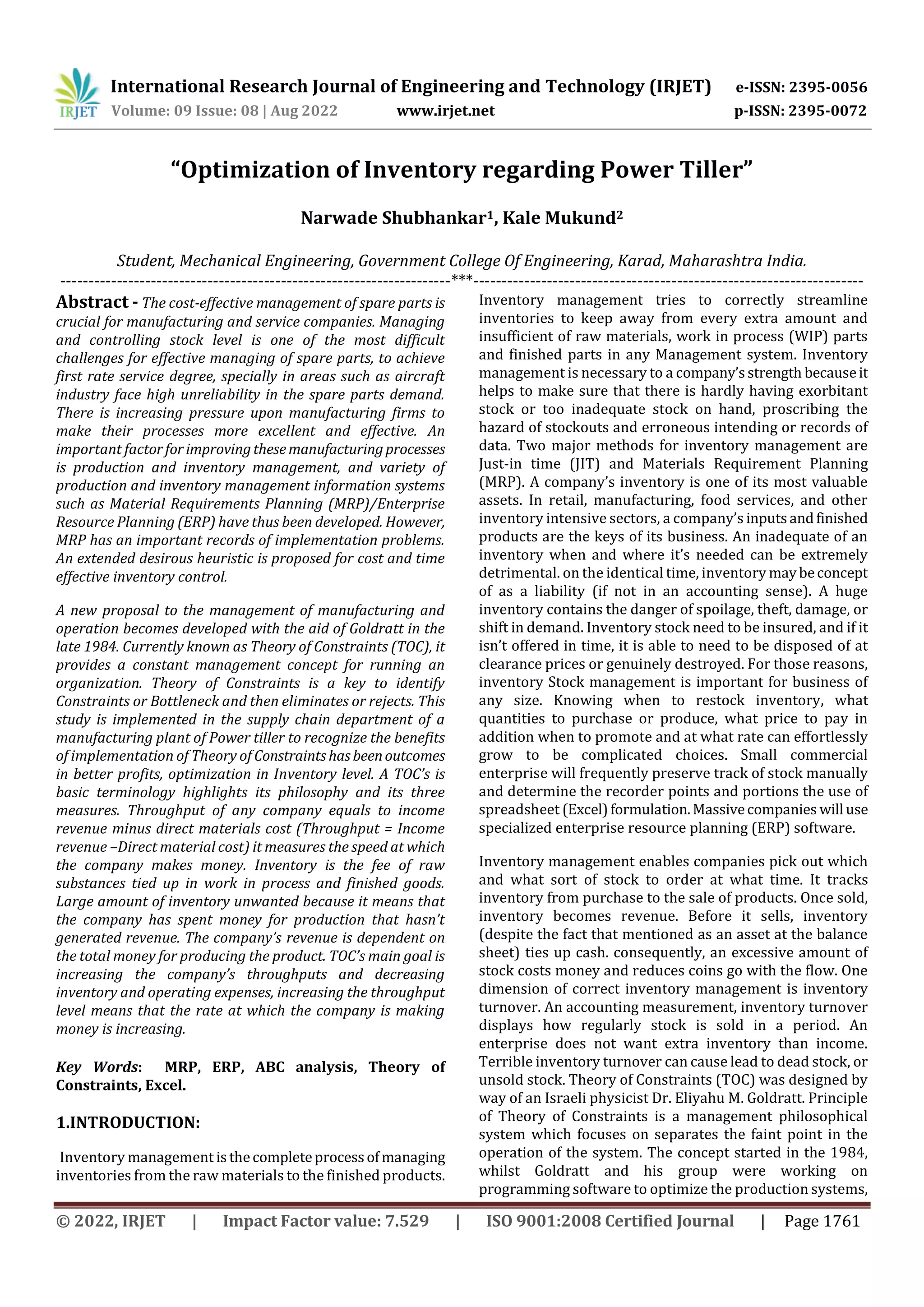
“Optimization of Inventory regarding Power Tiller”
Narwade Shubhankar1, Kale Mukund2
Student, Mechanical Engineering, Government College Of Engineering, Karad, Maharashtra India.
---------------------------------------------------------------------***---------------------------------------------------------------------
Abstract - The cost-effective management of spare parts is
crucial for manufacturing and service companies. Managing
and controlling stock level is one of the most difficult
challenges for effective managing of spare parts, to achieve
first rate service degree, specially in areas such as aircraft
industry face high unreliability in the spare parts demand.
There is increasing pressure upon manufacturing firms to
make their processes more excellent and effective. An
important factorforimprovingthesemanufacturingprocesses
is production and inventory management, and variety of
production and inventory management information systems
such as Material Requirements Planning (MRP)/Enterprise
Resource Planning (ERP) have thus been developed. However,
MRP has an important records of implementation problems.
An extended desirous heuristic is proposed for cost and time
effective inventory control.
A new proposal to the management of manufacturing and
operation becomes developed with the aid of Goldratt in the
late 1984. Currently known as Theory of Constraints (TOC), it
provides a constant management concept for running an
organization. Theory of Constraints is a key to identify
Constraints or Bottleneck and then eliminates or rejects. This
study is implemented in the supply chain department of a
manufacturing plant of Power tiller to recognize the benefits
of implementation of Theory of Constraintshasbeenoutcomes
in better profits, optimization in Inventory level. A TOC’s is
basic terminology highlights its philosophy and its three
measures. Throughput of any company equals to income
revenue minus direct materials cost (Throughput = Income
revenue –Direct material cost) it measures the speed at which
the company makes money. Inventory is the fee of raw
substances tied up in work in process and finished goods.
Large amount of inventory unwanted because it means that
the company has spent money for production that hasn’t
generated revenue. The company’s revenue is dependent on
the total money for producing the product. TOC’s main goal is
increasing the company’s throughputs and decreasing
inventory and operating expenses, increasing the throughput
level means that the rate at which the company is making
money is increasing.
Key Words: MRP, ERP, ABC analysis, Theory of
Constraints, Excel.
1.INTRODUCTION:
Inventory management isthecompleteprocessofmanaging
inventories from the raw materials to the finished products.
Inventory management tries to correctly streamline
inventories to keep away from every extra amount and
insufficient of raw materials, work in process (WIP) parts
and finished parts in any Management system. Inventory
management is necessary to a company’sstrength becauseit
helps to make sure that there is hardly having exorbitant
stock or too inadequate stock on hand, proscribing the
hazard of stockouts and erroneous intending or records of
data. Two major methods for inventory management are
Just-in time (JIT) and Materials Requirement Planning
(MRP). A company’s inventory is one of its most valuable
assets. In retail, manufacturing, food services, and other
inventory intensive sectors, a company’s inputsandfinished
products are the keys of its business. An inadequate of an
inventory when and where it’s needed can be extremely
detrimental. on the identical time, inventory maybeconcept
of as a liability (if not in an accounting sense). A huge
inventory contains the danger of spoilage, theft, damage, or
shift in demand. Inventory stock need to be insured, and if it
isn’t offered in time, it is able to need to be disposed of at
clearance prices or genuinely destroyed. For those reasons,
inventory Stock management is important for business of
any size. Knowing when to restock inventory, what
quantities to purchase or produce, what price to pay in
addition when to promote and at what rate can effortlessly
grow to be complicated choices. Small commercial
enterprise will frequently preserve track of stock manually
and determine the recorder points and portions the use of
spreadsheet (Excel)formulation.Massivecompanies will use
specialized enterprise resource planning (ERP) software.
Inventory management enables companies pick out which
and what sort of stock to order at what time. It tracks
inventory from purchase to the sale of products. Once sold,
inventory becomes revenue. Before it sells, inventory
(despite the fact that mentioned as an asset at the balance
sheet) ties up cash. consequently, an excessive amount of
stock costs money and reduces coins go with the flow. One
dimension of correct inventory management is inventory
turnover. An accounting measurement, inventory turnover
displays how regularly stock is sold in a period. An
enterprise does not want extra inventory than income.
Terrible inventory turnover can cause lead to dead stock, or
unsold stock. Theory of Constraints (TOC) was designed by
way of an Israeli physicist Dr. Eliyahu M. Goldratt. Principle
of Theory of Constraints is a management philosophical
system which focuses on separates the faint point in the
operation of the system. The concept started in the 1984,
whilst Goldratt and his group were working on
programming software to optimize the production systems,
International Research Journal of Engineering and Technology (IRJET) e-ISSN: 2395-0056
Volume: 09 Issue: 08 | Aug 2022 www.irjet.net p-ISSN: 2395-0072
© 2022, IRJET | Impact Factor value: 7.529 | ISO 9001:2008 Certified Journal | Page 1762
they called it optimized production technology (OPT). The
name TOC slowly acquired and was put forth by Goldratt in
the book. The book is The Goal in the year 1984. The
application program of TOC has been extended to various
areas, such as Marketing, Supply Chain Management and
retail. TOC philosophy which considers all processes in
system as rings of the same chain, they all are dependent on
each other. TOC philosophy focuses on the weakest
(Bottlenecks) and constraints in the chain (system). TOC
aims to maximize throughput contribution whilst reducing
funding and working prices. From organizations view, the
bottleneck or constraint can be from any functional areas
like Finance, Marketing area, Production line, Procurement
or strategic planning and TOC is useful in all these areas.
Mostly, constraints can be in theformphysical resourceslike
shortage supply of raw material, lack equipmentcapacity,or
the constraint can be conducting or policy related whichcan
limit the production capabilities. ThisstudyisdoneinPower
tiller production plant where TOC is implemented in the
supply chain management department for the buffer
management (daily stock) of the plant by using a new
concept on the bases of excel sheet buffer Management by
colour coding.
2. LITERATURE REVIEW:
Investigation emergence on “New retail” that produces a
great effect on the inventory management of retail
companies, by using a ASY company as the study object. In
that the Analytical Hierarchy process (AHP) technique is
used for to achieve the weight information of each thing
before and after the brand-new retail seems. There are six
influencing factors i.e., management system, personnel
capabilities, delivery method, sales method, product
categories and resources limitation on this basis it analyses
how new retail affects the inventory management of ASY
company (Zhou Chuanpeng1, Zhang Yi,2021). The demand
forecasting is the basis of the inventory management. The
quadratic exponential smoothing technique to set up the
mathematical version and the ABC classification
management method is used to clear up the inventory
management issues in that, A category is key materials, so
they should be conducted monthly and the most accurate
demand forecasting is needed. B category is second key
substances, so warehouse keeper ought to enforce a regular
manage, general frequency inspections and general worries
with the traditional recording. C category materials are less
important, so they need just regular inspections (normally
six months or a year). ABC classification approach can assist
draw close the important thing, and distinguish between
primaryand secondary, shop manpower and fabric assetsto
achieve a multiplier effect (Xi Jia, Sha Pingba, 2013). In
particular, mainly a promising studies location concerns
assembly systems with uncertain lead time, for which the
principle issue comes from the inter-dependence of
additives inventories also deals with random lead-times
studies and uncertainties. That means that the time had to
receive an issue may also vary from forecasted. As with
random demand, lead-time uncertainties provoke either
some shortages or surplus in inventories. These
uncertainties have been omitted for a long time in favor of
studying call for uncertainties. Troubles of uncertainties
aren’t restricted to versions of the for level, however also
fluctuations at the lead-times (Alexandre Dolgui, Aly Ould
Louly and Caroline Prodhon 2005). Improving operational
performance in a production gadget through enterprise
resource planning (ERP). By ERP improving the powerful
verbal exchange amongst departments to meet delivery
dates. ERP framework changedintodesignedtoreducework
in progress on the store ground floor and inventory. ERP
software which automates information update and
incorporate bestpracticestofacilitaterapiddecisionmaking,
cost reduction and greater managerial control for improved
organizational competitiveness(IgnatioMadanhirea,Charles
Mbohwab 2016). According to TOC, the goal of anycompany
is to make income now and within the future. The author
studied the process involving making of the frame and fork
assembly. In the manufacturing plant, a bicycle is assembled
using 18 different components or subassemblies. These
materials are received from different suppliers spread
throughout the country the employees which are facing raw
materials shortage which is one of the most important
constraints faced. There are two reasons for the shortage of
raw materials faced. One is that the plant procures raw
materials form various part of the country and major parts
from the northern India area whereas the plantissituated in
the southern India. This may resultsdelayindelivery.Urgent
parts deliveries cannot meet because of distance involved.
For continuous monitoring of the raw material inventory a
colour coded system is used in the department. Inventory is
classified as follows and colours are used to indicate the
criticality of situation.
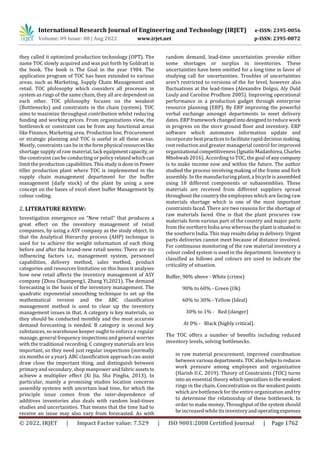
Buffer, 90% above - White (crime)
90% to 60% - Green (Ok)
60% to 30% - Yellow (Ideal)
30% to 1% - Red (danger)
At 0% - Black (highly critical).
The TOC offers a number of benefits including reduced
inventory levels, solving bottlenecks.
in raw material procurement, improved coordination
between variousdepartments.TOCalsohelpstoreduces
work pressure among employees and organization
(Harish U.C. 2019). Theory of Constraints (TOC) turns
into an essential theory which specializesinthe weakest
rings in the chain. Concentration on the weakest points
which are bottleneck for the entire organization and try
to determine the relationship of these bottleneck. In
order to make money, Throughput of the system should
be increased while its inventoryandoperating expenses
International Research Journal of Engineering and Technology (IRJET) e-ISSN: 2395-0056
Volume: 09 Issue: 08 | Aug 2022 www.irjet.net p-ISSN: 2395-0072
© 2022, IRJET | Impact Factor value: 7.529 | ISO 9001:2008 Certified Journal | Page 1763
are being decreased (Zeynep Tugce Simsit, Noyan Sebla
Gunay 2014). Theory of Constraints used for
replenishment solution for aggregate inventory buffers
at the imperative warehouse in plant and changing the
mode of operation in push to pull. TOC states that the
aggregating the inventory and holding it at the plant
warehouse. TOC includes such a method of buffer
management and has three objectives, which includes
protecting throughput, reducing inventory, decreasing
operating expenses. TOC which has divided the buffer
into three controlled zones: Green zone, Yellow zone,
Red zone. The buffer function works as a warning
mechanism. The size of the safety buffer does not affect
the maximum buffer size, but does affect the nervous of
the system. (Kuo-Jung yuvan, Sheng-hung chang and
Rong-kwei Li 2003).
Methodology:
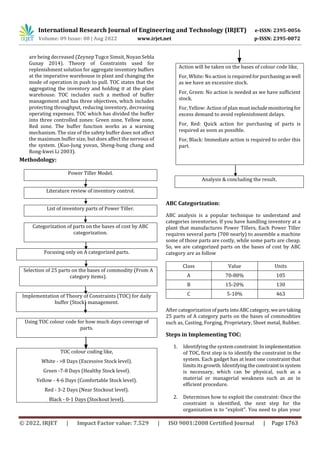
Power Tiller Model.
Literature review of inventory control.
List of inventory parts of Power Tiller.
Categorization of parts on the bases of cost by ABC
categorization.
Focusing only on A categorized parts.
Selection of 25 parts on the bases of commodity (From A
category items).
Implementation of Theory of Constraints (TOC) for daily
buffer (Stock) management.
Using TOC colour code for how much days coverage of
parts.
ABC Categorization:
ABC analysis is a popular technique to understand and
categories inventories. If you have handling inventory at a
plant that manufactures Power Tillers, Each Power Tiller
requires several parts (700 nearly) to assemble a machine
some of those parts are costly, while some parts are cheap.
So, we are categorized parts on the bases of cost by ABC
category are as follow
Class Value Units
A 70-80% 105
B 15-20% 130
C 5-10% 463
After categorization of parts intoABCcategory,wearetaking
25 parts of A category parts on the bases of commodities
such as, Casting, Forging, Proprietary, Sheet metal, Rubber.
Steps in Implementing TOC:
1. Identifying the systemconstraint: Inimplementation
of TOC, first step is to identify the constraint in the
system. Each gadget has at least one constraint that
limits its growth. Identifying theconstraintinsystem
is necessary, which can be physical, such as a
material or managerial weakness such as an in
efficient procedure.
2. Determines how to exploit the constraint: Once the
constraint is identified, the next step for the
organization is to “exploit”. You need to plan your
TOC colour coding like,
White - >8 Days (Excessive Stock level).
Green -7-8 Days (Healthy Stock level).
Yellow - 4-6 Days (Comfortable Stock level).
Red - 3-2 Days (Near Stockout level).
Black - 0-1 Days (Stockout level).
Action will be taken on the bases of colour code like,
For, White: No action is requiredforpurchasingaswell
as we have an excessive stock.
For, Green: No action is needed as we have sufficient
stock.
For, Yellow: Action of plan mustincludemonitoringfor
excess demand to avoid replenishment delays.
For, Red: Quick action for purchasing of parts is
required as soon as possible.
For, Black: Immediate action is required to order this
part.
Analysis & concluding the result.
International Research Journal of Engineering and Technology (IRJET) e-ISSN: 2395-0056
Volume: 09 Issue: 08 | Aug 2022 www.irjet.net p-ISSN: 2395-0072
© 2022, IRJET | Impact Factor value: 7.529 | ISO 9001:2008 Certified Journal | Page 1764
process so as to exploittheconstraint.Theconstraint
utilizing every part of the constraining component
without committing possibility of valuable changes
and/or improves. Effort may be taken sure that the
concentration is focused on the constrained process
or resource and it is fully utilized.
3. Subordinate everything else to the constraint: The
next step is subordinate all other activities of your
set to the constrained process orresourceorinother
words, organizations should handle the rest of the
system to allow the constraint to operate at most
effectiveness.
4. Elevate the production of the constraint: The next
step is to eliminate the system constraint if above
steps were not able to make that process/resources
a non-constraint.
5. If in any of the above steps the constraint hasshifted,
go back to step: Last step is to go back to first step
and identifying new constraint, as the earlier
constraint has been eliminated and go through the
cycle of implementation once again.
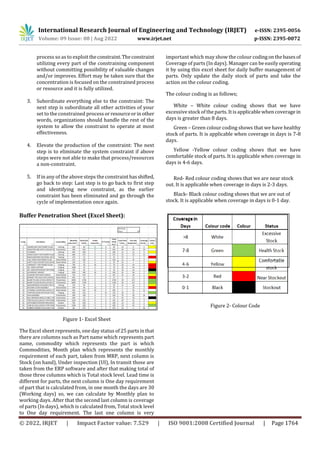
Buffer Penetration Sheet (Excel Sheet):
Figure 1- Excel Sheet
The Excel sheet represents, one day status of 25 partsinthat
there are columns such as Part name which represents part
name, commodity which represents the part is which
Commodities, Month plan which represents the monthly
requirement of each part, taken from MRP, next column is
Stock (on hand), Under inspection (UI), In transit those are
taken from the ERP software and after that making total of
those three columns which is Total stock level. Lead time is
different for parts, the next column is One day requirement
of part that is calculated from, in one month the days are 30
(Working days) so, we can calculate by Monthly plan to
working days. After that the second last column is coverage
of parts (In days), which is calculated from, Total stock level
to One day requirement. The last one column is very
important which may show the colour codingonthebasesof
Coverage of parts (In days). Manager can be easilyoperating
it by using this excel sheet for daily buffer management of
parts. Only update the daily stock of parts and take the
action on the colour coding.
The colour coding is as follows;
White – White colour coding shows that we have
excessive stock of the parts. Itis applicable when coverage in
days is greater than 8 days.
Green – Green colour coding shows that we have healthy
stock of parts. It is applicable when coverage in days is 7-8
days.
Yellow -Yellow colour coding shows that we have
comfortable stock of parts. It is applicable when coverage in
days is 4-6 days.
Black- Black colour coding shows that we are out of
stock. It is applicable when coverage in days is 0-1 day.
Figure 2- Colour Code
Red- Red colour coding shows that we are near stock
out. It is applicable when coverage in days is 2-3 days.
International Research Journal of Engineering and Technology (IRJET) e-ISSN: 2395-0056
Volume: 09 Issue: 08 | Aug 2022 www.irjet.net p-ISSN: 2395-0072
© 2022, IRJET | Impact Factor value: 7.529 | ISO 9001:2008 Certified Journal | Page 1765
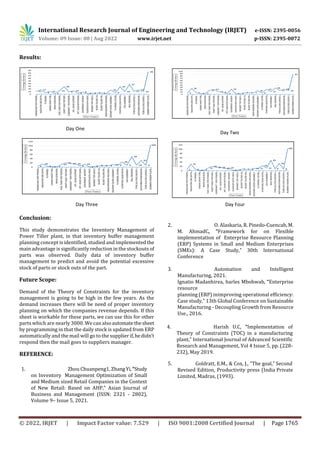
Results:
Conclusion:
This study demonstrates the Inventory Management of
Power Tiller plant, in that inventory buffer management
planning concept is identified, studied and implementedthe
main advantage is significantly reduction in the stockouts of
parts was observed. Daily data of inventory buffer
management to predict and avoid the potential excessive
stock of parts or stock outs of the part.
Future Scope:
Demand of the Theory of Constraints for the inventory
management is going to be high in the few years. As the
demand increases there will be need of proper inventory
planning on which the companies revenue depends. If this
sheet is workable for these parts, we can use this for other
parts which are nearly 3000. We can alsoautomatethesheet
by programming in that the daily stock is updated from ERP
automatically and the mail will go to the supplier if,hedidn’t
respond then the mail goes to suppliers manager.
REFERENCE:
1. Zhou Chuanpeng1, Zhang Yi, “Study
on Inventory Management Optimization of Small
and Medium sized Retail Companies in the Context
of New Retail: Based on AHP,” Asian Journal of
Business and Management (ISSN: 2321 - 2802),
Volume 9– Issue 5, 2021.
2. O. Alaskaria, R. Pinedo-Cuencab, M.
M. AhmadC, “Framework for on Flexible
implementation of Enterprise Resource Planning
(ERP) Systems in Small and Medium Enterprises
(SMEs): A Case Study,” 30th International
Conference
3. Automation and Intelligent
Manufacturing, 2021.
Ignatio Madanhirea, harles Mbohwab, “Enterprise
resource
planning (ERP) inimproving operational efficiency:
Case study,” 13th Global Conference on Sustainable
Manufacturing - Decoupling Growth from Resource
Use., 2016.
4. Harish U.C, “Implementation of
Theory of Constraints (TOC) in a manufacturing
plant,” International Journal of Advanced Scientific
Research and Management, Vol 4 Issue 5, pp. (228-
232), May 2019.
Day One
Day Two
Day Three Day Four
5. Goldratt, E.M., & Cox, J., “The goal,” Second
Revised Edition, Productivity press (India Private
Limited, Madras, (1993).

“Optimization of Inventory regarding Power Tiller”

  • 1.
    International Research Journalof Engineering and Technology (IRJET) e-ISSN: 2395-0056 Volume: 09 Issue: 08 | Aug 2022 www.irjet.net p-ISSN: 2395-0072 © 2022, IRJET | Impact Factor value: 7.529 | ISO 9001:2008 Certified Journal | Page 1761 “Optimization of Inventory regarding Power Tiller” Narwade Shubhankar1, Kale Mukund2 Student, Mechanical Engineering, Government College Of Engineering, Karad, Maharashtra India. ---------------------------------------------------------------------***--------------------------------------------------------------------- Abstract - The cost-effective management of spare parts is crucial for manufacturing and service companies. Managing and controlling stock level is one of the most difficult challenges for effective managing of spare parts, to achieve first rate service degree, specially in areas such as aircraft industry face high unreliability in the spare parts demand. There is increasing pressure upon manufacturing firms to make their processes more excellent and effective. An important factorforimprovingthesemanufacturingprocesses is production and inventory management, and variety of production and inventory management information systems such as Material Requirements Planning (MRP)/Enterprise Resource Planning (ERP) have thus been developed. However, MRP has an important records of implementation problems. An extended desirous heuristic is proposed for cost and time effective inventory control. A new proposal to the management of manufacturing and operation becomes developed with the aid of Goldratt in the late 1984. Currently known as Theory of Constraints (TOC), it provides a constant management concept for running an organization. Theory of Constraints is a key to identify Constraints or Bottleneck and then eliminates or rejects. This study is implemented in the supply chain department of a manufacturing plant of Power tiller to recognize the benefits of implementation of Theory of Constraintshasbeenoutcomes in better profits, optimization in Inventory level. A TOC’s is basic terminology highlights its philosophy and its three measures. Throughput of any company equals to income revenue minus direct materials cost (Throughput = Income revenue –Direct material cost) it measures the speed at which the company makes money. Inventory is the fee of raw substances tied up in work in process and finished goods. Large amount of inventory unwanted because it means that the company has spent money for production that hasn’t generated revenue. The company’s revenue is dependent on the total money for producing the product. TOC’s main goal is increasing the company’s throughputs and decreasing inventory and operating expenses, increasing the throughput level means that the rate at which the company is making money is increasing. Key Words: MRP, ERP, ABC analysis, Theory of Constraints, Excel. 1.INTRODUCTION: Inventory management isthecompleteprocessofmanaging inventories from the raw materials to the finished products. Inventory management tries to correctly streamline inventories to keep away from every extra amount and insufficient of raw materials, work in process (WIP) parts and finished parts in any Management system. Inventory management is necessary to a company’sstrength becauseit helps to make sure that there is hardly having exorbitant stock or too inadequate stock on hand, proscribing the hazard of stockouts and erroneous intending or records of data. Two major methods for inventory management are Just-in time (JIT) and Materials Requirement Planning (MRP). A company’s inventory is one of its most valuable assets. In retail, manufacturing, food services, and other inventory intensive sectors, a company’s inputsandfinished products are the keys of its business. An inadequate of an inventory when and where it’s needed can be extremely detrimental. on the identical time, inventory maybeconcept of as a liability (if not in an accounting sense). A huge inventory contains the danger of spoilage, theft, damage, or shift in demand. Inventory stock need to be insured, and if it isn’t offered in time, it is able to need to be disposed of at clearance prices or genuinely destroyed. For those reasons, inventory Stock management is important for business of any size. Knowing when to restock inventory, what quantities to purchase or produce, what price to pay in addition when to promote and at what rate can effortlessly grow to be complicated choices. Small commercial enterprise will frequently preserve track of stock manually and determine the recorder points and portions the use of spreadsheet (Excel)formulation.Massivecompanies will use specialized enterprise resource planning (ERP) software. Inventory management enables companies pick out which and what sort of stock to order at what time. It tracks inventory from purchase to the sale of products. Once sold, inventory becomes revenue. Before it sells, inventory (despite the fact that mentioned as an asset at the balance sheet) ties up cash. consequently, an excessive amount of stock costs money and reduces coins go with the flow. One dimension of correct inventory management is inventory turnover. An accounting measurement, inventory turnover displays how regularly stock is sold in a period. An enterprise does not want extra inventory than income. Terrible inventory turnover can cause lead to dead stock, or unsold stock. Theory of Constraints (TOC) was designed by way of an Israeli physicist Dr. Eliyahu M. Goldratt. Principle of Theory of Constraints is a management philosophical system which focuses on separates the faint point in the operation of the system. The concept started in the 1984, whilst Goldratt and his group were working on programming software to optimize the production systems,
  • 2.
    International Research Journalof Engineering and Technology (IRJET) e-ISSN: 2395-0056 Volume: 09 Issue: 08 | Aug 2022 www.irjet.net p-ISSN: 2395-0072 © 2022, IRJET | Impact Factor value: 7.529 | ISO 9001:2008 Certified Journal | Page 1762 they called it optimized production technology (OPT). The name TOC slowly acquired and was put forth by Goldratt in the book. The book is The Goal in the year 1984. The application program of TOC has been extended to various areas, such as Marketing, Supply Chain Management and retail. TOC philosophy which considers all processes in system as rings of the same chain, they all are dependent on each other. TOC philosophy focuses on the weakest (Bottlenecks) and constraints in the chain (system). TOC aims to maximize throughput contribution whilst reducing funding and working prices. From organizations view, the bottleneck or constraint can be from any functional areas like Finance, Marketing area, Production line, Procurement or strategic planning and TOC is useful in all these areas. Mostly, constraints can be in theformphysical resourceslike shortage supply of raw material, lack equipmentcapacity,or the constraint can be conducting or policy related whichcan limit the production capabilities. ThisstudyisdoneinPower tiller production plant where TOC is implemented in the supply chain management department for the buffer management (daily stock) of the plant by using a new concept on the bases of excel sheet buffer Management by colour coding. 2. LITERATURE REVIEW: Investigation emergence on “New retail” that produces a great effect on the inventory management of retail companies, by using a ASY company as the study object. In that the Analytical Hierarchy process (AHP) technique is used for to achieve the weight information of each thing before and after the brand-new retail seems. There are six influencing factors i.e., management system, personnel capabilities, delivery method, sales method, product categories and resources limitation on this basis it analyses how new retail affects the inventory management of ASY company (Zhou Chuanpeng1, Zhang Yi,2021). The demand forecasting is the basis of the inventory management. The quadratic exponential smoothing technique to set up the mathematical version and the ABC classification management method is used to clear up the inventory management issues in that, A category is key materials, so they should be conducted monthly and the most accurate demand forecasting is needed. B category is second key substances, so warehouse keeper ought to enforce a regular manage, general frequency inspections and general worries with the traditional recording. C category materials are less important, so they need just regular inspections (normally six months or a year). ABC classification approach can assist draw close the important thing, and distinguish between primaryand secondary, shop manpower and fabric assetsto achieve a multiplier effect (Xi Jia, Sha Pingba, 2013). In particular, mainly a promising studies location concerns assembly systems with uncertain lead time, for which the principle issue comes from the inter-dependence of additives inventories also deals with random lead-times studies and uncertainties. That means that the time had to receive an issue may also vary from forecasted. As with random demand, lead-time uncertainties provoke either some shortages or surplus in inventories. These uncertainties have been omitted for a long time in favor of studying call for uncertainties. Troubles of uncertainties aren’t restricted to versions of the for level, however also fluctuations at the lead-times (Alexandre Dolgui, Aly Ould Louly and Caroline Prodhon 2005). Improving operational performance in a production gadget through enterprise resource planning (ERP). By ERP improving the powerful verbal exchange amongst departments to meet delivery dates. ERP framework changedintodesignedtoreducework in progress on the store ground floor and inventory. ERP software which automates information update and incorporate bestpracticestofacilitaterapiddecisionmaking, cost reduction and greater managerial control for improved organizational competitiveness(IgnatioMadanhirea,Charles Mbohwab 2016). According to TOC, the goal of anycompany is to make income now and within the future. The author studied the process involving making of the frame and fork assembly. In the manufacturing plant, a bicycle is assembled using 18 different components or subassemblies. These materials are received from different suppliers spread throughout the country the employees which are facing raw materials shortage which is one of the most important constraints faced. There are two reasons for the shortage of raw materials faced. One is that the plant procures raw materials form various part of the country and major parts from the northern India area whereas the plantissituated in the southern India. This may resultsdelayindelivery.Urgent parts deliveries cannot meet because of distance involved. For continuous monitoring of the raw material inventory a colour coded system is used in the department. Inventory is classified as follows and colours are used to indicate the criticality of situation. Buffer, 90% above - White (crime) 90% to 60% - Green (Ok) 60% to 30% - Yellow (Ideal) 30% to 1% - Red (danger) At 0% - Black (highly critical). The TOC offers a number of benefits including reduced inventory levels, solving bottlenecks. in raw material procurement, improved coordination between variousdepartments.TOCalsohelpstoreduces work pressure among employees and organization (Harish U.C. 2019). Theory of Constraints (TOC) turns into an essential theory which specializesinthe weakest rings in the chain. Concentration on the weakest points which are bottleneck for the entire organization and try to determine the relationship of these bottleneck. In order to make money, Throughput of the system should be increased while its inventoryandoperating expenses
  • 3.
    International Research Journalof Engineering and Technology (IRJET) e-ISSN: 2395-0056 Volume: 09 Issue: 08 | Aug 2022 www.irjet.net p-ISSN: 2395-0072 © 2022, IRJET | Impact Factor value: 7.529 | ISO 9001:2008 Certified Journal | Page 1763 are being decreased (Zeynep Tugce Simsit, Noyan Sebla Gunay 2014). Theory of Constraints used for replenishment solution for aggregate inventory buffers at the imperative warehouse in plant and changing the mode of operation in push to pull. TOC states that the aggregating the inventory and holding it at the plant warehouse. TOC includes such a method of buffer management and has three objectives, which includes protecting throughput, reducing inventory, decreasing operating expenses. TOC which has divided the buffer into three controlled zones: Green zone, Yellow zone, Red zone. The buffer function works as a warning mechanism. The size of the safety buffer does not affect the maximum buffer size, but does affect the nervous of the system. (Kuo-Jung yuvan, Sheng-hung chang and Rong-kwei Li 2003). Methodology: Power Tiller Model. Literature review of inventory control. List of inventory parts of Power Tiller. Categorization of parts on the bases of cost by ABC categorization. Focusing only on A categorized parts. Selection of 25 parts on the bases of commodity (From A category items). Implementation of Theory of Constraints (TOC) for daily buffer (Stock) management. Using TOC colour code for how much days coverage of parts. ABC Categorization: ABC analysis is a popular technique to understand and categories inventories. If you have handling inventory at a plant that manufactures Power Tillers, Each Power Tiller requires several parts (700 nearly) to assemble a machine some of those parts are costly, while some parts are cheap. So, we are categorized parts on the bases of cost by ABC category are as follow Class Value Units A 70-80% 105 B 15-20% 130 C 5-10% 463 After categorization of parts intoABCcategory,wearetaking 25 parts of A category parts on the bases of commodities such as, Casting, Forging, Proprietary, Sheet metal, Rubber. Steps in Implementing TOC: 1. Identifying the systemconstraint: Inimplementation of TOC, first step is to identify the constraint in the system. Each gadget has at least one constraint that limits its growth. Identifying theconstraintinsystem is necessary, which can be physical, such as a material or managerial weakness such as an in efficient procedure. 2. Determines how to exploit the constraint: Once the constraint is identified, the next step for the organization is to “exploit”. You need to plan your TOC colour coding like, White - >8 Days (Excessive Stock level). Green -7-8 Days (Healthy Stock level). Yellow - 4-6 Days (Comfortable Stock level). Red - 3-2 Days (Near Stockout level). Black - 0-1 Days (Stockout level). Action will be taken on the bases of colour code like, For, White: No action is requiredforpurchasingaswell as we have an excessive stock. For, Green: No action is needed as we have sufficient stock. For, Yellow: Action of plan mustincludemonitoringfor excess demand to avoid replenishment delays. For, Red: Quick action for purchasing of parts is required as soon as possible. For, Black: Immediate action is required to order this part. Analysis & concluding the result.
  • 4.
    International Research Journalof Engineering and Technology (IRJET) e-ISSN: 2395-0056 Volume: 09 Issue: 08 | Aug 2022 www.irjet.net p-ISSN: 2395-0072 © 2022, IRJET | Impact Factor value: 7.529 | ISO 9001:2008 Certified Journal | Page 1764 process so as to exploittheconstraint.Theconstraint utilizing every part of the constraining component without committing possibility of valuable changes and/or improves. Effort may be taken sure that the concentration is focused on the constrained process or resource and it is fully utilized. 3. Subordinate everything else to the constraint: The next step is subordinate all other activities of your set to the constrained process orresourceorinother words, organizations should handle the rest of the system to allow the constraint to operate at most effectiveness. 4. Elevate the production of the constraint: The next step is to eliminate the system constraint if above steps were not able to make that process/resources a non-constraint. 5. If in any of the above steps the constraint hasshifted, go back to step: Last step is to go back to first step and identifying new constraint, as the earlier constraint has been eliminated and go through the cycle of implementation once again. Buffer Penetration Sheet (Excel Sheet): Figure 1- Excel Sheet The Excel sheet represents, one day status of 25 partsinthat there are columns such as Part name which represents part name, commodity which represents the part is which Commodities, Month plan which represents the monthly requirement of each part, taken from MRP, next column is Stock (on hand), Under inspection (UI), In transit those are taken from the ERP software and after that making total of those three columns which is Total stock level. Lead time is different for parts, the next column is One day requirement of part that is calculated from, in one month the days are 30 (Working days) so, we can calculate by Monthly plan to working days. After that the second last column is coverage of parts (In days), which is calculated from, Total stock level to One day requirement. The last one column is very important which may show the colour codingonthebasesof Coverage of parts (In days). Manager can be easilyoperating it by using this excel sheet for daily buffer management of parts. Only update the daily stock of parts and take the action on the colour coding. The colour coding is as follows; White – White colour coding shows that we have excessive stock of the parts. Itis applicable when coverage in days is greater than 8 days. Green – Green colour coding shows that we have healthy stock of parts. It is applicable when coverage in days is 7-8 days. Yellow -Yellow colour coding shows that we have comfortable stock of parts. It is applicable when coverage in days is 4-6 days. Black- Black colour coding shows that we are out of stock. It is applicable when coverage in days is 0-1 day. Figure 2- Colour Code Red- Red colour coding shows that we are near stock out. It is applicable when coverage in days is 2-3 days.
  • 5.
    International Research Journalof Engineering and Technology (IRJET) e-ISSN: 2395-0056 Volume: 09 Issue: 08 | Aug 2022 www.irjet.net p-ISSN: 2395-0072 © 2022, IRJET | Impact Factor value: 7.529 | ISO 9001:2008 Certified Journal | Page 1765 Results: Conclusion: This study demonstrates the Inventory Management of Power Tiller plant, in that inventory buffer management planning concept is identified, studied and implementedthe main advantage is significantly reduction in the stockouts of parts was observed. Daily data of inventory buffer management to predict and avoid the potential excessive stock of parts or stock outs of the part. Future Scope: Demand of the Theory of Constraints for the inventory management is going to be high in the few years. As the demand increases there will be need of proper inventory planning on which the companies revenue depends. If this sheet is workable for these parts, we can use this for other parts which are nearly 3000. We can alsoautomatethesheet by programming in that the daily stock is updated from ERP automatically and the mail will go to the supplier if,hedidn’t respond then the mail goes to suppliers manager. REFERENCE: 1. Zhou Chuanpeng1, Zhang Yi, “Study on Inventory Management Optimization of Small and Medium sized Retail Companies in the Context of New Retail: Based on AHP,” Asian Journal of Business and Management (ISSN: 2321 - 2802), Volume 9– Issue 5, 2021. 2. O. Alaskaria, R. Pinedo-Cuencab, M. M. AhmadC, “Framework for on Flexible implementation of Enterprise Resource Planning (ERP) Systems in Small and Medium Enterprises (SMEs): A Case Study,” 30th International Conference 3. Automation and Intelligent Manufacturing, 2021. Ignatio Madanhirea, harles Mbohwab, “Enterprise resource planning (ERP) inimproving operational efficiency: Case study,” 13th Global Conference on Sustainable Manufacturing - Decoupling Growth from Resource Use., 2016. 4. Harish U.C, “Implementation of Theory of Constraints (TOC) in a manufacturing plant,” International Journal of Advanced Scientific Research and Management, Vol 4 Issue 5, pp. (228- 232), May 2019. Day One Day Two Day Three Day Four 5. Goldratt, E.M., & Cox, J., “The goal,” Second Revised Edition, Productivity press (India Private Limited, Madras, (1993).