Optimization of Active magnetic
bearing system using Grey Wolf
Algorithm
Abstract
• A closed-loop metaheuristic optimization approach to regulate an unstable
active magnetic bearing (AMB) system.
• First of all, a hardware model of an AMB is fabricated in the laboratory.
• Mathematical analysis is carried out and a linearized open-loop transfer
function is obtained for an equilibrium point of operation, using the
parameters of the hardware model.
• Then, a closed loop is proposed for this AMB system, which comprises a
PID controller, power amplifier, and position sensor. Further, a
metaheuristic nature-inspired hunting-based optimization algorithm i.e
Grey wolf optimization (GWO) is implemented to calculate the gain
parameters of the PID controller.
Abstract
• The performance of these optimization algorithms is evaluated and
observed on four different performance indices: integral of absolute
error (IAE), integral of squared error (ISE), and an integral of time
multiplied absolute error (ITAE) and integral of time multiplied
squared error (ITSE).
Model Description & Analysis of AMB system
• Hardware Model Description
• For the experiment, a hardware model of an active magnetic bearing system
is constructed in the laboratory as depicted Fig2
Model Description & Analysis of AMB system
• Hardware Model Description
• The electromagnet and rotor (suspending object) are made of iron having a
relative permeability of 11000 and 5000 respectively. On the horizontal limb
of the electromagnet, the copper winding is stacked which has a relative
permeability of 0.88 and thickness of 17 SWG
• To calculate resistance and inductance of electromagnet some tests are
performed in the laboratory [26] and obtained results are- resistance of the
coil (R) is 1.2 ohms, inductance of coil. L (coil) is 20.598 mH. Rotor of this AMB
system is of disk shaped having a mass(m) of 0.0654 Kg
Model Description & Analysis of AMB system
• Analysis of Active Magnetic Bearing system
• A simplified diagram of the AMB system is shown below
Model Description & Analysis of AMB system
• Analysis of Active Magnetic Bearing system
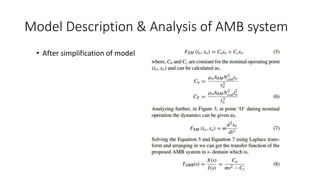
• According to Maxwell's electromagnetic theory, Magnetic force exerted by a
single electromagnet is formulated as
Model Description & Analysis of AMB system
• After simplification of model
Model Description & Analysis of AMB system
• The open-loop transfer function has a pole on the right side of the imaginary
(jw) axis. Therefore, this system is unstable and for proper operation, a closed
loop is needed consisting controller and power amplifier as depicted in Figure
4
Grey Wolf Optimization Algorithm
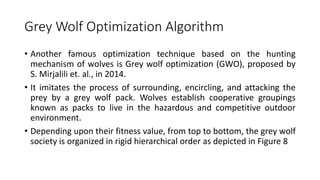
• Another famous optimization technique based on the hunting
mechanism of wolves is Grey wolf optimization (GWO), proposed by
S. Mirjalili et. al., in 2014.
• It imitates the process of surrounding, encircling, and attacking the
prey by a grey wolf pack. Wolves establish cooperative groupings
known as packs to live in the hazardous and competitive outdoor
environment.
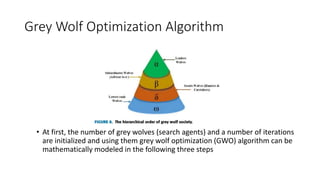
• Depending upon their fitness value, from top to bottom, the grey wolf
society is organized in rigid hierarchical order as depicted in Figure 8
Grey Wolf Optimization Algorithm
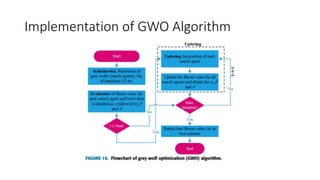
• At first, the number of grey wolves (search agents) and a number of iterations
are initialized and using them grey wolf optimization (GWO) algorithm can be
mathematically modeled in the following three steps
Grey Wolf Optimization Algorithm
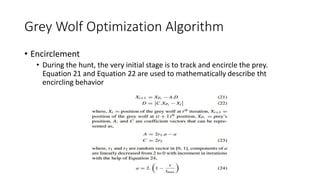
• Encirclement
• During the hunt, the very initial stage is to track and encircle the prey.
Equation 21 and Equation 22 are used to mathematically describe tht
encircling behavior
Grey Wolf Optimization Algorithm
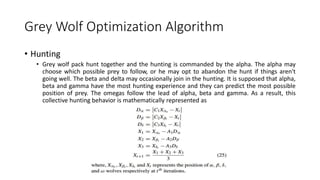
• Hunting
• Grey wolf pack hunt together and the hunting is commanded by the alpha. The alpha may
choose which possible prey to follow, or he may opt to abandon the hunt if things aren't
going well. The beta and delta may occasionally join in the hunting. It is supposed that alpha,
beta and gamma have the most hunting experience and they can predict the most possible
position of prey. The omegas follow the lead of alpha, beta and gamma. As a result, this
collective hunting behavior is mathematically represented as
Grey Wolf Optimization Algorithm
• Attacking
• The grey wolves encircled the prey when it stops moving and conclude the
hunt by attacking the prey. To mathematically represent approaching the
prey, the value of a is reduced linearly from 2 to 0 in Equation 23 and due to
this the value of A gets changed in the range [ 2a; 2a]. So, it may represent as
follow
Implementation of GWO Algorithm
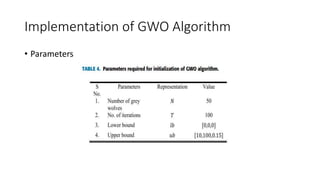
• Parameters
Implementation of GWO Algorithm
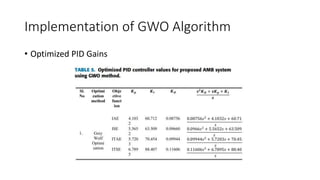
• Optimized PID Gains
Implementation of GWO Algorithm
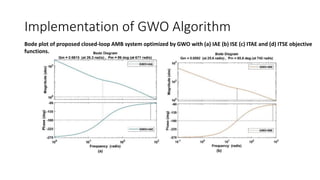
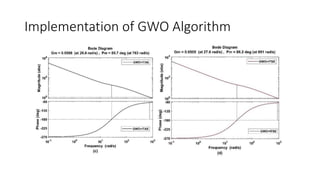
Bode plot of proposed closed-loop AMB system optimized by GWO with (a) IAE (b) ISE (c) ITAE and (d) ITSE objective
functions.
Implementation of GWO Algorithm
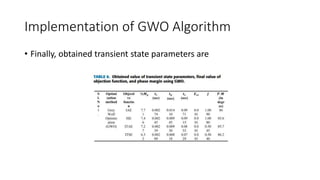
• Finally, obtained transient state parameters are
Conclusion
• GWO algorithm is implemented to calculate the gain parameters of a PID
controller for the proposed closed-loop AMB system.
• Execution of these algorithms is carried out on IAE, ISE, ITAE, and ITSE
objective functions individually and their performance is statistically
analyzed. Further, the action of the controller on the closed-loop is
observed for each combination of algorithm-objective functions on the
scale of step response analysis and bode plot.
• Using which transient state parameters and phase margin are calculated
• This study delivers a clear idea of the selection of optimization techniques
along with objective functions from the perspective of their workability
and performance, which will help in implementing them in a real-time
situation

Optimization of Active magnetic bearing system using Grey Wolf Algorithm.pptx

  • 1.
    Optimization of Activemagnetic bearing system using Grey Wolf Algorithm
  • 2.
    Abstract • A closed-loopmetaheuristic optimization approach to regulate an unstable active magnetic bearing (AMB) system. • First of all, a hardware model of an AMB is fabricated in the laboratory. • Mathematical analysis is carried out and a linearized open-loop transfer function is obtained for an equilibrium point of operation, using the parameters of the hardware model. • Then, a closed loop is proposed for this AMB system, which comprises a PID controller, power amplifier, and position sensor. Further, a metaheuristic nature-inspired hunting-based optimization algorithm i.e Grey wolf optimization (GWO) is implemented to calculate the gain parameters of the PID controller.
  • 3.
    Abstract • The performanceof these optimization algorithms is evaluated and observed on four different performance indices: integral of absolute error (IAE), integral of squared error (ISE), and an integral of time multiplied absolute error (ITAE) and integral of time multiplied squared error (ITSE).
  • 4.
    Model Description &Analysis of AMB system • Hardware Model Description • For the experiment, a hardware model of an active magnetic bearing system is constructed in the laboratory as depicted Fig2
  • 5.
    Model Description &Analysis of AMB system • Hardware Model Description • The electromagnet and rotor (suspending object) are made of iron having a relative permeability of 11000 and 5000 respectively. On the horizontal limb of the electromagnet, the copper winding is stacked which has a relative permeability of 0.88 and thickness of 17 SWG • To calculate resistance and inductance of electromagnet some tests are performed in the laboratory [26] and obtained results are- resistance of the coil (R) is 1.2 ohms, inductance of coil. L (coil) is 20.598 mH. Rotor of this AMB system is of disk shaped having a mass(m) of 0.0654 Kg
  • 6.
    Model Description &Analysis of AMB system • Analysis of Active Magnetic Bearing system • A simplified diagram of the AMB system is shown below
  • 7.
    Model Description &Analysis of AMB system • Analysis of Active Magnetic Bearing system • According to Maxwell's electromagnetic theory, Magnetic force exerted by a single electromagnet is formulated as
  • 8.
    Model Description &Analysis of AMB system • After simplification of model
  • 9.
    Model Description &Analysis of AMB system • The open-loop transfer function has a pole on the right side of the imaginary (jw) axis. Therefore, this system is unstable and for proper operation, a closed loop is needed consisting controller and power amplifier as depicted in Figure 4
  • 10.
    Grey Wolf OptimizationAlgorithm • Another famous optimization technique based on the hunting mechanism of wolves is Grey wolf optimization (GWO), proposed by S. Mirjalili et. al., in 2014. • It imitates the process of surrounding, encircling, and attacking the prey by a grey wolf pack. Wolves establish cooperative groupings known as packs to live in the hazardous and competitive outdoor environment. • Depending upon their fitness value, from top to bottom, the grey wolf society is organized in rigid hierarchical order as depicted in Figure 8
  • 11.
    Grey Wolf OptimizationAlgorithm • At first, the number of grey wolves (search agents) and a number of iterations are initialized and using them grey wolf optimization (GWO) algorithm can be mathematically modeled in the following three steps
  • 12.
    Grey Wolf OptimizationAlgorithm • Encirclement • During the hunt, the very initial stage is to track and encircle the prey. Equation 21 and Equation 22 are used to mathematically describe tht encircling behavior
  • 13.
    Grey Wolf OptimizationAlgorithm • Hunting • Grey wolf pack hunt together and the hunting is commanded by the alpha. The alpha may choose which possible prey to follow, or he may opt to abandon the hunt if things aren't going well. The beta and delta may occasionally join in the hunting. It is supposed that alpha, beta and gamma have the most hunting experience and they can predict the most possible position of prey. The omegas follow the lead of alpha, beta and gamma. As a result, this collective hunting behavior is mathematically represented as
  • 14.
    Grey Wolf OptimizationAlgorithm • Attacking • The grey wolves encircled the prey when it stops moving and conclude the hunt by attacking the prey. To mathematically represent approaching the prey, the value of a is reduced linearly from 2 to 0 in Equation 23 and due to this the value of A gets changed in the range [ 2a; 2a]. So, it may represent as follow
  • 15.
  • 16.
    Implementation of GWOAlgorithm • Parameters
  • 17.
    Implementation of GWOAlgorithm • Optimized PID Gains
  • 18.
    Implementation of GWOAlgorithm Bode plot of proposed closed-loop AMB system optimized by GWO with (a) IAE (b) ISE (c) ITAE and (d) ITSE objective functions.
  • 19.
  • 20.
    Implementation of GWOAlgorithm • Finally, obtained transient state parameters are
  • 21.
    Conclusion • GWO algorithmis implemented to calculate the gain parameters of a PID controller for the proposed closed-loop AMB system. • Execution of these algorithms is carried out on IAE, ISE, ITAE, and ITSE objective functions individually and their performance is statistically analyzed. Further, the action of the controller on the closed-loop is observed for each combination of algorithm-objective functions on the scale of step response analysis and bode plot. • Using which transient state parameters and phase margin are calculated • This study delivers a clear idea of the selection of optimization techniques along with objective functions from the perspective of their workability and performance, which will help in implementing them in a real-time situation