
DECISIONS ARE MADE AT THE MARGIN BY : H.N.Sujan kumar Urs  &  Ankitha
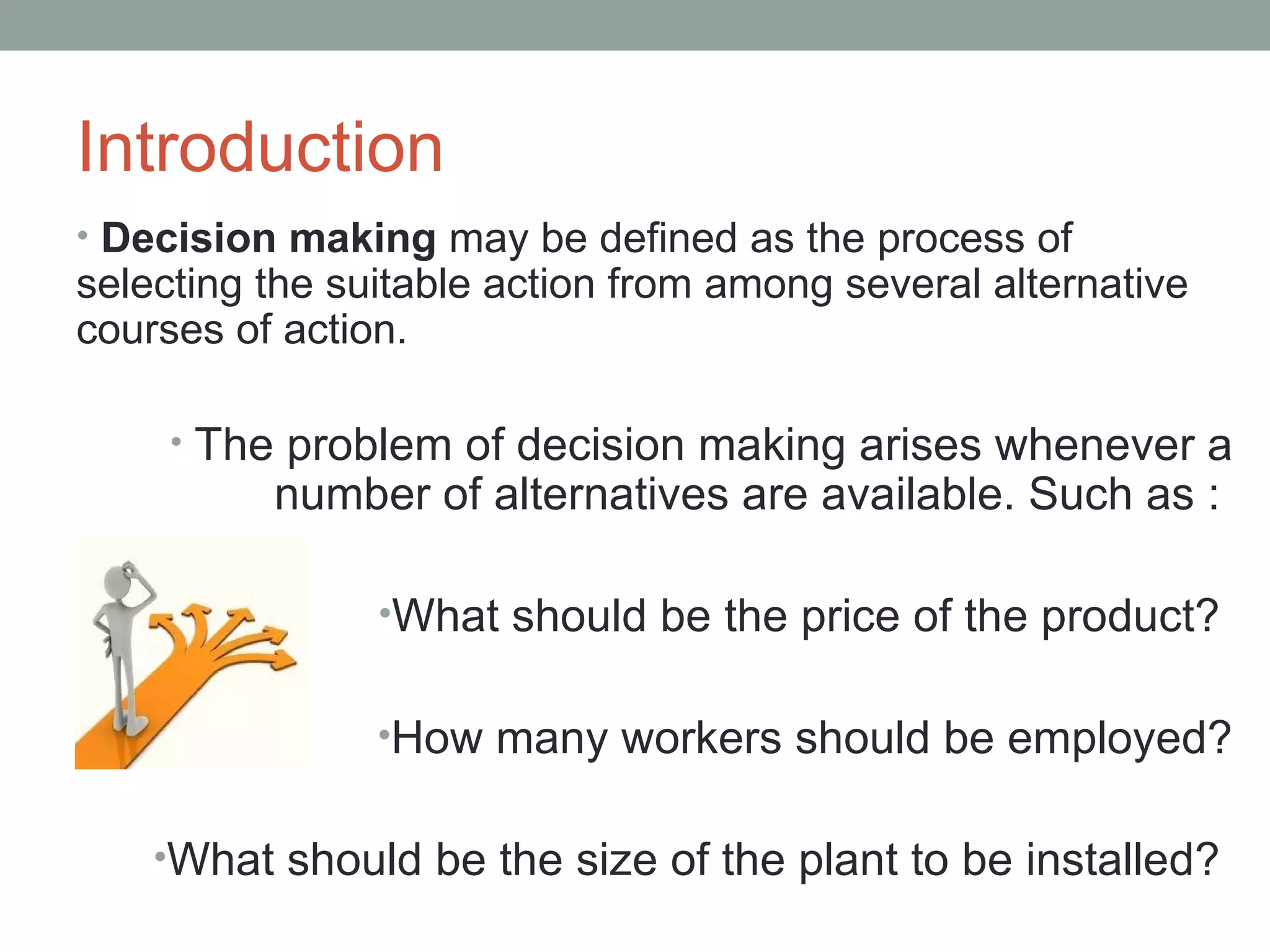
Introduction Decision making  may be defined as the process of selecting the suitable action from among several alternative courses of action.  The problem of decision making arises whenever a number of alternatives are available. Such as :  What should be the price of the product?  How many workers should be employed? What should be the size of the plant to be installed?
How does thinking at the margin change the decision making process? The key factor in the economics of decision making is that  Decisions are made at the margin.  What this means is that a decision maker looks at the  additional or marginal cost of an action ,  the additional or marginal benefit  of  the decision  and if the  incremental benefit is greater than the incremental cost, the action is taken.
How does thinking at the margin change the decision making process? Doing so leads to the optimal decisions being made, subject to preferences, resources and informational constraints. People’s decisions tend to be marginal ( incremental ) processes. Microeconomic analysis stresses how people  optimize , which usually entails balancing expected marginal benefits against expected marginal costs.
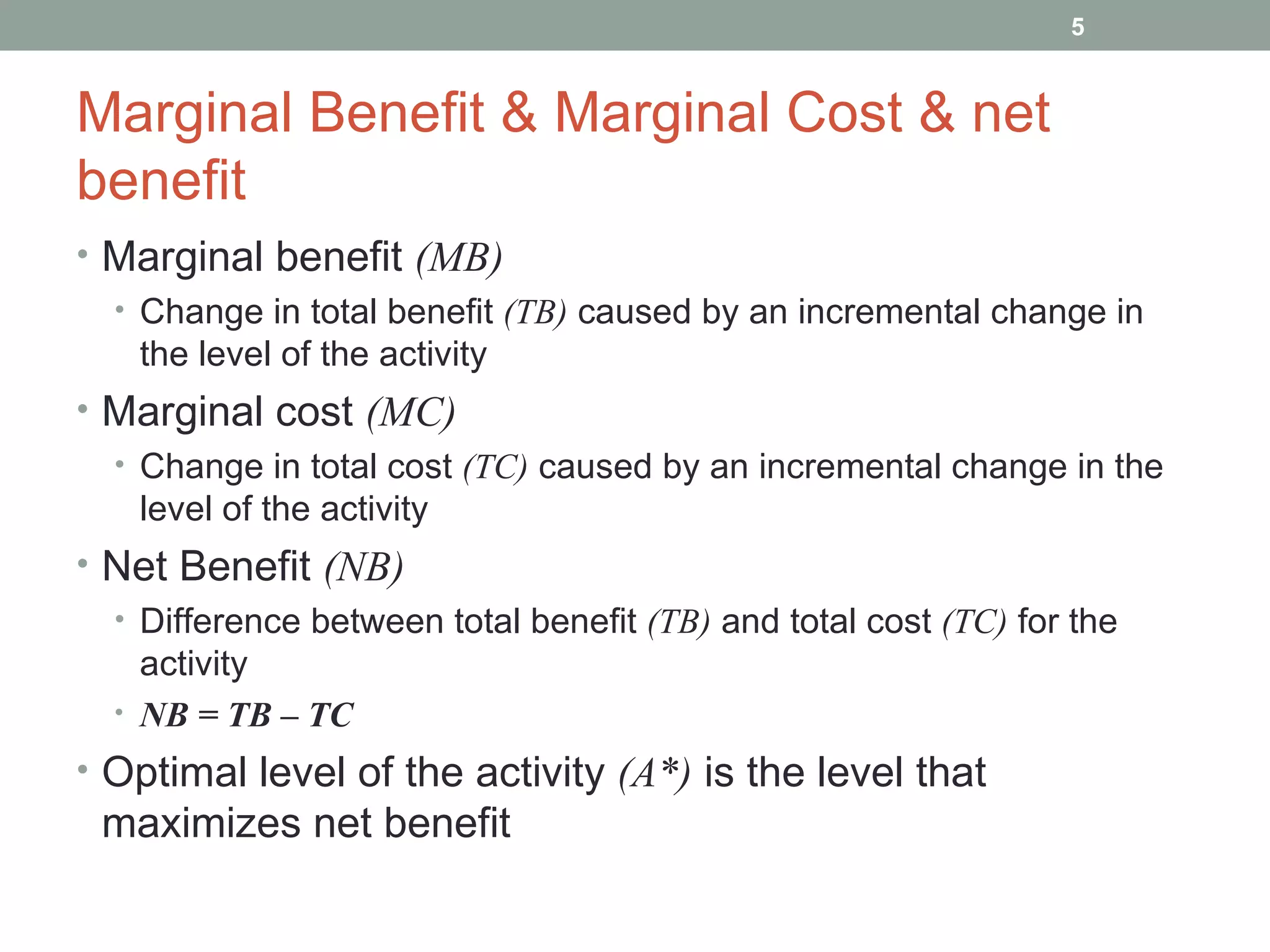
Marginal Benefit & Marginal Cost & net benefit Marginal benefit  (MB) Change in total benefit  (TB)  caused by an incremental change in the level of the activity Marginal cost  (MC) Change in total cost  (TC)  caused by an incremental change in the level of the activity Net Benefit  (NB) Difference between total benefit  (TB)  and total cost  (TC)  for the activity NB = TB – TC Optimal level of the activity  (A*)  is the level that maximizes net benefit
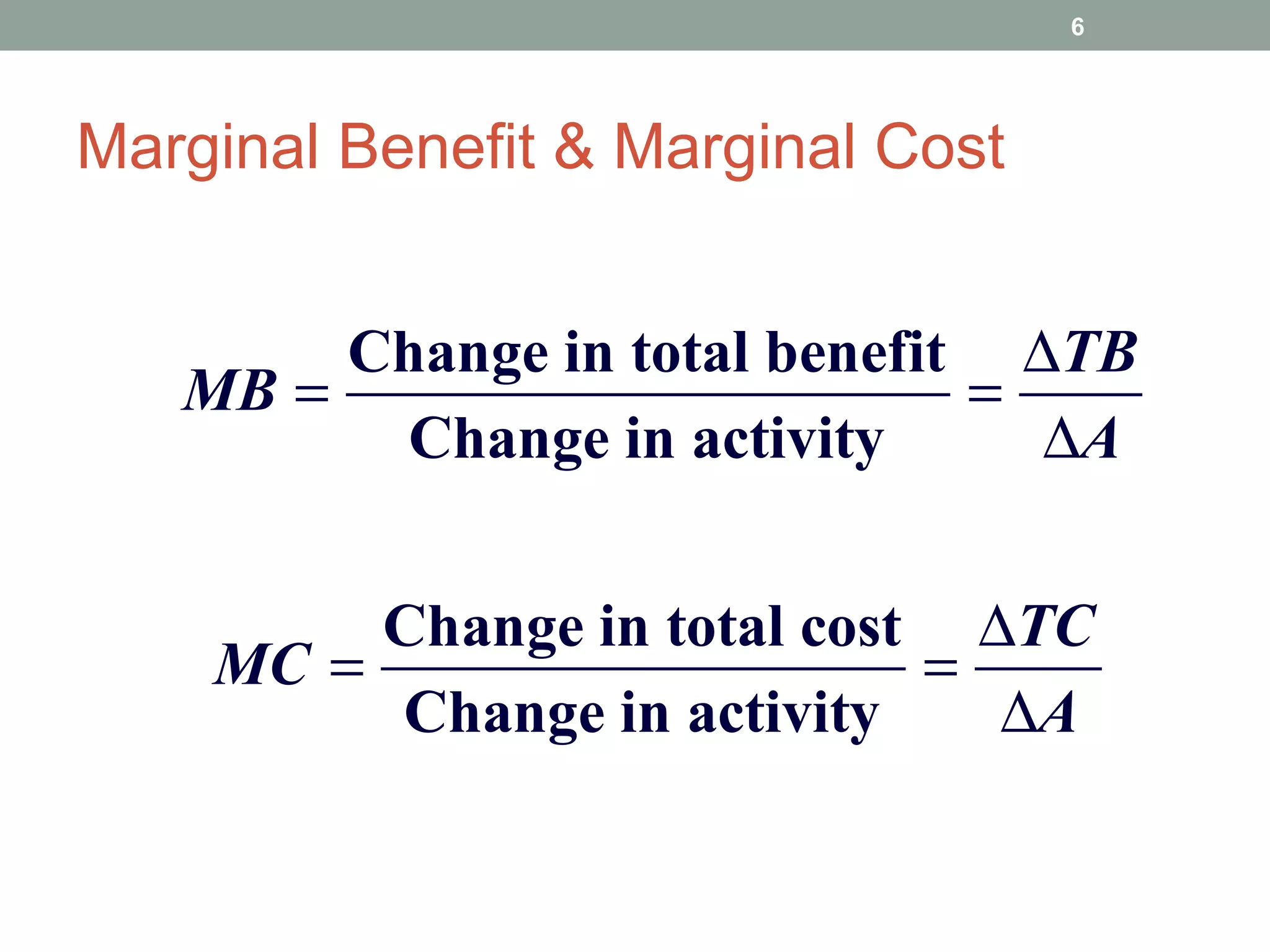
Marginal Benefit & Marginal Cost
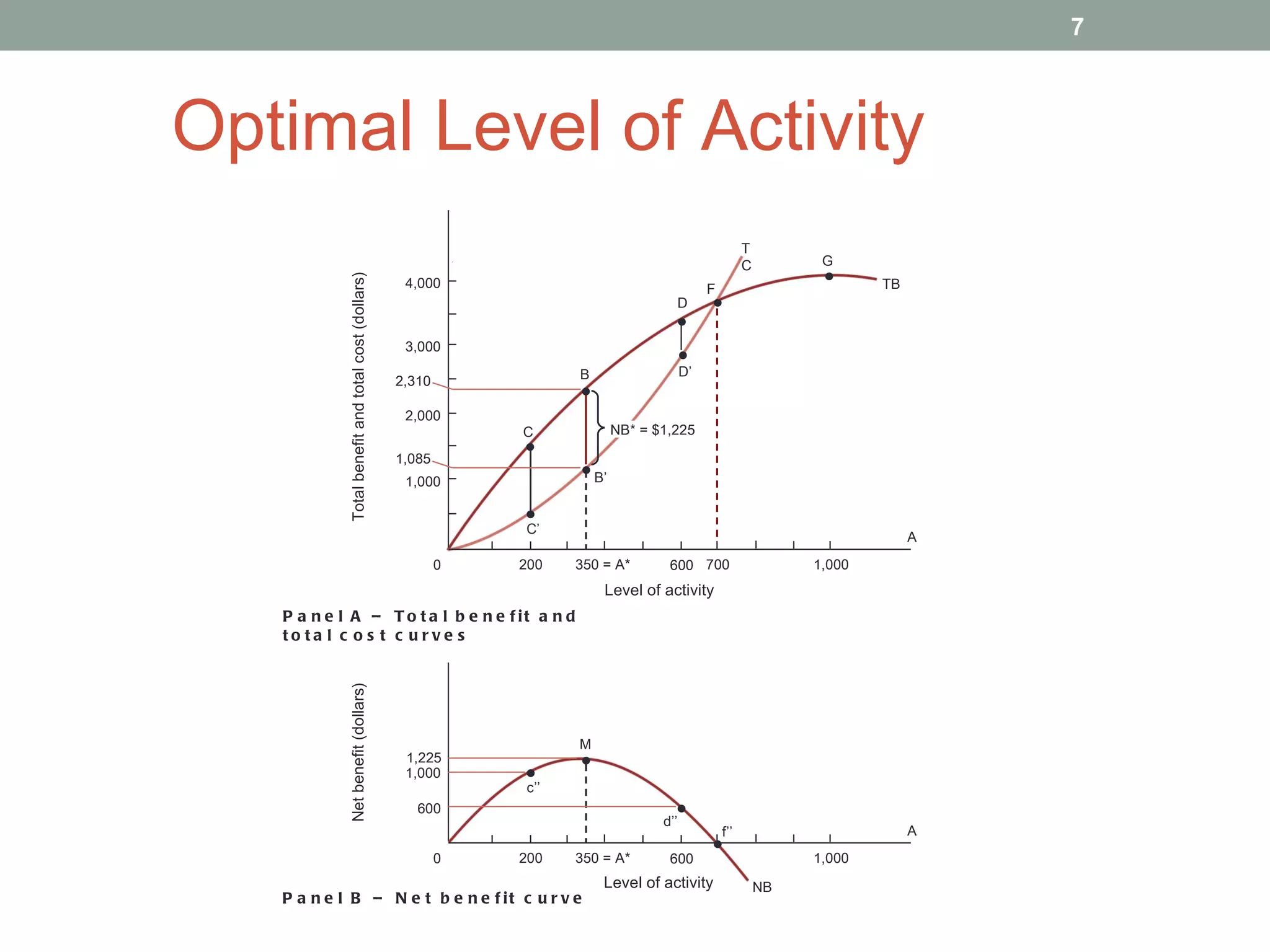
Optimal Level of Activity NB TB TC 1,000 Level of activity 2,000 4,000 3,000 A 0 1,000 600 200 Total benefit and total cost (dollars) Panel A – Total benefit and total cost curves A 0 1,000 600 200 Level of activity Net benefit (dollars) Panel B – Net benefit curve • G 700 • F • • D’ D • • C’ C • • B B’ 2,310 1,085 NB* = $1,225 • f’’ 350 = A* 350 = A* • M 1,225 • c’’ 1,000 • d’’ 600
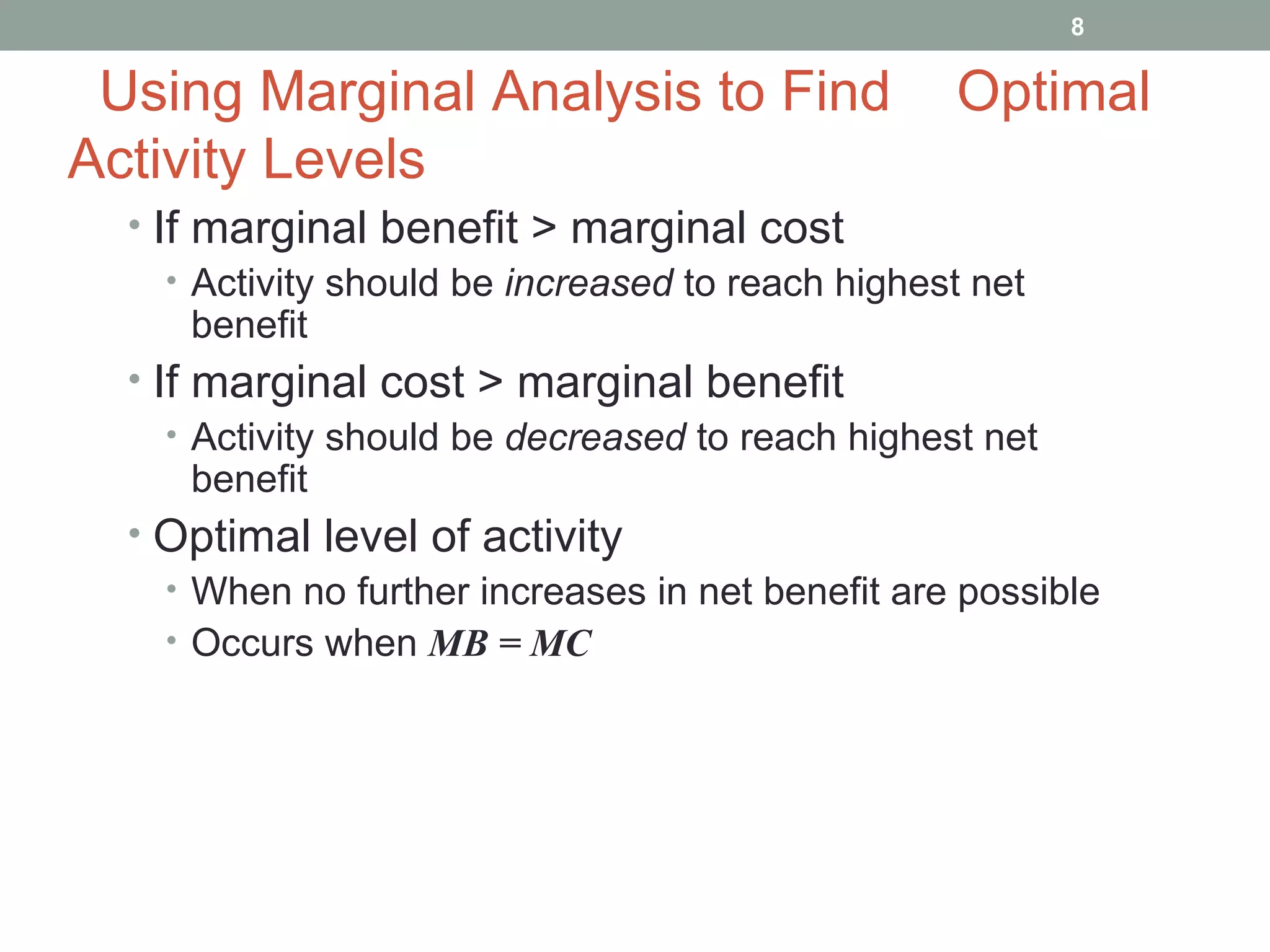
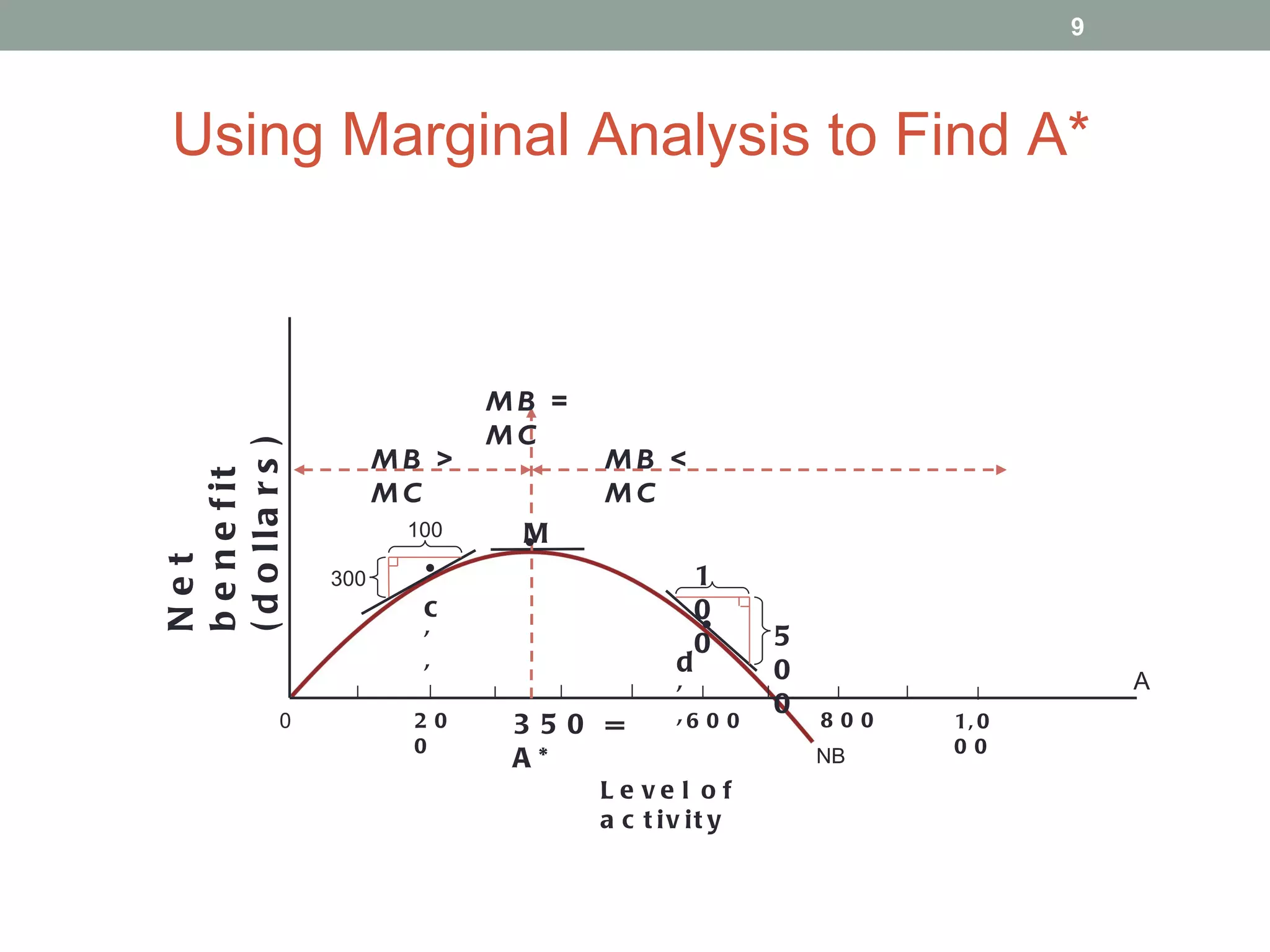
Using Marginal Analysis to Find  Optimal Activity Levels If marginal benefit > marginal cost Activity should be  increased  to reach highest net benefit If marginal cost > marginal benefit Activity should be  decreased  to reach highest net benefit Optimal level of activity When no further increases in net benefit are possible Occurs when  MB = MC
Using Marginal Analysis to Find A* MB > MC MB < MC NB A 0 1,000 600 200 Level of activity Net benefit (dollars) 800 • c’’ • d’’ 100 300 100 500 350 = A* MB = MC • M
Conclusion Hence, we can conclude that a manager before  taking a decision should aim at achieving the optimal point i.e., a situation where the total benefit is equal to the total cost.  We can say that decisions are made at margins.
THANK YOU

OPTIMAL Decisions are made at the margin

  • 1.
    DECISIONS ARE MADEAT THE MARGIN BY : H.N.Sujan kumar Urs & Ankitha
  • 2.
    Introduction Decision making may be defined as the process of selecting the suitable action from among several alternative courses of action. The problem of decision making arises whenever a number of alternatives are available. Such as : What should be the price of the product? How many workers should be employed? What should be the size of the plant to be installed?
  • 3.
    How does thinkingat the margin change the decision making process? The key factor in the economics of decision making is that Decisions are made at the margin. What this means is that a decision maker looks at the additional or marginal cost of an action , the additional or marginal benefit of the decision and if the incremental benefit is greater than the incremental cost, the action is taken.
  • 4.
    How does thinkingat the margin change the decision making process? Doing so leads to the optimal decisions being made, subject to preferences, resources and informational constraints. People’s decisions tend to be marginal ( incremental ) processes. Microeconomic analysis stresses how people optimize , which usually entails balancing expected marginal benefits against expected marginal costs.
  • 5.
    Marginal Benefit &Marginal Cost & net benefit Marginal benefit (MB) Change in total benefit (TB) caused by an incremental change in the level of the activity Marginal cost (MC) Change in total cost (TC) caused by an incremental change in the level of the activity Net Benefit (NB) Difference between total benefit (TB) and total cost (TC) for the activity NB = TB – TC Optimal level of the activity (A*) is the level that maximizes net benefit
  • 6.
    Marginal Benefit &Marginal Cost
  • 7.
    Optimal Level ofActivity NB TB TC 1,000 Level of activity 2,000 4,000 3,000 A 0 1,000 600 200 Total benefit and total cost (dollars) Panel A – Total benefit and total cost curves A 0 1,000 600 200 Level of activity Net benefit (dollars) Panel B – Net benefit curve • G 700 • F • • D’ D • • C’ C • • B B’ 2,310 1,085 NB* = $1,225 • f’’ 350 = A* 350 = A* • M 1,225 • c’’ 1,000 • d’’ 600
  • 8.
    Using Marginal Analysisto Find Optimal Activity Levels If marginal benefit > marginal cost Activity should be increased to reach highest net benefit If marginal cost > marginal benefit Activity should be decreased to reach highest net benefit Optimal level of activity When no further increases in net benefit are possible Occurs when MB = MC
  • 9.
    Using Marginal Analysisto Find A* MB > MC MB < MC NB A 0 1,000 600 200 Level of activity Net benefit (dollars) 800 • c’’ • d’’ 100 300 100 500 350 = A* MB = MC • M
  • 10.
    Conclusion Hence, wecan conclude that a manager before taking a decision should aim at achieving the optimal point i.e., a situation where the total benefit is equal to the total cost. We can say that decisions are made at margins.
  • 11.