Chapter 9: Ray Optics and Optical Instruments
Page No. 318 321–322 332–335 346
9.3 Refraction (delete only advanced sunrise and delayed sunset)
9.4.1(i) Mirage
9.4.1(ii) Diamond
9.7 Some Natural Phenomena due to Sunlight
9.7.1 The Rainbow
9.7.2 Scattering of Light Exercise 9.18
• Syllabus :
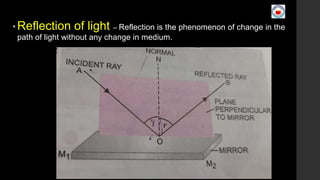
• Reflection of light – Reflection is the phenomenon of change in the
path of light without any change in medium.
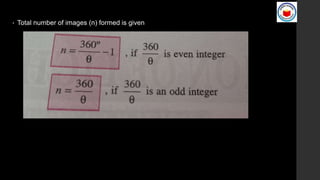
• Total number of images (n) formed is given
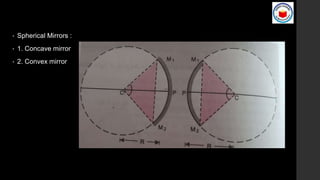
• Spherical Mirrors :
• 1. Concave mirror
• 2. Convex mirror
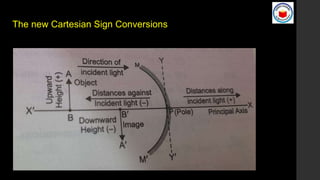
The new Cartesian Sign Conversions
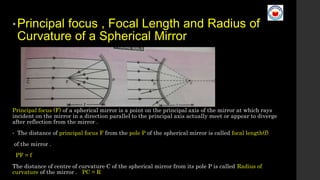
•Principal focus , Focal Length and Radius of
Curvature of a Spherical Mirror
Principal focus (F) of a spherical mirror is a point on the principal axis of the mirror at which rays
incident on the mirror in a direction parallel to the principal axis actually meet or appear to diverge
after reflection from the mirror .
• The distance of principal focus F from the pole P of the spherical mirror is called focal length(f)
of the mirror .
PF = f
The distance of centre of curvature C of the spherical mirror from its pole P is called Radius of
curvature of the mirror . PC = R
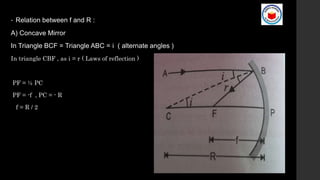
• Relation between f and R :
A) Concave Mirror
In Triangle BCF = Triangle ABC = i ( alternate angles )
In triangle CBF , as i = r ( Laws of reflection )
PF = ½ PC
PF = -f , PC = - R
f = R / 2
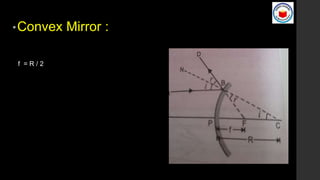
•Convex Mirror :
f = R / 2
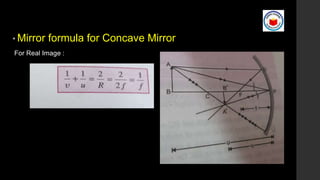
• Mirror formula for Concave Mirror
For Real Image :
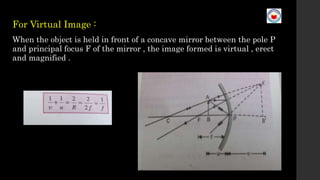
For Virtual Image :
When the object is held in front of a concave mirror between the pole P
and principal focus F of the mirror , the image formed is virtual , erect
and magnified .
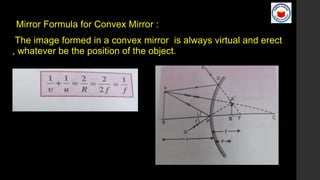
Mirror Formula for Convex Mirror :
The image formed in a convex mirror is always virtual and erect
, whatever be the position of the object.
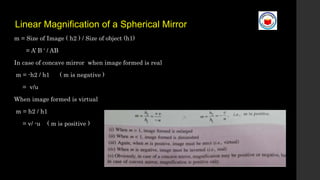
Linear Magnification of a Spherical Mirror
m = Size of Image ( h2 ) / Size of object (h1)
= A’ B ‘ / AB
In case of concave mirror when image formed is real
m = -h2 / h1 ( m is negative )
= v/u
When image formed is virtual
m = h2 / h1
= v/ -u ( m is positive )
Optics ppt class 12th.pptx

Optics ppt class 12th.pptx

  • 1.
    Chapter 9: RayOptics and Optical Instruments Page No. 318 321–322 332–335 346 9.3 Refraction (delete only advanced sunrise and delayed sunset) 9.4.1(i) Mirage 9.4.1(ii) Diamond 9.7 Some Natural Phenomena due to Sunlight 9.7.1 The Rainbow 9.7.2 Scattering of Light Exercise 9.18
  • 2.
  • 3.
    • Reflection oflight – Reflection is the phenomenon of change in the path of light without any change in medium.
  • 4.
    • Total numberof images (n) formed is given
  • 5.
    • Spherical Mirrors: • 1. Concave mirror • 2. Convex mirror
  • 6.
    The new CartesianSign Conversions
  • 7.
    •Principal focus ,Focal Length and Radius of Curvature of a Spherical Mirror Principal focus (F) of a spherical mirror is a point on the principal axis of the mirror at which rays incident on the mirror in a direction parallel to the principal axis actually meet or appear to diverge after reflection from the mirror . • The distance of principal focus F from the pole P of the spherical mirror is called focal length(f) of the mirror . PF = f The distance of centre of curvature C of the spherical mirror from its pole P is called Radius of curvature of the mirror . PC = R
  • 8.
    • Relation betweenf and R : A) Concave Mirror In Triangle BCF = Triangle ABC = i ( alternate angles ) In triangle CBF , as i = r ( Laws of reflection ) PF = ½ PC PF = -f , PC = - R f = R / 2
  • 9.
  • 10.
    • Mirror formulafor Concave Mirror For Real Image :
  • 11.
    For Virtual Image: When the object is held in front of a concave mirror between the pole P and principal focus F of the mirror , the image formed is virtual , erect and magnified .
  • 12.
    Mirror Formula forConvex Mirror : The image formed in a convex mirror is always virtual and erect , whatever be the position of the object.
  • 13.
    Linear Magnification ofa Spherical Mirror m = Size of Image ( h2 ) / Size of object (h1) = A’ B ‘ / AB In case of concave mirror when image formed is real m = -h2 / h1 ( m is negative ) = v/u When image formed is virtual m = h2 / h1 = v/ -u ( m is positive )