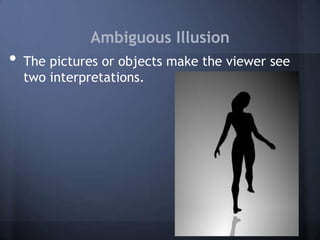
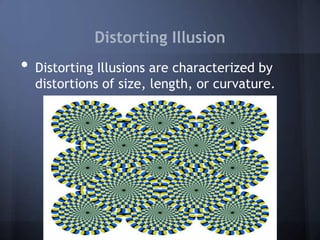
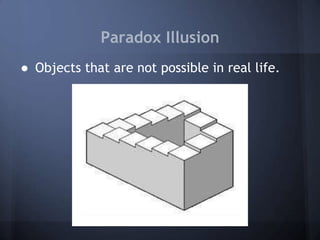
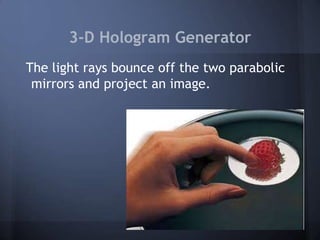
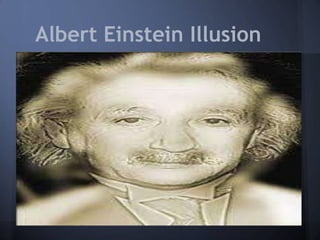
This document discusses optical illusions and provides several examples. Optical illusions occur when the information received by the eyes is interpreted differently in the brain, and perception is also influenced by prior learning and culture. There are three main types of optical illusions: ambiguous illusions that have two possible interpretations, distorting illusions that distort size or shape, and paradox illusions that depict impossible scenarios. The document also describes how a 3D hologram generator works using two parabolic mirrors to project an image and bounce light rays. It concludes with evaluation questions about the causes and examples of optical illusions.