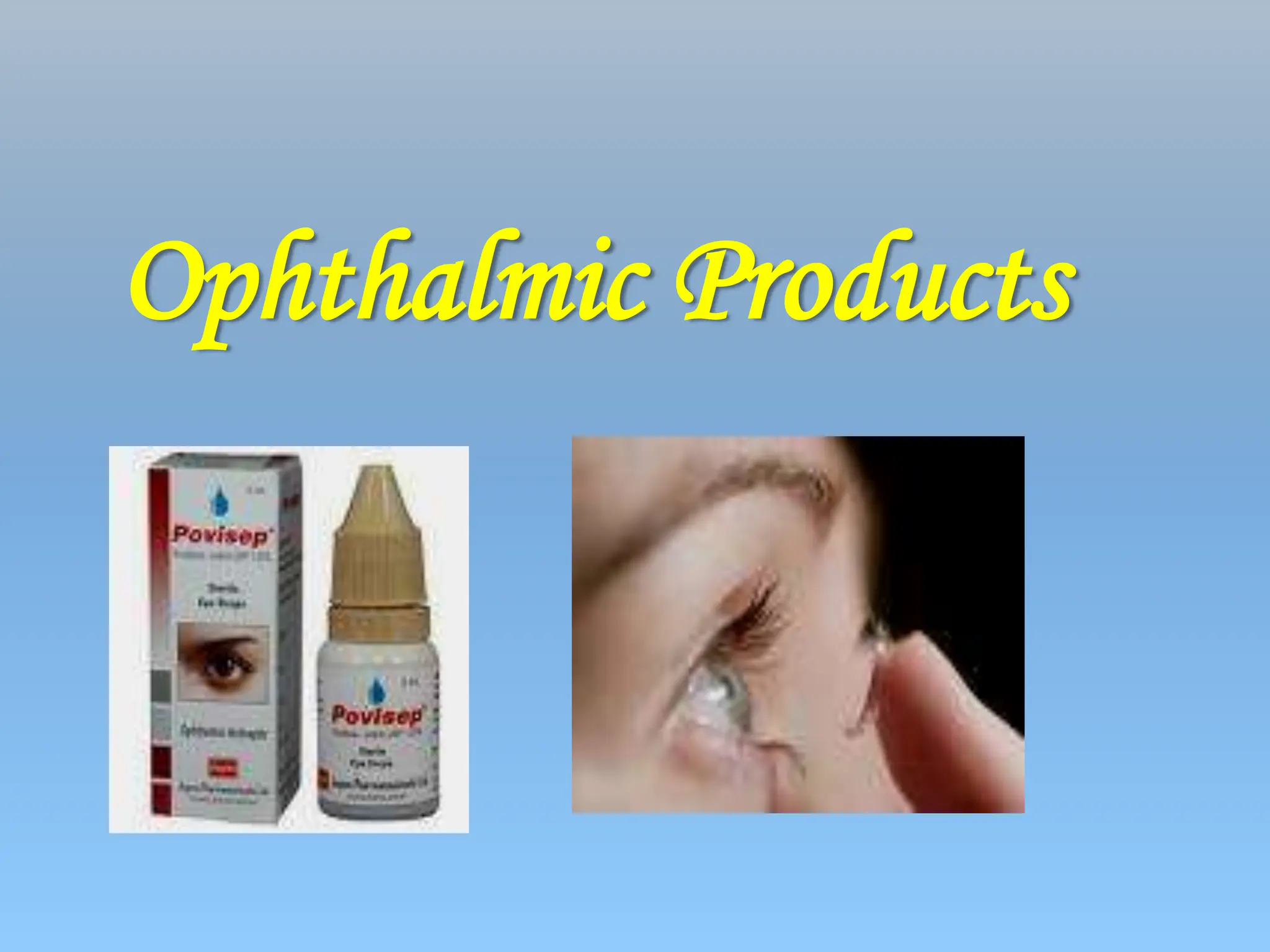
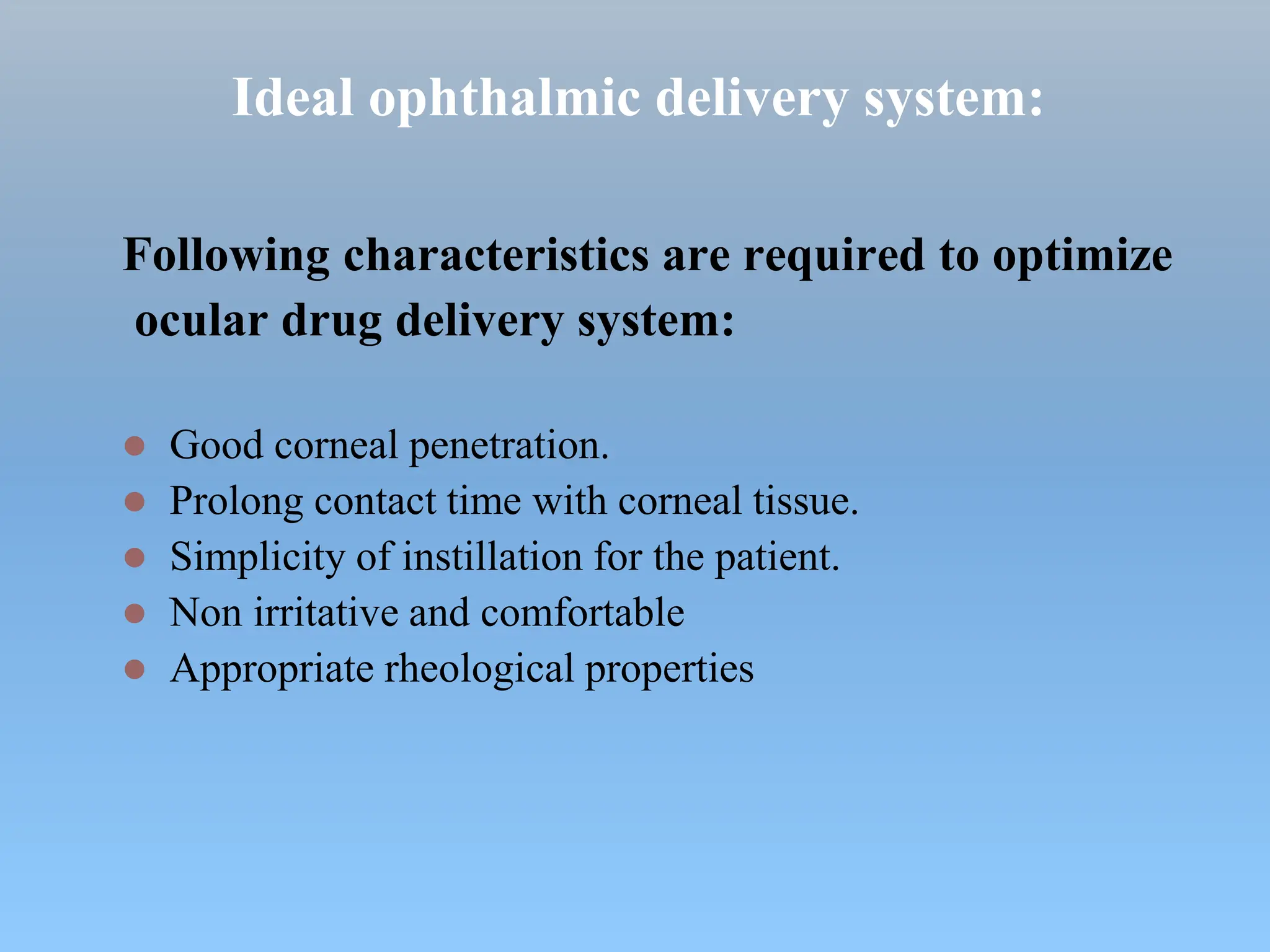
Ophthalmic Products
CONTENT
 General requirements,
 types of dosage forms.
 formulation,
 Contact lens and lens care products
Ophthalmic preparations
 Definition:
 They are sterile dosage forms designed to be instilled onto
the external surface of the eye (topical), administered
inside (intraocular) or adjacent (periocular) to the eye or
used in conjunction with an ophthalmic device.
Ideal ophthalmic delivery system:
Following characteristics are required to optimize
ocular drug delivery system:
 Good corneal penetration.
 Prolong contact time with corneal tissue.
 Simplicity of instillation for the patient.
 Non irritative and comfortable
 Appropriate rheological properties
Classification Of Ocular Drug Delivery
Systems
Topical eye drops:
-Solutions
- Suspensions
- Powders for
reconstitution
- Sol to gel systems
-Ointments
- Gels
Ocular inserts
General requirements
 Sterilization
 ocular toxicity & irritation
 Free from microorganism (Sterility)
 Tonicity
 pH
Sterilization
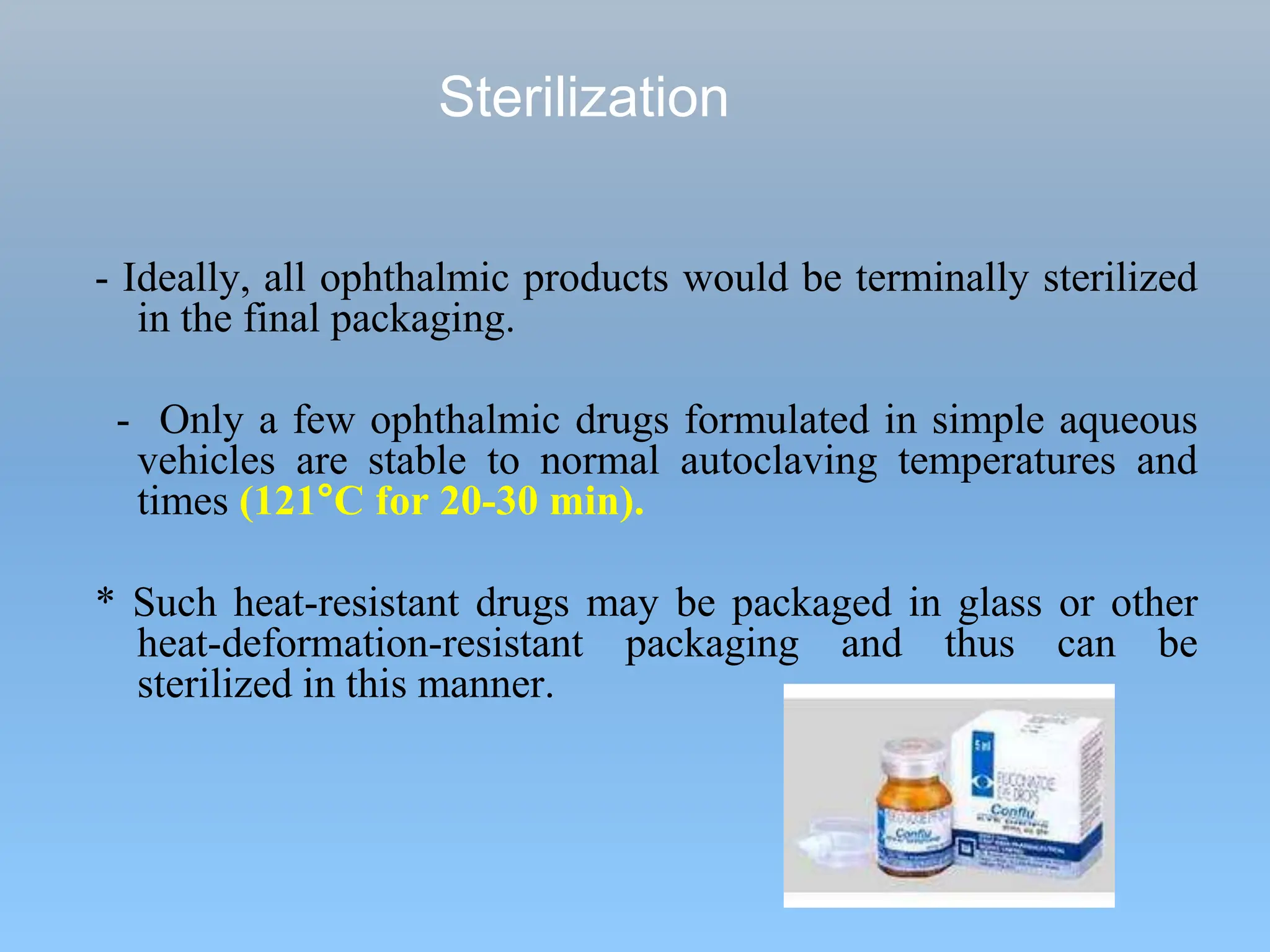
- Ideally, all ophthalmic products would be terminally sterilized
in the final packaging.
- Only a few ophthalmic drugs formulated in simple aqueous
vehicles are stable to normal autoclaving temperatures and
times (121°C for 20-30 min).
* Such heat-resistant drugs may be packaged in glass or other
heat-deformation-resistant packaging and thus can be
sterilized in this manner.
- Most ophthalmic products, however cannot be sterilized by
heat due to the active principle or polymers used to increase
viscosity are not stable to heat.
- Most ophthalmic products are aseptically manufactured and
filled into previously sterilized containers in aseptic
environments using aseptic techniques.
Ocular toxicity and irritation:
- Albino rabbits are used to test the ocular toxicity and
irritation of ophthalmic formulations.
- The procedure based on the examination of the conjunctiva,
the cornea or the iris.
- E.g. USP procedure for plastic containers:
1- Containers are cleaned and sterilized as in the final
packaged product.
2- Extracted by submersion in saline and cottonseed oil.
3- Topical ocular instillation of the extracts and blanks in
rabbits is completed and ocular changes examined.
Preservation and Sterility:
 Preservatives are included in multiple-dose eye solutions for
maintaining the product sterility during use.
 Preservatives not included in unit-dose package.
 The use of preservatives is prohibited in ophthalmic
products that are used at the of eye surgery because, if
sufficient concentration of the preservative is contacted with
the corneal endothelium, the cells can become damaged
causing clouding of the cornea and possible loss of vision.
So these products should be packaged in sterile, unit-of-
use containers.
 The most common organism is Pseudomonas aeruginosa
that grow in the cornea and cause loss of vision.
Tonicity
 The pharmacist should adjust the tonicity of an ophthalmic
Correctly (i.e.., exert an osmotic pressure equal to that of
tear fluid , generally agreed to be equal to 0.9% NaCl ).
A range of 0.5-2.0% NaCl equivalency does not cause a Marked
pain response and a range of about 0.7-1.5% Should be acceptable
to most person.
 Commonly tonicity adjusting ingredients include : NaCl, KCL,
buffer salts, dextrose, glycerin, propylene glycol, Mannitol
pH
pH adjustment is very
important tear 7.4
1- To provide the
formulation more stable
2- The comfort, safety and
activity of the product.
Eye irritation increase in tear
fluid secretion loss of
medication
3- To enhance aqueous
solubility of the drug.
4- To enhance the drug
bioavailability
 .
Formulation Aspect of
Solution
 Active Drug
 Preservative
 Buffer
 Osmolality adjusting agent
 Viscosity increasing agent
 Chelating agent
 Antioxidant
Manufacturing Techniques
Aqueous ophthalmic solution:
Manufactured by dissolution of the active ingredients and
a portion of the excipients into all portion of water.
The sterilization of this solution done by heat or by sterilizing
Filtration through sterile depth or membrane filter media
Into a sterile receptacle.
This sterile solution is then mixed with the additional required
Sterile components such as viscosity –imparting agents,
Preservatives and so and the solution is brought to final
Volume with additional sterile water.
Disadvantages of eye solutions
1-The very short time the solution stays at the
eye surface.
The retention of a solution in the eye is
influenced by viscosity.
2- Its poor bioavailability (a major portion i.e.
75% is lost via naso lacrimal drainage).
Formula & Example
 Pilocarpine eye drops .
 Pilocarpine Hydrochloride------------------------- 1 %
 Benzalkonium chloride----------------------------- 0.01 %
 Disodium EDTA-------------------------------------- 0.01 %
 Phosphate buffer------------------------------------- 50 mM
 Sodium Chloride-------------------------------------- Q.S
 HPMC-------------------------------------------------- 0.5 %
 NaOH & / HCl---------------------------------------- Q.S
 Purified water Q.S up to--------------------------- 100 ml
 ------------------------------------------------------------------------------------------
Other example:
• Atropine sulphate eye drops.
• Silver nitrate eye drops.
• Zinc sulphate eye drops.
Suspensions
If the drug is not sufficiently soluble, it can be formulated
as a suspension.
A suspension may also be desired to improve stability,
Bioavailability ,and efficacy.
The major topical ophthalmic suspensions are the steroid
anti-inflammatory agents.
An ophthalmic suspension should use the drug in a
microfine form; usually 98% or more of the particles have a
Diameter of 10µm or less.
Formulation
 Drug substance
 Preservative
 Dispersing agent
 Buffer
 Osmolality adjusting agent
 Chelating agent
 Antioxidant
Manufacturing Techniques
 Aqueous suspensions:
Are prepared in much the same manner, except that
Before bringing to the final volume with additional
sterile water .
The solid that is to be suspended is previously rendered sterile
by – heat ,exposure to ethylene oxide ,ionizing radiation
(gamma ), sterile filtration.
The particle size should be monitored.
Formula & Example
Prednisolone acetate suspension
 Prednisolone acetate (micronized)---------------- 1 %
 Benzalkonium chloride----------------------------- 0.01 %
 Disodium EDTA-------------------------------------- 0.01 %
 Phosphate buffer------------------------------------- 50 m M
 HPMC ------------------------------------------------ 0.5 %
 Polysorbate 80 --------------------------------------- 0.01 %
 Sodium chloride ------------------------------------- Q S
 NaOH/ HCl --------------------------------------------- QS
 Purified water --------QS up to --------------------- 100 ml
 ------------------------------------------------------------------------------------------
Other example:
 Besifloxacin suspension.
 Blephamide suspension.
 Fluorometholone suspension
Gel-Forming Solutions
 Solution that are liquid in the container and thus can
 be instilled as eye drops but forms gel on contact with the tear fluid and provide
increased contact time with the possibility of improved drug absorption and
Duration of therapeutic effect.
 * Take the advantage of changes in temperature ,pH,
 ion sensitivity, lysozymes upon contact with tear fluid.
Semisolid Dosage Forms: Ointment
 vehicles used in is mixture of Mineral oil and petrolatum base .
 The mineral oil is used to modify melting point and modify
consistency.
 Petrolatum vehicle used as a ocular lubricate to treat dry Eye
syndromes.
 They are mostly used as night time therapy, While eye drops
administered during the day
 It is suitable for moisture sensitive drugs and has longer Contact
time than drops.
Formulation of Ointment
 Base– mineral oil, petrolatum base
 Dispersing agent--- lanolin, glyceryl monostreate PEG-300,400,
 Preservative--- avoid in antibiotic
 Formula Gentamycine Ointment
Gentamycine sulphate……………………….. 0.6 %
Methyl paraben ……………………………… 0.05 %
Propyl paraben ……………………………….. 0.01 %
White petrolatum …… q.s up to…………….. 100 gm
Evaluation tests ophthalmic ointments
 Metal Particles
 Leakage test
 Sterility Tests
Metal Particles
 This test is required only for ophthalmic ointments.
 The presence of metal particles will irritate the corneal or conjunctival surfaces of the eye.
 It is performed using 10 ointment tubes.
 The content from each tube is completely removed onto a clean 60 - mm - diameter Petri
dish which possesses a flat bottom.
 The lid is closed and the product is heated at 85 ° C for 2 h.
 Once the product is melted and distributed uniformly, it is cooled to room temperature.
 The lid is removed after solidification.
 The bottom surface is then viewed through an optical microscope at 30× magnification.
 The viewing surface is illuminated using an external light source positioned at 45 ° on the
top.
 The entire bottom surface of the ointment is examined,
And the number of particles 50 μm or above are counted using a calibrated eyepiece
micrometer.
 The USP recommends that the number of such particles in 10 tubes should not exceed 50,
with not more than 8 particles in any individual tube.
 limits are not met, the test is repeated with an additional 20 tubes.
 In this case, the total number of particles in 30 tubes should not exceed 150, and not more
than 3 tubes are allowed to contain more than 8 particles .
Leakage test
 This test is mandatory for ophthalmic ointments, which
evaluates the intactness of the ointment tube and its seal.
 Ten sealed containers are selected, and their exterior
surfaces are cleaned.
 They are horizontally placed over absorbent blotting paper .
 Maintained at 60 ± 3 ° C for 8 h.
 The test passes if leakage is not observed from any tube.
 If leakage is observed, the test is repeated with an additional
20 tubes.
 The test passes if not more than 1 tube shows leakage out of
30 tubes .
Sterility Tests for ointment & Gel
 Ophthalmic semisolids should be free from
anaerobic and aerobic bacteria and fungi.
 Sterility tests are therefore performed by the:
1. Membrane filtration technique .
2. Direct - inoculation techniques.
In the Membrane filtration method :
A solution of test product (1%) is prepared in isopropyl myristate and allowed to
penetrate through cellulose nitrate filter with pore size less than 0.45 μ m.
If necessary, gradual suction or pressure is applied to aid filtration.
The membrane is then washed three times with 100 - mL quantities of sterile
diluting and rinsing fluid and transferred aseptically into fluid thioglycolate (FTG)
and soybean – casein digest medium (SBCD) .
The membrane is finally incubated for 14 days.
Growth on FTG medium indicates the presence of anaerobic and aerobic bacteria.
Soybean casein digest medium indicates fungi and aerobic bacteria
Absence of any growth in both these media establishes the sterility of the product.
In the Direct - inoculation technique :
1 part of the product is diluted with 10 parts of sterile diluting and
rinsing fluid with the help of an emulsifying agent
Incubated in Fluid thioglycolate (FTG) and soybean – casein
digest medium (SBCD) media for 14 days
In both techniques, the number of test articles is based on the batch
size of the product.
If the batch size is less than 200 the containers, either 5% of the
containers or 2 containers (whichever is greater) are used.
If the batch size is more than 200, 10 containers are used for
sterility testing .
Semisolid Gel
ADVANTAGES OVER OINTMENT
 Aqueous in nature
 Non greasy
 No blurred vision
DISADVANTAGE
Dried film left on eye lashes
Formulation of Gel
 Buffer
 Stabilizers, mostly antioxidants
 Surfactant, low concentration
 Viscosity enhancing agent
 Osmolarity adjusting agent
 Vehicles
Formula for Eye Gel
Packaging of semisolid
Ophthalmic ointment are packaged in :
1.Small collapsible tin tube usually holding 3.5g of product.
the pure tin tube is compatible with a wide range of drugs in
petrolatum-based ointments.
2.Aluminum tubes have been used because of their lower cost
and as an alternative should the supply of tin.
3.Plastic tubes made from flexible LDPE resins have also been
considered as an alternative material.
Factors affecting Bioavailability
through Eye
 Limited Dose
 Wasting of drug
 Less contact time in case of solution
 Tearing due to administration
 Blinking rate
Manufacturing Requirments
Environment
The environment should be sterile and particle-free through:
-Laminar-flow should be used throughout the manufacturing area.
-Total particles per cubic foot of space should be minimum.
- Relative humidity controlled to between 40 and 60%.
- Walls, ceilings and floors should be constructed of materials that are hard, non flaking,
smooth and non-affected by surface cleaners or disinfectants.
- Equipment
 All tanks, valves, pumps and piping must be of best available Grade of corrosion
– resistant stainless steel.
 All products-contact surface should be polished either mechanically or be electro
polishing to provide a surface as Free as possible from scratches or defects.
 Care should be taken in the design of such equipment to Provide adequate
means of cleaning and sanitization.
Solid Dosage Forms Ocular Inserts
 Ocular inserts are defined as sterile solid or
semisolid preparations, with a thin, flexible
and multilayered structure, for placing in the
conjunctival sac.
 Types
 Insoluble
 Soluble
Advantages
 Increasing contact time and improving bioavailability.
 Providing a prolong drug release and thus a better efficacy.
 Reduction of adverse effects.
 Reduction of the dosing frequency and thus better patient
compliance.
Insoluble insert
 Insoluble insert is a multilayered structure consisting of a drug containing core
surrounded on each side by a layer of copolymer membranes through which the
drug diffuses at a constant rate
e.g. The Ocusert® Pilo-20 and Pilo-40 Ocular system
- Designed to be placed in the inferior cul-de-sac between the sclera and the eyelid
and to release pilocarpine continuously at a steady rate for 7 days for treatment of
glucoma.
Contact Lenses & Care Solutions
 Types of contact lenses:
1- Hard contact lenses.
2- Soft contact lenses.
3- Rigid gas permeable (RGP).
1- Hard contact lenses
-Made of rigid plastic resin polymethylmethacrylate (PMMA)
-Impermeable to oxygen and moisture
2- Soft contact lenses
-Made of hydrophilic transparent plastic,
hydroxyethylmethacrylate (HEMA)
-Contain 30 – 80% water so are permeable to oxygen
-Have two types: daily wear and extended wear
3- Rigid gas permeable (RGP)
-Take the advantages of both soft and hard lenses, they are
hydrophobic and oxygen permeable.
Advantages & Disadvantages
of hard contact lenses and RGP lenses
Advantages:
1- strength durability
2- resistant to absorption of medications and
environmental contaminants
3- visual acuity
Disadvantages:
1- require adjustment period of the wearer
2- more easily dislodged from the eye
Advantages & Disadvantages of soft contact lenses:
 Advantages:
1- worn for longer periods
2- do not dislodge easily
Disadvantages:
1- have a shorter life span and the wearer must
ensure that the lenses do not dry out
University Question
 Write Note on formulation of ophthalmic formulation. 5 M
 What are contact lenses. Give detail of solution used for contact lenses. 10 M
 Give formulation aspect of ophthalmic ointment. 7 M
 Describe details about ophthalmic suspension. 7 M
 Give the general requirements of ophthalmic product. 7 M
Reference
 Parenteral Lachman series Vol 2
 Dispensing for pharmaceutical by Cooper
and gunn’s

OPHTHALMIC PRODUCT (1).pptx and evaluation

  • 1.
  • 2.
    CONTENT  General requirements, types of dosage forms.  formulation,  Contact lens and lens care products
  • 3.
    Ophthalmic preparations  Definition: They are sterile dosage forms designed to be instilled onto the external surface of the eye (topical), administered inside (intraocular) or adjacent (periocular) to the eye or used in conjunction with an ophthalmic device.
  • 4.
    Ideal ophthalmic deliverysystem: Following characteristics are required to optimize ocular drug delivery system:  Good corneal penetration.  Prolong contact time with corneal tissue.  Simplicity of instillation for the patient.  Non irritative and comfortable  Appropriate rheological properties
  • 5.
    Classification Of OcularDrug Delivery Systems Topical eye drops: -Solutions - Suspensions - Powders for reconstitution - Sol to gel systems -Ointments - Gels Ocular inserts
  • 6.
    General requirements  Sterilization ocular toxicity & irritation  Free from microorganism (Sterility)  Tonicity  pH
  • 7.
    Sterilization - Ideally, allophthalmic products would be terminally sterilized in the final packaging. - Only a few ophthalmic drugs formulated in simple aqueous vehicles are stable to normal autoclaving temperatures and times (121°C for 20-30 min). * Such heat-resistant drugs may be packaged in glass or other heat-deformation-resistant packaging and thus can be sterilized in this manner.
  • 8.
    - Most ophthalmicproducts, however cannot be sterilized by heat due to the active principle or polymers used to increase viscosity are not stable to heat. - Most ophthalmic products are aseptically manufactured and filled into previously sterilized containers in aseptic environments using aseptic techniques.
  • 9.
    Ocular toxicity andirritation: - Albino rabbits are used to test the ocular toxicity and irritation of ophthalmic formulations. - The procedure based on the examination of the conjunctiva, the cornea or the iris. - E.g. USP procedure for plastic containers: 1- Containers are cleaned and sterilized as in the final packaged product. 2- Extracted by submersion in saline and cottonseed oil. 3- Topical ocular instillation of the extracts and blanks in rabbits is completed and ocular changes examined.
  • 10.
    Preservation and Sterility: Preservatives are included in multiple-dose eye solutions for maintaining the product sterility during use.  Preservatives not included in unit-dose package.  The use of preservatives is prohibited in ophthalmic products that are used at the of eye surgery because, if sufficient concentration of the preservative is contacted with the corneal endothelium, the cells can become damaged causing clouding of the cornea and possible loss of vision. So these products should be packaged in sterile, unit-of- use containers.  The most common organism is Pseudomonas aeruginosa that grow in the cornea and cause loss of vision.
  • 12.
    Tonicity  The pharmacistshould adjust the tonicity of an ophthalmic Correctly (i.e.., exert an osmotic pressure equal to that of tear fluid , generally agreed to be equal to 0.9% NaCl ). A range of 0.5-2.0% NaCl equivalency does not cause a Marked pain response and a range of about 0.7-1.5% Should be acceptable to most person.  Commonly tonicity adjusting ingredients include : NaCl, KCL, buffer salts, dextrose, glycerin, propylene glycol, Mannitol
  • 13.
    pH pH adjustment isvery important tear 7.4 1- To provide the formulation more stable 2- The comfort, safety and activity of the product. Eye irritation increase in tear fluid secretion loss of medication 3- To enhance aqueous solubility of the drug. 4- To enhance the drug bioavailability  .
  • 14.
    Formulation Aspect of Solution Active Drug  Preservative  Buffer  Osmolality adjusting agent  Viscosity increasing agent  Chelating agent  Antioxidant
  • 15.
    Manufacturing Techniques Aqueous ophthalmicsolution: Manufactured by dissolution of the active ingredients and a portion of the excipients into all portion of water. The sterilization of this solution done by heat or by sterilizing Filtration through sterile depth or membrane filter media Into a sterile receptacle. This sterile solution is then mixed with the additional required Sterile components such as viscosity –imparting agents, Preservatives and so and the solution is brought to final Volume with additional sterile water.
  • 16.
    Disadvantages of eyesolutions 1-The very short time the solution stays at the eye surface. The retention of a solution in the eye is influenced by viscosity. 2- Its poor bioavailability (a major portion i.e. 75% is lost via naso lacrimal drainage).
  • 17.
    Formula & Example Pilocarpine eye drops .  Pilocarpine Hydrochloride------------------------- 1 %  Benzalkonium chloride----------------------------- 0.01 %  Disodium EDTA-------------------------------------- 0.01 %  Phosphate buffer------------------------------------- 50 mM  Sodium Chloride-------------------------------------- Q.S  HPMC-------------------------------------------------- 0.5 %  NaOH & / HCl---------------------------------------- Q.S  Purified water Q.S up to--------------------------- 100 ml  ------------------------------------------------------------------------------------------ Other example: • Atropine sulphate eye drops. • Silver nitrate eye drops. • Zinc sulphate eye drops.
  • 18.
    Suspensions If the drugis not sufficiently soluble, it can be formulated as a suspension. A suspension may also be desired to improve stability, Bioavailability ,and efficacy. The major topical ophthalmic suspensions are the steroid anti-inflammatory agents. An ophthalmic suspension should use the drug in a microfine form; usually 98% or more of the particles have a Diameter of 10µm or less.
  • 19.
    Formulation  Drug substance Preservative  Dispersing agent  Buffer  Osmolality adjusting agent  Chelating agent  Antioxidant
  • 20.
    Manufacturing Techniques  Aqueoussuspensions: Are prepared in much the same manner, except that Before bringing to the final volume with additional sterile water . The solid that is to be suspended is previously rendered sterile by – heat ,exposure to ethylene oxide ,ionizing radiation (gamma ), sterile filtration. The particle size should be monitored.
  • 21.
    Formula & Example Prednisoloneacetate suspension  Prednisolone acetate (micronized)---------------- 1 %  Benzalkonium chloride----------------------------- 0.01 %  Disodium EDTA-------------------------------------- 0.01 %  Phosphate buffer------------------------------------- 50 m M  HPMC ------------------------------------------------ 0.5 %  Polysorbate 80 --------------------------------------- 0.01 %  Sodium chloride ------------------------------------- Q S  NaOH/ HCl --------------------------------------------- QS  Purified water --------QS up to --------------------- 100 ml  ------------------------------------------------------------------------------------------ Other example:  Besifloxacin suspension.  Blephamide suspension.  Fluorometholone suspension
  • 22.
    Gel-Forming Solutions  Solutionthat are liquid in the container and thus can  be instilled as eye drops but forms gel on contact with the tear fluid and provide increased contact time with the possibility of improved drug absorption and Duration of therapeutic effect.  * Take the advantage of changes in temperature ,pH,  ion sensitivity, lysozymes upon contact with tear fluid.
  • 23.
    Semisolid Dosage Forms:Ointment  vehicles used in is mixture of Mineral oil and petrolatum base .  The mineral oil is used to modify melting point and modify consistency.  Petrolatum vehicle used as a ocular lubricate to treat dry Eye syndromes.  They are mostly used as night time therapy, While eye drops administered during the day  It is suitable for moisture sensitive drugs and has longer Contact time than drops.
  • 24.
    Formulation of Ointment Base– mineral oil, petrolatum base  Dispersing agent--- lanolin, glyceryl monostreate PEG-300,400,  Preservative--- avoid in antibiotic  Formula Gentamycine Ointment Gentamycine sulphate……………………….. 0.6 % Methyl paraben ……………………………… 0.05 % Propyl paraben ……………………………….. 0.01 % White petrolatum …… q.s up to…………….. 100 gm
  • 25.
    Evaluation tests ophthalmicointments  Metal Particles  Leakage test  Sterility Tests
  • 26.
    Metal Particles  Thistest is required only for ophthalmic ointments.  The presence of metal particles will irritate the corneal or conjunctival surfaces of the eye.  It is performed using 10 ointment tubes.  The content from each tube is completely removed onto a clean 60 - mm - diameter Petri dish which possesses a flat bottom.  The lid is closed and the product is heated at 85 ° C for 2 h.  Once the product is melted and distributed uniformly, it is cooled to room temperature.  The lid is removed after solidification.  The bottom surface is then viewed through an optical microscope at 30× magnification.  The viewing surface is illuminated using an external light source positioned at 45 ° on the top.  The entire bottom surface of the ointment is examined, And the number of particles 50 μm or above are counted using a calibrated eyepiece micrometer.  The USP recommends that the number of such particles in 10 tubes should not exceed 50, with not more than 8 particles in any individual tube.  limits are not met, the test is repeated with an additional 20 tubes.  In this case, the total number of particles in 30 tubes should not exceed 150, and not more than 3 tubes are allowed to contain more than 8 particles .
  • 27.
    Leakage test  Thistest is mandatory for ophthalmic ointments, which evaluates the intactness of the ointment tube and its seal.  Ten sealed containers are selected, and their exterior surfaces are cleaned.  They are horizontally placed over absorbent blotting paper .  Maintained at 60 ± 3 ° C for 8 h.  The test passes if leakage is not observed from any tube.  If leakage is observed, the test is repeated with an additional 20 tubes.  The test passes if not more than 1 tube shows leakage out of 30 tubes .
  • 28.
    Sterility Tests forointment & Gel  Ophthalmic semisolids should be free from anaerobic and aerobic bacteria and fungi.  Sterility tests are therefore performed by the: 1. Membrane filtration technique . 2. Direct - inoculation techniques.
  • 29.
    In the Membranefiltration method : A solution of test product (1%) is prepared in isopropyl myristate and allowed to penetrate through cellulose nitrate filter with pore size less than 0.45 μ m. If necessary, gradual suction or pressure is applied to aid filtration. The membrane is then washed three times with 100 - mL quantities of sterile diluting and rinsing fluid and transferred aseptically into fluid thioglycolate (FTG) and soybean – casein digest medium (SBCD) . The membrane is finally incubated for 14 days. Growth on FTG medium indicates the presence of anaerobic and aerobic bacteria. Soybean casein digest medium indicates fungi and aerobic bacteria Absence of any growth in both these media establishes the sterility of the product.
  • 30.
    In the Direct- inoculation technique : 1 part of the product is diluted with 10 parts of sterile diluting and rinsing fluid with the help of an emulsifying agent Incubated in Fluid thioglycolate (FTG) and soybean – casein digest medium (SBCD) media for 14 days In both techniques, the number of test articles is based on the batch size of the product. If the batch size is less than 200 the containers, either 5% of the containers or 2 containers (whichever is greater) are used. If the batch size is more than 200, 10 containers are used for sterility testing .
  • 31.
    Semisolid Gel ADVANTAGES OVEROINTMENT  Aqueous in nature  Non greasy  No blurred vision DISADVANTAGE Dried film left on eye lashes
  • 32.
    Formulation of Gel Buffer  Stabilizers, mostly antioxidants  Surfactant, low concentration  Viscosity enhancing agent  Osmolarity adjusting agent  Vehicles Formula for Eye Gel
  • 33.
    Packaging of semisolid Ophthalmicointment are packaged in : 1.Small collapsible tin tube usually holding 3.5g of product. the pure tin tube is compatible with a wide range of drugs in petrolatum-based ointments. 2.Aluminum tubes have been used because of their lower cost and as an alternative should the supply of tin. 3.Plastic tubes made from flexible LDPE resins have also been considered as an alternative material.
  • 34.
    Factors affecting Bioavailability throughEye  Limited Dose  Wasting of drug  Less contact time in case of solution  Tearing due to administration  Blinking rate
  • 35.
    Manufacturing Requirments Environment The environmentshould be sterile and particle-free through: -Laminar-flow should be used throughout the manufacturing area. -Total particles per cubic foot of space should be minimum. - Relative humidity controlled to between 40 and 60%. - Walls, ceilings and floors should be constructed of materials that are hard, non flaking, smooth and non-affected by surface cleaners or disinfectants. - Equipment  All tanks, valves, pumps and piping must be of best available Grade of corrosion – resistant stainless steel.  All products-contact surface should be polished either mechanically or be electro polishing to provide a surface as Free as possible from scratches or defects.  Care should be taken in the design of such equipment to Provide adequate means of cleaning and sanitization.
  • 36.
    Solid Dosage FormsOcular Inserts  Ocular inserts are defined as sterile solid or semisolid preparations, with a thin, flexible and multilayered structure, for placing in the conjunctival sac.  Types  Insoluble  Soluble
  • 37.
    Advantages  Increasing contacttime and improving bioavailability.  Providing a prolong drug release and thus a better efficacy.  Reduction of adverse effects.  Reduction of the dosing frequency and thus better patient compliance.
  • 38.
    Insoluble insert  Insolubleinsert is a multilayered structure consisting of a drug containing core surrounded on each side by a layer of copolymer membranes through which the drug diffuses at a constant rate e.g. The Ocusert® Pilo-20 and Pilo-40 Ocular system - Designed to be placed in the inferior cul-de-sac between the sclera and the eyelid and to release pilocarpine continuously at a steady rate for 7 days for treatment of glucoma.
  • 39.
    Contact Lenses &Care Solutions  Types of contact lenses: 1- Hard contact lenses. 2- Soft contact lenses. 3- Rigid gas permeable (RGP).
  • 40.
    1- Hard contactlenses -Made of rigid plastic resin polymethylmethacrylate (PMMA) -Impermeable to oxygen and moisture 2- Soft contact lenses -Made of hydrophilic transparent plastic, hydroxyethylmethacrylate (HEMA) -Contain 30 – 80% water so are permeable to oxygen -Have two types: daily wear and extended wear 3- Rigid gas permeable (RGP) -Take the advantages of both soft and hard lenses, they are hydrophobic and oxygen permeable.
  • 41.
    Advantages & Disadvantages ofhard contact lenses and RGP lenses Advantages: 1- strength durability 2- resistant to absorption of medications and environmental contaminants 3- visual acuity Disadvantages: 1- require adjustment period of the wearer 2- more easily dislodged from the eye
  • 42.
    Advantages & Disadvantagesof soft contact lenses:  Advantages: 1- worn for longer periods 2- do not dislodge easily Disadvantages: 1- have a shorter life span and the wearer must ensure that the lenses do not dry out
  • 43.
    University Question  WriteNote on formulation of ophthalmic formulation. 5 M  What are contact lenses. Give detail of solution used for contact lenses. 10 M  Give formulation aspect of ophthalmic ointment. 7 M  Describe details about ophthalmic suspension. 7 M  Give the general requirements of ophthalmic product. 7 M
  • 44.
    Reference  Parenteral Lachmanseries Vol 2  Dispensing for pharmaceutical by Cooper and gunn’s