Operating System 03
Handling of Interrupts
Prof Neeraj Bhargava
Vaibhav Khanna
Department of Computer Science
School of Engineering and Systems Sciences
Maharshi Dayanand Saraswati University Ajmer
Computer Startup
• bootstrap program is loaded at
power-up or reboot
– Typically stored in ROM or EPROM,
generally known as firmware
– Initializes all aspects of system
– Loads operating system kernel and
starts execution
Computer System Organization
• Computer-system operation
– One or more CPUs, device controllers connect
through common bus providing access to
shared memory
– Concurrent execution of CPUs and devices
competing for memory cycles
Computer-System Operation
• I/O devices and the CPU can execute concurrently
• Each device controller is in charge of a particular device
type
• Each device controller has a local buffer
• Each device controller type has an operating system
device driver to manage it
• CPU moves data from/to main memory to/from local
buffers
• I/O is from the device to local buffer of controller
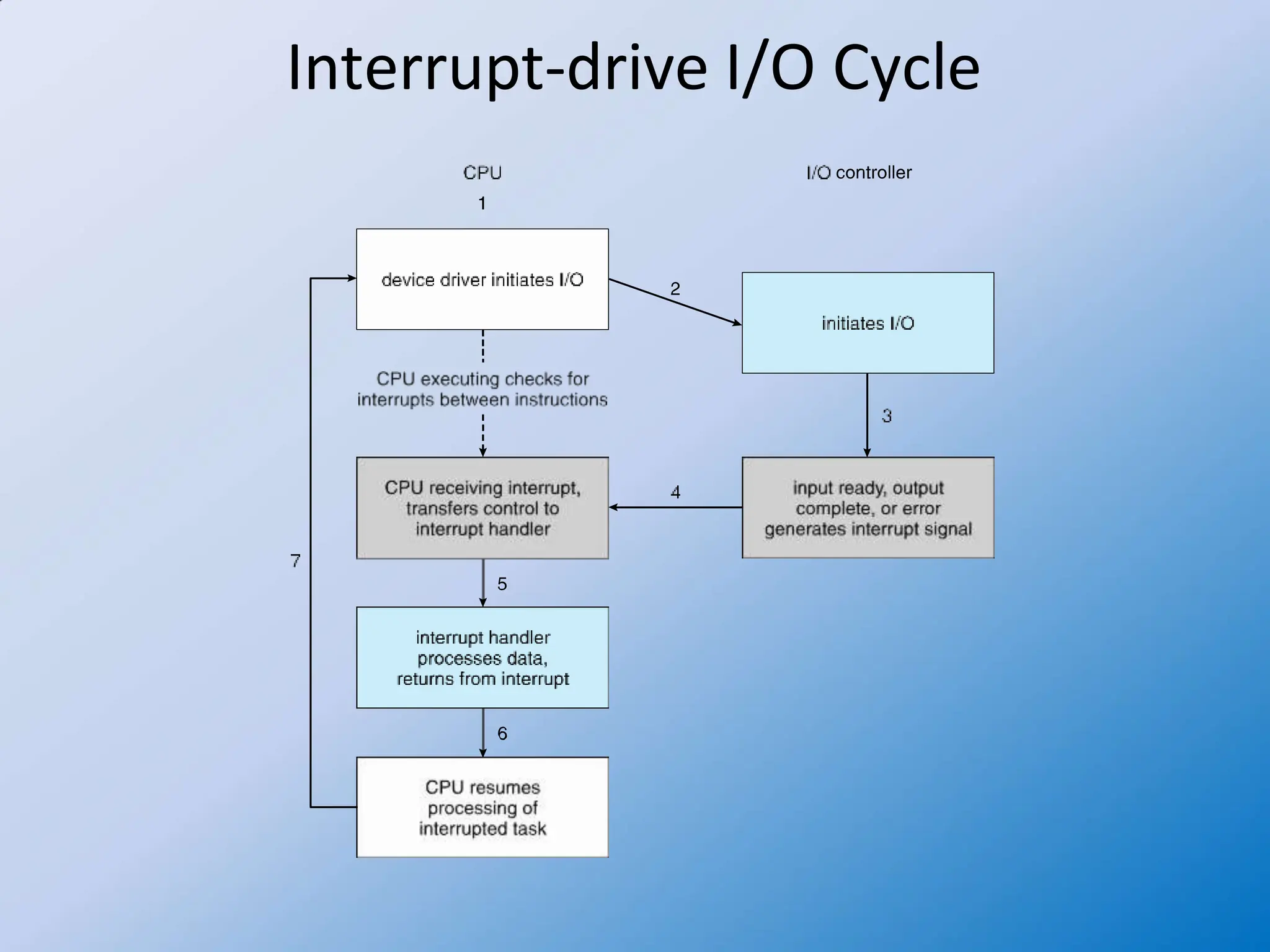
• Device controller informs CPU that it has finished its
operation by causing an interrupt
Common Functions of Interrupts
• Interrupt transfers control to the interrupt
service routine generally, through the interrupt
vector, which contains the addresses of all the
service routines
• Interrupt architecture must save the address of
the interrupted instruction
• A trap or exception is a software-generated
interrupt caused either by an error or a user
request
• An operating system is interrupt driven
Interrupt Timeline
Interrupt Handling
• The operating system preserves the state of the
CPU by storing registers and the program
counter
• Determines which type of interrupt has
occurred:
– polling
– vectored interrupt system
• Separate segments of code determine what
action should be taken for each type of interrupt
Interrupt-drive I/O Cycle
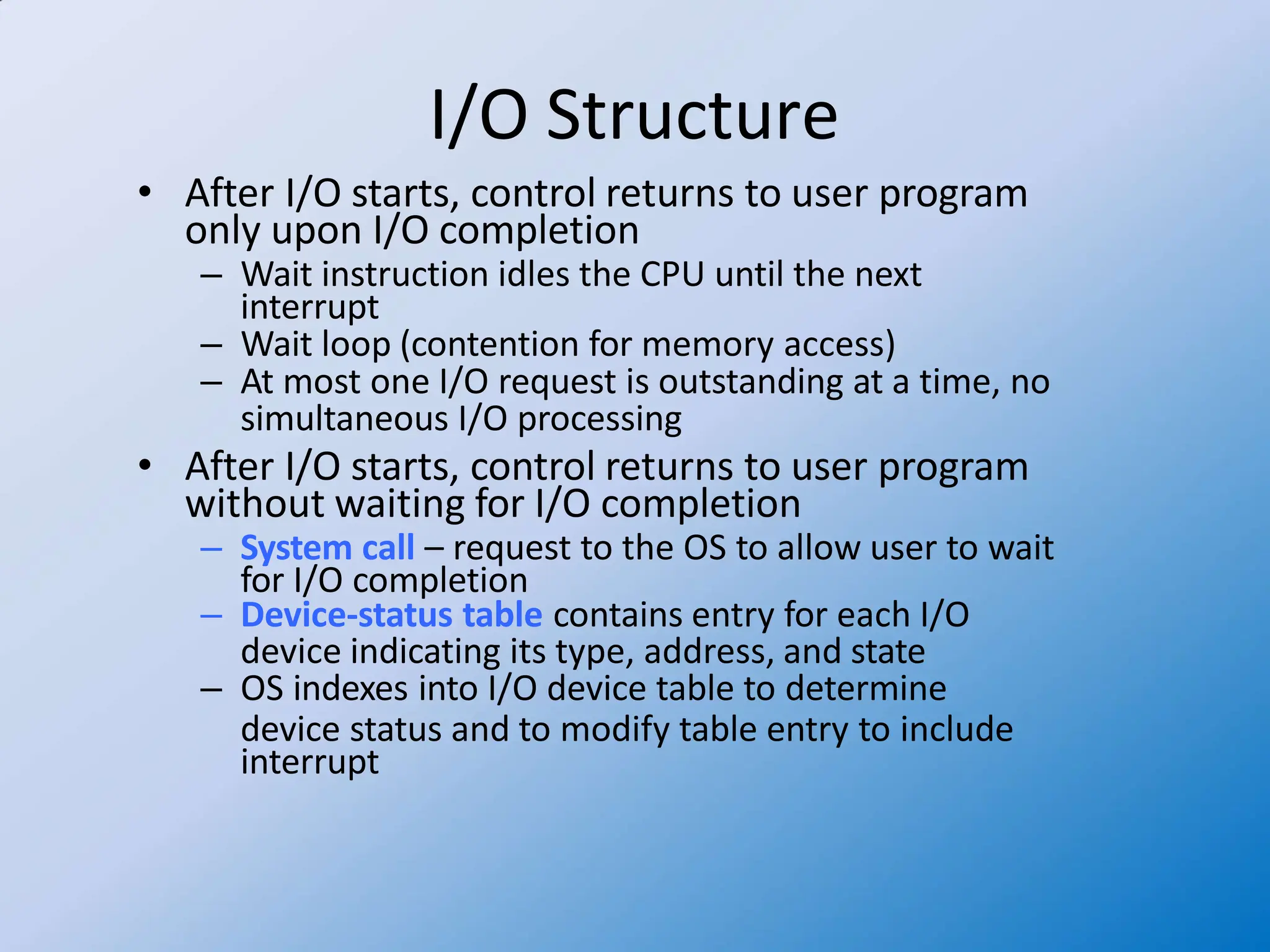
I/O Structure
• After I/O starts, control returns to user program
only upon I/O completion
– Wait instruction idles the CPU until the next
interrupt
– Wait loop (contention for memory access)
– At most one I/O request is outstanding at a time, no
simultaneous I/O processing
• After I/O starts, control returns to user program
without waiting for I/O completion
– System call – request to the OS to allow user to wait
for I/O completion
– Device-status table contains entry for each I/O
device indicating its type, address, and state
– OS indexes into I/O device table to determine
device status and to modify table entry to include
interrupt
Assignment
3. Discuss the computer system operation
and interrupt handling

operatingsystem03handlingofinterrupts-210603182850.pptx

  • 1.
    Operating System 03 Handlingof Interrupts Prof Neeraj Bhargava Vaibhav Khanna Department of Computer Science School of Engineering and Systems Sciences Maharshi Dayanand Saraswati University Ajmer
  • 2.
    Computer Startup • bootstrapprogram is loaded at power-up or reboot – Typically stored in ROM or EPROM, generally known as firmware – Initializes all aspects of system – Loads operating system kernel and starts execution
  • 3.
    Computer System Organization •Computer-system operation – One or more CPUs, device controllers connect through common bus providing access to shared memory – Concurrent execution of CPUs and devices competing for memory cycles
  • 4.
    Computer-System Operation • I/Odevices and the CPU can execute concurrently • Each device controller is in charge of a particular device type • Each device controller has a local buffer • Each device controller type has an operating system device driver to manage it • CPU moves data from/to main memory to/from local buffers • I/O is from the device to local buffer of controller • Device controller informs CPU that it has finished its operation by causing an interrupt
  • 5.
    Common Functions ofInterrupts • Interrupt transfers control to the interrupt service routine generally, through the interrupt vector, which contains the addresses of all the service routines • Interrupt architecture must save the address of the interrupted instruction • A trap or exception is a software-generated interrupt caused either by an error or a user request • An operating system is interrupt driven
  • 6.
  • 7.
    Interrupt Handling • Theoperating system preserves the state of the CPU by storing registers and the program counter • Determines which type of interrupt has occurred: – polling – vectored interrupt system • Separate segments of code determine what action should be taken for each type of interrupt
  • 8.
  • 9.
    I/O Structure • AfterI/O starts, control returns to user program only upon I/O completion – Wait instruction idles the CPU until the next interrupt – Wait loop (contention for memory access) – At most one I/O request is outstanding at a time, no simultaneous I/O processing • After I/O starts, control returns to user program without waiting for I/O completion – System call – request to the OS to allow user to wait for I/O completion – Device-status table contains entry for each I/O device indicating its type, address, and state – OS indexes into I/O device table to determine device status and to modify table entry to include interrupt
  • 10.
    Assignment 3. Discuss thecomputer system operation and interrupt handling