Open Source/Free Software (Non Tech) Talk is cheap! Show me the code ~Linus Trovalds Talk series #3  [email_address]
Imagine!  You love that fish curry your friend's mom cooks And she is  Leaving the town Hasn't taught anybody to cook that You dont have the recipe ......
...situation Where is the recipe (Source code) ?  Not able to make any changes by your own Even have to pray to the developer/vendor He may ask  money to fix even though you have the fix :(
Open Source o·pen-source (ō'pən-sôrs', -sōrs') adj.  Of or relating to source code that is available to the public: an    open - source operating system
Story time .. 1969-1970, Kenneth Thompson, Dennis Ritchie – Multics 1979, the ``seventh edition'' (V7) version of Unix Berkeley Software Distribution (BSD) 1984 Richard Stallman's Free Software Foundation (FSF) began the GNU project 1990s Linux, SLS, Apache, Postgres, Red Hat, Debian, L-I 1991 Linus Torvalds began developing an operating system kernel GNU/Linux 2000s F(L)OSS, Ubuntu, Java, Mono, OpenOffice
Source Code and Obect Code Fish curry – Object code Recipe    – Source code Object code is the usable thingy But to reproduce the same need source code
Define : Open source Community Culture Contribution Context Technology .. not a technique
Define! January 18, 2006 Licenses Community Methodology Alm ost 60 licenses today Some require that code changes be returned to the community at large These are called copyleft or reciprocal They are  not viral This requirement is what makes the methodology work Other licenses are similar to the public domain and have few requirements Copyrights are still a core foundational element of all open source licenses Any collection of developers with a common interest Historically made up of free agents Increasingly funded by large companies sharing development costs Governments and academia also contributing at an increasing pace Communal, shared development Various projects each with their own subculture Governance models vary widely, some autocratic, others consensus based Very few roadmaps, but some projects are starting to publish them Influence and control is achieved by being integrated & involved Individuals are largely in control, not companies
Community/Culture Passionate(passionate & paid?) programmer vs Programmer Cathedral Model and Bazaar Model Cathedral Well-organized, full-time development team Followed by corporate teams Release occasionally    buggy code    alienate users Bazaar Loosely-organized, volunteer “hackers” Release often    motivate developers    maximize development time Will it work ?
Don't Reinvent wheel  “ Good programmers know what to write.  Great ones know what to rewrite (and reuse).” 9 existing programs were close Linus Torvalds started, not from scratch, but with Minix “ When you lose interest in a program, your last duty is to hand it off to a competent successor.” Carl Harris handed ‘popclient’ code to Eric Raymond Lot of the programmers are reinventing the SAME wheel coz of the Closed Source :(
Free Software The freedom to run the program, for any purpose (freedom 0). The freedom to study how the program works, and adapt it to your needs (freedom 1). Access to the source code is a precondition for this. The freedom to redistribute copies so you can help your neighbor (freedom 2). The freedom to improve the program, and release your improvements to the public, so that the whole community benefits (freedom 3). Access to the source code is a precondition for this
OpenSource vs Free Software All open source softwares are not free Some are bounded to Closed Licenses Copy Left (?)  Licenses GPL V2/V3, apache, mozilla foundation, MIT etc. AntiDRM
Governance & Licensing  Open source governance licenses maturity too many options supportability GPL Original BSD Apache MIT W3C LGPL MPL IBM Restrictions Open Source  Licenses Reciprocal Non-reciprocal No Restrictions Patent clauses
New Generation Helps students “learn how to learn” Free content helps global reach of knowledge (e.g. MIT's open courseware) Powers revolutionary new technologies Fosters collaborative creation and dissemination of knowledge (Wikipedia) Solid way to build credibility (e.g. Google's SoC participants, Yahoo!'s hackday)
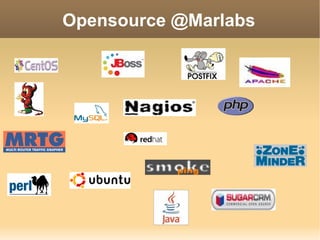
Opensource @Marlabs
Opensource Contribution http://code.google.com/ http://sourceforge.net http://gnu.org http://fsf.org http://setiathome.berkeley.edu

Opensource Talk

  • 1.
    Open Source/Free Software(Non Tech) Talk is cheap! Show me the code ~Linus Trovalds Talk series #3 [email_address]
  • 2.
    Imagine! Youlove that fish curry your friend's mom cooks And she is Leaving the town Hasn't taught anybody to cook that You dont have the recipe ......
  • 3.
    ...situation Where isthe recipe (Source code) ? Not able to make any changes by your own Even have to pray to the developer/vendor He may ask money to fix even though you have the fix :(
  • 4.
    Open Source o·pen-source(ō'pən-sôrs', -sōrs') adj. Of or relating to source code that is available to the public: an open - source operating system
  • 5.
    Story time ..1969-1970, Kenneth Thompson, Dennis Ritchie – Multics 1979, the ``seventh edition'' (V7) version of Unix Berkeley Software Distribution (BSD) 1984 Richard Stallman's Free Software Foundation (FSF) began the GNU project 1990s Linux, SLS, Apache, Postgres, Red Hat, Debian, L-I 1991 Linus Torvalds began developing an operating system kernel GNU/Linux 2000s F(L)OSS, Ubuntu, Java, Mono, OpenOffice
  • 6.
    Source Code andObect Code Fish curry – Object code Recipe – Source code Object code is the usable thingy But to reproduce the same need source code
  • 7.
    Define : Opensource Community Culture Contribution Context Technology .. not a technique
  • 8.
    Define! January 18,2006 Licenses Community Methodology Alm ost 60 licenses today Some require that code changes be returned to the community at large These are called copyleft or reciprocal They are not viral This requirement is what makes the methodology work Other licenses are similar to the public domain and have few requirements Copyrights are still a core foundational element of all open source licenses Any collection of developers with a common interest Historically made up of free agents Increasingly funded by large companies sharing development costs Governments and academia also contributing at an increasing pace Communal, shared development Various projects each with their own subculture Governance models vary widely, some autocratic, others consensus based Very few roadmaps, but some projects are starting to publish them Influence and control is achieved by being integrated & involved Individuals are largely in control, not companies
  • 9.
    Community/Culture Passionate(passionate &paid?) programmer vs Programmer Cathedral Model and Bazaar Model Cathedral Well-organized, full-time development team Followed by corporate teams Release occasionally  buggy code  alienate users Bazaar Loosely-organized, volunteer “hackers” Release often  motivate developers  maximize development time Will it work ?
  • 10.
    Don't Reinvent wheel “ Good programmers know what to write. Great ones know what to rewrite (and reuse).” 9 existing programs were close Linus Torvalds started, not from scratch, but with Minix “ When you lose interest in a program, your last duty is to hand it off to a competent successor.” Carl Harris handed ‘popclient’ code to Eric Raymond Lot of the programmers are reinventing the SAME wheel coz of the Closed Source :(
  • 11.
    Free Software Thefreedom to run the program, for any purpose (freedom 0). The freedom to study how the program works, and adapt it to your needs (freedom 1). Access to the source code is a precondition for this. The freedom to redistribute copies so you can help your neighbor (freedom 2). The freedom to improve the program, and release your improvements to the public, so that the whole community benefits (freedom 3). Access to the source code is a precondition for this
  • 12.
    OpenSource vs FreeSoftware All open source softwares are not free Some are bounded to Closed Licenses Copy Left (?) Licenses GPL V2/V3, apache, mozilla foundation, MIT etc. AntiDRM
  • 13.
    Governance & Licensing Open source governance licenses maturity too many options supportability GPL Original BSD Apache MIT W3C LGPL MPL IBM Restrictions Open Source Licenses Reciprocal Non-reciprocal No Restrictions Patent clauses
  • 14.
    New Generation Helpsstudents “learn how to learn” Free content helps global reach of knowledge (e.g. MIT's open courseware) Powers revolutionary new technologies Fosters collaborative creation and dissemination of knowledge (Wikipedia) Solid way to build credibility (e.g. Google's SoC participants, Yahoo!'s hackday)
  • 15.
  • 16.
    Opensource Contribution http://code.google.com/http://sourceforge.net http://gnu.org http://fsf.org http://setiathome.berkeley.edu