What is OpenCV?
OpenCV,or Open Source Computer Vision Library, is a
powerful library used for computer vision and machine
learning. It contains over 2500 optimized algorithms to
detect and recognize faces, identify objects, classify human
actions, track camera movements, etc. It’s widely used in
real-time applications to process images and videos
efficiently.
5.
Brief History ofOpenCV
OpenCV was created by Intel in 1999, and it was originally intended
for CPU-intensive applications. In 2006, it was supported by Willow
Garage and later by Itseez (now Intel). Its focus has expanded from
computer vision applications to include machine learning tasks,
making it versatile for developers and researchers alike. Its last
major update was the introduction of the Deep Learning module,
which integrates seamlessly with neural networks.
6.
OpenCV's Role in
ComputerVision
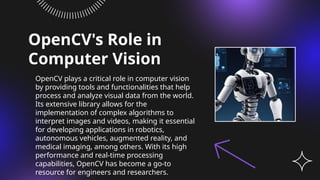
OpenCV plays a critical role in computer vision
by providing tools and functionalities that help
process and analyze visual data from the world.
Its extensive library allows for the
implementation of complex algorithms to
interpret images and videos, making it essential
for developing applications in robotics,
autonomous vehicles, augmented reality, and
medical imaging, among others. With its high
performance and real-time processing
capabilities, OpenCV has become a go-to
resource for engineers and researchers.
Image
Processing
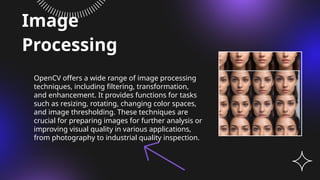
OpenCV offers awide range of image processing
techniques, including filtering, transformation,
and enhancement. It provides functions for tasks
such as resizing, rotating, changing color spaces,
and image thresholding. These techniques are
crucial for preparing images for further analysis or
improving visual quality in various applications,
from photography to industrial quality inspection.
9.
Object Detection
Object detectionusing OpenCV involves identifying and locating
objects within an image or video stream. Techniques like Haar
cascades, HOG (Histogram of Oriented Gradients), and deep
learning models allow developers to detect objects like cars,
people, or animals in real time. It is widely used in surveillance,
automotive safety, and sports analytics to monitor and analyze
scenes effectively.
10.
Facial Recognition
• OpenCV'sfacial recognition capabilities leverage
methods like Eigenfaces, Fisherfaces, and Local Binary
Patterns (LBP).
• These technologies enable applications to identify or
verify individuals based on their facial features.
• Facial recognition is extensively used in security
systems, social media, and user authentication,
providing a seamless and efficient method of interacting
with technology.
11.
Conclusions
OpenCV is apowerful, versatile tool that has revolutionized
the field of computer vision through its extensive library
and capabilities. From image processing to advanced
applications like facial recognition and object detection, it
stands out as an essential resource for professionals and
enthusiasts alike, driving innovation across various fields.