Open Shortest Path First (OSPF)
Computer Networks
Rahul Ranjan
(16010121)
Indian Institute of Information Technology Manipur
April 3, 2018
Rahul Ranjan(16010121) (Indian Institute of Information Technology Manipur)Open Shortest Path First (OSPF) April 3, 2018 1 / 32
Introduction to OSPF
Each router floods link-state information through its neighbors to
other routers.
Based on the flooded link-state information, each router maintains a
complete link-state database.
Based on the link-state database, a routing table is constructed using
SPF (e.g., Dijkstra’s) algorithm.
Runs over IP directly, protocol number 89
Rahul Ranjan(16010121) (Indian Institute of Information Technology Manipur)Open Shortest Path First (OSPF) April 3, 2018 2 / 32
Hierarchical OSPF
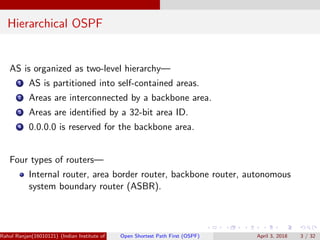
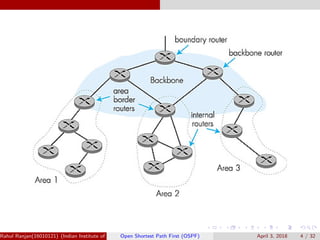
AS is organized as two-level hierarchy—
1 AS is partitioned into self-contained areas.
2 Areas are interconnected by a backbone area.
3 Areas are identified by a 32-bit area ID.
4 0.0.0.0 is reserved for the backbone area.
Four types of routers—
Internal router, area border router, backbone router, autonomous
system boundary router (ASBR).
Rahul Ranjan(16010121) (Indian Institute of Information Technology Manipur)Open Shortest Path First (OSPF) April 3, 2018 3 / 32
Rahul Ranjan(16010121) (Indian Institute of Information Technology Manipur)Open Shortest Path First (OSPF) April 3, 2018 4 / 32
Metric in OSPF
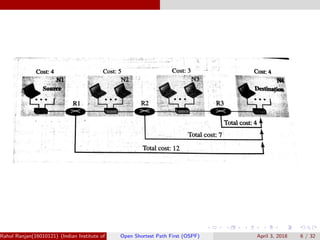
The Metric explains , the cost of reaching a destination from the host
is calculated from the source router to the destination network.
In case of Metric hop- count can be used as the Cost by
administration.
Rahul Ranjan(16010121) (Indian Institute of Information Technology Manipur)Open Shortest Path First (OSPF) April 3, 2018 5 / 32
Rahul Ranjan(16010121) (Indian Institute of Information Technology Manipur)Open Shortest Path First (OSPF) April 3, 2018 6 / 32
Forwarding Tables
1 Each OSPF router can create a forwarding table after finding the
shortest - path tree between itself and the destination.
2 If we take consider or use the hop count for OSPF , the both tables
will be exactly same.
Rahul Ranjan(16010121) (Indian Institute of Information Technology Manipur)Open Shortest Path First (OSPF) April 3, 2018 7 / 32
Rahul Ranjan(16010121) (Indian Institute of Information Technology Manipur)Open Shortest Path First (OSPF) April 3, 2018 8 / 32
Link-State Advertisement
OSPF is based on the link-state routing algorithm, which require that
a router advertise the state of each link to all neighbors for the
formation of the Link-State Database.
We used the graph theory and assumed each router as a node and
each network between two router is edge.
Rahul Ranjan(16010121) (Indian Institute of Information Technology Manipur)Open Shortest Path First (OSPF) April 3, 2018 9 / 32
Types of LSA
1 Router link
2 Network link
3 Summary link to Network
4 Summary link to AS
5 External Link
Rahul Ranjan(16010121) (Indian Institute of Information Technology Manipur)Open Shortest Path First (OSPF) April 3, 2018 10 / 32
Router Link
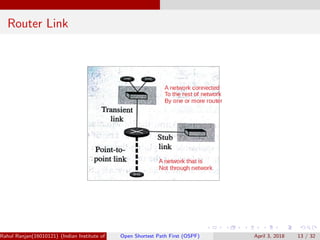
1 A router link advertises the existence of a router as a node.
2 These types of advertisements can define one or more types of links
that connect the advertising router to other entities.
3 Instead of just giving the address of announcing routers.
4 A transient link announces a link to a transient network.
Rahul Ranjan(16010121) (Indian Institute of Information Technology Manipur)Open Shortest Path First (OSPF) April 3, 2018 11 / 32
Router Link
1 A transient network is connected to the rest of the networks by one or
more routers.
2 The router link define the address and cost of all transient links.
3 A Stub Link advertises a link to a stub network, a network that is not
a through network (No Knowledge of other network) & the Router
link advertises the address & cost of Stub link.
Rahul Ranjan(16010121) (Indian Institute of Information Technology Manipur)Open Shortest Path First (OSPF) April 3, 2018 12 / 32
Router Link
Rahul Ranjan(16010121) (Indian Institute of Information Technology Manipur)Open Shortest Path First (OSPF) April 3, 2018 13 / 32
Network link
A network link advertises the network as a node.
However a network can’t do announcements itself so one of the router
is assigned as the designated router and does the advertising.
In addition to the address of the designated router , this type of LSP
announces the IP Address of all routers.
In case of Network link , no cost is advertised because each router
announces the cost to the network when it sends a router link
advertisements.
Rahul Ranjan(16010121) (Indian Institute of Information Technology Manipur)Open Shortest Path First (OSPF) April 3, 2018 14 / 32
Network link
Rahul Ranjan(16010121) (Indian Institute of Information Technology Manipur)Open Shortest Path First (OSPF) April 3, 2018 15 / 32
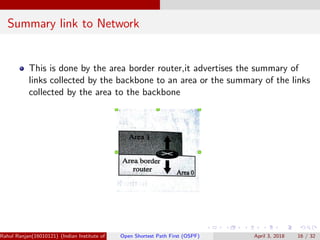
Summary link to Network
This is done by the area border router,it advertises the summary of
links collected by the backbone to an area or the summary of the links
collected by the area to the backbone
Rahul Ranjan(16010121) (Indian Institute of Information Technology Manipur)Open Shortest Path First (OSPF) April 3, 2018 16 / 32
Summary link to AS
This is done by the AS router that advertises the summary links from
ASs to the backbone area of the current AS, information which later
can be disseminated to the area so they will know about the network
in other ASs.
Rahul Ranjan(16010121) (Indian Institute of Information Technology Manipur)Open Shortest Path First (OSPF) April 3, 2018 17 / 32
Summary Link to AS
Rahul Ranjan(16010121) (Indian Institute of Information Technology Manipur)Open Shortest Path First (OSPF) April 3, 2018 18 / 32
External Link
This is also done by an AS router to announce the existence of a
single network outside the AS to the backbone area to be
disseminated into the area.
Rahul Ranjan(16010121) (Indian Institute of Information Technology Manipur)Open Shortest Path First (OSPF) April 3, 2018 19 / 32
External Link
Rahul Ranjan(16010121) (Indian Institute of Information Technology Manipur)Open Shortest Path First (OSPF) April 3, 2018 20 / 32
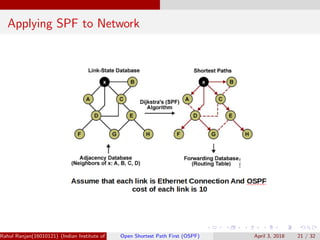
Applying SPF to Network
Rahul Ranjan(16010121) (Indian Institute of Information Technology Manipur)Open Shortest Path First (OSPF) April 3, 2018 21 / 32
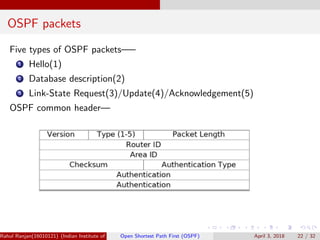
OSPF packets
Five types of OSPF packets—–
1 Hello(1)
2 Database description(2)
3 Link-State Request(3)/Update(4)/Acknowledgement(5)
OSPF common header—
Rahul Ranjan(16010121) (Indian Institute of Information Technology Manipur)Open Shortest Path First (OSPF) April 3, 2018 22 / 32
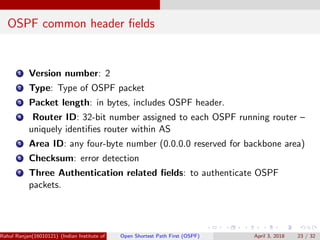
OSPF common header fields
1 Version number: 2
2 Type: Type of OSPF packet
3 Packet length: in bytes, includes OSPF header.
4 Router ID: 32-bit number assigned to each OSPF running router –
uniquely identifies router within AS
5 Area ID: any four-byte number (0.0.0.0 reserved for backbone area)
6 Checksum: error detection
7 Three Authentication related fields: to authenticate OSPF
packets.
Rahul Ranjan(16010121) (Indian Institute of Information Technology Manipur)Open Shortest Path First (OSPF) April 3, 2018 23 / 32
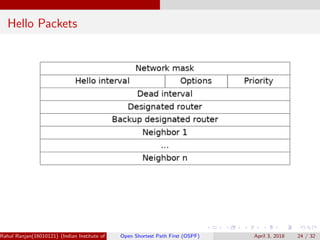
Hello Packets
Rahul Ranjan(16010121) (Indian Institute of Information Technology Manipur)Open Shortest Path First (OSPF) April 3, 2018 24 / 32
Hello packet fields
Network mask: Subnet mask of the interface the packet is sent on
Hello interval: Number of seconds between Hello packets
Options: optional capabilities supported by the router
Priority: of the router – used in election of designated router
Dead interval: Number of seconds before declaring a non
responding neighbor down
Designated router/Backup: Every broadcast network with at least
two routers has a designated router. This sends network LSAs for the
broadcast network. This field is 0.0.0.0 if there is no designated router
Neighbors: Router ID of each neighbor from whom Hello packets
have recently been received.
Rahul Ranjan(16010121) (Indian Institute of Information Technology Manipur)Open Shortest Path First (OSPF) April 3, 2018 25 / 32
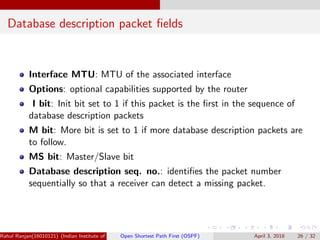
Database description packet fields
Interface MTU: MTU of the associated interface
Options: optional capabilities supported by the router
I bit: Init bit set to 1 if this packet is the first in the sequence of
database description packets
M bit: More bit is set to 1 if more database description packets are
to follow.
MS bit: Master/Slave bit
Database description seq. no.: identifies the packet number
sequentially so that a receiver can detect a missing packet.
Rahul Ranjan(16010121) (Indian Institute of Information Technology Manipur)Open Shortest Path First (OSPF) April 3, 2018 26 / 32
OSPF packets
Rahul Ranjan(16010121) (Indian Institute of Information Technology Manipur)Open Shortest Path First (OSPF) April 3, 2018 27 / 32
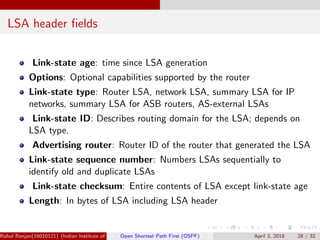
LSA header fields
Link-state age: time since LSA generation
Options: Optional capabilities supported by the router
Link-state type: Router LSA, network LSA, summary LSA for IP
networks, summary LSA for ASB routers, AS-external LSAs
Link-state ID: Describes routing domain for the LSA; depends on
LSA type.
Advertising router: Router ID of the router that generated the LSA
Link-state sequence number: Numbers LSAs sequentially to
identify old and duplicate LSAs
Link-state checksum: Entire contents of LSA except link-state age
Length: In bytes of LSA including LSA header
Rahul Ranjan(16010121) (Indian Institute of Information Technology Manipur)Open Shortest Path First (OSPF) April 3, 2018 28 / 32
Link-state Request/Update/ Acknowledgement
Rahul Ranjan(16010121) (Indian Institute of Information Technology Manipur)Open Shortest Path First (OSPF) April 3, 2018 29 / 32
Link state updates
Each Link State Update packet carries a set of new link state
advertisements (LSAs) one hop further away from their point of
origination.
A single Link State Update packet may contain the LSAs of several
routers. Each LSA is tagged with the ID of the originating router and
a checksum of its link state contents
Rahul Ranjan(16010121) (Indian Institute of Information Technology Manipur)Open Shortest Path First (OSPF) April 3, 2018 30 / 32
Performance of OSPF
Update messages :- As the LS message in it is more complex so
these message uses lot of bandwidth.
Convergence of Forwarding tables :- As each router need to run
SPF(Dijkstra) algorithm so this might take some time.
Robustness :- It is more robust than RIP because each router is
independent of others .
Rahul Ranjan(16010121) (Indian Institute of Information Technology Manipur)Open Shortest Path First (OSPF) April 3, 2018 31 / 32
Thank You!!
”Thank You for listenning me!!!”
Rahul Ranjan(16010121) (Indian Institute of Information Technology Manipur)Open Shortest Path First (OSPF) April 3, 2018 32 / 32

Open Shortest Path First (OSPF)-Unicast Routing

  • 1.
    Open Shortest PathFirst (OSPF) Computer Networks Rahul Ranjan (16010121) Indian Institute of Information Technology Manipur April 3, 2018 Rahul Ranjan(16010121) (Indian Institute of Information Technology Manipur)Open Shortest Path First (OSPF) April 3, 2018 1 / 32
  • 2.
    Introduction to OSPF Eachrouter floods link-state information through its neighbors to other routers. Based on the flooded link-state information, each router maintains a complete link-state database. Based on the link-state database, a routing table is constructed using SPF (e.g., Dijkstra’s) algorithm. Runs over IP directly, protocol number 89 Rahul Ranjan(16010121) (Indian Institute of Information Technology Manipur)Open Shortest Path First (OSPF) April 3, 2018 2 / 32
  • 3.
    Hierarchical OSPF AS isorganized as two-level hierarchy— 1 AS is partitioned into self-contained areas. 2 Areas are interconnected by a backbone area. 3 Areas are identified by a 32-bit area ID. 4 0.0.0.0 is reserved for the backbone area. Four types of routers— Internal router, area border router, backbone router, autonomous system boundary router (ASBR). Rahul Ranjan(16010121) (Indian Institute of Information Technology Manipur)Open Shortest Path First (OSPF) April 3, 2018 3 / 32
  • 4.
    Rahul Ranjan(16010121) (IndianInstitute of Information Technology Manipur)Open Shortest Path First (OSPF) April 3, 2018 4 / 32
  • 5.
    Metric in OSPF TheMetric explains , the cost of reaching a destination from the host is calculated from the source router to the destination network. In case of Metric hop- count can be used as the Cost by administration. Rahul Ranjan(16010121) (Indian Institute of Information Technology Manipur)Open Shortest Path First (OSPF) April 3, 2018 5 / 32
  • 6.
    Rahul Ranjan(16010121) (IndianInstitute of Information Technology Manipur)Open Shortest Path First (OSPF) April 3, 2018 6 / 32
  • 7.
    Forwarding Tables 1 EachOSPF router can create a forwarding table after finding the shortest - path tree between itself and the destination. 2 If we take consider or use the hop count for OSPF , the both tables will be exactly same. Rahul Ranjan(16010121) (Indian Institute of Information Technology Manipur)Open Shortest Path First (OSPF) April 3, 2018 7 / 32
  • 8.
    Rahul Ranjan(16010121) (IndianInstitute of Information Technology Manipur)Open Shortest Path First (OSPF) April 3, 2018 8 / 32
  • 9.
    Link-State Advertisement OSPF isbased on the link-state routing algorithm, which require that a router advertise the state of each link to all neighbors for the formation of the Link-State Database. We used the graph theory and assumed each router as a node and each network between two router is edge. Rahul Ranjan(16010121) (Indian Institute of Information Technology Manipur)Open Shortest Path First (OSPF) April 3, 2018 9 / 32
  • 10.
    Types of LSA 1Router link 2 Network link 3 Summary link to Network 4 Summary link to AS 5 External Link Rahul Ranjan(16010121) (Indian Institute of Information Technology Manipur)Open Shortest Path First (OSPF) April 3, 2018 10 / 32
  • 11.
    Router Link 1 Arouter link advertises the existence of a router as a node. 2 These types of advertisements can define one or more types of links that connect the advertising router to other entities. 3 Instead of just giving the address of announcing routers. 4 A transient link announces a link to a transient network. Rahul Ranjan(16010121) (Indian Institute of Information Technology Manipur)Open Shortest Path First (OSPF) April 3, 2018 11 / 32
  • 12.
    Router Link 1 Atransient network is connected to the rest of the networks by one or more routers. 2 The router link define the address and cost of all transient links. 3 A Stub Link advertises a link to a stub network, a network that is not a through network (No Knowledge of other network) & the Router link advertises the address & cost of Stub link. Rahul Ranjan(16010121) (Indian Institute of Information Technology Manipur)Open Shortest Path First (OSPF) April 3, 2018 12 / 32
  • 13.
    Router Link Rahul Ranjan(16010121)(Indian Institute of Information Technology Manipur)Open Shortest Path First (OSPF) April 3, 2018 13 / 32
  • 14.
    Network link A networklink advertises the network as a node. However a network can’t do announcements itself so one of the router is assigned as the designated router and does the advertising. In addition to the address of the designated router , this type of LSP announces the IP Address of all routers. In case of Network link , no cost is advertised because each router announces the cost to the network when it sends a router link advertisements. Rahul Ranjan(16010121) (Indian Institute of Information Technology Manipur)Open Shortest Path First (OSPF) April 3, 2018 14 / 32
  • 15.
    Network link Rahul Ranjan(16010121)(Indian Institute of Information Technology Manipur)Open Shortest Path First (OSPF) April 3, 2018 15 / 32
  • 16.
    Summary link toNetwork This is done by the area border router,it advertises the summary of links collected by the backbone to an area or the summary of the links collected by the area to the backbone Rahul Ranjan(16010121) (Indian Institute of Information Technology Manipur)Open Shortest Path First (OSPF) April 3, 2018 16 / 32
  • 17.
    Summary link toAS This is done by the AS router that advertises the summary links from ASs to the backbone area of the current AS, information which later can be disseminated to the area so they will know about the network in other ASs. Rahul Ranjan(16010121) (Indian Institute of Information Technology Manipur)Open Shortest Path First (OSPF) April 3, 2018 17 / 32
  • 18.
    Summary Link toAS Rahul Ranjan(16010121) (Indian Institute of Information Technology Manipur)Open Shortest Path First (OSPF) April 3, 2018 18 / 32
  • 19.
    External Link This isalso done by an AS router to announce the existence of a single network outside the AS to the backbone area to be disseminated into the area. Rahul Ranjan(16010121) (Indian Institute of Information Technology Manipur)Open Shortest Path First (OSPF) April 3, 2018 19 / 32
  • 20.
    External Link Rahul Ranjan(16010121)(Indian Institute of Information Technology Manipur)Open Shortest Path First (OSPF) April 3, 2018 20 / 32
  • 21.
    Applying SPF toNetwork Rahul Ranjan(16010121) (Indian Institute of Information Technology Manipur)Open Shortest Path First (OSPF) April 3, 2018 21 / 32
  • 22.
    OSPF packets Five typesof OSPF packets—– 1 Hello(1) 2 Database description(2) 3 Link-State Request(3)/Update(4)/Acknowledgement(5) OSPF common header— Rahul Ranjan(16010121) (Indian Institute of Information Technology Manipur)Open Shortest Path First (OSPF) April 3, 2018 22 / 32
  • 23.
    OSPF common headerfields 1 Version number: 2 2 Type: Type of OSPF packet 3 Packet length: in bytes, includes OSPF header. 4 Router ID: 32-bit number assigned to each OSPF running router – uniquely identifies router within AS 5 Area ID: any four-byte number (0.0.0.0 reserved for backbone area) 6 Checksum: error detection 7 Three Authentication related fields: to authenticate OSPF packets. Rahul Ranjan(16010121) (Indian Institute of Information Technology Manipur)Open Shortest Path First (OSPF) April 3, 2018 23 / 32
  • 24.
    Hello Packets Rahul Ranjan(16010121)(Indian Institute of Information Technology Manipur)Open Shortest Path First (OSPF) April 3, 2018 24 / 32
  • 25.
    Hello packet fields Networkmask: Subnet mask of the interface the packet is sent on Hello interval: Number of seconds between Hello packets Options: optional capabilities supported by the router Priority: of the router – used in election of designated router Dead interval: Number of seconds before declaring a non responding neighbor down Designated router/Backup: Every broadcast network with at least two routers has a designated router. This sends network LSAs for the broadcast network. This field is 0.0.0.0 if there is no designated router Neighbors: Router ID of each neighbor from whom Hello packets have recently been received. Rahul Ranjan(16010121) (Indian Institute of Information Technology Manipur)Open Shortest Path First (OSPF) April 3, 2018 25 / 32
  • 26.
    Database description packetfields Interface MTU: MTU of the associated interface Options: optional capabilities supported by the router I bit: Init bit set to 1 if this packet is the first in the sequence of database description packets M bit: More bit is set to 1 if more database description packets are to follow. MS bit: Master/Slave bit Database description seq. no.: identifies the packet number sequentially so that a receiver can detect a missing packet. Rahul Ranjan(16010121) (Indian Institute of Information Technology Manipur)Open Shortest Path First (OSPF) April 3, 2018 26 / 32
  • 27.
    OSPF packets Rahul Ranjan(16010121)(Indian Institute of Information Technology Manipur)Open Shortest Path First (OSPF) April 3, 2018 27 / 32
  • 28.
    LSA header fields Link-stateage: time since LSA generation Options: Optional capabilities supported by the router Link-state type: Router LSA, network LSA, summary LSA for IP networks, summary LSA for ASB routers, AS-external LSAs Link-state ID: Describes routing domain for the LSA; depends on LSA type. Advertising router: Router ID of the router that generated the LSA Link-state sequence number: Numbers LSAs sequentially to identify old and duplicate LSAs Link-state checksum: Entire contents of LSA except link-state age Length: In bytes of LSA including LSA header Rahul Ranjan(16010121) (Indian Institute of Information Technology Manipur)Open Shortest Path First (OSPF) April 3, 2018 28 / 32
  • 29.
    Link-state Request/Update/ Acknowledgement RahulRanjan(16010121) (Indian Institute of Information Technology Manipur)Open Shortest Path First (OSPF) April 3, 2018 29 / 32
  • 30.
    Link state updates EachLink State Update packet carries a set of new link state advertisements (LSAs) one hop further away from their point of origination. A single Link State Update packet may contain the LSAs of several routers. Each LSA is tagged with the ID of the originating router and a checksum of its link state contents Rahul Ranjan(16010121) (Indian Institute of Information Technology Manipur)Open Shortest Path First (OSPF) April 3, 2018 30 / 32
  • 31.
    Performance of OSPF Updatemessages :- As the LS message in it is more complex so these message uses lot of bandwidth. Convergence of Forwarding tables :- As each router need to run SPF(Dijkstra) algorithm so this might take some time. Robustness :- It is more robust than RIP because each router is independent of others . Rahul Ranjan(16010121) (Indian Institute of Information Technology Manipur)Open Shortest Path First (OSPF) April 3, 2018 31 / 32
  • 32.
    Thank You!! ”Thank Youfor listenning me!!!” Rahul Ranjan(16010121) (Indian Institute of Information Technology Manipur)Open Shortest Path First (OSPF) April 3, 2018 32 / 32