OpenSAF in the Cloud. Why an HA 
Middleware is still needed 
Anders Widell 
Ericsson 
Mathivanan NP 
Oracle 
opensaf.sourceforge.net
Agenda 
● The OpenSAF Project 
●High Availability and Service Availability 
●Why Application HA is necessary in the 
cloud 
●OpenSAF HA capabilities 
● Proposal to leverage OpenSAF HA with 
existing cloud solutions for unified 
availability management 
●OpenSAF roadmap
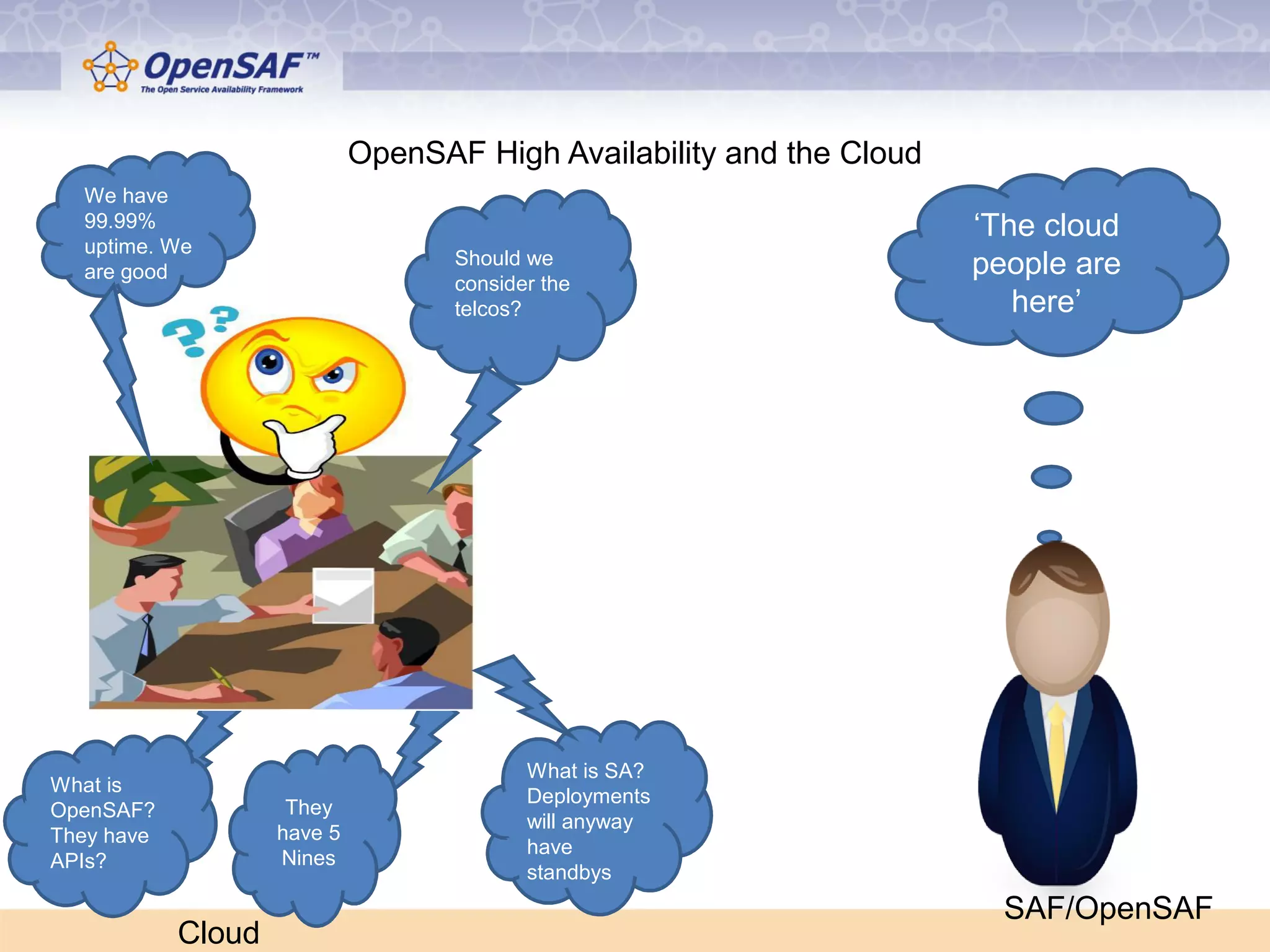
OpenSAF High Availability and the Cloud 
‘The cloud 
people are 
here’ 
They 
have 5 
Nines 
What is 
OpenSAF? 
They have 
APIs? 
Should we 
consider the 
telcos? 
We have 
99.99% 
uptime. We 
are good 
What is SA? 
Deployments 
will anyway 
have 
standbys 
SAF/OpenSAF 
Cloud
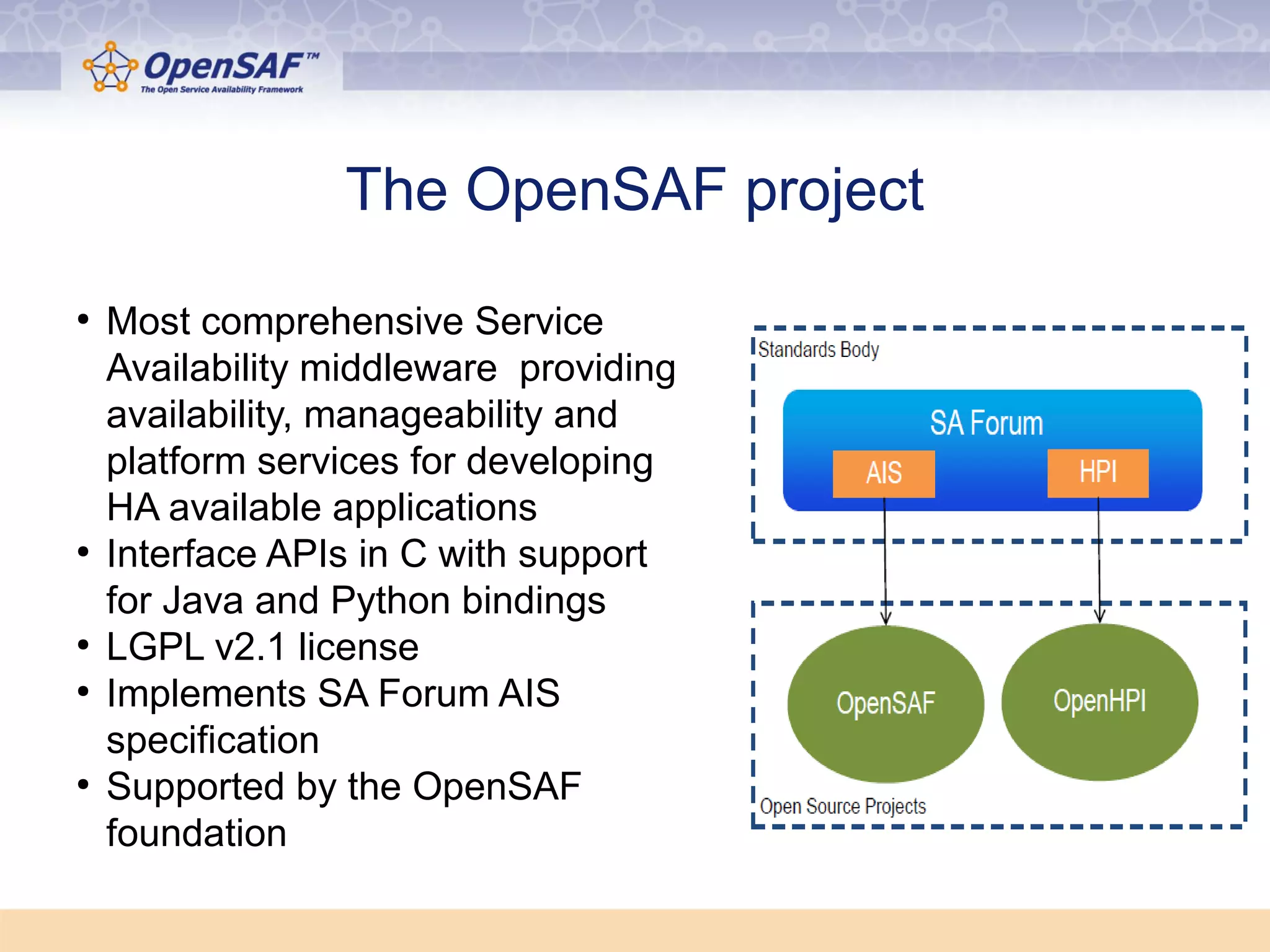
The OpenSAF project 
● Most comprehensive Service 
Availability middleware providing 
availability, manageability and 
platform services for developing 
HA available applications 
● Interface APIs in C with support 
for Java and Python bindings 
● LGPL v2.1 license 
● Implements SA Forum AIS 
specification 
● Supported by the OpenSAF 
foundation
High Availability and Service Availability 
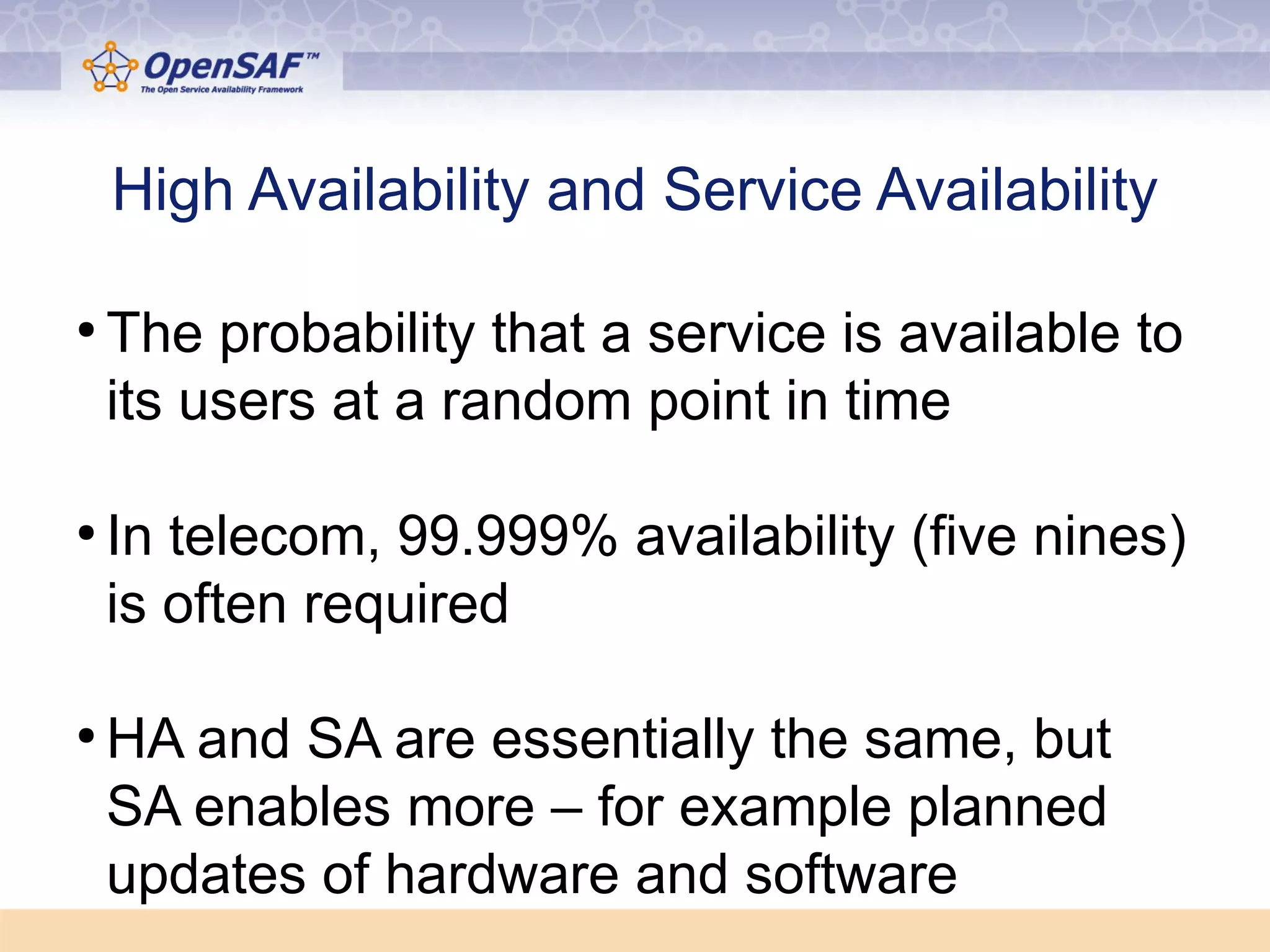
● The probability that a service is available to 
its users at a random point in time 
● In telecom, 99.999% availability (five nines) 
is often required 
●HA and SA are essentially the same, but 
SA enables more – for example planned 
updates of hardware and software
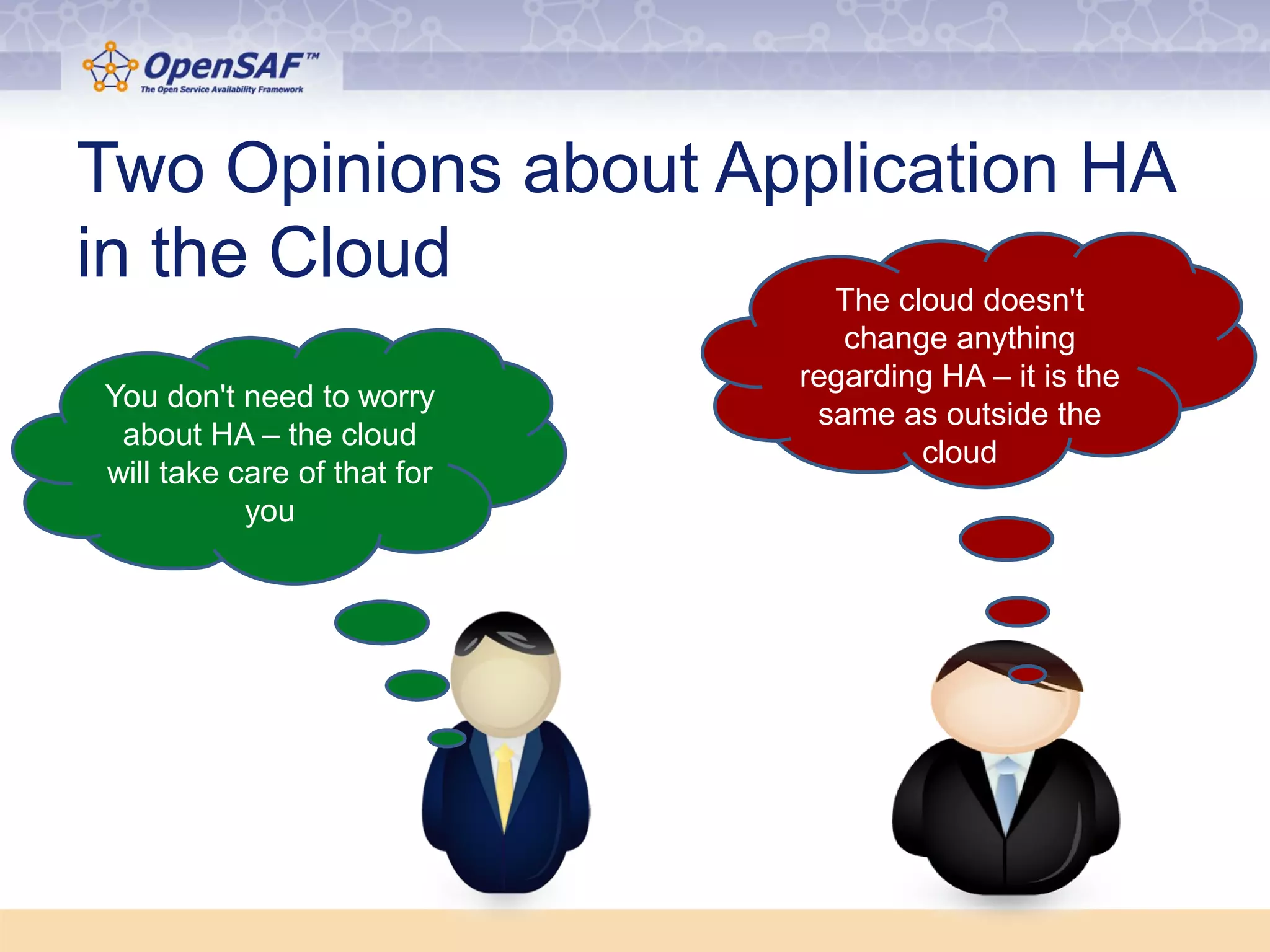
Two Opinions about Application HA 
in the Cloud 
The cloud doesn't 
change anything 
regarding HA – it is the 
same as outside the 
cloud 
You don't need to worry 
about HA – the cloud 
will take care of that for 
you
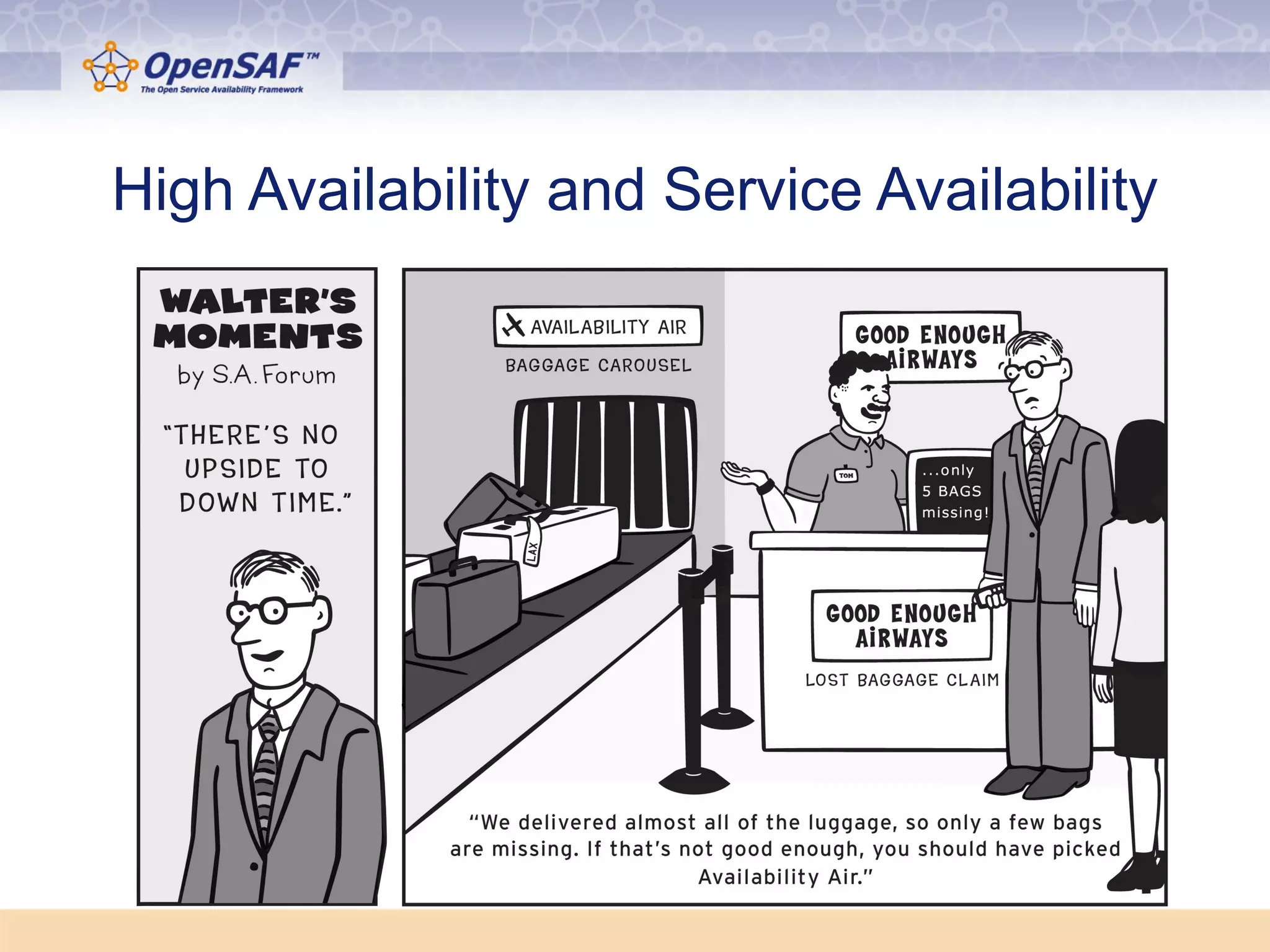
High Availability and Service Availability
Hardware Faults 
● The cloud infrastructure can handle 
hardware faults for you – all the application 
sees is a node reboot 
●With a hot standby VM, even a reboot may 
be avoided 
● Problem with co-located VMs – we don't 
want to have active and standby app on 
the same physical node
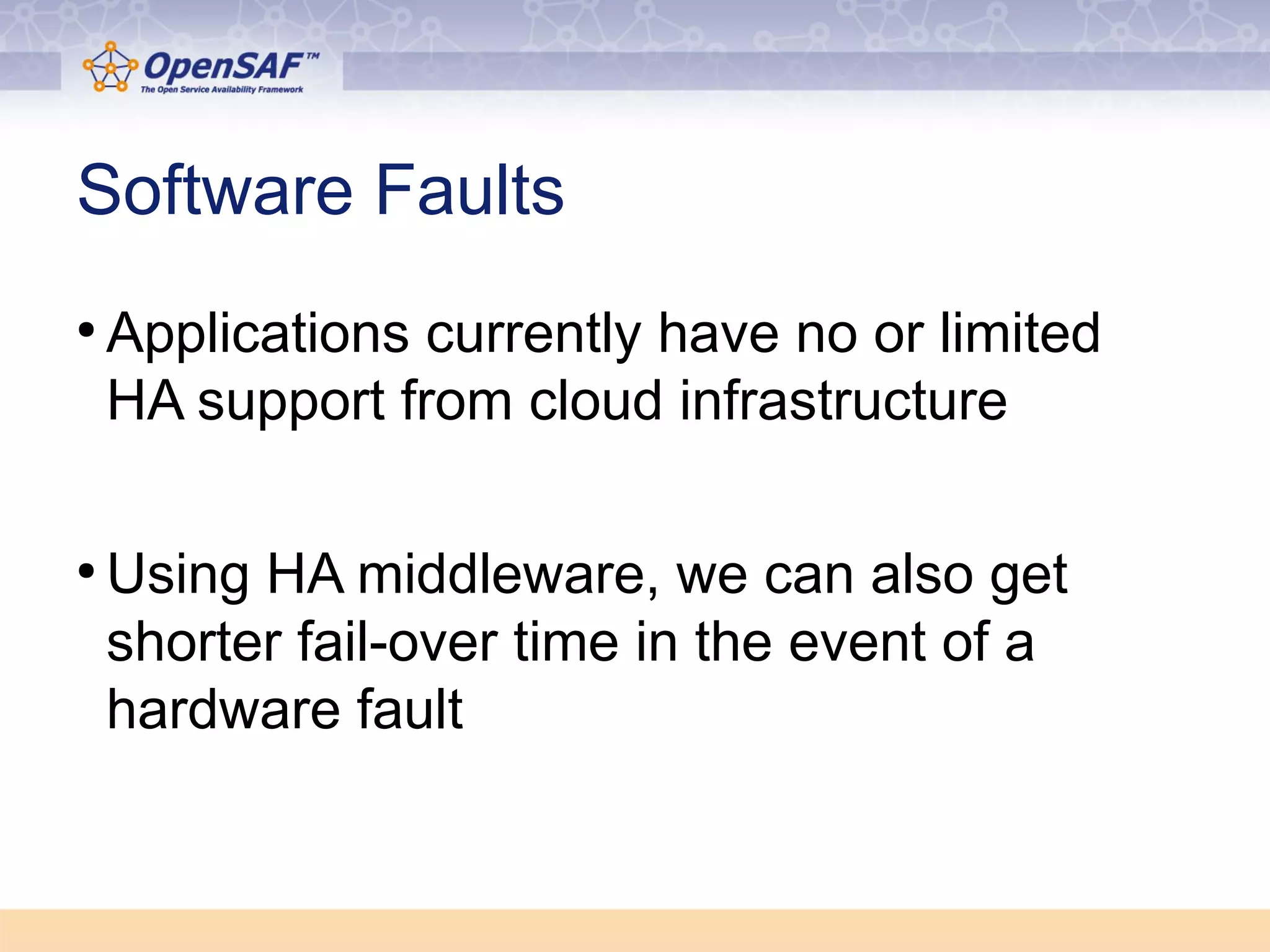
Software Faults 
● Applications currently have no or limited 
HA support from cloud infrastructure 
●Using HA middleware, we can also get 
shorter fail-over time in the event of a 
hardware fault
The Cloud Gives You More Faults 
●Hypervisor and cloud infrastructure are 
also subject to faults 
●Hardware used in cloud may be less 
reliable (not carrier grade) 
●Geographic distribution may decrease the 
risk of total outage, at the cost of network 
latency and increased risk for split-brain
The cloud way – pets vs. cattle 
• Pets: few powerful nodes, scale-up 
• Cattle: many cheap nodes, scale-out 
• “architecting for failure” vs “architecting for 
scale”
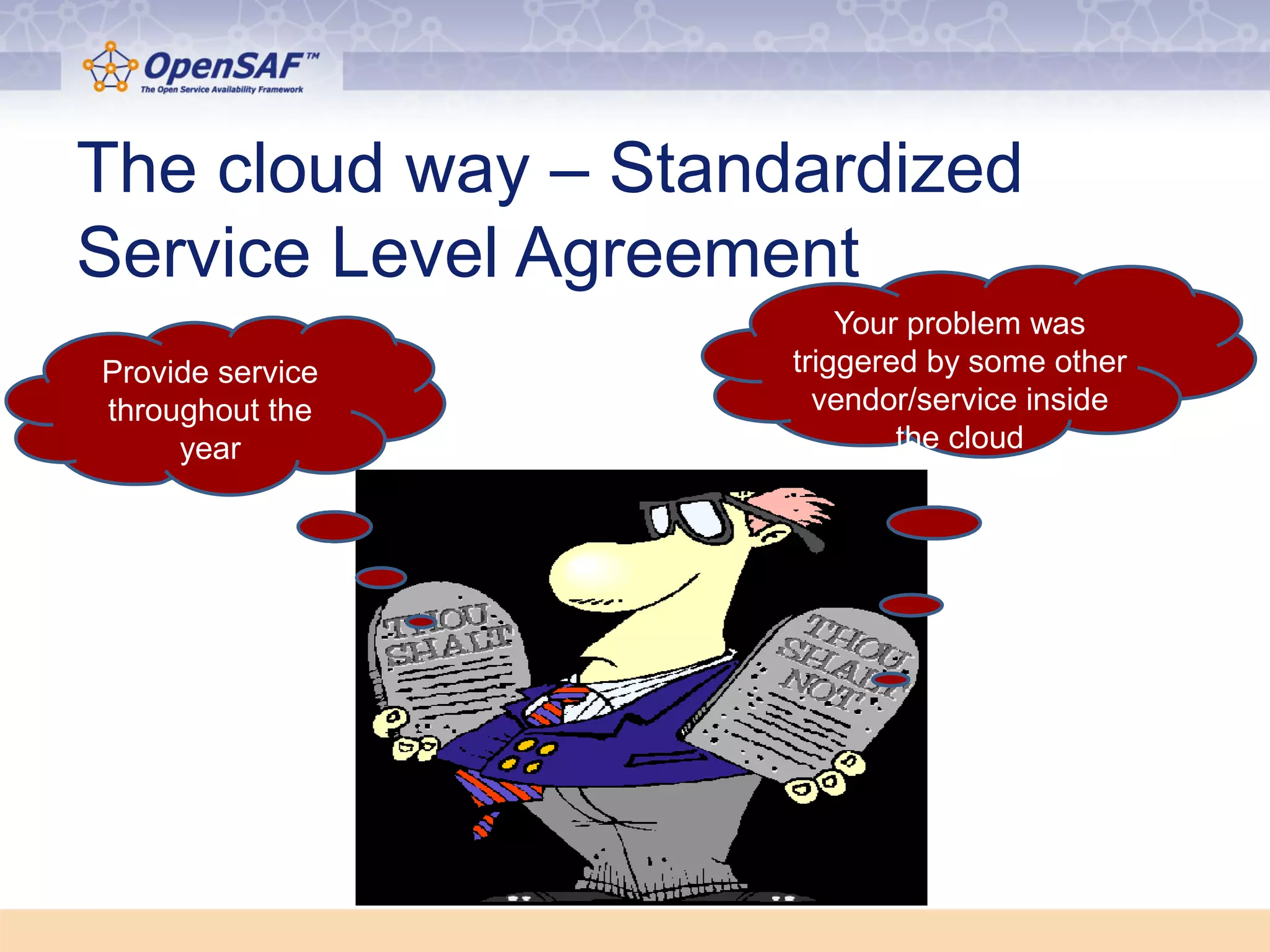
The cloud way – Standardized 
Service Level Agreement 
Your problem was 
triggered by some other 
vendor/service inside 
the cloud 
Provide service 
throughout the 
year
OpenSAF based HA 
●OpenSAF based HA solutions are 
applicable across the availability spectrum: 
● Enterprise 
● Telecom and aerospace/defense 
● Millisecond failover
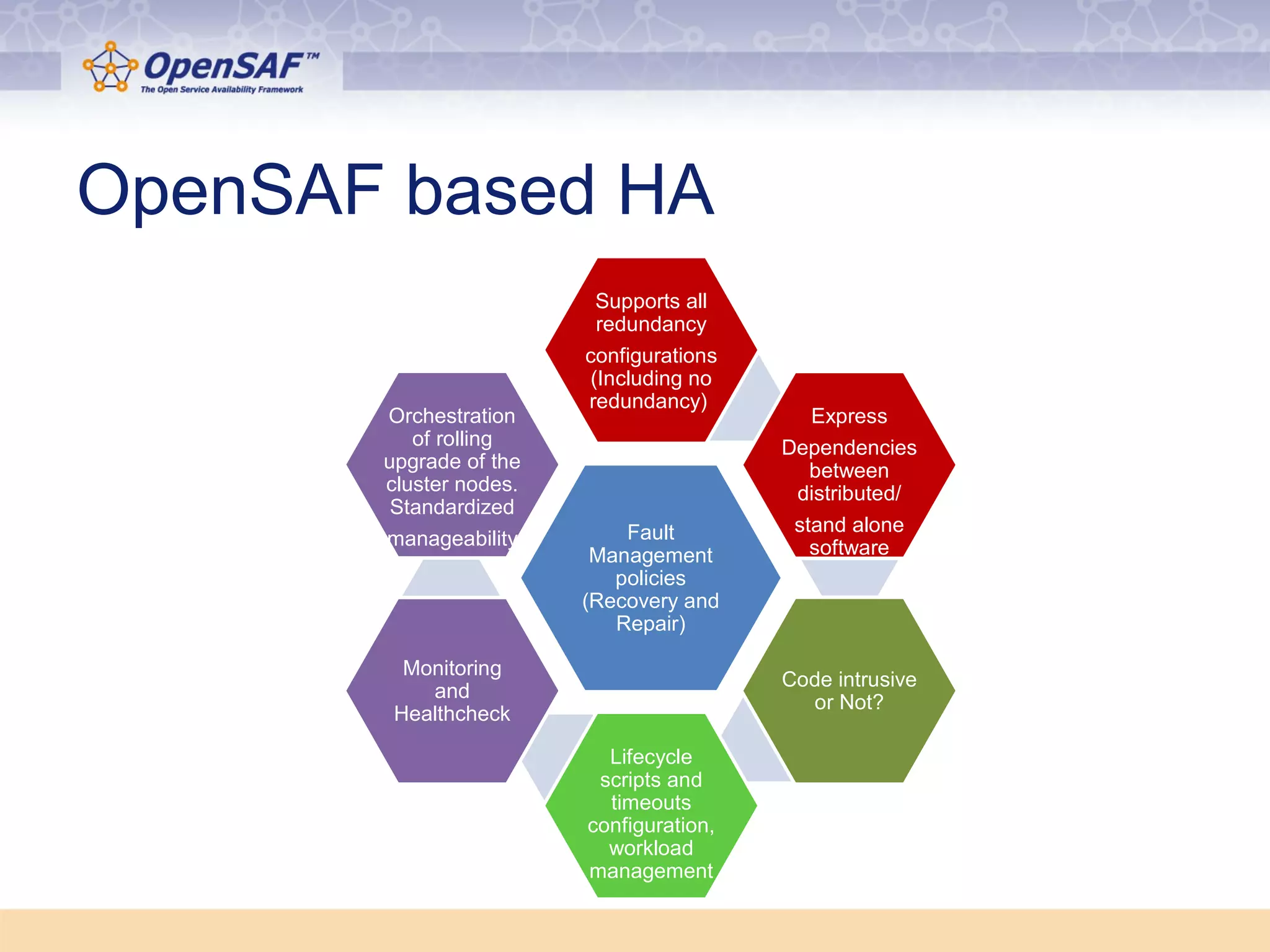
OpenSAF based HA 
Supports all 
redundancy 
configurations 
(Including no 
redundancy) 
Fault 
Management 
policies 
(Recovery and 
Repair) 
Express 
Dependencies 
between 
distributed/ 
stand alone 
software 
Code intrusive 
or Not? 
Lifecycle 
scripts and 
timeouts 
configuration, 
workload 
management 
Orchestration 
of rolling 
upgrade of the 
cluster nodes. 
Standardized 
manageability 
Monitoring 
and 
Healthcheck
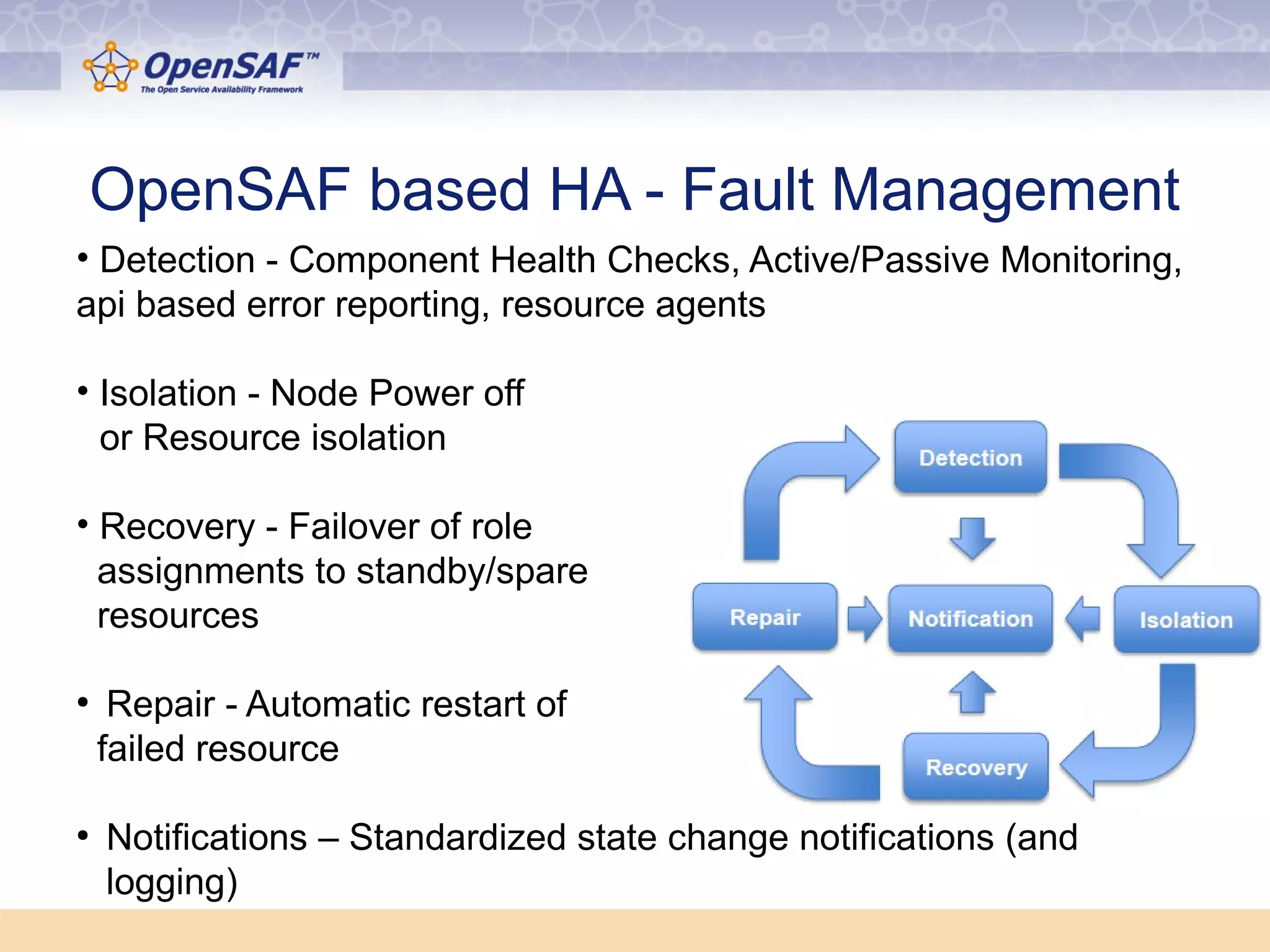
OpenSAF based HA - Fault Management 
• Detection - Component Health Checks, Active/Passive Monitoring, 
api based error reporting, resource agents 
• Isolation - Node Power off 
or Resource isolation 
• Recovery - Failover of role 
assignments to standby/spare 
resources 
● Repair - Automatic restart of 
failed resource 
● Notifications – Standardized state change notifications (and 
logging)
OpenSAF HA – Key Advantages 
● Provide for Availability as a service in the 
cloud 
●Centralized/Streamlined orchestration of 
workload management (maintaining 
affinity) 
● Enable cloud software to be more carrier 
grade 
● Ease of Integration – With Both API based 
and scripts based entities (software, vm, 
agents, etc)
OpenSAF HA – Key Advantages 
● Enables reliability for stateful applications 
● Application level failure detection and 
recovery. Enables fault mitigation and 
milli second failover 
● Support for automated rolling upgrades across 
the cluster involving application and cluster 
expansion/shrinking 
● Pythonic interface for provisioning, status and 
management of HA entities. (Java mappings 
also supported)
Leveraging existing cloud solutions with 
OpenSAF
OOppeennSSAAFF aanndd VVmmwwaarree ((AA ssttuuddyy)) 
● Outage time measured with/without adding OpenSAF 
capabilities to existing VMware solutions (FT and HA) 
● Outage time measurement by running OpenSAF within and 
outside the VMs and other combinations 
● OpenSAF can detect Hardware, OS and Application failures 
● The study concluded that outage time significantly reduced 
when combining OpenSAF with existing Vmware capabilities 
Reference: Ali Nikzad's thesis: 'OpenSAF and Vmware: From the perspective of HA' 
http://spectrum.library.concordia.ca/978013/4/Nikzad_MASc_S2014.pdf
Leveraging openstack and OpenSAF 
● OpenSAF can provide HighAvailability as a service in 
openstack – Uniform, centralized, automated availability 
management across openstack 
● Openstack's flexible deployment architectures enables 
easy integration with OpenSAF for all redundancy 
configurations for any of the OpenStack infrastructure 
software (distributed and standalone) 
● Monitoring (Intrusive and Non-Intrusive) a basic 
requirement 
- With/Without Resource agents. 
● Provide for a perspective of TRY_AGAIN /TIME_OUT 
semantics
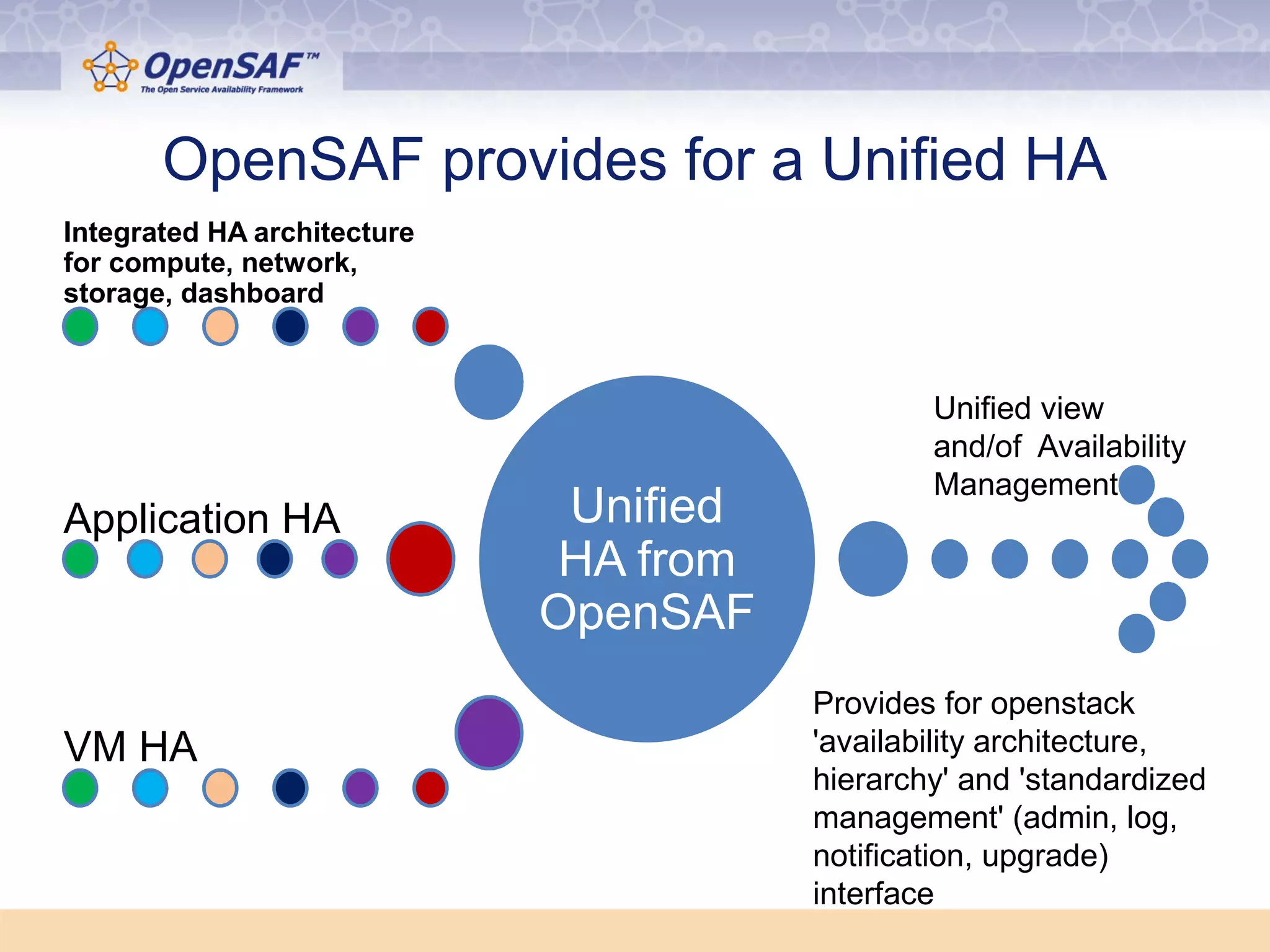
OpenSAF provides for a Unified HA 
Unified 
HA from 
OpenSAF 
Integrated HA architecture 
for compute, network, 
storage, dashboard 
Application HA 
VM HA 
Unified view 
and/of Availability 
Management 
Provides for openstack 
'availability architecture, 
hierarchy' and 'standardized 
management' (admin, log, 
notification, upgrade) 
interface
OpenSAF Roadmap 
● Enhanced cluster management 
(quorum/consensus based membership) 
● Scaling out even further 
● Feature rich CLI 
● Container - contained
& 
Thank You

OpenSAF in the cloud: Why an HA middleware is still needed

  • 1.
    OpenSAF in theCloud. Why an HA Middleware is still needed Anders Widell Ericsson Mathivanan NP Oracle opensaf.sourceforge.net
  • 2.
    Agenda ● TheOpenSAF Project ●High Availability and Service Availability ●Why Application HA is necessary in the cloud ●OpenSAF HA capabilities ● Proposal to leverage OpenSAF HA with existing cloud solutions for unified availability management ●OpenSAF roadmap
  • 3.
    OpenSAF High Availabilityand the Cloud ‘The cloud people are here’ They have 5 Nines What is OpenSAF? They have APIs? Should we consider the telcos? We have 99.99% uptime. We are good What is SA? Deployments will anyway have standbys SAF/OpenSAF Cloud
  • 4.
    The OpenSAF project ● Most comprehensive Service Availability middleware providing availability, manageability and platform services for developing HA available applications ● Interface APIs in C with support for Java and Python bindings ● LGPL v2.1 license ● Implements SA Forum AIS specification ● Supported by the OpenSAF foundation
  • 5.
    High Availability andService Availability ● The probability that a service is available to its users at a random point in time ● In telecom, 99.999% availability (five nines) is often required ●HA and SA are essentially the same, but SA enables more – for example planned updates of hardware and software
  • 6.
    Two Opinions aboutApplication HA in the Cloud The cloud doesn't change anything regarding HA – it is the same as outside the cloud You don't need to worry about HA – the cloud will take care of that for you
  • 7.
    High Availability andService Availability
  • 8.
    Hardware Faults ●The cloud infrastructure can handle hardware faults for you – all the application sees is a node reboot ●With a hot standby VM, even a reboot may be avoided ● Problem with co-located VMs – we don't want to have active and standby app on the same physical node
  • 9.
    Software Faults ●Applications currently have no or limited HA support from cloud infrastructure ●Using HA middleware, we can also get shorter fail-over time in the event of a hardware fault
  • 10.
    The Cloud GivesYou More Faults ●Hypervisor and cloud infrastructure are also subject to faults ●Hardware used in cloud may be less reliable (not carrier grade) ●Geographic distribution may decrease the risk of total outage, at the cost of network latency and increased risk for split-brain
  • 11.
    The cloud way– pets vs. cattle • Pets: few powerful nodes, scale-up • Cattle: many cheap nodes, scale-out • “architecting for failure” vs “architecting for scale”
  • 12.
    The cloud way– Standardized Service Level Agreement Your problem was triggered by some other vendor/service inside the cloud Provide service throughout the year
  • 13.
    OpenSAF based HA ●OpenSAF based HA solutions are applicable across the availability spectrum: ● Enterprise ● Telecom and aerospace/defense ● Millisecond failover
  • 14.
    OpenSAF based HA Supports all redundancy configurations (Including no redundancy) Fault Management policies (Recovery and Repair) Express Dependencies between distributed/ stand alone software Code intrusive or Not? Lifecycle scripts and timeouts configuration, workload management Orchestration of rolling upgrade of the cluster nodes. Standardized manageability Monitoring and Healthcheck
  • 15.
    OpenSAF based HA- Fault Management • Detection - Component Health Checks, Active/Passive Monitoring, api based error reporting, resource agents • Isolation - Node Power off or Resource isolation • Recovery - Failover of role assignments to standby/spare resources ● Repair - Automatic restart of failed resource ● Notifications – Standardized state change notifications (and logging)
  • 16.
    OpenSAF HA –Key Advantages ● Provide for Availability as a service in the cloud ●Centralized/Streamlined orchestration of workload management (maintaining affinity) ● Enable cloud software to be more carrier grade ● Ease of Integration – With Both API based and scripts based entities (software, vm, agents, etc)
  • 17.
    OpenSAF HA –Key Advantages ● Enables reliability for stateful applications ● Application level failure detection and recovery. Enables fault mitigation and milli second failover ● Support for automated rolling upgrades across the cluster involving application and cluster expansion/shrinking ● Pythonic interface for provisioning, status and management of HA entities. (Java mappings also supported)
  • 18.
    Leveraging existing cloudsolutions with OpenSAF
  • 19.
    OOppeennSSAAFF aanndd VVmmwwaarree((AA ssttuuddyy)) ● Outage time measured with/without adding OpenSAF capabilities to existing VMware solutions (FT and HA) ● Outage time measurement by running OpenSAF within and outside the VMs and other combinations ● OpenSAF can detect Hardware, OS and Application failures ● The study concluded that outage time significantly reduced when combining OpenSAF with existing Vmware capabilities Reference: Ali Nikzad's thesis: 'OpenSAF and Vmware: From the perspective of HA' http://spectrum.library.concordia.ca/978013/4/Nikzad_MASc_S2014.pdf
  • 20.
    Leveraging openstack andOpenSAF ● OpenSAF can provide HighAvailability as a service in openstack – Uniform, centralized, automated availability management across openstack ● Openstack's flexible deployment architectures enables easy integration with OpenSAF for all redundancy configurations for any of the OpenStack infrastructure software (distributed and standalone) ● Monitoring (Intrusive and Non-Intrusive) a basic requirement - With/Without Resource agents. ● Provide for a perspective of TRY_AGAIN /TIME_OUT semantics
  • 21.
    OpenSAF provides fora Unified HA Unified HA from OpenSAF Integrated HA architecture for compute, network, storage, dashboard Application HA VM HA Unified view and/of Availability Management Provides for openstack 'availability architecture, hierarchy' and 'standardized management' (admin, log, notification, upgrade) interface
  • 22.
    OpenSAF Roadmap ●Enhanced cluster management (quorum/consensus based membership) ● Scaling out even further ● Feature rich CLI ● Container - contained
  • 23.