1 
The Modern Data Center 
Topology: 
The High Availability Mantra
2 
GreenField Software 
• Company 
– GreenField Software is a privately held, early stage Indian (Kolkata-based) 
software company looking to be a globally recognized player in Cloud-based 
Intelligent Infrastructure Management 
• Mission 
– GFS delivers pioneering Cloud-based Intelligent Infrastructure Management 
solutions to improve operational and energy efficiencies, safety and 
environmental conditions of facilities with critical infrastructure. 
• Vision 
– Our Cloud-based Intelligent Infrastructure Management solutions help our 
customers to 
• Optimize capex, reduce operating costs and mitigate risks of critical infrastructure 
failures 
• Improve Sustainability through improved energy management and safety of their 
employees and other stakeholders using the facilities
3 
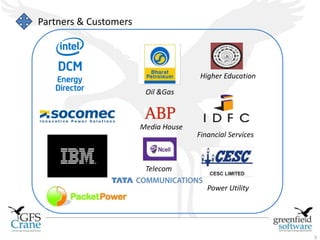
Partners & Customers 
Oil &Gas 
Media House 
Telecom 
Higher Education 
Financial Services 
Power Utility
4 
Today’s Topics 
• The Modern Data Center Overview 
• The High Availability (HA) Mantra 
• Operating Challenges 
• A Solution
5 
Modern Data Center 
Overview
6 
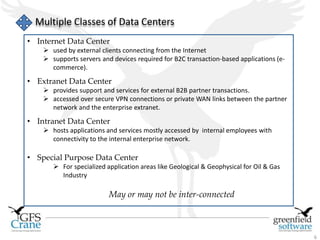
Multiple Classes of Data Centers 
• Internet Data Center 
 used by external clients connecting from the Internet 
 supports servers and devices required for B2C transaction-based applications (e-commerce). 
• Extranet Data Center 
 provides support and services for external B2B partner transactions. 
 accessed over secure VPN connections or private WAN links between the partner 
network and the enterprise extranet. 
• Intranet Data Center 
 hosts applications and services mostly accessed by internal employees with 
connectivity to the internal enterprise network. 
ness services. 
• Special Purpose Data Center 
 For specialized application areas like Geological & Geophysical for Oil & Gas 
Industry 
May or may not be inter-connected
7 
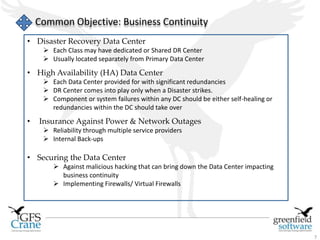
Common Objective: Business Continuity 
• Disaster Recovery Data Center 
 Each Class may have dedicated or Shared DR Center 
 Usually located separately from Primary Data Center 
• High Availability (HA) Data Center 
 Each Data Center provided for with significant redundancies 
 DR Center comes into play only when a Disaster strikes. 
 Component or system failures within any DC should be either self-healing or 
redundancies within the DC should take over 
• Insurance Against Power & Network Outages 
 Reliability through multiple service providers 
 Internal Back-ups 
ness services. 
• Securing the Data Center 
 Against malicious hacking that can bring down the Data Center impacting 
business continuity 
 Implementing Firewalls/ Virtual Firewalls
8 
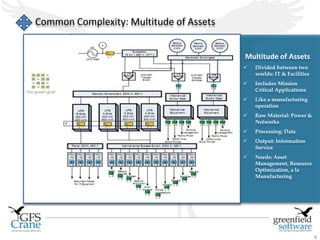
Common Complexity: Multitude of Assets 
Multitude of Assets 
 Divided between two 
worlds: IT & Facilities 
 Includes Mission 
Critical Applications 
 Like a manufacturing 
operation 
 Raw Material: Power & 
Networks 
 Processing: Data 
 Output: Information 
Service 
 Needs: Asset 
Management, Resource 
Optimization, a la 
Manufacturing
9 
The High Availability 
Mantra
10 
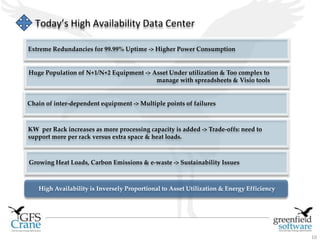
Today’s High Availability Data Center 
Extreme Redundancies for 99.99% Uptime -> Higher Power Consumption 
Huge Population of N+1/N+2 Equipment -> Asset Under utilization & Too complex to 
manage with spreadsheets & Visio tools 
Chain of inter-dependent equipment -> Multiple points of failures 
KW per Rack increases as more processing capacity is added -> Trade-offs: need to 
support more per rack versus extra space & heat loads. 
Growing Heat Loads, Carbon Emissions & e-waste -> Sustainability Issues 
High Availability is Inversely Proportional to Asset Utilization & Energy Efficiency
11 
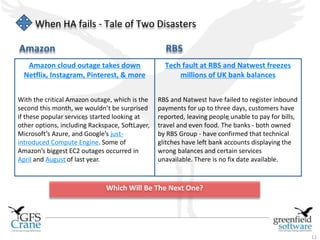
When HA fails - Tale of Two Disasters 
Amazon RBS 
Tech fault at RBS and Natwest freezes 
millions of UK bank balances 
RBS and Natwest have failed to register inbound 
payments for up to three days, customers have 
reported, leaving people unable to pay for bills, 
travel and even food. The banks - both owned 
by RBS Group - have confirmed that technical 
glitches have left bank accounts displaying the 
wrong balances and certain services 
unavailable. There is no fix date available. 
Amazon cloud outage takes down 
Netflix, Instagram, Pinterest, & more 
With the critical Amazon outage, which is the 
second this month, we wouldn’t be surprised 
if these popular services started looking at 
other options, including Rackspace, SoftLayer, 
Microsoft’s Azure, and Google’s just-introduced 
Compute Engine. Some of 
Amazon’s biggest EC2 outages occurred in 
April and August of last year. 
Which Will Be The Next One?
12 
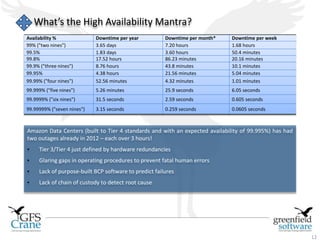
What’s the High Availability Mantra? 
Availability % Downtime per year Downtime per month* Downtime per week 
99% ("two nines") 3.65 days 7.20 hours 1.68 hours 
99.5% 1.83 days 3.60 hours 50.4 minutes 
99.8% 17.52 hours 86.23 minutes 20.16 minutes 
99.9% ("three nines") 8.76 hours 43.8 minutes 10.1 minutes 
99.95% 4.38 hours 21.56 minutes 5.04 minutes 
99.99% ("four nines") 52.56 minutes 4.32 minutes 1.01 minutes 
99.999% ("five nines") 5.26 minutes 25.9 seconds 6.05 seconds 
99.9999% ("six nines") 31.5 seconds 2.59 seconds 0.605 seconds 
99.99999% ("seven nines") 3.15 seconds 0.259 seconds 0.0605 seconds 
Amazon Data Centers (built to Tier 4 standards and with an expected availability of 99.995%) has had 
two outages already in 2012 – each over 3 hours! 
• Tier 3/Tier 4 just defined by hardware redundancies 
• Glaring gaps in operating procedures to prevent fatal human errors 
• Lack of purpose-built BCP software to predict failures 
• Lack of chain of custody to detect root cause
13 
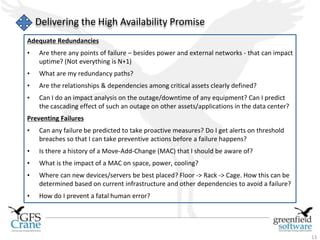
Delivering the High Availability Promise 
Adequate Redundancies 
• Are there any points of failure – besides power and external networks - that can impact 
uptime? (Not everything is N+1) 
• What are my redundancy paths? 
• Are the relationships & dependencies among critical assets clearly defined? 
• Can I do an impact analysis on the outage/downtime of any equipment? Can I predict 
the cascading effect of such an outage on other assets/applications in the data center? 
Preventing Failures 
• Can any failure be predicted to take proactive measures? Do I get alerts on threshold 
breaches so that I can take preventive actions before a failure happens? 
• Is there a history of a Move-Add-Change (MAC) that I should be aware of? 
• What is the impact of a MAC on space, power, cooling? 
• Where can new devices/servers be best placed? Floor -> Rack -> Cage. How this can be 
determined based on current infrastructure and other dependencies to avoid a failure? 
• How do I prevent a fatal human error?
14 
Operating Challenges
15 
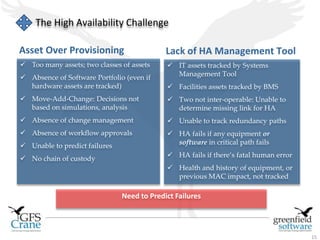
The High Availability Challenge 
Asset Over Provisioning Lack of HA Management Tool 
 IT assets tracked by Systems 
Management Tool 
 Facilities assets tracked by BMS 
 Two not inter-operable: Unable to 
determine missing link for HA 
 Unable to track redundancy paths 
 HA fails if any equipment or 
software in critical path fails 
 HA fails if there’s fatal human error 
 Health and history of equipment, or 
previous MAC impact, not tracked 
 Too many assets; two classes of assets 
 Absence of Software Portfolio (even if 
hardware assets are tracked) 
 Move-Add-Change: Decisions not 
based on simulations, analysis 
 Absence of change management 
 Absence of workflow approvals 
 Unable to predict failures 
 No chain of custody 
Need to Predict Failures
16 
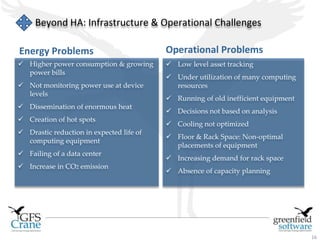
Beyond HA: Infrastructure & Operational Challenges 
Energy Problems Operational Problems 
 Low level asset tracking 
 Under utilization of many computing 
resources 
 Running of old inefficient equipment 
 Decisions not based on analysis 
 Cooling not optimized 
 Floor & Rack Space: Non-optimal 
placements of equipment 
 Increasing demand for rack space 
 Absence of capacity planning 
 Higher power consumption & growing 
power bills 
 Not monitoring power use at device 
levels 
 Dissemination of enormous heat 
 Creation of hot spots 
 Drastic reduction in expected life of 
computing equipment 
 Failing of a data center 
 Increase in CO2 emission
17 
A Solution
18 
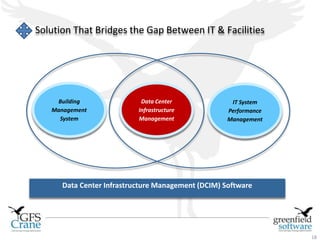
Solution That Bridges the Gap Between IT & Facilities 
IT System 
Performance 
Management 
Building 
Management 
System 
Data Center 
Infrastructure 
Management 
Data Center Infrastructure Management (DCIM) Software
19 
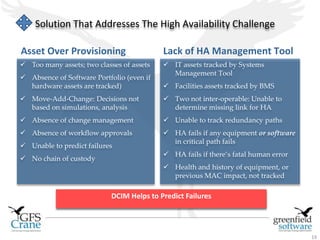
Solution That Addresses The High Availability Challenge 
Asset Over Provisioning Lack of HA Management Tool 
 IT assets tracked by Systems 
Management Tool 
 Facilities assets tracked by BMS 
 Two not inter-operable: Unable to 
determine missing link for HA 
 Unable to track redundancy paths 
 HA fails if any equipment or software 
in critical path fails 
 HA fails if there’s fatal human error 
 Health and history of equipment, or 
previous MAC impact, not tracked 
 Too many assets; two classes of assets 
 Absence of Software Portfolio (even if 
hardware assets are tracked) 
 Move-Add-Change: Decisions not 
based on simulations, analysis 
 Absence of change management 
 Absence of workflow approvals 
 Unable to predict failures 
DCIM Helps to Predict Failures 
 No chain of custody
20 
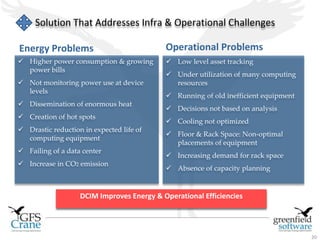
Solution That Addresses Infra & Operational Challenges 
Energy Problems Operational Problems 
 Low level asset tracking 
 Under utilization of many computing 
resources 
 Running of old inefficient equipment 
 Decisions not based on analysis 
 Cooling not optimized 
 Floor & Rack Space: Non-optimal 
placements of equipment 
 Increasing demand for rack space 
 Absence of capacity planning 
 Higher power consumption & growing 
DCIM Improves Energy & Operational Efficiencies 
power bills 
 Not monitoring power use at device 
levels 
 Dissemination of enormous heat 
 Creation of hot spots 
 Drastic reduction in expected life of 
computing equipment 
 Failing of a data center 
 Increase in CO2 emission
21 
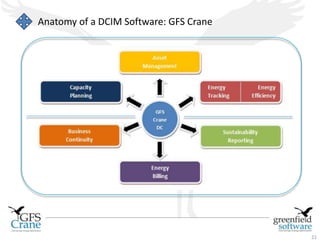
Anatomy of a DCIM Software: GFS Crane
22 
Thank You 
http://www.greenfieldsoft.com 
Email: sales@greenfieldsoft.com
23 
See also: 
Data Center Infrastructure 
Management: ERP for the Data 
Center Manager

The Modern Data Center Topology

  • 1.
    1 The ModernData Center Topology: The High Availability Mantra
  • 2.
    2 GreenField Software • Company – GreenField Software is a privately held, early stage Indian (Kolkata-based) software company looking to be a globally recognized player in Cloud-based Intelligent Infrastructure Management • Mission – GFS delivers pioneering Cloud-based Intelligent Infrastructure Management solutions to improve operational and energy efficiencies, safety and environmental conditions of facilities with critical infrastructure. • Vision – Our Cloud-based Intelligent Infrastructure Management solutions help our customers to • Optimize capex, reduce operating costs and mitigate risks of critical infrastructure failures • Improve Sustainability through improved energy management and safety of their employees and other stakeholders using the facilities
  • 3.
    3 Partners &Customers Oil &Gas Media House Telecom Higher Education Financial Services Power Utility
  • 4.
    4 Today’s Topics • The Modern Data Center Overview • The High Availability (HA) Mantra • Operating Challenges • A Solution
  • 5.
    5 Modern DataCenter Overview
  • 6.
    6 Multiple Classesof Data Centers • Internet Data Center  used by external clients connecting from the Internet  supports servers and devices required for B2C transaction-based applications (e-commerce). • Extranet Data Center  provides support and services for external B2B partner transactions.  accessed over secure VPN connections or private WAN links between the partner network and the enterprise extranet. • Intranet Data Center  hosts applications and services mostly accessed by internal employees with connectivity to the internal enterprise network. ness services. • Special Purpose Data Center  For specialized application areas like Geological & Geophysical for Oil & Gas Industry May or may not be inter-connected
  • 7.
    7 Common Objective:Business Continuity • Disaster Recovery Data Center  Each Class may have dedicated or Shared DR Center  Usually located separately from Primary Data Center • High Availability (HA) Data Center  Each Data Center provided for with significant redundancies  DR Center comes into play only when a Disaster strikes.  Component or system failures within any DC should be either self-healing or redundancies within the DC should take over • Insurance Against Power & Network Outages  Reliability through multiple service providers  Internal Back-ups ness services. • Securing the Data Center  Against malicious hacking that can bring down the Data Center impacting business continuity  Implementing Firewalls/ Virtual Firewalls
  • 8.
    8 Common Complexity:Multitude of Assets Multitude of Assets  Divided between two worlds: IT & Facilities  Includes Mission Critical Applications  Like a manufacturing operation  Raw Material: Power & Networks  Processing: Data  Output: Information Service  Needs: Asset Management, Resource Optimization, a la Manufacturing
  • 9.
    9 The HighAvailability Mantra
  • 10.
    10 Today’s HighAvailability Data Center Extreme Redundancies for 99.99% Uptime -> Higher Power Consumption Huge Population of N+1/N+2 Equipment -> Asset Under utilization & Too complex to manage with spreadsheets & Visio tools Chain of inter-dependent equipment -> Multiple points of failures KW per Rack increases as more processing capacity is added -> Trade-offs: need to support more per rack versus extra space & heat loads. Growing Heat Loads, Carbon Emissions & e-waste -> Sustainability Issues High Availability is Inversely Proportional to Asset Utilization & Energy Efficiency
  • 11.
    11 When HAfails - Tale of Two Disasters Amazon RBS Tech fault at RBS and Natwest freezes millions of UK bank balances RBS and Natwest have failed to register inbound payments for up to three days, customers have reported, leaving people unable to pay for bills, travel and even food. The banks - both owned by RBS Group - have confirmed that technical glitches have left bank accounts displaying the wrong balances and certain services unavailable. There is no fix date available. Amazon cloud outage takes down Netflix, Instagram, Pinterest, & more With the critical Amazon outage, which is the second this month, we wouldn’t be surprised if these popular services started looking at other options, including Rackspace, SoftLayer, Microsoft’s Azure, and Google’s just-introduced Compute Engine. Some of Amazon’s biggest EC2 outages occurred in April and August of last year. Which Will Be The Next One?
  • 12.
    12 What’s theHigh Availability Mantra? Availability % Downtime per year Downtime per month* Downtime per week 99% ("two nines") 3.65 days 7.20 hours 1.68 hours 99.5% 1.83 days 3.60 hours 50.4 minutes 99.8% 17.52 hours 86.23 minutes 20.16 minutes 99.9% ("three nines") 8.76 hours 43.8 minutes 10.1 minutes 99.95% 4.38 hours 21.56 minutes 5.04 minutes 99.99% ("four nines") 52.56 minutes 4.32 minutes 1.01 minutes 99.999% ("five nines") 5.26 minutes 25.9 seconds 6.05 seconds 99.9999% ("six nines") 31.5 seconds 2.59 seconds 0.605 seconds 99.99999% ("seven nines") 3.15 seconds 0.259 seconds 0.0605 seconds Amazon Data Centers (built to Tier 4 standards and with an expected availability of 99.995%) has had two outages already in 2012 – each over 3 hours! • Tier 3/Tier 4 just defined by hardware redundancies • Glaring gaps in operating procedures to prevent fatal human errors • Lack of purpose-built BCP software to predict failures • Lack of chain of custody to detect root cause
  • 13.
    13 Delivering theHigh Availability Promise Adequate Redundancies • Are there any points of failure – besides power and external networks - that can impact uptime? (Not everything is N+1) • What are my redundancy paths? • Are the relationships & dependencies among critical assets clearly defined? • Can I do an impact analysis on the outage/downtime of any equipment? Can I predict the cascading effect of such an outage on other assets/applications in the data center? Preventing Failures • Can any failure be predicted to take proactive measures? Do I get alerts on threshold breaches so that I can take preventive actions before a failure happens? • Is there a history of a Move-Add-Change (MAC) that I should be aware of? • What is the impact of a MAC on space, power, cooling? • Where can new devices/servers be best placed? Floor -> Rack -> Cage. How this can be determined based on current infrastructure and other dependencies to avoid a failure? • How do I prevent a fatal human error?
  • 14.
  • 15.
    15 The HighAvailability Challenge Asset Over Provisioning Lack of HA Management Tool  IT assets tracked by Systems Management Tool  Facilities assets tracked by BMS  Two not inter-operable: Unable to determine missing link for HA  Unable to track redundancy paths  HA fails if any equipment or software in critical path fails  HA fails if there’s fatal human error  Health and history of equipment, or previous MAC impact, not tracked  Too many assets; two classes of assets  Absence of Software Portfolio (even if hardware assets are tracked)  Move-Add-Change: Decisions not based on simulations, analysis  Absence of change management  Absence of workflow approvals  Unable to predict failures  No chain of custody Need to Predict Failures
  • 16.
    16 Beyond HA:Infrastructure & Operational Challenges Energy Problems Operational Problems  Low level asset tracking  Under utilization of many computing resources  Running of old inefficient equipment  Decisions not based on analysis  Cooling not optimized  Floor & Rack Space: Non-optimal placements of equipment  Increasing demand for rack space  Absence of capacity planning  Higher power consumption & growing power bills  Not monitoring power use at device levels  Dissemination of enormous heat  Creation of hot spots  Drastic reduction in expected life of computing equipment  Failing of a data center  Increase in CO2 emission
  • 17.
  • 18.
    18 Solution ThatBridges the Gap Between IT & Facilities IT System Performance Management Building Management System Data Center Infrastructure Management Data Center Infrastructure Management (DCIM) Software
  • 19.
    19 Solution ThatAddresses The High Availability Challenge Asset Over Provisioning Lack of HA Management Tool  IT assets tracked by Systems Management Tool  Facilities assets tracked by BMS  Two not inter-operable: Unable to determine missing link for HA  Unable to track redundancy paths  HA fails if any equipment or software in critical path fails  HA fails if there’s fatal human error  Health and history of equipment, or previous MAC impact, not tracked  Too many assets; two classes of assets  Absence of Software Portfolio (even if hardware assets are tracked)  Move-Add-Change: Decisions not based on simulations, analysis  Absence of change management  Absence of workflow approvals  Unable to predict failures DCIM Helps to Predict Failures  No chain of custody
  • 20.
    20 Solution ThatAddresses Infra & Operational Challenges Energy Problems Operational Problems  Low level asset tracking  Under utilization of many computing resources  Running of old inefficient equipment  Decisions not based on analysis  Cooling not optimized  Floor & Rack Space: Non-optimal placements of equipment  Increasing demand for rack space  Absence of capacity planning  Higher power consumption & growing DCIM Improves Energy & Operational Efficiencies power bills  Not monitoring power use at device levels  Dissemination of enormous heat  Creation of hot spots  Drastic reduction in expected life of computing equipment  Failing of a data center  Increase in CO2 emission
  • 21.
    21 Anatomy ofa DCIM Software: GFS Crane
  • 22.
    22 Thank You http://www.greenfieldsoft.com Email: sales@greenfieldsoft.com
  • 23.
    23 See also: Data Center Infrastructure Management: ERP for the Data Center Manager