Leveraging the public
      internet
Tonimir Kisasondi, mag.inf., EUCIP
$whois tkisason
•  Junior resarcher @ www.foi.hr
•  Head of Open Systems and Security lab
•  Likes to build and break things
•  tonimir.kisasondi@foi.hr
•  skype:tkisason
What happens when you digitize
the whole world?
•  Google, Facebook, Twitter
•  Is it a bubble or a valid business model?
•  The new buzzword is big data
•  Storage per capita doubles every three
     years
•    Kryder's law says that storage density
     doubles every 18 months
•    Can you really store the whole world?
What happens when you digitize
the whole world?
What happens when you digitize
the whole world?
•  Storing 20 Tbps traffic
•  Map/Reduce like infrastructure to mine and
     combine data
•    Why is this interesting to us now?
     o    Storage is cheap
     o    Big data is useful everywhere
     o    Use tricks that intel agencies use to enable cool stuff
     o    It’s not rocket science...
     o    Yes, the most interesting applications are in cross
          disciplinary fields
First: OSINT
•  OSINT: Open Source Intelligence
  o  Finding, selecting and acquiring information over
     open, publicly available sources like newspapers,
     internet, books, internet, social networks (twitter)...
  o  Various registries (firm, open postings, public listing)
  o  Metadata
  o  Mine those, and you might find a lot of interesting
     stuff
o  White zone – Legal and ethical
o  Black zone – Illegal and Unethical
o  Gray zone – Legal but unethical
First: OSINT
•  Not everything is OSINT, but you can
  actually glean interesting data from almost
  anything

•  It worked for the guys that wrote Splunk, so
  they decided to write Splunk.

•  It works for data mining folks.
Data analysis 101
•  Data is just data, you have to correlate it or
  put it in context for it to be useful
   o    Find outliers
   o    Spot differences
   o    Find common attributes
   o    Find connections, not answers
   o    First identify, then try to interpret
   o    Put data into perspective, seek help J
   o    "Data driven design”
•  A nice showcase of data driven design:
   o    A/B Testing
Do i need advanced statistics?
•  Most of the time: No
•  Are statistics awesome? Yup
•  Well, don’t play with things where you can
     get hurt. J
•    Seek professional help

•  Grep, Google refine/Mojo facets, and your
     favorite scripting languages are just fine...
How can we approach the problem
•  There are many (finished) tools, if they help,
     great
•    Roll your own script
     •    Duct tape some finished libraries
     •    Most of the times it takes less time then finding a
          tool.
     •    Cheating and stealing is encouraged. ;)
Finished tools
•  Wget, python, ruby, perl...
  •    Just kidding


•  Tapir
•  Maltego
•  Metagofil, FOCA, ExifTool
•  Wayback machine (Extremely interesting)
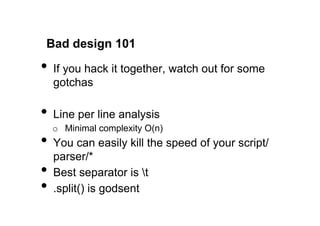
Bad design 101

•  If you hack it together, watch out for some
     gotchas

•  Line per line analysis
     o  Minimal complexity O(n)
•  You can easily kill the speed of your script/
     parser/*
•    Best separator is t
•    .split() is godsent
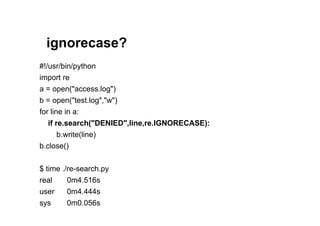
ignorecase?
#!/usr/bin/python
import re
a = open("access.log")
b = open("test.log","w")
for line in a:
   if re.search("DENIED",line,re.IGNORECASE):
       b.write(line)
b.close()


$ time ./re-search.py
real     0m4.516s
user    0m4.444s
sys     0m0.056s
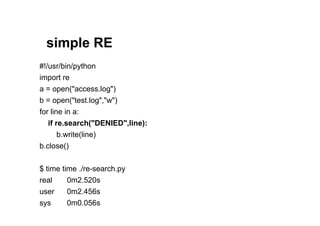
simple RE
#!/usr/bin/python
import re
a = open("access.log")
b = open("test.log","w")
for line in a:
   if re.search("DENIED",line):
       b.write(line)
b.close()


$ time time ./re-search.py
real     0m2.520s
user    0m2.456s
sys     0m0.056s
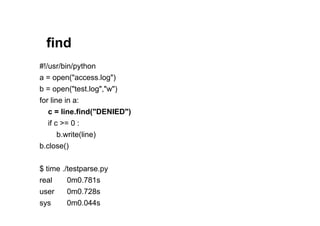
find
#!/usr/bin/python
a = open("access.log")
b = open("test.log","w")
for line in a:
   c = line.find("DENIED")
   if c >= 0 :
       b.write(line)
b.close()


$ time ./testparse.py
real     0m0.781s
user    0m0.728s
sys     0m0.044s
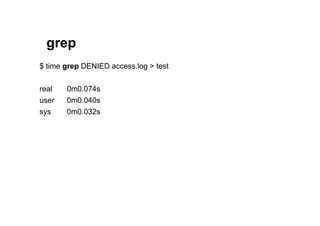
grep
$ time grep DENIED access.log > test


real   0m0.074s
user   0m0.040s
sys    0m0.032s
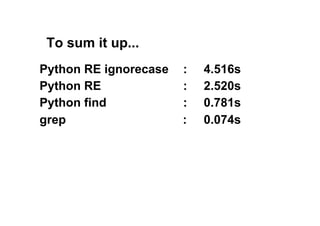
To sum it up...
Python RE ignorecase   :   4.516s
Python RE              :   2.520s
Python find            :   0.781s
grep                   :   0.074s
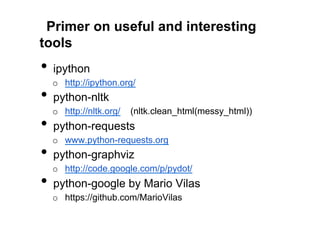
Primer on useful and interesting
tools
•  ipython
  o  http://ipython.org/
•  python-nltk
  o  http://nltk.org/   (nltk.clean_html(messy_html))
•  python-requests
  o  www.python-requests.org
•  python-graphviz
  o  http://code.google.com/p/pydot/
•  python-google by Mario Vilas
  o  https://github.com/MarioVilas
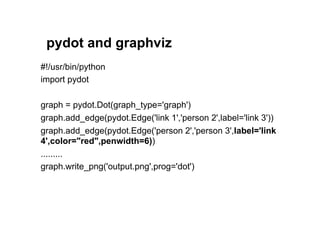
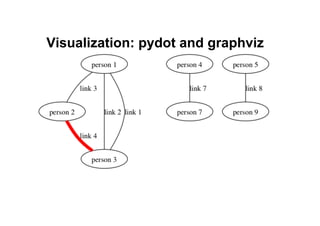
pydot and graphviz
#!/usr/bin/python
import pydot

graph = pydot.Dot(graph_type='graph')
graph.add_edge(pydot.Edge('link 1','person 2',label='link 3'))
graph.add_edge(pydot.Edge('person 2','person 3',label='link
4',color="red",penwidth=6))
.........
graph.write_png('output.png',prog='dot')
Visualization: pydot and graphviz
So, how about a short showcase of
some things i did
•  Yeah, they are lame, and simple
•  Works for me
•  Available on github
•  Hope they can motivate you to do some fun
     and simple “one afternoon” stuff
•    Most of the “hard” stuff is easy once you try
     to hack it together
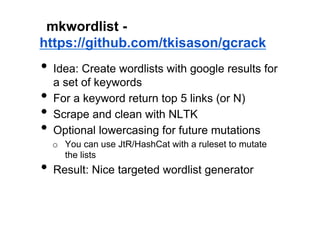
mkwordlist -
https://github.com/tkisason/gcrack
•  Idea: Create wordlists with google results for
     a set of keywords
•    For a keyword return top 5 links (or N)
•    Scrape and clean with NLTK
•    Optional lowercasing for future mutations
     o  You can use JtR/HashCat with a ruleset to mutate
        the lists
•  Result: Nice targeted wordlist generator
mkwordlist -
https://github.com/tkisason/gcrack
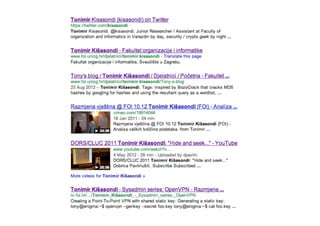
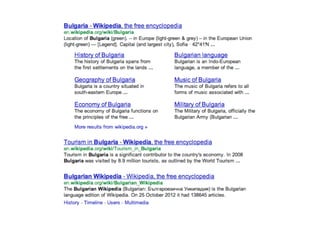
•  Some other cool things
  o  Keywords can be google dorks
     §  site:.bg
     §  filetype:txt
     §  “”
•  Interesting results for targeted attacks
•  Broad keywords are also ok
  o  If you are pentesting a company or similar
gcrack -
https://github.com/tkisason/gcrack
•  Idea: Most of the weak password hashes are
     cracked and leaked on the public internet
•    Google indexes the pages, and the content
     of this pages contains the plaintext
•    Use google searches for password cracking
•    Create bag of words as a wordlist
•    Result: Very effective and fast hash cracker
•    Bonus: hash agnostic
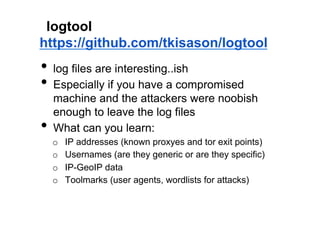
logtool
https://github.com/tkisason/logtool
•  log files are interesting..ish
•  Especially if you have a compromised
     machine and the attackers were noobish
     enough to leave the log files
•    What can you learn:
     o    IP addresses (known proxyes and tor exit points)
     o    Usernames (are they generic or are they specific)
     o    IP-GeoIP data
     o    Toolmarks (user agents, wordlists for attacks)
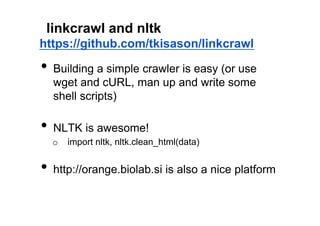
linkcrawl and nltk
https://github.com/tkisason/linkcrawl

•  Building a simple crawler is easy (or use
  wget and cURL, man up and write some
  shell scripts)

•  NLTK is awesome!
  o  import nltk, nltk.clean_html(data)


•  http://orange.biolab.si is also a nice platform
conclusion
•  Well, have just have fun
•  Problems are all around you, try to solve
  some J
questions?
Thank you!

OpenFest 2012 : Leveraging the public internet

  • 1.
    Leveraging the public internet Tonimir Kisasondi, mag.inf., EUCIP
  • 2.
    $whois tkisason •  Juniorresarcher @ www.foi.hr •  Head of Open Systems and Security lab •  Likes to build and break things •  tonimir.kisasondi@foi.hr •  skype:tkisason
  • 3.
    What happens whenyou digitize the whole world? •  Google, Facebook, Twitter •  Is it a bubble or a valid business model? •  The new buzzword is big data •  Storage per capita doubles every three years •  Kryder's law says that storage density doubles every 18 months •  Can you really store the whole world?
  • 4.
    What happens whenyou digitize the whole world?
  • 5.
    What happens whenyou digitize the whole world? •  Storing 20 Tbps traffic •  Map/Reduce like infrastructure to mine and combine data •  Why is this interesting to us now? o  Storage is cheap o  Big data is useful everywhere o  Use tricks that intel agencies use to enable cool stuff o  It’s not rocket science... o  Yes, the most interesting applications are in cross disciplinary fields
  • 6.
    First: OSINT •  OSINT:Open Source Intelligence o  Finding, selecting and acquiring information over open, publicly available sources like newspapers, internet, books, internet, social networks (twitter)... o  Various registries (firm, open postings, public listing) o  Metadata o  Mine those, and you might find a lot of interesting stuff o  White zone – Legal and ethical o  Black zone – Illegal and Unethical o  Gray zone – Legal but unethical
  • 7.
    First: OSINT •  Noteverything is OSINT, but you can actually glean interesting data from almost anything •  It worked for the guys that wrote Splunk, so they decided to write Splunk. •  It works for data mining folks.
  • 8.
    Data analysis 101 • Data is just data, you have to correlate it or put it in context for it to be useful o  Find outliers o  Spot differences o  Find common attributes o  Find connections, not answers o  First identify, then try to interpret o  Put data into perspective, seek help J o  "Data driven design” •  A nice showcase of data driven design: o  A/B Testing
  • 9.
    Do i needadvanced statistics? •  Most of the time: No •  Are statistics awesome? Yup •  Well, don’t play with things where you can get hurt. J •  Seek professional help •  Grep, Google refine/Mojo facets, and your favorite scripting languages are just fine...
  • 10.
    How can weapproach the problem •  There are many (finished) tools, if they help, great •  Roll your own script •  Duct tape some finished libraries •  Most of the times it takes less time then finding a tool. •  Cheating and stealing is encouraged. ;)
  • 11.
    Finished tools •  Wget,python, ruby, perl... •  Just kidding •  Tapir •  Maltego •  Metagofil, FOCA, ExifTool •  Wayback machine (Extremely interesting)
  • 12.
    Bad design 101 • If you hack it together, watch out for some gotchas •  Line per line analysis o  Minimal complexity O(n) •  You can easily kill the speed of your script/ parser/* •  Best separator is t •  .split() is godsent
  • 13.
    ignorecase? #!/usr/bin/python import re a =open("access.log") b = open("test.log","w") for line in a: if re.search("DENIED",line,re.IGNORECASE): b.write(line) b.close() $ time ./re-search.py real 0m4.516s user 0m4.444s sys 0m0.056s
  • 14.
    simple RE #!/usr/bin/python import re a= open("access.log") b = open("test.log","w") for line in a: if re.search("DENIED",line): b.write(line) b.close() $ time time ./re-search.py real 0m2.520s user 0m2.456s sys 0m0.056s
  • 15.
    find #!/usr/bin/python a = open("access.log") b= open("test.log","w") for line in a: c = line.find("DENIED") if c >= 0 : b.write(line) b.close() $ time ./testparse.py real 0m0.781s user 0m0.728s sys 0m0.044s
  • 16.
    grep $ time grepDENIED access.log > test real 0m0.074s user 0m0.040s sys 0m0.032s
  • 17.
    To sum itup... Python RE ignorecase : 4.516s Python RE : 2.520s Python find : 0.781s grep : 0.074s
  • 18.
    Primer on usefuland interesting tools •  ipython o  http://ipython.org/ •  python-nltk o  http://nltk.org/ (nltk.clean_html(messy_html)) •  python-requests o  www.python-requests.org •  python-graphviz o  http://code.google.com/p/pydot/ •  python-google by Mario Vilas o  https://github.com/MarioVilas
  • 19.
    pydot and graphviz #!/usr/bin/python importpydot graph = pydot.Dot(graph_type='graph') graph.add_edge(pydot.Edge('link 1','person 2',label='link 3')) graph.add_edge(pydot.Edge('person 2','person 3',label='link 4',color="red",penwidth=6)) ......... graph.write_png('output.png',prog='dot')
  • 20.
  • 21.
    So, how abouta short showcase of some things i did •  Yeah, they are lame, and simple •  Works for me •  Available on github •  Hope they can motivate you to do some fun and simple “one afternoon” stuff •  Most of the “hard” stuff is easy once you try to hack it together
  • 22.
    mkwordlist - https://github.com/tkisason/gcrack •  Idea:Create wordlists with google results for a set of keywords •  For a keyword return top 5 links (or N) •  Scrape and clean with NLTK •  Optional lowercasing for future mutations o  You can use JtR/HashCat with a ruleset to mutate the lists •  Result: Nice targeted wordlist generator
  • 23.
    mkwordlist - https://github.com/tkisason/gcrack •  Someother cool things o  Keywords can be google dorks §  site:.bg §  filetype:txt §  “” •  Interesting results for targeted attacks •  Broad keywords are also ok o  If you are pentesting a company or similar
  • 26.
    gcrack - https://github.com/tkisason/gcrack •  Idea:Most of the weak password hashes are cracked and leaked on the public internet •  Google indexes the pages, and the content of this pages contains the plaintext •  Use google searches for password cracking •  Create bag of words as a wordlist •  Result: Very effective and fast hash cracker •  Bonus: hash agnostic
  • 27.
    logtool https://github.com/tkisason/logtool •  log filesare interesting..ish •  Especially if you have a compromised machine and the attackers were noobish enough to leave the log files •  What can you learn: o  IP addresses (known proxyes and tor exit points) o  Usernames (are they generic or are they specific) o  IP-GeoIP data o  Toolmarks (user agents, wordlists for attacks)
  • 28.
    linkcrawl and nltk https://github.com/tkisason/linkcrawl • Building a simple crawler is easy (or use wget and cURL, man up and write some shell scripts) •  NLTK is awesome! o  import nltk, nltk.clean_html(data) •  http://orange.biolab.si is also a nice platform
  • 29.
    conclusion •  Well, havejust have fun •  Problems are all around you, try to solve some J
  • 30.
  • 31.