Open Data Project
Digital Cities of the Future

Lorenzino Vaccari

Autonomous Province of Trento
Trento, 03rd September 2013
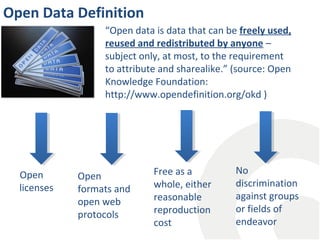
Open Data Definition
“Open data is data that can be freely used,
reused and redistributed by anyone –
subject only, at most, to the requirement
to attribute and sharealike.” (source: Open
Knowledge Foundation:
http://www.opendefinition.org/okd )

Open
licenses

Open
formats and
open web
protocols

Free as a
whole, either
reasonable
reproduction
cost

No
discrimination
against groups
or fields of
endeavor
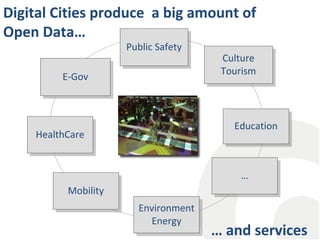
Digital Cities produce a big amount of
Open Data…
Public Safety
Public Safety

E-Gov
E-Gov

Culture
Culture
Tourism
Tourism

Education
Education

HealthCare
HealthCare

…
…

Mobility
Mobility
Environment
Environment
Energy
Energy

… and services
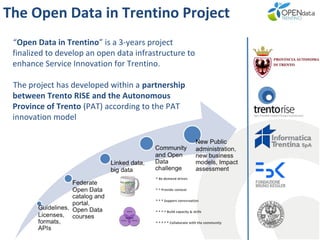
The Open Data in Trentino Project
“Open Data in Trentino” is a 3-years project
finalized to develop an open data infrastructure to
enhance Service Innovation for Trentino.
The project has developed within a partnership
between Trento RISE and the Autonomous
Province of Trento (PAT) according to the PAT
innovation model
Structure of the project
WP6 [Legal Issues & Tools]
WP4
[Entities]

[Implementation]

WP1
[Services]

Entity Based Layer

Services

WP3

Architecture

WP8

Open Data Catalog
Transformation Layer

[Demos, SINET
Integration,
Commissioning]

WP7
[Communities]

Data Sources
WP2
[Modelling]

Weather
forecast

Statistics

Agriculture

Transport

Family

Trento
municipality

Geo-data

…

Public
contracts

Etc...

WP5
[Organization]
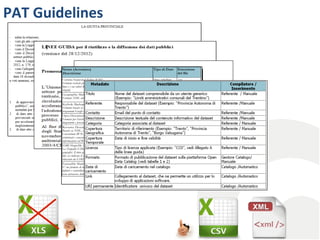
PAT Guidelines

Nome (Acronimo)
Descrizione

Tipo di Dato

Estensione
del file

Comma Separated Value (CSV)
Dato tabellare
Formato testuale per l'interscambio testuale di tabelle, le cui righe corrispondono a
linee e i cui valori delle singole colonne sono separati da una virgola (o punto e
virgola)
Geographic Markup Language (GML)
Dato geografico
Formato XML utile allo scambio di dati territoriali di tipo vettoriale
vettoriale

.csv

Keyhole Markup Language (KML)
Formato basato su XML creato per gestire dati territoriali in tre dimensioni nei
programmi Google Earth, Google Maps
Open Document Format (ODF)
Formato per l'archiviazione e lo scambio di documenti di testo, fogli di calcolo,
diagrammi e presentazioni
Resource Description Framework (RDF)
Basato su XML, e' lo strumento base proposto da World Wide Web
Consortium (W3C) per la codifica, lo scambio e il riutilizzo di metadati
strutturati e consente l'interoperabilità tra applicazioni che si scambiano
informazioni sul Web
ESRI Shapefile (SHP)
Lo Shapefile ESRI è un popolare formato vettoriale per sistemi informativi
geografici. Il dato geografico viene distribuito normalmente attraverso tre o quattro
files (se indicato il sistema di riferimento delle coordinate). Il formato è stato
rilasciato da ESRI come formato (quasi) aperto
Extensible Markup Language (XML)
E' un formato di markup, ovvero basato su un meccanismo che consente di
definire e controllare il significato degli elementi contenuti in un documento o in un
testo attraverso delle etichette (markup)

Dato geografico
vettoriale

.kml

Dato tabellare

.odc

.gml

Dato strutturato .rdf

Dato geografico
vettoriale

.shp, .shx, .dbf,
.prj

Dato strutturato .xml
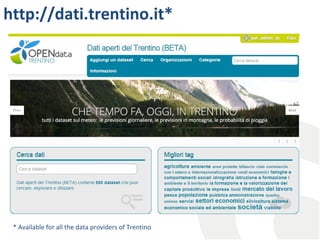
http://dati.trentino.it*

* Available for all the data providers of Trentino
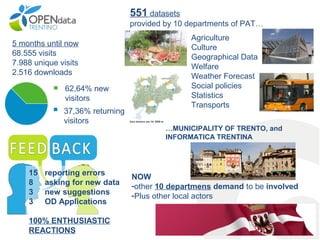
551 datasets
provided by 10 departments of PAT…
5 months until now
68.555 visits
7.988 unique visits
2.516 downloads
62,64% new
visitors
37,36% returning
visitors

15
8
3
3

reporting errors
asking for new data
new suggestions
OD Applications

100% ENTHUSIASTIC
REACTIONS

Agriculture
Culture
Geographical Data
Welfare
Weather Forecast
Social policies
Statistics
Transports
…MUNICIPALITY OF TRENTO, and
INFORMATICA TRENTINA

NOW
-other 10 departmens demand to be involved
-Plus other local actors
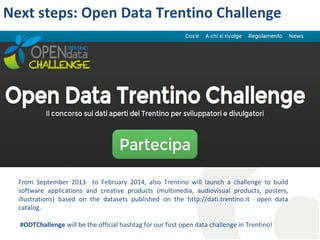
Next steps: Open Data Trentino Challenge

From September 2013 to February 2014, also Trentino will launch a challenge to build
software applications and creative products (multimedia, audiovisual products, posters,
illustrations) based on the datasets published on the http://dati.trentino.it open data
catalog.
#ODTChallenge will be the official hashtag for our first open data challenge in Trentino!
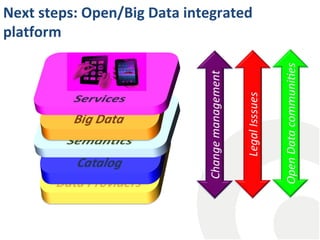
Next steps: Open/Big Data integrated
platform
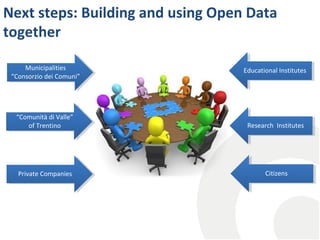
Next steps: Building and using Open Data
together
Municipalities
Municipalities
“Consorzio dei Comuni”

Educational Institutes

“Comunità di Valle”
“Comunità di Valle”
of Trentino
of Trentino

Research Institutes
Research Institutes

Private Companies
Private Companies

Citizens
Citizens
Useful Links and Contacts
Open Data Catalog
http://dati.trentino.it
Institutional Web site
http://www.innovazione.provincia.tn.it/opendata
Policies
http://www.innovazione.provincia.tn.it/documentazione/in_trentino/pagina182.html
Open Data course for PAT
http://www.innovazione.provincia.tn.it/contenuti.php?
t=opendata_tab&id=5&preview_only=yes&lang=1

info@dati.trentino.it
Lorenzino Vaccari: lorenzino.vaccari@provincia.tn.it

@datitrentinoit
Thank you for your attention !

Open Data for Digital Cities of the Future

  • 1.
    Open Data Project DigitalCities of the Future Lorenzino Vaccari Autonomous Province of Trento Trento, 03rd September 2013
  • 2.
    Open Data Definition “Opendata is data that can be freely used, reused and redistributed by anyone – subject only, at most, to the requirement to attribute and sharealike.” (source: Open Knowledge Foundation: http://www.opendefinition.org/okd ) Open licenses Open formats and open web protocols Free as a whole, either reasonable reproduction cost No discrimination against groups or fields of endeavor
  • 3.
    Digital Cities producea big amount of Open Data… Public Safety Public Safety E-Gov E-Gov Culture Culture Tourism Tourism Education Education HealthCare HealthCare … … Mobility Mobility Environment Environment Energy Energy … and services
  • 4.
    The Open Datain Trentino Project “Open Data in Trentino” is a 3-years project finalized to develop an open data infrastructure to enhance Service Innovation for Trentino. The project has developed within a partnership between Trento RISE and the Autonomous Province of Trento (PAT) according to the PAT innovation model
  • 5.
    Structure of theproject WP6 [Legal Issues & Tools] WP4 [Entities] [Implementation] WP1 [Services] Entity Based Layer Services WP3 Architecture WP8 Open Data Catalog Transformation Layer [Demos, SINET Integration, Commissioning] WP7 [Communities] Data Sources WP2 [Modelling] Weather forecast Statistics Agriculture Transport Family Trento municipality Geo-data … Public contracts Etc... WP5 [Organization]
  • 6.
    PAT Guidelines Nome (Acronimo) Descrizione Tipodi Dato Estensione del file Comma Separated Value (CSV) Dato tabellare Formato testuale per l'interscambio testuale di tabelle, le cui righe corrispondono a linee e i cui valori delle singole colonne sono separati da una virgola (o punto e virgola) Geographic Markup Language (GML) Dato geografico Formato XML utile allo scambio di dati territoriali di tipo vettoriale vettoriale .csv Keyhole Markup Language (KML) Formato basato su XML creato per gestire dati territoriali in tre dimensioni nei programmi Google Earth, Google Maps Open Document Format (ODF) Formato per l'archiviazione e lo scambio di documenti di testo, fogli di calcolo, diagrammi e presentazioni Resource Description Framework (RDF) Basato su XML, e' lo strumento base proposto da World Wide Web Consortium (W3C) per la codifica, lo scambio e il riutilizzo di metadati strutturati e consente l'interoperabilità tra applicazioni che si scambiano informazioni sul Web ESRI Shapefile (SHP) Lo Shapefile ESRI è un popolare formato vettoriale per sistemi informativi geografici. Il dato geografico viene distribuito normalmente attraverso tre o quattro files (se indicato il sistema di riferimento delle coordinate). Il formato è stato rilasciato da ESRI come formato (quasi) aperto Extensible Markup Language (XML) E' un formato di markup, ovvero basato su un meccanismo che consente di definire e controllare il significato degli elementi contenuti in un documento o in un testo attraverso delle etichette (markup) Dato geografico vettoriale .kml Dato tabellare .odc .gml Dato strutturato .rdf Dato geografico vettoriale .shp, .shx, .dbf, .prj Dato strutturato .xml
  • 7.
    http://dati.trentino.it* * Available forall the data providers of Trentino
  • 8.
    551 datasets provided by10 departments of PAT… 5 months until now 68.555 visits 7.988 unique visits 2.516 downloads 62,64% new visitors 37,36% returning visitors 15 8 3 3 reporting errors asking for new data new suggestions OD Applications 100% ENTHUSIASTIC REACTIONS Agriculture Culture Geographical Data Welfare Weather Forecast Social policies Statistics Transports …MUNICIPALITY OF TRENTO, and INFORMATICA TRENTINA NOW -other 10 departmens demand to be involved -Plus other local actors
  • 9.
    Next steps: OpenData Trentino Challenge From September 2013 to February 2014, also Trentino will launch a challenge to build software applications and creative products (multimedia, audiovisual products, posters, illustrations) based on the datasets published on the http://dati.trentino.it open data catalog. #ODTChallenge will be the official hashtag for our first open data challenge in Trentino!
  • 10.
    Next steps: Open/BigData integrated platform
  • 11.
    Next steps: Buildingand using Open Data together Municipalities Municipalities “Consorzio dei Comuni” “Consorzio dei Comuni” Educational Institutes Educational Institutes “Comunità di Valle” “Comunità di Valle” of Trentino of Trentino Research Institutes Research Institutes Private Companies Private Companies Citizens Citizens
  • 12.
    Useful Links andContacts Open Data Catalog http://dati.trentino.it Institutional Web site http://www.innovazione.provincia.tn.it/opendata Policies http://www.innovazione.provincia.tn.it/documentazione/in_trentino/pagina182.html Open Data course for PAT http://www.innovazione.provincia.tn.it/contenuti.php? t=opendata_tab&id=5&preview_only=yes&lang=1 info@dati.trentino.it Lorenzino Vaccari: lorenzino.vaccari@provincia.tn.it @datitrentinoit
  • 13.
    Thank you foryour attention !

Editor's Notes

  • #2 Good Morning to everybody. I am Lorenzino Vaccari, of the Autnomous Province of Trento, responsible for the Open Data Project I am very pleasured to present you our experience on the publication of the Open data for our territory which is part of the Digital City Vision of TrentoRise and the Autonomous Province of Trento.
  • #3 Following the syntetic definition given by the Open Knowledge Foundation, Open Data is data that can be FRELY USED, REUSED AND REDISTRIBUTED BY ANYONE. There’s only at most the requirements of attribution and sharealike. To put in place this definition Open Data must have some basic characteristics : They have to be published with open licenses: everyone can use data with no limitations. The license shall not restrict any party from selling or giving away the work either on its own or as part of a package made from works from many different sources. The license shall not require a royalty or other fee for such sale or distribution. The license may require as a condition for redistribution and re-use the attribution of the contributors and creators to the work. Published with open formats and open web protocols. The work must be provided in such a form that there are no technological obstacles to the performance of the above activities. This can be achieved by the provision of the work in an open data format. Free, The work shall be available as a whole and at no more than a reasonable reproduction cost, preferably downloading via the Internet without charge. The work must also be available in a convenient and modifiable form.
  • #4 Why Open data are important for digital cities? Open data power Digital cities: Intelligent towns will focus on existing resources and infrastructure, only better, faster and more effectually: they will leverage all the information and the technologies at hand into advanced analytics, innovative solutions and Open Data platforms. Regarding the Open Data platform, city governments have a big amount of information to support the change they need. Moreover, the open data contest is much broader than just data related to the government: also citizens, utility companies and private companies can share their information with governments Open Data Benefits are very important because thoruogh them we can: Improve the economic grow and the entrepreneurship based on the development of digital services reusing Public Sector Information Answer to social needs through the publication of innovative services and applications Reduce the cost of the public administrative activities within Public – Private Partnerships (PPP) Improve the transparency of the activities of the public institutions and the participation of the citizens to these activities
  • #5 To manage the changement and the publication of the open data of our territory we have implemented the 3 Years “Open Data in Trentino project”. This project has developed within a partnership between the Autnomous Province of Trento and TrentoRise, according to the innovation model put in place by he Autonomous Province of Trento. The main goal of the project is to define and implement the steps and the architecture to: Enhance the availability and reuse of the public sector information (PSI) through the definition of guidelines, open formats, licenses, and so on Release an open data platform based on open source technology which enables service innovation for citizens, businesses and government, enforcing the economic growth of Trentino To define a semantic layer to let the user for searching well identified object (such as persons, organizations, locations, events, and other artifacts following the linked data principles) and to Promote the integration with the Big Data and Smart Campus projects to enhance the scalability of data and services publication, access and reuse To implement the 5 stars model proposed by Tim David to perform the Data Engagement Model thorugh dissemination and open data contest events Improve and drive the PAT digital and organizational change through the use of well known Open Data practices With our open data initiative we have released more than 550 data-sets available and downloadable in open formats. Our staff comprises people from different fields and with different skills. Our approach is innovative for this reason represents in Italy an excellence. 
  • #6 The project architecture is based on different interconnected modules each of them related to specific activities which regards: The collection and gather of data from different and heterogenous resources such as geographical and statistical datasets, weather forecast datasets, mobility datasets and so on.. The transformation and harvesting layer to publish the datasets in a convenient and open format when necessary The Open source Open Data catalog (we adopted the platform proposed by the Open Knowledge foundation), which is used internationally by the United States, United Kingdom and by the European Commission The semantic layer which will implement a remodelled view of the entire knoledge base proposed by the data sources The service layer which will implement apps and web services mainly based on open Data Plus other trasversal modules regarding the legal issues (especially for the privacy and IPR issues), the organizational module which regards the change management we need to implement to publish our information by using the open data paradigm The community part which disseminates, connects and align the project to the open data communities at local, national and international level And of course a module which will integrate the platform to the other information systems of our territory
  • #7 The first action we performed was, at the end of last year, the definition and the publication as a local law, of the guidelines which are the reference for all the institution that publish open data on our catalog. Basically, the guidelines defines: the licences we are using for our data (we adopte well know licenses such as Creative Commons zero and creative commons by) The open formats we have to use to publish the datasets The metadata information which describes the data we publish on the catalog. We spend al lot f time to define the minumin and significant set of metadata, which now are also used as a reference at national level.
  • #8 Then, at the beginning of this year we published our open data catalog, which is based on the open platform proposed by the Open Knowledge foundation. Currently, the Open Data catalog contains more than 5 hundreds datasets which can be searched and downloaded both by users and thorugh open APIs. I would like to highlight here that dati.trentino.it started as an open government data portal but is open to the other intitutions and to the corporate world. We, as a project, started a dialogue with the local private business for this reason in order to convince them to open up their data. We are also planning to do training courses and workshops for educational purposes both for internal and external users  
  • #9 Some recently results include: The publication of more than 5 hundreds datasets coming from the different departmnets, a federated monucipality (Trento) and a company (Informatica Trentina) We had almost 70 thounsands visits and more than 2 thousands and 5 hundreds downloads We also received feedbacks: reporting errors, asking for new data, new suggestions and three apps based on the data we published were developed right now (ViviTrentino, SmartCampus and ViviFiemme)
  • #10 From September 2013 to February 2014, also Trentino will launch a challenge to build software applicatiosn and creative products (multimedia, audiovisual products, posters, illustrations) based on the datasets published on the http://dati.trentino.it open data catalog.
  • #11 We are actively working to build an integrated platform with other projects such as the Big Data project and the SmartCampus project also by using trasvesal best practices such as the ones we are using to tackle the change management, the legal issues and the Open Data Communities
  • #12 And of course we are working to build a shared common collaboration environment with the other public and private institutions of our territory at Muncipality and Valley level Thorugh the Monicipalities consortium. But we are also involving in the process educational institutes, research intitutes and citizens thourgh, for example the use of crowd sourcing techniques.
  • #13 Here I put some references for the project: The open data catalog link The Open Data institutional web site The reference to the course we did for the PA last March
  • #14 Thank you very much for your attentio… and please give us feedbacks on our open data work!