From OCaml to Javascript
      at Skydeck
   jake.donham@skydeck.com
What is Skydeck?

  o   a tool for managing your mobile phone

  o   reads your mobile phone call log

  o   presents it back to you in a useful way
        attach people to phone numbers
        view calls by person
        when did I last call Steve?
        who did I call yesterday?
        etc.
Where does the data come from?

  o   from your phone carrier's web site
         you give Skydeck your credentials
         we download bills and usage from carrier site
            with a Firefox extension
            with a standalone XULrunner app
            from our servers (a farm of XULrunners)

  o   via our web API
        3rd party can add new data sources
Where does OCaml come into this?

  o   most of our system is written in OCaml
        bill parsing, web servers, etc.

  o   but the web is Javascript
        Mozilla apps are Javascript
        Javascript is not my favorite programming language
            too forgiving
            heavy syntax for functional code

  o   sad programmers
OCamljs

 o   we wrote OCamljs
       Javascript back-end for OCaml compiler

 o   wrote our Mozilla app in OCaml

 o   we are happy
Really?

match referer with
  | None -> r#send body
  | Some re ->
  (* see http://developer.mozilla.org/en/docs/Setting_HTTP_req ...
  let os = XPCOM.getService_observer_service () in
  let observe (s : #XPCOM.supports) _ _ =
    let hc = s#_QueryInterface XPCOM.httpChannel in
    if hc == r#_get_channel#_QueryInterface XPCOM.httpChannel
    then hc#setRequestHeader "Referer" re false in
  let observer = Ocamljs.obj [
    "observe", Ocamljs.jsfun3 observe
  ] in
  os#addObserver observer "http-on-modify-request" false;
  r#send body;
  os#removeObserver observer "http-on-modify-request";
Benefits of OCaml for downloader

  o   types types types

  o   can give types to the complicated Mozilla API

  o   continuation passing style enforced by types

  o   transparent RPC to server

  o   tool support (Camlp4, ocamlbuild)
How does OCamljs work?

  o   ocamlc compiles to "lambda" intermediate language

  o   ocamljs translates lambda to Javascript

  o   almost everything in the front-end comes for free
        type checking
        module system
        Camlp4

  o   objects not free
        we want OCaml objects = JS objects
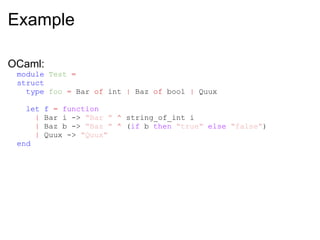
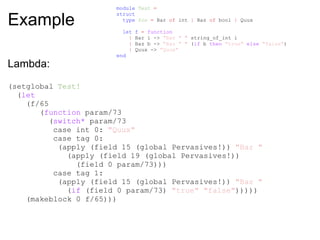
Example

OCaml:
 module Test =
 struct
   type foo = Bar of int | Baz of bool | Quux

   let   f = function
     |   Bar i -> "Bar " ^ string_of_int i
     |   Baz b -> "Baz " ^ (if b then "true" else "false")
     |   Quux -> "Quux"
 end
module Test =
                       struct
Example                  type foo = Bar of int | Baz of bool | Quux

                         let   f = function
                           |   Bar i -> "Bar " ^ string_of_int i
                           |   Baz b -> "Baz " ^ (if b then "true" else "false")
                           |   Quux -> "Quux"
                       end
Lambda:
(setglobal Test!
  (let
    (f/65
       (function param/73
         (switch* param/73
          case int 0: "Quux"
          case tag 0:
           (apply (field 15 (global Pervasives!)) "Bar "
             (apply (field 19 (global Pervasives!))
               (field 0 param/73)))
          case tag 1:
           (apply (field 15 (global Pervasives!)) "Baz "
             (if (field 0 param/73) "true" "false")))))
    (makeblock 0 f/65)))
(setglobal Test!
                               (let

 Example                         (f/65
                                    (function param/73
                                      (switch* param/73
                                       case int 0: "Quux"
                                       case tag 0:
                                        (apply (field 15 (global Pervasives!)) "Bar "
                                          (apply (field 19 (global Pervasives!))
                                            (field 0 param/73)))
                                       case tag 1:
Javascript:                             (apply (field 15 (global Pervasives!)) "Baz "
                                          (if (field 0 param/73) "true" "false")))))
                                 (makeblock 0 f/65)))
var oc$Test$ =
  function () {
    var f$65 =
       _f(function (param$73) {
            if (typeof param$73 == "number")
              switch (param$73) { case 0: return "Quux"; default: return ...
            else
              switch ($t(param$73)) {
              case 0:
                 return __(oc$Pervasives$[15],
                   ["Bar ", _(oc$Pervasives$[19], [param$73[0]])]);
              case 1:
                 return __(oc$Pervasives$[15],
                   ["Baz ", param$73[0] ? "true" : "false"]);
              default: return null;}
          });
    return $(f$65);
  }();
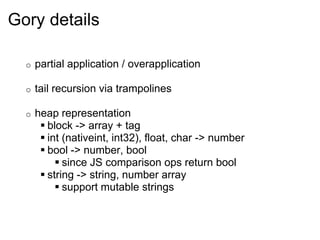
Gory details

  o   partial application / overapplication

  o   tail recursion via trampolines

  o   heap representation
        block -> array + tag
        int (nativeint, int32), float, char -> number
        bool -> number, bool
            since JS comparison ops return bool
        string -> string, number array
            support mutable strings
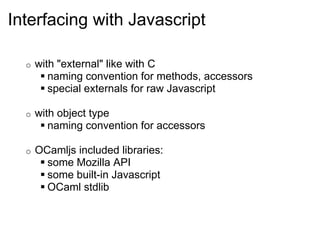
Interfacing with Javascript

  o   with "external" like with C
        naming convention for methods, accessors
        special externals for raw Javascript

  o   with object type
        naming convention for accessors

  o   OCamljs included libraries:
        some Mozilla API
        some built-in Javascript
        OCaml stdlib
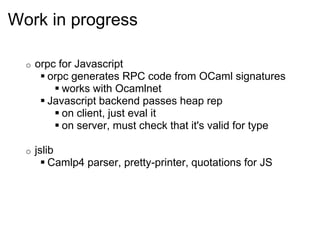
Work in progress

  o   orpc for Javascript
        orpc generates RPC code from OCaml signatures
           works with Ocamlnet
        Javascript backend passes heap rep
           on client, just eval it
           on server, must check that it's valid for type

  o   jslib
         Camlp4 parser, pretty-printer, quotations for JS
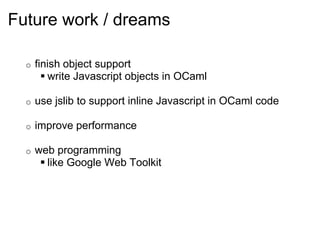
Future work / dreams

  o   finish object support
         write Javascript objects in OCaml

  o   use jslib to support inline Javascript in OCaml code

  o   improve performance

  o   web programming
        like Google Web Toolkit
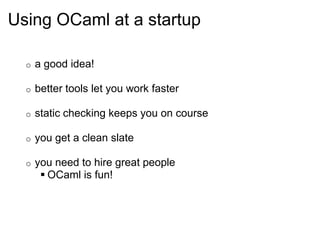
Using OCaml at a startup

  o   a good idea!

  o   better tools let you work faster

  o   static checking keeps you on course

  o   you get a clean slate

  o   you need to hire great people
        OCaml is fun!
Thanks!

  o   Skydeck is hiring
        http://skydeck.com/jobs

  o   http://code.google.com/p/ocamljs
  o   http://code.google.com/p/orpc2

From OCaml To Javascript At Skydeck

  • 1.
    From OCaml toJavascript at Skydeck jake.donham@skydeck.com
  • 2.
    What is Skydeck? o a tool for managing your mobile phone o reads your mobile phone call log o presents it back to you in a useful way  attach people to phone numbers  view calls by person  when did I last call Steve?  who did I call yesterday?  etc.
  • 3.
    Where does thedata come from? o from your phone carrier's web site  you give Skydeck your credentials  we download bills and usage from carrier site  with a Firefox extension  with a standalone XULrunner app  from our servers (a farm of XULrunners) o via our web API  3rd party can add new data sources
  • 4.
    Where does OCamlcome into this? o most of our system is written in OCaml  bill parsing, web servers, etc. o but the web is Javascript  Mozilla apps are Javascript  Javascript is not my favorite programming language  too forgiving  heavy syntax for functional code o sad programmers
  • 5.
    OCamljs o we wrote OCamljs  Javascript back-end for OCaml compiler o wrote our Mozilla app in OCaml o we are happy
  • 6.
    Really? match referer with | None -> r#send body | Some re -> (* see http://developer.mozilla.org/en/docs/Setting_HTTP_req ... let os = XPCOM.getService_observer_service () in let observe (s : #XPCOM.supports) _ _ = let hc = s#_QueryInterface XPCOM.httpChannel in if hc == r#_get_channel#_QueryInterface XPCOM.httpChannel then hc#setRequestHeader "Referer" re false in let observer = Ocamljs.obj [ "observe", Ocamljs.jsfun3 observe ] in os#addObserver observer "http-on-modify-request" false; r#send body; os#removeObserver observer "http-on-modify-request";
  • 7.
    Benefits of OCamlfor downloader o types types types o can give types to the complicated Mozilla API o continuation passing style enforced by types o transparent RPC to server o tool support (Camlp4, ocamlbuild)
  • 8.
    How does OCamljswork? o ocamlc compiles to "lambda" intermediate language o ocamljs translates lambda to Javascript o almost everything in the front-end comes for free  type checking  module system  Camlp4 o objects not free  we want OCaml objects = JS objects
  • 9.
    Example OCaml: module Test= struct type foo = Bar of int | Baz of bool | Quux let f = function | Bar i -> "Bar " ^ string_of_int i | Baz b -> "Baz " ^ (if b then "true" else "false") | Quux -> "Quux" end
  • 10.
    module Test = struct Example type foo = Bar of int | Baz of bool | Quux let f = function | Bar i -> "Bar " ^ string_of_int i | Baz b -> "Baz " ^ (if b then "true" else "false") | Quux -> "Quux" end Lambda: (setglobal Test! (let (f/65 (function param/73 (switch* param/73 case int 0: "Quux" case tag 0: (apply (field 15 (global Pervasives!)) "Bar " (apply (field 19 (global Pervasives!)) (field 0 param/73))) case tag 1: (apply (field 15 (global Pervasives!)) "Baz " (if (field 0 param/73) "true" "false"))))) (makeblock 0 f/65)))
  • 11.
    (setglobal Test! (let Example (f/65 (function param/73 (switch* param/73 case int 0: "Quux" case tag 0: (apply (field 15 (global Pervasives!)) "Bar " (apply (field 19 (global Pervasives!)) (field 0 param/73))) case tag 1: Javascript: (apply (field 15 (global Pervasives!)) "Baz " (if (field 0 param/73) "true" "false"))))) (makeblock 0 f/65))) var oc$Test$ = function () { var f$65 = _f(function (param$73) { if (typeof param$73 == "number") switch (param$73) { case 0: return "Quux"; default: return ... else switch ($t(param$73)) { case 0: return __(oc$Pervasives$[15], ["Bar ", _(oc$Pervasives$[19], [param$73[0]])]); case 1: return __(oc$Pervasives$[15], ["Baz ", param$73[0] ? "true" : "false"]); default: return null;} }); return $(f$65); }();
  • 12.
    Gory details o partial application / overapplication o tail recursion via trampolines o heap representation  block -> array + tag  int (nativeint, int32), float, char -> number  bool -> number, bool  since JS comparison ops return bool  string -> string, number array  support mutable strings
  • 13.
    Interfacing with Javascript o with "external" like with C  naming convention for methods, accessors  special externals for raw Javascript o with object type  naming convention for accessors o OCamljs included libraries:  some Mozilla API  some built-in Javascript  OCaml stdlib
  • 14.
    Work in progress o orpc for Javascript  orpc generates RPC code from OCaml signatures  works with Ocamlnet  Javascript backend passes heap rep  on client, just eval it  on server, must check that it's valid for type o jslib  Camlp4 parser, pretty-printer, quotations for JS
  • 15.
    Future work /dreams o finish object support  write Javascript objects in OCaml o use jslib to support inline Javascript in OCaml code o improve performance o web programming  like Google Web Toolkit
  • 16.
    Using OCaml ata startup o a good idea! o better tools let you work faster o static checking keeps you on course o you get a clean slate o you need to hire great people  OCaml is fun!
  • 17.
    Thanks! o Skydeck is hiring  http://skydeck.com/jobs o http://code.google.com/p/ocamljs o http://code.google.com/p/orpc2