OOP Concepts
BY
Mr. S.B.Gopal
Assistant Professor
ECE Department
Kongu Engineering
College
The Object-Oriented Approach
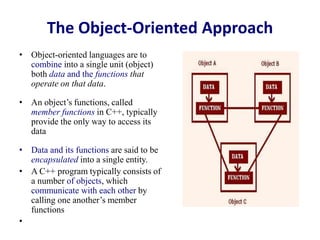
• Object-oriented languages are to
combine into a single unit (object)
both data and the functions that
operate on that data.
• An object’s functions, called
member functions in C++, typically
provide the only way to access its
data
• Data and its functions are said to be
encapsulated into a single entity.
• A C++ program typically consists of
a number of objects, which
communicate with each other by
calling one another’s member
functions
•
Characteristics of Object-Oriented
Languages
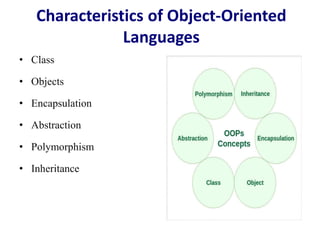
• Class
• Objects
• Encapsulation
• Abstraction
• Polymorphism
• Inheritance
Real Time Example – Human Being
• Broadly classified -> Male and Female
• Body Parts -> 2 hands, 2 legs,2 eyes, 1
nose etc..
• Body Functions –> Walk , Eat, See, Talk,
Hear etc..
Characteristics of Object-Oriented
Languages
• The main aim of OOP is to bind together the data and the
functions that operate on them so that no other part of the code can
access this data except that function.
• Class
• Basic building block of C++
• A user-defined data type, which holds its own data members and
member functions
• It can be accessed and used by creating an instance of that class
• A class is like a blueprint for an object.
• Example of class Human Being.
Object
• Mr. Anand etc..
• Ms. Diya etc..
• You, Your Friend and Me commonly we have
physical existence.
• So Male is a class Mr. Anand is an object
• Female is a class Ms. Diya is an object.
Characteristics of Object-Oriented
Languages
• Object
• An object is an identifiable
entity with some
characteristics and
behaviour.
• An object is an instance of a
Class.
• When a class is defined, no
memory is allocated
• But when it is instantiated
(i.e. an object is created)
memory is allocated.
class person
{
char name[20];
int id;
public:
void getdetails(){}
};
int main()
{
person p1; // p1 is a object
}
Inheritance
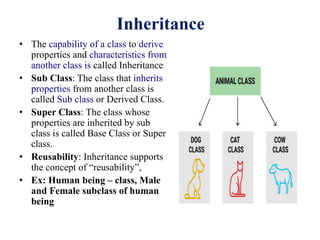
• The capability of a class to derive
properties and characteristics from
another class is called Inheritance
• Sub Class: The class that inherits
properties from another class is
called Sub class or Derived Class.
• Super Class: The class whose
properties are inherited by sub
class is called Base Class or Super
class.
• Reusability: Inheritance supports
the concept of “reusability”,
• Ex: Human being – class, Male
and Female subclass of human
being
Characteristics of Object-Oriented
Languages
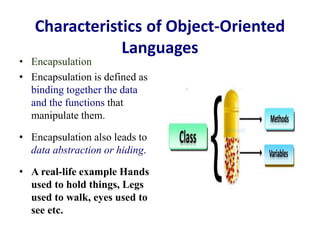
• Encapsulation
• Encapsulation is defined as
binding together the data
and the functions that
manipulate them.
• Encapsulation also leads to
data abstraction or hiding.
• A real-life example Hands
used to hold things, Legs
used to walk, eyes used to
see etc.
Characteristics of Object-Oriented
Languages
• Abstraction
• The technique of creating new data types that are well suited to
an application to be programmed is known as data abstraction.
• The class is a construct in C++ for creating user defined data
types called Abstract Data Type (ADT)
• It provides only essential information about the data to the
outside world, hiding the background details or
implementation.
• A real-life example is our skin, which hides all the organs
inside the body and only it exposing the required parts.
Characteristics of Object-Oriented
Languages
• Polymorphism
• Polymorphism can defined as the ability of a message to be
displayed in more than one form.
• Example:
• A person at the same time can have different characteristic.
• A man at the same time is a father, a husband, an employee.
• The same person posses different behaviour in different
situations
• C+ supports operator overloading and function overloading.
Characteristics of Object-Oriented
Languages
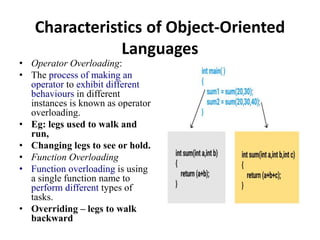
• Operator Overloading:
• The process of making an
operator to exhibit different
behaviours in different
instances is known as operator
overloading.
• Eg: legs used to walk and
run,
• Changing legs to see or hold.
• Function Overloading
• Function overloading is using
a single function name to
perform different types of
tasks.
• Overriding – legs to walk
backward
Characteristics of Object-Oriented
Languages
• Message Passing
• Objects communicate with one another by sending and
receiving information to each other.
• Message passing involves specifying the name of the object,
the name of the function and the information to be sent.

Oops concepts

  • 1.
    OOP Concepts BY Mr. S.B.Gopal AssistantProfessor ECE Department Kongu Engineering College
  • 2.
    The Object-Oriented Approach •Object-oriented languages are to combine into a single unit (object) both data and the functions that operate on that data. • An object’s functions, called member functions in C++, typically provide the only way to access its data • Data and its functions are said to be encapsulated into a single entity. • A C++ program typically consists of a number of objects, which communicate with each other by calling one another’s member functions •
  • 3.
    Characteristics of Object-Oriented Languages •Class • Objects • Encapsulation • Abstraction • Polymorphism • Inheritance
  • 4.
    Real Time Example– Human Being • Broadly classified -> Male and Female • Body Parts -> 2 hands, 2 legs,2 eyes, 1 nose etc.. • Body Functions –> Walk , Eat, See, Talk, Hear etc..
  • 5.
    Characteristics of Object-Oriented Languages •The main aim of OOP is to bind together the data and the functions that operate on them so that no other part of the code can access this data except that function. • Class • Basic building block of C++ • A user-defined data type, which holds its own data members and member functions • It can be accessed and used by creating an instance of that class • A class is like a blueprint for an object. • Example of class Human Being.
  • 6.
    Object • Mr. Anandetc.. • Ms. Diya etc.. • You, Your Friend and Me commonly we have physical existence. • So Male is a class Mr. Anand is an object • Female is a class Ms. Diya is an object.
  • 7.
    Characteristics of Object-Oriented Languages •Object • An object is an identifiable entity with some characteristics and behaviour. • An object is an instance of a Class. • When a class is defined, no memory is allocated • But when it is instantiated (i.e. an object is created) memory is allocated. class person { char name[20]; int id; public: void getdetails(){} }; int main() { person p1; // p1 is a object }
  • 8.
    Inheritance • The capabilityof a class to derive properties and characteristics from another class is called Inheritance • Sub Class: The class that inherits properties from another class is called Sub class or Derived Class. • Super Class: The class whose properties are inherited by sub class is called Base Class or Super class. • Reusability: Inheritance supports the concept of “reusability”, • Ex: Human being – class, Male and Female subclass of human being
  • 9.
    Characteristics of Object-Oriented Languages •Encapsulation • Encapsulation is defined as binding together the data and the functions that manipulate them. • Encapsulation also leads to data abstraction or hiding. • A real-life example Hands used to hold things, Legs used to walk, eyes used to see etc.
  • 10.
    Characteristics of Object-Oriented Languages •Abstraction • The technique of creating new data types that are well suited to an application to be programmed is known as data abstraction. • The class is a construct in C++ for creating user defined data types called Abstract Data Type (ADT) • It provides only essential information about the data to the outside world, hiding the background details or implementation. • A real-life example is our skin, which hides all the organs inside the body and only it exposing the required parts.
  • 11.
    Characteristics of Object-Oriented Languages •Polymorphism • Polymorphism can defined as the ability of a message to be displayed in more than one form. • Example: • A person at the same time can have different characteristic. • A man at the same time is a father, a husband, an employee. • The same person posses different behaviour in different situations • C+ supports operator overloading and function overloading.
  • 12.
    Characteristics of Object-Oriented Languages •Operator Overloading: • The process of making an operator to exhibit different behaviours in different instances is known as operator overloading. • Eg: legs used to walk and run, • Changing legs to see or hold. • Function Overloading • Function overloading is using a single function name to perform different types of tasks. • Overriding – legs to walk backward
  • 13.
    Characteristics of Object-Oriented Languages •Message Passing • Objects communicate with one another by sending and receiving information to each other. • Message passing involves specifying the name of the object, the name of the function and the information to be sent.