 Supported languages like C++, C#, Java
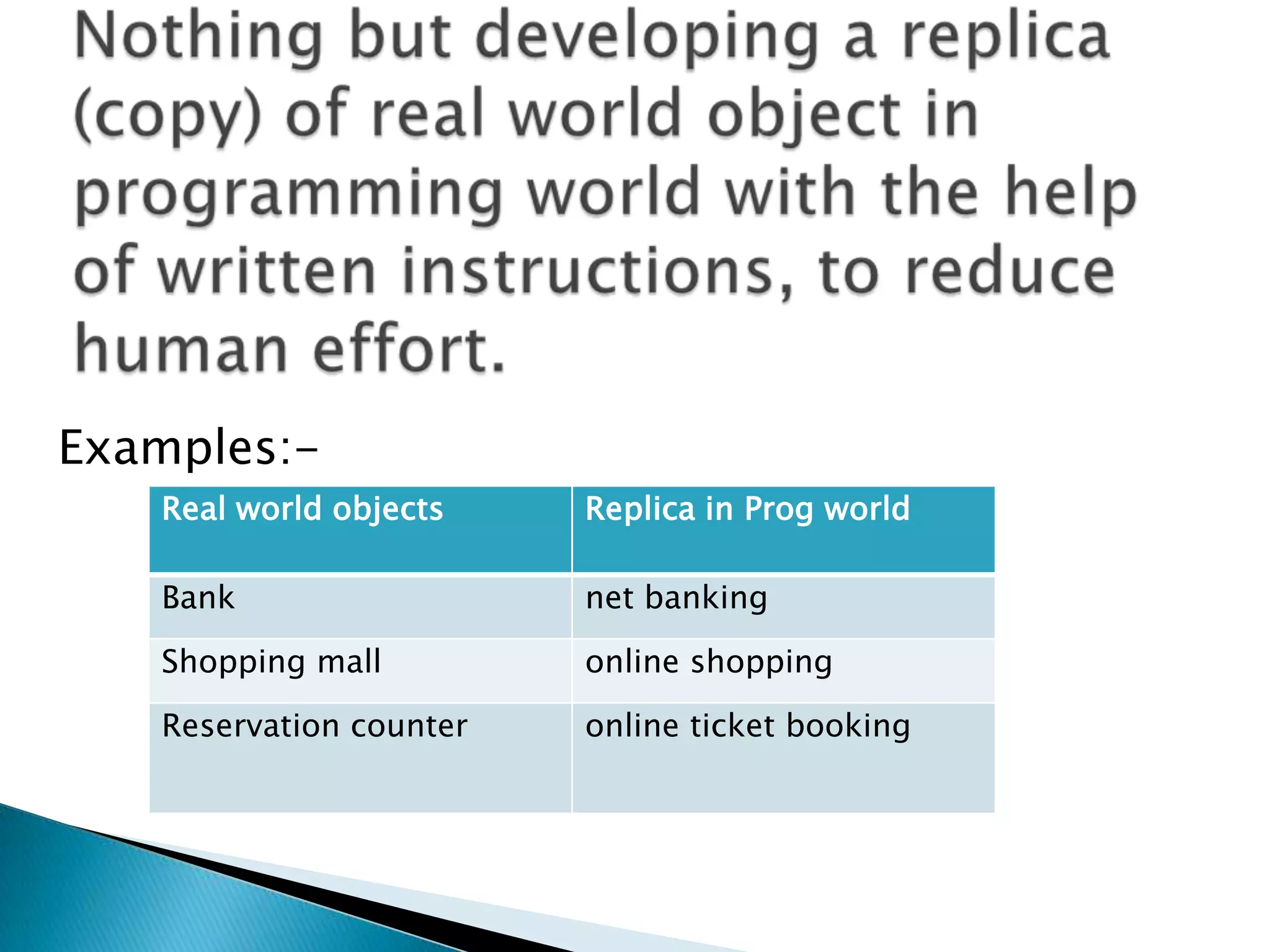
Examples:-
Real world objects Replica in Prog world
Bank net banking
Shopping mall online shopping
Reservation counter online ticket booking
 Developing a sw means We are copying the
real world objects into the prog world, it
means both the objects must look similar to
each other.
 Non object oriented languages like C failed in
creating the exact replica of the real world
object in prog world. So that’s why OOPS is
invented.
 With the following example we can prove,
how a non object oriented lang is failed in
creating the replica.
So firstly will see an example of shopping mall
using
1. non object oriented language
2. object oriented language
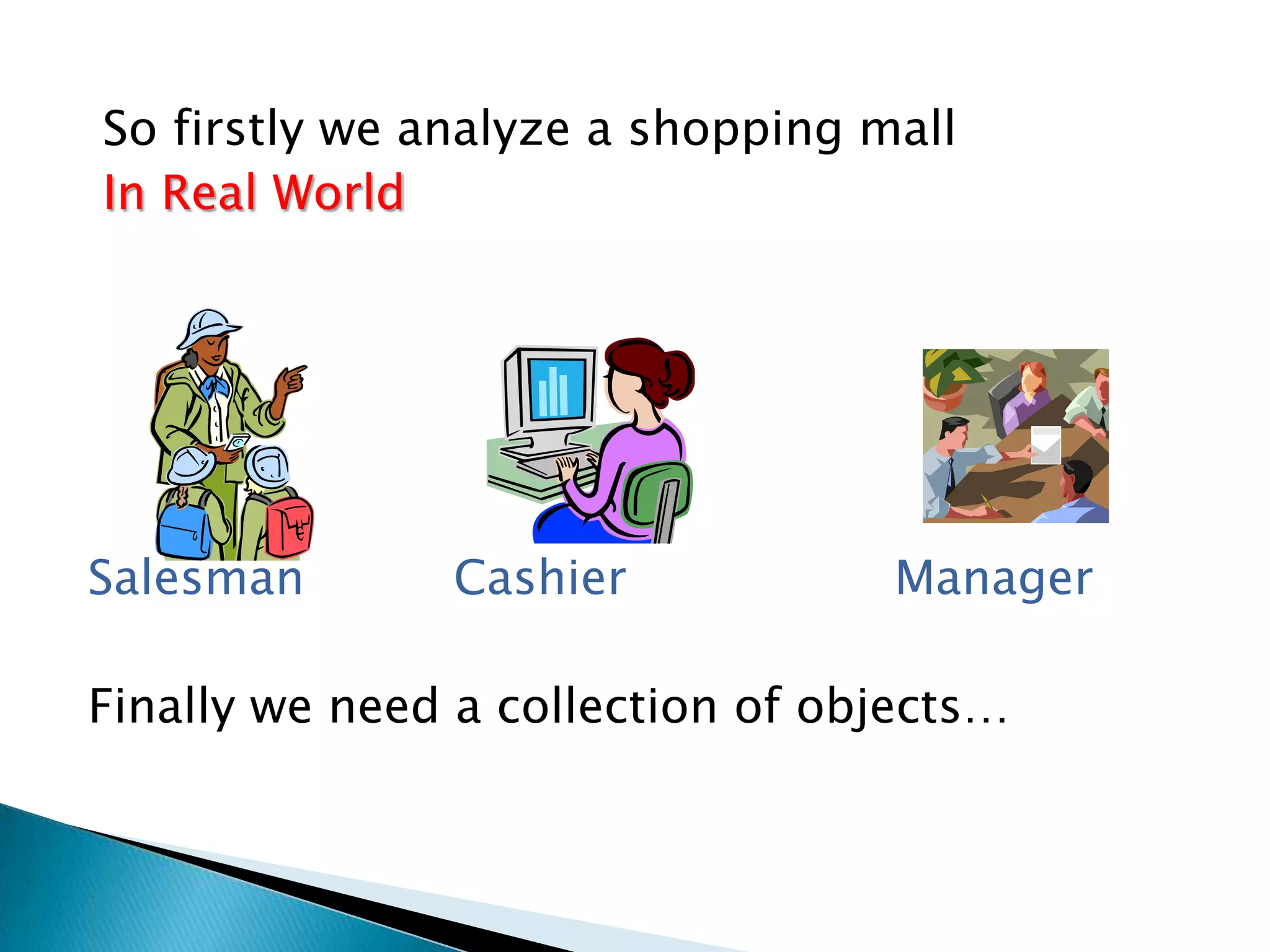
So firstly we analyze a shopping mall
In Real World
Salesman Cashier Manager
Finally we need a collection of objects…
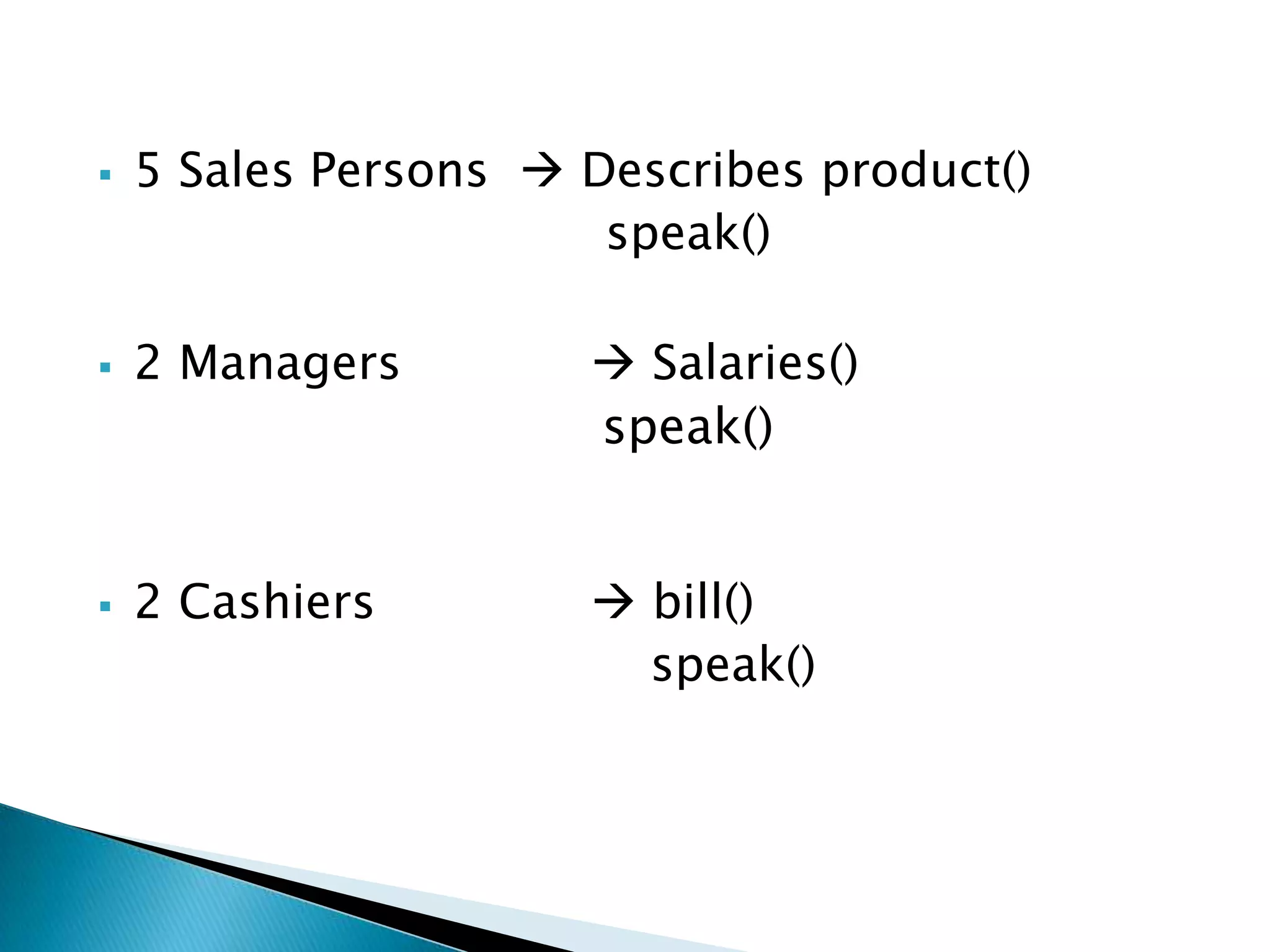
 5 Sales Persons  Describes product()
speak()
 2 Managers  Salaries()
speak()
 2 Cashiers  bill()
speak()
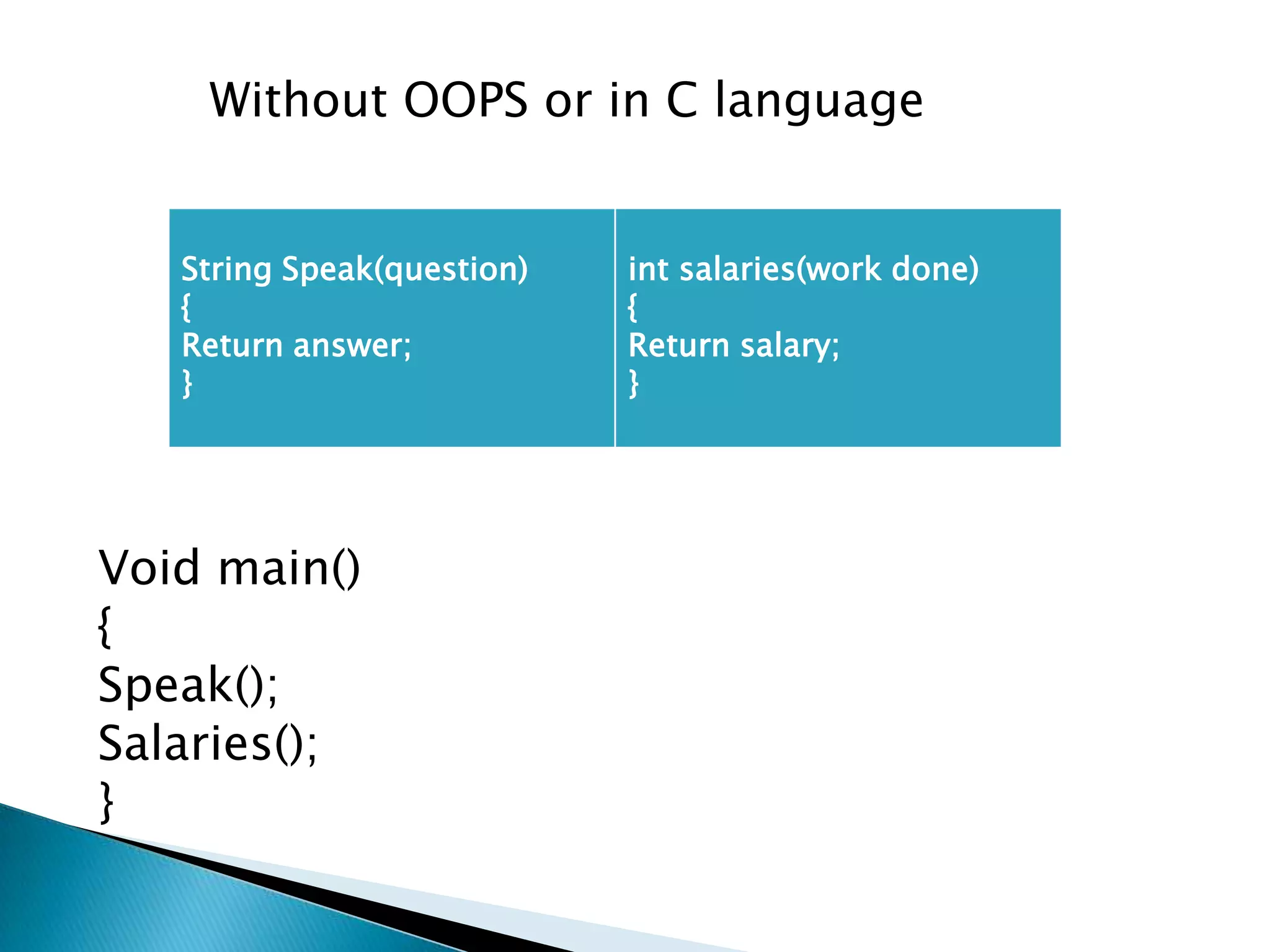
Without OOPS or in C language
Void main()
{
Speak();
Salaries();
}
String Speak(question)
{
Return answer;
}
int salaries(work done)
{
Return salary;
}
 In previous code where are those
sales persons, managers and cashiers ?
Can you locate them????
So without OOPS we are able to see
 Functions of our shopping mall members
 But actual persons are really missing…
it means objects are really missing…
With OOPS we can see them and we can feel
their presence.
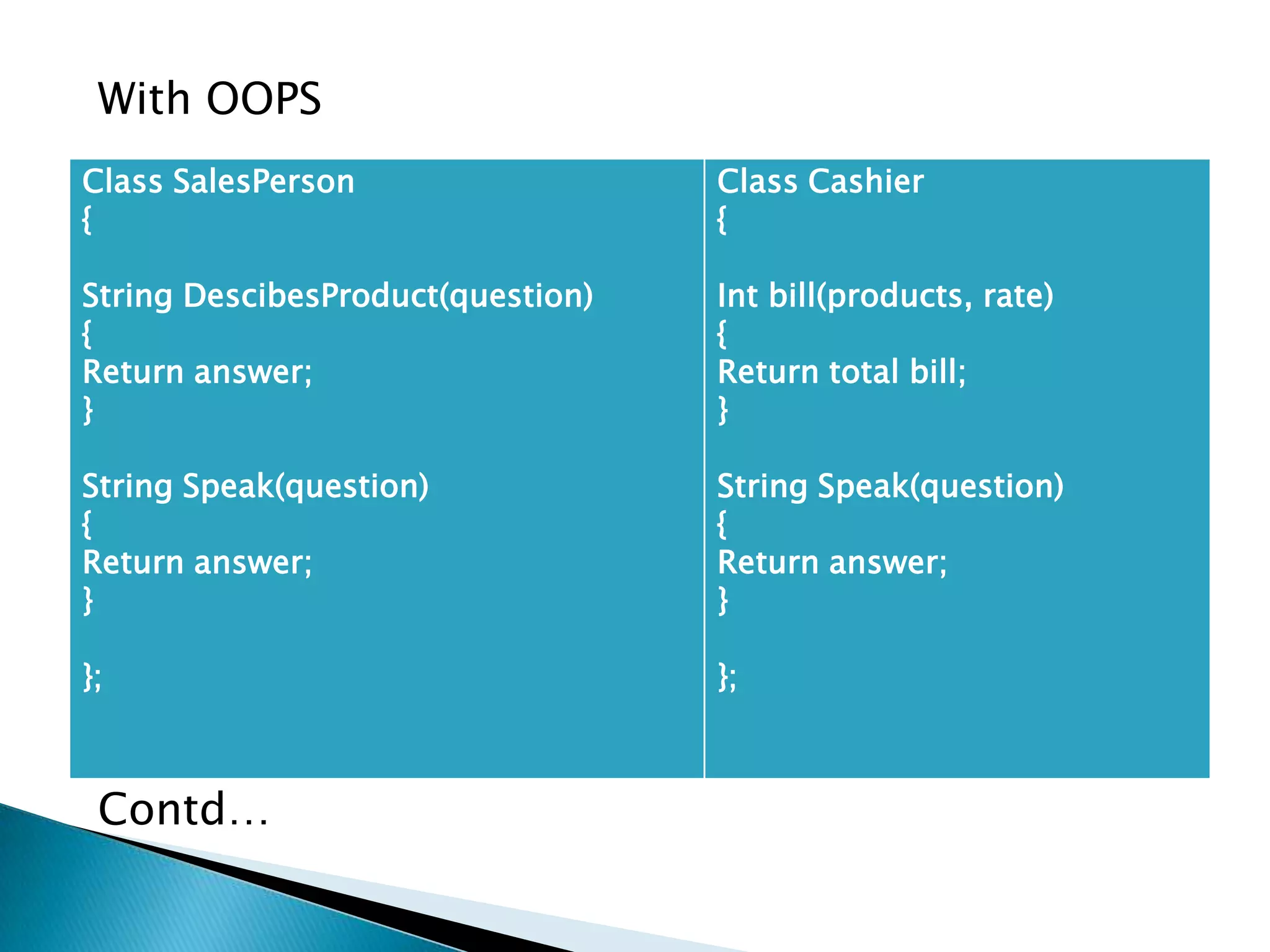
With OOPS
Contd…
Class SalesPerson
{
String DescibesProduct(question)
{
Return answer;
}
String Speak(question)
{
Return answer;
}
};
Class Cashier
{
Int bill(products, rate)
{
Return total bill;
}
String Speak(question)
{
Return answer;
}
};
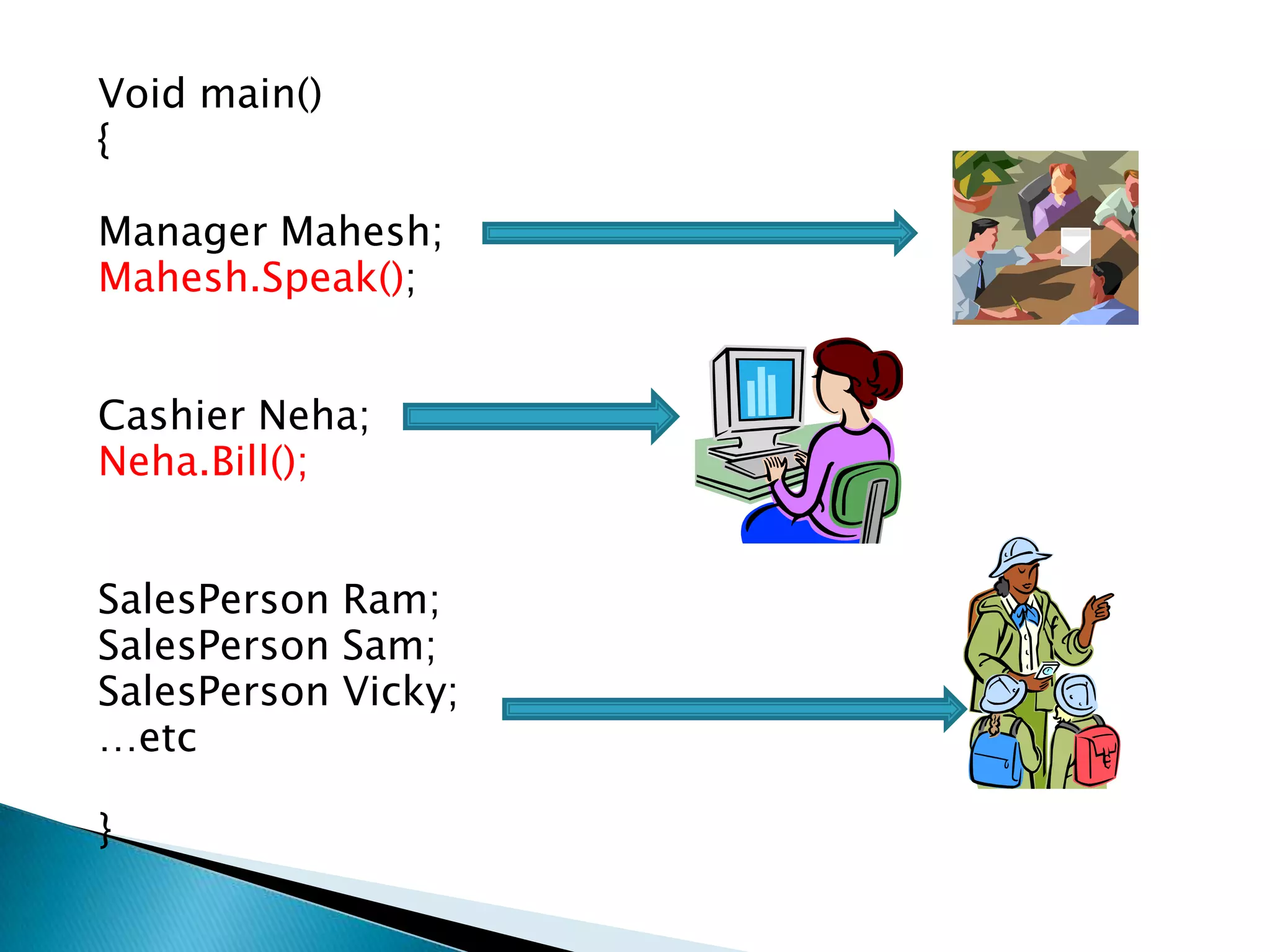
Void main()
{
Manager Mahesh;
Mahesh.Speak();
Cashier Neha;
Neha.Bill();
SalesPerson Ram;
SalesPerson Sam;
SalesPerson Vicky;
…etc
}
 As our software is completely dependent on real
world objects, to create exact replica, developers
started analyzing the real world objects like pen,
car, water bottle etc and finally they learned 4
principles & named them as OOPS.
 They finally concluded that, if we satisfy all the 4
principles in our programming language then
definitely we can create exact replica of real
world objects.
 But today we understanding OOPS in
programmes but we are failing to analyze it
in real world…
 Encapsulation
 Abstraction
 Inheritance
 Polymorphism
 Every real world object like bag, mobile &
pen-drive behaves like a container which is
used for the purpose of storing & hiding the
things.
 This is called encapsulation.
 So developers copied this principle in
programming & they are achieving
encapsulation through a kw called class.
 Hiding all the things is not a good idea, so
Every real world object like pen-drive is used
for some purpose.
so exposing those necessary functions is
called abstraction.
 So developers copied this principle in
programming & they are achieving
abstraction through a access modifiers.
 Each object in the real world is based on their
ancestors/parents & they also deriving some
common things from them.
example:- pen-drive object is derived some
storing mechanisms from hard-disk object.
 This is called inheritance.
 So developers copied this principle in
programming & they are achieving
inheritance through a colon : symbol.
 Each object in the real world behaves
according to the situation.
example:- a power button of an LCD monitor
behaves as a power-off button if monitor is
already switched on vice versa.
 This is called polymorphism.
 So developers copied this principle in
programming & they are achieving
polymorphism through a overloading &
overriding.
Advantages:-
It is helpful in developing
Meaningful code.
Maintenance is easy.
Mapping with real world
Objects.
Q. Why it is required?
To map software product similar to real life
Product.
To develop meaningful code.
To increase Passion in programming
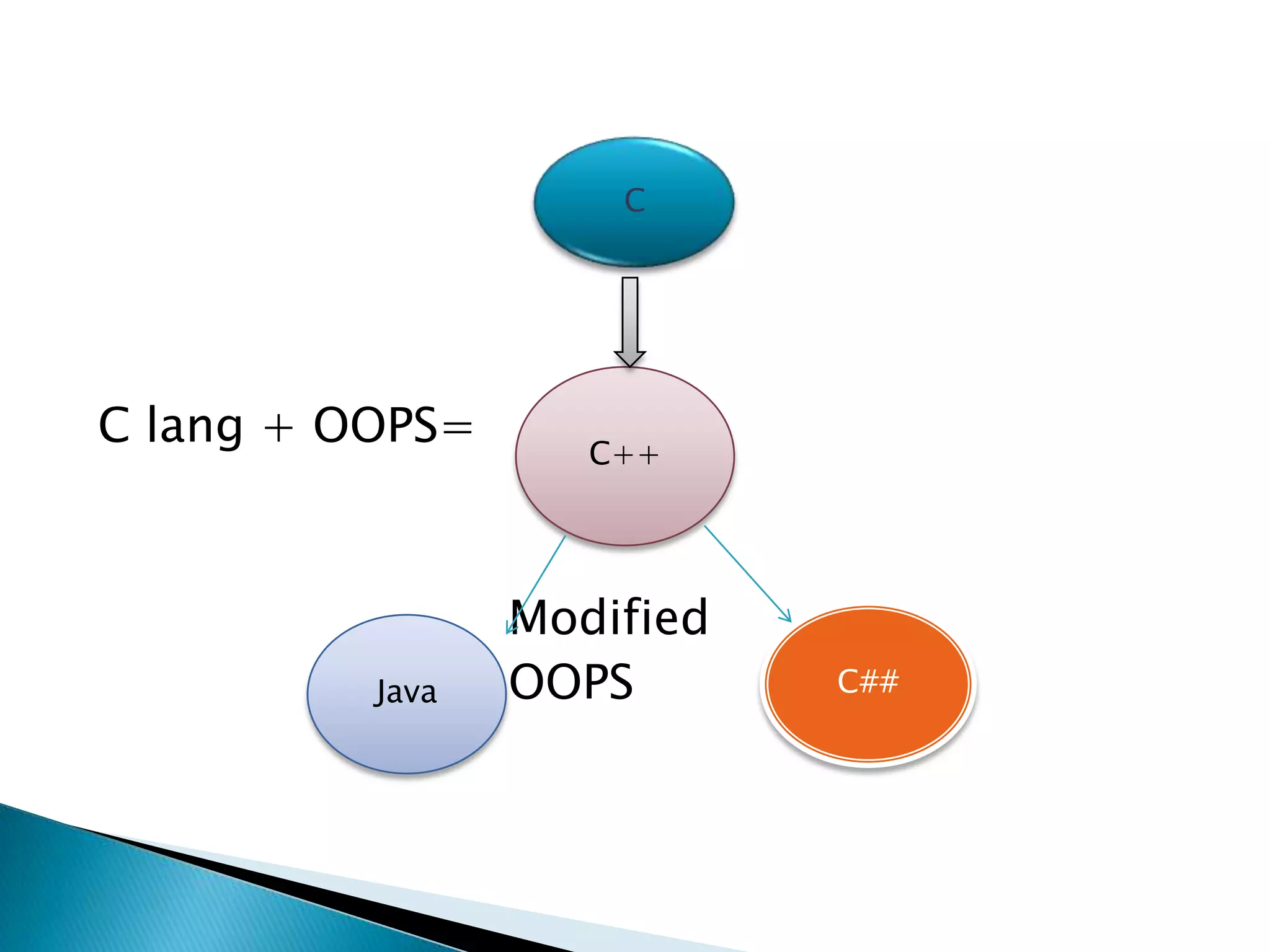
C lang + OOPS=
Modified
OOPS
C
C++
Java C##

Oops

  • 1.
     Supported languageslike C++, C#, Java
  • 3.
    Examples:- Real world objectsReplica in Prog world Bank net banking Shopping mall online shopping Reservation counter online ticket booking
  • 4.
     Developing asw means We are copying the real world objects into the prog world, it means both the objects must look similar to each other.  Non object oriented languages like C failed in creating the exact replica of the real world object in prog world. So that’s why OOPS is invented.  With the following example we can prove, how a non object oriented lang is failed in creating the replica.
  • 5.
    So firstly willsee an example of shopping mall using 1. non object oriented language 2. object oriented language
  • 6.
    So firstly weanalyze a shopping mall In Real World Salesman Cashier Manager Finally we need a collection of objects…
  • 7.
     5 SalesPersons  Describes product() speak()  2 Managers  Salaries() speak()  2 Cashiers  bill() speak()
  • 8.
    Without OOPS orin C language Void main() { Speak(); Salaries(); } String Speak(question) { Return answer; } int salaries(work done) { Return salary; }
  • 9.
     In previouscode where are those sales persons, managers and cashiers ? Can you locate them????
  • 10.
    So without OOPSwe are able to see  Functions of our shopping mall members  But actual persons are really missing… it means objects are really missing… With OOPS we can see them and we can feel their presence.
  • 11.
    With OOPS Contd… Class SalesPerson { StringDescibesProduct(question) { Return answer; } String Speak(question) { Return answer; } }; Class Cashier { Int bill(products, rate) { Return total bill; } String Speak(question) { Return answer; } };
  • 12.
    Void main() { Manager Mahesh; Mahesh.Speak(); CashierNeha; Neha.Bill(); SalesPerson Ram; SalesPerson Sam; SalesPerson Vicky; …etc }
  • 13.
     As oursoftware is completely dependent on real world objects, to create exact replica, developers started analyzing the real world objects like pen, car, water bottle etc and finally they learned 4 principles & named them as OOPS.  They finally concluded that, if we satisfy all the 4 principles in our programming language then definitely we can create exact replica of real world objects.
  • 14.
     But todaywe understanding OOPS in programmes but we are failing to analyze it in real world…
  • 15.
     Encapsulation  Abstraction Inheritance  Polymorphism
  • 16.
     Every realworld object like bag, mobile & pen-drive behaves like a container which is used for the purpose of storing & hiding the things.  This is called encapsulation.  So developers copied this principle in programming & they are achieving encapsulation through a kw called class.
  • 17.
     Hiding allthe things is not a good idea, so Every real world object like pen-drive is used for some purpose. so exposing those necessary functions is called abstraction.  So developers copied this principle in programming & they are achieving abstraction through a access modifiers.
  • 18.
     Each objectin the real world is based on their ancestors/parents & they also deriving some common things from them. example:- pen-drive object is derived some storing mechanisms from hard-disk object.  This is called inheritance.  So developers copied this principle in programming & they are achieving inheritance through a colon : symbol.
  • 19.
     Each objectin the real world behaves according to the situation. example:- a power button of an LCD monitor behaves as a power-off button if monitor is already switched on vice versa.  This is called polymorphism.  So developers copied this principle in programming & they are achieving polymorphism through a overloading & overriding.
  • 20.
    Advantages:- It is helpfulin developing Meaningful code. Maintenance is easy. Mapping with real world Objects.
  • 21.
    Q. Why itis required? To map software product similar to real life Product. To develop meaningful code. To increase Passion in programming
  • 22.
    C lang +OOPS= Modified OOPS C C++ Java C##