Fundamentals of Java-Programming -Covers OOPS Concepts
1.
Course : FUNDAMENTALSOF JAVA PROGRAMMING
Module 1 : JAVA BASICS
Topic : Review of Object Oriented Concepts
Faculty : S. Karthikeyini S
Sri Ramakrishna Institute of Technology,
Coimbatore
Assistant Professor/CSE
SRI RAMAKRISHNA INSTITUTE OF TECHNOLOGY
[Educational Service: SNR Sons Charitable Trust]
[Autonomous Institution, Reaccredited by NAAC with ‘A’ Grade]
[Approved by AICTE New Delhi, Permanently Affiliated to Anna University, Chennai]
SOFTWARE EVOLUTION
Layers ofsoftware
technology
Object Oriented Programming
Procedure Programming
Assembly Language
Machine Language
1, 0
4.
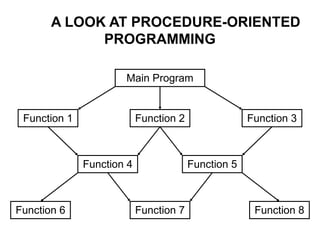
A LOOK ATPROCEDURE-ORIENTED
PROGRAMMING
Main Program
Function 1
Function 8
Function 6
Function 4 Function 5
Function 3
Function 2
Function 7
5.
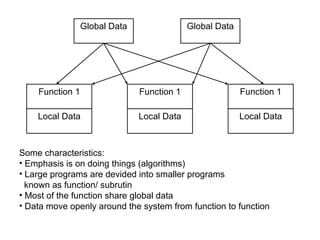
Global Data GlobalData
Function 1
Local Data
Function 1
Local Data
Function 1
Local Data
Some characteristics:
• Emphasis is on doing things (algorithms)
• Large programs are devided into smaller programs
known as function/ subrutin
• Most of the function share global data
• Data move openly around the system from function to function
Some of OOP’sstriking features:
▪ Emphasis is on data rather than procedure.
▪ Programs are divided into objects.
▪ Data structures are designed such that they
characterize the objects.
▪ Functions are tied together in the data structures.
▪ Data is hidden and can not be accessed by
external functions.
9.
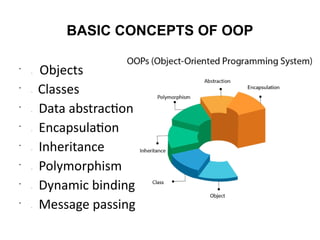
CLASSES
• It isa blueprint from which objects are
created
• A collection of objects of similar type
• Example:
– Object mango, apple, and orange is member of class fruit
10.
OBJECTS
• It isan instance of a
class.
• Have a life cycle.
• They can be created
and destroyed.
• Interacts by sending
message to one
another
• Contains data and
code/ function to
manipulate the data
DATA ABSTRACTION
• Theact of
representing
essential
features
without
including the
background
details or
explanations.
13.
ENCAPSULATION
• Wrapping upof data and functions into a single unit (called class).
• The data is not accessible to the outside world and only functions
which are wrapped in the class can access it.
• Insulation of the data from direct access by the program is called
data hiding
14.
INHERITANCE
• Is theprocess by
which objects of one
class acquire the
properties of objects
of another class.
• Supports the
concepts of
hierarchical
classification.
• Provides the idea of
reusability.
15.
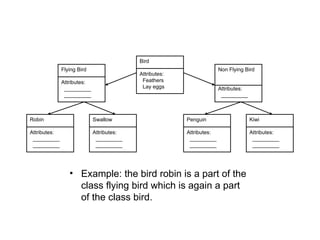
Bird
Attributes:
Feathers
Lay eggs
Flying Bird
Attributes:
_________
_________
NonFlying Bird
Attributes:
_________
Robin
Attributes:
_________
_________
Swallow
Attributes:
_________
_________
Penguin
Attributes:
_________
_________
Kiwi
Attributes:
_________
_________
• Example: the bird robin is a part of the
class flying bird which is again a part
of the class bird.
16.
POLYMORPHISM
• The abilityto take more than one form.
• An operation may exhibit different behaviour
in different instances depends upon the data
types used in the operation.
• Example: addition operation
– If two numbers, will generate a sum
– If two strings, will generate a concatenation
• Extensively used in implementing inheritance
DYNAMIC BINDING
• Thecode associated with a given procedure
call is not known until the time of the call at
run time.
• Associated with polymorphism and
inheritance.
• Example: (above diagram) Unique to each
object and so the draw procedure will be
redefined in each class that defines the object.
• At run-time, the code matching the object
under current reference will be called.
19.
MESSAGE PASSING
• Objectoriented program consist of a set of
objects communicate with each.
• Steps:
– Creating classes that define objects and their behaviour.
– Creating objects from class definitions.
– Establishing communication among objects.
• Objects communicate with one another by
sending and receiving information.
• Message passing involves: object’s name,
function’s name (message) and information
20.
BENEFITS OF OOP
•Through inheritance, we can eliminate redundant code
and extend the use of existing classes.
• The principle of data hiding helps the programmer to
build secure programs.
• Can be easily upgraded from small to large systems.
• Software complexity can be easily managed.
• "Don't Repeat Yourself" (DRY) principle is about reducing the repetition of
code.
21.
Summary
● How OOPSevolved
● OOP paradigm elements
● Applying OOPS concepts
● Benefits of using OOPS
22.
Advantage of OOPsover Procedure-oriented programming language
1) OOPs makes development and maintenance
easier, whereas, in a procedure-oriented
programming language, it is not easy to
manage if code grows as project size
increases.
2) OOPs provides data hiding, whereas, in a
procedure-oriented programming language,
global data can be accessed from anywhere.
23.
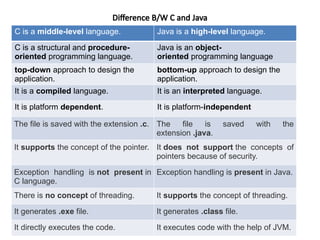
Difference B/W Cand Java
C is a middle-level language. Java is a high-level language.
C is a structural and procedure-
oriented programming language.
Java is an object-
oriented programming language
top-down approach to design the
application.
bottom-up approach to design the
application.
It is a compiled language. It is an interpreted language.
It is platform dependent. It is platform-independent
The file is saved with the extension .c. The file is saved with the
extension .java.
It supports the concept of the pointer. It does not support the concepts of
pointers because of security.
Exception handling is not present in
C language.
Exception handling is present in Java.
There is no concept of threading. It supports the concept of threading.
It generates .exe file. It generates .class file.
It directly executes the code. It executes code with the help of JVM.
24.
It supports thegoto
statement.
It does not support the goto
statement.
Preprocessors are supported
in C.
Preprocessors are not
supported in Java.
It is mainly used to
develop system
applications and firmware.
It is mainly used to
develop enterprise
applications and web-based
applications.
It does not maintain memory,
internally.
It maintains memory,
internally.
25.
public class Main
{
intx = 5;
public static void main(String[] args)
{
Main myObj = new Main();
System.out.println(myObj.x);
}
}
![Course : FUNDAMENTALS OF JAVA PROGRAMMING
Module 1 : JAVA BASICS
Topic : Review of Object Oriented Concepts
Faculty : S. Karthikeyini S
Sri Ramakrishna Institute of Technology,
Coimbatore
Assistant Professor/CSE
SRI RAMAKRISHNA INSTITUTE OF TECHNOLOGY
[Educational Service: SNR Sons Charitable Trust]
[Autonomous Institution, Reaccredited by NAAC with ‘A’ Grade]
[Approved by AICTE New Delhi, Permanently Affiliated to Anna University, Chennai]](https://image.slidesharecdn.com/1-251118063828-2707ede1/85/Fundamentals-of-Java-Programming-Covers-OOPS-Concepts-1-320.jpg)








![public class Main
{
int x = 5;
public static void main(String[] args)
{
Main myObj = new Main();
System.out.println(myObj.x);
}
}](https://image.slidesharecdn.com/1-251118063828-2707ede1/85/Fundamentals-of-Java-Programming-Covers-OOPS-Concepts-25-320.jpg)


![Attack surfaces and attack tress[inform]](https://cdn.slidesharecdn.com/ss_thumbnails/lecture03-260108015941-a4dee53b-thumbnail.jpg?width=640&height=640&fit=bounds)
