ooc
The Quest for the Holy Grail
OSDC.fr 2010 ooc-lang.org Amos Wenger
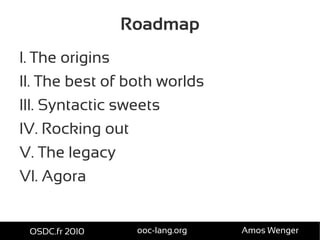
Roadmap
I. The origins
II. The best of both worlds
III. Syntactic sweets
IV. Rocking out
V. The legacy
VI. Agora
OSDC.fr 2010 ooc-lang.org Amos Wenger
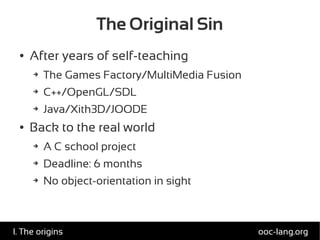
The Original Sin
● After years of self-teaching
➔ The Games Factory/MultiMedia Fusion
➔ C++/OpenGL/SDL
➔ Java/Xith3D/JOODE
● Back to the real world
➔ A C school project
➔ Deadline: 6 months
➔ No object-orientation in sight
ooc-lang.orgI. The origins
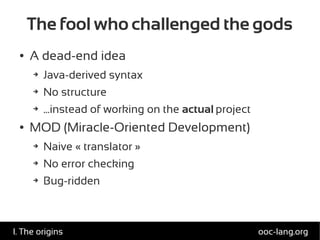
The fool who challenged the gods
● A dead-end idea
➔ Java-derived syntax
➔ No structure
➔ ...instead of working on the actual project
● MOD (Miracle-Oriented Development)
➔ Naive « translator »
➔ No error checking
➔ Bug-ridden
ooc-lang.orgI. The origins
The first-born
● ooc 0.1
➔ Written in Java, 11K SLOC
➔ Generates C code
➔ Handed in along with the real project
➔ « Real » project developed in a few days
➔ Success!
« Version 1.0 sucks, but ship it anyway »
Jeff Atwood (CodingHorror)
ooc-lang.orgI. The origins
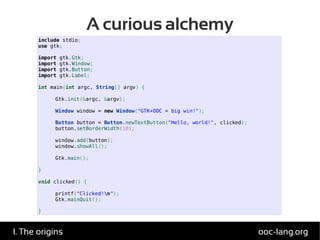
A curious alchemy
ooc-lang.orgI. The origins
The test of time
● 4 rewrites later
➔ Syntax evolved
➔ Still written in Java
➔ Type inference
➔ Generics (horribly implemented)
● Meanwhile, on #ooc-lang/Freenode
➔ A self-hosting effort is started
ooc-lang.orgI. The origins
A dream come true
● In just a few weeks
➔ rock = ooc port of the j/ooc compiler
➔ first real community effort
➔ serious cleanups
● A few more weeks, and
➔ rock compiled itself!
➔ again...
➔ and again...
➔ (with a spoon)
ooc-lang.orgI. The origins
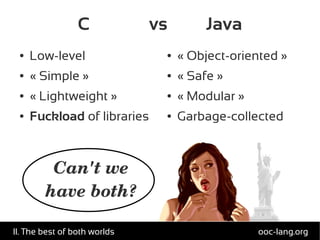
C vs Java
● Low-level
● « Simple »
● « Lightweight »
● Fuckload of libraries
● « Object-oriented »
● « Safe »
● « Modular »
● Garbage-collected
Can't we
have both?
ooc-lang.orgII. The best of both worlds
ooc in a nutshell
● Modularity
➔ import = Modules
➔ use = Libraries
● Types
➔ cover = base types from C
➔ class = simple inheritance, interface, enum
● Functions
➔ name: func (…) -> Type { … }
➔ first-class, overload, defaults, varargs
ooc-lang.orgII. The best of both worlds
ooc in a coconut shell
● Generics
➔ identity: func <T> (t: T) T { t }→
● try, catch = Exceptions
➔ Exception new("You dun goofed!") println()
● version = Platform-specific blocks
➔ version(trial) { Time sleepSec(5) }
● operator = Operator overload
➔ operator + (a, b: Int) { a - b } // huhu.
ooc-lang.orgII. The best of both worlds
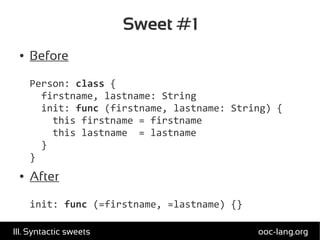
Sweet #1
● Before
Person: class {
firstname, lastname: String
init: func (firstname, lastname: String) {
this firstname = firstname
this lastname = lastname
}
}
● After
init: func (=firstname, =lastname) {}
ooc-lang.orgIII. Syntactic sweets
Sweet #2
● Before
import structs/ArrayList
import structs/HashMap
import structs/Stack
● After
import structs/[ArrayList, HashMap, Stack]
ooc-lang.orgIII. Syntactic sweets
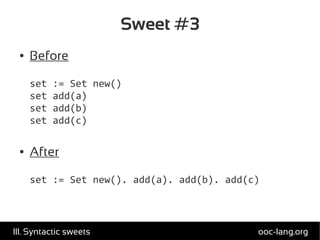
Sweet #3
● Before
set := Set new()
set add(a)
set add(b)
set add(c)
● After
set := Set new(). add(a). add(b). add(c)
ooc-lang.orgIII. Syntactic sweets
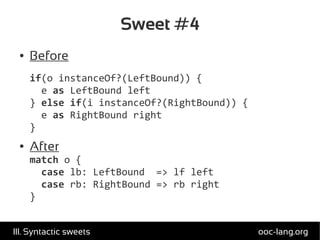
Sweet #4
● Before
if(o instanceOf?(LeftBound)) {
e as LeftBound left
} else if(i instanceOf?(RightBound)) {
e as RightBound right
}
● After
match o {
case lb: LeftBound => lf left
case rb: RightBound => rb right
}
ooc-lang.orgIII. Syntactic sweets
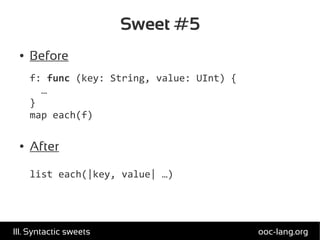
Sweet #5
● Before
f: func (key: String, value: UInt) {
…
}
map each(f)
● After
list each(|key, value| …)
ooc-lang.orgIII. Syntactic sweets
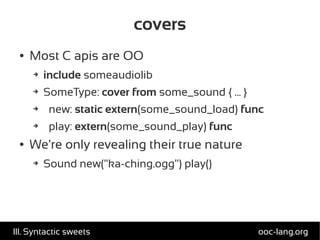
covers
● Most C apis are OO
➔ include someaudiolib
➔ SomeType: cover from some_sound { ... }
➔ new: static extern(some_sound_load) func
➔ play: extern(some_sound_play) func
● We're only revealing their true nature
➔ Sound new("ka-ching.ogg") play()
ooc-lang.orgIII. Syntactic sweets
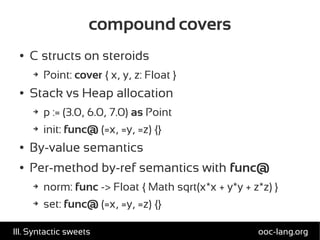
compound covers
● C structs on steroids
➔ Point: cover { x, y, z: Float }
● Stack vs Heap allocation
➔ p := (3.0, 6.0, 7.0) as Point
➔ init: func@ (=x, =y, =z) {}
● By-value semantics
● Per-method by-ref semantics with func@
➔ norm: func -> Float { Math sqrt(x*x + y*y + z*z) }
➔ set: func@ (=x, =y, =z) {}
ooc-lang.orgIII. Syntactic sweets
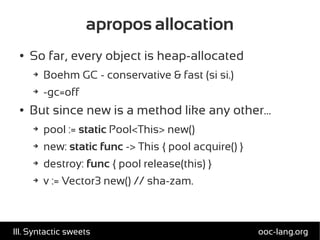
apropos allocation
● So far, every object is heap-allocated
➔ Boehm GC - conservative & fast (si si.)
➔ -gc=off
● But since new is a method like any other...
➔ pool := static Pool<This> new()
➔ new: static func -> This { pool acquire() }
➔ destroy: func { pool release(this) }
➔ v := Vector3 new() // sha-zam.
ooc-lang.orgIII. Syntactic sweets
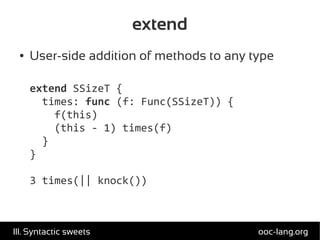
extend
● User-side addition of methods to any type
extend SSizeT {
times: func (f: Func(SSizeT)) {
f(this)
(this - 1) times(f)
}
}
3 times(|| knock())
ooc-lang.orgIII. Syntactic sweets
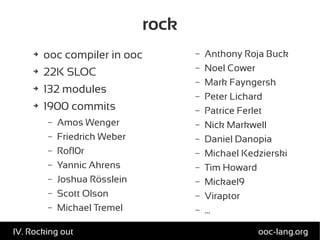
rock
➔ ooc compiler in ooc
➔ 22K SLOC
➔ 132 modules
➔ 1900 commits
– Amos Wenger
– Friedrich Weber
– Rofl0r
– Yannic Ahrens
– Joshua Rösslein
– Scott Olson
– Michael Tremel
– Anthony Roja Buck
– Noel Cower
– Mark Fayngersh
– Peter Lichard
– Patrice Ferlet
– Nick Markwell
– Daniel Danopia
– Michael Kedzierski
– Tim Howard
– Mickael9
– Viraptor
– ...
ooc-lang.orgIV. Rocking out
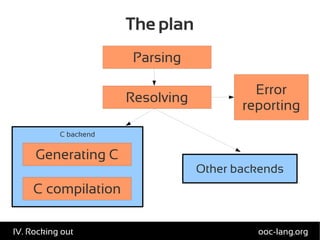
The plan
ooc-lang.orgIV. Rocking out
Parsing
Resolving
Error
reporting
C backend
Generating C
C compilation
Other backends
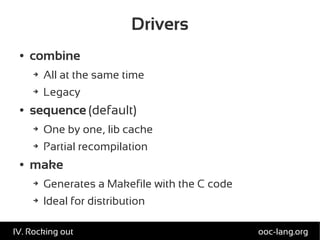
Drivers
● combine
➔ All at the same time
➔ Legacy
● sequence (default)
➔ One by one, lib cache
➔ Partial recompilation
● make
➔ Generates a Makefile with the C code
➔ Ideal for distribution
ooc-lang.orgIV. Rocking out
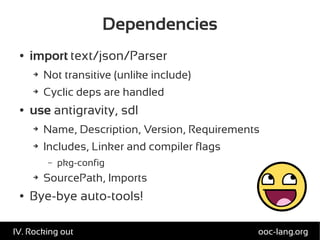
Dependencies
● import text/json/Parser
➔ Not transitive (unlike include)
➔ Cyclic deps are handled
● use antigravity, sdl
➔ Name, Description, Version, Requirements
➔ Includes, Linker and compiler flags
– pkg-config
➔ SourcePath, Imports
● Bye-bye auto-tools!
ooc-lang.orgIV. Rocking out
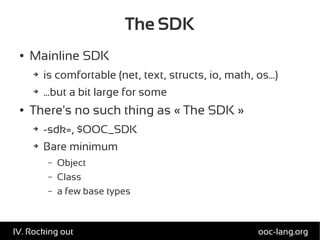
The SDK
● Mainline SDK
➔ is comfortable (net, text, structs, io, math, os...)
➔ ...but a bit large for some
● There's no such thing as « The SDK »
➔ -sdk=, $OOC_SDK
➔ Bare minimum
– Object
– Class
– a few base types
ooc-lang.orgIV. Rocking out
The legacy
● oos
ooc operating system, runs on x86 real hw,
custom sdk, bits of asm but 0% C
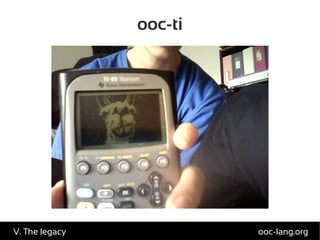
● ooc-ti
sdk for tigcc, compiles+runs stuff on TI89!
● pyooc
use ooc code from python, json backend
zero-configuration
● ruby-inline-ooc
load+evaluate ruby code inside ooc
ooc-lang.orgV. The legacy
ooc-ti
ooc-lang.orgV. The legacy
The legacy II
● reincarnate
package manager, in ooc, for ooc. deps based
on usefiles, python server backend (nirvana)
● stako
a stack-based language inspired by factor
● langsniff
analyzes a text and find which language it's in
● yajit
simple just-in-time assembler - used in rock for
flattening closures
ooc-lang.orgV. The legacy
teeworlds-ai
ooc-lang.orgV. The legacy
The legacy III
● spry
IRC bot framework in ooc
● proof
small testing framework for ooc
● ooc-web
ooc web applicaton framework
● mustang
templating engine based on
the infamous mustache
ooc-lang.orgV. The legacy
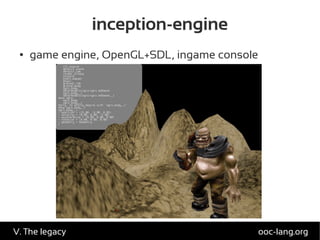
inception-engine
● game engine, OpenGL+SDL, ingame console
ooc-lang.orgV. The legacy
The legacy IV
<your project here>
http://github.com/languages/ooc
ooc-lang.orgV. The legacy
Questions
➔ Languages
– What about Go/Vala?
– What about
Scala/Clojure?
– What about C++?
– What about C#?
➔ Development
– Can I contribute?
– Do you want money?
– What's next for rock?
– Where else can I help?
➔ Performance
– Is it fast?
➔ Bindings
– Does lib X have
bindings yet?
– Isn't it tedious to do
bindings?
➔ Interoperability
– Let's do rbooc!
– Let's do Perl::ooc!
– Let's do Y!
ooc-lang.orgVI. Agora
Thanks for listening!
Web http://ooc-lang.org
IRC #ooc-lang on Freenode
Twitter @ooc_lang
Mail ndd@rylliog.cz
OSDC.fr 2010 ooc-lang.org Amos Wenger

ooc - OSDC 2010 - Amos Wenger

  • 1.
    ooc The Quest forthe Holy Grail OSDC.fr 2010 ooc-lang.org Amos Wenger
  • 2.
    Roadmap I. The origins II.The best of both worlds III. Syntactic sweets IV. Rocking out V. The legacy VI. Agora OSDC.fr 2010 ooc-lang.org Amos Wenger
  • 3.
    The Original Sin ●After years of self-teaching ➔ The Games Factory/MultiMedia Fusion ➔ C++/OpenGL/SDL ➔ Java/Xith3D/JOODE ● Back to the real world ➔ A C school project ➔ Deadline: 6 months ➔ No object-orientation in sight ooc-lang.orgI. The origins
  • 4.
    The fool whochallenged the gods ● A dead-end idea ➔ Java-derived syntax ➔ No structure ➔ ...instead of working on the actual project ● MOD (Miracle-Oriented Development) ➔ Naive « translator » ➔ No error checking ➔ Bug-ridden ooc-lang.orgI. The origins
  • 5.
    The first-born ● ooc0.1 ➔ Written in Java, 11K SLOC ➔ Generates C code ➔ Handed in along with the real project ➔ « Real » project developed in a few days ➔ Success! « Version 1.0 sucks, but ship it anyway » Jeff Atwood (CodingHorror) ooc-lang.orgI. The origins
  • 6.
  • 7.
    The test oftime ● 4 rewrites later ➔ Syntax evolved ➔ Still written in Java ➔ Type inference ➔ Generics (horribly implemented) ● Meanwhile, on #ooc-lang/Freenode ➔ A self-hosting effort is started ooc-lang.orgI. The origins
  • 8.
    A dream cometrue ● In just a few weeks ➔ rock = ooc port of the j/ooc compiler ➔ first real community effort ➔ serious cleanups ● A few more weeks, and ➔ rock compiled itself! ➔ again... ➔ and again... ➔ (with a spoon) ooc-lang.orgI. The origins
  • 9.
    C vs Java ●Low-level ● « Simple » ● « Lightweight » ● Fuckload of libraries ● « Object-oriented » ● « Safe » ● « Modular » ● Garbage-collected Can't we have both? ooc-lang.orgII. The best of both worlds
  • 10.
    ooc in anutshell ● Modularity ➔ import = Modules ➔ use = Libraries ● Types ➔ cover = base types from C ➔ class = simple inheritance, interface, enum ● Functions ➔ name: func (…) -> Type { … } ➔ first-class, overload, defaults, varargs ooc-lang.orgII. The best of both worlds
  • 11.
    ooc in acoconut shell ● Generics ➔ identity: func <T> (t: T) T { t }→ ● try, catch = Exceptions ➔ Exception new("You dun goofed!") println() ● version = Platform-specific blocks ➔ version(trial) { Time sleepSec(5) } ● operator = Operator overload ➔ operator + (a, b: Int) { a - b } // huhu. ooc-lang.orgII. The best of both worlds
  • 12.
    Sweet #1 ● Before Person:class { firstname, lastname: String init: func (firstname, lastname: String) { this firstname = firstname this lastname = lastname } } ● After init: func (=firstname, =lastname) {} ooc-lang.orgIII. Syntactic sweets
  • 13.
    Sweet #2 ● Before importstructs/ArrayList import structs/HashMap import structs/Stack ● After import structs/[ArrayList, HashMap, Stack] ooc-lang.orgIII. Syntactic sweets
  • 14.
    Sweet #3 ● Before set:= Set new() set add(a) set add(b) set add(c) ● After set := Set new(). add(a). add(b). add(c) ooc-lang.orgIII. Syntactic sweets
  • 15.
    Sweet #4 ● Before if(oinstanceOf?(LeftBound)) { e as LeftBound left } else if(i instanceOf?(RightBound)) { e as RightBound right } ● After match o { case lb: LeftBound => lf left case rb: RightBound => rb right } ooc-lang.orgIII. Syntactic sweets
  • 16.
    Sweet #5 ● Before f:func (key: String, value: UInt) { … } map each(f) ● After list each(|key, value| …) ooc-lang.orgIII. Syntactic sweets
  • 17.
    covers ● Most Capis are OO ➔ include someaudiolib ➔ SomeType: cover from some_sound { ... } ➔ new: static extern(some_sound_load) func ➔ play: extern(some_sound_play) func ● We're only revealing their true nature ➔ Sound new("ka-ching.ogg") play() ooc-lang.orgIII. Syntactic sweets
  • 18.
    compound covers ● Cstructs on steroids ➔ Point: cover { x, y, z: Float } ● Stack vs Heap allocation ➔ p := (3.0, 6.0, 7.0) as Point ➔ init: func@ (=x, =y, =z) {} ● By-value semantics ● Per-method by-ref semantics with func@ ➔ norm: func -> Float { Math sqrt(x*x + y*y + z*z) } ➔ set: func@ (=x, =y, =z) {} ooc-lang.orgIII. Syntactic sweets
  • 19.
    apropos allocation ● Sofar, every object is heap-allocated ➔ Boehm GC - conservative & fast (si si.) ➔ -gc=off ● But since new is a method like any other... ➔ pool := static Pool<This> new() ➔ new: static func -> This { pool acquire() } ➔ destroy: func { pool release(this) } ➔ v := Vector3 new() // sha-zam. ooc-lang.orgIII. Syntactic sweets
  • 20.
    extend ● User-side additionof methods to any type extend SSizeT { times: func (f: Func(SSizeT)) { f(this) (this - 1) times(f) } } 3 times(|| knock()) ooc-lang.orgIII. Syntactic sweets
  • 21.
    rock ➔ ooc compilerin ooc ➔ 22K SLOC ➔ 132 modules ➔ 1900 commits – Amos Wenger – Friedrich Weber – Rofl0r – Yannic Ahrens – Joshua Rösslein – Scott Olson – Michael Tremel – Anthony Roja Buck – Noel Cower – Mark Fayngersh – Peter Lichard – Patrice Ferlet – Nick Markwell – Daniel Danopia – Michael Kedzierski – Tim Howard – Mickael9 – Viraptor – ... ooc-lang.orgIV. Rocking out
  • 22.
    The plan ooc-lang.orgIV. Rockingout Parsing Resolving Error reporting C backend Generating C C compilation Other backends
  • 23.
    Drivers ● combine ➔ Allat the same time ➔ Legacy ● sequence (default) ➔ One by one, lib cache ➔ Partial recompilation ● make ➔ Generates a Makefile with the C code ➔ Ideal for distribution ooc-lang.orgIV. Rocking out
  • 24.
    Dependencies ● import text/json/Parser ➔Not transitive (unlike include) ➔ Cyclic deps are handled ● use antigravity, sdl ➔ Name, Description, Version, Requirements ➔ Includes, Linker and compiler flags – pkg-config ➔ SourcePath, Imports ● Bye-bye auto-tools! ooc-lang.orgIV. Rocking out
  • 25.
    The SDK ● MainlineSDK ➔ is comfortable (net, text, structs, io, math, os...) ➔ ...but a bit large for some ● There's no such thing as « The SDK » ➔ -sdk=, $OOC_SDK ➔ Bare minimum – Object – Class – a few base types ooc-lang.orgIV. Rocking out
  • 26.
    The legacy ● oos oocoperating system, runs on x86 real hw, custom sdk, bits of asm but 0% C ● ooc-ti sdk for tigcc, compiles+runs stuff on TI89! ● pyooc use ooc code from python, json backend zero-configuration ● ruby-inline-ooc load+evaluate ruby code inside ooc ooc-lang.orgV. The legacy
  • 27.
  • 28.
    The legacy II ●reincarnate package manager, in ooc, for ooc. deps based on usefiles, python server backend (nirvana) ● stako a stack-based language inspired by factor ● langsniff analyzes a text and find which language it's in ● yajit simple just-in-time assembler - used in rock for flattening closures ooc-lang.orgV. The legacy
  • 29.
  • 30.
    The legacy III ●spry IRC bot framework in ooc ● proof small testing framework for ooc ● ooc-web ooc web applicaton framework ● mustang templating engine based on the infamous mustache ooc-lang.orgV. The legacy
  • 31.
    inception-engine ● game engine,OpenGL+SDL, ingame console ooc-lang.orgV. The legacy
  • 32.
    The legacy IV <yourproject here> http://github.com/languages/ooc ooc-lang.orgV. The legacy
  • 33.
    Questions ➔ Languages – Whatabout Go/Vala? – What about Scala/Clojure? – What about C++? – What about C#? ➔ Development – Can I contribute? – Do you want money? – What's next for rock? – Where else can I help? ➔ Performance – Is it fast? ➔ Bindings – Does lib X have bindings yet? – Isn't it tedious to do bindings? ➔ Interoperability – Let's do rbooc! – Let's do Perl::ooc! – Let's do Y! ooc-lang.orgVI. Agora
  • 34.
    Thanks for listening! Webhttp://ooc-lang.org IRC #ooc-lang on Freenode Twitter @ooc_lang Mail ndd@rylliog.cz OSDC.fr 2010 ooc-lang.org Amos Wenger