NS2: Shadow ObjectNS2: Shadow Object
ConstructionConstruction
by Teerawat Issariyakul
http://www.ns2ultimate.com
October 2010
http://www.ns2ultimate.com 1
OutlineOutline
Introduction
Creating an OTcl object
Shadow Object Construction Process
Summary
http://www.ns2ultimate.com 2
IntroductionIntroduction
This is a series on how NS2 binds C++ and OTcl together.This is the
second topic of the series:
1.WhyTwo Languages?
2. Binding C++ and OTcl classes
3. Variable binding
4. OTcl command: Invoking C++ statements from the OTcl domain
5. Eval and result: Invoking OTcl statements from the C++ domain
6. Object binding and object construction process.
http://www.ns2ultimate.com 3
MotivationMotivation
http://www.ns2ultimate.com 4
 NS2 consists of 2 languages:
◦ OTcl: A user interface language used to create objects
◦ C++: A language defining the created objects’ attributes and
behaviors
 Objects in NS2
◦ A user creates an object from the OTcl domain
◦ NS2 automatically create a “shadow” object in the C++ domain
 From the user perspective, these two objects are the same.
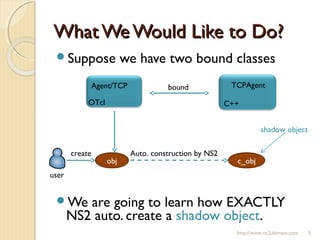
Suppose we have two bound classes
We are going to learn how EXACTLY
NS2 auto. create a shadow object.
What We Would Like to Do?What We Would Like to Do?
http://www.ns2ultimate.com 5
TCPAgent
C++
Agent/TCP
OTcl
bound
user
obj
create
c_obj
Auto. construction by NS2
shadow object
OutlineOutline
Introduction
Creating an OTcl object
Shadow Object Construction Process
Summary
http://www.ns2ultimate.com 6
Creating an OTcl ObjectCreating an OTcl Object
http://www.ns2ultimate.com 7
 An OTcl is created using the following syntax
<className> create <var> [<args>]
which creates an object of class <className> and store the
created object in the variable <var>. Note, [<args>]is optional
input argument for object construction.
 There are two key steps when invoking new
◦ Executing instproc “alloc” to allocate memory to hold the object
◦ Executing instproc “init” (i.e., the constructor) to initialize class
variables
Instproc “Instproc “initinit””
http://www.ns2ultimate.com 8
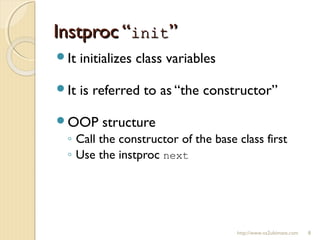
It initializes class variables
It is referred to as “the constructor”
OOP structure
◦ Call the constructor of the base class first
◦ Use the instproc next
Instproc “Instproc “nextnext””
http://www.ns2ultimate.com 9
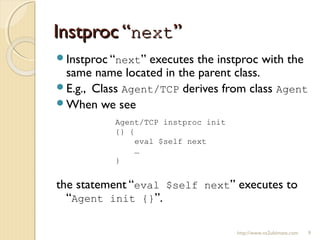
Instproc “next” executes the instproc with the
same name located in the parent class.
E.g., Class Agent/TCP derives from class Agent
When we see
the statement “eval $self next” executes to
“Agent init {}”.
Agent/TCP instproc init
{} {
eval $self next
…
}
OutlineOutline
Introduction
Creating an OTcl object
Shadow Object Construction Process
Summary
http://www.ns2ultimate.com 10
Shadow Object ConstructionShadow Object Construction
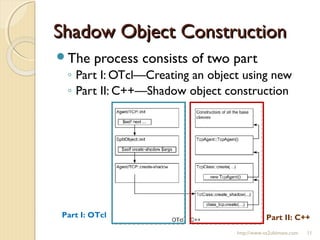
The process consists of two part
◦ Part I: OTcl—Creating an object using new
◦ Part II: C++—Shadow object construction
http://www.ns2ultimate.com 11
Part I: OTcl Part II: C++
Shadow Object ConstructionShadow Object Construction
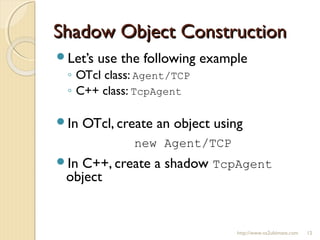
Let’s use the following example
◦ OTcl class: Agent/TCP
◦ C++ class: TcpAgent
In OTcl, create an object using
new Agent/TCP
In C++, create a shadow TcpAgent
object
http://www.ns2ultimate.com 12
Part I: OTclPart I: OTcl
Main steps of Part I:
The OTcl statement new <classname> [<args>]
The OTcl statement $classname create $o $args
The instproc alloc of the OTcl class <classname>
The instproc init of the OTcl class <classname>
The instproc init of the OTcl class SplitObject
The OTcl statement $self create-shadow $args
http://www.ns2ultimate.com 13
Part I: OTclPart I: OTcl
1. The OTcl statement new <classname>
[<args>]
http://www.ns2ultimate.com 14
proc new { className args } {
set o [SplitObject getid]
if [catch "$className create $o $args" msg] {
...
}
return $o
}
step 2
Part I: OTclPart I: OTcl
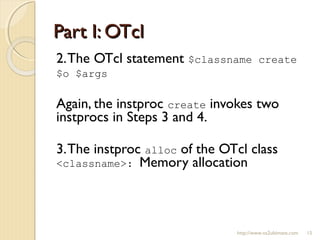
2.The OTcl statement $classname create
$o $args
Again, the instproc create invokes two
instprocs in Steps 3 and 4.
3.The instproc alloc of the OTcl class
<classname>: Memory allocation
http://www.ns2ultimate.com 15
Part I: OTclPart I: OTcl
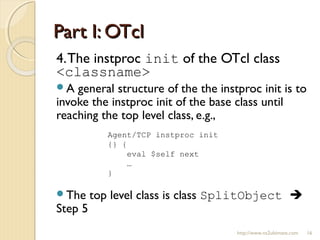
4.The instproc init of the OTcl class
<classname>
A general structure of the the instproc init is to
invoke the instproc init of the base class until
reaching the top level class, e.g.,
The top level class is class SplitObject 
Step 5
http://www.ns2ultimate.com 16
Agent/TCP instproc init
{} {
eval $self next
…
}
Part I: OTclPart I: OTcl
5. The instproc init of the OTcl class SplitObject
6. The OTcl statement $self create-shadow
$args:
 This executes, for example, instproc create-
shadow of class Agent/TCP
http://www.ns2ultimate.com 17
SplitObject instproc init args {
$self next
if [catch "$self create-shadow $args"] {
error "__FAILED_SHADOW_OBJECT_" ""
}
}
Part II: C++Part II: C++
http://www.ns2ultimate.com 18
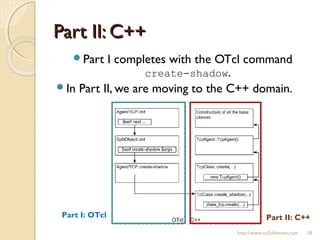
Part I completes with the OTcl command
create-shadow.
In Part II, we are moving to the C++ domain.
Part I: OTcl Part II: C++
Part II: C++Part II: C++
http://www.ns2ultimate.com 19
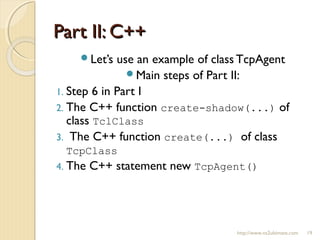
Let’s use an example of class TcpAgent
Main steps of Part II:
1. Step 6 in Part I
2. The C++ function create-shadow(...) of
class TclClass
3. The C++ function create(...) of class
TcpClass
4. The C++ statement new TcpAgent()
Part II: C++Part II: C++
http://www.ns2ultimate.com 20
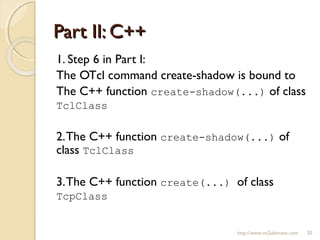
1. Step 6 in Part I:
The OTcl command create-shadow is bound to
The C++ function create-shadow(...) of class
TclClass
2.The C++ function create-shadow(...) of
class TclClass
3.The C++ function create(...) of class
TcpClass
Part II: C++Part II: C++
http://www.ns2ultimate.com 21
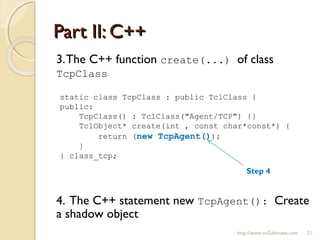
3.The C++ function create(...) of class
TcpClass
4. The C++ statement new TcpAgent(): Create
a shadow object
static class TcpClass : public TclClass {
public:
TcpClass() : TclClass("Agent/TCP") {}
TclObject* create(int , const char*const*) {
return (new TcpAgent());
}
} class_tcp;
Step 4
OutlineOutline
Introduction
Creating an OTcl object
Shadow Object Construction Process
Summary
http://www.ns2ultimate.com 22
SummarySummary
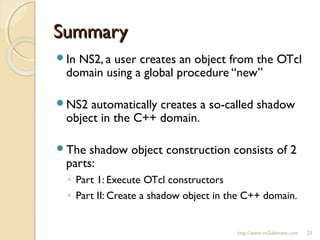
In NS2, a user creates an object from the OTcl
domain using a global procedure “new”
NS2 automatically creates a so-called shadow
object in the C++ domain.
The shadow object construction consists of 2
parts:
◦ Part 1: Execute OTcl constructors
◦ Part II: Create a shadow object in the C++ domain.
http://www.ns2ultimate.com 23
For more information aboutFor more information about
NS 2NS 2
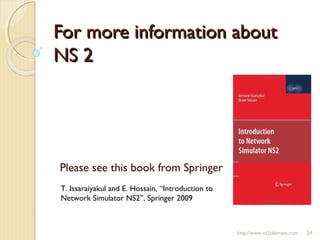
Please see this book from Springer
T. Issaraiyakul and E. Hossain, “Introduction to
Network Simulator NS2”, Springer 2009
http://www.ns2ultimate.com 24

NS2 Shadow Object Construction

  • 1.
    NS2: Shadow ObjectNS2:Shadow Object ConstructionConstruction by Teerawat Issariyakul http://www.ns2ultimate.com October 2010 http://www.ns2ultimate.com 1
  • 2.
    OutlineOutline Introduction Creating an OTclobject Shadow Object Construction Process Summary http://www.ns2ultimate.com 2
  • 3.
    IntroductionIntroduction This is aseries on how NS2 binds C++ and OTcl together.This is the second topic of the series: 1.WhyTwo Languages? 2. Binding C++ and OTcl classes 3. Variable binding 4. OTcl command: Invoking C++ statements from the OTcl domain 5. Eval and result: Invoking OTcl statements from the C++ domain 6. Object binding and object construction process. http://www.ns2ultimate.com 3
  • 4.
    MotivationMotivation http://www.ns2ultimate.com 4  NS2consists of 2 languages: ◦ OTcl: A user interface language used to create objects ◦ C++: A language defining the created objects’ attributes and behaviors  Objects in NS2 ◦ A user creates an object from the OTcl domain ◦ NS2 automatically create a “shadow” object in the C++ domain  From the user perspective, these two objects are the same.
  • 5.
    Suppose we havetwo bound classes We are going to learn how EXACTLY NS2 auto. create a shadow object. What We Would Like to Do?What We Would Like to Do? http://www.ns2ultimate.com 5 TCPAgent C++ Agent/TCP OTcl bound user obj create c_obj Auto. construction by NS2 shadow object
  • 6.
    OutlineOutline Introduction Creating an OTclobject Shadow Object Construction Process Summary http://www.ns2ultimate.com 6
  • 7.
    Creating an OTclObjectCreating an OTcl Object http://www.ns2ultimate.com 7  An OTcl is created using the following syntax <className> create <var> [<args>] which creates an object of class <className> and store the created object in the variable <var>. Note, [<args>]is optional input argument for object construction.  There are two key steps when invoking new ◦ Executing instproc “alloc” to allocate memory to hold the object ◦ Executing instproc “init” (i.e., the constructor) to initialize class variables
  • 8.
    Instproc “Instproc “initinit”” http://www.ns2ultimate.com8 It initializes class variables It is referred to as “the constructor” OOP structure ◦ Call the constructor of the base class first ◦ Use the instproc next
  • 9.
    Instproc “Instproc “nextnext”” http://www.ns2ultimate.com9 Instproc “next” executes the instproc with the same name located in the parent class. E.g., Class Agent/TCP derives from class Agent When we see the statement “eval $self next” executes to “Agent init {}”. Agent/TCP instproc init {} { eval $self next … }
  • 10.
    OutlineOutline Introduction Creating an OTclobject Shadow Object Construction Process Summary http://www.ns2ultimate.com 10
  • 11.
    Shadow Object ConstructionShadowObject Construction The process consists of two part ◦ Part I: OTcl—Creating an object using new ◦ Part II: C++—Shadow object construction http://www.ns2ultimate.com 11 Part I: OTcl Part II: C++
  • 12.
    Shadow Object ConstructionShadowObject Construction Let’s use the following example ◦ OTcl class: Agent/TCP ◦ C++ class: TcpAgent In OTcl, create an object using new Agent/TCP In C++, create a shadow TcpAgent object http://www.ns2ultimate.com 12
  • 13.
    Part I: OTclPartI: OTcl Main steps of Part I: The OTcl statement new <classname> [<args>] The OTcl statement $classname create $o $args The instproc alloc of the OTcl class <classname> The instproc init of the OTcl class <classname> The instproc init of the OTcl class SplitObject The OTcl statement $self create-shadow $args http://www.ns2ultimate.com 13
  • 14.
    Part I: OTclPartI: OTcl 1. The OTcl statement new <classname> [<args>] http://www.ns2ultimate.com 14 proc new { className args } { set o [SplitObject getid] if [catch "$className create $o $args" msg] { ... } return $o } step 2
  • 15.
    Part I: OTclPartI: OTcl 2.The OTcl statement $classname create $o $args Again, the instproc create invokes two instprocs in Steps 3 and 4. 3.The instproc alloc of the OTcl class <classname>: Memory allocation http://www.ns2ultimate.com 15
  • 16.
    Part I: OTclPartI: OTcl 4.The instproc init of the OTcl class <classname> A general structure of the the instproc init is to invoke the instproc init of the base class until reaching the top level class, e.g., The top level class is class SplitObject  Step 5 http://www.ns2ultimate.com 16 Agent/TCP instproc init {} { eval $self next … }
  • 17.
    Part I: OTclPartI: OTcl 5. The instproc init of the OTcl class SplitObject 6. The OTcl statement $self create-shadow $args:  This executes, for example, instproc create- shadow of class Agent/TCP http://www.ns2ultimate.com 17 SplitObject instproc init args { $self next if [catch "$self create-shadow $args"] { error "__FAILED_SHADOW_OBJECT_" "" } }
  • 18.
    Part II: C++PartII: C++ http://www.ns2ultimate.com 18 Part I completes with the OTcl command create-shadow. In Part II, we are moving to the C++ domain. Part I: OTcl Part II: C++
  • 19.
    Part II: C++PartII: C++ http://www.ns2ultimate.com 19 Let’s use an example of class TcpAgent Main steps of Part II: 1. Step 6 in Part I 2. The C++ function create-shadow(...) of class TclClass 3. The C++ function create(...) of class TcpClass 4. The C++ statement new TcpAgent()
  • 20.
    Part II: C++PartII: C++ http://www.ns2ultimate.com 20 1. Step 6 in Part I: The OTcl command create-shadow is bound to The C++ function create-shadow(...) of class TclClass 2.The C++ function create-shadow(...) of class TclClass 3.The C++ function create(...) of class TcpClass
  • 21.
    Part II: C++PartII: C++ http://www.ns2ultimate.com 21 3.The C++ function create(...) of class TcpClass 4. The C++ statement new TcpAgent(): Create a shadow object static class TcpClass : public TclClass { public: TcpClass() : TclClass("Agent/TCP") {} TclObject* create(int , const char*const*) { return (new TcpAgent()); } } class_tcp; Step 4
  • 22.
    OutlineOutline Introduction Creating an OTclobject Shadow Object Construction Process Summary http://www.ns2ultimate.com 22
  • 23.
    SummarySummary In NS2, auser creates an object from the OTcl domain using a global procedure “new” NS2 automatically creates a so-called shadow object in the C++ domain. The shadow object construction consists of 2 parts: ◦ Part 1: Execute OTcl constructors ◦ Part II: Create a shadow object in the C++ domain. http://www.ns2ultimate.com 23
  • 24.
    For more informationaboutFor more information about NS 2NS 2 Please see this book from Springer T. Issaraiyakul and E. Hossain, “Introduction to Network Simulator NS2”, Springer 2009 http://www.ns2ultimate.com 24

Editor's Notes

  • #3 Tip: Add your own speaker notes here.
  • #4 Tip: Add your own speaker notes here.
  • #5 Tip: Add your own speaker notes here.
  • #6 Tip: Add your own speaker notes here.
  • #7 Tip: Add your own speaker notes here.
  • #8 Tip: Add your own speaker notes here.
  • #9 Tip: Add your own speaker notes here.
  • #10 Tip: Add your own speaker notes here.
  • #11 Tip: Add your own speaker notes here.
  • #12 Tip: Add your own speaker notes here.
  • #13 Tip: Add your own speaker notes here.
  • #14 Tip: Add your own speaker notes here.
  • #15 Tip: Add your own speaker notes here.
  • #16 Tip: Add your own speaker notes here.
  • #17 Tip: Add your own speaker notes here.
  • #18 Tip: Add your own speaker notes here.
  • #19 Tip: Add your own speaker notes here.
  • #20 Tip: Add your own speaker notes here.
  • #21 Tip: Add your own speaker notes here.
  • #22 Tip: Add your own speaker notes here.
  • #23 Tip: Add your own speaker notes here.
  • #24 Tip: Add your own speaker notes here.