Privacy POV 

   The Media Kitchen

        October 2010

   be brave | be inventive | defy expectations
Who

The Media Kitchen (“TMK”), a division of kirshenbaum bond senecal + partners, is a
New York City based communications planning and buying agency. Over 100+
chefs in the Atlanta and New York “kitchens” plan and buy media on behalf of 19
clients including but not limited to Delta, Victoria Secret, PBS, Sesame Workshop,
Bank of NY Mellon, and Windstream Communications.

         
TMK plans and buys across all channels including television, print, radio,
OOH, and digital media (including social, display, search and mobile). We
specialize in creating new media channels. We believe big ideas can live in any
media channel and the biggest ideas live across all channels and are closely
measured and monitored. We also believe that the very biggest ideas are born from
collaboration.

        
We are active members of the Interactive Advertising Bureau (IAB).


                                                                                       2
                                                                                        2
What, When, & Where

Recent articles and congressional bills about Online Privacy have been published
that have caused some of our clients to ask questions about the industry (and our
very own) targeting/privacy practices.

We started to receive formal inquiries from our clients and the press right after the
Wall Street Journal released their “What They Know” section on July 31, 2010.


                                                                                        3
                                                                                         3
Why

The digital advertising industry is self regulated. Many companies (including
TMK) follow standards set by the Interactive Advertising Bureau (IAB) and
Network Advertising Initiative (NAI).

Recent articles have called into question the targeting practices of evolving
media platforms. The use of data (1st, 2nd, and 3rd party) for online targeting
has been highlighted by the WSJ and the US Congress and weʼd like to respond
to the recent press with how we use data to help our clients.


                                                                                  4
                                                                                   4
Summation of Online Privacy Bill

Two U.S. congressmen have proposed online privacy bills that confront disclosure
notices, opt-in requests, and user information licenses. Rick Boucher, Chairman of
the House Subcommittee on Communications, Technology and the Internet has
been most vocal.

The new proposed legislation would require companies to get a userʼs explicit
approval (that is, it would require users to “opt in”) before they “knowingly collect”
information about a personʼs medical history, financial records, Social Security
number, sexual orientation or precise geographic location. Other information, such
as that collected by web cookies or session logs on corporate servers, would not
require explicit consent, provided the company involved displays a “clearly-written,
understandable privacy policy that explains how information about individuals is
collected, used and disclosed” and provided users can decline or “opt out.”

Our position: the bill seems to codify accepted practice by reputable online
companies however isnʼt likely to pass in the short term due to much debate and
opposition.


                                                                                         5
                                                                                          5
We Believe

•  Consumers     want better targeted advertising.
•  Data   is necessary to better target ads.
•  Better
       targeted ads improve conversion and
 benefit business.
•  Increasedmessage/placement relevancy, driven
 by advanced data usage and capture, improves
 the overall consumer experience.
•  Privacy   has to be respected at all costs.


                                                      6
                                                       6
We Know

•    The data we collect and use is non-PII.
      •    FTC definition of PII is very broad: The FTC believes that
           PII is data "that could reasonable be associated with a
           particular consumer or computer or other device, regardless
           of whether the data is 'personally identifiable' in the
           traditional sense.”
•    We never, nor do we ever recommend to our clients to use PII
     data or store information in Flash cookies.
•    All of our 1st, 2nd, 3rd party data conforms to strict privacy
     policies.
•    Consumers have the option to opt-out, however that has not
     been easy and we are making recommendations to change that.

                                                                         7
                                                                          7
Before the debate goes too far, some background:


•  The following slides contain some simple exhibits
  that outline much of what the privacy/targeting
  chatter is about:
-  Exhibit A:   Understanding Ad Serving
-  Exhibit B:   Pixels, Containers, & Cookies
-  Exhibit C:   Example Pixel [tag]
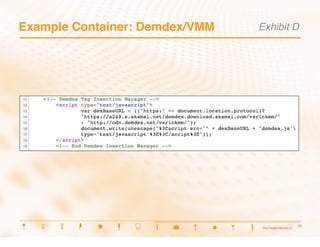
-  Exhibit D:   Example Container
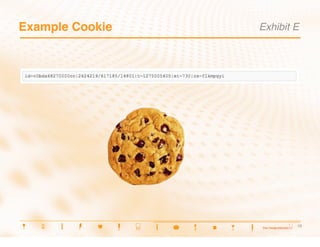
-  Exhibit E:   Example Cookie
-  Exhibit F:   Example 3rd Party Data Collection

                                                       8
                                                        8
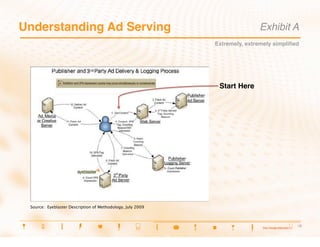
Understanding Ad Serving
                                                    Exhibit A
                                                             Extremely, extremely simplified


                                                              Start Here


 Source: Eyeblaster Description of Methodology, July 2009


                                                                                           9
                                                                                            9
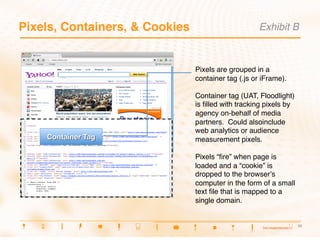
Pixels, Containers, & Cookies
                        Exhibit B


                                 Pixels are grouped in a
                                 container tag (.js or iFrame).

                                 Container tag (UAT, Floodlight)
                                 is filled with tracking pixels by
                                 agency on-behalf of media
                                 partners. Could alsoinclude
                                 web analytics or audience
                                 measurement pixels.

                                 Pixels “fire” when page is
                                 loaded and a “cookie” is
                                 dropped to the browserʼs
                                 computer in the form of a small
                                 text file that is mapped to a
                                 single domain.


                                                                    10
                                                                    10
Example [Pixel] Tag: Quantcast/HuffPo
 Exhibit C


                                                11
                                                11
Example Container: Demdex/VMM
   Exhibit D


                                         12
                                         12
Example Cookie
   Exhibit E


                          13
                          13
Example: 3rd Party Data Collection
                                                               Exhibit F
                                                                  Taken from an excerpt on BlueKaiʼs website
                                                                    Tag is from Motortrend.com Source Code
•    Jasmine is shopping online for air travel between New York to Hawaii. As she visits different online travel
     sites who partner with BlueKai, we [Bluekai] store an anonymous cookie on her browser.
•    As a result, BlueKai marketing partners will show ads on Jasmine's computer that are relevant to in-market
     Hawaii travelers. (For a limited amount of time.)
•    As a consumer, Jasmine has a choice to:
Be informed and participate: 

   From the BlueKai Registry, Jasmine can always get visibility into what marketers are using to serve
   targeted ads and she can also participate by updating her preferences
Choose NOT to participate: 

  At anytime, Jasmine can optout from having her preferences in the BlueKai Registry. While Jasmine will
  continue to see ads, she can rest assured that from that point on no more data will be collected or shared.


                                                                                                                   14
                                                                                                                   14
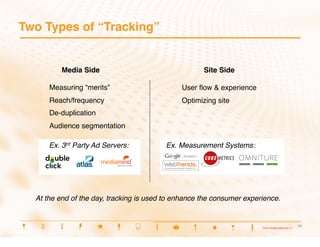
Two Types of “Tracking”


          Media Side
                                 Site Side

      Measuring “merits”
                      User flow & experience
      Reach/frequency
                         Optimizing site
      De-duplication
      Audience segmentation

      Ex. 3rd Party Ad Servers:
          Ex. Measurement Systems:


  At the end of the day, tracking is used to enhance the consumer experience.


                                                                                 15
                                                                                 15
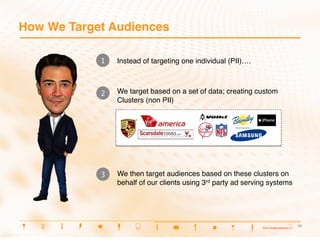
How We Target Audiences

            1
   Instead of targeting one individual (PII)….


            2
   We target based on a set of data; creating custom
                 Clusters (non PII)


            3
   We then target audiences based on these clusters on
                 behalf of our clients using 3rd party ad serving systems


                                                                             16
                                                                             16
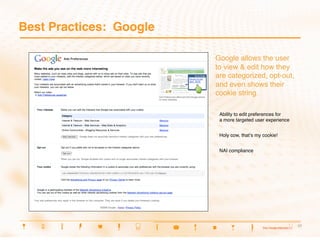
Best Practices: Google

                          Google allows the user
                          to view & edit how they
                          are categorized, opt-out,
                          and even shows their
                          cookie string. 

                           Ability to edit preferences for
                           a more targeted user experience


                           Holy cow, thatʼs my cookie!


                           NAI compliance


                                                              17
                                                              17
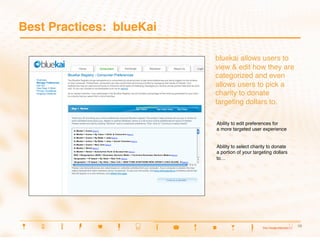
Best Practices: blueKai

                           bluekai allows users to
                           view & edit how they are
                           categorized and even
                           allows users to pick a
                           charity to donate
                           targeting dollars to.

                           Ability to edit preferences for
                           a more targeted user experience


                           Ability to select charity to donate
                           a portion of your targeting dollars
                           to…


                                                                 18
                                                                 18
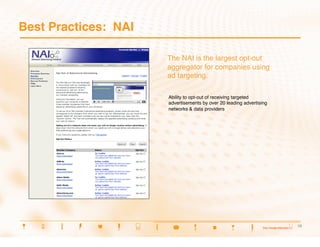
Best Practices: NAI

                       The NAI is the largest opt-out
                       aggregator for companies using
                       ad targeting. 

                       Ability to opt-out of receiving targeted
                       advertisements by over 20 leading advertising
                       networks & data providers


                                                                       19
                                                                       19
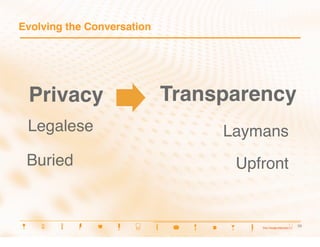
Evolving the Conversation


 Privacy
                    Transparency
 Legalese
                        Laymans
 Buried
                           Upfront


                                              20
                                              20
Evolving the Conversation


 Privacy
                    Transparency
•  Customers   donʼt want to feel taken advantage of, yet we
   create situations of obfuscation
•  The only way to build trust is to be fully transparent and
   inform customers what weʼre capturing and why weʼre doing
   it
•  Full transparency around how data is collected, how its used
   and whatʼs being collected is paramount if our customers
   and prospects are to trust us.


                                                                  21
                                                                  21
Evolving the Conversation


 Legalese
                         Laymans
•  Despite    our good intentions and need to protect ourselves in
   the litigious society we compete in, our vocabulary only
   seems to alienate our customers.
•  Since most people donʼt know legalese we have to use the
   vocabulary our customers easily understand. Anything less
   will create mistrust.


                                                                     22
                                                                     22
Evolving the Conversation


 Buried
                    Upfront
•  Weʼve   been taught that the small type on a contract is where
   all the dangerous stuff lives yet we burry our policies at the
   bottom in small type.
•  Lets bring our policies upfront and use a larger font. 


                                                                    23
                                                                    23
Making Consumers Feel Comfortable With Data Collection


•  Consumers   need to understand the opportunities and
  implications of data collection and the advertising
  industry has to drive the transparency agenda. 
•  We need to continue to partner with leading privacy
  groups to show consumers why and how they are being
  targeted for advertisements.
•  Weʼve  developed a process called the Privacy 

  Audit based on our beliefs and approaches to help
  clients better communicate their privacy policies clearly
  and overtly.


                                                              24
                                                              24
The Privacy Audit

•  Tohelp our clients determine if theyʼre privacy
  statements are helping them build trust with their
  customers and prospects weʼve developed our
  Privacy Audit, which is designed to answer:
-  Is your privacy statement clear?
-  Does the statement explain what data is being
  collected and how the data is used?
-  Is it prominently displayed?
-  Does it create a trust among customers?
-  What data is being collected and is it non-PII?

                                                       25
                                                       25
Contact Us
Barry Lowenthal     
President, The Media Kitchen
(212) 337-4712 
blowenthal@mediakitchen.tv 
Darren Herman   
Chief Digital Media Officer, The Media Kitchen   
(212) 337-4543 
dherman@mediakitchen.tv

Online Privacy & Targeting POV

  • 1.
    Privacy POV 
 The Media Kitchen
 October 2010
 be brave | be inventive | defy expectations
  • 2.
    Who The Media Kitchen(“TMK”), a division of kirshenbaum bond senecal + partners, is a New York City based communications planning and buying agency. Over 100+ chefs in the Atlanta and New York “kitchens” plan and buy media on behalf of 19 clients including but not limited to Delta, Victoria Secret, PBS, Sesame Workshop, Bank of NY Mellon, and Windstream Communications. TMK plans and buys across all channels including television, print, radio, OOH, and digital media (including social, display, search and mobile). We specialize in creating new media channels. We believe big ideas can live in any media channel and the biggest ideas live across all channels and are closely measured and monitored. We also believe that the very biggest ideas are born from collaboration. We are active members of the Interactive Advertising Bureau (IAB). 2 2
  • 3.
    What, When, &Where Recent articles and congressional bills about Online Privacy have been published that have caused some of our clients to ask questions about the industry (and our very own) targeting/privacy practices. We started to receive formal inquiries from our clients and the press right after the Wall Street Journal released their “What They Know” section on July 31, 2010. 3 3
  • 4.
    Why The digital advertisingindustry is self regulated. Many companies (including TMK) follow standards set by the Interactive Advertising Bureau (IAB) and Network Advertising Initiative (NAI). Recent articles have called into question the targeting practices of evolving media platforms. The use of data (1st, 2nd, and 3rd party) for online targeting has been highlighted by the WSJ and the US Congress and weʼd like to respond to the recent press with how we use data to help our clients. 4 4
  • 5.
    Summation of OnlinePrivacy Bill Two U.S. congressmen have proposed online privacy bills that confront disclosure notices, opt-in requests, and user information licenses. Rick Boucher, Chairman of the House Subcommittee on Communications, Technology and the Internet has been most vocal. The new proposed legislation would require companies to get a userʼs explicit approval (that is, it would require users to “opt in”) before they “knowingly collect” information about a personʼs medical history, financial records, Social Security number, sexual orientation or precise geographic location. Other information, such as that collected by web cookies or session logs on corporate servers, would not require explicit consent, provided the company involved displays a “clearly-written, understandable privacy policy that explains how information about individuals is collected, used and disclosed” and provided users can decline or “opt out.” Our position: the bill seems to codify accepted practice by reputable online companies however isnʼt likely to pass in the short term due to much debate and opposition. 5 5
  • 6.
    We Believe •  Consumers want better targeted advertising. •  Data is necessary to better target ads. •  Better targeted ads improve conversion and benefit business. •  Increasedmessage/placement relevancy, driven by advanced data usage and capture, improves the overall consumer experience. •  Privacy has to be respected at all costs. 6 6
  • 7.
    We Know •  The data we collect and use is non-PII. •  FTC definition of PII is very broad: The FTC believes that PII is data "that could reasonable be associated with a particular consumer or computer or other device, regardless of whether the data is 'personally identifiable' in the traditional sense.” •  We never, nor do we ever recommend to our clients to use PII data or store information in Flash cookies. •  All of our 1st, 2nd, 3rd party data conforms to strict privacy policies. •  Consumers have the option to opt-out, however that has not been easy and we are making recommendations to change that. 7 7
  • 8.
    Before the debategoes too far, some background: •  The following slides contain some simple exhibits that outline much of what the privacy/targeting chatter is about: -  Exhibit A: Understanding Ad Serving -  Exhibit B: Pixels, Containers, & Cookies -  Exhibit C: Example Pixel [tag] -  Exhibit D: Example Container -  Exhibit E: Example Cookie -  Exhibit F: Example 3rd Party Data Collection 8 8
  • 9.
    Understanding Ad Serving Exhibit A Extremely, extremely simplified Start Here Source: Eyeblaster Description of Methodology, July 2009 9 9
  • 10.
    Pixels, Containers, &Cookies Exhibit B Pixels are grouped in a container tag (.js or iFrame). Container tag (UAT, Floodlight) is filled with tracking pixels by agency on-behalf of media partners. Could alsoinclude web analytics or audience measurement pixels. Pixels “fire” when page is loaded and a “cookie” is dropped to the browserʼs computer in the form of a small text file that is mapped to a single domain. 10 10
  • 11.
    Example [Pixel] Tag:Quantcast/HuffPo Exhibit C 11 11
  • 12.
  • 13.
    Example Cookie Exhibit E 13 13
  • 14.
    Example: 3rd PartyData Collection Exhibit F Taken from an excerpt on BlueKaiʼs website Tag is from Motortrend.com Source Code •  Jasmine is shopping online for air travel between New York to Hawaii. As she visits different online travel sites who partner with BlueKai, we [Bluekai] store an anonymous cookie on her browser. •  As a result, BlueKai marketing partners will show ads on Jasmine's computer that are relevant to in-market Hawaii travelers. (For a limited amount of time.) •  As a consumer, Jasmine has a choice to: Be informed and participate: 
 From the BlueKai Registry, Jasmine can always get visibility into what marketers are using to serve targeted ads and she can also participate by updating her preferences Choose NOT to participate: 
 At anytime, Jasmine can optout from having her preferences in the BlueKai Registry. While Jasmine will continue to see ads, she can rest assured that from that point on no more data will be collected or shared. 14 14
  • 15.
    Two Types of“Tracking” Media Side Site Side Measuring “merits” User flow & experience Reach/frequency Optimizing site De-duplication Audience segmentation Ex. 3rd Party Ad Servers: Ex. Measurement Systems: At the end of the day, tracking is used to enhance the consumer experience. 15 15
  • 16.
    How We TargetAudiences 1 Instead of targeting one individual (PII)…. 2 We target based on a set of data; creating custom Clusters (non PII) 3 We then target audiences based on these clusters on behalf of our clients using 3rd party ad serving systems 16 16
  • 17.
    Best Practices: Google Google allows the user to view & edit how they are categorized, opt-out, and even shows their cookie string. Ability to edit preferences for a more targeted user experience Holy cow, thatʼs my cookie! NAI compliance 17 17
  • 18.
    Best Practices: blueKai bluekai allows users to view & edit how they are categorized and even allows users to pick a charity to donate targeting dollars to. Ability to edit preferences for a more targeted user experience Ability to select charity to donate a portion of your targeting dollars to… 18 18
  • 19.
    Best Practices: NAI The NAI is the largest opt-out aggregator for companies using ad targeting. Ability to opt-out of receiving targeted advertisements by over 20 leading advertising networks & data providers 19 19
  • 20.
    Evolving the Conversation Privacy Transparency Legalese Laymans Buried Upfront 20 20
  • 21.
    Evolving the Conversation Privacy Transparency •  Customers donʼt want to feel taken advantage of, yet we create situations of obfuscation •  The only way to build trust is to be fully transparent and inform customers what weʼre capturing and why weʼre doing it •  Full transparency around how data is collected, how its used and whatʼs being collected is paramount if our customers and prospects are to trust us. 21 21
  • 22.
    Evolving the Conversation Legalese Laymans •  Despite our good intentions and need to protect ourselves in the litigious society we compete in, our vocabulary only seems to alienate our customers. •  Since most people donʼt know legalese we have to use the vocabulary our customers easily understand. Anything less will create mistrust. 22 22
  • 23.
    Evolving the Conversation Buried Upfront •  Weʼve been taught that the small type on a contract is where all the dangerous stuff lives yet we burry our policies at the bottom in small type. •  Lets bring our policies upfront and use a larger font. 23 23
  • 24.
    Making Consumers FeelComfortable With Data Collection •  Consumers need to understand the opportunities and implications of data collection and the advertising industry has to drive the transparency agenda. •  We need to continue to partner with leading privacy groups to show consumers why and how they are being targeted for advertisements. •  Weʼve developed a process called the Privacy 
 Audit based on our beliefs and approaches to help clients better communicate their privacy policies clearly and overtly. 24 24
  • 25.
    The Privacy Audit • Tohelp our clients determine if theyʼre privacy statements are helping them build trust with their customers and prospects weʼve developed our Privacy Audit, which is designed to answer: -  Is your privacy statement clear? -  Does the statement explain what data is being collected and how the data is used? -  Is it prominently displayed? -  Does it create a trust among customers? -  What data is being collected and is it non-PII? 25 25
  • 26.
    Contact Us Barry Lowenthal President, The Media Kitchen (212) 337-4712 blowenthal@mediakitchen.tv Darren Herman Chief Digital Media Officer, The Media Kitchen (212) 337-4543 dherman@mediakitchen.tv