ONLINE
LEARNING
ONLINE
LEARNING
• learning that takes
place over the internet,
rather than the
traditional classroom
(Barlow, 2019).
According to Piamonte (2011), online learning is
a learning experience that occurs via digital
platforms, where students engage with course
materials, participate in discussions, and
complete assessments electronically.
The importance of
online learning
 Flexibility & convenience
Students can tailor their study schedules
to accommodate their individual needs,
balancing academics with other
commitments such as part-time
employment, extracurricular activities,
and personal commitments (Yaguru,
2024).
Importance of
online learning
cont.
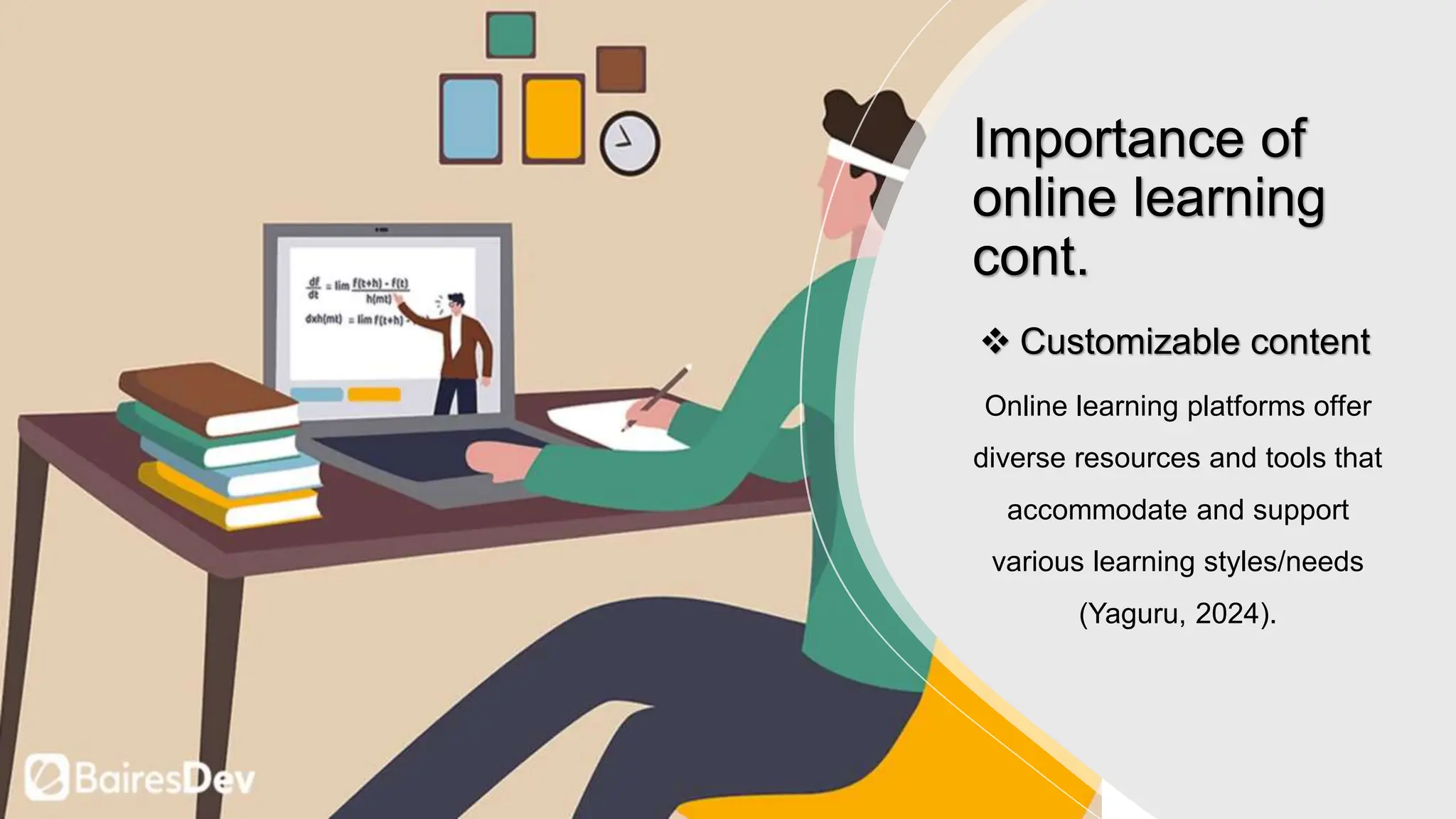
 Customizable content
Online learning platforms offer
diverse resources and tools that
accommodate and support
various learning styles/needs
(Yaguru, 2024).
Benefits of
online learning
 Jackson (2012) believes that online
learning offers numerous benefits,
including convenience, flexibility,
portability, as well as affordability,
while also fostering greater
collaboration providing access to
global opportunities, and improved
student engagement, leading to
better high retention.
Types of
online
learning
 Synchronou
s e-
Learning
• This is the type of learning that involves real-time communication and
interaction among participants, simultaneously access information access
information, sharing ideas, and receiving immediate feedback through
tools like virtual classrooms, video/audio conferencing, and live chat
platforms (Piamonte, 2011).
 Asynchronous e-
Learning
• This is a type of learning where
communication does not take
place in real-time, offering
students the flexibility to access
materials and interact with others
at their own pace, anytime and
anywhere promoting greater
convenience and autonomy
(Piamonte, 2011).
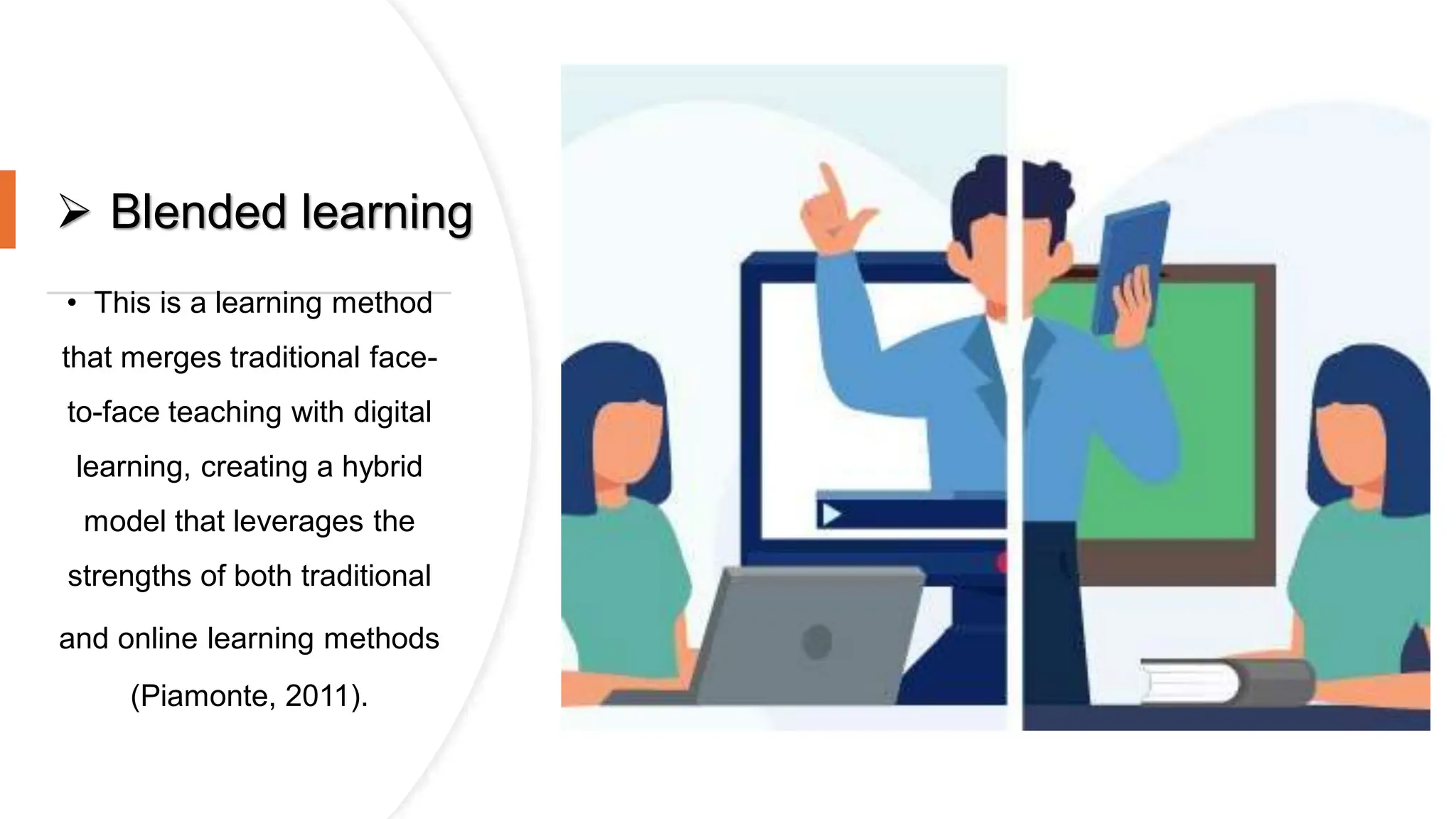
 Blended learning
• This is a learning method
that merges traditional face-
to-face teaching with digital
learning, creating a hybrid
model that leverages the
strengths of both traditional
and online learning methods
(Piamonte, 2011).
Online learning platforms
 Learning management
systems (LMS)
 Online degree programs
 Webinars
 video conferencing
(Sadik, 2009).
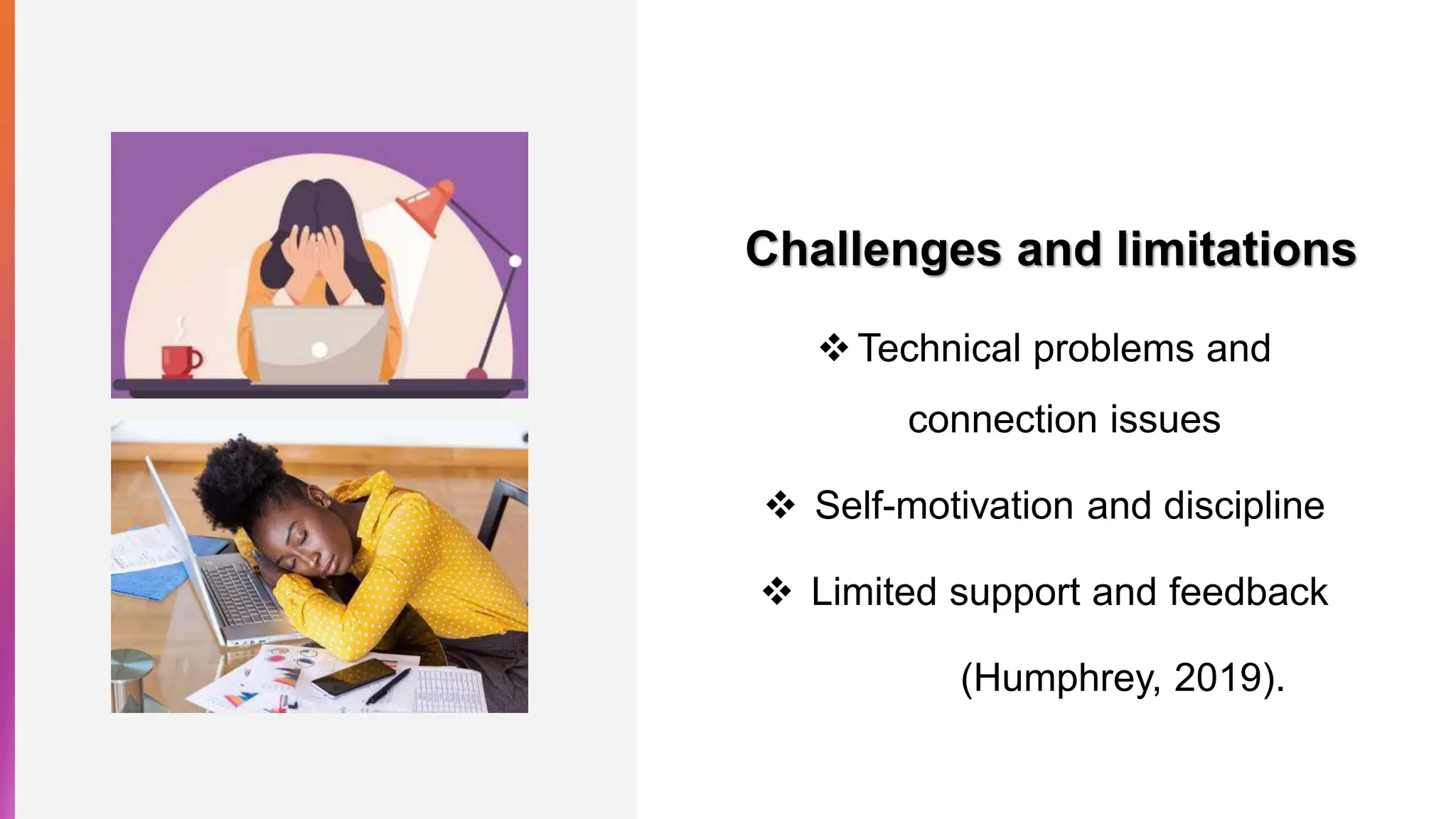
Challenges and limitations
Technical problems and
connection issues
 Self-motivation and discipline
 Limited support and feedback
(Humphrey, 2019).
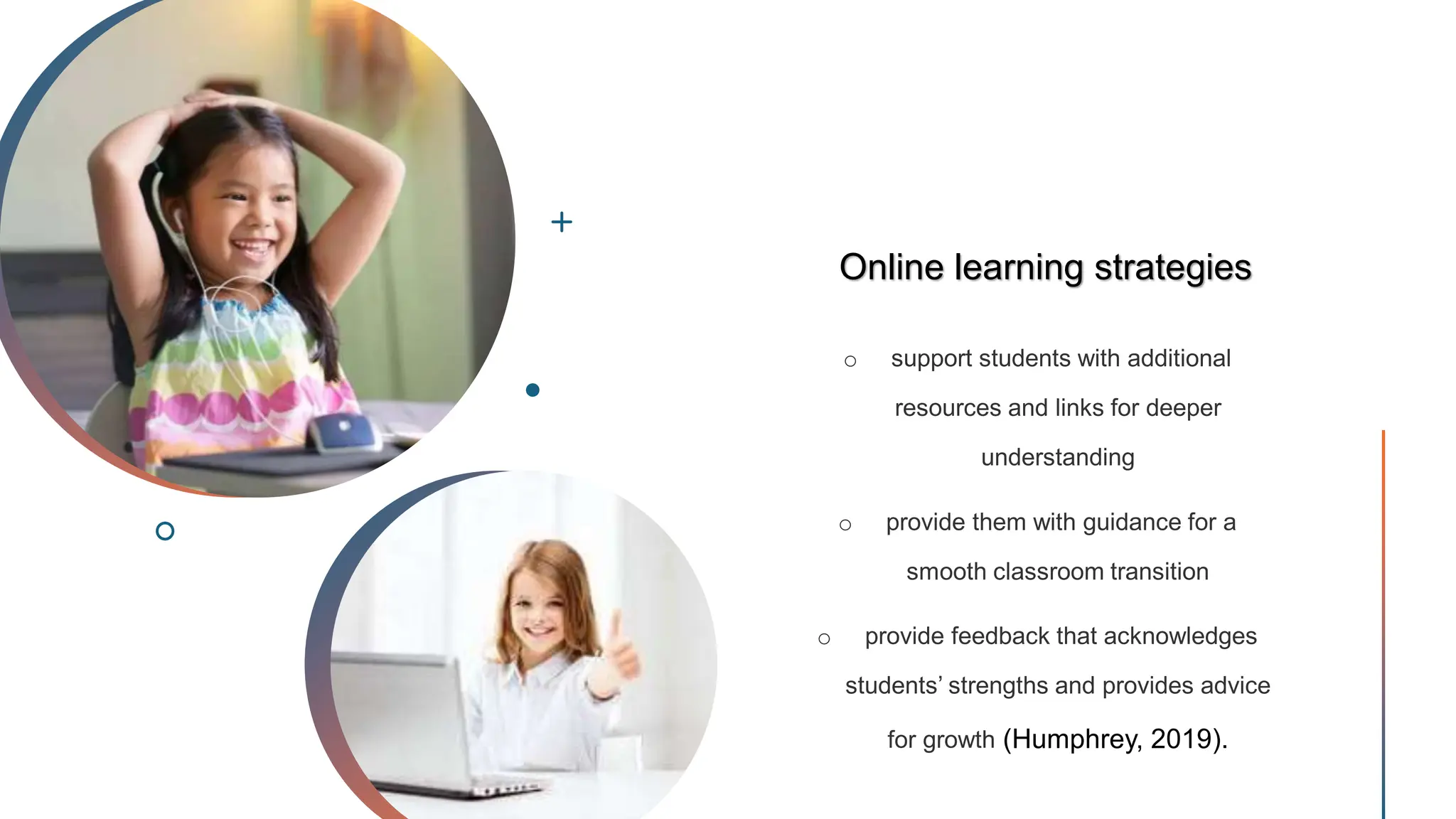
Online learning strategies
(Humphrey, 2019).
To
Conclude..
 The online learning
environment presents an
accessible, inclusive, and
captivating opportunity for
skill-building and knowledge
acquisition.
REFERENCES
• Barlow, K. (2019). TECHNOLOGY FOR TEACHER [online]. Retrieved
from https://www.slideshare.net/slideshow/online-learning-
142841794/142841794
• Humphrey, S. (2019). TECHNOLOGY FOR TEACHERS [online].
Retrieved from https://www.slideshare.net/slideshow/online-learning-
142838270/142838270
• Jackson, K. (2012). Online learning [online]. Retrieved from
https://www.slideshare.net/nyliak87/online-learning-topic-presentation
REFERENCES
• Piamonte, M. (2011). ONLINE LEARNING [online]. Retrieved from
https://www.slideshare.net/slideshow/online-learning-
6821605/6821605
• Sadik, A. (2009). Evaluation of online learning (online). Retrieved
from https://www.slideshare.net/slideshow/evaluation-of-online-
learning-1250201/1250201
REFERENCES
• Walia, P. (2021). Online-learning & Mobile learning [online]. Retrieved
from https://www.slideshare.net/slideshow/online-learning-
241082967/241082967
• Yaguru, S. (2024). Importance of online learning [online]. Retrieved
from https://www.slideshare.net/slideshow/importance-of-online-
learning-pptx/270805798

Online learning. .pdf

  • 1.
  • 2.
    ONLINE LEARNING • learning thattakes place over the internet, rather than the traditional classroom (Barlow, 2019).
  • 3.
    According to Piamonte(2011), online learning is a learning experience that occurs via digital platforms, where students engage with course materials, participate in discussions, and complete assessments electronically.
  • 4.
    The importance of onlinelearning  Flexibility & convenience Students can tailor their study schedules to accommodate their individual needs, balancing academics with other commitments such as part-time employment, extracurricular activities, and personal commitments (Yaguru, 2024).
  • 5.
    Importance of online learning cont. Customizable content Online learning platforms offer diverse resources and tools that accommodate and support various learning styles/needs (Yaguru, 2024).
  • 6.
    Benefits of online learning Jackson (2012) believes that online learning offers numerous benefits, including convenience, flexibility, portability, as well as affordability, while also fostering greater collaboration providing access to global opportunities, and improved student engagement, leading to better high retention.
  • 7.
  • 8.
     Synchronou s e- Learning •This is the type of learning that involves real-time communication and interaction among participants, simultaneously access information access information, sharing ideas, and receiving immediate feedback through tools like virtual classrooms, video/audio conferencing, and live chat platforms (Piamonte, 2011).
  • 9.
     Asynchronous e- Learning •This is a type of learning where communication does not take place in real-time, offering students the flexibility to access materials and interact with others at their own pace, anytime and anywhere promoting greater convenience and autonomy (Piamonte, 2011).
  • 10.
     Blended learning •This is a learning method that merges traditional face- to-face teaching with digital learning, creating a hybrid model that leverages the strengths of both traditional and online learning methods (Piamonte, 2011).
  • 11.
    Online learning platforms Learning management systems (LMS)  Online degree programs  Webinars  video conferencing (Sadik, 2009).
  • 12.
    Challenges and limitations Technicalproblems and connection issues  Self-motivation and discipline  Limited support and feedback (Humphrey, 2019).
  • 13.
  • 14.
    To Conclude..  The onlinelearning environment presents an accessible, inclusive, and captivating opportunity for skill-building and knowledge acquisition.
  • 15.
    REFERENCES • Barlow, K.(2019). TECHNOLOGY FOR TEACHER [online]. Retrieved from https://www.slideshare.net/slideshow/online-learning- 142841794/142841794 • Humphrey, S. (2019). TECHNOLOGY FOR TEACHERS [online]. Retrieved from https://www.slideshare.net/slideshow/online-learning- 142838270/142838270 • Jackson, K. (2012). Online learning [online]. Retrieved from https://www.slideshare.net/nyliak87/online-learning-topic-presentation
  • 16.
    REFERENCES • Piamonte, M.(2011). ONLINE LEARNING [online]. Retrieved from https://www.slideshare.net/slideshow/online-learning- 6821605/6821605 • Sadik, A. (2009). Evaluation of online learning (online). Retrieved from https://www.slideshare.net/slideshow/evaluation-of-online- learning-1250201/1250201
  • 17.
    REFERENCES • Walia, P.(2021). Online-learning & Mobile learning [online]. Retrieved from https://www.slideshare.net/slideshow/online-learning- 241082967/241082967 • Yaguru, S. (2024). Importance of online learning [online]. Retrieved from https://www.slideshare.net/slideshow/importance-of-online- learning-pptx/270805798