COMPENSATION
GUIDE:
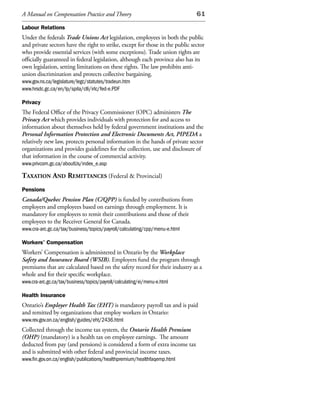
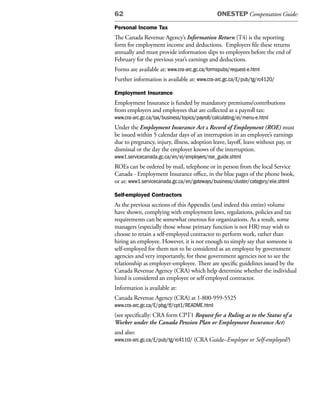
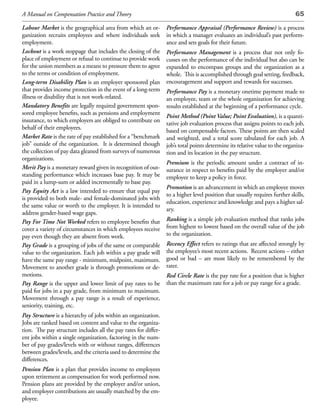
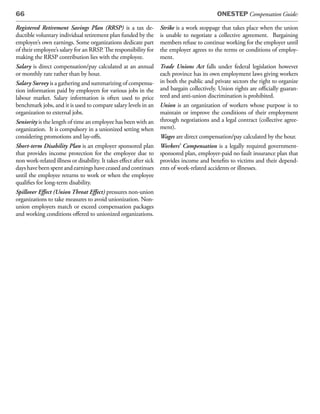
A Manual on Compensation
Practice & eory
ONESTEP Compensation Guide:


                                 A          cknowledgements

                                 ONESTEP would like to thank the following people for their
                                 contributions to the Compensation Framework project:
                                 Writer and Researcher
                                 Mary Cassandro Hamel, Project Manager, HR Specialist, ONESTEP
                                 Editor
                                 Andrea Demchuk
                                 HR Consultant
                                 Sandra Safran, Sandra Safran HR Services
                                 French translation was done by
                                 Andrée Clément, Communication Gama Inc.
                                 Layout and Design
                                 Lianne Côté, Côté Design
                                 ONESTEP Contributors:
                                 Bernadette Beaupre, Executive Director
                                 Christine Greaves, Manager of Administration and Finance
                                 Advisory Committee Members
                                 Ann Clancy,
                                 Director, National Volunteer Resource Management, Canadian Red Cross
                                 Jerry Colwell,
                                 Director of Client Services & Administration,
                                 Pathways Skill Development & Placement Centre
                                 Oliver Howey,
                                 Director, Office Workers Career Centre
                                 Doug Hyatt,
                                 Professor of Business Economics, Rotman School of Management
                                 Allison Pond,
                                 Executive Director, A.C.C.E.S.
                                 Sandra Watt,
                                 Director, Human Resources, Lutherwood
                                 Lois Willson,
                                 Associate Dean, Planning & Government Relations, Humber College
Copies of this document are
available by contacting          This Employment Ontario project is funded by the Ontario Government.
The Ontario Network of           Many thanks to ONESTEP members and organizations from the public and
Employment Skills Training       private sectors who contributed to the preparation of this project.
Projects                         www.compensationframework.org is the product of a collaborative effort of Mel-
207-517 Wellington Street West   anie Redman at Community Bandwidth and Jonathan Blumberg and team
Toronto, Ontario CANADA          from The Wire.
M5V 1G1                          The information in this book is intended as a general reference tool and not
                                 designed to give legal, tax and other specialist advice.
Tel: 416.591.7151                All rights reserved. No part of this document may be reproduced or transmit-
Fax: 416.591.9126                ted in any form or by any means, electronic or mechanic al including photo-
Email: info@onestep.on.ca        copying, or by any information storage or retrieval system, without written
Website: onestep.on.ca           permission from ONESTEP
                                 www.compensationframework.org
ISBN 978-0-9680721-7-2           March 2008
A Manual on Compensation Practice and Theory                                                                                iii


T        able of Contents

Executive Summary . . . . . . . . . . . . . . . . . . . . . . . . . . . . . . . . . . . . . . . . . . . . . . . . . . . . 1

Chapter 1: Compensation and Internal & External Equity. . . . . . . . . . . . . . . . . . . 3
    What is Compensation? . . . . . . . . . . . . . . . . . . . . . . . . . . . . . . . . . . . . . . . . . . . . . 3
    Internal Equity and External Competitiveness
    – Determining Pay & Benefits . . . . . . . . . . . . . . . . . . . . . . . . . . . . . . . . . . . . . . . . 4
       Importance of Achieving Internal and External Equity . . . . . . . . . . . . . . . . . . 4
       Inequities . . . . . . . . . . . . . . . . . . . . . . . . . . . . . . . . . . . . . . . . . . . . . . . . . . . . . . 5
    Examining Equity . . . . . . . . . . . . . . . . . . . . . . . . . . . . . . . . . . . . . . . . . . . . . . . . . . 5

Chapter 2: Forms of Pay. . . . . . . . . . . . . . . . . . . . . . . . . . . . . . . . . . . . . . . . . . . . . . . . 7
    Base Pay . . . . . . . . . . . . . . . . . . . . . . . . . . . . . . . . . . . . . . . . . . . . . . . . . . . . . . . . 7
    Performance Pay. . . . . . . . . . . . . . . . . . . . . . . . . . . . . . . . . . . . . . . . . . . . . . . . . . . 7
    Indirect Pay . . . . . . . . . . . . . . . . . . . . . . . . . . . . . . . . . . . . . . . . . . . . . . . . . . . . . . . 8
    The Compensation Mix. . . . . . . . . . . . . . . . . . . . . . . . . . . . . . . . . . . . . . . . . . . . . . 9
       Determinants of Compensation . . . . . . . . . . . . . . . . . . . . . . . . . . . . . . . . . . . . 9

Chapter 3: Evaluating Jobs (Part I) . . . . . . . . . . . . . . . . . . . . . . . . . . . . . . . . . . . . . 10
    What is Job Evaluation? . . . . . . . . . . . . . . . . . . . . . . . . . . . . . . . . . . . . . . . . . . . . 10
       Why Do We Do Job Evaluation? . . . . . . . . . . . . . . . . . . . . . . . . . . . . . . . . . . . 10
    Methods of Job Evaluation. . . . . . . . . . . . . . . . . . . . . . . . . . . . . . . . . . . . . . . . . . 11
       Steps in the Job Evaluation Process . . . . . . . . . . . . . . . . . . . . . . . . . . . . . . . 11
    Job Analysis . . . . . . . . . . . . . . . . . . . . . . . . . . . . . . . . . . . . . . . . . . . . . . . . . . . . . . 12
       Why Perform Job Analysis? . . . . . . . . . . . . . . . . . . . . . . . . . . . . . . . . . . . . . . . 12
       Methods of Job Analysis . . . . . . . . . . . . . . . . . . . . . . . . . . . . . . . . . . . . . . . . . 12
    Job Descriptions . . . . . . . . . . . . . . . . . . . . . . . . . . . . . . . . . . . . . . . . . . . . . . . . . . 13
       Job Description Guidelines . . . . . . . . . . . . . . . . . . . . . . . . . . . . . . . . . . . . . . . 13
       Writing Job Descriptions that Comply with
       Human Rights Legislation . . . . . . . . . . . . . . . . . . . . . . . . . . . . . . . . . . . . . . . . 14
    Job Evaluation Methods . . . . . . . . . . . . . . . . . . . . . . . . . . . . . . . . . . . . . . . . . . . . 14
Chapter 4: Job Evaluation (PART II) Scoring the Value of Jobs . . . . . . . . . . . . . 19
    What is a Compensable Factor? . . . . . . . . . . . . . . . . . . . . . . . . . . . . . . . . . . . . . 19
    Steps to a Point Method . . . . . . . . . . . . . . . . . . . . . . . . . . . . . . . . . . . . . . . . . . . . 20
       A Basic Weighting Formula . . . . . . . . . . . . . . . . . . . . . . . . . . . . . . . . . . . . . . . 22
       Levels Formula (percentages divided among 4 to 6 levels) . . . . . . . . . . . . 22
Chapter 5: Job Evaluation (PART III) The Pay Structure . . . . . . . . . . . . . . . . . . . 24
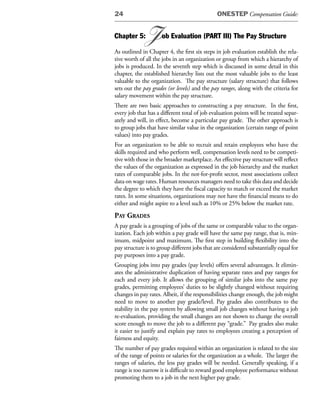
    Pay Grades. . . . . . . . . . . . . . . . . . . . . . . . . . . . . . . . . . . . . . . . . . . . . . . . . . . . . . . 24
    Pay Ranges . . . . . . . . . . . . . . . . . . . . . . . . . . . . . . . . . . . . . . . . . . . . . . . . . . . . . . 25
    Broadbanding (Bands) . . . . . . . . . . . . . . . . . . . . . . . . . . . . . . . . . . . . . . . . . . . . . 25
    Movement through the Salary Structure. . . . . . . . . . . . . . . . . . . . . . . . . . . . . . . 26

Chapter 6: Designing Your Benefits Package . . . . . . . . . . . . . . . . . . . . . . . . . . . . 28
    Trends in Canada . . . . . . . . . . . . . . . . . . . . . . . . . . . . . . . . . . . . . . . . . . . . . . . . . 28
    Common Types of Benefits and Services . . . . . . . . . . . . . . . . . . . . . . . . . . . . . . 29
       Mandatory Government Sponsored Benefits . . . . . . . . . . . . . . . . . . . . . . . . 30
       Private Pension Plans . . . . . . . . . . . . . . . . . . . . . . . . . . . . . . . . . . . . . . . . . . . 31
       Health Care Benefits . . . . . . . . . . . . . . . . . . . . . . . . . . . . . . . . . . . . . . . . . . . . 32
       Income Security . . . . . . . . . . . . . . . . . . . . . . . . . . . . . . . . . . . . . . . . . . . . . . . . 32
       Tax Status of Pension and Health Benefits . . . . . . . . . . . . . . . . . . . . . . . . . . 33
       Pay for Time not Worked . . . . . . . . . . . . . . . . . . . . . . . . . . . . . . . . . . . . . . . . . 33
       Mandatory Time Off – With or Without Pay . . . . . . . . . . . . . . . . . . . . . . . . . . 35
       Employee Services . . . . . . . . . . . . . . . . . . . . . . . . . . . . . . . . . . . . . . . . . . . . . . 36
iv                                                                      ONESTEP Compensation Guide:

        Considerations for Implementing a Benefit Package. . . . . . . . . . . . . . . . . . . . . 37
          Relationship to Total Compensation Costs . . . . . . . . . . . . . . . . . . . . . . . . . . 37
          Controlling Health Care Costs . . . . . . . . . . . . . . . . . . . . . . . . . . . . . . . . . . . . . 38
          Entitlement versus Consumerism. . . . . . . . . . . . . . . . . . . . . . . . . . . . . . . . . . 40
        Containing Costs . . . . . . . . . . . . . . . . . . . . . . . . . . . . . . . . . . . . . . . . . . . . . . . . . . 40
          Cost Sharing . . . . . . . . . . . . . . . . . . . . . . . . . . . . . . . . . . . . . . . . . . . . . . . . . . . 40
          Flex Plan/Cafeteria-Style Plans. . . . . . . . . . . . . . . . . . . . . . . . . . . . . . . . . . . . 41
          Fixed versus Flexible Benefit Systems . . . . . . . . . . . . . . . . . . . . . . . . . . . . . 41
          Health Care Spending Accounts . . . . . . . . . . . . . . . . . . . . . . . . . . . . . . . . . . . 42

Chapter 7: Linking Pay to Performance . . . . . . . . . . . . . . . . . . . . . . . . . . . . . . . . . 43
    Defining Merit Pay. . . . . . . . . . . . . . . . . . . . . . . . . . . . . . . . . . . . . . . . . . . . . . . . . 43
    Frequent Drawbacks to Performance Pay Plans . . . . . . . . . . . . . . . . . . . . . . . . 43
    The Case for Performance Appraisals . . . . . . . . . . . . . . . . . . . . . . . . . . . . . . . . 45
    Defining Performance Appraisal . . . . . . . . . . . . . . . . . . . . . . . . . . . . . . . . . . . . . 46
    Structure of Performance Appraisal as a Cyclical Process . . . . . . . . . . . . . . . . 46
    Performance Appraisal Methods . . . . . . . . . . . . . . . . . . . . . . . . . . . . . . . . . . . . . 47
       Rater Biases . . . . . . . . . . . . . . . . . . . . . . . . . . . . . . . . . . . . . . . . . . . . . . . . . . . 47
       Correcting for Bias . . . . . . . . . . . . . . . . . . . . . . . . . . . . . . . . . . . . . . . . . . . . . . 47
    Performance Management: Going beyond Performance Appraisal . . . . . . . . . 48

Chapter 8: Unions . . . . . . . . . . . . . . . . . . . . . . . . . . . . . . . . . . . . . . . . . . . . . . . . . . . . 49
    Why Workers Join Unions . . . . . . . . . . . . . . . . . . . . . . . . . . . . . . . . . . . . . . . . . . . 50
    Reasons for Not Joining a Union . . . . . . . . . . . . . . . . . . . . . . . . . . . . . . . . . . . . . 50
    Right to Organize. . . . . . . . . . . . . . . . . . . . . . . . . . . . . . . . . . . . . . . . . . . . . . . . . . 50
    Types of Unions . . . . . . . . . . . . . . . . . . . . . . . . . . . . . . . . . . . . . . . . . . . . . . . . . . 50
    Labour Relations . . . . . . . . . . . . . . . . . . . . . . . . . . . . . . . . . . . . . . . . . . . . . . . . . 50
    Collective Bargaining . . . . . . . . . . . . . . . . . . . . . . . . . . . . . . . . . . . . . . . . . . . . . . 50
    Administering the Collective Agreement . . . . . . . . . . . . . . . . . . . . . . . . . . . . . . . 51
    Strikes and Lockouts . . . . . . . . . . . . . . . . . . . . . . . . . . . . . . . . . . . . . . . . . . . . . . 51
    The Spillover Effect . . . . . . . . . . . . . . . . . . . . . . . . . . . . . . . . . . . . . . . . . . . . . . . . 51

Chapter 9: Using Salary Surveys . . . . . . . . . . . . . . . . . . . . . . . . . . . . . . . . . . . . . . . 52
    What are Salary Surveys and What Purpose Do They Serve?. . . . . . . . . . . . . . 52
    What Do I Look for in a Survey?. . . . . . . . . . . . . . . . . . . . . . . . . . . . . . . . . . . . . . 53
    Understanding Terms . . . . . . . . . . . . . . . . . . . . . . . . . . . . . . . . . . . . . . . . . . . . . . 53
    Participating in Salary Surveys . . . . . . . . . . . . . . . . . . . . . . . . . . . . . . . . . . . . . . 54
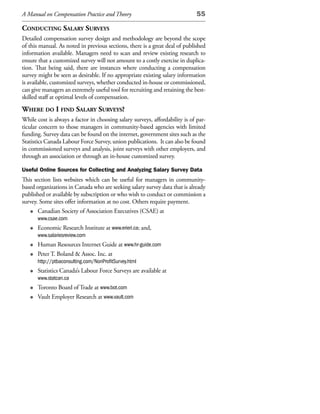
    Conducting Salary Surveys. . . . . . . . . . . . . . . . . . . . . . . . . . . . . . . . . . . . . . . . . . 55
    Where do I find Salary Surveys? . . . . . . . . . . . . . . . . . . . . . . . . . . . . . . . . . . . . . 55

Chapter 10: Communicating Compensation . . . . . . . . . . . . . . . . . . . . . . . . . . . . . 56
    A Matter of Trust . . . . . . . . . . . . . . . . . . . . . . . . . . . . . . . . . . . . . . . . . . . . . . . . . . 56
    Mode of Communication . . . . . . . . . . . . . . . . . . . . . . . . . . . . . . . . . . . . . . . . . . . 57
    Barriers to Effective Communication on Compensation . . . . . . . . . . . . . . . . . . 58
    In Summary . . . . . . . . . . . . . . . . . . . . . . . . . . . . . . . . . . . . . . . . . . . . . . . . . . . . . . 58
Appendix: Government Legislation in the Workplace . . . . . . . . . . . . . . . . . . . . . . 59
    Ontario Provincial Legislation. . . . . . . . . . . . . . . . . . . . . . . . . . . . . . . . . . . . . . . . 59
    Federal Legislation . . . . . . . . . . . . . . . . . . . . . . . . . . . . . . . . . . . . . . . . . . . . . . . . 60
    Taxation And Remittances (Federal & Provincial). . . . . . . . . . . . . . . . . . . . . . . . 61
       Personal Income Tax . . . . . . . . . . . . . . . . . . . . . . . . . . . . . . . . . . . . . . . . . . . . 62
       Employment Insurance . . . . . . . . . . . . . . . . . . . . . . . . . . . . . . . . . . . . . . . . . . 62
       Self-employed Contractors . . . . . . . . . . . . . . . . . . . . . . . . . . . . . . . . . . . . . . . 62

Glossary Terms . . . . . . . . . . . . . . . . . . . . . . . . . . . . . . . . . . . . . . . . . . . . . . . . . . . . . . 63

Bibliography . . . . . . . . . . . . . . . . . . . . . . . . . . . . . . . . . . . . . . . . . . . . . . . . . . . . . . . . . 67
A Manual on Compensation Practice and Theory                                    1


E     xecutive Summary

The Ontario Network of Employment Skills Training Projects (ONESTEP) is a
province-wide umbrella-organization that promotes community based employ-
ment and training (CBET) and provides a range of capacity building services
that support the viability of organizations within the CBET sector. The Strategic
Compensation Framework Project (SCF), supported by Employment Ontario
is one of ONESTEP’s initiatives that responds to the human resources needs of
our member agencies. The SCF project addresses compensation issues related
to the recruitment and retention of highly skilled staff in the CBET sector by
providing three deliverables: the bilingual compensation guide that will provide
the key elements of an employer compensation framework; the evaluation and
comparison of twelve key positions across the public, private and not-for profit
employment sectors, which will be used to inform stakeholders on the variances
in wage and job descriptions; and, online compensation tools that will facilitate
job matching and establishing salaries in organizations.
This Compensation Guide is a handbook developed by ONESTEP to assist
managers with an overview of human resources information to better under-
stand the components of compensation and choices available when reviewing
policies and practices for employing and retaining workers.
Managers have come to consider compensation as a key factor in their organ-
izations’ competitiveness in attracting, recruiting and reducing staff turnover.
Chapter 1 defines compensation including both its intrinsic and extrinsic re-
wards, and delves into the importance of internal equity and external competi-
tiveness. Examples of inequities are addressed and questions for consideration
are offered to help determine whether their organization actually practices in-
ternal and external equity.
Employee compensation which covers all forms of pay or rewards has become
more complex in recent years and since compensation comprises the largest ex-
pense for most organizations it is important for managers to understand how to
effectively manage compensation-related activities. Chapter 2 categorizes total
employee compensation into Base Pay, Performance Pay, and Indirect Pay out-
lining both the advantages, and the disadvantages of each form of pay.
Job Evaluation is a tool that compares jobs and ranks them based on their rela-
tive worth to the organization. Because this process can play a central role in en-
suring that an organization’s compensation system is internally equitable, legally
defensible and externally competitive, it will be outlined over three chapters.
Chapter 3 emphasizes the important role of job evaluation in compensation sys-
tems. It describes the process of job analysis and provides guidelines for writing
job descriptions. The four most commonly used methods of job evaluations are
described and compared. They are: Ranking, Classification, Factor Compari-
son, and the Point Method.
Because the Point Method is the most applicable methodology of job evaluation
for ONESTEP members, it has been chosen to be described in more detail in
this manual. Chapter 4 further describes the Point Method. Using examples
from Ontario’s Pay Equity Commission, this chapter outlines the first six of the
seven steps of the Point Method: 1) conducting a job analysis; 2) determining
2                                             ONESTEP Compensation Guide:

and defining compensable factors and sub-factors; 3) establishing and ranking
the degrees of the factors and sub-factors; 4) weighting the factors and sub-fac-
tors; 5) checking reliability, and 6) communicating with employees.
The focus of the first six steps in Job Evaluation is on determining the relative
worth of jobs within an organization from which a hierarchy of jobs is pro-
duced. The last step in the process is to construct a pay structure. Chapter 5
details the characteristics of a pay structure together with pay grades, pay ranges
and broadbanding. Also briefly described are the criteria organizations typically
use to advance employees through either pay ranges or pay grades.
Benefits are likely the single most misunderstood aspect of compensation ad-
ministration; this stems both from their complexity and from the difficulty of
controlling their costs. Chapter 6 describes the different types of benefits in-
cluding mandatory government plans, pensions, health care benefits, income
security, pay for time not worked and employee services. It also outlines various
options that managers might consider when evaluating and modifying benefit
plans offered to employees; for instance, suggestions are offered to help control
health care costs such as flexible benefit systems, cost sharing, and health care
expense accounts.
Linking compensation to performance has been found to be one of the most
unclear and controversial issues particularly for not-for-profit organizations. Al-
though most organizations have a performance appraisal system in place, few
managers and employees believe that it effectively links pay to performance.
Chapter 7 describes a case for and against financial incentives pointing out the
frequent drawbacks of implementing an improperly designed and flawed per-
formance appraisal system. This chapter goes on to briefly define Performance
Appraisal including rater biases and outlines Performance Management as a
relatively new practice in organizations.
Unions have had a direct influence on all organizations’ compensation policies
and programs whether or not their employees are bound by collective agreement
with an organization. Chapter 8 details the implications of unionization for the
management-employee relationship and its impact on compensation systems.
Salary survey information is essential for setting wages that are competitive
enough that an organization will be able to recruit and retain skilled employ-
ees. Chapter 9 outlines the uses of surveys, what to look for when interpreting
published survey results, reasons to participate in a salary survey, and the limited
circumstances in which an organization might consider conducting or com-
missioning a salary survey. This chapter also includes helpful online sources for
collecting and analyzing survey data.
Compensation will only have the desired impact on attitude and behaviour
when employees understand the pay and the benefit options that apply to them,
and the associated policies and procedures. Well thought out compensation
communication increases morale and employee satisfaction with their organiza-
tion and decreases turnover. Chapter 10 emphasizes the importance of convey-
ing information to employees in a transparent and well-explained manner. It
outlines useful modes of communication along with feedback mechanisms to
ensure that information is well understood, as well as pointing out some of the
barriers to effective communication on compensation.
A Manual on Compensation Practice and Theory                                           3


Chapter 1:       C      ompensation and Internal & External Equity

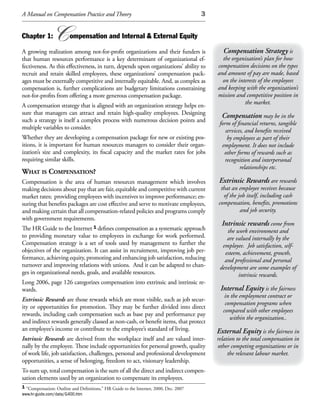
A growing realization among not-for-profit organizations and their funders is                Compensation Strategy is
that human resources performance is a key determinant of organizational ef-                  the organization’s plan for how
fectiveness. As this effectiveness, in turn, depends upon organizations’ ability to        compensation decisions on the types
recruit and retain skilled employees, these organizations’ compensation pack-              and amount of pay are made, based
ages must be externally competitive and internally equitable. And, as complex as             on the interests of the employees
compensation is, further complications are budgetary limitations constraining              and keeping with the organization’s
not-for-profits from offering a more generous compensation package.                        mission and competitive position in
A compensation strategy that is aligned with an organization strategy helps en-                        the market.
sure that managers can attract and retain high-quality employees. Designing
                                                                                             Compensation may be in the
such a strategy is itself a complex process with numerous decision points and
                                                                                            form of financial returns, tangible
multiple variables to consider.
                                                                                               services, and benefits received
Whether they are developing a compensation package for new or existing pos-                     by employees as part of their
itions, it is important for human resources managers to consider their organ-                employment. It does not include
ization’s size and complexity, its fiscal capacity and the market rates for jobs              other forms of rewards such as
requiring similar skills.                                                                      recognition and interpersonal
                                                                                                      relationships etc.
What is Compensation?
Compensation is the area of human resources management which involves                      Extrinsic Rewards are rewards
making decisions about pay that are fair, equitable and competitive with current            that an employee receives because
market rates; providing employees with incentives to improve performance; en-                of the job itself, including cash
suring that benefits packages are cost effective and serve to motivate employees,          compensation, benefits, promotions
and making certain that all compensation-related policies and programs comply                        and job security.
with government requirements.
                                                                                             Intrinsic rewards come from
The HR Guide to the Internet 1 defines compensation as a systematic approach                   the work environment and
to providing monetary value to employees in exchange for work performed.                       are valued internally by the
Compensation strategy is a set of tools used by management to further the                    employee. Job satisfaction, self-
objectives of the organization. It can assist in recruitment, improving job per-              esteem, achievement, growth,
formance, achieving equity, promoting and enhancing job satisfaction, reducing                and professional and personal
turnover and improving relations with unions. And it can be adapted to chan-                development are some examples of
ges in organizational needs, goals, and available resources.                                        intrinsic rewards.
Long 2006, page 126 categorizes compensation into extrinsic and intrinsic re-
wards.                                                                                      Internal Equity is the fairness
                                                                                              in the employment contract or
Extrinsic Rewards are those rewards which are most visible, such as job secur-
                                                                                              compensation programs when
ity or opportunities for promotion. They may be further divided into direct
                                                                                             compared with other employees
rewards, including cash compensation such as base pay and performance pay
                                                                                                within the organization..
and indirect rewards generally classed as non-cash, or benefit items, that protect
an employee’s income or contribute to the employee’s standard of living.                   External Equity is the fairness in
Intrinsic Rewards are derived from the workplace itself and are valued inter-              relation to the total compensation in
nally by the employee. These include opportunities for personal growth, quality            other competing organizations or in
of work life, job satisfaction, challenges, personal and professional development               the relevant labour market.
opportunities, a sense of belonging, freedom to act, visionary leadership.
To sum up, total compensation is the sum of all the direct and indirect compen-
sation elements used by an organization to compensate its employees.
1 “Compensation: Outline and Definitions,” HR Guide to the Internet, 2000, Dec. 2007
www.hr-guide.com/data/G400.htm
4                                                     ONESTEP Compensation Guide:

internal equity and external Competitiveness
– determining pay & Benefits
A central feature of a compensation policy is the balance between internal equity
and external competitiveness. Employees will perceive their pay to be equitable
if it is fair in relation to their peers in the workplace and in other organizations.
Internal equity is achieved when compensation programs are applied consist-
ently, horizontally and vertically, across an organization. Maintaining external
competitiveness relies on comparative data from competing employers in the
same labour market.2
Kanungo describes the role equity plays in compensation:
     Internal, external and individual/personal equity issues are key
     ethical concerns in compensation management. At the internal
     level, an organization’s pay structure reflects the values of jobs to
     the organization. At the external level, levels of compensation are
     in accord with those of the relevant labour market. At the personal
     or individual level, compensation matches their job performance.
     Perception of inequity at any of these levels will lead to employee
     dissatisfaction, which in turn will lessen the motivation to perform
     well. (Kanungo 65)

Importance of Achieving Internal and External Equity
Equity, in particular internal and external equity, is a crucial factor in determin-
ing pay rates. The fairness of a compensation policy can be assessed by employ-
ees’ pay levels in relation to those of their colleagues and employees in compar-
able jobs in the larger market. When pay rates are too low, the organization will
face difficulties with recruitment and retention. By contrast, if they are too high,
the organization may face financial difficulties.
The process of establishing pay rates, while ensuring internal and external equity,
typically takes different measures:
   • Achieving Internal Consistency (Internal Equity)
       Here the worth of each job within the organization is determined
       through the Job Evaluation process (job analysis, job descriptions, &
       job evaluations). This establishes the relative worth of a job in relation
       to the value of other jobs in the workplace.
   • Achieving External Competitiveness (External Equity)
       Before comparing external market rates on a position, human
       resources managers need to set out the essential elements of existing
       compensation policies such as cash compensation and indirect pay.
       This mix is a central consideration when making comparisons to
       pay levels at other organizations. Another consideration in designing
       compensation strategies is whether to match, lag or lead the market.
       One common method for accessing information on pay rates for
       benchmark jobs in other organizations is through using or collecting
       salary survey information.


2 “Internal Equity and External Competitiveness,” UOIT Academic Staff Compensation, Pensions and
Benefits, Nov. 2006, Dec. 2007 www.uoit.ca/EN/main2/about/14057/14152/
Employment-Related_Policies_and_Procedures/staff_compensation_pensions_benefits.html
A Manual on Compensation Practice and Theory                                  5

Inequities
Inequities exist within an organization when the salaries of employees are out       External Competitiveness
of alignment. Organizational alignment occurs when appropriate pay differ-             results from comparing and
ences exist between supervisors and the employees they supervise; employees in          matching or exceeding the
different grades; and, employees in the same pay grade with different levels of         compensation rates of one
responsibility, qualifications and performance.                                         organization to those of its
In addition, internal inequity is present when employees within a given or-                     competitors.
ganization with comparable qualifications, levels of responsibility, history,
                                                                                        Labour Market is the
performance and length of time within the same salary grade are not paid at
                                                                                    geographical area from which an
comparable rates.
                                                                                   organization recruits employees and
And, external inequity exists when an organization’s pay rates are not in line     where individuals seek employment.
with those of the relevant market. This can lead to serious employee recruitment
and retention issues.                                                               Market Rate is the rate of pay
                                                                                    established for a “benchmark job”
examining equity                                                                     outside of the organization. It is
The process of assessing internal equity can serve to highlight many organiza-       determined though the collection
tional problems. First compensation philosophies need to be identified and         of pay data gleaned from surveys of
examined for fit with internal equity adjustment plans. Next, managers need to           numerous organizations.
know whether the organization has the funds to implement such a plan. Ques-
tions that managers may need to consider are:                                       Benchmark (or key) job is a
                                                                                    standard job from either within
   • Is the pay structure properly defined or is it inadequate?                      the organization or outside the
   • What are employees making in comparison to those with identical                organization used as a reference
       skills and equally important experience?                                     point for pay comparisons. These
   • How are employees compensated for internally developed experience              jobs have relatively the same job
       versus external experience brought with them to the organization?              content and there is not much
                                                                                     difference in their rates of pay.
   • Is length of service valued?
   • What is the turnover rate and what, if any, impact does internal
       equity have on it?
   • Is the organization unable to attract candidates to a position because
       it cannot maintain market-competitive salaries?
   • Has the organization needed to increase compensation for a position,
       resulting in it being higher paid than the same type of jobs with more
       skills or responsibilities, thus throwing salaries out of alignment?
   • Does the organization have consistent hiring and promotion
       practices?
From the perspective of motivating performance, managing internal equity is
probably more important than managing external equity. Employees can more
easily understand and obtain information on salaries and job performance stan-
dards within their workplace than in other organizations. Their perceived in-
equity can lead to morale problems and turnover. Conducting a job evaluation
and the development of an equitable pay structure which is competitive with
the external market rates can be used to attract and retain high performance
employees.
6                                                   ONESTEP Compensation Guide:

Sometimes employees may decide to seek employment elsewhere because of
better pay; rather than lose the employee to the competition, a counter offer
may be made. In such circumstances pay increases can be used as a retention
strategy. However, before implementing such increases, consider the follow-
ing factors: Is the competing offer for the same level of responsibility? How
does to total compensation package (salary, benefits, hours of work per week,
etc.) compare to the existing compensation package? And, if this warrants an
increase, how will the counter offer impact internal equity? Does the organ-
ization have the financial capacity to provide an overall increase to salaries?
And, if it does not, how will this affect the morale of the other employees in
the organization?3
To correct salary inequities, managers may need to adjust their pay structure.
Once funds are approved for this undertaking, determining the worth of all
internal positions through job evaluation should be the first step in the pro-
cess. Achieving external equity would be the next important measure to be
taken and can be accomplished by comparing internal positions to ones in the
external market. The comparison can be done through the collection of salary
survey information and matching internal jobs with the survey’s “benchmark
jobs”, followed by adjusting the salary to the market reference point of com-
parable jobs. Although this sounds rather straightforward, there are other fac-
tors that may affect pay decisions, one being, labour shortages. It may mean
that in order to attract candidates which are scarce and in high demand a mar-
ket salary adjustment may be warranted. In such circumstances, transparency
of the pay structure and communicating the rationale behind compensation
decisions will ensure that employees will perceive their compensation system
to be fair and equitable.


3 “Compensation and Benefits,” The HR Manager, Auxillium West, Feb. 2006, Dec. 2007
www.auxillium.com/pay.shtml
A Manual on Compensation Practice and Theory                                     7


Chapter 2:     F      orms of Pay

Because employee compensation comprises the largest grouping of expenditures              Compensation encompasses
for most agencies, managers with HR responsibilities need to understand the              all forms of financial returns and
various types of compensation that are part of Total Compensation and how to                tangible services and benefits
manage these lines on the budget effectively. In keeping with the focus of this        received by employees as part of their
manual, this chapter will pay particular attention to the compensation issues                       employment.
most relevant to not-for-profits.
                                                                                        Base Pay is compensation based
In recent years, compensation has become a far more complicated issue than set-
                                                                                        on time worked, such as an annual
ting pay levels. Strategic compensation policies reward employees’ past perform-
                                                                                       salary or an hourly wage and it does
ance, allows the employer to remain competitive in the job market, maintain
                                                                                       not include pay benefits, overtime or
compensation equity among employees, align employees’ performance with
                                                                                                   incentive pay
organizational goals, control the compensation budget, help attract new em-
ployees and reduce the costs of employee turnover. For not-for-profits, strategic      Performance Pay is a monetary
compensation policies need to be grounded in organizations’ mission, vision               onetime payment made to an
and work, taking into account the size of the organization, its service area and          employee, team or the whole
financial capacities. They must ensure that their human resources is planned            organization for achieving results
most effectively toward meeting organizational goals.                                   established at the beginning of a
Total Compensation refers to all forms of pay or rewards going to employees                     performance cycle.
as a result of their employment and can be broken down into three categories
(Long 2006), Base Pay, Performance Pay and Indirect Pay. Although base pay             Merit Pay is a monetary reward
remains the largest, most readily quantified component in most pay systems, in-        given in recognition of outstanding
direct pay, often referred to as “benefits” constitutes a significant and increasing    performance which increases base
expenditure for many organizations. With good design and consistent adminis-           pay. It may be paid in a lump-sum
tration performance pay plans can aid in motivating employees toward meeting           or added incrementally to base pay.
strategic objectives.
                                                                                           Indirect Pay is part of an
Base pay                                                                                 employee’s total compensation
Pay in return for time worked, and separate from output or results achieved,           package, non-cash items or services
base pay is typically the largest amount on an employee’s pay cheque. Employees         provided to employees in return
have their wages (for hourly pay periods) or salaries (for weekly or monthly pay          for their contribution to the
periods) guaranteed by employers as part of the terms of their employment.             organization (i.e., health benefits,
When given a preference for how they would choose their form of income,                paid time off ). Sometimes the costs
most employees prefer having the security in that the largest proportion of their        for the items are shared by the
compensation is base pay. Trade unions have generally pushed for base pay as                        employees.
the primary pay component.
                                                                                           Compensation Mix may
performanCe pay                                                                          include a part of base pay and/or
                                                                                       performance pay and/or indirect pay
Sometimes known as ‘performance-contingent pay’, ‘variable pay’, or ‘at risk              or a relative proportion of each.
pay’, performance pay can be classified as to whether the performance is related
to individual employees, a work team, or the entire organization. Plans which          Salary is direct compensation/pay
highlight individual performance are the most effective in almost any setting for      calculated at an annual or monthly
promoting improved performance and include piece rates, commissions, merit                  rate rather than by hour.
pay and targeted incentives. Work team performance plans include productivity,
gain-sharing and goal-sharing. Organization performance plans include profit           Wages are direct compensation/pay
sharing and stock plans.                                                                      calculated by the hour.
8                                           ONESTEP Compensation Guide:

In this sector, merit pay is often portrayed as performance pay. Surveys have
shown that this form of compensation has some support if performance stan-
dards are perceived as objective and the performance appraisals that provide
data for decision making improve job performance. This type of plan leads to
permanent increases in base pay in recognition of past performance and can
be used to move employees to a higher level in their pay range, however, its
usefulness in aligning employee future behaviour with organization strategic
objectives is somewhat limited.
indireCt pay
The term indirect pay acknowledges that benefits are an integral and significant
part of total compensation for most organizations and should be considered a
component of employee pay in the same way as base pay and performance pay.
Averaging anywhere from 10 to 40% of a given organization’s total compensa-
tion, indirect pay can be any employee related expenditure not included in base
or performance pay that is a gain to the employee. The six main categories of
indirect pay are as follows:
   1. Benefits mandated by law, including employer contributions to the
        Canada/Quebec Pension Plan, Employment Insurance, and the
        Workplace Safety and Insurance Board;
   2. Deferred income plans, more commonly known as retirement or
        pension plans;
   3. Health-related benefits such as life, medical, dental, or disability
        insurance;
   4. Pay for time not worked, such as holidays and leaves;
   5. Employee services, ranging from employee assistance programs to
        food services;
   6. Miscellaneous benefits ranging from provision of agency cars to
        purchase discounts on agency products or services.
Indirect pay systems vary as to whether they are fixed or flexible and as to
whether the costs are borne by the employers, the employees or are shared. To be
successful, management of indirect pay systems must consider union demands,
the benefits other employers are offering, tax consequences, rising costs, and
legal ramifications.
A Manual on Compensation Practice and Theory                                  9

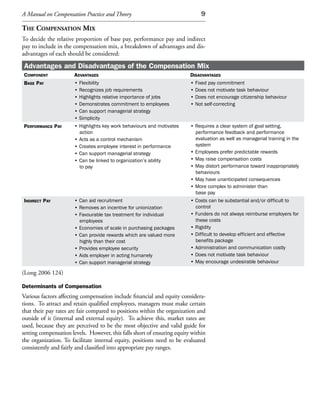
the Compensation mix
To decide the relative proportion of base pay, performance pay and indirect
pay to include in the compensation mix, a breakdown of advantages and dis-
advantages of each should be considered:

Advantages and Disadvantages of the Compensation Mix
Component             AdvAntAges                                         disAdvAntAges
BAse pAy              • Flexibility                                      • Fixed pay commitment
                      • Recognizes job requirements                      • Does not motivate task behaviour
                      • Highlights relative importance of jobs           • Does not encourage citizenship behaviour
                      • Demonstrates commitment to employees             • Not self-correcting
                      • Can support managerial strategy
                      • Simplicity
performAnCe pAy       • Highlights key work behaviours and motivates     • Requires a clear system of goal setting,
                        action                                             performance feedback and performance
                      • Acts as a control mechanism                        evaluation as well as managerial training in the
                      • Creates employee interest in performance           system
                      • Can support managerial strategy                  • Employees prefer predictable rewards
                      • Can be linked to organization’s ability          • May raise compensation costs
                        to pay                                           • May distort performance toward inappropriately
                                                                           behaviours
                                                                         • May have unanticipated consequences
                                                                         • More complex to administer than
                                                                           base pay
indireCt pAy          • Can aid recruitment                              • Costs can be substantial and/or difficult to
                      • Removes an incentive for unionization              control
                      • Favourable tax treatment for individual          • Funders do not always reimburse employers for
                        employees                                          these costs
                      • Economies of scale in purchasing packages        • Rigidity
                      • Can provide rewards which are valued more        • Difficult to develop efficient and effective
                        highly than their cost                             benefits package
                      • Provides employee security                       • Administration and communication costly
                      • Aids employer in acting humanely                 • Does not motivate task behaviour
                      • Can support managerial strategy                  • May encourage undesirable behaviour

(Long 2006 124)

Determinants of Compensation
Various factors affecting compensation include financial and equity considera-
tions. To attract and retain qualified employees, managers must make certain
that their pay rates are fair compared to positions within the organization and
outside of it (internal and external equity). To achieve this, market rates are
used, because they are perceived to be the most objective and valid guide for
setting compensation levels. However, this falls short of ensuring equity within
the organization. To facilitate internal equity, positions need to be evaluated
consistently and fairly and classified into appropriate pay ranges.
10                                                  ONESTEP Compensation Guide:


Chapter 3:      E       valuating Jobs (Part I)

In all organizations, managers have the expectation that they will be able to
recruit and retain appropriately skilled employees who are able to perform the
tasks and responsibilities outlined in their job descriptions. Employees want to
be paid at levels that are fair and equitable in comparison to other jobs in the
organization and in the marketplace. Job evaluation can increase the capacity of
organizations to recruit and retain qualified employees at competitive rates of
pay affordable to the organization; that is, job evaluation can ensure that both
management and employees will have the perception that compensation is fair
and equitable.
What is JoB evaluation?
Job evaluation is the systematic scoring and comparison of jobs along organiza-
tionally determined dimensions of job worth such as in the effort, responsibility,
complexity, importance, skills and the working conditions of a job. One pos-
sible end product of job evaluation is a job classification structure in which jobs
of similar value to the organization, no matter how different in other respects,
are located at the same level on the job pay hierarchy. This job pay hierarchy
provides the foundation for the development of pay grades and pay ranges.
(Long 2006 243)
Job evaluation is the process of determining and quantifying the value of jobs.
Significant aspects of the process include:
   1. Determining the innate value of jobs
   2. Determining the relative value of jobs
   3. The use of external market information
   4. The use of objective measurement instruments, and
   5. Stakeholder participation and negotiation.
During job evaluation jobs are analyzed and compared according to their job
descriptions. This process can be the foundation of an equitable and consistent
system of compensation. And it also provides information for organizational
analysis and human resource management.
Since job evaluation is critical both at the organization level and the individual
level, care must be taken that the process is objective. Both job analysis and
consequent evaluation should focus on the duties and responsibilities assigned
to specific positions, and not the incumbent’s performance.1

Why Do We Do Job Evaluation?
Job evaluation is a tool to compare jobs consistently and classify them into ap-
propriate pay ranges. The process can ensure that an organization’s pay system
is equitable, understandable, legally defensible, and externally competitive. Job
evaluations can be used to help to attract desirable job candidates and retain
high performance employees due to fair and equitable pay scales.

1 Government of Yukon, “Job Evaluation Manual, Section One,” Whitehorse, Oct. 25, 1985,
Dec. 2007 www.psc.gov.yk.ca/pdf/job_eval_man_1_general.pdf
A Manual on Compensation Practice and Theory                                11


methods of JoB evaluation                                                          Job Evaluation is a systematic
                                                                                     process that compares jobs and
Job evaluation requires information to distinguish among jobs, usually on the
                                                                                   ranks them based on their relative
basis of work activities and/or job required worker characteristics. The most
                                                                                     worth to the organization. It is
utilized evaluation methodologies are:
                                                                                    used to create a job structure for
    1. Ranking involves creating a hierarchy of jobs by comparing jobs               the organization and establish
        on global factors that presumably are common to all the jobs being              compensation standards.
        evaluated.
    2. The Classification method defines categories of jobs and slots jobs           Job Analysis is the process of
        into these classes.                                                           identifying and determining
                                                                                    information about a job for the
    3. Factor Comparison involves job-to job comparisons on several specific
                                                                                    purpose of writing descriptions.
        factors.
                                                                                   Factors considered include duties,
    4. The Point Method compares jobs on rating scales which are                     tasks, responsibilities, and skill
        comprised of specified factors.                                               requirements, among others.
Each of these methods is based on one or a combination of two general ap-
proaches: (1) an analysis of the job as a whole or (2) an analysis of the job’s      Job Description is a written
individual components.                                                             summary of a job which identifies
                                                                                   the position and describes its tasks,
Steps in the Job Evaluation Process                                                 major duties and responsibilities
                                                                                   and minimum qualifications and
Job evaluations typically follow these steps:
                                                                                  abilities required to perform the job.
   1. Review the choices of job evaluation methods such as job ranking,
       classification, factor comparison and point factor analysis and select     Job Family is made up of related
       the method most appropriate to meet the organization’s needs.                  jobs distinguished by levels of
   2. Gather information on each job within the organization, analyzing              knowledge, skills, and abilities
       job content to make sure it is clear and understandable; job content       (competencies) as well as other factor
       can be revealed utilizing job questionnaires, job descriptions,                     required of the jobs.
       interviews and/or work site visits.
                                                                                  Job Class (Job Grade) represents
   3. Ensure that each job description lists pertinent accountabilities           a group of jobs that are substantially
       and responsibilities; revise or expand job descriptions using the          similar, justifying a common name,
       information collected.                                                         similar selection processes and
   4. Evaluate each position utilizing the chosen method and link the                    similar compensation.
       ranked job to the organization’s existing compensation system or to a
       newly developed pay structure. The point system evaluates the skill,       Ranking is a simple job evaluation
       effort, responsibility and working conditions involved in the job;         method that ranks jobs from highest
       here, each of these factors is subdivided into sub factors to provide      to lowest based on the overall value
       standards against which each job is rated to determine its relative           of the job to the organization.
       worth.
   5. Create the appropriate pay grades and pay ranges in the pay structure
                                                                                  Alternation Ranking (Paired
       and along with policies and procedures setting out employee progress
                                                                                  Comparison) is a job evaluation
                                                                                     method that ranks jobs from two
       within the range.
                                                                                     extremes – most important and
   6. Periodically review the job evaluation system itself, developing              least important – simultaneously.
       procedures for evaluating and modifying the system and the resulting          The most valuable and the least
       compensation decisions.                                                      valuable jobs are ranked, then the
                                                                                  second most valuable and the second
                                                                                   least valuable, until all jobs in the
                                                                                     organization have been ranked.
12                                            ONESTEP Compensation Guide:

JoB analysis
Job Analysis is a process to identify and determine in detail the job duties and
requirements and the relative importance of these duties for a given job. Job
Analysis is a process where judgments are made about data collected on a job.
(www.hr-guide.com) The purpose of job analysis is to provide the information
necessary for preparing job descriptions and evaluating jobs. This information
may be obtained through workplace observation and/or interviews, question-
naires, and activity logs.
Job analysis has been referred to as the cornerstone of human resources manage-
ment. Organizations use information obtained by job analysis for a number
of interrelated human resources functions such as recruitment, selection, and
placement; organization planning and job design; training; grievance settlement;
as well as job evaluation and other compensation programs. Having accurate,
objective and verifiable information about jobs and their human resource re-
quirements is essential for legal compliance.
In compensation, job analysis has two critical uses:
    1. It documents similarities and difference in the content of jobs, and
    2. It establishes an internally rational and aligned job structure.
In such a structure, if jobs have equal content, then in all likelihood, the pay es-
tablished for them will be equal. On the other hand, differences in job content,
along with the market rates paid by competitors, are part of the rationale for
paying dissimilar jobs differently. (Milkolvich 2005 67)

Why Perform Job Analysis?
Potential uses for job analysis have been suggested for every major human re-
sources function. Job analysis identifies the skills and experience required to
perform specific jobs, clarifying hiring and promotion standards. Training pro-
grams and jobs themselves may be designed using job analysis data. In perform-
ance evaluation, both employees and supervisors look to the required behaviour
and results expected in a job to help assess performance.
Job Analysis can produce the following types of information:
   • Tools, materials, and equipment used to perform job tasks
   • Methods or processes used to perform job tasks
   • Specific duties related to a job, putting the position in context and
      sketching out broad responsibilities
   • Critical tasks and key result areas of the job, including discrete
      outcomes of the job for which the person appointed will be held
      accountable and evaluated on.

Methods of Job Analysis
There are five main methods (employed individually or in combination)
that can be used to obtain job information:
   1. Observation; the researcher watches the employee perform the job,
       recording data on a standardized form. This method is only useful for
       simple, usually manual tasks for which the employee can be directly
       observed.
A Manual on Compensation Practice and Theory                                   13

   2. Interviews; a sample of employees carrying out a given job and/or                Classification is a job evaluation
      their supervisors are asked a series of questions about the job, the              method based on job descriptions into
      essential tasks of the job, and the abilities required to perform it well.          which jobs are categorized by class
   3. Questionnaires; a standard questionnaire about the essential tasks of             descriptions such as “managerial” or
      the job is administered to the employee and/or supervisor; these may                “clerical” to name a few. Jobs are
      vary as to whether they are open or closed, organization-specific.               classified by comparing each job to the
   4. Activity Logs; employees identify every activity in the course of work          existing job classes and/or job families of
      and the time spent on it during a set period.                                    characteristically similar positions and
                                                                                      selecting the pay grade that best matches
   5. Functional Job Analysis; using the generic descriptions in Canada’s
                                                                                       them. This method is popular with the
      National Occupational Classification, the analyst can choose to use
                                                                                                     services sector.
      this guide and adapt it to the needs of the organization.
      (Long 2006 418-421)                                                                Factor Comparison is a more
JoB desCriptions                                                                        complex job evaluation method in
                                                                                         which jobs are assessed using a set
Making use of the information collected in job analysis, standardized job de-            of compensable factors (i.e., skill,
scriptions outline What physical, mental, and interactional activities a job en-        responsibilities, effort and working
tails, How a worker utilizes methods, procedures, tools, and information sources      conditions) and then ranked based on
to carry out a given job, and Why the job was developed (the necessary role it             the value to the organization.
plays in the organization’s meeting its objectives). The well written, detailed job        Jobs are compared within the
descriptions provide the foundation of any internally consistent compensation          organization to the benchmark jobs
system.                                                                                and their rates of pay for each factor
                                                                                             to determine job salaries.
Job Description Guidelines
Though there is no standard for job descriptions typically each contains the          Point Method (Point Value; Point
following information:                                                                   Evaluation), is a quantitative job
                                                                                      evaluation process that assigns points
    • Job Title, department and/or location, date of posting (job                        to each job, based on compensable
       descriptions are typically used for existing jobs, although they can, at
       times, be adapted for a posting).                                               factors. These points are then scaled
                                                                                           and weighted, and a total score
    • Job Summary – job’s purpose or objectives                                         tabulated for each job. A job’s total
    • Reporting and supervisory relationships, internal and external                  points determine its relative value to
    • Authority of incumbent in terms of responsibilities for people, results,         the organization and its location in
       and organizational assets and nature and extent of direct supervision                      the pay structure.
       of others
    • Duties and responsibilities in order of priority or importance,
       including work aids used in performing duties
    • Mental and physical effort demanded by the job
    • Working conditions
    • Qualifications required to perform the job such as skills, training,
       education, abilities and certificates or licenses.
Each job description should portray the work clearly both so that the duties can
be understood without reference to other job descriptions, and the job descrip-
tion function as a workable orientation tool for new employees. The document
should indicate the scope of authority by using phrases such as “for the depart-
ment” or “as requested by the manager” and include all important relationships.
Utilizing action words, it should be specific as to the kind of work, the degree of
complexity, the degree of skill required, the extent to which problems are stan-
dardized, the extent of the worker’s responsibility for each phase of the work,
and the degree and type of accountability.
14                                                     ONESTEP Compensation Guide:

Writing Job Descriptions that Comply with Human Rights Legislation
The purpose of human rights legislation is to ensure that employers do not
discriminate on any of the prohibited grounds in any aspect or terms and condi-
tions of employment. When assessing suitability for employment, training pro-
gram enrolment, and transfers or promotions; and appraising performance, the
only criteria considered should be knowledge, skills, and abilities, as required by
the essential duties of the job. Though job descriptions with clearly identified
job duties are not required under statute, they are a best practice in complying
with Human Rights legislation since they document that job duties are deter-
mined, clarified, prioritized, and justified.
Even when an employee cannot perform one or more of the essential duties of
the job due to reasons related to a prohibited ground, such as a physical disabil-
ity or religion, an employer is expected to make ‘reasonable accommodations,’
unless doing so would present ‘undue hardship.’ (Dessler 147)
Comprehensive job descriptions are a key feature of internally consistent com-
pensation systems, allowing for job analysis and for objective comparisons
among positions. They are also essential analytical supports to recruitment and
selection, training design, supervision, work performance, setting performance
standards and helping to ensure that all organizational activities serve the needs
of the organization.
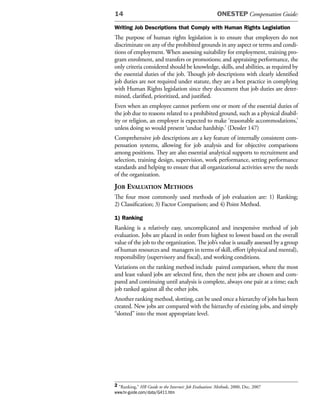
JoB evaluation methods
The four most commonly used methods of job evaluation are: 1) Ranking;
2) Classification; 3) Factor Comparison; and 4) Point Method.

1) Ranking
Ranking is a relatively easy, uncomplicated and inexpensive method of job
evaluation. Jobs are placed in order from highest to lowest based on the overall
value of the job to the organization. The job’s value is usually assessed by a group
of human resources and managers in terms of skill, effort (physical and mental),
responsibility (supervisory and fiscal), and working conditions.
Variations on the ranking method include paired comparison, where the most
and least valued jobs are selected first, then the next jobs are chosen and com-
pared and continuing until analysis is complete, always one pair at a time; each
job ranked against all the other jobs.
Another ranking method, slotting, can be used once a hierarchy of jobs has been
created. New jobs are compared with the hierarchy of existing jobs, and simply
“slotted” into the most appropriate level.


2 “Ranking,” HR Guide to the Internet: Job Evaluation: Methods, 2000, Dec. 2007
www.hr-guide.com/data/G411.htm
A Manual on Compensation Practice and Theory                                    15

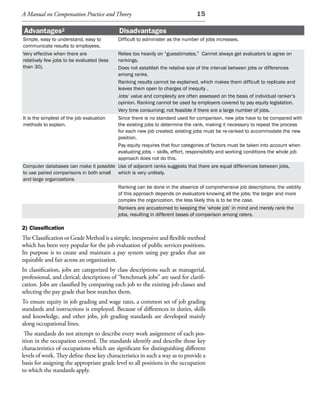
Advantages2                                 Disadvantages
Simple, easy to understand, easy to         Difficult to administer as the number of jobs increases.
communicate results to employees.
Very effective when there are            Relies too heavily on “guesstimates.” Cannot always get evaluators to agree on
relatively few jobs to be evaluated (lessrankings.
than 30).                                Does not establish the relative size of the interval between jobs or differences
                                         among ranks.
                                         Ranking results cannot be explained, which makes them difficult to replicate and
                                         leaves them open to charges of inequity .
                                         Jobs’ value and complexity are often assessed on the basis of individual ranker’s
                                         opinion. Ranking cannot be used by employers covered by pay equity legislation.
                                         Very time consuming; not feasible if there are a large number of jobs.
It is the simplest of the job evaluation Since there is no standard used for comparison, new jobs have to be compared with
methods to explain.                      the existing jobs to determine the rank, making it necessary to repeat the process
                                         for each new job created; existing jobs must be re-ranked to accommodate the new
                                         position.
                                         Pay equity requires that four categories of factors must be taken into account when
                                         evaluating jobs – skills, effort, responsibility and working conditions the whole job
                                         approach does not do this.
Computer databases can make it possible Use of adjacent ranks suggests that there are equal differences between jobs,
to use paired comparisons in both small which is very unlikely.
and large organizations
                                         Ranking can be done in the absence of comprehensive job descriptions; the validity
                                         of this approach depends on evaluators knowing all the jobs; the larger and more
                                         complex the organization, the less likely this is to be the case.
                                         Rankers are accustomed to keeping the ‘whole job’ in mind and merely rank the
                                         jobs, resulting in different bases of comparison among raters.

2) Classification
The Classification or Grade Method is a simple, inexpensive and flexible method
which has been very popular for the job evaluation of public services positions.
Its purpose is to create and maintain a pay system using pay grades that are
equitable and fair across an organization.
In classification, jobs are categorized by class descriptions such as managerial,
professional, and clerical; descriptions of “benchmark jobs” are used for clarifi-
cation. Jobs are classified by comparing each job to the existing job classes and
selecting the pay grade that best matches them.
To ensure equity in job grading and wage rates, a common set of job grading
standards and instructions is employed. Because of differences in duties, skills
and knowledge, and other jobs, job grading standards are developed mainly
along occupational lines.
 The standards do not attempt to describe every work assignment of each pos-
ition in the occupation covered. The standards identify and describe those key
characteristics of occupations which are significant for distinguishing different
levels of work. They define these key characteristics in such a way as to provide a
basis for assigning the appropriate grade level to all positions in the occupation
to which the standards apply.
16                                                      ONESTEP Compensation Guide:

Advantages3                                                         Disadvantages
Simple, straightforward, inexpensive, capacity to be flexible       Classification judgments are subjective.
enough to encompass a large number of jobs.


The grade/category structure exists independent of the jobs.        The classification structure may have biases that would
Therefore, new jobs can be classified more easily than in the       adversely affect certain groups of employees (females or
Ranking Method.                                                     minorities).
Job classification is simple once categories are established.       Some jobs may fit within more than one grade/category.
Jobs can be assigned and reassigned to categories as
responsibilities change within the existing system.
Since the basis for a particular job rating is documented, the Job classification is subjective and decisions rely on the
results are easier to defend than those derived by simple      judgment of the job evaluator; jobs might fall into several
ranking.                                                       categories or jobs with similar titles may be quite different from
                                                               each other.
Classification is common practice among organizations;         Whether grade descriptions contain the four essential factors
acceptance can be easy to secure among managers and            required for pay equity and the breadth of the job classes is
employees.                                                     sufficient determines whether this method is acceptable for pay
                                                               equity purposes
Because managers and employees are used to thinking of         Descriptions of pay grades must be fairly general in order
jobs in terms of classes and grades, disagreements over        to encompass several types of jobs, so there still may be
compensation administration are made easier to solve. Most disagreement about the exact grade placement for each job.
organizations that classify jobs into grades do so to ease the
task of building and operating pay structures.
                                                               Describing grade levels clearly and the judgment required to
                                                               apply them can pose difficulties.
                                                               Because the jobs are considered as entireties, compensable
                                                               factors used in class descriptions are unweighted and unscored.
                                                               For example, some jobs requiring high skill and other jobs
                                                               requiring little skill but carrying heavy responsibility are given the
                                                               same grade level.

                                              3) Factor Comparison
                                              Used less frequently than other methods because of its complexity, factor com-
 Job Class (Job Grade) represents             parison is a quantitative method in which evaluators identify and determine
  a group of jobs that are substantially      the worth of several major factors against which all jobs in a job class can be
  similar, justifying a common name,          assessed. Examples of compensable factors are: skill, responsibility, effort and
 similar selection processes and similar      working conditions.
             compensation.
                                              This method is similar in some ways to the ranking method. Each job is ranked
                                              for each of the several compensable factors. Job evaluators rank jobs that have
                                              similar responsibilities and tasks according to points assigned to compensable
                                              factors. Jobs across the organization are then compared to the benchmark jobs
                                              and rates of pay for each factor to determine job salaries.


                                              3 “Classification,” HR Guide to the Internet: Job Evaluation: Methods, 2000, Dec. 2007
                                              www.hr-guide.com/data/G412.htm
A Manual on Compensation Practice and Theory                                                   17

 Advantages4                                                                       Disadvantages
The value of the job is expressed in monetary terms.                              The pay for each factor is based on judgments that
                                                                                  are subjective. Using a rate of pay for each factor may
                                                                                  encourage raters to be influenced by whether a job is
                                                                                  high paid or low paid in determining its position in the
                                                                                  organizational hierarchy.
Can be applied to a wide range of jobs.                                           The standard used for determining the pay for each factor
                                                                                  may have built in biases that would affect certain groups of
                                                                                  employees (females or minorities).
Can be applied to newly created jobs.
Customized job ranking.                                                           Compensable factor comparison is a time-consuming and
                                                                                  subjective process.
The customized implementation in each organization may result in                  Very complex to use and or train others to use. Its many
a better fit with the organization.                                               and varied steps make it difficult to explain and lessen the
                                                                                  possibility of acceptance by all parties.
Once employees, union representatives, and managers have been
trained in the use of the job comparison scale, visual as well as
numerical job comparisons are easily made. The use of a monetary
unit in the basic method has the advantage of resulting in a wage
structure along with a job structure, eliminating the pricing step
required in other plans.

4) Point Method
The point method (also referred to as the point-factor5, point evaluation and
point value method) in which the value of jobs is expressed as a score is the most
commonly used system of job evaluation. It was used in Onestep’s Strategic
Framework Compensation Project to evaluate the twelve key jobs in the not-
for-profit community based employment and training sector.
Analysts identify key job characteristics (compensable factors including skill,
responsibility, effort and working conditions) that occur at different levels in
the jobs, weight these factors, and assess how much of each factor is present in
a given job by assigning a certain number of points to each job for that factor.
Points for each factor are added to produce a total for each job. This sum of
point values represents the relative “worth” of the position compared to all other
positions in the organization.
A carefully worded rating scale is constructed for each compensable factor. This
rating scale includes a definition of each factor, several divisions called degrees
(also carefully defined), and a point score for each degree. The rating scales may
be thought of as a set of rulers used to measure jobs. The point totals are used
to create a list of jobs in order of their job value. This list of jobs is then trans-
formed into a set of pay grades and pay ranges, based on internal equity or on
the market rates of certain key or ‘benchmark” jobs.
Designing a point method plan is complex, but once designed, the plan is relatively
simple to understand and use. Numerous ready-made plans developed by consult-
ants and associations exist. Existing plans are often modified to fit the organization.
Chapter 4 elaborates on the Point Method
4 “Factor Comparison,” HR Guide to the Internet: Job Evaluation: Methods, 2000, Dec. 2007
www.hr-guide.com/data/G413.htm
5 Dave Redekopp, Human Resources Development Canada and the Canadian Coalition of Com-
munity Based–Training, A Study to Investigate, Analyse & Organize Community-Based Training Roles in
Canada, (Toronto: December 2000).
18                                                     ONESTEP Compensation Guide:

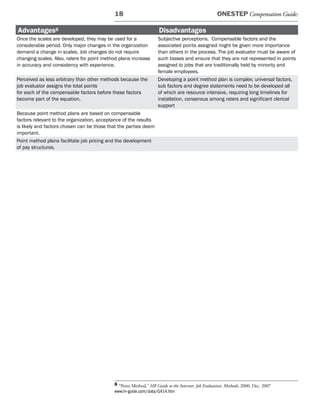
Advantages6                                                        Disadvantages
Once the scales are developed, they may be used for a              Subjective perceptions. Compensable factors and the
considerable period. Only major changes in the organization        associated points assigned might be given more importance
demand a change in scales. Job changes do not require              than others in the process. The job evaluator must be aware of
changing scales. Also, raters for point method plans increase      such biases and ensure that they are not represented in points
in accuracy and consistency with experience.                       assigned to jobs that are traditionally held by minority and
                                                                   female employees.
Perceived as less arbitrary than other methods because the         Developing a point method plan is complex; universal factors,
job evaluator assigns the total points                             sub factors and degree statements need to be developed all
for each of the compensable factors before these factors           of which are resource intensive, requiring long timelines for
become part of the equation.                                       installation, consensus among raters and significant clerical
                                                                   support
Because point method plans are based on compensable
factors relevant to the organization, acceptance of the results
is likely and factors chosen can be those that the parties deem
important.
Point method plans facilitate job pricing and the development
of pay structures.


                                            6 “Point Method,” HR Guide to the Internet: Job Evaluation: Methods, 2000, Dec. 2007
                                            www.hr-guide.com/data/G414.htm
A Manual on Compensation Practice and Theory                                                 19


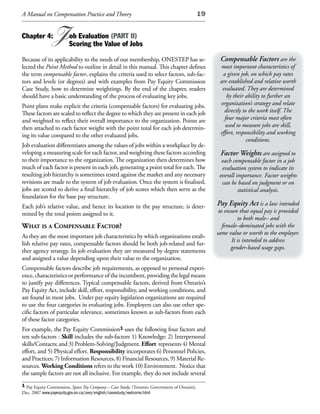
Chapter 4:     J        ob Evaluation (PART II)
                        Scoring the Value of Jobs

Because of its applicability to the needs of our membership, ONESTEP has se-                       Compensable Factors are the
lected the Point Method to outline in detail in this manual. This chapter defines                  most important characteristics of
the term compensable factor, explains the criteria used to select factors, sub-fac-                 a given job, on which pay rates
tors and levels (or degrees) and with examples from Pay Equity Commission                          are established and relative worth
Case Study, how to determine weightings. By the end of the chapter, readers                         evaluated. They are determined
should have a basic understanding of the process of evaluating key jobs.                              by their ability to further an
Point plans make explicit the criteria (compensable factors) for evaluating jobs.                  organization’s strategy and relate
These factors are scaled to reflect the degree to which they are present in each job                 directly to the work itself. The
and weighted to reflect their overall importance to the organization. Points are                     four major criteria most often
then attached to each factor weight with the point total for each job determin-                      used to measure jobs are skill,
ing its value compared to the other evaluated jobs.                                                effort, responsibility and working
                                                                                                                conditions.
Job evaluation differentiates among the values of jobs within a workplace by de-
veloping a measuring scale for each factor, and weighting these factors according                  Factor Weights are assigned to
to their importance to the organization. The organization then determines how                       each compensable factor in a job
much of each factor is present in each job, generating a point total for each. The                  evaluation system to indicate its
resulting job hierarchy is sometimes tested against the market and any necessary                   overall importance. Factor weights
revisions are made to the system of job evaluation. Once the system is finalized,                   can be based on judgment or on
jobs are scored to derive a final hierarchy of job scores which then serve as the                           statistical analysis.
foundation for the base pay structure.
Each job’s relative value, and hence its location in the pay structure, is deter-                 Pay Equity Act is a law intended
mined by the total points assigned to it.                                                          to ensure that equal pay is provided
                                                                                                            to both male– and
What is a CompensaBle faCtor?                                                                        female–dominated jobs with the
                                                                                                  same value or worth to the employer.
As they are the most important job characteristics by which organizations estab-
                                                                                                         It is intended to address
lish relative pay rates, compensable factors should be both job-related and fur-
                                                                                                         gender-based wage gaps.
ther agency strategy. In job evaluation they are measured by degree statements
and assigned a value depending upon their value to the organization.
Compensable factors describe job requirements, as opposed to personal experi-
ence, characteristics or performance of the incumbent, providing the legal means
to justify pay differences. Typical compensable factors, derived from Ontario’s
Pay Equity Act, include skill, effort, responsibility, and working conditions, and
are found in most jobs. Under pay equity legislation organizations are required
to use the four categories in evaluating jobs. Employers can also use other spe-
cific factors of particular relevance, sometimes known as sub-factors from each
of these factor categories.
For example, the Pay Equity Commission1 uses the following four factors and
ten sub-factors : Skill includes the sub-factors 1) Knowledge; 2) Interpersonal
skills/Contacts; and 3) Problem-Solving/Judgment. Effort represents 4) Mental
effort, and 5) Physical effort. Responsibility incorporates 6) Personnel Policies,
and Practices; 7) Information Resources, 8) Financial Resources, 9) Material Re-
sources. Working Conditions refers to the work 10) Environment. Notice that
the sample factors are not all inclusive. For example, they do not include several
1 Pay Equity Commission, Space Toy Company – Case Study, (Toronto: Government of Ontario),
Dec. 2007 www.payequity.gov.on.ca/peo/english/casestudy/welcome.html
20                                             ONESTEP Compensation Guide:

that relate to the work typically done by ONESTEP agencies, (i.e. responsibility
for the economic well-being, training and case management of people who may
be disadvantaged in finding jobs).
The four main factors/categories can encompass just about any characteristic
that an organization would want to measure. Some factors are generic, while
others may be more specific to the organization.
You may want to follow along with the Pay Equity Commission’s case study as
it provides an excellent example of Factors, Sub-factors and Levels (also referred to
as degrees). Go to Contents of Space Toy Co. (STC)” case study – Section 5 – Job
Evaluation.2
steps to a point method
Step One: Conduct a Job Analysis
As in all job evaluation methods (as noted in Chapter 3), Job Analysis is the first
step in the Point Method. Once job analysis is completed and a job description
is written or sample benchmark jobs are chosen, the content of the jobs is core
information for identifying and selecting compensable factors.

Step Two: Determine and Define Compensable
Factors and Sub-Factors
The four main compensable factors, skill, effort, responsibility and working con-
ditions are common to most jobs. Organizations in Ontario must utilize these
factors in the job evaluation systems to comply with pay equity legislation.
Employers can use specific criteria relevant to their organization (sometimes
known as sub-factors) for each of the factors. The number of sub-factors that
should be used must be enough that they capture all the key aspects of work that
are important to the organization, but not so many that they start to overlap or
add very little additional value to the system.
After selecting the factors and sub-factors, it is essential to develop a clear def-
inition of each one. The definitions must clearly convey the meaning of each
factor and sub-factor and clearly differentiate it from one another.

Step Three: Establishing the Degrees and Scaling the
Factors & Sub-Factors
After the compensable factors and sub-factors have been chosen for use in job
evaluation and defined, a number of ‘degrees’ (sometimes called ‘levels’) are es-
tablished for each factor and sub-factor, resulting in a measurement scale. These
degrees represent gradations in the extent to which a certain factor is present in
a particular job being rated. Each degree (or level) needs to be carefully defined
and in a specific order.
Referring to the example below3, Skills is the factor, knowledge is the subfactor:
This subfactor measures the level of experience, formal education and basic skills
necessary to meet the requirements of the job. Skills and knowledge may be
learned from both on-the-job or off-the-job experiences and/or education.


2 Ibid
A Manual on Compensation Practice and Theory                                  21

   •     Level 1: Job calls for little or no acquired knowledge. Job tasks may
         require knowledge in one area …
   •     Level 2: Job tasks call for some acquired knowledge. Understanding of
         the job tasks may be acquired through some specific courses …
   •     Level 3: Job tasks call for a higher level of acquired knowledge
         obtained through higher levels of required schooling or self-study …
   •     Level 4: Job tasks call for some specialized acquired knowledge.
         Understanding of the tasks is acquired progressively through required
         schooling …
   •     Level 5: Job tasks call for specialized acquired knowledge.
         Understanding of the tasks may be acquired progressively through
         highest levels of required schooling

Step Four: Determine the Weight of Every Compensable
Factor & Sub-Factor
Once the degrees have been assigned within the job evaluation system, the fac-
tor/sub-factor weights must be determined. Different weights reflect differences
in importance attached to each factor/sub-factor by the organization. The next
step in the point evaluation method involves ranking compensable factors and
their sub-factors by assigning weights to each according to its importance rela-
tive to the other factors and sub-factors within the organization. Assigning these
weights makes it possible to compute point values for each position within a job
structure. This builds the foundation for an internally equitable and consistent
compensation system.
Factor and sub-factor weights are based on judgment and knowledge of what
is important to the organization. In the committee approach, the procedure
is to have committee members (1) study factor/sub-factor and degree defin-
itions, (2) as individuals, separately rank the factors and sub-factors in order of
importance, (3) as a group develop a consensus on ranking, (4) as individuals
distribute all the 100 percentage points among the factors, and (5) once more as
a group achieve consensus. The resulting consensus makes it likely that the job
evaluation will be accepted within the workplace. Another approach to assign-
ing weights is to evaluate benchmark jobs and the points assigned are correlated
with an agreed-upon set of wage rates. Regressing this structure of pay rates on
the factor degrees assigned to each job yields weights that will produce scores
aligned with agreed-upon wage rates
Whether developed by committee decision or by other methods, the rating
scales are often tested by evaluating a group of benchmark jobs. If the results are
not satisfactory, several adjustments are possible. Benchmark jobs may be added
or deleted. Degrees assigned to jobs may be adjusted. The criterion – the pay
structure – may be changed; or the weights assigned to factors may be changed.
In any of these ways, the job evaluation plan is customized to the jobs and the
organization.


3 Ibid
22                                            ONESTEP Compensation Guide:

                                    A Basic Weighting Formula4
                                    The formula is based on a total of 100% (1000 points). The 100% / 1000 points
                                    are divided among the four factors.
                                     Factor Formula (100% divided between 4 factors)
                                     fACtors                                      perCentAges                 points
                                     skill                                               35%                   350
                                     effort                                              20%                   200
                                     responsiBility                                      35%                   350
                                     Working Conditions                                  10%                   100
                                     totAl vAlue   for the   system                  100%                     1000

                                    The basic formula is expanded by dividing the percentage given to each factor
                                    between its sub-factors. For example:
                                     Subfactor Formula (100% divided between 10 subfactors)
                                     fACtors                                      perCentAges                 points
                                     skill                                               35%                  350
                                       Knowledge                                         15%                  150
                                       Interpersonal skills/Contacts                     12%                  120
                                       Problem solving/Judgement                          8%                   80
                                     effort                                              20%                  200
                                       Mental Effort                                     12%                  120
                                       Physical Effort                                    8%                   80
                                     responsiBility                                      35%                  350
                                       Personnel, Policies and Practices                 12%                  120
                                       Information Resources                             10%                  100
                                       Financial Resources                                8%                   80
                                       Material Resources                                 5%                   50
                                     Working Conditions                                  10%                  100
                                      Environment                                        10%                  100
                                     totAl vAlue   for the   system                  100%                     1000


Levels Formula (percentages divided among 4 to 6 levels)
Skill (35% divided between three sub-factors)
suB-fACtors                          Weight        points                       points   for   levels
                                                                  1        2             3               4         5
Knowledge                             15%           150           30       60            90             120       150
Interpersonal skills/Contacts         12%           120           24       48            72              96       120
Problem solving/Judgement              8%            80           16       32            48              64        80


                                    4 Ibid
A Manual on Compensation Practice and Theory                                     23

Step Five: Applying and Checking for Reliability
A job evaluation system is deemed to have reliability when the same point scores
for each factor for a given job are produced by different persons applying the
system. Once it is established that a system has reliability, it is applied to all the
jobs covered by job evaluation, and a hierarchy of jobs which lists the jobs in
order of their value in the organization is produced.
It is important to note is that the external market has zero effect on Pay Equity
requirements and that a more usual method of assigning pay rates is internal
equity based on linear regression. Once equity is achieved, external benchmarks
can be used to raise the entire pay structure, not merely some jobs or some
levels.

Step Six: Communicate with Employees
During the period of job evaluation and afterwards, there is a need to com-
municate regularly with employees about the process and to make available
documentation that explains how the organization’s jobs were evaluated. These
measures aid in promoting a sense that the process is fair and equitable, espe-
cially in relation to their own jobs.
Job evaluation manuals help ensure organizational consistency and ongoing
functional adaptation to change. They document methods used, compensable
factors chosen, levels or degrees established for each factor/sub-factor and the
means by which weights were determined, approaches to pay structure, parties
involved and processes used to convert the point values into dollars. That be-
ing said, these manuals must only be used in combination with job evaluation
training otherwise publishing the entire job evaluation manual may be misused
and can lead to people “evaluating” their own jobs and coming up with much
higher scores than would be the result of a thoughtful and consistent committee
that used the same criteria for all jobs.

Step Seven: Determining Base Pay Structure
will be discussed in Chapter 5: Job Evaluation (PART III) The Pay Structure.
24                                            ONESTEP Compensation Guide:


Chapter 5:   J       ob Evaluation (PART III) The Pay Structure

As outlined in Chapter 4, the first six steps in job evaluation establish the rela-
tive worth of all the jobs in an organization or group from which a hierarchy of
jobs is produced. In the seventh step which is discussed in some detail in this
chapter, the established hierarchy lists out the most valuable jobs to the least
valuable to the organization. The pay structure (salary structure) that follows
sets out the pay grades (or levels) and the pay ranges, along with the criteria for
salary movement within the pay structure.
There are two basic approaches to constructing a pay structure. In the first,
every job that has a different total of job evaluation points will be treated separ-
ately and will, in effect, become a particular pay grade. The other approach is
to group jobs that have similar value in the organization (certain range of point
values) into pay grades.
For an organization to be able to recruit and retain employees who have the
skills required and who perform well, compensation levels need to be competi-
tive with those in the broader marketplace. An effective pay structure will reflect
the values of the organization as expressed in the job hierarchy and the market
rates of comparable jobs. In the not-for-profit sector, most associations collect
data on wage rates. Human resources managers need to take this data and decide
the degree to which they have the fiscal capacity to match or exceed the market
rates. In some situations, organizations may not have the financial means to do
either and might aspire to a level such as 10% or 25% below the market rate.
pay grades
A pay grade is a grouping of jobs of the same or comparable value to the organ-
ization. Each job within a pay grade will have the same pay range, that is, min-
imum, midpoint and maximum. The first step in building flexibility into the
pay structure is to group different jobs that are considered substantially equal for
pay purposes into a pay grade.
Grouping jobs into pay grades (pay levels) offers several advantages. It elimin-
ates the administrative duplication of having separate rates and pay ranges for
each and every job. It allows the grouping of similar jobs into the same pay
grades, permitting employees’ duties to be slightly changed without requiring
changes in pay rates. Albeit, if the responsibilities change enough, the job might
need to move to another pay grade/level. Pay grades also contributes to the
stability in the pay system by allowing small job changes without having a job
re-evaluation, providing the small changes are not shown to change the overall
score enough to move the job to a different pay “grade.” Pay grades also make
it easier to justify and explain pay rates to employees creating a perception of
fairness and equity.
The number of pay grades required within an organization is related to the size
of the range of points or salaries for the organization as a whole. The larger the
ranges of salaries, the less pay grades will be needed. Generally speaking, if a
range is too narrow it is difficult to reward good employee performance without
promoting them to a job in the next higher pay grade.
A Manual on Compensation Practice and Theory                                25

pay ranges
A pay range is the continuum of pay rates from minimum to maximum within             Pay Structure is a hierarchy of
a pay grade. A pay range maximum is the upper limit of what the employer pays        jobs within an organization. Jobs
for that type of work and the minimum is the lowest amount. The higher end            are ranked based on content and
of the range can be used to attract experienced, higher-paid employees when the        value to the organization. The
starting salary within a particular range would be too low, given their level of     pay structure includes all the pay
experience. These ranges also make it possible for managers to recognize per-          rates for different jobs within a
formance differences among employees within grades or for those with different     single organization, factoring in the
levels of seniority.                                                                number of pay grades/levels with or
When human resources managers establish pay ranges, they need to consider:          without ranges, differences between
how to determine the midpoints of the ranges; how to determine the range           grades/levels, and the criteria used to
spreads from minimum to maximum of each pay grade; whether ranges should                  determine the differences.
be permitted to overlap and how employees should progress through the ranges.
Some organizations have a minimum of three steps or increments whereas others
                                                                                   Pay Grade is a grouping of jobs of
                                                                                   the same or comparable value to the
may have as many as ten or more. When there is an overlap in the range, an
                                                                                   organization. Each job within a pay
employee in the lower pay grade can actually earn more than one in a higher
                                                                                    grade will have the same pay range
grade. If there were very small spreads in each pay range, there would be little
                                                                                   – minimum, midpoint, maximum.
or no overlap. As range spreads increase so does the overlap. One way to avoid
                                                                                       Movement to another grade is
problems with employee dissatisfaction is to create pay ranges that are always
                                                                                    through promotions or demotions.
lower than the midpoint of the next one (refer to sample pay structure below).
BroadBanding (Bands)                                                               Pay Range is the upper and lower
                                                                                   limit of pay rates to be paid for jobs
Broadbanding is the condensing of multiple pay grades into several broad and        in a pay grade, from minimum to
wide-ranging grades each with a sizable range. It may be comprised of four           maximum. Movement through a
or more grades consolidated into a single band with only one maximum and            pay range is a result of experience,
one minimum pay rate. With fewer pay grades (reduced into a few bands) the                seniority, training, etc.
point totals for the jobs in a particular band may be very large. The spread of
pay ranges is greater with less overlap with other ranges. A manager can move      Broadbanding is the condensing
employees within the band to gain experience without promoting or making a         of multiple salary grades into several
pay adjustment. Although this provides the flexibility to categorize job respon-     broad and wide-ranging grades.
sibilities more broadly, it may lead to biased decision making and inconsistent
practices within the organization. Another drawback is that there is very little     Benchmark (or key) job is a
difference between the point totals of the job at the low range of the band and      standard job from either within
the one that is at the higher range of the lower band yet the pay difference is       the organization or outside the
substantially more creating an inequity within the organization.                     organization used as a reference
                                                                                     point for pay comparisons. These
                                                                                     jobs have relatively the same job
                                                                                       content and there is not much
                                                                                      difference in their rates of pay.

                                                                                   Hierarchy (or Job Structure)
                                                                                    is a ranking of jobs based on their
                                                                                         value to the organization.
26                                                     ONESTEP Compensation Guide:

 Pay/Salary Structure1
    grAde            points              minimum              midpoint             mAximum
      1              92-108              $25 130              $27 922               $30 714
      2             109-127                 26 458               29 728               32 701
      3             128-147                 27 836               31 632              34 795
      4             148-177                 28 927               33 636              36 999
      5             178-209                 31 039               36 517               40 169
      6             210-244                 33 316               39 662              43 628
      7             245-286                 35 913               43 269               47 596
      8             287-335                 38 508               47 541              52 295
      9             336-399                 42 471               47 541              58 398
      10            400-459                 47 458               59 323              65 255
      11            460-540                 53 348               66 686              73 354
      12            541-634                 60 054               75 068               82 574
      13            635-745                 67 597               84 496              92 945
      14            746-875                 75 473               94 342             103 776
      15            876-1025                83 390             104 238              114 662
      16           1026-1200                91 121             113 902              125 292
      17           1201-1405                97 508             121 885              134 074

movement through the salary struCture
Managers move employees through pay ranges based on some or all the criteria
of experience, seniority, and performance. Some organizations add further cri-
teria of education/training. Movement between grades results from promotion
which is usually offered to employees who are high performers.
One of the problems often linked with a pay structure (that has been revised
through job evaluation) and may require adjusting in the pay structure are out-
liers: Employees below range who are “green circled” and have priority for raises;
and those above range who are “red circled’ and would have no raises allowed
until the range catches up to the employee’s current pay. There is not a hard
and fast formula to balance the internal equity of such jobs but lends itself to
a matter of judgment and having appropriate salary administration policies for
dealing with individual salary cases that fall outside the pay ranges.


1 “Salary Structure, Support Staff,” University of Ottawa, Human Resources Service, Nov. 19, 2007
www.hr.uottawa.ca/compensation/salary/support/year.php
A Manual on Compensation Practice and Theory                                                      27

graph: pay/salary struCture2

                                                                                             7

                                                                                 6
                                                                                                       Pay Polilcy
                                                                     5                                    Line

                                         Grades         4

                                           3

  WAGE                       2

RANGES           1


                                         Ranges


           100   120   140   160   180    200     220   240   260   280   300   320   340   360
                                         JOB EVALUATION POINTS


The dollar values occupy the vertical axis (Wage Ranges) and the organizational                                Promotion is an advancement
scorings the horizontal axis (Job Evaluation Points). Thus, pricing a job struc-                              in which an employee moves to a
ture involves a series of techniques and decisions applied to the points where the                            higher level position that usually
vertical and horizontal values meet.                                                                          requires further skills, education,
                                                                                                             experience and knowledge and pays
                                                                                                                       a higher salary.

                                                                                                            Red Circle Rate is the pay rate for
                                                                                                                 a position that is higher than
                                                                                                              the maximum rate for a job or pay
                                                                                                                       range for a grade.

                                                                                                            Green Circle Rate is the pay rate
                                                                                                               that is lower than the minimum
                                                                                                                pay rate for a job or pay range
                                                                                                                          for a grade.


2 ERI Distance Learning Centre. Designing Wage Structures: Chapter 15, (Nashville: 2002) Dec. 2007
www.eridlc.com/index.cfm?fuseaction=textbook.chpt15
28                                                    ONESTEP Compensation Guide:


Chapter 6:       D         esigning Your Benefits Package
Benefits are a form of indirect pay within a compensation system. They are
rewards (other than wages, salaries or performance-related payments) that em-
ployees receive in return for their continued service to the organization. They
are designed to protect employees and their families from loss of income due to
health problems or other work-related financial disruptions, and can improve
the employee’s general quality of life through special programs and services in
the workplace. They can include retirement plans, health insurance, life insur-
ance, disability insurance and vacation. Some benefits, such as Employment
Insurance, Workers’ Compensation and the Canada Pension Plan, are compul-
sory, government-mandated programs.
Benefits administration has become a highly specialized HR function, requiring
detailed knowledge of employment and tax laws in a quickly changing market-
place for benefits products (Long 2006). The strategy and design of benefit
packages are important to the recruitment and retention of qualified employees.
However, as much as this is the case, benefit packages must consider the organ-
ization’s ability to pay on an ongoing, sustained basis.(Long 2006). Continuing
escalating costs associated with providing benefits have forced changes to benefit
packages, and options such as flexible benefit plans have become common in
organizations.
There are many types of benefits and various ways to classify these. For example,
CPP is both a government-sponsored benefit and a contribution toward most
employees’ future retirement income. (Long 2006)
This chapter will focus on benefits and issues in benefits administration that are
most relevant to not-for-profit organizations.
trends in Canada1
Some organizations are trying to change the commonplace view among em-
ployees that benefits are an entitlement rather than a form of earnings. One
means of encouraging this to change is to implement flexible benefits packages;
when weighing their options, employees are made aware of costs and values.
(Long 2006 445)
In the 2007 Sanofi-Aventis Healthcare Survey2, employees valued their benefits
plans so highly that 61% of respondents suggested they would forego a yearly
$20,000 cash allowance in favour of keeping their health benefits. Despite this,
there is some sense that many employees still do not understand the costs to
organizations for providing benefits. Even with escalating costs and the increas-
ing complexity of managing the benefits system, many organizations continue
to see benefits as essential to comprehensive compensation packages and have
explored options to cost share with employees because they realize that employ-
ees would be willing to pay to maintain benefits rather than lose them or see
them reduced.3
1 Eric Shulman, “Want To See The Future Of Benefits? Look Across The Border,” HR Thought
Leader, Jan. 2006, Dec.2007 www.hrthoughtleader.com/HRTL/HR+Professional+Magazine/
Archives/2006/2/HRTL_comp+and+benefits.htm
2 “Sanofi-Aventis Healthcare Survey 2007,” AON Consulting, Dec. 2007 www.sanofi-aventis.ca
3 Linda Clay, “Facing Off Against Culture of Entitlement,” Canadian HR Reporter, Sept. 10, 2007,
Dec. 2007 www.canadianhrreporter.com/search/default.asp?submit=Go&txtKeyword=Linda+Clay
A Manual on Compensation Practice and Theory                               29

Common types of Benefits and serviCes
(Milkovich 2005 229) (Long 2006 425)
  1. Mandatory Government Sponsored Benefits                                        Indirect Pay is part of an
      a. Canada/Quebec Pension Plan                                                employee’s total compensation
                                                                                 package, non-cash items or services
      b. Employment Insurance                                                     provided to employees in return
      c. Workers’ Compensation                                                      for their contribution to the
      d. Provincial Health Insurance Plans                                       organization (i.e., health benefits,
                                                                                 paid time off ). Sometimes the costs
  2. Private Pension Plans
                                                                                   for the items are shared by the
      a. Defined Benefit Pension Plan Contributions                                           employees.
      b. Defined Contribution Plan Payments
      c. Hybrid Pension Plans
                                                                                 Benefits are any form of indirect
                                                                                payment due to an eligible employee
      d. Early Retirement and Voluntary Separation Packages                        (or his/her beneficiary) under
  3. Health Care Benefits:                                                        an employee benefit plan. These
      a. Supplemental Healthcare Insurance                                        payments can include pension,
                                                                                  medical and/or dental coverage.
      b. Dental Insurance
      c. Vision Care                                                            Benefit Ceiling is the maximum
  4. Income Security                                                              amount paid for specific benefit
                                                                                            claims.
      a. Life and Accident Insurance
      b. Short-Term Disability                                                     Benefits Deduction is the
      c. Long-Term Disability                                                      deduction from an employee’s
                                                                                   pay to cover all or a portion of
  5. Pay for Time not Worked [Pay for time off is not always required by          the premium of his/her benefits
      law and at the discretion of the organization.]                                         package.
      a. Vacation Time and Vacation Pay/Mandatory/(ESA)4
      b. Public Holidays/Mandatory/(ESA)                                                Cafeteria Plan
                                                                                  (Flexible Benefits Plan) is a
      c. Paid Rest Periods/Mandatory/(ESA)                                       customized benefits plan in which
      d. Leaves of Absence                                                      an employee may choose the benefits
             i. Sick Leave                                                       best suited to his/her needs. In most
                                                                                   cases a common core package is
             ii. Compassionate and Bereavement Leave
                                                                                 mandatory, with elective programs
             iii. Jury Duty/Mandatory                                           available at the employee’s discretion.
                  [But the organization doesn’t have to pay.]                     The employee may also choose to
             iv. Educational/Sabbatical Leaves                                   contribute for additional coverage.
      e. Severance Pay /Pay in Lieu of Notice/Mandatory(ESA)
                                                                                 Deductible is a subtraction of a
      f. Supplemental Unemployment Benefits                                      specified amount of money ($25 or
      g. Deferred Income for Leaves                                             $50) on a benefit claim that is taken
  6. Mandatory Time Off, With or Without Pay                                     off just the once at the beginning of
      [But the organization doesn’t have to pay.]                                           an annual term.
      a. Pregnancy Leave/Parental Leave/Mandatory/(ESA)                          Premium is the periodic amount
      b. Personal Emergency Leave/Mandatory/(ESA)                                 under a contract of insurance
      c. Family Medical Leave/Mandatory/(ESA)                                    in respect to benefits paid by the
                                                                                employer and/or employee to keep a
4 ESA is the acronym for the Employment Standards Act (Ontario)                           policy in force.
30                                            ONESTEP Compensation Guide:

   7. Employee Services
      a. Employee Assistance Programs
      b. Childcare services/Eldercare service
   8. Miscellaneous Benefits

Mandatory Government Sponsored Benefits
The Canadian and Ontario governments both sponsor benefit programs for
employees requiring employer and employee contributions. As well, they have
legislated minimums for vacations and holidays. www.cra-arc.gc.ca/E/pub/tg/
t4001/t4001-e.html.
Canada/Quebec Pension Plan (C/QPP) is a mandatory, government-sponsored
pension plan for working-age Canadians, with equal contributions from both
the employer and employees. These pensions or benefits are available only to
individual contributors or their dependents, and contributors may choose to
begin retirement benefits any time after the age of 60. Beneficiaries of this pro-
gram can receive retirement, survivor and disability pensions or death benefits.
This program is completely funded by contributions and receives no subsidy.
www.hrsdc.gc.ca/en/isp/cpp/cpptoc.shtml Milkovich.
Employment Insurance is a compulsory Canadian government program, funded
by both employers and employees. It pays workers facing unemployment or
work interruption with income replacement for a limited time period only after
a waiting period and in certain circumstances. To qualify, employees must have
worked a minimum number of hours in the previous year, not have chosen to
leave a job voluntarily (except under limited conditions) or they have to qualify
for pregnancy leave, parental leave or short-term disability. www1.servicecanada.
gc.ca/en/ei/menu/eihome.shtml.
Workers’ Compensation is a mandatory, no-fault government insurance program
that compensates employees for pay lost when injuries and diseases occur due
to the workers jobs. In Ontario, the Workplace Safety and Insurance Board
(WSIB) provides income, medical and other benefits to injured employees and
their families, no matter which party is at fault. Premiums are paid solely by
employers, and the amount of these premiums varies according to industry and
by individual organizations’ costs. The system does not allow organizations and
employees to sue each other for damages or costs related to workplace injury.
Employees cannot be obliged to contribute to a compensation fund or to waive
rights to benefits. Benefits are not taxable for employees. www.wsib.on.ca/wsib/
wsibsite.nsf/public/homepage.
Provincial-Health Insurance Plans pay healthcare providers directly for listed
health and hospital services with no direct fees to the patients. Typically these
plans are funded through payroll taxes. For example, Ontario’s Employer Health
Tax (EHT) is paid by the employer, and individual health taxes or premiums
are payable by individual residents. An example of the latter, the Ontario Health
Premium, is collected through the income tax system.
Employer Health Tax, Dec. 2007 www.rev.gov.on.ca/english/taxes/eht/
Ontario Health Premium, Dec. 2007
www.fin.gov.on.ca/english/publications/healthpremium/healthfaqemp.html
A Manual on Compensation Practice and Theory                                                      31

Private Pension Plans
Pensions provide a regular source of income to people at a specified age, to their                        Employee Benefits are part of
spouses or dependents at the employees’ or former employees’ deaths or when                                an employee’s total compensation
the employees are adjudicated to have disabilities that prevents them from work-                           package, other than pay for time
ing.                                                                                                       worked, provided in whole or in
Canada’s Income Tax Act 5 gives employees incentives to save for retirement,                                  part by employer payments
and organizations’ incentives can support such plans. Organizations can deduct                            (includes life insurance, vacation,
contributions to such plans on behalf of employees as regular business expenses,                           worker’s compensation, pension,
and these contributions are not taxable to the employee. Within limits, the pool                                 paid time off, etc.).
of pension plan contributions in the plan can grow and accumulate without
                                                                                                          Flexible Spending Accounts
taxes until it is distributed as pension payments to individuals.
                                                                                                            or Health Care Expense
Organizations can choose not to implement pension plans for a variety of rea-                            Account is an employer deductible
sons6. Some argue that they have met their responsibility to help employees plan                          tax-favoured employee benefit that
for retirement through their contributions to CPP/QPP. Others suggest that                                 allows employees to use employer-
money put into pensions could be better put to reinvesting in their organization                             provided health care credits to
or that the regulations surrounding pension plans make the plans too costly for                          purchase a wide array of health care
their organization.                                                                                        services. Employees have separate
For those not-for-profit organizations that decide to offer pension plans to their                        spending accounts with an allotted
employees there are three general types of pension plans available:                                      maximum to fund allowable health
                                                                                                                      care services.
Defined Benefit Pension Plans maintain a fixed level of income to the employee
from the time of retirement to their death or that of their surviving spouse. The                         Fixed Benefit Plan is a benefit
level is normally a percentage of the employee’s annual working income and is                             plan that is provided to all eligible
affected by the employee’s years of service and participation in the plan.7                                employees with the same array of
Defined Contribution Plans specify the employee’s and the organization’s con-                                           benefits.
tributions, which are invested to provide retirement income that is based on the
accrued value of employer and employee contributions. These are also known as                              Flexible Benefit Plan allows
“money purchase plans” in which contributions are held in an investment trust.                            employees to choose the benefits they
When an employee retires, the pension can be paid out based on the amount of                             prefer. Employees are allotted a fixed
capital in the trust at that time; as such, there is no assurance of what payment                         amount of money and permitted to
levels will be before the time of retirement. These plans tend to be more portable                        spend that amount in the purchase
for employees than defined benefit plans.                                                                  of benefit options. Employees can
                                                                                                         also top up or buy benefits with their
Both defined benefits and defined contribution plans can be contributory, re-                                          own salary.
quiring contributions from the employee. Both employer and employee con-
tributions to either type of plan are subtracted from allowable contributions to                           Long-term Disability Plan
group RRSPs.                                                                                                 is an employer sponsored plan
Hybrid Pension Plans have characteristics of both defined benefit and defined                             that provides income protection in
contribution plans. In some plans, organizations match employee contributions.                             the event of a long-term illness or
                                                                                                          disability that is not work-related.
Usually contributory plans are established as group RRSPs, making employee
contributions tax deductible. Earnings on the plan are not taxed until they are
paid out as income.
Early Retirement and Voluntary Separation Packages are designed to eliminate
the need for dismissals during organizational restructuring by giving long-term
5 The Centre for Employee Benefits, Employee Benefit Plans in Canada,
(Toronto: Humber College Press, 2000).
6 Ibid.
7 The costs of providing such plans can escalate beyond the capacity of the pension fund to service it
creating “underfunding”.
32                                           ONESTEP Compensation Guide:

employees incentives to leave the organization. Typically organizations will offer
such incentives for a limited time, and the financial incentive can be a combina-
tion of pension benefits and cash payments awarded for years of service. These
incentives are legal ways to reduce workforce size, but the acceptance by the
employee must be voluntary.

Health Care Benefits
Health Care Benefits provide coverage for disability, and prescription drugs, as
well as dental, optical and other needs that may be highly valued by employees.
Supplemental Healthcare Insurance is frequently offered by Canadian organiza-
tions. Because of government-provided health insurance, the costs to Canadian
employers for providing health insurance is markedly lower than it is for their
American counterparts. However, some services have never been covered under
Canadian public programs and the cost of private insurance has risen, mainly in
response to rising drug costs.
Many organizations provide their employees with supplementary health care
insurance. This type of insurance protects employees against medical costs
stemming from accidents and illness. Dental and Vision Care are often insured
under separate plans.
Dental Insurance has grown popular because there is no public dental coverage
and procedures can be costly. Such benefits are deductible as an employer busi-
ness expense and are not taxable to the employee. These plans have the effect of
encouraging employees to take care of their dental health, which can affect their
overall health and reduce sick time.
Vision Care has grown in popularity especially since routine eye exams are no
longer covered for most working-age residents of Ontario. Typically in the Vi-
sion Care plan, eye examinations are covered as well as a fixed amount for eye-
glasses, contact lenses and laser surgery.

Income Security
Life and Accident Insurance, long-term and short-term disability insurance pro-
tects against or compensates for income because of illness, disability, or death
the cause of which is not work-related.
Life and Accident Insurance, which is common to most benefit plans, will typ-
ically pay annual salary multiplied by a specified number of years. Because of
economies of scale, group insurance can usually be provided at lower rates for
all employees including new employees no matter their health status (although
not always). Dependent life insurance may also be included in the package with
premiums paid by employees or employer or a combination of the two. Benefits
administrators need to decide on policies, on the payment schedule, whether
benefits continue past retirement, and the amount of employee contribution. A
common employee benefit is group term life insurance, providing death bene-
fits to survivors, and sometimes including accidental death and dismemberment
benefits.
Short-term Disability or “Salary Continuation” plans replace all or part of an
employee’s earnings when the employee is away from work because of illness or
injury that is not work-related. If an absence goes beyond one or two days, some
employers require a medical certificate. Benefits stop when the employee returns
to work or qualifies for long-term disability.
A Manual on Compensation Practice and Theory                                              33

Long-term Disability Insurance protects employees’ income if they cannot work
because they become disabled for reasons that are not work-related. Usually
coverage is two-thirds of the monthly income, with a four-month waiting per-
iod. This amount continues until the employee returns to work, reaches retire-
ment age, or dies.
If long-term disability insurance premiums are paid by the organization, bene-
fits will be taxable; if they are paid by the employee and are not deducted as an
expense, payments are not taxable.
In organizations without short-term disability, employees may collect EI until
long-term benefits start. EI has a waiting period, so income during absences
would not start immediately.

Tax Status of Pension and Health Benefits (Long 2006 432)
Most benefits are either tax deductible or tax exempt.8
                                        employer           employer        employer        purChAse   of     fund inCome     is     Benefit
                                      ContriButions      ContriButions    ContriButions   Benefit suBjeCt        tAxABle            pAyouts
                                      deduCtiBle By     tAxABle for the   deduCtiBle By    to premium or                          tAxABle for
                                      the employer          employee      the employee      sAles tAxes                            employees

Registered Pension Plan                     Yes                No             Yes               No                  No                 Yes
Group Registered Retirement
                                            N/A                N/A            Yes               No                  No                 Yes
savings Plan
Deferred Profit-sharing Plan                Yes                No             N/A               No                  No                 Yes
Health and Dental Insurance/
                                            Yes                Noa             No              Yesb                N/A                  No
Health Care Expense Accounts
Short-Term Disability (self-
                                            Yes                No             N/A              N/A                 N/A                 Yes
insured)
Long-Term Disability Insurance              Yes                No              No              Yesc                N/A              Yes/Nod
Group Life Insurance                        Yes                Yes             No              Yesd                N/A                  No
Group Accidental Death and
                                            Yes                Noa             No              Noe                 N/A                  No
Dismemberment

Pay for Time not Worked
This includes any payment for time when employees are not on the job. It is
mandatory for organizations to pay for minimum annual vacations, statutory
(public) holidays, and rest breaks. Some organizations go beyond these levels                  a Except in Quebec for provincial income tax
and pay for additional holidays, additional vacation time, sick leave, personal                b Applies to both insured and uninsured plans in
and educational leaves. This can be the largest benefits expense for organizations             Ontario and Quebec
because of the amount of time off employees can receive.                                       c Provincial premium tax applies in all provinces;
Vacation Time and Vacation Pay are considered to be essential to an employee’s                 provincial sale tax applies in Ontario and Quebec
well-being. Under Ontario’s Employment Standards Act (ESA) employees must                      d Yes, if premiums are paid by employer; no, if pre-
receive at least four percent of their wages as vacation pay. For each 12-month                miums are paid by employee; partially, if premiums
vacation entitlement year employees earn two weeks of vacation time. These                     are shared

must be scheduled in one or two-week blocks, unless employees request their                    e Not subject to provincial premium tax, but
vacation time be scheduled in other ways depending on the organization’s poli-                 subject to provincial sales tax in Ontario.
cies and practices. Subject to an employee making the request in writing and an
employer agreeing in writing, vacation can be taken in periods as short as one
day at a time.
8 The Centre for Employee Benefits, Employee Benefit Plans in Canada,
(Toronto: Humber College Press, 2000).
34                                             ONESTEP Compensation Guide:

“Vacation buying or selling” is relatively new practice where organizations allow
employees to ‘buy’ additional vacation days by forgoing pay. As well, employees
can ‘sell’ vacation days they do not wish to use back to the organization. The
buying and selling do not apply to the minimum 2 weeks or 4% vacation en-
titlement. ESA – www.labour.gov.on.ca/english/es/.
There are Eight Mandatory Public Holidays in Ontario in each calendar year
with an additional one planned to start in February of 2008. These are an entitle-
ment no matter how long employees have been at a job. At a minimum, public
holiday pay is usually regular earnings plus vacation pay payable during the four
work weeks prior to the holiday, divided by 20. In addition, some organizations
give their employees two or more “floater” or “personal days” that can be used for
‘religious observance’ and can be moved around each year. Both salaried employ-
ees and those paid hourly wages are paid for public holidays
Rest Periods are mentioned in employment standards legislation (ESA), but
employers are not required to pay for them. Typically, organizations will
pay for two rest breaks of 15-20 minutes per day although this is not re-
quired by law. What is legally mandated is a minimum one half-hour un-
paid eating period free from work after no more than five consecutive hours.
www.labour.gov.on.ca/english/es/pdf/fs_hours.pdf.
Leaves of Absence are provided to employees in Ontario for reasons of pregnancy,
parental leave, personal emergency and family medical issues. Some organiza-
tions offer full or partial pay for all or part of these leaves; mandatory leaves are
taken without loss of seniority or benefits. Organizations need to have clearly
stipulated procedures and policies for such leaves. Even when leaves of absence
are unpaid, they can be costly to organizations in terms of lowered productivity
and the need to find and train replacement workers.
Sick Leave or Personal Leave is sometimes paid to employees for short-term
illness-related absences from work although there is no requirement to pay for
either of these. Some plans are formal and limit the number of such days per
year and/or month, although in some cases unused days can accumulate beyond
a year. Some organizations may stipulate that such time taken must be made up
during time off or vacations. Other organizations may try various ways to save
costs of absenteeism by buying back unused sick time, or creating awards for
employees who do not use their allotted time and/or conducting special checks
on employees who are absent for more than a specific number of days during a
year.
With Bereavement Leaves employees may take work time to attend the funer-
als of qualified family members (this can be paid or unpaid depending on the
organization’s policies and practices).
For Jury Duty organizations are legally required to give employees the time off
with or without pay and must re-instate the employee to his/her or a compar-
able position at not less than his or her wages, benefits and seniority status at the
time the leave of absence began.
With Educational /Sabbatical Leaves some organizations permit or encourage
employees to take paid or unpaid educational leaves. Typically paid leaves are
granted on the basis that the employee will return after the time away or repay
the cost of their leave.
A Manual on Compensation Practice and Theory                                                      35

Written Notice and Severance Pay and/or Pay in Lieu of Notice are required                                 Short-term Disability Plan
when an employer terminates an employee who has been serving more than                                    is an employer sponsored plan that
three continuous months, is not on a term contract that has expired and who                                provides income protection for the
has not been fired for just cause. The amount of notice required relates to the                            employee due to non work-related
length of employment and the number of employees terminated within the                                      illness or disability. It takes effect
most recent four weeks. During the notice period, organizations must pro-                                 after sick days have been spent and
vide benefit contributions whether employees have received payouts in lieu                                earnings have ceased and continues
of notice or are working through the notice period. The Employment Stan-                                  until the employee returns to work
dards Act specifies the minimum amounts to be paid. Companies whose                                        or when the employee qualifies for
total payroll is more than $2.5 million per year who terminate employees                                            long-term disability.
who have been with an organization more than five years are required to
pay Severance Pay in addition to providing notice or pay in lieu of notice.                               Mandatory Benefits are legally
www.labour.gov.on.ca/english/es/factsheets/fs_termination.html.                                             required government sponsored
With Supplemental Unemployment Benefits some organizations will top up Em-                                 employee benefits, such as pensions
ployment Insurance benefits for pregnancy and parental leaves up to a percent-                            and employment insurance, to which
age or all of the employee’s regular pay. These plans need to be registered with                           employers are obliged to contribute
the Canada Employment Insurance Commission.                                                                   on behalf of their employees.

Deferred Income for Leaves. The Income Tax Act has created some opportun-                                    Pension Plan is a plan that
ities for employees to defer income taxes while putting aside money for the                                provides income to employees upon
leave. Once an employer has registered a sabbatical leave plan with the Canada                            retirement as compensation for work
Revenue Agency, employees may put aside a portion of their earnings each year,                              performed now. Pension plans are
for a period of three to five years prior to the sabbatical. This has two tax ad-                            provided by the employer and/or
vantages: (1) the deferred salary fund can accumulate tax-free until the funds                             union, and employer contributions
are withdrawn. (2) the total amount of tax paid is reduced because income is                              are usually matched by the employee.
“smoothed”, taxed at less than that of a full year salary.
                                                                                                          Defined Benefit Pension Plan
Mandatory Time Off – With or Without Pay                                                                    is a benefits package in which an
Under Pregnancy Leave and Parental Leave requirements, birth mothers can                                  employer agrees to provide a specified
take 17 weeks of pregnancy leave and 35 weeks of job-protected parental leave.                             income from the time of retirement
Other new parents can take up to 37 weeks of leave. If each parent of a newborn                             until death. The amount is based
child elects to take the maximum allowable job-protected leave at separate times,                            on the employee’s annual income
a child could have a parent at home for up to 89 weeks. Maternity and parental                            and modified by how many years the
benefits are employment insurance payments from the Employment Insurance                                       employee has been covered by
program and can be supplemented by the employer. www.labour.gov.on.ca/english/                                            the plan.
es/factsheets/fs_preg.html.
                                                                                                             Defined Contribution
Personal Emergency Leave is stipulated in the ESA as an unpaid leave for a max-                           Pension Plan is a benefits package
imum of 10 days per calendar year. The job is protected until the employee’s                                 for which an employer’s gives an
return. These leaves are allowed for illness, injury and other emergencies and                             employee an established amount to
urgent matters.9 These leaves are available to employees of organizations who                               an employee’s retirement fund and
regularly have a minimum of 50 employees. However, even though it is not                                  the maximum payout is based on the
legally mandated for smaller organizations, most allow this type of leave.                                  contributions by the employer and
Family Medical Leave is an unpaid leave of up to eight weeks within a twenty-six-                          employee and the amount of money
week period during which an employee’s right to return to the job is protected.                                    earned in the trust.
Employees may take this leave if qualified health practitioners have certified that
family members or other individuals considered as family have serious medical
9 Death, injury, illness, medical emergency of or urgent matters relating to: a spouse, a parent, step-
parent, foster parent, child, step-child, foster child, grandparent, step-grandparent, grandchild or
step-grandchild of the employee or the employee’s spouse, the spouse of an employee’s child, a brother
or sister of the employee, a relative of the employee who is dependent on the employee for care or
assistance.
36                                                    ONESTEP Compensation Guide:

conditions and that death is likely within the twenty-six week period.
In the event that two or more employees may qualify for the same leave in order
to care for a single individual, the eight weeks of leave must be shared between
the employees. In some specific types of cases, subsequent leaves to care for the
same family member may be permitted. 10

Employee Services
Employee Assistance Programs (EAPs) provide supports and services to employ-
ees to aid them in dealing with personal problems that have the potential to
affect their work performance; these formal employer programs can provide
employees with counseling and/or treatment programs for mental health, mari-
tal/family problems, work/career stress, legal issues, and substance abuse. The
programs can help both reduce absenteeism and disability costs. EAPs can pro-
vide diagnosis, counseling, and referral for advice or treatment when necessary.
Childcare/Eldercare Services can help to meet employee childcare/eldercare needs
through information and referral services, financial assistance, emergency care,
on-site or off-site care, and can provide non-taxable subsidies to care centres to
reduce the costs to employees. These supports, along with counseling, education
programs and flexible work arrangements, have become valuable to maintaining
productivity among a workforce facing growing responsibilities for dependent
care.
Other benefits and services can include use of the organization’s vehicle, product
or service discounts, employee savings plans, tuition reimbursements, provision
of work clothing or equipment, travel expenses and employee expense accounts.
Expense accounts are not supposed to be a benefit. They are meant to cover
actual expenses. If they are a perk, they are expected to be taxable.


10 One way of helping both the employee and the employer to deal with the need for short-term
absences is through a flexible-hours or a flexible-workplace program.
A Manual on Compensation Practice and Theory                                                37

 Factors Influencing Choice of Benefits Package (Milkovich 2005 220)
 employer fACtors
 1. Relationship to total compensation costs
    • Are benefits worth their cost or would it be better to put the money towards
      another compensation component
 2. Costs relative to benefits
    • Cost-centered approach, decisions on level of benefit expenditures
      acceptable now and in the future
 3. Competitor offerings
    • Benefits must be externally equitable
 4. Role of benefits in:
    • Attraction
    • Retention
                                                                                                                  Benefits
    • Motivation                                                                                                  pACkAge
 5. Legal Requirements
    • Compliance with all aspects of the law
 employee fACtors
 1. Equity in benefits: fairness historically and in relationship to what others
    receive
 2. Personal needs for benefits as linked to:
    • Age
    • Sex
    • Marital Status
    • Number of Dependents


Given the continuing escalation in the cost of employee benefits, organiza-                        Registered Retirement
tions would do well to evaluate the effectiveness of their benefits management.                  Savings Plan (RRSP) is a tax
Specifically, how does an organization go about selecting appropriate employee                     deductible voluntary individual
benefits?                                                                                           retirement plan funded by the
                                                                                                    employee’s own earnings. Some
Considerations for implementing a Benefit paCkage                                                organizations dedicate part of their
According to Long, 2006, organizations have to consider a number of issues                        employee’s salary for an RRSP. The
when designing benefits:                                                                         responsibility for making the RRSP
                                                                                                 contribution lies with the employee.
   • Ensuring that benefits can be a factor in achieving compensation
      objectives
                                                                                                 Group Registered Retirement
   • Deciding on a process for designing the package                                             Savings Plan (Group RRSP)
   • Deciding on a benefit system and which specific benefits to include                          is an employee pension plan where
                                                                                                      each employee has their own
   • Optimizing each type of benefit for coverage                                                individual plan but it is set up and
   • Funding, eligibility and flexibility, and finally                                           administered as a group plan by the
   • Setting out procedures for administering, communicating, evaluating,                                employer or the union.
      and adapting the benefit package.                                                               The contributions are made
                                                                                                  through payroll before income tax
Relationship to Total Compensation Costs                                                            is deducted and the earnings of
According to the Mercer Human Resource Survey11, benefits plans are a sig-                           the plan accumulate on a tax
nificant expense for Canadian organizations, which continue to search for ways                               deferred basis.
to manage these costs.
11 “Canadian Benefits Plans Still Popular but Changes Needed to Contain Rising Costs,” Mercer
Report, June 18, 2004, Dec. 2007 www.hrpao.org/HRPAO/HRResourceCentre/KnowledgeCentre/
newscluster2/Canadian+Benefits+Plans+Still+Popular+but+Changes+Needed+to+Contain+Rising
+Costs.htm
38                                                   ONESTEP Compensation Guide:

Mandatory Employer-Related Costs – MERC’s (Employment Insurance, Can-
ada/Quebec Pension Plan, Workers’ Compensation, and Vacation Pay) plus
remaining benefits can range from 12% to 40% or more of payroll costs. Due
to the substantial expense, benefits need to be seriously considered for their
impact on compensation costs and whether monies spent can be put to better
use. (Milkovich 2005 215)
Evaluating employee benefits requires taking into account that they are part of
the total compensation package and ensuring that to be externally competitive,
benefits offered to employees must be relative to those of other organizations in
the sector. Moreover, assessing the culture of the organization and implement-
ing benefits that meet employee needs while discarding those that are not as
relevant will help contain costs associated with benefits. For example, a young,
childless workforce will probably not value expensive life insurance.
Another consideration is looking at the longer-term outcome of implementing
particular benefit plans. For example, while there is a trend toward employer-
funded workplace wellness programs, many organizations do not see the value
of adding more expenses to healthcare. However, research demonstrates that
there can be a significant return on investment from programs such as smoking
cessation, weight loss, nutrition, and stress management, resulting in a healthier,
more productive workforce.
Organizations are moving away from defined-benefit plans with uncontrolled
risks to defined contribution plans that give employees choice and limit the
organizations’ risks. With the increasing life expectancy, defined-benefit plans
may become a source of unforeseen costs to the organization; the funds that
were allocated to the pension fund may not be sufficient to meet the obligations
of the plan.

Controlling Health Care Costs
To control health care costs, organizations are taking measures such as employ-
ee-directed health plans.12 In such plans, an amount of money is allocated for
each employee to pay for all or a portion of their health care expenses. Infor-
mation regarding the cost and quality of health care services along with online
access to their account enables them to track their expenses and progress toward
meeting their deductibles.
The rising cost of benefits was identified as a major issue by 57% of the respond-
ents in a 2004 Compensation Trends and Projections Survey.13 Furthermore,
95% of the respondents in a 60-Second Survey in May 2004 expressed a med-
ium or high level of concern about rising pension and benefits costs. This trend
in rising costs is expected to continue for a least a decade.
Milkovich (2005) advocates that administrators should control benefit expenses
with a wide-ranging, cost-centered approach. Administrators should negotiate
benefits on a cost rather than package basis so that they are less likely to be locked
into escalating costs that become progressively more difficult to control. He also
suggests that organizations review their benefit systems for cost containment
possibilities. The most prevalent practices include setting probationary periods

12 Ibid
13 “Trends in Employee Benefits,” Morneau Sobeco, Dec. 2007
www.professionalreferrals.ca/article
A Manual on Compensation Practice and Theory                                                39

before employees can receive benefits, limiting maximum payment levels, in-
stituting co-insurance payments by employees, implementing or increasing de-                         Hybrid Pension Plan is a
ductibles, coordinating benefits among spouses or lowering administrative costs                   pension plan that combines elements
through competitive outsourcing.                                                                      of the defined benefit pension
Outsourcing is the biggest recent trend in benefits cost containment. Contract-                    plans and the defined contribution
ing with outside services to administer their benefits programs allows greater                                pension plans.
centralization, consistency, and control of costs and benefits.
                                                                                                      Employee Assistance
Ideas on Cost Containment 14                                                                      Programs (EAPs) are employer-
   1. Evaluate existing underwriting and explore financing through                                sponsored services to help employees
       employee contributions.                                                                     with personal problems that affect
   2. Maintain a long-term relationship with insurers.                                             job performance (stress, substance
                                                                                                     abuse, family problems, etc.).
   3. Assess whether brokers are providing services worth their costs.15
       Under the Canadian Life and Health Insurance Association                                     Pay for Time Not Worked
       Disclosure Guidelines (2005), brokers are required to disclose to                          refers to employee benefits that cover
       clients exactly how they are compensated.                                                  a variety of circumstances in which
   4. Audit claims to find errors and trends.                                                      employees receive pay even though
   5. Ensure that employee, spousal and dependent information is                                       they are absent from work.
       sufficiently current so that benefits can be coordinated with a view to
                                                                                                    Workers’ Compensation is
       savings.
                                                                                                     a legally required government-
   6. Adopt a workplace wellness campaign to generate returns in the form                          sponsored plan, employer-paid no
       of a better employer-employee relationship and lower some health-                           fault insurance plan that provides
       related costs.                                                                             income and benefits to victims and
   7. Review deductibles so that employees pay a more significant share of                          their dependents of work-related
       costs.                                                                                             accidents or illnesses.
   8. Cap dispensing fee reimbursement so that employees will either shop
                                                                                                    Canada/Quebec Pension
       at lower-cost pharmacies or share in costs.
                                                                                                  Plan (C/QPP) is a government-
   9. Introduce co-payments, limit reimbursement amounts and/or have                              sponsored pension plan, mandatory
       employees share the costs of premiums to lower costs to employer and                         for all employed Canadians and
       educate employees.                                                                          funded equally by employers and
It would be worthy to note that although many of these measures are cost ef-                                   employees.
fective, they also have downsides for employees. For example, long probationary
periods can mean that employees don’t get dental work done until they can do it
under a benefits plan. By then, the dental problems could have led to absentee-
ism and to more extensive measures at a higher cost.
Benefit costs can sometimes be controlled without a major effect on employee
benefits. Some organizations will group together with others for reasons of
economy of scale and a greater ability to negotiate with insurers. Joining plans
provided by Industry Associations, Chambers of Commerce and Boards of
Trade can be a good way to achieve these efficiencies. And, associations within
industries are not the only option. Some groups within local areas establish
health insurance networks.


14 Linda Clay, “Facing Off Against Culture of Entitlement,” Canadian HR Reporter, September 10,
2007, Dec. 2007 www.canadianhrreporter.com/search/default.asp?submit=Go&txtKeyword=Linda+Clay
15 Canadian Life and Health Insurance Association Disclosure Guidelines (2005), Dec. 2007
www.advocis.ca/content/programs/advocacy/Advisor_Disclosure_Ref-Doc.pdf
40                                                     ONESTEP Compensation Guide:

When choosing a package, it is useful to check references from other organiza-
tions that have used the service. While cost is a question, quality of service is an
issue, as is the ability to keep customers satisfied for the long term.
Within the organization, administrative errors can be time consuming and
costly. For example, a common mistake is not signing up employees before they
require proof of insurability. Even within smaller organizations it is important
for benefit administrators to be properly skilled and be current on plan rules.

Entitlement versus Consumerism
According to a Sanofi-Aventis Healthcare Survey,16 “Benefits are serving as a
proxy or a marker for a good workplace.” Noted as well is that employees are
showing that they are becoming more aware of the value and costs of benefits.
78% of those who responded thought they had a role to play in containing costs;
62% said they would pay personally for critical illness insurance, and 59% said
that they would pay for enhanced pharmacy coverage. These responses suggest a
movement in thinking from “entitlement to consumerism”.17 In consumerism
employees make choices on aspects of their benefits that go beyond those in flex
plans to include where and when they use their benefits. 18
Containing Costs
Cost Sharing
Cost sharing with employees is an alternative to other more complicated forms
of containing costs. Management decides what portion of costs it can afford
and negotiates with employees or union representatives on how to share costs
on benefits.
Healthcare benefits offer the biggest challenge to benefit administrators. Or-
ganizations can meet this challenge in several ways, including increasing em-
ployee contributions by raising employee premiums, raising deductibles, lower-
ing company co-insurance levels, instituting or lowering annual maximums on
some services, or even eliminating coverage for spouses, private hospital rooms
or other benefits.
Another area for lowering costs is to restrict the number of drugs covered by the
plan or encourage the use of generics. Here, new drugs would not be covered
unless they could be shown to be more effective than older or generic drugs at
a comparable cost.
Organizations are moving away from paying the entire cost of benefits. Many
require employee contributions of varying proportions toward health insurance.
Some employees are covered under the plans of other family members; if they
are asked to contribute even a small proportion of their own employer’s cost,
they will be encouraged to opt out in favour of receiving coverage under the
other plan.

16 Brooke Smith, “Employees value their health benefits plans,” Benefits Canada, Dec. 2007
www.benefitsCanada.com
17 Eric Shulman, “Want to See the Future of Benefits? Look across the border,” HR Thought Leader,
Jan. 2006, Dec.2007 www.hrthoughtleader.com/HRTL/HR+Professional+Magazine/Archives/
2006/2/HRTL_comp+and+benefits.htm
18 Ibid
A Manual on Compensation Practice and Theory                                  41

Flex Plan/Cafeteria-Style Plans
“Cafeteria plans” or flex plans that offer extensive lists of benefit options in
exchange for a fixed amount to spend have grown more popular. 19
Flex plans provide a means for organizations to identify employee benefit pref-
erences and for employees to show clearly which benefits mean most to them.
Employees are individually allotted a fixed amount to spend on purchasing
benefit options, which allows organizations to better manage benefits and, in
turn, costs.

Fixed versus Flexible Benefit Systems
According to Long (2006 442), in traditional fixed plans all employees within
a workplace receive the same coverage. This type of package has the advantages
of simplicity, economies of scale, relatively low administrative costs, and ease in
communicating to employees. However it does not allow for differences among
employees in the way they value particular benefits. And its costs tend to grow.
When organizations try to add new benefits to meet newly identified needs,
they usually do not tend to drop older benefits from this type of plan.
In Semi-Flexible Benefit Systems there is a “core” set of benefits which functions
as a base to which employees can ‘add on’ (at their own expense) different types
of coverage whereas, in a ‘modular plan,’ employees are given the choice among
multiple fixed benefits packages which are of comparable cost to the employer.
In Flexible Benefit Systems employees have more control on the spending of
benefits funds provided by the employer as well as their own contributions. In
a fully flexible plan there is no ‘core’ or ‘standard’ benefits package. Employees
receive a set of ‘flexible credits’ they use to ‘purchase’ the combination of bene-
fits they choose. For example, an employee can select several different levels of
coverage for each of a list of numerous benefits. They can also use real cash
(after-tax earnings) to purchase higher amounts of particular benefits after their
‘flexible credits’ run out. Unused flexible credits are not typically taken in the
form of cash; however, if an organization allows this, the cash drawn becomes
taxable income.
Pro-flex plans are another possible solution designed for organizations facing
escalating benefits costs, especially health insurance costs. Employees purchase
their original coverage using designated buy-back credits (which is based on the
fixed cost of the insurance at the time the plan is implemented). Although
managers may provide an annual increase in credits to employees depending on
their organization’s budget, employees may find that over time the increases in
credits do not always keep up with the increases in actual benefit costs. This type
of plan allows managers to create an awareness of increasing benefits costs with
employees and give them the choice of what to cut from benefit packages.
Traditional benefits packages which cover both spouses automatically can
duplicate benefit coverage. With coordination of benefits between spouses, one
spouse might drop coverage and use benefit credits either to raise their level of
benefits, add new benefits or even opt for the cash.


19 “Flex Benefits – Health Spending Account, CompanyBenefits.ca, Dec. 2007
www.companybenefits.ca
42                                                   ONESTEP Compensation Guide:

Shortcomings of the flexible plan are the increased costs in implementation and
administration, fewer economies of scale, misunderstanding among employees,
poor choices by employees, employee dissatisfaction and conflict with employ-
ees and unions.
Giving employees control over their choice of benefits may result in insurance
providers facing adverse selection where employees sign up for costly options
in disproportionate numbers, driving up the costs of these benefits. This can
ultimately drive up the costs for all parties.
Research indicates that flexible plans do not decrease costs as much as had been
hoped. However, employees tend to place higher value on flexible benefits.

Health Care Spending Accounts
A Health Care Spending Account is a benefit that allows employees to purchase
an extensive range of health care services using employer-supplied credits.20
Generally these benefits are not taxable to the employee and are a deductible by
the employer. They can be tailored to different classes of employee. They suit
employees’ individual and family needs. For all their flexibility, they comple-
ment rather than replace a more standard health plan.
With Health Spending Accounts, employees can access approximately 35
healthcare services not available through standard benefit plans or their prov-
incial government plan. These can range from cosmetic surgery, special vision
care, MRI scans and orthodontics to wheelchair or wellness programs and even
fertility treatments. These must meet Canada Revenue Agency’s guidelines on
Health Spending Accounts. Some providers give employees Interac-like cards
so as to make payments for services from the Health Spending Account easier.
Deposits to individual Health Spending can be made monthly, quarterly, on
a semi-annual basis or yearly. From the start of the plan, organizations need
to decide whether employees can carry over unused credits from one year to
the next.
For the most part, flexible and semi-flexible employee benefit plans seem to be
best options suited to the diverse needs of employees as well as to the financial
means of many organizations. They provide the flexibility to offer a wider as-
sortment of benefits, and the costs can be managed by organizations.


20 “Flex Benefits – Health Spending Account”, CompanyBenefits.ca, Dec. 2007
www.companybenefits.ca
A Manual on Compensation Practice and Theory                                                     43


Chapter 7:        L           inking Pay to Performance

When deciding whether to implement a performance-based compensation sys-                               Merit pay is a monetary reward
tem within an organization, managers need to consider whether it will or will                         given in recognition of outstanding
not be effective in enhancing their employees’ performance and satisfaction.                           performance which increases base
This chapter will address some of the typical drawbacks and benefits of linking                       pay. It may be paid in a lump-sum
merit pay to performance appraisal and will provide an overview of the per-                           or added incrementally to base pay.
formance appraisal and management process
                                                                                                      Performance Pay is a monetary
defining merit pay                                                                                       onetime payment made to an
As noted in earlier chapters, many not-for-profit or public organizations con-                           employee, team or the whole
sider merit pay to be a type of performance pay, which by definition is not the                        organization for achieving results
case. Performance pay does not increase the base pay whereas merit pay does.                           established at the beginning of a
By evaluating employees’ performance on a scheduled basis and, if merit war-                                   performance cycle.
rants, granting an increase to base pay, merit pay is often assumed to be a useful
mechanism for recognizing and encouraging continuing good performance.                                    Performance Appraisal
The concept of merit pay has been around for as long as people have been
                                                                                                         (Performance Review) is
                                                                                                         a process in which a manager
working for pay and has long been used as a mechanism for calculating salary
                                                                                                         evaluates an individual’s past
increases. Most employers would agree that higher levels of employee per-
                                                                                                         performance and sets goals for
formance should result in higher pay levels. Employees, in turn, appreciate
                                                                                                                  their future.
the recognition and increased pay provided to them by merit plans. However,
formal performance-based pay plans cannot be assumed to be effective merely                            Halo Effect is either the positive
because they are implemented; and, tying performance appraisals to merit                               (or negative) rating of an employee
pay has the potential for creating inequities in pay. Without careful imple-                          on one trait will bias the other traits
mentation and without ongoing evaluation as to their effectiveness, appraisal                               positively (or negatively).
processes can fail to have positive effects on employee motivation, creating
mistrust in the performance appraisal process itself and undermining the                                Error of Central Tendency
other functions associated with this process. For example, the focus on salaries                       is when all employees are rated as
may divert attention from feedback on employee performance, rendering the                             “average” with no really high or low
process ineffective particularly when the feedback is unfavorable and difficult                                   performers.
for the employee to hear. Moreover, giving positive reviews and then pay-
ing everyone the same even for different degrees of performance can have an                            Leniency Bias results from raters
equally negative motivating effect.                                                                   being too lax in evaluating employee
frequent draWBaCks to performanCe pay plans                                                               performance. And by contrast,
                                                                                                       Strictness Bias is just the opposite; it
While financial incentives such as merit pay can help organizations to motivate,                      results from the rater being too harsh
reward and retain valued employees, improper design and flawed implemen-                                in the evaluation of performance.
tation can detract from their usefulness. These negative effects can create an                           Both of these biases tend to occur
environment of mistrust, frustration, resentment and perceived and actual in-                         mainly in work environments where
equity. These pitfalls can include favouritism (to be discussed in more detail later                     standards are vaguely expressed.
in this chapter), goals and performance expectations that are not specific to each
employee, inequitable assignment of goals, insufficient resources for managers                         Recency Effect refers to ratings
to monitor and document performance, inadequate management training, in-                                that are affected strongly by the
effective feedback, unrealistic employee expectations on rating levels, the sense                        employee’s most recent actions.
of employee disempowerment at being left out of the final decision making,                            Recent actions – either good or bad
the reluctance of managers to give a rating that would adversely affect salaries,                     – are most likely to be remembered
and the tendency for members of historically disadvantaged groups to receive                                      by the rater.
proportionately smaller shares of merit awards.1
1 Lorrie Lefebvre, “Merit Pay,” University of Western Ontario Staff Association, 1978-79, Dec. 2007
www.uwosa.ca/Articles/merit.html
44                                                 ONESTEP Compensation Guide:

                                            In additions to these pitfalls, organizations have associated merit pay with the
                                            yearly salary increase. In these dysfunctional situations increases due to cost of
                                            living, experience/seniority, and merit are lumped together so that each em-
                                            ployee appears “to get something.” This has the contradictory effects of both de-
                                            valuing the efforts of outstanding performers (giving them the incentive to seek
                                            better pay elsewhere) and overvaluing the performance of marginal performers
                                            (giving them no specific feedback or incentive to improve).
                                            The consensus in the literature is that performance appraisals should be carried
                                            out, but that they should be independent of merit pay systems.2 For example,
                                            organizations may want to reward top performers through promotion or re-
                                            classification if their skill has them doing higher-level work but steer away from
                                            any form of across-the-board increases. It is important to note here that merit
                                            pay is not synonymous with across-the-board increases; it is, in fact, just the
                                            opposite; only those with high merit should get high increases.
                                            Even though performance appraisals have been shown in the research to be
                                            somewhat lacking as a motivation tool, it is not practical to eliminate them
                                            completely as managers still need to review employees’ work-related behaviours,
                                            and both employees and managers need feedback on their levels of perform-
                                            ance. A well-designed performance appraisal should be tailored to fit the nature
                                            of each type of work in an organization so that it can be used as an effective
                                            feedback mechanism. Prior to developing a new appraisal or implementing an
                                            existing performance appraisal system, some consideration should be given to
                                            the some of the potential system’s underlying assumptions to determine whether
                                            the organization’s policy and practices are based on the ‘myths’ or ‘realities’ as-
                                            sociated with performance appraisals.3

Performance Appraisal Myth Performance Appraisal Reality
One appraisal process can effectively serve Appraisals can tend to be overloaded with too many functions with one function
several functions at the same time.          undercutting another (for example, the focus on the financial rewards of merit pay
                                             interferes with people hearing the feedback.)
                                             Performance appraisals do not have to finish with the announcement of the dollar
                                             value of increases, if any. This information can be provided a day or more later.
                                             Tying performance to pay is a strong motivator, but certainly not the only good
                                             motivator.
A one-size-fits-all coaching structure works Supervisors have different supervisory styles; and employees have varying
well for all supervisors and employees.      individual preferences and needs for feedback, coaching, and development.
The organization and supervisors are         Empowerment is often promoted as an organizational value, yet appraisal makes
responsible for employees’ feedback,         the supervisor, not the employee, the driver of improvement and feedback from
ensuring their development, and raising      employees may be restricted by the supervisor’s value system.
performance levels.
Appraisal processes can objectively and      Evaluative processes are largely subjective; just-in- ratings provided for a single
reliably assess individual performance.      purpose will be more valid and reliable than multi-use ratings


                                            2 Ibid
                                            3 Tom Coens and Mary Jenkins, “Say Goodbye to the Annual Performance Review,” Business Know
                                            How, Oct. 2000, Dec. 2007 www.businessknowhow.com/manage/abolish/goodbye.htm
A Manual on Compensation Practice and Theory                                      45

Performance Appraisal Myth Performance Appraisal Reality
Ratings motivate employees and let them     Ratings typically don’t always provide information that portrays the employee
know where they stand.                      performance accurately; they can lead to demotivating them because nearly
                                            everyone expects to be rated highly and have their efforts appreciated.
Feedback, development, and performance Feedback and improvement opportunities need to be available all the time, not
opportunities should only be annual events once a year. (Events and situations should provide learning opportunities through
(or quarterly events).                      feedback, development, and improvement).
There is a tendency for employees to        People are intrinsically motivated to perform well when the work is meaningful;–
withhold effort without special incentives. that is, pay is not a motivator, but can be a powerful de-motivator when it is
                                            inequitable.
Inspecting individuals’ performance         Improvement results from identifying causes of poor performance and from
improves individual and organizational      planning specific steps for improvement.
performance.
Appraisals are required by law or are       With a few exceptions, the law does not require appraisals; appraisal evidence
necessary to assure legal documentation in tends to help employees in legal actions at least as much as it helps the employer;
support of dismissals.                      just-in- time written comments will provide more reliable performance indicators.

the Case for performanCe appraisals
Despite many of the drawbacks in practice to performance appraisals, many
organizations continue to conduct them. When they are carried out independ-
ently of performance pay determination, appraisals can:
   • Be an effective mechanism for improving performance by giving                     Performance Management is a
       management the opportunity to intervene to change employee                       process that not only focusses on the
       behaviour                                                                        performance of the individual but
                                                                                        also can be expanded to encompass
   • Motivate employees to set goals that are better aligned with                         groups and the organization as
       organizational objectives
                                                                                          a whole. This is accomplished
   • Aid in identifying training and development needs                                    through goal setting, feedback,
   • Be useful in career planning and promotion                                          encouragement and support and
                                                                                                rewards for successes.
   • Facilitate communication between employees and managers
   • Provide non-monetary recognition for good work behaviour                            Seniority is the length of time
   • Identify external impacts on performance                                             an employee has been with an
                                                                                       organization. It is compulsory in a
   • Provide data for organizational improvement.                                      unionized setting when considering
From the perspective of employees, performance appraisals provide an oppor-                 promotions and lay-offs.
tunity to know how they are doing and where they stand with management.
The appraisal is a chance for employees to:
   • Gain non-monetary recognition
   • Have good information for personal career planning
   • Identify support they require
   • Resolve problems and concerns
   • Receive reassurance and appreciation.4
defining performanCe appraisal
Performance Appraisal is the process by which organizations compare employee
job performance to goals and to established standards. It is a structured formal

4 “Giving Performance Appraisals,” Hays Specialist Recruitment, 2007, Dec. 2007
www.hays.ca/employers/giving-performance-appraisals.aspx
46                                                 ONESTEP Compensation Guide:

interaction between the employee and supervisor, usually through a series of
conversations and /or written materials intended to evaluate, recognize (reward)
and develop an employee’s performance. It is a periodic interview done annu-
ally, semi-annually or quarterly to identify weaknesses and strengths as well as
opportunities for improvement and skills development. This knowledge can be
used to improve the performance of the organization as a whole.
struCture of performanCe appraisal
as a CyCliCal proCess5
The Performance Appraisal Process can be seen as having four steps:
   1) Analysis,
   2) Evaluation,
   3) Objectives, and
   4) Skill Development.
Analysis begins with formal and informal information gathering on an employ-
ee’s performance; sources can include feedback from the employee, feedback
from the manager and feedback from others (360°) such as senior staff, man-
agers or clients and can take written or verbal form. The next part of analysis is
“Developing Conclusions”. Here employee achievements are identified in re-
spect to results, objectives, accomplishments and goals. Managers will ascertain
how the employees made achievements, which skills they used successfully and
which skill improvements would have made for a higher level of achievement.
In the Decision Making phase (referred to as the Evaluation phase) of the ap-
praisal process, a number of choices with regards to the rating needs to be made.
Managers must decide whether to use numbers, words or both, the size of the
evaluation scale, whether to rate against expectations or peer performance,
whether ratings from employees will be treated as confidential and whether this
evaluation will feed into compensation and career progress processes.
The Objectives Setting or Work Plan portion of the appraisal process needs to
be oriented to results; that is, the work plan and accomplishment/achievements
should be tightly aligned. Here the objectives must be expressed specifically and
include measures of success, that if met, point to a job well done. Intermediate
milestones, actions and steps can be helpful.
Skill Development considerations are key to the effectiveness of the Performance
Appraisal process. Managers need to decide which skills are of greatest value;
whether employees will be appraised on performance on each skill or whether
weakest and strongest will be highlighted, the best means of skills development,
and measures of success.
Before implementing a Performance Appraisal system, senior staff would be
wise to seek prior feedback on the process from managers, beta test the process
with a small group of employees and managers, attempt a partial rollout in the
first year, followed by a full rollout the next year. Next, develop a communica-
tion plan, address any apprehensions as they arise and finally establish a training
program.


5 Tammy Sturge, “Designing Your Performance Appraisal Process,” n.p. Humber College HR Mgmt,
2002
A Manual on Compensation Practice and Theory                                     47

performanCe appraisal methods
A wide range of performance appraisal methods are in common use such as
narrative essays; comparative standards (such as simple ranking, paired compari-
son, forced distribution), graphic rating scales and absolute standards (such as
critical incidents, Behaviourally Anchored Rating Scales [BARS], Management
By Objective [MBO]).

Rater Biases
A problem with subjective measures is the opportunity for bias. Bias is the (usu-
ally unintentional) distortion of a measurement and it can undermine the use-
fulness of appraisal tools. The most common rater biases include the halo effect,
the error of central tendency, leniency and strictness biases, personal prejudice
and the recency effect.
In the Halo Effect either the positive (or negative) rating of an employee on one
trait will bias the other traits positively (or negatively).
The Error of Central Tendency is a byproduct of raters not wishing to distin-
guish between employees on the basis that their performance is “effective” or
“ineffective.” As a consequence these raters will avoid checking the very highs
or lows and instead place their marks near the centre of the rating sheet, making
employees appear to be “average.” Sometimes this tendency is encouraged by
human resources departments requiring raters to justify extremely high or low
ratings.
Leniency bias results from raters being too lax in evaluating employee perform-
ance. And by contrast, strictness bias is just the opposite; it results from the rater
being too harsh in the evaluation of performance. Both of these biases tend to
occur mainly in work environments where standards are vaguely expressed.
Personal Prejudice (that is, a rater’s dislike for a person or group), may bring
about a distortion in ratings. Managers should pay close attention to prejudice
in appraisals since it prevents effective evaluations and violates antidiscrimina-
tion laws.
In the Recency Effect, ratings are affected strongly by the employee’s most recent
actions. Recent actions - either good or bad - are most likely to be remembered
by the rater.

Correcting for Bias
When subjective measures must be used, human resource specialists can reduce
the distortion from biases through training, feedback and the proper selection
of performance appraisal techniques.
performanCe management:
going Beyond performanCe appraisal6
Performance management is a relatively new concept in comparison to per-
48                                                     ONESTEP Compensation Guide:

                             formance appraisal. Performance appraisal focuses on the performance of in-
                             dividual employees, but performance management can be expanded beyond
                             individual employees to encompass groups and organizations, all having as-
                             pects in common.
                             Employee performance management is a process of creating a positive, ef-
                             fective work environment through goal setting, feedback, encouragement and
                             support, and rewards for success in which employees perform to the best of
                             their abilities.
                             It is a whole work system that begins when a job is defined and ends when an
                             employee leaves the organization. The process includes:
                                 • Planning work and setting expectations
                                 • Continually monitoring performance
                                 • Developing the capacity to perform
                                 • Periodically rating performance in a summary fashion
                                 • Rewarding good performance.
                             Performance Management’s Five Key Components7

                                                                    PLANNING
                   REWARDING                                  Set goals & measures
                Recognize & reward                          Establish & communicate
                 good performance                            Performance elements
                                                                   & standards


                                                                                            MONITORING
        RATING                                                                           Measure performance
Summarize performance                                                                     Provide Feedback
 Rating of performance                DEVELOPING                                          Conduct progress
                                Address poor performance                                        review
                                Improve good performance


                             6 “A Handbook for Measuring Employee Performance: Aligning Employee Performance Plans
                             with Organizational Goals,” Workforce Awards Compensation and Performance Services, Performance
                             Management and Incentive Divisions PMD-013, September 2001, Dec. 2007
                             www.opm.gov/perform/wppdf/handbook.pdf
                             7 Ibid
A Manual on Compensation Practice and Theory                                                49


Chapter 8:       U           nions
Unions have shaped the labour market to such a degree that most organization’s                        Union is an organization of
compensation policies and programs have been affected whether or not they                              workers whose purpose is to
are bound by collective agreements. In organizations bound by collective agree-                    maintain or improve the conditions
ments, managers need to follow contract provisions when determining wages,                            of their employment through
benefits, hours of employment, work conditions and grievance settlement                             negotiations and a legal contract
mechanisms. By contrast, managers in organizations that are not unionized                                 (collective agreement).
may not have such requirements but may seek a close match to many of the
compensation policies of organizations that are unionized to ensure that they                            Spillover Effect
not only are able to recruit and retain appropriately skilled employees but also                   (Union Threat Effect) pressures
to maintain a union-free environment. This type of practice which is explained                       non-union organizations to take
in more detail later in this chapter is referred to as the “spillover effect” or the                 measures to avoid unionization.
“union threat effect.”                                                                               Non-union employers match or
Unions exercise leadership within the broader labour force, ensuring that legis-                      exceed compensation packages
lative and regulatory provisions concerning workplace matters such as health                        and working conditions offered to
and safety, overtime hours and leaves are communicated and are enforced. As                             unionized organizations.
well, their effect on their non-unionized counterparts is such that within sec-
tors where a significant proportion of organizations are unionized, non-union-                      Trade Unions Act falls under
ized employers will sometimes match the compensation packages of unionized                            federal legislation however each
workplaces to avoid the potential costs of certification. In addition to the higher                  province has its own employment
wages and benefits associated with unionization, the costs of negotiation, the                        laws giving workers in both the
potential losses due to work stoppage and grievance procedures can be quite                             public and private sectors the
considerable.                                                                                          right to organize and bargain
Seven years into Confederation the Canadian Parliament passed the Trade                                 collectively. Union rights are
Unions Act, the country’s first legislation governing unions. Since that time,                     officially guaranteed and anti-union
labour relations evolved into the statutes and regulations that are currently                           discrimination is prohibited.
in force. Today, an array of laws at the federal and provincial levels currently
regulates labour relations. Collective agreements significantly affect the ability                    Collective Bargaining is
of managers to direct and control the various functions of human resources                           the process where the union and
management. Provisions of collective agreements govern pay, hours of work                             management come together to
and working conditions; any amendments to the provisions require consent of                        discuss and negotiate the terms and
the union. Compensation arrangements with individual employees have to be                           conditions of employment for the
signed off by the union. Seniority generally takes precedence over performance                      employees in the bargaining unit.
in determining compensation levels for jobs in unionized environments. As well,
                                                                                                      Collective Agreement is a
the range of performance appraisal methods available to managers is somewhat
                                                                                                      contract, negotiated between an
limited. Job evaluations will typically require union representation on advisory
                                                                                                     employer and a union, that states
committees. Managing within a unionized environment has become something
                                                                                                   terms and conditions of employment
of an HR sub-specialty. Managers need to be aware of the details of their em-
                                                                                                            for unionized staff.
ployees’ collective agreements, trends within unionized workplaces and current
labour relations law. (Belcourt 552)                                                               Strike is a work stoppage that takes
A summary analysis of 114 different studies highlights the difference union-                        place when the union is unable to
ization makes to levels of compensation.1 (Milkovich 329).Workers in unions                          negotiate a collective agreement.
typically enjoy wage levels from about 10% to as much as 20% higher than                              Bargaining members refuse to
workers in equivalent positions in non-unionized workplaces.2,3                                    continue working for the employer
1 Stephen B. Jarrel, and T.D. Stanley, “A Meta Analysis of the Union-Non-Union Wage Gap,” Indus-     until the employer agrees to the
trial and Labor Relations Review, Vol.44, (1) (1990), pp.54-67 (taken from Milkovich 2005 p.329)   terms or conditions of employment.
2 Lawrence Mishel, and Matthew Walters, “How Unions Help All Workers,” Economic Policy Institute
Briefing Paper Washington, D.C. August 2003, Dec. 2007 http://epinet.org
50                                                     ONESTEP Compensation Guide:

Why Workers Join unions
Employee motivation to join unions falls into two main categories: 1) job dis-
satisfaction and 2) the perception that unionization will improve employment.
These rewards include better compensation, a more open environment for dis-
cussing issues, increased job security, safeguards against unfair treatment and the
opportunity to gain senses of identity/unity.
reasons for not Joining a union
Employees may also choose not to join unions for a number of reasons. They
may feel that the costs of membership such as dues outweigh any potential bene-
fits. They may find current compensation levels and working conditions already
match those of unionized firms. They may be satisfied with or prefer the organ-
ization’s current management practices. Their employers may try to discourage
unionization with psychological, social or economic measures. Their employers
may sponsor to some degree a non-union form of employee association (which
serves the interest of the employer moreso than the employee).4
right to organize
Provincial and federal labour laws protect employees’ rights to engage in union
activities at the workplace and prohibit managers from threatening, dismissing
or disciplining them for any union-related activity.
types of unions
Craft Unions (representing those workers practicing the same craft or “trade”)
and Industrial Unions (usually representing most of the workers eligible for
union membership in a company or industry) have been the main types of
unions in the history of the labour movement. In recent decades the General
Union (representing workers in a variety of skilled occupations and/or indus-
tries) has emerged. An example of an industrial union which evolved into a
general union is the United Steelworkers which now represents administrative
support staff at the University of Toronto.
laBour relations
Labour Relations is the relationship between the employer and its employees
within a particular organization. This includes negotiations for a collective
agreement and the application and interpretation of the agreement on a day-to-
day basis once it has come into force.5
ColleCtive Bargaining
The negotiations between employers (or their representatives) and unions, the
recognized representatives of employees, to reach mutual agreement about em-
ployment terms are known as Collective Bargaining.


3 John W. Budd, “The Effect of Unions on Employee Benefits: Recent Results from the Employer
Costs for Employee Compensation Data,” Compensation and Working Conditions Online, U.S.
Department of Labor June 29, 2005, Dec. 2007 www.bls.gov/opub/cwc/print/cm20050616ar01p1.htm
4 Frank Kehoe and Maurice Archer, Canadian Industrial Relations, Eighth Edition.
(Oakville: Twentieth Century Labour Publications, 1996).
5 Ibid.
A Manual on Compensation Practice and Theory                                  51

All employees within the bargaining unit are covered by the collective agree-          Lockout is a work stoppage that
ment whether or not they choose to join the union. At the end of negotiations a        includes the closing of the place of
contract is signed by management and the union, which establishes the terms of        employment or refusal to continue to
employment for a given period. Managers and employees cannot have lockouts            provide work for the union members
or strikes during the life of the collective agreement and there must be compul-         as a means to pressure them to
sory inclusion in the agreement of a requirement for arbitration of outstanding         agree to the terms or condition of
grievances.                                                                                        employment.
administering the ColleCtive agreement                                                 Cost of Living Adjustments
Grievances can be filed by either employees or employers who believe that the          (COLAs) are general wage and
provisions of the collective agreement are not being followed. The four stages to      salary increases or extra payments
the resolution of grievances are 1) the informal stage with attempts to resolve the     based on changes in a referenced
grievance without it being put in writing 2) the written grievance 3) higher level     price index, usually the Consumer
bilateral discussion and 4) arbitration by an agreed-upon third party.                  Price Index (CPI). They may be
                                                                                         implemented automatically, if
strikes and loCkouts                                                                     stipulated by a union contract.
The union may exercise its right to strike and management can exercise its right
to lock out those employees who are unionized when the end of a collective
agreement is reached or by an agreed-upon extension deadline. If negotiations
continue past deadlines, the union membership sometimes will agree to work
until the agreement is achieved.
In many unionized organizations, the relationship between management and
unions is not an adversarial one. Both parties are able to achieve gains desired
- for management, meeting the organization’s goals, and for employees, receiv-
ing fair and equitable compensation. Measures can be taken to improve this
relationship such as open-door policies; prior consultation on issues pertinent to
the union; demonstrating genuine concern for employees’ well-being, forming
joint study committees, holding joint training programs, meeting regularly and
involving outside mediation. (Dessler, 662)
the spillover effeCt
No estimation of the extent to which unions have affected the broader labour
market is valid without taking into account the “spillover effect.” In this dy-
namic, managers in non-unionized workplaces offer comparable wages, benefits
and working conditions to those of unionized firms.
Unions have a significant impact on the compensation of both unionized and
non-unionized organizations raising the level of wages and benefits and creating
an overall awareness of workplace health and safety. In a unionized setting, em-
ployers are more likely to involve their employees (or their union representatives)
regarding changes to compensation policies and practices. However, unioniza-
tion does not always work in favour of the individual employee, particularly
those who are high performers and are looking for rapid career advancement.
Their opportunities for promotion in a unionized position may be somewhat
reduced due to union seniority provisions in the collective agreement. It is
essential for managers to understand how unions operate and be thoroughly
familiar with labour relations because it may mean the difference of working ef-
fectively with the collective agreement process or dealing with time consuming
problems around grievances; and, if not in a unionized environment it may be
an issue of preventing unionization of the organization.
52                                                    ONESTEP Compensation Guide:

Chapter 9:       U            sing Salary Surveys

Salary surveys are a consultative tool that employers and associations use to ob-
tain salary information that is useful in determining the competitive wage rates
needed to attract and retain competent employees. Employers can use surveys
in different ways; as well as establishing a competitive salary structure, they can
use the surveys to support their job evaluation system. When job evaluation and
survey data are used jointly, internal and external equity are mutually reinforced.
The focus of surveys tends to be on collecting base salary information and they
can also be an effective means of researching trends in the design of benefits pack-
ages and pay systems.1 Pay structures tend to be strongly influenced by practices
in the sector, the organization size and local labour market conditions.
In North America, Europe and most of the other industrialized countries there
are numerous organizations for profit and not-for-profit which specialize in con-
ducting salary surveys and can provide data information on such things as on
the cost of living, the cost of employee relocation and inter-regional variations,
along with information about job evaluation.2 However, small to medium-sized
community-based agencies do not usually have the resources to carry out com-
prehensive external salary surveys, let alone commission such studies by outside
organizations. Within the not-for-profit sector, large-scale, wide-ranging surveys
tend to be the prerogative of associations and sector councils.
This chapter explains how to identify salary surveys which are relevant to the
needs of organizations within the not-for-profit sector, and specifically within
community-based agencies. It also provides information on the meaning of
some survey terms and discusses the value of survey participation.
What are salary surveys and
What purpose do they serve?
Employers use salary surveys to compare pay levels in their organizations with
those of similar jobs in outside organizations within the relevant labour market.3
These surveys are usually carried out by or for large organizations, specialist
firms, associations and government, in some cases on a routine basis. They may
emphasize particular jobs, regions, size of organization or sector. Since the data
collected is based on current information, it is valid for a limited time period;
usually a year or possibly two, if a valid inflation factor is added.
The types of data gathered in salary surveys can include aspects of compensa-
tion such as base pay, performance pay, general increases, merit pay, ranges from
minimum to maximum, entry-level pay, benefits, working hours, job qualifi-
cations, geographical location and whether positions were filled internally or
externally.
Survey information is useful to employers in many ways. It can be used to show
whether an organization’s compensation levels are aligned with market rates, to


1 Monica Belcourt, et al., Managing Human Resources: 2nd Canadian Edition,
(Toronto: Thomson Nelson, 1999), 367.
2 “Employee Salary Surveys,” EzineArticles, Jun. 17, 2006, Dec. 2007
http://ezinearticles.com/?Employee-Salary-Surveys&id=222409
3 Ibid.
A Manual on Compensation Practice and Theory                                   53

allow compensation levels to be adjusted to market levels, to track sector trends        Salary Survey is a gathering
in compensation packages, to develop pay structures, to assess issues in compen-       and summarizing of compensation
sation management, to calculate human resources costs of other organizations           information paid by employers for
and to research information just prior to negotiations with unions.4                   various jobs in the labour market.
                                                                                         Salary information is often used
What do i look for in a survey?                                                         to price benchmark jobs, and it is
Published reports on wage and salary surveys offer comprehensive access to in-         used to compare salary levels in an
formation about compensation levels in the labour market at a relatively low              organization to external jobs.
cost. Accessing these sources is relatively less costly than carrying out in-house
research and has the increased reliability associated with large-sample surveys.        External Equity (External
When analyzing survey data, managers need to identify and focus on those jobs
                                                                                       Competitiveness) is the fairness
                                                                                       in relation to the total compensation
covered in the survey which most closely match the jobs in their own organiza-
                                                                                       in other competing organizations or
tion. The only way to do this with any precision is to review the brief job de-
                                                                                          in the relevant labour market.
scriptions attached to the survey; job titles alone do not provide enough detail to
ensure true matches. Having identified comparable jobs, managers should make            External Competitiveness is
certain that pay rates are described in a comprehensible way within the survey;        the comparing of compensation rates
for example, the different types of pay (base pay, performance pay and indirect          of one organization to those of its
pay) should be reported separately. Internal benchmark jobs should be selected                      competitors.
from the survey jobs that have been found to be comparable.
Once the benchmark jobs are compared, salary survey results should include a                Labour Market is the
summary of the data analysis. A basic report on survey results needs at the very        geographical area from which an
least to show job title and the average or median salary for each job in the survey.     organization recruits employees.
Typically, though, survey reports should show more detail.
                                                                                        Benchmark (or key) job is a
Managers need to assess the potential value of a survey from a number of per-           standard job from either within
spectives. They need to find out if it is current enough, if it covers comparable        the organization or outside the
jobs, organizations and geographic areas, if the sample size for each job is large      organization used as a reference
enough and if it indicates total compensation for each position along with break-       point for pay comparisons. These
downs for different types of pay, benefits, bonuses, etc. As well, managers need        jobs have relatively the same job
to ensure that data on pay levels are not distorted by organizations at either high       content and there is not much
or low-paying extremes, that respondents have formal compensation systems in             difference in their rates of pay.
place, that competitors in the labour market are covered. Finally, to increase the
likelihood of getting the best picture of the labour market, managers should use
data from more than one survey.
understanding terms
Benchmark (or key) job is a standard job from either within the organization or
outside the organization used as a reference point for pay comparisons. These
jobs have relatively the same job content, and there is not much difference in
their rates of pay.
The mean is the average pay calculated by adding up all the pays for benchmark
jobs and dividing the sum by the number of benchmark jobs. This measure is
most sensitive to unusually high or low pays.
The median is the discrete number at the middle of the range of benchmark
jobs; for this number half of the jobs are above and half are below. Medians
are not “the average” pay. The median is less sensitive to salary extremes than
the mean.

4 George T. Milkovich, et al., Compensation: First Canadian Edition,
(Toronto: McGraw-Hill Ryerson, 2005) 177.
54                                                     ONESTEP Compensation Guide:

Percentiles are the rank of values expressed as the percentage of values at or below
that score. The 25th percentile or the first quartile is the rank below which 25%
of salaries fall; the 50th percentile, or the second quartile is the rank below which
50% of salaries fall; the 75th percentile, or the third quartile is the rank below
which 75% of salaries fall.
The middle 50 percent or the interquartile range is the distance between the first
quartile and the third quartile, that is, the range of data between the highest 25
percent and lowest 25 percent of the reported data. This mitigates the tendency
of the mean to be distorted by extremely high or low values. Similarly, the upper
quartile is the 25% of highest paying jobs and the lower quartile is the 25% of
lowest paying jobs.
A job grade or pay grade is a grouping of jobs of the same or comparable value
to the organization. Each job within a pay grade will have the same pay range
– minimum, midpoint, maximum. Movement to another grade is through pro-
motions or demotions.
The mean rate reported in the salary survey is the midpoint: halfway between
the minimum and the maximum; it typically would be used for payment for an
employee who is competent at performing the job duties
Minimum rate is the lowest level of pay; employees meeting the minimum
qualifications for the job are entitled to the minimum rate.
Maximum rate is the highest pay rate reported within a pay grade. Typically, the
incumbent whose performance or attributes exceed those in the job description
and organizational goals for the job would receive this rate.
partiCipating in salary surveys
Organizations are frequently asked to participate in salary surveys which can
present a dilemma to managers. On one hand, no external survey data would be
available without participants and the validity of data is improved with increased
participation. Of more direct benefit, if other employers within an organization’s
sector are participating, participating in a survey allows for direct comparison
with competitors’ compensation for given jobs. As well, it is normal practice for
participating organizations to receive discounts on the final report. On the other
hand, the costs to the organization in terms of time and fees need to be weighed
against the potential benefits of access to data.
In addition, managers considering whether to participate in a compensation
survey need to assess whether they can meet the response deadline and if the
benchmark descriptions are a fit with those of their organization. They need to
review earlier reports and ask follow-up questions to decide if the data will be
current enough, if the sample size will be sufficiently large, if the analysis will be
thorough and if the results will be in a clear format.5


5 T. McBride, “Consult a Salary Survey: Worksheet,” Teachers’ Guide for Managing Remuneration and
Benefits. July 2003. Dec. 2007 http://toolboxes.flexiblelearning.net.au/demosites/series5/
506/lo/2002_329_022/documents/2002_329_022_reading.pdf
A Manual on Compensation Practice and Theory                                 55

ConduCting salary surveys
Detailed compensation survey design and methodology are beyond the scope
of this manual. As noted in previous sections, there is a great deal of published
information available. Managers need to scan and review existing research to
ensure that a customized survey will not amount to a costly exercise in duplica-
tion. That being said, there are instances where conducting a compensation
survey might be seen as desirable. If no appropriate existing salary information
is available, customized surveys, whether conducted in-house or commissioned,
can give managers an extremely useful tool for recruiting and retaining the best-
skilled staff at optimal levels of compensation.
Where do i find salary surveys?
While cost is always a factor in choosing salary surveys, affordability is of par-
ticular concern to those managers in community-based agencies with limited
funding. Survey data can be found on the internet, government sites such as the
Statistics Canada Labour Force Survey, union publications. It can also be found
in commissioned surveys and analysis, joint surveys with other employers, and
through an association or through an in-house customized survey.

Useful Online Sources for Collecting and Analyzing Salary Survey Data
This section lists websites which can be useful for managers in community-
based organizations in Canada who are seeking salary survey data that is already
published or available by subscription or who wish to conduct or commission a
survey. Some sites offer information at no cost. Others require payment.
   • Canadian Society of Association Executives (CSAE) at
       www.csae.com
   •   Economic Research Institute at www.erieri.ca; and,
       www.salariesreview.com
   •   Human Resources Internet Guide at www.hr-guide.com
   •   Peter T. Boland & Assoc. Inc. at
       http://ptbaconsulting.com/NonProfitSurvey.html
   •   Statistics Canada’s Labour Force Surveys are available at
       www.statcan.ca
   •   Toronto Board of Trade at www.bot.com
   •   Vault Employer Research at www.vault.com
56                                                   ONESTEP Compensation Guide:


Chapter 10:        C      ommunicating Compensation

Communication is central to achieving any organization’s strategic objectives.1
As much as it is management’s prerogative to set compensation levels, this role
will have positive effects on employee morale if it is exercised in an open, con-
sultative fashion. Communicating the rationale behind compensation systems
helps ensure that employees have solid understanding of these systems. They
should know their compensation packages and the decision-making process
which determined it. And they should also have a good grasp of the array of
benefits available to them.
Organizations that communicate most effectively are more likely to report
turnover rates below those of their competitors.2 Communications systems that
ensure employees are well-informed about their own compensation, that they
understand the decision-making process, and feel free to give frank feedback
results in positive employee attitude to working in the organization.
The process of communication is complete when the sender ascertains through
feedback whether the receiver has understood the communication. Open com-
munication tops the list of qualities of a great workplace, one where employees
have the opportunity to comment, share ideas and provide input. Not being lis-
tened to lowers employee morale, creating an incentive to seek work elsewhere.
The consensus in the literature is that employee satisfaction of their compensa-
tion is directly related to their understanding of the organization’s compensation
policies and practices. (Long 2006 466)
Open, two-way communication requires a willingness to listen as well as inform,
and to present both good and bad news with sufficient context for the news. It
requires adherence to a consistent set of messages about the organization and its
vision for growth, and frequency in getting those messages out across multiple
channels.3
a matter of trust
One of the best tools for building trust is transparency which can be accom-
plished by openly sharing how the pay program was developed, how it is de-
signed to operate and what its philosophical underpinnings are meant to be.4
Management should be explicit about their reasons and decisions regarding
compensation issues. This transparency will alleviate negative speculation and
demonstrate good-faith efforts of administrators to improve compensation. The
purpose of communicating compensation systems to employees is to inform
them of policies and procedures and the rationale behind them; it is not neces-
sary to provide employees with a detailed calculus for determining pay levels.


1 Effective Employee Communication Linked to Business Performance and Organizational Success,”
Watson Wyatt, Canada, February 2004, Dec. 2007 www.watsonwyatt.com/canada-english/
2 Ibid
3 Working Today: Understanding What Drives Employee Engagement,” The 2003 Towers Perrin
Talent Report, (Toronto: 2003), Dec. 2007 www.towersperrin.com
4 Ann Bares, “Growing Employee-Employer Disconnect on Compensation?” Compensation Force,
Oct., 2007, Dec. 2007 http://compforce.typepad.com
A Manual on Compensation Practice and Theory                                             57

Fairness or a sense of justice with employee pay is critical to their satisfaction
with the organization. Internal equity is far more important than external equity.
Employees need to know if they are paid fairly for their efforts compared to their
colleagues and to employees in other organizations. Furthermore, employees
need to know that when they identify inequities, there is an appeal procedure in
place for adjustments or, at the very least, a sound explanation justifying the pay.
Very often when employees raise issues, even if they disagree or the issues do not
get changed, they are satisfied to accept the outcome because of their perception
of the fairness in the process and that fairness is based on their confidence that
management uses a systematic, unbiased approach to establishing pay levels and
related policies.
mode of CommuniCation
Good decisions that are poorly communicated can lead to employee dissatis-
faction. Employees are more likely to accept decisions if clear information is
communicated in a timely manner, if the channels of communication work in
both directions, and if employees are well informed about their compensation
packages. Communications plans also need to incorporate the most appropriate
media to enhance employee understanding. In the past, newsletters and meet-
ings were the most common methods of organization-wide communication,
but with the widespread use of computers, the internet and intranets, organ-
izations are increasingly using electronic means to communicate compensation
policies and information. Email, homepages and other means of electronic
communication have the advantages of speed, lower cost and the capacity to
keep information current as changes occur.
The internet has provided employees access to comparative data on pay rates
within any geographical area, within their industry and often within their own
organization, giving them the ability to question the information their employ-
ers put forward. Only compensation systems that are consistent, comprehen-
sible and that represent clear, well-designed pay structures and benefits packages
can bear the scrutiny of informed or misinformed employees. The communica-
tion of the benefits package is a particular area of concern which requires clarity
especially if employees are in the position to choose their benefits. The organiza-
tion must provide clear and concise information concerning each employee’s
entitlement to benefits, descriptions of the benefits plans, employee obligations
and the timelines for claims. If the organization provides a defined-contribution
pension plan, it also has a legal requirement to provide clear communication of
costs, timelines and payouts.5
The only certain way to know if employees have a good understanding of a
compensation system is to encourage, obtain and assess their feedback, and by
measuring turnover. Mechanisms for obtaining feedback can include one-on-
one interviews, group/team meetings, employee opinion surveys, and a trad-
itional or electronic anonymous suggestion box. If employees keep asking the
same questions about pay-related matters that have been addressed through the
various media, this may indicate that they are not accessing information because
it is either not well organized or the language is not easily understood and may
need to be re-worked.

5 Government of Ontario, 2004 Guidelines for Capital Accumulation Plans, June 2004
www.osc.gov.on.ca/Regulation/Rulemaking/Current/Part8/csa_20040604_81-312_cap-accum-plans.pdf
58                                            ONESTEP Compensation Guide:

Barriers to effeCtive CommuniCation on Compensation
There are types of errors in communication that can sabotage even the best-
designed compensation system.
1) “Bunching” describes combining several increases in compensation for very
different reasons such changes in market indicators, performance recognition,
and cost-of-living. This type of increase does not permit employees to under-
stand why they received an increase at the level they did and what to expect in
the future. Moreover, it does not motivate them to continue excellent perform-
ance or to improve poor performance.
2) Taking away one increase because an employee has received another type
of increase is another error that can cause resentment and discouragement. It
reduces the incentive to improve performance or compete for promotion.
3) A poorly communicated rationale behind pay differences can lead employees
to feel that they are not fairly treated in relation to their colleagues. Employees
need to be informed about the criteria to determine the position of employ-
ees on pay ranges so that they will not feel that they have been subject to dis-
crimination. While employers generally treat individual compensation levels as
confidential, they need to assume that this information is widely shared. If the
employees are well-informed about the system for setting pay, they will be less
likely to feel they have been arbitrarily treated.
in summary
Compensation communications require careful planning and implementa-
tion. The type of communication and how often it is conveyed must be tied
to the needs of the organization. In common with other areas of management,
employee morale and motivation are dependent on the quality of communi-
cations. Putting thoughtful effort into pay decisions can significantly enhance
communicating these decisions effectively.
A Manual on Compensation Practice and Theory                                  59


A          ppendix: Government Legislation in the Workplace

This appendix provides an overview of the key federal and provincial laws, regu-
lations, policies programs and taxation legislation relevant to human resource
management. Employers are required to comply with all laws governing their
compensation policies and practices.
In Canada, both the federal and provincial governments have jurisdiction in
the area of employment. The federal government’s jurisdiction includes its own
employees and those workers in regulated industries such as transportation,
communications, defense, uranium mining, many First Nations activities, and
organizations engaged in interprovincial or international trade.
All organizations must comply with federal taxation legislation and with the
legislation of each province where they operate.
Employers need to consider four types of legislation affecting compensation.
  1. Employment Standards Act (provincial); Canada Labour Codes
     (federal)
  2. Human Rights Legislation (provincial); Canadian Human Rights Act
     (federal)
  3. Trade Union Legislation (provincial); Unionization and Collective
     Bargaining (federal)
  4. Tax Legislation (provincial); Income and Corporate Tax Laws
     (federal).
The summary and links below are provided as a general guide only and are current
only to the date of publication. To ensure compliance with all pertinent statutes,
regulations and policies, it is wise for managers to research ongoing developments
in each relevant area when implementing changes in compensation policies.
ontario provinCial legislation
Employment Rights and Responsibilities
Ontario’s Employment Standards Act 2000 (ESA) establishes minimum
standards for workplaces; addresses “equal pay for equal work”; establishes
minimum entitlements for employees, and sets maximum hours of work.
www.cbs.gov.on.ca/obc/english/5SCMLG.htm
Ontario’s Pay Equity Act outlines standards and procedures to ensure that
male and female workers performing work of the same value are paid at
comparable levels. “Equal pay for work of equal value.”
www.cbs.gov.on.ca/obc/English/642K39.htm

Occupational Health and Safety
Ontario’s Occupational Health and Safety Act outlines rights and
obligations in the workplace along with the enforcement procedures for
employers and employees in the area of health and safety.
www.labour.gov.on.ca/english/hs/ohsaguide/
60                                              ONESTEP Compensation Guide:

The Smoke-Free Ontario Act, 2006 bans smoking in enclosed workplaces and
enclosed public places. This law was introduced by the Ministry of Health and
Long-Term Care but it is enforced by the Ministry of Labour.
www.mhp.gov.on.ca/english/health/smoke_free/legislation.asp
Ontario’s Workplace Safety and Insurance Act, 1997 and Regulations. The
agency overseeing the Act has the dual function of promoting workplace safety
and providing compensation to employees injured on the job.
www.wsib.on.ca/wsib/wsibsite.nsf/public/about

Labour Relations
Ontario’s Labour Relations Act 1995 governs the processes and procedures for
union certification and collective bargaining for employers in Ontario.
www.labour.gov.on.ca/english/about/leg/lr_leg.html

Human Rights
Ontario’s Human Rights Code (the “Code”) specifies equal rights and
opportunities for everyone without discrimination or harassment on 15
grounds: race, ancestry, place of origin, colour, ethnic origin, citizenship, creed
(religion), sex (including pregnancy), sexual orientation, disability, age (was
18 to 65 before Bill 211 for employment, and 16 and over in occupancy of
accommodation), marital status (including same sex partners), family status,
receipt of public assistance (in accommodation only) and record of offences (in
employment only). http://ohrc.on.ca/english/publications/hr-code-guide.pdf
The Accessibility for Ontarians with Disabilities Act, 2000 sets out standards
for accessibility in five important areas: customer service; transportation;
information and communications; built environment; and employment.
All organizations, including not- for-profits offering goods or services to the
public must comply within specified timelines.
www.mcss.gov.on.ca/mcss/english/pillars/accessibilityOntario/
In 2006, Ontario’s Bill 211 ended Mandatory Retirement at age 65 and
provides employees with the choice to either retire or continue working past
the age of 65 (with specified exceptions).
www.ycdsb.ca/pdf/Elim_of_Mandatory_Retiremen.pdf

Privacy Legislation
Ontario’s Freedom of Information and Protection of Privacy Act (FIPPA)
and the Municipal Freedom of Information and Protection of Privacy Act
(MFIPPA) establish the rights of and procedures for individuals to access
information at public institutions and to protect their privacy.
www.accessandprivacy.gov.on.ca/english/act/index.html

federal legislation
Human Rights and Employment Equity
Along with The Canadian Human Rights Act, The Employment Equity Act
is administered by the Canadian Human Rights Commission; this legislation
protects employees and job applicants for positions in federally regulated
industries from unfair discrimination and sets out procedures and policies for
affirmative action to remedy systematic discrimination and to accommodate
difference unrelated to ability
www.chrc-ccdp.ca/legislation_policies/human_rights_act-en.asp
A Manual on Compensation Practice and Theory                                   61

Labour Relations
Under the federals Trade Unions Act legislation, employees in both the public
and private sectors have the right to strike, except for those in the public sector
who provide essential services (with some exceptions). Trade union rights are
officially guaranteed in federal legislation, although each province also has its
own legislation, setting limitations on these rights. The law prohibits anti-
union discrimination and protects collective bargaining.
www.gov.ns.ca/legislature/legc/statutes/tradeun.htm
www.hrsdc.gc.ca/en/lp/spila/clli/irlc/fed-e.PDF

Privacy
The Federal Office of the Privacy Commissioner (OPC) administers The
Privacy Act which provides individuals with protection for and access to
information about themselves held by federal government institutions and the
Personal Information Protection and Electronic Documents Act, PIPEDA a
relatively new law, protects personal information in the hands of private sector
organizations and provides guidelines for the collection, use and disclosure of
that information in the course of commercial activity.
www.privcom.gc.ca/aboutUs/index_e.asp

taxation and remittanCes (Federal & Provincial)
Pensions
Canada/Quebec Pension Plan (C/QPP) is funded by contributions from
employers and employees based on earnings through employment. It is
mandatory for employers to remit their contributions and those of their
employees to the Receiver General for Canada.
www.cra-arc.gc.ca/tax/business/topics/payroll/calculating/cpp/menu-e.html

Workers’ Compensation
Workers’ Compensation is administered in Ontario by the Workplace
Safety and Insurance Board (WSIB). Employers fund the program through
premiums that are calculated based on the safety record for their industry as a
whole and for their specific workplace.
www.cra-arc.gc.ca/tax/business/topics/payroll/calculating/ei/menu-e.html

Health Insurance
Ontario’s Employer Health Tax (EHT) is mandatory payroll tax and is paid
and remitted by organizations that employ workers in Ontario:
www.rev.gov.on.ca/english/guides/eht/2436.html
Collected through the income tax system, the Ontario Health Premium
(OHP) (mandatory) is a health tax on employee earnings. The amount
deducted from pay (and pensions) is considered a form of extra income tax
and is submitted with other federal and provincial income taxes.
www.fin.gov.on.ca/english/publications/healthpremium/healthfaqemp.html
62                                              ONESTEP Compensation Guide:

Personal Income Tax
The Canada Revenue Agency’s Information Return (T4) is the reporting
form for employment income and deductions. Employers file these returns
annually and must provide information slips to employees before the end of
February for the previous year’s earnings and deductions.
Forms are available at: www.cra-arc.gc.ca/formspubs/request-e.html
Further information is available at: www.cra-arc.gc.ca/E/pub/tg/rc4120/

Employment Insurance
Employment Insurance is funded by mandatory premiums/contributions
from employers and employees that are collected as a payroll tax:
www.cra-arc.gc.ca/tax/business/topics/payroll/calculating/ei/menu-e.html
Under the Employment Insurance Act a Record of Employment (ROE) must
be issued within 5 calendar days of an interruption in an employee’s earnings
due to pregnancy, injury, illness, adoption leave, layoff, leave without pay, or
dismissal or the day the employer knows of the interruption.
www1.servicecanada.gc.ca/en/ei/employers/roe_guide.shtml
ROEs can be ordered by mail, telephone or in person from the local Service
Canada - Employment Insurance office, in the blue pages of the phone book,
or at: www1.servicecanada.gc.ca/en/gateways/business/cluster/category/eiie.shtml

Self-employed Contractors
As the previous sections of this Appendix (and indeed this entire) volume
have shown, complying with employment laws, regulations, policies and tax
requirements can be somewhat onerous for organizations. As a result, some
managers (especially those whose primary function is not HR) may wish to
choose to retain a self-employed contractor to perform work, rather than
hiring an employee. However, it is not enough to simply say that someone is
self-employed for them not to be considered as an employee by government
agencies and very importantly, for these government agencies not to see the
relationship as employer-employee. There are specific guidelines issued by the
Canada Revenue Agency (CRA) which help determine whether the individual
hired is considered an employee or self employed contractor.
Information is available at:
Canada Revenue Agency (CRA) at 1-800-959-5525
www.cra-arc.gc.ca/E/pbg/tf/cpt1/README.html
(see specifically: CRA form CPT1 Request for a Ruling as to the Status of a
Worker under the Canada Pension Plan or Employment Insurance Act)
and also:
www.cra-arc.gc.ca/E/pub/tg/rc4110/ (CRA Guide–Employee or Self-employed?)
A Manual on Compensation Practice and Theory                                                                                63


G      lossary Terms

Alternation Ranking (Paired Comparison) is a job evalua-          Collective Bargaining is the process where the union and
tion method that ranks jobs from two extremes – most              management come together to discuss and negotiate the
important and least important – simultaneously. The most          terms and conditions of employment for the employees in
valuable and the least valuable jobs are ranked, then the sec-    the bargaining unit.
ond most valuable and the second least valuable, until all        Compensation may be in the form of financial returns,
jobs in the organization have been ranked.                        tangible services, and benefits received by employees as
Base Pay is compensation based on time worked, such as an         part of their employment. It does not include other forms
annual salary or an hourly wage and it does not include pay       of rewards such as recognition and interpersonal relation-
benefits, overtime or incentive pay.                              ships etc.
Benchmark (or key) job is a standard job from either within       Compensable Factors are the most important characteristics
the organization or outside the organization used as a refer-     of a given job, on which pay rates are established and relative
ence point for pay comparisons. These jobs have relatively        worth evaluated. They are determined by their ability to fur-
the same job content and there is not much difference in          ther an organization’s strategy and relate directly to the work
their rates of pay.                                               itself. The four major criteria most often used to measure
Benefits are any form of indirect payment due to an eligible      jobs are skill, effort, responsibility and working conditions.
employee (or his/her beneficiary) under an employee benefit       Compensation Mix may include a part of base pay and/or
plan. These payments can include pension, medical and/or          performance pay and/or indirect pay or a relative propor-
dental coverage.                                                  tion of each.
Benefit Ceiling is the maximum amount paid for specific           Compensation Strategy is the organization’s plan for how
benefit claims.                                                   compensation decisions on the types and amount of pay are
                                                                  made, based on the interests of the employees and keeping
Benefits Deduction is the deduction from an employee’s pay
                                                                  with the organization’s mission and competitive position in
to cover all or a portion of the premium of his/her benefits
                                                                  the market.
package.
                                                                  Cost of Living Adjustments (COLAs) are general wage and
Broadbanding is the condensing of multiple salary grades          salary increases or extra payments based on changes in a
into several broad and wide-ranging grades.                       referenced price index, usually the Consumer Price Index
Cafeteria Plan (Flexible Benefits Plan) is a customized           (CPI). They may be implemented automatically, if stipu-
benefits plan in which an employee may choose the benefits        lated by a union contract.
best suited to his/her needs. In most cases a common core         Deductible is a subtraction of a specified amount of money
package is mandatory, with elective programs available at         ($25 or $50) on a benefit claim that is taken off just the
the employee’s discretion. The employee may also choose to        once at the beginning of an annual term.
contribute for additional coverage.
                                                                  Defined Benefit Pension Plan is a benefits package in which
Canada/Quebec Pension Plan (C/QPP) is a government-               an employer agrees to provide a specified income from the
sponsored pension plan, mandatory for all employed Can-           time of retirement until death. The amount is based on the
adians and funded equally by employers and employees.             employee’s annual income and modified by how many years
Classification is a job evaluation method based on job de-        the employee has been covered by the plan.
scriptions into which jobs are categorized by class descrip-      Defined Contribution Pension Plan is a benefits package
tions such as “managerial” or “clerical” to name a few. Jobs      for which an employer gives an employee an established
are classified by comparing each job to the existing job class-   amount to an employee’s retirement fund and the maximum
es and/or job families of characteristically similar positions    payout is based on the contributions by the employer and
and selecting the pay grade that best matches them. This          employee and the amount of money earned in the trust.
method is popular with the services sector.                       Employee Assistance Programs (EAPs) are employer-spon-
Collective Agreement is a contract, negotiated between an         sored services to help employees with personal problems
employer and a union, that states terms and conditions of         that affect job performance (stress, substance abuse, family
employment for unionized staff.                                   problems, etc.).
64                                                                                        ONESTEP Compensation Guide:

Employee Benefits are part of an employee’s total compen-       Group Registered Retirement Savings Plan (Group RRSP)
sation package, other than pay for time worked, provided        is an employee pension plan where each employee has their
in whole or in part by employer payments (includes life         own individual plan but it is set up and administered as a
insurance, vacation, worker’s compensation, pension, paid       group plan by the employer or the union. The contributions
time off, etc.).                                                are made through payroll before income tax is deducted
Error of Central Tendency is when all employees are rated       and the earnings of the plan accumulate on a tax deferred
as “average” with no really high or low performers.             basis.
External Competitiveness results from the comparing and Halo Effect is either the positive (or negative) rating of an
matching or exceeding the compensation rates of one or- employee on one trait will bias the other traits positively (or
ganization to those of its competitors.                       negatively).
External Equity is the fairness in relation to the total com- Hierarchy (or Job Structure) is a ranking of jobs based on
pensation in other competing organizations or in the rel- their value to the organization.
evant labour market.                                            Hybrid Pension Plan is a pension plan that combines ele-
Extrinsic Rewards are rewards that an employee receives be- ments of the defined benefit pension plans and the defined
cause of the job itself, including cash compensation, bene- contribution pension plans.
fits, promotions and job security.                              Indirect Pay is part of an employee’s total compensation
Factor Comparison is a more complex job evaluation package, non-cash items or services provided to employees
method in which jobs are assessed using a set of compens- in return for their contribution to the organization (i.e.,
able factors (i.e., skill, responsibilities, effort and working health benefits, paid time off). Sometimes the costs for the
conditions) and then ranked based on the value to the or- items are shared by the employees.
ganization. Jobs are compared within the organization to Internal Equity is the fairness in the employment contract
the benchmark jobs and their rates of pay for each factor to or compensation programs when compared with other em-
determine job salaries.                                      ployees within the organization.
Factor Weights are assigned to each compensable factor in       Intrinsic Rewards come from the work environment and
a job evaluation system to indicate its overall importance.     are valued internally by the employee. Job satisfaction, self-
Factor weights can be based on judgment or on statistical       esteem, achievement, growth, and professional and personal
analysis.                                                       development are some examples of intrinsic rewards.
Fixed Benefit Plan is a benefit plan that is provided to all
                                                           Job Analysis is the process of identifying and determining
eligible employees with the same array of benefits.        information about a job for the purpose of writing descrip-
Flexible Benefit Plan allows employees to choose the bene- tions. Factors considered include duties, tasks, responsibil-
fits they prefer. Employees are allotted a fixed amount of ities, and skill requirements, among others.
money and permitted to spend that amount in the purchase Job Class (Job Grade) represents a group of jobs that are
of benefit options. Employees can also top up or buy bene- substantially similar, justifying a common name, similar se-
fits with their own salary.                                lection processes and similar compensation.
Flexible Spending Accounts or Health Care Expense Ac-           Job Description is a written summary of a job which identi-
count is an employer deductible tax-favoured employee           fies the position and describes its tasks, major duties and
benefit that allows employees to use employer-provided          responsibilities and minimum qualifications and abilities
health care credits to purchase a wide array of health care     required to perform the job.
services. Employees have separate spending accounts with        Job Evaluation is a systematic process that compares jobs
an allotted maximum to fund allowable health care servi-        and ranks them based on their relative worth to the organ-
ces.                                                            ization. It is used to create a job structure for the organiza-
Green Circle Rate is the pay rate that is lower than the min-   tion and establish compensation standards.
imum pay rate for a job or pay range for a grade.               Job Family is made up of related jobs distinguished by levels
                                                                of knowledge, skills, and abilities (competencies) as well as
                                                                other factor required of the jobs.
A Manual on Compensation Practice and Theory                                                                                65

Labour Market is the geographical area from which an or-         Performance Appraisal (Performance Review) is a process
ganization recruits employees and where individuals seek         in which a manager evaluates an individual’s past perform-
employment.                                                      ance and sets goals for their future.
Lockout is a work stoppage that includes the closing of the      Performance Management is a process that not only fo-
place of employment or refusal to continue to provide work       cusses on the performance of the individual but also can be
for the union members as a means to pressure them to agree       expanded to encompass groups and the organization as a
to the terms or condition of employment.                         whole. This is accomplished through goal setting, feedback,
Long-term Disability Plan is an employer sponsored plan          encouragement and support and rewards for successes.
that provides income protection in the event of a long-term      Performance Pay is a monetary onetime payment made to
illness or disability that is not work-related.                  an employee, team or the whole organization for achieving
Mandatory Benefits are legally required government spon-         results established at the beginning of a performance cycle.
sored employee benefits, such as pensions and employment
                                                                 Point Method (Point Value; Point Evaluation), is a quanti-
insurance, to which employers are obliged to contribute on
                                                                 tative job evaluation process that assigns points to each job,
behalf of their employees.
                                                                 based on compensable factors. These points are then scaled
Market Rate is the rate of pay established for a “benchmark      and weighted, and a total score tabulated for each job. A
job” outside of the organization. It is determined though        job’s total points determine its relative value to the organiza-
the collection of pay data gleaned from surveys of numerous      tion and its location in the pay structure.
organizations.
                                                                 Premium is the periodic amount under a contract of in-
Merit Pay is a monetary reward given in recognition of out-      surance in respect to benefits paid by the employer and/or
standing performance which increases base pay. It may be         employee to keep a policy in force.
paid in a lump-sum or added incrementally to base pay.
                                                                 Promotion is an advancement in which an employee moves
Pay Equity Act is a law intended to ensure that equal pay
                                                                 to a higher level position that usually requires further skills,
is provided to both male- and female-dominated jobs with
                                                                 education, experience and knowledge and pays a higher sal-
the same value or worth to the employer. It is intended to
                                                                 ary.
address gender-based wage gaps.
Pay For Time Not Worked refers to employee benefits that         Ranking is a simple job evaluation method that ranks jobs
cover a variety of circumstances in which employees receive      from highest to lowest based on the overall value of the job
pay even though they are absent from work.                       to the organization.
Pay Grade is a grouping of jobs of the same or comparable        Recency Effect refers to ratings that are affected strongly by
value to the organization. Each job within a pay grade will      the employee’s most recent actions. Recent actions – either
have the same pay range - minimum, midpoint, maximum.            good or bad – are most likely to be remembered by the
Movement to another grade is through promotions or de-           rater.
motions.                                                         Red Circle Rate is the pay rate for a position that is higher
Pay Range is the upper and lower limit of pay rates to be        than the maximum rate for a job or pay range for a grade.
paid for jobs in a pay grade, from minimum to maximum.
Movement through a pay range is a result of experience,
seniority, training, etc.
Pay Structure is a hierarchy of jobs within an organization.
Jobs are ranked based on content and value to the organiza-
tion. The pay structure includes all the pay rates for differ-
ent jobs within a single organization, factoring in the num-
ber of pay grades/levels with or without ranges, differences
between grades/levels, and the criteria used to determine the
differences.
Pension Plan is a plan that provides income to employees
upon retirement as compensation for work performed now.
Pension plans are provided by the employer and/or union,
and employer contributions are usually matched by the em-
ployee.
66                                                                                         ONESTEP Compensation Guide:

Registered Retirement Savings Plan (RRSP) is a tax de-             Strike is a work stoppage that takes place when the union
ductible voluntary individual retirement plan funded by the        is unable to negotiate a collective agreement. Bargaining
employee’s own earnings. Some organizations dedicate part          members refuse to continue working for the employer until
of their employee’s salary for an RRSP. The responsibility for     the employer agrees to the terms or conditions of employ-
making the RRSP contribution lies with the employee.               ment.
Salary is direct compensation/pay calculated at an annual          Trade Unions Act falls under federal legislation however
or monthly rate rather than by hour.                               each province has its own employment laws giving workers
Salary Survey is a gathering and summarizing of compensa-          in both the public and private sectors the right to organize
tion information paid by employers for various jobs in the         and bargain collectively. Union rights are officially guaran-
labour market. Salary information is often used to price           teed and anti-union discrimination is prohibited.
benchmark jobs, and it is used to compare salary levels in an      Union is an organization of workers whose purpose is to
organization to external jobs.                                     maintain or improve the conditions of their employment
Seniority is the length of time an employee has been with an       through negotiations and a legal contract (collective agree-
organization. It is compulsory in a unionized setting when         ment).
considering promotions and lay-offs.                               Wages are direct compensation/pay calculated by the hour.
Short-term Disability Plan is an employer sponsored plan Workers’ Compensation is a legally required government-
that provides income protection for the employee due to sponsored plan, employer-paid no fault insurance plan that
non work-related illness or disability. It takes effect after sick provides income and benefits to victims and their depend-
days have been spent and earnings have ceased and continues ents of work-related accidents or illnesses.
until the employee returns to work or when the employee
qualifies for long-term disability.
Spillover Effect (Union Threat Effect) pressures non-union
organizations to take measures to avoid unionization. Non-
union employers match or exceed compensation packages
and working conditions offered to unionized organizations.
A Manual on Compensation Practice and Theory                                                                       67


B        ibliography

Books                                                       Silverman, Susan, “Creating a Great Workplace.” HR
Barcelona, David and Joseph J. Marticcchio. Building        Professional. Vol. 19, no 6, December 2002-January 2003,
Strategic Compensation Systems: Student Manual. New         p. 32-34.
Jersey: Pearson Prentice Hall, 2006.                        Sturge, Tammy. “Designing Your Performance Appraisal
Belcourt, Monica et al. Managing Human Resources:           Process”, Humber College HR Mgmt, 2002 (not
Second Canadian Edition. Toronto: Thomson Nelson,           published)
1999.                                                       internet resourCes
Booth, Patricia L. Strategic Rewards Management: The        Allen, Paula. “Why and How: Managing Different
Variable Approach to Pay. Ottawa: Conference Board of       Generations in the Workplace.” HR Professional.
Canada, Report 52-90, 1990.                                 Sept. 2004. www.hrpao.org/HRPAO/HRResourceCentre/
Chaykowski, Richard P. and Brian Lewis. Compensation        KnowledgeCentre/newscluster3/Why+and+How+Managing+
Practices and Outcomes in Canada and the United States.     Different+Generations+in+the+Workplace.htm
Kingston: Industrial Relations Centre, 1995.
                                                            Alpert, William T. et al. “Employee Benefits and Labor
Dessler Gary et al. Human Resources Management In           markets in Canada and the United States” Upjohn Institute
Canada: Canadian 7th Edition. Scarborough, ON:              for Employment Research – Chapter 1. www.upjohninstitute.
Prentice Hall Canada, 1998.                                 org/PUBLICATIONS/ch1/alpert-woodbury.pdf
Jensen, Doug et al. The Manager’s Guide To Rewards. New     Bares, Ann, “Growing Employee-Employer Disconnect on
York: Hay Group, 2007.                                      Compensation?” Compensation Force, 2007.
Kanungo, Rabindra and Manuel Mendonca.                      http://compforce.typepad.com
Compensation: Effective Reward Management. Toronto:         Bart, Chris. “Communicate It: Mission:
Butterworths, 1992.                                         Possible.” HR Professional. Jan. 2007. www.hrpao.
Kehoe, Frank and Maurice Archer. Canadian Industrial        org/HRPAO/HRResourceCentre/KnowledgeCentre/
Relations, Eighth Edition. Oakville: Twentieth Century      HRProfessional/2007/2/Communicate+It.htm
Labour Publications,1996.                                   “The Basics of Employee Benefits.” Entrepreneur.com.
Long, Richard J. Strategic Compensation in Canada: Third    www.entrepreneur.com/article/printthis/80158.html
Edition. Toronto: Thomson Nelson, 2006 .
                                                            “Benefit Programs in the Internet Age: Chapter 7.” ERI
McKay, Robert J. Canadian Handbook of Flexible Benefits.    Distance Learning Centre. Nashville: 2002.
New York: John Wiley and Sons, 1996.                        www.eridlc.com/index.cfm?fuseaction=textbook.chpt07
Milkovich et al. Compensation: First Canadian Edition.      Beslin, Ralph, and Chitra Reddin. “How Leaders Can
Toronto: McGraw-Hill Ryerson 2005                           Communicate To Build Trust.” Ivey Management
                                                            Services. Nov/Dec. 2004.
puBliCations/artiCles
                                                            www.iveybusinessjournal.com/view_article.asp?
“Employee Benefit Plans in Canada.” The Centre for          intArticle_ID=525
Employee Benefits. Humber College Press, Toronto,
Ontario. 2000.                                              Blenche, C. “Chapter 9: Determining Pay and Benefits.”
                                                            University of Central Florida. College of Business
Jarrel, Stephen B. and T. D. Stanley. “A Meta Analysis of   Administration. Atomic Dog: 2007.
the Union-Non-Union Wage Gap,” Industrial and Labor         www.bus.ucf.edu/cblencke/files/Kleiman_Chapter_09.ppt
Relations Review 44, (1) (1990), pp.54-67.
                                                            Budd, John W. “The Effect of Unions on Employee
Redekopp, Dave. “A Study to Investigate, Analyse &          Benefits: Recent Results from the Employer Costs for
Organize Community-Based Training Roles in Canada.”         Employee Compensation Data,” Compensation and
Canadian Coalition of Community Based -Training and         Working Conditions Online, U.S. Department of Labor
Human Resources Development Canada. Toronto 2000.           June 29, 2005
                                                            www.bls.gov/opub/cwc/print/cm20050616ar01p1.htm
68                                                                                  ONESTEP Compensation Guide:

“Canadian Benefits Plans Still Popular but Changes          “Employee Salary Surveys.” Ezine Articles. 2006.
Needed to Contain Rising Costs.” Mercer Report 2004.        http://ezinearticles.com/?Employee-Salary-
HRPAO. www.hrpao.org/HRPAO/HRResourceCentre/                Surveys&id=222409
KnowledgeCentre/newscluster2/Canadian+Benefits+Plans+       “Flex Benefits – Health Spending Account.”
Still+Popular+but+Changes+Needed+to+Contain+Rising          Wise Financial Group
+Costs.htm                                                  www.companybenefits.ca/health-spending-account.php
“Characteristics of Employee Benefits: Chapter 8.” ERI      Fogleman, Sarah L. “Creative compensation.”
Distance Learning Centre. Nashville: 2002. www.eridlc.      Agricultural Labor Management articles | University of
com/index.cfm?fuseaction=textbook.chpt08                    California. 2001.
Clay, Linda. “Facing off against culture of entitlement.”   www.cnr.berkeley.edu/ucce50/ag-labor/7article/articles.htm
Canadian HR Reporter. 2007 www.canadianhrreporter.          “Formula for Pay Structure Design.” Salary Source.
com/search/default.asp?submit=Go&txtKeyword=Linda+Clay      www.salarysource.com/articles.cfm
Coens, Tom and Mary Jenkins. “Say Goodbye to the            “Giving Performance Appraisals”
Annual Performance Review.” Business Know How. 2000         Hays Specialist Recruitment. 2007.
www.businessknowhow.com/manage/abolish/goodbye.htm          www.hays.ca/employers/giving-performance-appraisals.aspx
Cohen, Philip and Geoff Nethersell. “There’s more to Job    Government of Ontario. 2004 Guidelines for Capital
Evaluation than meets the eye.” People Torque. Jan. 2005    Accumulation Plans. www.osc.gov.on.ca/Regulation/
newsweaver.co.uk/haygroup1/e_article000343013.cfm           Rulemaking/Current/Part8/csa_20040604_81-312_
“Compensation and Benefits.” The HR Manager.                cap-accum-plans.pdf
Auxillium West. Feb. 2006 www.auxillium.com/pay.shtml       Greene, Kate. “Employee compensation that
“Compensation and Benefit Surveys: Chapter 11.”             Encourages Performance.”
ERI Distance Learning Centre. Nashville: 2002.              www.humanresourcepartners.com/articles/compensation.pdf
www.eridlc.com/index.cfm?fuseaction=textbook.chpt11         “A Handbook for Measuring Employee Performance:
Compensation: Outline and Definitions.” HR Guide to the     Aligning Employee Performance Plans with Organizational
Internet. 2000. www.hr-guide.com/data/G400.htm              Goals.” Workforce Compensation and Performance
Compensation: Salary Survey.” HR Guide to the Internet.     Service. Performance Management and Incentive Awards
2000.                                                       Divisions PMD-013-2001.
www.hr-guide.com/data/G470.htm                              www.afsa.org/FASVP/OPMHandbook.pdf
Creelman, David and Tony Kerekes. “Communicating            “Healthcare Survey 2007 Edition.” sanofi-aventis.
Compensation Policy.” Creelman Research. HR.com             www.sanofi-aventis.ca
www.hr.com/servlets/sfs?&t=/Default/gateway&i=              Heathfield Susan M. “Conduct a Job Evaluation.”
1116423256281&b=1116423256281&application=story&            Microsoft Office Online. http://office.microsoft.com/
active=no&ParentID=1119278045896&StoryID=114160             en-us/infopath/FX100647131033.aspx
2349262&xref=http%3A//www.google.ca/search%3Fas_q           Heathfield Susan M. “Develop a Pay Structure that
%3D%26hl%3Den%26num%3D10%26btnG%3DGoogle+S                  reflects your Company Values.” Microsoft Office Online.
earch%26as_epq%3DCommunicating+Compensation+Poli            http://office.microsoft.com/en-us/help/
cy%26as_oq%3D%26as_eq%3D%26lr%3D%26cr%3D%2                  HA011879641033.aspx
6as_ft%3Di%26as_filetype%3D%26as_qdr%3Dall%26as_
occt%3Dany%26as_dt%3Di%26as_sitesearch%3D%26as_             “How is My Salary or Pay Rate Determined?”
rights%3D%26safe%3Dimages                                   LatPro – Employers. www.latpro.com
“Designing Wage Structures: Chapter 15.” ERI Distance       “Internal Equity and External Competitiveness.” University
Learning Centre. Nashville: 2002                            of Ontario Institute of Technology Academic
www.eridlc.com/index.cfm?fuseaction=textbook.chpt15         Staff Compensation, Pensions and Benefits. 2006.
                                                            www.uoit.ca/EN/main2/about/14057/14152/
“Effective Employee Communication Linked to Business        Employment-Related_Policies_and_Procedures/
Performance and Organizational Success,” Watson             staff_compensation_pensions_benefits.html
Wyatt. Canada. February 2004. www.watsonwyatt.com/
strategyatwork/article.asp?articleid=12380
A Manual on Compensation Practice and Theory                                                                           69

“Job Descriptions.” HRVS – Human Resources Council,            “Nonprofit Salaries: What Should I Earn?” Commongood
Staffing. www.hrcouncil.ca/staffing/pg003_e.cfm#whey           Careers. www.cgcareers.org/knowledgecenter/salaries.php
“Job Evaluation: Chapter 6.” Commonwealth of Virginia,         “Overview of Forms of Compensation.”
Department of Human Resource Management. Richmond:             “Job Evaluation Methods: Chapter 6.”
2000. www.dhrm.state.va.us/resources/hrmanualHTML              ERI Distance Learning Centre. Nashville: 2002.
“Job Evaluation.” CUPE. 2007.                                  www.eridlc.com/onlinetextbook/chpt06/text_main.htm
http://cupe.ca/jobevaluation                                   Rennekamp, Joan M. “Communicating Compensation
“Job Evaluation Manual, Section One.”                          Decisions.” Rothgerber Johnson & Lyons: Attorneys at Law.
Government of Yukon. Whitehorse: 1985                          2007. www.rothgerber.com/showarticle.aspx?Show=901
www.psc.gov.yk.ca/pdf/job_eval_man_1_general.pdf               “Salary Structure – Support Staff.” University of Ottawa,
“Job Evaluation Methods: Chapter 14.”                          Human Resources Service. 2007. www.hr.uottawa.ca/
ERI Distance Learning Centre. Nashville: 2002.                 compensation/salary/support/year.php
www.eridlc.com/onlinetextbook/chpt14/text_main.htm             “Salary Survey: Chapter 10.” Commonwealth of Virginia,
“Job Evaluation: Methods: Point Method.”                       Department of Human Resource Management. Richmond:
HR Guide to the Internet.                                      2000. www.dhrm.state.va.us/resources/hrmanualHTML
www.hr-guide.com/data/G414.htm                                 “Salary Surveys.” Compensation and Benefits: HR Council.
“Job Pricing.” Compensation.BLR.com – White Papers.            www.hrcouncil.ca/comp_benefits/pg003_e.cfm
2003. http://compensation.blr.com/search/index.cfm#35          Sauser, William. I. “A Comparison Of Factor
Kleiman, Lawrence. “Understanding Unions and                   Weighting Methods In Job Evaluation: Implications For
Their Impact on HRM” Chapter 12 Human Resource                 Compensation Systems.” Public Personnel Management.
Management: A Managerial Tool for Competitive                  Mar. 1993. www.allbusiness.com/human-resources/
Advantage. Thomson Custom Solutions Center, 2006.              compensation/360735-1.html
www.bus.ucf.edu/cblencke/files/Kleiman_Chapter_12.ppt          Seale, Donna. “Back To Basics: Where Do Workplace
Landry, Peter. “On Unions”. A Blupete Essay. 2000-2001.        Human Rights Come From?” Human Rights in the
www.blupete.com/Literature/Essays/BluePete/Unions.htm          Workplace. August 2007
                                                               http://donnasealeconsulting.typepad.com
Lawrence, Lindalee A. “Are Our Physicians Compensated
Fairly?” Consultant’s Corner, MHHRA News. Spring,1999.         “Setting Pay in the Internet Age: Chapter 1.”
www.lawrenceassociates.com/MD%20article.htm                    ERI Distance Learning Centre. Nashville: 2002.
                                                               www.eridlc.com/onlinetextbook
Lefebvre, Lorrie, “Merit Pay.” University of Western Ontario
Staff Association. 1979. www.uwosa.ca/Articles/merit.html      Shulman, Eric. “Want to See the Future of Benefits? Look
                                                               across the border.” HR Thought Leader. Jan. 2006.
McBride, T. “Consult a Salary Survey: Worksheet.”              www.hrthoughtleader.com/HRTL/HR+Professional+Magazine/
Teachers’ Guide for Managing Remuneration and Benefits.        Archives/2006/2/HRTL_comp+and+benefits.htm
July 2003. http://toolboxes.flexiblelearning.net.au/
demosites/series5/506/lo/2002_329_022/                         Slinger, Mike. “Communicate It: What Do Your
documents/2002_329_022_reading.pdf                             Employees Think? Ask Them Before They Leave.”
                                                               HR Thought Leader. Jan. 2006. www.hrthoughtleader.com/
McNamara, Carter. “Employee Benefits.” Free                    HRTL/HR+Professional+Magazine/Archives/2006/5/
Management Library. 2007.                                      HRTLCommunicateItWhatDoYourEmployeesThink
www.managementhelp.org/pay_ben/pay_ben.htm                     Askthembeforetheyleave.htm
Mishel, Lawrence and Matthew Walters. “How Unions              Smith, Brooke. “Employees Value Their Health Benefits
Help All Workers.” Economic Policy Institute Briefing Paper    Plans.” Benefits Canada. Oct. 2007.
Washington, D.C. August 2003. http://epinet.org                www.benefitscanada.com/benefit/health/article.jsp?
“Myths About Unions.” The Ontario Federation of                content=20071003_125838_4788
Labour’s Workers Under 30 Committee. http://youth.ofl.ca/
index.php/myths/myths_about_unions/
70                                                                              ONESTEPCompensation Guide:

 Smith, Karen Taylor. “Comp And Benefits: Look Out!:     “UCSD Implementing Procedures 30/Salary.” University of
Pitfalls To Watch For In Benefits Administration.”       California – Human Resources, San Diego. 2001.
HR Thought Leader. June, 2006. www.hrthoughtleadercom/   http://academicaffairs.ucsd.edu/staffhr/compensation/
HRTL/HR+Professional+Magazine/Archives/2006/4/           equity_faq.pdf
HRTL_CompandBenefitsLook+OutPitfallstowatchforin         Verma, Anil. “Financial Rewards and Compensation.”
benefitsadministration.htm                               Rotman School of Management. University of Toronto.
“Space Toy Company – Case Study.” Pay Equity             www.rotman.utoronto.ca/%7Everma/460/Handouts/
Commission. 2007                                         2005.wk8.Compensation.ppt
www.payequity.gov.on.ca/peo/english/casestudy/           “What are the Sources of the Survey Data?”
welcome.html                                             Compensation.BLR.com Specific Job Rate Range Report.
Taub, Stephen. “Benefits Nearly 40% of Payroll, Study    2005. http://compensation.blr.com/RRSJ_sample.pdf
Finds.” CFO.com Feb. 2003. www.cfo.com/printable/        “What is a Salary Survey?” HR-Survey. 2007.
article.cfm/3008278?f=options                            www.hr-survey.com/SalarySurvey.htm
Taube, Sandy et al. “Managing Employee Benefits.” U.S.   “Working Today: Understanding What Drives Employee
Small Business Administration. www.sba.gov/gopher/       Engagement,”
Business-Development/General-Information-                The 2003 Towers Perrin Talent Report. Toronto, 2003.
And-Publications/meb.txt                                 www.towersperrin.com/tp/getwebcachedoc?webc=HRS/
“Trade Unions”. Labour Law – Chapter 8. 1999.            USA/2003/200309/Talent_2003.pdf
www.paralegaladvice.org.za/docs/chap08/26.html
“Trends in Employee Benefits.” Sobeco Morneau
www.professionalreferrals.ca/article-1081.html
ONESTEP is a non-profit organization with registered charitable
status.
It was incorporated in 1987 and is governed by a volunteer Board
of Directors drawn from member agencies.
Ontario Network of Employment Skills Training Projects
517 Wellington Street West, Suite 207
Toronto, Ontario, Canada M5V 1G1
March 2008

ISBN 978-0-9680721-7-2


ONESTEP is financed by membership fees, special projects, consulting services and
events management.
This Employment Ontario project is funded by the Ontario Government.

One step compensation_v6

  • 1.
    COMPENSATION GUIDE: A Manual onCompensation Practice & eory
  • 2.
    ONESTEP Compensation Guide: A cknowledgements ONESTEP would like to thank the following people for their contributions to the Compensation Framework project: Writer and Researcher Mary Cassandro Hamel, Project Manager, HR Specialist, ONESTEP Editor Andrea Demchuk HR Consultant Sandra Safran, Sandra Safran HR Services French translation was done by Andrée Clément, Communication Gama Inc. Layout and Design Lianne Côté, Côté Design ONESTEP Contributors: Bernadette Beaupre, Executive Director Christine Greaves, Manager of Administration and Finance Advisory Committee Members Ann Clancy, Director, National Volunteer Resource Management, Canadian Red Cross Jerry Colwell, Director of Client Services & Administration, Pathways Skill Development & Placement Centre Oliver Howey, Director, Office Workers Career Centre Doug Hyatt, Professor of Business Economics, Rotman School of Management Allison Pond, Executive Director, A.C.C.E.S. Sandra Watt, Director, Human Resources, Lutherwood Lois Willson, Associate Dean, Planning & Government Relations, Humber College Copies of this document are available by contacting This Employment Ontario project is funded by the Ontario Government. The Ontario Network of Many thanks to ONESTEP members and organizations from the public and Employment Skills Training private sectors who contributed to the preparation of this project. Projects www.compensationframework.org is the product of a collaborative effort of Mel- 207-517 Wellington Street West anie Redman at Community Bandwidth and Jonathan Blumberg and team Toronto, Ontario CANADA from The Wire. M5V 1G1 The information in this book is intended as a general reference tool and not designed to give legal, tax and other specialist advice. Tel: 416.591.7151 All rights reserved. No part of this document may be reproduced or transmit- Fax: 416.591.9126 ted in any form or by any means, electronic or mechanic al including photo- Email: info@onestep.on.ca copying, or by any information storage or retrieval system, without written Website: onestep.on.ca permission from ONESTEP www.compensationframework.org ISBN 978-0-9680721-7-2 March 2008
  • 3.
    A Manual onCompensation Practice and Theory iii T able of Contents Executive Summary . . . . . . . . . . . . . . . . . . . . . . . . . . . . . . . . . . . . . . . . . . . . . . . . . . . . 1 Chapter 1: Compensation and Internal & External Equity. . . . . . . . . . . . . . . . . . . 3 What is Compensation? . . . . . . . . . . . . . . . . . . . . . . . . . . . . . . . . . . . . . . . . . . . . . 3 Internal Equity and External Competitiveness – Determining Pay & Benefits . . . . . . . . . . . . . . . . . . . . . . . . . . . . . . . . . . . . . . . . 4 Importance of Achieving Internal and External Equity . . . . . . . . . . . . . . . . . . 4 Inequities . . . . . . . . . . . . . . . . . . . . . . . . . . . . . . . . . . . . . . . . . . . . . . . . . . . . . . 5 Examining Equity . . . . . . . . . . . . . . . . . . . . . . . . . . . . . . . . . . . . . . . . . . . . . . . . . . 5 Chapter 2: Forms of Pay. . . . . . . . . . . . . . . . . . . . . . . . . . . . . . . . . . . . . . . . . . . . . . . . 7 Base Pay . . . . . . . . . . . . . . . . . . . . . . . . . . . . . . . . . . . . . . . . . . . . . . . . . . . . . . . . 7 Performance Pay. . . . . . . . . . . . . . . . . . . . . . . . . . . . . . . . . . . . . . . . . . . . . . . . . . . 7 Indirect Pay . . . . . . . . . . . . . . . . . . . . . . . . . . . . . . . . . . . . . . . . . . . . . . . . . . . . . . . 8 The Compensation Mix. . . . . . . . . . . . . . . . . . . . . . . . . . . . . . . . . . . . . . . . . . . . . . 9 Determinants of Compensation . . . . . . . . . . . . . . . . . . . . . . . . . . . . . . . . . . . . 9 Chapter 3: Evaluating Jobs (Part I) . . . . . . . . . . . . . . . . . . . . . . . . . . . . . . . . . . . . . 10 What is Job Evaluation? . . . . . . . . . . . . . . . . . . . . . . . . . . . . . . . . . . . . . . . . . . . . 10 Why Do We Do Job Evaluation? . . . . . . . . . . . . . . . . . . . . . . . . . . . . . . . . . . . 10 Methods of Job Evaluation. . . . . . . . . . . . . . . . . . . . . . . . . . . . . . . . . . . . . . . . . . 11 Steps in the Job Evaluation Process . . . . . . . . . . . . . . . . . . . . . . . . . . . . . . . 11 Job Analysis . . . . . . . . . . . . . . . . . . . . . . . . . . . . . . . . . . . . . . . . . . . . . . . . . . . . . . 12 Why Perform Job Analysis? . . . . . . . . . . . . . . . . . . . . . . . . . . . . . . . . . . . . . . . 12 Methods of Job Analysis . . . . . . . . . . . . . . . . . . . . . . . . . . . . . . . . . . . . . . . . . 12 Job Descriptions . . . . . . . . . . . . . . . . . . . . . . . . . . . . . . . . . . . . . . . . . . . . . . . . . . 13 Job Description Guidelines . . . . . . . . . . . . . . . . . . . . . . . . . . . . . . . . . . . . . . . 13 Writing Job Descriptions that Comply with Human Rights Legislation . . . . . . . . . . . . . . . . . . . . . . . . . . . . . . . . . . . . . . . . 14 Job Evaluation Methods . . . . . . . . . . . . . . . . . . . . . . . . . . . . . . . . . . . . . . . . . . . . 14 Chapter 4: Job Evaluation (PART II) Scoring the Value of Jobs . . . . . . . . . . . . . 19 What is a Compensable Factor? . . . . . . . . . . . . . . . . . . . . . . . . . . . . . . . . . . . . . 19 Steps to a Point Method . . . . . . . . . . . . . . . . . . . . . . . . . . . . . . . . . . . . . . . . . . . . 20 A Basic Weighting Formula . . . . . . . . . . . . . . . . . . . . . . . . . . . . . . . . . . . . . . . 22 Levels Formula (percentages divided among 4 to 6 levels) . . . . . . . . . . . . 22 Chapter 5: Job Evaluation (PART III) The Pay Structure . . . . . . . . . . . . . . . . . . . 24 Pay Grades. . . . . . . . . . . . . . . . . . . . . . . . . . . . . . . . . . . . . . . . . . . . . . . . . . . . . . . 24 Pay Ranges . . . . . . . . . . . . . . . . . . . . . . . . . . . . . . . . . . . . . . . . . . . . . . . . . . . . . . 25 Broadbanding (Bands) . . . . . . . . . . . . . . . . . . . . . . . . . . . . . . . . . . . . . . . . . . . . . 25 Movement through the Salary Structure. . . . . . . . . . . . . . . . . . . . . . . . . . . . . . . 26 Chapter 6: Designing Your Benefits Package . . . . . . . . . . . . . . . . . . . . . . . . . . . . 28 Trends in Canada . . . . . . . . . . . . . . . . . . . . . . . . . . . . . . . . . . . . . . . . . . . . . . . . . 28 Common Types of Benefits and Services . . . . . . . . . . . . . . . . . . . . . . . . . . . . . . 29 Mandatory Government Sponsored Benefits . . . . . . . . . . . . . . . . . . . . . . . . 30 Private Pension Plans . . . . . . . . . . . . . . . . . . . . . . . . . . . . . . . . . . . . . . . . . . . 31 Health Care Benefits . . . . . . . . . . . . . . . . . . . . . . . . . . . . . . . . . . . . . . . . . . . . 32 Income Security . . . . . . . . . . . . . . . . . . . . . . . . . . . . . . . . . . . . . . . . . . . . . . . . 32 Tax Status of Pension and Health Benefits . . . . . . . . . . . . . . . . . . . . . . . . . . 33 Pay for Time not Worked . . . . . . . . . . . . . . . . . . . . . . . . . . . . . . . . . . . . . . . . . 33 Mandatory Time Off – With or Without Pay . . . . . . . . . . . . . . . . . . . . . . . . . . 35 Employee Services . . . . . . . . . . . . . . . . . . . . . . . . . . . . . . . . . . . . . . . . . . . . . . 36
  • 4.
    iv ONESTEP Compensation Guide: Considerations for Implementing a Benefit Package. . . . . . . . . . . . . . . . . . . . . 37 Relationship to Total Compensation Costs . . . . . . . . . . . . . . . . . . . . . . . . . . 37 Controlling Health Care Costs . . . . . . . . . . . . . . . . . . . . . . . . . . . . . . . . . . . . . 38 Entitlement versus Consumerism. . . . . . . . . . . . . . . . . . . . . . . . . . . . . . . . . . 40 Containing Costs . . . . . . . . . . . . . . . . . . . . . . . . . . . . . . . . . . . . . . . . . . . . . . . . . . 40 Cost Sharing . . . . . . . . . . . . . . . . . . . . . . . . . . . . . . . . . . . . . . . . . . . . . . . . . . . 40 Flex Plan/Cafeteria-Style Plans. . . . . . . . . . . . . . . . . . . . . . . . . . . . . . . . . . . . 41 Fixed versus Flexible Benefit Systems . . . . . . . . . . . . . . . . . . . . . . . . . . . . . 41 Health Care Spending Accounts . . . . . . . . . . . . . . . . . . . . . . . . . . . . . . . . . . . 42 Chapter 7: Linking Pay to Performance . . . . . . . . . . . . . . . . . . . . . . . . . . . . . . . . . 43 Defining Merit Pay. . . . . . . . . . . . . . . . . . . . . . . . . . . . . . . . . . . . . . . . . . . . . . . . . 43 Frequent Drawbacks to Performance Pay Plans . . . . . . . . . . . . . . . . . . . . . . . . 43 The Case for Performance Appraisals . . . . . . . . . . . . . . . . . . . . . . . . . . . . . . . . 45 Defining Performance Appraisal . . . . . . . . . . . . . . . . . . . . . . . . . . . . . . . . . . . . . 46 Structure of Performance Appraisal as a Cyclical Process . . . . . . . . . . . . . . . . 46 Performance Appraisal Methods . . . . . . . . . . . . . . . . . . . . . . . . . . . . . . . . . . . . . 47 Rater Biases . . . . . . . . . . . . . . . . . . . . . . . . . . . . . . . . . . . . . . . . . . . . . . . . . . . 47 Correcting for Bias . . . . . . . . . . . . . . . . . . . . . . . . . . . . . . . . . . . . . . . . . . . . . . 47 Performance Management: Going beyond Performance Appraisal . . . . . . . . . 48 Chapter 8: Unions . . . . . . . . . . . . . . . . . . . . . . . . . . . . . . . . . . . . . . . . . . . . . . . . . . . . 49 Why Workers Join Unions . . . . . . . . . . . . . . . . . . . . . . . . . . . . . . . . . . . . . . . . . . . 50 Reasons for Not Joining a Union . . . . . . . . . . . . . . . . . . . . . . . . . . . . . . . . . . . . . 50 Right to Organize. . . . . . . . . . . . . . . . . . . . . . . . . . . . . . . . . . . . . . . . . . . . . . . . . . 50 Types of Unions . . . . . . . . . . . . . . . . . . . . . . . . . . . . . . . . . . . . . . . . . . . . . . . . . . 50 Labour Relations . . . . . . . . . . . . . . . . . . . . . . . . . . . . . . . . . . . . . . . . . . . . . . . . . 50 Collective Bargaining . . . . . . . . . . . . . . . . . . . . . . . . . . . . . . . . . . . . . . . . . . . . . . 50 Administering the Collective Agreement . . . . . . . . . . . . . . . . . . . . . . . . . . . . . . . 51 Strikes and Lockouts . . . . . . . . . . . . . . . . . . . . . . . . . . . . . . . . . . . . . . . . . . . . . . 51 The Spillover Effect . . . . . . . . . . . . . . . . . . . . . . . . . . . . . . . . . . . . . . . . . . . . . . . . 51 Chapter 9: Using Salary Surveys . . . . . . . . . . . . . . . . . . . . . . . . . . . . . . . . . . . . . . . 52 What are Salary Surveys and What Purpose Do They Serve?. . . . . . . . . . . . . . 52 What Do I Look for in a Survey?. . . . . . . . . . . . . . . . . . . . . . . . . . . . . . . . . . . . . . 53 Understanding Terms . . . . . . . . . . . . . . . . . . . . . . . . . . . . . . . . . . . . . . . . . . . . . . 53 Participating in Salary Surveys . . . . . . . . . . . . . . . . . . . . . . . . . . . . . . . . . . . . . . 54 Conducting Salary Surveys. . . . . . . . . . . . . . . . . . . . . . . . . . . . . . . . . . . . . . . . . . 55 Where do I find Salary Surveys? . . . . . . . . . . . . . . . . . . . . . . . . . . . . . . . . . . . . . 55 Chapter 10: Communicating Compensation . . . . . . . . . . . . . . . . . . . . . . . . . . . . . 56 A Matter of Trust . . . . . . . . . . . . . . . . . . . . . . . . . . . . . . . . . . . . . . . . . . . . . . . . . . 56 Mode of Communication . . . . . . . . . . . . . . . . . . . . . . . . . . . . . . . . . . . . . . . . . . . 57 Barriers to Effective Communication on Compensation . . . . . . . . . . . . . . . . . . 58 In Summary . . . . . . . . . . . . . . . . . . . . . . . . . . . . . . . . . . . . . . . . . . . . . . . . . . . . . . 58 Appendix: Government Legislation in the Workplace . . . . . . . . . . . . . . . . . . . . . . 59 Ontario Provincial Legislation. . . . . . . . . . . . . . . . . . . . . . . . . . . . . . . . . . . . . . . . 59 Federal Legislation . . . . . . . . . . . . . . . . . . . . . . . . . . . . . . . . . . . . . . . . . . . . . . . . 60 Taxation And Remittances (Federal & Provincial). . . . . . . . . . . . . . . . . . . . . . . . 61 Personal Income Tax . . . . . . . . . . . . . . . . . . . . . . . . . . . . . . . . . . . . . . . . . . . . 62 Employment Insurance . . . . . . . . . . . . . . . . . . . . . . . . . . . . . . . . . . . . . . . . . . 62 Self-employed Contractors . . . . . . . . . . . . . . . . . . . . . . . . . . . . . . . . . . . . . . . 62 Glossary Terms . . . . . . . . . . . . . . . . . . . . . . . . . . . . . . . . . . . . . . . . . . . . . . . . . . . . . . 63 Bibliography . . . . . . . . . . . . . . . . . . . . . . . . . . . . . . . . . . . . . . . . . . . . . . . . . . . . . . . . . 67
  • 5.
    A Manual onCompensation Practice and Theory 1 E xecutive Summary The Ontario Network of Employment Skills Training Projects (ONESTEP) is a province-wide umbrella-organization that promotes community based employ- ment and training (CBET) and provides a range of capacity building services that support the viability of organizations within the CBET sector. The Strategic Compensation Framework Project (SCF), supported by Employment Ontario is one of ONESTEP’s initiatives that responds to the human resources needs of our member agencies. The SCF project addresses compensation issues related to the recruitment and retention of highly skilled staff in the CBET sector by providing three deliverables: the bilingual compensation guide that will provide the key elements of an employer compensation framework; the evaluation and comparison of twelve key positions across the public, private and not-for profit employment sectors, which will be used to inform stakeholders on the variances in wage and job descriptions; and, online compensation tools that will facilitate job matching and establishing salaries in organizations. This Compensation Guide is a handbook developed by ONESTEP to assist managers with an overview of human resources information to better under- stand the components of compensation and choices available when reviewing policies and practices for employing and retaining workers. Managers have come to consider compensation as a key factor in their organ- izations’ competitiveness in attracting, recruiting and reducing staff turnover. Chapter 1 defines compensation including both its intrinsic and extrinsic re- wards, and delves into the importance of internal equity and external competi- tiveness. Examples of inequities are addressed and questions for consideration are offered to help determine whether their organization actually practices in- ternal and external equity. Employee compensation which covers all forms of pay or rewards has become more complex in recent years and since compensation comprises the largest ex- pense for most organizations it is important for managers to understand how to effectively manage compensation-related activities. Chapter 2 categorizes total employee compensation into Base Pay, Performance Pay, and Indirect Pay out- lining both the advantages, and the disadvantages of each form of pay. Job Evaluation is a tool that compares jobs and ranks them based on their rela- tive worth to the organization. Because this process can play a central role in en- suring that an organization’s compensation system is internally equitable, legally defensible and externally competitive, it will be outlined over three chapters. Chapter 3 emphasizes the important role of job evaluation in compensation sys- tems. It describes the process of job analysis and provides guidelines for writing job descriptions. The four most commonly used methods of job evaluations are described and compared. They are: Ranking, Classification, Factor Compari- son, and the Point Method. Because the Point Method is the most applicable methodology of job evaluation for ONESTEP members, it has been chosen to be described in more detail in this manual. Chapter 4 further describes the Point Method. Using examples from Ontario’s Pay Equity Commission, this chapter outlines the first six of the seven steps of the Point Method: 1) conducting a job analysis; 2) determining
  • 6.
    2 ONESTEP Compensation Guide: and defining compensable factors and sub-factors; 3) establishing and ranking the degrees of the factors and sub-factors; 4) weighting the factors and sub-fac- tors; 5) checking reliability, and 6) communicating with employees. The focus of the first six steps in Job Evaluation is on determining the relative worth of jobs within an organization from which a hierarchy of jobs is pro- duced. The last step in the process is to construct a pay structure. Chapter 5 details the characteristics of a pay structure together with pay grades, pay ranges and broadbanding. Also briefly described are the criteria organizations typically use to advance employees through either pay ranges or pay grades. Benefits are likely the single most misunderstood aspect of compensation ad- ministration; this stems both from their complexity and from the difficulty of controlling their costs. Chapter 6 describes the different types of benefits in- cluding mandatory government plans, pensions, health care benefits, income security, pay for time not worked and employee services. It also outlines various options that managers might consider when evaluating and modifying benefit plans offered to employees; for instance, suggestions are offered to help control health care costs such as flexible benefit systems, cost sharing, and health care expense accounts. Linking compensation to performance has been found to be one of the most unclear and controversial issues particularly for not-for-profit organizations. Al- though most organizations have a performance appraisal system in place, few managers and employees believe that it effectively links pay to performance. Chapter 7 describes a case for and against financial incentives pointing out the frequent drawbacks of implementing an improperly designed and flawed per- formance appraisal system. This chapter goes on to briefly define Performance Appraisal including rater biases and outlines Performance Management as a relatively new practice in organizations. Unions have had a direct influence on all organizations’ compensation policies and programs whether or not their employees are bound by collective agreement with an organization. Chapter 8 details the implications of unionization for the management-employee relationship and its impact on compensation systems. Salary survey information is essential for setting wages that are competitive enough that an organization will be able to recruit and retain skilled employ- ees. Chapter 9 outlines the uses of surveys, what to look for when interpreting published survey results, reasons to participate in a salary survey, and the limited circumstances in which an organization might consider conducting or com- missioning a salary survey. This chapter also includes helpful online sources for collecting and analyzing survey data. Compensation will only have the desired impact on attitude and behaviour when employees understand the pay and the benefit options that apply to them, and the associated policies and procedures. Well thought out compensation communication increases morale and employee satisfaction with their organiza- tion and decreases turnover. Chapter 10 emphasizes the importance of convey- ing information to employees in a transparent and well-explained manner. It outlines useful modes of communication along with feedback mechanisms to ensure that information is well understood, as well as pointing out some of the barriers to effective communication on compensation.
  • 7.
    A Manual onCompensation Practice and Theory 3 Chapter 1: C ompensation and Internal & External Equity A growing realization among not-for-profit organizations and their funders is Compensation Strategy is that human resources performance is a key determinant of organizational ef- the organization’s plan for how fectiveness. As this effectiveness, in turn, depends upon organizations’ ability to compensation decisions on the types recruit and retain skilled employees, these organizations’ compensation pack- and amount of pay are made, based ages must be externally competitive and internally equitable. And, as complex as on the interests of the employees compensation is, further complications are budgetary limitations constraining and keeping with the organization’s not-for-profits from offering a more generous compensation package. mission and competitive position in A compensation strategy that is aligned with an organization strategy helps en- the market. sure that managers can attract and retain high-quality employees. Designing Compensation may be in the such a strategy is itself a complex process with numerous decision points and form of financial returns, tangible multiple variables to consider. services, and benefits received Whether they are developing a compensation package for new or existing pos- by employees as part of their itions, it is important for human resources managers to consider their organ- employment. It does not include ization’s size and complexity, its fiscal capacity and the market rates for jobs other forms of rewards such as requiring similar skills. recognition and interpersonal relationships etc. What is Compensation? Compensation is the area of human resources management which involves Extrinsic Rewards are rewards making decisions about pay that are fair, equitable and competitive with current that an employee receives because market rates; providing employees with incentives to improve performance; en- of the job itself, including cash suring that benefits packages are cost effective and serve to motivate employees, compensation, benefits, promotions and making certain that all compensation-related policies and programs comply and job security. with government requirements. Intrinsic rewards come from The HR Guide to the Internet 1 defines compensation as a systematic approach the work environment and to providing monetary value to employees in exchange for work performed. are valued internally by the Compensation strategy is a set of tools used by management to further the employee. Job satisfaction, self- objectives of the organization. It can assist in recruitment, improving job per- esteem, achievement, growth, formance, achieving equity, promoting and enhancing job satisfaction, reducing and professional and personal turnover and improving relations with unions. And it can be adapted to chan- development are some examples of ges in organizational needs, goals, and available resources. intrinsic rewards. Long 2006, page 126 categorizes compensation into extrinsic and intrinsic re- wards. Internal Equity is the fairness in the employment contract or Extrinsic Rewards are those rewards which are most visible, such as job secur- compensation programs when ity or opportunities for promotion. They may be further divided into direct compared with other employees rewards, including cash compensation such as base pay and performance pay within the organization.. and indirect rewards generally classed as non-cash, or benefit items, that protect an employee’s income or contribute to the employee’s standard of living. External Equity is the fairness in Intrinsic Rewards are derived from the workplace itself and are valued inter- relation to the total compensation in nally by the employee. These include opportunities for personal growth, quality other competing organizations or in of work life, job satisfaction, challenges, personal and professional development the relevant labour market. opportunities, a sense of belonging, freedom to act, visionary leadership. To sum up, total compensation is the sum of all the direct and indirect compen- sation elements used by an organization to compensate its employees. 1 “Compensation: Outline and Definitions,” HR Guide to the Internet, 2000, Dec. 2007 www.hr-guide.com/data/G400.htm
  • 8.
    4 ONESTEP Compensation Guide: internal equity and external Competitiveness – determining pay & Benefits A central feature of a compensation policy is the balance between internal equity and external competitiveness. Employees will perceive their pay to be equitable if it is fair in relation to their peers in the workplace and in other organizations. Internal equity is achieved when compensation programs are applied consist- ently, horizontally and vertically, across an organization. Maintaining external competitiveness relies on comparative data from competing employers in the same labour market.2 Kanungo describes the role equity plays in compensation: Internal, external and individual/personal equity issues are key ethical concerns in compensation management. At the internal level, an organization’s pay structure reflects the values of jobs to the organization. At the external level, levels of compensation are in accord with those of the relevant labour market. At the personal or individual level, compensation matches their job performance. Perception of inequity at any of these levels will lead to employee dissatisfaction, which in turn will lessen the motivation to perform well. (Kanungo 65) Importance of Achieving Internal and External Equity Equity, in particular internal and external equity, is a crucial factor in determin- ing pay rates. The fairness of a compensation policy can be assessed by employ- ees’ pay levels in relation to those of their colleagues and employees in compar- able jobs in the larger market. When pay rates are too low, the organization will face difficulties with recruitment and retention. By contrast, if they are too high, the organization may face financial difficulties. The process of establishing pay rates, while ensuring internal and external equity, typically takes different measures: • Achieving Internal Consistency (Internal Equity) Here the worth of each job within the organization is determined through the Job Evaluation process (job analysis, job descriptions, & job evaluations). This establishes the relative worth of a job in relation to the value of other jobs in the workplace. • Achieving External Competitiveness (External Equity) Before comparing external market rates on a position, human resources managers need to set out the essential elements of existing compensation policies such as cash compensation and indirect pay. This mix is a central consideration when making comparisons to pay levels at other organizations. Another consideration in designing compensation strategies is whether to match, lag or lead the market. One common method for accessing information on pay rates for benchmark jobs in other organizations is through using or collecting salary survey information. 2 “Internal Equity and External Competitiveness,” UOIT Academic Staff Compensation, Pensions and Benefits, Nov. 2006, Dec. 2007 www.uoit.ca/EN/main2/about/14057/14152/ Employment-Related_Policies_and_Procedures/staff_compensation_pensions_benefits.html
  • 9.
    A Manual onCompensation Practice and Theory 5 Inequities Inequities exist within an organization when the salaries of employees are out External Competitiveness of alignment. Organizational alignment occurs when appropriate pay differ- results from comparing and ences exist between supervisors and the employees they supervise; employees in matching or exceeding the different grades; and, employees in the same pay grade with different levels of compensation rates of one responsibility, qualifications and performance. organization to those of its In addition, internal inequity is present when employees within a given or- competitors. ganization with comparable qualifications, levels of responsibility, history, Labour Market is the performance and length of time within the same salary grade are not paid at geographical area from which an comparable rates. organization recruits employees and And, external inequity exists when an organization’s pay rates are not in line where individuals seek employment. with those of the relevant market. This can lead to serious employee recruitment and retention issues. Market Rate is the rate of pay established for a “benchmark job” examining equity outside of the organization. It is The process of assessing internal equity can serve to highlight many organiza- determined though the collection tional problems. First compensation philosophies need to be identified and of pay data gleaned from surveys of examined for fit with internal equity adjustment plans. Next, managers need to numerous organizations. know whether the organization has the funds to implement such a plan. Ques- tions that managers may need to consider are: Benchmark (or key) job is a standard job from either within • Is the pay structure properly defined or is it inadequate? the organization or outside the • What are employees making in comparison to those with identical organization used as a reference skills and equally important experience? point for pay comparisons. These • How are employees compensated for internally developed experience jobs have relatively the same job versus external experience brought with them to the organization? content and there is not much difference in their rates of pay. • Is length of service valued? • What is the turnover rate and what, if any, impact does internal equity have on it? • Is the organization unable to attract candidates to a position because it cannot maintain market-competitive salaries? • Has the organization needed to increase compensation for a position, resulting in it being higher paid than the same type of jobs with more skills or responsibilities, thus throwing salaries out of alignment? • Does the organization have consistent hiring and promotion practices? From the perspective of motivating performance, managing internal equity is probably more important than managing external equity. Employees can more easily understand and obtain information on salaries and job performance stan- dards within their workplace than in other organizations. Their perceived in- equity can lead to morale problems and turnover. Conducting a job evaluation and the development of an equitable pay structure which is competitive with the external market rates can be used to attract and retain high performance employees.
  • 10.
    6 ONESTEP Compensation Guide: Sometimes employees may decide to seek employment elsewhere because of better pay; rather than lose the employee to the competition, a counter offer may be made. In such circumstances pay increases can be used as a retention strategy. However, before implementing such increases, consider the follow- ing factors: Is the competing offer for the same level of responsibility? How does to total compensation package (salary, benefits, hours of work per week, etc.) compare to the existing compensation package? And, if this warrants an increase, how will the counter offer impact internal equity? Does the organ- ization have the financial capacity to provide an overall increase to salaries? And, if it does not, how will this affect the morale of the other employees in the organization?3 To correct salary inequities, managers may need to adjust their pay structure. Once funds are approved for this undertaking, determining the worth of all internal positions through job evaluation should be the first step in the pro- cess. Achieving external equity would be the next important measure to be taken and can be accomplished by comparing internal positions to ones in the external market. The comparison can be done through the collection of salary survey information and matching internal jobs with the survey’s “benchmark jobs”, followed by adjusting the salary to the market reference point of com- parable jobs. Although this sounds rather straightforward, there are other fac- tors that may affect pay decisions, one being, labour shortages. It may mean that in order to attract candidates which are scarce and in high demand a mar- ket salary adjustment may be warranted. In such circumstances, transparency of the pay structure and communicating the rationale behind compensation decisions will ensure that employees will perceive their compensation system to be fair and equitable. 3 “Compensation and Benefits,” The HR Manager, Auxillium West, Feb. 2006, Dec. 2007 www.auxillium.com/pay.shtml
  • 11.
    A Manual onCompensation Practice and Theory 7 Chapter 2: F orms of Pay Because employee compensation comprises the largest grouping of expenditures Compensation encompasses for most agencies, managers with HR responsibilities need to understand the all forms of financial returns and various types of compensation that are part of Total Compensation and how to tangible services and benefits manage these lines on the budget effectively. In keeping with the focus of this received by employees as part of their manual, this chapter will pay particular attention to the compensation issues employment. most relevant to not-for-profits. Base Pay is compensation based In recent years, compensation has become a far more complicated issue than set- on time worked, such as an annual ting pay levels. Strategic compensation policies reward employees’ past perform- salary or an hourly wage and it does ance, allows the employer to remain competitive in the job market, maintain not include pay benefits, overtime or compensation equity among employees, align employees’ performance with incentive pay organizational goals, control the compensation budget, help attract new em- ployees and reduce the costs of employee turnover. For not-for-profits, strategic Performance Pay is a monetary compensation policies need to be grounded in organizations’ mission, vision onetime payment made to an and work, taking into account the size of the organization, its service area and employee, team or the whole financial capacities. They must ensure that their human resources is planned organization for achieving results most effectively toward meeting organizational goals. established at the beginning of a Total Compensation refers to all forms of pay or rewards going to employees performance cycle. as a result of their employment and can be broken down into three categories (Long 2006), Base Pay, Performance Pay and Indirect Pay. Although base pay Merit Pay is a monetary reward remains the largest, most readily quantified component in most pay systems, in- given in recognition of outstanding direct pay, often referred to as “benefits” constitutes a significant and increasing performance which increases base expenditure for many organizations. With good design and consistent adminis- pay. It may be paid in a lump-sum tration performance pay plans can aid in motivating employees toward meeting or added incrementally to base pay. strategic objectives. Indirect Pay is part of an Base pay employee’s total compensation Pay in return for time worked, and separate from output or results achieved, package, non-cash items or services base pay is typically the largest amount on an employee’s pay cheque. Employees provided to employees in return have their wages (for hourly pay periods) or salaries (for weekly or monthly pay for their contribution to the periods) guaranteed by employers as part of the terms of their employment. organization (i.e., health benefits, When given a preference for how they would choose their form of income, paid time off ). Sometimes the costs most employees prefer having the security in that the largest proportion of their for the items are shared by the compensation is base pay. Trade unions have generally pushed for base pay as employees. the primary pay component. Compensation Mix may performanCe pay include a part of base pay and/or performance pay and/or indirect pay Sometimes known as ‘performance-contingent pay’, ‘variable pay’, or ‘at risk or a relative proportion of each. pay’, performance pay can be classified as to whether the performance is related to individual employees, a work team, or the entire organization. Plans which Salary is direct compensation/pay highlight individual performance are the most effective in almost any setting for calculated at an annual or monthly promoting improved performance and include piece rates, commissions, merit rate rather than by hour. pay and targeted incentives. Work team performance plans include productivity, gain-sharing and goal-sharing. Organization performance plans include profit Wages are direct compensation/pay sharing and stock plans. calculated by the hour.
  • 12.
    8 ONESTEP Compensation Guide: In this sector, merit pay is often portrayed as performance pay. Surveys have shown that this form of compensation has some support if performance stan- dards are perceived as objective and the performance appraisals that provide data for decision making improve job performance. This type of plan leads to permanent increases in base pay in recognition of past performance and can be used to move employees to a higher level in their pay range, however, its usefulness in aligning employee future behaviour with organization strategic objectives is somewhat limited. indireCt pay The term indirect pay acknowledges that benefits are an integral and significant part of total compensation for most organizations and should be considered a component of employee pay in the same way as base pay and performance pay. Averaging anywhere from 10 to 40% of a given organization’s total compensa- tion, indirect pay can be any employee related expenditure not included in base or performance pay that is a gain to the employee. The six main categories of indirect pay are as follows: 1. Benefits mandated by law, including employer contributions to the Canada/Quebec Pension Plan, Employment Insurance, and the Workplace Safety and Insurance Board; 2. Deferred income plans, more commonly known as retirement or pension plans; 3. Health-related benefits such as life, medical, dental, or disability insurance; 4. Pay for time not worked, such as holidays and leaves; 5. Employee services, ranging from employee assistance programs to food services; 6. Miscellaneous benefits ranging from provision of agency cars to purchase discounts on agency products or services. Indirect pay systems vary as to whether they are fixed or flexible and as to whether the costs are borne by the employers, the employees or are shared. To be successful, management of indirect pay systems must consider union demands, the benefits other employers are offering, tax consequences, rising costs, and legal ramifications.
  • 13.
    A Manual onCompensation Practice and Theory 9 the Compensation mix To decide the relative proportion of base pay, performance pay and indirect pay to include in the compensation mix, a breakdown of advantages and dis- advantages of each should be considered: Advantages and Disadvantages of the Compensation Mix Component AdvAntAges disAdvAntAges BAse pAy • Flexibility • Fixed pay commitment • Recognizes job requirements • Does not motivate task behaviour • Highlights relative importance of jobs • Does not encourage citizenship behaviour • Demonstrates commitment to employees • Not self-correcting • Can support managerial strategy • Simplicity performAnCe pAy • Highlights key work behaviours and motivates • Requires a clear system of goal setting, action performance feedback and performance • Acts as a control mechanism evaluation as well as managerial training in the • Creates employee interest in performance system • Can support managerial strategy • Employees prefer predictable rewards • Can be linked to organization’s ability • May raise compensation costs to pay • May distort performance toward inappropriately behaviours • May have unanticipated consequences • More complex to administer than base pay indireCt pAy • Can aid recruitment • Costs can be substantial and/or difficult to • Removes an incentive for unionization control • Favourable tax treatment for individual • Funders do not always reimburse employers for employees these costs • Economies of scale in purchasing packages • Rigidity • Can provide rewards which are valued more • Difficult to develop efficient and effective highly than their cost benefits package • Provides employee security • Administration and communication costly • Aids employer in acting humanely • Does not motivate task behaviour • Can support managerial strategy • May encourage undesirable behaviour (Long 2006 124) Determinants of Compensation Various factors affecting compensation include financial and equity considera- tions. To attract and retain qualified employees, managers must make certain that their pay rates are fair compared to positions within the organization and outside of it (internal and external equity). To achieve this, market rates are used, because they are perceived to be the most objective and valid guide for setting compensation levels. However, this falls short of ensuring equity within the organization. To facilitate internal equity, positions need to be evaluated consistently and fairly and classified into appropriate pay ranges.
  • 14.
    10 ONESTEP Compensation Guide: Chapter 3: E valuating Jobs (Part I) In all organizations, managers have the expectation that they will be able to recruit and retain appropriately skilled employees who are able to perform the tasks and responsibilities outlined in their job descriptions. Employees want to be paid at levels that are fair and equitable in comparison to other jobs in the organization and in the marketplace. Job evaluation can increase the capacity of organizations to recruit and retain qualified employees at competitive rates of pay affordable to the organization; that is, job evaluation can ensure that both management and employees will have the perception that compensation is fair and equitable. What is JoB evaluation? Job evaluation is the systematic scoring and comparison of jobs along organiza- tionally determined dimensions of job worth such as in the effort, responsibility, complexity, importance, skills and the working conditions of a job. One pos- sible end product of job evaluation is a job classification structure in which jobs of similar value to the organization, no matter how different in other respects, are located at the same level on the job pay hierarchy. This job pay hierarchy provides the foundation for the development of pay grades and pay ranges. (Long 2006 243) Job evaluation is the process of determining and quantifying the value of jobs. Significant aspects of the process include: 1. Determining the innate value of jobs 2. Determining the relative value of jobs 3. The use of external market information 4. The use of objective measurement instruments, and 5. Stakeholder participation and negotiation. During job evaluation jobs are analyzed and compared according to their job descriptions. This process can be the foundation of an equitable and consistent system of compensation. And it also provides information for organizational analysis and human resource management. Since job evaluation is critical both at the organization level and the individual level, care must be taken that the process is objective. Both job analysis and consequent evaluation should focus on the duties and responsibilities assigned to specific positions, and not the incumbent’s performance.1 Why Do We Do Job Evaluation? Job evaluation is a tool to compare jobs consistently and classify them into ap- propriate pay ranges. The process can ensure that an organization’s pay system is equitable, understandable, legally defensible, and externally competitive. Job evaluations can be used to help to attract desirable job candidates and retain high performance employees due to fair and equitable pay scales. 1 Government of Yukon, “Job Evaluation Manual, Section One,” Whitehorse, Oct. 25, 1985, Dec. 2007 www.psc.gov.yk.ca/pdf/job_eval_man_1_general.pdf
  • 15.
    A Manual onCompensation Practice and Theory 11 methods of JoB evaluation Job Evaluation is a systematic process that compares jobs and Job evaluation requires information to distinguish among jobs, usually on the ranks them based on their relative basis of work activities and/or job required worker characteristics. The most worth to the organization. It is utilized evaluation methodologies are: used to create a job structure for 1. Ranking involves creating a hierarchy of jobs by comparing jobs the organization and establish on global factors that presumably are common to all the jobs being compensation standards. evaluated. 2. The Classification method defines categories of jobs and slots jobs Job Analysis is the process of into these classes. identifying and determining information about a job for the 3. Factor Comparison involves job-to job comparisons on several specific purpose of writing descriptions. factors. Factors considered include duties, 4. The Point Method compares jobs on rating scales which are tasks, responsibilities, and skill comprised of specified factors. requirements, among others. Each of these methods is based on one or a combination of two general ap- proaches: (1) an analysis of the job as a whole or (2) an analysis of the job’s Job Description is a written individual components. summary of a job which identifies the position and describes its tasks, Steps in the Job Evaluation Process major duties and responsibilities and minimum qualifications and Job evaluations typically follow these steps: abilities required to perform the job. 1. Review the choices of job evaluation methods such as job ranking, classification, factor comparison and point factor analysis and select Job Family is made up of related the method most appropriate to meet the organization’s needs. jobs distinguished by levels of 2. Gather information on each job within the organization, analyzing knowledge, skills, and abilities job content to make sure it is clear and understandable; job content (competencies) as well as other factor can be revealed utilizing job questionnaires, job descriptions, required of the jobs. interviews and/or work site visits. Job Class (Job Grade) represents 3. Ensure that each job description lists pertinent accountabilities a group of jobs that are substantially and responsibilities; revise or expand job descriptions using the similar, justifying a common name, information collected. similar selection processes and 4. Evaluate each position utilizing the chosen method and link the similar compensation. ranked job to the organization’s existing compensation system or to a newly developed pay structure. The point system evaluates the skill, Ranking is a simple job evaluation effort, responsibility and working conditions involved in the job; method that ranks jobs from highest here, each of these factors is subdivided into sub factors to provide to lowest based on the overall value standards against which each job is rated to determine its relative of the job to the organization. worth. 5. Create the appropriate pay grades and pay ranges in the pay structure Alternation Ranking (Paired and along with policies and procedures setting out employee progress Comparison) is a job evaluation method that ranks jobs from two within the range. extremes – most important and 6. Periodically review the job evaluation system itself, developing least important – simultaneously. procedures for evaluating and modifying the system and the resulting The most valuable and the least compensation decisions. valuable jobs are ranked, then the second most valuable and the second least valuable, until all jobs in the organization have been ranked.
  • 16.
    12 ONESTEP Compensation Guide: JoB analysis Job Analysis is a process to identify and determine in detail the job duties and requirements and the relative importance of these duties for a given job. Job Analysis is a process where judgments are made about data collected on a job. (www.hr-guide.com) The purpose of job analysis is to provide the information necessary for preparing job descriptions and evaluating jobs. This information may be obtained through workplace observation and/or interviews, question- naires, and activity logs. Job analysis has been referred to as the cornerstone of human resources manage- ment. Organizations use information obtained by job analysis for a number of interrelated human resources functions such as recruitment, selection, and placement; organization planning and job design; training; grievance settlement; as well as job evaluation and other compensation programs. Having accurate, objective and verifiable information about jobs and their human resource re- quirements is essential for legal compliance. In compensation, job analysis has two critical uses: 1. It documents similarities and difference in the content of jobs, and 2. It establishes an internally rational and aligned job structure. In such a structure, if jobs have equal content, then in all likelihood, the pay es- tablished for them will be equal. On the other hand, differences in job content, along with the market rates paid by competitors, are part of the rationale for paying dissimilar jobs differently. (Milkolvich 2005 67) Why Perform Job Analysis? Potential uses for job analysis have been suggested for every major human re- sources function. Job analysis identifies the skills and experience required to perform specific jobs, clarifying hiring and promotion standards. Training pro- grams and jobs themselves may be designed using job analysis data. In perform- ance evaluation, both employees and supervisors look to the required behaviour and results expected in a job to help assess performance. Job Analysis can produce the following types of information: • Tools, materials, and equipment used to perform job tasks • Methods or processes used to perform job tasks • Specific duties related to a job, putting the position in context and sketching out broad responsibilities • Critical tasks and key result areas of the job, including discrete outcomes of the job for which the person appointed will be held accountable and evaluated on. Methods of Job Analysis There are five main methods (employed individually or in combination) that can be used to obtain job information: 1. Observation; the researcher watches the employee perform the job, recording data on a standardized form. This method is only useful for simple, usually manual tasks for which the employee can be directly observed.
  • 17.
    A Manual onCompensation Practice and Theory 13 2. Interviews; a sample of employees carrying out a given job and/or Classification is a job evaluation their supervisors are asked a series of questions about the job, the method based on job descriptions into essential tasks of the job, and the abilities required to perform it well. which jobs are categorized by class 3. Questionnaires; a standard questionnaire about the essential tasks of descriptions such as “managerial” or the job is administered to the employee and/or supervisor; these may “clerical” to name a few. Jobs are vary as to whether they are open or closed, organization-specific. classified by comparing each job to the 4. Activity Logs; employees identify every activity in the course of work existing job classes and/or job families of and the time spent on it during a set period. characteristically similar positions and selecting the pay grade that best matches 5. Functional Job Analysis; using the generic descriptions in Canada’s them. This method is popular with the National Occupational Classification, the analyst can choose to use services sector. this guide and adapt it to the needs of the organization. (Long 2006 418-421) Factor Comparison is a more JoB desCriptions complex job evaluation method in which jobs are assessed using a set Making use of the information collected in job analysis, standardized job de- of compensable factors (i.e., skill, scriptions outline What physical, mental, and interactional activities a job en- responsibilities, effort and working tails, How a worker utilizes methods, procedures, tools, and information sources conditions) and then ranked based on to carry out a given job, and Why the job was developed (the necessary role it the value to the organization. plays in the organization’s meeting its objectives). The well written, detailed job Jobs are compared within the descriptions provide the foundation of any internally consistent compensation organization to the benchmark jobs system. and their rates of pay for each factor to determine job salaries. Job Description Guidelines Though there is no standard for job descriptions typically each contains the Point Method (Point Value; Point following information: Evaluation), is a quantitative job evaluation process that assigns points • Job Title, department and/or location, date of posting (job to each job, based on compensable descriptions are typically used for existing jobs, although they can, at times, be adapted for a posting). factors. These points are then scaled and weighted, and a total score • Job Summary – job’s purpose or objectives tabulated for each job. A job’s total • Reporting and supervisory relationships, internal and external points determine its relative value to • Authority of incumbent in terms of responsibilities for people, results, the organization and its location in and organizational assets and nature and extent of direct supervision the pay structure. of others • Duties and responsibilities in order of priority or importance, including work aids used in performing duties • Mental and physical effort demanded by the job • Working conditions • Qualifications required to perform the job such as skills, training, education, abilities and certificates or licenses. Each job description should portray the work clearly both so that the duties can be understood without reference to other job descriptions, and the job descrip- tion function as a workable orientation tool for new employees. The document should indicate the scope of authority by using phrases such as “for the depart- ment” or “as requested by the manager” and include all important relationships. Utilizing action words, it should be specific as to the kind of work, the degree of complexity, the degree of skill required, the extent to which problems are stan- dardized, the extent of the worker’s responsibility for each phase of the work, and the degree and type of accountability.
  • 18.
    14 ONESTEP Compensation Guide: Writing Job Descriptions that Comply with Human Rights Legislation The purpose of human rights legislation is to ensure that employers do not discriminate on any of the prohibited grounds in any aspect or terms and condi- tions of employment. When assessing suitability for employment, training pro- gram enrolment, and transfers or promotions; and appraising performance, the only criteria considered should be knowledge, skills, and abilities, as required by the essential duties of the job. Though job descriptions with clearly identified job duties are not required under statute, they are a best practice in complying with Human Rights legislation since they document that job duties are deter- mined, clarified, prioritized, and justified. Even when an employee cannot perform one or more of the essential duties of the job due to reasons related to a prohibited ground, such as a physical disabil- ity or religion, an employer is expected to make ‘reasonable accommodations,’ unless doing so would present ‘undue hardship.’ (Dessler 147) Comprehensive job descriptions are a key feature of internally consistent com- pensation systems, allowing for job analysis and for objective comparisons among positions. They are also essential analytical supports to recruitment and selection, training design, supervision, work performance, setting performance standards and helping to ensure that all organizational activities serve the needs of the organization. JoB evaluation methods The four most commonly used methods of job evaluation are: 1) Ranking; 2) Classification; 3) Factor Comparison; and 4) Point Method. 1) Ranking Ranking is a relatively easy, uncomplicated and inexpensive method of job evaluation. Jobs are placed in order from highest to lowest based on the overall value of the job to the organization. The job’s value is usually assessed by a group of human resources and managers in terms of skill, effort (physical and mental), responsibility (supervisory and fiscal), and working conditions. Variations on the ranking method include paired comparison, where the most and least valued jobs are selected first, then the next jobs are chosen and com- pared and continuing until analysis is complete, always one pair at a time; each job ranked against all the other jobs. Another ranking method, slotting, can be used once a hierarchy of jobs has been created. New jobs are compared with the hierarchy of existing jobs, and simply “slotted” into the most appropriate level. 2 “Ranking,” HR Guide to the Internet: Job Evaluation: Methods, 2000, Dec. 2007 www.hr-guide.com/data/G411.htm
  • 19.
    A Manual onCompensation Practice and Theory 15 Advantages2 Disadvantages Simple, easy to understand, easy to Difficult to administer as the number of jobs increases. communicate results to employees. Very effective when there are Relies too heavily on “guesstimates.” Cannot always get evaluators to agree on relatively few jobs to be evaluated (lessrankings. than 30). Does not establish the relative size of the interval between jobs or differences among ranks. Ranking results cannot be explained, which makes them difficult to replicate and leaves them open to charges of inequity . Jobs’ value and complexity are often assessed on the basis of individual ranker’s opinion. Ranking cannot be used by employers covered by pay equity legislation. Very time consuming; not feasible if there are a large number of jobs. It is the simplest of the job evaluation Since there is no standard used for comparison, new jobs have to be compared with methods to explain. the existing jobs to determine the rank, making it necessary to repeat the process for each new job created; existing jobs must be re-ranked to accommodate the new position. Pay equity requires that four categories of factors must be taken into account when evaluating jobs – skills, effort, responsibility and working conditions the whole job approach does not do this. Computer databases can make it possible Use of adjacent ranks suggests that there are equal differences between jobs, to use paired comparisons in both small which is very unlikely. and large organizations Ranking can be done in the absence of comprehensive job descriptions; the validity of this approach depends on evaluators knowing all the jobs; the larger and more complex the organization, the less likely this is to be the case. Rankers are accustomed to keeping the ‘whole job’ in mind and merely rank the jobs, resulting in different bases of comparison among raters. 2) Classification The Classification or Grade Method is a simple, inexpensive and flexible method which has been very popular for the job evaluation of public services positions. Its purpose is to create and maintain a pay system using pay grades that are equitable and fair across an organization. In classification, jobs are categorized by class descriptions such as managerial, professional, and clerical; descriptions of “benchmark jobs” are used for clarifi- cation. Jobs are classified by comparing each job to the existing job classes and selecting the pay grade that best matches them. To ensure equity in job grading and wage rates, a common set of job grading standards and instructions is employed. Because of differences in duties, skills and knowledge, and other jobs, job grading standards are developed mainly along occupational lines. The standards do not attempt to describe every work assignment of each pos- ition in the occupation covered. The standards identify and describe those key characteristics of occupations which are significant for distinguishing different levels of work. They define these key characteristics in such a way as to provide a basis for assigning the appropriate grade level to all positions in the occupation to which the standards apply.
  • 20.
    16 ONESTEP Compensation Guide: Advantages3 Disadvantages Simple, straightforward, inexpensive, capacity to be flexible Classification judgments are subjective. enough to encompass a large number of jobs. The grade/category structure exists independent of the jobs. The classification structure may have biases that would Therefore, new jobs can be classified more easily than in the adversely affect certain groups of employees (females or Ranking Method. minorities). Job classification is simple once categories are established. Some jobs may fit within more than one grade/category. Jobs can be assigned and reassigned to categories as responsibilities change within the existing system. Since the basis for a particular job rating is documented, the Job classification is subjective and decisions rely on the results are easier to defend than those derived by simple judgment of the job evaluator; jobs might fall into several ranking. categories or jobs with similar titles may be quite different from each other. Classification is common practice among organizations; Whether grade descriptions contain the four essential factors acceptance can be easy to secure among managers and required for pay equity and the breadth of the job classes is employees. sufficient determines whether this method is acceptable for pay equity purposes Because managers and employees are used to thinking of Descriptions of pay grades must be fairly general in order jobs in terms of classes and grades, disagreements over to encompass several types of jobs, so there still may be compensation administration are made easier to solve. Most disagreement about the exact grade placement for each job. organizations that classify jobs into grades do so to ease the task of building and operating pay structures. Describing grade levels clearly and the judgment required to apply them can pose difficulties. Because the jobs are considered as entireties, compensable factors used in class descriptions are unweighted and unscored. For example, some jobs requiring high skill and other jobs requiring little skill but carrying heavy responsibility are given the same grade level. 3) Factor Comparison Used less frequently than other methods because of its complexity, factor com- Job Class (Job Grade) represents parison is a quantitative method in which evaluators identify and determine a group of jobs that are substantially the worth of several major factors against which all jobs in a job class can be similar, justifying a common name, assessed. Examples of compensable factors are: skill, responsibility, effort and similar selection processes and similar working conditions. compensation. This method is similar in some ways to the ranking method. Each job is ranked for each of the several compensable factors. Job evaluators rank jobs that have similar responsibilities and tasks according to points assigned to compensable factors. Jobs across the organization are then compared to the benchmark jobs and rates of pay for each factor to determine job salaries. 3 “Classification,” HR Guide to the Internet: Job Evaluation: Methods, 2000, Dec. 2007 www.hr-guide.com/data/G412.htm
  • 21.
    A Manual onCompensation Practice and Theory 17 Advantages4 Disadvantages The value of the job is expressed in monetary terms. The pay for each factor is based on judgments that are subjective. Using a rate of pay for each factor may encourage raters to be influenced by whether a job is high paid or low paid in determining its position in the organizational hierarchy. Can be applied to a wide range of jobs. The standard used for determining the pay for each factor may have built in biases that would affect certain groups of employees (females or minorities). Can be applied to newly created jobs. Customized job ranking. Compensable factor comparison is a time-consuming and subjective process. The customized implementation in each organization may result in Very complex to use and or train others to use. Its many a better fit with the organization. and varied steps make it difficult to explain and lessen the possibility of acceptance by all parties. Once employees, union representatives, and managers have been trained in the use of the job comparison scale, visual as well as numerical job comparisons are easily made. The use of a monetary unit in the basic method has the advantage of resulting in a wage structure along with a job structure, eliminating the pricing step required in other plans. 4) Point Method The point method (also referred to as the point-factor5, point evaluation and point value method) in which the value of jobs is expressed as a score is the most commonly used system of job evaluation. It was used in Onestep’s Strategic Framework Compensation Project to evaluate the twelve key jobs in the not- for-profit community based employment and training sector. Analysts identify key job characteristics (compensable factors including skill, responsibility, effort and working conditions) that occur at different levels in the jobs, weight these factors, and assess how much of each factor is present in a given job by assigning a certain number of points to each job for that factor. Points for each factor are added to produce a total for each job. This sum of point values represents the relative “worth” of the position compared to all other positions in the organization. A carefully worded rating scale is constructed for each compensable factor. This rating scale includes a definition of each factor, several divisions called degrees (also carefully defined), and a point score for each degree. The rating scales may be thought of as a set of rulers used to measure jobs. The point totals are used to create a list of jobs in order of their job value. This list of jobs is then trans- formed into a set of pay grades and pay ranges, based on internal equity or on the market rates of certain key or ‘benchmark” jobs. Designing a point method plan is complex, but once designed, the plan is relatively simple to understand and use. Numerous ready-made plans developed by consult- ants and associations exist. Existing plans are often modified to fit the organization. Chapter 4 elaborates on the Point Method 4 “Factor Comparison,” HR Guide to the Internet: Job Evaluation: Methods, 2000, Dec. 2007 www.hr-guide.com/data/G413.htm 5 Dave Redekopp, Human Resources Development Canada and the Canadian Coalition of Com- munity Based–Training, A Study to Investigate, Analyse & Organize Community-Based Training Roles in Canada, (Toronto: December 2000).
  • 22.
    18 ONESTEP Compensation Guide: Advantages6 Disadvantages Once the scales are developed, they may be used for a Subjective perceptions. Compensable factors and the considerable period. Only major changes in the organization associated points assigned might be given more importance demand a change in scales. Job changes do not require than others in the process. The job evaluator must be aware of changing scales. Also, raters for point method plans increase such biases and ensure that they are not represented in points in accuracy and consistency with experience. assigned to jobs that are traditionally held by minority and female employees. Perceived as less arbitrary than other methods because the Developing a point method plan is complex; universal factors, job evaluator assigns the total points sub factors and degree statements need to be developed all for each of the compensable factors before these factors of which are resource intensive, requiring long timelines for become part of the equation. installation, consensus among raters and significant clerical support Because point method plans are based on compensable factors relevant to the organization, acceptance of the results is likely and factors chosen can be those that the parties deem important. Point method plans facilitate job pricing and the development of pay structures. 6 “Point Method,” HR Guide to the Internet: Job Evaluation: Methods, 2000, Dec. 2007 www.hr-guide.com/data/G414.htm
  • 23.
    A Manual onCompensation Practice and Theory 19 Chapter 4: J ob Evaluation (PART II) Scoring the Value of Jobs Because of its applicability to the needs of our membership, ONESTEP has se- Compensable Factors are the lected the Point Method to outline in detail in this manual. This chapter defines most important characteristics of the term compensable factor, explains the criteria used to select factors, sub-fac- a given job, on which pay rates tors and levels (or degrees) and with examples from Pay Equity Commission are established and relative worth Case Study, how to determine weightings. By the end of the chapter, readers evaluated. They are determined should have a basic understanding of the process of evaluating key jobs. by their ability to further an Point plans make explicit the criteria (compensable factors) for evaluating jobs. organization’s strategy and relate These factors are scaled to reflect the degree to which they are present in each job directly to the work itself. The and weighted to reflect their overall importance to the organization. Points are four major criteria most often then attached to each factor weight with the point total for each job determin- used to measure jobs are skill, ing its value compared to the other evaluated jobs. effort, responsibility and working conditions. Job evaluation differentiates among the values of jobs within a workplace by de- veloping a measuring scale for each factor, and weighting these factors according Factor Weights are assigned to to their importance to the organization. The organization then determines how each compensable factor in a job much of each factor is present in each job, generating a point total for each. The evaluation system to indicate its resulting job hierarchy is sometimes tested against the market and any necessary overall importance. Factor weights revisions are made to the system of job evaluation. Once the system is finalized, can be based on judgment or on jobs are scored to derive a final hierarchy of job scores which then serve as the statistical analysis. foundation for the base pay structure. Each job’s relative value, and hence its location in the pay structure, is deter- Pay Equity Act is a law intended mined by the total points assigned to it. to ensure that equal pay is provided to both male– and What is a CompensaBle faCtor? female–dominated jobs with the same value or worth to the employer. As they are the most important job characteristics by which organizations estab- It is intended to address lish relative pay rates, compensable factors should be both job-related and fur- gender-based wage gaps. ther agency strategy. In job evaluation they are measured by degree statements and assigned a value depending upon their value to the organization. Compensable factors describe job requirements, as opposed to personal experi- ence, characteristics or performance of the incumbent, providing the legal means to justify pay differences. Typical compensable factors, derived from Ontario’s Pay Equity Act, include skill, effort, responsibility, and working conditions, and are found in most jobs. Under pay equity legislation organizations are required to use the four categories in evaluating jobs. Employers can also use other spe- cific factors of particular relevance, sometimes known as sub-factors from each of these factor categories. For example, the Pay Equity Commission1 uses the following four factors and ten sub-factors : Skill includes the sub-factors 1) Knowledge; 2) Interpersonal skills/Contacts; and 3) Problem-Solving/Judgment. Effort represents 4) Mental effort, and 5) Physical effort. Responsibility incorporates 6) Personnel Policies, and Practices; 7) Information Resources, 8) Financial Resources, 9) Material Re- sources. Working Conditions refers to the work 10) Environment. Notice that the sample factors are not all inclusive. For example, they do not include several 1 Pay Equity Commission, Space Toy Company – Case Study, (Toronto: Government of Ontario), Dec. 2007 www.payequity.gov.on.ca/peo/english/casestudy/welcome.html
  • 24.
    20 ONESTEP Compensation Guide: that relate to the work typically done by ONESTEP agencies, (i.e. responsibility for the economic well-being, training and case management of people who may be disadvantaged in finding jobs). The four main factors/categories can encompass just about any characteristic that an organization would want to measure. Some factors are generic, while others may be more specific to the organization. You may want to follow along with the Pay Equity Commission’s case study as it provides an excellent example of Factors, Sub-factors and Levels (also referred to as degrees). Go to Contents of Space Toy Co. (STC)” case study – Section 5 – Job Evaluation.2 steps to a point method Step One: Conduct a Job Analysis As in all job evaluation methods (as noted in Chapter 3), Job Analysis is the first step in the Point Method. Once job analysis is completed and a job description is written or sample benchmark jobs are chosen, the content of the jobs is core information for identifying and selecting compensable factors. Step Two: Determine and Define Compensable Factors and Sub-Factors The four main compensable factors, skill, effort, responsibility and working con- ditions are common to most jobs. Organizations in Ontario must utilize these factors in the job evaluation systems to comply with pay equity legislation. Employers can use specific criteria relevant to their organization (sometimes known as sub-factors) for each of the factors. The number of sub-factors that should be used must be enough that they capture all the key aspects of work that are important to the organization, but not so many that they start to overlap or add very little additional value to the system. After selecting the factors and sub-factors, it is essential to develop a clear def- inition of each one. The definitions must clearly convey the meaning of each factor and sub-factor and clearly differentiate it from one another. Step Three: Establishing the Degrees and Scaling the Factors & Sub-Factors After the compensable factors and sub-factors have been chosen for use in job evaluation and defined, a number of ‘degrees’ (sometimes called ‘levels’) are es- tablished for each factor and sub-factor, resulting in a measurement scale. These degrees represent gradations in the extent to which a certain factor is present in a particular job being rated. Each degree (or level) needs to be carefully defined and in a specific order. Referring to the example below3, Skills is the factor, knowledge is the subfactor: This subfactor measures the level of experience, formal education and basic skills necessary to meet the requirements of the job. Skills and knowledge may be learned from both on-the-job or off-the-job experiences and/or education. 2 Ibid
  • 25.
    A Manual onCompensation Practice and Theory 21 • Level 1: Job calls for little or no acquired knowledge. Job tasks may require knowledge in one area … • Level 2: Job tasks call for some acquired knowledge. Understanding of the job tasks may be acquired through some specific courses … • Level 3: Job tasks call for a higher level of acquired knowledge obtained through higher levels of required schooling or self-study … • Level 4: Job tasks call for some specialized acquired knowledge. Understanding of the tasks is acquired progressively through required schooling … • Level 5: Job tasks call for specialized acquired knowledge. Understanding of the tasks may be acquired progressively through highest levels of required schooling Step Four: Determine the Weight of Every Compensable Factor & Sub-Factor Once the degrees have been assigned within the job evaluation system, the fac- tor/sub-factor weights must be determined. Different weights reflect differences in importance attached to each factor/sub-factor by the organization. The next step in the point evaluation method involves ranking compensable factors and their sub-factors by assigning weights to each according to its importance rela- tive to the other factors and sub-factors within the organization. Assigning these weights makes it possible to compute point values for each position within a job structure. This builds the foundation for an internally equitable and consistent compensation system. Factor and sub-factor weights are based on judgment and knowledge of what is important to the organization. In the committee approach, the procedure is to have committee members (1) study factor/sub-factor and degree defin- itions, (2) as individuals, separately rank the factors and sub-factors in order of importance, (3) as a group develop a consensus on ranking, (4) as individuals distribute all the 100 percentage points among the factors, and (5) once more as a group achieve consensus. The resulting consensus makes it likely that the job evaluation will be accepted within the workplace. Another approach to assign- ing weights is to evaluate benchmark jobs and the points assigned are correlated with an agreed-upon set of wage rates. Regressing this structure of pay rates on the factor degrees assigned to each job yields weights that will produce scores aligned with agreed-upon wage rates Whether developed by committee decision or by other methods, the rating scales are often tested by evaluating a group of benchmark jobs. If the results are not satisfactory, several adjustments are possible. Benchmark jobs may be added or deleted. Degrees assigned to jobs may be adjusted. The criterion – the pay structure – may be changed; or the weights assigned to factors may be changed. In any of these ways, the job evaluation plan is customized to the jobs and the organization. 3 Ibid
  • 26.
    22 ONESTEP Compensation Guide: A Basic Weighting Formula4 The formula is based on a total of 100% (1000 points). The 100% / 1000 points are divided among the four factors. Factor Formula (100% divided between 4 factors) fACtors perCentAges points skill 35% 350 effort 20% 200 responsiBility 35% 350 Working Conditions 10% 100 totAl vAlue for the system 100% 1000 The basic formula is expanded by dividing the percentage given to each factor between its sub-factors. For example: Subfactor Formula (100% divided between 10 subfactors) fACtors perCentAges points skill 35% 350 Knowledge 15% 150 Interpersonal skills/Contacts 12% 120 Problem solving/Judgement 8% 80 effort 20% 200 Mental Effort 12% 120 Physical Effort 8% 80 responsiBility 35% 350 Personnel, Policies and Practices 12% 120 Information Resources 10% 100 Financial Resources 8% 80 Material Resources 5% 50 Working Conditions 10% 100 Environment 10% 100 totAl vAlue for the system 100% 1000 Levels Formula (percentages divided among 4 to 6 levels) Skill (35% divided between three sub-factors) suB-fACtors Weight points points for levels 1 2 3 4 5 Knowledge 15% 150 30 60 90 120 150 Interpersonal skills/Contacts 12% 120 24 48 72 96 120 Problem solving/Judgement 8% 80 16 32 48 64 80 4 Ibid
  • 27.
    A Manual onCompensation Practice and Theory 23 Step Five: Applying and Checking for Reliability A job evaluation system is deemed to have reliability when the same point scores for each factor for a given job are produced by different persons applying the system. Once it is established that a system has reliability, it is applied to all the jobs covered by job evaluation, and a hierarchy of jobs which lists the jobs in order of their value in the organization is produced. It is important to note is that the external market has zero effect on Pay Equity requirements and that a more usual method of assigning pay rates is internal equity based on linear regression. Once equity is achieved, external benchmarks can be used to raise the entire pay structure, not merely some jobs or some levels. Step Six: Communicate with Employees During the period of job evaluation and afterwards, there is a need to com- municate regularly with employees about the process and to make available documentation that explains how the organization’s jobs were evaluated. These measures aid in promoting a sense that the process is fair and equitable, espe- cially in relation to their own jobs. Job evaluation manuals help ensure organizational consistency and ongoing functional adaptation to change. They document methods used, compensable factors chosen, levels or degrees established for each factor/sub-factor and the means by which weights were determined, approaches to pay structure, parties involved and processes used to convert the point values into dollars. That be- ing said, these manuals must only be used in combination with job evaluation training otherwise publishing the entire job evaluation manual may be misused and can lead to people “evaluating” their own jobs and coming up with much higher scores than would be the result of a thoughtful and consistent committee that used the same criteria for all jobs. Step Seven: Determining Base Pay Structure will be discussed in Chapter 5: Job Evaluation (PART III) The Pay Structure.
  • 28.
    24 ONESTEP Compensation Guide: Chapter 5: J ob Evaluation (PART III) The Pay Structure As outlined in Chapter 4, the first six steps in job evaluation establish the rela- tive worth of all the jobs in an organization or group from which a hierarchy of jobs is produced. In the seventh step which is discussed in some detail in this chapter, the established hierarchy lists out the most valuable jobs to the least valuable to the organization. The pay structure (salary structure) that follows sets out the pay grades (or levels) and the pay ranges, along with the criteria for salary movement within the pay structure. There are two basic approaches to constructing a pay structure. In the first, every job that has a different total of job evaluation points will be treated separ- ately and will, in effect, become a particular pay grade. The other approach is to group jobs that have similar value in the organization (certain range of point values) into pay grades. For an organization to be able to recruit and retain employees who have the skills required and who perform well, compensation levels need to be competi- tive with those in the broader marketplace. An effective pay structure will reflect the values of the organization as expressed in the job hierarchy and the market rates of comparable jobs. In the not-for-profit sector, most associations collect data on wage rates. Human resources managers need to take this data and decide the degree to which they have the fiscal capacity to match or exceed the market rates. In some situations, organizations may not have the financial means to do either and might aspire to a level such as 10% or 25% below the market rate. pay grades A pay grade is a grouping of jobs of the same or comparable value to the organ- ization. Each job within a pay grade will have the same pay range, that is, min- imum, midpoint and maximum. The first step in building flexibility into the pay structure is to group different jobs that are considered substantially equal for pay purposes into a pay grade. Grouping jobs into pay grades (pay levels) offers several advantages. It elimin- ates the administrative duplication of having separate rates and pay ranges for each and every job. It allows the grouping of similar jobs into the same pay grades, permitting employees’ duties to be slightly changed without requiring changes in pay rates. Albeit, if the responsibilities change enough, the job might need to move to another pay grade/level. Pay grades also contributes to the stability in the pay system by allowing small job changes without having a job re-evaluation, providing the small changes are not shown to change the overall score enough to move the job to a different pay “grade.” Pay grades also make it easier to justify and explain pay rates to employees creating a perception of fairness and equity. The number of pay grades required within an organization is related to the size of the range of points or salaries for the organization as a whole. The larger the ranges of salaries, the less pay grades will be needed. Generally speaking, if a range is too narrow it is difficult to reward good employee performance without promoting them to a job in the next higher pay grade.
  • 29.
    A Manual onCompensation Practice and Theory 25 pay ranges A pay range is the continuum of pay rates from minimum to maximum within Pay Structure is a hierarchy of a pay grade. A pay range maximum is the upper limit of what the employer pays jobs within an organization. Jobs for that type of work and the minimum is the lowest amount. The higher end are ranked based on content and of the range can be used to attract experienced, higher-paid employees when the value to the organization. The starting salary within a particular range would be too low, given their level of pay structure includes all the pay experience. These ranges also make it possible for managers to recognize per- rates for different jobs within a formance differences among employees within grades or for those with different single organization, factoring in the levels of seniority. number of pay grades/levels with or When human resources managers establish pay ranges, they need to consider: without ranges, differences between how to determine the midpoints of the ranges; how to determine the range grades/levels, and the criteria used to spreads from minimum to maximum of each pay grade; whether ranges should determine the differences. be permitted to overlap and how employees should progress through the ranges. Some organizations have a minimum of three steps or increments whereas others Pay Grade is a grouping of jobs of the same or comparable value to the may have as many as ten or more. When there is an overlap in the range, an organization. Each job within a pay employee in the lower pay grade can actually earn more than one in a higher grade will have the same pay range grade. If there were very small spreads in each pay range, there would be little – minimum, midpoint, maximum. or no overlap. As range spreads increase so does the overlap. One way to avoid Movement to another grade is problems with employee dissatisfaction is to create pay ranges that are always through promotions or demotions. lower than the midpoint of the next one (refer to sample pay structure below). BroadBanding (Bands) Pay Range is the upper and lower limit of pay rates to be paid for jobs Broadbanding is the condensing of multiple pay grades into several broad and in a pay grade, from minimum to wide-ranging grades each with a sizable range. It may be comprised of four maximum. Movement through a or more grades consolidated into a single band with only one maximum and pay range is a result of experience, one minimum pay rate. With fewer pay grades (reduced into a few bands) the seniority, training, etc. point totals for the jobs in a particular band may be very large. The spread of pay ranges is greater with less overlap with other ranges. A manager can move Broadbanding is the condensing employees within the band to gain experience without promoting or making a of multiple salary grades into several pay adjustment. Although this provides the flexibility to categorize job respon- broad and wide-ranging grades. sibilities more broadly, it may lead to biased decision making and inconsistent practices within the organization. Another drawback is that there is very little Benchmark (or key) job is a difference between the point totals of the job at the low range of the band and standard job from either within the one that is at the higher range of the lower band yet the pay difference is the organization or outside the substantially more creating an inequity within the organization. organization used as a reference point for pay comparisons. These jobs have relatively the same job content and there is not much difference in their rates of pay. Hierarchy (or Job Structure) is a ranking of jobs based on their value to the organization.
  • 30.
    26 ONESTEP Compensation Guide: Pay/Salary Structure1 grAde points minimum midpoint mAximum 1 92-108 $25 130 $27 922 $30 714 2 109-127 26 458 29 728 32 701 3 128-147 27 836 31 632 34 795 4 148-177 28 927 33 636 36 999 5 178-209 31 039 36 517 40 169 6 210-244 33 316 39 662 43 628 7 245-286 35 913 43 269 47 596 8 287-335 38 508 47 541 52 295 9 336-399 42 471 47 541 58 398 10 400-459 47 458 59 323 65 255 11 460-540 53 348 66 686 73 354 12 541-634 60 054 75 068 82 574 13 635-745 67 597 84 496 92 945 14 746-875 75 473 94 342 103 776 15 876-1025 83 390 104 238 114 662 16 1026-1200 91 121 113 902 125 292 17 1201-1405 97 508 121 885 134 074 movement through the salary struCture Managers move employees through pay ranges based on some or all the criteria of experience, seniority, and performance. Some organizations add further cri- teria of education/training. Movement between grades results from promotion which is usually offered to employees who are high performers. One of the problems often linked with a pay structure (that has been revised through job evaluation) and may require adjusting in the pay structure are out- liers: Employees below range who are “green circled” and have priority for raises; and those above range who are “red circled’ and would have no raises allowed until the range catches up to the employee’s current pay. There is not a hard and fast formula to balance the internal equity of such jobs but lends itself to a matter of judgment and having appropriate salary administration policies for dealing with individual salary cases that fall outside the pay ranges. 1 “Salary Structure, Support Staff,” University of Ottawa, Human Resources Service, Nov. 19, 2007 www.hr.uottawa.ca/compensation/salary/support/year.php
  • 31.
    A Manual onCompensation Practice and Theory 27 graph: pay/salary struCture2 7 6 Pay Polilcy 5 Line Grades 4 3 WAGE 2 RANGES 1 Ranges 100 120 140 160 180 200 220 240 260 280 300 320 340 360 JOB EVALUATION POINTS The dollar values occupy the vertical axis (Wage Ranges) and the organizational Promotion is an advancement scorings the horizontal axis (Job Evaluation Points). Thus, pricing a job struc- in which an employee moves to a ture involves a series of techniques and decisions applied to the points where the higher level position that usually vertical and horizontal values meet. requires further skills, education, experience and knowledge and pays a higher salary. Red Circle Rate is the pay rate for a position that is higher than the maximum rate for a job or pay range for a grade. Green Circle Rate is the pay rate that is lower than the minimum pay rate for a job or pay range for a grade. 2 ERI Distance Learning Centre. Designing Wage Structures: Chapter 15, (Nashville: 2002) Dec. 2007 www.eridlc.com/index.cfm?fuseaction=textbook.chpt15
  • 32.
    28 ONESTEP Compensation Guide: Chapter 6: D esigning Your Benefits Package Benefits are a form of indirect pay within a compensation system. They are rewards (other than wages, salaries or performance-related payments) that em- ployees receive in return for their continued service to the organization. They are designed to protect employees and their families from loss of income due to health problems or other work-related financial disruptions, and can improve the employee’s general quality of life through special programs and services in the workplace. They can include retirement plans, health insurance, life insur- ance, disability insurance and vacation. Some benefits, such as Employment Insurance, Workers’ Compensation and the Canada Pension Plan, are compul- sory, government-mandated programs. Benefits administration has become a highly specialized HR function, requiring detailed knowledge of employment and tax laws in a quickly changing market- place for benefits products (Long 2006). The strategy and design of benefit packages are important to the recruitment and retention of qualified employees. However, as much as this is the case, benefit packages must consider the organ- ization’s ability to pay on an ongoing, sustained basis.(Long 2006). Continuing escalating costs associated with providing benefits have forced changes to benefit packages, and options such as flexible benefit plans have become common in organizations. There are many types of benefits and various ways to classify these. For example, CPP is both a government-sponsored benefit and a contribution toward most employees’ future retirement income. (Long 2006) This chapter will focus on benefits and issues in benefits administration that are most relevant to not-for-profit organizations. trends in Canada1 Some organizations are trying to change the commonplace view among em- ployees that benefits are an entitlement rather than a form of earnings. One means of encouraging this to change is to implement flexible benefits packages; when weighing their options, employees are made aware of costs and values. (Long 2006 445) In the 2007 Sanofi-Aventis Healthcare Survey2, employees valued their benefits plans so highly that 61% of respondents suggested they would forego a yearly $20,000 cash allowance in favour of keeping their health benefits. Despite this, there is some sense that many employees still do not understand the costs to organizations for providing benefits. Even with escalating costs and the increas- ing complexity of managing the benefits system, many organizations continue to see benefits as essential to comprehensive compensation packages and have explored options to cost share with employees because they realize that employ- ees would be willing to pay to maintain benefits rather than lose them or see them reduced.3 1 Eric Shulman, “Want To See The Future Of Benefits? Look Across The Border,” HR Thought Leader, Jan. 2006, Dec.2007 www.hrthoughtleader.com/HRTL/HR+Professional+Magazine/ Archives/2006/2/HRTL_comp+and+benefits.htm 2 “Sanofi-Aventis Healthcare Survey 2007,” AON Consulting, Dec. 2007 www.sanofi-aventis.ca 3 Linda Clay, “Facing Off Against Culture of Entitlement,” Canadian HR Reporter, Sept. 10, 2007, Dec. 2007 www.canadianhrreporter.com/search/default.asp?submit=Go&txtKeyword=Linda+Clay
  • 33.
    A Manual onCompensation Practice and Theory 29 Common types of Benefits and serviCes (Milkovich 2005 229) (Long 2006 425) 1. Mandatory Government Sponsored Benefits Indirect Pay is part of an a. Canada/Quebec Pension Plan employee’s total compensation package, non-cash items or services b. Employment Insurance provided to employees in return c. Workers’ Compensation for their contribution to the d. Provincial Health Insurance Plans organization (i.e., health benefits, paid time off ). Sometimes the costs 2. Private Pension Plans for the items are shared by the a. Defined Benefit Pension Plan Contributions employees. b. Defined Contribution Plan Payments c. Hybrid Pension Plans Benefits are any form of indirect payment due to an eligible employee d. Early Retirement and Voluntary Separation Packages (or his/her beneficiary) under 3. Health Care Benefits: an employee benefit plan. These a. Supplemental Healthcare Insurance payments can include pension, medical and/or dental coverage. b. Dental Insurance c. Vision Care Benefit Ceiling is the maximum 4. Income Security amount paid for specific benefit claims. a. Life and Accident Insurance b. Short-Term Disability Benefits Deduction is the c. Long-Term Disability deduction from an employee’s pay to cover all or a portion of 5. Pay for Time not Worked [Pay for time off is not always required by the premium of his/her benefits law and at the discretion of the organization.] package. a. Vacation Time and Vacation Pay/Mandatory/(ESA)4 b. Public Holidays/Mandatory/(ESA) Cafeteria Plan (Flexible Benefits Plan) is a c. Paid Rest Periods/Mandatory/(ESA) customized benefits plan in which d. Leaves of Absence an employee may choose the benefits i. Sick Leave best suited to his/her needs. In most cases a common core package is ii. Compassionate and Bereavement Leave mandatory, with elective programs iii. Jury Duty/Mandatory available at the employee’s discretion. [But the organization doesn’t have to pay.] The employee may also choose to iv. Educational/Sabbatical Leaves contribute for additional coverage. e. Severance Pay /Pay in Lieu of Notice/Mandatory(ESA) Deductible is a subtraction of a f. Supplemental Unemployment Benefits specified amount of money ($25 or g. Deferred Income for Leaves $50) on a benefit claim that is taken 6. Mandatory Time Off, With or Without Pay off just the once at the beginning of [But the organization doesn’t have to pay.] an annual term. a. Pregnancy Leave/Parental Leave/Mandatory/(ESA) Premium is the periodic amount b. Personal Emergency Leave/Mandatory/(ESA) under a contract of insurance c. Family Medical Leave/Mandatory/(ESA) in respect to benefits paid by the employer and/or employee to keep a 4 ESA is the acronym for the Employment Standards Act (Ontario) policy in force.
  • 34.
    30 ONESTEP Compensation Guide: 7. Employee Services a. Employee Assistance Programs b. Childcare services/Eldercare service 8. Miscellaneous Benefits Mandatory Government Sponsored Benefits The Canadian and Ontario governments both sponsor benefit programs for employees requiring employer and employee contributions. As well, they have legislated minimums for vacations and holidays. www.cra-arc.gc.ca/E/pub/tg/ t4001/t4001-e.html. Canada/Quebec Pension Plan (C/QPP) is a mandatory, government-sponsored pension plan for working-age Canadians, with equal contributions from both the employer and employees. These pensions or benefits are available only to individual contributors or their dependents, and contributors may choose to begin retirement benefits any time after the age of 60. Beneficiaries of this pro- gram can receive retirement, survivor and disability pensions or death benefits. This program is completely funded by contributions and receives no subsidy. www.hrsdc.gc.ca/en/isp/cpp/cpptoc.shtml Milkovich. Employment Insurance is a compulsory Canadian government program, funded by both employers and employees. It pays workers facing unemployment or work interruption with income replacement for a limited time period only after a waiting period and in certain circumstances. To qualify, employees must have worked a minimum number of hours in the previous year, not have chosen to leave a job voluntarily (except under limited conditions) or they have to qualify for pregnancy leave, parental leave or short-term disability. www1.servicecanada. gc.ca/en/ei/menu/eihome.shtml. Workers’ Compensation is a mandatory, no-fault government insurance program that compensates employees for pay lost when injuries and diseases occur due to the workers jobs. In Ontario, the Workplace Safety and Insurance Board (WSIB) provides income, medical and other benefits to injured employees and their families, no matter which party is at fault. Premiums are paid solely by employers, and the amount of these premiums varies according to industry and by individual organizations’ costs. The system does not allow organizations and employees to sue each other for damages or costs related to workplace injury. Employees cannot be obliged to contribute to a compensation fund or to waive rights to benefits. Benefits are not taxable for employees. www.wsib.on.ca/wsib/ wsibsite.nsf/public/homepage. Provincial-Health Insurance Plans pay healthcare providers directly for listed health and hospital services with no direct fees to the patients. Typically these plans are funded through payroll taxes. For example, Ontario’s Employer Health Tax (EHT) is paid by the employer, and individual health taxes or premiums are payable by individual residents. An example of the latter, the Ontario Health Premium, is collected through the income tax system. Employer Health Tax, Dec. 2007 www.rev.gov.on.ca/english/taxes/eht/ Ontario Health Premium, Dec. 2007 www.fin.gov.on.ca/english/publications/healthpremium/healthfaqemp.html
  • 35.
    A Manual onCompensation Practice and Theory 31 Private Pension Plans Pensions provide a regular source of income to people at a specified age, to their Employee Benefits are part of spouses or dependents at the employees’ or former employees’ deaths or when an employee’s total compensation the employees are adjudicated to have disabilities that prevents them from work- package, other than pay for time ing. worked, provided in whole or in Canada’s Income Tax Act 5 gives employees incentives to save for retirement, part by employer payments and organizations’ incentives can support such plans. Organizations can deduct (includes life insurance, vacation, contributions to such plans on behalf of employees as regular business expenses, worker’s compensation, pension, and these contributions are not taxable to the employee. Within limits, the pool paid time off, etc.). of pension plan contributions in the plan can grow and accumulate without Flexible Spending Accounts taxes until it is distributed as pension payments to individuals. or Health Care Expense Organizations can choose not to implement pension plans for a variety of rea- Account is an employer deductible sons6. Some argue that they have met their responsibility to help employees plan tax-favoured employee benefit that for retirement through their contributions to CPP/QPP. Others suggest that allows employees to use employer- money put into pensions could be better put to reinvesting in their organization provided health care credits to or that the regulations surrounding pension plans make the plans too costly for purchase a wide array of health care their organization. services. Employees have separate For those not-for-profit organizations that decide to offer pension plans to their spending accounts with an allotted employees there are three general types of pension plans available: maximum to fund allowable health care services. Defined Benefit Pension Plans maintain a fixed level of income to the employee from the time of retirement to their death or that of their surviving spouse. The Fixed Benefit Plan is a benefit level is normally a percentage of the employee’s annual working income and is plan that is provided to all eligible affected by the employee’s years of service and participation in the plan.7 employees with the same array of Defined Contribution Plans specify the employee’s and the organization’s con- benefits. tributions, which are invested to provide retirement income that is based on the accrued value of employer and employee contributions. These are also known as Flexible Benefit Plan allows “money purchase plans” in which contributions are held in an investment trust. employees to choose the benefits they When an employee retires, the pension can be paid out based on the amount of prefer. Employees are allotted a fixed capital in the trust at that time; as such, there is no assurance of what payment amount of money and permitted to levels will be before the time of retirement. These plans tend to be more portable spend that amount in the purchase for employees than defined benefit plans. of benefit options. Employees can also top up or buy benefits with their Both defined benefits and defined contribution plans can be contributory, re- own salary. quiring contributions from the employee. Both employer and employee con- tributions to either type of plan are subtracted from allowable contributions to Long-term Disability Plan group RRSPs. is an employer sponsored plan Hybrid Pension Plans have characteristics of both defined benefit and defined that provides income protection in contribution plans. In some plans, organizations match employee contributions. the event of a long-term illness or disability that is not work-related. Usually contributory plans are established as group RRSPs, making employee contributions tax deductible. Earnings on the plan are not taxed until they are paid out as income. Early Retirement and Voluntary Separation Packages are designed to eliminate the need for dismissals during organizational restructuring by giving long-term 5 The Centre for Employee Benefits, Employee Benefit Plans in Canada, (Toronto: Humber College Press, 2000). 6 Ibid. 7 The costs of providing such plans can escalate beyond the capacity of the pension fund to service it creating “underfunding”.
  • 36.
    32 ONESTEP Compensation Guide: employees incentives to leave the organization. Typically organizations will offer such incentives for a limited time, and the financial incentive can be a combina- tion of pension benefits and cash payments awarded for years of service. These incentives are legal ways to reduce workforce size, but the acceptance by the employee must be voluntary. Health Care Benefits Health Care Benefits provide coverage for disability, and prescription drugs, as well as dental, optical and other needs that may be highly valued by employees. Supplemental Healthcare Insurance is frequently offered by Canadian organiza- tions. Because of government-provided health insurance, the costs to Canadian employers for providing health insurance is markedly lower than it is for their American counterparts. However, some services have never been covered under Canadian public programs and the cost of private insurance has risen, mainly in response to rising drug costs. Many organizations provide their employees with supplementary health care insurance. This type of insurance protects employees against medical costs stemming from accidents and illness. Dental and Vision Care are often insured under separate plans. Dental Insurance has grown popular because there is no public dental coverage and procedures can be costly. Such benefits are deductible as an employer busi- ness expense and are not taxable to the employee. These plans have the effect of encouraging employees to take care of their dental health, which can affect their overall health and reduce sick time. Vision Care has grown in popularity especially since routine eye exams are no longer covered for most working-age residents of Ontario. Typically in the Vi- sion Care plan, eye examinations are covered as well as a fixed amount for eye- glasses, contact lenses and laser surgery. Income Security Life and Accident Insurance, long-term and short-term disability insurance pro- tects against or compensates for income because of illness, disability, or death the cause of which is not work-related. Life and Accident Insurance, which is common to most benefit plans, will typ- ically pay annual salary multiplied by a specified number of years. Because of economies of scale, group insurance can usually be provided at lower rates for all employees including new employees no matter their health status (although not always). Dependent life insurance may also be included in the package with premiums paid by employees or employer or a combination of the two. Benefits administrators need to decide on policies, on the payment schedule, whether benefits continue past retirement, and the amount of employee contribution. A common employee benefit is group term life insurance, providing death bene- fits to survivors, and sometimes including accidental death and dismemberment benefits. Short-term Disability or “Salary Continuation” plans replace all or part of an employee’s earnings when the employee is away from work because of illness or injury that is not work-related. If an absence goes beyond one or two days, some employers require a medical certificate. Benefits stop when the employee returns to work or qualifies for long-term disability.
  • 37.
    A Manual onCompensation Practice and Theory 33 Long-term Disability Insurance protects employees’ income if they cannot work because they become disabled for reasons that are not work-related. Usually coverage is two-thirds of the monthly income, with a four-month waiting per- iod. This amount continues until the employee returns to work, reaches retire- ment age, or dies. If long-term disability insurance premiums are paid by the organization, bene- fits will be taxable; if they are paid by the employee and are not deducted as an expense, payments are not taxable. In organizations without short-term disability, employees may collect EI until long-term benefits start. EI has a waiting period, so income during absences would not start immediately. Tax Status of Pension and Health Benefits (Long 2006 432) Most benefits are either tax deductible or tax exempt.8 employer employer employer purChAse of fund inCome is Benefit ContriButions ContriButions ContriButions Benefit suBjeCt tAxABle pAyouts deduCtiBle By tAxABle for the deduCtiBle By to premium or tAxABle for the employer employee the employee sAles tAxes employees Registered Pension Plan Yes No Yes No No Yes Group Registered Retirement N/A N/A Yes No No Yes savings Plan Deferred Profit-sharing Plan Yes No N/A No No Yes Health and Dental Insurance/ Yes Noa No Yesb N/A No Health Care Expense Accounts Short-Term Disability (self- Yes No N/A N/A N/A Yes insured) Long-Term Disability Insurance Yes No No Yesc N/A Yes/Nod Group Life Insurance Yes Yes No Yesd N/A No Group Accidental Death and Yes Noa No Noe N/A No Dismemberment Pay for Time not Worked This includes any payment for time when employees are not on the job. It is mandatory for organizations to pay for minimum annual vacations, statutory (public) holidays, and rest breaks. Some organizations go beyond these levels a Except in Quebec for provincial income tax and pay for additional holidays, additional vacation time, sick leave, personal b Applies to both insured and uninsured plans in and educational leaves. This can be the largest benefits expense for organizations Ontario and Quebec because of the amount of time off employees can receive. c Provincial premium tax applies in all provinces; Vacation Time and Vacation Pay are considered to be essential to an employee’s provincial sale tax applies in Ontario and Quebec well-being. Under Ontario’s Employment Standards Act (ESA) employees must d Yes, if premiums are paid by employer; no, if pre- receive at least four percent of their wages as vacation pay. For each 12-month miums are paid by employee; partially, if premiums vacation entitlement year employees earn two weeks of vacation time. These are shared must be scheduled in one or two-week blocks, unless employees request their e Not subject to provincial premium tax, but vacation time be scheduled in other ways depending on the organization’s poli- subject to provincial sales tax in Ontario. cies and practices. Subject to an employee making the request in writing and an employer agreeing in writing, vacation can be taken in periods as short as one day at a time. 8 The Centre for Employee Benefits, Employee Benefit Plans in Canada, (Toronto: Humber College Press, 2000).
  • 38.
    34 ONESTEP Compensation Guide: “Vacation buying or selling” is relatively new practice where organizations allow employees to ‘buy’ additional vacation days by forgoing pay. As well, employees can ‘sell’ vacation days they do not wish to use back to the organization. The buying and selling do not apply to the minimum 2 weeks or 4% vacation en- titlement. ESA – www.labour.gov.on.ca/english/es/. There are Eight Mandatory Public Holidays in Ontario in each calendar year with an additional one planned to start in February of 2008. These are an entitle- ment no matter how long employees have been at a job. At a minimum, public holiday pay is usually regular earnings plus vacation pay payable during the four work weeks prior to the holiday, divided by 20. In addition, some organizations give their employees two or more “floater” or “personal days” that can be used for ‘religious observance’ and can be moved around each year. Both salaried employ- ees and those paid hourly wages are paid for public holidays Rest Periods are mentioned in employment standards legislation (ESA), but employers are not required to pay for them. Typically, organizations will pay for two rest breaks of 15-20 minutes per day although this is not re- quired by law. What is legally mandated is a minimum one half-hour un- paid eating period free from work after no more than five consecutive hours. www.labour.gov.on.ca/english/es/pdf/fs_hours.pdf. Leaves of Absence are provided to employees in Ontario for reasons of pregnancy, parental leave, personal emergency and family medical issues. Some organiza- tions offer full or partial pay for all or part of these leaves; mandatory leaves are taken without loss of seniority or benefits. Organizations need to have clearly stipulated procedures and policies for such leaves. Even when leaves of absence are unpaid, they can be costly to organizations in terms of lowered productivity and the need to find and train replacement workers. Sick Leave or Personal Leave is sometimes paid to employees for short-term illness-related absences from work although there is no requirement to pay for either of these. Some plans are formal and limit the number of such days per year and/or month, although in some cases unused days can accumulate beyond a year. Some organizations may stipulate that such time taken must be made up during time off or vacations. Other organizations may try various ways to save costs of absenteeism by buying back unused sick time, or creating awards for employees who do not use their allotted time and/or conducting special checks on employees who are absent for more than a specific number of days during a year. With Bereavement Leaves employees may take work time to attend the funer- als of qualified family members (this can be paid or unpaid depending on the organization’s policies and practices). For Jury Duty organizations are legally required to give employees the time off with or without pay and must re-instate the employee to his/her or a compar- able position at not less than his or her wages, benefits and seniority status at the time the leave of absence began. With Educational /Sabbatical Leaves some organizations permit or encourage employees to take paid or unpaid educational leaves. Typically paid leaves are granted on the basis that the employee will return after the time away or repay the cost of their leave.
  • 39.
    A Manual onCompensation Practice and Theory 35 Written Notice and Severance Pay and/or Pay in Lieu of Notice are required Short-term Disability Plan when an employer terminates an employee who has been serving more than is an employer sponsored plan that three continuous months, is not on a term contract that has expired and who provides income protection for the has not been fired for just cause. The amount of notice required relates to the employee due to non work-related length of employment and the number of employees terminated within the illness or disability. It takes effect most recent four weeks. During the notice period, organizations must pro- after sick days have been spent and vide benefit contributions whether employees have received payouts in lieu earnings have ceased and continues of notice or are working through the notice period. The Employment Stan- until the employee returns to work dards Act specifies the minimum amounts to be paid. Companies whose or when the employee qualifies for total payroll is more than $2.5 million per year who terminate employees long-term disability. who have been with an organization more than five years are required to pay Severance Pay in addition to providing notice or pay in lieu of notice. Mandatory Benefits are legally www.labour.gov.on.ca/english/es/factsheets/fs_termination.html. required government sponsored With Supplemental Unemployment Benefits some organizations will top up Em- employee benefits, such as pensions ployment Insurance benefits for pregnancy and parental leaves up to a percent- and employment insurance, to which age or all of the employee’s regular pay. These plans need to be registered with employers are obliged to contribute the Canada Employment Insurance Commission. on behalf of their employees. Deferred Income for Leaves. The Income Tax Act has created some opportun- Pension Plan is a plan that ities for employees to defer income taxes while putting aside money for the provides income to employees upon leave. Once an employer has registered a sabbatical leave plan with the Canada retirement as compensation for work Revenue Agency, employees may put aside a portion of their earnings each year, performed now. Pension plans are for a period of three to five years prior to the sabbatical. This has two tax ad- provided by the employer and/or vantages: (1) the deferred salary fund can accumulate tax-free until the funds union, and employer contributions are withdrawn. (2) the total amount of tax paid is reduced because income is are usually matched by the employee. “smoothed”, taxed at less than that of a full year salary. Defined Benefit Pension Plan Mandatory Time Off – With or Without Pay is a benefits package in which an Under Pregnancy Leave and Parental Leave requirements, birth mothers can employer agrees to provide a specified take 17 weeks of pregnancy leave and 35 weeks of job-protected parental leave. income from the time of retirement Other new parents can take up to 37 weeks of leave. If each parent of a newborn until death. The amount is based child elects to take the maximum allowable job-protected leave at separate times, on the employee’s annual income a child could have a parent at home for up to 89 weeks. Maternity and parental and modified by how many years the benefits are employment insurance payments from the Employment Insurance employee has been covered by program and can be supplemented by the employer. www.labour.gov.on.ca/english/ the plan. es/factsheets/fs_preg.html. Defined Contribution Personal Emergency Leave is stipulated in the ESA as an unpaid leave for a max- Pension Plan is a benefits package imum of 10 days per calendar year. The job is protected until the employee’s for which an employer’s gives an return. These leaves are allowed for illness, injury and other emergencies and employee an established amount to urgent matters.9 These leaves are available to employees of organizations who an employee’s retirement fund and regularly have a minimum of 50 employees. However, even though it is not the maximum payout is based on the legally mandated for smaller organizations, most allow this type of leave. contributions by the employer and Family Medical Leave is an unpaid leave of up to eight weeks within a twenty-six- employee and the amount of money week period during which an employee’s right to return to the job is protected. earned in the trust. Employees may take this leave if qualified health practitioners have certified that family members or other individuals considered as family have serious medical 9 Death, injury, illness, medical emergency of or urgent matters relating to: a spouse, a parent, step- parent, foster parent, child, step-child, foster child, grandparent, step-grandparent, grandchild or step-grandchild of the employee or the employee’s spouse, the spouse of an employee’s child, a brother or sister of the employee, a relative of the employee who is dependent on the employee for care or assistance.
  • 40.
    36 ONESTEP Compensation Guide: conditions and that death is likely within the twenty-six week period. In the event that two or more employees may qualify for the same leave in order to care for a single individual, the eight weeks of leave must be shared between the employees. In some specific types of cases, subsequent leaves to care for the same family member may be permitted. 10 Employee Services Employee Assistance Programs (EAPs) provide supports and services to employ- ees to aid them in dealing with personal problems that have the potential to affect their work performance; these formal employer programs can provide employees with counseling and/or treatment programs for mental health, mari- tal/family problems, work/career stress, legal issues, and substance abuse. The programs can help both reduce absenteeism and disability costs. EAPs can pro- vide diagnosis, counseling, and referral for advice or treatment when necessary. Childcare/Eldercare Services can help to meet employee childcare/eldercare needs through information and referral services, financial assistance, emergency care, on-site or off-site care, and can provide non-taxable subsidies to care centres to reduce the costs to employees. These supports, along with counseling, education programs and flexible work arrangements, have become valuable to maintaining productivity among a workforce facing growing responsibilities for dependent care. Other benefits and services can include use of the organization’s vehicle, product or service discounts, employee savings plans, tuition reimbursements, provision of work clothing or equipment, travel expenses and employee expense accounts. Expense accounts are not supposed to be a benefit. They are meant to cover actual expenses. If they are a perk, they are expected to be taxable. 10 One way of helping both the employee and the employer to deal with the need for short-term absences is through a flexible-hours or a flexible-workplace program.
  • 41.
    A Manual onCompensation Practice and Theory 37 Factors Influencing Choice of Benefits Package (Milkovich 2005 220) employer fACtors 1. Relationship to total compensation costs • Are benefits worth their cost or would it be better to put the money towards another compensation component 2. Costs relative to benefits • Cost-centered approach, decisions on level of benefit expenditures acceptable now and in the future 3. Competitor offerings • Benefits must be externally equitable 4. Role of benefits in: • Attraction • Retention Benefits • Motivation pACkAge 5. Legal Requirements • Compliance with all aspects of the law employee fACtors 1. Equity in benefits: fairness historically and in relationship to what others receive 2. Personal needs for benefits as linked to: • Age • Sex • Marital Status • Number of Dependents Given the continuing escalation in the cost of employee benefits, organiza- Registered Retirement tions would do well to evaluate the effectiveness of their benefits management. Savings Plan (RRSP) is a tax Specifically, how does an organization go about selecting appropriate employee deductible voluntary individual benefits? retirement plan funded by the employee’s own earnings. Some Considerations for implementing a Benefit paCkage organizations dedicate part of their According to Long, 2006, organizations have to consider a number of issues employee’s salary for an RRSP. The when designing benefits: responsibility for making the RRSP contribution lies with the employee. • Ensuring that benefits can be a factor in achieving compensation objectives Group Registered Retirement • Deciding on a process for designing the package Savings Plan (Group RRSP) • Deciding on a benefit system and which specific benefits to include is an employee pension plan where each employee has their own • Optimizing each type of benefit for coverage individual plan but it is set up and • Funding, eligibility and flexibility, and finally administered as a group plan by the • Setting out procedures for administering, communicating, evaluating, employer or the union. and adapting the benefit package. The contributions are made through payroll before income tax Relationship to Total Compensation Costs is deducted and the earnings of According to the Mercer Human Resource Survey11, benefits plans are a sig- the plan accumulate on a tax nificant expense for Canadian organizations, which continue to search for ways deferred basis. to manage these costs. 11 “Canadian Benefits Plans Still Popular but Changes Needed to Contain Rising Costs,” Mercer Report, June 18, 2004, Dec. 2007 www.hrpao.org/HRPAO/HRResourceCentre/KnowledgeCentre/ newscluster2/Canadian+Benefits+Plans+Still+Popular+but+Changes+Needed+to+Contain+Rising +Costs.htm
  • 42.
    38 ONESTEP Compensation Guide: Mandatory Employer-Related Costs – MERC’s (Employment Insurance, Can- ada/Quebec Pension Plan, Workers’ Compensation, and Vacation Pay) plus remaining benefits can range from 12% to 40% or more of payroll costs. Due to the substantial expense, benefits need to be seriously considered for their impact on compensation costs and whether monies spent can be put to better use. (Milkovich 2005 215) Evaluating employee benefits requires taking into account that they are part of the total compensation package and ensuring that to be externally competitive, benefits offered to employees must be relative to those of other organizations in the sector. Moreover, assessing the culture of the organization and implement- ing benefits that meet employee needs while discarding those that are not as relevant will help contain costs associated with benefits. For example, a young, childless workforce will probably not value expensive life insurance. Another consideration is looking at the longer-term outcome of implementing particular benefit plans. For example, while there is a trend toward employer- funded workplace wellness programs, many organizations do not see the value of adding more expenses to healthcare. However, research demonstrates that there can be a significant return on investment from programs such as smoking cessation, weight loss, nutrition, and stress management, resulting in a healthier, more productive workforce. Organizations are moving away from defined-benefit plans with uncontrolled risks to defined contribution plans that give employees choice and limit the organizations’ risks. With the increasing life expectancy, defined-benefit plans may become a source of unforeseen costs to the organization; the funds that were allocated to the pension fund may not be sufficient to meet the obligations of the plan. Controlling Health Care Costs To control health care costs, organizations are taking measures such as employ- ee-directed health plans.12 In such plans, an amount of money is allocated for each employee to pay for all or a portion of their health care expenses. Infor- mation regarding the cost and quality of health care services along with online access to their account enables them to track their expenses and progress toward meeting their deductibles. The rising cost of benefits was identified as a major issue by 57% of the respond- ents in a 2004 Compensation Trends and Projections Survey.13 Furthermore, 95% of the respondents in a 60-Second Survey in May 2004 expressed a med- ium or high level of concern about rising pension and benefits costs. This trend in rising costs is expected to continue for a least a decade. Milkovich (2005) advocates that administrators should control benefit expenses with a wide-ranging, cost-centered approach. Administrators should negotiate benefits on a cost rather than package basis so that they are less likely to be locked into escalating costs that become progressively more difficult to control. He also suggests that organizations review their benefit systems for cost containment possibilities. The most prevalent practices include setting probationary periods 12 Ibid 13 “Trends in Employee Benefits,” Morneau Sobeco, Dec. 2007 www.professionalreferrals.ca/article
  • 43.
    A Manual onCompensation Practice and Theory 39 before employees can receive benefits, limiting maximum payment levels, in- stituting co-insurance payments by employees, implementing or increasing de- Hybrid Pension Plan is a ductibles, coordinating benefits among spouses or lowering administrative costs pension plan that combines elements through competitive outsourcing. of the defined benefit pension Outsourcing is the biggest recent trend in benefits cost containment. Contract- plans and the defined contribution ing with outside services to administer their benefits programs allows greater pension plans. centralization, consistency, and control of costs and benefits. Employee Assistance Ideas on Cost Containment 14 Programs (EAPs) are employer- 1. Evaluate existing underwriting and explore financing through sponsored services to help employees employee contributions. with personal problems that affect 2. Maintain a long-term relationship with insurers. job performance (stress, substance abuse, family problems, etc.). 3. Assess whether brokers are providing services worth their costs.15 Under the Canadian Life and Health Insurance Association Pay for Time Not Worked Disclosure Guidelines (2005), brokers are required to disclose to refers to employee benefits that cover clients exactly how they are compensated. a variety of circumstances in which 4. Audit claims to find errors and trends. employees receive pay even though 5. Ensure that employee, spousal and dependent information is they are absent from work. sufficiently current so that benefits can be coordinated with a view to Workers’ Compensation is savings. a legally required government- 6. Adopt a workplace wellness campaign to generate returns in the form sponsored plan, employer-paid no of a better employer-employee relationship and lower some health- fault insurance plan that provides related costs. income and benefits to victims and 7. Review deductibles so that employees pay a more significant share of their dependents of work-related costs. accidents or illnesses. 8. Cap dispensing fee reimbursement so that employees will either shop Canada/Quebec Pension at lower-cost pharmacies or share in costs. Plan (C/QPP) is a government- 9. Introduce co-payments, limit reimbursement amounts and/or have sponsored pension plan, mandatory employees share the costs of premiums to lower costs to employer and for all employed Canadians and educate employees. funded equally by employers and It would be worthy to note that although many of these measures are cost ef- employees. fective, they also have downsides for employees. For example, long probationary periods can mean that employees don’t get dental work done until they can do it under a benefits plan. By then, the dental problems could have led to absentee- ism and to more extensive measures at a higher cost. Benefit costs can sometimes be controlled without a major effect on employee benefits. Some organizations will group together with others for reasons of economy of scale and a greater ability to negotiate with insurers. Joining plans provided by Industry Associations, Chambers of Commerce and Boards of Trade can be a good way to achieve these efficiencies. And, associations within industries are not the only option. Some groups within local areas establish health insurance networks. 14 Linda Clay, “Facing Off Against Culture of Entitlement,” Canadian HR Reporter, September 10, 2007, Dec. 2007 www.canadianhrreporter.com/search/default.asp?submit=Go&txtKeyword=Linda+Clay 15 Canadian Life and Health Insurance Association Disclosure Guidelines (2005), Dec. 2007 www.advocis.ca/content/programs/advocacy/Advisor_Disclosure_Ref-Doc.pdf
  • 44.
    40 ONESTEP Compensation Guide: When choosing a package, it is useful to check references from other organiza- tions that have used the service. While cost is a question, quality of service is an issue, as is the ability to keep customers satisfied for the long term. Within the organization, administrative errors can be time consuming and costly. For example, a common mistake is not signing up employees before they require proof of insurability. Even within smaller organizations it is important for benefit administrators to be properly skilled and be current on plan rules. Entitlement versus Consumerism According to a Sanofi-Aventis Healthcare Survey,16 “Benefits are serving as a proxy or a marker for a good workplace.” Noted as well is that employees are showing that they are becoming more aware of the value and costs of benefits. 78% of those who responded thought they had a role to play in containing costs; 62% said they would pay personally for critical illness insurance, and 59% said that they would pay for enhanced pharmacy coverage. These responses suggest a movement in thinking from “entitlement to consumerism”.17 In consumerism employees make choices on aspects of their benefits that go beyond those in flex plans to include where and when they use their benefits. 18 Containing Costs Cost Sharing Cost sharing with employees is an alternative to other more complicated forms of containing costs. Management decides what portion of costs it can afford and negotiates with employees or union representatives on how to share costs on benefits. Healthcare benefits offer the biggest challenge to benefit administrators. Or- ganizations can meet this challenge in several ways, including increasing em- ployee contributions by raising employee premiums, raising deductibles, lower- ing company co-insurance levels, instituting or lowering annual maximums on some services, or even eliminating coverage for spouses, private hospital rooms or other benefits. Another area for lowering costs is to restrict the number of drugs covered by the plan or encourage the use of generics. Here, new drugs would not be covered unless they could be shown to be more effective than older or generic drugs at a comparable cost. Organizations are moving away from paying the entire cost of benefits. Many require employee contributions of varying proportions toward health insurance. Some employees are covered under the plans of other family members; if they are asked to contribute even a small proportion of their own employer’s cost, they will be encouraged to opt out in favour of receiving coverage under the other plan. 16 Brooke Smith, “Employees value their health benefits plans,” Benefits Canada, Dec. 2007 www.benefitsCanada.com 17 Eric Shulman, “Want to See the Future of Benefits? Look across the border,” HR Thought Leader, Jan. 2006, Dec.2007 www.hrthoughtleader.com/HRTL/HR+Professional+Magazine/Archives/ 2006/2/HRTL_comp+and+benefits.htm 18 Ibid
  • 45.
    A Manual onCompensation Practice and Theory 41 Flex Plan/Cafeteria-Style Plans “Cafeteria plans” or flex plans that offer extensive lists of benefit options in exchange for a fixed amount to spend have grown more popular. 19 Flex plans provide a means for organizations to identify employee benefit pref- erences and for employees to show clearly which benefits mean most to them. Employees are individually allotted a fixed amount to spend on purchasing benefit options, which allows organizations to better manage benefits and, in turn, costs. Fixed versus Flexible Benefit Systems According to Long (2006 442), in traditional fixed plans all employees within a workplace receive the same coverage. This type of package has the advantages of simplicity, economies of scale, relatively low administrative costs, and ease in communicating to employees. However it does not allow for differences among employees in the way they value particular benefits. And its costs tend to grow. When organizations try to add new benefits to meet newly identified needs, they usually do not tend to drop older benefits from this type of plan. In Semi-Flexible Benefit Systems there is a “core” set of benefits which functions as a base to which employees can ‘add on’ (at their own expense) different types of coverage whereas, in a ‘modular plan,’ employees are given the choice among multiple fixed benefits packages which are of comparable cost to the employer. In Flexible Benefit Systems employees have more control on the spending of benefits funds provided by the employer as well as their own contributions. In a fully flexible plan there is no ‘core’ or ‘standard’ benefits package. Employees receive a set of ‘flexible credits’ they use to ‘purchase’ the combination of bene- fits they choose. For example, an employee can select several different levels of coverage for each of a list of numerous benefits. They can also use real cash (after-tax earnings) to purchase higher amounts of particular benefits after their ‘flexible credits’ run out. Unused flexible credits are not typically taken in the form of cash; however, if an organization allows this, the cash drawn becomes taxable income. Pro-flex plans are another possible solution designed for organizations facing escalating benefits costs, especially health insurance costs. Employees purchase their original coverage using designated buy-back credits (which is based on the fixed cost of the insurance at the time the plan is implemented). Although managers may provide an annual increase in credits to employees depending on their organization’s budget, employees may find that over time the increases in credits do not always keep up with the increases in actual benefit costs. This type of plan allows managers to create an awareness of increasing benefits costs with employees and give them the choice of what to cut from benefit packages. Traditional benefits packages which cover both spouses automatically can duplicate benefit coverage. With coordination of benefits between spouses, one spouse might drop coverage and use benefit credits either to raise their level of benefits, add new benefits or even opt for the cash. 19 “Flex Benefits – Health Spending Account, CompanyBenefits.ca, Dec. 2007 www.companybenefits.ca
  • 46.
    42 ONESTEP Compensation Guide: Shortcomings of the flexible plan are the increased costs in implementation and administration, fewer economies of scale, misunderstanding among employees, poor choices by employees, employee dissatisfaction and conflict with employ- ees and unions. Giving employees control over their choice of benefits may result in insurance providers facing adverse selection where employees sign up for costly options in disproportionate numbers, driving up the costs of these benefits. This can ultimately drive up the costs for all parties. Research indicates that flexible plans do not decrease costs as much as had been hoped. However, employees tend to place higher value on flexible benefits. Health Care Spending Accounts A Health Care Spending Account is a benefit that allows employees to purchase an extensive range of health care services using employer-supplied credits.20 Generally these benefits are not taxable to the employee and are a deductible by the employer. They can be tailored to different classes of employee. They suit employees’ individual and family needs. For all their flexibility, they comple- ment rather than replace a more standard health plan. With Health Spending Accounts, employees can access approximately 35 healthcare services not available through standard benefit plans or their prov- incial government plan. These can range from cosmetic surgery, special vision care, MRI scans and orthodontics to wheelchair or wellness programs and even fertility treatments. These must meet Canada Revenue Agency’s guidelines on Health Spending Accounts. Some providers give employees Interac-like cards so as to make payments for services from the Health Spending Account easier. Deposits to individual Health Spending can be made monthly, quarterly, on a semi-annual basis or yearly. From the start of the plan, organizations need to decide whether employees can carry over unused credits from one year to the next. For the most part, flexible and semi-flexible employee benefit plans seem to be best options suited to the diverse needs of employees as well as to the financial means of many organizations. They provide the flexibility to offer a wider as- sortment of benefits, and the costs can be managed by organizations. 20 “Flex Benefits – Health Spending Account”, CompanyBenefits.ca, Dec. 2007 www.companybenefits.ca
  • 47.
    A Manual onCompensation Practice and Theory 43 Chapter 7: L inking Pay to Performance When deciding whether to implement a performance-based compensation sys- Merit pay is a monetary reward tem within an organization, managers need to consider whether it will or will given in recognition of outstanding not be effective in enhancing their employees’ performance and satisfaction. performance which increases base This chapter will address some of the typical drawbacks and benefits of linking pay. It may be paid in a lump-sum merit pay to performance appraisal and will provide an overview of the per- or added incrementally to base pay. formance appraisal and management process Performance Pay is a monetary defining merit pay onetime payment made to an As noted in earlier chapters, many not-for-profit or public organizations con- employee, team or the whole sider merit pay to be a type of performance pay, which by definition is not the organization for achieving results case. Performance pay does not increase the base pay whereas merit pay does. established at the beginning of a By evaluating employees’ performance on a scheduled basis and, if merit war- performance cycle. rants, granting an increase to base pay, merit pay is often assumed to be a useful mechanism for recognizing and encouraging continuing good performance. Performance Appraisal The concept of merit pay has been around for as long as people have been (Performance Review) is a process in which a manager working for pay and has long been used as a mechanism for calculating salary evaluates an individual’s past increases. Most employers would agree that higher levels of employee per- performance and sets goals for formance should result in higher pay levels. Employees, in turn, appreciate their future. the recognition and increased pay provided to them by merit plans. However, formal performance-based pay plans cannot be assumed to be effective merely Halo Effect is either the positive because they are implemented; and, tying performance appraisals to merit (or negative) rating of an employee pay has the potential for creating inequities in pay. Without careful imple- on one trait will bias the other traits mentation and without ongoing evaluation as to their effectiveness, appraisal positively (or negatively). processes can fail to have positive effects on employee motivation, creating mistrust in the performance appraisal process itself and undermining the Error of Central Tendency other functions associated with this process. For example, the focus on salaries is when all employees are rated as may divert attention from feedback on employee performance, rendering the “average” with no really high or low process ineffective particularly when the feedback is unfavorable and difficult performers. for the employee to hear. Moreover, giving positive reviews and then pay- ing everyone the same even for different degrees of performance can have an Leniency Bias results from raters equally negative motivating effect. being too lax in evaluating employee frequent draWBaCks to performanCe pay plans performance. And by contrast, Strictness Bias is just the opposite; it While financial incentives such as merit pay can help organizations to motivate, results from the rater being too harsh reward and retain valued employees, improper design and flawed implemen- in the evaluation of performance. tation can detract from their usefulness. These negative effects can create an Both of these biases tend to occur environment of mistrust, frustration, resentment and perceived and actual in- mainly in work environments where equity. These pitfalls can include favouritism (to be discussed in more detail later standards are vaguely expressed. in this chapter), goals and performance expectations that are not specific to each employee, inequitable assignment of goals, insufficient resources for managers Recency Effect refers to ratings to monitor and document performance, inadequate management training, in- that are affected strongly by the effective feedback, unrealistic employee expectations on rating levels, the sense employee’s most recent actions. of employee disempowerment at being left out of the final decision making, Recent actions – either good or bad the reluctance of managers to give a rating that would adversely affect salaries, – are most likely to be remembered and the tendency for members of historically disadvantaged groups to receive by the rater. proportionately smaller shares of merit awards.1 1 Lorrie Lefebvre, “Merit Pay,” University of Western Ontario Staff Association, 1978-79, Dec. 2007 www.uwosa.ca/Articles/merit.html
  • 48.
    44 ONESTEP Compensation Guide: In additions to these pitfalls, organizations have associated merit pay with the yearly salary increase. In these dysfunctional situations increases due to cost of living, experience/seniority, and merit are lumped together so that each em- ployee appears “to get something.” This has the contradictory effects of both de- valuing the efforts of outstanding performers (giving them the incentive to seek better pay elsewhere) and overvaluing the performance of marginal performers (giving them no specific feedback or incentive to improve). The consensus in the literature is that performance appraisals should be carried out, but that they should be independent of merit pay systems.2 For example, organizations may want to reward top performers through promotion or re- classification if their skill has them doing higher-level work but steer away from any form of across-the-board increases. It is important to note here that merit pay is not synonymous with across-the-board increases; it is, in fact, just the opposite; only those with high merit should get high increases. Even though performance appraisals have been shown in the research to be somewhat lacking as a motivation tool, it is not practical to eliminate them completely as managers still need to review employees’ work-related behaviours, and both employees and managers need feedback on their levels of perform- ance. A well-designed performance appraisal should be tailored to fit the nature of each type of work in an organization so that it can be used as an effective feedback mechanism. Prior to developing a new appraisal or implementing an existing performance appraisal system, some consideration should be given to the some of the potential system’s underlying assumptions to determine whether the organization’s policy and practices are based on the ‘myths’ or ‘realities’ as- sociated with performance appraisals.3 Performance Appraisal Myth Performance Appraisal Reality One appraisal process can effectively serve Appraisals can tend to be overloaded with too many functions with one function several functions at the same time. undercutting another (for example, the focus on the financial rewards of merit pay interferes with people hearing the feedback.) Performance appraisals do not have to finish with the announcement of the dollar value of increases, if any. This information can be provided a day or more later. Tying performance to pay is a strong motivator, but certainly not the only good motivator. A one-size-fits-all coaching structure works Supervisors have different supervisory styles; and employees have varying well for all supervisors and employees. individual preferences and needs for feedback, coaching, and development. The organization and supervisors are Empowerment is often promoted as an organizational value, yet appraisal makes responsible for employees’ feedback, the supervisor, not the employee, the driver of improvement and feedback from ensuring their development, and raising employees may be restricted by the supervisor’s value system. performance levels. Appraisal processes can objectively and Evaluative processes are largely subjective; just-in- ratings provided for a single reliably assess individual performance. purpose will be more valid and reliable than multi-use ratings 2 Ibid 3 Tom Coens and Mary Jenkins, “Say Goodbye to the Annual Performance Review,” Business Know How, Oct. 2000, Dec. 2007 www.businessknowhow.com/manage/abolish/goodbye.htm
  • 49.
    A Manual onCompensation Practice and Theory 45 Performance Appraisal Myth Performance Appraisal Reality Ratings motivate employees and let them Ratings typically don’t always provide information that portrays the employee know where they stand. performance accurately; they can lead to demotivating them because nearly everyone expects to be rated highly and have their efforts appreciated. Feedback, development, and performance Feedback and improvement opportunities need to be available all the time, not opportunities should only be annual events once a year. (Events and situations should provide learning opportunities through (or quarterly events). feedback, development, and improvement). There is a tendency for employees to People are intrinsically motivated to perform well when the work is meaningful;– withhold effort without special incentives. that is, pay is not a motivator, but can be a powerful de-motivator when it is inequitable. Inspecting individuals’ performance Improvement results from identifying causes of poor performance and from improves individual and organizational planning specific steps for improvement. performance. Appraisals are required by law or are With a few exceptions, the law does not require appraisals; appraisal evidence necessary to assure legal documentation in tends to help employees in legal actions at least as much as it helps the employer; support of dismissals. just-in- time written comments will provide more reliable performance indicators. the Case for performanCe appraisals Despite many of the drawbacks in practice to performance appraisals, many organizations continue to conduct them. When they are carried out independ- ently of performance pay determination, appraisals can: • Be an effective mechanism for improving performance by giving Performance Management is a management the opportunity to intervene to change employee process that not only focusses on the behaviour performance of the individual but also can be expanded to encompass • Motivate employees to set goals that are better aligned with groups and the organization as organizational objectives a whole. This is accomplished • Aid in identifying training and development needs through goal setting, feedback, • Be useful in career planning and promotion encouragement and support and rewards for successes. • Facilitate communication between employees and managers • Provide non-monetary recognition for good work behaviour Seniority is the length of time • Identify external impacts on performance an employee has been with an organization. It is compulsory in a • Provide data for organizational improvement. unionized setting when considering From the perspective of employees, performance appraisals provide an oppor- promotions and lay-offs. tunity to know how they are doing and where they stand with management. The appraisal is a chance for employees to: • Gain non-monetary recognition • Have good information for personal career planning • Identify support they require • Resolve problems and concerns • Receive reassurance and appreciation.4 defining performanCe appraisal Performance Appraisal is the process by which organizations compare employee job performance to goals and to established standards. It is a structured formal 4 “Giving Performance Appraisals,” Hays Specialist Recruitment, 2007, Dec. 2007 www.hays.ca/employers/giving-performance-appraisals.aspx
  • 50.
    46 ONESTEP Compensation Guide: interaction between the employee and supervisor, usually through a series of conversations and /or written materials intended to evaluate, recognize (reward) and develop an employee’s performance. It is a periodic interview done annu- ally, semi-annually or quarterly to identify weaknesses and strengths as well as opportunities for improvement and skills development. This knowledge can be used to improve the performance of the organization as a whole. struCture of performanCe appraisal as a CyCliCal proCess5 The Performance Appraisal Process can be seen as having four steps: 1) Analysis, 2) Evaluation, 3) Objectives, and 4) Skill Development. Analysis begins with formal and informal information gathering on an employ- ee’s performance; sources can include feedback from the employee, feedback from the manager and feedback from others (360°) such as senior staff, man- agers or clients and can take written or verbal form. The next part of analysis is “Developing Conclusions”. Here employee achievements are identified in re- spect to results, objectives, accomplishments and goals. Managers will ascertain how the employees made achievements, which skills they used successfully and which skill improvements would have made for a higher level of achievement. In the Decision Making phase (referred to as the Evaluation phase) of the ap- praisal process, a number of choices with regards to the rating needs to be made. Managers must decide whether to use numbers, words or both, the size of the evaluation scale, whether to rate against expectations or peer performance, whether ratings from employees will be treated as confidential and whether this evaluation will feed into compensation and career progress processes. The Objectives Setting or Work Plan portion of the appraisal process needs to be oriented to results; that is, the work plan and accomplishment/achievements should be tightly aligned. Here the objectives must be expressed specifically and include measures of success, that if met, point to a job well done. Intermediate milestones, actions and steps can be helpful. Skill Development considerations are key to the effectiveness of the Performance Appraisal process. Managers need to decide which skills are of greatest value; whether employees will be appraised on performance on each skill or whether weakest and strongest will be highlighted, the best means of skills development, and measures of success. Before implementing a Performance Appraisal system, senior staff would be wise to seek prior feedback on the process from managers, beta test the process with a small group of employees and managers, attempt a partial rollout in the first year, followed by a full rollout the next year. Next, develop a communica- tion plan, address any apprehensions as they arise and finally establish a training program. 5 Tammy Sturge, “Designing Your Performance Appraisal Process,” n.p. Humber College HR Mgmt, 2002
  • 51.
    A Manual onCompensation Practice and Theory 47 performanCe appraisal methods A wide range of performance appraisal methods are in common use such as narrative essays; comparative standards (such as simple ranking, paired compari- son, forced distribution), graphic rating scales and absolute standards (such as critical incidents, Behaviourally Anchored Rating Scales [BARS], Management By Objective [MBO]). Rater Biases A problem with subjective measures is the opportunity for bias. Bias is the (usu- ally unintentional) distortion of a measurement and it can undermine the use- fulness of appraisal tools. The most common rater biases include the halo effect, the error of central tendency, leniency and strictness biases, personal prejudice and the recency effect. In the Halo Effect either the positive (or negative) rating of an employee on one trait will bias the other traits positively (or negatively). The Error of Central Tendency is a byproduct of raters not wishing to distin- guish between employees on the basis that their performance is “effective” or “ineffective.” As a consequence these raters will avoid checking the very highs or lows and instead place their marks near the centre of the rating sheet, making employees appear to be “average.” Sometimes this tendency is encouraged by human resources departments requiring raters to justify extremely high or low ratings. Leniency bias results from raters being too lax in evaluating employee perform- ance. And by contrast, strictness bias is just the opposite; it results from the rater being too harsh in the evaluation of performance. Both of these biases tend to occur mainly in work environments where standards are vaguely expressed. Personal Prejudice (that is, a rater’s dislike for a person or group), may bring about a distortion in ratings. Managers should pay close attention to prejudice in appraisals since it prevents effective evaluations and violates antidiscrimina- tion laws. In the Recency Effect, ratings are affected strongly by the employee’s most recent actions. Recent actions - either good or bad - are most likely to be remembered by the rater. Correcting for Bias When subjective measures must be used, human resource specialists can reduce the distortion from biases through training, feedback and the proper selection of performance appraisal techniques. performanCe management: going Beyond performanCe appraisal6 Performance management is a relatively new concept in comparison to per-
  • 52.
    48 ONESTEP Compensation Guide: formance appraisal. Performance appraisal focuses on the performance of in- dividual employees, but performance management can be expanded beyond individual employees to encompass groups and organizations, all having as- pects in common. Employee performance management is a process of creating a positive, ef- fective work environment through goal setting, feedback, encouragement and support, and rewards for success in which employees perform to the best of their abilities. It is a whole work system that begins when a job is defined and ends when an employee leaves the organization. The process includes: • Planning work and setting expectations • Continually monitoring performance • Developing the capacity to perform • Periodically rating performance in a summary fashion • Rewarding good performance. Performance Management’s Five Key Components7 PLANNING REWARDING Set goals & measures Recognize & reward Establish & communicate good performance Performance elements & standards MONITORING RATING Measure performance Summarize performance Provide Feedback Rating of performance DEVELOPING Conduct progress Address poor performance review Improve good performance 6 “A Handbook for Measuring Employee Performance: Aligning Employee Performance Plans with Organizational Goals,” Workforce Awards Compensation and Performance Services, Performance Management and Incentive Divisions PMD-013, September 2001, Dec. 2007 www.opm.gov/perform/wppdf/handbook.pdf 7 Ibid
  • 53.
    A Manual onCompensation Practice and Theory 49 Chapter 8: U nions Unions have shaped the labour market to such a degree that most organization’s Union is an organization of compensation policies and programs have been affected whether or not they workers whose purpose is to are bound by collective agreements. In organizations bound by collective agree- maintain or improve the conditions ments, managers need to follow contract provisions when determining wages, of their employment through benefits, hours of employment, work conditions and grievance settlement negotiations and a legal contract mechanisms. By contrast, managers in organizations that are not unionized (collective agreement). may not have such requirements but may seek a close match to many of the compensation policies of organizations that are unionized to ensure that they Spillover Effect not only are able to recruit and retain appropriately skilled employees but also (Union Threat Effect) pressures to maintain a union-free environment. This type of practice which is explained non-union organizations to take in more detail later in this chapter is referred to as the “spillover effect” or the measures to avoid unionization. “union threat effect.” Non-union employers match or Unions exercise leadership within the broader labour force, ensuring that legis- exceed compensation packages lative and regulatory provisions concerning workplace matters such as health and working conditions offered to and safety, overtime hours and leaves are communicated and are enforced. As unionized organizations. well, their effect on their non-unionized counterparts is such that within sec- tors where a significant proportion of organizations are unionized, non-union- Trade Unions Act falls under ized employers will sometimes match the compensation packages of unionized federal legislation however each workplaces to avoid the potential costs of certification. In addition to the higher province has its own employment wages and benefits associated with unionization, the costs of negotiation, the laws giving workers in both the potential losses due to work stoppage and grievance procedures can be quite public and private sectors the considerable. right to organize and bargain Seven years into Confederation the Canadian Parliament passed the Trade collectively. Union rights are Unions Act, the country’s first legislation governing unions. Since that time, officially guaranteed and anti-union labour relations evolved into the statutes and regulations that are currently discrimination is prohibited. in force. Today, an array of laws at the federal and provincial levels currently regulates labour relations. Collective agreements significantly affect the ability Collective Bargaining is of managers to direct and control the various functions of human resources the process where the union and management. Provisions of collective agreements govern pay, hours of work management come together to and working conditions; any amendments to the provisions require consent of discuss and negotiate the terms and the union. Compensation arrangements with individual employees have to be conditions of employment for the signed off by the union. Seniority generally takes precedence over performance employees in the bargaining unit. in determining compensation levels for jobs in unionized environments. As well, Collective Agreement is a the range of performance appraisal methods available to managers is somewhat contract, negotiated between an limited. Job evaluations will typically require union representation on advisory employer and a union, that states committees. Managing within a unionized environment has become something terms and conditions of employment of an HR sub-specialty. Managers need to be aware of the details of their em- for unionized staff. ployees’ collective agreements, trends within unionized workplaces and current labour relations law. (Belcourt 552) Strike is a work stoppage that takes A summary analysis of 114 different studies highlights the difference union- place when the union is unable to ization makes to levels of compensation.1 (Milkovich 329).Workers in unions negotiate a collective agreement. typically enjoy wage levels from about 10% to as much as 20% higher than Bargaining members refuse to workers in equivalent positions in non-unionized workplaces.2,3 continue working for the employer 1 Stephen B. Jarrel, and T.D. Stanley, “A Meta Analysis of the Union-Non-Union Wage Gap,” Indus- until the employer agrees to the trial and Labor Relations Review, Vol.44, (1) (1990), pp.54-67 (taken from Milkovich 2005 p.329) terms or conditions of employment. 2 Lawrence Mishel, and Matthew Walters, “How Unions Help All Workers,” Economic Policy Institute Briefing Paper Washington, D.C. August 2003, Dec. 2007 http://epinet.org
  • 54.
    50 ONESTEP Compensation Guide: Why Workers Join unions Employee motivation to join unions falls into two main categories: 1) job dis- satisfaction and 2) the perception that unionization will improve employment. These rewards include better compensation, a more open environment for dis- cussing issues, increased job security, safeguards against unfair treatment and the opportunity to gain senses of identity/unity. reasons for not Joining a union Employees may also choose not to join unions for a number of reasons. They may feel that the costs of membership such as dues outweigh any potential bene- fits. They may find current compensation levels and working conditions already match those of unionized firms. They may be satisfied with or prefer the organ- ization’s current management practices. Their employers may try to discourage unionization with psychological, social or economic measures. Their employers may sponsor to some degree a non-union form of employee association (which serves the interest of the employer moreso than the employee).4 right to organize Provincial and federal labour laws protect employees’ rights to engage in union activities at the workplace and prohibit managers from threatening, dismissing or disciplining them for any union-related activity. types of unions Craft Unions (representing those workers practicing the same craft or “trade”) and Industrial Unions (usually representing most of the workers eligible for union membership in a company or industry) have been the main types of unions in the history of the labour movement. In recent decades the General Union (representing workers in a variety of skilled occupations and/or indus- tries) has emerged. An example of an industrial union which evolved into a general union is the United Steelworkers which now represents administrative support staff at the University of Toronto. laBour relations Labour Relations is the relationship between the employer and its employees within a particular organization. This includes negotiations for a collective agreement and the application and interpretation of the agreement on a day-to- day basis once it has come into force.5 ColleCtive Bargaining The negotiations between employers (or their representatives) and unions, the recognized representatives of employees, to reach mutual agreement about em- ployment terms are known as Collective Bargaining. 3 John W. Budd, “The Effect of Unions on Employee Benefits: Recent Results from the Employer Costs for Employee Compensation Data,” Compensation and Working Conditions Online, U.S. Department of Labor June 29, 2005, Dec. 2007 www.bls.gov/opub/cwc/print/cm20050616ar01p1.htm 4 Frank Kehoe and Maurice Archer, Canadian Industrial Relations, Eighth Edition. (Oakville: Twentieth Century Labour Publications, 1996). 5 Ibid.
  • 55.
    A Manual onCompensation Practice and Theory 51 All employees within the bargaining unit are covered by the collective agree- Lockout is a work stoppage that ment whether or not they choose to join the union. At the end of negotiations a includes the closing of the place of contract is signed by management and the union, which establishes the terms of employment or refusal to continue to employment for a given period. Managers and employees cannot have lockouts provide work for the union members or strikes during the life of the collective agreement and there must be compul- as a means to pressure them to sory inclusion in the agreement of a requirement for arbitration of outstanding agree to the terms or condition of grievances. employment. administering the ColleCtive agreement Cost of Living Adjustments Grievances can be filed by either employees or employers who believe that the (COLAs) are general wage and provisions of the collective agreement are not being followed. The four stages to salary increases or extra payments the resolution of grievances are 1) the informal stage with attempts to resolve the based on changes in a referenced grievance without it being put in writing 2) the written grievance 3) higher level price index, usually the Consumer bilateral discussion and 4) arbitration by an agreed-upon third party. Price Index (CPI). They may be implemented automatically, if strikes and loCkouts stipulated by a union contract. The union may exercise its right to strike and management can exercise its right to lock out those employees who are unionized when the end of a collective agreement is reached or by an agreed-upon extension deadline. If negotiations continue past deadlines, the union membership sometimes will agree to work until the agreement is achieved. In many unionized organizations, the relationship between management and unions is not an adversarial one. Both parties are able to achieve gains desired - for management, meeting the organization’s goals, and for employees, receiv- ing fair and equitable compensation. Measures can be taken to improve this relationship such as open-door policies; prior consultation on issues pertinent to the union; demonstrating genuine concern for employees’ well-being, forming joint study committees, holding joint training programs, meeting regularly and involving outside mediation. (Dessler, 662) the spillover effeCt No estimation of the extent to which unions have affected the broader labour market is valid without taking into account the “spillover effect.” In this dy- namic, managers in non-unionized workplaces offer comparable wages, benefits and working conditions to those of unionized firms. Unions have a significant impact on the compensation of both unionized and non-unionized organizations raising the level of wages and benefits and creating an overall awareness of workplace health and safety. In a unionized setting, em- ployers are more likely to involve their employees (or their union representatives) regarding changes to compensation policies and practices. However, unioniza- tion does not always work in favour of the individual employee, particularly those who are high performers and are looking for rapid career advancement. Their opportunities for promotion in a unionized position may be somewhat reduced due to union seniority provisions in the collective agreement. It is essential for managers to understand how unions operate and be thoroughly familiar with labour relations because it may mean the difference of working ef- fectively with the collective agreement process or dealing with time consuming problems around grievances; and, if not in a unionized environment it may be an issue of preventing unionization of the organization.
  • 56.
    52 ONESTEP Compensation Guide: Chapter 9: U sing Salary Surveys Salary surveys are a consultative tool that employers and associations use to ob- tain salary information that is useful in determining the competitive wage rates needed to attract and retain competent employees. Employers can use surveys in different ways; as well as establishing a competitive salary structure, they can use the surveys to support their job evaluation system. When job evaluation and survey data are used jointly, internal and external equity are mutually reinforced. The focus of surveys tends to be on collecting base salary information and they can also be an effective means of researching trends in the design of benefits pack- ages and pay systems.1 Pay structures tend to be strongly influenced by practices in the sector, the organization size and local labour market conditions. In North America, Europe and most of the other industrialized countries there are numerous organizations for profit and not-for-profit which specialize in con- ducting salary surveys and can provide data information on such things as on the cost of living, the cost of employee relocation and inter-regional variations, along with information about job evaluation.2 However, small to medium-sized community-based agencies do not usually have the resources to carry out com- prehensive external salary surveys, let alone commission such studies by outside organizations. Within the not-for-profit sector, large-scale, wide-ranging surveys tend to be the prerogative of associations and sector councils. This chapter explains how to identify salary surveys which are relevant to the needs of organizations within the not-for-profit sector, and specifically within community-based agencies. It also provides information on the meaning of some survey terms and discusses the value of survey participation. What are salary surveys and What purpose do they serve? Employers use salary surveys to compare pay levels in their organizations with those of similar jobs in outside organizations within the relevant labour market.3 These surveys are usually carried out by or for large organizations, specialist firms, associations and government, in some cases on a routine basis. They may emphasize particular jobs, regions, size of organization or sector. Since the data collected is based on current information, it is valid for a limited time period; usually a year or possibly two, if a valid inflation factor is added. The types of data gathered in salary surveys can include aspects of compensa- tion such as base pay, performance pay, general increases, merit pay, ranges from minimum to maximum, entry-level pay, benefits, working hours, job qualifi- cations, geographical location and whether positions were filled internally or externally. Survey information is useful to employers in many ways. It can be used to show whether an organization’s compensation levels are aligned with market rates, to 1 Monica Belcourt, et al., Managing Human Resources: 2nd Canadian Edition, (Toronto: Thomson Nelson, 1999), 367. 2 “Employee Salary Surveys,” EzineArticles, Jun. 17, 2006, Dec. 2007 http://ezinearticles.com/?Employee-Salary-Surveys&id=222409 3 Ibid.
  • 57.
    A Manual onCompensation Practice and Theory 53 allow compensation levels to be adjusted to market levels, to track sector trends Salary Survey is a gathering in compensation packages, to develop pay structures, to assess issues in compen- and summarizing of compensation sation management, to calculate human resources costs of other organizations information paid by employers for and to research information just prior to negotiations with unions.4 various jobs in the labour market. Salary information is often used What do i look for in a survey? to price benchmark jobs, and it is Published reports on wage and salary surveys offer comprehensive access to in- used to compare salary levels in an formation about compensation levels in the labour market at a relatively low organization to external jobs. cost. Accessing these sources is relatively less costly than carrying out in-house research and has the increased reliability associated with large-sample surveys. External Equity (External When analyzing survey data, managers need to identify and focus on those jobs Competitiveness) is the fairness in relation to the total compensation covered in the survey which most closely match the jobs in their own organiza- in other competing organizations or tion. The only way to do this with any precision is to review the brief job de- in the relevant labour market. scriptions attached to the survey; job titles alone do not provide enough detail to ensure true matches. Having identified comparable jobs, managers should make External Competitiveness is certain that pay rates are described in a comprehensible way within the survey; the comparing of compensation rates for example, the different types of pay (base pay, performance pay and indirect of one organization to those of its pay) should be reported separately. Internal benchmark jobs should be selected competitors. from the survey jobs that have been found to be comparable. Once the benchmark jobs are compared, salary survey results should include a Labour Market is the summary of the data analysis. A basic report on survey results needs at the very geographical area from which an least to show job title and the average or median salary for each job in the survey. organization recruits employees. Typically, though, survey reports should show more detail. Benchmark (or key) job is a Managers need to assess the potential value of a survey from a number of per- standard job from either within spectives. They need to find out if it is current enough, if it covers comparable the organization or outside the jobs, organizations and geographic areas, if the sample size for each job is large organization used as a reference enough and if it indicates total compensation for each position along with break- point for pay comparisons. These downs for different types of pay, benefits, bonuses, etc. As well, managers need jobs have relatively the same job to ensure that data on pay levels are not distorted by organizations at either high content and there is not much or low-paying extremes, that respondents have formal compensation systems in difference in their rates of pay. place, that competitors in the labour market are covered. Finally, to increase the likelihood of getting the best picture of the labour market, managers should use data from more than one survey. understanding terms Benchmark (or key) job is a standard job from either within the organization or outside the organization used as a reference point for pay comparisons. These jobs have relatively the same job content, and there is not much difference in their rates of pay. The mean is the average pay calculated by adding up all the pays for benchmark jobs and dividing the sum by the number of benchmark jobs. This measure is most sensitive to unusually high or low pays. The median is the discrete number at the middle of the range of benchmark jobs; for this number half of the jobs are above and half are below. Medians are not “the average” pay. The median is less sensitive to salary extremes than the mean. 4 George T. Milkovich, et al., Compensation: First Canadian Edition, (Toronto: McGraw-Hill Ryerson, 2005) 177.
  • 58.
    54 ONESTEP Compensation Guide: Percentiles are the rank of values expressed as the percentage of values at or below that score. The 25th percentile or the first quartile is the rank below which 25% of salaries fall; the 50th percentile, or the second quartile is the rank below which 50% of salaries fall; the 75th percentile, or the third quartile is the rank below which 75% of salaries fall. The middle 50 percent or the interquartile range is the distance between the first quartile and the third quartile, that is, the range of data between the highest 25 percent and lowest 25 percent of the reported data. This mitigates the tendency of the mean to be distorted by extremely high or low values. Similarly, the upper quartile is the 25% of highest paying jobs and the lower quartile is the 25% of lowest paying jobs. A job grade or pay grade is a grouping of jobs of the same or comparable value to the organization. Each job within a pay grade will have the same pay range – minimum, midpoint, maximum. Movement to another grade is through pro- motions or demotions. The mean rate reported in the salary survey is the midpoint: halfway between the minimum and the maximum; it typically would be used for payment for an employee who is competent at performing the job duties Minimum rate is the lowest level of pay; employees meeting the minimum qualifications for the job are entitled to the minimum rate. Maximum rate is the highest pay rate reported within a pay grade. Typically, the incumbent whose performance or attributes exceed those in the job description and organizational goals for the job would receive this rate. partiCipating in salary surveys Organizations are frequently asked to participate in salary surveys which can present a dilemma to managers. On one hand, no external survey data would be available without participants and the validity of data is improved with increased participation. Of more direct benefit, if other employers within an organization’s sector are participating, participating in a survey allows for direct comparison with competitors’ compensation for given jobs. As well, it is normal practice for participating organizations to receive discounts on the final report. On the other hand, the costs to the organization in terms of time and fees need to be weighed against the potential benefits of access to data. In addition, managers considering whether to participate in a compensation survey need to assess whether they can meet the response deadline and if the benchmark descriptions are a fit with those of their organization. They need to review earlier reports and ask follow-up questions to decide if the data will be current enough, if the sample size will be sufficiently large, if the analysis will be thorough and if the results will be in a clear format.5 5 T. McBride, “Consult a Salary Survey: Worksheet,” Teachers’ Guide for Managing Remuneration and Benefits. July 2003. Dec. 2007 http://toolboxes.flexiblelearning.net.au/demosites/series5/ 506/lo/2002_329_022/documents/2002_329_022_reading.pdf
  • 59.
    A Manual onCompensation Practice and Theory 55 ConduCting salary surveys Detailed compensation survey design and methodology are beyond the scope of this manual. As noted in previous sections, there is a great deal of published information available. Managers need to scan and review existing research to ensure that a customized survey will not amount to a costly exercise in duplica- tion. That being said, there are instances where conducting a compensation survey might be seen as desirable. If no appropriate existing salary information is available, customized surveys, whether conducted in-house or commissioned, can give managers an extremely useful tool for recruiting and retaining the best- skilled staff at optimal levels of compensation. Where do i find salary surveys? While cost is always a factor in choosing salary surveys, affordability is of par- ticular concern to those managers in community-based agencies with limited funding. Survey data can be found on the internet, government sites such as the Statistics Canada Labour Force Survey, union publications. It can also be found in commissioned surveys and analysis, joint surveys with other employers, and through an association or through an in-house customized survey. Useful Online Sources for Collecting and Analyzing Salary Survey Data This section lists websites which can be useful for managers in community- based organizations in Canada who are seeking salary survey data that is already published or available by subscription or who wish to conduct or commission a survey. Some sites offer information at no cost. Others require payment. • Canadian Society of Association Executives (CSAE) at www.csae.com • Economic Research Institute at www.erieri.ca; and, www.salariesreview.com • Human Resources Internet Guide at www.hr-guide.com • Peter T. Boland & Assoc. Inc. at http://ptbaconsulting.com/NonProfitSurvey.html • Statistics Canada’s Labour Force Surveys are available at www.statcan.ca • Toronto Board of Trade at www.bot.com • Vault Employer Research at www.vault.com
  • 60.
    56 ONESTEP Compensation Guide: Chapter 10: C ommunicating Compensation Communication is central to achieving any organization’s strategic objectives.1 As much as it is management’s prerogative to set compensation levels, this role will have positive effects on employee morale if it is exercised in an open, con- sultative fashion. Communicating the rationale behind compensation systems helps ensure that employees have solid understanding of these systems. They should know their compensation packages and the decision-making process which determined it. And they should also have a good grasp of the array of benefits available to them. Organizations that communicate most effectively are more likely to report turnover rates below those of their competitors.2 Communications systems that ensure employees are well-informed about their own compensation, that they understand the decision-making process, and feel free to give frank feedback results in positive employee attitude to working in the organization. The process of communication is complete when the sender ascertains through feedback whether the receiver has understood the communication. Open com- munication tops the list of qualities of a great workplace, one where employees have the opportunity to comment, share ideas and provide input. Not being lis- tened to lowers employee morale, creating an incentive to seek work elsewhere. The consensus in the literature is that employee satisfaction of their compensa- tion is directly related to their understanding of the organization’s compensation policies and practices. (Long 2006 466) Open, two-way communication requires a willingness to listen as well as inform, and to present both good and bad news with sufficient context for the news. It requires adherence to a consistent set of messages about the organization and its vision for growth, and frequency in getting those messages out across multiple channels.3 a matter of trust One of the best tools for building trust is transparency which can be accom- plished by openly sharing how the pay program was developed, how it is de- signed to operate and what its philosophical underpinnings are meant to be.4 Management should be explicit about their reasons and decisions regarding compensation issues. This transparency will alleviate negative speculation and demonstrate good-faith efforts of administrators to improve compensation. The purpose of communicating compensation systems to employees is to inform them of policies and procedures and the rationale behind them; it is not neces- sary to provide employees with a detailed calculus for determining pay levels. 1 Effective Employee Communication Linked to Business Performance and Organizational Success,” Watson Wyatt, Canada, February 2004, Dec. 2007 www.watsonwyatt.com/canada-english/ 2 Ibid 3 Working Today: Understanding What Drives Employee Engagement,” The 2003 Towers Perrin Talent Report, (Toronto: 2003), Dec. 2007 www.towersperrin.com 4 Ann Bares, “Growing Employee-Employer Disconnect on Compensation?” Compensation Force, Oct., 2007, Dec. 2007 http://compforce.typepad.com
  • 61.
    A Manual onCompensation Practice and Theory 57 Fairness or a sense of justice with employee pay is critical to their satisfaction with the organization. Internal equity is far more important than external equity. Employees need to know if they are paid fairly for their efforts compared to their colleagues and to employees in other organizations. Furthermore, employees need to know that when they identify inequities, there is an appeal procedure in place for adjustments or, at the very least, a sound explanation justifying the pay. Very often when employees raise issues, even if they disagree or the issues do not get changed, they are satisfied to accept the outcome because of their perception of the fairness in the process and that fairness is based on their confidence that management uses a systematic, unbiased approach to establishing pay levels and related policies. mode of CommuniCation Good decisions that are poorly communicated can lead to employee dissatis- faction. Employees are more likely to accept decisions if clear information is communicated in a timely manner, if the channels of communication work in both directions, and if employees are well informed about their compensation packages. Communications plans also need to incorporate the most appropriate media to enhance employee understanding. In the past, newsletters and meet- ings were the most common methods of organization-wide communication, but with the widespread use of computers, the internet and intranets, organ- izations are increasingly using electronic means to communicate compensation policies and information. Email, homepages and other means of electronic communication have the advantages of speed, lower cost and the capacity to keep information current as changes occur. The internet has provided employees access to comparative data on pay rates within any geographical area, within their industry and often within their own organization, giving them the ability to question the information their employ- ers put forward. Only compensation systems that are consistent, comprehen- sible and that represent clear, well-designed pay structures and benefits packages can bear the scrutiny of informed or misinformed employees. The communica- tion of the benefits package is a particular area of concern which requires clarity especially if employees are in the position to choose their benefits. The organiza- tion must provide clear and concise information concerning each employee’s entitlement to benefits, descriptions of the benefits plans, employee obligations and the timelines for claims. If the organization provides a defined-contribution pension plan, it also has a legal requirement to provide clear communication of costs, timelines and payouts.5 The only certain way to know if employees have a good understanding of a compensation system is to encourage, obtain and assess their feedback, and by measuring turnover. Mechanisms for obtaining feedback can include one-on- one interviews, group/team meetings, employee opinion surveys, and a trad- itional or electronic anonymous suggestion box. If employees keep asking the same questions about pay-related matters that have been addressed through the various media, this may indicate that they are not accessing information because it is either not well organized or the language is not easily understood and may need to be re-worked. 5 Government of Ontario, 2004 Guidelines for Capital Accumulation Plans, June 2004 www.osc.gov.on.ca/Regulation/Rulemaking/Current/Part8/csa_20040604_81-312_cap-accum-plans.pdf
  • 62.
    58 ONESTEP Compensation Guide: Barriers to effeCtive CommuniCation on Compensation There are types of errors in communication that can sabotage even the best- designed compensation system. 1) “Bunching” describes combining several increases in compensation for very different reasons such changes in market indicators, performance recognition, and cost-of-living. This type of increase does not permit employees to under- stand why they received an increase at the level they did and what to expect in the future. Moreover, it does not motivate them to continue excellent perform- ance or to improve poor performance. 2) Taking away one increase because an employee has received another type of increase is another error that can cause resentment and discouragement. It reduces the incentive to improve performance or compete for promotion. 3) A poorly communicated rationale behind pay differences can lead employees to feel that they are not fairly treated in relation to their colleagues. Employees need to be informed about the criteria to determine the position of employ- ees on pay ranges so that they will not feel that they have been subject to dis- crimination. While employers generally treat individual compensation levels as confidential, they need to assume that this information is widely shared. If the employees are well-informed about the system for setting pay, they will be less likely to feel they have been arbitrarily treated. in summary Compensation communications require careful planning and implementa- tion. The type of communication and how often it is conveyed must be tied to the needs of the organization. In common with other areas of management, employee morale and motivation are dependent on the quality of communi- cations. Putting thoughtful effort into pay decisions can significantly enhance communicating these decisions effectively.
  • 63.
    A Manual onCompensation Practice and Theory 59 A ppendix: Government Legislation in the Workplace This appendix provides an overview of the key federal and provincial laws, regu- lations, policies programs and taxation legislation relevant to human resource management. Employers are required to comply with all laws governing their compensation policies and practices. In Canada, both the federal and provincial governments have jurisdiction in the area of employment. The federal government’s jurisdiction includes its own employees and those workers in regulated industries such as transportation, communications, defense, uranium mining, many First Nations activities, and organizations engaged in interprovincial or international trade. All organizations must comply with federal taxation legislation and with the legislation of each province where they operate. Employers need to consider four types of legislation affecting compensation. 1. Employment Standards Act (provincial); Canada Labour Codes (federal) 2. Human Rights Legislation (provincial); Canadian Human Rights Act (federal) 3. Trade Union Legislation (provincial); Unionization and Collective Bargaining (federal) 4. Tax Legislation (provincial); Income and Corporate Tax Laws (federal). The summary and links below are provided as a general guide only and are current only to the date of publication. To ensure compliance with all pertinent statutes, regulations and policies, it is wise for managers to research ongoing developments in each relevant area when implementing changes in compensation policies. ontario provinCial legislation Employment Rights and Responsibilities Ontario’s Employment Standards Act 2000 (ESA) establishes minimum standards for workplaces; addresses “equal pay for equal work”; establishes minimum entitlements for employees, and sets maximum hours of work. www.cbs.gov.on.ca/obc/english/5SCMLG.htm Ontario’s Pay Equity Act outlines standards and procedures to ensure that male and female workers performing work of the same value are paid at comparable levels. “Equal pay for work of equal value.” www.cbs.gov.on.ca/obc/English/642K39.htm Occupational Health and Safety Ontario’s Occupational Health and Safety Act outlines rights and obligations in the workplace along with the enforcement procedures for employers and employees in the area of health and safety. www.labour.gov.on.ca/english/hs/ohsaguide/
  • 64.
    60 ONESTEP Compensation Guide: The Smoke-Free Ontario Act, 2006 bans smoking in enclosed workplaces and enclosed public places. This law was introduced by the Ministry of Health and Long-Term Care but it is enforced by the Ministry of Labour. www.mhp.gov.on.ca/english/health/smoke_free/legislation.asp Ontario’s Workplace Safety and Insurance Act, 1997 and Regulations. The agency overseeing the Act has the dual function of promoting workplace safety and providing compensation to employees injured on the job. www.wsib.on.ca/wsib/wsibsite.nsf/public/about Labour Relations Ontario’s Labour Relations Act 1995 governs the processes and procedures for union certification and collective bargaining for employers in Ontario. www.labour.gov.on.ca/english/about/leg/lr_leg.html Human Rights Ontario’s Human Rights Code (the “Code”) specifies equal rights and opportunities for everyone without discrimination or harassment on 15 grounds: race, ancestry, place of origin, colour, ethnic origin, citizenship, creed (religion), sex (including pregnancy), sexual orientation, disability, age (was 18 to 65 before Bill 211 for employment, and 16 and over in occupancy of accommodation), marital status (including same sex partners), family status, receipt of public assistance (in accommodation only) and record of offences (in employment only). http://ohrc.on.ca/english/publications/hr-code-guide.pdf The Accessibility for Ontarians with Disabilities Act, 2000 sets out standards for accessibility in five important areas: customer service; transportation; information and communications; built environment; and employment. All organizations, including not- for-profits offering goods or services to the public must comply within specified timelines. www.mcss.gov.on.ca/mcss/english/pillars/accessibilityOntario/ In 2006, Ontario’s Bill 211 ended Mandatory Retirement at age 65 and provides employees with the choice to either retire or continue working past the age of 65 (with specified exceptions). www.ycdsb.ca/pdf/Elim_of_Mandatory_Retiremen.pdf Privacy Legislation Ontario’s Freedom of Information and Protection of Privacy Act (FIPPA) and the Municipal Freedom of Information and Protection of Privacy Act (MFIPPA) establish the rights of and procedures for individuals to access information at public institutions and to protect their privacy. www.accessandprivacy.gov.on.ca/english/act/index.html federal legislation Human Rights and Employment Equity Along with The Canadian Human Rights Act, The Employment Equity Act is administered by the Canadian Human Rights Commission; this legislation protects employees and job applicants for positions in federally regulated industries from unfair discrimination and sets out procedures and policies for affirmative action to remedy systematic discrimination and to accommodate difference unrelated to ability www.chrc-ccdp.ca/legislation_policies/human_rights_act-en.asp
  • 65.
    A Manual onCompensation Practice and Theory 61 Labour Relations Under the federals Trade Unions Act legislation, employees in both the public and private sectors have the right to strike, except for those in the public sector who provide essential services (with some exceptions). Trade union rights are officially guaranteed in federal legislation, although each province also has its own legislation, setting limitations on these rights. The law prohibits anti- union discrimination and protects collective bargaining. www.gov.ns.ca/legislature/legc/statutes/tradeun.htm www.hrsdc.gc.ca/en/lp/spila/clli/irlc/fed-e.PDF Privacy The Federal Office of the Privacy Commissioner (OPC) administers The Privacy Act which provides individuals with protection for and access to information about themselves held by federal government institutions and the Personal Information Protection and Electronic Documents Act, PIPEDA a relatively new law, protects personal information in the hands of private sector organizations and provides guidelines for the collection, use and disclosure of that information in the course of commercial activity. www.privcom.gc.ca/aboutUs/index_e.asp taxation and remittanCes (Federal & Provincial) Pensions Canada/Quebec Pension Plan (C/QPP) is funded by contributions from employers and employees based on earnings through employment. It is mandatory for employers to remit their contributions and those of their employees to the Receiver General for Canada. www.cra-arc.gc.ca/tax/business/topics/payroll/calculating/cpp/menu-e.html Workers’ Compensation Workers’ Compensation is administered in Ontario by the Workplace Safety and Insurance Board (WSIB). Employers fund the program through premiums that are calculated based on the safety record for their industry as a whole and for their specific workplace. www.cra-arc.gc.ca/tax/business/topics/payroll/calculating/ei/menu-e.html Health Insurance Ontario’s Employer Health Tax (EHT) is mandatory payroll tax and is paid and remitted by organizations that employ workers in Ontario: www.rev.gov.on.ca/english/guides/eht/2436.html Collected through the income tax system, the Ontario Health Premium (OHP) (mandatory) is a health tax on employee earnings. The amount deducted from pay (and pensions) is considered a form of extra income tax and is submitted with other federal and provincial income taxes. www.fin.gov.on.ca/english/publications/healthpremium/healthfaqemp.html
  • 66.
    62 ONESTEP Compensation Guide: Personal Income Tax The Canada Revenue Agency’s Information Return (T4) is the reporting form for employment income and deductions. Employers file these returns annually and must provide information slips to employees before the end of February for the previous year’s earnings and deductions. Forms are available at: www.cra-arc.gc.ca/formspubs/request-e.html Further information is available at: www.cra-arc.gc.ca/E/pub/tg/rc4120/ Employment Insurance Employment Insurance is funded by mandatory premiums/contributions from employers and employees that are collected as a payroll tax: www.cra-arc.gc.ca/tax/business/topics/payroll/calculating/ei/menu-e.html Under the Employment Insurance Act a Record of Employment (ROE) must be issued within 5 calendar days of an interruption in an employee’s earnings due to pregnancy, injury, illness, adoption leave, layoff, leave without pay, or dismissal or the day the employer knows of the interruption. www1.servicecanada.gc.ca/en/ei/employers/roe_guide.shtml ROEs can be ordered by mail, telephone or in person from the local Service Canada - Employment Insurance office, in the blue pages of the phone book, or at: www1.servicecanada.gc.ca/en/gateways/business/cluster/category/eiie.shtml Self-employed Contractors As the previous sections of this Appendix (and indeed this entire) volume have shown, complying with employment laws, regulations, policies and tax requirements can be somewhat onerous for organizations. As a result, some managers (especially those whose primary function is not HR) may wish to choose to retain a self-employed contractor to perform work, rather than hiring an employee. However, it is not enough to simply say that someone is self-employed for them not to be considered as an employee by government agencies and very importantly, for these government agencies not to see the relationship as employer-employee. There are specific guidelines issued by the Canada Revenue Agency (CRA) which help determine whether the individual hired is considered an employee or self employed contractor. Information is available at: Canada Revenue Agency (CRA) at 1-800-959-5525 www.cra-arc.gc.ca/E/pbg/tf/cpt1/README.html (see specifically: CRA form CPT1 Request for a Ruling as to the Status of a Worker under the Canada Pension Plan or Employment Insurance Act) and also: www.cra-arc.gc.ca/E/pub/tg/rc4110/ (CRA Guide–Employee or Self-employed?)
  • 67.
    A Manual onCompensation Practice and Theory 63 G lossary Terms Alternation Ranking (Paired Comparison) is a job evalua- Collective Bargaining is the process where the union and tion method that ranks jobs from two extremes – most management come together to discuss and negotiate the important and least important – simultaneously. The most terms and conditions of employment for the employees in valuable and the least valuable jobs are ranked, then the sec- the bargaining unit. ond most valuable and the second least valuable, until all Compensation may be in the form of financial returns, jobs in the organization have been ranked. tangible services, and benefits received by employees as Base Pay is compensation based on time worked, such as an part of their employment. It does not include other forms annual salary or an hourly wage and it does not include pay of rewards such as recognition and interpersonal relation- benefits, overtime or incentive pay. ships etc. Benchmark (or key) job is a standard job from either within Compensable Factors are the most important characteristics the organization or outside the organization used as a refer- of a given job, on which pay rates are established and relative ence point for pay comparisons. These jobs have relatively worth evaluated. They are determined by their ability to fur- the same job content and there is not much difference in ther an organization’s strategy and relate directly to the work their rates of pay. itself. The four major criteria most often used to measure Benefits are any form of indirect payment due to an eligible jobs are skill, effort, responsibility and working conditions. employee (or his/her beneficiary) under an employee benefit Compensation Mix may include a part of base pay and/or plan. These payments can include pension, medical and/or performance pay and/or indirect pay or a relative propor- dental coverage. tion of each. Benefit Ceiling is the maximum amount paid for specific Compensation Strategy is the organization’s plan for how benefit claims. compensation decisions on the types and amount of pay are made, based on the interests of the employees and keeping Benefits Deduction is the deduction from an employee’s pay with the organization’s mission and competitive position in to cover all or a portion of the premium of his/her benefits the market. package. Cost of Living Adjustments (COLAs) are general wage and Broadbanding is the condensing of multiple salary grades salary increases or extra payments based on changes in a into several broad and wide-ranging grades. referenced price index, usually the Consumer Price Index Cafeteria Plan (Flexible Benefits Plan) is a customized (CPI). They may be implemented automatically, if stipu- benefits plan in which an employee may choose the benefits lated by a union contract. best suited to his/her needs. In most cases a common core Deductible is a subtraction of a specified amount of money package is mandatory, with elective programs available at ($25 or $50) on a benefit claim that is taken off just the the employee’s discretion. The employee may also choose to once at the beginning of an annual term. contribute for additional coverage. Defined Benefit Pension Plan is a benefits package in which Canada/Quebec Pension Plan (C/QPP) is a government- an employer agrees to provide a specified income from the sponsored pension plan, mandatory for all employed Can- time of retirement until death. The amount is based on the adians and funded equally by employers and employees. employee’s annual income and modified by how many years Classification is a job evaluation method based on job de- the employee has been covered by the plan. scriptions into which jobs are categorized by class descrip- Defined Contribution Pension Plan is a benefits package tions such as “managerial” or “clerical” to name a few. Jobs for which an employer gives an employee an established are classified by comparing each job to the existing job class- amount to an employee’s retirement fund and the maximum es and/or job families of characteristically similar positions payout is based on the contributions by the employer and and selecting the pay grade that best matches them. This employee and the amount of money earned in the trust. method is popular with the services sector. Employee Assistance Programs (EAPs) are employer-spon- Collective Agreement is a contract, negotiated between an sored services to help employees with personal problems employer and a union, that states terms and conditions of that affect job performance (stress, substance abuse, family employment for unionized staff. problems, etc.).
  • 68.
    64 ONESTEP Compensation Guide: Employee Benefits are part of an employee’s total compen- Group Registered Retirement Savings Plan (Group RRSP) sation package, other than pay for time worked, provided is an employee pension plan where each employee has their in whole or in part by employer payments (includes life own individual plan but it is set up and administered as a insurance, vacation, worker’s compensation, pension, paid group plan by the employer or the union. The contributions time off, etc.). are made through payroll before income tax is deducted Error of Central Tendency is when all employees are rated and the earnings of the plan accumulate on a tax deferred as “average” with no really high or low performers. basis. External Competitiveness results from the comparing and Halo Effect is either the positive (or negative) rating of an matching or exceeding the compensation rates of one or- employee on one trait will bias the other traits positively (or ganization to those of its competitors. negatively). External Equity is the fairness in relation to the total com- Hierarchy (or Job Structure) is a ranking of jobs based on pensation in other competing organizations or in the rel- their value to the organization. evant labour market. Hybrid Pension Plan is a pension plan that combines ele- Extrinsic Rewards are rewards that an employee receives be- ments of the defined benefit pension plans and the defined cause of the job itself, including cash compensation, bene- contribution pension plans. fits, promotions and job security. Indirect Pay is part of an employee’s total compensation Factor Comparison is a more complex job evaluation package, non-cash items or services provided to employees method in which jobs are assessed using a set of compens- in return for their contribution to the organization (i.e., able factors (i.e., skill, responsibilities, effort and working health benefits, paid time off). Sometimes the costs for the conditions) and then ranked based on the value to the or- items are shared by the employees. ganization. Jobs are compared within the organization to Internal Equity is the fairness in the employment contract the benchmark jobs and their rates of pay for each factor to or compensation programs when compared with other em- determine job salaries. ployees within the organization. Factor Weights are assigned to each compensable factor in Intrinsic Rewards come from the work environment and a job evaluation system to indicate its overall importance. are valued internally by the employee. Job satisfaction, self- Factor weights can be based on judgment or on statistical esteem, achievement, growth, and professional and personal analysis. development are some examples of intrinsic rewards. Fixed Benefit Plan is a benefit plan that is provided to all Job Analysis is the process of identifying and determining eligible employees with the same array of benefits. information about a job for the purpose of writing descrip- Flexible Benefit Plan allows employees to choose the bene- tions. Factors considered include duties, tasks, responsibil- fits they prefer. Employees are allotted a fixed amount of ities, and skill requirements, among others. money and permitted to spend that amount in the purchase Job Class (Job Grade) represents a group of jobs that are of benefit options. Employees can also top up or buy bene- substantially similar, justifying a common name, similar se- fits with their own salary. lection processes and similar compensation. Flexible Spending Accounts or Health Care Expense Ac- Job Description is a written summary of a job which identi- count is an employer deductible tax-favoured employee fies the position and describes its tasks, major duties and benefit that allows employees to use employer-provided responsibilities and minimum qualifications and abilities health care credits to purchase a wide array of health care required to perform the job. services. Employees have separate spending accounts with Job Evaluation is a systematic process that compares jobs an allotted maximum to fund allowable health care servi- and ranks them based on their relative worth to the organ- ces. ization. It is used to create a job structure for the organiza- Green Circle Rate is the pay rate that is lower than the min- tion and establish compensation standards. imum pay rate for a job or pay range for a grade. Job Family is made up of related jobs distinguished by levels of knowledge, skills, and abilities (competencies) as well as other factor required of the jobs.
  • 69.
    A Manual onCompensation Practice and Theory 65 Labour Market is the geographical area from which an or- Performance Appraisal (Performance Review) is a process ganization recruits employees and where individuals seek in which a manager evaluates an individual’s past perform- employment. ance and sets goals for their future. Lockout is a work stoppage that includes the closing of the Performance Management is a process that not only fo- place of employment or refusal to continue to provide work cusses on the performance of the individual but also can be for the union members as a means to pressure them to agree expanded to encompass groups and the organization as a to the terms or condition of employment. whole. This is accomplished through goal setting, feedback, Long-term Disability Plan is an employer sponsored plan encouragement and support and rewards for successes. that provides income protection in the event of a long-term Performance Pay is a monetary onetime payment made to illness or disability that is not work-related. an employee, team or the whole organization for achieving Mandatory Benefits are legally required government spon- results established at the beginning of a performance cycle. sored employee benefits, such as pensions and employment Point Method (Point Value; Point Evaluation), is a quanti- insurance, to which employers are obliged to contribute on tative job evaluation process that assigns points to each job, behalf of their employees. based on compensable factors. These points are then scaled Market Rate is the rate of pay established for a “benchmark and weighted, and a total score tabulated for each job. A job” outside of the organization. It is determined though job’s total points determine its relative value to the organiza- the collection of pay data gleaned from surveys of numerous tion and its location in the pay structure. organizations. Premium is the periodic amount under a contract of in- Merit Pay is a monetary reward given in recognition of out- surance in respect to benefits paid by the employer and/or standing performance which increases base pay. It may be employee to keep a policy in force. paid in a lump-sum or added incrementally to base pay. Promotion is an advancement in which an employee moves Pay Equity Act is a law intended to ensure that equal pay to a higher level position that usually requires further skills, is provided to both male- and female-dominated jobs with education, experience and knowledge and pays a higher sal- the same value or worth to the employer. It is intended to ary. address gender-based wage gaps. Pay For Time Not Worked refers to employee benefits that Ranking is a simple job evaluation method that ranks jobs cover a variety of circumstances in which employees receive from highest to lowest based on the overall value of the job pay even though they are absent from work. to the organization. Pay Grade is a grouping of jobs of the same or comparable Recency Effect refers to ratings that are affected strongly by value to the organization. Each job within a pay grade will the employee’s most recent actions. Recent actions – either have the same pay range - minimum, midpoint, maximum. good or bad – are most likely to be remembered by the Movement to another grade is through promotions or de- rater. motions. Red Circle Rate is the pay rate for a position that is higher Pay Range is the upper and lower limit of pay rates to be than the maximum rate for a job or pay range for a grade. paid for jobs in a pay grade, from minimum to maximum. Movement through a pay range is a result of experience, seniority, training, etc. Pay Structure is a hierarchy of jobs within an organization. Jobs are ranked based on content and value to the organiza- tion. The pay structure includes all the pay rates for differ- ent jobs within a single organization, factoring in the num- ber of pay grades/levels with or without ranges, differences between grades/levels, and the criteria used to determine the differences. Pension Plan is a plan that provides income to employees upon retirement as compensation for work performed now. Pension plans are provided by the employer and/or union, and employer contributions are usually matched by the em- ployee.
  • 70.
    66 ONESTEP Compensation Guide: Registered Retirement Savings Plan (RRSP) is a tax de- Strike is a work stoppage that takes place when the union ductible voluntary individual retirement plan funded by the is unable to negotiate a collective agreement. Bargaining employee’s own earnings. Some organizations dedicate part members refuse to continue working for the employer until of their employee’s salary for an RRSP. The responsibility for the employer agrees to the terms or conditions of employ- making the RRSP contribution lies with the employee. ment. Salary is direct compensation/pay calculated at an annual Trade Unions Act falls under federal legislation however or monthly rate rather than by hour. each province has its own employment laws giving workers Salary Survey is a gathering and summarizing of compensa- in both the public and private sectors the right to organize tion information paid by employers for various jobs in the and bargain collectively. Union rights are officially guaran- labour market. Salary information is often used to price teed and anti-union discrimination is prohibited. benchmark jobs, and it is used to compare salary levels in an Union is an organization of workers whose purpose is to organization to external jobs. maintain or improve the conditions of their employment Seniority is the length of time an employee has been with an through negotiations and a legal contract (collective agree- organization. It is compulsory in a unionized setting when ment). considering promotions and lay-offs. Wages are direct compensation/pay calculated by the hour. Short-term Disability Plan is an employer sponsored plan Workers’ Compensation is a legally required government- that provides income protection for the employee due to sponsored plan, employer-paid no fault insurance plan that non work-related illness or disability. It takes effect after sick provides income and benefits to victims and their depend- days have been spent and earnings have ceased and continues ents of work-related accidents or illnesses. until the employee returns to work or when the employee qualifies for long-term disability. Spillover Effect (Union Threat Effect) pressures non-union organizations to take measures to avoid unionization. Non- union employers match or exceed compensation packages and working conditions offered to unionized organizations.
  • 71.
    A Manual onCompensation Practice and Theory 67 B ibliography Books Silverman, Susan, “Creating a Great Workplace.” HR Barcelona, David and Joseph J. Marticcchio. Building Professional. Vol. 19, no 6, December 2002-January 2003, Strategic Compensation Systems: Student Manual. New p. 32-34. Jersey: Pearson Prentice Hall, 2006. Sturge, Tammy. “Designing Your Performance Appraisal Belcourt, Monica et al. Managing Human Resources: Process”, Humber College HR Mgmt, 2002 (not Second Canadian Edition. Toronto: Thomson Nelson, published) 1999. internet resourCes Booth, Patricia L. Strategic Rewards Management: The Allen, Paula. “Why and How: Managing Different Variable Approach to Pay. Ottawa: Conference Board of Generations in the Workplace.” HR Professional. Canada, Report 52-90, 1990. Sept. 2004. www.hrpao.org/HRPAO/HRResourceCentre/ Chaykowski, Richard P. and Brian Lewis. Compensation KnowledgeCentre/newscluster3/Why+and+How+Managing+ Practices and Outcomes in Canada and the United States. Different+Generations+in+the+Workplace.htm Kingston: Industrial Relations Centre, 1995. Alpert, William T. et al. “Employee Benefits and Labor Dessler Gary et al. Human Resources Management In markets in Canada and the United States” Upjohn Institute Canada: Canadian 7th Edition. Scarborough, ON: for Employment Research – Chapter 1. www.upjohninstitute. Prentice Hall Canada, 1998. org/PUBLICATIONS/ch1/alpert-woodbury.pdf Jensen, Doug et al. The Manager’s Guide To Rewards. New Bares, Ann, “Growing Employee-Employer Disconnect on York: Hay Group, 2007. Compensation?” Compensation Force, 2007. Kanungo, Rabindra and Manuel Mendonca. http://compforce.typepad.com Compensation: Effective Reward Management. Toronto: Bart, Chris. “Communicate It: Mission: Butterworths, 1992. Possible.” HR Professional. Jan. 2007. www.hrpao. Kehoe, Frank and Maurice Archer. Canadian Industrial org/HRPAO/HRResourceCentre/KnowledgeCentre/ Relations, Eighth Edition. Oakville: Twentieth Century HRProfessional/2007/2/Communicate+It.htm Labour Publications,1996. “The Basics of Employee Benefits.” Entrepreneur.com. Long, Richard J. Strategic Compensation in Canada: Third www.entrepreneur.com/article/printthis/80158.html Edition. Toronto: Thomson Nelson, 2006 . “Benefit Programs in the Internet Age: Chapter 7.” ERI McKay, Robert J. Canadian Handbook of Flexible Benefits. Distance Learning Centre. Nashville: 2002. New York: John Wiley and Sons, 1996. www.eridlc.com/index.cfm?fuseaction=textbook.chpt07 Milkovich et al. Compensation: First Canadian Edition. Beslin, Ralph, and Chitra Reddin. “How Leaders Can Toronto: McGraw-Hill Ryerson 2005 Communicate To Build Trust.” Ivey Management Services. Nov/Dec. 2004. puBliCations/artiCles www.iveybusinessjournal.com/view_article.asp? “Employee Benefit Plans in Canada.” The Centre for intArticle_ID=525 Employee Benefits. Humber College Press, Toronto, Ontario. 2000. Blenche, C. “Chapter 9: Determining Pay and Benefits.” University of Central Florida. College of Business Jarrel, Stephen B. and T. D. Stanley. “A Meta Analysis of Administration. Atomic Dog: 2007. the Union-Non-Union Wage Gap,” Industrial and Labor www.bus.ucf.edu/cblencke/files/Kleiman_Chapter_09.ppt Relations Review 44, (1) (1990), pp.54-67. Budd, John W. “The Effect of Unions on Employee Redekopp, Dave. “A Study to Investigate, Analyse & Benefits: Recent Results from the Employer Costs for Organize Community-Based Training Roles in Canada.” Employee Compensation Data,” Compensation and Canadian Coalition of Community Based -Training and Working Conditions Online, U.S. Department of Labor Human Resources Development Canada. Toronto 2000. June 29, 2005 www.bls.gov/opub/cwc/print/cm20050616ar01p1.htm
  • 72.
    68 ONESTEP Compensation Guide: “Canadian Benefits Plans Still Popular but Changes “Employee Salary Surveys.” Ezine Articles. 2006. Needed to Contain Rising Costs.” Mercer Report 2004. http://ezinearticles.com/?Employee-Salary- HRPAO. www.hrpao.org/HRPAO/HRResourceCentre/ Surveys&id=222409 KnowledgeCentre/newscluster2/Canadian+Benefits+Plans+ “Flex Benefits – Health Spending Account.” Still+Popular+but+Changes+Needed+to+Contain+Rising Wise Financial Group +Costs.htm www.companybenefits.ca/health-spending-account.php “Characteristics of Employee Benefits: Chapter 8.” ERI Fogleman, Sarah L. “Creative compensation.” Distance Learning Centre. Nashville: 2002. www.eridlc. Agricultural Labor Management articles | University of com/index.cfm?fuseaction=textbook.chpt08 California. 2001. Clay, Linda. “Facing off against culture of entitlement.” www.cnr.berkeley.edu/ucce50/ag-labor/7article/articles.htm Canadian HR Reporter. 2007 www.canadianhrreporter. “Formula for Pay Structure Design.” Salary Source. com/search/default.asp?submit=Go&txtKeyword=Linda+Clay www.salarysource.com/articles.cfm Coens, Tom and Mary Jenkins. “Say Goodbye to the “Giving Performance Appraisals” Annual Performance Review.” Business Know How. 2000 Hays Specialist Recruitment. 2007. www.businessknowhow.com/manage/abolish/goodbye.htm www.hays.ca/employers/giving-performance-appraisals.aspx Cohen, Philip and Geoff Nethersell. “There’s more to Job Government of Ontario. 2004 Guidelines for Capital Evaluation than meets the eye.” People Torque. Jan. 2005 Accumulation Plans. www.osc.gov.on.ca/Regulation/ newsweaver.co.uk/haygroup1/e_article000343013.cfm Rulemaking/Current/Part8/csa_20040604_81-312_ “Compensation and Benefits.” The HR Manager. cap-accum-plans.pdf Auxillium West. Feb. 2006 www.auxillium.com/pay.shtml Greene, Kate. “Employee compensation that “Compensation and Benefit Surveys: Chapter 11.” Encourages Performance.” ERI Distance Learning Centre. Nashville: 2002. www.humanresourcepartners.com/articles/compensation.pdf www.eridlc.com/index.cfm?fuseaction=textbook.chpt11 “A Handbook for Measuring Employee Performance: Compensation: Outline and Definitions.” HR Guide to the Aligning Employee Performance Plans with Organizational Internet. 2000. www.hr-guide.com/data/G400.htm Goals.” Workforce Compensation and Performance Compensation: Salary Survey.” HR Guide to the Internet. Service. Performance Management and Incentive Awards 2000. Divisions PMD-013-2001. www.hr-guide.com/data/G470.htm www.afsa.org/FASVP/OPMHandbook.pdf Creelman, David and Tony Kerekes. “Communicating “Healthcare Survey 2007 Edition.” sanofi-aventis. Compensation Policy.” Creelman Research. HR.com www.sanofi-aventis.ca www.hr.com/servlets/sfs?&t=/Default/gateway&i= Heathfield Susan M. “Conduct a Job Evaluation.” 1116423256281&b=1116423256281&application=story& Microsoft Office Online. http://office.microsoft.com/ active=no&ParentID=1119278045896&StoryID=114160 en-us/infopath/FX100647131033.aspx 2349262&xref=http%3A//www.google.ca/search%3Fas_q Heathfield Susan M. “Develop a Pay Structure that %3D%26hl%3Den%26num%3D10%26btnG%3DGoogle+S reflects your Company Values.” Microsoft Office Online. earch%26as_epq%3DCommunicating+Compensation+Poli http://office.microsoft.com/en-us/help/ cy%26as_oq%3D%26as_eq%3D%26lr%3D%26cr%3D%2 HA011879641033.aspx 6as_ft%3Di%26as_filetype%3D%26as_qdr%3Dall%26as_ occt%3Dany%26as_dt%3Di%26as_sitesearch%3D%26as_ “How is My Salary or Pay Rate Determined?” rights%3D%26safe%3Dimages LatPro – Employers. www.latpro.com “Designing Wage Structures: Chapter 15.” ERI Distance “Internal Equity and External Competitiveness.” University Learning Centre. Nashville: 2002 of Ontario Institute of Technology Academic www.eridlc.com/index.cfm?fuseaction=textbook.chpt15 Staff Compensation, Pensions and Benefits. 2006. www.uoit.ca/EN/main2/about/14057/14152/ “Effective Employee Communication Linked to Business Employment-Related_Policies_and_Procedures/ Performance and Organizational Success,” Watson staff_compensation_pensions_benefits.html Wyatt. Canada. February 2004. www.watsonwyatt.com/ strategyatwork/article.asp?articleid=12380
  • 73.
    A Manual onCompensation Practice and Theory 69 “Job Descriptions.” HRVS – Human Resources Council, “Nonprofit Salaries: What Should I Earn?” Commongood Staffing. www.hrcouncil.ca/staffing/pg003_e.cfm#whey Careers. www.cgcareers.org/knowledgecenter/salaries.php “Job Evaluation: Chapter 6.” Commonwealth of Virginia, “Overview of Forms of Compensation.” Department of Human Resource Management. Richmond: “Job Evaluation Methods: Chapter 6.” 2000. www.dhrm.state.va.us/resources/hrmanualHTML ERI Distance Learning Centre. Nashville: 2002. “Job Evaluation.” CUPE. 2007. www.eridlc.com/onlinetextbook/chpt06/text_main.htm http://cupe.ca/jobevaluation Rennekamp, Joan M. “Communicating Compensation “Job Evaluation Manual, Section One.” Decisions.” Rothgerber Johnson & Lyons: Attorneys at Law. Government of Yukon. Whitehorse: 1985 2007. www.rothgerber.com/showarticle.aspx?Show=901 www.psc.gov.yk.ca/pdf/job_eval_man_1_general.pdf “Salary Structure – Support Staff.” University of Ottawa, “Job Evaluation Methods: Chapter 14.” Human Resources Service. 2007. www.hr.uottawa.ca/ ERI Distance Learning Centre. Nashville: 2002. compensation/salary/support/year.php www.eridlc.com/onlinetextbook/chpt14/text_main.htm “Salary Survey: Chapter 10.” Commonwealth of Virginia, “Job Evaluation: Methods: Point Method.” Department of Human Resource Management. Richmond: HR Guide to the Internet. 2000. www.dhrm.state.va.us/resources/hrmanualHTML www.hr-guide.com/data/G414.htm “Salary Surveys.” Compensation and Benefits: HR Council. “Job Pricing.” Compensation.BLR.com – White Papers. www.hrcouncil.ca/comp_benefits/pg003_e.cfm 2003. http://compensation.blr.com/search/index.cfm#35 Sauser, William. I. “A Comparison Of Factor Kleiman, Lawrence. “Understanding Unions and Weighting Methods In Job Evaluation: Implications For Their Impact on HRM” Chapter 12 Human Resource Compensation Systems.” Public Personnel Management. Management: A Managerial Tool for Competitive Mar. 1993. www.allbusiness.com/human-resources/ Advantage. Thomson Custom Solutions Center, 2006. compensation/360735-1.html www.bus.ucf.edu/cblencke/files/Kleiman_Chapter_12.ppt Seale, Donna. “Back To Basics: Where Do Workplace Landry, Peter. “On Unions”. A Blupete Essay. 2000-2001. Human Rights Come From?” Human Rights in the www.blupete.com/Literature/Essays/BluePete/Unions.htm Workplace. August 2007 http://donnasealeconsulting.typepad.com Lawrence, Lindalee A. “Are Our Physicians Compensated Fairly?” Consultant’s Corner, MHHRA News. Spring,1999. “Setting Pay in the Internet Age: Chapter 1.” www.lawrenceassociates.com/MD%20article.htm ERI Distance Learning Centre. Nashville: 2002. www.eridlc.com/onlinetextbook Lefebvre, Lorrie, “Merit Pay.” University of Western Ontario Staff Association. 1979. www.uwosa.ca/Articles/merit.html Shulman, Eric. “Want to See the Future of Benefits? Look across the border.” HR Thought Leader. Jan. 2006. McBride, T. “Consult a Salary Survey: Worksheet.” www.hrthoughtleader.com/HRTL/HR+Professional+Magazine/ Teachers’ Guide for Managing Remuneration and Benefits. Archives/2006/2/HRTL_comp+and+benefits.htm July 2003. http://toolboxes.flexiblelearning.net.au/ demosites/series5/506/lo/2002_329_022/ Slinger, Mike. “Communicate It: What Do Your documents/2002_329_022_reading.pdf Employees Think? Ask Them Before They Leave.” HR Thought Leader. Jan. 2006. www.hrthoughtleader.com/ McNamara, Carter. “Employee Benefits.” Free HRTL/HR+Professional+Magazine/Archives/2006/5/ Management Library. 2007. HRTLCommunicateItWhatDoYourEmployeesThink www.managementhelp.org/pay_ben/pay_ben.htm Askthembeforetheyleave.htm Mishel, Lawrence and Matthew Walters. “How Unions Smith, Brooke. “Employees Value Their Health Benefits Help All Workers.” Economic Policy Institute Briefing Paper Plans.” Benefits Canada. Oct. 2007. Washington, D.C. August 2003. http://epinet.org www.benefitscanada.com/benefit/health/article.jsp? “Myths About Unions.” The Ontario Federation of content=20071003_125838_4788 Labour’s Workers Under 30 Committee. http://youth.ofl.ca/ index.php/myths/myths_about_unions/
  • 74.
    70 ONESTEPCompensation Guide: Smith, Karen Taylor. “Comp And Benefits: Look Out!: “UCSD Implementing Procedures 30/Salary.” University of Pitfalls To Watch For In Benefits Administration.” California – Human Resources, San Diego. 2001. HR Thought Leader. June, 2006. www.hrthoughtleadercom/ http://academicaffairs.ucsd.edu/staffhr/compensation/ HRTL/HR+Professional+Magazine/Archives/2006/4/ equity_faq.pdf HRTL_CompandBenefitsLook+OutPitfallstowatchforin Verma, Anil. “Financial Rewards and Compensation.” benefitsadministration.htm Rotman School of Management. University of Toronto. “Space Toy Company – Case Study.” Pay Equity www.rotman.utoronto.ca/%7Everma/460/Handouts/ Commission. 2007 2005.wk8.Compensation.ppt www.payequity.gov.on.ca/peo/english/casestudy/ “What are the Sources of the Survey Data?” welcome.html Compensation.BLR.com Specific Job Rate Range Report. Taub, Stephen. “Benefits Nearly 40% of Payroll, Study 2005. http://compensation.blr.com/RRSJ_sample.pdf Finds.” CFO.com Feb. 2003. www.cfo.com/printable/ “What is a Salary Survey?” HR-Survey. 2007. article.cfm/3008278?f=options www.hr-survey.com/SalarySurvey.htm Taube, Sandy et al. “Managing Employee Benefits.” U.S. “Working Today: Understanding What Drives Employee Small Business Administration. www.sba.gov/gopher/ Engagement,” Business-Development/General-Information- The 2003 Towers Perrin Talent Report. Toronto, 2003. And-Publications/meb.txt www.towersperrin.com/tp/getwebcachedoc?webc=HRS/ “Trade Unions”. Labour Law – Chapter 8. 1999. USA/2003/200309/Talent_2003.pdf www.paralegaladvice.org.za/docs/chap08/26.html “Trends in Employee Benefits.” Sobeco Morneau www.professionalreferrals.ca/article-1081.html
  • 75.
    ONESTEP is anon-profit organization with registered charitable status. It was incorporated in 1987 and is governed by a volunteer Board of Directors drawn from member agencies. Ontario Network of Employment Skills Training Projects 517 Wellington Street West, Suite 207 Toronto, Ontario, Canada M5V 1G1 March 2008 ISBN 978-0-9680721-7-2 ONESTEP is financed by membership fees, special projects, consulting services and events management. This Employment Ontario project is funded by the Ontario Government.