On Cooking: A Textbook of Culinary
Fundamentals
Sixth Edition
Chapter 20
Fish and Shellfish
Copyright © 2019, 2015, 2012, 2009 Pearson Education, Inc. All Rights Reserved
Learning Objectives (1 of 2)
After studying this chapter, you will be able to:
20.1 Explain the structure and composition of fish and
shellfish
20.2 Identify a variety of fish and shellfish
20.3 Purchase fish and shellfish appropriate for your needs
20.4 Describe the importance of sustainability and apply it
to purchasing fish and shellfish
Copyright © 2019, 2015, 2012, 2009 Pearson Education, Inc. All Rights Reserved
Learning Objectives (2 of 2)
After studying this unit you will be able to:
20.5 Store fish and shellfish properly
20.6 Fabricate fish and shellfish for cooking
20.7 Explain and apply appropriate cooking methods for
different types and cuts of fish and shellfish
20.8 Explain and apply appropriate ways to handle and
serve raw fish and shellfish
Copyright © 2019, 2015, 2012, 2009 Pearson Education, Inc. All Rights Reserved
Fish and Shellfish
• Fish are aquatic vertebrates with fins for swimming and
gills for breathing
• Shellfish are aquatic invertebrates with shells or
carapaces
Copyright © 2019, 2015, 2012, 2009 Pearson Education, Inc. All Rights Reserved
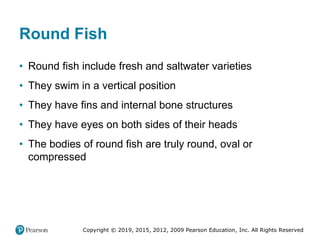
Round Fish
• Round fish include fresh and saltwater varieties
• They swim in a vertical position
• They have fins and internal bone structures
• They have eyes on both sides of their heads
• The bodies of round fish are truly round, oval or
compressed
Copyright © 2019, 2015, 2012, 2009 Pearson Education, Inc. All Rights Reserved
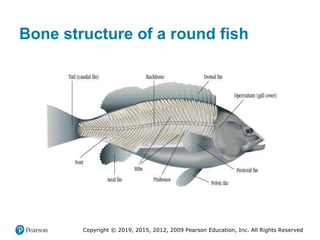
Bone structure of a round fish
Copyright © 2019, 2015, 2012, 2009 Pearson Education, Inc. All Rights Reserved
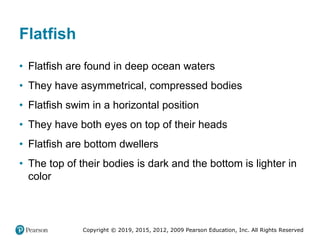
Flatfish
• Flatfish are found in deep ocean waters
• They have asymmetrical, compressed bodies
• Flatfish swim in a horizontal position
• They have both eyes on top of their heads
• Flatfish are bottom dwellers
• The top of their bodies is dark and the bottom is lighter in
color
Copyright © 2019, 2015, 2012, 2009 Pearson Education, Inc. All Rights Reserved
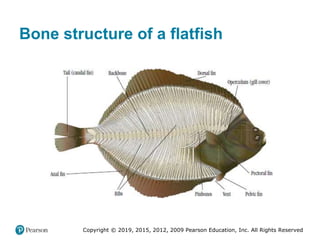
Bone structure of a flatfish
Copyright © 2019, 2015, 2012, 2009 Pearson Education, Inc. All Rights Reserved
Muscle Composition
• Flesh of fish is composed of short muscle fibers.
• Unlike connective tissue in meat, connective tissue in fish
is weak.
• Long cooking times are not required to break down
connective tissue in fish.
• Cooking firms the proteins and enhances the flavor in
fish.
Copyright © 2019, 2015, 2012, 2009 Pearson Education, Inc. All Rights Reserved
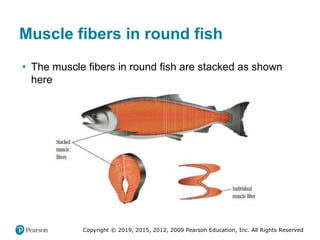
Muscle fibers in round fish
• The muscle fibers in round fish are stacked as shown
here
Copyright © 2019, 2015, 2012, 2009 Pearson Education, Inc. All Rights Reserved
Mollusks
• Mollusks have small unsegmented bodies and no internal
skeleton
• Mollusks fall into two categories.
– Univalves
– Bivalves
Copyright © 2019, 2015, 2012, 2009 Pearson Education, Inc. All Rights Reserved
Univalves
• Univalves are single shell mollusks. They include:
– Marine snails
▪ Abalone
▪ Conch
▪ Snails
Copyright © 2019, 2015, 2012, 2009 Pearson Education, Inc. All Rights Reserved
Bivalves
• Bilvales are mollusks with two bilateral shells. They
include:
– Clams
– Oysters
– Scallops
– Mussels
– Cockles
Copyright © 2019, 2015, 2012, 2009 Pearson Education, Inc. All Rights Reserved
Cephalopods
• Cephalopods are a type of sea creature that has no
exterior shell
• A cephalopod has one single internal shell called a pen
or cuttlebone
– Squid
▪ Calamari, the Italian name for squid, is also used
– Octopus
Copyright © 2019, 2015, 2012, 2009 Pearson Education, Inc. All Rights Reserved
Crustaceans
• Crustaceans are a type of shellfish. They have a hard,
outer shell and jointed appendages
• They are found in both fresh and salt water
• They breathe through gills
– Crayfish
– Crab
– Lobster
– Shrimp
Copyright © 2019, 2015, 2012, 2009 Pearson Education, Inc. All Rights Reserved
Crab
• King
• Dungeness
• Soft-shell
• Blue
• Jonah
• Stone
• King
• Snow
Copyright © 2019, 2015, 2012, 2009 Pearson Education, Inc. All Rights Reserved
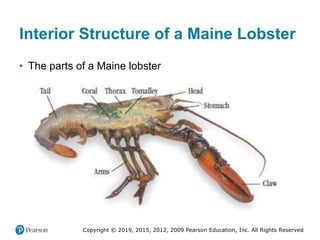
Interior Structure of a Maine Lobster
• The parts of a Maine lobster
Copyright © 2019, 2015, 2012, 2009 Pearson Education, Inc. All Rights Reserved
Inspection and Grading of Fish and
Shellfish
• Grades assigned to fish are A, B, C
• Inspections on fish and shellfish are voluntary.
• There are three types of inspections:
– Type 1 covers the plant, product and processing methods from raw to
final product
▪ Product safe, wholesome, properly labeled, good flavor, produced
under inspection
– Type 2: warehouses, processing plants and cold storage facilities
▪ Product meets specifications – weight labeling and packaging
– Type 3: fishing vessels and plants
▪ Inspection services for sanitation only
Copyright © 2019, 2015, 2012, 2009 Pearson Education, Inc. All Rights Reserved
Determining Freshness in Fish (1 of 2)
Determine the freshness of fish by using these sever
criteria:
• Smell
– Fish should smell of the se or have no odor at all.
• Eyes
– Eyes should be clear and full
• Gills
– Gills should be intact and bright red
• Texture
– The flesh should be firm
Copyright © 2019, 2015, 2012, 2009 Pearson Education, Inc. All Rights Reserved
Determining Freshness in Fish (2 of 2)
• Fins and scales
– The fins and scales should be moist and full with no dry
edges
• Moistness
– Fish cuts should be moist and glistening with no bruises or
dark spots
• Movement
– Shellfish that is purchased alive should show movement
– Lobsters and other crustaceans should be active
– Crustaceans should close their shells when tapped
Copyright © 2019, 2015, 2012, 2009 Pearson Education, Inc. All Rights Reserved
Market Forms of Fish
Fish comes in many forms including the following:
• Whole or round
• Drawn
• Dressed
• Pan-dressed
• Butterflied
• Fillet
• Steak
• Wheel or center-cut
Copyright © 2019, 2015, 2012, 2009 Pearson Education, Inc. All Rights Reserved
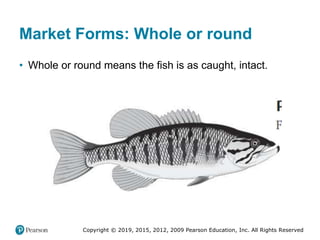
Market Forms: Whole or round
• Whole or round means the fish is as caught, intact.
Copyright © 2019, 2015, 2012, 2009 Pearson Education, Inc. All Rights Reserved
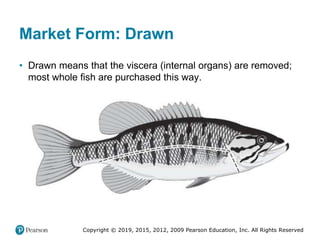
Market Form: Drawn
• Drawn means that the viscera (internal organs) are removed;
most whole fish are purchased this way.
Copyright © 2019, 2015, 2012, 2009 Pearson Education, Inc. All Rights Reserved
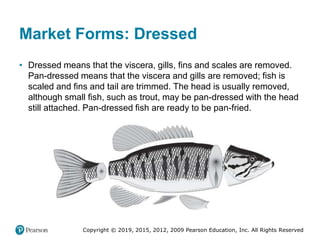
Market Forms: Dressed
• Dressed means that the viscera, gills, fins and scales are removed.
Pan-dressed means that the viscera and gills are removed; fish is
scaled and fins and tail are trimmed. The head is usually removed,
although small fish, such as trout, may be pan-dressed with the head
still attached. Pan-dressed fish are ready to be pan-fried.
Copyright © 2019, 2015, 2012, 2009 Pearson Education, Inc. All Rights Reserved
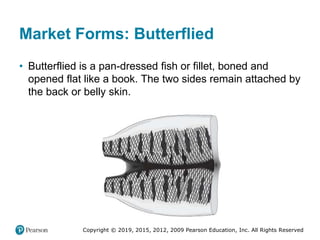
Market Forms: Butterflied
• Butterflied is a pan-dressed fish or fillet, boned and
opened flat like a book. The two sides remain attached by
the back or belly skin.
Copyright © 2019, 2015, 2012, 2009 Pearson Education, Inc. All Rights Reserved
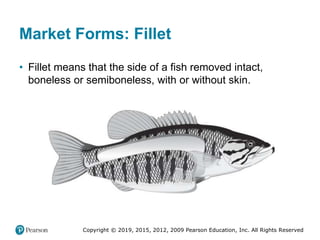
Market Forms: Fillet
• Fillet means that the side of a fish removed intact,
boneless or semiboneless, with or without skin.
Copyright © 2019, 2015, 2012, 2009 Pearson Education, Inc. All Rights Reserved
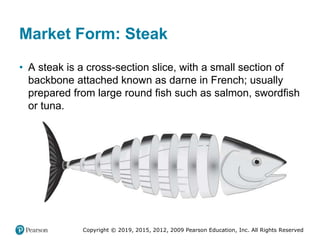
Market Form: Steak
• A steak is a cross-section slice, with a small section of
backbone attached known as darne in French; usually
prepared from large round fish such as salmon, swordfish
or tuna.
Copyright © 2019, 2015, 2012, 2009 Pearson Education, Inc. All Rights Reserved
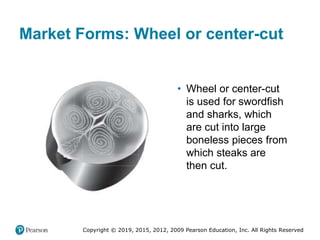
Market Forms: Wheel or center-cut
• Wheel or center-cut
is used for swordfish
and sharks, which
are cut into large
boneless pieces from
which steaks are
then cut.
Copyright © 2019, 2015, 2012, 2009 Pearson Education, Inc. All Rights Reserved
Storing Fresh Fish and Shellfish
• Store fresh fish at temperatures between 30°Fahrenheit and 34°Fahrenheit
• If shipped in ice, store in ice
• Do not allow seafood to become dry
• Scallops and fish fillets should not be in direct contact
with ice
• Live animals should be stored in saltwater tanks or in
boxes with seaweed
• Bivalves should be stored in net bags or boxes at high
humidity
Copyright © 2019, 2015, 2012, 2009 Pearson Education, Inc. All Rights Reserved
Purchasing Terms for Fish and
Shellfish (1 of 2)
There are many purchasing terms used to describe fish
including the following:
• Fresh
– The item is not and has never been frozen
• Chilled
– The item was refrigerated and held at 30°Fahrenheit to 34°Fahrenheit
• Flash-frozen
– The item was rapidly flash frozen at extreme low
temperatures onboard ship, within hours of being
caught
Copyright © 2019, 2015, 2012, 2009 Pearson Education, Inc. All Rights Reserved
Purchasing Terms for Fish and
Shellfish (2 of 2)
• Fresh-frozen
– The item was frozen while fresh, but not as quickly as
flash-frozen
• Frozen
– The item was subjected to temperature below 0°Fahrenheit
• Glazed
– The frozen product was dipped in water to form a
protective shell of ice
• Fancy
– Marketing term used to indicate the product was previously
frozen
Copyright © 2019, 2015, 2012, 2009 Pearson Education, Inc. All Rights Reserved
Sustainable Seafood
• Damaged habitat, overfishing, fishing practices and demand
threaten world fish supplies. Chefs can do a number of things
to help protect fish supplies.
• Work with suppliers committed to sustainable practices
• Fine species of fish that replicate texture of endangered fish
• Serve lesser-known species
• Consult resources to inform seafood sourcing options such as:
– Aquaculture or fish farming
– Purchasing certain types of fish
Copyright © 2019, 2015, 2012, 2009 Pearson Education, Inc. All Rights Reserved
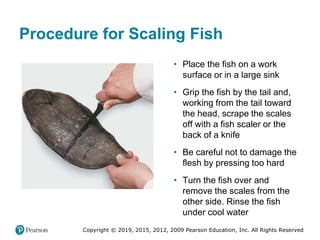
Procedure for Scaling Fish
• Place the fish on a work
surface or in a large sink
• Grip the fish by the tail and,
working from the tail toward
the head, scrape the scales
off with a fish scaler or the
back of a knife
• Be careful not to damage the
flesh by pressing too hard
• Turn the fish over and
remove the scales from the
other side. Rinse the fish
under cool water
Copyright © 2019, 2015, 2012, 2009 Pearson Education, Inc. All Rights Reserved
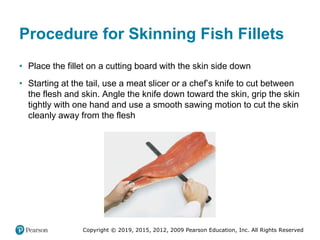
Procedure for Skinning Fish Fillets
• Place the fillet on a cutting board with the skin side down
• Starting at the tail, use a meat slicer or a chef’s knife to cut between
the flesh and skin. Angle the knife down toward the skin, grip the skin
tightly with one hand and use a smooth sawing motion to cut the skin
cleanly away from the flesh
Copyright © 2019, 2015, 2012, 2009 Pearson Education, Inc. All Rights Reserved
Cooking Seafood
• All cooking methods can be used when cooking fish and
shellfish
• Seafood is inherently tender
• It should be cooked until just done
• Overcooking is the most common mistake made in
preparing seafood
Copyright © 2019, 2015, 2012, 2009 Pearson Education, Inc. All Rights Reserved
Determining Doneness
Doneness of fish and shellfish can be determined by the
following:
• Translucent flesh becomes opaque
• Flesh becomes firm
• Flesh separates from the bone easily
• Flesh begins to flake
Copyright © 2019, 2015, 2012, 2009 Pearson Education, Inc. All Rights Reserved
Safety Alert - Serving Raw Fish
• Raw fish such as clams on the half shell, ceviche and
sushi are popular dishes.
• Raw fish and shellfish are require time and temperature
control for safety (TCS).
– Follow Model Food Code for freezing fish before
using to kill harmful parasites
– Observe the strictest sanitation standards
– Know the source of all fish and shellfish
Copyright © 2019, 2015, 2012, 2009 Pearson Education, Inc. All Rights Reserved
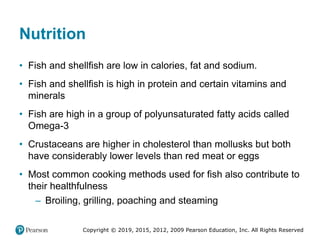
Sushi or Zushi Ingredients
• Fish
– Must be of the highest quality and absolutely fresh
• Rice
– Short-grain rice seasoned with vinegar, salt and sugar
• Seasonings
– Shoyu = Japanese soy sauce
– Wasabi= Sometimes called green horseradish
– Pickled ginger= Fresh ginger pickled in vinegar
• Nori = Dried seaweed purchased in sheets
Copyright © 2019, 2015, 2012, 2009 Pearson Education, Inc. All Rights Reserved
Types of Sushi
• Nigiri zushi
– Rice and raw fish
• Norimaki zushi
– Rice rolled in seaweed
• Fukusa zushi
– Rice wrapped in omelet
• Chirashi
– zushi rice with fish, shellfish and vegetables
Copyright © 2019, 2015, 2012, 2009 Pearson Education, Inc. All Rights Reserved
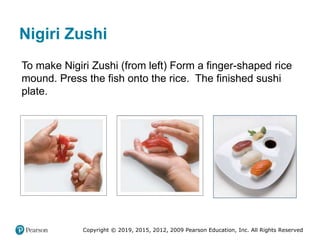
Nigiri Zushi
To make Nigiri Zushi (from left) Form a finger-shaped rice
mound. Press the fish onto the rice. The finished sushi
plate.
Copyright © 2019, 2015, 2012, 2009 Pearson Education, Inc. All Rights Reserved
Safety Alert - Sushi, Sashimi
• Raw fish and cooked rice require time and temperature
control for safety (TCS).
• Observe handling procedures in the Model Food Code
and local heath regulations when preparing and serving
sushi and sashimi
– Freeze fish before serving
– Chill cooked rice to 41°Fahrenheitor lower
Copyright © 2019, 2015, 2012, 2009 Pearson Education, Inc. All Rights Reserved
Nutrition
• Fish and shellfish are low in calories, fat and sodium.
• Fish and shellfish is high in protein and certain vitamins and
minerals
• Fish are high in a group of polyunsaturated fatty acids called
Omega-3
• Crustaceans are higher in cholesterol than mollusks but both
have considerably lower levels than red meat or eggs
• Most common cooking methods used for fish also contribute to
their healthfulness
– Broiling, grilling, poaching and steaming
Copyright © 2019, 2015, 2012, 2009 Pearson Education, Inc. All Rights Reserved
Copyright
This work is protected by United States copyright laws and is
provided solely for the use of instructors in teaching their courses
and assessing student learning. Dissemination or sale of any part
of this work (including on the World Wide Web) will destroy the
integrity of the work and is not permitted. The work and materials
from it should never be made available to students except by
instructors using the accompanying text in their classes. All
recipients of this work are expected to abide by these restrictions
and to honor the intended pedagogical purposes and the needs of
other instructors who rely on these materials.

OnCooking6CH20PPLecture_accessible.pptx

  • 1.
    On Cooking: ATextbook of Culinary Fundamentals Sixth Edition Chapter 20 Fish and Shellfish Copyright © 2019, 2015, 2012, 2009 Pearson Education, Inc. All Rights Reserved
  • 2.
    Copyright © 2019,2015, 2012, 2009 Pearson Education, Inc. All Rights Reserved Learning Objectives (1 of 2) After studying this chapter, you will be able to: 20.1 Explain the structure and composition of fish and shellfish 20.2 Identify a variety of fish and shellfish 20.3 Purchase fish and shellfish appropriate for your needs 20.4 Describe the importance of sustainability and apply it to purchasing fish and shellfish
  • 3.
    Copyright © 2019,2015, 2012, 2009 Pearson Education, Inc. All Rights Reserved Learning Objectives (2 of 2) After studying this unit you will be able to: 20.5 Store fish and shellfish properly 20.6 Fabricate fish and shellfish for cooking 20.7 Explain and apply appropriate cooking methods for different types and cuts of fish and shellfish 20.8 Explain and apply appropriate ways to handle and serve raw fish and shellfish
  • 4.
    Copyright © 2019,2015, 2012, 2009 Pearson Education, Inc. All Rights Reserved Fish and Shellfish • Fish are aquatic vertebrates with fins for swimming and gills for breathing • Shellfish are aquatic invertebrates with shells or carapaces
  • 5.
    Copyright © 2019,2015, 2012, 2009 Pearson Education, Inc. All Rights Reserved Round Fish • Round fish include fresh and saltwater varieties • They swim in a vertical position • They have fins and internal bone structures • They have eyes on both sides of their heads • The bodies of round fish are truly round, oval or compressed
  • 6.
    Copyright © 2019,2015, 2012, 2009 Pearson Education, Inc. All Rights Reserved Bone structure of a round fish
  • 7.
    Copyright © 2019,2015, 2012, 2009 Pearson Education, Inc. All Rights Reserved Flatfish • Flatfish are found in deep ocean waters • They have asymmetrical, compressed bodies • Flatfish swim in a horizontal position • They have both eyes on top of their heads • Flatfish are bottom dwellers • The top of their bodies is dark and the bottom is lighter in color
  • 8.
    Copyright © 2019,2015, 2012, 2009 Pearson Education, Inc. All Rights Reserved Bone structure of a flatfish
  • 9.
    Copyright © 2019,2015, 2012, 2009 Pearson Education, Inc. All Rights Reserved Muscle Composition • Flesh of fish is composed of short muscle fibers. • Unlike connective tissue in meat, connective tissue in fish is weak. • Long cooking times are not required to break down connective tissue in fish. • Cooking firms the proteins and enhances the flavor in fish.
  • 10.
    Copyright © 2019,2015, 2012, 2009 Pearson Education, Inc. All Rights Reserved Muscle fibers in round fish • The muscle fibers in round fish are stacked as shown here
  • 11.
    Copyright © 2019,2015, 2012, 2009 Pearson Education, Inc. All Rights Reserved Mollusks • Mollusks have small unsegmented bodies and no internal skeleton • Mollusks fall into two categories. – Univalves – Bivalves
  • 12.
    Copyright © 2019,2015, 2012, 2009 Pearson Education, Inc. All Rights Reserved Univalves • Univalves are single shell mollusks. They include: – Marine snails ▪ Abalone ▪ Conch ▪ Snails
  • 13.
    Copyright © 2019,2015, 2012, 2009 Pearson Education, Inc. All Rights Reserved Bivalves • Bilvales are mollusks with two bilateral shells. They include: – Clams – Oysters – Scallops – Mussels – Cockles
  • 14.
    Copyright © 2019,2015, 2012, 2009 Pearson Education, Inc. All Rights Reserved Cephalopods • Cephalopods are a type of sea creature that has no exterior shell • A cephalopod has one single internal shell called a pen or cuttlebone – Squid ▪ Calamari, the Italian name for squid, is also used – Octopus
  • 15.
    Copyright © 2019,2015, 2012, 2009 Pearson Education, Inc. All Rights Reserved Crustaceans • Crustaceans are a type of shellfish. They have a hard, outer shell and jointed appendages • They are found in both fresh and salt water • They breathe through gills – Crayfish – Crab – Lobster – Shrimp
  • 16.
    Copyright © 2019,2015, 2012, 2009 Pearson Education, Inc. All Rights Reserved Crab • King • Dungeness • Soft-shell • Blue • Jonah • Stone • King • Snow
  • 17.
    Copyright © 2019,2015, 2012, 2009 Pearson Education, Inc. All Rights Reserved Interior Structure of a Maine Lobster • The parts of a Maine lobster
  • 18.
    Copyright © 2019,2015, 2012, 2009 Pearson Education, Inc. All Rights Reserved Inspection and Grading of Fish and Shellfish • Grades assigned to fish are A, B, C • Inspections on fish and shellfish are voluntary. • There are three types of inspections: – Type 1 covers the plant, product and processing methods from raw to final product ▪ Product safe, wholesome, properly labeled, good flavor, produced under inspection – Type 2: warehouses, processing plants and cold storage facilities ▪ Product meets specifications – weight labeling and packaging – Type 3: fishing vessels and plants ▪ Inspection services for sanitation only
  • 19.
    Copyright © 2019,2015, 2012, 2009 Pearson Education, Inc. All Rights Reserved Determining Freshness in Fish (1 of 2) Determine the freshness of fish by using these sever criteria: • Smell – Fish should smell of the se or have no odor at all. • Eyes – Eyes should be clear and full • Gills – Gills should be intact and bright red • Texture – The flesh should be firm
  • 20.
    Copyright © 2019,2015, 2012, 2009 Pearson Education, Inc. All Rights Reserved Determining Freshness in Fish (2 of 2) • Fins and scales – The fins and scales should be moist and full with no dry edges • Moistness – Fish cuts should be moist and glistening with no bruises or dark spots • Movement – Shellfish that is purchased alive should show movement – Lobsters and other crustaceans should be active – Crustaceans should close their shells when tapped
  • 21.
    Copyright © 2019,2015, 2012, 2009 Pearson Education, Inc. All Rights Reserved Market Forms of Fish Fish comes in many forms including the following: • Whole or round • Drawn • Dressed • Pan-dressed • Butterflied • Fillet • Steak • Wheel or center-cut
  • 22.
    Copyright © 2019,2015, 2012, 2009 Pearson Education, Inc. All Rights Reserved Market Forms: Whole or round • Whole or round means the fish is as caught, intact.
  • 23.
    Copyright © 2019,2015, 2012, 2009 Pearson Education, Inc. All Rights Reserved Market Form: Drawn • Drawn means that the viscera (internal organs) are removed; most whole fish are purchased this way.
  • 24.
    Copyright © 2019,2015, 2012, 2009 Pearson Education, Inc. All Rights Reserved Market Forms: Dressed • Dressed means that the viscera, gills, fins and scales are removed. Pan-dressed means that the viscera and gills are removed; fish is scaled and fins and tail are trimmed. The head is usually removed, although small fish, such as trout, may be pan-dressed with the head still attached. Pan-dressed fish are ready to be pan-fried.
  • 25.
    Copyright © 2019,2015, 2012, 2009 Pearson Education, Inc. All Rights Reserved Market Forms: Butterflied • Butterflied is a pan-dressed fish or fillet, boned and opened flat like a book. The two sides remain attached by the back or belly skin.
  • 26.
    Copyright © 2019,2015, 2012, 2009 Pearson Education, Inc. All Rights Reserved Market Forms: Fillet • Fillet means that the side of a fish removed intact, boneless or semiboneless, with or without skin.
  • 27.
    Copyright © 2019,2015, 2012, 2009 Pearson Education, Inc. All Rights Reserved Market Form: Steak • A steak is a cross-section slice, with a small section of backbone attached known as darne in French; usually prepared from large round fish such as salmon, swordfish or tuna.
  • 28.
    Copyright © 2019,2015, 2012, 2009 Pearson Education, Inc. All Rights Reserved Market Forms: Wheel or center-cut • Wheel or center-cut is used for swordfish and sharks, which are cut into large boneless pieces from which steaks are then cut.
  • 29.
    Copyright © 2019,2015, 2012, 2009 Pearson Education, Inc. All Rights Reserved Storing Fresh Fish and Shellfish • Store fresh fish at temperatures between 30°Fahrenheit and 34°Fahrenheit • If shipped in ice, store in ice • Do not allow seafood to become dry • Scallops and fish fillets should not be in direct contact with ice • Live animals should be stored in saltwater tanks or in boxes with seaweed • Bivalves should be stored in net bags or boxes at high humidity
  • 30.
    Copyright © 2019,2015, 2012, 2009 Pearson Education, Inc. All Rights Reserved Purchasing Terms for Fish and Shellfish (1 of 2) There are many purchasing terms used to describe fish including the following: • Fresh – The item is not and has never been frozen • Chilled – The item was refrigerated and held at 30°Fahrenheit to 34°Fahrenheit • Flash-frozen – The item was rapidly flash frozen at extreme low temperatures onboard ship, within hours of being caught
  • 31.
    Copyright © 2019,2015, 2012, 2009 Pearson Education, Inc. All Rights Reserved Purchasing Terms for Fish and Shellfish (2 of 2) • Fresh-frozen – The item was frozen while fresh, but not as quickly as flash-frozen • Frozen – The item was subjected to temperature below 0°Fahrenheit • Glazed – The frozen product was dipped in water to form a protective shell of ice • Fancy – Marketing term used to indicate the product was previously frozen
  • 32.
    Copyright © 2019,2015, 2012, 2009 Pearson Education, Inc. All Rights Reserved Sustainable Seafood • Damaged habitat, overfishing, fishing practices and demand threaten world fish supplies. Chefs can do a number of things to help protect fish supplies. • Work with suppliers committed to sustainable practices • Fine species of fish that replicate texture of endangered fish • Serve lesser-known species • Consult resources to inform seafood sourcing options such as: – Aquaculture or fish farming – Purchasing certain types of fish
  • 33.
    Copyright © 2019,2015, 2012, 2009 Pearson Education, Inc. All Rights Reserved Procedure for Scaling Fish • Place the fish on a work surface or in a large sink • Grip the fish by the tail and, working from the tail toward the head, scrape the scales off with a fish scaler or the back of a knife • Be careful not to damage the flesh by pressing too hard • Turn the fish over and remove the scales from the other side. Rinse the fish under cool water
  • 34.
    Copyright © 2019,2015, 2012, 2009 Pearson Education, Inc. All Rights Reserved Procedure for Skinning Fish Fillets • Place the fillet on a cutting board with the skin side down • Starting at the tail, use a meat slicer or a chef’s knife to cut between the flesh and skin. Angle the knife down toward the skin, grip the skin tightly with one hand and use a smooth sawing motion to cut the skin cleanly away from the flesh
  • 35.
    Copyright © 2019,2015, 2012, 2009 Pearson Education, Inc. All Rights Reserved Cooking Seafood • All cooking methods can be used when cooking fish and shellfish • Seafood is inherently tender • It should be cooked until just done • Overcooking is the most common mistake made in preparing seafood
  • 36.
    Copyright © 2019,2015, 2012, 2009 Pearson Education, Inc. All Rights Reserved Determining Doneness Doneness of fish and shellfish can be determined by the following: • Translucent flesh becomes opaque • Flesh becomes firm • Flesh separates from the bone easily • Flesh begins to flake
  • 37.
    Copyright © 2019,2015, 2012, 2009 Pearson Education, Inc. All Rights Reserved Safety Alert - Serving Raw Fish • Raw fish such as clams on the half shell, ceviche and sushi are popular dishes. • Raw fish and shellfish are require time and temperature control for safety (TCS). – Follow Model Food Code for freezing fish before using to kill harmful parasites – Observe the strictest sanitation standards – Know the source of all fish and shellfish
  • 38.
    Copyright © 2019,2015, 2012, 2009 Pearson Education, Inc. All Rights Reserved Sushi or Zushi Ingredients • Fish – Must be of the highest quality and absolutely fresh • Rice – Short-grain rice seasoned with vinegar, salt and sugar • Seasonings – Shoyu = Japanese soy sauce – Wasabi= Sometimes called green horseradish – Pickled ginger= Fresh ginger pickled in vinegar • Nori = Dried seaweed purchased in sheets
  • 39.
    Copyright © 2019,2015, 2012, 2009 Pearson Education, Inc. All Rights Reserved Types of Sushi • Nigiri zushi – Rice and raw fish • Norimaki zushi – Rice rolled in seaweed • Fukusa zushi – Rice wrapped in omelet • Chirashi – zushi rice with fish, shellfish and vegetables
  • 40.
    Copyright © 2019,2015, 2012, 2009 Pearson Education, Inc. All Rights Reserved Nigiri Zushi To make Nigiri Zushi (from left) Form a finger-shaped rice mound. Press the fish onto the rice. The finished sushi plate.
  • 41.
    Copyright © 2019,2015, 2012, 2009 Pearson Education, Inc. All Rights Reserved Safety Alert - Sushi, Sashimi • Raw fish and cooked rice require time and temperature control for safety (TCS). • Observe handling procedures in the Model Food Code and local heath regulations when preparing and serving sushi and sashimi – Freeze fish before serving – Chill cooked rice to 41°Fahrenheitor lower
  • 42.
    Copyright © 2019,2015, 2012, 2009 Pearson Education, Inc. All Rights Reserved Nutrition • Fish and shellfish are low in calories, fat and sodium. • Fish and shellfish is high in protein and certain vitamins and minerals • Fish are high in a group of polyunsaturated fatty acids called Omega-3 • Crustaceans are higher in cholesterol than mollusks but both have considerably lower levels than red meat or eggs • Most common cooking methods used for fish also contribute to their healthfulness – Broiling, grilling, poaching and steaming
  • 43.
    Copyright © 2019,2015, 2012, 2009 Pearson Education, Inc. All Rights Reserved Copyright This work is protected by United States copyright laws and is provided solely for the use of instructors in teaching their courses and assessing student learning. Dissemination or sale of any part of this work (including on the World Wide Web) will destroy the integrity of the work and is not permitted. The work and materials from it should never be made available to students except by instructors using the accompanying text in their classes. All recipients of this work are expected to abide by these restrictions and to honor the intended pedagogical purposes and the needs of other instructors who rely on these materials.