Dr Hatem ElBitar
‫البيطار‬ ‫حاتم‬ ‫د‬
‫أستشاري‬‫أسنان‬ ‫وجراح‬
‫المصرية‬ ‫الزمالة‬ ‫زميل‬
‫العدوى‬ ‫ومكافحة‬ ‫المستشفيات‬ ‫ادارة‬ ‫محاضر‬
01005684344
Cancer – Chronic condition
Dietary management of cancer patients
is typically seen during the patients
active treatment phase – weight loss,
anorexia, cachexia, nausea, vomitting
Long term survival- No advice for
patients in terms of diet and lifestyle
similar to cardiac rehab or dietary
management of diabetes
Cancer Survivorship
• 62% 5 year survival over all adult cancers
• 60, 000 cancer survivors (diagnosed in the previous 5 years) in
Ireland
• Increased risk for developing secondary cancers, other chronic
diseases (CVD diabetes)
• Environmental factors such as diet and physical activity
contribute
• Unhealthy behaviours tend to cluster in the population at
large and specifically among cancer survivors
Aziz; J Nutr 2002; 132: 3494S
Major Lifestyle Opportunities for Cancer
Survivors
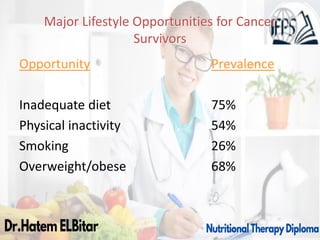
Opportunity Prevalence
Inadequate diet 75%
Physical inactivity 54%
Smoking 26%
Overweight/obese 68%
Lifestyle Interventions in Breast Cancer
Survivors
Randomised Controlled Trials
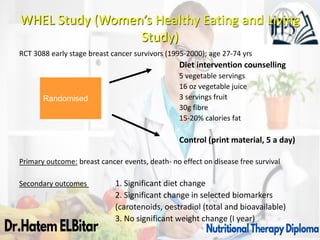
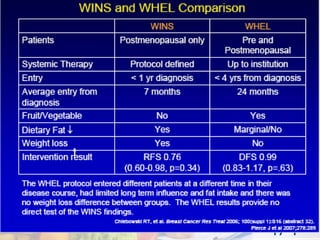
WHEL Study (Women’s Healthy Eating and Living
Study)
RCT 3088 early stage breast cancer survivors (1995-2000); age 27-74 yrs
Diet intervention counselling
5 vegetable servings
16 oz vegetable juice
3 servings fruit
30g fibre
15-20% calories fat
Control (print material, 5 a day)
Primary outcome: breast cancer events, death- no effect on disease free survival
Secondary outcomes 1. Significant diet change
2. Significant change in selected biomarkers
(carotenoids, oestradiol (total and bioavailable)
3. No significant weight change (I year)
Randomised
Women’s healthy Eating and Living
Study (WHEL)
• Among survivors of early stage breast cancer,
adoption of a diet that was very high in vegetables,
fruit, fibre and low in fat did not reduce additional
breast cancer events or mortality during a 7.3 year
follow up period
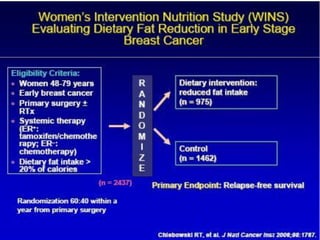
WINS
Risk of Recurrence
low fat diet vs. control
Women’s Intervention Nutrition Study
(WINS)- role of low fat diet
• Lifestyle intervention reducing dietary fat
intake (target 20% E), with modest influence
on body weight, may improve relapse-free
survival of breast cancer
• 24% reduction in risk for recurrence; subset
analyses suggest that this effect was even
greater among women with oestrogen
receptor-negative disease
Chlebowski et al, 2006, J Natl Cancer Inst 98(24):1767-76.
Prospective Cohort Studies
1. Healthy Eating Activity and Lifestyle (HEAL) study (USA
multicentre) n = 1182
2. Life after Cancer Epidemiology (LACE) USA multicentre n=2321
3. Shanghai Breast Cancer Survivors Study n= 5000
4. Pathways Northern California n= 4000
5. DietCompLyf Study –UK multicentre n= 3000
Weight management and Breast
Cancer Survival
0
0.2
0.4
0.6
0.8
1
1.2
1.4
1.6
1.8
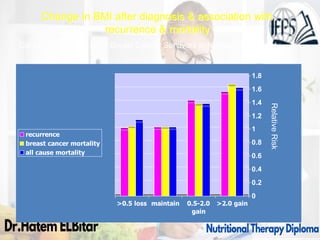
>0.5 loss maintain 0.5-2.0
gain
>2.0 gain
recurrence
breast cancer mortality
all cause mortality
Change in BMI after diagnosis & association with
recurrence & mortality
Data from cohort of 5204 Breast Cancer Survivors in Nurses Health Study
RelativeRisk
Physical Activity and Breast
cancer survival
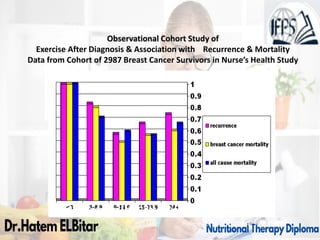
Observational Cohort Study of
Exercise After Diagnosis & Association with Recurrence & Mortality
Data from Cohort of 2987 Breast Cancer Survivors in Nurse’s Health Study
Holmes et al. JCO 20:2479-86, 2005
RelativeRisk
Level of Exercise (MET hrs/week)
Ongoing work - Cancer Survivors
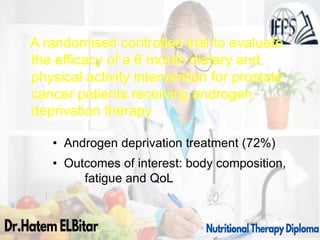
A randomised controlled trial to evaluate
the efficacy of a 6 month dietary and
physical activity intervention for prostate
cancer patients receiving androgen
deprivation therapy
• Androgen deprivation treatment (72%)
• Outcomes of interest: body composition,
fatigue and QoL
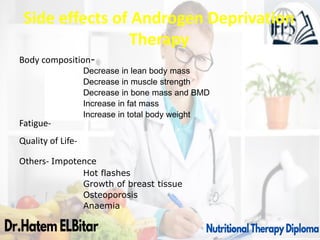
Side effects of Androgen Deprivation
Therapy
Body composition-
Decrease in lean body mass
Decrease in muscle strength
Decrease in bone mass and BMD
Increase in fat mass
Increase in total body weight
Fatigue-
Quality of Life-
Others- Impotence
Hot flashes
Growth of breast tissue
Osteoporosis
Anaemia
Ongoing Research
DietCompLyf study - Role of diet, lifestyle and
complementary therapies on breast cancer survival
study
Prospective Cohort Study:
50 centres
3000 breast cancer patients
Collected FFQ, Food Diaries, Serum, Urine
1. Change in food /nutrient intake after breast cancer
diagnosis – Louiza Valentzis
2. Dietary patterns and breast cancer survival and
quality of life in a cohort of breast cancer survivors-
Sarah Brennan, Marice Lunny
Conclusions
• Adjuvant treatments for breast cancer lowers
disease mortality 25-40%
• Weight maintenance after breast cancer may
lower disease mortality ∼ 40%
• Moderate exercise after breast cancer may
lower disease mortality ∼ 40-50%
Conclusions
• Advising weight maintenance and exercise after breast cancer may help
our patients as much as standard treatments
• Important in our sedentary & obesigenic environment.
• Diagnosis of cancer –”Teachable moment”
• Often demonstrate an enhanced motivation to change their lifestyle
behaviours
• Interventions that address multiple risk factors such as diet and physical
activity in more diverse populations and for other cancer sites, are
required
Thank you for your attention
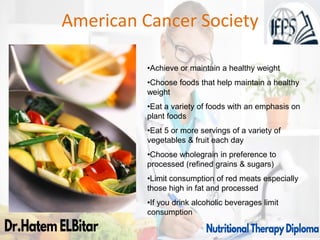
American Cancer Society
•Achieve or maintain a healthy weight
•Choose foods that help maintain a healthy
weight
•Eat a variety of foods with an emphasis on
plant foods
•Eat 5 or more servings of a variety of
vegetables & fruit each day
•Choose wholegrain in preference to
processed (refined grains & sugars)
•Limit consumption of red meats especially
those high in fat and processed
•If you drink alcoholic beverages limit
consumption
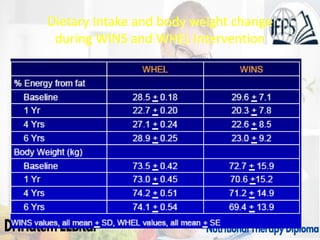
Dietary Intake and body weight change
during WINS and WHEL Intervention
• Dr Hatem ElBitar
• ‫البيطار‬ ‫حاتم‬ ‫د‬
• ‫أستشاري‬‫أسنان‬ ‫وجراح‬
• ‫المصرية‬ ‫الزمالة‬ ‫زميل‬
• ‫العدوى‬ ‫ومكافحة‬ ‫المستشفيات‬ ‫ادارة‬ ‫محاضر‬
• 01005684344
Oncology دحاتم البيطار

Oncology دحاتم البيطار

  • 1.
    Dr Hatem ElBitar ‫البيطار‬‫حاتم‬ ‫د‬ ‫أستشاري‬‫أسنان‬ ‫وجراح‬ ‫المصرية‬ ‫الزمالة‬ ‫زميل‬ ‫العدوى‬ ‫ومكافحة‬ ‫المستشفيات‬ ‫ادارة‬ ‫محاضر‬ 01005684344
  • 2.
    Cancer – Chroniccondition Dietary management of cancer patients is typically seen during the patients active treatment phase – weight loss, anorexia, cachexia, nausea, vomitting Long term survival- No advice for patients in terms of diet and lifestyle similar to cardiac rehab or dietary management of diabetes
  • 3.
    Cancer Survivorship • 62%5 year survival over all adult cancers • 60, 000 cancer survivors (diagnosed in the previous 5 years) in Ireland • Increased risk for developing secondary cancers, other chronic diseases (CVD diabetes) • Environmental factors such as diet and physical activity contribute • Unhealthy behaviours tend to cluster in the population at large and specifically among cancer survivors Aziz; J Nutr 2002; 132: 3494S
  • 4.
    Major Lifestyle Opportunitiesfor Cancer Survivors Opportunity Prevalence Inadequate diet 75% Physical inactivity 54% Smoking 26% Overweight/obese 68%
  • 5.
    Lifestyle Interventions inBreast Cancer Survivors Randomised Controlled Trials
  • 6.
    WHEL Study (Women’sHealthy Eating and Living Study) RCT 3088 early stage breast cancer survivors (1995-2000); age 27-74 yrs Diet intervention counselling 5 vegetable servings 16 oz vegetable juice 3 servings fruit 30g fibre 15-20% calories fat Control (print material, 5 a day) Primary outcome: breast cancer events, death- no effect on disease free survival Secondary outcomes 1. Significant diet change 2. Significant change in selected biomarkers (carotenoids, oestradiol (total and bioavailable) 3. No significant weight change (I year) Randomised
  • 7.
    Women’s healthy Eatingand Living Study (WHEL) • Among survivors of early stage breast cancer, adoption of a diet that was very high in vegetables, fruit, fibre and low in fat did not reduce additional breast cancer events or mortality during a 7.3 year follow up period
  • 9.
    WINS Risk of Recurrence lowfat diet vs. control
  • 10.
    Women’s Intervention NutritionStudy (WINS)- role of low fat diet • Lifestyle intervention reducing dietary fat intake (target 20% E), with modest influence on body weight, may improve relapse-free survival of breast cancer • 24% reduction in risk for recurrence; subset analyses suggest that this effect was even greater among women with oestrogen receptor-negative disease Chlebowski et al, 2006, J Natl Cancer Inst 98(24):1767-76.
  • 11.
  • 12.
    Prospective Cohort Studies 1.Healthy Eating Activity and Lifestyle (HEAL) study (USA multicentre) n = 1182 2. Life after Cancer Epidemiology (LACE) USA multicentre n=2321 3. Shanghai Breast Cancer Survivors Study n= 5000 4. Pathways Northern California n= 4000 5. DietCompLyf Study –UK multicentre n= 3000
  • 13.
    Weight management andBreast Cancer Survival
  • 14.
    0 0.2 0.4 0.6 0.8 1 1.2 1.4 1.6 1.8 >0.5 loss maintain0.5-2.0 gain >2.0 gain recurrence breast cancer mortality all cause mortality Change in BMI after diagnosis & association with recurrence & mortality Data from cohort of 5204 Breast Cancer Survivors in Nurses Health Study RelativeRisk
  • 15.
    Physical Activity andBreast cancer survival
  • 16.
    Observational Cohort Studyof Exercise After Diagnosis & Association with Recurrence & Mortality Data from Cohort of 2987 Breast Cancer Survivors in Nurse’s Health Study Holmes et al. JCO 20:2479-86, 2005 RelativeRisk Level of Exercise (MET hrs/week)
  • 17.
    Ongoing work -Cancer Survivors
  • 18.
    A randomised controlledtrial to evaluate the efficacy of a 6 month dietary and physical activity intervention for prostate cancer patients receiving androgen deprivation therapy • Androgen deprivation treatment (72%) • Outcomes of interest: body composition, fatigue and QoL
  • 19.
    Side effects ofAndrogen Deprivation Therapy Body composition- Decrease in lean body mass Decrease in muscle strength Decrease in bone mass and BMD Increase in fat mass Increase in total body weight Fatigue- Quality of Life- Others- Impotence Hot flashes Growth of breast tissue Osteoporosis Anaemia
  • 20.
    Ongoing Research DietCompLyf study- Role of diet, lifestyle and complementary therapies on breast cancer survival study Prospective Cohort Study: 50 centres 3000 breast cancer patients Collected FFQ, Food Diaries, Serum, Urine
  • 21.
    1. Change infood /nutrient intake after breast cancer diagnosis – Louiza Valentzis 2. Dietary patterns and breast cancer survival and quality of life in a cohort of breast cancer survivors- Sarah Brennan, Marice Lunny
  • 22.
    Conclusions • Adjuvant treatmentsfor breast cancer lowers disease mortality 25-40% • Weight maintenance after breast cancer may lower disease mortality ∼ 40% • Moderate exercise after breast cancer may lower disease mortality ∼ 40-50%
  • 23.
    Conclusions • Advising weightmaintenance and exercise after breast cancer may help our patients as much as standard treatments • Important in our sedentary & obesigenic environment. • Diagnosis of cancer –”Teachable moment” • Often demonstrate an enhanced motivation to change their lifestyle behaviours • Interventions that address multiple risk factors such as diet and physical activity in more diverse populations and for other cancer sites, are required
  • 24.
    Thank you foryour attention
  • 25.
    American Cancer Society •Achieveor maintain a healthy weight •Choose foods that help maintain a healthy weight •Eat a variety of foods with an emphasis on plant foods •Eat 5 or more servings of a variety of vegetables & fruit each day •Choose wholegrain in preference to processed (refined grains & sugars) •Limit consumption of red meats especially those high in fat and processed •If you drink alcoholic beverages limit consumption
  • 27.
    Dietary Intake andbody weight change during WINS and WHEL Intervention
  • 28.
    • Dr HatemElBitar • ‫البيطار‬ ‫حاتم‬ ‫د‬ • ‫أستشاري‬‫أسنان‬ ‫وجراح‬ • ‫المصرية‬ ‫الزمالة‬ ‫زميل‬ • ‫العدوى‬ ‫ومكافحة‬ ‫المستشفيات‬ ‫ادارة‬ ‫محاضر‬ • 01005684344