www.duanemorris.com
©2010 Duane Morris LLP. All Rights Reserved. Duane Morris is a registered service mark of Duane Morris LLP.
Duane Morris – Firm and Affiliate Offices | New York | London | Singapore | Los Angeles | Chicago | Houston | Hanoi | Philadelphia | San Diego | San Francisco | Baltimore | Boston | Washington, D.C.
Las Vegas | Atlanta | Miami | Pittsburgh | Newark | Boca Raton | Wilmington | Cherry Hill | Princeton | Lake Tahoe | Ho Chi Minh City | Duane Morris LLP – A Delaware limited liability partnership
OLIVER MASSMANN – PARTNER
DUANE MORRIS VIETNAM LLC
Overview of Transacting Business
in Vietnam
1
www.duanemorris.com
Agenda:
2
• Basic Regulatory Background
• How to Access the Market
• Transacting in Mining Business
• Case study and Recommendation
www.duanemorris.com
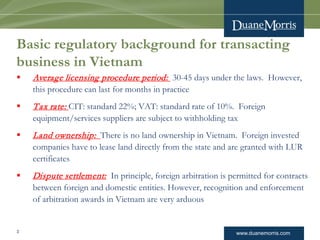
Basic regulatory background for transacting
business in Vietnam
 Average licensing procedure period: 30-45 days under the laws. However,
this procedure can last for months in practice
 Tax rate: CIT: standard 22%; VAT: standard rate of 10%. Foreign
equipment/services suppliers are subject to withholding tax
 Land ownership: There is no land ownership in Vietnam. Foreign invested
companies have to lease land directly from the state and are granted with LUR
certificates
 Dispute settlement: In principle, foreign arbitration is permitted for contracts
between foreign and domestic entities. However, recognition and enforcement
of arbitration awards in Vietnam are very arduous
3
www.duanemorris.com
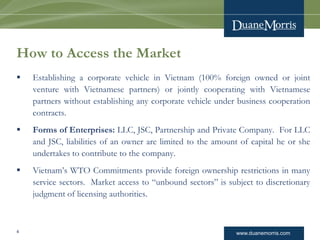
How to Access the Market
 Establishing a corporate vehicle in Vietnam (100% foreign owned or joint
venture with Vietnamese partners) or jointly cooperating with Vietnamese
partners without establishing any corporate vehicle under business cooperation
contracts.
 Forms of Enterprises: LLC, JSC, Partnership and Private Company. For LLC
and JSC, liabilities of an owner are limited to the amount of capital he or she
undertakes to contribute to the company.
 Vietnam’s WTO Commitments provide foreign ownership restrictions in many
service sectors. Market access to “unbound sectors” is subject to discretionary
judgment of licensing authorities.
4
www.duanemorris.com
Transacting in Mining Business
 Vietnam’s WTO Commitments on Minerals Sector:
• Vietnam committed to opening its market for services incidental to
mining (CPC 883) subject to conditions and exemption
• Conditions and exemption:
 Not cover activities such as supply of equipment, materials and chemicals, supply base
services, offshore/marine support vessels, accommodation, catering or helicopter
services
 Without prejudice to the rights of the Government: the necessary regulations and
procedures regarding the regulation of oil and gas related activities in the territory and
jurisdiction of Vietnam are in full conformity with the rights and obligations of
Vietnam under the General Agreement on Trade in Services
 Foreign enterprises without a commercial presence may be required to register with
the competent authority
 Under the applicable mineral law:
• No access and capital limitation on foreign investor. The foreign firm may
apply for 100% owned capital project.
• But the foreign investor must satisfy with the licensing requirements!!!
5
www.duanemorris.com
Transacting in Mining Business
 General Criteria for Foreign Investors:
• Enterprises with foreign owned capital which have been
granted:
 investment certificates by the competent Investment Certificate
Issuance Authority; and
 mineral licenses by the competent Mineral License Issuance
Authority
may actively explore for minerals, mine and process minerals
based on the specific rights granted to them in the relevant
licenses
• Foreign enterprises which have established representative
offices or branches in Vietnam and have obtained the
appropriate mineral license may explore for minerals
6
www.duanemorris.com
Transacting in Mining Business
• Licensing requirements:
 Investment certificate (IC):
 Before issuing IC, the licensing authority must obtain the written
opinion of the relevant mining management authorities
 The investment project for mineral exploration and mining must
comply with the Master plan (if not yet concluded a Master Plan,
it is required an in-principal approval issued by the Prime
Minister) and ensure the compliance with the relevant
environmental protection laws
 Licenses: Under the mining laws, two separate licenses
must be obtained for each activity undertaken during a
commercial scale mining project:
 Exploration license
 Mining license
7
www.duanemorris.com
Transacting in Mining Business
 Exploration license:
• Required for exploration activities in areas not already subject
to any other licenses issued by the MONRE
• The land area is granted for exploration in the license
depending on the minerals involved and location of the site
• The exploration license is exclusive in respect of the granted
area and is transferable under certain conditions: the issuance
conditions, receipt of issuer approval and payment of
assignment tax.
But, the Mineral Law cancelled the inheritance right of an
individual over the exploration license
• Term of exploration license : 48 months, possibly extended for
further 48 months
8
www.duanemorris.com
Transacting in Mining Business
 Mining license:
 The Mining license is issued at the same time as, or subsequent to, the IC
issue
 The license duration is determined on the basis of the feasibility study
submitted in the IC application dossier, but cannot exceed 30 years, possibly
extended for several time.
 Conditions for transfer of Mining license:
 The mine has been constructed and put into operation;
 The assignee is eligible to be the mining license holder as required in the
Mineral Law; and
 the licensing authority for the transferred mining license has approved the
terms and conditions of transfer.
 Mineral export: The laws does not have any restriction but the Master
plan provides the restriction on the export of certain minerals pursuant to
that plan. Under Directive 02/2012 of the Prime Minister, export of raw
minerals are now strictly prohibited
9
www.duanemorris.com
Transacting in Mining Business
 Regulatory requirements:
• Requirements for approval:
 an environmental impact assessment report under the Law on
Environmental Protection, or for exploration activities, the
registration of a Commitment of Environmental Protection
 the change of use of land where land designated for ‘forest’ use is
involved
 the lease of land from the State or the transfer of land rights from
other economic organisations, family households or individuals
The mining company will also need to apply for a change in the
designated use of the land if the land use is designated for other
purpose, not for ‘non agricultural production and business’
10
www.duanemorris.com
Case study in Mining sector
• Background Information:
 Company A, a foreign company, has 02 local subsidiaries (the
“Subsidiaries”) investing in mining sector (i.e. – exploiting and
exporting precious metal) to European market
 Under Vietnamese tax law, precious metal at a specific purity level or
higher enjoys preferential export duty rate. The Subsidiaries must
provide evidence for purity level of its products for the tax purposes.
Testing has been done by a State body
 Testing certificate is shown to tax authority and the Subsidiaries have
been entitled to preferential rate for a long period of time without any
questions by tax authority
11
www.duanemorris.com
Case study in Mining sector
• Background Information:
 On a beautiful day, the tax authority organized an inspection of the
Subsidiaries’ operations and found documents by an offshore
assessment body that purity level is not reached
 The Subsidiary challenged validity of these documents by asserting
that its testing method not provided by Vietnamese law and that
body itself is not licensed to operate in Vietnam
 Despite this tax authority still imposes normal tax rate on the
ground that the Subsidiary’s wrong declaration of exported precious
metal content to enjoy 0% export duty rate”
12
www.duanemorris.com
Case study in Mining sector
• Duane Morris’ Comments
 Legal framework of Vietnam is still in its infancy and is unclear on
key aspects of society. Laws can be therefore interpreted at
discretion of specific State bodies or in-charge persons
 It is not easy to claim liabilities of other related parties including the
testing body as risks are solely shifted to the exporter
 Company’s operations are easily exposed to unexpected risks if a tax
authority/a relevant State body happen to “identify” something
“unusual” relating to its past performance
13
www.duanemorris.com
Case study in Mining sector
• Valuable Lessons: It is never too late to be what you
might have been!
 Work closely with legal counsels to identify possible risks and work out solutions to
deal with the same BEFORE officially carrying out an activity which is possibly
involved with legal issues.
In this particular case, it is utmost important to inspect capacity of the testing body
and validity of certificates they issue before engaging it
 “Don’t ever let the grass grow under your feet”. This mean do not wait until you see
the official decisions of State bodies.
It will be too late then. It is essential to pre-empt any attempts to make your case
officially and more seriously publically
 If official decisions are issued, don’t be panic and should not quickly accept
“compromises” by tax authority (i.e. - they normally offer delay of tax payment in
exchange for victims’ agreement with their decisions). Challenge their decisions to
its end including a possibility that the dispute ends up at a court
14
www.duanemorris.com
Case study in Mining sector
• Valuable Lessons:
– Have well-drafted contracts with third parties including the processors and/or the
testing bodies at the first place so that you will have a good legal/contractual
position to request for reimbursements later on
– Be actively involve foreign bodies especially the embassies and business associations
in order to exert political pressures on these bodies
– Without prejudice to the preceding, please be ready to show your hands to a good
offer made by the Government of Vietnam. As a matter of practice, the Ministry of
Finance has many flexible ways to effectively “neutralize” decisions of [local and
central] tax authorities (e.g. – via an official letter of the Government’s Office that
no tax would be collected). While the tax decision is not officially revoked and its
validity remains unaffected, additional taxes will never be imposed in practice
– Put every benefit you are entitled to your subsidiary’s investment certificate. Laws
can be changed in future but the Government in fact does not retroactively revoke
your existing incentives
15
www.duanemorris.com
DUANE MORRIS VIETNAM LLC
Thank you!
Duane Morris Vietnam LLC Duane Morris Vietnam LLC
Pacific Place, Unit V1307/08, 13th Floor, Suite 1503/04, Saigon Tower
83B Ly Thuong Kiet, Hoan Kiem District 29 Le Duan Street, District 1
Hanoi, Vietnam Ho Chi Minh City, Vietnam
Tel.: +84 4 39462200 Tel.: +84 8 3824 0240
Fax: +84 4 3946 1311 Fax: +84 8 3824 0241
Contact email:
omassmann@duanemorris.com
16

Overview of Transacting Business in Vietnam

  • 1.
    www.duanemorris.com ©2010 Duane MorrisLLP. All Rights Reserved. Duane Morris is a registered service mark of Duane Morris LLP. Duane Morris – Firm and Affiliate Offices | New York | London | Singapore | Los Angeles | Chicago | Houston | Hanoi | Philadelphia | San Diego | San Francisco | Baltimore | Boston | Washington, D.C. Las Vegas | Atlanta | Miami | Pittsburgh | Newark | Boca Raton | Wilmington | Cherry Hill | Princeton | Lake Tahoe | Ho Chi Minh City | Duane Morris LLP – A Delaware limited liability partnership OLIVER MASSMANN – PARTNER DUANE MORRIS VIETNAM LLC Overview of Transacting Business in Vietnam 1
  • 2.
    www.duanemorris.com Agenda: 2 • Basic RegulatoryBackground • How to Access the Market • Transacting in Mining Business • Case study and Recommendation
  • 3.
    www.duanemorris.com Basic regulatory backgroundfor transacting business in Vietnam  Average licensing procedure period: 30-45 days under the laws. However, this procedure can last for months in practice  Tax rate: CIT: standard 22%; VAT: standard rate of 10%. Foreign equipment/services suppliers are subject to withholding tax  Land ownership: There is no land ownership in Vietnam. Foreign invested companies have to lease land directly from the state and are granted with LUR certificates  Dispute settlement: In principle, foreign arbitration is permitted for contracts between foreign and domestic entities. However, recognition and enforcement of arbitration awards in Vietnam are very arduous 3
  • 4.
    www.duanemorris.com How to Accessthe Market  Establishing a corporate vehicle in Vietnam (100% foreign owned or joint venture with Vietnamese partners) or jointly cooperating with Vietnamese partners without establishing any corporate vehicle under business cooperation contracts.  Forms of Enterprises: LLC, JSC, Partnership and Private Company. For LLC and JSC, liabilities of an owner are limited to the amount of capital he or she undertakes to contribute to the company.  Vietnam’s WTO Commitments provide foreign ownership restrictions in many service sectors. Market access to “unbound sectors” is subject to discretionary judgment of licensing authorities. 4
  • 5.
    www.duanemorris.com Transacting in MiningBusiness  Vietnam’s WTO Commitments on Minerals Sector: • Vietnam committed to opening its market for services incidental to mining (CPC 883) subject to conditions and exemption • Conditions and exemption:  Not cover activities such as supply of equipment, materials and chemicals, supply base services, offshore/marine support vessels, accommodation, catering or helicopter services  Without prejudice to the rights of the Government: the necessary regulations and procedures regarding the regulation of oil and gas related activities in the territory and jurisdiction of Vietnam are in full conformity with the rights and obligations of Vietnam under the General Agreement on Trade in Services  Foreign enterprises without a commercial presence may be required to register with the competent authority  Under the applicable mineral law: • No access and capital limitation on foreign investor. The foreign firm may apply for 100% owned capital project. • But the foreign investor must satisfy with the licensing requirements!!! 5
  • 6.
    www.duanemorris.com Transacting in MiningBusiness  General Criteria for Foreign Investors: • Enterprises with foreign owned capital which have been granted:  investment certificates by the competent Investment Certificate Issuance Authority; and  mineral licenses by the competent Mineral License Issuance Authority may actively explore for minerals, mine and process minerals based on the specific rights granted to them in the relevant licenses • Foreign enterprises which have established representative offices or branches in Vietnam and have obtained the appropriate mineral license may explore for minerals 6
  • 7.
    www.duanemorris.com Transacting in MiningBusiness • Licensing requirements:  Investment certificate (IC):  Before issuing IC, the licensing authority must obtain the written opinion of the relevant mining management authorities  The investment project for mineral exploration and mining must comply with the Master plan (if not yet concluded a Master Plan, it is required an in-principal approval issued by the Prime Minister) and ensure the compliance with the relevant environmental protection laws  Licenses: Under the mining laws, two separate licenses must be obtained for each activity undertaken during a commercial scale mining project:  Exploration license  Mining license 7
  • 8.
    www.duanemorris.com Transacting in MiningBusiness  Exploration license: • Required for exploration activities in areas not already subject to any other licenses issued by the MONRE • The land area is granted for exploration in the license depending on the minerals involved and location of the site • The exploration license is exclusive in respect of the granted area and is transferable under certain conditions: the issuance conditions, receipt of issuer approval and payment of assignment tax. But, the Mineral Law cancelled the inheritance right of an individual over the exploration license • Term of exploration license : 48 months, possibly extended for further 48 months 8
  • 9.
    www.duanemorris.com Transacting in MiningBusiness  Mining license:  The Mining license is issued at the same time as, or subsequent to, the IC issue  The license duration is determined on the basis of the feasibility study submitted in the IC application dossier, but cannot exceed 30 years, possibly extended for several time.  Conditions for transfer of Mining license:  The mine has been constructed and put into operation;  The assignee is eligible to be the mining license holder as required in the Mineral Law; and  the licensing authority for the transferred mining license has approved the terms and conditions of transfer.  Mineral export: The laws does not have any restriction but the Master plan provides the restriction on the export of certain minerals pursuant to that plan. Under Directive 02/2012 of the Prime Minister, export of raw minerals are now strictly prohibited 9
  • 10.
    www.duanemorris.com Transacting in MiningBusiness  Regulatory requirements: • Requirements for approval:  an environmental impact assessment report under the Law on Environmental Protection, or for exploration activities, the registration of a Commitment of Environmental Protection  the change of use of land where land designated for ‘forest’ use is involved  the lease of land from the State or the transfer of land rights from other economic organisations, family households or individuals The mining company will also need to apply for a change in the designated use of the land if the land use is designated for other purpose, not for ‘non agricultural production and business’ 10
  • 11.
    www.duanemorris.com Case study inMining sector • Background Information:  Company A, a foreign company, has 02 local subsidiaries (the “Subsidiaries”) investing in mining sector (i.e. – exploiting and exporting precious metal) to European market  Under Vietnamese tax law, precious metal at a specific purity level or higher enjoys preferential export duty rate. The Subsidiaries must provide evidence for purity level of its products for the tax purposes. Testing has been done by a State body  Testing certificate is shown to tax authority and the Subsidiaries have been entitled to preferential rate for a long period of time without any questions by tax authority 11
  • 12.
    www.duanemorris.com Case study inMining sector • Background Information:  On a beautiful day, the tax authority organized an inspection of the Subsidiaries’ operations and found documents by an offshore assessment body that purity level is not reached  The Subsidiary challenged validity of these documents by asserting that its testing method not provided by Vietnamese law and that body itself is not licensed to operate in Vietnam  Despite this tax authority still imposes normal tax rate on the ground that the Subsidiary’s wrong declaration of exported precious metal content to enjoy 0% export duty rate” 12
  • 13.
    www.duanemorris.com Case study inMining sector • Duane Morris’ Comments  Legal framework of Vietnam is still in its infancy and is unclear on key aspects of society. Laws can be therefore interpreted at discretion of specific State bodies or in-charge persons  It is not easy to claim liabilities of other related parties including the testing body as risks are solely shifted to the exporter  Company’s operations are easily exposed to unexpected risks if a tax authority/a relevant State body happen to “identify” something “unusual” relating to its past performance 13
  • 14.
    www.duanemorris.com Case study inMining sector • Valuable Lessons: It is never too late to be what you might have been!  Work closely with legal counsels to identify possible risks and work out solutions to deal with the same BEFORE officially carrying out an activity which is possibly involved with legal issues. In this particular case, it is utmost important to inspect capacity of the testing body and validity of certificates they issue before engaging it  “Don’t ever let the grass grow under your feet”. This mean do not wait until you see the official decisions of State bodies. It will be too late then. It is essential to pre-empt any attempts to make your case officially and more seriously publically  If official decisions are issued, don’t be panic and should not quickly accept “compromises” by tax authority (i.e. - they normally offer delay of tax payment in exchange for victims’ agreement with their decisions). Challenge their decisions to its end including a possibility that the dispute ends up at a court 14
  • 15.
    www.duanemorris.com Case study inMining sector • Valuable Lessons: – Have well-drafted contracts with third parties including the processors and/or the testing bodies at the first place so that you will have a good legal/contractual position to request for reimbursements later on – Be actively involve foreign bodies especially the embassies and business associations in order to exert political pressures on these bodies – Without prejudice to the preceding, please be ready to show your hands to a good offer made by the Government of Vietnam. As a matter of practice, the Ministry of Finance has many flexible ways to effectively “neutralize” decisions of [local and central] tax authorities (e.g. – via an official letter of the Government’s Office that no tax would be collected). While the tax decision is not officially revoked and its validity remains unaffected, additional taxes will never be imposed in practice – Put every benefit you are entitled to your subsidiary’s investment certificate. Laws can be changed in future but the Government in fact does not retroactively revoke your existing incentives 15
  • 16.
    www.duanemorris.com DUANE MORRIS VIETNAMLLC Thank you! Duane Morris Vietnam LLC Duane Morris Vietnam LLC Pacific Place, Unit V1307/08, 13th Floor, Suite 1503/04, Saigon Tower 83B Ly Thuong Kiet, Hoan Kiem District 29 Le Duan Street, District 1 Hanoi, Vietnam Ho Chi Minh City, Vietnam Tel.: +84 4 39462200 Tel.: +84 8 3824 0240 Fax: +84 4 3946 1311 Fax: +84 8 3824 0241 Contact email: omassmann@duanemorris.com 16